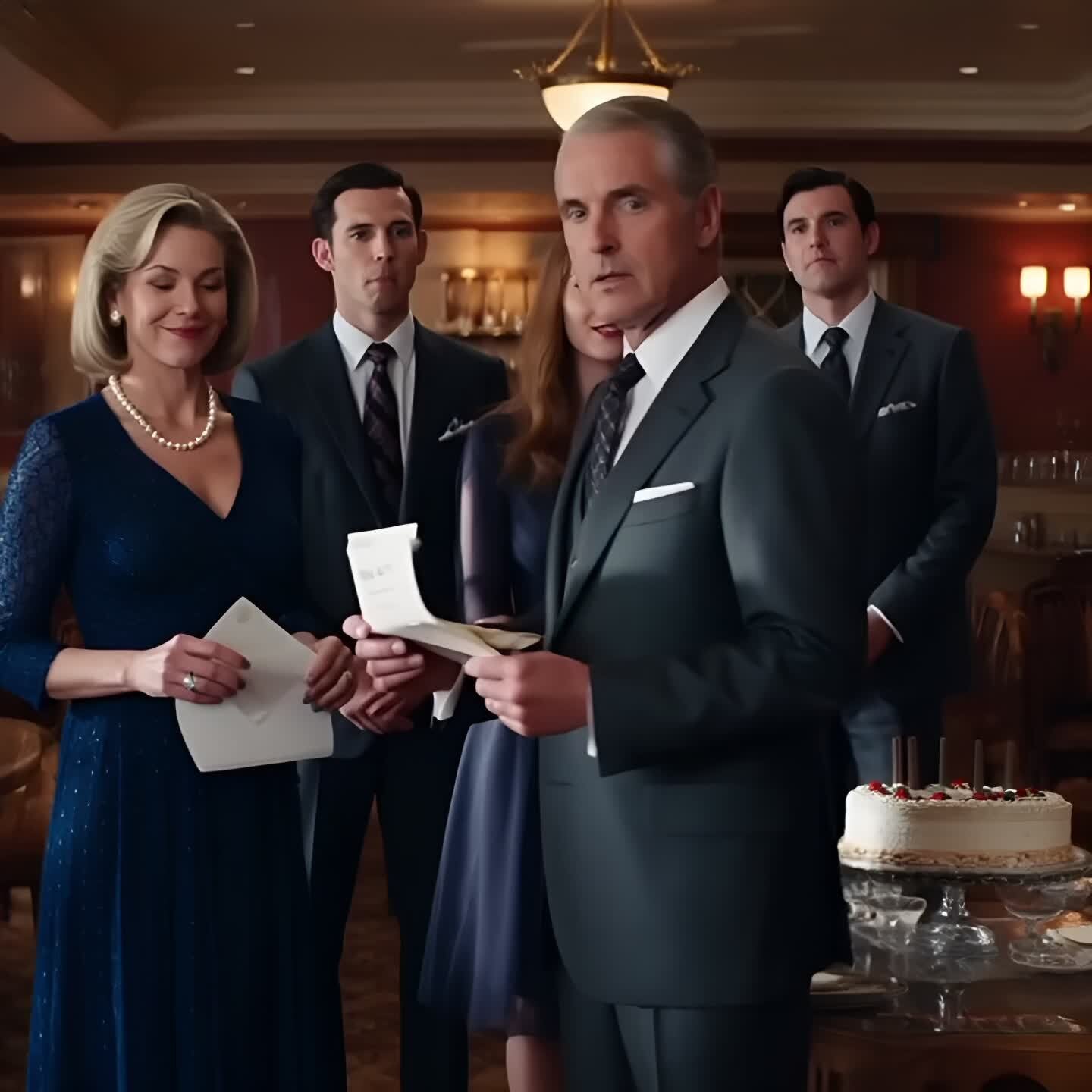
The air in the banquet hall of a mid-range hotel outside Hartford was thick with the smell of stale perfume and ambitious greed. It was supposed to be a celebration of 40 years of service as the chief financial officer for a logistics firm that ran distribution centers from New Jersey to Illinois, but the guest list told a different story.
My colleagues were not there. My old friends from the firm were missing. Instead, the room was filled with my wife Catherine’s country club friends from our Connecticut town, my son Brandon’s entourage of failed “entrepreneurs,” and my daughter Rachel’s social media followers who were currently live-streaming my humiliation to a few hundred thousand strangers.
I tapped the microphone, the feedback screeching through the room. I had planned to say a few words about hard work and legacy, maybe make a joke about Midwestern winters and long nights over balance sheets.
But before I could open my mouth, Catherine stepped up.
She was wearing a red dress that cost more than my first car—a dress I had paid for. She snatched the microphone from my hand with a smile that was all teeth and no warmth.
“Lawrence,” she said, her voice amplified and echoing off the walls, smooth with years of practiced charm at charity galas and country club dinners. “You have worked so hard to provide for us all, but today marks a new chapter. You are retiring from work… and I am retiring from being your wife.”
The room went silent for a heartbeat, just long enough for the shock to register.
And then came the sound that haunts me more than the divorce itself.
The applause.
It started at the corner table where my son Brandon sat with his wife Megan. They were laughing. Brandon, my 32-year-old son who had never held a job for more than six months, was clapping for the end of my marriage.
Next to him, my daughter Rachel raised her glass, shouting, “Finally, Mom, you’re free!” My son-in-law Travis, a real estate agent who somehow couldn’t sell a house in a seller’s market in suburban Connecticut, popped a confetti cannon. Glittering paper rained down on me like debris from a collapsing building.
This was not a spontaneous outburst.
This was a coup.
I looked at the manila envelope sitting on the ruined cake.
Petition for Dissolution of Marriage.
They had planned this. They had orchestrated a public execution of my dignity, counting on my shame to force a quick, favorable settlement. Catherine looked at me, her eyes gleaming with triumph. She expected me to beg. She expected me to cry, to yell, to cause a scene that would justify her cruelty. She wanted the angry, controlling husband she had described in her whispered stories over cocktails at the country club.
But I did not feel anger. Not yet.
I felt a cold, mathematical clarity.
I looked at the legal papers and then at my family. I saw them not as my flesh and blood, but as liabilities—assets that had depreciated to zero.
I reached into the inside pocket of my suit jacket, a navy suit I had bought ten years ago because I saw no need to waste money on fashion, and pulled out my Montblanc fountain pen. It was the only luxury item I allowed myself—a gift from my father when I passed the CPA exam 40 years ago.
Catherine’s smile faltered for a fraction of a second. She had expected resistance. She had armed herself for war, bringing her shark of a lawyer, a man named Jameson, who was currently smirking by the bar. She was not ready for immediate surrender.
“Sign it, Larry,” she hissed, leaning in so only I could hear. “Don’t make this difficult. I want half of the brokerage accounts, the house, and alimony. Jameson says we can drag this out until you’re living in a cardboard box… or you can sign and keep your dignity.”
Dignity.
That was a rich word coming from a woman who had just turned my retirement party into a circus.
I looked past her at Brandon. He was already on his phone, probably looking up the price of sports cars. He thought the Bank of Dad was about to be broken open and looted. He had no idea that the bank had a security system he had never bothered to ask about.
I uncapped the pen.
The black ink flowed smoothly onto the signature line.
Lawrence Edward Bennett.
I signed my name with a steady hand—the same hand that had signed billion-dollar merger contracts in Chicago boardrooms and authorized layoffs of thousands of employees during the recession to keep our Midwestern warehouses alive.
I knew how to cut losses.
I knew how to stop the bleeding.
As I finished the signature, I looked Catherine dead in the eye. Her triumph was starting to curdle into confusion. She snatched the papers from the table, checking to make sure I hadn’t written an obscenity or a joke. It was a valid signature.
“You have no idea what you just did, Catherine,” I whispered, my voice low and level. “You think you just won the lottery.
But you just triggered Clause 14B.”
She laughed, a nervous, high-pitched sound.
“What are you talking about, you old fool? There is no prenup. I know exactly what we own. We own the house in Connecticut. We own the investment portfolio. It’s marital property.”
I simply capped my pen and placed it back in my pocket.
“Enjoy the party,” I said. “You’re paying for it.”
I turned to walk away, the confetti crunching under my dress shoes. I did not look back at the cake or at the banner that said “Happy Retirement” in cheap gold letters. I walked toward the double doors, intent on leaving this toxic life behind me instantly.
But they were not done with me.
Brandon stepped into my path, his chest puffed out, a glass of scotch in his hand. He was wearing a slim-cut suit that was too tight, a style he claimed was “European,” but that just made him look desperate.
“Going somewhere, Dad?” he asked, a smirk plastered on his face. “Not so fast. We need the keys.”
I stopped.
“The keys to what, Brandon?”
“The keys to the Ford.”
“You want my ten-year-old sedan?”
“No.” He laughed, glancing back at his wife Megan, who was watching us with hungry eyes. “The credit cards. The keys to the house. Mom’s lawyer said that since you’re leaving the marital home, you can’t take marital assets. We don’t want you draining the accounts before the judge freezes them. Hand them over.”
I looked at my son. I remembered teaching him to ride a bike on a quiet suburban street in Connecticut. I remembered paying for his private college tuition at a small liberal arts school in New England, which he wasted on a degree in philosophy he never used. I remembered the three startups I had funded in Boston, San Francisco, and Austin—all of which failed because he refused to wake up before noon.
And now he was standing here, acting as the enforcer for his mother’s greed.
He truly believed he was protecting his inheritance.
He thought the money was a static thing, a pile of gold sitting in a vault waiting for him. He did not understand that wealth is a living thing, and I was the heart that kept it beating.
“You want the wallet?” I asked.
Brandon held out his hand, snapping his fingers impatiently.
“Give it here. Mom needs to secure the liquidity.”
I pulled out my old leather wallet. It was worn at the corners, softened by decades in the pockets of Midwestern suits and East Coast winters. Inside there was a debit card, a corporate credit card, and about forty dollars in cash.
I took the cash out and put it in my pocket.
Then I slapped the wallet into Brandon’s hand.
“Here you go, son,” I said.
“You want the keys to the house?”
I took the heavy brass ring from my pocket—the key to the front door of the two-million-dollar colonial in Connecticut that Catherine loved so much. The house with the white columns and the American flag fluttering out front, the one that looked like it had been pulled from a movie set about successful suburban families.
I dropped the keys into his palm. He closed his fist around them, his eyes lighting up with greed. He thought he was holding power.
He was holding an anchor.
“And the car keys,” Brandon demanded. “I want the keys to the Ford. You can take an Uber.”
I tossed the car keys at his feet. They clattered on the floor.
Brandon laughed and kicked them aside.
“Have a nice life, Dad. Don’t worry about us. We’ll take good care of your money.”
I walked out of the banquet hall and into the cool New England night. The noise of the party faded behind me, replaced by the sound of traffic on the interstate and the wind in the trees lining the hotel parking lot. I stood on the curb, a 67-year-old man with no car, no wallet, and no home.
Any observer would have seen a pathetic figure, a man stripped of everything by a family of vultures.
But I did not feel pathetic.
I checked my watch.
It was 8:03 p.m.
A sleek black Lincoln Town Car pulled up to the curb silently, the kind of car I used to ride in from O’Hare to downtown Chicago on business trips. The rear window rolled down, and a face I had trusted for 30 years looked out.
It was Samuel Kaufman, my personal attorney, and the only man who knew where the bodies were buried—financially speaking.
He did not smile. He simply unlocked the door.
“Get in, Larry,” Kaufman said. “Did she do it?”
I slid into the leather seat, the interior smelling of expensive leather and cold air conditioning. I closed the door, sealing out the humid Connecticut night and the wreckage of my family life.
“She did,” I replied. “Served me publicly. Brandon demanded the keys and the cards. They have possession of the physical assets.”
Kaufman nodded, tapping a command onto his tablet.
“And the signature?” he asked.
“I signed,” I said, leaning back and closing my eyes. “The divorce is contested, but the separation date is established as of tonight. That means the trigger is active.”
Kaufman looked at me through the rearview mirror.
“You know what happens next, Larry,” he said. “Once I hit enter, there’s no going back. The protocols are irreversible. The assets in the irrevocable trust are designed to protect the principal at all costs. If the beneficiary—that’s you—is compromised by a hostile legal action, the liquidity dries up, the assets freeze. It’s the nuclear option.”
I thought about Catherine’s face when she demanded the house.
I thought about Rachel’s followers posting my humiliation online from a Connecticut banquet hall as if it were a comedy skit.
I thought about Brandon snapping his fingers at me for my wallet like I was an ATM with legs.
They wanted the Bennett fortune. They wanted the lifestyle. They did not understand that Lawrence Bennett did not own anything. Lawrence Bennett was merely the manager of a very complex, very aggressive financial structure designed by my father in the Midwest and perfected by me in boardrooms from New York to Chicago to ensure that exactly this scenario could never happen.
“Do it,” I said, my voice devoid of emotion. “Initiate Protocol Omega. Shut it all down. Cancel the secondary cards. Revoke the authorized user status. Notify the leasing companies. And send the eviction notice to the Connecticut property.
“They want to play hardball?” I added. “Let’s show them what major-league pitching looks like.”
Kaufman hit the enter key. The screen on his tablet flashed green for a second, then settled into a processing bar.
It was done.
The financial veins that had pumped lifeblood into my ungrateful family for decades were severed.
I wasn’t just cutting them off. I was erasing the artificial reality they lived in.
“Where to?” Kaufman asked.
“The club?”
“No,” I said. “Take me to the city. I have a small apartment in the garment district that nobody knows about. It’s under the LLC’s name. It has a cot and a coffee maker. That’s all I need. Tonight, I sleep like a baby. Tomorrow, the real show begins.”
As the car pulled onto the interstate, I looked back at the glowing windows of the banquet hall one last time. I could see the lights flashing through the glass. They were probably ordering expensive champagne, charging it to the credit card I had just handed Brandon.
They would be toasting to their victory. They would be planning their shopping sprees in Manhattan and their vacations to the Caribbean.
They had absolutely no clue that the card in Brandon’s pocket was already dead plastic.
They didn’t know that the house they were planning to return to, the white-columned Connecticut dream with the backyard pool and the Stars and Stripes out front, was no longer their home.
They were dancing on the deck of the Titanic.
And I had just ordered the iceberg.
The next morning, the sun rose over the city with a brilliance that felt like a personal endorsement from the universe. My tiny studio in the garment district overlooked a busy Manhattan street full of delivery trucks and honking taxis rather than manicured lawns and gated driveways. I woke up on the stiff mattress, my back aching slightly, but my mind clear.
I made a pot of black coffee and sat by the window, looking down at the sidewalks cluttered with steam rising from subway grates and people clutching to-go cups from corner delis. For the first time in 40 years, I didn’t have to go to the office. I didn’t have to check the stock market for the company. I didn’t have to listen to Catherine complain that the pool boy hadn’t cleaned the filter properly.
My phone—a burner prepaid model I had purchased days ago from a bodega on Eighth Avenue—buzzed. It was a notification from the security system at the Connecticut house.
Motion detected at the front gate.
I opened the app, which I still had access to as the administrator of the trust. The camera feed loaded.
It showed a tow truck—a very large, very aggressive repossession tow truck—backing up to the driveway where Brandon had parked his Porsche and Rachel had parked her Range Rover, side by side like trophies.
I took a sip of coffee and watched.
This was scene four of my new life, and the script was playing out perfectly.
The cars weren’t owned by me, and they certainly weren’t owned by my children. They were leased through a holding company under the corporate umbrella, part of the Bennett Logistics fleet structure that stretched from New Jersey warehouses to Midwestern depots.
One of the clauses in the lease agreement—a clause I had written myself—stated that upon the termination of my employment or a change in my marital status that threatened the assets, all company vehicles were to be returned immediately to the fleet.
Since I had retired and divorced in the same hour, the contracts were void.
On the small screen, I saw Brandon run out of the house in his silk pajamas, the kind you buy on Fifth Avenue. He was waving his arms, screaming at the tow truck driver. I couldn’t hear the audio, but I could read his body language.
He was shouting, “Do you know who I am?”
The driver, a burly man from New Jersey who clearly did not care who Brandon was, simply hooked the chains onto the Porsche’s axle. Brandon tried to physically block the truck. The driver stepped out, crossed his arms, and pointed a finger at my son.
Whatever he said made Brandon step back.
Then Catherine appeared. She was wearing a dressing gown, her hair in curlers, looking less like a country club queen and more like a confused neighbor. She was holding her phone, frantically tapping the screen.
I knew exactly who she was trying to call.
She was trying to call me, but my old phone was sitting in a trash can three blocks from the banquet hall.
She was trying to call the bank, but the bank was currently looking at a flagged account status that said:
FRAUD ALERT. UNAUTHORIZED ACCESS.
The previous night, after Kaufman initiated the protocol, every credit card linked to my Social Security number and the joint accounts had been frozen.
When Catherine tried to pay the $25,000 bill for the retirement party, the card I handed Brandon would have declined.
I imagined the scene at the conference center: the waiter returning with that polite, pitying smile, the confusion, the second card being declined, the scramble to find cash or a friend. The humiliation of having to call one of her “rich” friends to bail her out.
Now, watching the tow truck hoist the Porsche into the air, I saw reality setting in.
They were stranded.
They were in a house that was about to eject them, with no cars, no credit, and no cash.
Rachel came out next, filming the tow truck driver with her phone, probably threatening to expose him to her followers on Instagram and TikTok. The driver ignored her and lifted her Range Rover next.
I switched the camera view to the kitchen interior. I had cameras everywhere.
I saw Megan, my daughter-in-law, pacing back and forth in the high-end Connecticut kitchen with its granite island and Viking appliances. She was on the phone with her mother.
I turned up the volume on my tablet.
“He must be insane,” Megan was saying. “He cut us off. Everything is declined. Brandon’s card didn’t work at the gas station last night. We had to walk home. And now they’re taking the cars. Mom, you have to send us money.”
I smiled.
It was beginning.
But the cars were just the appetizer.
The main course was arriving in exactly one hour.
Kaufman was sending the sheriff.
You see, the house in Connecticut was never in my name. It was never in Catherine’s name. It belonged to the Bennett Family Trust. We lived there as tenants. The rent was one dollar a year, a symbolic gesture.
But the lease agreement had a very specific termination clause.
If the primary tenant—me—vacated the premises due to marital dissolution, the lease was voided for all occupants. They were now officially squatters.
I watched as the tow truck drove away with their status symbols. Brandon kicked the gravel driveway, throwing a tantrum like a toddler. Catherine stood frozen, staring at the empty spots where the cars used to be.
She looked old.
The makeup couldn’t hide the fear anymore. She realized that the man she had called a cheapskate, the man she mocked for driving a Ford sedan instead of something European, was the only thing standing between her and the abyss.
And she had just pushed me off the cliff.
The phone buzzed again.
It was Kaufman.
The sheriff is en route, he texted. Eviction notice is being served at 10:00 a.m. They have 48 hours to vacate.
I replied with a thumbs-up emoji.
I poured another cup of coffee. I had a busy day ahead. I had a meeting with a new investment broker in Midtown to restructure my personal portfolio, free from the encumbrances of a family that hated me. I had a lunch date at a small book-lined café with a woman named Elena, a history professor at a university in the city I had met at a library a month ago—someone who didn’t know I was wealthy and didn’t care.
But first, I wanted to watch the sheriff arrive. I wanted to see the moment they realized that the divorce papers Catherine threw at me were not a ticket to freedom, but an eviction notice from their own lives.
This was the education I should have given them 20 years ago. It was harsh, yes, but as any good CFO knows, sometimes you have to liquidate the bad assets to save the company.
And my family?
They were toxic assets.
At 10:00 a.m. sharp, the sheriff’s cruiser rolled up the driveway, its blue lights off but its presence unmistakable against the green Connecticut lawn and the American flag flapping lazily in the summer air.
I watched Catherine’s face as the uniformed officer handed her the papers.
She dropped them.
She actually dropped them on the ground.
She looked up at the camera—the security camera she knew I had installed. She looked right into the lens, and for the first time in my life, I saw her beg. She mouthed one word.
“Larry.”
I took a sip of coffee.
“Sorry, honey,” I said to the empty Manhattan apartment. “Larry doesn’t live there anymore.
Protocol Omega is in full effect.”
While I sat in my studio apartment sipping black coffee and listening to the noise of New York traffic below, the morning sun was just beginning to stream through the floor-to-ceiling windows of the colonial mansion in Connecticut—a house that was currently hosting a victory breakfast for my soon-to-be ex-wife and her brood.
I could see it all through the kitchen security feed on my tablet.
They were gathered around the granite island I had paid for three times over, picking at a spread of gourmet pastries from a local bakery in town and drinking mimosas made with the vintage champagne I had been saving for my 70th birthday.
Catherine looked radiant in her silk robe, the flush of what she thought was freedom coloring her cheeks. Brandon was there, nursing a hangover and scrolling through his phone, probably reading the comments on the video of my humiliation. Rachel was taking selfies with a champagne flute, adjusting the lighting to make sure her followers knew she was living the “high life” in a picture-perfect Connecticut kitchen.
They looked like royalty, secure in their castle, unaware that the moat had been drained and the drawbridge was burning.
The atmosphere of self-congratulatory bliss was interrupted by the arrival of Stefan, the owner of the high-end catering company from New York that had serviced the retirement party the night before. He stood in the entryway, looking uncomfortable, clutching a wireless payment terminal.
I turned up the volume on my tablet.
Stefan cleared his throat and apologized for the intrusion so early in the morning, but explained that there had been an issue with the final settlement of the bill the previous night.
The total outstanding balance for the venue, the food, the staff, and the open bar was $25,000.
Catherine waved a hand dismissively and told him not to worry. She reached into her designer purse and pulled out the platinum card, the one authorized on my primary account, the card she had used to buy jewelry on Madison Avenue and designer handbags in SoHo for decades without ever looking at the price tag.
She handed it to Stefan with the air of a queen granting a favor.
Stefan inserted the chip.
The machine beeped—a sharp, dissonant sound that cut through the morning chatter.
Stefan frowned and tried again.
Another beep.
He looked at the screen and apologized, saying the card had been declined.
Catherine laughed a high-pitched, nervous sound. She told him that was impossible and that the limit on that card was astronomical. She told him to run it again.
He did.
DECLINED.
The code on the screen was specific.
ACCOUNT CLOSED.
I watched Brandon step up, puffing out his chest. He told his mother not to stress and pulled out his own black card, the one I had given him “for emergencies,” which he interpreted as bottle service at nightclubs in Manhattan and Las Vegas. He handed it to Stefan with a smirk.
The machine beeped again.
DECLINED.
Brandon’s smirk vanished. He pulled out another card.
Declined.
Rachel tried hers.
Declined.
The silence in the kitchen was heavy. Stefan was no longer smiling.
He said he needed payment immediately or he would have to involve the police as this was technically theft of services.
Catherine’s face went pale. She grabbed her phone and dialed the number for Jameson, her shark of a lawyer.
I could hear her frantic voice echoing in the kitchen. She was screaming that I had cut them off, that I was hiding assets, that she needed an emergency order to unfreeze the accounts.
Then she went silent, listening to whatever Jameson was saying on the other end.
I knew exactly what Jameson was telling her, because I had sent his firm a digital packet at midnight.
I watched Catherine’s legs give out. She slumped onto one of the bar stools, the phone slipping from her fingers.
Brandon asked what was wrong.
Catherine looked at her children with eyes wide with horror.
She whispered that the accounts were not frozen.
They didn’t exist.
Not for them.
This was the moment the backstory they had ignored for 40 years finally caught up with them.
You see, my father was a man who did not trust easily. He had built the foundation of the Bennett fortune out of Milwaukee in the 1950s, shipping goods on trains through the heartland before trucks took over the interstates. When he built the fortune, he did not put it in my name.
He created the Bennett Investment Trust, an entity designed with ironclad bylaws to preserve capital for future generations—but only under specific moral conditions.
I was never the owner of the fortune.
I was merely the trustee. The guardian.
The bylaws stated clearly that the primary beneficiary had full access to the funds for the maintenance of his lifestyle and family only so long as the family unit remained intact.
My father had written a poison-pill clause specifically for the event of a divorce initiated against the bloodline beneficiary.
It was called the Preservation of Capital Clause.
The moment a petition for divorce was signed, the trust automatically reclassified all assets used by the spouse and adult children not as gifts, but as unauthorized liabilities.
The house, the cars, the credit lines—they were all legally property of the trust.
And since the marriage was effectively over, the trust was legally required to liquidate those liabilities to protect the principal investment.
Catherine was listening to Jameson explain that she had not just divorced a husband.
She had divorced the money.
The trust did not recognize her claim.
The house was not marital property because it had been purchased by the trust 20 years ago and leased to us for a symbolic dollar.
The portfolio was not marital property because it was an inheritance vehicle protected by layers of corporate law, Delaware LLCs, and Midwestern holding companies that even Jameson could not penetrate.
Brandon started screaming. He grabbed his mother’s phone and yelled at the lawyer, asking about his trust fund.
I could almost hear Jameson’s dry laugh on the other end.
There was no trust fund for Brandon.
There never was.
I had given them allowances from my salary as the trustee. The actual trust capital was locked away, accessible only to me—and only for approved expenses.
Divorce settlements were not approved expenses.
The reality hit them like a physical blow.
They were standing in a kitchen they did not own, eating food they could not pay for, wearing clothes that were suddenly their only real assets.
Rachel started crying, saying she couldn’t be poor, saying it would ruin her “brand.” Brandon threw a crystal glass across the room, shattering it against the stainless steel fridge.
Stefan, the caterer, cleared his throat again.
He said he still needed the $25,000.
Catherine looked at her children. She looked at her purse. She opened her wallet and pulled out a stack of cash—maybe $300.
She put it on the counter.
It was pathetic.
I watched as the realization settled in.
They had thought I was a stingy old man hoarding his millions.
They didn’t realize I was the dam holding back the floodwaters of reality.
I had protected them from the complexity of the trust, from the audits I had filed, from the paperwork, from the delicate architecture that kept everything flowing. I had ensured the money flowed smoothly into their ungrateful hands.
By serving me those papers, Catherine had blown up the dam.
Now they were drowning, and the water was rising fast.
The beautiful colonial house was no longer a home.
It was a corporate asset scheduled for liquidation.
The credit cards were just plastic.
They had absolutely zero liquidity.
Brandon turned to his mother, his face red with rage.
He asked her what she had done. He asked her why she hadn’t checked the financials before staging the coup.
Catherine stammered. She said she thought it was all community property. She thought 40 years of marriage meant she owned half of everything.
She didn’t understand the difference between ownership and stewardship.
I turned off the tablet screen.
The coffee in my mug was cold, but it tasted like victory.
They were beginning to understand.
They were beginning to see the architecture of their own demise.
But the lesson was not over.
The eviction notice was still on its way, and the morning was still young.
I washed my cup in the tiny Manhattan sink and prepared for my meeting with the new broker. I walked out into the bustling city street, feeling lighter than I had in decades, leaving the silence of the dead security feed behind me.
While the chaos of the declined credit cards was still reverberating through the Connecticut kitchen, I switched the camera feed to my home office, a sanctuary of mahogany and leather on the second floor of the colonial that I had forbidden anyone from entering for decades.
Standing behind my desk, sitting in my chair with his feet up on the polished wood, was my son-in-law, Travis.
He was holding a tape measure in one hand and his cell phone in the other, pacing the room with the swagger of a man who believed he had just inherited a kingdom.
I turned up the audio.
Travis was practically shouting into the phone, his voice thick with unearned confidence. He was talking to a developer friend of his, a man I knew to be as shady as he was insolvent. Travis was telling him that the listing was going to be exclusive. He was bragging about the square footage, the custom millwork, the prestige of the zip code.
He said he was going to fast-track the sale for cash. He said he was going to take a double commission on the deal.
He called it “the easiest flip” of his life.
He was already spending the money in his head, planning to upgrade his leased BMW to something he actually owned. It was pathetic.
Travis was a realtor who had sold exactly two houses in five years—both to relatives who took pity on him. He didn’t understand the first thing about property law, let alone the complex titling of a high-value estate held in a corporate trust.
He thought possession was nine-tenths of the law.
He was about to learn that in my world, paperwork is the only law that matters.
The front doorbell rang.
It wasn’t the polite chime of a guest.
It was the heavy, authoritative knock of law enforcement.
I saw Travis freeze. He told his friend he had to go and hung up. He smoothed his jacket, checked his reflection in the glass of my framed diploma from the University of Wisconsin, and walked out to the foyer, expecting to greet a buyer.
I switched the feed to the entryway camera.
Catherine was already there, opening the massive oak double doors.
Standing on the porch was Sheriff Miller, a man I had played poker with on Tuesdays at a VFW hall for ten years. Beside him stood Samuel Kaufman, looking like the grim reaper in a three-piece charcoal suit, holding a thick leather binder.
Catherine forced a smile—a reflex from her days as a society hostess.
“Is everything all right, Sheriff?” she asked.
She probably assumed I had been found in a ditch somewhere or that I had been arrested for causing a disturbance. She was ready to play the grieving, confused wife.
Sheriff Miller didn’t smile back. He tipped his hat slightly and said he was there to escort Mr. Kaufman, who had legal documents to serve regarding the occupancy of the premises.
Catherine frowned. She looked at Kaufman with disdain.
She told him that if this was about the divorce papers, he could send them to Jameson.
She tried to close the door.
Sheriff Miller put a hand out, stopping the door firmly.
He told her this wasn’t about the divorce.
It was about trespassing.
Travis pushed past Catherine, trying to exert some alpha-male dominance. He asked what was going on. He said this was private property and they couldn’t just barge in. He pulled a business card from his pocket and tried to hand it to Kaufman, introducing himself as the “listing agent” for the estate.
Kaufman looked at the card and let it drop to the floor. He didn’t even blink.
He stepped into the foyer, the sound of his dress shoes echoing on the marble. He opened the leather binder. He spoke with a voice that was calm, dry, and utterly destructive.
He informed them that they were currently in violation of criminal trespass statutes.
He stated that the property located at this address was the sole asset of Bennett Real Estate Holding Group, a subsidiary of the Bennett Family Trust.
He explained that there was no listing agent because the property was not for sale.
Catherine laughed, a sharp, hysterical sound.
She screamed that this was her house. She said she had picked out the curtains from a store in New York. She said she had raised her children here. She yelled that her name was on the deed and that Jameson had assured her she had squatter’s rights until the divorce was finalized.
Kaufman pulled a document from the binder. It was a single page, yellowed with age, protected by a plastic sleeve.
He held it up for her to see.
It was a residential lease agreement dated 25 years ago.
He asked her if she recognized her signature.
Catherine squinted at the paper.
I watched her face go slack.
She remembered.
I had brought that paper to her two decades ago, telling her it was a tax formality, something my accountants needed to depreciate the asset for the IRS.
She had signed it between sips of wine one night after a charity dinner, without reading a single clause.
Kaufman read the terms aloud for the benefit of the sheriff and the cameras he knew I was watching through.
The lease agreement stated that Lawrence and Catherine Bennett were tenants of the trust, renting the property for the sum of $1 per year. The lease was renewable annually.
However, Clause 7, Paragraph C stated explicitly that the lease was contingent upon the continued employment of Lawrence Bennett as the trustee and the continuation of the legal marriage between the tenants.
Kaufman looked over his glasses at Catherine.
He told her that by filing the petition for dissolution of marriage the previous night, she had voluntarily terminated the qualifying condition of the lease.
The contract was void the moment the court clerk stamped her filing.
The one-dollar rent was no longer valid.
Travis started shouting that it was a trick. He said a judge would never uphold it. He said it was marital fraud to “hide” the house in a trust.
Kaufman turned to Travis and smiled a cold, reptilian smile.
He told Travis that the trust had purchased the land five years before Lawrence had even met Catherine. It wasn’t marital property because it had never belonged to Lawrence. It belonged to his father.
Lawrence was just the caretaker.
And now that the caretaker had been removed from the equation by his wife’s legal action, the trust was reclaiming its asset.
Catherine was shaking. She leaned against the wall for support.
She asked what that meant.
She asked where they were supposed to go.
Sheriff Miller stepped forward.
He said he had an eviction order signed by a judge that morning. He said the trust had declared the property at risk due to unauthorized occupants. He told them they had 48 hours to vacate the premises.
Travis argued that they needed 30 days. He said tenant laws protected them.
Kaufman corrected him.
He said they weren’t tenants. Since the lease was voided, they were technically intruders.
The 48 hours was a courtesy, not a right.
Then came the final blow.
Kaufman looked around the foyer at the antique console table, the crystal chandelier imported from Italy, the framed American landscapes lining the staircase. He consulted his list.
He informed them that the eviction order applied to the structure and all fixtures and furnishings owned by the trust.
He explained that the furniture, the art, the electronics, and even the silverware were all cataloged assets of the Bennett Family Trust.
They were allowed to remove their personal clothing and toiletries.
Everything else stayed.
Catherine screamed. She lunged at Kaufman, trying to grab the binder.
Sheriff Miller intercepted her gently but firmly, holding her back. He warned her that assaulting an officer of the court would result in immediate arrest and that she would spend the 48 hours in a cell rather than packing.
I watched from my studio apartment, my heart beating with a steady, rhythmic thud.
It wasn’t joy I felt.
It was the satisfaction of a math problem finally solved.
They had lived in a bubble of luxury, never asking who paid for the air conditioning. They assumed the lifestyle was theirs by right. They didn’t understand that they were guests.
And guests can be asked to leave.
Travis was on his phone again, likely calling Jameson. But Jameson couldn’t help them. The trust documents were ironclad, written by the best estate lawyers on the East Coast, specifically to withstand this exact scenario.
My father had warned me.
He had said that money attracts parasites, even the ones you give birth to.
He had built the castle walls thick and high.
I had just raised the drawbridge.
Kaufman handed Catherine a copy of the eviction notice.
She took it, her hands trembling so hard the paper rattled.
She looked around the foyer, the grand entrance she had used to impress her friends from the country club in Fairfield County for years. It wasn’t hers. It never was.
She was a tenant who had just been fired.
“Get packing, folks,” Sheriff Miller said, touching the brim of his hat. “I’ll have a deputy stationed at the gate to ensure nothing belonging to the trust leaves the property.
“You have until 10:00 a.m. on Thursday.”
Kaufman and the sheriff turned and walked out through the heavy doors, which closed with a finality that shook the frame.
Inside, the silence was absolute.
Travis looked at Catherine.
Catherine looked at the floor.
I closed the laptop.
The show was over—for now.
They had 48 hours to dismantle their lives.
I had a lunch date.
I checked my reflection in the bathroom mirror of the Manhattan apartment. I looked tired, but for the first time in years, I didn’t look weighed down.
I grabbed my jacket.
I had a life to start living.
And they had a reality to start facing.
The playing field had finally been leveled.
They were about to find out just how cold the world is when you don’t have a checkbook to keep you warm.
I watched the blue dot on my tablet screen moving rapidly east along Interstate 95.
It was the GPS transponder for the Porsche 911 GT3, a car that my son Brandon believed was his birthright.
He was currently driving 90 miles an hour, weaving through traffic, fueled by rage and the desperate need to find a new host organism.
He was heading toward the estate of his father-in-law, a man named Franklin, who owned a chain of car dealerships in New Jersey and Pennsylvania and who had always looked at me with a mixture of envy and suspicion at suburban barbecues.
Brandon was going to beg for a loan, or perhaps spin a story about how his cruel father had “lost his mind.”
I took a sip of my iced tea, sitting comfortably in the corner of a quiet bistro near the New York Public Library. I wasn’t worried about Brandon’s safety. The car was a marvel of German engineering, designed to protect the driver, even if the driver was an idiot.
I was more interested in the lesson about to be delivered by the onboard computer system.
You see, Brandon had always bragged to his friends that I had bought him the car for his 30th birthday as a “gift.” He told everyone it was a reward for his hard work at the company, even though his work mostly consisted of showing up at noon and harassing the interns.
But I never buy depreciating assets.
That is rule number one of wealth preservation.
Buying a $200,000 sports car is a vanity project.
Leasing it through a corporate fleet agreement with a tax-deductible structure is a business strategy.
The Porsche wasn’t Brandon’s.
It belonged to Bennett Logistics Fleet Services.
And the lease agreement had a very specific clause regarding authorized operators.
The vehicle was authorized for use only by employees in good standing or immediate family members domiciled with the primary officer.
Since I had retired and filed for legal separation, Brandon was neither.
He was now driving a stolen vehicle.
I opened the fleet management app on my phone. It was the same interface used to track shipping trucks crossing the Midwest.
I selected the unit labeled GT3–Brandon.
I tapped the menu option that said REMOTE IMMOBILIZATION.
A warning box popped up, asking if I was sure.
I didn’t hesitate.
I pressed CONFIRM.
On the GPS map, the blue dot slowed down.
I imagined the scene: the engine cutting power, the power steering stiffening, the digital dashboard flashing a red warning light that said:
CONTACT FLEET ADMINISTRATOR.
Brandon would be forced to pull over onto the shoulder as the car entered limp mode, a safety feature that restricted speed to five miles per hour before shutting down completely.
I switched to the audio feed from the car’s cabin. The interior microphone was crystal clear. I heard the roar of highway traffic rushing past. I heard Brandon pounding the steering wheel, screaming obscenities.
He was shouting at the car as if it were a disobedient servant.
“Come on, you piece of junk, work!”
He tried to restart the engine. It cranked once and died.
The silence inside the cabin was heavy.
Then he dialed a number.
It wasn’t me.
It was the number that had flashed on the dashboard: the 24-hour assistance line for the leasing company based out of an office park in Ohio.
I listened as the operator answered with a pleasant, professional voice.
“Roadside Assistance, how can I help you?”
Brandon didn’t even say hello.
He started yelling.
“My car died. I’m on the highway. Fix it. Reset the computer. Do something.”
The operator asked for the VIN number or the license plate.
Brandon rattled it off, his voice dripping with entitlement.
“Do you know who I am?” he demanded. “I’m Brandon Bennett. This is my car.”
There was a pause as the operator typed.
Then her voice returned, cooler this time.
“Sir, I see the vehicle here,” she said. “It hasn’t malfunctioned. A remote disable signal was sent by the account administrator.”
Brandon laughed a sharp, hysterical bark.
“That’s a mistake. My father retired yesterday. He doesn’t control the account anymore. Turn it back on. I have a meeting.”
“Sir,” the operator said, her patience wearing thin. “The account status is listed as terminated. The vehicle has been flagged for immediate recovery. We have dispatched a flatbed to your location. Please remain with the vehicle and surrender the keys to the recovery agent.”
Brandon went quiet.
“Terminated?” he finally said. “What do you mean, terminated? I work for the company. I’m the Vice President of Special Projects.”
I almost laughed out loud in the bistro.
“Special Projects” was a title I had invented to give him health insurance. It wasn’t a real job. It had no responsibilities, no reports, and crucially, no contract.
“Sir,” the operator continued, delivering the final blow. “According to the file, updated this morning, all employment contracts associated with the Bennett family riders have been voided due to the dissolution of the primary trust agreement.
“You are no longer listed as an employee. You are listed as an unauthorized driver. The police have been notified as a precaution due to the high value of the asset.”
Brandon dropped the phone.
I heard it hit the center console.
He didn’t hang up. He just sat there, breathing heavily.
Reality was closing in on him from all sides.
He didn’t have a job.
He didn’t have a car.
He didn’t even have health insurance anymore.
The bubble he had lived in for 32 years had popped.
He had spent his entire adult life believing he was a businessman, a “player” in the industry.
He wore the suits, he drove the car, he handed out the business cards.
But it was all a costume.
He was an actor on a stage I had built.
And I had just turned off the lights.
I watched on the GPS as the recovery vehicle approached his location.
Brandon didn’t wait for them.
He opened the door and stepped out onto the gravel shoulder of I-95. He started walking.
He was miles from the nearest exit, wearing Italian leather loafers that were never designed for asphalt. He tried to call an Uber. I could see him tapping furiously on his screen, but without a valid credit card, the app was useless.
He tried to call Megan. I couldn’t hear that conversation, but I could guess how it went.
Megan was probably screaming at him, asking why her own car, a Mercedes SUV leased under the same program, had just locked its doors in the driveway, trapping her purse inside.
They were learning the harsh physics of their existence.
They possessed nothing.
They owned nothing.
Everything they touched, everything they used to define their identities, was property of the Bennett Investment Trust.
And the trust was a cold, unfeeling entity that recognized only one master.
I closed the fleet app.
The cars were gone.
The jobs were gone.
The facade of their success had been stripped away, leaving them naked on the side of the road.
It was a brutal lesson, but a necessary one.
For years, they had looked at me with disdain, seeing only an old man who paid the bills. They had never bothered to ask how the bills were paid. They never asked about the legal structures, the tax shelters, or the liability shields.
They just swiped the cards and drove the cars.
Now they knew.
They were guests in their own lives.
And the eviction was total.
I finished my iced tea and left a generous tip on the table in cash—the only currency that truly belongs to anyone.
As I walked out into the afternoon sun on a Midtown sidewalk, I felt a strange sense of clarity.
I wasn’t just divorcing a wife.
I was liquidating a failed investment.
And for the first time in 40 years, the books were finally starting to balance.
They were walking now—literally and metaphorically—and perhaps for the first time, they would look at the ground beneath their feet and realize how hard the pavement truly is.
The courtroom air was stale, recycled, and cold—exactly the way I like it. It keeps emotions low and logic high.
But today, the temperature in Superior Courtroom 4B in downtown Hartford was rising rapidly, thanks to the theatrical performance of Arthur Jameson, the shark my wife had hired to skin me alive.
Jameson was a man who charged $800 an hour to yell at people, and he was currently earning every penny.
He paced in front of the judge’s bench, gesturing wildly at me as if I were a war criminal rather than a retired accountant.
“Your Honor,” he boomed, his voice echoing off the mahogany panels. “This is a clear case of financial infidelity. Mr. Bennett has spent 40 years constructing a labyrinth of shell companies and offshore trusts for one purpose only: to defraud his loyal wife and children of their rightful marital assets.
“We are talking about tens of millions of dollars vanished into thin air overnight. This is not estate planning. This is theft.”
I sat at the defendant’s table, my hands folded calmly on the empty surface in front of me. I didn’t have a stack of papers. I didn’t have a team of paralegals whispering in my ear. I just had Samuel Kaufman sitting next to me, looking bored, checking his watch.
Across the aisle, Catherine was putting on the performance of a lifetime. She was dabbing at dry eyes with a lace handkerchief, wearing a modest black suit she had probably bought yesterday to look like a grieving victim.
Behind her, in the gallery, sat Brandon and Rachel, looking like vultures waiting for a carcass to be served. They were whispering, pointing at me, smirking.
They thought Jameson was winning.
They thought the judge was buying the story of the poor, abandoned family.
Jameson slammed his hand on the railing.
“We demand a full forensic audit of the Bennett Investment Trust,” he thundered. “We demand the immediate unfreezing of all assets, and we demand punitive damages for the emotional distress inflicted upon this devoted mother and her children.”
The judge, a stern woman named Justice Halloway, looked over her glasses at me.
“Mr. Kaufman,” she said, “does your client have a response to these allegations of hiding assets?”
Kaufman didn’t stand up immediately.
He took a sip of water.
He adjusted his cufflinks.
Then he stood slowly, buttoning his jacket.
He didn’t walk to the center of the room. He stayed by the table.
“Your Honor,” Kaufman said, his voice quiet but carrying to every corner of the room. “Mr. Jameson is partially correct. There are millions of dollars that are no longer accessible to Mrs. Bennett and her children.
“However, the allegation that my client has hidden them is factually incorrect. Mr. Bennett hasn’t hidden a dime.”
Catherine scoffed loudly enough for the court reporter to look up.
“Then where is the money?” Jameson demanded.
Kaufman reached under the table and pulled out a single heavy banker’s box. He placed it on the defense table with a thud. He opened the lid.
“The money isn’t in an offshore account,” Kaufman said, pulling out a thick bound volume. “It isn’t in a shell company.
“It is right here in the receipts.”
He walked up to the bench and handed the volume to the judge. He handed a copy to Jameson.
Jameson snatched it, looking confused.
“What is this?” Jameson asked.
“That,” Kaufman said, “is a ten-year forensic accounting of the discretionary spending of the Bennett family.
“You see, Your Honor, my client is a man of meticulous records. Every swipe of a credit card, every wire transfer, every cash withdrawal made by his wife and children since 2014 has been cataloged, categorized, and archived.”
I watched Catherine.
She stopped dabbing her eyes.
She leaned forward, trying to see the book.
Kaufman turned to the courtroom.
“The plaintiffs claim they have been cut off from their fair share,” he said. “The defense argues that they have already consumed their share. In fact, they have consumed it with a gluttony that borders on the pathological.
“Let us look at Exhibit A.
“Catherine Bennett.”
Kaufman’s voice sharpened.
“Over the last decade, Mrs. Bennett has charged exactly $3.2 million to the trust’s primary credit lines.”
The number hung in the air.
Jameson froze.
Catherine went pale.
“Three point two million?” the judge repeated, looking at the ledger. “On what, exactly?”
Kaufman didn’t need to look at the book.
He had memorized it.
“Couture clothing, Your Honor—$1.4 million. Jewelry—$800,000. Cosmetic procedures—$400,000.”
He flipped a page.
“And my personal favorite: a line item for ‘spiritual consulting,’ which appears to be a psychic in Sedona who charges $5,000 a month to cleanse Mrs. Bennett’s aura.”
There was a ripple of laughter in the back of the courtroom.
Catherine turned red.
“That is my money,” she hissed. “I am his wife. I have a right to maintain my lifestyle.”
Kaufman ignored her.
He turned another page.
“Exhibit B,” he said. “Brandon Bennett—the 32-year-old son who claims to be a ‘venture capitalist.’”
I looked back at Brandon.
He was shrinking in his seat.
He knew what was coming.
“According to these records,” Kaufman continued, “the trust has financed six separate business ventures for Mr. Brandon Bennett: a craft brewery in Brooklyn in 2016—liquidation loss $200,000; a cryptocurrency arbitrage firm in 2018—loss $400,000; a luxury sneaker resale app in 2020—loss $500,000.
“Total capital destroyed by Mr. Brandon Bennett in failed vanity projects: $1.5 million.
“This does not include the $300,000 spent on travel and entertainment to promote these businesses, which produced zero revenue.
Brandon shot to his feet.
“That was seed capital!” he shouted, his voice cracking. “You can’t count that against me. That was investment.”
“It was a loan,” Kaufman corrected him coldly. “A loan against his future inheritance. The trust bylaws are very specific. Capital provided to beneficiaries for business ventures is structured as a callable debt obligation.”
Jameson was flipping through the pages frantically. He was realizing that his client had lied to him. He had been told I was a miser who gave them nothing. The book in his hands proved I had been a fountain of cash they had drained dry.
“And finally,” Kaufman said, “Exhibit C. Rachel Bennett—the influencer.”
Rachel pulled her sunglasses down her nose and glared at Kaufman.
“Five hundred thousand dollars in credit card debt,” Kaufman stated. “Mostly travel, hotels, and photographers. But the most interesting part, Your Honor, is that while Miss Bennett claims to make money from her social media career, the tax returns included in the appendix show a net income of less than $4,000 a year.
“The trust has been subsidizing her entire existence to the tune of $10,000 a month.”
Kaufman closed the book. He walked back to our table and stood next to me.
“Your Honor, the plaintiffs are asking where the money went. It went to Paris. It went to Milan. It went to bad crypto deals and psychic readings. My client, Lawrence Bennett, didn’t hide the assets.
“He watched them eat the assets.”
The judge looked at Jameson.
“Mr. Jameson, do you have a response to these figures?” she asked.
Jameson was sweating. He loosened his tie.
“Your Honor, even if these figures are accurate, this was marital spending. It was a lifestyle established during the marriage, and that marriage—”
“—ended the moment Mrs. Bennett filed the paperwork,” Kaufman interrupted. “And here is the final nail in the coffin.”
Kaufman pulled one last document from the box.
“This,” he said, “is the master charter of the Bennett Investment Trust, established by Mr. Bennett’s father. Clause 4, Section 9: the Recoupment Clause.”
I stood up then. It was time for me to speak.
I didn’t need a microphone. My voice was trained in boardrooms where silence was a weapon.
“Your Honor,” I said, looking at the judge, “my father was a man who believed in consequences. He wrote that clause to ensure that the family fortune would never be squandered by incompetence or greed.
“The clause states that in the event of a divorce initiated by a beneficiary’s spouse, any funds spent by the spouse and children in excess of the standard cost-of-living index are retroactively reclassified as personal debt to the trust.”
Catherine gasped.
She understood.
Finally.
“I am not hiding assets,” I said to the silent courtroom. “I am calling in the loan.
“They don’t just have nothing, Your Honor. They owe the trust $5.2 million. And since I am the sole trustee, I am initiating collection proceedings effective immediately.”
The room erupted.
Catherine started screaming at Jameson, telling him to do something. Brandon was trying to leave the courtroom, but the bailiff blocked the aisle. Rachel was crying, saying she couldn’t be in debt.
The judge banged her gavel.
“Order!” she shouted. “Order in this court!”
She looked at the ledger again.
She looked at me.
There was a flicker of something in her eyes.
Respect.
“Mr. Bennett,” she said, “this court finds the documentation provided by the defense to be substantial. The motion to freeze Mr. Bennett’s personal accounts is denied. The motion for a forensic audit is denied, as the defense has already provided one.”
She turned to Jameson.
“Counselor, I suggest you advise your clients to find a way to settle their debts with the trust before this goes to bankruptcy court. Case dismissed.”
Jameson slammed his briefcase shut and glared at Catherine.
“You told me he was hiding money,” he hissed. “You didn’t tell me you spent $5 million. I’m done. Find another lawyer.”
He stormed out, leaving them alone.
I walked past my family.
Catherine grabbed my arm, her nails digging into my suit jacket.
“Larry,” she whispered, her voice trembling with terror. “You can’t do this. We don’t have $5 million. You know we don’t.”
I gently removed her hand from my arm.
“I know, Catherine,” I said. “That’s why you need to get a job. The trust accepts monthly payments, but don’t be late. The interest rate is prime plus four percent.”
I walked out of the courtroom, leaving them standing in the wreckage of their own greed.
They had come looking for a payout.
They left with a bill.
And for the first time in ten years, I didn’t feel the weight of their expectations on my shoulders.
I felt only the lightness of the truth.
They had spent their future.
Now they had to pay for their past.