Subscribe to Cheating Tales Lab. Now, let’s begin.
Michael Lambert’s hands tightened around the steering wheel as he pulled into the parking lot of his son’s school. Eight-year-old Ethan would be waiting by the oak tree near the playground, just like every Tuesday and Thursday. Michael had fought hard for this custody arrangement after Lorie’s death two years ago—two days a week during the school year, alternating holidays, and most of the summer. It wasn’t enough time with his boy, but it was something.
He spotted Ethan’s sandy-brown hair before the kid noticed him. His son sat alone on a bench, shoulders hunched, staring at his shoes. Michael’s chest tightened. That wasn’t the posture of a happy eight-year-old on a day he’d get to spend with his dad.
“Hey, champ,” Michael called out as he approached.
Ethan looked up, and Michael saw it immediately—the redness around his eyes, the way his lip trembled before he bit down on it.
“Dad.”
Ethan ran to him, arms wrapping around Michael’s waist with surprising force. The boy was shaking. Michael knelt down, hands on his son’s shoulders.
“What happened?”
“Grandpa Reginald came to school today.” Ethan’s voice was barely a whisper. “He talked to Principal Anderson. He said… he said, ‘Next week might be my last visit with you.’”
The words hit Michael like a freight train, but he kept his face calm. Reginald Allison—Lorie’s father. The man who’d made the last two years of Michael’s life a carefully orchestrated hell. Always with a smile on his face and lawyers on speed dial.
“Did he say anything else?”
Ethan nodded, pulling a folded piece of paper from his pocket. “He made me give you this.”
Michael unfolded the legal notice. His vision blurred at the edges as he read: Petition for full custody. Emergency hearing scheduled. The Allisons were claiming Michael was an unfit parent. Claims of neglect, substance abuse, emotional instability. All lies—lies backed by Reginald Allison’s considerable wealth and connections.
“Dad,” Ethan said, voice pulling him back. “Are they going to take me away?”
Michael pulled his son close. “No. I promise you that’s not going to happen.”
But as he said the words, he wondered if he could keep that promise.
Michael’s apartment was modest—a two-bedroom in a quiet neighborhood forty minutes from the Allison estate. He bought it after Lorie’s funeral, when living in the house they’d shared became unbearable. Reginald had offered to let him stay in the guest house on the Allison property to make co-parenting easier, but Michael had seen that trap from a mile away.
That evening, while Ethan did homework at the kitchen table, Michael reread the custody petition. Each allegation was carefully crafted to paint him as dangerous: missed pickups that had actually been Reginald changing schedules last minute; the therapist visits that Rosemary Allison had insisted were for Ethan’s trauma over his mother’s death. Even Michael’s career change after Lorie passed was spun as financial instability.
Michael worked as a freelance data analyst now, specializing in financial forensics for small firms. Before Lorie’s death, he’d been on track to make partner at a prestigious consulting firm. But sixty-hour work weeks didn’t fit with being a present father, so he’d walked away. Reginald had called it throwing away your future. Michael called it choosing what mattered.
His phone buzzed.
Ramon Mahoney—the attorney he’d hired to handle the custody arrangement two years ago. Michael stepped into his bedroom to take the call.
“Michael, I got the petition.” Ramon’s voice was tight. “This is… this is bad. The Allisons have Judge Howard Johns presiding. He’s old school—traditional family values type—and they’ve lined up Dr. Bridget Irwin as their expert witness.”
“Who’s that?”
“Child psychologist. Very respected. If she testifies that Ethan would be better off with his grandparents…” Ramon trailed off. “Look, I’m going to be straight with you. We need to talk settlement.”
“Settlement? They’re accusing me of being an unfit father, Ramon. Those are lies.”
“I know that. But fighting this in court, Michael—the Allisons have unlimited resources. They can drag this out, bleed you dry financially, and there’s no guarantee we win. Johns tends to favor stable, traditional homes. The Allisons can offer Ethan private schools, travel, a trust fund…”
“I can offer him a father who loves him.” Michael’s voice was steel.
Ramon sighed. “That might not be enough. Think about what’s best for Ethan. Shared custody. Summers with you. That’s not nothing. You could negotiate favorable terms.”
“No.” Michael hung up.
Ethan appeared in the doorway, face pale. “You’re going to fight them, right?”
Michael looked at his son—really looked at him. There was something in Ethan’s eyes, a determination that seemed too old for eight years. Lorie had had that same look when she’d made up her mind about something.
“Yeah, champ. I’m going to fight them.”
Ethan nodded slowly. “Good, because I have something to tell you. Something about Grandpa Reginald.”
They sat at the kitchen table, two mugs of hot chocolate between them. Ethan hadn’t touched his—just stared at the marshmallows dissolving in the brown liquid.
“After Mom died,” Ethan began, voice small, “Grandma Rosemary started crying all the time, but Grandpa Reginald didn’t. He was happy.”
Michael frowned. “Happy?”
“Not like smiling happy… but like relieved. I heard him on the phone one night. I was supposed to be asleep, but I couldn’t sleep in that big house. It’s creepy.” Ethan shuddered. “He was talking to someone named Dale. He said, ‘It’s done. The problem is solved. Now we just need to handle Lambert.’”
The room felt suddenly cold.
“When was this?” Michael asked.
“Maybe a week after the funeral. I didn’t understand it then, but I’ve been thinking about it a lot.” Ethan finally looked up at his father. “Dad, what if… what if Grandpa did something to Mom?”
Michael’s heart was pounding. Lorie had died in a car accident. Single vehicle. She’d swerved off a mountain road late at night. The police had ruled it accidental—but Lorie had been the most careful driver Michael knew. And in the weeks before her death, she’d been stressed, had mentioned wanting to talk to him about something with the family finances.
“Have you heard anything else?” Michael kept his voice level.
Ethan nodded. “Lots of things. Grandpa has people over sometimes late at night. They meet in his study. The staff all goes to bed by ten, and Grandma takes her sleeping pills. I’ve heard them talk about money, about shipments, about paying off someone at the port.”
He pulled out his phone—a basic model the Allisons had given him. “I started recording them.”
“Three months ago?” Michael stared at his eight-year-old son—this brave, brilliant boy who’d been conducting his own investigation while living in the enemy’s house.
“Can I hear them?”
Ethan opened a voice memo app. The recordings were rough, muffled—but clear enough. Michael listened to five different clips: Reginald Allison discussing bribes, falsified import documents, threats against a city inspector named Carl Kaiser. The last recording was the most damning—Reginald talking about the “widow problem,” and how removing Michael from Ethan’s life would “close the loop on any remaining risks.”
“Dad,” Ethan said quietly, “I think Grandpa is scared of what you might find out. I think that’s why he wants custody—to control me so I can’t talk to you.”
Michael pulled his son into a hug, mind racing. This changed everything. But he couldn’t just take these recordings to the police. Reginald had half the city in his pocket. He needed more evidence. A strategy that would expose Reginald in a way he couldn’t escape.
“Ethan, I need you to do something very brave. Can you keep living there? Keep recording—for just a little while longer.”
Ethan pulled back, eyes wide but resolute. “You have a plan.”
“I’m going to,” Michael promised. “But I need to know everything Reginald is hiding. And you’re the only one who can get that close.”
“I can do it,” Ethan said. “But Dad… I don’t want to be there anymore. It’s scary. Grandma cries in her room. And Grandpa looks at me sometimes like… like he wishes I wasn’t there.”
“I know, champ. Just a little longer. And I swear to you, they’re never going to hurt you. I’m going to make sure of it.”
After Ethan was asleep, Michael sat in his home office, surrounded by three monitors and a decade’s worth of forensic analysis experience. If Reginald Allison was running some kind of smuggling operation, there would be a financial trail. There always was. He just needed to know where to look.
He started with public records. Reginald’s primary business was Allison Import and Export, a company that had been in the family for three generations. On paper, it was legitimate—importing textiles, furniture, art pieces from Southeast Asia. But Michael knew from Ethan’s recordings that something else was moving through those shipments.
He pulled up customs records, shipping manifests, tax filings. Everything looked clean. Too clean.
Reginald had been careful—but careful people made mistakes when they felt safe, when they felt untouchable.
Michael thought about Lorie, about those last conversations they’d had. She’d mentioned her father’s business partner, someone named Dale Webster. A quick search showed Webster had been Reginald’s college roommate, and he’d served as CFO of Allison Import and Export for twenty years. But eighteen months ago, he’d retired suddenly.
Michael dug deeper. Webster’s retirement had come with a generous pension—suspiciously generous. And three months after retiring, he purchased a beach house in Florida for cash. Retirement gift… or hush money.
He wrote down Webster’s name. If anyone knew where Reginald’s bodies were buried, it would be the man who’d helped him hide them.
The next morning, Michael drove Ethan back to the Allison estate. The property sprawled across fifteen acres in the wealthiest part of town—a colonial mansion surrounded by manicured gardens, a separate guest house, and a garage that held Reginald’s collection of vintage cars.
Rosemary Allison met them at the door. She’d been beautiful once. Michael could see it in the bone structure, the posture—but grief and whatever pills her doctor prescribed had hollowed her out. Her eyes were glassy, her smile automatic and empty.
“Ethan, darling. Did you have a nice time with your father?”
“Yes, Grandma.” Ethan hugged her, and Michael saw genuine affection there. Whatever Rosemary’s faults, she loved her grandson. That would make what was coming harder.
Reginald appeared behind his wife—tall and imposing, even at sixty-eight. His silver hair was perfectly styled, his suit tailored to hide the slight punch of age. Everything about him screamed control, power, permanence.
“Lambert.” The greeting was cold. “I trust you received our petition.”
“I did.”
“And you’ve contacted your lawyer. Good. We can settle this like civilized people. You’ll have visitation rights. Of course. Supervised. Naturally, until we can be sure—”
“I’m not settling,” Michael interrupted.
Reginald’s eyes narrowed. “Don’t be foolish. You can’t win this fight. I have the resources, the connections, the evidence that you’re an unstable influence in Ethan’s life. Save yourself the humiliation.”
Michael met his gaze, not flinching. “See you in court.”
As he walked back to his car, Reginald called after him. “You’ll never see him again, Lambert. I promise you that.”
Michael didn’t respond. He’d learned long ago that the worst thing you could do with men like Reginald Allison was show weakness. But he also knew the second worst thing was revealing your hand too early.
He had two weeks until the custody hearing. Two weeks to build a case that would bring Reginald’s empire crashing down.
Michael spent the next three days tracking down Dale Webster. The man wasn’t hiding exactly, but he wasn’t advertising his whereabouts either. Michael finally found him through a property tax database and a phone number listed for a beach house in Clearwater, Florida.
The call went straight to voicemail. Michael left a simple message. “Mr. Webster, my name is Michael Lambert. I’m Lorie Allison’s widower. I’d like to talk to you about Reginald. I think we might be able to help each other.”
He didn’t expect a call back. Men like Webster—who’d taken payoffs to disappear—didn’t usually grow a conscience.
But three hours later, his phone rang.
“You shouldn’t have called me.” Webster’s voice was gravelly, aged by cigarettes and stress.
“I know. But I don’t have many options. Reginald is trying to take my son.”
Silence on the line. Then: “I’m sorry about Lorie. She was a good kid. Too good for that family.”
“Did Reginald kill her?”
More silence.
“I can’t talk about this on the phone. And I’m not testifying in any court. I took Reginald’s money to keep quiet, and testifying would make me an accessory to… things I don’t want to be associated with.”
“I’m not asking you to testify. I’m asking you to point me in the right direction.”
Webster sighed a long exhale that spoke of years of regret. “There’s a woman—Josephine Ashley. She works for Coastal Freight Logistics at the Port of Philadelphia. Ask her about the Nightingale shipments. That’s all I can give you.”
“Why are you helping me?”
“Because Lorie came to see me about a month before she died. She’d found something in her father’s office. Some ledgers that didn’t make sense. She wanted me to explain them.” Webster’s voice broke. “I told her to forget what she’d seen. I told her some things were better left alone. Two weeks later, she was dead. So maybe this is me trying to sleep better at night. Or maybe I’m just a coward hoping someone else will do what I couldn’t.”
The line went dead.
Michael sat back, adrenaline coursing through his veins. Lorie had known. She discovered whatever Reginald was hiding—and it had gotten her killed. And now Reginald wanted Ethan, probably because he feared what the boy might know, or might have overheard.
He booked a flight to Philadelphia for the next morning.
Josephine Ashley was a middle-aged Black woman with tired eyes and the kind of weariness that came from years of looking over her shoulder. Michael found her during her lunch break at a diner two blocks from the port.
“I don’t know you,” she said when he approached her booth. “And I don’t know anyone named Dale Webster.”
“I’m not a cop. I’m not a fed. I’m just a father trying to protect his son from a very dangerous man.”
Josephine studied him for a long moment. “Reginald Allison.”
Michael nodded and sat down without being invited. “What’s in the Nightingale shipments?”
She laughed bitterly. “You think I’m going to tell you that? You think I’m going to risk my life, my family’s lives, because some stranger asks nicely?”
“I think you’re tired of being complicit in whatever Reginald is doing. I think you’ve wanted out for a long time, but you’re scared. I think if I can offer you a way to be free of him—really free—you take it.”
Josephine’s jaw tightened. “You can’t protect me from him.”
“Maybe not. But I can expose him. And once he’s exposed—once federal investigators are crawling all over his operation—you become a witness instead of a co-conspirator. You cooperate, you testify, and you walk away with immunity.”
“You’re not a cop,” she repeated. “How are you going to expose him?”
“I have evidence—recordings. But I need to know what I’m looking for. What connects everything together?” Michael leaned forward. “Please. He killed my wife, and now he’s trying to take my son.”
Josephine closed her eyes. When she opened them, they were wet.
“The Nightingale shipments are antiques. High-end stuff. Furniture and art from Cambodia and Vietnam. Except mixed in with the real pieces are counterfeits. Museum-quality forgeries that Reginald has been selling to private collectors for the last fifteen years.”
“Art fraud,” Michael breathed.
“Multi-million dollar art fraud. He has a network of forgers in Asia. Brings the pieces through my port with falsified provenance documents, sells them to collectors who don’t know they’re buying fakes—and anyone who figures it out…” She trailed off.
“There was an appraiser named Arnold Hos about three years back. He got suspicious about a Ming Dynasty vase Reginald sold to a museum. Started asking questions. His car went off a bridge six months later.”
The pattern was unmistakable. Lorie. Hos. Probably others. Anyone who threatened Reginald’s operation ended up dead—deaths ruled accidents.
“Do you have proof?” Michael asked. “Documents? Shipping records?”
Josephine shook her head. “Everything goes through customs clean. Reginald has inspectors on his payroll, but…” She hesitated. “There’s a warehouse in South Philly. That’s where he stores the real pieces and the fakes before distribution. If you could get inside—if you could photograph the forgeries next to the paperwork, claiming they’re authentic…”
“Where’s the warehouse?”
She wrote an address on a napkin, hands shaking. “I’m trusting you to end this, because if you don’t—if Reginald finds out I talked to you—I’m dead.”
Michael took the napkin. “I’ll end it.”
That night, Michael broke into the warehouse.
It wasn’t hard. His years analyzing corporate fraud had taught him that physical security was usually the weakest link in any operation. A rusty padlock. A malfunctioning alarm system. Minutes later, he was inside.
The space was massive, filled with carefully labeled crates and display pieces. Michael photographed everything: the invoices claiming a Tang Dynasty horse sculpture was authentic when it was clearly resin covered in aged glaze; the certificates of authenticity that bore forged signatures from deceased experts; the ledgers tracking sales to museums and private collectors across the country.
But the real gold mine was in the office at the back of the warehouse: Reginald’s personal computer—password protected, but connected to a network. Michael had brought a USB drive loaded with data extraction software. Twenty minutes later, he was downloading everything—emails, financial records, communications with forgers and corrupt customs officials.
And most damning: insurance policies taken out on business associates shortly before their convenient deaths, including a policy on Lorie Lambert (née Allison), taken out six weeks before her car went off that mountain road.
Michael’s hands shook as he copied the file. This was it. Murder for profit. Conspiracy. Fraud on a massive scale. This would bury Reginald Allison for the rest of his life.
He was almost out when he heard voices—two men entering the warehouse, their flashlight beams cutting through the darkness. Michael ducked behind a crate of authentic Cambodian textiles, barely breathing.
“Boss wants us to clear out the Ming pieces,” one voice said. “Says there’s heat on them.”
“Heat from who?”
“Feds maybe. Or that nosy son-in-law. Boss mentioned something about tying up loose ends before the custody hearing.”
Michael’s blood ran cold. They were talking about him. Reginald knew he was digging, and he was planning to eliminate the threat.
He waited until the men moved to the far side of the warehouse, then slipped out the way he’d come. His rental car was parked three blocks away. He drove straight to the airport, not stopping until he was on a plane back home.
He had the evidence. Now he needed to figure out how to use it without getting himself—or Ethan—killed.
Michael called Ramon Mahoney the next morning. “I need you to do something for me, and I need you to not ask questions.”
“Michael, what did you do?”
“I found evidence that Reginald Allison is running a multi-million dollar art fraud operation. And I found evidence that he’s been murdering people who threatened to expose him, including Lorie.”
Silence.
“Then you need to go to the police. The FBI.”
“Reginald has connections everywhere. Local cops, judges, customs officials. If I go through normal channels, he’ll know before I even file the report. He’ll destroy evidence—maybe worse.” Michael paused. “But I have an idea. The custody hearing—it’s public record, right? Everything that happens in that courtroom is official testimony.”
“Yes, but you can’t just introduce evidence of criminal activity in a custody hearing. Johns will shut it down, say it’s not relevant.”
“What if I make it relevant? What if I can show that Reginald is a danger to Ethan—that his criminal enterprise puts my son at risk?”
Ramon was quiet for a long moment. “You need a witness. Someone who could authenticate the evidence, testify to its relevance in determining Ethan’s best interests.”
“I’ll find one. Just be ready.”
Michael hung up and stared at the mountain of evidence he’d collected: Josephine Ashley’s statement recorded with her permission; the warehouse documents; Reginald’s financial records; Ethan’s recordings. It was overwhelming, damning—and utterly useless if he couldn’t get it in front of the right people.
He needed someone with credibility. Someone the judge would listen to. Someone who could connect all the dots in a way that made sense.
And then he remembered Lorie had a sister.
Stacy Robinson had been Lorie’s younger sister by three years. She left the family when she was eighteen, right after a massive blowout with Reginald. Michael had only met her a handful of times. She lived in Oregon, worked as an investigative journalist, and maintained minimal contact with the Allisons. He’d last seen her at Lorie’s funeral, where she’d stood apart from the family, crying silent tears.
Finding her wasn’t hard. A quick search showed she was working for a midsized newspaper in Portland, specializing in exposing corporate fraud. Perfect.
The phone rang four times before she answered. “This is Stacy.”
“Stacy, this is Michael Lambert—Lorie’s husband.”
A pause. “Widower, you mean?”
“Yeah.” The words still hurt. “I need your help. Reginald is trying to take Ethan from me, and I’ve discovered why.”
“Let me guess,” Stacy said. “You found out what dear old Dad really does for a living.”
Michael’s pulse quickened. “You knew?”
“I suspected. Why do you think I left? Reginald Allison is a monster, Michael. He’s been a monster my whole life. Lorie just… she never wanted to see it. She convinced herself he was just a tough businessman, that the rumors were jealous competitors spreading lies.” Stacy’s breath caught. “She found out the truth right before she died. You think he killed her?”
“I know he did, and I can prove it. But I need help getting the evidence in front of people who can actually do something about it.”
He spent the next hour walking Stacy through everything: Ethan’s recordings, the warehouse break-in, Josephine Ashley’s testimony, the insurance policy.
When he finished, Stacy was quiet for a long time.
“You broke into a warehouse,” she finally said. “That makes the evidence inadmissible in court.”
“In a criminal trial, yes. But the custody hearing isn’t a criminal trial. It’s about Ethan’s welfare. If we can show that Reginald is a criminal—that he’s dangerous—”
“The judge will still question how you obtained the evidence. Reginald’s lawyers will argue it was illegally obtained, that you’re making false accusations to win custody.”
Michael felt his plan crumbling. “So what do I do?”
“You let me do my job,” Stacy said. “I’m a journalist, Michael. I can publish this story—expose Reginald publicly. Once it’s out there, once federal investigators start looking into his operation, the evidence becomes part of a legitimate investigation.”
“That could take weeks. The custody hearing is in nine days.”
“Then we work fast. Get me copies of everything. I’ll reach out to my sources at the FBI—see if any of them are interested in an art fraud case that crosses state lines. And Michael…” Her voice softened. “Thank you. For loving my sister. For protecting my nephew. For finally doing what I couldn’t—standing up to that bastard.”
Michael sent her encrypted files within the hour. Then he called Ethan, who was at school.
“Champ… do you trust me?”
“Of course, Dad.”
“I need you to keep recording everything at Grandpa’s house. But more than that, I need you to be brave at the custody hearing. Can you do that?”
“What do you need me to do?”
“Just tell the truth about everything.”
Stacy Robinson worked fast. Within three days, she’d written an explosive investigative piece connecting Reginald Allison to fifteen years of art fraud, two suspicious deaths, and a network of international forgers. She’d verified the documents Michael provided through independent sources, interviewed Josephine Ashley under protection of journalistic privilege, and convinced an FBI agent named Ignacio Ellis to open a preliminary investigation.
The article broke five days before the custody hearing. It spread like wildfire—picked up by national news, shared across social media, dissected by legal experts and art historians. Reginald Allison’s carefully constructed reputation as a respected businessman crumbled overnight.
Michael watched the fallout from his apartment. Reginald’s lawyers issued denials. His business partners distanced themselves. Museums that had purchased pieces through Allison Import and Export announced internal reviews. But Reginald himself remained silent—holed up in his estate.
Ramon called, excitement barely contained in his voice. “Michael, this changes everything. Johns will have to consider this evidence. Reginald’s lawyers are probably advising him to withdraw the custody petition—minimize exposure.”
“He won’t withdraw,” Michael said. “He can’t. If he loses control of Ethan, he loses any leverage he has. Ethan knows things—has evidence. Reginald will fight this to the bitter end.”
He was right.
Two days before the hearing, Reginald’s legal team filed a motion to proceed. They claimed the article was defamatory, that Michael had orchestrated a smear campaign, that none of it was relevant to Ethan’s best interests.
Judge Howard Johns scheduled an emergency conference call. Michael, Ramon, Reginald, and his battalion of lawyers all joined the line.
“Gentlemen,” Johns’s gravelly voice crackled through the phone, “this case has become considerably more complicated. Mr. Allison, are these allegations true?”
“Absolutely not, Your Honor.” Reginald’s voice was smooth, unruffled. “This is a desperate attempt by Mr. Lambert to avoid the reality of his inadequacy as a parent. He has broken the law, trespassed on private property, stolen confidential business documents—and now he’s using a family member with an axe to grind to spread these lies.”
“Your honor,” Ramon interjected, “the FBI has opened an investigation into—”
“An investigation is not a conviction,” Reginald’s lead attorney—a shark named Arnold Hos Jr.—interrupted. “Our client is innocent until proven guilty. This custody hearing is about what’s best for Ethan Allison Lambert, not about unproven allegations of corporate malfeasance.”
“I tend to agree,” Johns said. “However, if there’s credible evidence that Mr. Allison poses a danger to the child, that’s absolutely relevant to custody determination. We’ll proceed with the hearing as scheduled. Both parties should be prepared to address these allegations as they pertain to the child’s welfare.”
The call ended.
Michael looked at Ramon. “He’s going to fight this.”
“Then we fight harder.”
The night before the custody hearing, Michael couldn’t sleep. He paced his apartment, reviewing strategy with Ramon, going over every possible angle Reginald’s lawyers might take.
At midnight, his phone rang. It was Ethan—whispering.
“Dad, I’m scared.”
“It’s okay, champ. Tomorrow we end this.”
“Grandpa’s been acting weird. He’s been in his study all night with Mr. Hos. I heard them talking about making you look unstable in court. About bringing up Mom’s death. About… about saying you were the one who killed her.”
Michael’s blood boiled. “They’re lying.”
“I know. But Dad… what if the judge believes them? What if—”
“Ethan, listen to me. Tomorrow, you need to be the bravest you’ve ever been. Can you do that?”
“I can. I already did something brave tonight.” Ethan’s voice went even lower. “I went into Grandpa’s study while he was at dinner and I… I took something.”
Michael’s breath caught. “What did you take?”
“A flash drive. It was in his safe. I know the combination because I’ve watched him open it before. The drive has a label that says ‘insurance.’ I think it’s important.”
“Ethan, that’s incredibly dangerous.”
“If he finds out—”
“He won’t. I replaced it with a different flash drive from his desk drawer. He’ll never know.” The boy’s voice was steady, mature beyond his years. “Dad, I want to give this to the judge tomorrow. I want everyone to see what Grandpa really is.”
Michael closed his eyes, pride and fear warring in his chest. “Okay. But champ, you need to be very careful. Bring the drive tomorrow, but keep it hidden until the right moment. Can you do that?”
“Yes, Dad. I love you.”
“I love you too, son. More than anything in the world.”
The line went dead.
Michael sat in the darkness, wondering what could be on that flash drive—what “insurance” Reginald Allison thought he needed to keep. Tomorrow would answer all his questions.
The courtroom was packed. Michael arrived early with Ramon, taking their seats at the plaintiff’s table. Across the aisle, Reginald Allison sat surrounded by three attorneys, looking calm and distinguished in a navy suit. Rosemary sat beside him, heavily medicated—if her glassy eyes were any indication.
Ethan was led in by a court-appointed guardian. The boy looked small in his dress clothes, but his spine was straight, his eyes alert. He glanced at Michael and gave a tiny nod.
Judge Howard Johns entered, and everyone stood. Johns was seventy-three, a fixture of the family court for thirty years. His reputation was that of a traditionalist who favored stability and financial security over emotional arguments.
“Be seated,” Johns commanded. “We’re here to determine custody of Ethan Allison Lambert, currently eight years old. Mr. Allison, you’re petitioning for full custody based on claims that the child’s father is an unfit parent. Mr. Lambert, you’re opposing this petition.”
Before we hear testimony, I want to address the elephant in the room.” He looked directly at Reginald. “Mr. Allison, there are serious criminal allegations against you currently being investigated by federal authorities. While you’re entitled to the presumption of innocence, this court must consider whether these allegations, if true, would impact your suitability as a guardian. Do you understand?”
“I do, Your Honor,” Reginald said smoothly, “and I’m prepared to address each false allegation.”
“We’ll get to that. Mr. Hos, call your first witness.”
The hearing began.
Reginald’s lawyers presented a devastating case: testimony from Dr. Bridget Irwin claiming Ethan showed signs of anxiety and instability during visits with his father; testimony from teachers about Michael’s occasional late pickups; financial records showing Michael’s income had decreased significantly since Lorie’s death.
Ramon cross-examined each witness, but the damage was done. To an outside observer, Michael looked like a struggling single father who couldn’t provide the stability Ethan needed.
Then Reginald took the stand.
“Mr. Allison,” Hos began, “why are you seeking full custody of your grandson?”
“Because I love him.” Reginald’s voice was heavy with emotion. “Ethan is all I have left of my daughter, and I can see him struggling under the current arrangement. Michael means well, but he’s overwhelmed. He can’t provide the structure, the opportunities that Ethan deserves. In my home, Ethan has everything he needs—excellent schools, therapists to help him cope with his mother’s death. A stable family environment.”
“And these allegations of criminal activity?” Reginald’s expression hardened. “Lies orchestrated by my younger daughter, who has held a grudge against me for years—and amplified by Michael in a desperate attempt to discredit me. I’ve built a successful business over four decades. Yes, I’ve made enemies. Yes, competitors spread rumors, but I’ve never been charged with a crime. Never been found guilty of wrongdoing.”
“Thank you. Your witness, Mr. Mahoney.”
Ramon stood. “Mr. Allison, you mentioned providing stability for Ethan. Is murdering people who threaten your business part of that stability?”
The courtroom erupted.
Johns slammed his gavel. “Mr. Mahoney, you will refrain from inflammatory accusations without evidence.”
“I have evidence, Your Honor.” Ramon pulled out a folder. “I’d like to enter into evidence these financial records obtained by investigative journalist Stacy Robinson, showing that Mr. Allison took out a substantial life insurance policy on his daughter, Lorie Lambert, six weeks before her death.”
Reginald’s lawyer objected. “Your honor—”
“These documents were obtained through legal means,” Ramon countered. “They were obtained by a journalist conducting a legitimate investigation. They’re part of the public record now.”
Johns examined the documents, his expression darkening. “I’ll allow it. Mr. Allison, can you explain why you would insure your daughter’s life?”
“It was a standard policy. Lorie worked for my company, handled significant responsibilities. It was a business precaution.”
“But she quit working for your company three years before her death,” Ramon pointed out. “Why maintain the policy?”
Reginald’s jaw tightened. “I… I don’t recall the specifics.”
Ramon pressed on, introducing more evidence: testimony from Josephine Ashley via video deposition about the art fraud; the warehouse documents; communications with forgers. With each piece of evidence, Reginald’s composure slipped.
Finally, Johns held up a hand. “Enough. This is highly irregular, but I’m going to allow a brief recess. Mr. Allison, I strongly suggest you consult with your attorneys about the implications of this testimony.”
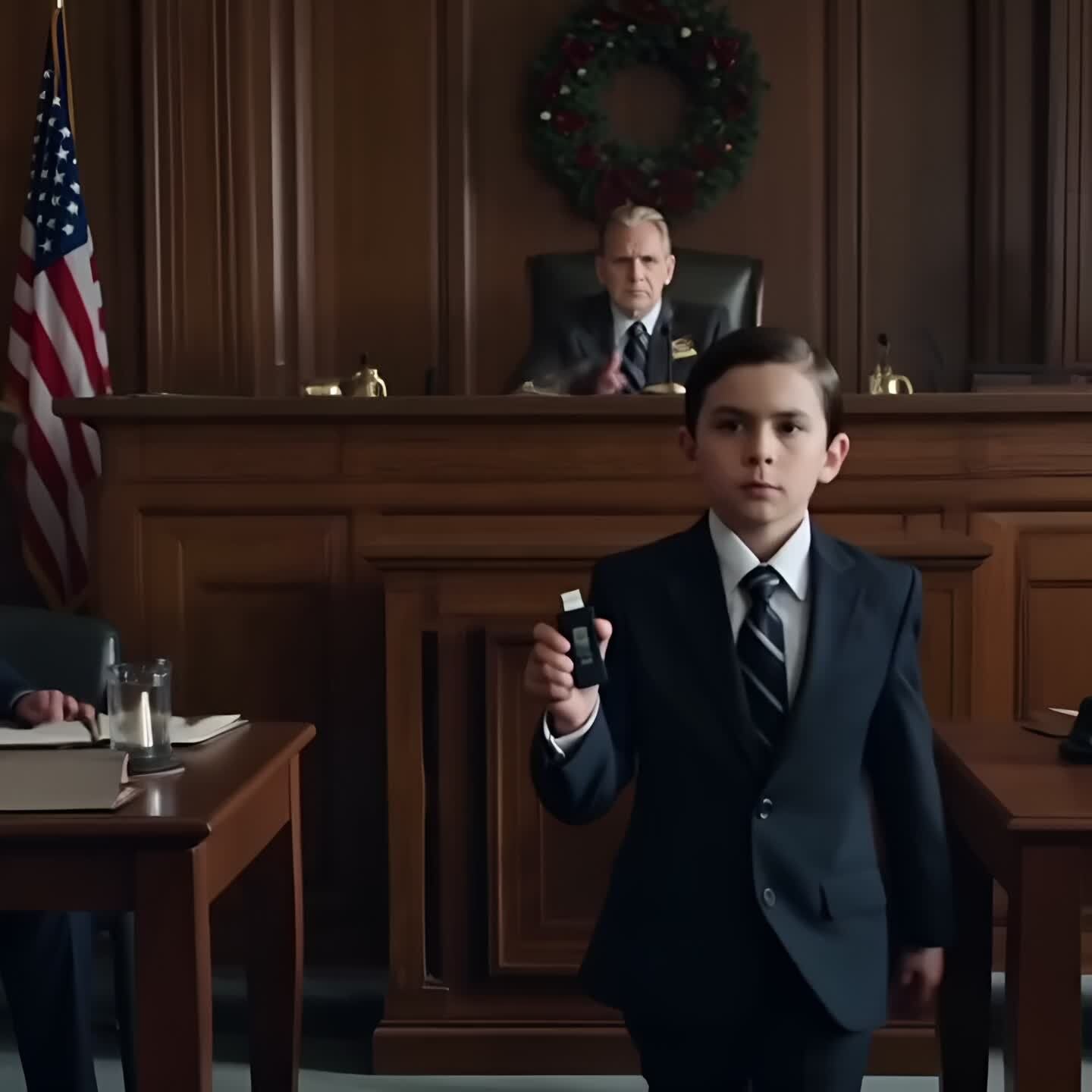
As the courtroom emptied, Michael saw Ethan approach the bench. The boy was holding something—a small flash drive.
“Your Honor,” Ethan said, his young voice clear in the quiet room, “I have something you need to see.”
Johns looked down at the child. “What is it, son?”
“It’s from my grandfather’s safe. I think it will help you decide where I should live.”
Reginald stood abruptly. “Ethan, what did you do?”
“Your honor,” Hos interjected, “the child has no authority to present evidence and anything he obtained from my client’s private property is—”
“Exactly the kind of thing this court needs to see when determining a child’s welfare,” Johns snapped.
He was old school, but he wasn’t stupid. He could see what was happening.
Ethan handed over the flash drive. Johns called for a laptop. The courtroom held its breath.
The files on the drive were meticulously organized: video surveillance from Reginald’s office showing meetings with forgers; audio recordings of conversations about bribing officials. And most damning—detailed notes in Reginald’s own handwriting about “removing obstacles.”
One entry, dated three weeks before Lorie’s death, read: “Elle knows too much.” Dale confirms she copied ledgers. Vehicle solution preferable, clean, defensible. Insurance already in place.”
Rosemary Allison let out a strangled sob and collapsed. Bailiffs rushed to help her, but her eyes were locked on her husband.
“You killed our daughter,” she whispered. “You killed Lorie.”
Reginald’s face had gone white. “This is… this is fabricated.”
“The metadata on these files,” Johns interrupted, reading from the screen, “shows they were created over a period of fifteen years.” He looked up. “Unless you’re suggesting your eight-year-old grandson is capable of time travel and forgery, Mr. Allison, I think we have a problem.”
Johns stood. “Bailiff, I’m ordering Mr. Reginald Allison taken into custody immediately. These recordings constitute evidence of conspiracy to commit murder. I’m also issuing an emergency order granting full custody of Ethan Lambert to his father, Michael Lambert, effective immediately.”
Two bailiffs moved toward Reginald. For a moment, the older man just stood there, his carefully constructed world crumbling. Then he lunged—not toward the exit, but toward Ethan.
Michael was faster. He intercepted Reginald, putting himself between the man and his son. Reginald swung wildly, connecting with Michael’s jaw, but Michael barely felt it. He grabbed Reginald’s wrist, twisting it in a move he’d learned years ago in self-defense classes, and forced the older man to the ground.
“You don’t touch my son,” Michael said quietly.
Bailiffs swarmed in, pulling Reginald to his feet and cuffing him. As they dragged him toward the door, Reginald screamed, “This isn’t over. I have connections, lawyers, money. You’ll never see the end of this.”
But his threats rang hollow. Federal agents were already waiting in the hallway, ready to take him into custody on charges of fraud, conspiracy, and murder.
Ethan ran to Michael, wrapping his arms around his father.
“Is it over, Dad? Is it really over?”
Michael held his son tight, looking at the chaos in the courtroom—Rosemary being led away by her attorneys, Reginald’s legal team scrambling to distance themselves, reporters pushing to get into the room.
“Yeah, champ,” Michael said. “It’s over.”
Three weeks later, Michael and Ethan sat on the back porch of their apartment, eating ice cream and watching the sunset. Ethan’s belongings had been moved out of the Allison estate, his room at Michael’s place finally feeling like a real home.
Stacy had flown in from Portland, and she sat with them now—her investigative piece having won national recognition and several journalism awards. The FBI’s case against Reginald was airtight. He’d been denied bail and faced over fifty counts of fraud, conspiracy, and murder.
Josephine Ashley had testified in exchange for immunity. Dale Webster had come forward with additional evidence. Rosemary Allison had filed for divorce and entered a rehabilitation program for prescription drug addiction. She’d also reached out to Michael asking if she could maintain a relationship with Ethan.
After some consideration and a long conversation with his son, Michael had agreed to supervised visits. Rosemary was a victim, too, in her own way.
“You know what’s funny?” Stacy said, sipping her wine. “Reginald’s insurance files were supposed to protect him. He kept evidence of every crime, every payoff, every dirty deal, thinking it would give him leverage if anyone came after him. Instead, it became the weapon that destroyed him.”
Michael nodded. “Pride. He couldn’t imagine anyone outsmarting him—especially not his own grandson.”
Ethan smiled, a kid smile, finally free of the weight he’d been carrying. “I learned it from watching you, Dad. You always said bad people make mistakes when they think they’re too smart to get caught.”
“When did I say that?”
“Last year, when we were watching that detective show. You said the criminals always keep evidence of their crimes because they’re arrogant.”
Michael laughed. “I did say that, didn’t I?”
Later, after Stacy left and Ethan was asleep, Michael sat alone in the quiet apartment. He thought about Lorie—about the life they’d planned together, about how everything had gone wrong. But he also thought about justice, about truth, about a brave eight-year-old boy who’d risked everything to expose evil.
His phone buzzed. A message from Ramon: Full custody order is officially signed. Reginald’s trial date set for 6 months out. Prosecutors expect conviction on all counts. You did it, Michael.
He had done it.
But more importantly, Ethan had done it. Together, they’d taken down a monster.
Michael closed his eyes, and for the first time in two years, he felt the weight of grief and fear lift from his shoulders. Tomorrow, he and Ethan would go to the park. They’d throw a football. They’d be a family—whole and safe.
And somewhere, he hoped Lorie was watching, proud of the man he’d remained and the boy she’d helped create. The cycle of pain Reginald Allison had created was finally broken. And in its place, something better had begun to grow.
This is where our story comes to an end. Share your thoughts in the comments section. Thanks for your time. If you enjoy this story, please subscribe to this channel. Click on the video you see on the screen and I will see you