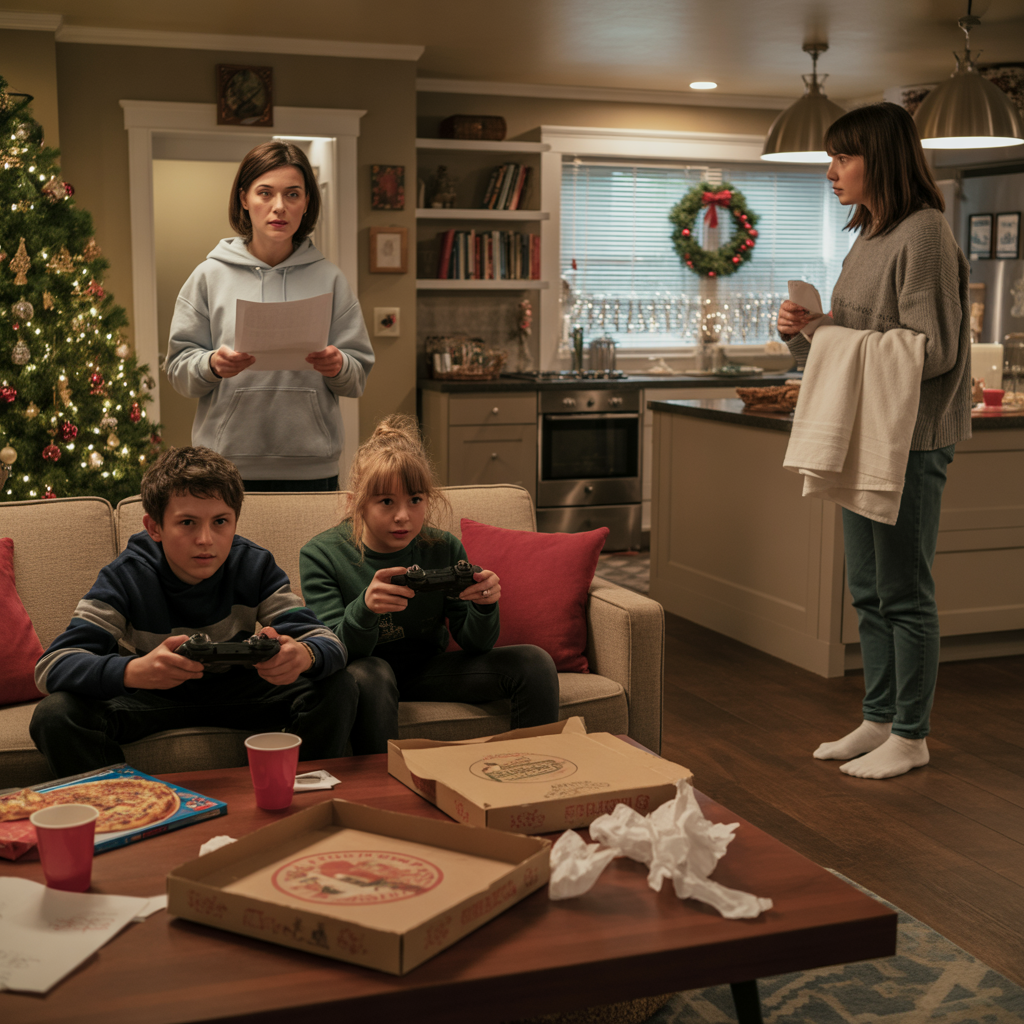
My name is Sarah. I am 20, and my life has become one long to-do list no one else in my family reads.
While my younger siblings laugh in the living room and my mom relaxes, I am the one with my hands in the sink, dragging trash bags to the hallway, staying up past midnight to fix the mess everyone else pretends not to see.
The night everything snapped, I slammed a stack of greasy plates onto the counter and finally said it out loud.
“Why am I the only one doing everything?”
No answer—just a shrug, an eye roll, a laugh. When I pushed again, when I dared to say it was unfair, I did not get an apology. I got the same line I had heard my whole life.
“You are too sensitive.”
Those three words hit harder than any slammed door. In that moment, I realized they did not just expect me to do everything. They expected me to stay quiet forever.
I stood there shaking, soap on my hands, thinking, If I do not move now, this will be my life for the next 10 years.
So I made a decision I had never let myself imagine. That night, while they brushed me off and went back to their screens, I quietly started planning my exit.
Within hours, I would be gone, and the girl they called too sensitive was about to become the one person they could no longer live without.
If you have ever felt like the unpaid maid of your own family, stay with me until the end. Share this story and tell me in the comments what you would do if your own mom let your younger siblings skip chores while you were forced to carry it all alone.
The day everything finally exploded did not look special on the calendar. No holiday, no birthday, just another weekday no one would remember—unless you count the way my whole life split into before and after.
I had been on campus since 8 in the morning. Lecture, quiz, group project, then a rushed sandwich eaten standing up in the break room at work. By the time my shift ended, my feet ached and my brain felt like it was buzzing.
I remember thinking, If I can just get home and lie down for 30 minutes, I will survive.
I opened our apartment door and knew that 30 minutes was never going to happen.
The smell hit me first—old food, dirty socks, something sticky that should not have been sticky. The living room looked like a tornado had passed through and decided to settle down long term.
Game controllers on the floor, cups on every surface, an entire bag of chips crushed into the couch cushions.
For a second, I just stood there, backpack digging into my shoulder, keys still in my hand, staring. You know that feeling when you are so tired your body goes cold instead of hot? That was me.
I dropped my keys onto the table. They bounced off a stack of mail. I recognized overdue notices, utility bills, things I normally sorted, paid, tracked—things no one else had touched.
From the other room, I heard laughter and the sound of a video blasting. I walked into the living room, stepped on a plastic cup, and it cracked under my shoe.
No one even turned around.
“Can you pause that for a second?” I said.
My voice sounded too calm in my own ears. One head turned slightly.
“What?”
I took a breath I could not afford. I had done this the emotional way a thousand times—begging, explaining, crying. This time I wanted it to be simple, factual, undeniable.
“Look around,” I said. “I got home from work five minutes ago. Who do you think is going to clean all of this?”
Silence, then a shrug.
“I don’t know. Not me. I had a long day, too.”
Something in me snapped.
I walked to the TV and hit the power button. The screen went black. Now I had their full attention.
“I am done,” I said. “We are making a chore plan today. No more me doing everything while you do nothing. I am in school. I work, and I am not your maid.”
Immediately the complaining started.
“Why are you freaking out?”
“You always do this.”
“It’s just a mess.”
“You are being dramatic.”
My mom walked in then, wiping her hands on a towel like she had been busy in the kitchen, even though I could see the takeout containers on the counter behind her.
“What is going on now?”
I turned to her. “What is going on is that I am burning out. I go to class. I work. I do the laundry, the dishes, the cleaning, the bills. They do nothing. You let them do nothing. And when I say anything, you tell me I am too sensitive.”
She frowned like I had just insulted her.
“Sarah, you know that is not true. I do a lot around here, and you are the oldest. You are supposed to set an example.”
“Set an example,” I repeated, “of what? Letting people walk all over you? Teaching them that if they ignore a problem long enough, someone else will fix it?”
The room went quiet in the heavy way that means an explosion is coming. I pushed ahead anyway. I had already lost the peace. There was nothing left to protect.
I grabbed a notebook from my bag, sat at the table, and started drawing a simple chart. Three columns, seven rows. Dishes, trash, laundry, floors.
I wrote my name at the top of one column and left blank spaces at the top of the others.
“We are doing this like adults,” I said. “Everyone takes responsibilities. Everyone sticks to them.”
My siblings groaned. My mom crossed her arms.
“This is ridiculous. They have school activities. They are busy.”
I stared at her. “I have school and a job. I am still doing all of this. If they are old enough to leave cups everywhere and eat on the couch, they are old enough to rinse a plate and take out the trash.”
She rolled her eyes. There it was again—that little gesture that said, Here she goes.
“Overreacting. You really need to calm down,” she said. “You are making a scene over nothing.”
Nothing. That word burned. My time, my energy, my mental health—nothing.
I felt my voice drop lower, steadier. “I am not making a scene. I am drawing a line. I will not keep living like this.”
And that was when my mom said the sentence that turned everything from a fight into a decision.
“If you do not like it here, you can leave.”
For years, that line had been used like a threat, a way to shut me down, to remind me that I was dependent, that I had nowhere else to go.
This time, it landed differently. Instead of fear, I felt clarity.
You know those moments when the room feels suddenly brighter, like someone flipped a switch inside your head?
I looked at her—really looked at her—and then I nodded.
“All right,” I said. “Maybe I will.”
She blinked, thrown off.
“Do not be ridiculous.”
“I am not being ridiculous,” I answered. “I am taking you at your word for once. If me asking for basic respect is too much, then maybe I should not be here.”
They all started talking at once—accusing, mocking, dismissing.
“You are not going anywhere.”
“You are just trying to scare us.”
“Stop being childish.”
But inside, the decision had already been made.
I thought about the overdue bills I handled, the schedules I coordinated, the messes I cleaned. I thought about how easy their lives would be until the day I simply stopped holding everything together.
Have you ever had someone throw if you do not like it, leave at you, not realizing you are finally ready to call their bluff? Because that is exactly what I decided to do.
That same day, the moment I walked back into my room, the noise from the living room faded like someone had shut a door inside my head. My hands were still shaking, but it was not from fear anymore. It was adrenaline.
My room was small, barely big enough for a bed, a dresser, and a tiny desk. But it was the only space in the entire apartment that felt like mine.
I shut the door, leaned my back against it, and let myself ask the question I had always avoided.
What if I really leave?
Not someday. Not when things get better. Today.
For the first time, the idea did not feel ridiculous. It felt possible. Ugly and hard and terrifying, yes—but possible.
I grabbed my phone and opened my messages. There was one person I knew I could text without being judged for wanting out.
Mia.
She worked with me at the cafe, the one who always joked that I basically had two full-time jobs—school, and being my family’s unpaid housekeeper.
I typed, erased, then finally sent:
“Can I ask you something insane?”
She replied in seconds.
“Those are my favorite kinds of questions. What happened?”
A minute later, I was spilling everything—the fight, the chore chart, the you can leave if you do not like it, and the part I had not said out loud to anyone yet.
“I think I actually want to go.”
She did not send back a wall of pity or tell me I was overreacting. She sent a single sentence that made my chest loosen.
“Then let us figure out how.”
While the rest of my family sat in the living room, assuming I would cool off and come back to scrub their plates, I sat on my bed and opened a new tab on my phone.
Rooms for rent near campus.
I was not starting from zero. I had savings from the cafe. Not much, but enough for a deposit if I found something small. I had my own paycheck.
I had a boss who liked me and would gladly give me extra hours if I needed them.
Scrolling through listings, I remembered every time I had thought, I wish I could leave, and then forced myself to stop dreaming because it hurt too much.
This time, I did not stop.
One place caught my eye. Tiny room, shared apartment, older building, but it was three subway stops from school and cheaper than I expected.
I stared at the pictures. Bare white walls, a narrow bed, a little window. It did not look like much, but in my head, it looked like freedom.
You know that line people always say, they will never survive without me? I used to think it was dramatic. Now I realized it was just true.
My family did not see half of what I did. The emails I answered for my mom, the forms I filled out, the late fees I prevented, the calls I made when something broke.
If I walked out, the house would not literally burn down, but their carefully curated comfort would.
And for the first time, I wanted them to feel even a fraction of the weight I had been carrying alone.
I messaged the landlord, half expecting no answer. Instead, my phone rang, a calm voice on the other end.
“We have one room left. You can come see it tonight if you want.”
“Tonight?” My heart raced. I glanced at the clock. If I left now, I could make it.
I told my mom I was going out for a walk. She did not even look up from her phone.
“Take your keys,” she said. “Do not be late.”
If she had looked at my face, really looked, she might have noticed something was different. But she did not.
That hurt more than I wanted to admit, and it pushed me even closer to the edge.
The room was exactly what the pictures showed. Small, plain, quiet.
The landlord went over the rules, the rent, the deposit. I answered automatically, my mind half in the conversation and half replaying the words: You are too sensitive, and if you do not like it, leave.
“Do you want it?” he asked. “There is someone else interested this weekend.”
I heard myself say, “Yes, I want it.”
When I left, I was holding a set of keys that did not belong to my mother’s apartment. My hands trembled all the way home.
This was no longer a fantasy. I had a place to go tonight.
Back in my room, I closed the door and pulled out a duffel bag. Clothes first, my laptop, important documents—the things I had bought with my own money.
I was not running away like a child. I was moving out like an adult who had finally realized she did not have to live as everyone’s backup plan.
For a brief second, guilt flooded me. What if they really cannot handle it? What if everything falls apart?
Then another thought answered back, sharp and clear. Maybe that is what needs to happen.
Maybe the only way they will understand that you were not too sensitive is if they finally feel how heavy all of this has been without you holding it up.
I was not trying to destroy them. I was trying to stop them from destroying me.
But if that meant a few overdue bills and some panic along the way, I was done shielding them from it.
I zipped the bag, took one last look at the room that had never truly been mine, and stepped out into the hallway with my heart pounding.
My mom called from the couch without turning her head.
“Where are you going with that bag?”
This time, I did not lie.
“I am doing what you told me to do,” I said. “You said if I do not like it here, I can leave. So I am leaving today.”
Have you ever watched someone’s face go from confident to terrified in three seconds? Because that was exactly what I saw when she finally looked at me.
For a moment, no one spoke. The television hummed in the background, filling the silence with canned laughter that did not match the feeling in the room at all.
My mom sat up straight.
“That is not funny,” she said. “Put the bag down. Stop being dramatic.”
I tightened my grip on the strap. “I am not joking. I already found a room. I signed for it. I have keys. I am moving out.”
My siblings stared at me like I had just announced I was moving to another planet.
“You are not serious,” one of them said. “You always say stuff like that.”
“No,” I answered—and I was surprised by how steady my voice sounded. “I always think it. I never say it. Today I am saying it and doing it.”
My mom’s face changed again, from irritation to anger.
“So you are just going to abandon your family. After everything I have done for you, after all the times I have been there for you.”
The list came out like a reflex.
“The roof over your head, the food on your plate, the sacrifices I made.”
I swallowed hard. “I am grateful for those things. I really am. But feeding your child and giving them a place to sleep is not a lifetime contract that says they have to work as your live-in housekeeper forever.”
“You are twisted,” she snapped. “All families help each other.”
“Exactly,” I said. “Help each other. Not one person does everything while everyone else calls her too sensitive when she finally speaks up.”
When she finally spoke, I could see panic starting to creep into her eyes, even as she tried to hold her ground.
“Who is going to take care of things if you leave?”
The honest answer was simple—the people who should have been helping all along—but I knew she did not want to hear that.
I walked over to the table, grabbed the stack of unpaid bills, and set them down in front of her.
“Here is the electricity, the internet, the rent reminder. I have been tracking all of this. From now on, you will have to do it yourself or show them how.”
Her mouth opened, then closed. She had always been able to rely on me to handle the boring stuff. Suddenly, boring had turned into terrifying.
“You cannot just dump this on me,” she said.
I felt a bitter laugh rise in my chest. “That is exactly what you have been doing to me for years. The only difference is I was a kid when it started.”
My siblings finally spoke up, voices climbing.
“So you are really just leaving.”
“You do not care what happens to us.”
“If I did not care, I would have left a long time ago,” I said. “I care so much it almost broke me. That is why I have to go now before I lose myself completely.”
I could see them cycling through reactions—denial, anger, guilt-tripping.
“You will come crawling back.”
“You cannot afford it.”
“You will miss us too much.”
Maybe I would miss them. In fact, I knew I would. But missing someone is not the same as being obligated to destroy yourself for them.
I put my phone number on a sticky note and pressed it onto the fridge, even though they already had it. Next to it, I wrote a simple sentence:
If you need advice, call. If you need a maid, hire one.
My mom read it and her face twisted.
“You are being cruel.”
“No,” I said quietly. “I am finally being honest.”
I did not expect a movie-style reconciliation. I did not get one.
There were no tears and hugs and sudden understanding. There were raised voices, accusations, and a slammed door—mine.
As I walked out, the hallway outside our apartment felt different that day. I had walked it a thousand times, always returning to the same cycle.
This time, every step took me further away from the version of myself who believed she had no choice.
The subway ride to my new place was a blur—noise, lights, strangers. My new keys felt heavy in my pocket. I kept touching them like I needed to confirm they were real.
The room was still empty when I arrived, just the narrow bed and bare walls waiting for me.
I dropped my bag, sat down, and for the first time in years, there were no dishes calling my name, no laundry waiting, no voice yelling from the other room asking where something was.
It was so quiet that it almost hurt.
I let myself cry for a few minutes, not because I regretted leaving, but because stepping out of a role you have played your whole life feels like losing a part of yourself, even when that part was killing you.
My phone buzzed. A string of messages from home.
“Where did you put the detergent?”
“How do I pay the internet?”
“When are you coming back?”
“You cannot just ignore us.”
I stared at the screen. The old me would have rushed back, or at least walked them through every step, doing emotional and logistical labor from a distance.
The new me typed something different.
“You can figure it out. Look at the labels. Call the company. There are instructions on the bills.”
That was it. I hit send. No apologies, no overexplaining—just the truth.
They were capable. They had just never been forced to be.
A minute later, another message popped up.
“So, you really are leaving us to deal with this alone.”
I took a breath and replied, “I am not leaving you. I am leaving the version of this family where I am the only one who cleans, plans, and cares about the consequences. If you want me in your life, learn to carry your share.”
There was no answer after that. Not right away. Just three dots blinking and disappearing.
Have you ever finally walked away from a situation that was breaking you and then sat in the first moment of silence wondering if you are brave or selfish or both?
Because that is exactly where I was—sitting on that narrow bed in a room that smelled like fresh paint and possibility.
I thought leaving would be the end of the story. I was wrong.
Leaving was just the start.
The real revenge was what happened when they realized I was serious and that there was no one left to quietly fix everything they had been ignoring.
The first few days in my new room felt like walking around with a weight missing from my shoulders and a new one pressing on my chest. The freedom was real. So was the fear.
I woke up to my own alarm, not to someone yelling my name because they could not find their shoes. I made coffee for one.
I left a single mug in the sink and actually had time to wash it before running out the door.
No piles, no sticky counters, no one waiting for me to fix what they broke.
But the silence had a way of making my phone buzz louder.
On the third day, I was in the library when my screen lit up: 10 missed calls from my mom, three from my brother, a flood of messages in our family group chat.
“The internet is not working. What did you do with the password?”
“The power company called—something about an overdue bill.”
“Where is the login for the bank app?”
“We need you to come over and sort this out.”
I stared at the notifications, my heart pounding. This was it—the beginning of the collapse.
The part of me that had been trained to jump up and fix everything was already halfway out of my chair. Then I remembered the note on the fridge.
If you need advice, call. If you need a maid, hire one.
They were not asking for advice. They were asking for their maid back.
I forced myself to sit down again and texted back—short and clear.
“Check the back of the blue folder in the drawer by the microwave. Everything is written there. Call the number on the bill. Set up autopay. You can do this.”
A few seconds later, my phone rang again. I let it go to voicemail.
I could hear my mom’s voice in my head anyway. You cannot just abandon us when things get complicated. We are family.
But that was the point. It had always been complicated. I had just been the only one dealing with it.
That evening, Mia and I sat on the floor of my new room, eating instant noodles out of mismatched bowls. She listened as I read the messages out loud.
“So they are already falling apart after three days,” she said. “That was fast.”
I laughed, but it came out shaky. “I feel horrible. I know how much stress this stuff causes. I do not want them to suffer.”
She tilted her head. “But you were fine suffering alone.”
The words stung because they were true.
“For years, no one had worried about how much pressure I was under. Now that that pressure was landing on them, it was suddenly an emergency.”
“You are not making them suffer,” she added. “You are giving them a chance to finally grow up. You are not their mother.”
The next week proved she was right—and also that growth is ugly, loud, and usually comes with a lot of complaining.
The messages kept coming.
“How do you reset the router?”
“Where is the landlord’s number?”
“The washing machine is broken.”
“There is mold in the fridge. What do we do?”
I answered some questions—the ones that were actually about learning.
“Unplug the router. Wait 30 seconds. Plug it back in.”
“The landlord’s number is on the lease. It is in the top drawer of the hallway cabinet.”
“Scrub the mold. Throw out old food. You have to check expiry dates.”
But the moment a message turned into a demand, into blame, I pulled back.
“You are being selfish.”
“You do not understand how hard this is.”
“You are ruining this family.”
Those got no response.
One night around midnight, my phone buzzed again. This time it was a video call. I almost ignored it, but something in my chest would not let me.
I answered.
The camera showed our kitchen—or what used to be our kitchen. Dishes stacked in the sink, overflowing trash, a sticky stain spreading across the counter.
My brother’s face hovered in the corner of the screen, frantic.
“We cannot do this,” he said. “Everything is a mess. Mom is freaking out. We tried to do the laundry and shrunk half of it. We forgot the trash and it smells like something died.”
I bit back the first thing that came to mind, which was, That is what it looked like the whole time. You just never noticed because I cleaned it.
Instead, I asked, “Did you make a list?”
He frowned.
“A list of what?”
“Everything that needs to be done, how often. Who is going to do what?”
“That is your thing,” he said. “You are good at organizing.”
I shook my head. “No, it is not my thing. It is a basic life skill. You are going to need it whether I am there or not.”
He groaned.
“Why are you being like this?”
“Because,” I said slowly, “if I fix this for you now, you will never learn and I will never be free.”
His eyes darted to someone off-screen. Then my mom’s voice cut in, sharp and tired.
“Sarah, stop tormenting your family. Just come home and help. You proved your point.”
Tormenting. The word echoed.
“I am not tormenting you,” I said. “I am living my own life. You are experiencing what I have lived for years. That is not cruelty. That is reality finally catching up.”
There was a long pause. For the first time, I noticed how exhausted my mom looked—dark circles, hair shoved into a messy bun, a dish towel still in her hand.
“This is too much,” she muttered. “I cannot work and handle the bills and keep this place clean and make sure they do their homework and remember appointments,” and she stopped mid-sentence.
I did not have to finish it for her.
And yet, I had been doing exactly that on top of my own school and job.
“Do you hear yourself?” I asked softly. “That is what I have been doing alone.”
Her eyes flickered. For a moment, I thought I saw something like realization. Then, just as fast, she pushed it away.
“You are stronger than them,” she said. “You can handle more.”
That was the lie I had built my whole life around.
“Just because I can handle more does not mean I should,” I replied, “and it definitely does not mean you should expect it from me for free forever.”
She exhaled loudly.
“Fine. Stay in your little room and pretend you do not care what happens to your family, but do not come running back when you realize how selfish you are being.”
The call ended before I could answer.
I stared at my reflection on the black screen. My eyes were red, but not from crying. From holding it together, from refusing to break the boundary I had set.
The next day at work, I made a mistake on a customer’s order because my brain was half at the register, half in that kitchen.
My manager pulled me aside.
“You need a day off,” he said. “You look like you are carrying a building on your back.”
I almost laughed. If only he knew.
Days turned into weeks.
Slowly, the messages changed. Less blaming, more practical questions.
“How do you make a basic grocery list?”
“How often do you clean the bathroom?”
“How do you plan meals for a week?”
I answered those calmly, without rushing, without offering to come do it for them.
Then one afternoon, a different kind of message came in. Not a question—a statement.
“We messed up.”
My fingers froze above the keyboard. Before I could reply, another text appeared.
“The rent is late. Mom thought you paid it last week like always. The landlord came by. He is giving us one more chance. But he was really mad.”
I closed my eyes.
Late rent meant late fees. Warnings. Real consequences.
The old me would have drained my savings to fix it.
The new me typed, “Did you figure out a plan to pay it?”
There was a long pause.
“We are selling some stuff, cutting some things. Mom is asking for extra shifts. It is bad. She keeps saying she did not realize how much you were doing.”
I stared at those words.
I did not realize how much you were doing.
There it was—the beginning of the confession I had needed for years.
I did not celebrate. I did not gloat. This was not a game. It was my family’s stability.
But I also did not rush in to save them.
I wrote back, “I am sorry it got this bad. This is what I was trying to tell you. I am glad you are stepping up now.”
That night, as I lay in my narrow bed, I realized something.
My revenge was not about making them suffer. It was about forcing them to see the invisible work they had taken for granted and finally feel the cost of it.
The question was: when they did see it, would it change anything between us, or would they just resent me for walking away?
I got my answer a week later.
There was a knock on my door, and I opened it to find my mother standing in the hallway, looking smaller than I had ever seen her.
For a second, I thought I was imagining her. She never came to my side of town. It was too far, too inconvenient, too much trouble.
Yet there she was, clutching her purse like a life raft, eyes scanning the narrow hallway.
“Hi,” she said.
Her voice sounded tired. Not sharp, not defensive—just tired.
I stepped aside. “Do you want to come in?”
She hesitated, then nodded.
My room suddenly felt even smaller with her in it, like two worlds colliding in one cramped space. She looked around—the bed, the tiny desk, the single chair.
No clutter, no chaos. Just the trace of my life stacked neatly in corners.
“So this is where you have been,” she murmured.
“Yeah,” I replied. “This is it.”
For a moment, we just stood there, not sure which version of ourselves to be.
The old pattern tugged at me. I almost asked if she wanted something to drink, if she had eaten, if she was okay. Then I remembered why we were here, why I was here.
She sat on the edge of my bed, smoothing the blanket like it was an excuse to avoid my eyes. Finally, she said, “Things have been hard since you left.”
I leaned against the wall and waited.
“The bills, the cleaning, the cooking, the appointments.” She shook her head. “I had no idea you were handling so much.”
“You did,” I said gently. “I told you many times. You just did not want to see it.”
She flinched but did not argue. That alone was new.
“You are right,” she admitted. “I dismissed you. I thought you were exaggerating. I thought you were just emotional. Too sensitive.”
I finished for her.
She winced. “Yes.”
That silence stretched between us. Somewhere down the hall, someone turned up their music. A dog barked. Life went on, indifferent to the fact that my mother was finally saying the words I had needed for so long.
“I am sorry,” she said quietly.
Not the dramatic kind of sorry people give in movies. A small, raw, almost embarrassed one.
“I did not want to believe I had made my own child feel used. So I told myself you were stronger, that you could handle it, that it was good for you to be responsible.”
I swallowed. “Being responsible is not the same as being exploited.”
“I know that now,” she said.
She took a deep breath. “The rent being late the other week scared me. The landlord said another delay like that and he will start the eviction process. I realized how much I had been relying on you without even thinking about it. I should have been the one teaching them, not dumping everything on you.”
There it was—the real cost. Not just a messy kitchen or a pile of laundry. A home at risk because the person holding it together had walked away.
I did not say I told you so. I did not have to. It hung there in the air between us.
“What do you want from me now?” I asked. “I need to know if you are here to ask for my help or for my presence. There is a difference.”
She looked up sharply. “What do you mean?”
“If you are here because you want me to come back and fix everything again, that is not going to happen,” I said. “I will not move back in. I will not be the default person for every crisis. I love you. I love them. But I am not going back to that role.”
Her eyes filled, but she blinked the tears away. “I am not here to drag you back,” she said. “I can see you are doing better on your own.”
Better is a complicated word, I thought. But I was definitely not drowning the way I had been.
“Then why are you here?” I asked.
She twisted the strap of her purse.
“Because the house is different without you. Quieter, less organized, less warm. Not because no one is doing chores—we are trying. I promise. But because you were the one who held everyone together. And I did not respect that. I weaponized it.”
The honesty in that sentence took my breath away.
“I am not asking you to come clean,” she continued. “We are learning. The kids complain, but they are doing their part. I am trying. I made a budget. We made a chore chart for real this time. No one is erased from it.”
I pictured it. A chart where my name did not fill every line, where other people’s names had tasks next to them.
It was a small thing. It was everything.
“I wanted to see you,” she said simply. “I miss my daughter. Not the worker I turned you into.”
I did not answer right away. My mind flashed through all the nights I had cried doing dishes, all the times she had called me dramatic, ungrateful, too sensitive. All the birthdays and plans I had given up because the house needed me more.
I thought about the viewers who would be watching this if my life were a video, waiting for me to say I forgave everything instantly or that I cut her off forever.
But real life is not that clean.
I sat down in the chair across from her. “I miss you too,” I said. “I miss them. But I cannot pretend what you did did not hurt me. And I cannot be the only one who changed.”
She nodded. “I know. I am not asking you to pretend.”
“So here is what I can offer,” I said. “I can visit for dinner for a weekend sometimes. I can be your daughter. I can be their sister. I can answer questions and give advice. But I will not live there again. And when I am there, I am a guest, not the staff.”
She let out a shaky breath. “That sounds fair.”
Fair. A word that had barely existed in our house before.
“There is one more thing,” I added. “If you ever call me too sensitive again for having feelings about how I am treated, that will be the last conversation we have for a long time.”
She flinched like I had slapped her. Then she nodded slowly. “That is fair, too.”
A heavy quiet settled over the room, but it was not the suffocating kind I had grown up with.
It felt like a field that had been burned down—dark and empty and ugly—but ready for something new to grow if we were careful.
She reached into her bag and pulled out a folded piece of paper.
“We started writing things down,” she said. “Not for you—for us. What needs to be done? Who is doing what? When. Like the chart you tried to make that day.”
I took it.
The writing was messy, the categories uneven, but there they were—their names next to actual responsibilities.
My name was not on it.
I felt a strange mix of grief and vindication. This is what I had been begging for all along.
“We are late on some things,” she admitted. “Money is tight. The kids are annoyed, but they are learning. I am learning. It should not have taken you leaving for me to get it. But it did.”
“Sometimes the only way people notice you are holding everything up is when you finally walk away and let it all fall,” I said.
She nodded, tears finally spilling over. “I am sorry it had to be that way.”
I handed the chart back. “I am glad you are doing this,” I said. “But you have to understand something. This is not me punishing you. This is me protecting myself, my future.”
“I do,” she whispered. “Or at least I am trying to.”
We sat there for a while talking about small things—work, school, my new room, the fact that I had learned to cook for one without making giant family-style portions.
When she left, she hugged me at the door. It was not the clingy, guilt-soaked hug I was used to. It was careful, almost respectful.
On the way down the hall, she turned back.
“One more thing,” she said.
“Yeah?”
“You are not too sensitive, Sarah. You were right. You have always been right about this.”
My throat closed. I had not realized how badly I needed to hear that sentence until it was finally out in the open, hanging between us like a bridge.
After she left, I sat on my bed and let myself feel everything—the anger that was still there, the relief, the tiny flicker of hope that maybe, slowly, painfully, we could build a different kind of relationship, one where love did not mean servitude.
Weeks later, I went back to the apartment for dinner for the first time.
The kitchen was not perfect, but it was not a disaster either.
There was a chore chart on the fridge, just like she had shown me. Each name had tasks underneath. Mine was not there.
“You are a guest,” my mom said when she saw me looking. “Sit, eat, rest.”
For the first time in my life, I did.
Sitting at that table, I realized something important. My revenge had never really been about payback. It had been about proof. Proof that I was not crazy, that I was not weak, that my pain was real, and my boundaries were valid.
They had paid a price for taking me for granted—late fees, stress, sleepless nights, a shaken sense of control.
I had paid a price, too. Years of my life spent cleaning up after people who did not see me.
Now at least the bill was finally on the table and everyone was looking at it together.
If you are watching this and you feel like the unpaid maid of your own family, ask yourself this honestly. If you disappeared tomorrow, would they fall apart because they love you so much or because they never bothered to learn how to live without using you?
And more importantly, what are you going to do about that? Tell me in the comments. Would you stay and keep doing everything or would you walk away and let them finally see what you were really