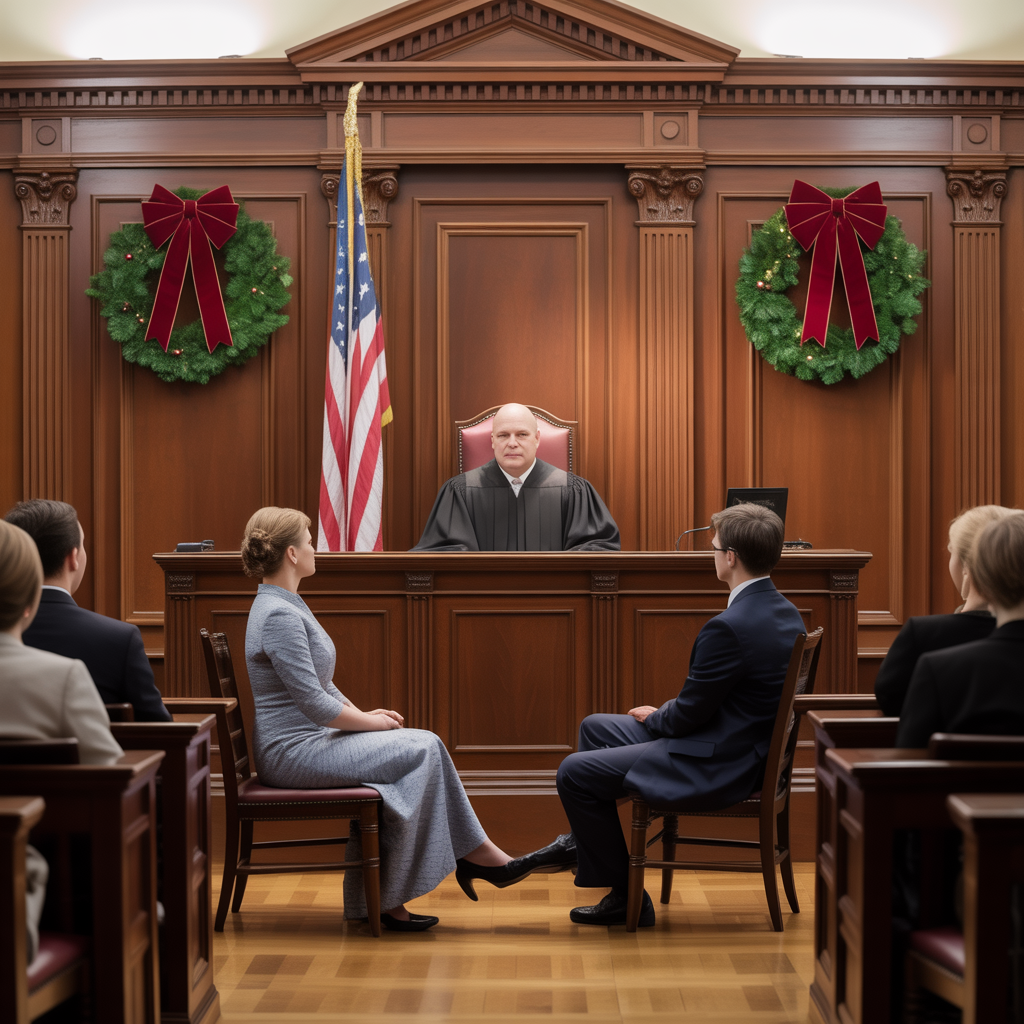
When my father arrived at the inheritance hearing proudly holding his “pregnant mistress,” he thought he had already won. He mocked me, claimed the baby would take everything my mother left behind, and acted as if the courtroom belonged to him.
But my lawyer brought one envelope that changed everything.
The moment the judge opened the DNA results… the entire room fell silent.
My father’s confidence vanished. His carefully built lies began to collapse—one line at a time.
This is a story about family betrayal, buried truths, a mother’s last wish… and the moment justice finally arrived. But it’s also a story about what happens after revenge—when forgiveness becomes the only way forward.
For anyone who’s ever faced a toxic parent, a broken inheritance, or a battle you never asked for… this story is for you.
“At the inheritance hearing, all parties will remain silent while I review this final document.”
The judge’s voice bounced off the paneled walls, but all I could see was my father, three chairs away, grinning like he’d already won.
Dad sat with his shoulders back, one arm around the young woman at his side—the one he proudly called his pregnant mistress. She rested a manicured hand on her belly, as if the child inside already owned everything my mother had worked for.
He’d said it loud enough for the whole waiting area to hear: “After today, sweetheart, our baby might own half this town.”
I hadn’t answered. I just watched him walk past me without a glance—his only child, the daughter he was trying to push out of the picture.
Then my lawyer stood up and lifted the envelope.
“Your Honor,” he said, steady and clear. “The DNA results are here.”
The room went very still. The fluorescent lights hummed. The mistress’s fingers tightened on Dad’s sleeve.
Dad turned toward my lawyer with that little smirk I knew too well—the one that said, I always land on my feet.
The judge motioned for the envelope. My lawyer crossed the room, placed it in his hand, and sat down beside me.
I could hear my heartbeat while the judge slid on his reading glasses and unfolded the papers.
No one else in that courtroom knew what was coming.
But I did—because I’m the one who ordered that test.
A few years earlier, my life had looked very different.
I was still living in the same small Midwestern town where I’d grown up—a place with one main street, a Walmart by the highway, and more churches than stop signs. I worked the front desk at the clinic.
Most mornings, I drove past my mother’s house, the little blue one with the white porch and the maple tree that turned red every fall. Even after she was gone, that house still felt like hers.
Her death cracked the world open.
Lung cancer took her faster than anyone expected. I watched her shrink into her favorite recliner while the TV murmured. At night, I slept on the couch so I could help her to the bathroom or steady her when the pain hit.
Dad was rarely there.
He always had something to do—church meetings, errands, men’s group. Sometimes he came home smelling like someone else’s perfume. I noticed. I just didn’t have the strength to argue.
By the time we buried her, there was already a new “friend from church.” He introduced the woman at the funeral. She stayed near the back pew—hair perfect, eyes too calm.
When our eyes met, she gave me a small, practiced smile.
A few weeks later, the envelopes began to arrive. Mom’s will. Bank summaries. Notices from a probate attorney.
I wasn’t thinking about inheritance. I was still burning casseroles because I kept forgetting to set the timer.
But Dad suddenly had plenty to say.
“I’m sure your mother wanted to make sure I’m taken care of,” he said one evening at the old kitchen table. “After all I did for her.”
He started talking about simplifying things. Selling Mom’s rental duplex near the high school. “Maybe selling the house. You don’t want to be stuck with old buildings and repairs.”
He said, “Let me handle it. We can cash out while the market’s decent.”
“Did Mom say she wanted that?” I asked.
He shrugged. “We talked. You know how she worried.”
Once, I might have nodded and dropped it.
But a few months earlier, when Mom was first diagnosed, she’d called me into her bedroom. She’d taken my hand and shown me her will.
“I just want you to have somewhere that’s yours,” she’d told me. “If everything else falls apart, you’ll still have a roof.”
I remembered the way her fingers squeezed mine when she said it.
So instead of nodding now, I called the number on one of the legal envelopes and made an appointment with the estate attorney listed at the bottom.
That’s how I met Mark.
He looked more like a retired teacher than a lawyer—late fifties, thinning hair, a coffee mug that said Best Grandpa Ever. A photo of three grandkids sat behind his desk.
He let me tell the story. Mom’s illness. Dad’s absences. The friend from church. The talk about selling everything.
I slid a folded copy of Mom’s will across his desk—the one she’d shown me, the one I’d quietly photographed.
He read in silence for a minute.
“Your mother left the house and the rental property to you,” he said at last. “Your father was named executor until you reached a certain age. You’re past that now. He can’t legally sell those assets without your consent.”
I felt something loosen in my chest and tighten at the same time.
“So if he’s trying to push me—”
“You don’t sign anything you don’t understand,” Mark said. “And you don’t let anyone rush you. Grief and money bring out sides of people we’d rather not see.”
On the drive home, the sky hung low over the fields. For the first time since her funeral, I felt more than just sadness.
I felt responsibility.
Over the next year, Dad turned into a man I barely recognized. New car, new clothes, different women on his arm at church. At family gatherings, he joked that I was too soft for the real world and called me our little bleeding heart. People chuckled. I smiled tightly and filed every word away.
Whenever I asked about estate papers, he brushed me off.
“Why can’t you just trust me?” he’d say. “You’re not built for this.”
But quietly, with Mark’s help, I began to learn exactly what I was built for.
I didn’t yet know that the road we were on would end in that courtroom—with a mistress clutching her belly, a sealed envelope in my lawyer’s hand, and a judge about to read words that would drain the color from my father’s face.
All I knew was that my mother had trusted me with the truth, and I was finally ready to fight for it.
If there’s one thing I’ve learned in small-town America, it’s this: nothing spreads faster than a funeral rumor—except a rumor about money.
By the time the inheritance hearing finally rolled around, nearly everyone in town had heard some version of the story. Depending on which coffee shop you sat in, people whispered that Dad was about to inherit a fortune, or that he was fighting his deadbeat daughter in court.
Or my favorite: that he was expecting a new baby at nearly sixty-five.
I didn’t correct any of it. Let people talk.
They always talked anyway.
But nothing prepared me for the show Dad put on the morning of the hearing.
I pulled into the courthouse parking lot early, hoping to sit in the hallway, breathe, and collect myself. I still had that old instinct—the one that told me to make myself small, quiet, easy.
Years of living around Dad will do that to you.
But as I stepped through the courthouse doors, my breath caught.
Dad wasn’t just here.
He had brought an audience.
He strutted into the lobby wearing his favorite charcoal sport coat. Hair slicked back, a smile stretched so wide it showed every capped tooth he’d bought after Mom died.
And on his arm—clinging to him like a prom date—was her. The mistress.
She was younger than I remembered.
Or maybe she just dressed younger.
Tight sweater dress. Heels too high for a courthouse. Hair curled like she was auditioning for a soap opera. One hand rested dramatically on her stomach as if she were posing for a maternity magazine.
Dad laughed too loudly at something she whispered, then looked around to make sure people noticed them.
When his eyes landed on me, they didn’t soften. Not even a flicker of recognition.
Just that smug, polished smile.
“Well, if it isn’t my daughter,” he said as if greeting a distant cousin. “You’re early. That’s surprising.”
The mistress giggled and pressed closer to him.
“Hi, sweetheart,” she said to me, her tone dripping with condescension. “We’ve heard so much about you.”
I didn’t answer.
Mark had coached me: Do not take the bait.
But Dad didn’t need me to react. He wanted an audience, and the courthouse hallway delivered one. Every bench, every chair was lined with people waiting for their own cases.
But all of them were watching us now.
Dad thrived on that.
“You know,” he said loudly, patting the mistress’s belly as if he were presenting a grand prize on a game show, “the Lord works in mysterious ways. Just when life seems to be winding down, He gives you something to live for.”
The mistress placed a hand over her heart and looked up at him lovingly.
“Our little miracle.”
My throat burned with something between anger and embarrassment—not because of the baby, if it really existed, but because it was so painfully clear what he was doing.
He wanted to humiliate me.
He wanted the whole town to see him as a revitalized man with a new family while I stood alone with my folders and quiet dignity.
He leaned toward the couple sitting beside us, total strangers, and said with theatrical sadness, “My daughter hasn’t been supportive. Of course, some people don’t like sharing.”
The strangers looked uncomfortable.
I swallowed a small lump of shame I didn’t deserve.
Mark arrived just then, briefcase in hand. He nodded politely at Dad, who puffed his chest out like a bantam rooster.
“Morning, everyone,” my lawyer said calmly. “Isn’t it a beautiful day?”
Dad snorted. “Beautiful for some.”
The mistress tightened her grip on his arm.
“It’ll be a very big day for our baby,” she said. “Generational wealth changes everything.” She said it like a line she’d practiced.
I stiffened.
Dad noticed.
“Oh, did you not know?” he said, voice booming through the hallway. “My child—my future child—has just as much claim as you do. That’s how real families work.”
A few heads turned. Someone whispered.
I felt the sting of humiliation—sharp and familiar.
He’d always known how to make me feel small with just a sentence, a glance, a smirk. Growing up, he perfected it like a craft.
But this time, something was different.
His cruelty didn’t land the way it used to.
Maybe because I wasn’t a scared teenager anymore.
Maybe because my mother’s signature on her will was burned into my memory.
Or maybe because I knew what my lawyer had sealed in that plain white envelope tucked into his briefcase.
The mistress took a step closer and lowered her voice so only Dad, Mark, and I could hear.
“Don’t take it too hard,” she whispered, smiling sweetly. “Some women just aren’t meant to be heirs or mothers.”
Dad chuckled.
Mark shot her a sharp, disapproving look. “Classy,” he murmured.
Before she could respond, a bailiff opened the courtroom door.
“Estate of Fern Hall,” he called. “Please step inside.”
Dad inhaled deeply and squeezed the mistress’s waist.
“Showtime,” he said.
As we walked into the courtroom together—but not together—I felt the old ache of family rupture, the kind that never fully heals.
The wooden pews. The solemn seal above the judge’s bench. The stale government air.
It all felt too holy a place for the performance Dad was putting on.
We took our seats.
The judge entered.
Dad straightened proudly, beaming like a man about to collect a lottery check.
And that’s when I knew, with quiet certainty, that the truth sitting in Mark’s briefcase—the truth Dad didn’t know was coming—would hit him harder than anything I could ever say.
For once in my life, I didn’t feel small.
I felt ready.
Part Two: The Pregnant Mistress and the Public Humiliation. 1028 words. Banjanoi. Continue.
Part Three: The Courtroom Battle Begins. 1 do50 words.
When the judge finally settled into his seat, the entire room shifted into that heavy, disciplined silence you only feel in government buildings and church basements—the kind where every cough echoes and every whisper feels like a sin.
Dad loved it.
He sat tall, chin lifted, his hand resting possessively on the mistress’s knee as if presenting her to the judge as Exhibit A: Proof I deserve everything.
I kept my eyes forward, hands folded neatly on the table. I could feel Mark’s calm presence beside me—not loud, not flashy, just steady like the old oak trees that line Main Street.
The judge flipped through the case file, pausing here and there.
“This is a continuation of the estate matter regarding the late Fern Hall,” he said. “Today’s goal is to clarify asset distribution and address objections raised by Mr. Hall.”
Dad gave a theatrical sigh, the kind only someone deeply committed to their own performance could pull off.
“Yes, Your Honor,” he said. “I’m here to make sure my late wife’s wishes are honored.”
I almost laughed out loud.
Mark didn’t look at Dad, nor at me. He simply adjusted his glasses the way he always did before letting someone talk themselves into trouble.
The judge turned to Dad.
“Your filings claimed that certain assets—specifically the marital home and the rental duplex—should revert to you rather than transfer to your daughter.”
“That’s correct,” Dad said with a smile that didn’t reach his eyes. “My wife always believed in keeping the family secure. She said many times she wanted me in control of things.”
“And the will?” the judge asked.
Dad shrugged, as though the will were inconvenient paperwork.
“My wife was very sick. You know how pain affects clarity. I believe she meant something different from what was written.”
I stiffened.
Mark placed a steady hand on my forearm, a subtle reminder to stay composed.
The mistress leaned forward, cleavage strategically visible, and whispered loudly enough for the microphones to pick it up.
“Besides, Your Honor, there’s a baby now. Family grows. Priorities shift.”
Dad nodded enthusiastically.
“Exactly. My unborn child deserves protection, too.”
The judge raised an eyebrow.
“We will address that claim in due time.”
Dad beamed, mistaking patience for agreement.
Mark cleared his throat.
“Your Honor, before we proceed, I’d like to enter into record that the will was prepared by a licensed attorney and signed independently by Mrs. Hall while she was mentally competent. I have the medical assessments to confirm her full capacity at the time.”
He handed several documents to the bailiff.
The judge skimmed them, nodding slowly.
“This appears in order.”
Dad’s jaw tightened.
But arrogance is a stubborn thing. It doesn’t yield easily.
He leaned forward, elbows on the table.
“My daughter has had a difficult life,” he said. “She’s fragile, easily influenced. I worry the responsibility of managing property will overwhelm her. My guidance would honor her mother’s intent.”
Fragile.
The word hit me like a pebble, not a stone. Not anymore. Something small, irritating, almost laughable.
Mark responded gently.
“Your Honor, my client has maintained employment, paid her own bills, and dealt responsibly with multiple legal documents over the past two years. She is neither fragile nor incapable. The issue here is simply respecting the written will.”
The judge nodded again.
A crack formed in Dad’s smile.
That only made him push harder.
“My wife always said our daughter wasn’t prepared for the real world,” he said. “She struggled in school, had trouble making friends, never stuck with anything.”
“Enough,” the judge said firmly.
Dad blinked.
The courtroom held its breath.
“This is a probate hearing, not a personal character evaluation. We are here to interpret the will and determine legality. Unless you can provide written evidence that your wife’s stated wishes changed, we move forward with the document as signed.”
Dad opened his mouth, closed it, then shifted strategies.
“Well, Your Honor,” he said, gesturing toward the mistress’s belly, “the real issue is fairness. If my daughter takes everything, that leaves nothing for my next child. A child who deserves their birthright.”
The mistress lifted her chin, playing her role perfectly.
I waited.
Mark waited.
We both knew what was coming later, but letting Dad dig his own hole was a strange kind of satisfaction. Quiet, steady revenge.
The judge folded his hands.
“At this point, the unborn child’s rights depend entirely on paternity and applicable state law. This claim has been vigorously disputed by the petitioner.”
The mistress piped up. “There’s no dispute. He’s the father. He’s always been.”
Mark finally spoke, voice calm as a lake.
“Your Honor, we will address the paternity matter shortly.”
Dad glared at him, then at me, as if I had conjured the universe out of spite.
The judge turned pages.
“Mr. Hall, there also appears to be an issue with financial management. Several accounts show large withdrawals under your signature with funds unaccounted for. You were executor at the time.”
Dad looked stunned—genuinely, for once.
“Those were normal expenses,” he said quickly. “Home repairs, bills. A man can’t be expected to remember every detail.”
Mark slid a folder onto the table.
“Your Honor, we have itemized statements and contractor testimony indicating no such repairs occurred. Additionally, multiple withdrawals coincide with casino charges.”
The mistress stiffened.
Dad shot her a warning look.
I watched silently—not with glee, though a touch of that flickered through me, but with something heavier.
This was the man who raised me. The man who laughed at my school awards and told me not to get a big head. The man who bought new furniture when Mom needed chemo.
He had spent years perfecting the role of the aggrieved father, but the mask was cracking.
The judge removed his glasses and rubbed the bridge of his nose.
“This case is quickly becoming more complicated than a simple will review,” he said. “We will take a short recess before proceeding with paternity questions.”
Dad rose confidently as if he still believed he could spin this.
But as the bailiff called for recess, I noticed something new in his eyes.
Not confidence.
Fear.
For the first time in my life, my father looked small—and we hadn’t even opened the envelope yet.
When the bailiff announced the recess, Dad rose like a man preparing for a parade instead of a legal inquest. He straightened his jacket, smoothed his thinning hair, and escorted the mistress toward the hallway with all the swagger of a small-town mayor.
She clung to him, smiling brightly, whispering little reassurances he seemed desperate to hear.
Mark and I stayed in our seats.
He leaned over, lowered his voice, and said, “He’s rattled. You just can’t see it yet.”
I exhaled slowly.
My hands trembled—not with fear, but with the kind of anticipation that coils deep in your bones when truth is about to walk into the room.
“He still thinks he has control,” I murmured.
Mark nodded. “Arrogance is predictable. It always forgets to look behind itself.”
We sat quietly for a moment. The judge was in chambers reviewing the will again, the bailiff leaning against the sidewall, the hum of the fluorescent lights filling the room like static.
My eyes drifted to the judge’s bench—the same place where, minutes from now, Dad’s future would pivot.
I thought about my mother, the way she had squeezed my hand the day she showed me her will. How her voice cracked when she said she didn’t trust Dad to handle the estate alone. How she whispered, “Promise me you’ll stand up for yourself when the time comes.”
I had promised.
I just never imagined the time would look like this—with a pregnant mistress in a skin-tight dress, a father twisting my mother’s memory into something that suited his ego, and a secret envelope holding the power to tear down his entire performance.
“Ready?” Mark asked.
I nodded.
“Good,” he said. “Then let’s finish this.”
When recess ended, the judge returned, expression composed, but sterner than before. The courtroom filled again—Dad with renewed confidence, the mistress with her practiced gentle smile, and a few curious bystanders who seemed to sense that the juicy part was coming.
“All right,” the judge said, settling in. “Before we continue the financial matters, we need to address the paternity claim presented by Mr. Hall.”
The mistress lifted her chin proudly.
Dad squeezed her hand.
Mark rose.
“Your Honor,” he said, “as indicated earlier, my client has submitted documentation relevant to this matter. With the court’s permission, we’d like to present it now.”
The judge motioned with his hand. “Proceed.”
Mark reached into his briefcase and withdrew the envelope—plain white, unassuming—and held it up like a relic.
Dad laughed.
Actually laughed. A dry, incredulous sound.
“Oh, come on,” he said. “What is this? Some stunt? A test my daughter ordered because she’s jealous of our family.”
The mistress stroked her stomach.
“This is harassment,” she whispered loudly enough for everyone to hear.
Mark remained unbothered.
“Your Honor, these are accredited laboratory results from a legally obtained paternity test.”
The judge held out his hand.
“Bring it here.”
Dad leaned back, smirking.
“Go on, then. Let’s get this over with.”
Mark walked the envelope to the bench and placed it gently in the judge’s palm.
A hush fell over the courtroom.
I felt my heartbeat in my ears.
The judge tore the seal, took out the papers, and unfolded them. He read the first section, then the second.
His expression shifted—not dramatically, but enough that the courtroom air seemed to tighten.
Dad’s smirk wavered.
“Your Honor,” he prompted.
The judge looked up, fixing his gaze on the mistress first.
“These test results,” he said, “indicate a 0% probability of paternity.”
Silence.
The mistress blinked.
Dad frowned.
“What does that mean?”
The judge repeated, enunciating each word.
“Mr. Hall is not the father of this child.”
The mistress’s face drained of color.
Dad turned to her slowly, like an old hinge resisting movement.
“What is he talking about?”
She opened her mouth, closed it, and then burst into tears—loud, dramatic sobs that echoed off the wooden pews.
“It’s wrong,” she cried. “It has to be wrong. Those things aren’t accurate. They mix up samples all the time.”
“They don’t,” Mark said gently. “Not when chain of custody is properly documented.”
Dad shot to his feet.
“You’re lying. All of you.”
The judge held up a hand.
“Sit down, Mr. Hall.”
“I won’t sit down,” Dad roared. “This is a setup, a conspiracy. My daughter has been out to destroy me for years.”
I stayed seated, calm.
Dad’s fury, so familiar, washed over me like background noise.
“Your Honor,” Mark said smoothly, “we would also like to submit Exhibit C—security footage from the laboratory on the day of the test, confirming both her presence”—he gestured to the mistress—“and the identity verification required before samples were taken.”
People in the pews turned to look at her.
Dad stared at her with a stiff, twitching jaw.
“You tell them the truth,” he hissed. “Tell them this baby is mine.”
Her sobs quieted suddenly.
She looked at him with a strange mixture of guilt and resentment.
“You don’t know what it’s been like,” she whispered. “He said he’d take care of me. You made promises, too.”
“He—” Dad shrieked. “Who is he?”
She didn’t answer.
But she didn’t have to.
Mark whispered to me, “This is where arrogance finally sees itself.”
The judge cleared his throat.
“Given this new evidence, the unborn child has no legal standing in this estate matter. Paternity fraud is a serious allegation, and the court will not entertain any further claims regarding this pregnancy.”
Dad slumped back into his seat as though something inside him had collapsed.
His mistress looked away.
And then, for the first time since I’d walked into the courthouse, Dad’s eyes met mine—not with power, not with contempt, but with something raw and unfamiliar.
Panic.
The judge stacked the papers neatly and set them aside.
“We will now continue with the inheritance proceedings,” he said. “But first, Mr. Hall”—he paused—“you will need to compose yourself.”
Dad inhaled sharply, chest trembling.
The proud man who had strutted into the hallway an hour ago was gone, replaced by someone smaller, older, stripped bare.
And all I felt was a quiet sadness.
Not triumph.
Not revenge.
Just the truth settling into place the way truth always does—heavily, inevitably, without apology.
Dad didn’t look like himself anymore. The confident man who’d strutted into the courthouse with a mistress wrapped around his arm had evaporated.
What sat before me now was someone smaller, someone shaken, someone who kept blinking like he couldn’t quite believe the world had tilted under his feet.
But the day wasn’t done with him yet.
The judge waited for the murmurs in the courtroom to settle.
“We will now resume the matter of estate distribution,” he said. “But given the previous executor’s conduct, we must address irregularities in the financial records.”
Dad stiffened, his fingers trembling as they clutched the edge of the table.
The mistress sat rigidly beside him, mascara streaking down her cheeks, but she still managed to lean away from him as though his disgrace might be contagious.
Mark stood, unhurried.
“Your Honor, as we outlined in our filings, the financial documentation raises serious concerns. I’d like to walk the court through a few examples.”
He opened a thick binder, the pages crisp and neatly tabbed.
Dad’s copies of those same statements had shown up crumpled, coffee-stained, and suspiciously incomplete.
Mark began with the first withdrawal.
“Two months after Mrs. Hall’s passing,” he said, “Mr. Hall withdrew $10,000 from the joint estate account.”
Dad swallowed.
“House repairs,” he muttered, though no one had asked him yet.
Mark raised a patient eyebrow.
“We contacted every contractor in the county. No work orders, no estimates, no home visits.”
Dad gripped the table harder.
“I paid cash,” he said. “Small jobs under the table.”
Mark nodded politely, flipping to another tab.
“And this second withdrawal—$12,000—a few weeks later.”
Dad’s lips tightened.
“More house repairs. And the next one—garage repairs. And the next—roof repairs.”
Mark paused.
“Interesting, because the home inspector who evaluated the property just eight months ago stated that the house hadn’t seen recent repairs of any kind. In fact, he noted long-term neglect.”
The judge leaned forward.
“Mr. Hall, do you have documentation for any of these repair expenses?”
Dad rubbed his forehead.
“I didn’t keep them. Not everyone keeps receipts.”
Mark flipped to a printed email.
“Your Honor, please note Exhibit F: Mr. Hall’s credit card statements. On the same days as these alleged repairs, charges were made at Silver Star Casino in Wisconsin.”
A wave of soft gasps rippled through the courtroom.
Dad shot up from his seat.
“This is out of context,” he yelled. “I’m allowed to have a little fun. My wife had died. How dare you judge how I coped?”
The judge tapped his gavel lightly.
“Sit down.”
Dad sank into his seat, face flushed.
The mistress inched farther away.
Mark continued gently, as though guiding a struggling student through a lesson.
“Your Honor, this pattern continues for several months. Large withdrawals coinciding with out-of-state casino trips, recreational spending, and hotel charges—all using estate funds during the period when Mr. Hall acted as executor.”
Dad tried to speak, but his voice came out hoarse.
“I didn’t know it wasn’t clear. Lawyers make this stuff too complicated.”
“The law is very clear,” the judge said sharply. “An executor is legally obligated to act in the best interest of the estate and its beneficiaries. Misuse of estate funds is a breach of fiduciary duty.”
I looked down at my hands.
My palms were damp.
Yes, the DNA revelation had rattled him.
But this—this was the part that broke something inside him.
For years, he’d built his life on pride and image. The respectable church man. The devoted husband who had sacrificed for a difficult wife. The father burdened with a daughter who never made things easy.
Now the mask was dissolving, and the truth underneath wasn’t glamorous.
It was reckless.
Selfish.
Lonely.
Mark turned another page.
“And then there’s the matter of the rental property. Mr. Hall attempted to sell it without my client’s consent or knowledge.”
“It was falling apart,” Dad shouted. “I was trying to save her from a financial disaster.”
Mark didn’t look rattled.
“Odd,” he said, “because the appraisal we obtained last spring valued the property at nearly $200,000, and records show Mr. Hall had already accepted a below-market offer—cash only—from an associate who owns multiple rental units near the high school.”
Dad slammed his fist on the table.
“I needed money. All right. Is that what you want to hear? I was drowning. Drowning. And she”—he jabbed a finger toward me—“was too selfish to help.”
Something in me went still.
Too selfish to help.
After I had spent the last months of my mother’s life sleeping on a couch beside her bed. After I had spent a year trying to honor the will she had shown me with trembling hands. After I had endured his cruelty, his neglect, his public humiliation.
The judge exhaled.
“Mr. Hall, this is deeply concerning. Given the misuse of estate funds, the attempt to sell property without authority, and the misleading statements you’ve made in this courtroom, I am considering sanctions.”
Dad sagged.
For the first time, he looked old.
Not older—old.
The way a man looks when he realizes he can’t bluff his way out of a hole he dug himself.
“I just…” he said quietly, voice cracking. “I just needed a chance. Life hasn’t been fair to me.”
The mistress rolled her eyes.
Mark closed the binder.
“Your Honor, we believe that at this point the safe and lawful path is to remove Mr. Hall entirely from any remaining estate roles and proceed with full transfer to my client as the will dictates.”
The judge nodded slowly.
“I agree.”
Dad let out a sound somewhere between a gasp and a whimper.
And strangely, my heart hurt for him.
Not because he deserved sympathy, but because reality was catching up to him like a slow, cold tide—and he was a man completely unequipped to face it.
This wasn’t triumph.
This was heartbreak in slow motion.
The judge let the silence stretch—one of those deep courtroom silences that makes you feel like even the walls are holding their breath.
Dad stared at the table as though the wood grain might offer him an escape route.
The mistress, now visibly irritated, dabbed at her smeared mascara, but didn’t look at him. Not once.
I sat still, hands clasped tightly to keep them from shaking.
Revenge doesn’t always look like fireworks. Sometimes it looks like a quiet, inevitable settling of truth.
The judge finally spoke.
“Mr. Hall, I’ve reviewed the will, the financial documents, and the evidence presented today. It is abundantly clear that your late wife intended her assets to go to her daughter. It is also clear you have repeatedly acted against that intent.”
Dad opened his mouth, but the judge lifted a hand.
“You mismanaged funds, attempted unauthorized sales, and misled this court. You also introduced a paternity claim that has now proven fraudulent.”
The mistress flinched at the word fraudulent.
Dad pressed a hand to his forehead as though blindsided, though the facts had been creeping toward him all morning.
The judge continued, voice steady but unyielding.
“Therefore, I am removing you from any involvement in this estate. You will repay the mismanaged amount as determined by the forensic accountant assigned to this case, and going forward, you are barred from making further claims against the estate.”
Dad’s shoulders slumped as if someone had placed a heavy coat made of bricks across his back.
“This is absurd,” he whispered. “You’re punishing me. Everything I did, I did for my family.”
The judge’s tone softened only slightly.
“Family is not defined by control, Mr. Hall, nor by intimidation, nor by deceit.”
A murmur rippled through the courtroom—those quiet communal sounds that come when people witness something painfully human.
I felt a tightness in my throat.
Then the judge turned to me.
“Ms. Hall, the estate will now transfer fully to you. I trust you will honor your mother’s wishes responsibly.”
I nodded, unable to speak past the sudden swell of emotion.
The relief wasn’t triumphant.
It was gentle—like finally putting down a heavy box you’d carried too far.
“Court is adjourned,” the judge said.
The gavel struck wood—sharp and final.
Dad didn’t move.
The mistress, however, moved quickly. She stood, gathered her purse, and walked right past him. No goodbye, no explanation—just a stiff exit in her two high heels.
A woman whose performance had ended the minute the spotlight dimmed.
Dad didn’t notice she was gone.
He just sat there, hands trembling, staring at nothing.
Most people began filing out—some whispering, others shaking their heads in sympathy or disbelief.
I stayed seated, torn between wanting to flee and wanting to breathe in the moment.
Mark packed his briefcase slowly.
“This was a long time coming,” he said softly. “Your mother would be proud.”
“Proud?”
The word hit me in a place I didn’t know was still raw.
“Thank you,” I managed.
He nodded and left to handle paperwork in the clerk’s office, leaving me—for the first time—truly alone with my father.
Dad finally lifted his gaze.
His eyes looked puffy, unfocused, the way a man looks after losing a long, bitter fight he thought he’d win by default.
“You’re happy now,” he said hoarsely.
The accusation wasn’t sharp.
It was tired.
Almost childlike.
“No,” I said quietly. “I’m not happy.”
“Then what do you want from me?” His voice cracked. “You’ve taken everything.”
“I didn’t take anything,” I said. “Mom left it to me. I’m just honoring that.”
He rubbed his temples.
“She always favored you. Always.”
I felt something twist inside me.
“Dad,” I said, “she favored whoever showed up. I just happened to be there.”
He flinched.
For a moment, neither of us spoke. The courtroom was nearly empty now, the echoes of footsteps fading down the hall.
Outside the tall windows, the American flag flapped lazily in the fall breeze.
“You could have told me you were struggling,” I said. “With the money. With everything.”
He laughed bitterly.
“And look weak in front of my own daughter?”
“You already did,” I said softly. “Just not in the ways you think.”
He looked at me.
Then really looked.
It was the first time in years he’d seen me not as an extension of his ego or a reminder of my mother, but as a person.
A grown woman.
He opened his mouth again, but words didn’t come.
Instead, his face crumpled—not dramatically, not loudly, but in a quiet, devastating way. The kind of collapse you don’t see coming until it’s already happened.
I felt a surprising ache in my chest. Old wounds and new truths tangled together.
“I’m sorry it ended this way,” I said softly.
He shook his head.
“No. This is exactly how everything was always going to end. I just didn’t see it.”
He stood slowly, leaning on the table for support.
He looked smaller somehow, like time had finally caught him.
“Take it all,” he whispered. “The house, the money, all of it. You’ve won.”
I shook my head gently.
“It wasn’t about winning.”
He didn’t believe me.
Maybe he never would.
He walked toward the double doors, shoulders slumped, steps uneven.
As he reached the threshold, he paused and looked back.
“I loved your mother,” he said. “I just never knew how to love her the way she deserved—or you.”
Then he left—not triumphant, not angry.
Just hollow.
And as the doors swung shut behind him, I realized something with surprising clarity.
This revenge wasn’t a victory.
It was a release.
A release from years of wondering if I deserved better.
A release from carrying his failures as if they were my own.
A release from trying to earn love that was never freely given.
The truth had done what truth always does.
It settled everything—one way or another.
In the weeks after the hearing, everyone else seemed to move on. People at the diner went back to talking about sales and surgeries. At church, the whispers drifted toward someone else’s trouble.
Our day in court turned into a story that started with, “Remember that inheritance case?” and ended with a shrug.
My life didn’t shrug it off.
I moved into Mom’s blue house on Maple Street. For a while, I slept on the couch, staring down the hallway at her closed bedroom door.
One night, I stood in that doorway, looked at the quilt she’d sewn, and remembered her saying, “I just want you to have somewhere that’s yours.”
She hadn’t fought for this house so it could sit untouched.
So I unpacked.
I put my lamp on her nightstand.
I filled the closet with my clothes.
I painted the kitchen cabinets and fixed the wobbly porch step.
One cool afternoon, raking leaves under the maple tree, I realized the feeling in my chest wasn’t triumph.
It was safety.
The estate work ended quietly. Mark called to say the last papers were signed and filed.
“It’s done,” he told me. “Your mother’s wishes are in place.”
News about my father reached me in small, awkward updates. Someone mentioned he’d sold his car. Another said his place looked emptier.
A woman from church shook her head and muttered, “He’s having a hard time,” in that tone people use when they’re not sure if they’re more sorry for the person or for themselves.
I didn’t ask for more.
I’d already spent enough of my life trying to manage his storms.
I went home, paid my own bills, and tried to build something steady in the house Mom left me.
Then an envelope arrived with his handwriting on it.
I stood at the mailbox, thumb under the flap, tempted to drop it straight into the trash.
After everything—the lies, the mistress, the way he’d treated my mother’s will like a game—what could he possibly say?
Still, I carried it inside.
At the kitchen table, at the seat where Mom used to drink her coffee, I opened it.
The letter was short and shaky.
He didn’t mention the hearing.
He didn’t blame the judge or my lawyer.
He didn’t ask for money.
He wrote:
“I’ve told myself for years that I was the one who got cheated. The truth is I failed your mother and I failed you—not because you were ungrateful, but because I was too proud to admit I needed help. I see that now. I don’t expect you to forgive me. I just don’t want to leave this world without saying I know what I did.”
At the bottom was the name and address of an assisted living facility in the next town.
There’s a special kind of tired that comes from being hurt by the same person over and over. It sits in your shoulders and in the way you answer the phone.
My father had given me plenty of that kind of tired.
I didn’t owe him a visit.
But I owed myself a choice I could live with when I was his age.
A week later, on a gray Saturday, I drove to the facility. It was a plain brick building with a flag out front and a narrow strip of grass.
Inside, it smelled like cleaner and weak coffee. A TV game show flickered in the common room.
A nurse led me down the hall.
“Your father talks about you,” she said.
“In what way?” I asked.
“In an I wish I’d done better way,” she answered.
We stopped at his door.
She knocked and opened it.
He sat in a recliner by the window, thinner and grayer than I remembered.
On the nightstand sat a worn Bible and an old picture of me as a kid holding a fishing pole and grinning like the world was simple.
He stared at me.
“You came,” he said.
“I read your letter,” I replied.
He motioned to the chair near his feet.
“Sit if you want.”
I did.
There was no shouting this time. No show to put on.
Just the tick of a clock and the low hum of the air conditioner.
“I’m not going to pretend I didn’t hurt you,” he said. “I did. Over and over.”
“Yes,” I said. “You did.”
He looked at his hands.
“I thought if I controlled everything—money, decisions, what people believed—I’d never have to feel small,” he said. “Turns out the more I grabbed, the smaller I got.”
We talked for a while—not about the will or the mistress or the money.
We talked about my mother. About the day they brought me home from the hospital. About how scared he’d been when she got sick, and how anger had been easier than fear.
He didn’t excuse himself.
He just admitted it.
Finally, he looked up, eyes wet.
“I can’t give you the father you should have had,” he said, “or your mother the husband she deserved. All I can say is I know it now. And I’m sorry I made you fight so hard for what should have been yours all along.”
Part of me wanted him to sit in that shame.
Another part wanted to get up and walk out the door.
Instead, I took a slow breath.
“I won’t forget,” I said. “And I won’t pretend it didn’t matter. But I’m tired, too. Tired of carrying this.
“So I accept your apology, and I forgive you. Not because you earned it—because I don’t want this to own the rest of my life.”
He let out a long breath, like air escaping slowly from a tire.
“Thank you,” he whispered.
We didn’t become close.
I visited once a month.
Sometimes we talked about ball games or the nurses.
Sometimes we just sat in a quiet that, for the first time, didn’t feel dangerous.
When he died, it was a simple phone call from the facility one evening while I was making dinner.
I hung up, turned off the stove, and walked out to the porch.
The maple tree rustled overhead.
The house Mom left me stood steady around me.
For the first time, I felt grief for my father without anger tangled in it.
Just sadness for a man who’d spent most of his life running from himself.
If you’ve stayed with me this far, maybe some part of this sounds familiar.
Maybe your inheritance hearing took place in a lawyer’s office, a hospital room, or around a kitchen table after a funeral.
If my story says anything, I hope it’s this:
Stand up for what’s right.
Protect what you’ve been trusted with.
Don’t let anyone push you out of your place in your own story.
But when the truth has done its work—when the decisions are made and the shouting is over—don’t be afraid to set your anger down, too.
Justice can give you closure.
Forgiveness can give you rest.
And if this story stirred something in you—if it brought back a memory or a name or a face—take a quiet moment tonight.
Think about what you still need to guard.
And what you might finally be ready to release.
Call someone you’ve been meaning to call.
Think of a friend who might need to hear this.
And if you’d like more stories like this about real life’s hard lessons and second chances, you’re welcome to come back for the next one.
We’re all just trying to move through this life with a little more honesty, a little more courage, and a little more peace than we had yesterday.
Dad Brought His “Pregnant Mistress” to Court — When the Judge Read the DNA Test, His Smile Vanished
Extended Continuation
The courthouse emptied the way old churches do after Sunday service—slow at first, then all at once, as if everyone had agreed to leave the same story behind them on the wooden pews.
Mark’s hand rested lightly at the small of my back as we stepped into the hallway. It wasn’t possessive. It wasn’t even protective.
It was simply there, steady, the way a person puts their palm against a door to make sure it doesn’t swing back and hit you.
My father followed several paces behind, moving like someone who’d forgotten the rhythm of his own legs.
The woman he’d brought—the one who had smiled with her hand pressed to her stomach—was gone already. She must have slipped out during the confusion, the moment the room had turned from performance to paperwork.
No one rushed after her.
No one asked where she went.
In a courthouse, people learn quickly what matters and what doesn’t.
Outside, the autumn air felt sharper than it had that morning. The wind cut down the courthouse steps and lifted the fallen leaves into little spirals, as if the town itself were trying to sweep the day clean.
Across the street, a few familiar faces lingered near parked cars, pretending they had errands, pretending they weren’t waiting to see who would speak first.
Small towns don’t love silence.
They only tolerate it long enough for a better story to arrive.
Mark stopped on the steps and turned to me.
“Go to your car,” he said quietly. “I’ll meet you there.”
I nodded.
My legs moved on their own. My hands, though—my hands didn’t know what to do with themselves. They felt too empty, as if I should be holding something.
A folder.
A stack of mail.
My mother’s hand.
Anything.
At the bottom of the steps, I heard my father’s voice behind me.
“Wait.”
I paused, not because I wanted to, but because my body remembered the old rule: when he spoke, you stopped.
He came down two steps, then three, then froze as if he’d walked into an invisible line.
Up close, I could see the thin sweat at his hairline, the slight tremor in his jaw. His eyes were bright, too bright.
Not with anger.
With the kind of panic that comes when a man realizes his usual tools—his charm, his certainty, his volume—have stopped working.
“You did this,” he said.
It didn’t land like an accusation. It sounded like a diagnosis.
“I told the truth,” I answered.
He opened his mouth, closed it again, then tried to adjust his jacket like the fabric could pull the moment back into shape.
“You humiliated me.”
“I didn’t,” I said. “The paperwork did.”
His nostrils flared. For a second, I saw him reach for the version of himself that used to win: the loud laugh, the dismissive shrug, the line that made everyone else chuckle.
But there was no room for it now.
The courthouse had taken that room away.
“You could have handled this privately,” he said.
I looked at him.
“Privately,” I repeated, tasting the word.
Like late-night conversations at a kitchen table where he leaned in close and told me to sign something, told me not to ask questions, told me that grief made people unreasonable.
“Privately is where you tried to erase me,” I said. “Mom didn’t leave me a home so I could lose it in your living room.”
His mouth tightened.
For a breath, he looked like he might say something softer.
Then he glanced toward the street, toward the watching faces.
And the softness vanished.
“I hope you enjoy your little victory,” he said, voice cutting sharp again. “Because you’re going to regret it.”
I felt the familiar old reaction rise—the quick spike of fear, the instinct to make peace.
But it didn’t have anywhere to land.
Not anymore.
“I’m going to enjoy the roof Mom wanted me to have,” I said. “And I’m going to enjoy sleeping at night.”
His eyes narrowed.
Then Mark’s voice carried down the steps.
“Mr. Hall.”
Mark didn’t sound threatening.
He didn’t have to.
He was just a man with a briefcase and the law behind him.
My father stared at him, then back at me.
Something in his face broke—not dramatically, not for the audience.
Just a tiny crack that revealed what had been underneath all along.
Fear.
He turned and walked away, faster than I expected, as if the air around me had become too heavy to breathe.
Mark came down the steps and stopped beside me.
“You okay?”
I nodded again, even though I wasn’t sure what okay meant yet.
Mark looked across the street at the bystanders.
“Go,” he said softly. “Let the town do what it does. You don’t have to stand in it.”
I opened my car door, sat behind the wheel, and stared at my hands.
They were empty.
But for the first time in a long time, they felt like mine.
That afternoon, Mark called to outline the next steps.
He spoke the way he always did—calm, methodical, as if the world could be steadied with enough organization.
“The judge ordered a forensic accounting,” he said. “You’ll get a list of requested documents. You’ll also get a temporary order preventing your father from entering the house or the duplex without your permission.”
“That’s… real?” I asked.
“It’s real,” he said. “And it’s necessary. I know you don’t want to treat him like a stranger. But right now, legally speaking, you have to.
“Protect the assets. Protect yourself.”
I sat on Mom’s porch step when he said it. The sun had dropped behind the maple tree, leaving the yard in long shadows.
Across the street, Mrs. Henderson’s curtains twitched.
In the driveway next door, someone revved an engine a little too long.
The town had already begun to rearrange today’s hearing into tomorrow’s gossip.
“Do you want me to come by tomorrow?” Mark asked.
“For what?”
“To walk through the house with you,” he said. “To make a list. To change locks if you need to.”
I swallowed.
Mom’s house had been mine on paper, but it still felt like hers in the way the air held her.
“I can do it,” I said, because I had spent years telling myself I could.
Mark paused.
“You don’t have to do everything alone,” he said.
The sentence hit me harder than the judge’s ruling.
I looked at the porch railing, at the chipped paint Mom had always said she’d fix “one of these days.”
“One of these days,” I repeated under my breath.
The day had arrived.
“Come tomorrow,” I told him.
“Good,” he said. “And tonight—lock the door. If anyone knocks, you don’t answer. If your father calls, you don’t pick up. Not yet.”
“Okay.”
“And one more thing,” he added.
“What?”
“If the town tries to make you feel guilty for setting boundaries,” he said, “remember that boundaries are not cruelty. They’re clarity.”
After we hung up, I stayed on the porch step until the porch light clicked on automatically.
Mom had installed that sensor after a neighbor’s car was broken into years ago.
“Better safe than sorry,” she’d said.
Back then, I’d thought she was talking about thieves.
Now, I understood she’d been talking about everything.
The next morning, Mark arrived with a locksmith.
His truck was plain, the kind a man buys when he doesn’t need anyone to mistake him for wealth. He stepped out, lifted his coffee in greeting, and nodded at the house.
“How you holding up?” he asked.
“I’m awake,” I said.
He smiled, like he understood what I meant.
The locksmith was a middle-aged woman named Dana with short hair and an efficient expression. She wore a tool belt and spoke in a voice that didn’t ask permission.
“Which doors?” she asked.
“Front and back,” I said.
Dana studied the knob.
“Old,” she said. “But solid. Your mom had good instincts.”
The words made my throat tighten.
Dana began working, the sound of metal and small clicks filling the quiet morning.
Mark and I stepped inside.
The house smelled like lemon cleaner and cedar—Mom’s favorite scent, the one she used because it made her feel like the place was breathing.
Sunlight fell across the entryway, catching the dust that had settled overnight like tiny stars.
Mark pulled out a legal pad.
“We’re not going to rush,” he said. “We’re going to do this right.”
We walked room to room.
Not as strangers.
Not as an attorney and his client.
As two people moving through a life that had been interrupted.
In the living room, Mom’s quilt still lay folded over the back of her recliner.
I reached out and touched the fabric.
My fingers remembered the way she’d stitched each square.
Mark wrote notes quietly.
“Television. Couch. Recliner.”
In the kitchen, the table where Dad used to sit felt like an empty stage.
The chair he’d claimed—his “head of the table” chair—was still there.
I didn’t move it.
Not because I wanted it.
Because I wanted the evidence of what had been.
Mark opened cabinets, checked for missing paperwork, asked gentle questions.
“Where did your mother keep important documents?”
“Top drawer, left side,” I said.
We opened it.
It was empty.
Not messy.
Not rummaged.
Just empty.
My stomach dropped.
Mark’s pen paused.
“Was it always like this?” he asked.
“No,” I said, voice thin. “She kept everything. Receipts. Warranty papers. Old tax returns. She kept… everything.”
Mark’s eyes sharpened.
He didn’t say your father took them.
He didn’t need to.
The empty drawer did the talking.
We checked the next drawer.
Also empty.
And the next.
By the time we reached the hall closet, my hands were cold.
I opened the closet door and stared.
Mom’s winter coat was gone.
Not the coat she wore when she was sick.
The good one.
The one Dad always told her she didn’t need because “we’re not made of money.”
It was missing.
So was her jewelry box.
A small wooden box with a brass latch, the kind she’d kept on her dresser and opened only when she thought no one was watching.
Mark exhaled slowly.
“Okay,” he said.
That single word wasn’t comfort.
It was a pivot.
It meant: Now we move from grief to action.
He looked at me.
“Do you want to report missing property?” he asked.
My first instinct was to say no.
Not because I didn’t care.
Because my whole life had trained me not to escalate.
To smooth.
To swallow.
But then I pictured Mom’s hands, thin with illness, placing that jewelry box back in its spot.
I pictured her wedding ring.
The small gold band she’d worn every day, even when Dad didn’t deserve it.
And I pictured my father, standing in a courtroom talking about honoring her wishes while her drawer sat empty.
“Yes,” I said.
Mark nodded once.
“Good,” he said, and his voice didn’t carry judgment. It carried approval.
Dana finished the last lock and handed me a set of keys.
“New keys,” she said. “Old house, new keys. It matters.”
I took them.
The metal was cool and heavy, and for a second I wanted to cry.
Not because I was sad.
Because I was finally allowed to hold something that was mine.
The report didn’t turn into flashing lights or dramatic accusations.
It turned into a uniformed deputy named Curtis coming to my porch with a clipboard and a polite, uncomfortable expression.
Curtis was about my age, maybe a little older. He’d been in my graduating class, the kind of guy who’d played baseball and smiled at everyone without promising anything.
He stood on the porch like the wood might judge him.
“Bea,” he said.
Only people who’d known me when I was small called me that.
I didn’t correct him.
“Hey,” I said.
He glanced behind me into the house.
“Mark called,” he said. “Told me what’s going on.”
I nodded.
Curtis cleared his throat.
“I’m sorry about your mom,” he added.
“Thank you.”
He scratched the back of his neck.
“So,” he said, looking down at the clipboard like it might offer him the right words, “you’re reporting missing documents and personal items.”
“Yes.”
“What items?”
I listed them.
The jewelry box.
The coat.
A small tin Mom kept in the drawer with her birth certificate and Social Security card.
Curtis’s pen moved quickly.
“Any idea who took them?” he asked, and his voice stayed gentle.
I looked at the maple tree in the yard.
The leaves were turning, red at the edges.
The tree had watched my childhood.
It had watched my mother die.
It had watched my father walk away.
“I have an idea,” I said.
Curtis nodded.
“Okay,” he said. “I’ll do what I can.”
He paused.
“And Bea?”
I looked at him.
“If he shows up,” he said, “call. Don’t handle it alone. This is your home.”
The sentence tasted strange.
Your home.
I had heard my mother say it.
I had never heard the law say it.
Curtis tipped his hat awkwardly and left.
As his cruiser pulled away, I stood on the porch with the new keys in my palm.
The town could whisper.
The church could speculate.
My father could tell his version until his throat went raw.
But the locks were changed.
And the house was mine.
Sunday came with sunshine and a church parking lot full of minivans.
For most of my life, Sundays had been where Dad built his reputation.
He knew how to shake hands.
He knew how to bow his head at the right moment.
He knew how to look humble while making sure everyone noticed him.
I hadn’t planned on going to church.
But church in our town wasn’t just faith.
It was the bulletin board.
The grocery store line.
The place where people decided what was true.
So I went.
Not in anger.
In clarity.
I walked in alone.
A few people turned.
A few smiled in that careful way people smile when they don’t know which side they’re allowed to stand on.
I slid into a pew near the back.
The pastor—Pastor Reilly—began the service with a prayer about mercy.
The timing felt almost comedic.
But then, halfway through the hymns, I saw my father.
He came in late, as if he wanted the spectacle of being noticed.
He sat three rows ahead of me.
Alone.
No young woman on his arm.
No hand pressed to a belly.
Just him, stiff-backed, jaw tight, eyes forward.
People glanced at him, then glanced away.
A town can be cruel in the quietest ways.
After service, the lobby filled with coffee and cinnamon rolls.
The ladies’ group had set out paper plates.
Someone’s toddler ran circles around the coat rack.
It all looked normal.
Which was the strangest part.
Pain can be loud in your body and invisible to everyone else.
I poured coffee. My hands didn’t shake.
Mrs. Henderson approached first.
She was in her seventies, hair sprayed into a helmet that never moved.
She patted my arm.
“Your mother was a saint,” she said.
I swallowed.
“She was human,” I answered, because sainthood had never helped anyone.
Mrs. Henderson’s eyes flicked toward my father.
“Well,” she said, “it’s good everything got… sorted.”
Sorted.
As if years of manipulation could be folded like laundry.
I sipped my coffee.
“It’s getting there,” I said.
A younger woman—Emily Harkins, from the clinic—stepped closer.
“I’m glad you stood up,” she whispered.
I looked at her.
She blushed, like she’d said too much.
Then, from across the lobby, my father’s voice rose.
Not yelling.
But loud enough.
“I don’t know what happened to her,” he told a small circle of men. “Her mother spoiled her. Filled her head with ideas.”
I felt the old reflex: freeze.
Then I remembered Mark’s words.
Boundaries are clarity.
I set my coffee down and walked toward him.
The circle of men stiffened.
Dad saw me and lifted his chin.
“Ah,” he said. “Here she is.”
I stopped a few feet away.
“Dad,” I said.
The room seemed to hold its breath.
“You can tell people whatever you want,” I continued, keeping my voice even. “But if you say Mom’s name like that—like she’s the reason you did what you did—I’m going to correct you.”
His eyes narrowed.
“Are you threatening me in church?” he asked, like he wanted to make me the villain.
“I’m telling the truth in church,” I said.
A ripple moved through the circle.
One of the men—Mr. Daley—cleared his throat.
“Well,” he said, staring hard at the carpet, “we should probably get going.”
The circle dissolved in the smooth, cowardly way circles do.
Dad and I stood alone in the lobby.
His face tightened.
“You like humiliating me,” he said.
“No,” I said. “I like not being lied about.”
He looked as if he might spit out a retort.
Then his shoulders sagged.
For a heartbeat, he looked tired.
“Your mother never trusted me,” he muttered.
“She trusted you with me,” I said. “And you still found a way to treat that like a burden.”
His jaw twitched.
He turned away.
I watched him walk out of the church.
The doors closed behind him with a soft click.
No thunder.
No dramatic music.
Just a man leaving a room where his story had stopped working.
The duplex near the high school had always felt like an abstract concept.
A property.
An asset.
Something adults argued about.
But once the court paperwork began moving, it stopped being abstract.
It became keys.
Insurance.
Tenants.
A roof that needed repair.
Mark drove with me the first time I went to meet the tenants.
The building sat on a corner lot, white siding slightly faded, two separate front doors with small covered stoops.
A bicycle leaned against the railing.
A plastic pumpkin from last Halloween still sat on the steps, sun-bleached.
“This place is worth more than your father pretended,” Mark said, scanning the structure with a practiced eye. “But it also needs attention.”
We climbed the steps.
A woman opened the left door before we could knock.
She was in her forties, wearing a cardigan and holding a dish towel.
“Are you… Fern’s girl?” she asked.
My throat tightened.
“Yes,” I said. “I’m her daughter.”
The woman’s face softened.
“I’m Lacey,” she said. “I’m so sorry. Your mom was good to us.”
“I’m trying to be,” I said, and the words felt small.
Lacey waved us inside.
Her living room was tidy, filled with children’s drawings on the fridge and a couch covered in a throw blanket.
“I heard there was court,” she said quietly. “I didn’t want to pry.”
“It’s okay,” I said. “I’m here because I want you to hear this from me: the lease stays. Nothing changes because of gossip.”
Lacey exhaled like she’d been holding her breath for weeks.
“Thank you,” she said. “Your dad—”
She stopped herself.
“Your father came by,” she corrected. “A few months ago. He asked if we’d be interested in buying. Cash. Said it would be easier.”
My stomach tightened.
Mark’s pen moved.
“Did he give you anything in writing?” Mark asked.
Lacey shook her head.
“No,” she said. “But he kept saying your mom would have wanted it. I didn’t know what to believe.”
I nodded.
“That’s what he does,” I said, and then I stopped myself, because I didn’t want to poison the air of someone else’s home with my bitterness.
“What I mean is,” I added, “there’s no need for you to worry. I’m going to keep this place stable. That’s what Mom wanted.”
Lacey’s eyes glistened.
“Thank you,” she repeated.
On the right side unit, an older man named Mr. Vance answered the door.
He wore slippers and had a paper-thin smile.
“I paid my rent,” he said immediately, before I could introduce myself.
“I know,” I said. “I’m not here about rent. I’m here to tell you the ownership has transferred officially. I’ll be handling things going forward.”
Mr. Vance squinted.
“You’re the girl,” he said.
“Yes.”
He nodded, as if that confirmed something.
“Your mom was fair,” he said. “Your dad tried to raise the rent last spring. Said he could.”
Mark’s pen moved again.
“I told him no,” Mr. Vance added. “I said your mom never raised it like that.”
A pressure built behind my eyes.
I blinked hard.
“Thank you,” I said.
He shrugged.
“I just don’t like bullies,” he said plainly.
The word landed, sharp and true.
When we got back to the car, Mark shut the door slowly.
“You see?” he said. “People noticed. Not everyone speaks up, but people noticed.”
I stared at the duplex.
“It’s so weird,” I said. “To realize I’ve been living with his version of the truth, and meanwhile everyone else had pieces of the real one.”
Mark nodded.
“That’s how manipulation survives,” he said. “It isolates you. It convinces you you’re the only one who sees the mess.”
I gripped the steering wheel.
“Well,” I said, “I’m seeing it now.”
The forensic accountant assigned to the case didn’t look like a villain.
She looked like someone who owned a lot of comfortable sweaters.
Her name was Denise Carter, and she wore reading glasses on a chain around her neck.
She sat at Mark’s office table with a laptop and a folder full of printouts.
“I’m going to be direct,” she said. “The pattern is clear.”
I sat with my hands folded.
Mark sat beside me, calm.
Denise tapped the screen.
“Withdrawals from estate accounts,” she said. “No documentation. Charges consistent with gambling. Hotel stays. Purchases unrelated to the maintenance of the properties.”
She paused.
“I’m not here to punish your father emotionally,” she said. “I’m here to quantify what happened financially.”
I nodded.
“Okay,” I whispered.
Denise softened her tone.
“And I’ll say this,” she added. “It’s difficult to sit in your chair. People make it sound like money solves grief. But money just brings a different set of problems to the surface.”
I swallowed.
Denise continued.
“Based on the documentation, we’re looking at a mismanaged amount somewhere between forty and sixty thousand. We’ll know more once we get the full bank records.”
Mark nodded.
“And repayment?” he asked.
Denise’s mouth tightened.
“That depends on his assets,” she said. “If he has accounts, vehicles, property, the court can order repayment and garnish income. If he has nothing, it gets complicated.”
My chest tightened.
I wanted to say, He always has something.
A new car.
New teeth.
New clothes.
But I didn’t know what he actually had.
Only what he displayed.
Denise closed the folder.
“I’m going to need access to the house documents, prior tax filings, and any estate correspondence,” she said. “And I’ll need you to tell me if you find anything else missing.”
I nodded.
Mark walked her out.
When he returned, he sat across from me.
“You did the right thing,” he said.
“I didn’t do anything,” I said, and my voice came out sharper than I intended.
Mark’s eyes stayed kind.
“You showed up,” he said. “You asked questions. You didn’t sign away your mother’s intentions because someone pressured you. That’s doing something.”
I looked at the legal pad on his desk.
All those numbers.
All those dates.
It felt like proof of something ugly.
And yet, beneath it, there was something else.
Proof that my mother had tried.
Proof that I wasn’t crazy.
Proof that what I felt in my bones all those years had been real.
The woman—his girlfriend, his affair partner, his chosen spectacle—reappeared a week later.
Not at church.
Not in a courtroom.
In the grocery store parking lot.
I was loading bags into my trunk when I heard a cautious voice.
“Hey.”
I turned.
She stood near a silver sedan, arms crossed, hair pulled back, no heels, no tight dress.
Just a woman.
No hand pressed to her stomach.
No performance.
Her eyes looked tired.
For a second, I didn’t recognize her without the costume.
Then I did.
My muscles tensed.
“I’m not here to fight,” she said quickly, as if reading my body.
“I didn’t say you were,” I answered.
She swallowed.
“My name is Tessa,” she said. “I should’ve said that before.”
I didn’t respond.
Tessa’s gaze flicked toward my car, then back to my face.
“I didn’t know it would go like that,” she said.
I let out a slow breath.
“You didn’t know a DNA test would tell the truth?” I asked.
Her cheeks flushed.
“I didn’t know he’d drag me into court,” she said. “He told me it would be simple. That you’d sign. That he’d take care of it.”
I stared at her.
“You weren’t pregnant,” I said.
She winced.
“No,” she admitted.
The word hung in the air between us, heavy and embarrassing and real.
“I’m not proud of it,” she added quickly. “But I was scared, okay? I was behind on rent. My job cut my hours. He told me he could help if I played along. And I believed him because he sounded so certain.”
I felt something complicated rise.
Anger, yes.
But also recognition.
Because certainty is how my father recruited people.
He offered certainty like a gift.
And then he charged you for it.
Tessa’s eyes flicked down.
“I’m sorry,” she said. “For your mom. For what happened. For what I… let happen.”
I waited.
She didn’t move closer.
She didn’t try to touch my arm.
She just stood there, letting the apology exist without demanding forgiveness.
That, at least, was something.
“There’s something else,” she said, voice lowering. “Something you should know.”
I felt my stomach tighten.
“What?”
She hesitated.
“He has a storage unit,” she said. “On Route 9. He kept boxes there. Papers. Stuff he didn’t want in his house. He told me not to ask about it.”
My pulse quickened.
“What kind of papers?”
Tessa shook her head.
“I don’t know,” she said. “But I saw your mother’s name on some envelopes.”
The air around me seemed to sharpen.
Mark had warned me grief and money bring out sides of people.
But he hadn’t mentioned the way secrets multiply when they’re cornered.
“Why are you telling me this?” I asked.
Tessa’s eyes filled.
“Because I don’t want to be part of it anymore,” she whispered. “And because he’s blaming you for everything. He’s saying you ruined his life. He’s saying you’re cold. But I saw how you looked when they read that test. You weren’t cold.
“You were… tired.”
She swallowed.
“I know what it is to be tired from someone else’s promises,” she said.
I stared at her.
Then I nodded once.
“Thank you,” I said.
The words surprised me as much as they seemed to surprise her.
Tessa’s shoulders sagged.
“I’m not asking you to like me,” she said. “I just… I needed you to know.”
I watched her walk to her car.
She didn’t look back.
And for the first time, I understood something I hadn’t let myself understand before.
My father didn’t just hurt me and my mother.
He hurt everyone who believed him.
Including the woman who had tried to stand beside him in court.
Mark took the storage unit information seriously.
He didn’t roll his eyes.
He didn’t say it was gossip.
He made a phone call.
Then another.
Then he sat across from me in his office and said, “We’re going to do this legally.”
Of course he did.
“Can we subpoena records?” I asked.
“Yes,” he said. “But it’s slower. And your father will have time to move things.”
My hands clenched in my lap.
“What else can we do?”
Mark looked at me.
“We can ask,” he said.
I almost laughed.
“Ask?”
Mark’s expression didn’t change.
“Sometimes,” he said, “a man who’s losing tries to bargain by offering information. He thinks it buys him mercy.”
My stomach twisted.
“You think he’ll give it up?”
Mark shrugged.
“I think he’s scared,” he said. “And scared people do strange things.”
Two days later, my father called.
I stared at the phone.
His name lit the screen.
I let it ring.
Then it rang again.
Then a third time.
Finally, I answered, not because I wanted to hear his voice, but because I was tired of the buzzing in my life.
“Hello.”
His breath crackled through the speaker.
“Bea,” he said.
My chest tightened.
“What do you want?” I asked.
A pause.
Then he exhaled.
“I want to talk,” he said.
“About what?”
“About… everything,” he said, and his voice sounded strained, like he was holding back anger and fear and shame all at once.
“I’m not meeting you alone,” I said.
Another pause.
“Fine,” he snapped. “Bring your lawyer.”
Mark met us at a diner on the edge of town.
The kind with cracked vinyl booths and coffee that tasted like it had been reheated since 1997.
I chose the booth near the window.
The daylight felt safer.
Dad arrived late, of course.
He slid into the booth like he owned it.
Then he saw Mark.
His posture stiffened.
“Really,” he muttered.
“Really,” I replied.
The waitress came.
Dad ordered pie.
He always ordered pie when he wanted to look like he wasn’t stressed.
As if sugar could disguise desperation.
Mark didn’t order anything.
He simply opened his notebook.
Dad’s eyes flicked to it.
“You’re writing this down,” he said.
“It’s my job,” Mark answered.
Dad’s jaw clenched.
He looked at me.
“You’re going to ruin me,” he said.
I stared at him.
“I didn’t take your money to a casino,” I said.
His face flushed.
“Don’t,” he snapped.
“Then don’t pretend this is my doing,” I said.
Dad’s hands trembled slightly as he wrapped them around his coffee cup.
For a moment, he looked old.
Then he lifted his eyes.
“I have something,” he said.
Mark’s pen paused.
“What?” Mark asked.
Dad swallowed.
“Documents,” he said. “Your mother’s. Estate stuff.”
My stomach tightened.
“Where?” I asked.
Dad’s gaze slid away.
“In storage,” he admitted.
Mark’s eyes sharpened.
“You removed documents from the home?” Mark asked.
Dad’s face reddened.
“I was trying to keep them safe,” he said.
The lie came out reflexively, like a cough.
Mark didn’t react.
“Mr. Hall,” he said calmly, “if you have estate documents, you need to return them immediately. Those papers are not bargaining chips.”
Dad’s jaw flexed.
He looked at me.
“If I return them,” he said, “will you… ease up?”
I sat very still.
This was the moment he thought he could negotiate love.
Like everything else.
“I want Mom’s things back,” I said. “And I want the truth.”
Dad’s eyes narrowed.
“The truth,” he repeated, mocking.
“Yes,” I said. “Because you’ve spent my whole life acting like you’re the only one allowed to define reality.”
Mark’s hand lifted slightly—an unspoken reminder to keep my voice steady.
Dad’s breath came faster.
“You think you’re better than me,” he said.
I stared at him.
“I think my mother deserved better than what you gave her,” I said.
His eyes flashed.
Then, abruptly, his shoulders collapsed.
He looked down at the table.
“I didn’t know what I was doing,” he muttered.
The sentence sounded rehearsed.
Mark’s eyes narrowed.
“You knew enough to hide documents,” Mark said.
Dad flinched.
“I was trying to survive,” he snapped.
Mark’s pen moved again.
“How much did you take?” Mark asked.
Dad’s jaw clenched.
“I don’t know,” he said.
Mark’s voice stayed flat.
“You’ll know soon,” he said.
The waitress set down Dad’s pie.
Dad stared at it like it was a foreign object.
Finally, he looked at me.
“I can’t pay all of it,” he said quietly.
My chest tightened.
“I’m not asking for revenge,” I said. “I’m asking for accountability.”
He laughed, bitter.
“Accountability,” he repeated.
“Yes,” I said. “That thing you demanded from everyone else.”
Dad’s eyes flicked away.
He shoved the pie plate slightly, as if losing his appetite had given him moral high ground.
“Fine,” he said. “I’ll bring the documents.”
Mark nodded.
“Good,” he said. “We’ll arrange a formal exchange. And, Mr. Hall—if anything is missing, the court will take that seriously.”
Dad’s mouth tightened.
He leaned toward me.
“You don’t have to do this,” he whispered. “You could still be my daughter.”
The words were a hook.
An old one.
A promise laced with control.
I looked at him.
“I am your daughter,” I said softly. “And that’s why this hurts. But being your daughter doesn’t mean being your shield.”
His face twisted.
He pushed back from the booth and stood.
“I’ll bring the papers,” he snapped, then turned and walked out, leaving the pie behind.
The waitress watched him go.
Then she looked at me.
“Some men,” she said quietly, “don’t know how to stay in a room when they’re not in charge.”
I nodded.
“I know,” I said.
The documents came in a cardboard box two days later.
Not from my father’s hands.
From a courier.
He couldn’t even show up for the one act of return.
Mark opened the box in his office.
Inside were tax filings.
Old bank statements.
Mom’s insurance paperwork.
And—wrapped in a dish towel—Mom’s jewelry box.
My breath caught.
The brass latch was scratched.
But it was intact.
I opened it slowly.
Her wedding ring lay inside.
Her small gold earrings.
A bracelet Dad had once mocked as “too fancy.”
I touched the ring.
The metal felt warm, as if it remembered her.
Mark watched me quietly.
“What now?” I asked.
Mark exhaled.
“Now,” he said, “we keep moving forward. With evidence. With facts. With patience.”
I looked at the box.
At all the proof.
At all the paper that had controlled our grief.
“I hate that this is what’s left,” I whispered.
Mark’s voice softened.
“It’s not what’s left,” he said. “It’s what’s documented. Your mother is in more than these pages. But these pages will protect what she tried to give you.”
I nodded.
Then I did something I hadn’t done since her funeral.
I took the ring out of the box.
And I put it on a chain.
Not because I wanted to pretend I was her.
Because I wanted to carry her with me in a way my father couldn’t take.
Winter arrived early that year.
The first snow dusted the porch and turned the maple tree into a silhouette.
The house creaked at night like it was settling into itself.
I learned the sound of the furnace.
The hiss of old pipes.
The way the wind found every small gap around the windows.
I also learned the sound of my own thoughts when the house was quiet.
Grief isn’t just sadness.
It’s the constant rereading of conversations.
The constant wondering if you could have changed someone.
The constant awareness that you couldn’t.
One evening, as I stood at the kitchen sink washing dishes, my phone rang.
Mark.
“Denise finished the report,” he said.
My stomach tightened.
“How bad?”
He exhaled.
“Fifty-two thousand,” he said. “Documented mismanagement.”
The number landed like a brick.
Not because of the money.
Because I could picture exactly how many nights my mother had worried about bills.
How many times she’d turned the thermostat down.
How many times she’d gone without something small because Dad said we couldn’t afford it.
And meanwhile…
“Next step?” I asked.
Mark’s voice stayed steady.
“We file for repayment,” he said. “The court will set a schedule. Your father will likely have to liquidate assets.”
I swallowed.
“And if he doesn’t?”
Mark paused.
“Then the court has options,” he said. “But I want you to understand something—whatever happens next, it’s not you doing it. It’s consequences.”
Consequences.
I repeated the word in my head.
I’d spent my whole life watching my father dodge them.
Now, they were finally walking toward him, slow and steady.
My father moved into the assisted living facility in the next town sooner than I expected.
Not because he was sick.
Because he was broke.
His house—rented, not owned, despite the way he’d boasted—was too expensive.
His car—newer than mine—was sold to cover part of the repayment.
The man who had strutted into court with a woman on his arm had been reduced, not by cruelty, but by math.
When the letter arrived with the facility’s address, I stared at it for a long time.
I remembered the way he’d looked in court when the judge said fraudulent.
I remembered the way he’d said, You could still be my daughter.
As if daughterhood was a membership he could revoke.
Still, I drove there.
The first visit didn’t feel brave.
It felt like stepping into a room with a storm that had finally run out of weather.
He sat in a recliner by the window, thinner, his hands resting on the arms like he didn’t know what to do with them.
When he saw me, his face shifted.
Surprise.
Relief.
And then, quickly, defensiveness.
“You came,” he said.
“I said I might,” I answered.
He motioned to the chair.
“Sit,” he said.
I sat.
We didn’t talk about money at first.
We talked about the weather.
About the furnace in the facility being too loud.
About the food tasting like it had been boiled into submission.
Then, finally, he looked at me.
“You hate me,” he said.
The sentence sounded like a child testing the world.
“I don’t want to,” I said.
He blinked.
“I don’t want to spend the rest of my life hating you,” I continued. “But I also don’t want to pretend what happened didn’t matter.”
His mouth tightened.
“I didn’t mean for it to go that far,” he muttered.
I looked at him.
“That’s the problem,” I said softly. “You didn’t mean anything. You just did what felt good in the moment and expected everyone else to clean up the damage.”
He flinched.
For a while, he stared out the window.
Then his voice came out quiet.
“I was scared,” he admitted.
The words didn’t excuse him.
But they cracked something open.
“Of what?” I asked.
He swallowed.
“Of being nothing,” he said. “Of people seeing I wasn’t… who I said I was.”
I felt a strange sadness.
Because I’d spent my life wondering why he couldn’t just be a father.
And here he was, confessing that he’d been performing fatherhood like a role.
“I loved your mother,” he said suddenly.
The words had the familiar shape of a defense.
But his voice didn’t carry the old swagger.
“I think you believed you did,” I replied.
He looked at me.
“I didn’t know how to be married to someone who didn’t need me,” he said, and the sentence sounded like it surprised even him. “Your mom had her own strength. And instead of respecting it, I tried to… control it.”
I swallowed.
“She wasn’t your project,” I said.
“I know,” he whispered.
The air between us shifted.
Not into peace.
But into honesty.
And honesty, I was learning, was its own kind of relief.
The visits became monthly.
Not because we suddenly became close.
Because I wanted to stop running my life around the wound.
Some months we talked.
Some months we sat in silence.
Sometimes he tried to tell old stories—stories where he was the hero.
Sometimes he caught himself and stopped.
Once, he handed me a box.
A small cardboard box sealed with tape.
“I kept these,” he said.
My chest tightened.
“What?”
“Your mother’s letters,” he said. “She wrote them when she was sick.”
My hands went cold.
“You kept them from me,” I said.
He flinched.
“I didn’t know what to do with them,” he whispered.
I stared at the box.
It felt heavier than it should have.
Not because of the paper.
Because of the time inside it.
I didn’t open it there.
I took it home.
That night, I sat at the kitchen table and cut the tape slowly.
Inside were envelopes.
My name written in my mother’s handwriting.
Each one dated.
Some for birthdays.
Some for future milestones she knew she might not see.
And one, on top, simply labeled:
When you’re ready.
I held that envelope for a long time.
My fingers traced the ink.
When you’re ready.
It wasn’t a command.
It was permission.
I opened it.
Inside was a letter written in my mother’s steady script, though I could tell her hand had been tired.
She wrote about the house.
About the duplex.
About wanting me to have safety.
But then she wrote something I hadn’t expected.
She wrote about my father.
Not with bitterness.
With clarity.
She wrote that she had tried to help him get counseling.
That she had begged him to talk to someone about his anger.
That she had watched him turn fear into control.
And then she wrote:
If you ever have to choose between protecting yourself and protecting his pride, choose yourself. I love him, but I love you with the kind of love that wants you to live free.
The sentence blurred.
Tears fell onto the paper.
I wiped them away carefully.
Not because I wanted to hide my grief.
Because the letter deserved gentleness.
That night, for the first time, I understood that my mother’s last wish wasn’t revenge.
It was freedom.
Spring arrived the way it always does in our town—muddy, stubborn, and slow.
The maple tree in the yard pushed out new leaves.
The porch step I’d fixed stopped wobbling.
The duplex roof got repaired after a long fight with an insurance adjuster who talked to me like I was a child.
I learned to say, “Send that in writing.”
I learned to keep a folder for everything.
I learned to stop apologizing when I asked for what I was owed.
At the clinic, Emily Harkins started bringing me lunch on days she knew I was overwhelmed.
Not because she wanted gossip.
Because she understood what it was like to carry something heavy and invisible.
One afternoon, she sat with me in the break room and said, “Do you ever feel guilty for being okay?”
I stared at her.
“Yes,” I admitted.
Emily nodded.
“My mom died last year,” she said. “And sometimes I laugh and then I feel like I shouldn’t.”
I swallowed.
“Me too,” I said.
We sat in that shared honesty, and it felt like a small bridge.
Healing doesn’t always arrive like a grand revelation.
Sometimes it arrives like someone handing you a sandwich and saying, I see you.
The day my father died wasn’t dramatic.
It was a call at dinner.
A nurse’s calm voice.
A sentence that landed softly and still changed the shape of the room.
I turned off the stove.
I sat on the porch.
The evening air smelled like lilacs.
The maple leaves rustled.
For a long time, I felt nothing but stillness.
Then the grief came.
Not the hot, angry kind.
A quieter grief.
Grief for the father I never had.
Grief for the man he might have been if he’d been brave enough to face himself.
Two days later, Pastor Reilly called.
“Your father didn’t have much family,” he said gently. “Would you like a service?”
A service.
A public moment.
A chance for my father to be seen one last time.
I thought about it.
Then I thought about my mother’s letter.
Choose yourself.
“I’ll do something small,” I said.
So we did.
A simple gathering in the facility’s chapel.
A few people from church.
A couple of nurses.
No speeches about sainthood.
No performance.
Just a quiet acknowledgment that a life had ended.
When the pastor asked if anyone wanted to share a memory, the room stayed silent.
Then I stood.
Not because I owed my father praise.
Because I owed myself truth.
“My dad was complicated,” I said. “He could be generous and he could be controlling. He could make you laugh and he could make you feel small. He didn’t always do right by the people who loved him.
“But I also know he was scared. And sometimes his fear made him hurt others.
“I’m not here to pretend it didn’t happen.
“I’m here to say I hope he has peace now. And I hope the people he hurt—including me—can find peace too.”
My voice didn’t shake.
It felt like setting down a weight.
After the service, I stood by the facility’s front door.
The sky was pale.
The wind gentle.
And for the first time, I didn’t feel like I was waiting for my father’s next storm.
I felt like I could finally hear my own life again.
Months later, Mark called.
“The repayment is complete,” he said.
I blinked.
“How?”
Mark exhaled.
“Your father’s small life insurance policy,” he said. “It covered the remainder. The court released the lien.”
I sat at my kitchen table.
The same table where Dad had once tried to convince me to sign away my mother’s will.
Now, the table held a vase of fresh flowers.
Daffodils.
Something bright.
“I don’t feel anything,” I admitted.
Mark chuckled softly.
“That’s normal,” he said. “Sometimes the end of a long fight doesn’t feel like fireworks. It feels like quiet.”
Quiet.
Yes.
“That’s okay,” Mark added. “Quiet is where you get to rebuild.”
After we hung up, I walked through the house.
I touched the doorframes.
The windows.
The porch railing.
All the places my mother’s hands had once rested.
Then I walked out to the backyard.
The maple tree cast shade over the grass.
I sat beneath it and let the wind move through the leaves.
There was no audience.
No courtroom.
No rumor.
Just me.
And the steady, ordinary miracle of being safe in the place my mother had tried to give me.
People ask sometimes if I regret it.
If I regret standing up.
If I regret letting the truth hit as hard as it did.
If I regret that my father ended his life in a smaller room than the one he’d imagined.
The answer is complicated.
Because regret and relief can live in the same body.
I regret that my mother didn’t get the marriage she deserved.
I regret that my father couldn’t accept love without trying to control it.
I regret that I had to learn law and boundaries while I was still learning how to breathe without my mom.
But I don’t regret protecting what she left.
I don’t regret refusing to be erased.
I don’t regret telling the truth when a lie would have been easier.
And I don’t regret forgiveness—because forgiveness, for me, wasn’t a gift to my father.
It was a gift to myself.
It was me choosing not to drag his failures behind me like a chain.
These days, the duplex is stable.
The tenants wave when I drive by.
Sometimes, kids play on the stoops.
Sometimes, the smell of dinner drifts through open windows.
And sometimes, when the sun hits the siding just right, the building looks almost new.
Not because the past vanished.
Because the past stopped owning the present.
On my mother’s birthday, I sit on the porch with a cup of coffee.
I wear her ring on its chain.
I listen to the maple leaves.
And I let myself remember her not as a saint, not as a victim, not as a cautionary tale.
As a woman who loved me fiercely.
As a woman who tried.
As a woman who, even at the end, gave me the one gift she knew mattered most.
A home.
A truth.
A chance to live free.
Have you ever had to protect what someone entrusted to you—while still choosing calm and dignity with family—and what helped you stay steady in that moment? I’d love to hear your story in the comments.