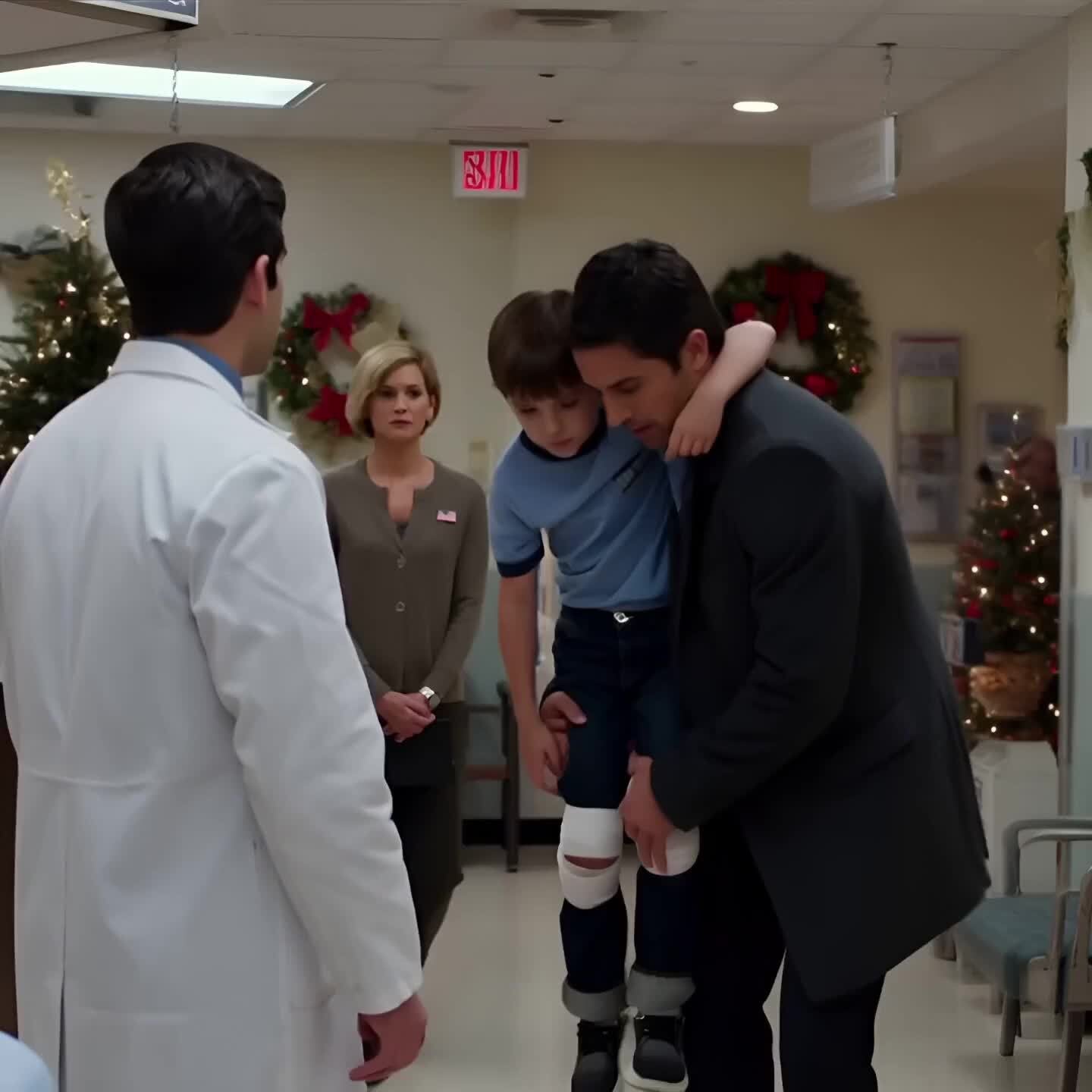
Son Limped “Aunt Made Me Kneel On Rice 6 Hours” — ER Called DCFS, I Called Someone Else.
Subscribe to Cheating Tales Lab. Now, let’s begin.
The concrete pour had started as a simple job—an early afternoon slab behind a row of new townhomes—but nothing stayed simple once the trucks rolled in.
By the time Mitchell Brown glanced at his phone, the light had shifted, the sky flattening into that pale California gray that came before sunset.
4:21 p.m.
The school pick-up window was already closing.
Mitchell had been trying not to look at the time all day, like ignoring it could buy him extra minutes.
He wiped his thumb across the screen, smearing a streak of dust.
He’d texted Donna at 3:52.
Can you grab Tyler? I’m stuck on site. I’ll be there by five.
Her response came back with a single word and a period.
Fine.
Donna Atkinson wrote like a judge passing sentence.
Mitchell stared at it for a moment longer than he should have.
He could have tried someone else.
He could have called Jerry’s wife, Missy.
He could have begged his neighbor.
He could have told the foreman he had to leave, even if it meant losing the overtime they depended on.
But the truth was, he’d made that exact choice too many times already—choosing between parenting and the bills, between promises and survival.
Some days it felt like the world kept asking him which part of his life he was willing to watch collapse.
He shoved the phone into his pocket and kept working.
Mitchell was thirty-four and built like a man who had never had the luxury of being soft.
Six-foot-two, broad shoulders, forearms lined with old scars and new abrasions, hands rough enough that paper towels felt like sand.
He’d been in construction since dropping out of college at nineteen, when Sarah called him crying and shaking and said she was pregnant and didn’t know what to do.
He’d told her they’d figure it out.
He’d meant it.
He still meant it.
Even now.
Especially now.
Because Sarah wasn’t here anymore to figure anything out with him.
Three years.
Three years since the hospital room smelled like antiseptic and artificial flowers.
Three years since Sarah’s skin had gone paper-thin, her hair falling out in soft clumps that she tried to hide like it was a bad haircut.
Three years since she’d looked at Mitchell with eyes dulled by pain medication but sharpened by fear, and she’d made him promise.
“Promise me you won’t leave Tyler alone with her,” she’d whispered.
Mitchell had tried to pretend he didn’t understand.
“Sarah—”
Sarah’s fingers had tightened around his hand with a sudden, startling strength.
“She’ll hurt him,” she’d said, voice breaking. “The way she hurt me. Promise me, Mitch.”
He’d promised.
He’d promised like it was the easiest thing in the world.
Like a vow could build a fence high enough to keep Donna out.
But promises were complicated when the closest family you had lived inside a phone and a memory.
Complicated when your shift ran late.
Complicated when the world didn’t pause for grief.
At 4:39, the foreman finally clapped Mitchell on the shoulder and told him to go.
Mitchell didn’t waste time.
He washed his hands quickly in a portable sink that never quite got the grime out, grabbed his keys, and jogged to his truck.
The parking lot at East View Elementary was nearly empty by the time he pulled in.
4:47 p.m.
A few cones stood near the curb.
A handful of teachers lingered at the doors, talking in the way people did when their day was over but their energy had nowhere to go.
An American flag snapped in the breeze above the office, faded but stubborn.
Sarah used to point flags out to Tyler when he was little.
“Look,” she’d say, smiling into his hair. “It’s waving at you.”
Mitchell killed the engine and sat for a beat with his hands on the steering wheel.
His chest felt tight in that familiar way—like he was always holding his breath without realizing.
He forced himself to move.
He climbed out and scanned the entrance.
Donna stood there like she belonged, floral dress crisp, purse held tight against her ribs.
Her silver hair was pulled back so severely it gave her face a permanent look of disapproval.
Some women wore grief like a bruise.
Donna wore it like armor.
“You’re late,” she said as Mitchell approached.
No hello.
No, Are you okay?
Just a verdict.
“Traffic,” Mitchell said.
It was easier than explaining the pour, the overtime, the way the world made him choose.
Donna’s gaze traveled down his jeans, his boots, the dried concrete flecks.
A flash of distaste.
Mitchell didn’t flinch.
“Where’s Tyler?” he asked.
“Bathroom,” Donna said. “He should learn to manage his time. Children need structure.”
Mitchell felt his jaw tighten.
Structure.
Donna always talked like a parenting book written by someone who hated kids.
The doors opened and Tyler stepped out.
Backpack slung over one shoulder.
Hair sticking up in the back like he’d been running his hands through it all day.
Sarah’s green eyes.
Sarah’s delicate mouth.
Mitchell’s long limbs beginning to show.
But Tyler didn’t bounce.
He didn’t chatter.
He didn’t race toward Mitchell the way he usually did.
He walked.
Slow.
Measured.
Like each step cost him something.
Mitchell’s stomach dropped.
“Hey, buddy,” Mitchell said, forcing cheer into his voice. “Ready to go?”
Tyler nodded.
“Yeah, Dad.”
His voice was too small.
Mitchell turned his eyes to Donna.
“What happened?”
“Nothing happened,” Donna said quickly. “He’s dramatic.”
Then, as if she couldn’t resist pressing the knife deeper:
“Like his mother.”
Tyler flinched.
Mitchell felt heat rise behind his eyes.
He leaned closer to Tyler, lowering his voice.
“You’re not in trouble,” Mitchell said. “I just need to know if you’re okay.”
Tyler’s eyes flicked to Donna, then back to Mitchell.
His nod was small and uncertain.
Mitchell swallowed his anger.
He’d learned how to swallow anger as a kid, in foster homes where adults held all the power and you survived by making yourself invisible.
“Let’s go,” he said.
Donna walked them to the parking lot.
At Mitchell’s truck, Tyler climbed in slowly.
When he bent his knees, he sucked in a sharp breath like pain had caught him by surprise.
Mitchell’s voice stayed calm.
“Tyler,” he said, “what happened?”
“Nothing,” Tyler whispered.
Donna leaned toward the open window.
“He fell playing,” she said. “Boys get scraped. You coddle him too much.”
Mitchell stared at her.
Her expression was pleasant.
Her eyes were cold.
“Thanks for picking him up,” Mitchell said.
Donna’s smile was thin.
“Of course,” she replied. “Someone has to help when you’re… busy.”
Mitchell started the truck.
As he pulled away, Donna lifted her hand in a wave that felt like dismissal.
He made it to the first stop sign before he spoke again.
“Tyler,” he said quietly, “look at me.”
Tyler stared at his lap.
“Look at me,” Mitchell repeated, firmer.
Tyler lifted his eyes.
They were wet.
Mitchell felt something crack.
“You’re not in trouble,” Mitchell said. “Nothing you tell me is going to make me mad at you. I just need the truth.”
Tyler’s mouth trembled.
“She said I needed discipline lessons,” he whispered.
Mitchell kept his hands steady on the wheel.
“Why?”
“I knocked over a vase,” Tyler said, voice shaking. “I didn’t mean to. It was on the edge of the table. I was reaching for my homework folder and—”
He swallowed.
“She got really mad.”
Mitchell’s knuckles whitened.
“What did she do?”
Tyler squeezed his eyes shut.
“She made me kneel on rice,” he said, and the words rushed out like he was afraid courage might vanish mid-sentence. “In a metal pan. In the kitchen. She set the timer.”
Mitchell felt his heartbeat turn heavy.
“How long?”
Tyler’s voice went so quiet Mitchell almost didn’t catch it.
“Six hours.”
The world narrowed.
Six hours.
Mitchell tasted metal.
He heard Sarah’s voice in his head, ragged and urgent.
She’ll hurt him.
“Let me see your knees,” he said.
Tyler hesitated.
Mitchell softened his tone.
“Buddy. Please.”
Tyler slowly pulled up his pant legs.
Mitchell’s breath caught.
Tyler’s knees were swollen and raw.
Skin torn.
Blood dried in places.
Tiny grains of rice embedded where they didn’t belong.
The flesh around the wounds was angry red.
Mitchell felt heat behind his eyes.
Rage.
Guilt.
A sick, sinking understanding that he’d failed a promise.
He pulled out his phone and took three photos, quick and precise, as if documentation could protect Tyler the way love hadn’t.
Then he started the engine again and turned toward St. Mary’s.
“We’re going to the hospital,” he said.
Tyler’s face panicked.
“Dad, I’m okay.”
“No,” Mitchell said. “You’re not okay.”
Tyler’s voice wobbled.
“Is Grandma going to be mad?”
Mitchell kept his eyes on the road.
“Grandma is going to be held responsible,” he said. “And none of this is your fault.”
Tyler cried silently, tears sliding down his cheeks.
Mitchell reached across and squeezed his son’s shoulder.
He remembered his own childhood too clearly.
A foster mother making him stand facing a wall for hours.
A man at a group home saying, “Pain builds character,” like cruelty was a lesson.
Adults turning harm into discipline.
He’d promised himself he’d never let that kind of adult near his kid.
And yet, here he was.
St. Mary’s emergency room was moderately busy.
The waiting area smelled like disinfectant and old coffee.
A toddler screamed with the primal outrage of exhaustion.
A man held an ice pack to his forehead.
A TV played quietly in the corner, people laughing on-screen while real pain sat in plastic chairs.
Mitchell carried Tyler in because Tyler couldn’t walk without wincing.
Tyler protested, embarrassed.
Mitchell didn’t give him the option.
At the intake desk, a tired-looking nurse glanced up.
Her name tag read: Kristen Schwarz.
One look at Tyler’s knees and her entire posture changed.
“Honey,” she said, softer, “how long ago did this happen?”
Mitchell answered.
“Today.”
Kristen pressed a button.
A curtain opened.
A wheelchair appeared.
They moved quickly.
In the treatment room, the smell of antiseptic grew sharper.
A young doctor stepped in—wire-rimmed glasses, kind eyes that didn’t flinch from what he saw.
“Dr. Julian Hudson,” he introduced himself.
Mitchell told him everything.
Not the softened version.
Not the polite version.
The truth.
As Mitchell spoke, Hudson’s expression grew grim.
“This is severe,” Hudson said. “There’s significant tissue damage, and foreign material embedded that needs removal.”
He paused and looked at Mitchell carefully.
“This is abuse. I’m a mandated reporter.”
Mitchell nodded.
“I know,” he said. “I want you to report it. Document everything. Every grain. Every bruise.”
Hudson’s eyes flickered—surprise, maybe, because too many parents came in trying to minimize.
“Okay,” Hudson said. “We will.”
Tyler lay pale on the bed, gripping Mitchell’s hand.
When the anesthetic went in, Tyler cried out once.
Mitchell felt that sound like a knife.
Hudson and a nurse worked carefully, removing rice grains and cleaning wounds.
Mitchell forced himself to watch.
If he looked away, he feared he’d lose control.
His phone buzzed.
Donna.
Mitchell stared at the screen.
He didn’t answer.
It buzzed again.
And again.
A voicemail icon appeared.
Mitchell didn’t listen yet.
He couldn’t.
A social worker arrived.
Andrea Harrison.
Forties, competent, compassionate, the kind of person who’d seen too much but still chose kindness.
She crouched beside Tyler so she wasn’t looming.
“Tyler,” she said gently, “can you tell me what happened at Grandma’s today?”
Tyler looked at Mitchell.
Mitchell nodded.
“You can tell her,” he said. “You’re safe.”
Tyler whispered the story.
The pan.
The rice.
The timer.
Donna’s voice.
“If you move, I add another hour.”
Donna sitting in her chair watching television while Tyler cried.
Tyler’s voice broke when he spoke about Sarah.
“She said Mom was weak,” Tyler whispered. “She said Mom never learned proper discipline.”
Mitchell felt something turn cold.
He excused himself.
In the bathroom, he locked the door and stared at his reflection.
His face looked calm.
His eyes did not.
He saw the foster kid version of himself—harder, sharper, built for survival.
He’d buried that man when he met Sarah.
Sarah had believed in gentleness.
She used to touch his cheek and say, “You can be safe now.”
Sarah was gone.
And Donna had reached Tyler.
Mitchell called Jerry.
It rang three times.
Jerry Duncan answered with a gravelly voice.
“Mitch?”
“I need a favor,” Mitchell said.
Jerry had been Mitchell’s foreman for eight years, built like a refrigerator, loyal in the way men were loyal when loyalty was earned.
Mitchell had once lent him fifteen thousand dollars without hesitation when Jerry’s daughter needed surgery.
They weren’t just coworkers.
They were the kind of friends you called when you were standing at the edge of something.
“Name it,” Jerry said.
“I need everything on someone,” Mitchell said. “Donna Atkinson. Carmichael.”
He gave the address.
“I need police reports, lawsuits, anything. And I need to know if she’s hurt anyone else.”
A pause.
“This about Tyler?” Jerry asked.
“Yeah.”
“How bad?”
Mitchell stared at the sink, at the water running clear over hands that had built houses.
“They’re pulling rice out of his skin,” Mitchell said. “She made him kneel for six hours.”
Silence.
Then Jerry exhaled.
“I’ll have what I can by morning,” Jerry said. “Keep Tyler close. Don’t answer Donna. Don’t let her spin this.”
Mitchell’s voice went quiet.
“She’s been spinning my wife’s whole life,” he said.
Jerry’s tone hardened.
“We’ll stop her,” Jerry said.
When Mitchell returned, Dr. Hudson was finishing bandages.
“We’re admitting him overnight,” Hudson said. “The wounds are deep. I want to watch for infection.”
Mitchell nodded.
Andrea touched his arm.
“DCFS will investigate,” she said. “We’ll likely go to Ms. Atkinson’s home tonight. Given the severity, I expect an emergency protective order.”
“Good,” Mitchell said.
He sat beside Tyler.
Tyler’s eyelids drooped from medication.
“You did nothing wrong,” Mitchell told him. “Nothing. What she did was cruel, and it’s never going to happen again.”
Tyler’s voice was soft.
“Is Grandma going to be mad at me?”
Mitchell kept his tone gentle.
“Grandma will not be near you again,” he said. “Sleep. I’m right here.”
After Tyler drifted off, Mitchell listened to Donna’s voicemail.
Her voice was sweet as honey.
“Mitchell, hi,” she said. “Tyler had a little tumble. Boys, you know. Don’t make a scene.”
Then, sharp as a blade:
“If you can’t handle being a single father, maybe you shouldn’t punish the people trying to help.”
Mitchell lowered the phone.
He didn’t feel like shouting.
He felt like breaking something.
Instead, he sat through the night in an uncomfortable chair beside Tyler’s bed.
He watched his son breathe.
He replayed Sarah’s last weeks.
He remembered the way Sarah avoided talking about childhood.
How she’d sometimes flinch when a door slammed.
How she’d wake from nightmares with tears on her cheeks and refuse to say what she saw.
Mitchell had assumed it was the cancer.
Now he wondered how much of Sarah’s life had been spent surviving Donna.
At 2:00 a.m., his phone buzzed.
Jerry.
Found something. Sarah wasn’t her first daughter. There was an older one. Disappeared in 1998. Call me.
Mitchell stepped into the hallway and called.
Jerry answered immediately.
“Tell me,” Mitchell said.
“Donna had two daughters,” Jerry said. “The older was Diana. Born ’76. Twenty-two when she disappeared in ’98.”
Mitchell’s throat tightened.
“There was a missing person report filed by a neighbor,” Jerry continued. “Donna claimed Diana ran away to Los Angeles to pursue acting. Case went cold. Diana was never found.”
Mitchell closed his eyes.
“Sarah never told me,” he said.
“Sarah was eleven when Diana vanished,” Jerry said. “Donna probably made sure that topic stayed buried.”
Mitchell leaned against the wall.
“What else?”
Jerry’s voice lowered.
“There was an incident in ’97,” he said. “Diana showed up at a hospital with a broken arm and cigarette burns. Told the ER doc her mother did it. Charges filed, then she recanted. Six months later, she vanished.”
Mitchell felt ice form in his chest.
“You think Donna killed her,” Mitchell said.
“I think it’s not random,” Jerry replied. “And Mitch… she sounds dangerous. Like genuinely dangerous.”
“I need everything,” Mitchell said.
“I’m digging,” Jerry promised. “Just keep Tyler safe.”
By morning, Tyler was awake, sipping apple juice, trying to smile like he hadn’t spent a night in pain.
Dr. Hudson checked his wounds.
“No infection yet,” he said. “That’s good. But these will scar.”
Tyler frowned.
“Like superheroes?” he asked, trying to make it lighter.
Hudson’s smile was gentle.
“Something like that,” he said.
Andrea returned.
“DCFS visited Donna’s home at seven,” she told Mitchell. “She denied everything. Claimed Tyler hurt himself and blamed her. She was… convincing.”
Mitchell felt his jaw clench.
“But we have medical evidence,” Andrea continued. “We filed for an emergency protective order. She won’t be allowed within five hundred feet of Tyler.”
Mitchell exhaled.
“What about criminal charges?”
“The DA is reviewing,” Andrea said. “Child endangerment, possibly assault. But older defendants who present well can be difficult.”
Donna presented well.
Donna cried on cue.
Donna smiled in church.
Mitchell stared at Andrea.
“There may be other victims,” he said. “Donna had an older daughter. Diana. She disappeared in 1998.”
Andrea blinked.
“That’s… not in our current file,” she said.
“It’s real,” Mitchell said. “I’m looking into it. I have a name.”
Andrea’s expression shifted.
“If you have evidence, we can coordinate,” she said carefully. “But I need you to understand: it won’t change Tyler’s case directly.”
“I understand,” Mitchell said. “I just want the truth on record.”
Tyler was discharged that afternoon.
Mitchell carried him to the truck.
Tyler clung to him differently now—not just from pain, but from the way trust had cracked.
At home, Mitchell propped Tyler on the couch with pillows.
He made grilled cheese and cut it into triangles the way Sarah used to.
Tyler ate slowly.
His eyes kept darting to the windows as if Donna might appear in the yard.
Mitchell’s phone rang.
Jerry.
“The PI found something,” Jerry said immediately.
Mitchell shut himself in his bedroom.
“Tell me.”
“Diana had a boyfriend in ’98,” Jerry said. “Spencer Harden. Alive. Lives in Portland now. Motorcycle repair shop.”
Mitchell’s chest tightened.
“I spoke to him,” Jerry continued. “Diana planned to leave. Saved money. Bought a bus ticket to Seattle for March fifteenth, ’98. Spencer was supposed to meet her there. She called him March fourteenth crying. Said Donna found the ticket and suspected. Told him: if anything happens to me, it’s Donna.”
Mitchell closed his eyes.
“And then she was gone,” Jerry said. “Donna told everyone she ran off to LA.”
“Did Spencer report it?” Mitchell asked.
“He tried,” Jerry said. “Donna painted him as a drug dealer because he had a possession charge when he was a teenager. Police didn’t take him seriously.”
Mitchell felt pieces click.
“Anything else?”
Jerry hesitated.
“Spencer says Diana believed Donna killed her dad,” Jerry said. “Poisoned him with medication and made it look natural.”
Mitchell exhaled.
“Spencer willing to talk now?”
“Yeah,” Jerry said. “He’s been waiting.”
Mitchell stared at his closet door like it could hold him up.
“I’m going to Portland,” he said.
“Mitch,” Jerry said quietly, “be careful.”
Mitchell’s voice went flat.
“I’ve been careful,” he said. “Careful is how she got close.”
That night, Mitchell set up a bed for Tyler downstairs.
Tyler fell asleep with his hand gripping Mitchell’s shirt.
Mitchell sat at the kitchen table and built what he knew how to build.
A plan.
A timeline.
A file.
Order.
Because the world had turned chaotic, and order was the only way he knew to fight back.
At midnight, a new text came.
This is Spencer. Jerry gave me your number. I’ve been waiting 27 years to tell someone what really happened to Diana. When can we talk?
Mitchell replied:
Tomorrow. I’ll come to you.
He booked a flight for Saturday.
Tyler would stay with Jerry and Missy.
Mitchell hated leaving, but he hated not going more.
On the plane, he stared out at the clouds and thought about Sarah.
About how she’d never spoken of a sister.
About how she’d turned quiet whenever Donna’s name came up.
About how she’d once said, after a holiday dinner, “She doesn’t love people. She loves control.”
Mitchell had dismissed it as bitterness.
Now it sounded like a warning.
Portland greeted him with fine rain that clung to his jacket.
He rented a car and drove to a weathered brick building with a hand-painted sign.
Harden Custom Cycles.
Inside, the air smelled like oil, metal, and old coffee.
A man in oil-stained jeans leaned over an engine.
Lean.
Weathered.
Late forties.
Eyes that had held a question for decades.
“You must be Mitchell,” the man said.
They shook hands.
Spencer’s grip was firm.
Working-man strong.
“Thanks for meeting me,” Mitchell said.
Spencer let out a breath like he’d been holding it for years.
“I’ve been waiting for this,” he said.
He led Mitchell into a cramped office.
Mitchell asked permission to record.
Spencer nodded.
Then Spencer talked.
He spoke about Diana like she might still walk through the door.
“She was nineteen when we met,” Spencer said. “Working at a diner. Saving tips in a coffee can hidden behind cleaning supplies.”
He shook his head.
“She never spent money on herself. She was always saving for leaving.”
Spencer described Donna in a way Mitchell recognized.
“A public version,” Spencer said. “Church smile. Cookie-baking. Then the door shuts and she changes.”
His voice roughened.
“Diana said she lived with two people,” he continued. “One who wanted applause. One who enjoyed hurting you.”
Mitchell’s throat tightened.
Spencer described the poisoning as Diana told it.
“Crushing pills,” Spencer said. “Mixing them into food. Her dad complaining he felt strange. Passing out. Donna acting worried.”
Spencer stood and disappeared into a back room.
When he returned, he held a cardboard box that looked like it had been opened and resealed a hundred times.
“Diana gave me this two weeks before she disappeared,” Spencer said. “She told me if anything happened, I needed to give it to police.”
Mitchell opened it carefully.
Spiral notebooks.
Pages filled with tight handwriting.
Dates.
Details.
Photos—faded now—of bruises and burns.
A small prescription bottle labeled with Diana’s father’s name.
Digoxin.
Mitchell stared.
“This is evidence,” he said.
Spencer laughed bitterly.
“I said that in ’98,” he replied. “They treated me like I was wasting their time.”
Spencer told Mitchell about March fourteenth, 1998.
A pay phone.
Diana crying.
Donna finding her bus ticket.
Threats.
Diana saying she was leaving that night.
Spencer waiting.
All night.
No Diana.
Spencer going to Donna’s house.
Donna answering calm.
Saying she drove Diana to Greyhound.
Spencer checking the station.
No ticket.
No record.
Spencer calling police.
Donna telling police Spencer was dangerous.
One old possession charge becoming a weapon.
“What do you think happened to her?” Mitchell asked.
Spencer met his eyes.
“I think Donna killed her,” he said. “Donna never let go of what she owned.”
Mitchell photographed pages, documented, took what he could without disrupting.
When he finally stood to leave, Spencer asked:
“Why are you doing this?”
Mitchell pictured Tyler’s swollen knees.
Pictured Sarah’s dying hand gripping his.
“Because someone has to,” Mitchell said. “And because my wife made me promise I’d protect our son. I failed once. I won’t fail again.”
Spencer nodded.
“What do you need from me?”
“Will you testify?” Mitchell asked.
Spencer didn’t hesitate.
“Absolutely,” he said. “I’ve been ready for twenty-seven years.”
On the flight back, Mitchell stared at the box like it weighed more than paper.
It was Diana’s voice.
It was Sarah’s silence explained.
It was proof.
But proof wasn’t the same as consequence.
The system moved slow.
Donna moved fast.
When Mitchell landed, he had a voicemail from Andrea.
“Mr. Brown, please call,” she said. “There’s a development.”
Mitchell called from the airport parking garage.
“What happened?”
“Donna filed a counter-complaint,” Andrea said. “She claims you coached Tyler. She’s petitioning for grandparent visitation.”
Mitchell closed his eyes.
“She’s saying Tyler fell while playing,” Andrea added. “That the injury was accidental.”
Mitchell felt rage flare.
“We have medical evidence,” he said.
“I know,” Andrea replied. “But Donna presents well. She has witnesses. The judge will hear both sides next week.”
Mitchell sat in silence, feeling the fight sharpen inside him.
He made phone calls.
To Jerry.
To a family law attorney—Ronald Fischer.
Ronald didn’t sugarcoat.
“Grandparent rights are real,” Ronald said. “Especially when one parent is deceased. If Donna convinces the judge contact is beneficial, she could get visitation. Supervised at first, maybe.”
Mitchell’s hands tightened.
“Even after this?”
“Judges err on preserving family relationships,” Ronald said. “And her lawyer will paint this as misunderstanding. A fall. A dramatic child. A bitter father.”
Mitchell looked at the evidence on his passenger seat.
“What do we do?” he asked.
“We present everything,” Ronald said. “Medical reports. DCFS recommendations. Tyler’s testimony. And anything else that shows a pattern.”
Mitchell’s voice went quiet.
“I have something,” he said.
At home, Tyler looked terrified when Mitchell walked in.
“Dad,” he whispered, “did Grandma say I’m lying?”
Mitchell sat beside him.
“She did,” he said. “But she’s the liar, not you.”
Tyler’s eyes filled.
“What if the judge believes her?” Tyler asked. “What if I have to see her again?”
Mitchell took his son’s hands.
“You won’t be alone with her again,” he said. “Whatever it takes.”
Later, alone in bed, Mitchell repeated the phrase in his head.
Whatever it takes.
He didn’t recognize himself.
But he recognized the fear.
The hearing came fast.
Sacramento County Family Court smelled like paper and old coffee.
Mitchell arrived with Ronald and Tyler.
Tyler wore a button-down Mitchell had ironed with trembling hands.
Donna sat across with her attorney—Timothy Blanchard, slick suit, practiced smile.
Donna’s posture was soft.
Her eyes were hard.
Judge Cheryl Harmon presided.
A no-nonsense woman in her sixties.
She reviewed medical reports.
Photos.
DCFS notes.
Then Blanchard called Donna.
Donna transformed.
Shoulders sagged.
Hands trembled.
Tears appeared.
She spoke about losing Sarah.
About grief.
About loving Tyler.
About the ‘misunderstanding.’
“That day,” Donna testified, “Tyler was playing outside. I had scattered rice to feed birds. He slipped and fell. He came inside crying. I cleaned his knees. He said he was fine.”
Mitchell stared.
The performance was flawless.
Blanchard called character witnesses.
Church friends.
Neighbors.
Book club.
All praising Donna.
A teacher suggested Tyler had honesty issues.
Mitchell felt the room tilt.
Ronald called Tyler.
Tyler’s voice shook, then steadied.
He described the rice.
The timer.
Donna sitting and watching.
Blanchard suggested confusion.
Tyler looked up.
“I know what happened to me,” he said. “Grandma hurt me on purpose. She said Mom was weak and she wouldn’t let me be weak.”
Judge Harmon called a recess.
Tyler pressed against Mitchell’s side.
“Did I do okay?” Tyler whispered.
“You did perfect,” Mitchell said.
When the judge returned, her expression was troubled.
“This is a deeply troubling case,” she said. “Tyler’s injuries are consistent with prolonged kneeling on rice. The medical evidence is compelling. However, family dynamics can be complicated, and well-meaning people sometimes misinterpret situations.”
Mitchell felt his hands clench.
“I’m issuing a temporary protective order,” the judge continued. “Ms. Atkinson will have no unsupervised contact for six months pending psychological evaluation and completion of parenting classes. Supervised visitation may be considered after that period if the evaluation is favorable.”
Six months.
A crack in the door.
Donna could wait.
As they left, Donna walked past and—when no one else was looking—smiled.
Cold.
Triumphant.
That night, Mitchell sat in his garage with the overhead light buzzing.
Lumber stacked in the corner from a deck job.
His hands were still.
His mind wasn’t.
He pictured Donna in therapy, crying her way back into Tyler’s life.
He pictured supervised visits.
Donna’s hand on Tyler’s shoulder.
Donna’s voice in Tyler’s ear.
He couldn’t allow it.
He called Jerry.
“I need to know if you’re willing to cross a line,” Mitchell said.
“What kind of line?” Jerry asked.
“The illegal kind,” Mitchell said.
A long pause.
“For Tyler?” Jerry asked.
“Yeah.”
Jerry exhaled.
“Then yes,” he said. “But you do it smart. You don’t leave traces. You document. You walk away.”
Mitchell swallowed.
Donna went to book club Friday nights.
She posted it like a badge.
Friday evening, Mitchell parked two blocks away.
He and Jerry approached from behind, using the orchard as cover.
The house was dark.
Mitchell’s pulse hammered.
They got inside without causing obvious damage, moving quietly.
The house smelled like lavender and old wood.
Spotless.
Controlled.
They searched methodically for anything connected to Diana.
In a spare room turned storage, Jerry opened a box.
Girls’ clothes.
A jacket that screamed the ’90s.
Jeans folded carefully.
Sneakers preserved.
Mitchell felt his throat tighten.
They opened more boxes.
Textbooks.
Photos.
Ticket stubs.
A diary.
A life cataloged.
“Trophies,” Mitchell whispered.
They found a scrapbook.
A memorial filled with clippings.
Notes in the margins:
“She was always so dramatic.”
“This wouldn’t have happened if she’d been obedient.”
They moved into the basement.
Unfinished.
Concrete.
Old furniture.
And in the far corner—a patch of newer concrete.
Color slightly off.
Surface smoother.
Roughly six feet by three.
Mitchell photographed it.
A minimal record.
Enough to prove it existed.
He made a small opening at the edge, careful not to disturb more than necessary.
Below the concrete was dirt.
And something pale.
He extracted a small scrap of deteriorated fabric.
Jerry’s voice went tight.
“We call police,” he said.
Mitchell nodded.
“Yes,” he said. “But not from here. Not like this.”
They put everything back.
They left.
Outside, Mitchell’s hands shook.
But his mind was cold and clear.
That night, he sat at the kitchen table and built a package.
Diana’s journals.
Spencer’s testimony.
A timeline.
Names.
A path for investigators.
He made an anonymous report to authorities and sent the evidence to the offices that needed to see it.
He didn’t dramatize.
He didn’t threaten.
He simply made it impossible to ignore.
By noon, police had contacted Spencer.
By afternoon, they had a warrant.
By evening, Donna’s house was surrounded by vehicles.
Mitchell heard from Andrea.
“There’s a major development,” she said. “Police are searching Donna Atkinson’s home for evidence related to Diana’s disappearance.”
Mitchell kept his voice neutral.
“That’s… unbelievable timing,” he said.
“It changes everything,” Andrea replied. “If they find what they suspect, Tyler will be protected permanently.”
Mitchell turned on the news.
Live footage.
Crime scene tape.
Officers moving in and out.
Neighbors watching.
Then the anchor’s voice sharpened.
“Human remains have been discovered in the basement.”
Mitchell closed his eyes.
Diana had been there all along.
Buried beneath concrete.
Tyler stood in the doorway.
“Dad,” he asked softly, “what’s happening?”
Mitchell pulled him into a hug.
“Justice,” he whispered. “Justice is happening.”
Donna was arrested that night.
Cameras caught her in handcuffs, fury on her face.
The story exploded.
Local became national.
Investigators exhumed Donna’s husband.
Evidence consistent with poisoning surfaced.
Former victims came forward.
Foster kids.
Neighbors.
Students.
A decades-long pattern.
Ronald called.
“Judge Harmon terminated Donna’s parental and grandparent rights permanently,” he said. “Protective order is indefinite. She has no legal access to Tyler.”
Mitchell didn’t feel victory.
He felt hollow.
Tyler was safe.
Diana was found.
Donna was finally seen.
But Sarah was still gone.
And Tyler still woke some nights crying.
Mitchell put them in therapy.
He sat in beige offices with tissue boxes and quiet voices.
He learned that trauma didn’t vanish because the person who caused it went to jail.
It lived in the body.
In flinches.
In “I’m sorry” said too often.
In eyes that checked the window at every sound.
The criminal case moved forward.
Spencer testified.
Diana’s journals were entered.
Dr. Hudson testified about Tyler’s injuries.
Andrea testified about DCFS findings.
Forensics testified about the basement.
Donna’s lawyers tried to paint Diana as unstable and Spencer as biased.
They tried to paint Mitchell as vindictive.
But the truth had weight.
Eventually, Donna agreed to plead guilty in exchange for consecutive life sentences.
On sentencing day, the courtroom was packed.
Mitchell sat behind Spencer.
Tyler did not attend.
Mitchell refused to let his son watch his abuser become a headline.
Donna stood with no floral dress, no church-lady smile.
Her mask was gone.
When offered a chance to speak, Donna said only:
“Diana was always dramatic. She made everything difficult.”
A gasp rolled through the courtroom.
Even Donna’s lawyer looked horrified.
Judge Harmon’s voice was ice.
“Ms. Atkinson,” she said, “you murdered your own daughter and buried her in your basement. You murdered your husband. You harmed children for decades and show no remorse.”
She paused.
“I sentence you to two consecutive life sentences without possibility of parole for the murders of Diana Atkinson and Robert Atkinson, plus additional decades for child abuse-related charges. You will die in prison.”
The gavel fell.
Donna was led away.
She looked at Mitchell once.
No triumph.
Only rage that she’d been caught.
Outside, Spencer found Mitchell.
“Thank you,” Spencer said, voice rough. “For believing.”
Mitchell nodded.
“Diana deserved justice,” Mitchell said.
“She did,” Spencer replied. “And she got it.”
Months later, Mitchell visited Sarah’s grave with Tyler.
Tyler carried flowers.
And a folded letter.
Mitchell didn’t read it.
He didn’t ask.
Some grief belonged only to the person carrying it.
Tyler knelt carefully beside the headstone.
His knees were scarred—thin white lines.
He tucked the letter into the soil.
“I miss you,” Tyler whispered.
Mitchell swallowed hard.
He felt the weight of the promise.
And the weight of what he’d done to keep it.
One evening, Tyler asked:
“Dad… how did the police find Diana?”
Mitchell’s chest tightened.
He kept his face calm.
“Someone who knew something finally came forward,” he said. “Sometimes it takes a long time for the truth to come out.”
Tyler frowned.
“Do you think Diana knows we found her?”
Mitchell looked at his son.
“I think wherever Diana is,” he said, “she’s not trapped anymore.”
Tyler nodded.
Then his voice went small.
“Are you okay, Dad? You seem different.”
Mitchell pulled him close.
“I’m okay,” he said. “I’m just glad you’re safe.”
It was true.
And it wasn’t.
Mitchell had changed.
Crossing lines left marks.
Some nights he woke sweating, not from nightmares of Donna, but from nightmares of himself.
The survival version.
The man Sarah had helped him bury.
Mitchell didn’t feel proud.
He felt responsible.
So he rebuilt.
He cut back hours.
He coached Tyler’s soccer team.
He learned to pack lunches and attend school meetings.
He learned to apologize.
Tyler learned too.
That fear had a name.
That what happened wasn’t his fault.
That scars meant you survived.
Jerry stayed close.
He never spoke about that Friday night.
Neither did Mitchell.
Some rooms stayed sealed.
Two years later, on a warm Saturday, Mitchell and Tyler stood in their backyard with lumber laid out.
Tyler was nine.
Taller.
Stronger.
Laughing more easily.
The scars on his knees were faint.
They were building a treehouse.
Not fancy.
Just solid.
Safe.
A place where Tyler could be a kid.
Tyler hammered nails carefully, tongue sticking out in concentration.
“This is going to be the best treehouse ever,” he declared.
“It is,” Mitchell said. “We’re building it right.”
Tyler grinned.
“Good foundation,” he said, repeating Mitchell’s favorite phrase.
Mitchell nodded.
“Good foundation.”
Tyler’s face turned serious.
“Just like us,” Tyler said.
Mitchell felt his throat tighten.
“We’re solid, right, Dad?” Tyler asked.
Mitchell set down the hammer and pulled him into a hug.
“Yeah, buddy,” he said. “We’re solid. Nothing’s going to shake us.”
The sun dipped low over Sacramento.
A neighbor’s sprinkler clicked on.
Someone down the street grilled burgers.
An American flag fluttered from a porch.
Normal life.
Mitchell watched Tyler climb into the treehouse, laughter echoing.
And for the first time in years, Mitchell felt something close to peace.
Not perfect.
Not clean.
But real.
The scars remained.
On Tyler’s knees.
On Mitchell’s conscience.
But they were healing.
They were survivors.
They were strong.
They were solid.
And they were finally, truly free.
This is where our story comes to an end. Share your thoughts in the comments section. Thanks for your time. If you enjoy this story, please subscribe to this channel. Click on the video you see on the screen and I will see you