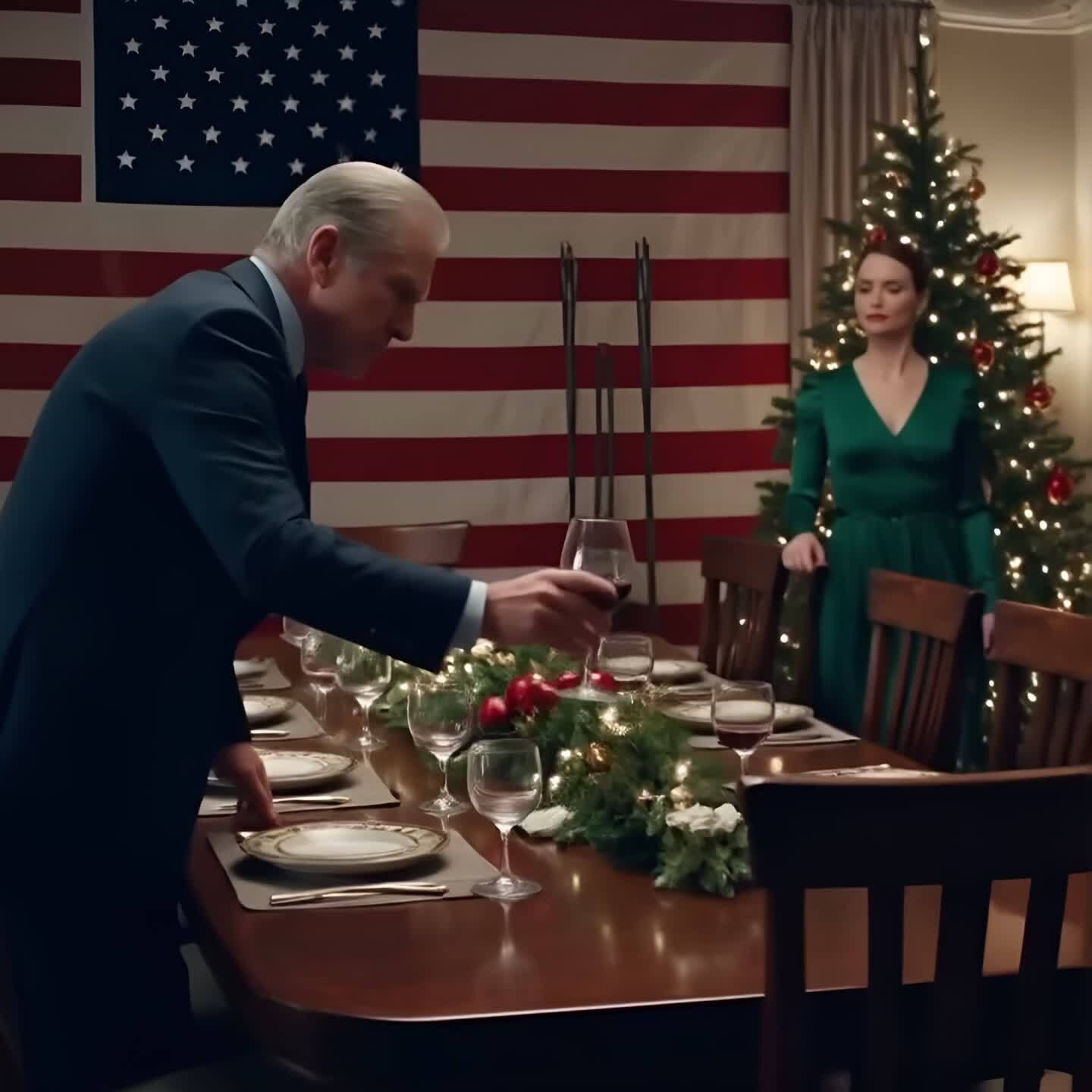
I had just served the ham I paid for, on plates I bought, under lights my name kept on, when my dad raised his glass and announced I was a leech who could not stay there anymore. I did not cry. I simply nodded and left. Ten minutes later, I found their secret account growing fat on money they swore they did not have. That was when Christmas stopped being about family and became about consequences.
My name is Brooklyn Moore, and for the last three years, I had convinced myself that paying the heating bill was the same thing as buying love. The kitchen in our split-level house in Brier Hollow smelled of rosemary, brown sugar, and the expensive hickory wood chips I had specially ordered for the ham. It was 2:00 in the afternoon on Christmas Day. My hands were red and raw from scrubbing potatoes, and there was a persistent ache in my lower back from standing over the stove since 6:00 in the morning. I was thirty-one years old, a grown woman with a career and a 401(k), yet here I was fretting over the texture of the mashed potatoes like a terrified child hoping to avoid a scolding.
Through the thin drywall of the kitchen, I could hear the television blaring in the living room. The football game was on at maximum volume. My father, Gary, was sitting in his recliner—the one with the broken lever that I had offered to replace last month. He refused the offer, claiming he liked the way it leaned, just as he refused to get up and help me set the table.
“Brooklyn!” His voice boomed over the sound of the referee’s whistle. “Where is the damn salt? The popcorn is bland.”
I wiped my hands on my apron. “It is in the cupboard, Dad. Second shelf, where it always is.”
“Bring it here!” he shouted back. “I’m watching the game.”
I paused. The timer on the oven was ticking down. The green beans needed to be sautéed. The gravy needed to be stirred so it would not form a skin. I took a breath, grabbed the salt shaker, and walked into the living room. Gary did not look at me. He just held out a hand, his eyes glued to the screen, his fingers greasy from the butter I had paid for. I placed the shaker in his palm and returned to the kitchen. That was the dynamic: I provided, and he consumed.
By 4:00, the table was set. I had bought the tablecloth at a boutique downtown because Mom said the old one was too stained for company, even though the only company was us. I had bought the crystal wine glasses because Gary complained that drinking wine out of mugs made him feel poor. I had bought the food, the decorations, and the gifts that sat under the tree.
“Dinner is ready,” I announced, my voice steady.
My mother, Maryanne, walked in from the patio where she had been smoking a cigarette. She looked at the spread and nodded—a tight, almost imperceptible dip of her chin. She did not say thank you. She sat at her usual spot, adjusting her napkin.
“Kylie,” I called out. “Time to eat.”
My sister came down the stairs. She was seventeen with the kind of nervous energy that made her look like she was constantly waiting for a loud noise to startle her. She gave me a small, apologetic smile as she slid into her chair. Gary lumbered to the head of the table. He picked up the carving knife and fork—tools he had not touched during the preparation—and looked at the ham.
“Looks a bit dry,” he muttered, slicing into the meat.
I sat down, unfolding my napkin. “It is basted perfectly, Dad. Just try it.”
We ate in relative silence for the first ten minutes. The only sounds were the scraping of silverware against the porcelain plates—plates I had purchased when the old set started chipping—and the heavy breathing of my father as he chewed. I watched them eat. I watched them consume the meal that had cost me three hundred dollars and eight hours of labor. I decided to break the silence. I had good news, and despite everything, a foolish part of me still wanted to share it with them. I wanted them to be proud.
“I got promoted last week,” I said, keeping my tone casual.
Kylie looked up, her eyes brightening. “Really? That is awesome, Brooke!”
“Yes,” I continued, looking at my parents. “Crestline Compliance Group is moving me up to senior analyst. It comes with a raise, and I even got a holiday bonus.”
It was $1,500. I mentioned the amount because money was the only language Gary and Maryanne understood. If I talked about my responsibilities or the team I was leading, their eyes would glaze over. But $1,500—that was real to them. Maryanne stopped chewing.
“$1,500. That is nice,” she said, taking a sip of her wine. “Does that mean you can handle the car insurance increase next month? The agent called and said rates are going up across the state.”
I felt a small pinch in my chest, the familiar sting of being seen as a wallet rather than a daughter. “I suppose I can look at it,” I said. “But I was hoping to save some of this bonus. Maybe put it toward a down payment on a place of my own eventually.”
The air in the room changed instantly. The temperature seemed to drop ten degrees. Gary stopped eating. He put his fork down with a deliberate clatter. He wiped his mouth with the back of his hand and reached for his wine glass. He stood up for a second. I thought he was going to make a toast. It was Christmas, after all. We were healthy. We were eating well. I had just been promoted. I looked up at him, waiting.
Gary looked down at me. His face was flushed, likely from the alcohol he had been drinking since noon, but his eyes were hard and clear. “You are a leech,” he said.
The words hung in the air, heavy and suffocating. The silence that followed was absolute; I could hear the hum of the refrigerator in the other room.
“Excuse me?” I asked, my voice barely a whisper. I thought perhaps I had misheard him.
“You heard me,” Gary said, his voice rising loud enough to rattle the glassware. “You are a leech, Brooklyn. You live in my house. You use my heat. You use my water. And now you sit here talking about saving money for yourself while your mother and I struggle to keep this roof over your head. You are selfish.”
I stared at him. The absurdity of his statement made me dizzy. “Dad, I pay the electric bill. I pay the water bill. I bought the groceries for this dinner. I paid for the new furnace last winter.”
“You pay a pittance!” he shouted, slamming his hand on the table. The gravy boat jumped. Kylie flinched, her knuckles turning white as she gripped her water glass. “You think buying a ham gives you the right to strut around here like you own the place? You are thirty-one years old. It is embarrassing. Everyone at the club asks me why my adult daughter is still clinging to my leg.”
He did not go to a club. He went to a dive bar where he complained to anyone who would listen.
“You can’t stay here anymore,” Gary announced, pronouncing each word with venomous finality. “I am done carrying you. Get out.”
I looked at my mother. Surely, she would step in. Surely. She knew the math. She knew who transferred the money every month to cover the mortgage shortfall. She knew who paid for her prescriptions when the coverage gap hit. Maryanne did not look at me. She stared down at her plate, pushing a piece of carrot around with her fork.
“Well,” Maryanne said, her voice cold and devoid of affection. “If you leave, the health insurance is still in your name. You are still paying that for us this month, right?”
That was the knife. It went in deep, right between the ribs. It was not a question of where I would go, or if I would be safe, or why her husband was throwing their daughter out on Christmas. It was a question of logistics. It was a question of extraction.
Kylie looked at me, her eyes wide and terrified. Her hand was shaking so badly that water sloshed over the rim of her glass. She opened her mouth to speak, but Gary shot her a warning glare, and she snapped her mouth shut, looking down at her lap.
I felt a strange sensation wash over me. It was not sadness. It was not hysteria. It was clarity. It was the same feeling I got at work when I found a discrepancy in a compliance report—a cold, hard realization that the numbers did not add up and that swift action was required. I did not cry. I did not argue. I did not beg. I picked up my fork, speared a piece of ham, and put it in my mouth. I chewed slowly, tasting the hickory smoke and the salt. I swallowed. Then, I placed the fork down on the edge of the plate, aligning it perfectly with the knife.
“I understand perfectly,” I said.
The room was silent again. Gary looked almost disappointed that I had not made a scene. He wanted the drama. He wanted the shouting match where he could play the victim, the long-suffering father burdened by an ungrateful child. I stood up. I picked up my plate.
“What are you doing?” Gary asked, sitting back down.
“Cleaning up,” I said.
I walked to the sink, scraped my leftovers into the trash, and rinsed my plate. I placed it in the dishwasher. Then, I turned and walked out of the kitchen, past the dining table where my family sat like statues.
As I walked down the hallway to my bedroom, my mind began to toggle into work mode. I was no longer a daughter; I was an auditor, and I was beginning the process of closing a fraudulent account. Electricity account number ending in 45502: in my name. Internet Comcast Business Package: in my name. Water and sewage, City of Brier Hollow: in my name. Streaming services—Netflix, Hulu, HBO: in my name. Cell phone plan, family bundle: in my name. Car insurance, multi-driver policy: in my name. Life insurance policies: in my name. The list scrolled through my head with the precision of a spreadsheet.
I entered my bedroom and closed the door. I turned the lock. The click was the most satisfying sound I had heard all day. My room was small. It was the same room I had slept in since I was ten, though I had repainted it and bought new furniture with my own money three years ago when I moved back in to help them out after Dad’s injury. An injury that mysteriously prevented him from working, but not from playing golf or fixing his motorcycle.
I walked over to the filing cabinet in the corner. It was a gray metal two-drawer unit I had bought at an office supply store. This was my domain. This was where the truth lived. I opened the top drawer. Inside were color-coded folders: green for income, red for debts, blue for household utilities. I pulled out the blue folder. I needed to see the dates. I needed to know exactly when the billing cycles ended. If I was leaving, I was leaving cleanly. I would not give them a single kilowatt of electricity I was not present to consume.
I grabbed a duffel bag from the closet and started throwing clothes into it: jeans, sweaters, my work blazers. I moved with mechanical efficiency. I would stay until the weekend, just two days, to get my affairs in order and find a storage unit. But in my mind, I was already gone. I was already calculating the deposit on a new apartment.
I went back to the file cabinet to grab my birth certificate and social security card. They were in the back in a fireproof pouch. As I reached deep into the drawer, my fingers brushed against something unfamiliar. It was a thick manila envelope taped to the underside of the drawer above it. It had come loose, the tape yellowing and failing, and dropped down behind my neatly organized files.
I frowned. I was the only one who used this cabinet, or so I thought. I pulled the envelope out. It was heavy. There was no return address, just a bank logo stamped in the corner: First National of Brier Hollow. That was not our bank. We banked at Stonebridge Credit Union. I had moved all the family accounts there two years ago because the fees were lower. I turned the envelope over. It was addressed to Gary Moore.
My heart rate picked up. I sat down on the edge of my bed, the mattress sinking under my weight. I hesitated for a moment. Opening someone else’s mail was a federal offense. But then I remembered the words he had just spoken to me: You are a leech. I slid my finger under the flap and tore it open. Inside was a paper statement, a quarterly summary. I unfolded the document. The paper was crisp. The date on the statement was from last month, November.
My eyes scanned the lines. I expected to see a debt. I expected to see a final notice for a loan he had taken out without telling me—some gambling debt or a bad investment he was hiding. That fit the narrative of the struggling, injured father. But the numbers were in black, not red.
Opening balance: $42,000. Deposit Nov 1st: $2,000. Deposit Dec 1st: $2,000. Closing balance: $46,000.
I blinked. I read it again. $46,000.
For three years, they had told me they were destitute. For three years, they claimed they could not afford heating oil. For three years, I had handed over seventy percent of my paycheck to keep this house running, believing I was saving my parents from homelessness. I looked at the transaction history. The deposits were regular, monthly, and the source of the deposits was listed simply as: Rental Income, 401 Main St.
My blood ran cold. 401 Main Street was my grandmother’s old house. They told me they had sold it five years ago to pay for Kylie’s braces and Gary’s medical bills. They told me it was gone. They had not sold it. They were renting it out, and they were funneling every single penny into a secret account while I paid for their turkey, their electricity, and the roof over their heads.
I looked at the door of my bedroom down the hall. Gary was probably laughing at the TV, drinking the wine I bought, secure in the knowledge that he had put his leech of a daughter in her place. I folded the statement and slipped it into my purse. I wasn’t just leaving. I was preparing a counterstrike.
The house was finally quiet, settling into the heavy, suffocating silence that only comes after a catastrophe. It was 2:00 in the morning. Outside, the wind was whipping through the bare branches of the oak trees in the backyard. But inside my bedroom, the air was stagnant. I had not slept. I could not sleep. The adrenaline that had kept me upright during dinner had cooled into a hard, crystalline resolve.
I was packing, but not in a panic. I was folding my clothes with military precision, stacking them into the cardboard boxes I had pulled from the attic weeks ago, originally intending to use them for donating old coats to charity. Now I was the charity case. Or at least that was the narrative Gary and Maryanne had spun.
I paused, my hand hovering over a stack of sweaters. The manila envelope I had found in the filing cabinet earlier—the one containing the bank statement for the secret account—was sitting on my nightstand. It seemed to pulse under the lamplight. It was a physical manifestation of betrayal. But my gut told me it was only the surface. You do not hide $46,000 just to have a safety net. You hide that kind of money because you are planning something.
I walked back to the filing cabinet. If they had missed that envelope, what else had they been careless with? My parents were not criminal masterminds. They were lazy narcissists. Laziness leaves a paper trail. I pulled the bottom drawer all the way out. This was the junk drawer of the cabinet, usually reserved for warranties on toasters that died ten years ago and instruction manuals for VCRs we no longer owned. I sat cross-legged on the floor and started sifting.
Beneath a stack of old TV guides and a tangled mess of extension cords, I found a clear plastic file folder. It was new. It crinkled as I pulled it out. Inside, there was a glossy brochure. On the cover, a silver behemoth of a vehicle drove along a scenic coastal highway: The 2025 Fleetwood Bounder, Life Without Limits. It was a luxury RV, a motorhome. I opened the brochure. Circled in red marker was the 35-foot model with the optional fireplace and the leather upgrade package. The base price was $140,000.
Paperclipped to the brochure was a handwritten note on a sticky pad. I recognized the scrawl immediately. It was Gary’s handwriting—spiky, aggressive, all caps.
DOWN PAYMENT $50,000. CHECK READY. FINANCING APPROVED. DELIVERY SCHEDULED FOR JANUARY 2ND. TELL NEIGHBORS IT IS A RENTAL.
I felt the blood drain from my face. I looked at the date on the sticky note. It was dated three weeks ago. I grabbed the bank statement from the nightstand and held it next to the brochure. The $46,000 in the secret account was not retirement money. It was not an emergency fund. It was the down payment for a toy.
The pieces slammed together in my mind with the force of a car crash. Every time Gary had sighed and said he could not afford the heating oil, he was banking the cash for this RV. Every time Maryanne had looked at me with sad, wet eyes and said they might have to cut back on groceries, they were picking out leather interiors. They were not poor. They were diverting funds. They were using me as a human ATM to cover their living expenses so they could hoard their own income for a grand exit.
The “leech” comment at dinner was not just an insult. It was a distraction. It was a projection. They needed me to feel guilty so I would keep paying the bills right up until the moment they drove off into the sunset. And the date, January 2nd—they were going to let me pay the January mortgage, which was due on the 1st. They were going to let me pay the health insurance premiums for the new year. And then, once the checks cleared, they were going to take delivery of their land yacht and kick me to the curb.
I felt a wave of nausea so strong I had to close my eyes. I had been eating ramen noodles for lunch to save money. I had canceled my gym membership. I had driven my car on bald tires for six months because Gary said they needed $500 to fix a leak in the roof—a leak I never actually saw. I was not a daughter to them. I was a venture capital firm with zero return on investment.
A soft scratching sound at my door made me jump. I shoved the papers under my pillow and stood up, my heart hammering against my ribs.
“Brooklyn.” The whisper was barely audible.
I unlocked the door and opened it a crack. Kylie was standing there. My seventeen-year-old sister looked like a ghost. She was wearing her oversized pajamas, her hair a tangled mess, and her eyes were red and swollen. She looked over her shoulder at the dark hallway, checking to see if our parents were awake.
“Can I come in?” she breathed.
I stepped back and let her in, engaging the lock quietly behind her. Kylie stood in the middle of the room, hugging herself. She looked at the boxes on the floor, at the half-emptied closet, and fresh tears welled up in her eyes.
“You are really leaving, aren’t you?” she asked, her voice cracked.
“I have to, Kylie,” I said softly. I sat on the edge of the bed, moving the pillow to cover the documents completely. “You heard Dad. He kicked me out.”
Kylie sat on the floor, pulling her knees up to her chest. She looked small, too small for a girl who was about to graduate high school. “They planned it,” she said. The words came out in a rush, as if she had been holding them in until she physically couldn’t anymore.
I froze. “What do you mean?”
“I heard them,” Kylie said, wiping her nose with her sleeve. “Two nights ago, they were in the garage smoking. They didn’t know I was doing laundry in the mudroom. Dad said…” She paused, her lower lip trembling. “Dad said they just needed to wait until you paid the December bills. He said the Christmas bonus you usually get would cover the property tax, and once that was paid, they could cut you loose.”
I stared at her. Confirmation. Hearing it from my little sister hurt worse than deducing it from the papers. It meant it was a spoken conspiracy. “Did they say why?” I asked, my voice deadly calm.
Kylie nodded. “They said you were getting too nosy about the finances. Dad said you asking about the electricity usage was a sign you were trying to take over. He said…” She looked down at the carpet. “He said you were dead weight now that the house is paid off.”
The house was paid off. They told me they were still underwater on the mortgage. That was why I paid $1,500 a month in rent—to help them cover the bank note.
“But that isn’t the worst part,” Kylie whispered. She looked up at me, her eyes wide with terror. “When I made a noise, Dad came to the door. He didn’t see me, but he yelled into the house. He said, ‘If anyone warns her, they are next.’ He told Mom that if I opened my mouth, I would be the one paying the bills, or I would be on the street too.”
I reached out and touched her shoulder. She flinched, then leaned into my hand. “I am sorry, Kai. I am so sorry you have to live in this war zone.”
“There is something else,” she said. She was picking at a loose thread on her pajama pants. “You know how Mom goes to the specialist for her back and the migraines?”
I nodded. “Dr. Evans. I pay the co-pays. I handle the deductibles. Why?”
“Dr. Evans isn’t an orthopedist,” Kylie said. “He is a plastic surgeon. And the other place she goes, the wellness center? It is a medical spa.”
I felt the room spin. “What?”
“She isn’t getting physical therapy,” Kylie said, her voice dropping to a harsh whisper. “She is getting Botox. She is getting fillers. She got that cool-sculpting thing done on her stomach last month. She tells you it is pain management, so the insurance coding looks weird, but she brags about it on the phone to Aunt Brenda when you aren’t home. She laughs about it. She says, ‘Brooklyn’s corporate plan covers the best maintenance.’”
I stood up. I walked to the window and looked out at the dark street. I thought about the last six months. I had skipped my annual dental cleaning because I wanted to save the $50 co-pay to buy Mom a heating pad for her “bad back.” I had been wearing glasses with a scratched lens because I didn’t want to spend money on contacts, forcing myself to squint at spreadsheets all day. Meanwhile, Maryanne was getting Botox on my dime. She was literally beautifying herself with the money I earned by destroying my own health.
“How long have you known?” I asked, not turning around.
“A while,” Kylie admitted. “But I was scared, Brooke. I am still scared. If they find out I told you…”
“They won’t,” I said. I turned back to her. “Look at this.” I pulled my phone out of my pocket and opened my banking app. I navigated to my savings account and held the screen out for Kylie to see. Available balance: $2,140.
Kylie gasped. “I thought you had… I thought you were saving for a condo.”
“I was,” I said, putting the phone away. “I had $25,000 saved two years ago. It is all gone, Kylie. The new water heater, the transmission on Dad’s truck, the emergency vet bills for the dog we don’t even have anymore. I am one month away from zero. If I stayed here another two months, I would be bankrupt.”
Kylie put her face in her hands and started to cry silently. “We are awful. This family is awful.”
“No,” I corrected her. “They are awful. You are a hostage, and I was the bank.”
I walked over to the closet and pulled down a heavy shoebox from the top shelf. It was marked Warranties. I sat on the floor and opened it. Inside was my armor.
“What is that?” Kylie asked, wiping her eyes.
“Receipts,” I said. “Proof of ownership.” I started laying them out on the floor like tarot cards. “The stainless steel refrigerator: purchased by Brooklyn Moore, June 2023. Serial number recorded. The Persian rug in the living room: purchased by Brooklyn Moore, December 2022. The 65-inch OLED TV Gary was watching football on: purchased by Brooklyn Moore, Super Bowl Sunday, 2024. The washer and dryer: purchased by Brooklyn Moore. Kylie’s MacBook Pro for school: purchased by Brooklyn Moore.”
I picked up the receipt for the laptop. “This one is yours,” I said, handing it to her. “Keep it hidden. If they try to take your computer away or sell it, you show the police this paper. It is in my name, and I am authorizing you to use it. They cannot touch it.”
Kylie took the slip of paper as if it were a holy relic. “Thank you.”
“I have the serial numbers for everything,” I said, my voice hardening. “The dining table, the microwave, even the damn toaster oven. I paid for all of it.”
I looked at the pile of receipts, then at the bank statement on the bed, and finally at the brochure for the RV. I had a complete picture now. It wasn’t just a dysfunctional family dynamic. It was a systematic financial extraction. They had hollowed me out dollar by dollar, lie by lie, intending to discard the husk when there was nothing left to take.
I stood up and paced the small room. The anger was vibrating in my fingertips. I wanted to march into their bedroom, kick open the door, and throw the RV brochure in Gary’s face. I wanted to scream until the windows shattered. I wanted to wake up the neighbors and tell them exactly what kind of monsters lived at number 405.
But then I looked at Kylie. She was terrified. If I exploded now, tonight, the fallout would hit her. Gary would know she had talked. Maryanne would turn her psychological warfare on the only target left in the house. And if I confronted them now, they would go into damage control mode. They would hide the money better. They would destroy the brochure. They would gaslight me, call me crazy, call the police and say I was threatening them. They would spin the story before I even stepped out the door.
I had two choices. Option A: I could unleash hell right now. I could get the satisfaction of seeing the fear in their eyes, but it would be messy. It would be emotional, and it might give them a chance to maneuver. Option B: I could finish packing. I could leave quietly before the sun came up. I could let them think they had won. Let them think the leech had been shamed into fleeing. I could let them feel comfortable, secure in their victory, waiting for the consequences to arrive—not with a scream, but with the silent, crushing weight of a systemic shutdown.
I looked at the clock. It was 2:45 in the morning. I looked at the receipts on the floor.
“Go to bed, Kylie,” I said quietly. “Lock your door.”
“What are you going to do?” she asked, standing up.
“I am going to leave,” I said. “But I am not leaving them anything.”
Kylie slipped out of the room, closing the door soundlessly behind her. I sat back down on the floor, surrounded by the paper trail of my stolen life. I picked up the receipt for the refrigerator. If I confronted them, it was a fight. If I left silently, it was a war. And I knew exactly how to win a war: you cut off the supply lines.
The morning after Christmas, I woke up to the smell of strong coffee and the sound of sirens in the distance. I was not in my childhood bedroom with the peeling wallpaper. I was on a beige pullout sofa in apartment 4B of the Brierwood complex, about five miles from the house I had fled in the middle of the night. My entire life was currently contained in three cardboard boxes and a duffel bag stacked neatly against the wall.
Janelle, my best friend since the third grade and a trauma nurse who worked the graveyard shift, was standing in the kitchenette. She was wearing scrubs that looked like they had seen a war zone, her hair pulled back in a messy bun. She held out a steaming mug.
“Drink,” she commanded gently. “It is Earl Grey. I put extra honey in it because you look like you’re about to collapse.”
I sat up, the thin blanket falling away. My back ached from the sofa springs, but it was a good ache. It was the ache of freedom. “Thank you,” I said, taking the mug. My hands were steady. That surprised me. I expected to be shaking, to be a mess of tears and regret, but the cold clarity from the night before had not evaporated. It had hardened into something like steel.
“I have to get to work,” Janelle said, leaning against the counter. “But I made a list. The Wi-Fi password is on the fridge. There is leftover lasagna in the oven, and I wrote down the numbers for the local legal aid clinic just in case.”
She didn’t ask what happened. She didn’t need to. When I had shown up at her door at 3:00 in the morning, dragging my life behind me, she had simply unlocked the deadbolt and started making the bed. That was Janelle. She dealt with gunshot wounds and car accidents; a family implosion was just another Tuesday for her.
“I am going to handle it,” I said, taking a sip of the tea. “Today is Administrative Day.”
Janelle nodded. “Good. If Gary shows up here, do not open the door. Call the cops, then call me. In that order.”
After she left, I opened my laptop. It was time for Operation Cutoff. I sat at Janelle’s small dining table, treating it like my desk at Crestline Compliance Group. I opened a fresh spreadsheet. Column A was the Service Provider. Column B was the Account Number. Column C was the Status.
I started with the power company. The hold music was a tiny version of a classical symphony. I waited for twenty minutes. When the representative finally answered, her voice was cheerful, a stark contrast to the demolition I was about to initiate.
“Thank you for calling Tri-State Electric. How can I help you today?”
“Hi,” I said, my voice flat. “My name is Brooklyn Moore. I am the account holder for the residence at 12 Oak Street, account number ending in 45502.”
“Okay, Ms. Moore, I see that here. Are you calling to make a payment?”
“No,” I said. “I am calling to schedule a disconnect.”
There was a pause. “A disconnect? Are you moving?”
“I have already moved,” I replied. “I need the service taken out of my name effective immediately. Today.”
“Well, we usually need a few days’ notice,” the rep said. “And if there are other residents in the home, we advise transferring the service so they do not lose power.”
“The other residents are capable adults,” I said. “They can call and open their own account. I want my liability to end as of this phone call. Please process the request.”
“Okay.” She sounded hesitant. “I can take your name off, but the power will be shut off tomorrow morning at 8:00 if no one else assumes the account.”
“Tomorrow at 8:00 is perfect,” I said. “Please send the final bill to this new email address.” I gave her the secure email I had created ten minutes ago. I hung up and typed PENDING DISCONNECT in the spreadsheet.
Next was the water department, then the gas company, then the trash collection. Then came the big one: Comcast. Gary lived for his cable package. He had the premium sports tier, the movie channels, and the highest speed internet available for his online poker games. The bill was $240 a month. It was auto-paid from my checking account on the 28th. That was two days from now.
I navigated to the website. I logged in. I didn’t just cancel the auto-pay; I canceled the entire service. Reason for cancellation: Moving out of service area. The website tried to offer me deals. It tried to beg me to stay. I clicked confirm with a vicious satisfaction. The screen flashed: Service will be terminated in 24 hours. The silence in the house was going to be deafening without the football game blaring. They would have to sit in the quiet and look at each other.
I moved down the list: Netflix, Hulu, HBO Max, Spotify Family Plan. I went into the settings for each account. I selected Sign Out of All Devices. Then I changed the passwords to a random string of sixteen characters that I wrote down in my physical notebook. Somewhere in Brier Hollow, on a television screen mid-stream, a loading circle was spinning.
The final piece of the utility puzzle was the cell phone plan. We were on a family bundle. I was the primary account holder because my credit score was 750 while Gary’s was somewhere in the basement. I called the provider.
“I need to separate my line from the group,” I told the agent. “I want to keep my number, but I’m leaving the family plan.”
“Okay,” the agent said. “What would you like to do with the other three lines? There is a Gary, a Maryanne, and a Kylie.”
I hesitated. Leaving Kylie without a phone felt wrong. She was my lifeline. She was the spy behind enemy lines. “Keep Kylie Moore on my new plan,” I said. “I will assume financial responsibility for her line. But the other two—Gary and Maryanne…”
“Yes?”
“Release them,” I said. “They are no longer my responsibility. They will need to set up their own billing.”
“Understood. We will send a text notification to those lines letting them know they have 48 hours to secure a new plan before service is suspended.”
I authorized the change. 48 hours. The clock was ticking.
By noon, I had severed every logistical tie that bound me to 12 Oak Street. But the financial tie was the most dangerous one. I drove to the Stonebridge Credit Union branch on the other side of town, far away from the one my parents used. The air outside was biting cold, gray and grim, matching the mood of the day.
I sat across from a loan officer named Sarah. She looked young, maybe my age, with kind eyes behind thick glasses. “I need to open a new checking and savings account,” I said. “And I need to transfer everything from my existing account at this institution. Every cent.”
Sarah typed on her keyboard. “Okay, let me pull up your profile. Brooklyn Moore. Ah, here we are. I see you are currently linked to a joint account with Gary Moore.”
“No,” I corrected her sharply. “That is a mistake. My personal account is solo. The joint account was closed three years ago.”
Sarah frowned, squinting at the screen. “I see a Gary Moore listed as an authorized user on your primary checking. It says he was added six months ago.”
My blood ran cold. “I did not authorize that.”
“It says here the authorization came via a phone request with verbal password verification,” Sarah said.
I gripped the edge of the desk. They had guessed my security question. Or maybe they just knew it. What was the name of your first pet? They knew the name of the dog. They bought the damn dog.
“He has access?” I asked, my voice tight. “Has he made withdrawals?”
Sarah clicked a few more keys. “I see two attempted transfers in the last week. Both declined due to insufficient funds in the savings portion. But the checking… it looks like he has been moving $50 here, $20 there. Small amounts. Under the radar.”
I felt sick. It wasn’t just the big RV scheme. They were skimming off the top, nickel-and-diming me for lunch money while I worked sixty hours a week.
“Close it,” I said. “Close it all, right now.”
“I can do that,” Sarah said, seeing the panic in my eyes. “We will open a fresh account, new number, new security protocols, and we will put a flag on your social security number for any internal inquiries.”
“Please,” I said. “And I want two-factor authentication on everything. If someone sneezes near my money, I want a text message about it.”
We spent the next hour locking down my financial identity. I transferred the remaining $2,000—my entire net worth—into the new account. It wasn’t much, but it was mine.
“One more thing,” Sarah said, lowering her voice. “Since you are worried about unauthorized access, I can see the login history for your old online banking profile.”
“What do you see?”
“There were three failed login attempts in the last 24 hours,” she said, “from an IP address in Brier Hollow. They were trying to reset your password, but they failed the security questions regarding your recent transaction history.”
I nodded slowly. Of course they were. They couldn’t get into the account because I had changed the password last night before I left, but they were trying to brute-force their way back in.
“They are locked out now,” Sarah assured me. “Permanently.”
I walked out of the bank with a new debit card in my pocket and a sense of grim satisfaction. I got back to Janelle’s apartment around 2:00. My phone buzzed. It was a text from Kylie.
Mom is freaking out. She says she can’t log into the electric bill to see how much we owe. She keeps asking if I know your banking password because she needs to deposit a check for you.
I stared at the screen. Deposit a check? The lies were effortless for them. They didn’t want to deposit anything. They wanted to drain whatever was left before I noticed the RV money.
I typed back: Do not give her anything. Tell her you don’t know. Stay in your room.
A second later, another buzz. An email notification popped up on my phone: Subject: Password Reset Request – Crestline Compliance Group Employee Portal.
I froze. They were trying to get into my work email. If they got into my work email, they could find my HR records. They could find my direct deposit information. They could sabotage my job.
I sat down at the table and opened a fresh notebook. I picked up a black pen. I wrote EVIDENCE LOG at the top of the page.
Date: December 26th. Time: 14:00 hours. Event: Unauthorized password reset attempt on employer email account. Source IP: Likely 12 Oak Street residence.
I logged the bank attempt Sarah had told me about. Time: Various intervals over the last 24 hours. Event: Three failed login attempts to personal banking profile. Witness: Sarah, Stonebridge Credit Union Branch Manager.
I logged the text from Kylie. Time: 14:10 hours. Event: Third-party confirmation that Maryanne Moore is actively seeking banking credentials under false pretenses.
This was not a family dispute anymore. This was a case file.
My phone rang. It was an unknown number. I let it go to voicemail. Then it rang again, and again. I looked at the screen. It was Aunt Brenda, Maryanne’s sister. I silenced the phone. They were circling the wagons. They had realized that the silence from my end was not a sulk. It was a severance.
I thought back to the dinner table, Gary’s voice booming You are a leech. I realized now that he hadn’t believed it. He knew I wasn’t a leech. He knew I was the host. The parasite does not kick the host out—unless the parasite is stupid, or unless the parasite thinks it has found a new host. But the RV wasn’t a host. The RV was a metal box that burned gas. They had miscalculated. They thought they had enough money stashed away to survive without me, but they had forgotten the burn rate of their own lives. They had forgotten who paid the premiums that kept their health insurance active. They had forgotten who paid the data plan that let them look up RV parks.
They thought I would come back. They thought I would be sitting in my car in a parking lot crying, waiting for them to call and forgive me so I could come home and pay the mortgage for January. They didn’t expect me to go to the bank.
I looked at my evidence log. I looked at the PENDING DISCONNECT status on the utilities. I wasn’t just leaving. I was watching the bridge burn, and I was taking notes on the structural failure.
My phone buzzed again. A text from my provider: ALERT: Data Usage Warning. Line ending in 8832 (Gary) has attempted to purchase an International Roaming Pass. Charge Declined. Account is Restricted.
I smiled. It was a cold, humorless smile. “Welcome to the real world, Dad,” I whispered to the empty room. “I hope you have cash.”
By 10:00 the next morning, my phone had stopped being a communication device and had transformed into a weapon of mass harassment. I was sitting on Janelle’s floor, surrounded by the cardboard boxes that contained my life. When the onslaught began, it was not my parents calling. They were too smart for that. They knew that if they called, I might record them, or I might simply not answer. So, they had deployed the flying monkeys.
The first call was from my cousin Mike, a man I had not spoken to since his wedding four years ago. He left a voicemail saying he was “disappointed” that I would abandon family during the holidays. The second was from my Great Aunt Shirley, who left a rambling message about the Bible and the commandment to honor thy father and mother, conveniently forgetting the verses about parents not provoking their children to wrath.
But the ringleader was Aunt Brenda. Brenda was my mother’s older sister, a woman who treated gossip like a competitive sport and family drama like a spectator event. She called four times in twenty minutes. Finally, I picked up. I needed to know the narrative they were spinning. I needed to know the enemy’s position.
“Hello, Aunt Brenda,” I said. My voice was calm, the voice I used when explaining a compliance violation to a defensive executive.
“Brooke!” Her voice was shrill, laced with a performative concern that made my skin crawl. “Oh, thank heavens. We have been so worried. Your mother is sick with worry. She has not eaten since yesterday.”
I looked at the half-eaten bagel on Janelle’s table. “I am sure she will manage,” I said.
“How can you be so cold?” Brenda asked, her tone shifting from concern to accusation in a heartbeat. “To storm out like that on Christmas… Gary told us everything. Brooklyn, he told us how you threw a tantrum because he gave you a little constructive criticism about your spending habits.”
I almost laughed. The audacity was breathtaking. “Is that what he said?” I asked.
“He said I threw a tantrum. He said he tried to talk to you about saving money, about being more responsible for the future, and you just snapped.” Brenda continued, gathering steam. “He said you felt entitled to the house because you buy a few groceries now and then. Brooklyn, honey, you are thirty-one. You cannot expect your parents to cater to your every mood. You need to grow up.”
There it was: the rewrite. In their version, I was the bratty, ungrateful child who couldn’t handle a lecture. They had completely excised the part where Gary stood up, humiliated me, and ordered me to leave.
“Brenda,” I said, cutting through her monologue. “Did he tell you he kicked me out?”
There was a pause on the other end, a beat of silence that told me everything.
“What?” Brenda asked, her voice faltering slightly.
“Did Gary tell you that he stood up at the dinner table, raised his glass, called me a leech, and explicitly stated, ‘You can’t stay here anymore’?” I asked. I enunciated every syllable.
“Oh, Brooklyn, do not exaggerate,” Brenda scoffed, recovering her footing. “Gary would never do that. He loves you. He is just… he is under a lot of pressure with his injury. He said you took a suggestion the wrong way and packed your bags to punish them.”
“I see,” I said. “So the narrative is that I am the aggressor.”
“We want to fix this,” Brenda said, pivoting to her real agenda. “I am hosting a family meeting tonight at my house. 7:00. Your parents will be there. Pastor Miller will be there. We want to sit down, air these grievances, and get you back home where you belong. We need to adjust your attitude, Brooklyn, for your own good.”
A family meeting. A tribunal. I knew exactly what that would be. It would be Gary crying crocodile tears about his bad back. It would be Maryanne looking frail and victimized. It would be the pastor talking about forgiveness while I was pressured to apologize for being evicted. They wanted me back in the house not because they missed me, but because the first of the month was five days away and they needed a check.
“I will not be there, Brenda,” I said.
“You have to be!” she insisted. “If you do not come, you are proving them right. You are proving that you do not care about this family.”
“I care about the truth,” I said. “And I have the receipts to prove it.”
“Receipts?” She sounded confused. “What are you talking about?”
“Have a nice evening, Brenda,” I said, and hung up.
I blocked her number immediately. Then I blocked Mike. Then Aunt Shirley. I looked at Janelle, who had just woken up and was watching me from the kitchen doorway.
“Do you have a printer?” I asked.
Janelle nodded. “In the closet. Ink might be low, but it works. Why?”
“I need to prepare a counter-brief,” I said.
For the next two hours, the only sound in the apartment was the rhythmic whirring of Janelle’s laser printer. I logged into the utility portals—the ones I had canceled yesterday—and downloaded the billing history for the last six months. I downloaded the mortgage transfer confirmations from my old bank statements. I downloaded the credit card statements showing the grocery runs, the pharmacy co-pays, the internet bills. I created a stack of paper two inches thick.
Then I took a yellow highlighter. September electric bill: $240. Paid by Brooklyn Moore. October heating oil: $600. Paid by Brooklyn Moore. November property tax installment: $1,200. Paid by Brooklyn Moore.
I highlighted every single line item that kept that house functioning. It was a sea of yellow neon. It was indisputable. If Gary wanted to claim I was a leech, he would have to explain why the leech was the one feeding the host.
My phone buzzed with a text message. It was Kylie. Are you okay? Aunt Brenda is here. She is screaming at Mom about how you are unstable.
I typed back: I am fine. Just stay out of the way.
Kylie sent an image file a moment later. I found this in the kitchen trash. Mom tried to rip it up but she didn’t do a good job.
I opened the image. It was a photo of a piece of notebook paper, torn in half and then crumpled. Kylie had flattened it out on her bedspread. It was Maryanne’s handwriting, her loopy, decorative script. A to-do list.
1. Call Dr. Evans. Reschedule Botox for Jan 5th. 2. Cancel Cable. Switch to streaming. Ask Brooklyn for password. 3. January Mortgage: Wait for Transfer. 4. The Talk: After bills paid (Jan 2nd).
Next to number four, there was a little check mark, but then it was scribbled out as if she had changed the timeline.
I stared at the screen. “The Talk.” That was what they called my eviction. And the note explicitly said, After bills paid. They had jumped the gun. Gary had gotten drunk and impatient at dinner and fired the shot before the ammunition was secured. That was their mistake. That was my leverage.
“Look at this,” I said to Janelle, holding up the phone.
Janelle squinted at the screen. “Wait for Transfer… meaning your money?”
“Meaning my paycheck,” I said. “They had a schedule. They were going to bleed me for one last month.”
Janelle shook her head. “That is cold, Brooke. That is ice cold.”
“It gets worse,” I said. I refreshed my email inbox. There was a new message from Tri-State Electric. The subject line read: URGENT: Request to Restore Service.
I clicked it open. Dear Ms. Moore, We received a call at 10:45 AM regarding your request to disconnect service at 12 Oak Street. The caller, identifying herself as Brooklyn Moore, stated that the disconnection request was made in error due to a computer glitch and requested immediate restoration of the account status. However, the caller was unable to provide the new security PIN you established yesterday. We have denied the request pending your verification.
I felt a chill go down my spine that had nothing to do with the winter draft. “They tried to impersonate me,” I whispered. “Maryanne. It had to be Maryanne. She was the one who handled the phone calls.”
She had called the power company, pretended to be me, and tried to undo the cancellation. This was not just a toxic family dynamic anymore. This was identity theft. They were not just trying to get the lights back on; they were trying to put the liability back on my social security number. They wanted the bill in my name, but the control in their hands.
I sat back in the chair. The anger I had felt yesterday was hot and volatile. This new feeling was different. It was cold. It was heavy. It was the weight of a judge’s gavel.
“They are trying to commit fraud,” I told Janelle. “They are trying to use my identity to secure services they cannot afford.”
Janelle sat down opposite me. “So, what about this family meeting Brenda is organizing? Are you going to go and throw these papers in their faces?”
I looked at the stack of highlighted bills. I looked at the photo of the to-do list. I looked at the email from the electric company. If I went to Brenda’s house, I would be walking into an ambush. It would be four against one. They would shout over me. They would cry. They would twist my words. Gary would play the victim, and Brenda would act as the judge, jury, and executioner. No amount of paper evidence would matter in a court of public opinion where the jury was rigged.
I did not need to win an argument in Brenda’s living room. I needed to win a case in the real world.
“No,” I said. “I am not going to the meeting.”
“Good,” Janelle said. “So what is the plan?”
I picked up the printed email from the electric company and stapled it to the top of my evidence stack. “I am going to call a lawyer,” I said. “I am going to draft a cease and desist letter, and I am going to make sure that the next time Gary hears from me, it won’t be a text message. It will be a summons.”
I picked up my pen and opened my notebook to the evidence log. Date: December 27th. Time: 10:45 hours. Event: Attempted identity theft. Impersonation of account holder to Tri-State Electric. Suspect: Maryanne Moore.
I wrote it down with a steady hand. The family meeting could go on without me. Let them eat cake. Let them talk about how terrible I was. Let them spin their stories. While they were talking, I would be building a wall—a wall made of legal statutes, restraining orders, and fraud alerts.
I turned to Janelle. “Can I borrow your car? I need to go to the police station to file an informational report about the impersonation attempt. I want it on record before they try it with the bank.”
Janelle tossed me her keys. “Go get them, Tiger.”
I grabbed my coat. The time for being a daughter was over. The time for being a plaintiff had begun.
The digital clock on Janelle’s microwave read 8:45 in the evening. It was Tuesday, two days after the bills had been canceled, and the silence from my parents’ house had been total. No texts, no calls, just a vacuum where my family used to be.
I was sitting on the sofa bed, which was currently folded up to give us some living space. My laptop was open, and I was reorganizing my resume. I had decided that Brier Hollow might be too small for me now. The air here felt recycled, tainted by the toxicity radiating from 12 Oak Street.
Janelle was in the kitchen making popcorn. She had just finished a twelve-hour shift at the hospital and was wearing oversized sweatpants and a t-shirt that said NURSES CALL THE SHOTS.
“Do you want butter on this?” she asked, shaking the pan.
Before I could answer, the room shook. It wasn’t an earthquake. It was a sound so loud, so violent, that it vibrated through the floorboards and rattled the windowpanes. Someone was hammering on the front door of the apartment. Thud. Thud. Thud.
I froze. My heart hammered against my ribs, matching the rhythm of the blows.
“JANELLE!” A voice roared from the hallway. “I KNOW SHE IS IN THERE! OPEN THE DAMN DOOR!”
It was Gary. My stomach dropped. He didn’t sound like my father. He sounded like a stranger, a wild animal caught in a trap. His voice was thick, slurred, and laced with a rage I had never heard before—not even when he broke his leg, not even when he lost his job at the plant ten years ago.
Janelle dropped the popcorn pan on the stove. She moved instantly, her trauma nurse training kicking in. She didn’t scream. She pointed at me and mouthed: Phone.
I grabbed my cell phone. My hands were trembling, but I forced my fingers to unlock the screen.
“BROOKLYN!” Gary screamed. He kicked the door this time. The impact sounded like a gunshot. “YOU UNGRATEFUL LITTLE BRAT! YOU COME OUT HERE! YOU THINK YOU CAN JUST TURN OFF THE LIGHTS? YOU THINK YOU CAN CUT ME OFF?”
I could hear doors opening down the hallway. The neighbors were coming out. Mrs. Higgins from 4A. The young couple from 4C.
“Sir, you need to lower your voice,” I heard a neighbor say tentatively.
“SHUT UP!” Gary bellowed. “THIS IS FAMILY BUSINESS! MY DAUGHTER IS IN THERE HIDING LIKE A COWARD WHILE HER MOTHER SITS IN THE DARK!”
I dialed 911.
“911, what is your emergency?” The operator’s voice was calm, a lifeline in the chaos.
“My name is Brooklyn Moore,” I said. I was surprised by how steady my voice sounded. It was small, but it was clear. “I am at the Brierwood Apartments, Building 4, Unit B. There is a man trying to kick down the door. He is violent. He is threatening the residents.”
“Is the man known to you?”
“Yes,” I said. “It is my father.”
Thud. The door jumped in its frame. I saw a fine dusting of plaster fall from the top hinge. The deadbolt was holding, but the wood around it was old. Janelle was standing by the hallway entrance, her phone raised. She was recording video. Her face was set in a hard line.
“I am recording this, Gary!” she shouted through the door. “The police are on their way! Go home!”
“I am not going anywhere!” Gary yelled back. “Not until that leech comes out here and fixes what she broke! You ruined my life, Brooklyn! You hear me? You ruined everything!”
He wasn’t talking about the electricity. He was talking about the RV. He was talking about the $46,000 he was going to burn through while I paid his mortgage. He was talking about the loss of his host.
“Ma’am, are you safe?” the operator asked.
“The door is holding for now,” I said, watching the wood splinter near the lock plate. “But he is kicking it. Please hurry.”
“Officers are dispatched. They are two minutes away. Stay away from the door.”
I backed up until my legs hit the sofa. I felt like a cornered animal. But beneath the fear, there was a cold, simmering anger. He had come here, to my sanctuary, to the home of the only person who had helped me, and he was bringing his violence to our doorstep.
“OPEN IT!” Gary shrieked.
There was a sickening crack. The top hinge gave way slightly, creating a sliver of light between the door and the jamb. I could see him through the crack. His face was purple. His eyes were bulging. He looked insane.
Suddenly, a new voice entered the hallway. Deep. Authoritative. “Hey! Back away from the door, buddy. Now!”
It was Marcus, the building’s night security guard. He was a retired Marine, sixty years old, but built like a tank.
“Get out of my face,” Gary snarled. “I am getting my daughter.”
“You are trespassing,” Marcus said.
I could hear the scuffle, the sound of fabric tearing. Then a heavy thud against the opposite wall. “Stay down! Do not move!”
Sirens wailed outside, cutting through the winter air. Blue and red lights flashed against the living room curtains, painting the walls in a chaotic strobe effect. Police voices shouted from the stairwell: “Hands where we can see them!”
I stayed on the line with the dispatcher until she told me it was safe to hang up. Then I looked at Janelle. She lowered her phone. Her hand was shaking now.
“Are you okay?” she asked.
“No,” I said. “I am not.”
There was a sharp rap on the door. “Police Department. Is anyone inside?”
I walked to the door. The wood around the lock was chewed up, splintered where Gary’s boot had connected. I undid the deadbolt and opened it. Two uniformed officers stood there. Behind them, pinned against the wall by a third officer, was Gary. He was panting, his shirt untucked, his hair wild. When he saw me, his eyes narrowed into slits of pure hatred.
“There she is,” he spat. “Tell them, Brooklyn! Tell them this is a misunderstanding. Tell them to let me go!”
I looked at him. I looked at the man who had raised me, the man who had taught me to ride a bike, the man who had sat at the head of the dinner table three days ago and told me I was garbage. I did not say a word to him. I turned to the officer in front of me. His badge read Officer Miller.
“I am Brooklyn Moore,” I said. “This is my apartment. That man does not live here. He was not invited here.”
“He claims he is your father and he was checking on your welfare,” Officer Miller said, looking from the splintered doorframe back to me. “He says you ran away and have been unresponsive.”
“I am thirty-one years old,” I said. “I moved out because he evicted me on Christmas Day. And he’s here because I cut off the utilities that were in my name.”
Gary struggled against the officer holding him. “She is lying! She is stealing from us! She cut off the heat to her sick mother!”
I walked back to the table where my evidence stack was sitting. I picked up the folder. I had organized it yesterday, creating a timeline of the escalating harassment. I walked back to Officer Miller and opened the folder.
“This is a log of the attempted unauthorized access to my bank accounts from his IP address in the last 48 hours,” I said, pointing to the first page. “This is a copy of the email from the electric company where his wife impersonated me to try and restore service this morning. And this…” I flipped to the photo Kylie had sent me, the to-do list. “This is their written plan to evict me only after I paid their bills for January. I left before they could execute it. This is not a welfare check, Officer. This is retaliation for financial abuse that I put a stop to.”
Officer Miller looked at the documents. He looked at the log of calls. He looked at the shattered doorframe.
“He tried to break down the door,” Janelle added, stepping forward. “I have it on video. He was threatening to kill her.”
“I did not say that!” Gary screamed. “I said I would make her pay!”
“That sounds like a threat to me,” Officer Miller said dryly. He turned to his partner. “Get him out of here. Put him in the cruiser.”
Gary’s face went slack as the handcuffs clicked. He looked at me, realizing for the first time that his shouting was not working. The audience—the neighbors, the police, the security guard—was not on his side.
“Brooklyn,” he pleaded, his voice cracking. “Do not do this. It is Dad. I am sorry about the door. I just lost my temper. You know how I get.”
“Yes,” I said softly. “I know exactly how you get.”
Officer Miller turned back to me. He held a notepad. “Ms. Moore, given the damage to the property and the threats witnessed by your neighbors and the security guard, we have grounds for criminal mischief and disorderly conduct. Do you want to press charges?”
The hallway went silent. The neighbors were watching. Janelle was watching. Gary was watching, his eyes wide with a mixture of fear and disbelief. He expected me to fold. He expected the daughter who had paid the bills for three years to absorb this blow too, to smooth it over, to pay for the door and apologize to the police for wasting their time.
I took a deep breath. The air smelled of ozone and cheap cologne.
“Yes,” I said.
Gary gasped. “Brooklyn!”
“And,” I continued, my voice gaining strength, “I want to file for an immediate emergency restraining order. I want him kept away from my residence and my place of employment.”
“Understood,” Officer Miller said. “We will process the paperwork tonight.”
They dragged Gary toward the elevator. He was shouting now, incoherently, calling me a traitor, a snake, a leech. But as the elevator doors closed, cutting off his voice, the silence that rushed back into the hallway was heavy and sweet. I leaned against the doorframe, my knees suddenly feeling like water.
“You did it,” Janelle whispered, putting a hand on my back.
“I did,” I said. I felt hollowed out, scraped clean.
My phone buzzed in my pocket. I pulled it out, thinking it might be the police dispatcher again, or maybe Aunt Brenda calling to scream at me for arresting her brother. It was a text from Kylie.
They took him. I saw the lights.
I typed back: Yes. He is arrested. Are you safe?
Three dots appeared. Then the message came through. Mom is going crazy. She is tearing the house apart looking for money. But Brooklyn… listen to me.
A second message followed immediately. While Dad was gone, Mom went into your old room. She had a screwdriver. She forced the lock on your closet.
My heart stopped. I had cleared out most of my clothes, but I had left a few things behind—things I couldn’t carry in the first trip, things I thought were safe because they were locked up.
What did she take? I typed, my fingers flying.
She took your DSLR camera, Kylie replied. The expensive one you use for your side gigs. And she took your backup laptop, the silver one. She put them in her bag and drove off right before the police called to say they had Dad.
I stared at the screen. The camera was worth $2,000. The laptop was an older model, but it was worth at least $800.
“What is it?” Janelle asked, seeing my face pale.
“They have pivoted,” I said, my voice dead. “They realize the accounts are locked. They realized I am not paying the bills. So now they are looting.” I looked up at Janelle. “Maryanne just stole my camera and my computer. They aren’t trying to manipulate me anymore, Janelle. They are liquidating me.”
I looked at the empty hallway where my father had stood. I thought the restraining order was the end of it. I thought drawing the line was the victory. But you cannot draw a line with people who are willing to burn the map.
“I need to go to the police station,” I told Janelle. “I need to add theft to the file.”
“Tonight?” Janelle asked. “You are exhausted.”
“If I don’t report it tonight,” I said, grabbing my coat, “by tomorrow morning those things will be sold. And I need every single piece of paper to prove that this isn’t a family dispute. It is a crime spree.”
I walked out the door, stepping over the splintered wood of the doorframe. My father had broken the door to get in. My mother had broken the lock to steal. Christmas was definitely over.
The fluorescent lights of the police station were humming with a frequency that seemed to drill directly into my skull. It was 3:00 in the morning. I was sitting at a metal desk across from a Detective Henderson, a man who looked like he had seen everything and was impressed by none of it. I was not crying. I was not shaking. I was organizing papers.
My phone sat on the table between us, the screen glowing with a text message from Kylie that had arrived twenty minutes ago.
She went to Oakland Pawn on 4th Street. She came back with cash. She is bragging to Aunt Brenda on the phone that she ‘liquidated some assets’ to cover the distress Brooklyn caused.
Liquidated assets. That was the phrase my mother used. As if stealing my camera and laptop was a strategic portfolio rebalancing rather than a felony.
“Ms. Moore?” Detective Henderson said, tapping his pen on his notepad. “You are sure these items were taken tonight?”
“I am certain,” I said. I reached into my accordion folder, the evidence packet that was quickly becoming the most important object in my life. I pulled out two stapled documents.
“This is the purchase receipt for a Canon EOS R6 camera, bought eighteen months ago from B&H Photo,” I said, sliding the paper across the desk. “Price: $2,400. Serial number: 210449.”
I slid the second paper. “This is the receipt for an Apple MacBook Air, purchased three years ago. Serial number: C02W… well, it is all there. Value at time of purchase: $900.”
Henderson picked up the papers. He looked at the serial numbers, then at me. “Most people do not keep receipts like this,” he observed.
“I work in compliance,” I said. “Paper trails are my religion. My mother broke into a locked closet in my former residence, removed these items without my permission, and sold them to a pawn shop. That is theft by conversion. It is also trafficking in stolen property.”
Henderson nodded slowly. “If the serials match, it is an open-and-shut case. We will pay a visit to Oakland.”
The next twelve hours were a blur of procedural bureaucracy that felt strangely comforting. The law does not care about feelings. The law does not care that Maryanne Moore wiped my nose when I was three, or that she taught me how to make stuffing. The law only cares about who holds the title and who took the property.
By the afternoon, I was back at the station. Henderson had news.
“We recovered the items,” he said. “They were still in the hold cage at the pawn shop. The owner was very cooperative once we mentioned the serial numbers.” He turned his computer monitor so I could see it. “And we have video.”
I watched the screen. The footage was grainy, black and white, timestamped from the previous night. I saw my mother walk into the pawn shop. She was wearing her good coat, the camel hair one I had bought her for her birthday two years ago. She did not look like a frantic woman trying to keep the lights on. She looked annoyed. She looked like someone running a tedious errand.
She hoisted my camera bag onto the counter. She slapped the laptop down next to it. She haggled with the broker. I watched her gestures—sharp, dismissive. Then I saw something that made my blood freeze. While the broker was typing up the pawn ticket, Maryanne pulled out her phone. She typed a message. She looked at the phone, smirked—a small, cold tightening of her lips—and then put it back in her pocket just as she signed the pawn slip.
“Can you pause that?” I asked.
Henderson hit the space bar. “What is it?”
“Check the timestamp,” I said. “21:14 hours.”
I pulled out my own phone. I scrolled back through my messages. At exactly 9:14 the previous night, I had received a text from Maryanne. I hadn’t replied to it. I hadn’t even really processed it in the chaos of Gary’s arrest. I held my phone up next to the monitor.
The text read: You owe me for the electricity you used this month. Consider this a down payment on your debt. Do not bother coming back for your junk.
“She confessed,” I whispered.
Henderson looked at the text, then back at the video of Maryanne signing the legal declaration that she was the rightful owner of the goods.
“She is claiming it was debt collection,” Henderson said, rubbing his chin. “But you cannot just seize assets to settle a civil dispute without a court order. And signing that pawn slip declaring she owned them… that is fraud. I want that text message added to the file,” I said. “She admits she took them. She admits she considered them payment. It proves intent.”
I saved the screenshot. I backed it up to the cloud. I emailed it to Janelle. This text message was not just an admission of guilt; it was the final nail in the coffin of our relationship. She wasn’t holding my things hostage to get me to come home. She was selling them because she felt entitled to every dollar I had ever generated.
I left the station with my camera and laptop in the trunk of Janelle’s car. I should have felt relieved. Instead, I felt a cold, surgical precision taking over my mind. If they were going to nickel-and-dime me, I was going to audit them into oblivion.
I remembered what Kylie had said about the medical visits. She is getting Botox. She is getting fillers.
I went back to Janelle’s apartment. I sat down at the table and opened my laptop. I logged into the health insurance portal. The policy was still active until the end of the month. I was still the primary policyholder. I pulled up the claims history. There were dozens of claims from a “Wellness Institute of Brier Hollow.” The provider was listed as Dr. Evans.
I clicked on the Explanation of Benefits for a visit from three weeks ago. Service Code: 97140. Myofascial Release. Patient Responsibility: $40.
Myofascial release. It is a legitimate therapy for muscle pain, but it is also a code frequently used by shady clinics to bill insurance for facial massages and spa treatments. I looked at the frequency: twice a week, every week. I cross-referenced the dates with my own calendar. On November 12th, Maryanne had texted me saying she was in agony with a migraine and needed me to pick up dinner because she couldn’t stand. I looked at the claim for November 12th. Service Code: 97110. Therapeutic Exercise.
She wasn’t in agony. She was at the spa.
I picked up the phone and called the insurance provider’s fraud department.
“My name is Brooklyn Moore,” I told the representative. “I am the policyholder for group number 7784. I want to flag a series of claims for review.”
“What is the nature of the concern?” the agent asked.
“I have reason to believe the services rendered to the dependent Maryanne Moore are cosmetic in nature and are being miscoded as physical therapy,” I said. “I also want to place a privacy lock on the account immediately.”
“A privacy lock?”
“Yes,” I said. “No changes are to be made to this policy without in-person verification at a local branch with a photo ID. No password resets over the phone. No adding or removing dependents via the web portal. And I want to revoke all authorization for Maryanne Moore to speak to representatives regarding billing.”
“Okay,” the agent said, the clicking of her keyboard audible. “I have set the lock. Maryanne will need your explicit permission to access any information.”
“She won’t get it,” I said.
I hung up. I sat there for a moment, looking at the screen. A week ago, I would have felt guilty. I would have worried that maybe she really was in pain, that maybe I was being too harsh. I would have tried to understand her perspective. But the daughter who tried to understand was gone. She had been replaced by a plaintiff. I was no longer family. I was a creditor, and they were a bad debt I was writing off.
The sun was setting, casting long shadows across the living room. My phone pinged. It was Kylie again.
Brooklyn, something weird just happened.
I called her immediately. “Are you safe? Is Gary back?”
“No, Dad is still in holding. I think Aunt Brenda is trying to bail him out, but the judge set it high because of the threats,” Kylie whispered. She sounded like she was hiding in a closet. “But the mail just came.”
“The mail?” I asked. “Kylie, I don’t care about their mail.”
“You should,” she said. “The mailman delivered a letter here. It is addressed to you, but it has our address on it. Not your new PO box.”
“Who is it from?”
“It is from First National of Brier Hollow,” Kylie said. “The bank where they have the secret account.”
I frowned. “I don’t have an account at First National. I bank at Stonebridge.”
“I know,” Kylie said. “That is why it is weird. The envelope says Important Information Regarding Your Loan Application.“
My stomach dropped. “Open it.”
“I can’t. It is a federal offense,” Kylie said, her voice trembling.
“Kylie, open the damn envelope,” I commanded. “If they are using my name, I need to know.”
I heard the sound of paper tearing. There was a pause.
“Oh my god,” Kylie breathed.
“Read it to me,” I said. “Read every word.”
“Dear Ms. Moore,” Kylie read. “Congratulations. Your application for a personal unsecured loan in the amount of $20,000 has been approved pending final signature verification. Please visit the branch to finalize the funds disbursement.”
“$20,000,” I repeated. “Is there a date on the application?” I asked, my voice shaking with rage.
“It says application received December 24th,” Kylie said.
December 24th. Christmas Eve. The day before the dinner. The day before the explosion.
They didn’t just want the RV, I realized. They wanted me to pay for it twice. They had applied for a loan in my name using my social security number—which they had from tax forms years ago—and used their address so I wouldn’t see the correspondence. They were going to take the $20,000, add it to their secret stash, buy the RV, and leave me with the debt.
“Send me a picture of that letter,” I told Kylie. “Do not let Mom see it. Hide it. Burn it if you have to, but get me that picture first.”
“I got it,” Kylie said. “Sent.”
I stared at the image loading on my screen. It wasn’t just theft. It wasn’t just fraud. It was financial assassination. They had tried to bury me. They had dug a hole, intending to push me in and drive away in a luxury motorhome while I spent the next ten years paying off their vacation.
I looked at the letterhead: First National. I picked up my pen. I opened my evidence log to a fresh page. Date: December 28th. Incident: Identity Theft. Bank Fraud. Perpetrator: Gary and Maryanne Moore. Evidence: Loan approval letter for unauthorized application.
I closed the notebook. I wasn’t just going to defend myself anymore. I was going to prosecute. I was going to make sure that when the dust settled, the only thing they owned was the silence they had created.
The image of the letter from First National of Brier Hollow was still burning on my phone screen, a pixelated testament to the depths my parents were willing to sink. $20,000. They had tried to take out a loan equal to half my annual salary using my name while I was sleeping on a pullout sofa five miles away.
I sat down at Janelle’s small kitchen table, pushing aside the cold cup of tea. It was time to stop reacting and start auditing. I opened my laptop and navigated to the annual credit report website. I paid the rush fee for instant access to reports from all three bureaus. My fingers flew across the keyboard, typing in my social security number, my date of birth, and my previous addresses. The screen loaded, a spinning wheel that felt like it was buffering my entire future.
When the report popped up, I scrolled past the student loans I had paid off, past the car note I had cleared last year. I went straight to the section marked RECENT INQUIRIES.
There it was. First National Bank. Hard Inquiry. Date: December 24th. And right below it, under NEW ACCOUNTS, was a line item that made my breath hitch in my throat. Personal Loan. Status: Pending Final Signature. Amount: $20,000.
They hadn’t just applied. They had been approved. The bank was just waiting for a wet signature to release the funds. If Kylie hadn’t intercepted that letter, my parents—or rather Maryanne, since Gary was currently sitting in a holding cell—would have forged my name and cashed the check before the new year.
I grabbed my phone and dialed the number for First National. It was not my bank. But today, I was going to be their most difficult customer.
“First National Fraud Department,” I told the automated voice system.
When a human finally picked up, her name was Linda. She sounded tired, the post-holiday fatigue evident in her voice.
“I am calling regarding a loan application under the name Brooklyn Moore,” I said, my voice steady and cold as liquid nitrogen. “Social Security number ending in 8944.”
Linda typed for a moment. “Yes, Ms. Moore. I see the application here. Congratulations. It looks like you are approved. We just need you to come in and sign the promissory note. Or… did you mail the signature card back? I see a notation here that a signature card was scanned in yesterday.”
I froze. They had already tried to sign it.
“Linda,” I said, “I need you to listen to me very carefully. I did not apply for this loan. I do not bank with First National. And I certainly did not scan a signature card yesterday.”
There was a long silence on the other line. The clicking of the keyboard stopped. “Are you saying this is a fraudulent application?” Linda asked, her tone shifting from bored to alert.
“I am saying that this is identity theft,” I replied. “Can you tell me what address is listed on the application?”
“12 Oak Street,” Linda read. “And the phone number… 555-1222.”
“My parents’ landline,” I said. “That is not my residence, and that is not my phone number. I want this application flagged immediately. I want a hold placed on any disbursement of funds. And I want to know about this signature card you mentioned.”
“Well…” Linda hesitated. “It was uploaded through our online portal. It is a PDF scan.”
“Look at it, Linda,” I challenged her. “Compare it to the signature on my driver’s license, which I assume was submitted with the application.”
“One moment.”
I waited. The silence stretched for thirty seconds.
“It does look different,” Linda admitted, her voice dropping. “The loop on the ‘B’ is very wide, and the pressure points are heavy. It looks… shaky.”
It was Gary or Maryanne trying to replicate the signature of the daughter they had raised, the signature they had seen on birthday cards and checks for three decades, and failing because they didn’t know the woman who signed it anymore.
“I am sending you an affidavit of identity theft right now,” I said, “along with a copy of a police report filed last night regarding a domestic disturbance and theft at that address. I am also sending a log of unauthorized access attempts to my other financial accounts. I want this investigation opened today.”
“I will escalate this to the fraud manager immediately,” Linda promised. “Do not worry, Ms. Moore. No money will leave the bank.”
I hung up. I didn’t feel relief. I felt a profound, sickening sense of clarity. They weren’t just desperate. They were malicious. They had calculated that if they took out the loan in my name and then kicked me out, the debt would follow me, not them. They would get the cash for the RV, and I would get the bill. And when I couldn’t pay it, they would probably shake their heads and tell the neighbors how sad it was that Brooklyn had gotten into financial trouble after leaving home.
I needed professional help. This was beyond spreadsheets.
I turned to Janelle, who was sitting on the floor folding laundry. “You said you knew a lawyer?” I asked.
“Elena Ross,” Janelle said instantly. “She handled my cousin’s divorce when her husband tried to hide the business assets. She is a shark. I already texted her this morning when you went to the police station. She can see you at 4:00.”
At 4:00, I walked into the office of Elena Ross. It was not a fancy high-rise office. It was a small brick building next to a dentist’s office, with stacks of files on every surface and a coffee machine that looked like it worked harder than anyone in the city. Elena was a woman in her fifties with short steel-gray hair and eyes that looked like they could cut glass.
She listened to me for twenty minutes without interrupting. She looked at my evidence log. She looked at the police report for the broken door. She looked at the photo of the loan letter. When I finished, she took off her reading glasses and leaned back in her chair.
“Brooklyn,” she said. “I need you to stop thinking about this as a family dispute. This is not a drama. This is a crime spree.”
“I know,” I said. “That is why I am here.”
“No, I don’t think you fully understand,” Elena said. “Family court is for custody battles and inheritance arguments. This? This is federal wire fraud. This is banking fraud. This is identity theft. If these were strangers, they would be looking at ten years in prison. The fact that they are your parents just makes it more pathetic, not less illegal.”
She pulled a legal pad toward her. “Here is what we are going to do,” she said, her pen scratching loudly against the paper. “Step one: We are freezing everything. And I mean everything.”
“I already canceled the utilities,” I said.
“That is child’s play,” Elena dismissed. “We are going to place a fraud alert and a credit freeze on your file with Equifax, Experian, and TransUnion. From this moment on, if anyone tries to open a credit card, take out a loan, or even buy a cell phone plan in your name, the lender will have to call you personally at a verified number to get approval. It stops the bleeding.”
“Done,” I said.
“Step two,” Elena continued. “We need to deal with the loan application. I will draft a formal letter to First National’s legal department. We won’t just cancel the application. We will demand they preserve the digital footprint of the application—the IP address, the timestamps, the uploaded signature. That is evidence.”
“And the police report?” I asked. “Gary is still in holding.”
“Let him rot there for a day or two,” Elena said ruthlessly. “He has a bail hearing tomorrow, but the restraining order you filed is good. We will petition to make it permanent. However, we have a problem.”
“What problem?”
“The money,” Elena said. “The $46,000 in the secret account. We need to prove that money was misappropriated if we want to claim damages for the bills you paid under false pretenses. That is a harder hill to climb civilly. You paid those bills voluntarily.”
“I paid them under duress,” I argued. “They lied about their solvency.”
“Fraud by inducement,” Elena nodded. “It is a valid argument, but it takes time to prove in court. Unless…” She tapped her pen against her lips.
“Unless what?”
“Unless we get them to admit it,” Elena said. “Not in a text message, not in a drunken rant, but in a formal setting.”
Before I could ask her to elaborate, my phone buzzed on the desk. It was a text from Kylie. I picked it up.
Hey sis, please can we just stop this? Mom is really sick. Dad is in jail. We are a family. Please just drop the charges and come home so we can talk. We can work this out. Please, Brooklyn. For me.
I stared at the words.
“What is it?” Elena asked.
“It is my sister,” I said. “But it isn’t my sister. Read it.”
I read the text aloud. When I finished, I shook my head. “Kylie doesn’t use the word ‘sis’. She calls me Brooke. And she doesn’t use punctuation like that. She writes in run-on sentences. And she knows Mom isn’t sick; she told me about the Botox.”
“They have her phone,” Elena surmised. “Or they are standing over her shoulder dictating. They are using her as a shield.”
“They know she is the only person I care about,” I said, the anger flaring up again. “So they are trying to manipulate me through her.” I picked up the phone. “I am not texting back.”
I hit the video call button. It rang for a long time. Finally, the connection opened. Kylie’s face filled the screen. She looked terrified. Her eyes were darting to the side, off-camera. She was sitting at the kitchen table, the same table where Gary had called me a leech.
“Hi, Brooke,” she said, her voice high and tight.
“Kylie,” I said, keeping my voice calm. “Are you alone?”
“Ah, yes,” she lied. I could see her eyes flick to the left again. Someone was standing right there. Probably Maryanne.
“Okay,” I said. “I got your text. It was very eloquent.”
“Yeah,” Kylie said nervously. “I just want us to be a family again.”
“I understand,” I said. “But Kylie, I need to ask you something, and I need you to look at me when you answer. Are you safe?”
Kylie hesitated. She looked at the camera, then to the left, then back at the camera. She gave a microscopic shake of her head. That was all I needed.
“Okay,” I said casually. “Listen, I am going to think about what you said. But I need a few days. Don’t worry about anything. I will fix it.” I hung up.
“She is not safe,” I told Elena. “They are cornered animals, and she is in the cage with them.”
“We need to get her out,” Elena said. “How old is she?”
“Seventeen. She turns eighteen in three months.”
“Does she have a place to go?”
“She can come to me,” I said. “But legally?”
“Legally? If she leaves of her own volition and claims she feels unsafe, the police are unlikely to drag a 17-year-old back to a home where the father was just arrested for violence,” Elena explained. “But we can do better. Is she going to college?”
“Yes,” I said. “She was accepted to State. She starts in the fall.”
“Check if they have an early orientation or a summer start program,” Elena suggested. “Or better yet, do you have a relative? A neutral party?”
“Aunt Brenda is their ally,” I thought aloud. “But Uncle Jerry… my dad’s brother. He lives two towns over. He hates Gary. They haven’t spoken in ten years because Gary borrowed money and never paid it back.”
“Perfect,” Elena said. “Call Uncle Jerry. Get him on board. If Kylie has a safe harbor, we can extract her.”
I made a note in my notebook: Call Uncle Jerry.
“Now,” Elena said, leaning forward. “About getting this to end. We can spend two years in court, Brooklyn. You will win, but it will cost you thousands in legal fees and years of stress. Or we can try to force a settlement.”
“How?”
“We invite them to a meeting,” Elena said. “A mediation. We tell them you are open to discussing a resolution. We tell them if they come and explain the situation, you might drop the restraining order and the theft charges.”
“They will lie,” I said.
“Of course they will.” Elena smiled, a predatory grin that made me glad she was on my side. “But we won’t be meeting at a coffee shop. We will meet here, in my conference room, with a court reporter present. And we will have the evidence of the loan fraud on the table.”
“They won’t admit to the fraud,” I said.
“They don’t have to admit to the fraud directly,” Elena said. “We just need them to admit that the money in the secret account exists. Once they admit the money is theirs, and we show the timeline of your payments, the fraud becomes self-evident. And if Gary is arrogant enough—which he seems to be—he might just slip up and admit he used your name because ‘families share everything’.”
“A trap,” I said.
“A deposition,” Elena corrected. “But yes. A trap.” She stood up. “I will send the letter to First National. You go set up the fraud alerts and call your Uncle Jerry. We are going to isolate them completely.”
I walked out of the law office into the gathering dusk. The wind was biting, but I didn’t feel the cold. I felt the heat of the fire I was building. I sat in my car and opened the credit bureau apps on my phone.
TransUnion: Freeze Credit. Confirm. Equifax: Freeze Credit. Confirm. Experian: Freeze Credit. Confirm.
One by one, I locked the doors. If they tried to apply for a credit card tonight: Declined. If they tried to buy a car: Declined. If they tried to open a new utility account in my name: Declined. I was shutting down the factory.
Then I called Uncle Jerry.
“Brooklyn?” His voice was gruff, surprised. “I heard there was some trouble at the house. Brenda has been posting all over Facebook about how you abandoned your parents.”
“Brenda is lying, Uncle Jerry,” I said. “Gary was arrested last night for trying to break down my door, and they are stealing my identity.”
There was a silence. Then Jerry let out a low whistle. “I always knew he was a crook. He tried to swindle me out of five grand back in ’95. What do you need?”
“I need a place for Kylie,” I said. “Just for a few weeks until she turns eighteen. She is trapped there, and I can’t take her because I am living on a sofa.”
“Send her,” Jerry said without hesitation. “I have a guest room, and I have a shotgun. Gary knows better than to come up my driveway.”
“Thank you,” I said.
I hung up and looked at the phone. The pieces were moving. The credit was frozen. The fraud investigation was open. The lawyer was armed. The sister had an escape route.
I looked at the text from Kylie again: Please just drop the charges.
I typed a reply, knowing Maryanne would read it: I am willing to talk. Have your lawyer contact Elena Ross. We can schedule a mediation.
I put the phone down. They would think they had won. They would think I was crumbling, that I was scared of the family pressure. They would walk into Elena’s office thinking they could bully me into submission one last time. They had no idea they were walking into a room with no exits.
The screen of my phone was bright in the dim light of Janelle’s living room. It was Wednesday morning. Two days had passed since Gary had been arrested and twenty-four hours since I had frozen their financial world. I typed the message slowly, measuring every word. This was not a conversation. It was a tactical maneuver.
Mom, I am willing to meet. I want to talk about a resolution. But I will be recording the conversation to ensure there are no misunderstandings like Christmas. If you agree to that, tell me where.
I hit send. I expected a fight. I expected a long, rambling text about trust and family values. Instead, the three dots of a typing indicator appeared almost instantly.
Of course, honey. We just want to see you. We want to put this ugly business behind us. Dad is out on bail and he is so sorry. Come to Aunt Brenda’s house tonight at 7. We can have a late Christmas dinner. Just family.
The speed of the reply was terrifying. It was the speed of a predator that sees the trapdoor opening. The tone switch was even worse. Yesterday I was a debtor who owed her for electricity; today I was “honey.”
“She took the bait,” I said to Elena Ross, who was sitting across from me reviewing a stack of affidavits.
“She thinks she is reeling you in,” Elena corrected. “She assumes that your request to record means you are still operating in good faith, just cautiously. She does not know you are bringing a lawyer, and she certainly does not know you are bringing the nuclear codes.”
“I am not going alone,” I said. “You are coming with me.”
“Absolutely.” Elena said. “I will be the bad cop. You be the heartbroken daughter. Let them think they can sway you right up until I open my briefcase.”
My phone buzzed again. This time it was a covert signal from the inside.
Kylie: They are printing things. Mom is using Brenda’s printer. Dad is practicing what he is going to say. He keeps saying ‘just get her to sign the authorization and we can fix the credit score later.’
I showed the text to Elena.
“‘Authorization’?” Elena mused. “That is the key word. They know the loan at First National is stuck in limbo because of the signature mismatch. They want you to sign a document—probably backdated—that authorizes them to act on your behalf. Or maybe they want you to co-sign the loan officially to correct the error. They want to legitimize the fraud.”
I realized: “If I sign a paper saying I gave them permission, the identity theft charges disappear. The bank releases the $20,000, and I am on the hook for the debt.”
“Exactly,” Elena said. “They are going to frame it as a peace offering. They will say, ‘Just sign this so the bank stops bothering us and we will pay it back, we promise.’ They are counting on your guilt.”
I looked at the evidence log I had been meticulously keeping. Incident: Conspiracy to suborn perjury and commit bank fraud. Date: December 29th. Evidence: Witness testimony from Kylie Moore regarding document preparation.
“I need to make sure Kylie is safe,” I said. “If this blows up tonight—and it will—I don’t want her in the blast radius.”
I picked up my laptop. I had one more piece of administrative magic to perform. I navigated to the student housing portal for the State University where Kylie had been accepted for the fall. I found the section for early start—summer session. There was a program for incoming freshmen who were at risk or had housing instability. It allowed for move-in as early as January 15th.
I filled out the application in Kylie’s name. Reason for early request: Domestic instability / Unsafe living environment. Guarantor: Brooklyn Moore. Application Fee: $50. Housing Deposit: $350.
I paid it with my new debit card. Then I typed an email to the admissions officer, attaching the police report from the night Gary broke my door. To Whom It May Concern: Please expedite this request. The student, Kylie Moore, is currently residing in a home where law enforcement has intervened due to domestic violence. We need to secure her housing immediately.
I hit send. Then I texted Kylie on the burner app we were using, which disguised the messages as a calculator game.
I have a way out for you. State University has a dorm room waiting for you in two weeks. Until then, Uncle Jerry is expecting you tonight. When the shouting starts, do not intervene. Just go to your room and pack. If they kick you out, Jerry will be in the driveway.
Kylie replied: You are the best. Please be careful. Dad looks calm. It is scary.
Gary was calm because he thought he had won. He thought I was coming back to the fold. He thought the leech was returning to the host because she couldn’t survive on her own.
At 5:00, I started assembling the physical evidence packet. I went to an office supply store and bought a thick red binder. I wanted it to be visible. I wanted it to look official.
Tab One: Financial Forensics. I included the six months of highlighted utility bills, the mortgage transfer receipts, the text messages where Maryanne demanded money, the receipt for the ham. Tab Two: Theft and Conversion. I included the police report for the stolen camera and laptop, the affidavit from the pawn shop owner, the still frame from the video showing Maryanne signing the pawn ticket, the screenshot of her text admitting she took the items as payment. Tab Three: Identity Fraud. I included the letter from First National regarding the $20,000 loan, the credit report showing the hard inquiry, the log of the unauthorized password reset attempts, the email from the electric company about the impersonation. Tab Four: The Secret Account. This was the centerpiece. The bank statement I had found in the filing cabinet—the one showing the $46,000. The brochure for the RV with the sticky note saying “Scheduled Delivery After Christmas.”
I punched holes in every sheet. The sound of the hole puncher was rhythmic, soothing. Click, crunch. Click, crunch.
Elena watched me work. “You are very thorough,” she noted.
“I learned from the best,” I said. “My mother taught me that if you don’t track every penny, you will be taken advantage of. She just didn’t expect me to use that skill on her.”
At 6:30, I put on my coat. I chose a blazer, not a sweater. I dressed for a deposition, not a dinner.
“Ready?” Elena asked, picking up her briefcase.
“No,” I said honestly. “But let’s go.”
We drove separately to Aunt Brenda’s house. It was a large, sprawling suburban home with a perfectly manicured lawn and a wreath on the door that cost more than my weekly grocery budget. The driveway was full. Gary’s truck was there. Maryanne’s sedan was there. Aunt Brenda’s SUV. I parked on the street. I didn’t want to be blocked in. Elena parked behind me. She stepped out, looking sharp and intimidating in a charcoal suit.
“Remember the plan,” she murmured as we walked up the driveway. “Let them talk. Let them make the offer. Let them present the paper. And then, you ask the question.”
“I got it,” I said. My heart was pounding, but my hands, clutching the red binder, were steady.
I rang the doorbell. It played a cheerful chime, a stark contrast to the dread in my stomach. Aunt Brenda opened the door. She was wearing a festive sweater with a snowman on it. Her smile was wide, plastic, and strained.
“Brooke!” she cried, reaching out to hug me. “Oh, thank God. Come in, come in. We were so worried…” She stopped when she saw Elena. “Oh. Who is this? A friend?”
“This is Elena Ross,” I said calmly. “She is my legal counsel. She is observing the meeting tonight to ensure everything remains civil.”
Brenda’s face went stiff. “Legal counsel? Brooklyn, this is a family dinner. We made pot roast. I am sure it smells delicious…”
“Brenda,” I said, stepping past her into the foyer. “But given that Gary was arrested two nights ago for attacking me, surely you understand why I would want a witness.”
Brenda looked like she wanted to argue, but Elena simply smiled—a shark showing its teeth—and said, “I will be very quiet. Pretend I am not here.”
We walked into the living room. It was staged perfectly. A fire was crackling in the fireplace. Soft jazz was playing. Gary was sitting in an armchair, wearing a clean shirt, looking somber and misunderstood. Maryanne was on the sofa, clutching a tissue, looking frail. Kylie was sitting on a stool in the corner, her eyes fixed on the floor.
When I walked in, Gary stood up. He didn’t yell. He didn’t glare. He looked sad.
“Brooklyn,” he said, his voice thick with emotion. “I am glad you came.”
“Hello, Dad,” I said. I did not move to hug him. I stayed standing near the entrance of the room. Elena stood silently behind me, a shadow in a power suit.
“Who is the suit?” Gary asked, his eyes darting to Elena.
“My lawyer,” I said.
Gary flinched. Maryanne sat up straighter. The air in the room shifted from warm family reunion to hostage negotiation.
“A lawyer?” Maryanne said, her voice trembling. “Baby, why do you need a lawyer? We are your parents. We love you.”
“I am recording this,” I reminded them, placing my phone on the coffee table face up. “The recording app is running, as we agreed.”
“Right, right,” Gary said, waving his hand dismissively. “Look, Brooklyn, things got out of hand. I know that. I was stressed. Your mother is sick. We said things we didn’t mean.”
“You called me a leech,” I said. “And you kicked me out.”
“I was drunk,” Gary said. It was his universal excuse. “I didn’t mean it. And then the police… it was all just a big misunderstanding. But we can fix it. We are a family. Families forgive.”
He reached onto the side table and picked up a manila envelope. Here it comes.
“We want you to come home,” Gary said. “We want to start over. But first, we need to clear up this mess with the bank and the accounts. The police… they are asking questions that don’t need to be asked, and the bank is confused.” He pulled a document out of the envelope. It was a single sheet of paper.
“This is just a standard form,” Gary said, his voice casual. Too casual. “It tells the bank that you authorized the loan application, that it was a family decision. And it tells the police that the camera and laptop were borrowed, not stolen. Once you sign this, all the legal trouble goes away. We get the money to pay off the debts, and we can all go back to normal.”
I looked at the paper. I didn’t need to read the fine print to know what it was. It was a confession, not his—mine. It was a document stating that I had agreed to the loan, making me liable for the $20,000, and it was a waiver of prosecution for the theft. If I signed it, I would be taking on $20,000 of debt and absolving them of all crimes.
“So,” I said, keeping my voice level. “You want me to take responsibility for the loan?”
“It is just paperwork, honey,” Maryanne chimed in. “We will pay it back. We just need the cash flow right now to fix the roof and pay for my treatments.”
“Treatments,” I repeated. “Dr. Evans.”
“Yes,” Maryanne said, dabbing her eyes. “My back is getting worse.”
I looked at Kylie. She gave me a tiny nod. Don’t do it. I looked at Elena. She gave me a slight nod. Now.
I took a step forward. I put my hand on the red binder I was holding. “I have a question,” I said.
“Anything,” Gary said, holding the pen out to me. “Ask anything.”
I looked him dead in the eye. “If you need this loan for the roof and for medical bills,” I said, my voice cutting through the soft jazz music, “then what is the $46,000 in the account at First National for?”
The room went silent. Absolute, vacuum-sealed silence. Gary’s hand holding the pen froze in midair. Maryanne stopped dabbing her eyes. Aunt Brenda, who had been hovering by the kitchen door, stopped chewing her lip.
“What?” Gary whispered.
“The account,” I said, opening my red binder to Tab Four. I pulled out the statement. “Account number ending in 339. The one with $46,000 in it. The one fueled by the rent from the house on Main Street you swore you sold.”
I placed the statement on the coffee table, right next to my recording phone. And I continued, pulling out the RV brochure. “Is that money for the roof, or is it for the 2025 Fleetwood Bounder you scheduled for delivery on January 2nd?”
Gary’s face went from pale to a deep, blotchy red. He looked at the paper. He looked at me. He looked at the lawyer standing behind me. “Where did you get that?” he snarled. The sadness was gone. The loving father mask had disintegrated.
“I found it,” I said. “In the house you kicked me out of, while I was paying for the lights you are reading it under.”
“That is my private property!” Gary shouted. He lunged for the paper, but Elena stepped forward, blocking his path with a seamless, professional grace.
“Actually,” Elena said, her voice cool and sharp. “That is evidence in a pending fraud investigation. I wouldn’t touch it if I were you, Mr. Moore.”
“Fraud?” Maryanne shrieked. “We are your parents! It is our money!”
“Then why did you apply for a loan in my name?” I asked, pulling out the letter from Tab Three. “If you have $46,000, why did you steal my identity to borrow $20,000 more on Christmas Eve?”
“BECAUSE WE DESERVED IT!” Gary yelled. The truth exploded out of him like vomit. “We raised you! We fed you! That money is our retirement! We aren’t going to spend our own cash when you are sitting there with a good job and no kids, hoarding your paycheck!”
He realized what he had said a second too late.
“Thank you,” Elena said quietly. “We have that on record.”
The room was spinning with tension. Gary was breathing hard, realizing he had just confessed to financial predation in front of a lawyer and a recording device.
“You tricked us,” Maryanne hissed. Her eyes were venomous. “You ungrateful little…”
“I didn’t trick you,” I said, closing the red binder with a heavy thud. “I just audited you.” I looked at the paper Gary wanted me to sign. “I am not signing that,” I said. “And I am not dropping the charges. In fact, my lawyer has already sent this entire packet to the fraud department at First National and the District Attorney.”
Gary looked like he was going to be sick. He sank back into the armchair, the pen rolling out of his hand onto the floor. I turned to Kylie.
“Go pack your bag,” I said. “You are leaving.”
“She stays here!” Gary roared, trying to regain control.
“She is seventeen,” Elena interjected. “But if you try to stop her, I will call the police officers who are currently parked down the street to execute a welfare check based on the domestic violence report from Tuesday. Do you really want the neighbors to see the lights again, Gary?”
Gary went silent. He was defeated. He was out of moves. Kylie stood up. She walked past her parents without looking at them. She walked to my side. “I have a bag in the hall,” she whispered. “I packed it before we came.”
I looked at Aunt Brenda. She was staring at the bank statement on the table, her mouth open. She had bought the lie about the struggling parents. Now she was looking at the proof of a $46,000 hoard and a luxury RV.
“You knew?” Brenda asked Gary, her voice quiet. “You borrowed $500 from me last week for groceries, and you had forty thousand in the bank?”
I didn’t stay to watch the implosion. The family meeting was over. “Let’s go,” I said to Kylie.
We walked out of the house, past the snowman wreath, into the cold night air. The door closed behind us, muffling the sound of Brenda starting to scream at her brother. I walked Kylie to my car. Elena walked to hers.
“That went well,” Elena said, unlocking her door. “He confessed to motive and intent. The ‘we deserved it’ line? That is gold for the civil suit.”
“Thank you,” I said.
I got into the driver’s seat. Kylie buckled her seatbelt. She was shaking. “Is it over?” she asked.
“No,” I said, starting the engine. “But the hard part is done. They can’t hurt us anymore.”
I drove away from the house, watching it disappear in the rearview mirror. I felt a strange lightness in my chest. It wasn’t happiness. It was the feeling of a heavy pack being dropped after a long uphill march. I had walked into the lion’s den, and I had walked out with my sister and the truth. And I had it all on tape.
The living room of Aunt Brenda’s house had been transformed into a courtroom. Though they had tried to disguise it as a holiday party, the furniture had been rearranged. The plush sofas and armchairs were set in a semicircle facing a single wooden chair in the center of the rug. It was a staging area designed for an interrogation, not a reunion.
When I walked in with Elena Ross and Kylie, the air in the room was so thick with judgment you could practically taste it. It wasn’t just Gary, Maryanne, and Brenda. It was everyone. Uncle Jerry was there, looking uncomfortable in the corner. Cousin Mike was leaning against the mantel. Great Aunt Shirley was sitting in her wheelchair, clutching her purse like a weapon. There were at least fifteen people—my entire extended family—gathered to witness my public shaming.
They had done their prep work. I could see it in their eyes. They looked at me not with curiosity, but with the weary disappointment reserved for a drug addict or a criminal. Gary and Maryanne had clearly spent the last 48 hours spinning a narrative where I was the unstable, heartless daughter who had snapped under pressure and abandoned her ailing parents on the holiest day of the year.
“Sit down, Brooklyn,” Aunt Brenda said, pointing to the wooden chair. Her voice was sugary, but her eyes were hard. “We are just going to have a little chat. We want to understand why you are doing this to your family.”
I did not sit in the chair. I remained standing near the foyer with Elena flanking me on the right and Kylie tucked safely behind my left shoulder. “I prefer to stand,” I said. My voice was calm, projecting the cool detachment of a compliance officer delivering a failing audit report.
Gary stood up from the main sofa. He was playing the role of the grieving patriarch perfectly. He wore a cardigan that looked a size too big, emphasizing his frailty. He sighed, a long, tragic sound that seemed to rattle in his chest.
“We are not here to fight, Brooklyn,” Gary said, addressing the room more than me. He spread his hands, palms up. “We are here because we love you. We are worried about you. You have been acting erratic, controlling. You left us in the dark on Christmas Day. You cut off the heat to your mother’s house in the dead of winter. Who does that?”
A murmur of agreement rippled through the room. Aunt Shirley shook her head, muttering, “Shameful.”
“I did not cut off the heat,” I said clearly. “I canceled the utility contracts that were in my name because I was told I could no longer stay in the residence. I assumed the homeowners would open their own accounts.”
“See?” Gary said, pointing a shaking finger at me. “So cold. So technical. She talks about accounts and contracts when we are talking about survival. She has become obsessed with money. She counts every penny we spend. It is pathological.”
Maryanne, sitting next to him, let out a sob. She pulled a tissue from her sleeve and dabbed at dry eyes. “I just want my daughter back,” she whispered, loud enough for the back row to hear. “I don’t care about the money. I just want peace.” She reached into her purse and pulled out a stack of papers. They were clipped together. “Brooklyn, honey,” Maryanne said, holding the papers out to me. “Dad and I talked. We don’t want to drag this out. We don’t want the police involved anymore. It is embarrassing for the family. Just sign these papers. It authorizes the bank to fix the confusion, and it tells the police that this was all a family misunderstanding. Just sign it, and we can eat dinner. I made your favorite pie.”
The room held its breath. This was the climax of their play: the offer of absolution, the come-to-Jesus moment. I looked at the papers. I didn’t need to read them to know they were a death sentence for my financial future. They were the authorization for the fraudulent loan and a waiver for the theft charges.
I reached into my pocket and pulled out my phone. I tapped the screen. “I am recording this conversation,” I announced, “as my lawyer, Ms. Ross, advised me to do. Recording.”
Cousin Mike scoffed. “Jesus, Brooklyn, you are paranoid.”
“I am careful,” I corrected him. I looked at Gary. “You said I am obsessed with money. You said I am controlling.”
“You are!” Gary insisted. “You hold your paycheck over our heads like a weapon.”
“Okay,” I said. I signaled to Elena. She opened her briefcase and handed me the red binder. I opened it to Tab Four. “If I am the one obsessed with money, Dad, can you explain to everyone in this room what the account at First National Bank is for?”
Gary blinked. He looked at the binder, then at the relatives watching him. He couldn’t back down. He had to maintain his frame. “I don’t know what you’re talking about,” he blustered.
“The account ending in 339,” I said, my voice rising slightly to ensure Aunt Shirley could hear. “The one with a balance of $46,000. The one that receives monthly deposits from the rental property on Main Street—the house you told this family you sold five years ago to pay for medical bills.”
The silence that followed was absolute. Uncle Jerry’s head snapped up.
“You still own the Main Street house?” Jerry asked, his voice rough. “You told me you sold that at a loss. You borrowed five grand from me because you said the sale didn’t cover your debts.”
Gary’s face flushed a deep, ugly purple. He was caught, but his ego was too big to let him fold. He decided to pivot. He decided to brag. “So what if I have it?” Gary shouted, puffing out his chest. “I saved that money. I invested it. That is my nest egg. I was saving it for us. For the family!”
“For the family?” I asked. I pulled out the glossy brochure for the RV. I held it up like a piece of evidence in a murder trial. “Is ‘the family’ a 2025 Fleetwood Bounder motorhome? Because according to this note in your handwriting, you scheduled delivery for January 2nd. You were going to buy a $140,000 toy.”
“IT IS MY MONEY!” Gary roared, losing his composure. “I CAN BUY WHAT I WANT. I AM THE FATHER. I DESERVE A RETIREMENT.”
“You deserve a retirement,” I repeated. “But you didn’t use that money to pay for the heat. You didn’t use it to pay for the groceries. You didn’t use it to pay for Mom’s treatments. You used me.”
I slapped the six months of highlighted utility bills onto the coffee table. “I paid every single bill in that house for three years,” I said. “While that account grew fat. And the moment I paid the last bill for December, you kicked me out.”
“That is a lie!” Maryanne shrieked. “We never kicked you out!”
“Really?” I asked. “Then why did you text me this?” I pulled out the enlarged printout of the screenshot from the night of the pawn shop incident. I handed it to Cousin Mike. “Read it, Mike,” I commanded.
Mike looked at the paper. He looked at Maryanne. He read aloud, his voice hesitant: “‘You owe me for the electricity you used this month. Consider this a down payment on your debt. Do not bother coming back for your junk.’”
“And here is the video,” I said, holding up my iPad. I pressed play. The video from the pawn shop played clearly: Maryanne walking in, slamming my laptop on the counter, signing the slip. “She stole my camera and my computer,” I told the room. “And she sold them for cash. That isn’t a misunderstanding. That is theft.”
The relatives were shifting in their seats. Aunt Brenda looked pale. She looked from the brochure to the video to her sister. “Maryanne?” Brenda whispered. “You told me Brooklyn pawned those things for drugs.”
“She did!” Maryanne lied, desperate. “That video is fake! She doctored it!”
“It is not fake,” Elena said, stepping forward. Her voice was sharp, cutting through the hysteria. “It is evidence in active case number 4492 at the Brier Hollow Police Department.”
Gary slammed his hand on the table. “ENOUGH! This is a family matter. We don’t need lawyers and police reports. Get out of my house!”
“It is technically Brenda’s house,” Uncle Jerry muttered, standing up. He looked furious.
“We aren’t done,” I said. “There is one more thing. The loan.” I pointed to the papers Maryanne was still clutching. “You want me to sign that authorization because you applied for a $20,000 loan in my name on Christmas Eve. You used my social security number. You used my date of birth. And you tried to forge my signature.”
“That is insane,” Gary laughed, a nervous, high-pitched sound. “Why would we need a loan if we have $46,000? You are not making sense, Brooklyn.”
“Because you are greedy,” I said. “And because you thought you could get away with it.”
“Prove it,” Gary sneered. “Show me the proof. You have nothing but your paranoid little spreadsheets.”
Elena smiled. It was the smile of a hunter who has just triggered the snare. “Actually,” Elena said, “we anticipated you might say that, so we brought an expert.” Elena turned to the hallway door. “Mr. Silas, you can come in now.”
The door opened. A man in a gray suit walked in. He was holding a leather portfolio. He did not look like a family friend. He looked like the personification of a bank audit. Gary’s eyes went wide.
“Who is that?”
“My name is Arthur Silas,” the man said. His voice was dry and devoid of emotion. “I am a senior fraud investigator for First National Bank.”
Gary slumped back into the sofa as if he had been shot.
“Mr. Silas is here because I subpoenaed the records of the loan application as part of our civil suit,” Elena explained. “And he was kind enough to bring the metadata.”
Mr. Silas opened his portfolio. He didn’t look at the relatives. He looked straight at Gary. “We tracked the IP address of the application submitted on December 24th,” Mr. Silas said. “It originated from the residence at 12 Oak Street. We also have the digital scan of the signature card uploaded at 10:45 yesterday morning.” He pulled out a magnified image of the signature. “This signature does not match the exemplar we have on file for Ms. Brooklyn Moore from her previous auto loan. However, it bears a striking resemblance to the handwriting on the joint checking account of Gary Moore.”
Mr. Silas placed the document on the table next to the RV brochure. “We are currently processing this as a case of federal identity theft and bank fraud. The penalties include up to thirty years in prison and a fine of up to one million dollars.”
The room was silent. Not a relative moved. Even Aunt Shirley had stopped rocking in her chair. Gary looked at the investigator. Then he looked at me. The bravado was gone. The victim mask was gone. He looked small, trapped, and terrified. He stood up, his face twisting into a snarl of pure desperation. He lunged for the papers on the table.
“GIVE ME THAT!” he screamed. “IT IS MY HOUSE! IT IS MY COMPUTER! I CAN USE WHATEVER NAME I WANT!”
Uncle Jerry stepped forward and shoved Gary back into the sofa. “Sit down, Gary.”
“I JUST BORROWED IT!” Gary shouted, his voice cracking, tears of rage and fear streaming down his face. “I WAS GOING TO PAY IT BACK! WE ARE FAMILY! FAMILIES SHARE EVERYTHING! I JUST USED HER NAME TO GET THE APPROVAL BECAUSE MY CREDIT IS BAD! IT WASN’T STEALING! IT WAS LEVERAGE!”
“It was a crime,” Mr. Silas said calmly.
“And you just confessed to it,” I added.
Gary looked around the room. He looked for an ally. He looked at Brenda. “Brenda,” he pleaded. “Tell them. Tell them how hard it is. You know I needed the money. The RV… it was for all of us. We could have gone camping!”
Brenda stood up. She walked over to the coffee table. She picked up the utility bills I had highlighted. She looked at the total. “You told me Brooklyn was bleeding you dry,” Brenda said, her voice shaking. “You told me she was a leech. But she paid for your heat. She paid for your food. And you had forty thousand in the bank.”
Brenda looked at me. Her eyes were wet. “I am sorry, Brooklyn,” she whispered. “I didn’t know.” She turned back to Gary. “Get out.”
“What?” Gary gasped.
“GET OUT OF MY HOUSE!” Brenda screamed. “YOU ARE A LIAR AND A THIEF. GET OUT!”
Maryanne tried to grab Brenda’s hand. “Brenda, please. He is your brother.”
“Don’t touch me,” Brenda recoiled. “You stole from your own daughter. You make me sick.”
Gary looked at the relatives. Cousin Mike was filming him with his phone now. Aunt Shirley was looking away. The jury had returned its verdict. Gary looked at me one last time. There was no love in his eyes—only the hatred of a narcissist who has been exposed.
“You happy now?” he spat. “You destroyed this family.”
“No,” I said, picking up my red binder. “I just turned on the lights.”
Mr. Silas stepped forward. “Mr. Moore, I advise you not to leave town. The police will be contacting you regarding the warrant for the loan application.”
Gary scrambled toward the door, Maryanne trailing behind him like a ghost. The front door slammed shut, shaking the wreath. The silence they left behind was heavy, but for the first time in years, it felt clean.
I looked at Kylie. She was crying, but she was smiling. “Come on,” I said to her. “Let’s go home.”
“To Janelle’s?” she asked.
“No,” Uncle Jerry said, stepping up and putting a hand on Kylie’s shoulder. “You are coming with me tonight, kiddo. And tomorrow, we are getting you that dorm room.”
I looked at Elena. She snapped her briefcase shut. “Well,” Elena said, “I think we can call that a successful mediation.”
The flashing blue and red lights of the police cruisers washed over Aunt Brenda’s living room walls, turning the tasteful beige wallpaper into a chaotic, strobing nightmare. It was not a surprise. Elena had signaled the officers parked down the street the moment Gary lunged for the evidence. The front door opened and Officer Miller walked in, followed by two other officers. The air in the room changed instantly. It went from a heated family argument to a crime scene investigation.
“Everyone stay where you are,” Officer Miller commanded. His voice was calm but authoritative, cutting through the murmurs of the relatives.
Gary was standing near the coffee table, his chest heaving. When he saw the uniforms, he pointed a shaking finger at me. “She is doing this!” he shouted. “My daughter is trying to destroy this family! She is hysterical! She is making things up!”
I did not scream back. I did not cry. I simply walked over to Officer Miller. I was holding the red binder. It felt heavy in my hands, a physical representation of the burden I was about to put down forever.
“Officer,” I said, “my name is Brooklyn Moore. This is my attorney, Elena Ross. And this binder contains the documentation regarding the identity theft, bank fraud, and grand larceny we discussed at the station.” I handed him the binder. I opened it to the first tab. “Here is the log of the unauthorized loan application made on Christmas Eve using my social security number,” I explained, my voice steady. “Here is the affidavit from Mr. Arthur Silas, the fraud investigator from First National Bank, who is present in the room and can verify the digital signature was forged from this address.”
Officer Miller looked at Mr. Silas. The bank investigator nodded gravely. “We have confirmed the IP address and the signature mismatch,” Mr. Silas stated. “Mr. Moore also just admitted in front of twelve witnesses that he used his daughter’s name to secure the loan because of his own credit history.”
Gary’s face went white. He looked around the room, desperate for someone to contradict the banker. He looked at Uncle Jerry.
“Jerry,” Gary pleaded. “Tell them! I was just talking! I didn’t mean it!”
Uncle Jerry crossed his arms. He looked at his brother with a mixture of pity and disgust. “I heard you, Gary,” Jerry said, his voice rough. “You said you borrowed her name. You said families share everything. You admitted it.”
“He admitted it,” Cousin Mike added from the back of the room. “I recorded it on my phone.”
Gary looked at Mike, betrayed. “You? You are recording me?”
“You stole forty grand from your kid, Uncle Gary,” Mike said, holding up his phone. “That is messed up.”
Officer Miller turned to Gary. “Mr. Moore, you are under arrest for identity fraud and violation of the conditional release terms from your previous domestic incident.”
As the officers moved to cuff him, Maryanne rushed forward. She grabbed my arm, her fingernails digging into my blazer. “Brooklyn!” she hissed, her voice low and frantic. “Stop this right now. Tell them it was a mistake. If you drop the charges, I will give you the money back. I will sell the camera. I will get your laptop back from the pawn shop. Just make them stop!”
I looked down at her hand on my arm. It was the hand that used to smooth my hair when I was sick. It was the hand that had signed a pawn slip selling my property two nights ago. I gently but firmly peeled her fingers off my sleeve.
“You cannot give it back, Mom,” I said. “You already spent it. And I don’t want the stuff.”
“Then what do you want?” she cried, tears streaming down her face. Real tears this time. Tears of fear. “We are your parents! It was Christmas!”
I looked her in the eyes. “You had Christmas to treat me like a daughter,” I said. “You chose something else.” I turned my back on her. “Officer,” I said to Miller, “I also need to finalize the restraining order. My lawyer has the paperwork.”
Elena stepped forward, handing a clipboard to the officer. “We are filing for a permanent order of protection,” Elena said. “It includes a no-contact provision for Ms. Moore’s residence and her place of employment, Crestline Compliance Group. Given the attempted digital impersonation at her utility company and the physical breach of her temporary residence, we believe there is an imminent risk of further harassment.”
Officer Miller nodded. “We will add the new charges to the file. The theft by conversion for the pawned items, the identity fraud for the loan, and the breach of peace.” He looked at Gary, who was now in handcuffs, standing by the fireplace where he had planned to hold court. “Let’s go, Mr. Moore.”
Gary looked at the room. He looked at Aunt Brenda, who was weeping silently into a napkin. He looked at Aunt Shirley, who refused to meet his eyes. He looked at the family he had invited here to witness my submission.
“I did this for us!” Gary shouted as they led him toward the door. “I did this for the family!”
Nobody answered him. The silence was deafening. For the first time in his life, Gary Moore did not have an audience. He was just a man in handcuffs shouting at a room full of people who finally saw him for what he was.
Maryanne collapsed onto the sofa, sobbing. Aunt Brenda stood over her, but she did not offer comfort. She just looked at her sister with a cold, hard stare.
“You need to leave my house, Maryanne,” Brenda said. “As soon as the police are done.”
I walked over to the corner where Kylie was standing with Uncle Jerry. She looked small, frightened, but relieved. “Is he gone?” she whispered.
“He is gone,” I said.
I pulled a folder from my bag. It contained the confirmation from the University Housing Office. “Here,” I said, handing it to her. “You move in on January 15th. The deposit is paid. The application fee is paid. It is a single room in the honors dorm.”
Kylie looked at the paper, her hands trembling. “You did this? When?”
“This morning,” I said. “You are not going back to that house, Kylie. You are going to Uncle Jerry’s for two weeks, and then you are going to college. You are starting your life.”
Uncle Jerry put a heavy hand on my shoulder. “I got her, Brooklyn,” he promised. “I will take her to get her clothes tomorrow with a police escort. She will be safe with me.”
“Thank you, Jerry,” I said.
I looked around the room one last time. The relatives who had called me selfish, who had left voicemails calling me a brat, were now studying the pattern of the rug. They couldn’t look at me. The shame in the room had shifted. It no longer belonged to me.
“I am leaving now,” I announced to the room.
“Brooke…” Aunt Brenda stammered, taking a step toward me. “I… we didn’t know. We only heard their side. I am so sorry.”
“I know, Brenda,” I said. “But you didn’t ask for my side. You just assumed the check cleared.”
I walked out the front door. The night air was biting cold, sharp and clean in my lungs. I watched the police cruiser pull away, the red taillights disappearing down the dark suburban street. Elena was waiting by her car. She looked tired but satisfied.
“You did good, kid,” she said. “The civil suit for the $46,000 will be a slam dunk after tonight. We will attach a lien to the house. You will get every penny back.”
“Keep the fee,” I said. “I don’t care about the money. I just want my name off their books.”
“We will get that too,” Elena promised.
I walked to my car. I sat in the driver’s seat and watched the house—the house where I’d been put on trial, the house where I had finally delivered the verdict. My phone buzzed. It was a notification from the bank.
FRAUD ALERT: Inquiry Blocked.
They were still trying. Or maybe it was just an automated system pinging one last time. It didn’t matter. The walls were up. The moat was dug.
I pulled up my text messages. I opened the thread with Kylie. I typed one last message. You are not stuck. I will help you build your exit. I hit send. Then I turned off my phone.
I drove away from Brier Hollow, leaving the wreckage of my family in the rearview mirror. I was going back to a sofa bed in a small apartment. I had no furniture. I had no parents. I had a camera and a laptop that smelled like a pawn shop. But as I merged onto the highway, watching the city lights twinkle in the distance, I realized I had something else. I had the truth. And for the first time in thirty-one years, I had silence.