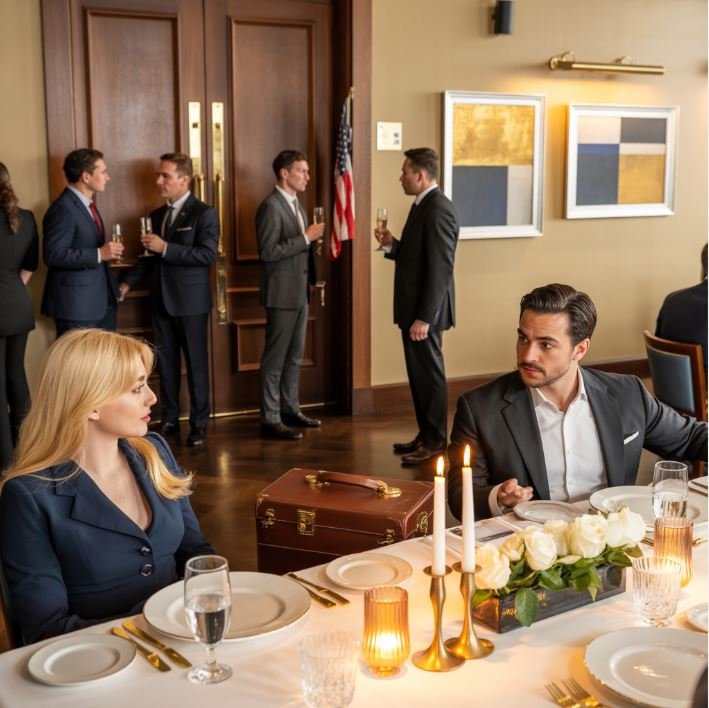
The lawyers arrived with the paperwork before dessert.
But the real surprise was never meant to happen, because Brian Coleman never meant for me to understand the difference between a harmless deduction and a felony. At least, that’s what he believed as he casually talked about inventing “business expenses” across our kitchen table while I made his coffee, the steam rising between us like a veil.
With my back turned, he never noticed how I angled my phone against the sugar bowl, recording every word as I nodded sympathetically.
“You wouldn’t get it, Marissa,” he’d say, the condescension growing sharper with each passing year. “Your literature degree is great for bedtime stories, but this is real business.”
And I would smile—soft, agreeable, harmless—playing my part perfectly.
For five years, I maintained a meticulously crafted persona: the supportive, simple wife who traded academic ambition for domestic bliss. My shelves of classic novels became the perfect prop for his favorite story about me—Marissa, the woman who lived in fictional worlds and couldn’t possibly grasp the machinery of his financial empire. What Brian failed to recognize was that literature had trained me to observe, to analyze patterns, and to recognize foreshadowing in a man’s character long before he thought the plot had begun.
If you’re drawn to stories of underestimated women turning the tables on the people who dismissed them, consider subscribing. It’s free, and it supports more empowering content.
Now, let me show you how five years of patience finally paid off.
In the early days of our marriage, the dismissiveness was subtle: a patronizing smile when I asked about his work, the way he simplified his explanations as if speaking to a child. I noticed. I also noticed something more valuable—when he thought I wasn’t equipped to understand, he stopped hiding things.
By our second anniversary, he left sensitive paperwork in plain sight. By our third, he took questionable calls right in front of me, discussing “creative” practices with his partners while I folded laundry nearby, quiet as a lamp.
“Don’t worry about her,” he’d say, not even lowering his voice. “Marissa’s too busy thinking about her book club to understand what we’re doing.”
What started as hurt pride slowly hardened into calculated observation. I created a simple system: a separate email address where I forwarded photos of pages he left out, careful notes on what I overheard, typed summaries of conversations, and patterns I saw repeated in his business life like recurring themes.
At first, it wasn’t revenge. It was proof—proof to myself—that I wasn’t as simple as he’d decided I was. I didn’t have a plan yet. I just couldn’t bear the thought of being as ignorant as he assumed.
The turning point came on a rainy Tuesday fourteen months ago.
Brian left his laptop open while he took a shower, and a notification popped up from someone named Vanessa. The preview showed just enough: Last night was amazing. Can’t wait to see you again when she’s visiting her parents.
My hands shook as I clicked.
There she was—Vanessa Miller, his sister’s best friend since college, the woman who hugged me at every family gathering while apparently sleeping with my husband. I scrolled through months of messages, each one more intimate and disrespectful than the last, until my throat went tight with something colder than grief.
“She doesn’t suspect a thing,” Brian had written. “Too busy with her books to notice the real world.”
I took screenshots of everything, added them to my growing archive, and set the laptop back exactly as I’d found it. When Brian stepped out of the shower, towel around his waist, smelling like expensive soap and certainty, I greeted him with the same warm smile I’d perfected over years.
Only this time, something fundamental had shifted.
My documentation was no longer about wounded pride.
It had become ammunition.
Two days later, I reconnected with Andrea Blackwell, an old college acquaintance who’d become a lawyer specializing in divorce and financial crimes. Our coffee meet-up looked casual from the outside—two friends catching up, laughing softly over cappuccinos—but underneath, I tested the ground carefully, asking “hypothetical” questions about marriage agreements, disclosure rules, and what kinds of evidence mattered.
“It’s for a character in a novel I’m outlining,” I explained when Andrea lifted an eyebrow at my oddly specific questions about recordings and proof-gathering.
She didn’t believe me. I could tell.
But she answered each question with professional precision.
Our occasional coffee dates evolved into strategic planning sessions disguised as friendly gatherings. Andrea never forced me to confess what we were really discussing, and I kept up the pretense of “creative research” for months—until I showed her a transcript of Brian talking, too comfortably, about hiding assets.
Andrea closed her notebook, looked at me directly, and lowered her voice.
“Marissa,” she said, “if your character has this kind of evidence, she needs to be very careful about when and how she uses it. Some of what you’ve described goes beyond grounds for divorce. We’re talking potential criminal charges.”
That conversation changed everything.
Andrea helped me organize what I had, explaining what would matter in family court and what might interest federal investigators. She connected me with a forensic accountant who—under the cover story of helping with research—analyzed the patterns buried in Brian’s records and the inconsistencies in his filings.
The most shocking discovery came when the accountant found discrepancies in our marriage agreement. The document I’d signed had been subtly altered after my mark was already on it—new clauses inserted that effectively left me with nothing if we separated. The manipulation was clever, not obvious at a casual glance, but unmistakable once you knew where to look.
“This isn’t just unethical,” Andrea explained. “It’s illegal—and it blows up the entire agreement.”
For the next several months, I perfected my performance as the oblivious wife while preparing for the moment I would shatter Brian’s illusion in one clean strike. I purchased discreet recording devices. I backed up everything in multiple locations. I learned the correct legal language for what Brian was actually doing, so no one could shrug it off as “complicated business.”
And I waited for the perfect moment.
Our fifth anniversary.
Brian insisted on an elaborate celebration at Harlo’s, an upscale restaurant downtown. He invited forty guests—mostly business associates and friends, with a sprinkling of my family members to keep the optics neat. The invitations went out weeks ago, embossed in gold lettering: Five years of partnership and success.
I traced the raised letters with my fingertip and almost laughed at the irony. Five years of partnership, yes—just not the kind Brian thought he was celebrating.
The night before the dinner, I laid out my outfit: a sophisticated navy dress Brian once called “faculty-wife appropriate,” like he was approving a costume. I slid Andrea’s card into my clutch beside a small thumb drive holding five years of evidence.
In the morning, I would contact the IRS whistleblower office with a carefully prepared report.
The clock on our bedroom wall ticked down the hours.
Tomorrow, Brian would stand before our friends and family, glass lifted in a toast to our marriage, and I would finally stop playing the simple, tolerant wife he’d forced me to become.
The morning of our anniversary arrived with an unusual serenity. My hands should have trembled as I did my makeup, but they stayed steady—five years of practice had taught my face how to lie when my heart refused.
Brian had already left for the office, promising to meet me directly at Harlo’s.
“I’ve arranged everything,” he said, kissing my forehead the way someone pats a child. “Just show up looking pretty.”
Harlo’s gleamed under soft lighting when I arrived thirty minutes early. The maître d’ recognized me immediately.
“Mrs. Coleman. Your husband has arranged a beautiful evening. The Magnolia Room is ready.”
He led me past the main dining area into the private room Brian reserved. Crystal chandeliers cast a warm glow over a horseshoe-shaped table dressed in white roses and silver accents. Calligraphy place cards marked every seat, with Brian and me positioned at the center curve like we were the obvious focal point of everyone’s admiration.
I walked the table slowly, memorizing the arrangement. His business partners clustered to his right. My family was pushed toward the far ends, polite and distant.
My manila folder slid neatly into the side-table drawer near my seat.
I checked my phone one last time: Andrea would arrive at precisely 9:00 p.m. The messages were queued, ready to send with a single tap.
Five years of calculated tolerance would end tonight.
Guests began arriving at seven.
Brian’s parents entered first, his mother hugging me with the practiced affection of a woman who always saw me as sensible, if uninspired. “You look lovely, dear,” she said, already scanning the room for more important people. Brian’s father nodded, his attention fixed on the bar setup as if the evening was a corporate function.
My sister Clare arrived with her husband and immediately caught something in my expression. “Are you okay?” she whispered while she hugged me.
I squeezed her hand—reassuring, steady—because she was the only one in the room who might have detected the steel beneath my smile.
Brian made his entrance at 7:30, flanked by his three closest associates, laughing at some shared joke. He looked handsome in his tailored suit, radiating the confidence of a man who believed the world was built to accommodate him. His eyes found mine, and he offered the same indulgent smile he’d given me for years—affectionate, dismissive, proprietary.
“There’s my beautiful wife,” he announced, crossing the room to kiss my cheek. “Always punctual. Always perfect.”
His hand lingered at my waist as he leaned in and whispered, “I’ve arranged for the Thompson account to be finalized tonight. Jeffrey’s here—he’ll sign after dinner.”
I nodded appreciatively, because I knew the Thompson account wasn’t romance or stability. It was one of his favorite vehicles for “creative” filings.
Another piece already documented.
Dinner moved forward with practiced elegance. Conversation flowed around me while I maintained my role, smiling at the right moments, asking the right questions about vacations and children and renovations. Brian grew louder with each glass of wine. Under the table, his hand sometimes pressed my thigh in a possessive gesture while above it he largely ignored me, speaking past me as if I were décor.
Between the main course and dessert, Brian’s partner Daniel tapped his glass.
“I think it’s time for a toast to the happy couple.”
Brian stood, champagne flute in hand. The room quieted and turned toward him. His smile sharpened into that familiar edge—the one that appeared whenever he felt particularly clever.
“Five years ago,” he began, “I made what my friends called the safest bet of my career.”
A few appreciative chuckles rose.
“Marriage to the quiet literature professor who’s more interested in fictional worlds than the real one around her.”
I kept my smile steady as a ripple of discomfort passed through the room.
“My colleagues warned me that marrying someone so academic might be challenging for a man in my position,” he continued, gesturing expansively. “But I saw what they didn’t. A woman who would never question my business decisions. A woman content to stay in her lane.”
Silence thickened. Even his closest friends looked uneasy.
“So,” Brian concluded, lifting his glass higher, “here’s to five years wasted on a gold-digging nobody.”
He laughed, as if cruelty could be charming when dressed in a suit.
“Who knew my simple wife would be my greatest asset?”
The polite chuckles that followed sounded more like people clearing their throats.
Clare’s face flushed with anger. Even Brian’s mother looked embarrassed.
And Brian sat down, pleased with himself.
I quietly opened the side-table drawer and withdrew my folder.
The moment had arrived.
“I’d like to respond to that lovely toast,” I said, my voice clear enough to cut through the stunned hush.
Brian’s smirk stayed fixed as I stood, folder in hand. “It’s true I’ve been quiet these five years,” I continued, sliding the folder across the table toward him. “But not for the reasons you think.”
His expression tightened as he glanced at it without opening. “What’s this, honey? An anniversary gift? Save it for later.”
“Oh, it can’t wait,” I replied, still calm. “It’s funny you mentioned assets… because this altered marriage agreement—the one you changed after I signed—means you actually get nothing.”
Color drained from his face as he flipped it open, revealing side-by-side comparisons: the original and the doctored version, complete with forensic documentation showing exactly what had been inserted and when.
“And speaking of assets,” I added, lifting my phone, “those messages with your sister’s best friend, Vanessa? They just went to everyone in this room.”
Phones chimed around the table like a sudden storm. Hands reached reflexively. Confusion turned to shock in real time as guests opened the thread and realized what they were looking at.
Brian half rose from his chair, voice sharp and hushed. “What have you done?”
“Exactly what you never expected me to do,” I said. “I paid attention.”
The atmosphere detonated.
Brian’s mother stared at her phone as if it had burned her. His father looked away in disgust. Clare moved behind me, her hand settling on my shoulder—steady, protective.
“You’ve misunderstood,” Brian began, eyes darting, hunting for a way out.
“These messages are dated,” I cut in, “and they include location data. Interesting how often you were ‘working late’ at Vanessa’s apartment.”
Daniel had already shifted several seats away, staring down at the evidence with mounting concern. “Brian… is this true? Did you falsify legal paperwork?”
Before Brian could answer, the front door opened and Andrea Blackwell stepped into the Magnolia Room, briefcase in hand, two colleagues behind her.
I smiled. “Perfect timing.”
“The attorneys are here with the divorce papers,” I said. “I believe we’re right on schedule for dessert.”
Andrea’s heels clicked across the hardwood as the room fell into eerie silence, the soft classical music continuing as if nothing extraordinary was happening. Brian’s face twisted between rage and disbelief as he recognized her from a charity gala six months earlier.
“You,” he stammered. “You’re the tax attorney from the children’s hospital benefit.”
Andrea smiled politely. “Among other specialties.”
As she placed the leather portfolio on the table, my mind flashed back to a crisp autumn evening three years ago, when Brian was on the phone with his accountant in the home office while I dusted the bookshelves, seemingly absorbed in my task.
“Listen,” he’d said, feet propped on his desk, “just move the Henderson payments through the Cayman account first. They don’t have the manpower to track everything. Besides, technically it’s not illegal if we route it through the consulting subsidiary first.”
That night, I transcribed the entire conversation verbatim.
My literature degree finally proved useful in a way Brian never anticipated. Years of analyzing text trained my memory to capture dialogue with remarkable precision, and I built a method: record what I could, then expand my notes with context—his tone, his posture, the exact words he chose, the pauses where he thought no one was listening.
“I’ve prepared everything according to your instructions,” Andrea said now, sliding documents toward me rather than Brian. “All evidence we discussed has been properly filed with the appropriate authorities.”
Brian lunged for the papers, but his partner Jeffrey caught his arm.
“Don’t make this worse,” Jeffrey muttered, his face ashen as he looked between his phone and the agreement comparisons.
Another memory surfaced: Brian at our kitchen island eighteen months ago, laughing into his phone. “Of course she doesn’t understand the Thompson restructuring,” he’d said. “She thinks it’s just corporate reshuffling. The woman reads Jane Austen for fun. She’s not equipped to spot a shell company.”
What Brian never realized was that my training made me excellent at spotting patterns and inconsistencies. When the same numbers resurfaced in places they didn’t belong, when timelines didn’t align with his public claims, I didn’t need an accounting degree to flag it.
I just needed patience.
And attention to detail.
The very traits Brian mocked as “bookish fussiness.”
“This is ridiculous,” Brian sputtered, searching the room for support. “Whatever she thinks she found is taken completely out of context. Marissa doesn’t understand the first thing about operations.”
“Is that so?” Andrea replied, pulling another sheet from her case. “Perhaps you can explain the context of this recorded conversation from February 12th, where you instructed your CFO to cook the books for the quarterly filing. Or this email chain discussing fake invoices for services never rendered.”
The blood drained from Brian’s face.
“You recorded me?” he snapped. “That’s illegal.”
“One-party consent is legal in this state,” I said softly. “Something you might’ve known if you’d ever listened when I mentioned ‘research’ for my novel about white-collar crime.”
My “novel” had been the perfect cover. For two years, I openly discussed fictional scenarios with Brian that mirrored his real behavior, gauging his reactions and letting him—without realizing it—teach me exactly which lines he was crossing.
“You were writing about me,” Brian choked out.
“Not initially,” I admitted. “But you became such a compelling case study, I couldn’t resist.”
A dessert cart appeared in the doorway, the server hesitating when he sensed the tension. Andrea waved him in smoothly. “Please continue,” she said. “We’re just concluding some business.”
Then Brian’s attorney, Mitchell Davis, burst through the restaurant doors, breathing as if he’d run.
“Don’t sign anything,” he ordered.
“Too late for that advice,” Andrea replied. “But your client may benefit from counsel regarding the IRS investigation.”
“What IRS investigation?” Mitchell demanded, bewildered.
I met Brian’s eyes directly. “The one triggered by the report I filed three months ago.”
All those nights I said I was talking to my sister, I was building a case with the financial crimes division. Brian’s complexion went gray.
“You wouldn’t understand enough—” he began.
“—to document your systematic tax fraud,” I finished, voice steady. “To map the shell companies you used to hide assets. To track the falsified charitable donations.”
I leaned in, just enough for him to hear the truth without theatrics.
“Actually, I understood everything, Brian. I just never let you see that I did.”
The chocolate soufflé arrived and was set between us with practiced elegance, oblivious to the marriage collapsing around it.
Jeffrey stood abruptly. “I need to distance myself from this situation immediately,” he announced, grabbing his coat.
Several others followed, offering excuses, avoiding Brian’s gaze.
“You can’t just leave,” Brian hissed. “We’ve worked together for years. You’re involved in half of these deals.”
“That’s exactly why I’m leaving,” Jeffrey replied coldly. “And why you’ll be hearing from my attorney tomorrow.”
As Brian watched his network unravel, an odd calm settled over me. The soufflé deflated in the center, much like Brian’s illusion of control.
“You know what’s ironic?” I said, breaking the silence. “If you’d ever actually read any of the novels on my shelves, you’d recognize the classic arc of hubris and downfall. Literature’s been warning men like you for centuries.”
Brian’s mother approached, face rigid with controlled emotion. “I’d like to understand exactly what’s happening,” she said—addressing me directly for perhaps the first time in our marriage.
“Your son created fraudulent records, evaded taxes, and manipulated legal paperwork,” I explained gently. “And he’s been sleeping with Vanessa for at least a year.”
She nodded once, removed her pearl necklace—Brian’s anniversary gift to her—and placed it on the table. “I believe this belongs to your company,” she said, voice clipped, “not to my son.”
Then she collected her husband and left.
As the room continued emptying, Brian leaned toward me, voice low and dangerous. “You spent five years planning this. Living a lie.”
“No, Brian,” I corrected him. “I spent five years married to a lie. Tonight, I’m finally telling the truth.”
Mitchell pulled Brian aside, their urgent whispers carrying fragments—damage control, injunctions, containment. The remaining guests hovered like cautious birds, unsure whether to flee or stare.
Clare slid into the chair beside me. “I always knew he was a jerk,” she whispered. “But this… this is beyond anything I imagined.”
For the first time all evening, my composure cracked. My hand trembled as I reached for my water.
“I’ve been living with this knowledge so long,” I admitted, “I almost forgot how shocking it actually is.”
Clare squeezed my hand. “Why didn’t you tell me?”
“I couldn’t risk anyone knowing,” I said. “Brian had to believe I was exactly who he thought I was—too devoted to question, too simple to understand.”
Across the room, Brian’s friend Thomas was already deleting contacts, face grim. “I’m out, Brian,” he announced loudly. “The Davidson contract was bad enough, but this—” he gestured toward the folder—“this could implicate all of us.”
“You’re overreacting,” Brian snapped, desperation cracking his voice. “Marissa doesn’t understand what she found. It’s all explainable.”
“To whom?” Thomas shot back. “The IRS? I have a family. I’m not going down for this.”
As another pillar crumbled, something in Brian’s expression shifted. Shock hardened into something darker. He straightened his tie, approached our table with forced control.
“We need to talk,” he said quietly. “Privately.”
“I don’t think that’s necessary,” Andrea said, stepping in without raising her voice. “Anything you have to say can go through legal channels from this point forward.”
“This doesn’t concern you,” Brian hissed, then turned back to me. “Marissa, think about what you’re doing. Five years together means nothing to you? You’re willing to destroy everything over some misunderstanding.”
For a moment, the old rhythm tried to return—his command, my instinct to appease. The muscle memory of submission twitched.
Then I remembered his toast.
Five years wasted on a gold-digging nobody.
“There’s no misunderstanding,” I said, steady. “And there’s nothing to discuss.”
Brian leaned closer, lowering his voice. “You think this little performance makes you powerful? I built everything we have. When this is over, you’ll have nothing and no one.”
Something unexpected happened then.
I laughed—not the polite, accommodating laugh I’d perfected as his wife, but the raw sound of liberation.
“I already had nothing, Brian,” I said. “You made sure of that. The difference is, now I know my worth.”
He looked unsettled, as if he’d never seen this version of me—upright, direct, unafraid.
“You’ll regret this,” he threatened, but the tremor in his voice dulled the impact.
“I only regret not doing it sooner.”
As Brian retreated to confer with his increasingly frantic attorney, my former friend Emma approached hesitantly. She’d drifted away over the years, pulled toward Brian’s polished circle.
“Marissa, I had no idea,” she began, face tight with conflict. “The way he talked about you at dinner parties… I just assumed—”
“That I was exactly what he described,” I finished for her. “That was the point, Emma.”
“I should have checked on you,” she whispered.
“Yes,” I said quietly. “You should have. Five years is a long time to believe the worst about someone you once called a friend.”
Emma flinched at my honesty. In the past, I would’ve rushed to smooth it over, to protect her comfort. But that woman—who carried everyone else’s feelings like they were her job—had served her purpose.
I didn’t need her anymore.
Around the room, the remaining associates huddled over their phones, frantically checking accounts and messages. The elegant anniversary dinner had devolved into crisis management: allies turned liabilities, reputations crumbling in whispers.
My brother-in-law Mark—always quiet around Brian—surprised me by bringing a fresh glass of wine. “Thought you might need this,” he said.
“For what it’s worth,” he added, voice careful, “I always knew you were the smartest person in any room Brian entered.”
“Yet you never said anything,” I observed without rancor.
Mark nodded, shame flickering. “I convinced myself it wasn’t my place. I was wrong.”
Then Brian’s phone rang—a specific chime he used only for his executive assistant—cutting through the murmurs. He checked the screen, and his face drained as if the blood had been siphoned out.
“What do you mean they’re there now?” he demanded. “Don’t let them access anything. Nothing. I’m on my way.”
He ended the call and looked around with fresh desperation. “I need to go to the office. There’s an emergency.”
“What kind of emergency?” his attorney demanded.
Brian swallowed. “Federal agents are at the building with some kind of warrant.”
The revelation rippled through the remaining guests. Two more associates bolted for the exit, avoiding eye contact like they could outrun their own names.
For the first time since I’d known him, Brian looked truly lost. His curated image—successful businessman, community leader, devoted husband—was dissolving in real time, revealing the hollow center beneath.
He turned to me with naked fury. “Did you do this? Did you call them?”
Andrea shifted subtly, positioning herself between us. “Federal investigations don’t happen overnight,” she said. “This has been in motion for quite some time.”
Brian grabbed his coat and rushed toward the exit, nearly colliding with the manager, who appeared with a strained expression.
“Sir,” the manager said nervously, “there are some men outside asking for you. They said it’s urgent.”
Brian froze mid-step, caught between the ruins behind him and whatever waited beyond the doors.
For a brief moment, our eyes met across the room, and I saw something I’d never witnessed in him before.
Fear.
Three men in dark suits entered the Magnolia Room, their expressions professionally neutral. The lead agent—a silver-haired man with piercing eyes—held up his credentials.
“Brian Coleman?” he asked, though his gaze had already locked on Brian by the exit.
“That’s him,” someone volunteered, far too quickly.
Brian’s attorney stepped forward. “I represent Mr. Coleman. Whatever this is about—”
“Brian Coleman,” the agent continued, unbothered, “we have a warrant for your arrest on charges of tax evasion, wire fraud, and falsification of federal documents.”
He produced an official sheet. The familiar warning followed, clinical and unavoidable, echoing through the suddenly silent room.
Brian’s face cycled through disbelief, rage, and then dawning horror as he looked back at me.
“You,” he whispered. “What exactly did you tell them?”
I remained seated, calm at the center of the storm.
“Everything you told me, Brian,” I said. “Every conversation you had in front of your ‘simple’ wife. Every page you left where I could find it. Every call you took in our home.”
As handcuffs came out, Brian instinctively backed away. “This is a mistake,” he insisted, voice rising. “These are complex matters. My wife couldn’t possibly understand enough to—”
“Actually,” the lead agent interrupted, “the evidence Mrs. Coleman provided was remarkably detailed and precise. In twenty years with financial crimes, I’ve rarely seen documentation this thorough from seasoned professionals, let alone a civilian.”
A third agent opened a laptop. “Mrs. Coleman, if we could verify a few final details before we proceed… there are transactions we’d like to confirm.”
Brian watched in stunned silence as I discussed complex maneuvers with terminology he’d always assumed lived outside my reach.
“The Davidson shell entity was formed in March,” I explained. “But the fraudulent invoices don’t begin until after the Thompson restructuring in June. He kept the original paperwork in the home office safe—combination 27-14-36—behind the reproduction Monet.”
Brian’s attorney went pale. “Stop talking,” he hissed at Brian. “Not another word.”
But Brian couldn’t look away from me. The realization finally landed with full weight.
“All this time,” he said hoarsely. “All those evenings you were reading in the corner. All those parties where you just smiled and nodded…”
“I was paying attention,” I said simply. “Something you never bothered to do with me.”
They moved to escort him out, and as they passed our table, Brian paused, cuffed hands awkward in front of him.
“Why?” he asked, genuine confusion breaking through the bravado. “Why go through with the anniversary dinner? Why the public humiliation? You could’ve just had them pick me up at the office.”
I considered the question, because he deserved the answer.
“Because you needed to understand what you did,” I said. “Not just the crimes—but the way you diminished me for years. Tonight wasn’t only legal justice, Brian. It was about finally being seen.”
Something flickered in his eyes—maybe the first glimmer of real comprehension he’d ever had about me.
Then the agents guided him through the restaurant doors and into the night.
The remaining guests dispersed in stunned murmurs. Andrea collected her portfolio and approached my side of the table.
“Are you all right?” she asked gently.
I inhaled, assessing the hollow space where fear and anger had lived for so long. “I think I will be,” I said, surprised by the truth of it.
Clare wrapped an arm around my shoulders. “What happens now? Do you need a place to stay tonight?”
I shook my head. “The house is in my name as of this afternoon.”
Another detail Brian never bothered to read in the paperwork he occasionally shoved at me and told me not to worry about.
Andrea’s smile held a quiet admiration. “The federal case will take months, possibly years. Are you prepared for that?”
“I’ve been preparing for five years,” I reminded her. “I can handle a few more.”
As we gathered our things to leave, I paused at the table where Brian and I had sat side by side for the last time. The anniversary cake remained uncut, the decorative “five” topper now looking less like celebration and more like a countdown that had finally reached zero.
Later, the classroom hummed with energy as my students debated the symbolic significance of wealth in The Great Gatsby. I watched them from behind my desk, appreciating their enthusiasm for literature in a way Brian never could.
“Dr. Wilson,” Amber called from the back row, using my reclaimed maiden name, “do you think Daisy really loved Gatsby, or just what he represented?”
“What an excellent question,” I replied, and felt something in my chest loosen. “What does the text tell us about the difference between genuine connection and the performance of love?”
The discussion bloomed—students citing passages, challenging each other, leaning into ideas with bright, hungry minds. Skills I once used to dismantle my husband’s empire now guided young people toward sharper thinking and safer futures.
After class, I headed to the campus coffee shop, where I’d started an informal weekly gathering for female students interested in financial literacy. What began as casual conversation evolved into structured sessions on everything from compound interest to recognizing red flags in relationships.
My phone buzzed with a message from my publisher confirming our meeting to discuss my manuscript—hidden in plain sight for years: a woman’s guide to financial self-defense. The advance was modest, but early interest from women’s groups surprised everyone but me.
Outside the coffee shop, I spotted a familiar figure hovering near the entrance.
Vanessa.
Brian’s former mistress.
Our eyes met, and I braced for confrontation. Instead, she approached with visible hesitation.
“I saw the flyer about your financial literacy group,” she said, avoiding my gaze. “I wasn’t sure if I’d be welcome.”
The old Marissa might have turned her away—or offered immediate forgiveness to avoid discomfort.
Instead, I considered her request carefully.
“The group is open to any woman who wants to learn,” I said finally. “Everyone deserves independence.”
Vanessa nodded, relief flickering across her face, and followed me inside, where a dozen women of different ages already waited.
As I arranged my materials, I caught my reflection in the window—upright posture, direct gaze, no trace of the woman who spent years making herself smaller to fit inside someone else’s story.
Brian’s trial was still months away, but it was no longer the center of my life.
For the first time in years, I was writing my own narrative—not as a revenge plot, not as a survival strategy, but as the life I had always been capable of living.
“Let’s begin,” I said to the waiting women, opening my notebook to a fresh page.