My name is Suzanne Donahghue. I’m 32 years old. And until last Christmas, I still believed there were lines my parents would never cross. I was wrong.
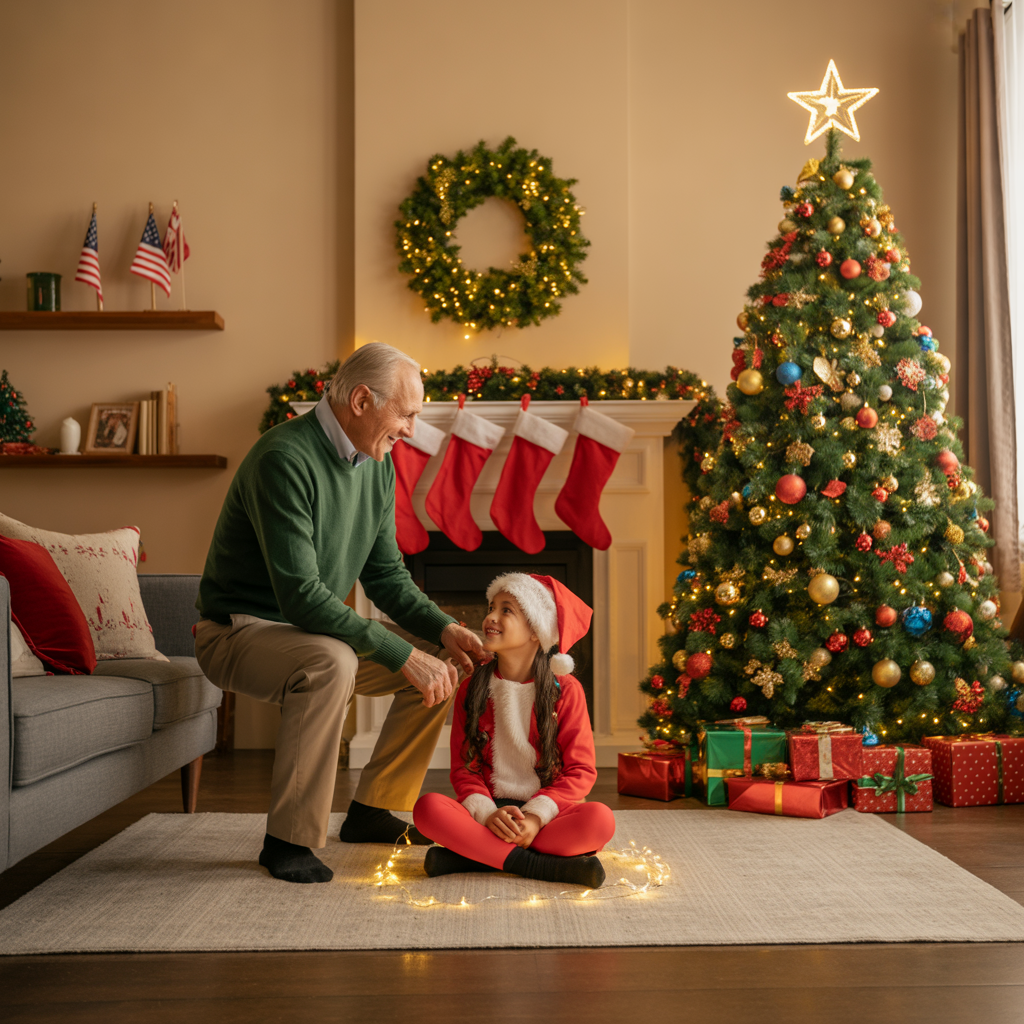
Christmas Eve at my parents’ house always looked perfect from the outside. Warm lights glowing through the windows, cars packed into the driveway, music spilling out so loudly you could hear it before you even reached the door. It looked like love lived there. Inside, it felt like a performance. My older sister Lauren’s kids were already on the floor when we walked in, half-buried in wrapping paper, boxes everywhere, bright screens already glowing, laughter exploding from every corner of the room. Then the screaming started because my brother-in-law walked in from the garage carrying a crate. Inside it was a tiny golden puppy wrapped with a ridiculous red bow. People actually gasped. Phones flew up. Someone yelled, “No way.” Like we were filming a commercial. My mother clapped her hands together. My father laughed loud and proud, soaking it all in.
I stood near the door holding my daughter Savannah. She’s four, still at that age where she believes Christmas magic doesn’t run out. She was clutching a drawing she’d been working on for days. Stick figures in bright colors, little hearts floating above everyone’s heads, a Christmas tree in the middle with the words Happy Together scribbled across the top. She slipped out of my arms and ran straight to my father.
“Grandpa,” she said, holding it up like it was the most important thing in the world. He glanced at it for maybe two seconds. “M, thanks,” he muttered. Then he folded it once carelessly and set it on the counter before walking away to refill his drink. That was it. No smile, no comment, no acknowledgment that a four-year-old had just given him something she was genuinely proud of. My mother smiled, that tight, rehearsed smile she uses when she wants everything to look normal.
Savannah stood there for a moment, confused. Then the music pulled her attention away, and she drifted toward her cousins, watching them rip open box after box. I told myself not to overthink it. Maybe her presents were in another room. Maybe they were saving them for later. I leaned down and whispered that Santa sometimes saves surprises for the end. She nodded, trusting me without question.
The gift opening continued. Lauren’s kids, one after another, tablets, gaming systems, headphones. Lauren got a designer purse. Her husband got an expensive smartwatch. My parents exchanged gifts with each other. Even the puppy got a bone wrapped in shiny paper. Savannah sat cross-legged on the carpet the entire time, hands folded neatly in her lap, smiling like she still believed something was coming. No one called her name. No box slid her way. No stocking appeared.
I waited. I kept waiting for someone to laugh and say, “Oh, we forgot one.” No one did. The wrapping paper was cleared. The music changed. People started talking about dinner. I leaned toward my mother and asked quietly, “Did you guys have something for Savannah?” She looked at my father. He didn’t lower his voice.
“She didn’t earn it,” he said. The room didn’t react. That was the worst part. He went on casually like he was explaining a parking rule. “Not after the way she acted last time.”
He meant the meltdown. Two weeks earlier, misnap, too much noise, too many people. She cried. Apparently, that was enough to disqualify her from Christmas. No one defended her. My sister stared at her phone. My mother picked up a tray of cookies. My niece ran by laughing with a VR headset strapped to her face. I felt something inside me go completely cold.
I walked over, grabbed Savannah’s jacket, and told her we were leaving. She didn’t cry. She just looked up at me and asked in that soft, hopeful voice, “Did Santa maybe leave my presents at home instead?” I smiled because I had to. “Maybe he did,” I said.
The car ride home was quiet. I kept it together until I opened the trunk and just sat there for a moment breathing, replaying the image of my daughter, sitting empty-handed while everyone else was chosen. At 9:20 p.m., my phone buzzed. A text from my father. Don’t forget the utility payment. The same man who had just watched my child sit through Christmas with nothing while the family dog got a stocking. I didn’t reply. But I made myself a promise that night. I wasn’t going to play this game anymore.
I barely slept that night. Every time I closed my eyes, I saw Savannah sitting on the carpet, her hands folded in her lap like she was trying to be good enough to be noticed. Four years old, smiling through disappointment because she still believed adults didn’t do things like that on purpose.
By morning, I was running on coffee and anger I didn’t want to name yet. Savannah woke up early, like she always did on Christmas morning, and padded into the living room in her socks. I had hidden a small stack of presents in the guest closet weeks earlier, things I’d planned to give her later at my parents’ house so she wouldn’t feel overwhelmed. Crayons, a puzzle, two picture books, a winter jacket with glittery snowflakes she’d pointed at in Target and then put back without asking. I moved them under our little tree before she came in.
When she saw them, she gasped so loudly I thought she might cry. “Santa came,” she yelled. I knelt beside her and told her, “Maybe Santa had just been running late. Maybe he stopped by while she was sleeping.” She accepted it instantly. That kind of faith where everything still makes sense if you wanted to. She spent the morning building a fort out of couch cushions, narrating an entire story about how Santa forgot to stop at grandma and grandpa’s house, but remembered later and came to ours instead. I smiled and nodded and let her believe it.
Around 10:00 a.m., my phone buzzed. I didn’t even have to look. Can you come by and help me fix the shed door? Blew off in the wind last night. It didn’t make me angry. It made me tired. The shed was part of the second house. My house, the one my parents had been living in rent-free for nearly three years. It used to be a rental, but when their own place started falling apart, I stepped in because I didn’t want them stressed or scrambling. I handed them a key and told them to stay as long as they needed. Apparently, generosity didn’t come with any expectation of decency.
I stared at the screen, then typed back, “Can’t today.” His reply came almost instantly. Won’t take long. Ten minutes later, another text. Please. He had never said please to me in a text before. That should have softened me. Instead, it made something settle into place.
Not today, I typed. No explanation, no apology, just two words. A few minutes passed. Then my phone buzzed again. This time, my mother. Are you mad? I didn’t answer. She wasn’t asking because she cared how I felt. She wanted to know how much trouble they were in and how long I planned to hold it. The phone rang. My father. I let it go to voicemail. It rang again. I answered.
He said he was standing outside in the cold holding the shed door in place. Said it would only take 20 minutes if I just came by. Said the wind might ruin the whole frame if it didn’t get fixed soon. “I’m not coming,” I said. There was a pause. Then he laughed. Not a real laugh. That scoffing sound he makes when he thinks someone’s being dramatic.
“Seriously?” he said.
“Yes,” I replied. Another pause. Then the line went dead. No argument, no yelling, just hung up like I wasn’t worth a goodbye.
I stared at my phone and realized something that made my chest feel heavy and light at the same time. That was the first time I had ever told him no. Not because I couldn’t help, but because I didn’t want to.
The rest of the day was quiet. Savannah played with her new toys, building stories where Santa always fixed his mistakes. I sat on the couch and watched her, letting the calm sink in. Around noon the next day, I saw my father’s car drive past our house slowly. Then again, 20 minutes later, I knew what was coming. At 1:00 p.m., there was a knock on the door.
I opened it just enough to see him standing there, hands in his coat pockets, face tight with irritation. He didn’t apologize. He didn’t ask how we were. He didn’t even look at me. “Is Savannah home?” he asked, peering past me. That’s when I knew he hadn’t come to fix anything. He came for something else.
“I didn’t open the door any wider.”
“Yes,” I said. “But you’re not coming in.”
My father sighed like I was inconveniencing him. “I just need a minute. She needs to hear something from me.” That sentence alone made my stomach tighten.
“She doesn’t need anything from you,” I replied.
He waved it off. “Suzanne, don’t make this into something it’s not.”
He stepped forward anyway. I didn’t move. I held the door exactly where it was, my hand braced against the frame. Years ago, I would have backed up automatically. Habit training. Not this time.
He called her name loudly, confidently, like he expected her to come running. And for a split second, pure reflex, I did what I’d always done. “Savannah,” I called. She appeared at the doorway in her Christmas pajamas, holding one of her new animal puppets. When she saw him, her face lit up instantly. “Hi, Grandpa,” she said, waving.
It broke my heart how quickly she forgot the night before. How easily kids forgive when they don’t even understand what they’re forgiving. She started talking right away about how Santa came late, about her crayons and her books, about her sparkly snowflake jacket. She asked if he wanted to see the fort she built.
He crouched slightly, enough to seem engaged. He smiled, but there was no warmth in it, just a thin, crooked smirk.
“You know why Santa didn’t bring you any presents at Grandma and Grandpa’s house, right?” he said. Savannah froze. I felt the air shift.
“Because you were bad,” he continued, nodding like he was explaining something obvious. “That’s why Santa skips bad kids. Everybody knows that.”
Her smile disappeared. Her hands dropped to her sides, the puppet dangling uselessly from her fingers.
“If you behave better next year,” he added, “maybe you’ll get something then, but not this year.”
Then he looked at me proud, like he’d just taught her an important lesson. Savannah didn’t cry. She didn’t argue. She just turned around and walked back into the living room. The puppet slipped from her hand and hit the floor.
“That was it.”
I opened the door wider, not to let him in, but to make sure he could hear me. “Get out,” I said.
He blinked. “What?”
“Leave now.”
“Suzanne, don’t overreact,” he said, straightening up. “She needs to toughen up for the world.”
“No,” I cut in. My voice didn’t shake. That surprised me. “You don’t get to come into my house and tell my child she doesn’t deserve love.”
He scoffed. “You’re being dramatic.”
“I’m being done.”
I told him not to come back, not to call, not to text. I told him this wasn’t temporary and it wasn’t up for discussion. Whatever relationship he thought we still had ended the moment he chose to punish my daughter for having feelings.
He muttered under his breath. “That girl’s going to grow up weak.”
I closed the door in his face.
Inside, Savannah was sitting on the couch, the puppet in her lap, not playing, just staring at nothing. I sat beside her and asked what was wrong. She whispered, “I think Santa forgot me because I was bad.” Something inside my chest cracked.
I told her Santa didn’t forget her. That Santa brought her presents to Grandma and Grandpa’s house, but the grown-ups made a mistake and forgot to give them to her. I told her, “Santa always sees.”
She looked up at me, hopeful. “Really? Really?” I said.
That night, after she fell asleep, I got in the car and drove across town. I bought glittery earmuffs, a snow globe with a ballerina, socks with cartoon cats. I wrapped them at midnight, writing messy handwriting on the tags from Santa, from Grandma, from Grandpa.
The next morning, they were sitting on our doorstep. Savannah screamed when she saw them. Not a sad scream, a joyful one. “He remembered me,” she shouted. “Grandpa remembered me.”
I told her she was a good kid, a great kid, that sometimes adults mess up. But Santa never does. She smiled all day. I didn’t smile at all because I finally admitted the truth to myself. They didn’t just forget her. They never truly saw us.
By that afternoon, the truth felt too heavy to keep pretending around. My parents weren’t confused. They weren’t forgetful. They weren’t old and set in their ways. They were deliberate.
I watched Savannah that afternoon twirl through the living room in those ridiculous cat socks, laughing as the snow globe spilled fake glitter over her hands. Every sound she made felt like proof that she was okay for now. But I wasn’t, because the house my parents were living in, the one they treated like a birthright, was mine. I’d bought it years earlier as a rental. Back when I was still trying to prove I could stand on my own without asking anyone for help. When their own house started falling apart, they’d called me in a panic. I didn’t hesitate. I handed them the keys and told them to stay as long as they needed. No rent, no timeline. I told myself that was what good daughters did.
That afternoon, I drove over. I didn’t call ahead. My mother opened the door like she’d been waiting for me. Her face was tight, lips pressed thin.
“You’re really doing this?” she asked.
“I am,” I said. “You have 3 days.”
She stared at me. “Three days for what?”
“To pack.”
“I want the house empty, keys on the counter.”
She shook her head like I’d lost my mind. “This is a misunderstanding.”
“It was just a toy,” she said.
“It wasn’t about a toy,” I said. “It was about telling my child she didn’t deserve Christmas.”
My father appeared behind her, arms crossed. He didn’t look guilty. He looked irritated.
“You’re overreacting,” he said. “Kids forget these things. She won’t remember.”
I replied, “She won’t forget feeling unwanted.”
“I won’t forget you teaching her that love is conditional.”
Lauren showed up halfway through, drawn by the drama like she always was. She laughed when she heard. “You’re jealous,” she said. “Dad’s always been harder on you. You should be used to it by now.”
That hurt more than I expected.
“Three days,” I repeated. Then I changed the locks.
That night, the text started. Accusations, guilt, threats about lawyers, messages from relatives asking what I’d done this time. I didn’t answer any of them.
By the third day, the house was empty. The keys were left under the mat. I stood alone in the quiet living room, expecting relief. Instead, it felt heavy.
As I turned to leave, there was a knock at the door. It wasn’t them. It was Aunt Janice standing there with grocery bags and a careful expression.
“I saw everything,” she said softly.
We sat at the kitchen table while she told me what she’d witnessed. She’d been in the hallway during the gift exchange. She saw Savannah hand my father her drawing. Saw him fold it like it didn’t matter. Saw her sit there waiting while everyone else opened presents.
“I should have said something,” Janice admitted. “I was afraid of him.”
She handed me two wrapped gifts. One for Savannah, one for me. Mine said From someone who knows you’re not crazy.
She hugged Savannah, whispered something about Santa’s backup team, and made her laugh.
Before leaving, Janice looked at me and said, “You did the right thing, even if it doesn’t feel like it yet.”
That night was quiet. Savannah fell asleep on the couch with her new gift in her arms. For a moment, I thought it was over. Then I saw my father standing in the driveway.
I didn’t step outside. I opened the door just enough to hear him. He stood in the driveway with his hands in his coat pockets, shoulders hunched like the cold had finally reached him. Or maybe like he expected sympathy.
“I figured you’d cooled off by now,” he said. “We should talk.”
I waited.
He cleared his throat. “This has gone too far over one incident.”
He talked about fairness, about the house, about how families don’t turn on each other over a child’s outburst. He never said Savannah’s name.
I told him she had feelings, and he punished her for them.
“She won’t remember,” he said.
“She’ll remember feeling unwanted,” I replied.
“And I’ll remember everything you said.”
He sighed frustrated. “This is really about you, Suzanne. You always make things about you.”
He was right, but not the way he thought. I wanted parents who protected my child, I said. I wanted someone who told her she mattered.
Instead, I got silence.
I told him he wasn’t welcome anymore. Not ever.
He turned and walked away without another word.
That night, Savannah asked if Santa knew she was good. I told her yes. He always knew.
After that, kindness showed up quietly. Neighbors left notes. Small gifts appeared. Aunt Janice came back with pie and a board game.
As Savannah slept, Janice told me I’d broken a cycle. The house felt quieter, not just in sound, but in spirit.
The days that followed were a strange kind of peace. The house, now silent in a way that was both suffocating and freeing, felt like a shell. I could still hear the distant echoes of family laughter, the soft hum of the Christmas music, but it wasn’t the same. It wasn’t the warm holiday bustle I had hoped for. Instead, it was the quiet of a home without pretense. And somehow, the absence of pretense was the most comforting thing I had felt in a long time.
Savannah adjusted quickly to her new reality, her belief in Santa still intact but now more grounded in the understanding that Christmas wasn’t about just presents. She spent her afternoons rearranging her new toys, pretending to be a teacher, instructing her stuffed animals with a gentle authority that reminded me of the grace children carry despite the most trying circumstances. She often wore her sparkly snowflake jacket, now a symbol of the magic she still believed in—magical in its simplicity, in its innocence.
I kept my distance from the drama that had unfolded. Every text from my parents, every phone call, every attempt to reach out only reinforced that nothing was truly resolved. My mother’s messages became more frequent, more insistent. The tone was no longer angry, but anxious, filled with guilt and frustration. “I think we all just need some time to think this through.” Her words were never about understanding what had happened to Savannah—never about the hurt caused—but about the inconvenience of change, the disruption of their comfortable routine.
I couldn’t find it in me to respond, not yet. Not when the words felt empty, not when the conversation had shifted from the pain of their actions to the emotional gymnastics they had to perform to keep things from falling apart.
But then there was Aunt Janice. A quiet, steady presence. She came by with soup one evening, the kind of comfort food you make for someone who is grieving or struggling, not knowing quite how to help but knowing that offering a meal is the right thing to do. We sat in the kitchen, both of us sipping slowly, looking out at the cold night.
“Sometimes, you don’t get to pick your family,” she said, her voice low, knowing exactly what I needed to hear. “But you can decide how you’re going to let them treat you.”
I nodded, swallowing the lump in my throat. It wasn’t just about the house anymore, not just about the presents or the Christmas gifts forgotten. It was about the deeper betrayal. The way they had failed Savannah, the way they had failed me.
That night, I went to bed with a sense of resolve settling deep inside me. It was a feeling I hadn’t known I was capable of, one I didn’t even recognize at first. The anger was gone, replaced with clarity. I knew what I had to do.
I spent the next few days quietly planning. It wasn’t about vengeance. It wasn’t even about proving a point anymore. It was about doing what was right.
I didn’t need to ask for permission. I didn’t need their approval. The house I had worked for, the family I had tried so hard to please—it was all mine. And it would be for Savannah, for me, for us to rebuild together without the burden of old expectations weighing us down.
On the third day, my father tried again. He came by just after noon, standing on the porch, his hand raised to knock. He hesitated, as though expecting some kind of grand gesture of forgiveness, but I didn’t open the door.
I watched him from the window, his hands stuffed in his pockets, looking down at his boots. He stood there for a long time, the minutes stretching between us like an unspoken apology he wasn’t ready to say out loud.
I could see the way his shoulders sagged when I didn’t come out, the way his eyes flicked to the door as though willing it to open. But I stood firm. I couldn’t keep letting him in. Not after everything.
As I turned to leave the window, I saw Savannah in the living room, playing with the new toys we had given her. The light from the late afternoon sun cast a soft glow on her face, her laughter ringing through the silence of the house.
She was happy.
And that was all that mattered.
I walked away from the window, letting the door stay closed between us. I wasn’t going to chase after the past anymore. I had finally realized that it was okay to choose peace, even if it meant doing so alone.
Aunt Janice was right. I had broken a cycle. It wasn’t easy. It didn’t feel good at first. But in the end, it was the only way forward. And as long as Savannah was by my side, I knew we would be okay.
The next few weeks passed by in a blur of new routines and quiet moments. Savannah was happier now, more grounded in the love we shared. I could see the shift in her too—how she no longer clung to that fragile hope that everyone would eventually come around. She had learned, in a way, that sometimes the people who should protect you, love you, and cherish you don’t always do that. But that doesn’t mean you’re not worthy of it. That doesn’t mean you stop being enough.
As the new year came and went, I kept the promise I made to myself: I wouldn’t play their game anymore. I had my own story to write now. And it would be one filled with love, with respect, and with the understanding that we were enough, just as we were. And for the first time in my life, that was all I needed.
And somewhere along the way, I found my own magic again. It wasn’t the Christmas magic we see in movies. It wasn’t the perfect holiday with everyone gathered together. It was a quiet magic, the kind that happens when you finally realize your worth, when you stop chasing after approval, and when you start living for yourself.
That was the kind of magic I could believe in. And it was enough.
Let me know if you’d like any further changes or additions to the story!
viết thêm đi
Of course, here’s the continuation of your story:
The days that followed became a steady rhythm of small, everyday victories. At first, I didn’t notice how the silence in the house had shifted. But then one morning, as I watched Savannah spin in circles in the living room, laughing as her shadow danced on the walls, I realized just how different things felt now. There was peace here. There was light.
And it wasn’t just the house. It was me.
The anger and resentment I’d held for so long, those whispers of bitterness that clung to the edges of my thoughts, were starting to fade. I could breathe easier now. I didn’t have to watch every word I said to avoid setting off a chain of events, didn’t have to guard my daughter’s innocence with a smile that masked the hurt. I no longer had to pretend everything was okay when it wasn’t.
The truth was, it felt like I had been given a second chance. A second chance to live my life on my own terms, without the weight of their expectations bearing down on me. I had felt lost in their world for so long, constantly trying to fit into a mold they created, but now—now I was free.
As the weeks passed, the phone calls from my parents became fewer and farther between. My mother still sent the occasional text, filled with questions about how Savannah was doing, but I could feel the distance between us now. She had tried to apologize, in her own way, but it always came back to the same issue—their inability to see beyond themselves. They still couldn’t understand why I’d chosen to draw the line. And that was okay.
What mattered now was that Savannah was growing up in a home where love wasn’t conditional. She was learning that her voice mattered. That her feelings had weight, even when they weren’t always easy to understand.
One evening, as I tucked her into bed, I sat beside her, brushing the hair from her face, and watched her drift into a peaceful sleep. She had that look of contentment, of a child who felt safe and secure. She wasn’t worried about what people thought of her. She didn’t have to ask for validation. She just existed, full of life and wonder. I realized then that everything I had done—everything I was doing—was for her. It was all for her.
I wasn’t going to let her grow up like I did—constantly questioning her worth, wondering if she was enough. She was enough. She was everything.
And as I watched the soft rise and fall of her chest, I felt a sense of certainty that I hadn’t known before. We didn’t need the approval of anyone else. We had each other. And that was all that mattered.
It wasn’t long before my parents tried again, this time through a letter. It arrived one chilly Saturday afternoon, its edges worn from the journey. I opened it slowly, my fingers trembling not from fear but from something else—perhaps the last thread of hope I had clung to, hoping that maybe, just maybe, they’d truly understand this time.
But as I read their words, I realized nothing had changed. They still didn’t get it. My father’s handwriting was stiff, formal, as if he were addressing a business associate, not his daughter. My mother’s note, tucked behind his, was the same: polite, apologetic, but lacking the warmth that would have made it genuine. They still didn’t understand the depth of what they had done to us.
I didn’t feel the wave of anger or frustration I expected. Instead, I felt a kind of relief. This was it. This was the final thread severed. I could stop hoping for something that wasn’t coming. I could stop looking back, stop yearning for something that was never going to be.
I folded the letter carefully, placed it in the trash, and went upstairs to Savannah’s room. She was sitting on her bed, flipping through a picture book. Her laughter filled the room when she saw me, her bright eyes sparkling as if she had no idea what had just happened.
And in that moment, I understood.
There was nothing left to fix, no wound to heal that hadn’t already been closed. The love I had for her—uncomplicated, pure, and fierce—was enough. It was more than enough.
Weeks turned into months, and as the seasons changed, so did we. The house, once a place of contention, had become a home again. We filled it with the scent of fresh flowers, the laughter of friends, and the quiet moments that made life worth living. Savannah and I spent our weekends at the park, or at the local bakery, or simply curled up on the couch with books. We weren’t waiting for anyone’s approval anymore. We were enough.
There were still moments—small, fleeting moments—when my thoughts would drift to my parents. I’d wonder what they were doing, if they missed me, if they regretted their decisions. But then I’d look at Savannah, at the way she smiled without hesitation, at the way she played with her toys, her imagination soaring.
She didn’t need them. She had me. And that was all she needed.
In time, the people who mattered came around. My friends, my neighbors, even Aunt Janice, who had become more of a fixture in our lives than anyone could have anticipated, stood by us. They didn’t question me. They didn’t try to fix what wasn’t broken. They just supported me, supported us, in the quiet way that families sometimes do when they don’t need to say much to be there.
And through it all, I realized something. That the love we seek from others, the kind we yearn for from the people closest to us, it’s important. But the love we give ourselves—how we choose to treat ourselves, how we set boundaries and honor our own worth—that is the love that sustains us.
That is the love that shapes us into who we are meant to be.
As I sat by the window one evening, watching the last light of the day slip behind the horizon, I realized something profound: I wasn’t just living for me anymore. I was living for her. For Savannah. And in doing so, I had found something I hadn’t known I’d lost.
Peace.
It was the kind of peace that didn’t come with explanations or apologies. The kind of peace that was earned, quietly and steadily, over time.
And that was enough.
As the days slipped into years, I found myself looking at life differently. Savannah, now a young girl with big dreams and even bigger heart, had grown into a version of herself I could be proud of. A confident, kind soul who believed in herself, in the magic of kindness, and the power of standing up for what was right.
Sometimes, when the evening was quiet and the world outside was still, I’d catch myself watching her. She was reading or drawing, completely immersed in her world, her eyes full of that same wonder that had filled her when she was little. The kind of wonder that comes from being unafraid to believe in something, even when the world tells you not to.
And in those moments, I knew. All those years of doubt, of feeling invisible in my own family, had led me here. To this life. To this love. To this peaceful certainty that what I had given her—the freedom to be herself, the strength to walk her own path—was everything.
One evening, as we sat on the porch watching the sun set, Savannah turned to me, her eyes reflecting the orange and pink hues of the sky. She smiled that quiet, knowing smile she reserved for moments when she was happy—truly happy—and said, “You know, Mom, I think Santa never really forgot me. He was just waiting for the right time.”
My heart swelled with an emotion I couldn’t name. Maybe it was pride, maybe relief, or maybe just love. But in that moment, I realized that all the pain, the heartache, the years of holding on to a hope that wasn’t meant to be, had been worth it. Worth it for her. Worth it for me.
We had our own Christmas now—our own traditions, our own magic. It was different from the fairy tales of perfect families I had once imagined. It wasn’t about perfection. It was about what we had built together. A life based on truth, on love, on the understanding that mistakes would happen but we would always have each other to rely on. That was our Christmas.
The door had closed on a chapter I would never look back on with fondness, but what came next was the beginning of something real. Something strong. A future where my daughter would never question her worth, where we would stand tall in the knowledge that we were enough—no approval needed.
And as the years went by, as Savannah and I grew, we never forgot the lessons we had learned along the way. We had learned that family is not just about blood—it’s about who you choose to stand by, who you choose to love, and who you choose to forgive.
Sometimes, that’s the hardest part. But for us, it became the most beautiful part of all.
We had our own story now. And in the end, that was all that mattered.