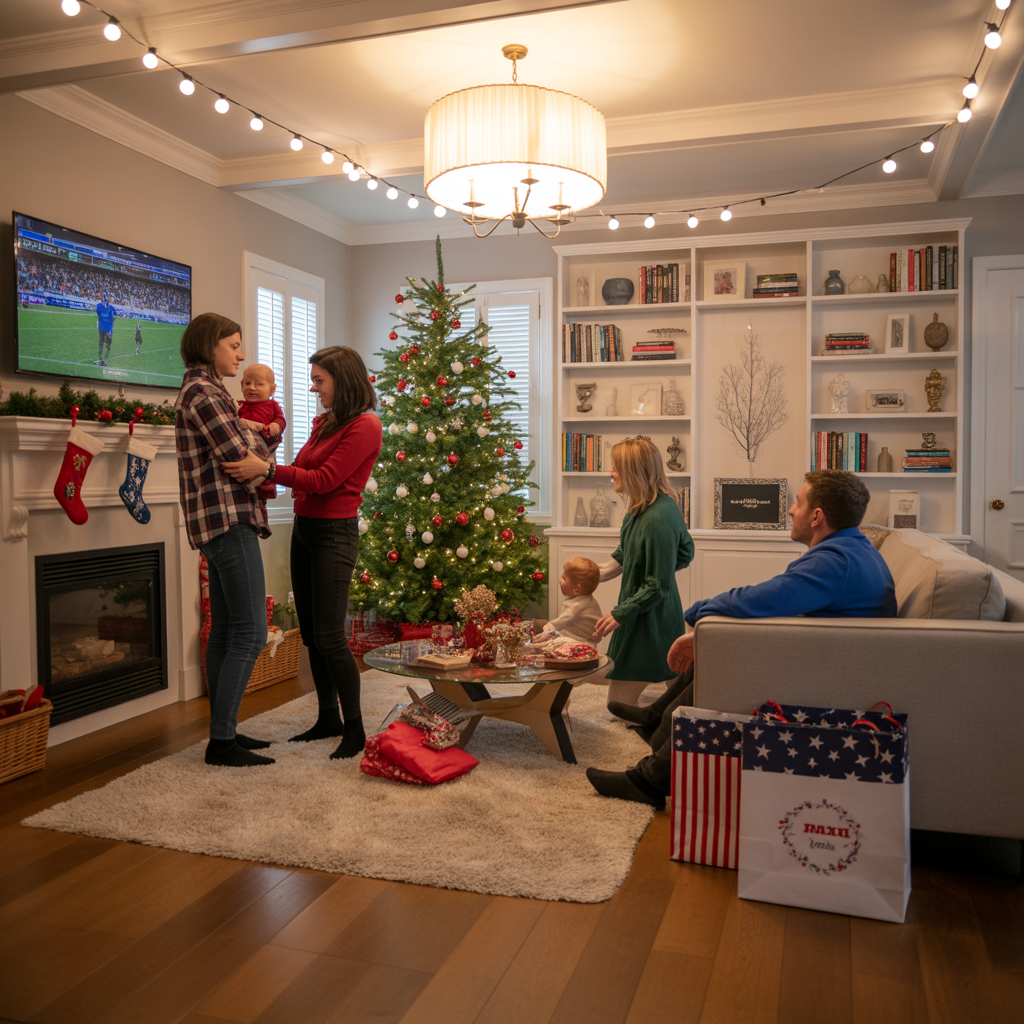
My name is Jacqueline, 32 years old.
I hadn’t even taken my coat off when my mom said it, standing near the tree with a wine spritzer in her hand, barely looking at me, her eyes fixed on my daughter like she was something foreign, like the small bundle on my hip didn’t belong in her house.
“Why did you come to Christmas?” she asked. Not with surprise, not with warmth, but with the sharp impatience of someone who believes they have the right to question your presence.
My nine-month-old baby had just woken up from the drive, cheeks flush from the cold, her tiny hand clutching the edge of my scarf—not crying, not fussing, just quiet and curious, trying to make sense of the lights and the smells and the unfamiliar voices. None of that mattered to my mom.
“Your 9-month-old baby makes people uncomfortable,” she added, like she was stating a fact everyone else had already agreed to.
I stared at her, standing there with my winter coat damp from melted snow, my back aching from the long drive, my body still not fully recovered from mastitis the week before, and the exhaustion of new motherhood sitting behind my eyes like a weight I couldn’t put down. I hadn’t come expecting much—just a normal Christmas, just a few hours where someone might look at my daughter and smile and say her name—but even that was apparently too much.
My dad hadn’t even looked up from whatever football game was on, and when he smirked, it was like a punchline had landed.
“She’s right,” he said, voice casual, amused. “Sit this one out.”
In that moment, it wasn’t just the words. It was how easy it was for them to say them, how practiced they sounded, like they’d been waiting for the chance to remind me where I ranked.
I stood there holding my baby with one arm and a giant reusable shopping bag full of carefully wrapped gifts in the other. I’d spent three days picking them out, imagining my nephew’s faces, choosing colors and sizes, folding tissue paper carefully the way I always did, like effort could substitute for belonging.
No one offered to take the bag. No one asked how we were.
My sister Jenny walked in from the kitchen, already on her second mimosa, and looked at me like I’d tracked in something foul. One of her kids was sitting on the floor playing with a new iPad, probably from me if last year was any pattern. Jenny didn’t say hi either. She just flicked her eyes over my baby and then back to my face like she was daring me to make a scene.
I shifted my daughter higher on my hip, feeling her warm breath against my neck, and I realized something I didn’t want to realize.
They weren’t uncomfortable with my baby. They were uncomfortable with me not being convenient.
A baby meant I couldn’t just show up and absorb their insults quietly. A baby meant I had limits. A baby meant I had something more important than them, and they hated that.
So I told them calmly, “If I’m not welcome, that’s fine, but you all need to know this is the last time I do this.”
My mom blinked like she didn’t understand the language I was speaking. Jenny scoffed under her breath. My dad chuckled like I was being dramatic.
I looked straight at all of them and said it without emotion, because emotion was what they expected from me and they had used it against me for years.
If you don’t want me or my daughter here, then I will stop financing your lifestyle.
It shut them up for a second—just a second—then the laughter started. It wasn’t the kind that lightens the room. It was mocking, satisfied, like they were watching a child threaten to run away.
My dad actually clapped once.
Jenny leaned against the kitchen doorway and said something about postpartum hormones, like my boundary was a symptom. My mom muttered something about me always needing attention, like I’d driven two hours through snow with a baby for attention.
They said the words in the same tone they’d always used when they wanted me to shrink back into my role.
I didn’t flinch. I didn’t argue. I didn’t defend myself. I just said it again, slower this time, so there could be no confusion.
You will not receive another dollar from me.
Then I listed it—not as a threat, but as a reality, like I was reading off a contract I’d finally decided to terminate. No more mortgage help, no more school tuition, no more emergency cash transfers, no more groceries, ballet classes, braces, car notes, rent insurance.
My daughter shifted against me, and I kissed her forehead instinctively, because the room had turned cold in a way that had nothing to do with weather.
You’ve all lived off me like parasites for years while making me feel like I’m the burden.
I walked into the living room, set the bag of wrapped presents on the floor next to the fireplace, and for a second I almost laughed at myself for how symbolic it felt, like I was placing down a part of my old life with it.
I picked up my diaper bag, turned around, and headed for the door.
Jenny followed me, her voice sharper now that she realized I wasn’t negotiating.
“You’re seriously leaving,” she said. “You’re going to ruin Christmas for everyone over a baby tantrum that hasn’t even happened yet.”
I didn’t answer. I didn’t give her words to twist.
Outside, snow started falling again—heavy, thick flakes that blurred the windshield by the time I buckled my daughter into her car seat. The roads were getting worse by the minute, but I wasn’t staying. I’d rather slide into a ditch than sit through another hour in that house pretending the way they treated me was normal.
The drive home was silent.
My daughter dozed off quickly, her pacifier bobbing with each breath, the glow from the dashboard making her face look impossibly soft. I glanced at her every few minutes, not because I was afraid she’d wake up, but because looking at her reminded me why I didn’t cry.
I didn’t cry because somewhere deep down a part of me had expected it to go this way.
When we finally pulled into my driveway, it was close to midnight. Snow had piled up in ridges across the walkway. I carried her inside, kissed her forehead, and laid her down gently in the bassinet.
Then I sat on the edge of my bed, still wearing my sweater, still feeling the ache in my back, staring at the empty space where the bag of gifts should have been.
I realized I hadn’t even labeled the presents with names. I had memorized each one—who it was for, what I’d thought when I bought it—as if knowing them by heart meant I belonged.
I thought maybe they’d open them and feel something.
But deep down, I knew they wouldn’t.
No one had said my daughter’s name the whole night, not once. And for the first time in my life, I didn’t want them to.
Later, after I fed her and watched her fall asleep with her little fingers curled around mine, I leaned close and whispered the promise I didn’t know I’d been carrying for years.
“You’re never going to grow up thinking that kind of love is normal,” I told her softly. “I promise you that.”
The morning after Christmas, I woke up to silence so complete it felt staged, like my family was waiting to see how long I could sit with it before I cracked.
No text from my mom, no missed calls from Jenny, nothing from my dad—not even a lazy emoji or a blurry photo of the twins holding up their presents.
You’d think I hadn’t spent three days picking out those gifts with care, or driven two hours through a snowstorm just to be told I wasn’t welcome.
I sat in my kitchen with lukewarm coffee, watching my daughter smack her mashed banana across the high chair tray, and realized I’d done something irreversible. Not just by walking out, but by saying the quiet truth out loud about the money, about how they’d been leeching off me for years while making me feel like I was the burden.
I meant every word, but the silence still stung.
It wasn’t that I expected an apology. I wasn’t surprised they didn’t reach out. I was surprised by how quickly they moved on, how easily they could pretend I didn’t exist the moment I stopped being useful.
By evening, I gave up checking my phone and turned it off.
That night, I fed my daughter mashed carrots, gave her a bath, and watched her fall asleep with her little fingers curled around mine. She looked so peaceful in her crib, so innocent, and I found myself whispering again—more to myself than to her—that she would never grow up thinking love comes with conditions.
The next morning, I heard it knocking. Not a single knock, not the friendly kind that comes with a neighbor and a package. This was loud, repeated, persistent, like someone believed the door belonged to them.
My daughter was still asleep, the baby monitor glowing softly on the counter.
I walked barefoot across the cold floor, cracked the door open, and nearly slammed it shut out of instinct.
My entire family was on my front porch.
My mom was holding a Tupperware container like a peace offering, her mouth already shaped into the expression she uses when she wants to look reasonable.
My dad had his cap pulled low, eyes half closed like he couldn’t be bothered.
Jenny stood in the back with her arms crossed, flanked by the twins who were tossing snowballs at each other like this was a casual weekend visit. Her husband sat in their van with the engine running as if he didn’t plan on staying long.
I didn’t say anything. I just opened the door wider, because I wanted to see what they thought they were doing, and because a small part of me wanted to believe—in spite of everything—that maybe they came for the right reason.
They filed in like it was nothing.
My mom made a show of taking off her boots on the mat like she was a guest with manners, then walked straight into my kitchen and placed the container on my counter without asking.
My dad dropped onto my couch and turned on the TV like he was resuming a show he’d paused.
Jenny didn’t even look at me. She was already on her phone, thumbs moving fast, as if my living room was just a waiting room for whatever she actually wanted.
It took them five minutes to get comfortable. And in those five minutes, I realized something that made my stomach turn.
They weren’t nervous. They weren’t ashamed. They weren’t here to repair anything.
They were here to reset the balance, to return everything to the way it had always been, as if Christmas never happened.
Then came the soft voices, the rehearsed apologies delivered with just enough warmth to sound believable.
My mom said, “We were wrong,” while she wiped down my counter like she was helping.
My dad muttered, “I didn’t mean it like that,” as he scrolled through his phone.
Jenny added, “It wasn’t personal. You were just emotional.”
They kept calling me that—emotional—like that was the flaw, like my feelings were the problem and not the years of taking, not the way they made me feel like I owed them something for existing.
They moved quickly into the part they’d clearly practiced.
They wanted to make things right, start fresh. They missed their granddaughter. They wanted to be part of her life. They wanted to spend New Year’s together.
My mom smiled and said she had already bought new decorations.
Jenny said her husband could pick us up.
My dad offered to shovel my driveway, like a small task could erase a lifetime of contempt.
For a minute, I sat there holding my daughter, listening, nodding at the right moments, pretending to consider it.
That was the sickest part.
They were good at this.
They knew exactly how to sound like family. They knew which words to use, which promises to make, how to soften their voices so I would doubt myself.
And underneath all of it, I could feel the real reason they were there. The thing they never said out loud, but carried in every sentence.
The mortgage payment was due soon.
Jenny’s son needed help with school tuition again.
My mom’s car was making a weird noise.
Gas prices were up.
Groceries, too.
They were circling the money like it was a campfire they’d forgotten how to light without me.
That night, after they had eaten my food and used my bathroom and acted like nothing had ever happened, they went to sleep.
My dad on the couch.
Jenny in my guest room.
My mom in the rocking chair with a throw blanket, still clutching her tea like she was the victim.
The house was too quiet for how many people were in it.
I walked down the hallway and felt my chest tighten with something I couldn’t name yet.
Around midnight, I found my mom’s purse in the bathroom. She left it on the sink.
Her phone screen was lit up from a recent message.
I didn’t touch it. I didn’t need to. The preview was right there, bright and unmistakable, like the universe wanted me to see it.
It was from Jenny.
Told you she’d fold. She always does.
My hands went numb.
I stared at the words until they stopped looking like letters and started looking like a bruise.
Fold like I was paper, like I was predictable, like my boundaries were a performance they could wait out.
I walked into the living room and looked at all of them snoring, curled up, cozy in the home they couldn’t even pretend to respect.
For the first time in my life, I felt something colder than the snow outside.
They didn’t come to apologize.
They came because they were losing their ATM, and they thought I’d never catch on.
When they left the next morning, it was like they’d never been there at all.
My kitchen still smelled faintly like the leftovers my mom brought, but that was it. No note, no thank you.
Just an empty guest bed, a half-used roll of toilet paper in the bathroom, and a wine glass in the sink with lipstick I didn’t recognize.
They were gone before my daughter finished her breakfast.
My mom mumbled something about calling soon.
Jenny forced a smile and reminded me casually that her son’s tuition was due again next week, like she was reminding me to grab milk on the way home.
My dad didn’t even look up from his phone as he stepped into their SUV.
I stood in the doorway holding my daughter against my chest and watched them drive off, the tail lights disappearing down the street like nothing had happened.
I shut the door slowly and leaned my back against it.
Something inside me stopped. Not cracked, not broke, just stopped.
I slid down onto the floor right there in the hallway and sat for twenty minutes without moving.
I wasn’t crying. I wasn’t even sad.
I was tired in a way that went deeper than sleep, deeper than exhaustion.
It was the kind of tired that comes from carrying a weight for so long you forget it’s optional.
By noon, I had my bank app open.
I hovered over the scheduled payments I’d set up months ago—mortgage help for my parents, the prepaid balance for Jenny’s kids’ school, my dad’s insurance premium, everything I’d been quietly covering for the last year and a half.
I didn’t cancel them yet. I stared at the numbers like they might rearrange themselves into something that made sense.
I told myself maybe they really were sorry.
Maybe they were just clumsy.
Maybe I was being too harsh.
That thought lasted until my phone rang.
It was Aunt Linda.
We weren’t close. She was my dad’s older sister, widowed, no kids, the kind of woman who sent birthday cards with perfect cursive and left family gatherings early without explanation.
When I answered, her voice was calm but heavy, like she’d been carrying something she didn’t want to carry anymore.
She asked if I was alone.
I told her yes.
She asked if she could tell me something she’d heard.
I told her she could say whatever she wanted.
She didn’t ease into it.
She told me she’d stopped by my parents’ house the day after Christmas to drop off a box of dishes. Nothing serious.
When she walked in, they were laughing.
Not just laughing, but laughing about me.
My mom called me hysterical.
My dad said I thought they needed me, but I’d come crawling back.
Jenny joked that I was broke emotionally, not financially, and that was the worst kind because I’d crack first.
Linda said they talked openly about it, like they were planning a weekend trip.
They said they’d give me a few days, then show up, act sorry, bring the kids because that always works, and get me back where they wanted me.
My dad said, “We’ve got her wrapped.”
Wrapped.
That word hit harder than everything else.
She said wrapped like a package, wrapped like a thing, wrapped like I was something they could put back in place when it suited them.
Linda paused on the phone, then said she almost didn’t call me. She didn’t want to get involved, but after hearing how sure they were, how confident they were that I’d fold, she couldn’t ignore it.
She said she’d always known they leaned on me, but she hadn’t realized how deep it ran, how cruel it had become.
I thanked her.
That was all I could say.
When we hung up, I walked straight back to my bank app.
I didn’t hover this time.
I canceled everything.
Mortgage assistance gone, school tuition canceled, car insurance revoked, grocery cards turned off, phone plans shut down, emergency transfers ended—every string they could pull.
I cut.
Then I blocked every number.
My mom, my dad, Jenny, her husband.
Within an hour, the call started from unknown numbers.
Hey, what’s going on?
Pretty sure the bank glitched.
You didn’t mean to cancel all that, right?
Then the guilt followed.
How could you do this to your own family?
You’re punishing the kids.
This is unfair.
You’re overreacting.
I didn’t respond.
By evening, the tone shifted.
Jenny sent a long message from a new number reminding me who was there for me when my husband left.
My dad sent a single line.
You’re on a power trip.
Then silence.
I stood in my living room holding my baby, watching her reach up for the ceiling fan like it was magic.
And I realized something that made me straighten my spine.
They hadn’t underestimated me.
They had forgotten who they were dealing with.
The next morning, Jenny left two voicemails from another new number.
The first started with, “Hey, I think there’s a glitch with the bank,” and ended with, “Call me ASAP.”
The second was sharper.
By noon, my mom was emailing me from three different accounts, all versions of the same message.
Confused, concerned, family is forever.
Don’t let one fight ruin everything.
She reminded me again that I was emotional.
She reminded me that they tried.
I didn’t reply.
I was sitting at my kitchen table drinking tea when another message came in.
This one from Jenny’s husband.
He said he didn’t want to get involved, but I should know my mom was losing it, talking about lawyers, saying I stole from the family.
That’s when it really hit me.
They weren’t just upset.
They were panicking.
For the first time in years, they weren’t in control.
That afternoon, I started getting messages from people I barely knew.
Hope you’re okay.
We should talk.
Your mom’s not well.
You’re hurting everyone with this stunt.
I turned my phone off.
Instead of spiraling, I logged into every other account I’d ever connected to them.
Utilities, medical subscriptions, school emergency contacts, grocery balances.
I removed my name from all of it.
I even called the school office and told them I was no longer the financial contact for Jenny’s twins.
They didn’t ask why.
Then I opened a spreadsheet.
Two years of transactions, gift cards, mortgage top-ups, last-minute rent checks, car repairs, therapy bills, medications, streaming services.
It added up to more than I made the year I graduated college.
I stared at the total until it stopped feeling abstract.
I hadn’t been helping them.
I’d been funding their lives.
Around three, the doorbell rang.
No one was there.
Just a box on my welcome mat with my name written in black marker.
Inside was a framed photo from Christmas three years ago.
Me on the floor laughing with one of the twins.
Taped to the back was a note.
You were happy once.
That’s the version of you we miss.
Think about that before you ruin what’s left.
No signature.
Just manipulation wrapped in nostalgia.
I put the photo face down on the counter and turned on every light in the house.
That night, I moved my daughter’s crib into my bedroom.
I didn’t think they’d do anything reckless, but I also didn’t trust them not to.
While scrolling aimlessly, I saw a vague post from an old family friend about people forgetting who raised them.
My mom’s name appeared in the comments three times.
She was spreading her story already.
I leaned back on the couch and smiled, because she had no idea how much worse it was about to get for them.
It started quietly, the way real consequences always do.
Not with shouting or dramatic confrontations, but with small systems failing all at once.
The first alert came from my email, a generic notification I almost ignored because it looked like spam.
Jenny’s credit card payment had been declined at a dentist’s office.
I knew it immediately because the account was still tied to my email from when I’d helped her set it up the previous summer.
It was for one of the twins—a routine cleaning I’d been quietly covering for months without saying a word.
Less than five minutes later, my phone buzzed with a text from an unfamiliar number.
Hope you’re happy.
They had to reschedu.
The twins were embarrassed.
I stared at that last word for a long time.
Embarrassed.
Not ashamed of how she’d laughed behind my back.
Not embarrassed about the manipulation.
Embarrassed because the money stopped.
An hour later, my mom emailed me again.
This time a single sentence.
We’re all very disappointed in you.
I didn’t open it.
I didn’t need to.
I archived it and moved on, because I could feel the shift happening.
They weren’t angry anymore.
They were unraveling.
Jenny’s school payment was declined next.
I found out when the school office called me directly, assuming there had been a mistake since I was still listed as the financial contact.
I told them calmly to remove my name from everything.
The woman on the phone didn’t ask questions.
She just said she’d take care of it.
That evening, my dad finally reached out.
He used a new number, probably a burner, and left a voicemail that almost sounded reasonable if you didn’t know him.
He said things had gotten out of hand.
He said he didn’t agree with everything my mom and Jenny had done.
He said I was making this too big.
Then he said he missed his granddaughter.
He asked if I’d call him just to talk, just to see if we could work something out.
I played the message twice.
Not once did he say he was sorry.
Not once did he mention Christmas.
Not once did he ask how I was holding up as a new mother.
He just wanted the benefits back in motion.
The smear campaign followed right on schedule.
A mutual friend messaged me out of nowhere saying she didn’t want to stir anything up, but my mom had been talking.
She was telling people I’d become cold, that I was taking things out on the family, that I might be having some kind of breakdown.
I read it without surprise.
It still stung, but not because it was true.
It stung because I knew my mom believed it could be.
That’s how little she trusted me to know my own mind.
I replied with a simple thank you and closed the chat.
A few minutes later, another message came in.
Aunt Linda posted something.
You should see it.
I opened Facebook and felt my chest tighten.
Linda hadn’t named names.
She didn’t have to.
She wrote about watching someone give and give until there’s nothing left.
About families mistaking generosity for obligation.
About how silence becomes complicity.
About how sometimes the strongest thing a person can do is walk away.
The comments flooded in almost immediately.
People thanking her.
People sharing their own stories.
And mixed among them were familiar names, people who’d liked my mom’s vague post just days earlier.
Now they were quiet, or worse for her, they were liking Linda’s words instead.
That night, my mom sent one last email from a fourth account.
This doesn’t have to go any further, she wrote.
Let’s not air Dirty Laundry.
You’re not this person.
You’re better than this.
I stood in my living room holding my daughter, reading it over and over, realizing something I hadn’t fully accepted until then.
They hadn’t just been living off my money.
They’d built an entire image of me, a version they could manage.
Endless giver.
Endless forgiver.
Always available.
They didn’t love me.
They loved the role.
And now the role was gone.
I replied with one sentence.
You used me and then you laughed about it.
We’re done.
I hit send, blocked the address, and closed my laptop.
There was no apology, no explanation, just silence.
And somewhere I knew they were scrambling, because without me, the foundation cracked.
Bills stacked up.
The story they told about me no longer matched the version of me they couldn’t reach anymore.
The silence lasted three days.
Not a call, not a message, not even another burner number.
They wanted me to feel it, to doubt myself, to think maybe I’d gone too far.
But this time it didn’t work.
I was already past guilt, past fear.
I could finally see it clearly.
They didn’t miss me.
They missed the access.
On the fourth day, it snowed again.
I heard a knock and opened the door slowly, bracing myself out of habit more than fear.
It wasn’t a delivery.
It was Aunt Linda.
Her husband stood behind her holding a casserole dish under his coat, and behind him were my cousins carrying grocery bags and a wrapped box with my daughter’s name written in bright letters.
I didn’t say anything at first.
Linda smiled gently and said, “We figured you probably haven’t had a break in a while.”
They came in without expectations, no speeches, no conditions.
They played with my daughter on the floor until she laughed herself tired.
Linda made tea and asked if I had laundry she could help with.
We ate together.
Nothing fancy, just warm food and quiet conversation.
When I finally asked Linda why she came, she didn’t dress it up.
She said family isn’t supposed to be conditional and she was wrong for staying quiet all these years.
Before they left, she told me my mom had called her furious, accusing her of poisoning me, banning her from the family.
Linda told her the truth.
The only thing holding that family together had been me, and I had finally stepped away.
That night, after they were gone, I sat in the nursery watching my daughter sleep, one tiny hand curled around her blanket.
I opened the box they’d left.
Inside were handmade toys, a framed photo, and a card in Linda’s familiar cursive.
You’re not alone.
Not anymore.
For the first time since Christmas, I slept through the night.
No guilt, no second guessing, just peace.
The quiet that followed felt different from the other silences.
It wasn’t heavy or threatening.
It didn’t feel like a pause before the next blow.
It felt settled, like dust finally sinking after a storm that had been raging for years without me realizing how loud it was.
I woke up the next morning to sunlight on the nursery wall and my daughter babbling to herself in a soft singong rhythm, completely unaware that something fundamental in our lives had shifted.
I lifted her from the crib, breathed in that warm baby smell, and felt a strange sense of certainty.
Nothing was chasing me anymore.
Days passed without interruption.
No new numbers.
No emails slipping through filters.
No mutual friends just checking in.
My parents and Jenny had gone quiet, not because they understood, but because they had no move left that didn’t expose them further.
Control only works when the other person still wants something from you.
I didn’t.
And that was the part they never planned for.
I went back to routines I hadn’t realized I’d abandoned.
Morning walks with the stroller, even when it was cold.
Cooking real meals instead of grabbing whatever was fastest.
I started leaving my phone in another room without anxiety, without that constant low-level dread that someone would need something from me.
The house felt lighter.
Even my daughter seemed different, calmer, like she could feel the absence of tension the way animals do before humans admit it’s there.
About a week later, I ran into an old neighbor at the grocery store.
She smiled warmly and asked how my parents were doing.
The question didn’t sting the way it used to.
I answered honestly but simply that we weren’t in touch right now.
She nodded like she understood more than she said and changed the subject.
That was the moment I realized the story my family told about me no longer had power outside their circle.
People see what they’re ready to see.
And some of them had been waiting for me to stop pretending.
A few days after that, a final email slipped through before I fully locked everything down.
It was from my dad.
Short, controlled, almost polite.
He said he didn’t recognize me anymore.
That family shouldn’t be handled like business accounts.
That someday I’d regret this.
I read it once, felt nothing rise in my chest, and archived it without responding.
He was right about one thing.
I didn’t recognize myself anymore, and that was the point.
That night, I stood in the nursery again, rocking my daughter while the house settled into its nighttime sounds.
I thought about the version of me who drove through the snow to Christmas—aching and hopeful, still believing effort could buy safety.
I thought about how carefully I’d wrapped those gifts, how much of myself I’d folded into every obligation.
I felt a wave of sadness for her, for that version of me.
But it wasn’t regret.
It was compassion.
I kissed my daughter’s forehead and whispered something different at this time.
Not a promise fueled by anger or fear, but one rooted in clarity.
I told her she would grow up knowing what love looks like when it’s not transactional.
That she would never have to earn her place in a room.
That walking away doesn’t mean you failed.
Sometimes it means you finally chose yourself.
I didn’t rebuild bridges.
I didn’t send updates or olive branches.
I let the distance exist.
Some relationships don’t need closure conversations.
They end the moment you stop participating in the lie that holds them together.
My family lost access to me, and in losing that, they lost the version of me they depended on.
What they did with that loss wasn’t my responsibility anymore.
One afternoon, weeks later, I took the card Aunt Linda left and pinned it inside the closet door where I’d see it every morning.
You’re not alone.
Not anymore.
It reminded me that family can be chosen, that love can show up quietly without conditions or debt attached.
It reminded me that I didn’t destroy anything.
I stepped out of something that was destroying me.
And for the first time in my adult life, the future didn’t feel like something I had to manage for everyone else.
It felt open.
It felt honest.
It felt like mine.
Continuation — The Part They Didn’t Plan For
The first thing I noticed after everything went quiet wasn’t relief.
It was how loud my own thoughts sounded without their voices stacked on top of them.
For years, my mind had been trained to live in a constant state of readiness. Ready for an urgent call. Ready for an “accident” that needed money. Ready for a last-minute deadline that became my responsibility because someone else refused to prepare.
When I stopped paying, that noise didn’t disappear overnight. It lingered in my body like a habit, the way you still reach for a light switch in a room you no longer live in.
On the surface, life looked simple.
A baby monitor glowing on the counter. A sink full of bottles. A stroller tucked by the door. The kind of small domestic mess that comes with being a single mother.
But inside me, there was a different kind of mess. Not guilt exactly. Not regret.
More like the disorienting feeling of realizing you’ve been holding your breath for years, and you didn’t even know it until you finally exhaled.
The morning after Aunt Linda left, I stood in front of my closet and stared at the card I’d pinned inside the door.
You’re not alone. Not anymore.
It wasn’t a solution. It wasn’t a magic charm.
But it was evidence.
Evidence that my family’s version of reality wasn’t the only one. Evidence that love could exist without strings.
I pressed my palm against the paper and held it there for a moment. Then I turned around, picked my daughter up from her crib, and kissed her soft forehead.
“Okay,” I whispered. “We’re going to build something better.”
I’d avoided giving her a name out loud around my parents for months.
Not because I didn’t love her name.
Because I didn’t trust them not to use it like a tool.
In my house, when it was just us, I said it all the time.
“Mara,” I murmured, rocking her against my shoulder. “Good morning, sweetheart.”
Her eyes blinked open, slow and sleepy, and she pressed her cheek into my sweater like she recognized safety.
That was the only kind of recognition I needed.
January came in on a gray sky.
The snow that had looked pretty around Christmas turned into packed ice on the edges of the roads, the kind that made every drive feel like a decision. I bundled Mara into her little puffy suit and strapped her into the car seat the way I always did—careful, thorough, like the world could be managed through precision.
I drove to the pediatrician for her checkup, and even though it was routine, I felt the familiar tension in my chest.
Because routine had never been safe in my family.
Routine was always waiting to be interrupted by someone else’s emergency.
The waiting room was full of other parents—women with tired eyes and men in work boots, toddlers dragging blankets across the floor, a baby crying somewhere behind a closed door.
I sat with Mara on my lap, bouncing her gently while she tried to eat my scarf.
A woman across from me smiled.
“How old?” she asked.
“Nine months,” I said.
“Oh, that’s such a sweet stage,” she replied.
I almost laughed.
My mother had called nine months “uncomfortable.” This stranger called it sweet.
It was such a small thing, but it landed like proof.
When the nurse called us back, I followed her down the hall and felt my shoulders lower a fraction.
No one here was looking at my baby like she didn’t belong.
No one here was questioning why I showed up.
After the appointment, I stopped at a coffee shop and ordered a tea, not because I had time, but because I wanted to practice living like I did.
Mara gnawed on a silicone ring while I sat at a small table near the window.
Outside, the street moved with quiet purpose.
People going to work.
People carrying groceries.
People living their lives without constantly being pulled into someone else’s crisis.
I took a slow sip and thought about how my family had framed my boundaries.
They called it drama.
They called it emotional.
They called it a stunt.
But the truth was, I’d done the most boring thing in the world.
I’d stopped paying.
And boring was powerful.
Because it left them with nothing to argue against except the truth.
The first real test came in the form of a letter.
Not an email this time. Not a message from an unknown number.
A thick envelope with a law office’s return address.
My hands went cold when I saw it.
I stood in my kitchen with Mara strapped in her high chair, smearing avocado into a green constellation across the tray, and stared at the envelope like it might start speaking.
I didn’t open it right away.
I put it down on the counter, washed my hands, and finished feeding my daughter.
I changed her diaper.
I read her a book.
I walked her around the living room until she got sleepy.
Only when she was down for her nap did I sit at the table and slide my finger under the flap.
The letter was written in formal language.
It said my parents were “concerned” about my behavior.
It said they believed I was making “irrational” financial decisions.
It said they wanted a “family resolution” to avoid “unnecessary conflict.”
Then it asked me to reinstate the payments.
Not asked, exactly.
Requested, with the implication that refusal would lead to further action.
I read it twice.
By the second time, my fear had shifted into something steadier.
Clarity.
Because even with a lawyer’s letterhead, it was still the same old move.
Pressure disguised as reason.
Control disguised as concern.
I didn’t panic.
I called Aunt Linda.
She answered on the second ring.
“Hey,” she said gently, like she already knew.
“I got a letter,” I told her.
There was a pause.
Then she sighed.
“I was wondering when they’d try that,” she said.
My throat tightened.
“They hired a lawyer,” I said.
Linda’s voice stayed calm.
“They hired someone to write a letter,” she corrected. “That’s not the same as having a case.”
I stared at the paper.
“It makes me feel like I’m doing something wrong,” I admitted.
“You’re doing something different,” she replied. “They confuse those two things on purpose.”
I swallowed.
“What do I do?”
Linda didn’t hesitate.
“You don’t respond alone,” she said. “I have a friend who’s a family attorney. Not a flashy one. A steady one. I’ll text you her name.”
A steady one.
That phrase mattered more than I expected.
Because my family loved flash.
Flashy apologies.
Flashy gestures.
Big emotional speeches.
What I needed now was steadiness.
“Thank you,” I said.
“Of course,” Linda replied. “And Jacqueline? Don’t let a fancy envelope make you forget what you already know.”
After we hung up, I sat there with my phone in my hand and looked around my kitchen.
The counters weren’t perfect.
There were baby spoons in the sink.
There were crumbs on the floor.
But it was mine.
And no letter could change that.
The attorney Linda recommended was named Claire.
She had kind eyes and a practical haircut and the type of voice that didn’t rise unless it needed to.
When I met her in her office, she didn’t greet me with pity.
She greeted me like a person.
“Tell me what’s going on,” she said.
So I did.
I told her about Christmas.
I told her about the money.
I told her about the text preview—Told you she’d fold. She always does.
I told her about the accounts I’d been paying, the payments I’d canceled, the people I’d blocked.
Claire listened without interrupting, jotting notes in a neat script.
When I finished, she leaned back slightly.
“Do you have documentation?” she asked.
I slid my folder across the desk.
Receipts.
Screenshots.
A spreadsheet that made the whole story look less like a family dynamic and more like a system.
Claire flipped through it.
Her expression stayed neutral, but her eyes sharpened.
“Okay,” she said finally. “This is helpful. And I’m going to tell you something you might not believe yet.”
I held my breath.
“Most of what they’re doing is intimidation,” she said. “They want you to feel like you’re not allowed to change the rules. But you are.”
My shoulders released a fraction.
“What about the letter?” I asked.
Claire tapped the paper.
“I can respond,” she said. “We’ll be polite, factual, and brief. We’ll say there’s no legal obligation for you to fund them. We’ll say any further contact should go through my office. And we’ll make it clear that uninvited visits to your home are not acceptable.”
I swallowed.
“They can’t make me pay?”
Claire’s gaze was steady.
“No,” she said. “And Jacqueline? You’re not taking anything away from them. You’re stopping something you were voluntarily doing.”
Voluntarily.
The word felt sharp.
Because it meant the truth.
I had chosen it.
I could un-choose it.
Claire closed the folder.
“One more thing,” she said. “Your child. Who is authorized to pick her up from daycare?”
I blinked.
“Me,” I said. “And… no one else.”
Claire nodded.
“Good,” she said. “Keep it that way. And make sure the daycare knows.”
A chill slid down my spine.
“You think they’d try?” I asked.
Claire didn’t answer like she was trying to scare me.
She answered like she’d seen families do strange things when they felt desperate.
“I think you should protect your peace,” she said. “Just in case.”
When I left her office, the air outside felt colder, but my hands felt steadier.
Because for the first time, I wasn’t fighting my family with emotion.
I was protecting myself with structure.
Two days later, the daycare called.
I was in the middle of folding laundry, Mara babbling on a blanket beside me, when my phone lit up with the daycare’s number.
My stomach tightened before I even answered.
“Hi, this is Maple Grove,” a woman said. Her voice was careful. “We just wanted to confirm something.”
My throat went dry.
“Okay,” I said.
“There’s a man here,” she continued. “He says he’s your father. He asked if he could see your daughter.”
For a moment, I couldn’t speak.
Not because I didn’t have words.
Because my body remembered old fear.
The kind that makes your mouth go empty.
“He’s not authorized,” I said finally, keeping my voice as calm as I could.
“Okay,” the woman replied quickly. “We told him that. We just wanted to confirm you didn’t add him recently.”
“No,” I said. “Please don’t let him in.”
“We won’t,” she promised. “He’s still outside. Should we call security?”
I closed my eyes.
“Yes,” I said quietly. “If he doesn’t leave.”
When I hung up, my hands were shaking.
Mara looked up at me, her eyes wide and curious.
I reached for her, pulled her against my chest, and breathed into her soft hair.
This was what my family didn’t understand.
They thought everything was about money.
But it had never been only money.
It was access.
It was entitlement.
It was the belief that my life belonged to them.
I called Claire.
She answered immediately.
“This is exactly why I asked about daycare,” she said after I told her.
“What do I do?” I whispered.
“You document it,” she replied. “And you don’t engage. If he shows up again, we escalate. But for now, you do not let this pull you into a confrontation.”
No confrontation.
No scene.
Just boundaries.
I set Mara down on her blanket and walked to the window.
Snow fell softly outside, thick and quiet.
And somewhere across town, my father was learning what it felt like to be told no.
My phone stayed silent for three days after that.
Not because they’d suddenly become respectful.
Because they were recalculating.
They tried to find a new angle.
On the fourth day, Jenny showed up at my house.
No call.
No warning.
Just her car in my driveway like she still had the right.
I watched from behind the curtain while she climbed the steps with one of the twins at her side.
The other twin stayed in the back seat, face pressed to the window like a bored spectator.
Jenny knocked, not gently.
Then she knocked again.
I didn’t open the door.
My heart pounded, but my feet stayed planted.
She knocked harder.
“Jacqueline,” she called, her voice sharp. “Open up. The kids want to see you.”
The kids.
Always the kids.
She used them like shields.
I didn’t respond.
From the living room, Mara made a soft sound, a squeal that turned into babble.
Jenny paused.
Then her voice softened into something almost sweet.
“I brought them,” she said. “They miss you.”
I stayed still.
After a moment, my phone buzzed.
A text from an unknown number.
If you don’t open the door, you’re proving Mom right.
I stared at the screen.
Mom right.
Proving.
It was still a game to them.
A test.
I typed one message.
If you want to see us, we can meet at the park. Not here. Not today.
Then I turned my phone off.
Outside, Jenny stood on my porch for a full minute, waiting.
When nothing happened, she stomped back down the steps and got in her car.
The tires spun slightly on the snow as she backed out.
I didn’t feel triumphant.
I felt tired.
But it was a different tired than before.
Before, tired meant I’d given too much.
Now, tired meant I’d protected what mattered.
The next week, my mother called from a number I didn’t recognize.
I let it go to voicemail.
Her voice was soft, almost fragile.
“Jacqueline,” she said. “We need to talk. Your father is… he’s not doing well. Please. Just meet me somewhere. I’m begging you.”
Begging.
The word was meant to undo me.
It did, in a way.
Because it reminded me of how often I’d begged them silently.
Begged them to be kind.
Begged them to notice.
Begged them to stop treating my love like a resource.
I deleted the voicemail.
Then I sat on my couch and stared at the wall for a long time.
Not because I wanted to punish her.
Because I was learning a new truth.
If my mother could beg when she needed something, she could have been gentle when I needed it.
She just hadn’t wanted to.
Life kept moving.
Mara learned to crawl.
Then to pull herself up on the coffee table.
Then to wobble along the couch like she was practicing independence before she could even say the word.
I watched her and felt something in my chest shift.
Because children don’t ask for permission to become themselves.
They just do.
In February, the snow softened into slush.
The days stretched a little longer.
And I started to notice how much my body had been holding.
I started sleeping better.
Not perfectly—single mothers don’t get perfect sleep—but deeper.
My shoulders didn’t sit up around my ears all day.
My jaw unclenched.
I stopped checking my phone every five minutes.
I started taking pictures of Mara for myself, not for family group chats.
Her tiny fingers wrapped around a spoon.
Her open-mouthed grin when I made a silly face.
Her serious concentration while she tried to stack blocks.
I saved them in an album titled Mara.
Not Family.
Not Christmas.
Not Proof.
Just her.
In the past, I’d documented my life like evidence.
Now, I documented it like joy.
In March, Claire sent me a copy of the letter she’d mailed back to my parents’ attorney.
It was short.
Professional.
Unemotional.
It stated that I had no obligation to provide financial support to other adults.
It stated that any future contact should be directed through her.
It stated that any attempts to contact my child’s caregivers, school, or medical providers were inappropriate.
It stated that I would not tolerate uninvited visits.
Reading it made my stomach flutter.
Not because it was harsh.
Because it was clear.
Clarity is uncomfortable when you’ve been raised in a fog.
My mother sent one more email after that, slipped through a new address.
It was shorter than her usual messages.
We never meant to make you feel used.
I stared at that sentence and felt something strange.
It wasn’t relief.
It wasn’t forgiveness.
It was the recognition that she still wasn’t saying the truth.
She wasn’t saying, We used you.
She was saying, We never meant to.
Intent, again.
A way to soften the reality.
I didn’t respond.
Instead, I wrote something in my journal.
Intent doesn’t pay back years.
Intent doesn’t change patterns.
Intent doesn’t show up when a tired mother arrives with a baby.
Then I closed the journal and went into the kitchen to make Mara lunch.
In April, my cousin Tori got engaged.
She was Linda’s niece, older than me by a few years, the kind of woman who always smelled like clean laundry and wore her hair in a loose braid.
She called me directly.
“I’m getting married,” she said, and her voice sounded like sunshine.
I laughed.
“That’s amazing,” I replied.
There was a pause.
Then she said, carefully, “I want you there.”
My chest tightened.
“Are my parents going?” I asked.
Tori exhaled.
“I invited everyone,” she said. “But I talked to Linda. She told me what happened. And I want you to feel safe.”
Safe.
That word, again.
It was becoming the theme of my new life.
“I don’t want drama,” I said.
Tori’s tone stayed steady.
“Then don’t bring it,” she replied gently. “Just come. Bring your baby. Sit with us. If anyone says anything out of line, it’s my wedding. I’ll handle it.”
I swallowed.
“Okay,” I said.
When I hung up, I sat on my couch and stared at the invitation timeline.
Part of me wanted to hide.
Another part of me wanted to show up.
Not to prove anything.
To reclaim space.
Because my parents had trained me to believe that if I didn’t comply, I didn’t belong.
Tori was offering me a different truth.
Belonging could be chosen.
The wedding was in late June.
By then, the air had turned warm and the trees were full.
Mara was a year old.
She toddled now—wobbly, determined, delighted with herself.
I put her in a little white dress and braided her soft hair as best I could.
Then I looked at myself in the mirror and realized I hadn’t bought new clothes in two years.
Not because I couldn’t afford them.
Because I’d always been paying for someone else.
I went to a department store and bought a simple blue dress.
It wasn’t flashy.
It fit.
It made me feel like myself.
On the day of the wedding, I drove out to the venue with Mara humming in the back seat.
My hands were steady on the wheel, but my stomach still fluttered.
Old fear doesn’t disappear just because you made a decision.
It lingers.
Then you meet it with new choices.
The venue was a renovated barn with white lights strung across the ceiling.
People laughed and hugged and carried drinks.
No one looked at Mara like she didn’t belong.
In fact, she became a magnet.
Aunts leaned down to make silly faces at her.
Cousins offered her crackers.
Tori’s fiancé’s grandmother pinched her cheeks gently and called her beautiful.
Beautiful.
Not uncomfortable.
I realized, standing there with my daughter on my hip, that my family’s cruelty had been framed as normal for so long that I’d stopped expecting warmth.
Warmth was real.
It just hadn’t lived in my parents’ house.
Halfway through the reception, I saw them.
My mother in a pale dress.
My father in a suit that looked slightly too tight.
Jenny beside them, scanning the room with sharp eyes.
My pulse kicked.
Then I felt a hand touch my arm.
Aunt Linda.
“You okay?” she asked quietly.
I swallowed.
“I’m okay,” I said.
Linda nodded.
“Good,” she replied. “Stay with me.”
We didn’t make it dramatic.
We didn’t stare.
We simply moved together through the room like we belonged there.
Because we did.
My mother noticed me first.
Her eyes widened.
She took a step forward.
Then she hesitated.
In that hesitation, I saw something I’d never seen before.
Uncertainty.
She didn’t know how to approach me without money as the glue.
My father’s gaze landed on Mara.
His face softened slightly.
Not enough to erase the past.
But enough to show that even he could recognize a baby’s innocence.
Jenny’s eyes narrowed.
She watched me like she was waiting for me to flinch.
I didn’t.
I turned my attention back to the table where Tori was laughing with her bridesmaids.
I held Mara close.
I stayed.
At the end of the night, my mother approached.
She didn’t come with a speech.
She came with a careful smile.
“Jacqueline,” she said softly.
I looked at her.
“Hi,” I replied.
Her gaze flicked to Mara.
“Hello, sweetheart,” she said.
Mara stared at her, curious.
Then she leaned her head against my shoulder.
My mother’s eyes shone.
“I didn’t know you were coming,” she said.
“I was invited,” I replied.
My mother’s smile tightened.
“Yes,” she said. “Of course. Tori…”
She trailed off.
I waited.
She cleared her throat.
“I miss you,” she said.
The words sounded rehearsed, but there was something raw underneath.
I didn’t give her a dramatic response.
I simply said, “I needed space.”
My mother’s eyes flickered.
“I understand,” she whispered.
I wasn’t sure she did.
But I nodded.
“Take care of yourself,” I said.
Then I turned and walked back to Linda.
I didn’t feel guilty.
I felt strong.
Not loud.
Strong.
In July, my father tried again.
Not through daycare.
Not through a lawyer.
Through a letter.
This one was handwritten.
No official return address.
No threats.
Just his rough, familiar handwriting.
He wrote that he’d been thinking.
He wrote that he didn’t like how things had gone.
He wrote that he missed his granddaughter.
He wrote that he wanted to “start fresh.”
Then he added one line that made my stomach turn.
He said, We can talk about the money later.
Later.
As if the money was still a topic.
As if it was still negotiable.
As if my boundary was a phase.
I folded the letter and put it in my folder.
Not because I planned to respond.
Because I was documenting.
Because I was protecting myself.
Then I called Linda.
“He wrote,” I told her.
Linda sighed.
“What did he say?”
I read her the line.
Linda made a sound under her breath.
“They don’t know how to separate relationship from access,” she said.
“What do I do?” I asked.
Linda didn’t hesitate.
“If you respond, respond once,” she said. “And make it clear. Not emotional. Clear.”
That night, after Mara fell asleep, I typed a short message.
I received your letter. If you want a relationship with me and my daughter, it can’t be tied to finances. If you bring up money, I will end the conversation.
Then I turned my phone off and went to bed.
I didn’t wait for his response.
I didn’t need to.
Because the point wasn’t convincing him.
The point was naming the line.
The first time we met after that was at a park.
Neutral ground.
Open space.
No walls filled with old patterns.
My father arrived first.
He stood near a bench with his hands in his pockets, looking like a man who had lost something and didn’t know how to admit it.
My mother arrived a few minutes later.
She carried a small bag.
Not a huge peace offering.
Just a bag.
Jenny didn’t come.
That was a relief I didn’t say out loud.
Mara toddled ahead of me, her little sandals slapping the pavement.
When my parents saw her, my mother’s face softened.
My father’s jaw tightened, like he was trying not to feel.
Mara stopped a few feet away and stared.
She didn’t run to them.
She didn’t reach out.
She simply watched, as if she could sense the history even without understanding it.
My mother crouched slightly.
“Hi, baby,” she said.
Mara looked back at me.
I nodded gently.
“It’s okay,” I whispered.
Mara took a cautious step forward.
Then another.
My mother held out her hand.
Mara touched it briefly with one finger, then backed away.
My mother’s eyes filled.
My father cleared his throat.
“I didn’t realize…” he started.
I held up a hand.
“Not here,” I said quietly. “Not today.”
My father’s mouth tightened.
But he nodded.
We sat on a bench while Mara played in the grass.
My mother talked about mundane things.
The weather.
A neighbor’s new dog.
A recipe she’d tried.
My father stayed mostly silent.
Then, after ten minutes, my mother slipped.
“We’ve been struggling,” she said softly.
There it was.
The hook.
I didn’t raise my voice.
I didn’t argue.
I simply looked at her.
“I’m not discussing that,” I said.
My mother’s eyes widened.
“I’m not asking for—” she started.
I shook my head.
“It doesn’t matter,” I said. “If you want to be here, be here. Don’t bring that into it.”
My mother swallowed.
My father stared at the ground.
Mara squealed suddenly, delighted by a butterfly.
The sound cut through the tension.
My mother forced a smile.
“You’re right,” she whispered.
We stayed for an hour.
When it was time to leave, my mother asked if she could hug Mara.
Mara let her, stiff at first, then loosening slightly.
My mother held her carefully, like she was afraid of breaking something.
My father didn’t ask to hold her.
He simply watched.
When we walked back to the car, my mother said, “Thank you.”
It wasn’t an apology.
But it wasn’t nothing.
I nodded once.
Then I drove away.
Jenny didn’t like that I met them.
She made sure I knew.
Two days later, she texted from a new number.
So you’re letting them back in now?
I stared at the message.
It wasn’t about my parents.
It was about control.
She wanted to know if the system was coming back.
I replied with one sentence.
This is not about money.
Then I blocked the number.
That night, I sat on my floor while Mara played with blocks and realized show-ups like that were going to be part of the new life.
Not because I was inviting chaos.
Because people who are used to taking don’t accept change quietly.
They test.
They poke.
They look for cracks.
And my job wasn’t to convince them.
My job was to stay solid.
In August, my ex-husband called.
I hadn’t heard his voice in months.
The sound of it still pulled something tight inside me.
Not love.
Not longing.
Just the memory of abandonment.
I let the call go to voicemail.
He left a message.
“Jacqueline,” he said. “I heard you’ve been… having issues with your family. I just want to make sure Mara is okay. Call me.”
I listened to it twice.
Then I sat on my couch and stared at the wall.
My family had done this.
They’d reached for the one person they knew could unsettle me.
They’d tried to pull him into the story.
I called Claire.
She didn’t sound surprised.
“They’re looking for leverage,” she said.
“What do I do?” I asked.
Claire’s voice was steady.
“You keep it simple,” she said. “If he wants to be involved, he can do it appropriately. But you don’t let your family triangulate.”
Triangulate.
That word landed.
Because it was exactly what they were doing.
Turning relationships into weapons.
I didn’t call my ex back.
Instead, I sent one email.
Mara is safe and healthy. If you want updates, please communicate respectfully and directly. Do not get information through my family.
Then I set a new boundary.
I added a password to Mara’s medical file.
I made sure daycare knew not to share information with anyone except me.
I wasn’t living in fear.
I was living in preparation.
By September, the air cooled again.
Leaves started to turn.
Mara started saying a few words.
“Up.”
“More.”
“Mom.”
The first time she said Mom clearly, I cried.
Not because it was dramatic.
Because it was real.
And because I realized my family had never spoken about me like I was a person.
They spoke about me like a resource.
Mara spoke about me like I was home.
I started therapy that month.
Not because I was broken.
Because I wanted to understand why I’d stayed in that role for so long.
The therapist’s office smelled like peppermint tea.
She asked me about my childhood.
I told her what I could.
I told her about Jenny always being the one my parents protected.
I told her about being praised for being “responsible.”
I told her about being the one who didn’t need anything.
“And what did you need?” she asked.
The question made my throat tighten.
I stared at a small plant in the corner.
“I needed them to be glad I was there,” I admitted.
The therapist nodded.
“And were they?”
I swallowed.
“No,” I said.
Saying it out loud made it feel final.
Not hopeless.
Final.
And finality can be freeing.
In October, Jenny’s husband showed up at my door.
Not Jenny.
Him.
He looked uncomfortable standing on my porch, like he wasn’t sure which role he was supposed to play.
I opened the door and kept the chain latched.
“What do you want?” I asked.
He cleared his throat.
“I’m not here to fight,” he said.
I stared at him.
“Then why are you here?”
He glanced down the street, like he didn’t want anyone to see.
“Jenny’s struggling,” he said.
There it was again.
Struggling.
The old bait.
I didn’t bite.
“I’m sorry,” I said, keeping my voice neutral. “But that’s not my responsibility.”
He swallowed.
“She talks about you like you ruined everything,” he said quietly.
I didn’t flinch.
“That’s easier than admitting she depended on me,” I replied.
He nodded, slowly.
Then he surprised me.
“I didn’t know how much you were paying,” he said. “Jenny never told me. She made it sound like it was… normal.”
Normal.
That word again.
I studied his face.
He looked tired.
Not manipulative.
Just tired.
“Why are you telling me this?” I asked.
He hesitated.
“Because the kids,” he said. “They hear everything. And I don’t want them growing up thinking… I don’t want them thinking it’s okay to treat you like that.”
My throat tightened.
It wasn’t an apology.
But it was something human.
I kept my voice calm.
“If you want them to have me in their life,” I said, “then it has to be respectful. No pressure. No money. And no showing up uninvited.”
He nodded quickly.
“I can do that,” he said.
I studied him.
Then I said, “We can meet at the park sometime. With the kids. If Jenny agrees to the same boundaries.”
He exhaled like he’d been holding his breath.
“Okay,” he said. “Thank you.”
When he left, I closed the door and leaned back against it.
I didn’t feel softened.
I felt cautious.
But for the first time, I saw a potential path where the children didn’t have to lose me because their mother refused to change.
That mattered.
In November, my parents asked if we could do Thanksgiving.
Not at their place.
At mine.
The request came through my mother in a careful text.
Just a small meal, she wrote. Just family.
I stared at the message for a long time.
The word family used to make me fold.
Now it made me evaluate.
Not because I didn’t care.
Because I did.
And caring without boundaries had almost destroyed me.
I called Linda.
“Don’t host them alone,” she said immediately.
“I wasn’t planning to,” I admitted.
Linda’s voice softened.
“You don’t owe them a holiday,” she said. “But if you want to try, do it on your terms. Public place. Or with other people present.”
Other people present.
Witnesses.
Support.
I texted my mother back.
We can meet at Linda’s. If she’s hosting. If we keep it calm.
My mother replied quickly.
Okay.
No argument.
That alone told me how badly they wanted access.
Thanksgiving at Linda’s was small.
A table set with mismatched plates.
A turkey that Linda swore was “good enough.”
Cousins arriving with casseroles.
Kids running through the living room.
Mara in a high chair, throwing tiny pieces of bread like confetti.
My parents came in quietly.
My father looked around like he didn’t know where he fit.
My mother smiled too tightly.
Jenny didn’t come.
When Linda greeted my mother, she hugged her quickly and then said, loud enough for everyone to hear, “We’re keeping this peaceful today.”
My mother nodded, eyes flickering.
My father avoided Linda’s gaze.
We ate.
We talked about safe topics.
The weather.
Tori’s wedding.
A new bakery.
My mother asked about Mara’s favorite foods.
My father watched Mara quietly.
Then, halfway through the meal, my father slipped.
He said, casually, “It’s been hard, you know.”
The table went quiet.
Not dramatically.
Just the subtle hush of people sensing danger.
Linda set down her fork.
“Tom,” she said calmly, “we’re not doing that today.”
My father’s face flushed.
“I wasn’t asking—” he started.
Linda cut him off gently.
“I know,” she said. “And you’re still not doing it.”
My father’s jaw tightened.
My mother reached for his hand under the table.
He swallowed.
Then he nodded.
The moment passed.
And I realized something.
Linda wasn’t just supporting me.
She was teaching them the new rules.
Rules that didn’t depend on my strength alone.
After dinner, my mother followed me into the kitchen.
Mara was napping in a portable crib Linda had set up in the spare room.
The kitchen smelled like pie and warm dishes.
My mother leaned against the counter.
“I didn’t think it would end up like this,” she whispered.
I looked at her.
“You didn’t think I’d stop,” I said.
Her eyes flickered.
She didn’t deny it.
Instead, she said, “I miss being close.”
I swallowed.
“I miss what I thought we were,” I admitted.
My mother’s face tightened.
“You’re still punishing us,” she said softly.
I shook my head.
“I’m protecting myself,” I replied.
She stared at me.
Then she whispered, “Do you hate us?”
The question was so raw it almost softened me.
Almost.
But I didn’t lie.
“I don’t hate you,” I said. “I just can’t live inside the old system.”
My mother’s eyes filled.
“I don’t know how to be your mom without it,” she admitted.
There it was.
The truth.
I nodded slowly.
“Then learn,” I said.
She blinked, tears slipping down.
“I’m trying,” she whispered.
I didn’t hug her.
Not because I wanted to be cruel.
Because I wasn’t ready.
I simply said, “Keep trying.”
December came again.
The first Christmas after the break.
The air was cold. The lights were everywhere. The ads on TV kept telling me what a family holiday was supposed to look like.
In the past, December made me tense.
It was when my parents’ expectations increased.
More gifts.
More money.
More performance.
This year, I kept it small.
A tree in the corner.
A handful of ornaments.
Mara’s tiny handprints on paper as a craft project.
I invited Linda and a few cousins over on Christmas Eve.
Not a grand event.
Just food and warmth and people who didn’t question my presence.
Mara toddled around the living room, fascinated by the lights.
She pressed her fingers to the tree ornaments and giggled.
Linda watched her with a soft smile.
“She’s happy,” Linda said.
I nodded.
“She is,” I replied.
“Are you?” Linda asked.
The question was quiet.
Not a test.
Not a trap.
Just care.
I swallowed.
“I’m learning,” I said honestly.
Linda nodded.
“That counts,” she replied.
Later that night, after everyone left, I found an envelope tucked under my doormat.
No return address.
My stomach tightened.
I picked it up and carried it inside.
I opened it cautiously.
Inside was a single card.
A simple holiday card.
My father’s handwriting.
Merry Christmas, Jacqueline.
Merry Christmas, Mara.
I hope you have a peaceful day.
No mention of money.
No manipulation.
Just that.
I stared at it for a long time.
I didn’t cry.
But my throat tightened.
Because whether he meant it sincerely or not, it was the first time my father had spoken to me like a person instead of a system.
I set the card on the counter.
Then I went to check on Mara.
She was asleep, her cheeks flushed, her hand curled around her stuffed bunny.
I watched her for a moment and felt the familiar promise rise again.
You will never grow up thinking that kind of love is normal.
But now, the promise had expanded.
You will grow up seeing what love can look like when it’s steady.
On Christmas morning, my phone buzzed.
A text from my mother.
Merry Christmas.
No hearts.
No long speech.
Just those two words.
I stared at it.
Then I typed back.
Merry Christmas.
That was all.
Not forgiveness.
Not reconciliation.
A small, cautious thread.
Later that afternoon, while Mara opened her gifts—blocks, a book, a soft blanket—there was a knock at my door.
Not frantic.
Not demanding.
Just a knock.
My stomach tightened.
I walked to the door and looked through the peephole.
My mother stood outside.
My father beside her.
No Jenny.
No kids.
Just them.
My hand hovered over the lock.
My heart pounded.
Then I heard Mara giggle in the living room.
The sound steadied me.
I opened the door, keeping my body in the doorway.
“Hi,” I said.
My mother’s eyes were wet.
“We didn’t know if you’d open,” she whispered.
“I didn’t know if I would,” I admitted.
My father cleared his throat.
“We’re not here to stay,” he said. “We just wanted to… see her for a minute.”
See her.
Not talk about payments.
Not talk about bills.
Just see her.
I breathed.
“Okay,” I said. “Come in. Ten minutes.”
My mother nodded quickly.
They stepped inside.
Mara looked up from her toys, curious.
My mother knelt slowly.
“Hi,” she said to Mara.
Mara stared.
Then she pointed at my mother’s scarf.
“Soft,” she said.
My mother laughed softly, startled.
“Yes,” she whispered. “Soft.”
My father stood behind her, hands clasped.
He watched Mara like he didn’t know how to approach.
After a moment, he took a cautious step forward.
Mara looked at him.
Then she reached out and touched his sleeve.
My father’s face tightened.
For a second, I thought he might cry.
He didn’t.
But his voice came out rough.
“Hi, kiddo,” he murmured.
My mother glanced up at me.
“She’s beautiful,” she whispered.
I didn’t respond.
Not because I disagreed.
Because I was watching.
Watching for the old patterns.
Watching for the hook.
For ten minutes, they stayed in my living room.
My mother watched Mara stack blocks.
My father smiled once, small and surprised, when Mara clapped for herself.
No one mentioned money.
No one hinted.
No one tested.
When the ten minutes were up, I said, gently, “Okay.”
My mother stood.
She looked at me like she wanted to say more.
Then she swallowed.
“Thank you,” she said.
My father nodded.
He hesitated at the door.
Then he said, quietly, “I’m sorry about Christmas.”
The words were simple.
Not perfect.
But real enough to make the room feel different.
I stared at him.
My mother’s breath caught.
My father’s gaze stayed on mine, steady, almost uncomfortable.
Then, before my mother could add anything, before the moment could turn into negotiation, my father opened the door and stepped outside.
My mother followed.
They left.
No speeches.
No demands.
Just a brief visit.
I closed the door and leaned against it.
My hands were shaking.
Not from fear.
From the unfamiliar sensation of my family showing up without taking.
In the living room, Mara clapped again, delighted by the sound.
I walked back to her, sat on the floor, and pulled her into my lap.
For the first time, I let myself imagine something I hadn’t allowed before.
Not the old family.
Not the perfect family.
But a new version.
One where I didn’t have to disappear for them to feel comfortable.
One where my daughter’s existence wasn’t treated like an inconvenience.
One where love wasn’t a transaction.
I didn’t know if we’d get there.
But I knew this.
If we ever did, it would be because they learned how to show up.
Not because I paid for the privilege.
And if they couldn’t learn, my life would still be okay.
Because I had already built the most important thing.
A home where my daughter was never questioned.
A home where we both belonged.
A home that didn’t require me to fold.
Have you ever realized someone valued your “help” more than your presence—and what boundary did you set to protect your child and your peace? Share your story in the comments.