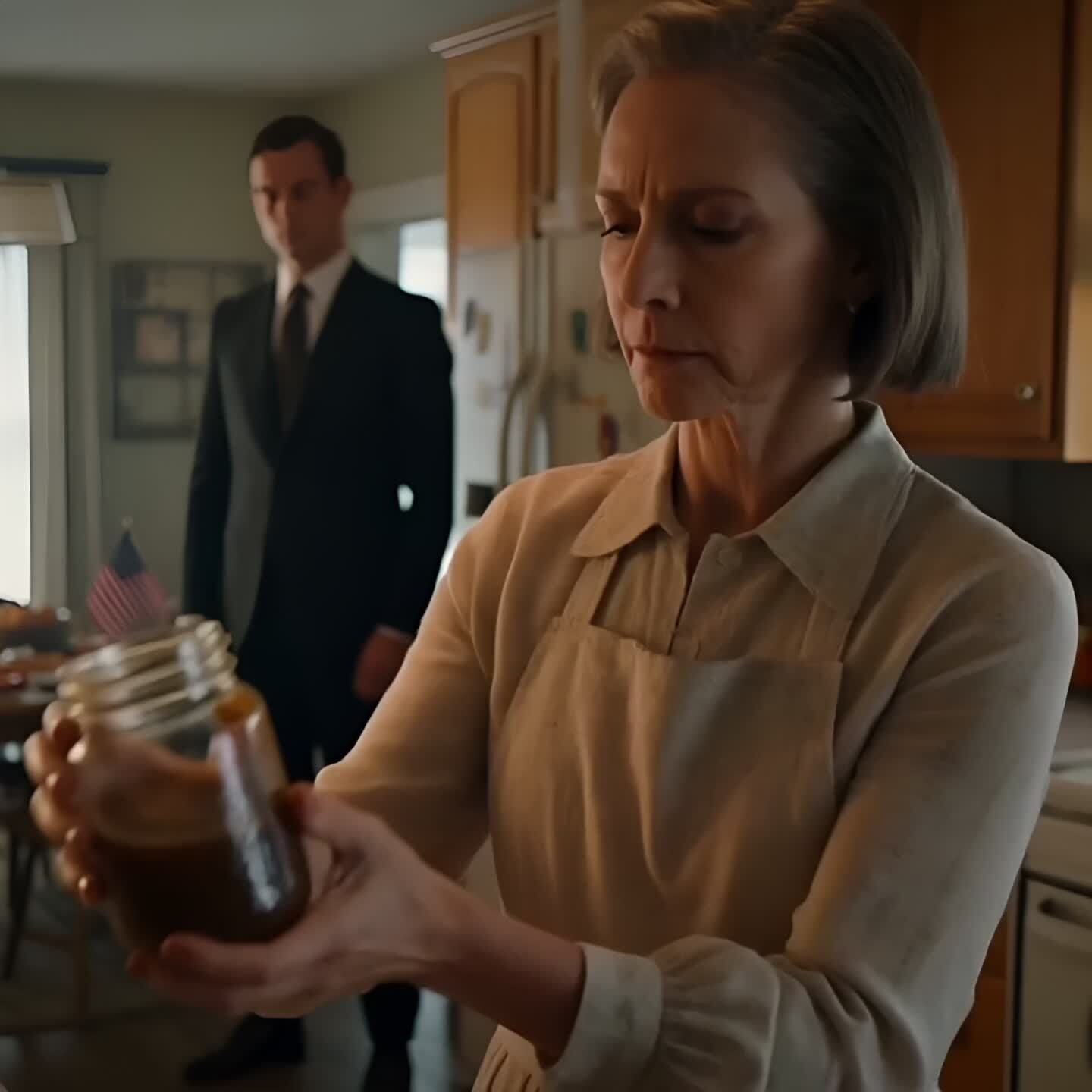
My son smiled a little too hard when he said, “Try the gravy, Mom,” and that was when I knew something was wrong. Nothing obvious, nothing you could point to and prove—just a glint in his eye, too eager, and the way his fingers hovered near my plate like he was waiting for something to happen.
He had never cared about the food before. Most years, Jeremy barely acknowledged my presence at Thanksgiving, but this time he leaned over, syrupy and sweet, and said, “I made this one just for you. You’ll love it. Promise.”
I didn’t even answer. I looked at the gravy—rich and dark, pooling thick over the turkey slice on my plate—then I looked at his wife, Sheila, laughing too loudly at something the youngest cousin had said, her plate untouched beside mine like a prop waiting for its cue.
I don’t know why I did it. Maybe it was instinct, maybe it was the years of watching the two of them whisper when they thought I couldn’t hear, the way they exchanged glances whenever I brought up my house, my future plans, or—God help me—my health, like my body was a calendar they were already flipping ahead on. I reached over and swapped our plates, quiet as a breath, and Sheila didn’t notice.
No one noticed, except Jeremy. He stiffened for a second—barely—but I saw it, the fake smile slipping by a fraction as he said, “Wait, no, Mom—uh, that one’s yours,” too late because I’d already taken a bite of her mashed potatoes and nodded politely like nothing was wrong.
Ten minutes later, Sheila complained of stomach pain. Twenty minutes after that she was pale and clutching her gut, and at thirty we called 911, the kind of number you don’t call in a home unless the air has already turned sharp with fear.
The rest of the evening unraveled like old yarn. The kids cried, Jeremy paced, and I sat perfectly still at the long oak dining table, sipping cold coffee while ambulance lights painted the snow outside in frantic flashes of red, making the whole world look like it was flickering between truth and emergency.
No one asked how I felt, and no one remembered it was my plate she’d eaten from. The paramedics said it looked like a sudden allergic reaction, serious and fast, and Sheila could barely talk, her face flushed and slick with sweat, but I heard her whisper, hoarse and terrified, “It was the gravy.”
I looked at Jeremy. He looked at me. Neither of us blinked, and the silence between us wasn’t confusion—it was recognition.
I hadn’t had a reaction. Not a stomach cramp, not a tickle in my throat, nothing, and I had more allergies than I could count—seafood, nuts, shellac, even certain mushrooms—so I lived like a woman reading the world in tiny warnings. At my age you get used to checking labels and sniffing before sipping; it becomes a second nature you don’t even realize you’re practicing.
Sheila didn’t have allergies, not that I knew of, but she had eaten something that made her body scream. And if that something had been in the gravy—my special serving—then what exactly had Jeremy intended?
After the ambulance left, I stayed. Everyone else followed to the hospital or trickled away with awkward hugs and excuses, but I stayed and cleaned up, folding napkins, rinsing plates, setting aside leftovers, because no one offered to help and they never did.
The gravy boat was nearly empty. I poured what remained into a mason jar, sealed it tight, and tucked it into the back of the fridge behind the cranberry jelly, then sat in the kitchen with the lights off and listened to the quiet, the kind that makes a house feel older than it is.
Something inside me had shifted. Not fear—no, I wasn’t afraid—but it felt like the moment right before a storm, when the sky turns that strange heavy gray and you know the world is about to split open.
I’d been blind for too long. I’d let them smile at me with teeth like knives, tell me how grateful they were, how they loved having me there, while maneuvering around me as if I were just another piece of furniture from the past they hadn’t figured out how to throw out yet, and tonight I’d seen it clear as day.
For the first time in years, I wasn’t going to let it slide. I didn’t sleep that night, not out of worry for Sheila—though I did wonder how she was doing—but because my mind wouldn’t stop reassembling the evening moment by moment, like someone rewinding a tape to find the exact second the lie began.
The kitchen still smelled faintly of cinnamon and turkey fat. I left one lamp on—the old yellow one over the sink—and sat there with a notebook in front of me, not to write anything down, just to keep my hands busy turning pages, because I hadn’t used it since Derek died and even paper felt like company.
At 2:23 a.m., my phone lit up with a message from Jeremy: Still in ER. She’s stable now. I’ll keep you updated. No thank you for staying, no how are you feeling, no love you—just a sterile status update, as if I were a distant relative on a mailing list, and I didn’t reply.
At 3:07, I opened the fridge and took out the mason jar. I held it up to the light, and it looked fine and smelled fine, but something was off, the same way a smile can look fine until you notice it doesn’t reach the eyes.
I poured a little onto a plate and stirred it with a spoon. There were specks—too sharp to be pepper, too pale to be thyme—so I picked one out with a toothpick and stared at it, too small to say for sure, but I wasn’t imagining things.
I rinsed the jar, scrubbed it clean, and made a note to call the doctor in the morning, not for me—I was fine—but because I wanted a record. I wanted a trace.
The next day I didn’t hear from Jeremy at all. Around noon, I got a call from my granddaughter, Caitlyn—seventeen, soft voice, big eyes like her mother’s, but with the same steady gaze I’d had at her age—and she whispered, “Grandma, I need to tell you something.”
I sat down slowly. “Go ahead, honey,” I said, and she hesitated like the truth was hot.
“I don’t know if I should. Maybe it’s nothing, but yesterday before dinner, I saw Dad in the kitchen with the gravy. He was adding something from a little glass bottle—like a dropper thing. I thought it was spices or something, but… my throat tightened.”
“Are you sure?” I asked, and there was a pause.
“He looked nervous,” she said. “When I came in, he jumped, then told me to go help set the table.”
“Did your mom see?” I asked.
“I don’t think so. She was upstairs with Aunt Denise.”
I thanked her and told her she did the right thing calling me. I told her not to say anything yet, not yet, because you don’t wave a lantern when you’re not sure where the snakes are.
After I hung up, I stared at the wall until it stopped being a wall and started being every moment I’d refused to interpret. Then I stood, opened my filing cabinet, and pulled out the envelope Jeremy had given me last spring.
“This is just a form for hospital emergencies, Mom,” he’d said, sliding it across the table with that same boyish smile he used in high school when he was trying to hide a failed test. “Nothing major. Just a precaution.”
I hadn’t read it carefully. I’d trusted him, because I’d raised him, bathed him, fed him, taught him how to tie his shoes and ride a bike and tell right from wrong, and suddenly I remembered the way he’d pushed me to put my name down, the second envelope I hadn’t asked about, and the way Sheila had said, “Good, now that’s done,” before she even glanced inside.
I opened the envelope now, hands steady, and read the first page and then the second. It wasn’t just a medical release—it was a broad, durable authorization, stamped and witnessed, giving Jeremy sweeping control over my money and property if I were ever deemed medically unfit.
My stomach turned. I flipped to the last page, and my handwriting stared back at me—shaky and slanted—because I hadn’t understood what I’d agreed to.
And if that gravy had made me sick, if I’d gone to the hospital confused, vomiting, disoriented… what then? Would they have declared me unfit, would Jeremy have stepped into my life like a man slipping into a coat he’d already tried on in private?
Something inside me settled, not panic, not fear—resolution. I picked up the phone and called my lawyer.
“Michael,” I said, keeping my voice even, “I need you to review a document for me, and I need to change my emergency authorization today.”
There was a pause, then his calm voice. “Of course, Mrs. Reynolds. Can you come in this afternoon?”
I looked at the clock. “Yes,” I said. “I’ll be there in an hour,” because some storms don’t announce themselves with thunder. Some begin quiet and slow and inevitable, and they wash away everything you thought was safe.
Michael Adams had been our family lawyer since Derek first drafted an inheritance plan. Sharp mind, soft voice, always in a charcoal suit that looked too expensive for a man with peeling office paint, and when I walked into his downtown building that afternoon he was already waiting in the hallway.
“I took a look at your call notes,” he said gently, leading me into his office. “Bring the document.”
I handed him the envelope. He read slowly, adjusting his glasses twice, then held up the final page like it might change if he stared long enough.
“Did you understand what you were agreeing to here, Mrs. Reynolds?” he asked.
“No,” I said calmly. “I trusted my son.”
He nodded once, pity and anger crossing his face in quick succession. “This isn’t limited to health matters. It gives Jeremy authority over your money, your home, even decisions about where you live, if someone claims you’re not mentally capable.”
I didn’t react, because I’d already gone cold inside. “Do you feel mentally incapable?” he asked, not smiling.
“I drove myself here,” I said. “I read the Wall Street Journal this morning, fixed my leaky faucet last week, and made a chess move by mail that’s about to ruin a retired engineer in Florida,” and that made him smile briefly.
“I’d say you’re fine,” he replied.
“Good,” I said. “I want this revoked, immediately, and I want new paperwork naming my granddaughter Caitlyn as the only person allowed to step in for me.”
Michael blinked. “Not Jeremy.”
“Not Jeremy,” I said, and he nodded, firmer this time.
“We’ll also want a living directive,” he said, “and I recommend a trust arrangement if you’re ready to talk estate structure.”
“I’m ready,” I told him, more than ready—I was certain, and we spent the next hour drafting everything while I made him read every word aloud, then read it again myself, because I was done letting other people skim my life.
When it came time to put pen to paper, my hand didn’t shake once. By the time I left his office, my shoulders felt a little lighter, like I’d finally set down a heavy bag I’d been pretending wasn’t mine.
Back home, I made tea and sat in the kitchen with the radio turned low, the way Derek used to like it. Outside, the wind pushed leaves into slow spirals across the porch, and I opened a drawer and pulled out my household ledger.
For years, I’d tracked every expense, not out of obsession but because I believed in accountability, and I flipped to the last year and skimmed: two thousand for Jeremy’s new water heater, six hundred for Sheila’s urgent dental work, eight hundred for Caitlyn’s school trip—the only one I didn’t resent—and the big one, twelve thousand last winter to cover “emergency repairs” on the garage Jeremy never actually fixed.
It was all there in my neat handwriting, every dollar I’d handed over, every time I’d nodded and said, Of course, dear, and when I closed the book I felt something clean click into place, because I wasn’t doing this anymore.
At 5:17 p.m., my phone rang. Jeremy. I stared at the screen until it stopped, and when he didn’t leave a message a text came in five minutes later: Mom, we need to talk. Are you free tonight? I didn’t reply, because silence was the first boundary I could draw without anyone’s permission.
At 7:43, Caitlyn called again. “Grandma,” she said softly, “Dad and Mom are saying you’re confused, that maybe you’re forgetting things,” and I felt my pulse slow the way it does when you realize the fire alarm isn’t an accident—it’s a strategy.
“They say it a lot lately,” she continued. “Not to your face, but when you’re not around. They said you should maybe consider a care home.”
I closed my eyes. “Thank you for telling me,” I said, and after a long silence her voice cracked.
“I don’t think you’re confused,” she whispered. “I think you’re the only one who sees what’s happening.”
“I see it clearly now,” I told her. “Do you want to come over?”
“No, darling,” I said. “Just keep your ears open, and don’t let them scare you,” and when we hung up I turned off the lights and stood at the window watching streetlights flicker on one by one.
They thought they were clever. They thought they’d slide me gently into silence, into invisibility—into a home, into controlled finances, into a staged moment of concern followed by a legal takeover—and they’d forgotten who I was.
I raised a family. I buried a husband. I built a life from scratch with calloused hands and a clear head, and no one—no matter how politely—was going to erase me.
I woke early the next morning, not because I had somewhere to be, but because my body didn’t know how to sleep past dawn anymore. At seventy-two, you stop waiting for alarm clocks; your bones do the waking for you, and the house was quiet in the way that reminds you no one’s coming down the stairs for breakfast, no one’s leaving wet towels in the bathroom or slamming the back door.
Just me, the tick of the wall clock, and the old percolator sputtering to life.
I poured my coffee, took a seat at the table, and pulled the small red notebook from the drawer, the one I hadn’t opened in over a decade. Inside were records, letters, notes, even receipts I’d tucked away without knowing why, and at the time I’d called it my rainy day file, which meant some part of me had known one day it would pour.
There was a sticky note from three years ago: Mom, can you put your name on this quick? I forgot to submit the city permit for the garage and they’ll fine us if it’s late.
I had written my name, of course I had, because who wouldn’t help their own son? I dug further and found another paper folded in thirds, a scanned copy of something he’d emailed marked urgent, and at the bottom, barely legible, was a line authorizing temporary access to my investment account, just for some short-term restructuring, he’d said.
I hadn’t remembered that one.
Next, a Christmas card from Sheila dated two years back, with an extra envelope tucked inside—a thank you note, supposedly, but inside was a printed list titled joint expenses to reimburse Jeremy, approved by Mom, with a blank line at the bottom.
My scrawl was already there, slanted and rushed, and I stared at it long enough to feel the shame turn into anger and the anger turn into something harder. If there was going to be a storm, I needed to start gathering the thunder.
By ten o’clock, I was in my car, a dependable 2011 Ford—beige and boring as an unbuttered biscuit. I didn’t need flash; I needed reliability, and my first stop was my financial institution.
The woman at the counter, Megan, was new—young, pleasant, called me ma’am with a sweetness I could smell a mile away—but when I asked to speak to someone about recent account activity she handed me off quickly to a manager.
Mr. Lee was maybe forty, maybe younger, wearing a tie with ducks on it and smiling like he’d been trained in seminars, but when I told him what I needed—twelve months of activity and any active authorizations or linked accounts—the smile dropped.
“Of course, Mrs. Reynolds,” he said. “Let me pull up your account,” and he clicked and clacked on his keyboard while I watched his eyes move left to right, then pause, then move left again as his forehead creased.
“There are a few active links to third-party accounts,” he said carefully. “One joint authorization set up for a recurring monthly draw to an external account in the name of J. Reynolds and S. Reynolds.”
“How much?” I asked.
“It’s been running monthly,” he said. “Fifteen hundred, on the third. Categorized as maintenance support.”
“Stop it,” I said, and the word landed like a gavel.
He blinked. “Excuse me?”
“Cancel that immediately,” I said. “And I want written confirmation,” and when he nodded slowly he added, “Just to clarify, this was enabled under the emergency authorization you signed in March.”
“That document is no longer valid,” I said. “I revoked it yesterday. My lawyer will send you the updated one today,” and his throat cleared before he nodded again.
“Understood.”
I leaned forward. “Also, I want to restrict any future changes to this account without in-person verification. No online or phone amendments.”
“Yes, ma’am,” he said, and before I left I asked him to print the last twelve months of transactions and tucked them into my bag like evidence.
Back home, I read line by line: dry cleaning, caterers, online orders for electronics, three hundred to a photography studio I didn’t recognize. At the bottom of one statement, a flagged transaction: emergency cash pull, twenty-five hundred.
I never made that withdrawal, but Jeremy had access then, and as I looked out at the bare maple trees swaying in the wind I made another decision: I wasn’t going to be the kind of mother who forgave and forgot, not this time. This wasn’t a misunderstanding—it was theft—and I was going to treat it as such.
Spring had come early that year, the magnolia blooming in April a full three weeks ahead of schedule, and it was the same week Jeremy stopped by unannounced with a Starbucks cup and a stack of manila folders like he’d just walked out of a business meeting.
“Mom,” he said, all smiles. “You look great. Been gardening,” and I remember wiping my hands on my pants and squinting up at him.
“You’re two years late for compliments, Jeremy,” I said. “What do you want?”
He laughed. “Come on. I can’t visit my favorite lady without being accused of needing something,” but he followed me inside like a man on a mission.
“I do need a favor,” he admitted once we were seated. “Nothing complicated. I just need your name on a couple things. Legal ease. You know how it is,” and he laid the folder flat in front of me.
“This one’s for the city,” he explained, tapping the top page. “Permits for the garage project. Technically, since it’s in your name, they want your approval. Stupid bureaucracy.”
I looked at the page, saw my name typed neatly at the top, the city seal faintly watermarked across the middle, and it looked official enough to lull a tired mother.
“And this one?” I asked as he slid a second form toward me.
“That’s just a medical release,” he said too quickly. “In case anything ever happens to you, God forbid. Hospitals love to have this stuff on file,” and I frowned because I already had a living directive.
“Yeah, but this one’s newer, more comprehensive,” he said. “Mike Adams helped me draw it up. You trust Mike, don’t you?” and that was when I hesitated, because I trusted Mike but I didn’t trust Jeremy’s tone.
He’d always been a good talker. Got it from his father. But this was something else—too polished, too ready.
I remember picking up the pen, then putting it down. “Let me read through this one,” I said, and Jeremy’s jaw tightened just a flicker, a twitch at the corner of his mouth.
“Of course,” he said, pushing the folder closer. “Take your time. I’ll refill your coffee,” and I nodded, but I didn’t read it, not fully. I skimmed the top lines, saw words about durable authority, and fool that I was, I thought it meant he’d be allowed to speak on my behalf if I were on a ventilator.
So I put my name down and handed it back. He left with both folders tucked under his arm, smiling like a man who’d won a bet, and now—months later with statements spread around me like confetti—I saw that moment for what it had been.
Not love. Not concern. Preparation.
That same week, a letter had arrived from my insurance provider, a notice of change in policy access, and I’d shuffled it in with junk mail. Now I understood: Jeremy had been laying the groundwork, and I’d walked straight into it.
I called Michael again. “I want another meeting,” I said. “I want full asset protection. Locked structures, the kind he can’t touch,” and he didn’t ask why—he just said, “Of course, tomorrow morning.”
After I hung up, I stood at the sink looking out at bare limbs against the gray November sky. The wind scattered dry leaves across the yard, the air smelling like woodsmoke and distance, and I remembered Jeremy as my miracle baby after two miscarriages and a long string of doctors saying unlikely.
I’d nursed him through colic, chickenpox, his first broken heart when Miranda left him in college. I’d paid off his student loans when he lost his job in 2008, lent him the down payment for their first house, covered their taxes twice, and none of it bought loyalty or decency.
Now that he saw me not as a mother but as a hurdle, I owed it to myself to become a wall he couldn’t scale, and tomorrow I’d start building it, brick by brick, and this time no one was getting over.
Michael rearranged his schedule for me. When I arrived at 9:05 the next morning, he was already in his office with a fresh pot of coffee and a yellow legal pad open on the desk.
“You weren’t kidding,” he said, glancing at the stack I handed over. “You brought evidence.”
“I brought a pattern,” I corrected, “one that’s been going on for years, and I just never wanted to look at it closely,” and we went through everything, page by page—statements, the forms I’d been rushed into, the reimbursement list Sheila had slipped me.
By the time we reached the bottom, Michael took off his glasses. “Mrs. Reynolds,” he said, “this is more than negligence. This is exploitation,” and I nodded because I didn’t need a name for it—I needed a solution.
“We can revoke what’s already in place, which you’ve done,” he said. “That’s step one. But I suggest you go further.”
“How far?” I asked.
“A trust arrangement that can’t be undone,” he said. “We move your assets into it—accounts, home, anything you want protected. You appoint a trustee you truly trust. That person manages everything according to your wishes. Jeremy can’t touch it, not now, not ever, and if someone tries to question your competence, your instructions stay in place.”
I exhaled slowly. “And who can be trustee?”
“Could be a professional or a family member,” he said. “Depends on your comfort level,” and I didn’t hesitate.
“Caitlyn,” I said.
He looked at me over the rims of his glasses. “Your granddaughter?”
“She’s the only one who’s told me the truth lately,” I said. “She’s seventeen, but she’s not a child, not in the ways that matter,” and he explained we’d need a co-trustee until she turned eighteen, someone neutral.
“Do it,” I said. “Start the paperwork.”
While he typed, I glanced around the office—the same mahogany desk, the same courthouse-square view, the same framed picture of his old retriever—and I remembered sitting in that chair with Derek years ago, making plans to protect our family.
But this felt different. This time I wasn’t preserving something. I was reclaiming it.
When we finished, Michael printed the preliminary forms. I initialed and inked my name slowly, carefully, no rushing, no distractions, just resolve, and as I gathered my coat he stood.
“You’re doing the right thing,” he said gently. “But brace yourself. When people like your son lose access to something they thought was guaranteed, they don’t always take it well.”
“I’m not worried about their feelings,” I said. “I’m worried about mine, and I’m tired of being the only one who is,” and his smile was small but real.
Before I left, I handed him one last envelope. “Open this after I go,” I said. “It’s my updated estate instructions. I want to finalize it now,” and I told him there was a clause—if anyone contested the trust or tried to challenge my mental fitness, they got nothing.
Michael raised an eyebrow. “That’s serious.”
“That’s clarity,” I said, and he slipped it into a drawer.
Back home, the phone was ringing before I even took off my coat. Jeremy. I let it ring, then Sheila, then Jeremy again, their names flickering on the screen like warnings until a voicemail finally came.
“Mom, we need to talk. What’s going on with the account? They’re saying you blocked all outgoing draws. Are you okay? Call me.”
I didn’t, and instead I sat with my tea, opened the curtains, and let the November light flood the room—soft and gray, but honest enough to breathe.
That afternoon, Caitlyn texted, Just checking in. Everything okay? and I replied, Better than okay. I’m finally building fences they can’t climb. She didn’t ask what I meant; she just wrote, I’m proud of you, Grandma, and I stared at that sentence until my eyes stung.
I smiled, the first real smile in a long, long time.
I didn’t wait for an invitation. Two days later, I drove to the old neighborhood where I once pushed a stroller along familiar sidewalks and waved to neighbors over picket fences, and I pulled into the driveway of Jeremy and Sheila’s house—soft gray siding trimmed in white, the kind of place that looked perfect in holiday ads.
I knocked. Sheila answered, tired and thin, her face sharper than I remembered.
“Hi, Mom,” she said flatly.
“Hello, dear,” I said. “May I come in?” and she hesitated, but I stepped inside anyway.
The living room smelled of eucalyptus and new upholstery, the silence heavy as damp wool. I settled into a chair near the window where I used to sit when Caitlyn visited on weekends and looked around.
“How are you feeling?” I asked.
She gave me a tight smile. “Better. The doctor said it was an allergic reaction. I was lucky. They kept me for observation, but I’m fine now.”
“Good,” I nodded. “I wanted to see you, just you, so we could talk quietly,” and she shifted like she already knew where this was going.
“I want to clear something up,” I said. “The night of Thanksgiving, when you got sick, did you eat the gravy that was on my plate?” and she didn’t answer right away.
“Yes,” she said finally.
“Was it mine,” I asked, “or was it prepared by someone else?”
She swallowed. “Jeremy made it,” she admitted. “But it’s the same recipe you always used. You’ve tasted it.”
“That’s right,” I said. “And I’m glad I did, because I want things to be clear.” Her eyes narrowed.
“What I’m clear about is that you got sick,” I continued. “You didn’t know why yet. I didn’t either. But something that night changed the rules,” and she looked down like a woman trying to hide her footprints.
“What I’m also clear about,” I said, “is that what I agreed to months ago gave Jeremy access to things I never meant him to have, and that dish—the gravy—was the moment I realized I couldn’t trust convenience anymore.”
Silence settled between us, thicker than the winter air outside.
“Mom,” Sheila said, voice low, “I don’t know what you’re suggesting.”
I looked at her and felt no anger now, just cold, measured clarity. “I’m suggesting we don’t pretend anymore,” I said. “That we stop the performance of family when the family act is just an excuse for a takeover.”
I paused, letting the words land. “From now on, I will not be someone you think you can push aside, someone you think you can work around,” and her lips pressed together so tightly they nearly vanished.
“Would you like some tea?” she asked, distant.
“No, thank you,” I said. “But I would like you to understand this: I am not done. Not silent. Not invisible,” and I stood, steady on my feet, because seventy-two is old enough to stop apologizing for existing.
I nodded politely. “Thank you for letting me come,” I said, and at the door I paused.
“Take care,” I told her, not love, because love had become too heavy a word in that house.
Outside, the wind rattled leaves against the porch. I didn’t hurry to my car; I stood there a minute, letting the cold brush my cheeks and listening to the distant hum of traffic and the quiet inside the house behind me.
When I drove away, I didn’t feel relief. I felt control, and a future I would shape, not one I would endure.
The manager met me again the next day with a firm handshake and a furrow in his brow. He’d received Michael’s packet—proper copies of my new paperwork, the living directive, the trust documents—and he said everything was in order, effective immediately, the account protected.
“Good,” I said. “Now I’d like to open something new.”
He looked up. “Additional checking or savings?”
“Neither,” I replied. “A custodial trust in my granddaughter’s name. Caitlyn Reynolds. I want to fund it directly from my investment account.”
He blinked. “For education?”
“For whatever future she chooses,” I said, “and I want it locked. Jeremy Reynolds is not to be granted access or advisory rights,” and the manager nodded slowly.
“We can do that.”
We went through the forms. I was deliberate with each answer—no optional add-ons, no contact sharing, no co-signers—and I funded it with the exact amount Jeremy once asked me to invest in a “startup” that had suspiciously never materialized: one hundred fifty thousand.
Caitlyn would never ask me for a dime. That was exactly why I wanted her to have it.
Before I stood to leave, I turned to the manager. “Out of curiosity,” I asked, “if someone tried to access funds using a revoked authorization, what happens?”
He looked slightly uncomfortable. “We’d flag the attempt and, depending on the nature of the document, potentially notify legal counsel.”
I smiled. “Good,” and by the time I stepped back out into the weak winter sun I felt ten pounds lighter.
Back home, I made Caitlyn’s favorite snack—cheddar crackers and apple slices dusted with cinnamon—and called her. She arrived within thirty minutes, breathless and pink-cheeked from the cold, still in her school hoodie, still the only person who walked into my house without checking her phone first.
“What’s going on, Grandma?” she asked, and I handed her the plate and then the folder.
She opened it carefully, read the top line, and her eyes widened. “I don’t understand. Is this—”
“It’s yours,” I said. “For college, for your future, for your freedom. No one can touch it but you,” and tears welled in her eyes.
“Why?” she whispered.
I looked at her, my heart heavy and certain all at once. “Because I’ve watched a lot of people take from me—take from this family, take from what little dignity women try to keep—and you’ve never taken. You’ve only tried to understand,” and she hugged me so tightly I felt my ribs protest.
No words. Just warmth, and for once I didn’t feel like I was giving something away. I felt like I was giving something back to the right person at the right time.
After she left, I sat in the silence and watched the streetlamps flicker on one by one, because I knew Jeremy would find out eventually. He’d rage. He’d call. He’d ask questions I no longer had any interest in answering, and I was done explaining myself to people who never listened.
It didn’t take long. The call came just after six as I was folding laundry and listening to an old Sinatra record, and the phone lit up with Jeremy’s name again and again until on the fourth try I answered.
“Hi, Jeremy.”
His voice came fast and clipped. “Why are there blocks on the accounts? Why is the bank saying I’m not authorized anymore?”
“Because you’re not,” I said.
“What the hell is going on, Mom?”
I didn’t respond right away. I walked to the kitchen, set the phone on speaker, and filled the kettle, because I’d learned that calm is a kind of power when someone is trying to yank it from you.
“Did you revoke that authorization?” he demanded.
“Yes,” I said, and the silence that followed felt like him doing math in his head.
“You didn’t even talk to me about it,” he said finally, quieter now.
“I didn’t need to.”
“You’re not thinking straight,” he said.
I smiled faintly. “I think more clearly now than I have in years.”
“You’re being dramatic.”
“No,” I said. “I’m being awake.”
He sighed loudly. “Look, I get it. You’re upset about Thanksgiving, but this is an overreaction. I was trying to make sure you were protected, that your affairs were in order. I’m your son.”
“You tried to take ownership of my life,” I said evenly. “That’s not love. That’s control.”
“Mom, don’t be ridiculous,” he snapped, and something flickered in me then—pity—because he still thought he could talk his way out of it.
“I’ve spoken to a lawyer,” I said. “Everything’s locked now. Your name is not on any account. I’ve made my decisions and they’re final.”
His voice rose. “You’re making a mistake. What about the house? What about inheritance?”
I laughed softly. “Ah,” I said, “there it is,” and he fell silent.
“I’ve left something for Caitlyn,” I continued. “She knows nothing about the rest because there is nothing else. I’ve kept what I need. I’m not dead yet,” and his voice tightened.
“This is unfair.”
“Not as unfair as tampering with someone’s food to trigger a medical event,” I said.
“That’s insane,” he snapped. “You think I tried to poison you?”
“I think you added something to that gravy,” I said calmly. “Caitlyn saw you. And I know what I agreed to last spring,” and he didn’t answer, the silence on the line suddenly thick with guilt.
“You should be careful, Jeremy,” I added, my tone sharpening, “because now if anything happens to me, the police will know exactly where to look first.”
“You wouldn’t.”
“I already did,” I said, and another silence fell, quieter now.
“Is this how you want to end things?” he asked.
“I want things to begin again,” I said, “without fear, without manipulation, and without your family’s hands in my life. I have Caitlyn, and that’s more than enough,” and he hung up.
The kettle began to whistle. I took it off the stove and poured the water over a bag of mint tea, my hands steady, and for the first time I didn’t feel empty.
I felt clean, the kind of clean that only comes after you finally throw away something rotten you should have tossed years ago.
The police station smelled like old coffee and worn linoleum, the kind of place where people sit on plastic chairs trying not to cry too loudly. I didn’t cry. I didn’t fidget. I sat with my purse in my lap and my coat buttoned all the way up like I had for jury duty ten years ago, because there’s a certain kind of dignity that comes from showing up prepared.
When the officer came out, he looked barely older than Caitlyn.
“Mrs. Reynolds?” he asked.
I nodded. “Yes,” I said. “I’d like to make a report.”
He guided me into a small interview room with thin walls and a buzzing fluorescent light overhead. I handed him the paperwork—the revoked authorization, the account activity, and a written summary Michael had helped me prepare—and I told him, “This isn’t a criminal complaint. Not yet, but I want it on record.”
The officer—Hernandez, his badge said—flipped through the pages, skimming. “I see,” he said slowly. “You’re saying your son may have attempted to use his authority to access your funds.”
“Yes,” I said. “And he may have tampered with my food during a family gathering. I didn’t get sick, but someone else did badly,” and he looked up.
“Do you have evidence?”
“I have a witness who saw him add something,” I said, “and I have motive. The papers I agreed to gave him full access if I were incapacitated,” and he exhaled slowly.
“That’s unusual,” he said.
“It’s predatory,” I replied, and he nodded, scribbling into his notebook.
“We’ll take this seriously,” he said. “I’ll file this as a protective record—a matter of potential financial coercion and attempted harm. No charges right now, but if anything else happens, it gives us a paper trail.”
“Good,” I said, and he paused.
“Does your son know you’re here?”
“I hope so,” I said. “Eventually,” and he didn’t smile, but his eyes flickered with something like respect.
When I got home, the sky was already turning pale orange. November sunsets don’t last long, but they linger just enough to cast everything in gold, and I stood by the window watching bare branches shiver in the cold before I made another call—not to Jeremy, not to Sheila, but to Leonard Hayes.
Leonard had been Derek’s friend once, a retired detective. We drifted after Derek passed, like people do, but I still had his number in an old address book, and he picked up on the third ring.
“Marge,” he said.
“Still breathing, Len,” I replied.
He chuckled. “You always had good timing. What’s the occasion?”
“I need to ask a favor,” I said, “and I need someone who won’t try to talk me out of it,” and he told me I was in trouble.
“Not yet,” I said, “but I want to be ready if it finds me,” and after a beat he said, “I’m listening.”
I told him everything—the gravy, the paperwork, the account activity, the calls—and he didn’t interrupt once. When I finished, he said, “I’ve seen this before. Not with you, but this. What they’re doing. It’s real. It’s a slow bleed dressed up like concern.”
“I need to know what they’ll do next,” I said.
“They’ll get desperate,” he replied. “Try to make you look unstable, try to isolate you, but they’ll be careful now because they know you’re awake,” and I told him I wanted to hire him, not as a friend but as backup.
He hesitated. “I’m not licensed anymore.”
“I’m not asking for a gun and a badge,” I said. “I’m asking for someone who sees patterns and won’t pretend they’re coincidence,” and after another pause he said, “All right. I’m in.”
Something uncoiled in my chest—not safety, exactly, but something close to it—and that night I slept better than I had in months, no pills, no turning the same thoughts over, just rain on the roof and a quiet promise: They started this. I’ll finish it.
Leonard showed up the next morning with a thermos of black coffee and a folder tucked under his arm.
“Always hated decaf,” he said, handing me the cup. “You still take it black?”
“I still take it seriously,” I replied, and he chuckled, laying out clippings and typed notes and a printout of Jeremy’s LinkedIn updated last week, plus a list of known associates.
“Don’t take this the wrong way, Marge,” he said, “but your son’s been busy—financial restructuring, private consulting gigs, and a pretty aggressive push to liquidate some real estate assets.”
“He’s getting ready to run,” I said.
“Or to fight,” Leonard agreed, and then he hesitated and pulled out a piece of paper.
It was a printed email from Sheila, dated two days ago, addressed to a contact at a local elder care agency. Subject: Urgent. Need consultation for cognitive evaluation of aging parent.
I read it once, then twice. Hi Diane. Reaching out again about my mother-in-law. We’re seeing troubling signs of memory lapses and paranoia. Is there a way to initiate a wellness review without her consent?
“She’s laying the foundation,” I said quietly.
Leonard nodded. “They want the courts involved. Force a psychiatric evaluation. Maybe temporary guardianship.”
“They won’t get it,” I said, and he didn’t argue—he just tapped the email.
“You want me to dig deeper?” he asked.
“No,” I replied. “I want to answer it,” and when he stared at me I added, “Not in writing. In person.”
That afternoon I dressed carefully, not for beauty but for clarity—long coat, low heels, simple blouse, no confusion, no drama. When I rang the doorbell at Jeremy’s house, it was Caitlyn who opened the door, blinking in surprise.
“Grandma—”
“Is your mother home?” I asked.
She hesitated. “She’s upstairs.”
“Call her,” I said, and Sheila appeared five minutes later, arms crossed, mouth already tight.
“I don’t know what this is about,” she began.
I handed her the printed email and watched her face go pale. “I know what you’re planning,” I said, “and I want you to hear me clearly. I’ve filed a statement with the police. I’ve secured counsel. I’ve moved my assets.”
“I didn’t—” she started.
“Don’t lie to me, Sheila,” I said. “It’s insulting,” and she looked over my shoulder like she expected Jeremy to swoop in and take control.
He didn’t.
“This isn’t about anger,” I said. “It’s about boundaries. You crossed them. Now I’m drawing them with ink and steel,” and her voice trembled.
“We were worried.”
“You were greedy,” I said. “And now you’re scared. That’s the first honest feeling I’ve seen from you in years,” and she flushed, angry and cornered.
“You think you can walk in here and threaten me?”
“I’m not threatening you,” I said. “I’m outliving you,” and her mouth opened but no words came out.
Caitlyn stood in the hallway behind her, watching silently.
“I won’t be intimidated,” I added, “and I won’t be erased. Tell that to your husband,” and I walked out without waiting for her to find her voice.
As I reached my car, Caitlyn slipped out the front door and ran to me. “Are you okay?” she asked.
“I’m more than okay,” I said, hugging her. “I’m free,” and she held on longer than usual, and when I pulled away I saw something new in her eyes—not just love, but pride.
The letter came in a pale blue envelope, the kind used for wedding invitations or baby showers. Soft paper, elegant cursive on the front: Margaret Reynolds. No return address.
I opened it with my letter opener, slicing neatly across the top, and inside was a single page, typed. No greeting, no sign-off, just a wall of measured words warning of legal action for defamation, documenting my “verbal threats,” reserving the right to pursue protective measures, demanding I stop escalating.
No signature, but I knew whose voice it carried.
I folded the letter, set it on the table, and didn’t react right away. I made tea. I fed the birds. I walked slowly to the mailbox and back, and only then did I pick up the phone.
Leonard answered on the first ring. “She’s baiting you,” he said flatly after I read it to him. “She wants you to react, to lose your cool.”
“She won’t get that,” I said.
“Good,” he replied.
“I want to make a move,” I told him. “Something undeniable,” and he paused.
“Are you sure?”
“They think this is a game of shadows,” I said. “I want to make it visible.”
By that evening, I did two things. First, I scheduled a consultation with a journalist—a woman who’d written a series on elder abuse last year—because we weren’t going to publish anything yet, but I wanted the story ready. Second, I mailed a response, short and plain, telling them I had representation, prior authorizations were revoked, and any attempt to contact me would be treated as harassment and referred to law enforcement.
I mailed it the next morning, certified, and then I waited.
Three days passed in silence. On the fourth, a car I didn’t recognize pulled into my driveway—black, new, windows tinted—and I didn’t move from the kitchen as the doorbell rang, then rang again, then stopped, while the car stayed parked for nearly ten minutes before driving away.
Later that afternoon, Caitlyn came by, pale. “They told me I’m not allowed to see you anymore,” she said, sitting on my couch like she didn’t know where to put her hands. “Mom said it’s for the best because you’re not… stable.”
My chest ached, not with surprise but with grief, because what they were stealing from her was the same thing they’d tried to steal from me: reality.
“You’re always welcome here,” I told her. “But I don’t want you caught in the middle.”
“I don’t care,” she said. “They don’t see what I see,” and she pulled out her phone and showed me an audio file.
“I recorded them,” she whispered. “Right after Thanksgiving, when they thought I was in the basement.”
My fingers went cold as I pressed play. Sheila’s voice, sharp as a slap: It should have been her. I told you not to mix the plates. Jeremy muttering, low and frantic: She was supposed to be tired, not— not poisoned. Just enough to raise concern. Then another voice, someone saying doctor, and the recording cut.
Caitlyn’s eyes filled with tears. “I didn’t know what to do with it. I didn’t want to ruin everything, but then they started talking about putting you in a home and I got scared.”
“You did the right thing,” I whispered. “You’re brave,” and we sat in silence as the weight of her decision settled into the room.
That night, I called Leonard. “I have the tape,” I said.
He didn’t ask how. He just said, “Then it’s time.”
The next morning, the sky was pale, the kind of November light that makes everything look borrowed and soft. I opened the blinds and watched smoke from my neighbor’s chimney drift across the yard, sipping coffee slowly, feeling neither pride nor fear—just an even calm.
Then the doorbell rang.
Two uniformed officers stood there, one holding a folder, the other a tablet. “Mrs. Reynolds,” they said politely, “we have a warrant to review you as a potential vulnerable adult,” and my heart didn’t race—it ticked the way it always had.
“On what grounds?” I asked.
They showed me the paperwork: an adult protective services evaluation request filed by a family member, with my son and daughter-in-law’s names printed like an accusation. I read it, closed my eyes for a brief moment, and said, “You may proceed, but I want my attorney present.”
They nodded. “Understood. We’ll wait,” and I closed the door carefully, locked it, sat at the kitchen table, and called Michael first, then Leonard, not leaving the chair until they arrived.
At two o’clock, the officers came back with files. Michael sat beside me while I scanned every page: claims of memory lapses, increasing confusion, allegations I might be unable to manage finances, all phrased in careful legal language, with “evidence” pulled from Sheila’s statements, a letter, and a few overheard remarks.
They hadn’t even interviewed me yet.
Michael stood and said firmly, “Mrs. Reynolds will cooperate under her rights, but we need complete transparency and no assumption of incapacity,” and the officers glanced at each other.
“Can we take your account statements?” one asked.
“You already have a copy,” I said. “And you’ll need a court order for anything further,” and they left a card on my counter before leaving.
After they were gone, I sat back and felt a strange peace, even as tension circled outside like a hawk. I touched the folder in front of me—the recording, the statements, the trust documents—everything that proved I wasn’t drifting into fog.
I called Caitlyn. “They came,” I told her.
“I know,” she whispered. “I stood on your porch for twenty minutes. I saw.”
“Thank you,” I said.
“I don’t like it,” she admitted.
“I know,” I replied. “I’m safe, and so are you,” and she sighed.
“Mom’s furious. Dad’s hiding. They said you’re making a scene.”
“I’m making a statement,” I said. “Not a scene.”
“Is this over?” she asked.
“No,” I told her. “This is just beginning.”
Two days later, the newspaper ran a small story: Local woman under review for elder care. I printed it, folded it carefully, read the reporter’s name, dated the page, and added it to my file.
That night I sat in the living room, the house quiet but full, the clock ticking like a witness. I held the recording in one hand and a pen in the other and wrote in my notebook: If they refuse to acknowledge me, I’ll show them why they must.
The next morning, I sent one line from the recording to Michael—It should have been her. I told you not to mix the plates—and he replied, Understood. This may shift from civil to criminal.
I didn’t sleep that night either, but the darkness felt softer, because the realization had settled in: I wasn’t alone. I was visible. I was prepared.
The car returned a third time that week. I heard the engine before I saw headlights through the curtains, and when I walked to the window, the driver sat motionless for a long minute before pulling away. I didn’t call the police; I just watched, because now I knew two things—one, they were afraid of what I would do next, and two, I already had.
The magnolia still hadn’t bloomed, but inside me something long dormant had awakened, a wordless truth that age is not invisibility and silence is not safety. In the steady ticking of the clock, I heard the promise of dawn.
I woke before the sun, not from worry this time, but from certainty. I’d spent too long hesitating, too many years hoping people would come around, and this wasn’t about waiting anymore—it was about naming.
At 8:06 a.m., I walked into the office of the county investigator. Michael had sent the file ahead—the recording, the statements, Sheila’s email, the warrant, my written summary—and it was already in a folder on the desk when the investigator greeted me.
Her name was Rachel McKee, mid-forties, no-nonsense energy. She didn’t offer small talk; she motioned for me to sit.
“We’ve reviewed your materials, Mrs. Reynolds,” she said, “and spoken with your attorney. The claim filed against you lacks evidentiary foundation.”
“Meaning?” I asked.
“You’re not under any mental fitness review,” she said. “The request was closed permanently,” and I nodded once.
“Good,” I said.
“But that’s not why you’re here,” she added.
“No,” I replied. “It isn’t,” and I placed the recording on her desk, then the printed transcript, then the affidavit Caitlyn had signed.
“I want to file a formal complaint,” I said. “Under oath.”
Rachel read the top line of the transcript: It should have been her. I told you not to mix the plates. She adjusted her glasses and looked up at me.
“We will open an investigation,” she said.
“Criminal?” I asked.
“That depends on intent and medical evidence,” she replied, “but attempted poisoning is no small matter,” and I nodded again.
“I want them on record,” I said. “I want them to know I see them,” and she leaned forward.
“Mrs. Reynolds,” she asked, “do you feel safe?”
“Yes,” I said. “Now I do.”
When I walked out of the building, the air was crisp and full of dry wind. November had finally turned, the last leaves skittering across sidewalks like warnings that winter didn’t care who was ready, and that evening Caitlyn came over, picking at her nails like she had when she was little.
“They’re angry,” she whispered. “They’re not talking to each other. Dad slammed a door. Mom’s threatening to call a lawyer.”
“She already did,” I said.
“I think they know it’s over,” Caitlyn murmured.
I watched her for a moment, then handed her a letter. “I want you to have this,” I said, and she took it carefully.
“What is it?” she asked.
“My story,” I told her. “Start to finish. What they tried to do. What I did to stop it. You can keep it, publish it, burn it, but I want you to know you have a history, and it’s not made of silence,” and she read the first lines with trembling lips.
“I don’t want to forget this,” she said.
“You won’t,” I told her. “Because you’re the one who changed it,” and after she left I lit a single candle in the kitchen, a tradition from my childhood—one flame to mark a shift.
Tomorrow there might be more noise: another letter, another knock, more rumors. Let them come, because the worst had already happened—they’d shown me who they were—and now I’d shown them who I still was, a woman with her name back, a woman they couldn’t write out of the story.
I didn’t know silence could feel this full until I had it back. The phone didn’t ring for days. No cars in the driveway. No letters in the mail. No visits, not from Jeremy, not from Sheila, not even from their lawyer, and Leonard called once just to say, “The investigation’s open. They’ve been notified. You’ll likely hear from the DA next month, but you don’t need to do anything else. You did it.”
I thanked him. I didn’t ask what would happen next, because some fights don’t end in a courtroom—some just end with a door that doesn’t open anymore.
Caitlyn came over that weekend with her sketchbook, two bagels, and a quiet smile I hadn’t seen in weeks. “They’re not talking to me,” she said, unwrapping her food. “Mom says I betrayed them.”
“You told the truth,” I said.
“Yeah,” she whispered. “That’s what I told her,” and we sat at the table like we used to, her drawing while I made tea.
Every so often she showed me a page—a bird, a hand, an old woman’s face half wrapped in branches—and I asked, “Is that me?” She nodded.
“But it’s not a prison,” she said. “It’s a tree. You’re still growing,” and I touched the drawing gently.
“You’re better than they know,” I said, and she gave me the smallest smile.
When she left, she hugged me hard. “You saved yourself,” she whispered.
I watched her for a moment, then said, “No. You reminded me I was still worth saving,” and that night I cleaned the house, not as a chore but as a ritual.
I opened closets I hadn’t touched in years, threw out things that didn’t feel like mine anymore, took down old curtains, packed away porcelain no one ever used. I found a box of Derek’s cufflinks and sat with them for a while, letting grief feel like a quiet companion instead of a weapon someone else could grab.
Then I drafted a new estate plan, not out of fear but out of order—clean lines, clear gifts, one page. I left the house to Caitlyn. I left a small donation to the women’s shelter where I used to volunteer. Everything else—every book, every dish, every saved photo—was hers to sort through when I was gone, and no one else would get to rewrite my life like it belonged to them.
In the morning, I stood in front of the mirror and looked at myself. Not younger, not prettier—present, and I no longer saw the woman they’d tried to make me: forgetful, burdensome, fading.
I saw the woman who had raised a son, buried a husband, survived betrayal, and still stood steady in her own kitchen, and that woman was not to be pitied. She was to be remembered.
Before breakfast, I walked out onto the porch. The sky was wide and clean, the light sharp like everything had been freshly carved, and I held my tea and watched the street, quiet and still.
Slowly, I smiled. They wouldn’t come back, and I didn’t want them to, because the life I had now—quiet as it was—finally belonged to me.
For the first time in years, I didn’t feel old. I felt real, and I felt free.