My name is Aloan Frost, and I am 33 years old. Up until last Tuesday, I believed I understood the boundaries of family, love, and betrayal. I was wrong.
The envelope arrived on a Tuesday morning, the paper crisp and official, smelling of ink and dread. It wasn’t delivered by the regular postman. A man in a dark uniform handed it to me at the door of my apartment, his expression blank, his eyes avoiding mine as if I were already a defendant. When I saw the words *family court* and *petition for conservatorship* typed in stark black letters, the floor beneath my feet didn’t just tilt—it vanished.
They were trying to have me declared incompetent. My own parents.
Before I go any further, let me tell you where my life was before that envelope. I lived in a small but bright one-bedroom apartment in a quiet part of the city. I worked as a senior archivist at the City Historical Society, a job that paid modestly but filled my soul. My days were spent with old letters, faded photographs, and the silent, dusty stories of people long gone. It was peaceful work. I liked the quiet.
I had built a quiet life—a careful life—brick by brick after a childhood that felt like walking on a floor made of eggshells that were already cracked.
My parents, Robert and Diana Frost, were masters of public image. From the outside, our family portrait was a masterpiece: a beautiful colonial house in the Willow Creek subdivision, two luxury cars in the driveway, charity galas, country club memberships. My father was a partner at a respected law firm. My mother chaired committees. They were pillars—or so everyone believed.
Inside that house, the air was different. It was thin, cold, and measured. Love wasn’t given. It was a transaction. Affection was a currency they doled out based on performance.
My brother, Asher—two years younger—was a natural at their game. He mirrored their ambitions, echoed their opinions, and was rewarded with their approval. I was the faulty prototype. Too quiet. Too bookish. Too content with simple things. I didn’t want a corner office. I wanted a corner in a library. I didn’t dream of networking at parties. I dreamed of deciphering the handwriting on a century-old diary.
To them, this wasn’t just different. It was a defect.
The breaking point—the real one—happened eight years ago when I was 25. I had just completed my master’s degree in archival science. At a family dinner meant to celebrate, my father pushed a brochure for a business management program across the table.
“This is where you need to be,” he said, his voice leaving no room for discussion. “This archival nonsense ends now. We’ve supported this little hobby long enough.”
I looked at my mother for support. She was examining her nail polish, a faint, disapproving smile on her lips.
“Your father knows what’s best for your future,” she said without looking up.
That night, I made a decision that would define my life. I thanked them for dinner, went to my old bedroom, packed a single suitcase, and left. I didn’t slam the door. I closed it softly, finally understanding that the silence I was leaving behind was my own.
Those first years on my own were brutal. I waited tables, lived in a shared apartment with three other people, and saved every spare cent. The historical society job was a lifeline I clung to, starting as a lowly assistant. I built my life with deliberate, patient hands. I paid off my student loans. I saved for a used car. I scrimped for years to afford the down payment on my cozy apartment.
I had no trust fund, no secret safety net. It was just me—and it was the hardest, most rewarding thing I had ever done.
We spoke rarely after I left. Occasional stiff phone calls on birthdays and holidays. They saw my choices as a prolonged tantrum, a phase of stubbornness they were sure I would outgrow. When I bought my apartment, my mother’s only comment was, “I hope it’s in a safe neighborhood at least.”
They never visited. They had no idea what my home looked like, what I had filled it with, what it meant to me. They only knew it was mine. And in their world, that meant it was something they could not control.
So when that court summons came, it wasn’t a complete shock. It was the nuclear option I had always feared but never truly believed they would use: a conservatorship.
They were petitioning the court to declare that I, a 33-year-old woman with a steady job, a clean credit history, and a paid-off home, could not manage my own affairs. They wanted control of everything—my money, my assets, my decisions.
The stated reason: “a pattern of financial immaturity and emotional instability that puts the respondent at significant risk.” The evidence: a list of my life choices they found frivolous—my career, my isolation, my refusal to pursue a more lucrative path. They claimed I was vulnerable, easily influenced, and wasting my resources.
My hands shook as I read the petition. Their lawyer—a man named Arthur Vance from my father’s firm—had filed it. I could almost hear my father’s voice in the legal jargon, see my mother’s satisfied nod. They thought I would be too overwhelmed to fight. They thought I would crumble.
For a moment, staring at that paper, I almost did. The old feelings rushed back: the inadequacy, the fear of never being enough.
Then I looked up around my quiet living room—at the bookshelf I had built myself, filled with novels and historical texts; at the thriving peace lily on the windowsill I’d nursed from a seedling. This was my life. I had built it, and I would be damned if I let them bulldoze it because they didn’t understand its architecture.
I took a deep, steadying breath. The panic hardened into something else—something clear and sharp and cold.
Resolve.
I was not the scared girl who left eight years ago. I was a woman who had fought for every good thing in her life. And I was about to show them that the quiet daughter they had underestimated had been listening, learning, and preparing for this battle her entire life.
I picked up my phone.
It was time to find a lawyer of my own.
I didn’t call just any lawyer. I called Miranda.
You might not have heard of her, but in certain circles, she’s legendary. She specializes in cases where power tries to crush autonomy—financial abuse, predatory guardianships, family coercion. I found her name buried in an article I’d read years ago, a story about a young artist whose parents tried to seize control of her inheritance. Miranda had dismantled their case with surgical precision. I’d saved the article, a vague instinct telling me I might need it someday. I guess that instinct was right.
Her office was downtown in a modern building—all glass and steel—a world away from the wood-paneled, cigar-scented halls of my father’s firm. The receptionist led me to a corner office with a breathtaking view of the river.
Miranda stood to greet me. She was in her 50s with sharp gray eyes and a no-nonsense bob of dark hair. She wore a simple black dress, no jewelry except a sleek watch. She didn’t smile, but her handshake was firm, her gaze assessing.
“Aloan Frost,” she said, gesturing for me to sit. “I’ve reviewed the petition. Your parents aren’t playing games. This is a serious, aggressive move.”
“I know,” I said, my voice surprisingly steady. “They don’t play games. They win them.”
She nodded, a flicker of approval in her eyes. “Good. You understand the battlefield. Now tell me everything. Not just about the petition—about them, about you, about every interaction, every comment, every loan, every gift with strings attached since you were born. Leave nothing out.”
And so I talked for two hours. I poured out my history: the conditional praise, the engineered competitions with Asher, the way they’d borrow money from my childhood savings account for “household emergencies” that were really luxury purchases. I told her about the dinner where they demanded I change my career, about the silent treatment when I refused, about the eight years of distant, disapproving peace. I told her about my job, my apartment, my car, my quiet, ordered life.
Miranda listened, taking sparse notes, her focus absolute.
When I finished, she leaned back in her chair.
“They framed this as concern,” she said. “The emotionally fragile daughter with the impractical job who can’t be trusted with money. It’s a classic tactic. To beat it, we need to do two things. First, we prove you are the opposite of incompetent. We’ll get testimony from your employer, your colleagues, your bank manager. We’ll show a decade of impeccable financial responsibility.”
She held up a finger.
“Second—and this is crucial—we prove their motive is not concern. It’s control. Possibly greed. Do they have financial troubles?”
I blinked. “I don’t know. They’ve always lived lavishly. The house, the cars, the trips.”
“Lavish lifestyles can be facades,” Miranda said evenly. “Digging into their finances will be our first step. If they’re under pressure, this conservatorship could be a lifeline for them. Your assets—liquidated—would solve a lot of problems.”
The idea made me feel sick.
“But we need more than suspicion,” she continued. “We need a pattern. Have they ever tried to access your accounts before? Asked for money since you became independent?”
I thought hard. “No. Not directly. But about six months ago, my father called—which was unusual. He asked, very casually, if I had a financial adviser, if I was properly diversified. He said he could recommend someone from his firm to take a look at my portfolio. I told him I had it handled. He seemed annoyed. He said, ‘You always think you have it handled, Aloan.’ That was it.”
Miranda’s eyes gleamed. “That’s a start. A probe. They were assessing your vulnerability.”
She steepled her fingers. “The hearing is in three weeks. We’ll file a forceful objection immediately, but we also need to be prepared for them to have tricks up their sleeve. They may have witnesses. A doctor they’ve paid for a shady evaluation. A ‘concerned friend’ of the family. We will be ready for that.”
Her gaze sharpened.
“But you need to be ready for something else: the emotional warfare in that courtroom. They will not be your parents. They will be plaintiffs. They will look at you with practiced concern. They will speak about you as if you’re a child who can’t tie her own shoes. Your mother might cry. Your father will use that calm, reasonable voice that makes anyone who disagrees seem hysterical.”
She leaned forward slightly.
“You cannot react. You cannot cry. You cannot get angry. You sit, you listen, you look competent and calm. Your reaction is part of the evidence. Can you do that?”
I thought of their faces—the disappointment permanently etched around my mother’s mouth, the impatient set of my father’s jaw. I thought of the little girl who used to hide in the closet to cry so they wouldn’t see. That girl was gone.
“Yes,” I said. “I can do that.”
“Good.” Miranda stood, signaling the end of our meeting. “I’ll have my investigator start immediately. You go about your life. Be normal. Do not contact them. If they reach out, you direct them to me. This is a war now. And the first rule of war is to never let the enemy see you sweat.”
I left her office feeling both terrified and electrified. For the first time, I had a general. I wasn’t fighting alone.
I went straight to the historical society, losing myself in the familiar, comforting smell of old paper. My boss, Mrs. Gable—a woman in her 70s with the spirit of a warrior librarian—took one look at my face and shut her office door.
“Out with it, dear.”
When I told her, her eyes blazed with indignation. “The absolute gall,” she hissed. “You are the most capable, level-headed person I know. Your work is meticulous. Your personal finances are none of my business, but you’ve never been late on your share of the coffee fund in ten years.”
She leaned forward, practically vibrating with outrage. “They want to fight? We’ll give them one. You have my full support—testimony, character reference, whatever you need.”
That support was the anchor.
Over the next few days, as Miranda’s team worked in the shadows, I focused on the tangible. I gathered years of account records, filing summaries, home ownership paperwork, employment records. I created a timeline of my adult life—a ledger of independence. Every on-time obligation, every professional accomplishment, every quiet joy in my apartment was a brick in my fortress.
Then, a week before the hearing, Miranda called. Her voice was tight with controlled excitement.
“Aloan, we found something. Our investigator looked into your parents’ property records. The beautiful colonial in Willow Creek—it’s been refinanced three times in the last five years. There are two liens against it from unpaid contractor bills. Their investment portfolio is a mess of high-risk failed ventures.”
She paused, letting the weight settle.
“And there’s a pending lawsuit against your father’s firm for malpractice. A big one. His partnership is on the line.”
The pieces clicked into place with a chilling finality. It wasn’t just about control. It was about survival. Their survival.
My apartment. My savings. My car.
They were a life raft.
They weren’t trying to save me from myself. They were trying to save themselves by drowning me.
“This changes everything,” Miranda said. “But we have to be careful. We can’t reveal we know this yet. It’s our ace in the hole. Let them present their case of the poor, unstable daughter. Let them commit to their story. Then we dismantle it—and we reveal the truth about their desperate circumstances. The judge will not look kindly on petitioners who are clearly acting in bad faith.”
The night before the hearing, I didn’t sleep. I stood in my living room, running my fingers over the spines of my books, looking at the prints I’d bought at street fairs, feeling the solidity of my own walls around me.
This wasn’t just a legal proceeding. It was a reckoning—for the girl I was, for the woman I’d become, and for the parents who had never seen me as anything more than a reflection of their own failures or an instrument for their needs.
I put on a simple tailored navy dress. No frills, no flash—just quiet, undeniable professionalism. I looked like what I was: a capable, sober, responsible adult.
As I met Miranda in the courthouse lobby, she gave me a once-over and a single satisfied nod. “Remember,” she whispered. “They are the performance. You are the truth.”
The heavy doors of the courtroom loomed ahead.
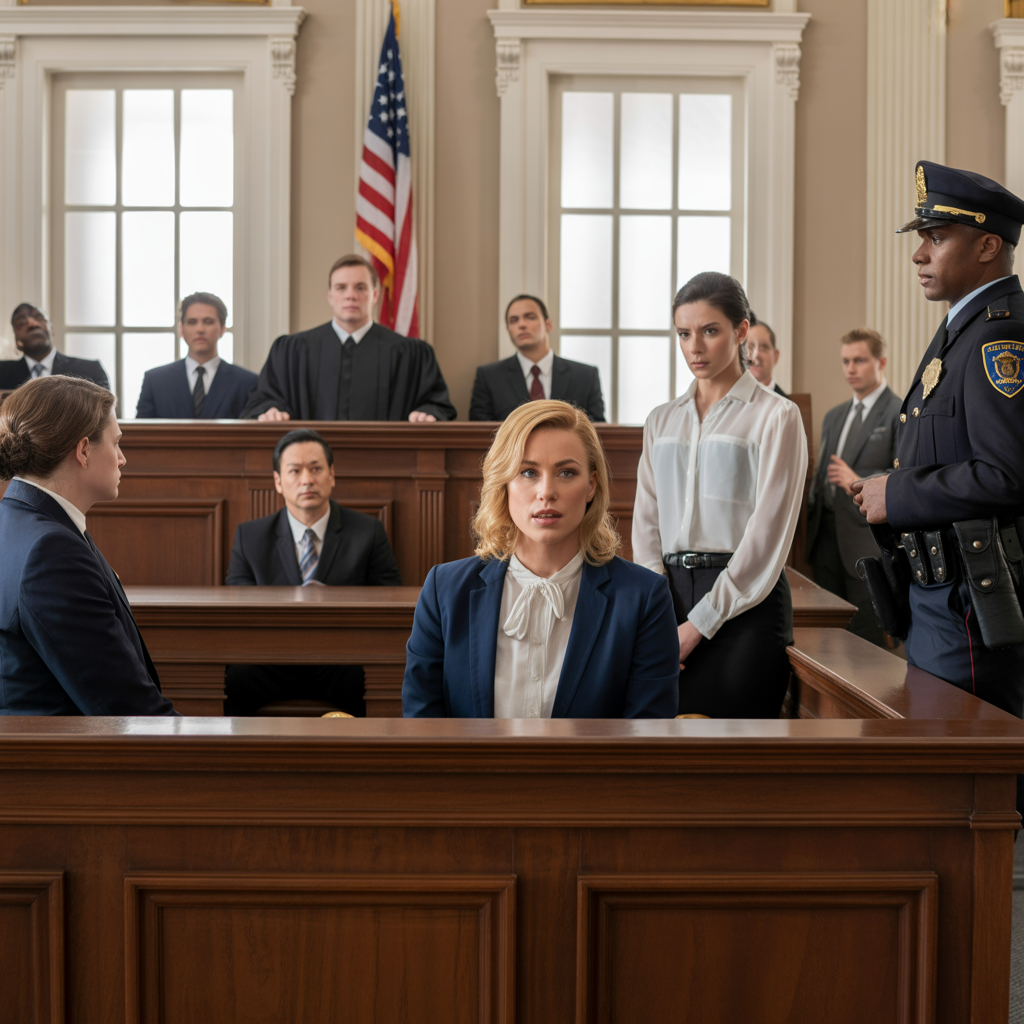
The courtroom was smaller than I’d imagined—and quieter. The air was stale, smelling of lemon-scented polish and old anxiety. The bench where the judge would sit was a dark, formidable slab of wood.
To the left, at the plaintiffs’ table, they were already there.
My father, Robert, in his best suit—the one he wore for closing arguments—looking every inch the respectable patriarch. My mother, Diana, in a tailored cream suit, her posture perfect, her hands folded neatly on the table. She looked like she was attending a charity luncheon, not a hearing to strip her daughter of her rights.
Arthur Vance sat between them, a man with a smug, settled expression, already reviewing his notes. He didn’t look up as we entered.
Miranda guided me to the defendant’s table on the right. The physical divide felt profound. We were in the same room, but we occupied different universes.
I placed my hands flat on the cool tabletop, willing them not to shake. I followed Miranda’s advice. I did not look at them. I looked straight ahead at the empty judge’s bench, at the seal of the state on the wall. I became a student of the room’s details—the scuff mark on the floor, the way the light fell through the high, narrow windows.
The bailiff called the court to order, and Judge Harold Winslow entered.
He was an older man with a stern, weary face and intelligent eyes that scanned the room quickly. He settled into his chair, and the hearing began.
Arthur Vance stood first. His voice was smooth—a velvet hammer.
“Thank you, Your Honor. This is a difficult, painful day for my clients, Robert and Diana Frost. They are here out of nothing but profound love and concern for their only daughter, Aloan.”
He painted a picture with his words: a fragile, dreamy child who never grew up. He spoke of my withdrawn nature, my choice to pursue a dead-end career despite clear potential, my isolation from family and sound advice. He made my quiet apartment sound like a hermit’s cave, my careful financial management sound like hoarding, my independence sound like pathology.
“We fear,” Vance said, his tone dripping with reluctant sorrow, “that Aloan is incapable of recognizing her own limitations. She is vulnerable to exploitation and is making decisions that will inevitably lead to financial ruin and personal crisis. My clients seek only to protect her, to guide her, to ensure her safety and future stability through a limited conservatorship.”
Then he called my mother to the stand.
Watching her walk to the witness stand, her heels clicking softly, was like watching a masterclass in performance. She was sworn in, and Vance began with gentle leading questions.
“Diana, can you describe your daughter’s behavior growing up?”
My mother’s voice was soft, laced with a tremble that was just believable enough.
“Aloan was always sensitive. A lovely girl, but in her own world. While other children were playing sports or joining clubs, she was alone in her room with her books. We tried to encourage her, to bring her out of her shell, but she resisted.”
She dabbed at the corner of her eye with a tissue. “We’ve been so worried, especially these past few years. She cut us out. She refuses our help. When we hear about her life—that tiny apartment, that job with no future—our hearts break. We just want to help her before it’s too late.”
Miranda’s pen scratched a note on her pad. She didn’t object. She was letting them build their stage.
Vance led my mother through a series of anecdotes, each carefully curated to show my impracticality: the time I spent my birthday money on a set of historical novels instead of a savings bond; the time I wanted to study art history instead of pre-law; the time I chose a hiking trip with friends over a family networking event.
Each story was a stitch in their tapestry of my incompetence.
My mother’s performance was flawless—the concerned mother burdened by a difficult child. It was a role she’d been rehearsing for 33 years.
Then it was Miranda’s turn for cross-examination.
She stood slowly, her movements calm and deliberate. “Mrs. Frost, you say your daughter is financially immature. When was the last time you reviewed her actual financial records?”
My mother blinked. “Well… we haven’t. She won’t share them. That’s part of the problem.”
“So your concern is based not on evidence of debt or mismanagement,” Miranda said, “but on her choice of career and her decision to live independently.”
“It’s based on a pattern of poor judgment,” my mother said, her voice tightening slightly.
“A pattern that includes graduating with honors, obtaining a master’s degree, maintaining continuous employment for a decade, and purchasing a home without any financial assistance from you or your husband,” Miranda said. “Is that correct?”
My mother’s lips pressed into a thin line. “Anyone can get a mortgage. That doesn’t mean she can manage the responsibility.”
“But she has managed it,” Miranda replied, “for five years without a single late payment.”
She let that hang in the air before moving on.
“You mentioned her isolation. Does she have friends, a support system outside the family?”
“She has acquaintances from work,” my mother said, “but no real connections. No one who truly looks out for her.”
“Your Honor,” Miranda said, turning slightly to the judge, “we will present testimony from several of those acquaintances, including her employer of ten years, who will attest to Miss Frost’s strong character and deep connections within her community.”
She turned back to my mother. “Mrs. Frost, if your daughter were to marry tomorrow, would you still believe she needed a conservator?”
The question seemed to startle her. “That would be different. A husband would provide guidance.”
“So her problem,” Miranda said evenly, “in your view, is not having a man to manage her affairs.”
“Objection,” Vance boomed.
“Sustained,” Judge Winslow said, but he was watching my mother closely.
Miranda didn’t miss a beat. “Withdrawn. Mrs. Frost, do you love your daughter?”
My mother’s mask slipped for a microsecond, revealing sheer annoyance at the question. “Of course I do. That’s why we’re here.”
“Thank you,” Miranda said. “No further questions.”
My father was next. Vance’s questioning was more technical, playing to my father’s identity as a lawyer and rational man. He spoke of risk assessment and fiduciary responsibility. He called my life a series of unchecked sentimental choices and claimed my aversion to their advice was a symptom of financial obstinacy.
He was colder, more clinical than my mother, but the message was the same: Aloan is a child in an adult’s body, and we—the capable adults—must take control.
When Miranda rose to cross-examine him, the temperature in the room seemed to drop.
“Mr. Frost,” she began, “you are a partner at Sterling and Vance. Is that correct?”
“It is.”
“A firm that specializes in corporate and property law.”
“Yes.”
“So you are intimately familiar with concepts like liens, refinancing, and asset management.”
My father’s eyes narrowed slightly. “I am.”
“Your home in Willow Creek is quite beautiful,” Miranda said. “How many times have you refinanced that property in the last five years?”
Arthur Vance was on his feet. “Objection. Relevance.”
Judge Winslow looked at Miranda. “Counselor?”
“It goes directly to the petitioners’ credibility and motives, Your Honor,” Miranda said. “Their own financial stability is highly relevant to their claim that they are disinterested parties acting solely out of concern.”
The judge pondered for a moment. “I’ll allow it, but tread carefully, Miss Shaw.”
My father’s jaw was tight. “I’d have to check the exact number.”
“Would three times be accurate?” Miranda pressed.
A faint red flush crept up my father’s neck. “That sounds possible. The market has been volatile—”
“And the two contractor liens currently filed against the property,” Miranda said, “are those also due to market volatility?”
The silence was absolute.
My mother had gone very still. Vance looked furious. My father stared at Miranda, and for the first time I saw a crack in his armor. It wasn’t fear exactly. It was the rage of a man whose hand has just been revealed.
“I handle my personal affairs competently,” he said, his voice low and dangerous.
“Unlike your daughter,” Miranda said, her tone deceptively mild, “whom you claim cannot handle hers.”
She paused, then: “No further questions, Your Honor.”
She sat down.
The damage wasn’t catastrophic for them, but a seed of doubt had been planted. The judge’s expression was inscrutable, but he made a note on his pad.
The morning wore on. Vance called a family friend, a woman who parroted their concerns, and a psychiatrist they’d hired who gave vague testimony about “attachment issues” and “potential for financial naïveté” based solely on interviews with my parents. Miranda shredded his credibility by getting him to admit he’d never met or evaluated me.
Then it was our turn.
Miranda called Mrs. Gable.
My boss was a force of nature. She spoke not just of my professional competence, but of my integrity, my reliability, my quiet leadership among the volunteers. She called me the backbone of our archival department and said she trusted me with priceless historical documents.
“If Aloan Frost is incompetent,” she said, fixing the judge with a steely gaze, “then so is everyone in this room.”
Miranda called my bank manager, who presented a summary of my accounts showing consistent savings, excellent credit, and zero debt outside my home loan. She called two friends from my book club—ordinary women who spoke with genuine warmth about our friendship, about dinners at my apartment, about my kindness and stability.
With each witness, the portrait they were painting of a capable, rooted, responsible woman grew stronger and more vivid. It stood in stark contrast to the ghostly helpless figure my parents had tried to conjure.
Finally, as the afternoon light began to slant through the windows, Miranda said, “Your Honor, the defense calls Aloan Frost.”
My heart was a drum in my chest. This was it.
I walked to the witness stand, my steps steady. I swore to tell the truth. I looked not at my parents, but at Miranda—my anchor. Her questions were simple, direct. She led me through my education, my career, my purchase of the apartment. She had me explain my job—what it meant to me.
I spoke clearly, my voice gaining strength as I talked about preserving stories, about honoring the past. It wasn’t a dead-end job. It was a calling. I described my life—my routines, my friendships, my planning.
It was boring. It was normal.
It was utterly, undeniably sane.
Then Miranda approached the bench.
“Your Honor, at this time the defense wishes to submit a comprehensive list of the respondent’s assets and possessions, as cataloged for this proceeding, to be entered into the record.”
The judge nodded. “Very well.”
Miranda handed a thick bound document to the bailiff, a serious-looking man in his 50s. He took it and stepped forward.
“I’ll read the list into the record,” the bailiff said, his voice a dry, official baritone.
He opened the folder. He began to read.
“Item one: primary residence, condominium unit 4B at 321 Cedar Lane, owned outright. Market value approximately $400,000.”
My father’s eyes flickered. They hadn’t known it was paid off.
“Item two: retirement investment portfolio, diversified. Current value approximately $220,000.”
My mother’s hand went to her throat.
The bailiff continued, his voice calm and methodical.
“Item three: collection of rare first-edition historical texts and personal journals, acquired over ten years. Last professional appraisal valued at approximately $1,500,000.”
The gasp in the courtroom wasn’t loud. It was a collective, sharp intake of air.
My father’s head snapped toward me, his eyes wide with pure, unfiltered shock. The judge, who had been leaning back, suddenly jerked forward, his eyes locked on the bailiff. Arthur Vance’s smug grin vanished, replaced by a look of dawning horror. The bailiff, unaware of the earthquake he had just triggered, prepared to read the next item.
For a moment, there was no sound at all.
The bailiff’s words seemed to hang in the air, visible, solid.
$1,500,000.
Then the room erupted.
“Your Honor!” Arthur Vance shouted, leaping to his feet, his chair screeching backward. “This is—this is a ridiculous fabrication. A stunt—”
My father was staring at me, his face a mask of stunned betrayal. “What is this?” he demanded, his voice cutting through the chaos. He wasn’t asking the judge. He was asking me. The mask of the concerned patriarch was gone, stripped away by sheer, ravenous shock. “What collection? What journals?”
My mother looked bewildered, her performance completely derailed. “Aloan… what is he talking about?”
Judge Winslow slammed his gavel. “Order. Silence in my courtroom.”
The sharp crack restored a tense quiet. The judge’s eyes—sharp and probing—moved from the bailiff’s folder to Miranda to me, and finally to my spluttering parents and their lawyer. He looked intensely curious.
“Bailiff,” he said, “continue. But slowly.”
The bailiff, looking slightly uncomfortable under the sudden spotlight, cleared his throat.
“Item four: one vintage 1965 Ford Mustang, fully restored, garage-kept, insured value $180,000.”
Another wave of shock visibly hit my parents. My father’s hand gripped the edge of their table, his knuckles white. That car was my secret joy—a project I’d worked on with a retired mechanic for years, paid for in cash from careful saving. It lived in a rented garage unit across town. They thought I drove a sensible sedan. I did. The Mustang was for Sundays.
“Item five,” the bailiff continued, the list now feeling like a series of detonations, “assorted historical artifacts and antique maps acquired through licensed dealers and estate sales. Insured value approximately $300,000.”
“Item six: municipal and corporate bonds portfolio. Value approximately $400,000.”
“Item seven: liquid savings and checking accounts. Total balance approximately $150,000.”
He finished and closed the folder.
The final tally hung in the silent room. My tiny life—my “impractical” choices—added up to a net worth well over $2.5 million. All self-made, all acquired quietly and patiently while they believed I was barely scraping by.
Judge Winslow leaned forward, his elbows on the bench.
“Miss Shaw,” he said, his voice deceptively calm, “would you care to explain?”
Miranda stood, the picture of composure. “Certainly, Your Honor. What you have just heard is a verified inventory of my client’s assets, prepared by a licensed, court-approved appraiser and auditor. Every item is documented, insured, and legally owned by Aloan Frost.”
She continued smoothly. “The collection of rare texts and journals is the result of a decade of expert curation. Miss Frost has a recognized eye in certain academic circles for significant primary-source documents. Her personal collection includes letters and diaries that have shed new light on local industrial history. She has quietly loaned pieces to university archives for study.”
“It is not a hobby,” Miranda said. “It is a scholarly pursuit with significant financial and historical value.”
She turned slightly, casting a glance at my parents.
“This inventory proves several things beyond doubt. First, that Aloan Frost is not only financially competent, but exceptionally savvy and disciplined. Second, that the petitioners’ claim of her financial immaturity is not just incorrect—it is a grotesque misrepresentation.”
“And third,” she said, pausing to let the implication sink in, “it raises the unavoidable question of motive. Why would two individuals facing substantial financial pressures of their own seek control over the affairs of a daughter who has demonstrably managed her affairs with spectacular success?”
Arthur Vance was back on his feet. “Your Honor, this is a trick—a last-minute ambush. We had no knowledge of these so-called assets. If they exist, which I doubt, their—”
“The provenance is impeccable, Counselor,” Miranda cut in coolly. “And your lack of knowledge is the entire point. You filed this petition based on ignorance and presumption. You assumed because your clients chose to be willfully blind to their daughter’s life that there was nothing to see. You were wrong.”
The judge held up a hand. “Mr. Vance, sit down.”
He looked at Miranda. “Miss Shaw, your client may step down for a moment.”
Then his gaze shifted to me. “Miss Frost, is this your verification mark on the authentication documents for this inventory?”
He held up a paper the bailiff handed him.
I looked at it. It was mine. “Yes, Your Honor.”
“And you affirm under penalty of perjury that this list is accurate and complete to the best of your knowledge?”
“I do, Your Honor.”
He nodded slowly, then turned his gaze to my parents. Their earlier poise was shattered. My father looked furious. My mother pale and confused. The performance was over. The raw truth was on display.
“Mr. and Mrs. Frost,” the judge said, his tone grave, “your petition is based on the assertion that your daughter is incapable of managing assets of substantial value. The court has just been presented with compelling evidence that she has not only managed such assets, but has acquired them independently.”
“Furthermore,” he continued, “it appears she has done so while you were entirely unaware of their existence. This severely undermines your credibility as petitioners.”
My father found his voice, the lawyer in him fighting through the shock.
“Your Honor, if these assets are real, it only heightens our concern. That kind of value in the hands of someone with no experience managing wealth—it’s a target for fraud, for manipulation. She’s been secretive, hiding this from her own family. That, in itself, is a sign of instability.”
“Or a sign of self-preservation,” Miranda said quietly.
“Mr. Frost,” the judge said dryly.
Then he looked at Miranda. “You mentioned financial pressures on the petitioners. Elaborate.”
This was the ace.
Miranda didn’t smile. She simply opened a new folder.
“Your Honor, we have documentation here—publicly filed—showing the Frosts’ primary residence is heavily leveraged with multiple liens. We have records of several high-risk investments that have failed significantly in the last eighteen months.”
“Most notably,” she continued, “we have notice of a major malpractice suit filed against Sterling and Vance, which places Mr. Frost’s partnership and personal assets at direct risk.”
She handed copies to the bailiff, who delivered them to the judge and to a now-ashen Arthur Vance.
“This suit,” Miranda said, “seeks damages in excess of five million dollars. A conservatorship over a daughter with suddenly revealed, liquidatable assets worth over 2.5 million would be remarkably convenient timing.”
The accusation wasn’t shouted. It was stated like simple math.
The pieces of the puzzle—once scattered—now formed a devastatingly clear picture.
My mother made a small choking sound. “That’s not why—”
But the lie died in the thick air of the courtroom.
The judge’s face was hard. He looked from their financial records to my inventory, from their panicked expressions to my calm one.
Arthur Vance tried one last desperate move. “Your Honor, I move to have this so-called inventory thrown out as prejudicial and irrelevant. My clients’ financial situation has no bearing on their legitimate fears for their daughter.”
“It has every bearing, Counselor,” Judge Winslow said, his voice low and final. “It speaks directly to bias and potential bad faith.”
“The petition for conservatorship is based on a premise that has been conclusively disproven. Miss Frost is not incapable. She is extraordinarily capable.”
He took a deep breath. “The petitioners’ stated concern is contradicted by their demonstrable ignorance of her life and their own pressing financial incentives.”
“I’ve seen enough. The petition for conservatorship is—”
He never finished the sentence.
My father, in a move born of pure reckless rage, stood up and pointed a shaking finger at me.
“You deceitful little cheat,” he roared, his voice echoing off the walls. “You hid all this from us! After everything we gave you, you owe us!”
It was the unfiltered truth—the core of their entitlement laid bare in a courtroom.
My mother gasped. “Robert—”
But it was too late.
The judge’s eyes went cold.
“Bailiff,” he said, his voice suddenly razor-sharp, “stop immediately. Get security in here now.”
The judge’s command sliced through my father’s outburst like a blade.
For a second, my father stood frozen, his face purpling with a mix of rage and dawning horror at what he had just done. The professional veneer hadn’t just cracked. It had exploded. The raw, ugly truth was now a matter of court record.
My mother had both hands pressed over her mouth, her eyes wide with terror.
The heavy courtroom door swung open, and two uniformed court officers entered, their expressions alert and serious. They moved to stand between our table and my parents—a physical embodiment of the chasm that had just been ripped wide open.
The bailiff had already stepped closer to the judge’s bench, a protective posture.
Judge Winslow’s demeanor had transformed from weary arbitrator to something formidable. He looked at my father not as a petitioner, but as a disruption to his courtroom.
“Mr. Frost,” he said, his voice dangerously quiet, “you will sit down. You will be silent. Another outburst like that and I will have you removed and held in contempt. Do you understand?”
My father’s chest heaved. For a terrifying moment, I thought he might argue. But the sight of the officers, the stern finality in the judge’s eyes, and probably the last shred of his lawyer’s instinct broke through. He collapsed into his chair, his shoulders slumping. He looked suddenly old—deflated.
The performance was not just over. The actor had been exposed and booed off the stage.
The judge then turned his gaze to Arthur Vance, who looked like he wanted the floor to swallow him whole.
“Counselor, control your client. Or I will.”
“Yes, Your Honor,” Vance mumbled, not meeting anyone’s eyes. “Deepest apologies.”
Judge Winslow let the silence stretch, allowing the weight of the moment to settle on everyone. He looked at the documents before him—my inventory on one side, the evidence of my parents’ financial desperation on the other.
He finally spoke, his words measured and clear.
“What has been presented in this hearing today is one of the most stark contrasts I have ever seen in my courtroom. On one hand, we have a petition alleging incapacity based on speculation, prejudice, and a profound lack of knowledge. On the other, we have documented evidence of not just capacity, but of significant acumen, discipline, and success.”
He looked directly at my parents.
“Mr. and Mrs. Frost, you came before this court asking me to believe you were motivated by selfless concern. The evidence suggests otherwise. Your ignorance of your daughter’s life is willful. Your own financial distress provides a clear alternate motive for seeking control over her assets.”
“And your reaction here today,” he said, glancing at my father, “reveals an attitude of entitlement that is entirely at odds with the role of a protector.”
My mother began to cry in earnest now—but they were not the delicate, performative tears from earlier. These were harsh, silent sobs that shook her shoulders. Tears of shame. Of exposure. Of a plan utterly destroyed.
The judge continued.
“The petition for conservatorship is denied, dismissed with prejudice.”
The finality of the legal phrase was a death knell. With prejudice meant they could not file it again on the same grounds.
It was over.
But he wasn’t finished.
He looked at Miranda. “Miss Shaw, you have raised serious questions about the petitioners’ conduct. Filing a frivolous or malicious petition for conservatorship is a serious matter. It abuses the court’s process and can cause profound harm to the respondent.”
He shifted his gaze back to my parents.
“I am ordering a formal inquiry into whether this petition was filed in bad faith. The court will be examining the timing, the allegations, and the motivations behind it. You may be facing sanctions. You will be hearing from the court on this matter.”
My father’s head dropped into his hands. Sanctions. A formal inquiry. His reputation—already teetering from the malpractice suit—was now facing a direct judicial blow. The cost wouldn’t just be financial. It would be professional annihilation.
Judge Winslow then looked at me. His expression softened just a fraction.
“Miss Frost, the court apologizes for the ordeal you have been put through. You are clearly a woman of substantial ability and character. You are free to go, with the court’s confidence that you are more than capable of managing your own life. This case is closed.”
He slammed his gavel once.
The sound was definitive.
The hearing was over.
The immediate aftermath was a blur of surreal quiet. The judge left the bench. The officers lingered, ensuring a peaceful exit. Miranda began calmly packing her briefcase. I just sat there, my hands still flat on the table, absorbing the sudden immense silence.
The war was over. We had won—not just won. We had obliterated the opposition.
At the other table, chaos simmered in whispers. Arthur Vance was hissing at my father. “I told you to stay calm. What were you thinking?” My father was silent, staring at the wood grain of the table as if it held the answers to where his life had gone so wrong. My mother was fumbling in her purse, avoiding all eyes.
Miranda touched my arm gently. “Let’s go, Aloan. Don’t look at them. Don’t speak to them. Just walk out.”
I stood. My legs felt like they belonged to someone else, but they held me. I followed Miranda toward the door. As we passed their table, I couldn’t help it. I glanced over.
My father looked up.
Our eyes met.
The fury was still there, but it was now mixed with something else—something worse. A hollow, defeated understanding. He saw me—truly saw me—for the first time. Not as his wayward daughter, but as a stranger who had outmaneuvered him completely, a stranger with resources and resolve he never imagined. The knowledge broke something in his gaze.
My mother looked at me. Her mascara streaked. Her face crumpled.
“Aloan, please,” she whispered.
I didn’t stop. I didn’t say a word.
I walked out of the courtroom behind Miranda, through the heavy doors, and into the bright, ordinary hallway of the courthouse. The contrast was jarring. People milled about, talking about traffic, lunch, other cases. Life went on.
Outside on the courthouse steps, the afternoon sun was blinding. I took a deep, shuddering breath of free air.
It was over.
Miranda turned to me, a rare, genuine smile touching her lips. “You were perfect. Absolutely perfect. They never knew what hit them.”
“The collection,” I started, my voice hoarse from disuse. “When you told me to get everything appraised, I didn’t think it would be a silver bullet.”
“It wasn’t a silver bullet,” she said. “Aloan, your discipline built that collection. Your eye for value found those pieces. Your patience acquired them. That wasn’t luck. That was proof. It was the most elegant possible rebuttal to their entire argument. You didn’t just manage money. You built a legacy they were too blind to see.”
She squeezed my shoulder. “Go home. Rest. The inquiry into their conduct will proceed. But that’s my job now. You are free. Truly free.”
I nodded, words failing me. Gratitude welled up so strong it was almost painful.
“Thank you, Miranda… for everything.”
“You earned this,” she said simply.
Then she was gone—striding back toward the glass building, a warrior returning from a victorious field.
I stood alone on the steps for a long time. The adrenaline began to recede, leaving a deep, trembling exhaustion in its wake. But beneath the exhaustion, something new was stirring. It wasn’t happiness—not yet. It was a profound, seismic sense of peace.
The verdict was more than a legal decision. It was a validation—a declaration shouted from a bench of authority:
You are competent. You’re whole. You are free.
The cage they had tried to build around me—made of their doubts and their projections and their needs—had not just been unlocked. It had been shown to have never had a door in the first place. I had been outside it all along. They were the ones trapped inside their own crumbling illusions.
I got into my sensible sedan and drove—not to my apartment—but to the rented garage unit across town. I used the key, rolled up the door, and there she sat under a soft cover: my 1965 Ford Mustang, deep forest green.
I pulled the cover off and just looked at her.
This, too, was a part of me they never knew. A secret joy. A testament to patience and passion. I ran a hand over the flawless chrome bumper.
For the first time since the envelope arrived, I smiled.
It was a small, private, real smile.
Then I got back in my sedan and drove home—to my home, to my life.
The first few days after the hearing passed in a strange, liquid quiet. It was as if a deafening noise that had been my constant background hum had suddenly been switched off, leaving a silence so profound it was almost loud. I went back to work at the historical society. Mrs. Gable took one look at me, handed me a cup of terribly strong tea, and said, “Don’t you dare try to thank me. Just get back to cataloging the Henderson letters. They’re a mess.”
It was the kindest thing she could have done. The normalcy of it—the demand for my competence—was a balm.
The news, of course, did not stay in the courtroom. Willow Creek is a small world in a big city. Whispers traveled through the country club, the law firm, my parents’ social circles. The story mutated with each telling: a dramatic courtroom showdown, a hidden fortune, a judge threatening sanctions.
I heard snippets through Miranda, who kept a close watch. My father’s firm—already reeling from the malpractice suit—began to distance itself from him. Partnership reviews were postponed indefinitely. The vultures were circling.
I did not hear from my parents. Not a call, not a message, not a letter.
The silence from them was different now. Before, it was a weapon of disapproval. Now, it was the silence of a defeated army retreating from the field. It held no power over me anymore.
Then, a week after the hearing, my brother Asher showed up at my apartment.
I opened the door to find him standing there, looking uncomfortable in a way I’d never seen. Asher had always been the golden child, effortlessly mirroring our parents’ values. He worked in finance, lived in a sleek downtown condo, dated women whose smiles were as polished as their handbags.
We weren’t close. We were satellites in different orbits, occasionally passing with a nod.
“Aloan,” he said, not meeting my eyes. “Can I come in?”
I hesitated, then stepped back.
He walked in, his gaze darting around my living room, taking in the bookshelves, the art, the comfortable lived-in warmth of it. He looked like a tourist in a foreign country.
“Nice place,” he said. The words sounded hollow.
“What do you want, Asher?”
He finally looked at me, and I saw genuine confusion there. “I just… I heard what happened. Mom and Dad, they’re a wreck. The house—there’s talk of having to sell it. The legal fees from their case, the inquiry the judge ordered. It’s a lot.”
I said nothing. I waited.
He shifted his weight. “They said you had a collection worth a lot of money… that you never told anyone.”
“That’s right.”
“Why?” The question burst out of him, plaintive and almost childlike. “Why wouldn’t you tell your family something like that?”
And there was the core of their worldview: family as a monolithic entity entitled to all secrets, all assets, all lives.
I felt a sudden, unexpected pang of pity for him. He was a product of the same factory, but he’d never questioned the assembly line.
“Asher,” I said softly, “if I had told them… what do you think would have happened?”
He opened his mouth, then closed it. The answer was obvious. They would have taken over. They would have told me how to manage it, who to sell it to, how to invest the proceeds. They would have absorbed it into the crumbling edifice of their own status. My independence, my quiet achievement, would have become just another asset in their portfolio.
“It wasn’t about hiding it from family,” I said. “It was about it being mine—something I built for myself, by myself. They never showed any interest in my life, Asher. Not the real parts of it. They were only ever interested in the version of me that fit their narrative. The collection didn’t fit, so it didn’t exist to them.”
He sank onto my sofa, running a hand through his perfectly styled hair. “Dad’s different. He’s angry, but it’s like all the air’s gone out of him. Mom just cries. She keeps saying she doesn’t understand what she did wrong.”
“She didn’t see me,” I said.
The truth was simple and stark.
“That’s what she did wrong.”
We sat in silence for a minute. The gulf between us felt vast, but for the first time, it wasn’t hostile. It was just a fact.
“They wanted me to come talk to you,” he admitted, not looking at me. “To see if… if there was any way to fix things. To help them.”
Of course they did. Old habits die hard. Even in defeat, they sent their emissary.
“There’s nothing to fix, Asher,” I said. “The court fixed it. They don’t need my help. They need to face the consequences of their own choices—just like I did.”
He nodded slowly—not in agreement, but in comprehension. He was beginning to see the shape of the new world, one where I was not a subordinate, but a separate sovereign state.
“They’re going to lose the house,” he said again, almost to himself.
“I’m sorry to hear that,” I said, and found—to my surprise—that I partly meant it. I wasn’t sorry for their loss of a symbol, but I was sorry for the pain of downfall, even if it was self-created. It was a distant, detached sorrow.
He stood up to leave. At the door, he turned. “That car—the Mustang—is it really a ’65?”
A small, genuine smile touched my lips. “Yeah. It is.”
He shook his head, a baffled, almost rueful look on his face. “I never knew you were into cars.”
“There’s a lot you never knew,” I said gently.
He left, and I was alone again with my quiet victory.
His visit clarified something for me. The battle was won, but the aftermath was a country I would have to navigate alone. My family, as I had known it, was gone. What remained were individuals I would have to learn new ways to relate to—or not—on my own terms.
A few days later, Miranda called. Her voice was brisk with satisfaction.
“The court’s inquiry is moving fast. The judge is not messing around. Your parents are facing significant financial sanctions for the bad-faith filing. It won’t bankrupt them, but combined with their other troubles, it will force a major lifestyle change. The house is definitely going on the market. Arthur Vance is also facing disciplinary review from the bar association for his role in this.”
It was justice—cold and procedural. It brought no thrill, only a sense of appropriate finality.
“There’s one more thing,” Miranda said. “A reporter from the *Chronicle* got wind of the case. The ‘hidden fortune in the archives’ angle is apparently irresistible. She wants to talk to you. I’d normally say no, but it might be a chance to control the narrative—to tell your side on your terms.”
I thought about it. The idea of publicity made my reclusive soul cringe. But Miranda was right. My parents’ version of me—the unstable, incapable daughter—could still linger in whispers. This was a chance to redefine myself publicly, not as a victim or a secret miser, but as what I was: an archivist, a collector, a woman who built a life of quiet meaning.
“I’ll do it,” I said.
The interview was set for a Saturday afternoon at the historical society. The reporter—a woman named Chloe with intelligent eyes and a non-threatening demeanor—didn’t ask about the court case directly at first. She asked about my job. I showed her the archives, explained the magic of holding a letter written two hundred years ago. I talked about the importance of preserving ordinary stories. Her interest was genuine.
Eventually, she broached the subject. “The court documents mention a remarkable personal collection that seems at odds with the image of someone who needs protection.”
I took a deep breath. “The collection wasn’t an investment strategy,” I said. “It was a parallel to my work. It was about preserving fragments of history that spoke to me. The value was a byproduct of care and time.”
“My parents,” I continued, “they see the world in terms of status and transactions. They couldn’t understand that something could be both personally meaningful and financially valuable. They assumed if it was valuable, it must be managed their way—and if it was personal to me, it must be trivial.”
Chloe nodded, jotting notes. “And now—what’s next for Aloan Frost?”
I looked around the quiet archive at the shelves holding centuries of secrets and stories.
“The same as before,” I said, and it was the truth. “My work. My home. My life. Maybe with a little less noise.”
The article came out the following week. The headline read: “The Archivist’s Fortune: Silence, Secrets, and Self-Made Security.”
It was respectful. Nuanced. It painted me as a dedicated professional and a savvy individual, and it framed the court case as a brutal clash between outdated control and modern autonomy. It was the final piece of the reckoning. My truth was now part of the public record, too.
That weekend, I did something I hadn’t done in years. I took the Mustang out of the garage. I didn’t have a destination. I just drove.
The deep purr of the engine was a tangible proof of my own hidden strengths. I drove out of the city onto winding country roads, the wind in my hair, the sun on the hood. I was alone, but I was not lonely.
I was free.
I had won my life back—not just in court, but in my own soul. The little girl hiding in the closet was finally completely home.
Winning a war doesn’t mean the ground stops shifting. In the weeks that followed, the tremors from the courtroom reached further than I ever imagined. The article in the *Chronicle* was like dropping a stone into a still pond. The ripples moved outward, touching shores I didn’t even know existed.
The first ripple was professional. I started getting emails—not from reporters, but from universities, small museums, historical foundations. The article had mentioned my collection’s focus on local industrial history. A professor from the state university wrote, asking if I’d be interested in collaborating on a digital exhibit. A director of a railroad museum wondered if I had any material related to early train surveys.
My quiet expertise—once known only to Mrs. Gable and a few dedicated researchers—was now a matter of public, professional record. I wasn’t just an archivist. I was Aloan Frost: recognized collector and scholar.
It was terrifying and exhilarating.
I said yes to the digital exhibit. It felt like the next natural step in the life I had built.
The second ripple was personal, and more complicated. It came in the form of a message on a professional networking site from a woman named Laura.
“Dear Miss Frost,” it began. “I read the article about you with particular interest. My aunt, Eleanor Vance, was Arthur Vance’s secretary for twenty years. She retired last year. She has some things she feels you should know about your father’s firm and their practices. She’s willing to speak with you if you’re willing to listen.”
My heart did a slow, heavy thump.
Arthur Vance’s secretary.
This was a ripple from deep within the enemy’s own camp.
I discussed it with Miranda. Her eyes lit with a fierce, predatory interest. “This could be critical for the court’s inquiry into their conduct, and it might give us a clearer picture of their mindset when they filed the petition. Proceed, but be careful. Meet in a public place. I can have someone nearby if you’re uncomfortable.”
I met Laura and her aunt Eleanor at a quiet tea shop in a neutral neighborhood. Eleanor was in her late 60s with sharp, kind eyes and a no-nonsense air. She didn’t waste time.
“I worked for Arthur Vance since he was a junior partner,” she said, her voice low but clear. “I liked him for a long time. But these last few years, the firm changed. The pressure was immense. Your father’s practice was aggressive. When that malpractice suit was filed, the panic was palpable. Arthur was desperate to keep his oldest friend and partner afloat.”
She took a sip of tea.
“About two months before they filed the petition against you, I brought paperwork into Arthur’s office. He and your father were talking. The door was ajar. I heard your father say, ‘There has to be something we can leverage. She’s always been the weak link emotionally. We can frame it as concern.’”
“Arthur said, ‘It’s risky, Robert. If she fights—’ Your father cut him off. ‘She won’t fight. She never fights. She’ll fold. And once we have conservatorship, we can quietly liquidate. It’ll be enough to settle the suit and refinance everything. We just need the court to see her our way.’”
The words hung in the fragrant air of the tea shop—ugly and precise.
It was the confirmation I didn’t know I needed.
It wasn’t just about greed or control in a vague sense. It was a specific, calculated plan to use me as a financial fire escape. My supposed weakness was the cornerstone of their strategy.
Eleanor looked at me with profound sympathy. “I’m sorry, my dear. When I read that article and saw how wrong they were about you, I couldn’t stay quiet anymore. I’ve already given a statement to the bar association’s investigator, but I wanted you to hear it from me. You weren’t just a daughter they misunderstood. You were a target.”
I thanked her, my throat tight. Her words were a gift—a brutal kind of closure. The mystery of why now was solved. It was the malpractice suit. The ticking clock. I was the emergency fund they thought they could access with a legal sledgehammer.
The third ripple was the most surprising. It came from my brother Asher again.
This time he didn’t come to my apartment. He called.
“Aloan,” he said, his voice strained. “I’ve been doing some digging into my own finances—the family stuff. Dad had me co-sign on some things. Loans. I never really looked at the details. I just signed where he told me.”
He let out a shaky breath. “I’m in trouble. Not like them, but… it’s a mess. And I realized I have no idea how to manage it. I’ve never had to.”
The golden child was discovering his gilding was peeling, revealing fragile plaster underneath. He was facing the consequences of his own passivity.
“I don’t expect anything from you,” he rushed to say. “No money, nothing. But… how did you learn to do all this? To manage everything alone?”
The question was so earnest, so stripped of his usual arrogance, that it disarmed me. He wasn’t asking for a bailout. He was asking for a map.
For the first time in our lives, he was seeing me not as a rival or a disappointment, but as someone who knew something he didn’t.
“It starts with looking at the numbers,” I said, my tone softer than I’d ever used with him. “All of them, even the scary ones. You get a notebook and you write everything down—every debt, every asset, every monthly cost. You stop signing things you don’t understand. You make a plan one step at a time. It’s not magic. It’s just attention.”
We talked for an hour. I gave him the names of a few reputable, fee-only financial advisers. I told him about budgeting tools. I didn’t solve his problems, but I gave him the first tools to start solving them himself.
At the end of the call, he was quiet for a moment. “Thank you, Aloan,” he said, and it sounded real. “I’m… I’m sorry for everything.”
It wasn’t a dramatic reconciliation. It was a tentative, fragile bridge being thrown across the chasm. It might not hold, but it existed.
The final ripple was internal—and the deepest of all.
With the external battles receding, I had to face the quiet within my own walls. The adrenaline of the fight had masked a deep well of grief—not for the parents I had, but for the parents I never did. The ones who would have been proud of my collection, who would have helped me restore the Mustang, who would have seen my quiet life as a triumph, not a failure.
That loss—the loss of a dream I’d secretly carried since childhood—finally hit me.
I let it.
I sat in my quiet apartment and I cried—not for what they did, but for what they could never be. And in that crying, I found a strange kind of cleansing. I was mourning a phantom, and once mourned, it lost its power to haunt me.
The space it left behind wasn’t empty.
It was free.
Free to be filled with my own choices, my own relationships, my own definition of family.
One evening, Mrs. Gable invited me over for dinner—not as a boss, but as a friend. Her house was cluttered and warm, filled with cats and books and the smell of roasting chicken. We ate, and we talked about work, about history, about nothing important.
As I was leaving, she hugged me—a quick, fierce thing.
“You did good, kid,” she muttered into my shoulder. “Now go live your life.”
“And for heaven’s sake, bring that Mustang by sometime. I want a ride.”
I drove home that night, the city lights shimmering around me, and I realized the ripples weren’t just disturbances. They were the world rearranging itself around the new solid fact of me.
I was no longer the invisible daughter, the silent victim. I was a person with a reputation, a professional standing, a complicated family history, and a hard-won peace.
The ripples would keep coming, but now I was the stone at the center.
I was steady.
I was here.
And I was just beginning to understand what that meant.
Peace, I discovered, wasn’t a passive state. It was something you built—like a house. With the rubble of the old battles cleared away, I finally had the space and the quiet to lay a new foundation. Not for defense, but for a life that was truly my own.
The first brick was my home. For five years, my apartment had been a sanctuary, but it also bore the subtle marks of a fortress—a place to retreat from the world. I decided to change that. Nothing drastic. I didn’t sell it and move. Instead, I made it more mine.
I finally hung the large framed antique map of the city I’d bought years ago and never dared put up, thinking it was too bold. I bought a new, deeply comfortable armchair just for reading—not for worrying in. I started a small herb garden on the kitchen windowsill.
These were small acts, but each one felt like a declaration.
I am staying.
I am thriving here.
The second brick was my work, which began to evolve in exciting ways. The collaboration with the university on the digital exhibit—*Voices from the Furnace: The Human Stories of Industrial Growth*—gave my archival skills a new canvas. I wasn’t just preserving documents. I was curating a narrative, weaving together letters from factory workers, engineering schematics, and newspaper clippings to tell a story bigger than any single piece.
The professor, Dr. Evans, treated me as a peer.
“Your eye for connective tissue is exceptional, Aloan,” he said during one of our planning sessions.
It was a different kind of validation—pure and professional—and it meant more than any forced family praise ever could.
The third and most unexpected brick was community.
The article and the notoriety of the court case had an odd effect. People at the historical society—volunteers I’d worked with for years—started talking to me differently. Not with pity or gossip, but with a new respect. A few even confided in me about their own family struggles. I became, in a small way, a person others saw as strong.
It was a role I’d never imagined for myself, but I found I didn’t shrink from it. I listened. I didn’t always have answers, but I could offer a quiet, understanding ear.
In giving that, I found I felt less alone.
Then there was Asher.
Our bridge held.
He took my advice, hired one of the advisers I recommended, and began the slow, painful process of untangling himself from my parents’ sinking ship. He called me every few weeks—not to ask for anything, but to report progress.
“I sold the condo,” he said one evening, sounding exhausted but clear. “It was too much. I’m renting a smaller place downtown, closer to work. This is fine. Simple.”
There was no self-pity in his voice—just a weary acceptance. He was learning resilience, and it was humbling him in a way that made him almost likable.
He never asked about our parents directly, and I never volunteered. But one day he said, “Mom called. She asked if I’d spoken to you. I told her yes. She just said, ‘Oh.’ And then she changed the subject.”
The information was neutral, but it told a story. The subject of me was now a closed door in their world. It was a door they had locked, but I was the one who had thrown away the key.
Miranda’s work reached its own conclusion. The court’s inquiry found that the petition had indeed been filed in bad faith. My parents were ordered to pay a significant portion of my legal fees and a separate fine to the court. It wasn’t ruinous, but it was another heavy stone on the scales tipping against them. The disciplinary review for Arthur Vance was still pending, but Miranda told me his reputation was in tatters.
The legal community, it seemed, had little tolerance for one of their own attempting to weaponize the courts against a family member.
Justice, in its dry, paper-pushing way, was served.
With the legal and financial storm settling, I turned my attention to the one part of my life that felt like unfinished business: my collection. It had been my secret, then my shield, then my revelation. Now I needed to decide what it was going to be—an hoard, an investment, or something else.
I invited Dr. Evans and a curator from the state historical museum to my apartment. It felt vulnerable, opening this most private part of my world to professional scrutiny. We spent an afternoon going through the carefully stored boxes and climate-controlled cases. The curator—a woman named Marie with gentle hands—handled a leather-bound journeyman’s log from 1880 with something like reverence.
“This is extraordinary,” she murmured. “The level of daily detail… it’s a priceless social record.”
By the end of the visit, they made a proposal—not to buy the collection, but to house a significant portion of it on a long-term loan at the museum, as the centerpiece of a new permanent exhibit on state industry. I would retain ownership, but it would be preserved under ideal conditions, studied by scholars, and seen by the public. The more personal pieces—the diaries that felt like friends—I could keep.
It was the perfect solution.
My collection would stop being a secret fortune and start being a shared legacy. It would fulfill its purpose—to tell stories on a grander scale than I ever could alone.
I said yes.
The day the movers came to carefully pack the selected pieces was bittersweet. I watched as boxes I had carried home myself with such private excitement were carried out to a specialized van. But the sadness was clean—like the ache after good work. I was not losing something. I was giving it a new, greater life.
That evening, my apartment felt different—lighter. The ghosts of secrecy were gone. The space that remained was filled only with my present. I made myself a simple dinner and ate it at my kitchen table, looking out at the city lights. The silence was no longer the silence of hiding.
It was the silence of contentment.
A few days later, I did something I’d been putting off. I drove the Mustang to Mrs. Gable’s house. She was waiting on her porch, a grin on her face.
“About time,” she called.
I took her for a drive along the river parkway, the engine a contented rumble. She whooped with delight as we accelerated onto an open stretch.
“You know, Aloan,” she shouted over the wind, “I always knew you had a bit of fire in you. I’m glad the rest of the world finally gets to see it.”
I laughed—a real, free sound lost in the rush of air.
She was right. The fire had always been there—banked and careful, warming me through the cold years. Now it was out in the open, not as a destructive blaze, but as a steady, sustaining flame.
The new foundation was laid. It was built on truth, on competence, on chosen connections. It was strong enough to hold whatever came next.
For the first time in my life, I wasn’t looking over my shoulder at what was chasing me, or ahead at what I needed to escape.
I was just here—in the solid, sunlit present—building a life.
And it was more than enough.
A foundation, no matter how solid, can still be tested.
The test came on a rainy Thursday evening, about three months after the museum took the bulk of my collection. The storm had settled into a steady gray drizzle, and I was cozied in my armchair, a book in my lap, a cup of tea steaming on the side table. The world outside my windows was a blur of wet pavement and shimmering streetlights.
It was the kind of night that made you grateful for walls and a roof.
The buzzer from the building’s front door sounded sharp and intrusive in the quiet.
I frowned. I wasn’t expecting anyone. Mrs. Gable would have called. Asher texted.
I set my book down and padded over to the intercom. “Yes?”
No answer at first—just the hollow sound of the rain.
Then a voice, strained and faintly familiar.
“Aloan… it’s—it’s your mother.”
The words didn’t compute for a second. My mother here, at my building, in the rain. A cold numbness spread from my chest outward. I stood frozen, my finger hovering over the talk button.
“Please,” her voice came again, tiny through the speaker. It sounded thin, washed out. “I just… I need to talk to you. Five minutes.”
Every instinct Miranda had drilled into me screamed to say no—to tell her to leave, to direct her to my lawyer. This was a boundary, the most important one.
But another part of me—the part that had just finished building a new foundation of my own strength—felt a morbid curiosity. What could she possibly want now? The legal avenues were closed. The money was beyond their reach. What performance was left?
“Five minutes,” I said into the intercom, my voice flat.
I buzzed her in.
I unlocked my apartment door, but left it closed. I needed the barrier. I listened to the slow, hesitant footsteps coming up the stairs. She hadn’t taken the elevator.
Then a soft knock.
I took a deep breath, turned the knob, and opened the door.
The woman on my threshold was a ghost of Diana Frost. She was soaked, her cream trench coat darkened with rain, her hair plastered to her scalp. She wore no makeup, and without it, she looked ten years older—the lines on her face etched by something deeper than time. She clutched a small wet handbag.
She didn’t try to come in. She just stood there, shivering slightly, her eyes huge and lost.
“You’re wet,” I said, stating the obvious because I couldn’t think of anything else.
“I walked from the bus stop,” she said, as if that explained everything.
Maybe it did. The Diana Frost I knew didn’t take buses.
I stepped back. “Come in. You’re dripping on the hall carpet.”
She entered slowly, her eyes scanning my apartment with a hunger that had nothing to do with possessions. She was looking for something—some clues, some anchor. She saw the antique map, the new armchair, the herb garden. Her gaze lingered on the empty spaces on my bookshelves where the collection used to be.
She said nothing.
“Sit,” I said, pointing to the kitchen table. I didn’t offer the living room. It felt too intimate.
I grabbed a clean towel from the linen closet and handed it to her. She took it, dabbed at her hair mechanically. I remained standing, leaning against the kitchen counter, arms crossed.
The distance between us was only a few feet, but it felt continental.
The silence stretched, filled only by the drumming of the rain.
Finally, she spoke, not looking at me. Her voice was a raw whisper. “We sold the house yesterday. The movers come next week. We’re renting an apartment in Brookside.”
Brookside was a decent, unremarkable suburb—a far cry from Willow Creek. I nodded. I heard.
She flinched as if my simple knowledge was an accusation.
“Your father… he’s taken it very hard. He doesn’t leave the study. He just sits with the blinds closed.”
She looked up then, her eyes swimming with a confusion so profound it was almost childlike.
“Aloan… what happened? How did it all go so wrong?”
The question was so breathtaking in its lack of self-awareness that I almost laughed. Instead, a cold, clear clarity settled over me. She truly didn’t know. In her narrative, they were the victims—of a world that had inexplicably turned against them, of a daughter who had, what, become too competent? Existed too successfully on her own terms?
“You came here to ask me that,” I said, my voice calm. “You tried to have a court declare me mentally incompetent so you could sell everything I own to pay your debts. The court saw through it. That’s what happened.”
She shook her head—not in denial, but in bewilderment. “We were trying to help you. To protect you. You always needed guidance.”
“I needed parents,” I said softly. “Not guides. Not managers. Parents who saw me. You never did. You saw a reflection. And when I stopped reflecting what you wanted, you tried to erase the glass.”
A tear escaped, tracing a clean path through the rainwater on her cheek.
“We loved you.”
“Did you?” The question hung in the air. I didn’t ask it with anger, but with a genuine, final curiosity. “Or did you love the idea of a daughter you could shape? Because the woman I am—the one who built this life—you’ve never loved her. You’ve never even met her.”
She had no answer. She just stared at her hands twisting the damp towel. The performance was completely absent. This was the raw, unscripted wreckage underneath. It was almost more unsettling than her perfect courtroom tears.
“Why are you here, Mom?” I used the word deliberately to see if it still fit. It felt like a label for a stranger.
She took a shuddering breath. “I wanted to see where you lived. I wanted to understand. And… I wanted to give you this.”
She fumbled in her wet handbag and pulled out a small velvet jewelry box. It was old, worn at the edges. She pushed it across the table toward me.
“It was my mother’s,” she said. “Your grandmother’s. She left it to me. I was going to give it to you someday. I think someday is now.”
I didn’t touch it.
“I don’t want your jewelry.”
“It’s not an apology,” she said quickly, as if reading my mind. “I know it can’t be. It’s just… it belongs with you. Not in some storage unit. She would have liked you, you know. Grandma Rose. She was quiet, too. She liked old things.”
A faint ghost of a smile touched her lips and vanished.
“She thought I was too loud,” my mother whispered, “too concerned with what people thought.”
The irony was so thick it was suffocating.
I finally reached out and picked up the box. I opened it. Inside, on a bed of faded silk, lay a simple pendant—a silver oak leaf, delicately engraved. It was beautiful in its simplicity. It was nothing my mother would ever wear.
“Thank you,” I said, because it was the only polite thing to say.
I closed the box and set it back down. It sat between us—a tiny, inadequate bridge over an impossible gorge.
She stood, her five minutes evidently over. She looked even smaller standing there, dripping in my kitchen.
“I’ll go,” she said.
She took a step toward the door, then paused. “Asher says you’re doing well. That you’re happy.”
“I am.”
She nodded, absorbing this like a fact from a foreign news report. “Good. That’s good.”
She reached for the doorknob, then turned back one last time. Her eyes met mine, and for a fleeting second I saw not my mother, but a woman staring at a locked door she had thrown away the key to.
“I’m sorry, Aloan,” she whispered.
And for the first time, it didn’t sound like a line. It sounded like a confession with no hope of absolution.
Then she was gone, her footsteps retreating softly down the stairs.
I stood in the sudden silence of my apartment, the rain now the only sound. I looked at the little velvet box on my table. I didn’t open it again. I picked it up and put it in a drawer in my bedroom, out of sight.
It wasn’t a treasure or a token.
It was an artifact—a piece of a history that was no longer mine to carry.
The uninvited guest had come and gone. She had brought no drama, no new demands—only a profound, unsettling sadness. But she hadn’t cracked my foundation. If anything, her visit had shown me its strength. I had faced the ghost of what was, listened to its confusion, and felt only a distant pity.
The past had no power here anymore.
I went back to my armchair, picked up my book, and took a sip of now-lukewarm tea. The story on the pages was far more real to me now than the one that had just walked out my door.
I was home.
And I was finally at peace.
Spring arrived not with a dramatic fanfare, but with a gentle insistence. The gray rains gave way to soft green sunlight that poured through my windows and made the herbs on my sill seem to glow. The city shook off its winter coat, and life moved into a new quiet rhythm.
My rhythm.
The museum exhibit—*Voices from the Furnace*—opened to a small crowd of academics, history buffs, and curious citizens. I stood at the back of the gallery, unseen, watching people peer at the glass cases that held pieces of my heart. I saw a young student lean close, tracing the lines of a factory worker’s penciled handwriting with her eyes. I heard an older man point out a schematic to his grandson.
“See,” he said, “that’s how they built the bridge we drove over.”
My collection—my secret passion—was now a public conversation. It was giving context, sparking connection.
That was its real value, far beyond any appraisal.
Dr. Evans found me and squeezed my arm. “You did this,” he said.
I shook my head. “We did.”
Work at the historical society took on a new depth. I wasn’t just preserving the past. I felt like I was actively participating in a lineage of caretakers.
Mrs. Gable announced her retirement. At her party, in a room filled with cake and colleagues, she took me aside.
“You’re ready,” she said, her voice gruff. “I’ve recommended you as my successor. The board agrees. It’s not a title. It’s a responsibility. This place—these stories—they’ll be yours to watch over.”
The offer wasn’t a surprise, but the weight of it was profound. It wasn’t a promotion they were handing me. It was a sacred trust.
I accepted.
Asher and I met for coffee once a month. Our conversations were still a bit stilted—navigating the unfamiliar territory of a sibling relationship built on something other than parental comparison. He talked about budgeting, about a woman he was dating who was nothing like the others, about the strange relief of living within his means.
He never mentioned our parents, and I never asked. We were building something new, piece by fragile piece.
The sanctions against my parents were finalized. The financial blow, combined with the sale of their house, forced the major lifestyle change Miranda had predicted. I heard through distant channels that my father had taken early retirement from the firm. The malpractice suit was settled quietly, draining what remained of their resources.
They were ghosts in a new apartment in Brookside, living a life of quiet obscurity. The world they had built their identity upon had evaporated. I felt no triumph in this—only a solemn acknowledgement of cause and effect. They had chosen a path of control and image, and when the image shattered, there was nothing solid left underneath.
One Saturday, I took the Mustang for a long drive, the windows down, the scent of blooming earth rushing in. I drove without a destination, just following the feel of the road. I ended up at a lookout point over the river valley. I turned off the engine and just sat, listening to the birds and the distant hum of the city.
I thought about the long winding road from the girl hiding in the closet to the woman sitting here in a car she’d restored, overlooking a vista of her own choosing.
The measure of a life isn’t in the battles you win, but in the peace you build after the noise fades. It isn’t in the fortune you amass, but in the meaning you create from it. It isn’t in the family you’re born into, but in the connections you choose to nurture—and the ones you choose to release with grace.
My life was measured in the quiet order of my archives, in the purr of my car’s engine, in the thoughtful silence of a coffee with my brother. It was measured in the courage it took to say no to a life that wasn’t mine—and the greater courage it took to say yes to building one that was.
It was measured in the strength to face a courtroom—and the even greater strength to face an empty apartment afterward and not feel alone.
I had gone into that courtroom fearing I would have to prove I wasn’t the fragile creature they claimed. I walked out having proven I was something far more powerful:
a whole person.
The bailiff’s list wasn’t just an inventory of assets. It was an inventory of my resilience, my patience, my secret joy. Every item was a silent *I can.*
And when the judge slammed his gavel, it wasn’t just a case closing.
It was a door opening onto the rest of my life.
If you’re watching this, maybe you’ve had your own version of that courtroom. Maybe it wasn’t a judge and a bailiff, but a family dinner, a relationship, a workplace where people tried to tell you who you were, what you were worth, what you couldn’t handle. Maybe they used words like “concern” or “practicality” or “for your own good” to build walls around you.
My story is just a reminder: you are the only appraiser of your own life. Your value isn’t determined by the people who underestimate you. Your strength isn’t defined by the battles they force you to fight, but by the peace you build when you win your freedom.
Sometimes walking away is the first step. Sometimes standing your ground is the only step. And sometimes the sweetest revenge isn’t vengeance at all.
It’s a life lived well—quietly, on your own unshakable terms.
If this story resonated with you, if you’ve ever had to fight to be seen for who you truly are, I’d love to hear about it. Drop a comment below and tell me where you’re watching from. Your story matters. If you found strength here, hit that like button and share this with someone who might need a reminder of their own power. And if you want to join this community of people learning to build their own foundations, hit subscribe.
Thank you for watching.
Remember: the most important list you’ll ever have is the one you write for yourself—the list of all the things you are, and all the things you’re capable of becoming.
Go write it.