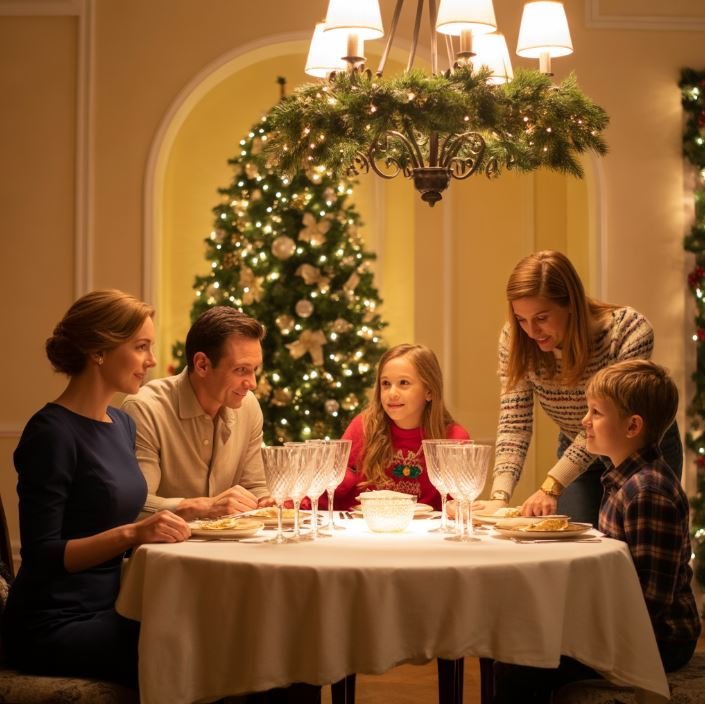
They didn’t expect me to hear it.
I was in the kitchen adjusting the angle of the serving tray when I heard her voice float in from the dining room—light, careless, just loud enough to reach me from the hallway.
“Make sure that’s her glass,” she said. “She’ll be out before dessert. I don’t want her ruining the toast.”
There was a pause, then my son’s muffled voice, too low to catch. Then her again, laughing softly.
“It’s harmless. She’ll sleep like a baby. We just need a peaceful evening for once.”
I stood completely still. My hand gripped the edge of the countertop until my knuckles paled. My heart didn’t race. It stopped, then restarted—slower, heavier—like it now carried more weight than before.
They were talking about me.
I turned my face toward the mirror above the stove. A ridiculous thing to hang in a kitchen, but there it was: a small square with a wooden frame and a crack across the lower left corner. I saw my own eyes there—calm, flat, unmoving—the way I imagine I looked when I buried my husband, the way I must have looked when my son first told me, years ago, that Pauline had “a different way of doing family.”
I walked slowly to the dining room. Ten steps. I counted each one.
They were standing at the table arranging the cutlery, smiling, not a trace of anything on their faces. She kissed him on the cheek and went to the hallway to get the wine. I didn’t say a word. I smiled back, took the water glasses from the table, walked them to the kitchen, poured fresh water, and when I came back, I switched them just like that.
Her glass for mine. Mine for hers.
A quiet act, unnoticed. Final.
It was my house, even if they liked to pretend it wasn’t.
They’d insisted on hosting the dinner here. It’s cozier, more traditional, and besides, you’ve got the best dining room. What they meant was my house looked respectable and familiar. What they meant was their apartment—with its sleek grays and metal stools—didn’t feel like family.
What they meant was I was good for appearances.
I set the glasses back on the table, sat down, smoothed the front of my navy dress.
Pauline returned holding the wine bottle like she was in a commercial. “Cabernet Sauvignon,” she said. “Your favorite, Iris.” She used my name like it tasted bitter in her mouth.
I nodded. “Lovely.”
The others arrived one by one.
My older grandson, Henry, distracted as always, glancing at his phone every few minutes. My younger granddaughter, Amy, polite and sweet, helping with napkins without being asked.
The table filled. The candles flickered. The roast cooled slightly while Pauline fussed about lighting.
Then came the first sip.
Pauline raised her glass for a toast. “To family,” she said, “to patience, and to keeping things civil.”
That earned a few confused glances, a tight chuckle from my son, a silence that lingered too long.
She drank. I watched her throat move as she swallowed.
Then I took my glass and raised it slightly.
I didn’t drink.
Dinner began—conversations about schools, promotions, a vacation someone might take in July. Nothing about me, except when Pauline turned and said brightly, “I hope the food’s not too salty for your blood pressure, Iris.”
I smiled at her. “We’ll find out, won’t we?”
She didn’t catch the tone. She never did.
Twenty minutes later, she started blinking more often. She rubbed her temple, sipped more water. Her fork slowed.
“Are you all right?” I asked gently, almost kindly.
“Fine,” she mumbled. “Just tired.”
Another ten minutes and she was pale. Her posture slackened, her words slurred just enough for everyone to notice—but no one said anything until she slumped sideways in her chair.
Henry jumped up. Amy gasped. My son stood still.
“Pauline,” he said.
I rose slowly, took her glass, carried it back to the kitchen, and poured the rest down the drain. I didn’t say a word.
They laid her on the couch. Someone called an ambulance.
The diagnosis would be exhaustion, low blood sugar, perhaps stress. No one would ask what was really in that glass, and I would say nothing.
I didn’t need to.
My son didn’t ride in the ambulance. He stayed back, dazed, muttering something about how she’d been working too much.
I walked him to the door after the medics left. The house was quiet again.
“You should rest too, Mom,” he said. His eyes didn’t meet mine.
“I will,” I replied.
He turned to leave.
“I heard you,” I said.
Just that. Nothing more.
He froze, then walked out into the night, and I closed the door.
The silence after they left was different. Not peaceful. Not sad. Just full—like something had finally landed after floating in the air for years.
I sat in the living room, hands folded on my lap, and watched the dark settle over the porch. Pauline’s perfume still lingered faintly in the cushions—some expensive thing she wore too much of, sharp, floral, insistent. Even passed out, she managed to leave her mark.
I didn’t feel guilt.
That surprised me.
I expected some trembling, some doubt. But all I felt was clarity, like a fog had lifted.
I picked up the wine glasses, the plates they left behind, and began clearing the table. No one had finished their food. The roast had gone cold, the green beans limp. Amy had taken her napkin and folded it into a perfect little triangle before leaving.
That girl had a good heart. I hoped she would survive this family with it intact.
In the kitchen, I scrubbed the dishes like it was any other night, like nothing unusual had happened.
But it had—and it didn’t begin tonight.
It began long before.
Years ago, I would have laughed at the idea of such a thing: that my son’s wife would slip something into my drink just to keep me quiet during a family dinner. But then again, years ago, I used to believe kindness alone built family.
Pauline had always disliked me subtly at first—gentle corrections about how I spoke.
“You mean salmon, not salmon, Iris.”
“It’s pronounced croissant, not crescent.”
Then came the bigger ones.
“You really should stay out of our parenting choices.”
“Iris, your décor is so nostalgic.”
Code for outdated. Low-class. Embarrassing.
She came from money, not old money—flashy money, the kind that gets spent quickly and loudly. Designer clothes, weekly spa visits, a car that cost more than my house. And somehow, despite all that, they were always behind.
That’s where I came in.
My son, Nathan, was no better. He didn’t defend me, didn’t contradict her, just smoothed things over.
“She doesn’t mean it like that, Mom.”
“Pauline’s just stressed.”
“You’re being too sensitive.”
“Let’s not make a thing out of it.”
I didn’t make a thing out of it for years.
I wrote checks, helped with the down payment on their house, covered private school fees when Henry started slipping behind. I quietly cleared a credit card balance once after they asked for a “small favor.” I never told anyone.
That was my mistake.
They got used to it. They started acting like it was expected, like I owed it to them just for being alive. And I took it because Nathan was my only child, because I thought if I kept giving, eventually I’d be part of their lives again—not just a backup wallet, but a mother, a grandmother.
I thought if I stayed useful, I’d stay wanted.
Tonight proved otherwise.
They didn’t just want me silent. They wanted me unconscious—out of the picture, an obstacle removed from their performance of unity and polish.
I washed Pauline’s wine glass last, watching the soap run down the stem, the rim where her lipstick had left a faint mark. I rinsed it carefully, set it on the rack to dry.
Then I wiped down the counters, turned off the kitchen light, and went to bed.
I didn’t sleep.
My mind replayed their conversation in loops—her voice, confident, careless, talking about me like I was a dog to be tranquilized.
I used to say nothing: when they left me off the Christmas card; when they told the neighbors Iris was “just a friend” helping out with childcare; when I offered a suggestion and got a patronizing smile in return.
I swallowed it all.
Not anymore.
In the morning, I dressed without rush. Same routine: soft slacks, cardigan, a brooch my husband gave me before he passed. I made tea, sat by the window.
The garden needed weeding, but I let it be. Today wasn’t for that.
My phone buzzed around 9:17 a.m. A message from Amy.
Grandma, is everything okay? That was so weird last night. Dad said Pauline fainted because she hadn’t eaten all day, but I don’t know. She looked strange. You okay?
I smiled. Bless that girl.
I’m perfectly fine, sweetheart. Thank you for checking. And yes, something was strange.
I didn’t say more. Not yet. She deserved the truth, but not in a text message. I would talk to her soon—when it was time.
I spent the morning reviewing my account records: three accounts, one savings, one checking, and one I hadn’t touched in over a year. My name on every page, and Nathan’s on several.
I had forgotten how many scheduled withdrawals I’d set up in their name. Phones, car coverage, school fees, a gym membership I’d never used. It was all there, plain as day.
They used my money to build their life, and now they’d tried to erase me from it.
I closed the laptop gently and called the bank.
The voice on the other end of the line was young, chipper, too bright for 9:30 in the morning. “Good morning, Ms. Lorn. This is Colleen at First Carolina Federal. How can I assist you today?”
I paused before answering. My hand rested on the notepad beside the phone where I’d written every recurring transfer I could remember. My handwriting looked steadier than I felt.
“Yes. Hello. I need to review some permissions on my accounts, and I’d like to pause a number of scheduled transfers—possibly all of them.”
There was a beat of silence. “Of course, Ms. Lorn, I can assist with that. May I verify your identity first?”
We went through the standard dance—last four digits of my ID number, the name of my late husband, the answer to a security question I’d forgotten I’d even set.
“Perfect,” she said finally. “I see you have three active accounts with us. There are currently seventy-two scheduled transactions. Would you like to cancel specific ones or pause everything for now?”
“Everything,” I said.
My voice didn’t shake. I’d half expected it to, but it came out clear and steady. I almost didn’t recognize it.
“All right,” Colleen replied, now more serious. “I’m initiating a pause of all scheduled payments effective immediately. They’ll remain paused until we receive further instructions from you on paper or in person.”
I thanked her, hung up, and stared at the phone.
So that’s how it starts, I thought—not with a bang, not with a confrontation, just a quiet call to a cheerful stranger, a flip of a switch in some system.
And now the bloodline of their comfort—their real dependency—was cut off.
By lunch, the first text came in. It was from Nathan.
Hey, did something happen with the phone plan? Mine’s not working.
I didn’t answer. Let him wonder.
I made myself a sandwich—nothing fancy, just turkey and cheese. I took it out to the porch and sat in the wicker chair with the peeling armrest, the one Pauline always made a face at. Funny: that armrest had outlasted her decency.
The air was warm, a little sticky. September always came heavy around here.
I watched a neighbor mow his lawn in slow, careful stripes and remembered how my husband used to do the same. I wondered if he were here what he’d have said about all this.
He wouldn’t have been surprised. He saw things I didn’t. Warned me gently years ago.
“Iris,” he said once, “if they only come around when there’s a check involved, they’re not visiting you. They’re visiting the money.”
Back then, I brushed it off. Told him he was being cynical.
Now I thought, no—he was just tired. Tired of watching me get chipped away piece by piece.
Around 2:00, the doorbell rang. I knew before I opened it who it was.
Nathan.
His shirt was wrinkled—unusual for him. His hair hadn’t been combed. He looked like a man who’d been chasing an explanation all morning and still hadn’t found one.
“Mom,” he said, stepping inside before I could say yes or no, “I need to ask you something.”
I didn’t invite him to sit.
He stood in the living room, glancing around like he was looking for something. Maybe he was.
“Did you talk to the bank?”
“I did.”
“Why?” He said it like it was a real question, like it was unexpected.
“You know why,” I said simply.
His face changed, flickering through irritation, confusion—something else I couldn’t name—then settling into that careful, measured expression he used with clients.
He folded his hands together. “Mom, Pauline’s been under a lot of stress lately. She didn’t mean anything by what she said. It was just poor wording. She was nervous about the evening going smoothly. That’s all.”
“You’re calling it poor wording?” I asked.
“She didn’t—” he said quickly, eyes widening. “She didn’t put anything in your drink. You’re jumping to conclusions. It was just a supplement. She uses melatonin herself. Thought it might help you relax.”
“She put it in my glass without telling me.”
He hesitated. “Yes. Okay. That part was… not great.”
I almost laughed at that. Not great.
I said nothing. Just stood there, arms folded, waiting to see where he’d go next.
He exhaled. “Look, I’m not saying it was the right call, but she thought—We both thought—that sometimes these dinners get tense. You know how you get—”
“How I get,” I repeated.
“You make these comments, Mom, about her, about the house, the kids—”
“I pay for the house,” I interrupted.
That stopped him.
“I paid the down payment. I paid the home loan every month for six years. I covered the kids’ school costs, your insurance, Pauline’s medical bills. I paid for groceries when your card was declined last spring. I know because the bank called me about it. So if I made a few comments over dinner, I think I earned the right.”
His mouth opened, closed.
“You’ve taken my money,” I said. “And in return, you tried to put me to sleep like an inconvenient child.”
“It wasn’t like that.”
“Was it your idea?” I asked. “Or did you just let her say it and stay quiet?”
He didn’t answer.
We stood in silence for a moment.
Finally, he asked, softer, “So that’s it. You’re cutting us off.”
“I’m cutting myself loose,” I said.
From the kitchen, the tea kettle started to whistle. I turned calmly and went to pour myself a cup.
I used to think silence was strength—that if I kept the peace, held my tongue, smiled when it hurt, I was being noble. That good mothers endure. That decent women forgive. That it’s better to be unthanked than to be bitter.
That was before I saw my son standing in my living room trying to explain away a tampered drink like it was a social slip.
After he left—without tea, without an apology—I sat at the kitchen table and stared at the steam rising from my cup. It curled slowly like a quiet goodbye.
I didn’t cry.
I hadn’t cried in years. That used to bother me. Now I saw it as proof I’d stopped expecting tenderness from the people who should have known how to give it.
The next day, I opened the drawer in the hallway console, the one I hadn’t looked in for years. It held files, warranties, loose batteries, and a thick manila envelope with Nathan’s name written in my handwriting.
I emptied it out onto the table.
There they were: copies of checks, receipts, loan agreements never repaid, birthday cards with thank you for everything scribbled next to numbers that had more zeros than any gift should.
Seventeen years of generosity.
No—seventeen years of trying to buy my place in a family that had slowly decided I was optional.
I looked at one check for $6,200 labeled nursery furniture. That was when Pauline was pregnant with Henry. She’d cried on the phone, said she didn’t want her baby to sleep in secondhand junk. I wired the money the same day.
Another: $12,000 listed as bridge loan until bonus comes through. It never did.
And the biggest one: $45,000—down payment on the house. They’d had champagne that night. I remember because Nathan sent a photo of the cork and said, “Wouldn’t have popped this without you, Mom.”
I didn’t print that photo.
It wasn’t just the money. It was the little things. Pauline had a way of correcting me in front of others.
“Iris, I think you meant to say autumnal, not just fall.”
“Don’t tell the kids those old stories. They’re a little dated.”
Nathan would laugh like it was charming.
They never hit me, never shouted—just chipped away, slow and soft, until I started doubting my own place at the table.
So I stayed quiet.
When Henry forgot to call me on my birthday, I said nothing. When Amy’s recital went by without an invitation, I pretended I hadn’t heard about it. When Pauline planned holidays without even asking if I’d be free, I made other plans alone because it was easier than making a scene.
Because I thought they’d come around.
They didn’t.
I pulled out a fresh notepad and began writing. Not a letter, not yet—just a list of dates and patterns.
It was long.
At the bottom, I drew a line and wrote one sentence:
A person’s worth is not measured by what they give, but by how they’re treated when they stop giving.
Then I picked up the phone and called Amy.
She answered on the second ring. “Grandma.” Her voice was bright, cautious, like she wasn’t sure if I’d be angry. That hurt more than anything.
“Hi, sweetheart,” I said. “You asked me yesterday if everything was okay.”
“Yeah. You seemed different.”
“I need to tell you something,” I said. “But not over the phone. Can you come by after school?”
“Of course,” she said immediately. “Do you want me to bring anything?”
“Just yourself.”
She came that afternoon, walked in like she always did—quietly, respectfully, backpack slung over one shoulder, that little frown she got when she was thinking hard.
We sat at the table. I didn’t offer snacks. I didn’t ask about school. I just told her the truth—about the glass, about what I heard, about what I did.
She didn’t speak for a long time.
Then she said, “She’s been weird with you for years.”
That surprised me.
“I noticed it when I was ten,” she said. “I remember you gave me a sweater and she said it wasn’t my style, and Dad just let her.”
I nodded slowly.
Amy looked at me, then down at her hands. “Are you okay?”
“I am now,” I said.
“I’m sorry.”
“You don’t need to be. You didn’t do any of it.”
She took a breath, then asked, “What happens now?”
“I’m not sure,” I said. “But it’s going to be different.”
She didn’t push. She just reached across the table and squeezed my hand.
That night, I wrote a letter.
Not to Nathan. Not yet.
To my lawyer.
I asked for an appointment, and I slept well for the first time in months.
The law office smelled like old wood and copy paper—that sterile sort of calm that makes you sit up straighter even if no one asks you to. I hadn’t been there in years, not since I updated my will after my husband died.
Back then, I’d left everything to Nathan because who else was there?
Now I was here for a different reason.
The receptionist recognized me. She smiled politely, offered tea. I declined.
“Ms. Lorn, Mr. Davidson will see you now,” she said a few minutes later.
Richard Davidson was nearing seventy himself—thin, sharp-eyed, hands as still as a surgeon’s. He’d drawn up my first will back when Nathan was still in high school. We’d been acquaintances for decades, not friends, but familiar in the way small-town professionals often become.
“Iris,” he said warmly, rising as I entered. “It’s been a while.”
“Too long,” I said, shaking his hand. “I need to make some changes.”
He nodded and gestured to the chair across from his desk. “Tell me what you’re thinking.”
I laid out the facts slowly, without drama. He listened without interrupting, only nodding occasionally, scribbling on a legal pad with his fountain pen.
When I got to the part about the drink, the switch, he set the pen down and looked at me over his glasses.
“Do you want to file a formal complaint?” he asked quietly.
“No,” I said.
He didn’t ask why.
Instead, he opened a file drawer and pulled out my last will, flipped to the second page.
“Currently, Nathan is the sole beneficiary. You’re still listed as executor, and you designated him decision authority if you become incapacitated. Do you want to remove him from all of that?”
“Yes,” I said. “And replace him with my granddaughter, Amy.”
He didn’t blink, just made a note.
“I’d also like to create a trust,” I said. “A separate account, protected for Amy’s education, housing, her future—something no one else can touch. Not her parents, not her brother, not me, once it’s set.”
Richard raised an eyebrow. “That can be done. I’d suggest a revocable living trust with a named successor trustee—preferably someone outside the family.”
I nodded. “Can you be that person?”
He smiled faintly. “Happy to, but I’ll need to confirm with her first that she understands what’s being offered.”
“She doesn’t know yet,” I said. “Not the details.”
“She will soon,” he replied, and began drawing up the paperwork.
It took two hours—signing, initialing, reviewing clause after clause. I felt no hesitation, just a calm sense of direction, like I was finally walking the path I should have taken years ago.
When it was done, I felt lighter—not euphoric, just unburdened.
Outside, the sun had shifted westward. The light was different, softer.
I stopped by the bakery on the way home and bought a cherry tart—Amy’s favorite. It felt like the right thing to have waiting.
The next morning, Nathan called. I didn’t pick up. A few minutes later, a message came through.
I just got a notification from the mortgage company. Payment bounced. What’s going on? Can you call me back?
I stared at the screen, then set the phone down and went to water my plants.
Let him sit in the silence for a while. I’d lived in his for years.
Later that afternoon, Amy came by again. This time, she had a stack of school papers with her and a worried look in her eyes.
“I think Dad’s starting to freak out,” she said, dropping into the kitchen chair.
I poured her some lemonade.
“He should have thought about that before letting Pauline put something in a wine glass,” I said calmly.
Amy winced. “He says it wasn’t like that.”
“I know what I heard.”
“I believe you.”
I sat across from her and slid the tart across the table. “Cherry. I remembered.”
She smiled. That same soft, grateful smile I used to get from Nathan when he was a boy—before the distance, before the expectations.
“I made his favorite grilled cheese today,” I said. “Before the distance, before the expectations.”
Then I made a decision out loud.
“I changed my will.”
Her eyes widened. “You what?”
“I took your father out,” I said. “Removed him as beneficiary, as executor, as the person who’d make decisions for me if I couldn’t. I named you instead.”
“Me?”
“Yes, you. And I set up a trust for your future.”
She sat back, stunned. “Grandma, I don’t know what to say.”
“You don’t need to say anything,” I said. “Just promise me something—anything. Don’t ever let people take your kindness as permission.”
Amy nodded. Her eyes were glassy.
“I didn’t do this to punish them,” I said. “I did it because I want what I built to go to someone who sees me—not just what I can give.”
“I do see you,” she whispered.
I reached across the table and squeezed her hand.
And for the first time in a very long time, I felt like someone’s mother again—not because of what I could provide, but because I was finally being heard.
The first past-due notice arrived three days later, a pale yellow envelope with Nathan’s name in bold type but my address listed as the billing source—leftover from when I used to handle the mail while they were “getting organized.” After moving in, I opened it out of habit more than concern.
Past due. Home loan. Coverage.
One bounced, one suspended.
I set the letter on the counter and made myself tea.
It wasn’t my problem anymore.
Later that afternoon, the bank called to confirm the final closure of all recurring transfers. A pleasant woman named Denise read the list back to me: phone plans, household services, tuition support, two gym memberships, and something labeled executive essentials monthly.
I didn’t even want to know what that one was.
“All canceled,” she said. “Would you like printed copies for your records?”
“Yes, please,” I said. “And could you send them to my attorney as well—Richard Davidson?”
“Absolutely.”
That was that. No ceremony, just a phone call and a quiet eraser of financial strings I had tied myself up in for nearly two decades.
The silence after felt whole.
I didn’t realize how much noise I’d been living with—not just the literal noise of texts, calls, requests, but the mental weight, the invisible math of being generous, of calculating what wouldn’t cause a fight, what would earn me just enough inclusion to not feel erased.
They used to make it sound like I was doing it all out of obligation.
“You’re always so generous, Mom,” Nathan would say with that gentle tone that now felt like sandpaper. “You’ve always loved to help.”
Yes, I had.
But I’d also learned to mistake help for currency—for a place at the table.
Not anymore.
By the weekend, I began rearranging the house slowly, deliberately—not redecorating, just reclaiming. I took down the stiff gray curtains Pauline once insisted were “more modern.” I put the floral ones back up, the ones she rolled her eyes at.
I liked them.
They reminded me of mornings when my husband was alive making coffee while I tied back the sashes.
I packed up a shelf of gifts they’d given me over the years—mostly things that came with passive-aggressive notes. A book on Updating Your Look. A blender I never used. A necklace too bold for my taste.
I put them in a box, labeled it donation, and set it by the door.
I was clearing space—literally and otherwise.
Monday, Amy came over again after school and found me sitting on the floor in the living room surrounded by old photo albums. I hadn’t looked at them in years. It had always felt too heavy.
She sat beside me without asking.
“I found some,” I said, holding up a page with Nathan at six, beaming next to a sandcastle.
Amy smiled. “He looks like Henry.”
I nodded. “He used to laugh so loud people turned around in restaurants.”
Amy traced the edge of the photo. “What happened?”
I shook my head. “I don’t know the exact day it changed. It wasn’t dramatic—just slow. He got older, got smarter, met Pauline. Things started getting small between us, tighter, like he was shrinking away from who we were.”
“He shouldn’t have let her treat you like that,” Amy said quietly.
“No,” I agreed. “But I let it happen, too. I wanted peace more than I wanted truth.”
We flipped a few more pages—birthdays, holidays.
One picture of me holding baby Amy in a hospital chair, my eyes puffy from crying. I remembered that day. She’d come early. Nathan had panicked. I held her all night while Pauline slept.
Amy looked at it for a long time. “I don’t remember that,” she said.
“You were just a few hours old.”
She hesitated. “Do you ever think about cutting him off completely? Like not talking to him at all?”
“I think about it,” I said, “but I’m not sure it’s about punishment anymore. It’s about peace. If he can be in my life without demanding anything from me, I’m open to that. But I won’t pay for love anymore. That chapter’s over.”
Amy didn’t say anything. She just leaned her head lightly against my shoulder.
After she left, I got a call from a blocked number. I let it ring, then listened to the voicemail.
Pauline.
Her voice sounded strained, forced, too sweet by half.
“Iris, I think we should talk. There’s been some misunderstandings. Nathan told me you’ve been feeling hurt. That’s really unfortunate. I think we could all benefit from clearing the air. Maybe we could do lunch.”
I replayed the message once just to hear the way she said unfortunate, as if my feelings were a scheduling conflict.
I didn’t call back—not because I was angry, but because I knew what that lunch would be: a performance, an apology laced with conditions, a plea for restoring balance.
What she really wanted was access—to me, to my money, to my silence.
She could keep waiting.
That evening, I sat by the window with a blanket and watched the sun dip behind the trees. The porch light clicked on automatically, a soft yellow halo over the chair I’d reclaimed—the one with the peeling armrest.
And for the first time in years, I wasn’t waiting for a call. I wasn’t hoping to be included. I wasn’t adjusting myself to fit inside someone else’s version of family.
I was simply home.
And it was enough.
The first message from Henry came the next morning. It was short, stiff, polite—like he was writing to a teacher he didn’t really like.
Hey, Grandma. Dad said you’re mad at everyone. Just wanted to say I hope you’re okay.
I stared at it for a while.
The words weren’t cruel, but they weren’t curious either—no question, no real concern, just a vague hope that whatever disruption I’d caused would resolve itself and the machinery would keep running smoothly.
He’d always been like that: hands-off, a nice boy, but trained early to keep a safe distance from discomfort.
I didn’t answer.
An hour later, Amy called.
“Henry just texted me,” she said. “He said you’re mad at everyone.”
“I’m not mad,” I replied. “I’m done.”
There was a silence on the line, then a soft laugh.
“Good,” she said.
Amy had been checking in every day now—not out of obligation, not out of guilt, just being there. Sometimes she came over. Sometimes she called. Once she dropped off a bag of lemons because she said I made the best lemonade and she was tired of the bottled kind.
I didn’t realize how thirsty I’d been for that kind of attention—simple, quiet, undemanding.
That same afternoon, another message came in, this one from Nathan.
Can we talk? Not about money, just talk.
I didn’t reply.
Instead, I turned off the phone and went out to the garden. The weeds had gotten bold while I was busy handling everyone else’s life. I dug in with my hands, pulled root after root, clearing space for air and sun.
It felt good—honest, messy, real.
That evening, I baked bread. The house filled with warmth and the smell of something rising. I didn’t realize how much I’d missed that—the slow miracle of flour and water becoming something alive again.
I sat by the window with a slice, still warm, no butter, just salt. The porch light flicked on. I didn’t look at my phone.
When it rang again after dark, I let it go to voicemail.
This time, the voice was Pauline’s mother. That one surprised me.
“Iris, this is Vanessa. I know things have been tense lately, but I wanted to say I never meant for you to feel excluded. I assumed Nathan and Pauline were involving you in the planning. If I had known…” She paused. “Well, I just wanted to reach out. For what it’s worth, I always admired how you carried yourself.”
I didn’t know what to make of that. Maybe she meant it. Maybe she just heard about the canceled transfers.
Either way, it didn’t change anything.
The next day, the florist delivered a bouquet of white lilies. No note, just a typed card: Thinking of you.
I snorted. There wasn’t a lily in the world that could undo what had been done.
I gave the flowers to Mrs. Elkins next door. Her dog had died last week. At least she’d appreciate them.
Later that week, I made an appointment at the credit union—not the same bank Nathan used. I wanted a clean break.
A young woman helped me set up a separate account—one for Amy’s trust and one just for me. My name only. No shared access. No co-signers. No “just in case.”
When she asked if I wanted to link any family members as an emergency contact, I shook my head.
“I’ve already had that emergency,” I said. “I handled it.”
Back home, I found a handwritten letter in my mailbox.
Amy had written me a real letter on lined paper. Her handwriting was neat, loopy, like mine had once been. She wrote about how things felt strange at home, how Nathan was quieter than usual, how Pauline pretended nothing had happened, how Henry kept asking if I was coming over for Sunday dinner.
They don’t get it, she wrote. They think you’re being dramatic or difficult, but I see what’s happening. You’re setting a line and I respect it.
Then one sentence I read twice.
You taught me how to bake, but now you’re teaching me how to have a backbone.
I folded the letter and placed it in the drawer where I kept my husband’s watch, an old church program, and the only photo I still displayed of Nathan as a boy.
The next day, I walked to the post office and bought a box of stationery.
If they were going to start writing, I’d respond in kind—but only to the ones who wrote with truth. Not lilies, not voicemails, not white lies hidden in expensive paper.
Words. Honest ones.
I wrote Amy back that evening. No advice, no preaching—just told her about the bread, about the lilies, about the garden finally getting its space again.
And I ended with this:
Kindness is a gift, sweetheart, but it’s not a contract. Never forget the difference.
I sealed the letter and smiled.
Let the silence stretch on if it wanted. I was no longer afraid of it.
The letter from Nathan arrived on a Thursday—not an email, not a text, a real envelope. My name in his handwriting, careful, almost too neat, like he’d taken his time, like he wanted the effort to show.
I didn’t open it right away.
I let it sit on the table while I boiled water for tea, sorted the laundry, refolded the kitchen towels. I moved around it, aware of it in the way you’re aware of a sore tooth—not painful, but persistent.
When I finally slid it open, I braced for excuses.
But it wasn’t that.
It started with a sentence I hadn’t seen from him in years.
Mom, I’m sorry.
No qualifiers. No spin. Just that.
He went on to say he hadn’t realized how much he’d relied on me, how easy it had become to let Pauline run the show while he stayed neutral. He admitted he heard her that night in the dining room, that he’d been too afraid to stop her.
I knew what she meant, and I didn’t stop her. I thought it would keep things smooth. I see now what that says about me.
He didn’t ask for money. He didn’t mention the canceled transfers.
Instead, he wrote about memories—how I used to sing while doing the dishes, how he’d wake up to the smell of coffee and humming, how I made his favorite soup when he had the flu and sat by his bed reading the same book over and over until he fell asleep.
Somewhere along the way, I stopped seeing you as a person and started seeing you as a function—a role, a resource. I hate that it took something so ugly for me to realize it.
At the end, he asked nothing. He just said he hoped I was okay, that he was trying to understand what came next, that he wanted to earn the right to be in my life again if I’d let him.
I folded the letter slowly and set it aside.
I didn’t know how I felt.
I’d spent so long waiting for that kind of apology that now, having it, I wasn’t sure what to do with it.
It didn’t erase anything. It didn’t make what happened better, but it was something. And maybe it wasn’t for me to decide right then what came of it.
Later that day, I went into town to see Richard Davidson. The documents for the trust were ready for final signatures.
He greeted me with his usual quiet smile. We sat in his office, the thick file between us, and went over everything one more time.
“The trust is fully funded,” he said, adjusting his glasses. “Disbursement begins when Amy turns twenty-five, with provisions for education and housing before that if needed. All conditions are locked. Only she can access the funds. No co-signers, no transfers.”
I nodded.
“She’ll be protected,” he added. “You did this right.”
“She deserves it,” I said.
Richard hesitated, then added gently, “I’ve worked with a lot of families over the years, Iris. Most people don’t do this—not unless there’s a lot of anger behind it.”
“There was,” I said, “but not anymore. Not exactly.”
He didn’t press.
I signed the last document—just a name on a line, but it felt like sealing a chapter.
On the way out, I stopped by the bakery and picked up two pastries: one for me, one for Amy. I didn’t know if she’d be by that day, but it felt right.
I got home just as the mail truck rolled up.
Another envelope.
This one from Pauline.
I nearly tossed it in the trash without opening it, but I didn’t.
It was one page, printed, not handwritten—polite, cold. She wrote that she hoped I was well, that she regretted how things had been perceived, and that she wanted to rebuild bridges. She asked to meet for lunch—her treat—at one of those modern places she loved, where everything was plated on stone and tasted like salt and air.
There was no apology, only optics.
I folded the letter once and slid it into the drawer where I kept coupons and spare batteries—a waiting room for things I didn’t know what to do with yet.
That evening, Amy came by. I handed her the pastry and told her the trust was official.
She stared at me. “What does that mean?”
“It means no one can take your future from you,” I said. “Not even you, if you’re being foolish.”
She laughed, then paused. “Is it a lot?”
“It’s enough,” I said.
She didn’t ask for numbers. I liked that about her.
We sat on the porch eating, watching the last light leave the sky.
“Dad wrote me a letter,” I said eventually.
She looked over.
“And I believe he means it,” I said. “But believing someone’s regret doesn’t mean you hand them a key again.”
Amy nodded.
“Do you think you’ll forgive him?”
“I already did,” I said. “But that doesn’t mean I’m letting him back in the house.”
Amy didn’t argue.
We finished our pastries in silence—the kind that doesn’t ache.
That night, I slept with the window open. The air was cooler now. September was shifting toward fall—the kind of fall I liked. Not autumnal, not curated—just plain, honest weather.
I woke once around midnight and stood by the window. The street was empty. No cars, no footsteps, just the hum of quiet houses.
Mine no longer felt like a waiting room.
It felt like a home again.
I wasn’t expecting them to show up at my door—not like that.
It was late afternoon, the kind of day where the air hangs heavy and still just before a storm. I’d been out in the backyard pulling weeds from the far corner of the garden—the one no one ever helped me with—when I heard the car.
I knew the engine before I saw it. Nathan’s sedan was always a little too clean, always parked just a little too straight.
I stood up, wiped my hands on my pants, and watched them get out—both of them.
Nathan looked tired, older than I remembered.
But it was Pauline who caught my eye.
Dressed down, hair pulled back, no makeup, which was rare for her. She always presented herself like she expected a camera to appear at any moment. But today she looked normal—small, almost.
I didn’t move.
Nathan lifted a hand in a little wave. “Mom,” he said. “Can we talk?”
I didn’t answer. I just turned and walked toward the porch.
If they wanted a conversation, they could have it on my ground.
They followed me up the steps like children, unsure if they were still in trouble. I didn’t offer chairs. I didn’t invite them in.
Pauline spoke first. “I know I’m probably the last person you want to see.”
“You’re not wrong,” I said.
She swallowed. “I came to say something, and not just because of the money—though I’d be lying if I said we weren’t affected.”
I waited.
She glanced at Nathan, who gave her a small nod.
“I’m sorry,” she said. “For everything. The dinner. The glass. I shouldn’t have done that. I was trying to control a situation that wasn’t mine to control. It was selfish and wrong.”
Her voice was flat—practiced, not robotic, but careful, like someone trying to walk across ice without slipping.
I didn’t speak.
“I wasn’t raised to ask for help,” she continued. “And when you kept giving it—money, time, space—I told myself it was just your way of being. I didn’t think about what it cost you. I didn’t want to.”
Still, I said nothing.
Nathan stepped forward. “We came because we know we can’t undo it, but we don’t want to pretend anymore. I don’t.”
I looked at them both for a long time.
Then I said, “I’ve already forgiven you.”
They blinked.
“But forgiveness doesn’t come with a seat at my table,” I added. “Not yet.”
Nathan nodded slowly. “I understand.”
Pauline, to her credit, didn’t argue.
“I spent a long time thinking I could earn love with usefulness,” I said. “That if I stayed helpful, no one would throw me away.”
They shifted, uncomfortable.
“I’m not angry anymore,” I added. “But I’m not available either.”
That seemed to land.
Nathan looked down. “Is there anything we can do?”
I thought about that.
“You can stop trying to manage the narrative,” I said. “Don’t tell the kids I’m being difficult. Don’t play the victim. Just say the truth: I set boundaries you didn’t like.”
He nodded.
“And you can live with the consequences,” I said. “If money is tight, figure it out. You’re grown people. You have jobs, a house, a car I helped you buy. Figure it out like I had to when I was thirty-five and widowed.”
Pauline’s face twitched just a little. I wasn’t sure if it was shame or pride trying to stay intact.
“That’s fair,” Nathan said quietly.
I stepped back toward the door. “If you want to visit again, write first. No unannounced appearances. No requests. No strings.”
They both murmured agreement.
I didn’t hug them, didn’t reach out—just nodded and stepped inside, closing the screen door behind me.
I watched through the curtain as they got back into the car. No fight. No dramatics. Just two people finally realizing they’d lost access to something they thought was permanent.
The next morning, Amy stopped by. I told her they’d come.
“What did you say?” she asked.
“The truth.”
Amy smiled faintly. “I bet that rattled them.”
“They’ll survive,” I said. “We all do.”
She looked around the living room. “It’s so quiet here now.”
“I like the quiet,” I said. “It tells me when someone’s voice matters.”
That afternoon, I sat down with a new notepad.
I started a list—not of transfers, but of things I wanted. Small things. Take a pottery class. Visit the arboretum in Raleigh. Find my old recipe for lemon bars and see if it’s still as good as I remember.
I hadn’t made a list like that in years.
I always made lists for others—shopping, obligations, favors.
This one was mine, and it felt like a beginning.
Freedom doesn’t always arrive with fireworks. Sometimes it creeps in slowly, like light under a closed door.
That’s how it felt the morning after they came.
I woke before the sun. No alarm, no reason—just eyes open, body rested.
I got up, made coffee the old-fashioned way, and sat on the porch with a blanket over my knees. The street was still asleep—no cars, no sprinklers, no barking dogs—just stillness, and me in it.
Not as an intruder. Not as a prop.
As the owner of my own time.
I watched the light grow inch by inch across the yard, pale at first, then gold—the kind of morning you notice more when you’re not distracted by what others need from you.
I wasn’t weak. I was patient.
That’s the part no one understood. They thought my silence meant agreement, that my quiet was consent.
But it wasn’t.
It was endurance. It was a long-held breath.
And now I was exhaling—finally, fully.
After breakfast, I cleaned out the hallway closet. Not out of necessity, just because I wanted the space. I found coats that didn’t fit, board games no one played, a pair of shoes Nathan gave me years ago that pinched my toes but looked appropriate for formal events.
Into the donation bag they went.
I kept one thing, though—an old sweater with fraying sleeves.
My husband’s.
It still smelled faintly of cedar and something warm I could never name. I held it for a moment, then folded it neatly and set it on the bed.
Some things you keep not for function, but for memory.
Around noon, Amy called.
“You sound good,” she said, halfway surprised.
“I feel good.”
“Did they say anything after they left?”
“No,” I said, “and that’s just fine.”
I didn’t need follow-ups. I didn’t need explanations. They’d had their moment. I’d had mine. The rest would take care of itself—or it wouldn’t.
That part wasn’t up to me anymore.
After we hung up, I drove to the nursery and bought herbs for the garden: basil, thyme, lavender—simple things.
I’d neglected that corner of my life for too long. I wanted to grow something that didn’t require apology.
Back home, I spent the afternoon planting—hands in the dirt, sun on my back—the kind of quiet work that makes you forget you ever worried about account lists or strained smiles over roast beef.
The phone rang once—Nathan again. I let it go to voicemail. He didn’t leave a message this time.
That, I decided, was progress.
Later, I opened the drawer where I’d kept his letter and reread it—still honest, still painful, but less sharp now, like a wound that had scabbed over.
I put it back, then picked up the letter Amy wrote and read that again, too.
I found myself smiling at the line about the backbone.
She was growing one, too, and that mattered more than anything else.
That night, I cooked for myself. Not leftovers, not something frozen—real food. Fresh pasta with tomatoes and garlic and a little too much olive oil.
I ate it slowly at the table with music playing low from the kitchen radio. No one interrupted. No one asked for seconds. No one picked at the food or said it was a bit heavy.
Just me eating, living.
It struck me mid-bite how rare that had become. For years, I’d been a provider, a buffer, a quiet shadow in the background of someone else’s life—the dependable one, the helper, the bank.
Now I was just a woman with a plate of pasta, a glass of wine, and a house that no longer echoed with quiet resentment.
I thought back to that night—the dinner, the glass, the slow collapse of pretense. I remembered Pauline’s face just before she slumped, Nathan’s panic, my own calm.
How still I’d been.
Not vengeful. Not angry.
Just done.
Some people need drama to end a story.
I needed stillness.
That was my exit and my return.
I went to bed early that night—not out of exhaustion, but because I could. Because no one needed me to stay up to answer questions or move money or listen to complaints about other people’s choices.
Because peace, when it finally comes, asks nothing of you except presence.
And I was fully present, for once, in my own life.
When I turned off the light, I thought to myself, almost absently: They thought I was weak.
But I was patient, and I was right.
Two weeks passed without a word—no texts, no visits, no apologies wrapped in flowers or guilt disguised as concern—and it was the most peace I’d had in years.
I spent the time doing small things, things I used to rush through or put off. I repainted the back door, organized the pantry, even stitched a tear in the living room curtain I’d ignored for nearly a decade.
Not because any of it mattered, really, but because it was mine to tend to—without supervision, without commentary, without being told there was a better way to do it.
That was the difference: I wasn’t being watched anymore.
When you live with people—or even just near them—who think they know better than you, everything becomes performative. Every choice you make is up for quiet debate. Even silence starts to feel like judgment.
But now the quiet felt like breath.
One morning, I made pancakes just for myself—not for grandkids, not for guests, just because I wanted them. I made them the way I liked: crisp edges, too much butter, a little lemon in the batter.
I sat by the window, watching the sun move across the kitchen tile, and thought, This is what a second life feels like.
That afternoon, I took out my recipe box—the old one, wood chipped in the corners. The cards inside were smudged with flour and oil from years of use. I hadn’t touched it in ages.
Pauline didn’t care for my recipes. Said they were too heavy, too dated. Once she even asked if I could try cooking with “less emotion,” whatever that meant.
But Amy had asked me once, years ago, if I’d write them all down for her someday.
So I began—one card at a time.
Not just the ingredients, but the stories, too: where the recipe came from, who loved it most, when it was usually made.
Not for anyone’s approval—just so that someday, someone would open this box and hear my voice in their kitchen.
That evening, Amy called.
“They’re quiet,” she said, meaning her parents.
“Good,” I replied.
“I think they’re waiting to see if you’ll come around.”
I laughed softly. “Let them wait.”
She was quiet for a moment. “Then you’re really not angry anymore, are you?”
“No,” I said. “Anger’s a fire. It needs oxygen. I stopped feeding it.”
“What’s left?”
“Space,” I said. “And silence. And peace.”
She liked that.
We talked a little longer about school, her friends, the new book she was reading—no heavy subjects, just a real conversation, one that didn’t circle back to guilt or negotiation.
After we hung up, I found myself thinking about legacy—not the money, not the house, not even the trust, but the feeling I was leaving behind.
What would they remember? Would they say I was kind, strong, distant, cold?
Maybe all of it.
But I hoped most of all they’d remember I stopped letting myself be used—that I found the line where giving becomes losing, and I stepped back.
The next day, I went to the library and checked out three books I’d always meant to read but never had time for. When I walked out, the sun was high and the breeze felt like a small reward.
At home, I started another letter to Amy—not about the trust this time, not about Nathan—just about life. I told her about the books, the pancakes, the recipe box. I told her I was thinking about starting a new flower bed in the front yard, something colorful, wild, unkempt.
I ended it with this:
Don’t wait for someone else to tell you your life has value. Decide it does, and then live like it.
I sealed the envelope, added a stamp with a little bee on it—cheerful, busy, unbothered—and as I walked it out to the mailbox, I realized something.
For the first time in a long time, I wasn’t waiting to be chosen.
I had chosen myself.
It rained for three days straight—not the loud kind, not thunder and flash and drama, but the soft, soaking kind that makes everything slow down, the kind of rain that seems to wash more than just the streets.
I spent most of those days inside—reading, writing, moving from room to room with no real urgency. There was something comforting about hearing the water on the windows, knowing the world outside was doing its own quiet work of renewal.
I didn’t hear from Nathan or Pauline, and I didn’t wonder why.
On the second night, I sat down with a pad of paper and started something I hadn’t done in years: I wrote a list of people I hadn’t spoken to in a long time—people I’d let drift away because I was too busy being needed by the ones who didn’t value me.
Friends I’d stopped calling because Pauline didn’t like them. Neighbors I waved to but never invited in. Even my cousin Mabel, who lived two towns over and had always sent me a card on my birthday, even after I forgot hers twice.
I decided to write them—not to explain, not to apologize, just to reconnect.
That’s what I was learning. Freedom isn’t always about cutting ties. Sometimes it’s about retying the ones that mattered, the ones you let fray while holding up the wrong end of someone else’s rope.
I started with Mabel.
Dear Mabel, I wrote, I’ve been quiet for too long. Not because I didn’t care, but because I forgot I was allowed to have a life of my own.
It felt good.
The next morning, I received a delivery—not flowers, not guilt gifts: a basket.
Inside: honey, tea, a jar of homemade jam, and a folded note.
Amy.
She wrote that she’d made the jam herself—blackberries from a neighbor’s fence—and that she thought of me when she tasted it because it was a little tart, a little sweet, and totally itself.
I smiled at that.
She added one more thing at the bottom of the note, almost like a whisper:
You’re the kind of woman I want to become.
I sat with that sentence for a long time—not because it flattered me, but because it reminded me that nothing I’d built was wasted. Not the meals, not the patience, not even the mistakes.
It had reached someone.
It had shaped someone.
And that mattered.
That same day, I finally opened the drawer with Pauline’s letter, the one I’d tucked away weeks ago. I didn’t reread it. I just took it out, walked it to the fire pit in the backyard, and lit a match.
It burned quickly. No resistance.
Sometimes closure isn’t a door slamming. It’s just deciding not to carry something anymore.
That evening, I sat by the window again, tea warm in my hands, and watched the rain slow to a stop. The garden would be drenched by morning.
But I didn’t mind.
It needed the soak.
Things grow better when the soil’s been softened first—just like people.
The next day, I went to the nursery again. This time, I bought wildflower seeds—the kind that bloom where they want, how they want. No order, no pruning, just color and stubbornness.
I came home, put on my gloves, and scattered them in the front yard.
Let them surprise me.
I thought I didn’t need control.
I needed life.
And life, I was learning, was best lived uncontained.
Somewhere along the way, I stopped expecting the apology to fix anything.
That’s the thing about clarity: once it arrives, it doesn’t need ceremony. It doesn’t ask for a stage. It just settles in quietly, like a truth you already knew but didn’t want to speak aloud.
One morning, I woke up and realized I hadn’t thought about Nathan or Pauline in three whole days—not once. Not when I opened the mailbox, not when I cooked, not even when I passed the corner of the kitchen where Pauline used to leave her purse every time they visited.
That space didn’t feel haunted anymore.
It felt available.
I started filling it, little by little, with my own things: a small stack of cookbooks I actually liked, a radio that only picked up two stations, both of them full of joy, a bowl of lemons just because they looked nice in the morning light.
That was the biggest change.
I think I started putting beauty where the ache used to live.
I didn’t do it all at once. Just one corner, then another. A drawer here, a frame there—not out of some grand need to reinvent myself, just a quiet reminder that I still had taste, still had preferences, still had a life worth shaping.
Amy noticed first.
She came by with a pile of books from her literature class and stopped short in the hallway.
“Did you move the chairs?” she asked.
I nodded. “They never really belonged there. Always too stiff.”
“It looks better like this,” she said.
Then, with that soft curiosity I’d come to admire in her, “Do you feel different now?”
I didn’t answer right away. But later that evening, I thought about it.
Did I?
I wasn’t lighter—not exactly. The past was still there. The memories didn’t vanish.
But I felt steadier, like a house that’s finally been repaired after years of patchwork. Nothing flashy, just sound, solid, my own.
That weekend, I got a letter from Mabel—three pages, front and back. She wrote about her arthritis, her neighbor’s runaway cat, the church choir’s new director who insisted on modern songs that sound like someone yelling underwater.
She also wrote this:
I don’t know what made you reach out after all this time, but I’m glad you did. We forget we have choices. Then one day we remember we can call someone who makes us laugh, and just like that, the world gets wider again.
I cried reading that—not from sadness, but from recognition.
That was the thing, wasn’t it?
The world was wide.
But I had made mine small trying to stay wanted by people who only saw me when they needed something.
Now I was letting it widen again.
Amy and I started walking in the evenings—nothing far, just around the block, sometimes to the park. She told me about her friends, her plans, a boy she liked who didn’t like her back.
Which is fine, she said, because she didn’t want to teach someone how to see her.
That stopped me in my tracks.
I turned and looked at her—really looked.
“You already know that?” I asked.
She nodded. “You taught me.”
And I suppose I had—not with speeches, not with lectures, but with choices. By saying no when it counted. By choosing peace over performance. By walking away without burning down the house on my way out.
That night, I wrote her a new letter and slipped it under her windshield when she wasn’t looking. In it, I wrote:
Strength isn’t what people see when you raise your voice. It’s what you learn to carry quietly, and more importantly, what you learn to set down.
I watched from the window as she found it the next morning. She smiled, didn’t even open it right away, just tucked it into her bag and drove off.
She trusted the words could wait.
The wildflowers started coming up that week—small green shoots, brave and messy, with no sense of direction. I bent down, brushed the dirt gently, and smiled.
No one told them where to grow.
They just decided to.
A letter arrived addressed only to Mom.
The handwriting was Nathan’s. Not as careful as the last time—rushed, messier—but still his.
I opened it without hesitation this time.
I didn’t feel dread or hope or anything that asked for an emotional investment—just a quiet curiosity, the kind you feel when someone you used to love knocks softly from a distance.
Inside were four short paragraphs—no excuses, no apologies, just reflection.
He wrote that the house felt different now, that Amy talked to him less, that Henry had started asking questions—not accusing, just observing. He wrote that Pauline cried sometimes—not from guilt, but from fear: of what they’d lost, of what they couldn’t get back.
He didn’t ask for forgiveness. He asked for understanding.
I know now there’s a difference, he wrote, between being sorry and becoming different. I’m trying for the second one.
He ended by saying he’d stopped looking at the bank app every morning—that the silence in that space used to feel like punishment, and now it felt like the only honest thing they’d shared in years.
I folded the letter once, set it on the counter, and didn’t rush to answer.
Maybe I wouldn’t at all.
Not everything requires a response.
That weekend, Amy brought over a pie she’d baked herself. The crust was crooked, the filling too sweet.
But it was the best pie I’d had in a decade.
We ate it at the table I used to dread—the one where too many tense dinners had played out like bad theater. But now it was just a table, just two women eating pie and talking about things that had nothing to do with survival.
“Do you think you’ll ever invite them over again?” Amy asked.
“Maybe,” I said. “But not until I stop flinching at the thought.”
She nodded. Didn’t push.
Later, she helped me rearrange the guest room—not for them, not anymore, but for a new purpose. I told her I was thinking about turning it into a sewing room, or maybe a reading space, a place that wasn’t about anyone else’s comfort but my own.
She smiled and said, “That sounds exactly right.”
We moved the bed to the far wall, took down the bland art Pauline had once gifted me.
“Neutral tones, Iris, so you don’t have to think about it.”
And we opened the curtains wide.
The light that came in was real—not perfect, but warm.
And I realized then I hadn’t just taken my life back.
I’d remade it.
Not out of spite. Not out of rage.
Out of clarity.
People assume reinvention is loud—that it’s grand, dramatic, public.
But mine had been quiet, private, almost invisible—except to the people who bothered to look.
I hadn’t shouted anyone out of my life.
I’d simply stopped holding the door open for those who kept wiping their feet on the welcome mat.
Amy found one last photo in the drawer: an old Polaroid of me and Nathan years ago, both of us laughing at something out of frame. I was holding him by the shoulders and he was looking up at me like I could fix anything.
She held it up. “You want to keep this?”
I looked at it.
“Yes,” I said. “But not in the hallway.”
“Where, then?”
“In the sewing room,” I said. “In a drawer. For me, not for show.”
Amy understood. She always did.
That night, I sat with a piece of paper in front of me—blank, clean.
I wasn’t sure if I would write Nathan back, but I knew this much: whatever came next would be on my terms, not because I was punishing him, but because I’d finally learned how to protect peace like a precious thing.
Because it is.
It didn’t end with a grand gesture—no tears, no reunion, no last-minute apologies under rain-soaked skies. Life rarely gives you that kind of symmetry.
It ended—or maybe continued—with a choice I made in silence.
I mailed the photo back, the one Amy found—me and Nathan laughing in a time that now felt distant but still real. I didn’t include a note, just the picture in a plain envelope addressed in my handwriting, the way I used to label his lunchbox in second grade.
Let him decide what it meant.
That was the thing about healing: it wasn’t about getting even. It wasn’t about being understood. It was about being able to stand in your own house, look around, and say, This is mine. No one else gets to rewrite it.
Amy helped me finish the sewing room.
We painted the walls a soft green—not trendy, not tasteful, just warm. I ordered a secondhand armchair, the kind that swallows you whole when you sit down with a book. We strung lights around the window and bought a rug that didn’t match anything else in the house.
And for the first time in years, I looked at a room and saw something that reflected me—not the version I showed at dinner tables or in polite conversations.
Me.
That quiet space became my favorite part of the day. I’d go in, close the door, and sit. Sometimes I read. Sometimes I sewed. Sometimes I did nothing at all—just existed in a place that didn’t demand anything from me.
The wildflowers bloomed—not all at once, not in a perfect pattern, but steadily. A riot of color right there in the front yard where anyone walking by could see.
People noticed.
Neighbors I barely knew complimented the flowers. A few left notes in the mailbox. One woman even asked if she could take a picture.
“Of course,” I said. “They’re not private—just unbothered.”
Amy laughed when I told her that.
“That’s you now,” she said. “Unbothered.”
Maybe she was right.
The truth is, I didn’t become someone new.
I just stopped shrinking inside someone else’s comfort.
I’m not angry anymore. I’m not bitter. Those words don’t fit me.
But I’m not available either—not for manipulation, not for performance, not for being softened just to be tolerated.
I love my son. I always will.
But I won’t be his lesson anymore.
That’s his work.
Now, as for Pauline, I don’t hate her. I don’t think about her much at all. She lives in a different world—one I’m no longer applying to enter.
Amy comes by often, not because she has to, because she wants to. We talk, we eat, we plant things, we tell the truth.
She told me she’s thinking of moving away after college—not to escape, but to grow. She said she wants to build a life where she never has to shrink herself to keep someone close.
I told her I’d visit.
She smiled and said, “I’ll hold you to that.”
And I hope she does.
The house is quiet again, but it’s not lonely.
It’s full of things that matter: letters, books, music, flowers, time, and my voice—not raised, not shaky, just present.
If you’ve made it this far, maybe something in this story belongs to you, too. Maybe you’ve been told to be small, to stay grateful, to accept crumbs and call them kindness.
Don’t.
You’re not too much. You’re just enough for the life that actually fits you.
So go plant something wild. Say no and mean it. Take your seat back.
And when the silence finally settles around you, let it remind you: you were never asking for too much.
You were just asking the wrong people.
If this story spoke to you, share it. Leave a comment. Tell me what you’ve stopped shrinking for.
I’m listening.