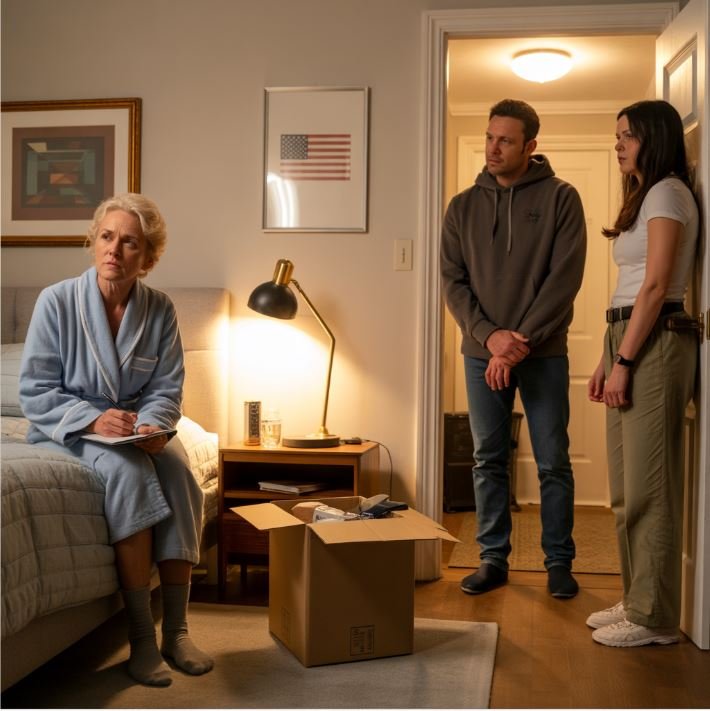
You won’t co-sign your own grandson’s loan? Then don’t expect to stay here for long.
That’s what my daughter said to me, standing in the middle of the kitchen with a spatula in one hand and her voice sharp like vinegar. I didn’t say anything right away—not because I didn’t know what to say, but because at seventy-six, I’ve learned that some silences carry more weight than arguments.
I was holding a dish towel, still warm from drying plates. Zach had just left the room, his sneakers squeaking against the laminate as he stormed off. The air still held the residue of his words, quick and impatient.
It’s just a formality, Grandma. I’ve got a job. I’m not asking for money.
But it wasn’t just a formality. I’d been to that bank branch before. I knew what it meant to put my name beside a twenty-year-old who barely kept his checking account in the black.
“I raised him better,” Lydia muttered, shoving the pan into the sink, water splashing. “You know that boy needs a car for work. He’s trying, but I guess trying’s not enough for you.”
I wiped my hands and folded the towel in half. “He’s got energy. He’s got time. He can take the bus a while longer.”
She turned sharply. “We took you in, didn’t we? After your surgery, we rearranged everything. That back room could’ve been my office, but we made space.”
It was true. I had moved in after the hip replacement, when stairs became too dangerous and the silences in my old house became too long. They had made space, and I was grateful—or I thought I was, until that moment.
“Don’t think you can just sit here and not be part of this family,” she added, quieter this time.
I looked at her then. Really looked. She wasn’t the little girl I once braided hair for. She was a tired woman with a mortgage, a full-time job, and a son who didn’t know what responsibility meant yet. But I wasn’t just an extension of their needs. I was a person.
And my name on a line wasn’t free.
That night, I lay in bed with the shadows stretched long across the ceiling. My body ached—not from age, but from carrying the weight of knowing I no longer belonged. Somewhere between her words and his expectation, something in me shifted. Not out of spite, but out of clarity.
Around midnight, the light in my room flickered once, then died completely.
At first, I thought it was a fuse. I checked the lamp, the outlet. Nothing. The rest of the house glowed soft with warmth—the hallway light, the blue flicker of the TV in the living room.
Only my room was dark.
I lay there, eyes open, swallowed by the dark. The silence in the house felt colder than the draft slipping through the poorly sealed window. I reached again for the lamp switch, flicked it once, twice—nothing.
I got out of bed slowly, knees stiff, joints protesting. I pulled on my robe, shuffled across the floor in wool socks, and opened the door just enough to see the hallway.
Light. Soft, golden. Everything else was working.
I stood there a long moment before closing the door again.
The darkness wasn’t a mistake.
The following morning, no one mentioned it. Zach was already gone by the time I walked into the kitchen. Lydia stood at the counter sipping her coffee, scrolling through her phone.
I said, “Good morning.”
She nodded but didn’t look up.
I reached for my teacup in the cabinet, filled the kettle, and stood in silence beside her—the kind of silence that thickens the air, presses against your temples.
“My light didn’t work last night,” I said quietly. Not accusing. Just stating.
She shrugged, eyes still on the screen. “Maybe something tripped.”
“Everything else was fine.”
Another shrug. “You’ll have to ask Zach,” she added after a pause. “He was fiddling with the breakers the other day.”
I didn’t respond. Instead, I made my tea, sat at the far end of the table, and stirred slowly, the spoon clinking against porcelain like a ticking clock.
I could have pushed, could have asked why he’d touch anything in the panel. But I knew better. Pushing would turn me into the problem—into the reason the house felt tense, into the burden.
And I’d had enough of being cast in that role.
Later that afternoon, I checked the breaker box myself. Everything was fine—every switch in its place, no labels scratched out, no wires out of place. Just neat rows and steady humming.
The next night, it was the outlet.
I went to plug in my heating pad—the only thing that soothed my hip when it flared—and nothing. I tried the second plug, then the one near the door. Dead. I carried the pad to the hallway.
It worked there just fine.
It was subtle. A slow fade, not a confrontation. No one screamed at me. No one locked the door. They just started chipping away at comfort, one little piece at a time.
I didn’t speak of it again. Not about the light, not about the outlet. I went about my days as if nothing had shifted—cooked when I was asked, folded towels from the dryer, fed the cat, answered Zach’s lazy hellos with polite nods.
But at night, I sat in that dim room, lamp dead, plugs cold, and felt the weight of a message they weren’t brave enough to say out loud.
You are no longer welcome here.
It’s a strange thing, realizing your presence has moved from needed to tolerated. You become careful with your movements, quiet when you breathe. You stop asking questions because every question feels like a complaint. Every word becomes a disturbance in their rhythm.
I took to sitting by the window after dinner, looking out onto the cul-de-sac where other homes buzzed with life—where porch lights glowed and cars came home after long days. I watched neighbors I barely knew carry in groceries, walk dogs, argue gently on porches, then disappear behind curtains that shut softly, not like doors closed in anger.
I imagined what it would be like to live in a place that didn’t dim its lights when I disagreed.
That’s when the thought came—quiet at first, almost apologetic, but persistent.
You could leave.
It sat with me all night, even as I lay in bed with an extra blanket over my legs, wishing for warmth. It wasn’t anger that brought it on. It wasn’t revenge.
It was breath.
The kind you draw in when you come up for air after thinking you might drown.
Leave.
I didn’t have much. A pension check that barely stretched. A few savings in the old account Derek and I had opened before he passed. But I had enough for something small, something quiet, something mine.
That night, for the first time in weeks, I slept—not long and not deeply, but without waking to the creak of someone else’s footsteps or the flick of a light being turned off. I slept because the idea had rooted itself, and it brought peace.
Tomorrow I’d call the bank. Not to beg for a loan, not to ask for approval—just to ask how much of my life was still mine to decide.
The teller’s voice was pleasant, distant, like someone trained to sound calm even when reading out bad news.
“Yes, Mrs. Carver, your checking account is still active. Would you like me to go over the current balance with you?”
I was sitting on the edge of the guest bed—my bed—clutching the cordless phone so tightly my hand ached. I stared at the unplugged lamp in the corner and whispered, “Yes, please.”
She told me the number. It wasn’t much, but it was mine.
I thanked her and hung up. My fingers trembled slightly, but not from fear.
From possibility.
Later, I sat at the kitchen table with Lydia. She was tapping away at her laptop, one earbud in. The clatter of keys and the faint rhythm of a podcast filled the air between us.
I didn’t ask for her attention. I just waited.
Eventually, she sighed, pulled out the earbud, and looked up. “Something wrong?”
I hesitated. “Do you remember that little account Derek and I set aside? The one for emergencies?”
She narrowed her eyes. “The one you said you weren’t touching?”
“Yes. I might use it.”
Her fingers hovered above the keyboard. “What for?”
“I haven’t decided yet,” I said softly, stirring my tea. “But I think it’s time I start making plans.”
She frowned. “Mom, if this is about the loan—”
“It’s not.” I met her eyes. “It’s about space.”
She blinked. “Space?”
“I don’t feel like I belong here anymore.”
That silence—the heavy kind—settled again.
“You’re overreacting,” she said finally. “We’ve all had a rough month. You’re taking everything too personally.”
I nodded, because arguing would have been pointless. “Maybe.”
But I knew better.
The rest of the week passed with brittle civility. I folded laundry, refilled the bird feeder, kept to myself. Zach didn’t speak to me at all, except once when he asked if I’d seen his car keys. I hadn’t. He muttered something under his breath as he walked off.
I let it pass.
On Friday morning, I walked three blocks to the library, sat at a computer station near the window, and opened the listings—apartments for rent, studios, senior communities, anything under a thousand.
Most of what I found was either too far or too worn down to trust.
But one listing caught my eye.
A small one-bedroom on Lynwood Avenue. It had a porch and a shared garden. No stairs. Household basics included.
I printed it out, folded it carefully, and slipped it into my purse like it was something sacred.
Back home, I laid the paper on the nightstand beside the unplugged lamp.
That evening, as I chopped onions for dinner, Lydia hovered nearby, sipping wine. The kitchen smelled of garlic and something sweet simmering in the pot.
“You know,” she said lightly, “I talked to Zach. He’s still really upset.”
I kept chopping.
“He just feels rejected, I guess, by you.”
I nodded. “He’ll get over it.”
She didn’t answer right away. Then she said, “Well, maybe he wouldn’t feel that way if you hadn’t been so quick to shut him down.”
I put down the knife. “I didn’t shut him down,” I said calmly. “I protected myself.”
She rolled her eyes. “He’s family. Isn’t that what family’s for?”
To sign for loans they can’t afford. To sit quietly while their room goes dark at night.
I met her gaze. “Is that your version of family?”
The words hung in the air between us.
She didn’t respond. She picked up her wine glass and walked away.
That night, I called the number from the listing.
A kind woman named Nadine answered. She said the place was still available. She said I could come see it Monday morning.
I thanked her, heart hammering. My voice sounded small even to me.
When I hung up, I looked around the room—my room. The dresser I’d polished. The curtains I’d hemmed to block the summer heat.
None of it was mine.
I’d borrowed this space temporarily out of need. Now I needed something else—something Lydia couldn’t offer, no matter how clean the sheets or how carefully she cut my fruit.
Peace.
Monday would come soon, and I would go see that little house on Lynwood. I didn’t know yet if I’d take it, but I knew I needed to see it. I needed to know what it felt like to stand in a room and not wonder when someone would pull the plug again.
I spent Saturday going through my things when no one was home.
I opened the bottom drawer of the old dresser—the one Lydia said they’d eventually replace, but never did—and pulled out the file folder I kept hidden under a stack of folded scarves.
Inside were papers no one had looked at in years: Derek’s death certificate, the deed to our first house, a dozen faded photographs, and a small cream-colored envelope marked for later.
Derek’s handwriting.
I didn’t open it. I knew what was inside—his last note, written from the hospital bed the night before he passed. I’d read it once, and it had gutted me. I didn’t need to read it again.
I just needed to hold it for a while.
I set the folder on the bed and moved on to the closet.
I didn’t have much: a few cardigans, two good dresses, slippers, the coat with the worn cuffs I hadn’t been able to part with. I took mental inventory, calculating how many boxes I’d need.
Probably four. Five at most.
It was strange how easily I could reduce my life to a trunkload of fabric and paper.
Strange—and somehow freeing.
Later that evening, I sat in the backyard, bundled in a shawl, watching the sky turn violet behind the neighbors’ roofs. The kitchen window was open, and I could hear Lydia on the phone.
“She’s been acting weird,” she said, “like she’s planning something, but won’t say what. You know how she gets.”
A pause.
“No, I didn’t ask again about the loan. What’s the point? She made it clear.”
Another pause. Longer this time. I imagined Zach’s voice on the other end, annoyed, pacing.
“She should be grateful,” Lydia added. Quieter now. “We took her in. I rearranged my life. I made room.”
I looked down at my hands—knotted, veined, palms dry from years of dishes and garden soil. Once they had wiped fevers from her forehead, zipped her dresses, tied her shoes.
Had she forgotten? Or had I just overestimated what those things meant?
I stood up slowly, knees stiff, and went back inside without a sound.
The next morning, I took the early bus downtown. I wore my good shoes—the navy pair with the low heels—and packed a notepad in my purse. I wanted to look serious, like someone who still made decisions for herself.
Nadine greeted me at the door of the Lynwood place with a warm smile and a clipboard. She was younger than me by twenty years, maybe more, but she had kind eyes and a calm voice.
The place was even smaller than I expected—a square living room, a narrow galley kitchen, a bedroom just big enough for a twin bed and a dresser.
But it was bright.
The floors were clean. The windows were large. There were wind chimes on the porch and a tiny strip of grass behind the building.
“This is the last available unit,” Nadine said as she walked me through. “Mostly widows here. It’s quiet, safe. The landlord lives next door, so if you ever need help…”
She smiled again. Not the kind of smile people give you when they’re waiting for you to leave.
The real kind.
I nodded. “It’s peaceful.”
And it was.
I hadn’t realized how noisy Lydia’s house had become until I stood in this quiet—no television humming, no doors slamming upstairs, no forced conversations behind clenched teeth.
I filled out the application right there, using the pen Nadine offered. When I handed it back, she looked it over, then said, “We’ll process it by the end of the week. But if all checks out, the place is yours.”
I thanked her, heart beating fast.
She gave me a copy of the form and a small pamphlet about the community garden. “You can plant something if you like. Most of the women do.”
I smiled. “Maybe tomatoes. Or lavender.”
When I got back home that afternoon, no one noticed I’d been gone. Zach was in the garage tinkering with something that wouldn’t work, and Lydia was out grocery shopping.
I slipped back into my room, placed the packet into the drawer, and sat on the edge of the bed.
Something had changed.
Not in them—in me.
For the first time in a long while, I wasn’t waiting for someone to notice me. I wasn’t hoping for kindness or for things to go back to how they were.
I was making plans.
And soon I’d no longer be a guest in someone else’s home. I’d be a woman in her own space with her own light, her own warmth, and her own keys.
Zach knocked once before pushing my door open. Not Grandma, no—just the sound of his hand on the wood and the click of the handle.
I looked up from my crossword, pencil still in hand.
“Can we talk?” he asked, already stepping inside.
His cologne was too strong. Or maybe I’d just grown more sensitive with age.
“Of course,” I said, setting the puzzle on my nightstand.
He didn’t sit. He stood near the dresser, arms crossed like he was guarding something or preparing for a speech.
“I don’t get it,” he started, his tone sharp from the start. “I mean, it’s not like I asked you to give me the money. I just needed your name on the paperwork. You know that, right?”
I nodded. “I do.”
“And you still said no.”
“Yes.”
He let out a bitter laugh. “You don’t trust me.”
“I trust you to be who you are right now,” I replied calmly. “And right now you’re a young man who’s learning, figuring things out, which means you’ll make mistakes—and that’s all right. But I won’t risk what little I have on something you might not be ready to carry.”
He looked at me like I’d spoken another language. “You think I’m irresponsible.”
I didn’t respond. I didn’t need to.
Zach ran a hand through his hair. “You’ve been living here rent-free. My mom’s cooking, cleaning. I do my share.”
I interrupted, but gently. “I cook. I clean. I babysit when needed. I pay for my own groceries. And if you believe I’m a burden, say it plainly. Don’t wrap it in the word rent.”
That made him pause. He hadn’t expected pushback.
“I just…” His voice faltered. “I thought you’d help. You always help.”
I nodded. “I’ve helped many times. When your mother’s first car broke down. When she needed braces. When your school trip wasn’t covered. I helped because I wanted to. But helping isn’t the same as enabling.”
He shifted on his feet. “So you’re punishing me.”
“No, Zach. I’m protecting both of us—you from a debt you might not be able to carry, and me from losing what little independence I have left.”
He looked at the unplugged lamp in the corner, then back at me. “Did you unplug that?”
“No,” I said quietly.
He looked away.
A pause hung there.
Then, softer, he asked, “So what now?”
I met his eyes. “Now we go on. You make your choices. I make mine. But you don’t get to guilt me into co-signing. Not with family, not with history.”
He didn’t reply, just nodded slowly and left the room, closing the door with more force than necessary.
I sat for a long time after that, my hand resting on the pencil, the crossword half finished.
It wasn’t easy. Saying no to someone you’ve loved since the day they were born takes something out of you. But it also gives something back—a piece of yourself that had been eroded by years of yes.
That night, Lydia didn’t speak to me during dinner. She passed the butter wordlessly, refused eye contact. Zach didn’t come down at all.
I cleared my own plate, rinsed it, and left the kitchen clean.
In my room, I packed a box—just one, a trial run. My photo albums, the small keepsake box with my wedding ring, Derek’s note, a scarf that still smelled faintly of lilac.
I taped it shut and slid it under the bed.
It felt good—solid—like a door was opening, and I was the one holding the key.
Tuesday morning, I called the bank again, not the main line this time. I asked for Ms. Halverson, the branch manager—a woman I’d spoken to years ago when Derek passed, and again when I had to open a separate account from Lydia after my surgery.
She remembered me.
“Mrs. Carver,” she said warmly. “How can I help you?”
I explained my situation carefully—without the personal details. I didn’t need sympathy, just the facts. I was preparing to rent a place on my own. I needed to understand how much I could draw from my savings without penalties, and I wanted to ask about setting up scheduled transfers for rent and basic services.
She listened attentively, then walked me through the steps.
“You’ve been frugal,” she noted. “Very sensible. You could manage just fine for years with careful planning, especially with a modest rent.”
I thanked her, wrote everything down in a neat column in my notebook, and hung up.
Then I called Nadine.
“Yes, it’s still available,” she said, a little excitement in her voice. “In fact, we just finished the maintenance touch-ups yesterday. Would you like to reserve it officially?”
I glanced at the box under my bed.
“Yes,” I said. “Please mark it as taken.”
“Wonderful. You can bring the deposit and first month’s rent this Friday, if that works for you. We’ll have the key ready.”
When I hung up, I stared at my reflection in the mirror for a long moment. I hadn’t realized how tired my eyes looked—not just from age, but from the holding back, from walking on eggshells in a house that pretended to welcome me while quietly pushing me to the edges.
I ran a brush through my hair, changed into my walking shoes, and left the house without saying a word.
I walked three blocks to the corner coffee shop and ordered something I hadn’t had in years: a hot chocolate with extra whipped cream. I sat by the window and sipped slowly like a woman who wasn’t in anyone’s way.
Then I pulled out my notebook and made a list.
Call the companies. Forward the mail. Pack essentials first. Inform the doctor of the new address. Leave a note for Lydia or don’t.
That last one I left blank.
Back at the house, the air was strangely still. Zach was out. Lydia was upstairs on a work call.
I went straight to my room and began packing box number two—books, stationery, my sewing kit, a small clock Derek once gave me with an inscription on the back:
Time is what we share.
I wrapped it carefully in a dish towel.
That night, Lydia knocked on my door. Not hard—just a few fingers on wood.
“Can we talk?” she asked.
I sat on the bed, a half-packed box beside me. “Of course.”
She stepped in and looked around. Her eyes paused on the tape roll, the empty shelves, the open drawers.
“You’re leaving?” she said flatly.
I nodded. “Yes.”
“When?”
“Friday.”
She stood very still, her jaw tightened, but she didn’t raise her voice. “So that’s it. You just decided?”
“I thought about it for weeks,” I said. “And you didn’t ask.”
“And you didn’t tell me.”
“I didn’t think you’d be happy for me.”
She laughed bitterly. “You’re twisting everything. We gave you a room when you needed one. We’ve tried.”
“Yes,” I said softly. “You gave me a room, but not a place.”
She looked like she might cry, but the tears didn’t come.
“You think you’ll be happier alone?”
“I think I’ll be freer alone,” I said. “That’s not the same thing.”
A pause.
“And what about Zach?” she asked. “He’s still upset.”
I met her eyes. “He’ll recover. He’s young. He has time to learn that love isn’t a contract.”
She didn’t reply. She just left, closing the door behind her.
That night, I lay awake—not from anxiety, but from relief. It was happening quietly, cleanly. No drama, no shouting.
Just a decision made by a woman who had spent a lifetime giving, and now had chosen to take something back: her dignity, her space, her peace.
On Wednesday, I started boxing up the last few things that still made this room feel like mine—my nightgown, a crocheted throw I’d made during chemo treatments when my hands shook too much to hold a book, a small tin of buttons that once belonged to my mother.
The rest—the furniture, the curtains, the mattress—had never been mine to begin with.
Midmorning, Lydia called from the other side of the door. Not a knock this time, just her voice, short and clipped.
“Do you need anything from the store?”
I hesitated, then answered, “No, thank you.”
A pause. Then footsteps down the hall.
She didn’t ask where I was going. She hadn’t asked why I was packing. It was easier for both of us, I suppose, to pretend this was just another room being emptied for repainting—another load of laundry, another box for the attic.
Around noon, I found an old photograph tucked into a book I hadn’t opened in years. It was from a summer picnic—Lydia no more than ten, Zach still a baby in my arms, Derek grinning beside me wearing that ridiculous fishing hat he refused to throw out.
We were sitting on a plaid blanket, a jug of lemonade beside us, and the sun made everyone look a little golden.
I held it for a long time. Not with sadness—just acknowledgment.
That was a good day. That day, we were happy.
I put it into the box labeled keep close.
That afternoon, I walked over to the mailbox and mailed three envelopes: one to the power company, one to the post office, one to my doctor.
All simple notices. Change of address effective next week. Please update records accordingly.
It felt like shedding an old skin.
I didn’t tell Lydia I’d be gone by Friday morning. I didn’t want a scene. I didn’t want a tearful apology offered for appearances—or worse, a last-ditch manipulation to make me stay.
The truth was, I didn’t think she’d stop me. She’d probably watch me leave with the same expression she used when donating clothes to Goodwill—conflicted, relieved, vaguely guilty.
Zach didn’t speak to me at all, not even in passing. I heard him come and go, keys jingling, car engine growling in the driveway, then fading into the distance.
It didn’t matter. I was done trying to interpret silence like it held meaning.
That evening, I allowed myself something small.
I wrote a grocery list for the new apartment. Not what Lydia liked. Not what Zach would eat.
Just what I wanted.
Oatmeal. Fresh apples. Strong black tea. One small jar of strawberry preserves. Rye crackers. Whole milk, not skim. Cocoa mix.
The simple things. The quiet things.
I could already picture the cupboards in that little kitchen, the chipped mugs, the single drawer for silverware, the way the kettle would sound on a real stove, not a microwave hum.
That night, I sat by the window again—not out of sadness, but ritual. The streetlight flickered as it always did, casting that soft yellow glow on the driveway.
Somewhere across the street, wind chimes tinkled gently in the breeze.
And for the first time in a long time, I didn’t feel like I was waiting for something—not for change, not for apology, not for the old Lydia to reappear or for Zach to understand.
I was just sitting.
And it was enough.
Two more nights. Then the last morning would come, and with it my name on a lease, my hand on a doorknob that opened into peace.
The apartment smelled like fresh paint and lemon cleaner. It was quiet—not the kind of quiet you get in the back room of someone else’s house, where footsteps above your head remind you who the walls belong to, but a true quiet, still spacious even in the smallest rooms.
Nadine handed me the keys with a smile and said, “Congratulations, Mrs. Carver. Welcome home.”
I held them in my palm for a moment—cold and unfamiliar—then closed my fingers around them and nodded.
“Thank you,” I said. “It’s been a long time since something felt like mine.”
She helped me bring in the first few boxes, the ones I’d packed with care, not haste—books, linens, two ceramic mugs, the photo of Derek at the lake.
She didn’t ask questions. She just smiled politely and said, “Take your time settling in. I live three doors down, apartment 3B, if you need anything.”
After she left, I stood in the center of the room and turned a slow circle. The hardwood floor creaked gently under my slippers. The heater hummed to life near the window, warm and steady.
Outside, the shared garden was half-bloomed, green, pushing up through dirt with soft defiance.
I placed Derek’s photo on the windowsill and opened the cupboard to put away the groceries I’d brought.
My groceries. My choices.
There was only one chair—a wooden one with a seat cushion I’d brought from Lydia’s, the one no one wanted in the kitchen anymore. I set it beside the window, boiled water in the kettle, and made myself a cup of tea.
It tasted stronger here—not because the leaves were different, but because no one else had brewed it.
I added a splash of milk and sat down with both hands around the cup.
For the first hour, I did nothing. No unpacking, no organizing. I just watched the light move across the floor and felt the silence settle in beside me like an old friend.
In the afternoon, I unpacked my sewing kit and the crossword book, laid a small throw blanket across the back of the chair, and hung my two good dresses in the tiny closet.
By evening, the place was still half boxed, half bare, but it already felt more like home than that back room ever had.
I reheated a bowl of lentil soup I’d made the night before and brought with me in a thermos, ate it at the little foldout table.
No conversation. No rush. No one asking if I’d used too much salt.
I washed the bowl, dried it, and placed it neatly back in the cupboard.
Later, as I was changing into my nightgown, the phone rang. I had kept the same number, a small act of continuity.
Caller ID: Lydia.
I stared at the screen. She hadn’t called yesterday—not during the move, not when she found my room emptied and the drawers bare.
Now, at 8:43 p.m., she was calling.
I didn’t answer. I let it ring until the voicemail picked up, then watched the message icon flash.
One new voicemail.
I didn’t listen to it. I turned the phone face down on the windowsill and climbed into bed. The sheets smelled like lavender. I’d packed them with dried sachets, something I hadn’t done in years.
I pulled the covers up to my chin and looked out through the small square window.
The stars above Lynwood Avenue were faint but visible—a scattering of light over the dark.
I whispered something into the quiet, not expecting anyone to answer.
I’m here.
And that was enough.
The next morning, I woke up before the sun rose—old habit. My body still thought it lived under someone else’s roof, still expected the clatter of dishes, the muffled television, footsteps outside my door.
But here, there was only stillness.
A good stillness.
I lay in bed a while, listening to the radiator tick softly like a contented sigh. Then I got up, put on my robe, and brewed coffee—real coffee, not the bitter instant kind Lydia always bought in bulk.
I poured it into my favorite mug and stepped out onto the small porch.
The air was brisk, sharp with early spring, and smelled faintly of wet soil and distant woodsmoke. Across the courtyard, someone was already up—a woman in a thick cardigan watering potted plants by her door.
She looked up and smiled.
“New neighbor,” she called gently.
“Yes,” I said, lifting my mug. “Moved in yesterday.”
“Welcome. I’m Rita. Apartment 2A. We’ve got a walking group on Thursdays if you’re interested.”
“Thank you,” I said. “I just might be.”
She gave me a little wave and turned back to her violets.
I stayed outside another minute, sipping coffee, watching a squirrel dash across the fence.
Then I went back inside and opened the voicemail from the night before.
Lydia’s voice.
“Mom, I… uh… I saw your room. I guess this is real.”
A pause. She was breathing too fast. Or maybe trying not to sound like she was.
“I don’t know what you want me to say. Zach’s upset. I’m upset. It just feels like you disappeared without a word.”
Another pause.
“I wish you’d at least told me where you were going.”
Click.
No apology. No questions about whether I was safe, whether I had enough money, whether I needed help moving—just that they were upset, that my absence had inconvenienced them.
I deleted the message. Not out of anger.
Out of clarity.
By noon, I had unpacked all but one final box—the one with the old photograph albums and Derek’s letter. I carried it to the bedroom and slid it under the bed.
Some things didn’t need to be sorted yet. Some memories could rest quietly for now.
After lunch, I walked to the corner market three blocks down and bought a bunch of tulips—yellow, my favorite. The clerk, a teenage girl with chipped purple nail polish, wrapped them gently and said, “Someone special?”
I smiled. “Yes. Me.”
Back home, I put them in a glass jar and set them on the table.
Later that evening, just as I was finishing my soup, the phone rang again.
Zach, this time.
I watched the screen blink. Five rings, six.
Then it stopped.
I didn’t check the voicemail. I didn’t need to. I knew what it would say.
Instead, I pulled the afghan over my legs and turned on the little radio I’d brought with me. I found a classical station playing something soft and sweeping. I closed my eyes and let it fill the room.
And for the first time in years, I didn’t feel like I owed anyone an explanation.
No one could reach into my silence anymore and claim it for themselves. No one could demand space in my thoughts or a name on a line or my presence in a house that felt like exile.
This space was mine—the quiet, the warmth, the small yellow tulips bending toward the lamp.
I didn’t know what tomorrow would bring. I didn’t have a plan beyond the next cup of tea.
But for tonight, I had everything I needed.
The first night in the new apartment felt like a slow exhale. The second felt like stillness.
But the third— the third felt like arrival.
That morning, I made pancakes for one. I used real butter, sliced up an apple, and listened to the radio play something old and sweet. I didn’t miss the chatter of a household I never really belonged to. I didn’t miss being tiptoed around or dismissed entirely. I didn’t even miss the sound of footsteps outside my door.
After breakfast, I sat with my notebook and wrote three simple words:
I am home.
I don’t know why it mattered to write them. Maybe because I’d spent so many years being temporary in someone else’s life. Even before I moved in with Lydia, I’d floated from medical appointments to Zach’s school concerts to family holidays where I was needed but never invited.
Now I had a front door that locked from the inside, a cupboard where nothing disappeared overnight, a small hook where I hung my robe without it being pushed aside.
And I had space—quiet, unfilled space.
I took a walk to the library, signed up for a new card, and checked out two books—one on herb gardening, and one on women who reinvented themselves after seventy.
I sat on a park bench nearby and read for over an hour, my coat buttoned tight, the sun warm on my face. It felt luxurious somehow to sit with a book and no one expecting me to be anywhere else.
When I came back to the apartment, there was a note under my door, handwritten in neat script.
Mrs. Carver, if you ever feel like joining for tea, we meet on Wednesdays at 4 in the garden. Just a few of us neighbors.
Rita.
I placed the note on the fridge with a magnet I’d brought from Derek’s workshop—an old horseshoe bent into a heart.
Then I sat down at the table and smiled.
A real smile, not the practiced, polite one I’d worn at Lydia’s.
That evening, I lit a candle for the first time in years. A small act, but meaningful. I let the room glow soft and orange as I prepared dinner—a bowl of soup, a slice of toast, and a little dish of olives, something Lydia always said smelled like old furniture.
I liked that smell.
Halfway through dinner, the phone rang again. This time, it was a number I didn’t recognize.
I answered.
“Grandma,” Zach’s voice was quieter than usual.
“Yes.”
“I, uh…” He cleared his throat. “I just wanted to know you’re okay.”
“I am,” I said. “I’m well.”
Another pause.
“Where are you living?”
“A few miles from you. Still in town.”
He hesitated. “You didn’t tell us.”
“No,” I agreed.
“Why not?”
“Because you didn’t ask,” I said gently. “Not really. You were angry. I said no. You weren’t interested in where I’d go—only in the fact that I left.”
He didn’t respond.
“I’m not saying that to punish you,” I added. “Just so you understand. Sometimes people leave not out of anger, but out of necessity.”
“I didn’t mean to make you feel—”
“You didn’t make me feel anything, Zach,” I said. “I’ve been feeling that way for years. I just finally acted on it.”
Silence again.
Then, “Can I see you?”
“Not yet,” I said. “Soon, maybe. But not yet.”
“Okay.”
His voice was so small I had to close my eyes to bear it.
“I’m not angry with you,” I said. “But I need to be here now. I need to be mine.”
“Okay, Grandma.”
After he hung up, I sat at the table a long while. The soup had gone cold. The candle flickered low.
I wasn’t crying. I didn’t feel broken.
I felt whole.
Maybe for the first time in decades.
This little apartment with its crooked drawer and chipped counter tile had become the place where I returned to myself—where silence wasn’t punishment, where light stayed on as long as I wanted it.
And I knew whatever came next, I’d never again live in a house where the door to my peace was controlled by someone else’s mood.
On Thursday morning, I went to the lawyer’s office.
Francine Daily—sturdy, in her sixties, gray hair tied back in a braid, eyes that missed nothing—had been handling my affairs since Derek passed. She was the one who helped me settle the estate, rewrite the plans, and navigate paperwork I never wanted to learn to read.
When I walked into her office, she looked up from her desk and gave me a slow, approving nod.
“Well,” she said, “I was wondering when I’d see you.”
“I need to make some changes,” I said, taking the seat opposite her. “I’ve moved.”
She folded her hands. “I heard Lydia left a message last night. Sounded concerned.”
“I imagine she’s more surprised than concerned.”
Francine raised an eyebrow. “She also asked whether your accounts were still in your name.”
That didn’t surprise me either.
“I’d like to review my financial directives,” I said calmly, “and update my estate plan.”
Francine gave a small smile. “Let’s get to it.”
For the next hour, we went through documents. I removed Lydia as the primary beneficiary—not out of revenge, but out of reality. We both knew she’d treat my savings like a resource, not a legacy.
Instead, I named a local scholarship fund for women over forty returning to school. Education had changed my life once, briefly, before I left to care for my father. And I wanted someone else to get their second chance.
I also left a small monthly stipend in trust for Zach, but with clear conditions. It wouldn’t begin until he turned twenty-five and only if he’d completed some form of training—trade, school, anything.
It wasn’t punishment.
It was structure. Something I hoped might help him when I no longer could.
Lastly, I requested that my modest belongings—jewelry, books, the handmade quilts—be donated to a local shelter for women leaving abusive homes.
When we were done, Francine printed a fresh copy and slid it across the desk.
“Still sure?” she asked.
I signed without hesitation.
“Completely?” She sat back, hands folded again. “You look lighter, Rosalind. Happier.”
“I am.”
As I left her office, I walked past the florist on the corner and picked out a single daffodil—yellow again, the color of beginnings.
I carried it home in one hand and placed it in a small jar on the windowsill beside Derek’s picture.
He looked right there in the light.
That evening, I made pasta and opened a bottle of red wine I’d been saving for no occasion in particular. I toasted quietly to the air—to freedom, to clarity, to late decisions that still count.
The phone rang just as I was finishing my meal.
Lydia again.
I didn’t pick up, but this time I listened to the message.
“Mom, I don’t know what to say. You just left. Zach’s confused. I’m trying to be respectful, but I don’t understand what I did wrong.”
There was no apology—just confusion wrapped in self-pity.
She wasn’t ready to see it. Not yet. Maybe never.
And that was all right. I wasn’t living this life so she’d understand me. I was living it because I’d spent too many years pretending I didn’t need one of my own.
Later, I curled up in my chair with a blanket around my shoulders and a book in my lap. Outside, rain tapped softly on the window. Inside, the daffodil bent its head gently in the warm lamplight.
No interruptions. No raised voices down the hall. No doors closing too hard.
Just the rhythm of my own breath—steady and quiet.
My own roof. My own name on the pages.
My own life.
Not loud. Not big.
But fully mine.
On Saturday afternoon, there was a knock at the door. Not a delivery, not a neighbor.
It was Zach.
I saw him through the peephole—his tall frame hunched slightly, a nervous shift from foot to foot. He wasn’t wearing his usual confidence. His shoulders sagged, hands stuffed deep in his hoodie pocket.
I opened the door.
“Hi, Grandma,” he said quietly.
The last time I saw him, he’d been angry. Now he looked like someone who’d just realized how many bridges he’d burned on a single walk.
I stepped back. “You can come in—but only if you’re ready to talk like an adult.”
He nodded. “I am.”
He took a few slow steps inside and looked around the small apartment—his eyes scanning the walls, the single chair by the window, the yellow tulips still hanging on days later. He didn’t say anything about the size or the modesty of it. Maybe he was smart enough to know that would have been the end of the visit.
“I like it here,” he said finally.
“I do too.”
I motioned to the small table. He sat. I poured us both tea. We were quiet for a while—just the soft clink of spoons and cups.
Then he said, “I didn’t come to ask you for anything.”
“That’s good,” I replied, gentle but firm.
“I just wanted to see you. I… I’ve been thinking a lot.”
I nodded and waited.
“You were right,” he said after a moment. “About the loan. About me not being ready. I got denied anyway, even with someone else.”
I didn’t gloat. That’s not what this moment needed.
“I’m sorry,” he said. “Not just about the loan—about everything. About how I spoke to you. About how I acted like… like you owed me something.”
I studied him for a moment. His hands were trembling slightly—whether from nerves or shame, I didn’t know.
Maybe both.
“You didn’t just act entitled, Zach,” I said quietly. “You acted like I stopped being a person the moment I said no.”
He winced. “I know.”
“I raised your mother not to need anyone, but somewhere along the way, she taught you that needing meant taking—and I let that happen. I played along.”
He looked at me then. Really looked.
“You were always there,” he said. “Every school trip, every birthday… even when Mom forgot. I guess I… I took that for granted.”
“Yes,” I said. “You did.”
A long silence passed. It wasn’t uncomfortable. It was heavy with truth.
“I started a job at the repair shop on West Street,” he said finally. “Not what I thought I’d be doing, but it’s something.”
I nodded. “Honest work is never the wrong choice.”
“I wanted you to know I’m trying.”
“I believe you,” I said. “Trying is a good start. But trust doesn’t come back overnight, Zach. You understand that, don’t you?”
“I do.”
He looked down at his tea, then added, “Mom doesn’t understand. She thinks you’re punishing us.”
“I’m not,” I said. “I’m protecting myself. That’s different.”
He gave a small, almost sheepish smile. “I didn’t know there was a difference until now.”
I reached across the table and placed my hand over his.
“Zach, I don’t stop loving people just because they hurt me,” I said, “but I do start choosing what kind of love I can give—and what kind I no longer have to.”
He didn’t cry, but I could see it in the way his jaw tensed, the way his eyes blinked a little too fast.
“Can I come again?” he asked.
“Yes,” I said. “But only when you want to visit me—not when you want something.”
“I understand.”
He stood, looked around once more, then hugged me.
Not the rushed, obligatory kind.
A real one—like the kind he used to give me when he was small and still believed I could fix everything.
He didn’t stay long. He didn’t overreach.
And when he left, I didn’t feel drained.
I felt hopeful.
That night, I lit another candle. This one was lavender, slow-burning. I curled into my chair, a blanket over my knees, and sipped warm cocoa.
Outside, the street was quiet.
Inside, I finally believed something I hadn’t dared to feel in a long time: that leaving hadn’t been the end of love.
It had been the beginning of self-respect.
Lydia showed up three days later.
I hadn’t invited her. I hadn’t expected her.
I was watering the herbs I’d started on the windowsill—basil, rosemary, and a little pot of chives—when I heard the knock. Not hurried, not tentative. Just three short wraps.
I looked through the peephole.
She was standing there, arms crossed, coat buttoned to the neck, her mouth set in that line I knew too well.
I opened the door halfway. “Lydia.”
“Hi, Mom.”
She didn’t smile. “Can I come in?”
I stepped back slowly, letting her pass.
She stood in the center of my little apartment like someone inspecting a hotel room they hadn’t booked. Not hostile, but not at ease.
“It’s smaller than I expected,” she said.
“It’s enough,” I replied.
She turned, looked at me. “Why didn’t you tell me?”
“I did,” I said. “In a hundred quiet ways you chose not to hear.”
She flinched, just barely.
“Zach said he came by.”
“He did.”
She nodded, started walking slowly around the room, fingers grazing the edge of the table, the back of the chair. She paused at the window, at Derek’s photo.
“I didn’t think you’d actually leave,” she said softly. “I thought you were upset… but you’d calm down.”
“I wasn’t angry, Lydia,” I said. “I was done.”
She looked at me, and for a moment, I saw the little girl she used to be—the one who crawled into bed beside me during thunderstorms, the one who cried when she scraped her knee and only stopped when I kissed the bandage.
“You raised me to be strong,” she said. “But sometimes I think I took that to mean hard.”
“Yes,” I said. “You did.”
She sat down in the chair slowly, like it wasn’t built to hold something as heavy as regret.
“I didn’t know how to help you when you moved in,” she said. “I didn’t know how to make space for you without losing my own.”
“I never asked you to lose anything,” I said gently. “I only asked for room to breathe.”
She looked down at her hands. “I thought I was helping. I told myself I was… but I started to resent it. I let Zach speak to you in ways he never should have. I let myself believe you owed us.”
“I gave you years,” I said. “My time, my money, my patience. But the moment I stopped giving, the door started to close.”
“I know,” she whispered. “And I hate that I didn’t see it until you were gone.”
We sat in silence for a while. The heater clicked on, a soft hum against the quiet.
“I’m not here to ask you to come back,” she said. “I know better.”
I nodded.
“I just wanted to say… I’m sorry.”
It wasn’t dramatic. No tears. No pleading.
Just five words that had taken her far too long to find.
“I accept that,” I said, “but I’m not coming back. That house stopped being mine long ago.”
She nodded, stood, walked to the door, then turned.
“Can we start over from here?”
I looked at her—older now, like me. Not the child I raised. Not the cold woman from the kitchen months ago. Just a daughter trying, maybe for the first time, to speak without defense.
“We can start something,” I said, “but not over. This isn’t back to before. This is forward.”
Her shoulders dropped just a bit. The line in her mouth softened.
“All right,” she said.
She reached for the handle, then paused. “Do you need anything?”
“No,” I said. “But thank you for asking.”
She opened the door, stepped into the hallway, and left it gently behind her—not slammed, not half shut, just closed.
And in its place was stillness again—the kind that wasn’t empty, the kind that made room.
The season shifted without much ceremony. Spring folded into early summer. The garden out back came alive with more colors than I had names for.
Rita brought me a cutting from her lilac bush and we planted it just beneath my window. She said it would take root quickly, that by next year it would be full and fragrant.
“It’s patient,” she said, “but strong.”
Like me, I thought, though I didn’t say it out loud.
I joined the Wednesday tea circle. There were four of us at first—all women, all in our sixties or older, all carrying stories we never rushed to tell. We spoke of books, of neighbors, of aches in our hips and knees, of recipes long-forgotten.
But underneath it all, there was a quiet kind of sisterhood—the kind that doesn’t need explaining.
No one asked me why I’d moved. They just made space at the table and passed me the sugar bowl.
I kept to myself otherwise. I read more. Cooked. Walked to the market once a week and bought what I wanted, nothing more.
I even bought a little radio with a handle, just like the one Derek and I used to take on picnics. One Sunday afternoon, I played it on the porch, watching birds dart through the hedges while Billie Holiday sang low and slow through the speakers.
That was the day I let myself cry.
Not the sharp, gasping kind of grief. Not anger.
Just a long, quiet weeping for everything I had carried too long—the years of being needed without being seen, of loving in silence, of sitting in darkened rooms wondering when the next kindness would come.
I cried because I had survived it.
And now I had this.
Not perfection. Not endless joy.
But space. Dignity. Light that stayed on when I wanted it to.
Lydia called sometimes—not often, just enough. The conversations were tentative, but better. She didn’t ask when I’d visit. She didn’t bring up the past.
She once told me, “Zach’s changed since he saw you. He started showing up on time. Bought a secondhand car with his own name on the paperwork.”
I didn’t say much. I just nodded and said I was glad—because I was.
And Zach wrote me a letter on paper. A short note, folded in half, slipped into a plain envelope.
Dear Grandma, I think about you every time I check my bank balance before I swipe my card. Thank you for teaching me that being told no might just save your future.
Love, Zach.
I kept the letter in the same drawer where Derek’s old note lived.
Different kinds of love, both earned.
The apartment felt more lived-in now. My books lined the shelf. The chives had taken over their pot. The daffodil had wilted and been replaced by a small clay dish filled with dried lavender.
I didn’t need much.
One afternoon, as I was folding laundry, I thought back to that night—the light in my old room went out. How I’d lain in the dark more numb than afraid.
And I smiled. Not from bitterness.
From clarity.
Because that light going out, cruel as it was, showed me everything. It showed me how little power I truly had in that house—and how much I still had when I finally stepped outside it.
I didn’t need a grand ending. No grandchild falling at my feet in apology. No daughter transformed by guilt.
I just needed a place where my yes meant something, and where my no didn’t cost me the roof over my head.
And now I had it.
Last week, I hung a wind chime outside my window. Just a simple one—five hollow tubes and a wooden heart at the center. It doesn’t make much noise unless the breeze is right.
But when it does, it sings gently, like something soft remembering its own voice.
That’s what this place has been for me.
Not a retreat. Not an escape.
A remembering.
I remembered what it feels like to be seen as a whole person—not a background figure in someone else’s life, not a placeholder, not an obligation. Just a woman who’s lived long enough to know when love starts to look like debt, and when silence starts to feel like exile.
I’ve made peace with the fact that Lydia and I may never be close again—not in the way we once were. But we speak now, carefully, with fewer landmines between us. She sends photos sometimes—Zach at work, the cat asleep on the porch, the garden she planted this year without my help.
They’re learning to live without me.
And I’m learning.
I was never supposed to disappear just because I was no longer needed.
Rita invited me over for supper last night. She made soup and we sat on her back patio while the sky turned soft with dusk. She said something that stayed with me.
“You know,” she said, “a lot of women our age think they’ve already lived the story—that everything from here is just waiting. But I think this part… this choosing yourself… might be the best chapter yet.”
I nodded, because I knew it was true.
I’d lived so long inside other people’s needs that I’d forgotten what it meant to build a life without asking permission.
Now, every morning, I open the window. I water my herbs. I read in the quiet. I buy my own food from my own list.
And no one turns out the lights when I disagree.
And when the breeze comes through and that wind chime stirs, I remember:
This is mine.
This time. This space. This peace.
If you’re reading this and something in your life feels like a slow eraser—if your presence is tolerated more than it is welcomed, if your silence is mistaken for agreement—I want you to know you’re not too old to begin again. You’re not too late to protect your dignity. You’re not selfish for saying enough.
And if you’ve ever been made to feel that your no is a betrayal, remember this:
Your peace is not a luxury. It’s your right.
And it’s never too late to claim it.
If this story spoke to you, share it somewhere. Another woman needs to hear that it’s not too late.