My Sister Dumped Her Baby On My Doorstep Then Disappeared. My Parents Said, “She’s Your Burden Now…”
“She’s your burden now.”
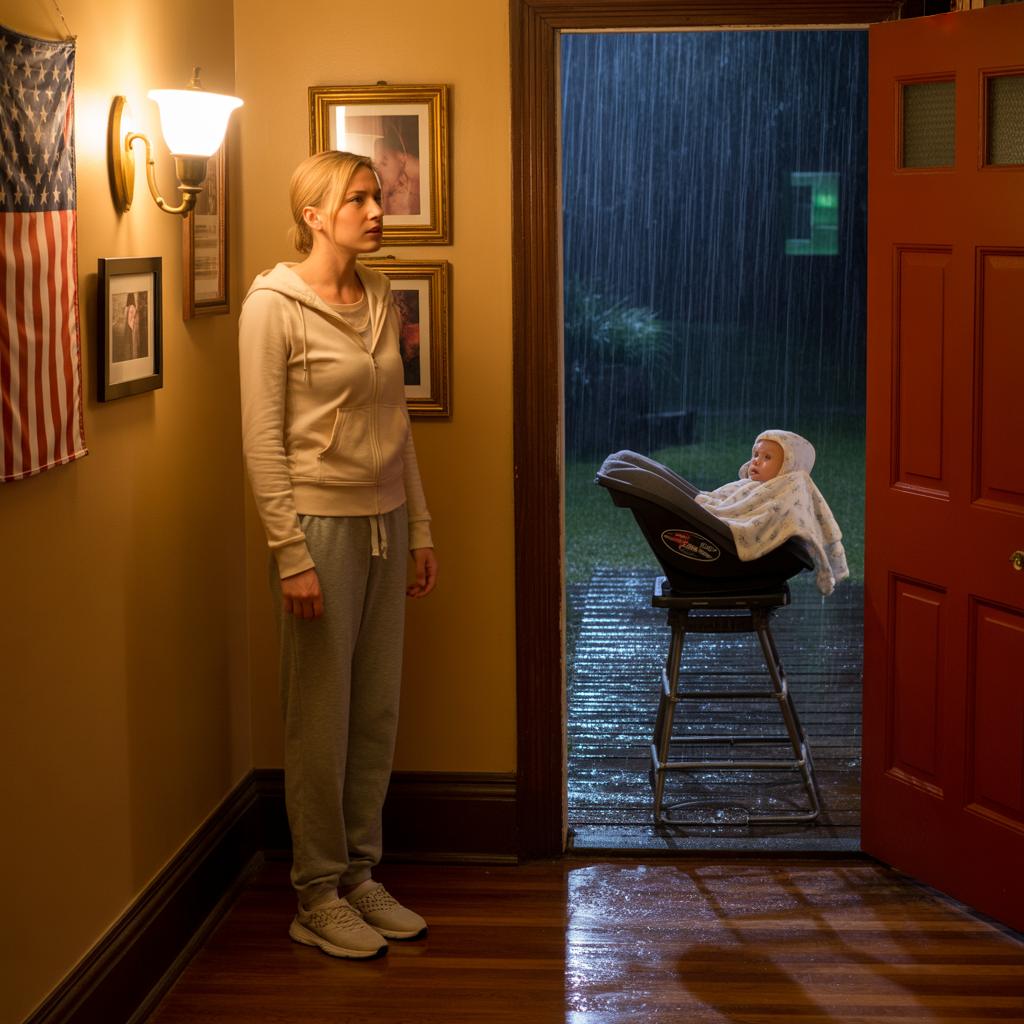
Those were my mother’s exact words the night my sister dumped her three-month-old baby on my doorstep and vanished into the rain. She didn’t ask if I was okay. She didn’t even look at the baby. She just handed me a life I never planned for and walked away.
Ten years later, those same people dragged me into court, claiming I’d kept them apart. I sat there holding the sealed folder they never knew existed, listening to them lie like it was effortless. And the moment I stood up to speak, something shifted, because the truth in that folder wasn’t just damaging, but also revealed things they never thought of.
I used to think my life was small in the best way—quiet, predictable, safe. I worked long shifts as a pediatric nurse, came home to my one-bedroom apartment in a quiet corner of the city, reheated leftovers, watered my plants, and fell asleep to the hum of the radiator. I never imagined motherhood. Certainly not the kind that arrives wrapped in a damp blanket at midnight. But life doesn’t ask if you’re ready. It just shows up and waits to see who you become.
The night Elena disappeared felt unreal. One moment I was folding laundry while a storm tore across the streetlights outside. The next, I was staring at a three-month-old in a car seat, rain dripping from the canopy, a single crumpled note tucked beside her tiny fist. She looked so small, so breakable, her breath soft and shaky, like she knew she’d been left behind.
I remember my hands shaking as I called my parents, desperate for any sign they cared. My mother answered on the second ring, sighed like I’d inconvenienced her, and said the sentence that would carve itself into my ribs. “She’s your burden now.”
My father didn’t even get on the phone. They hung up before I could say anything else.
Even now, a decade later, I can still feel the thickness of the silence after that call. It was the moment I realized no one was coming to help. Not Ross, who left two weeks later. Not my parents. Not anyone. It was just me and a baby who had no one else in the world.
I didn’t sleep for the first forty-eight hours. I learned how to warm bottles by watching videos between sobs. I ran to the store at dawn with Lily tucked into my jacket because I didn’t own a single thing for a child. I changed my entire life without a second thought. And slowly, something shifted—from obligation to love, from survival to devotion.
Lily would grip my finger and look at me like I was the only solid thing in her world. And maybe I was. People talk about chosen family like it’s a soft idea, but mine was built through storms, tears, and promises whispered in the dark. And for ten years, it felt unshakable.
At least until the day Elena came back.
Elena didn’t return with an apology. She returned with a performance.
It happened on an ordinary Wednesday. Lily was nine, stretched across the living room floor, building a cardboard solar system, humming softly the way she did when she felt safe. My phone rang with an unknown number. I almost let it go to voicemail.
Almost.
“Ruby, it’s me.”
For a second, my brain refused to match the voice to the sister who’d vanished into the rain ten years earlier. But then the familiar tremble slipped through—the one she used whenever she wanted something. She said she was in the city. She wanted to talk. She wanted to explain.
She chose a café across from a quiet park—neutral ground, she called it. And when she walked in, I barely recognized her. Polished hair, soft makeup, steady eyes. Not the frantic girl who’d left a baby on my doorstep. She looked curated.
“I’m sober now,” she said, fingers laced, voice perfectly measured. “Seven years.”
“I’m glad,” I responded, truthfully and cautiously.
“I want to meet her,” she added. “If you think that’s okay.” As if she hadn’t forfeited that right years ago.
I didn’t answer immediately. My mind was running calculations. Lily’s stability. Her anxieties. The nights she woke up after nightmares, whispering, “Don’t let them take me.” But I agreed to try one controlled meeting. One. The children’s museum felt safe—public, bright, full of noise. Lily clung to my hand, shy in a way she never was. Elena approached gently, too gently, like she was trying to earn points. And when Lily said, “Nana is my real mom,” and Elena’s eyes filled with tears, I wanted to believe the moment humbled her. But humility doesn’t last long on people who are used to shortcuts.
Over the next months, Elena’s presence grew—weekly visits, texts asking about school projects, little gifts dropped off at our door—and Lily, being soft-hearted, opened up slowly. I didn’t trust it, but I didn’t want my fear to become Lily’s cage.
Then, one night after Lily had fallen asleep, I got a message.
We have something important to discuss tomorrow.
Signed, not just Elena, but Elena and Grant.
Grant Dalton. Her new husband. A man I had never met.
The next day, they sat across from me at my dining table, hands intertwined, smiling like everything was predetermined.
“We want custody,” Grant said calmly.
Elena didn’t even flinch. And right then, watching Lily’s crayons scattered across the table between us, I felt something inside me lock into place.
This wasn’t a reunion. This was a takeover.
For a moment, I couldn’t breathe. The word “custody” hit harder than anything Elena had ever done to me, including the night she abandoned her child on my doorstep. My fingers curled around the edge of the table to steady myself.
“You can’t be serious,” I said quietly, not trusting my voice.
“We are,” Grant replied, tone smooth. Too smooth. “Lily deserves a traditional household, a stable home, two parents.”
He said it like I hadn’t been both parents for a decade.
Elena nodded with rehearsed calm. “You’ve done so much for her, Ruby. Truly. But it’s time she comes home.”
Home.
Lily’s home was ten feet away down the hall—her drawings taped to the walls, her little shoes lined neatly by the door. I didn’t argue, not because I agreed, but because Lily was in the living room coloring, listening for every sound.
I walked them to the door, expression neutral, voice steady. They mistook that for weakness.
Later that night, after I tucked Lily in, I found her curled up, whispering in her sleep, “Don’t take me. Don’t take me.” I sat on the floor beside her bed, hand on her back, feeling her tiny breaths tremble. And in that quiet, something in me snapped. Not the brittle kind of breaking, but the clean, sharp click of a lock closing. A decision made.
I wasn’t losing her. Not to Elena. Not to anyone.
The letter arrived three weeks later—a formal petition for custody, filed, stamped, cold. My parents signed an affidavit supporting Elena, claiming I had blocked family access and distorted Lily’s understanding of her heritage. Lies, all of them.
I stared at the page until the words blurred. My parents—people who never bought Lily a birthday card—were suddenly claiming I had kept them apart. Collapse doesn’t always look like falling apart. Sometimes it’s quiet, a sinking, a cold clarity.
I hired an attorney the next morning.
Julia Hernandez had kind eyes, sharp instincts, and a voice that didn’t tremble. After reviewing everything, she looked at me with a steady seriousness.
“This isn’t a reunion case,” she said. “This is a power grab—and possibly a financial one.”
“Financial?” I repeated.
Julia nodded. “Their timeline doesn’t make sense. People don’t come back after ten years by accident. I suggest we verify what they’ve been doing before they resurfaced.”
Enter Detective Harris.
He was quiet, methodical, and had a way of sliding information across a table like he was dealing cards no one wanted. Within two weeks, he’d uncovered three things that turned my stomach.
Grant was drowning in debt. He’d been searching for Lily’s biological father for months. That man—who Elena had never named—had recently inherited several million.
Suddenly, everything made sense. Elena’s polished reappearance. Grant’s interest. The urgency to get custody now. Not for love. Not for redemption. For money.
I stared at the documents Harris gathered. Financial inconsistencies. Online searches. Messages between Elena and my parents proving they’d been in contact for years. A betrayal wrapped in a decade of silence.
I wasn’t collapsing anymore. I was preparing. And when the court date came, I would not walk in holding fear. I’d walk in holding the truth.
The courthouse smelled like old paper and cold air, an odd mix that somehow made everything feel more real. I sat beside Julia, palms damp, the sealed folder resting between us like a live wire. Every few seconds, I glanced at the door, imagining Lily at school, unaware of the storm reaching its peak.
Then Elena and Grant walked in. Elena wore a soft blue dress, her hair styled into gentle waves meant to signal innocence. Grant had on a sharp suit and that confident half-smile he used like a shield. Behind them, my parents took their seats, hands folded like they were attending a church service, not a trial they helped orchestrate.
When the judge entered, the room shifted. Judge Harrowman—silver hair, calm gaze—sat down, scanned the court, and said, “Let’s proceed.”
Elena testified first.
“My sister kept Lily from me,” she said, voice trembling perfectly on cue. “I was sick, but I got better. I wanted to reconnect. She refused. She shut me out.”
Her attorney nodded, encouraging.
“And your parents?” he asked.
“They were heartbroken,” she whispered. “Ruby didn’t let them see their granddaughter.”
A lie delivered like scripture.
My parents took the stand next, repeating it.
“She alienated us,” my mother said with a practiced sigh.
“We tried,” my father added. “She wanted Lily to forget us.”
Not once did they mention the nights I begged them for help. The birthdays they skipped. The hurt they caused. When Lily asked why they didn’t stay.
Grant testified last. Cold, polished, dangerous.
“Ruby’s unstable schedule, limited income, and lack of a two-parent household put Lily at a disadvantage,” he said. “Elena and I can give her stability. Opportunity.”
Opportunity.
The word tightened something behind my ribs.
Then it was my turn.
Julia guided me through the story, carefully showing photos, school reports, therapist notes, testimonies from teachers, neighbors, doctors. Every document painted a portrait of Lily’s life as it truly was—stable, loved, nurtured. But even as I spoke, the opposing attorney tried to dismantle it.
“You work two jobs, correct?”
“I do telehealth after Lily is asleep,” I answered. “To save for her future.”
“You’re unmarried.”
“Yes.”
“You rent.”
“Yes.”
“Do you believe you can provide what a married couple with a home can?”
Julia objected. The judge sustained it. But the damage wasn’t the question. It was the implication.
I inhaled slowly. “I can provide her everything she actually needs. Safety. Stability. Love. The things she’s known only with me.”
The judge watched me closely. Her gaze wasn’t cold, just measuring, weighing truth against appearances.
When testimony ended, the judge folded her hands.
“Does the respondent have additional evidence to submit?”
Julia nodded. “Yes, Your Honor. We do.”
My heartbeat thudded. This was the moment everything turned.
She lifted the sealed folder.
“May I approach?”
“Proceed.”
The folder landed on the judge’s desk with a soft thud, but the sound sliced straight through the room. Elena frowned. Grant shifted in his chair. My parents leaned forward.
Judge Harrowman broke the seal. When she opened the first page, her eyebrows lifted. The second page, she inhaled sharply. By the third, her expression had hardened.
“What is this?” she asked, voice controlled but edged.
“Verified findings from a licensed private investigator,” Julia said. “Including financial records, communication logs, and search history obtained legally. The evidence directly contradicts testimony given in this courtroom.”
Elena’s face drained. Grant’s jaw clenched.
The judge read silently for nearly a minute. Then:
“Ms. Morgan,” she said, addressing Elena. “Were you aware your husband has been attempting to locate Lily’s biological father?”
Elena blinked. “What?”
“Were you aware that this man recently inherited a substantial estate, and that Mr. Dalton initiated a search immediately afterward?”
Grant opened his mouth, but his attorney yanked his sleeve.
Elena’s voice cracked. “I… I didn’t know the details.”
The judge’s gaze sharpened. “That is not what these messages suggest.”
My parents shifted nervously.
“And Mr. and Mrs. Lane,” the judge continued, turning toward them, “can you explain why your phone records show regular communication with Elena for three years despite your sworn statements claiming you did not know her whereabouts?”
My mother stammered. My father wiped sweat from his brow.
“I don’t tolerate perjury,” the judge said flatly. “Especially in a case involving a child.”
Julia placed a second set of documents on the desk.
“Additionally, Your Honor, you’ll find school counselor reports indicating severe anxiety episodes in Lily due to fear of being separated from her primary caregiver.”
That landed harder than any financial lie.
Silence spread across the room. Judge Harrowman closed the folder. Then she looked at me directly.
“Ms. Lane, please stand.”
My legs trembled, but I stood.
“The court acknowledges your decade of consistent, loving care. Lily identifies you as her psychological parent. Removing her from your home would be emotionally damaging and contrary to her best interests.”
I felt the room tilt. My breath hitched.
“Therefore,” she continued, “custody remains solely with you.”
A sound escaped me—a quiet, broken gasp.
“Elena Morgan,” Judge Harrowman said firmly, “you are granted supervised visitation, contingent upon continued compliance with all court recommendations.”
Grant shot up.
“Your Honor—”
“Sit down, Mr. Dalton,” she commanded. “Your financial motives are documented, and the court will be notifying the proper authorities for further review.”
My parents stared at me like they no longer recognized who I was.
“Court adjourned.”
The gavel struck one clean, final blow.
What followed felt like a blur—chairs scraping, whispers filling the room, attorneys packing up. Elena approached me slowly, eyes red, voice thin.
“I didn’t know,” she whispered. “Grant, he…”
I stepped back, not out of anger—out of self-preservation.
“You had ten years,” I said quietly. “Ten years to show up for her. You came back for the money, not the child.”
She didn’t deny it.
As I walked out of the courtroom, sunlight spilled through the tall windows, warm against my face. I stepped into it like someone surfacing after years underwater. My phone buzzed—a message from Lily’s art teacher. A picture of Lily smiling, holding up a drawing of the two of us. A family made by choice. Not blood. Not lies. Not entitlement.
I finally exhaled. We were safe. And this time, the truth had done the fighting for me.
The weeks after the ruling felt strangely quiet, like my life was finally settling into the shape it was always meant to hold. Lily slept through the night again. No more nightmares. No more clinging at school drop-off. She drew brighter colors—sunny yellows, sky blues—not the anxious grays that had filled her pages for months.
I met with my parents once at a neutral café. There was no shouting, no dramatic scene, just a calm distance that felt irreversible. They wanted access. I set boundaries. Supervised visits. Full transparency. Zero manipulation. They agreed, but I could see the realization that the power they’d always held was gone.
Elena filed for divorce from Grant quietly. She sent a short message apologizing, not expecting forgiveness. I didn’t offer it, but I didn’t shut the door on her either. For Lily’s sake, I could leave room for something gentler.
Julia helped me finalize long-term guardianship paperwork—ironclad, undeniable.
One evening, as Lily and I sat on our small porch eating ice cream, she leaned against my shoulder and said, “Mom, we’re okay now, right?”
I smiled, smoothing her hair. “Yes, sweetheart. We’re more than okay.”
For the first time in months, the future felt wide open and ours.
Some families are built from blood. Others are built from choice, from loyalty, from every quiet promise kept when no one is watching. Lily and I—we are the second kind. And after everything, we survived. Abandonment. Lies. A courtroom where truth had to fight for air.
We came out stronger. Steadier. Unbreakable.
If this story stayed with you, tell me in the comments. And if you’ve ever had to protect someone you love from your own family, you’re not alone. Hit subscribe so you don’t miss the next story.
She’s your burden now.
Those were my mother’s exact words the night my sister dumped her three-month-old baby on my doorstep and vanished into the rain. She didn’t ask if I was okay. She didn’t even look at the baby. She just handed me a life I never planned for and walked away.
Ten years later, those same people dragged me into court, claiming I’d kept them apart. I sat there holding the sealed folder they never knew existed, listening to them lie like it was effortless. And the moment I stood up to speak, something shifted, because the truth in that folder wasn’t just damaging—it exposed things they never imagined I’d have the courage to bring into the light.
Before that night, I used to think my life was small in the best way—quiet, predictable, safe. I worked long shifts as a pediatric nurse at a hospital on the edge of the city. I came home to my one-bedroom apartment, reheated leftovers, watered my plants, and fell asleep to the hum of the radiator and the traffic three floors down. My coworkers talked about climbing the ladder, grad school, moving to bigger cities. I just wanted a steady paycheck, a decent coffee maker, and enough quiet to hear myself think.
I never imagined motherhood. Certainly not the kind that arrives wrapped in a damp blanket at midnight.
But life doesn’t ask if you’re ready. It just shows up and waits to see who you become.
The night Elena disappeared felt like a scene from someone else’s life. Rain hammered the windows hard enough that the glass rattled in its frame. I was barefoot, folding a small mountain of scrubs on the couch, the TV on low, some crime show murmuring in the background. I remember looking at the clock—11:52 p.m.—and thinking I should go to bed if I wanted to survive my 7 a.m. shift.
Then my doorbell rang.
Not a normal ring, either. Three sharp, frantic jabs that made my heart jump. For a second I just froze, my mind going straight to worst-case scenarios the way it does when you work with emergencies all day. Fire. Police. A neighbor in trouble.
I padded to the door, peered through the peephole, and saw nothing but the warping blur of rain on the dim hallway light.
The bell rang again, harder.
I pulled the chain, cracked the door open, and the sound of the storm rushed in with the smell of wet concrete and exhaust. At first, all I could see was the outline of a car seat on the doormat, plastic glistening with water droplets. Then a figure stepped out from the shadow of the stairwell.
“Ruby.”
My sister’s voice always had a particular pitch when she needed something—soft, breathless, urgent. That same note slid down my spine now.
“Elena?” I opened the door wider.
She looked…wrecked. Hair plastered to her cheeks, mascara smudged under her eyes, jacket hanging open like she’d forgotten to zip it. But her hands were steady on the handle of the car seat.
“What are you doing here? It’s almost midnight.”
She didn’t answer. She bent down, set the car seat gently on the threshold, and for the first time, I saw the baby inside. A tiny face, scrunched and pink, wrapped in a damp blanket that had clearly lost the battle with the weather. A hat with little bear ears was crooked over one eyebrow. Her eyes fluttered open for half a second, dark and unfocused, then closed again as she let out a shaky little breath.
My stomach dropped.
“Elena,” I whispered, “what is this?”
She straightened up, shoved a crumpled envelope into my hand, and swallowed like the effort hurt.
“Her name is Lily,” she said. “She—she’s better off with you.”
My heart started pounding so hard I could hear it. “What do you mean, better off with me? You can’t just—”
“I can’t do this anymore.” Her voice cracked. “You’re the responsible one. You always have been.”
Not the words you want to hear when someone is leaving a baby on your doorstep.
I looked from her to the car seat and back again, my brain refusing to process what was happening. “Come inside. We’ll talk. You’re soaked, she’s soaked—”
She shook her head, already stepping backward. “I can’t. If I stay, I’ll change my mind.”
“Good,” I shot back. “Change your mind.”
She flinched like my words were a slap. For a second, I saw the girl she’d been at sixteen, standing in our parents’ kitchen with smeared eyeliner and trembling hands, promising she’d do better. That girl had always had a parent behind her, ready to sigh and say, “We’ll fix it. Just this once.”
I had never been that girl. I’d been the one cleaning up the mess.
“Elena, you can’t just leave her here,” I said, voice shaking. “Where is her father? Where are Mom and Dad? Does anyone know you’re—”
She cut me off with a wild shake of her head. “Don’t call him. Don’t call them. They’ll just make it worse.”
That should have been my first clue. But all I could see was the baby’s tiny chest rising and falling, the damp blanket, the way her fingers flexed against the cheap fleece like she was reaching for something that wasn’t there.
“Please,” Elena whispered. “Just this. Just help me this one time.”
I wanted to scream that it was never just one time with her. That “just this once” had been the soundtrack of our childhood. Just once, could I cover for her when she broke curfew. Just once, could I loan her the money, lie to our parents, fix her mess.
But there was a baby in the seat. And that changed everything.
“Come inside,” I tried again, softer. “We’ll call a social worker, a program, something. You don’t have to disappear.”
Her eyes filled with tears. “I already did.”
She stepped back into the shadows, one hand pressed to her mouth, then turned and ran down the stairs. I stood frozen in the doorway, the rain blowing in around my ankles, until the slam of the building’s front door jolted me into motion.
“Elena!” I shouted, leaning over the stair rail. “Get back here! You can’t—”
Nothing. Just the echo of my own voice and the muffled growl of a car engine starting outside.
And then there was silence.
I turned back to the baby. She was starting to fuss, her face scrunching up, little fists pushing against the blanket.
“Okay,” I whispered, voice shaking. “Okay, hey. Hey there.”
I picked up the car seat, the weight of it heavier than it looked, and brought it inside. I kicked the door shut, set the seat on the coffee table, and fumbled with the buckle, my fingers clumsy. The blanket was wet along the edges. I peeled it back, revealing tiny socks, a pink onesie, and skin that felt too cool under my fingertips.
“Okay,” I said again, like repetition could build a plan. “We’re going to warm you up. We’re going to…figure this out.”
When you’re a pediatric nurse, you know just enough to be terrified.
I grabbed a towel from the bathroom, a fresh blanket from the closet, and worked as quickly as I could to dry her off without startling her too much. She let out a thin, indignant cry that made my chest ache.
“Yeah, I know,” I murmured. “I’d cry too if someone left me with a stranger.”
The envelope Elena had shoved at me lay on the arm of the couch, limp and damp, the ink already bleeding at the edges. I stared at it for a second, then forced myself to pick it up and slide my finger under the flap.
Inside was a single sheet of paper, folded in thirds, the lines of Elena’s handwriting slanting across the page.
Ruby,
I know you hate me. I don’t blame you. But I can’t be her mother. I’ve tried. I keep failing. She deserves better than me and the mess I make of everything. You always wanted a simple life. You’re good with kids. You’re steady. If anyone can give her a chance, it’s you.
Don’t try to find me. Don’t tell Mom and Dad where I am. They’ll only make this worse. Tell them whatever you want. Tell them I’m gone.
Her name is Lily.
I’m sorry.
E.
My vision blurred. I sat down hard on the edge of the couch, the paper trembling in my hands. Somewhere in the back of my mind, a practical voice was muttering about child services and legal guardianship and the fact that I had absolutely no idea how to care for an infant overnight, let alone forever. But the louder voice—the one that had learned to triage in chaos—focused on the baby.
Her breath was soft and uneven, her tiny chest rising in quick, shallow motions. I tucked the dry blanket around her, lifted her carefully, and felt the light, shockingly fragile weight of her settle against my chest.
“Hi, Lily,” I whispered. “I’m Ruby. I’m…apparently your aunt. And for tonight, I guess I’m everything else too.”
My hands were still shaking when I grabbed my phone.
I should have called 911. I should have called CPS. I should have called any number of emergency hotlines we kept posted in the break room at work.
Instead, I called my parents.
Mom picked up on the second ring.
“Ruby? Do you know what time it is?”
Her voice was sharp with sleep and irritation. I clutched the phone tighter.
“Elena was here,” I blurted. “She left her baby on my doorstep. She just left, Mom. I don’t—”
My mother let out a long, weary sigh. “Ruby.”
“Mom, I’m serious. I’m standing here holding a three-month-old. I need help. I don’t have formula, I don’t have diapers, I don’t know—”
“She called earlier,” Mom interrupted, like I’d just reminded her of something mildly inconvenient. “Said she might do something dramatic. I told her not to drag you into it.”
“Well, she did,” I snapped. “She left her. Here. With me.”
I expected panic. Shock. Anger. Something.
Instead, my mother’s voice went flat.
“She’s your burden now.”
For a second, I thought I’d misheard. “What?”
“You heard me,” she said. “You’re the stable one. We’re too old to chase after Elena’s disasters. We warned you about enabling her. If you take that baby in, that’s on you.”
“Mom, what are you talking about?” My throat felt tight. “She’s your granddaughter.”
“We didn’t ask for this,” she said, and I could picture her in the dark of their living room, hand pressed to her forehead like this was just another one of Elena’s bad choices we were all expected to absorb. “We raised our kids. We’re done.”
“Can you at least come over and—”
“No.” The word landed like a door slamming. “If you keep her, that’s your decision. But we’re not getting involved.”
“Can I talk to Dad?” I asked, desperation creeping into my voice.
“He’s asleep,” she said. “And he’ll say the same thing.”
“Mom—”
“I’m hanging up now, Ruby. I’m sorry Elena dragged you into this, but you can’t keep expecting us to fix everything. Goodnight.”
The line went dead.
Even now, a decade later, I can still feel the thickness of the silence after that call. It was the moment I realized no one was coming to help.
Not Ross, the boyfriend who said he loved me but couldn’t handle “drama.” Not my parents, who had clearly decided their parental responsibilities ended the day we moved out. Not Elena, who was halfway to nowhere by then.
It was just me and a baby who had no one else in the world.
I didn’t sleep for the first forty-eight hours. I learned how to warm bottles by watching videos between sobs, propping my phone against a mug on the counter while Lily wailed behind me. I ran to the all-night pharmacy at dawn with her tucked into my jacket because I didn’t own a single thing for a child and the idea of leaving her alone even for a minute made my chest hurt.
The cashier—some tattooed twenty-something with sleepy eyes—watched me pile diapers, wipes, formula, bottles, pacifiers, and a random stuffed elephant on the conveyor belt.
“New mom?” he asked.
I almost said no. I almost said, I don’t know what I am. But Lily whimpered against my chest, and my arms tightened reflexively.
“Something like that,” I said.
Ross came over once. He walked in, saw the bassinet I’d borrowed from a coworker set up in the corner of my bedroom, saw the bottles lined up on the counter, saw the baby monitor glowing green on my nightstand. He stayed exactly forty minutes. Long enough to say, “This is crazy,” and “You don’t have to do this,” and “This isn’t what we talked about, Ruby.”
“You’re right,” I told him, bouncing Lily on my shoulder while she squalled at the unfairness of gas bubbles. “None of this was part of my plan. But I’m the only one standing between her and the system right now.”
He ran a hand through his hair, pacing. “You could call CPS. Isn’t that what they’re for?”
I thought about the kids I’d seen come through the ER with plastic bracelets on their ankles and garbage bags holding all their belongings. The way some of them flinched at raised voices. The way others stared at the ceiling like they’d already learned not to attach to anyone.
“Maybe,” I said. “But they’re overloaded. I’ve seen the files. And whatever else I don’t know how to do, I know how to keep a baby alive.”
He looked at me for a long moment. Then he picked up his keys.
“I can’t do this,” he said. “I’m sorry.”
He left his spare toothbrush in my bathroom and his sweatshirt draped over the back of my chair. He took his presence, his future, his half-hearted promises of vacations and weekend trips and maybe a dog someday.
It hurt. It also clarified things.
I changed my entire life without a second thought. My social life disappeared. My savings shrank. My circle narrowed to the baby in my arms and the coworkers who noticed the dark circles under my eyes and quietly passed me coupons and hand-me-down onesies.
And slowly, something shifted—from obligation to love, from survival to devotion.
Lily would grip my finger and look at me like I was the only solid thing in her world. Her eyes followed me across the room. Her cry changed from panicked to outraged when I set her down and walked away. She relaxed quicker when I was the one holding her, the one talking to her, the one humming nonsense songs at 3 a.m.
Maybe I was the only solid thing in her world. And the terrifying part was, she started to become the solid thing in mine.
People talk about chosen family like it’s a soft idea, something made of brunches and group chats and holiday invitations. Mine was built through storms, medical bills, and promises whispered in the dark to a baby who would never remember them but who felt every one.
For ten years, it felt unshakable.
There were milestones I celebrated alone: her first steps across my faded living room rug, her first word—”light,” pointing at the lamp I always clicked on in the mornings—her first day of preschool when she clung to my leg and then marched into the classroom with her tiny backpack anyway. Every birthday, I baked a cake from scratch, even when money was tight, and took a picture of her next to a big construction-paper number taped to the wall.
My parents never came. They always had an excuse.
“We’re busy that weekend.”
“We’ll get her something next time.”
“Tell her we said happy birthday.”
I stopped asking.
Instead, I built traditions for just the two of us. Friday night pizza and movie, even if the pizza was frozen and the movie was something we’d seen ten times already. Sunday morning pancakes shaped like letters, spelling out her name. Walks to the park with a cheap kite we mended together three times.
Lily grew into a kid with big, serious eyes and a laugh that sounded like it surprised her every time. She loved drawing and space documentaries and anything to do with animals. For school projects, she always chose subjects like “How Stars Are Born” and “The Life Cycle of a Sea Turtle.”
“Do I have a dad?” she asked me once when she was five, sitting at the kitchen table with markers fanned out around her like a rainbow.
Everyone in her class was drawing their families. Stick-figure moms and dads and siblings, and in one case, a very enthusiastic goldfish. Lily had drawn me with long orange hair that I did not have in real life and herself with a crown.
“You have a biological father,” I said carefully, sitting down beside her. “That means there’s a man who helped bring you into the world.”
“But I don’t know him,” she said.
“No,” I agreed. “You don’t.”
“Do I have a mom?” She frowned, looking at the paper. She’d drawn herself standing next to me, our hands touching.
“You have me,” I said, my throat tightening.
She considered that for a long moment, then smiled and drew a crown on my stick-figure head too.
“Okay,” she said. “I’ll just put you down twice.”
So that’s what she did. She drew two of me. One labeled “Mom” and one labeled “Ruby.”
People at school thought it was adorable. I thought it was terrifying. It highlighted something I’d managed not to stare at straight on for years: I had nothing official binding Lily to me except a pile of medical records and school forms with my name listed as “guardian.” No adoption papers. No formal termination of Elena’s rights. No legal declaration that Lily was mine and I was hers, forever.
I thought about fixing it. I really did. But life has a way of convincing you that “later” will always be there. Between shifts, bills, and the constant scramble of single parenthood, the thought of navigating lawyers and courts and paperwork on purpose made my stomach hurt. Besides, Elena was gone. My parents didn’t care. No one was contesting anything.
It felt safe enough.
At least until the day Elena came back.
She didn’t return with an apology. She returned with a performance.
It happened on an ordinary Wednesday after school. Lily was nine, stretched across the living room floor, building a cardboard solar system for a science project. There were paint smudges on her cheeks and glitter in her hair. She hummed under her breath as she wrote tiny planet names on sticky notes.
My phone rang with an unknown number. I almost let it go to voicemail. Unknown numbers meant telemarketers, appointment reminders, maybe a wrong number.
Almost.
“Hello?” I answered, tucking the phone between my shoulder and ear as I rinsed paintbrushes in the sink.
“Ruby, it’s me.”
For a second, my brain refused to match the voice to reality. It had been ten years. Ten years of silence. Ten years of telling myself I’d go insane if I kept wondering where she was.
But the familiar tremble was still there, buried under a practiced smoothness. The same tremor she’d used every time she called asking for money, a ride, a favor.
“Elena,” I said.
Just her name tasted bitter.
“I’m in the city,” she said quickly. “I…I want to talk. I want to explain.”
There was so much I could have said then. What is there to explain about walking away from your own child? About leaving your sister to figure everything out in the middle of the night?
Instead, I looked over at Lily, who had abandoned Saturn to come peer at me, her forehead scrunched in curiosity.
“Is everything okay?” I asked, my words clipped.
“I’m sober now,” Elena rushed on. “Seven years. I’ve been working a program. I have a sponsor, a job, a place. I know I don’t deserve anything from you, but I…” She swallowed audibly. “I want to meet her. Just once. If you think that’s okay.”
If.
As if she hadn’t forfeited that right a decade ago.
I didn’t answer right away. My mind was running through all the possibilities at once. Lily’s stability. Her anxiety. The nights she woke up from nightmares, whispering, “Don’t let them take me,” even though no one had ever tried yet. The way she clung a little tighter whenever we passed a police car.
I could say no. I could hang up. I could tell Elena she’d made her choice and there was no rewinding.
But I also imagined the future where Lily found out, at sixteen, at twenty, that her mother had tried to come back and I’d blocked it. That I’d lied. That I’d made the decision for her.
I’d spent ten years protecting Lily from everyone else’s selfishness. I didn’t want my fear to become another cage.
“One meeting,” I said finally. “Somewhere public. Somewhere she feels safe. And you don’t get to tell her you’re her mom without my say-so. You understand me?”
“Yes,” Elena breathed. “Yes, of course. Thank you, Ruby. Thank you.”
She chose a café across from a quiet park, neutral ground. I almost laughed when she said that. There was nothing neutral about any of this.
When she walked in, I barely recognized her.
Her hair was glossy, cut into a sleek bob instead of the tangled mess I remembered. She wore soft makeup, a simple gold necklace, a cardigan that looked expensive in a casual way. Not the frantic girl who’d left a baby on my doorstep. She looked curated, like the version of herself she wanted the world to see. Like she’d practiced this. Like she’d rehearsed it in a mirror.
She sat down across from me, hands folded neatly on the table, fingers laced.
“I’m sober now,” she said again, as if the words were a shield. “Seven years.”
“I’m glad,” I answered, and I meant it. Sobriety is hard. Recovery is hard. None of that erased what she’d done, but I wasn’t interested in kicking someone when they were finally standing.
“I…think about her every day,” she said, eyes glistening. “I know I don’t have the right, but I want to meet her. Just once. If you think she’d want that.”
If.
I thought about Lily at home, legs crossed on the floor, arranging planets in order. I thought about the questions she’d started to ask lately, sharper and more specific. Why don’t I have grandparents who come to school events? Why don’t I have baby pictures from when I was born? Why don’t I look like you?
“I’ll ask her,” I said. “And if she says no, that’s the end of it. You don’t go around me. You don’t show up anywhere near her school or our apartment. You understand?”
Elena nodded quickly, relief washing over her face. “Of course. Of course. Whatever you say.”
The children’s museum felt like the safest place I could think of—bright, crowded, full of noise and exhibits and things for Lily to focus on if she got overwhelmed. The day we went, I could feel her tension before we even walked through the doors. She held my hand tighter than usual, her eyes scanning the lobby.
“Are you sure about this?” I asked softly.
She took a breath, squared her shoulders in a way that reminded me painfully of myself, and nodded.
“I want to see her,” she said. “I just…want to know what she looks like.”
My chest hurt.
Elena approached gently, too gently, like she was auditioning for a role. Her eyes filled with tears the moment she saw Lily up close.
“Hi,” she said, voice trembling. “You must be Lily.”
Lily shrugged, half-hiding behind me. “That’s me.”
“I’ve heard a lot about you,” Elena said carefully, glancing at me for permission. “You’re even more beautiful in person.”
Lily didn’t know what to do with that, so she changed the subject. “We’re going to see the dinosaur bones.”
For two hours, we moved through the museum in a strange choreography—Lily darting from exhibit to exhibit, me orbiting close, Elena hovering just a step behind, trying not to push, trying to seem casual.
In the arts and crafts room, Lily sat between us, painting a lopsided star. The volunteer asked, “Is this your mom?” gesturing vaguely toward our side of the table.
Lily didn’t hesitate.
“Yeah,” she said, pointing at me. “That’s my real mom.”
Elena’s eyes filled with tears so fast she had to look away. Her jaw clenched. Her hands twisted in her lap.
I wanted to believe that moment humbled her. That it snapped something into place in her mind about what she’d done, what she’d given up. But humility doesn’t last long in people who are used to shortcuts, especially when money and ego start whispering in their ears.
Over the next months, Elena’s presence grew. Weekly visits turned into twice-weekly. Texts asking about school projects, requests to come to her recital, her parent-teacher conference, her dentist appointment. Little gifts appeared on our doorstep—a new set of markers, a stuffed animal, a hoodie with Lily’s favorite animal on it.
Lily, being soft-hearted, opened up slowly. She liked that Elena made a big deal out of small things. That she gasped dramatically when Lily showed her a drawing, that she clapped a little too loud at the school talent show. Kids notice that stuff.
I didn’t trust it. But I also didn’t want my fear to teach Lily that love was something to avoid.
Then, one night after Lily had fallen asleep, my phone buzzed with a new message.
We have something important to discuss tomorrow.
Signed, not just Elena, but Elena and Grant.
Grant Dalton. Her new husband. A man I had never met, never even heard her mention until a passing comment about “my husband and I” three weeks prior.
The next day, they sat across from me at my dining table, hands intertwined, smiling like everything was predetermined.
Grant was all polished edges—perfectly trimmed beard, expensive watch, the kind of suit people buy to project stability. He looked like he’d stepped out of a commercial for financial planning. His smile never reached his eyes.
Lily’s crayons were scattered across the table between us, a half-finished drawing of our porch abandoned in the middle. She was in the living room, coloring quietly but listening to every sound. I could feel it.
“We want custody,” Grant said calmly.
Elena didn’t even flinch. She squeezed his hand, as if this was a difficult but necessary conversation they’d rehearsed in the car.
For a moment, I couldn’t breathe. The word “custody” hit harder than anything Elena had ever done to me, including the night she abandoned her child on my doorstep. It wasn’t just a word; it was a threat, a blade placed gently on the table between us.
“You can’t be serious,” I said quietly, not trusting my voice.
“We are,” Grant replied, tone smooth. Too smooth. “Lily deserves a traditional household. A stable home. Two parents.”
He said it like I hadn’t been both parents for a decade.
Elena nodded with rehearsed calm. “You’ve done so much for her, Ruby. Truly. But it’s time she comes home.”
Home.
Lily’s home was ten feet away down the hall. Her drawings taped to the walls, her little shoes lined neatly by the door, her stuffed turtle propped up on her pillow waiting for bedtime. Home was the groove she’d worn in the couch cushion beside me, the notch on the doorframe where I’d marked her growth every birthday.
I didn’t argue. Not because I agreed, but because Lily was in earshot, and this was not going to be the first time she heard her life being treated like a custody negotiation.
I walked them to the door, expression neutral, voice steady.
“Thank you for sharing your thoughts,” I said as if they’d just given me unsolicited decorating advice. “I’ll talk to my attorney.”
They exchanged a quick glance—surprise, then irritation. They had expected tears, maybe. Panic. Begging. They mistook my calm for weakness.
Later that night, after I tucked Lily in, I found her curled up in the smallest space she could make, her knees drawn up, fingers gripping the edge of her blanket as if someone might try to pull it away.
“Don’t take me,” she whispered in her sleep. “Don’t take me.”
I sat on the floor beside her bed, hand on her back, feeling her tiny breaths tremble under my palm. The nightlight cast soft shadows of stars on the ceiling.
In that quiet, something in me snapped. Not the brittle kind of breaking, but the clean, sharp click of a lock sliding into place.
A decision made.
I wasn’t losing her. Not to Elena. Not to anyone.
The letter arrived three weeks later. A formal petition for custody. Filed. Stamped. Cold.
My parents’ names were on the supporting affidavits. They claimed I had blocked family access, manipulated Lily’s understanding of her heritage, poisoned her against them. They used phrases like “alienation” and “hostile environment.”
People who had never once bought her a birthday card were suddenly claiming I had kept them apart.
I stared at the pages until the words blurred. Collapse doesn’t always look like falling apart. Sometimes it’s quiet. A sinking. A cold clarity.
The next morning, I found a family law attorney with the best reviews I could afford and marched into her office with a folder full of school reports and doctor’s notes clutched to my chest.
Julia Hernandez had kind eyes, sharp instincts, and a voice that didn’t tremble, even when she was delivering bad news. She wore her hair pulled back in a tight bun and had a framed photo of two kids on her desk, both missing front teeth and grinning like the camera had told them a secret.
After reviewing everything, she looked up at me with a steady seriousness.
“This isn’t a reunion case,” she said. “This is a power grab. And possibly a financial one.”
“Financial?” I repeated, numb. “What money? I’m a nurse. I rent. I drive a used car that rattles when I hit forty-five.”
Julia leaned back in her chair. “Kids are worth money in certain situations,” she said bluntly. “If the biological father has means, if there are potential inheritances, if there are government benefits…people make decisions based on dollar signs all the time.”
“Elena never even told me who Lily’s father is,” I said. “I asked. She shut down.”
“That’s something we might need to change,” Julia said. “And I think we should verify what your sister and her husband have been up to these past few years. People don’t come back after ten years by accident.”
So entered Detective Harris.
He was quiet, methodical, and had a way of sliding information across a table like he was dealing cards no one wanted. He wore shirts that never quite fit right at the cuffs, a tie always slightly askew, and carried a battered leather notebook that looked older than I was.
Within two weeks, he’d uncovered three things that made my stomach flip.
First: Grant was drowning in debt. Maxed-out credit cards, late notices, a failed business venture that closed six months before Elena contacted me.
Second: He’d been searching for Lily’s biological father for months. Hiring online investigators, sending inquiries to old rehab centers, digging through social media like a man hunting for a missing lottery ticket.
Third: The man—who Elena had never named to me—had recently inherited several million dollars from a relative. The ink on the probate documents was barely dry when Grant’s first search pinged.
Suddenly, everything made sense. Elena’s polished reappearance. Grant’s sudden interest in being “a family.” The urgency to get custody now.
Not for love. Not for redemption.
For money.
Harris also uncovered something else—records of communication between Elena and my parents. Years of it. Texts. Emails. Calls. Photos. My mother sending pictures of holiday tables, my father sending chain jokes, both of them pretending, in black and white, that their relationship with Elena was complicated but ongoing.
I sat in Julia’s office, staring at printed screenshots. My mother’s name at the top of the screen. Elena’s responses. The casual use of emojis, the “love you”s, the “we’ll figure it out”s.
“They told me they didn’t know where she was,” I said slowly. “They said she’d disappeared.”
Julia’s mouth tightened. “They lied. Under oath now, in their affidavits. This is perjury material.”
Betrayal wrapped in a decade of silence tastes different. It’s not a sharp shock. It’s a slow, bitter burn at the back of your throat that doesn’t go away.
I wasn’t collapsing anymore. I was preparing.
I spent nights after Lily went to bed sitting at the kitchen table with Julia and Harris’s reports spread out like a battlefield map. We highlighted timelines, attached sticky notes with questions, organized everything into binders. School records showing Lily’s consistent attendance and good grades, therapist notes documenting her anxiety, pediatrician reports noting my presence at every visit.
I learned more legal vocabulary in three months than I had in my entire life. I learned the difference between physical and legal custody, how the “best interest of the child” standard worked, what “psychological parent” meant in case law.
I also learned how to pretend I wasn’t terrified every time I looked at Lily.
Because that’s what fear does when you’re a parent. It crawls into all the spaces between you and your child and whispers, “They can take this away.”
The courthouse smelled like old paper and cold air, an odd mix that somehow made everything feel more real. The day of the hearing, I sat beside Julia on a hard wooden bench outside the courtroom, palms damp, the sealed folder resting between us like a live wire.
Every few seconds, I glanced at the door, imagining Lily at school, oblivious to the storm reaching its peak. I’d packed her lunch that morning like any other day. Cut her sandwich into triangles because she insisted they tasted better than squares. Braided her hair, kissed her forehead, told her I’d be at school pickup no matter what.
I’d meant it like a promise. I realized, sitting there, it was also a prayer.
Elena and Grant arrived together. She wore a soft blue dress, her hair styled into gentle waves meant to signal innocence. He had on a sharp suit and that confident half-smile he used like a shield. Behind them, my parents took their seats in the gallery, hands folded like they were attending a church service, not a trial they’d helped orchestrate.
When the judge entered, the room shifted. Judge Harrowman—silver hair, calm gaze—sat down, scanned the court, and said, “Let’s proceed.”
Elena testified first.
“My sister kept Lily from me,” she said, voice trembling perfectly on cue. “I was sick, but I got better. I wanted to reconnect. She refused. She shut me out.”
Her attorney nodded, encouraging. “And your parents?”
“They were heartbroken,” she whispered. “Ruby didn’t let them see their granddaughter.”
A lie delivered like scripture.
My parents took the stand next, repeating it. My mother spoke about “missed birthdays” and “years of being denied contact.” My father talked about “praying for reconciliation” and “a daughter who turned her back on her family.”
Not once did they mention the nights I begged them for help when Lily was sick and I was alone. The birthdays they skipped. The texts I sent that got no response.
Grant testified last. Cold. Polished. Dangerous.
“Ruby’s unstable schedule, limited income, and lack of a two-parent household put Lily at a disadvantage,” he said. “Elena and I can give her stability. Opportunity.”
Opportunity. The word tightened something behind my ribs.
Then it was my turn.
Julia guided me through the story carefully. She asked questions that let me paint the picture of our life the way it truly was. We showed photos of Lily’s birthdays, school projects, trips to the park. School reports with A’s and B’s and teacher comments like “kind friend” and “hard worker.” Therapist notes about her anxiety decreasing over time—up until the moment “maternal reappearance” was noted.
The opposing attorney tried to dismantle it piece by piece.
“You work two jobs, correct?” he asked.
“I do telehealth shifts after Lily is asleep,” I answered. “To save for her future.”
“You’re unmarried.”
“Yes.”
“You rent.”
“Yes.”
“Do you believe you can provide what a married couple with a home can?”
Julia objected. “Speculative and biased.”
The judge sustained the objection, but the damage wasn’t the question. It was the implication. Single equals unstable. Renting equals temporary. Working hard equals unfit.
I inhaled slowly.
“I can provide everything she actually needs,” I said, looking directly at the judge. “Safety. Stability. Love. The things she’s known only with me.”
Judge Harrowman watched me closely. Her gaze wasn’t cold, just measuring, weighing truth against appearances.
When testimony ended, the judge folded her hands.
“Does the respondent have additional evidence to submit?” she asked.
Julia nodded. “Yes, Your Honor. We do.”
My heartbeat thudded against my ribs. This was the moment everything turned.
She lifted the sealed folder.
“May I approach?”
“Proceed.”
The folder landed on the judge’s desk with a soft thud, but the sound sliced straight through the room. Elena frowned. Grant shifted in his chair. My parents leaned forward, frowning, noses wrinkling like they smelled something burning.
Judge Harrowman broke the seal. When she opened the first page, her eyebrows lifted. The second page, she inhaled sharply. By the third, her expression had hardened.
“What is this?” she asked, voice controlled but edged.
“Verified findings from a licensed private investigator,” Julia said. “Including financial records, communication logs, and search history obtained legally. The evidence directly contradicts testimony given in this courtroom.”
Elena’s face drained of color. Grant’s jaw clenched so hard I could see the muscle jump from across the room.
The judge read silently for nearly a minute. The room held its breath.
“Ms. Morgan,” she said at last, addressing Elena. “Were you aware your husband has been attempting to locate Lily’s biological father?”
Elena blinked rapidly. “What?”
“Were you aware that this man recently inherited a substantial estate, and that Mr. Dalton initiated a search immediately afterward?”
Grant opened his mouth, but his attorney yanked his sleeve, a silent warning.
“I—I didn’t know the details,” Elena stammered.
The judge’s gaze sharpened. “That is not what these messages suggest.”
My parents shifted nervously in their seats.
“And Mr. and Mrs. Lane,” the judge continued, turning toward them. “Can you explain why your phone records show regular communication with Elena for three years despite your sworn statements claiming you did not know her whereabouts?”
My mother’s mouth opened and closed soundlessly. My father wiped sweat from his brow with a trembling hand.
“I don’t tolerate perjury,” the judge said flatly. “Especially in a case involving a child.”
Julia placed a second set of documents on the desk.
“Additionally, Your Honor,” she said, “you’ll find school counselor reports indicating severe anxiety episodes in Lily due to fear of being separated from her primary caregiver.”
That landed harder than any financial lie.
Silence spread across the room, thick and heavy.
Judge Harrowman closed the folder. Then she looked at me directly.
“Ms. Lane, please stand,” she said.
My legs trembled, but I stood.
“The court acknowledges your decade of consistent, loving care,” she said. “Lily identifies you as her psychological parent. Removing her from your home would be emotionally damaging and contrary to her best interests.”
I felt the room tilt. My breath hitched.
“Therefore,” she continued, “custody remains solely with you.”
A sound escaped me—a quiet, broken gasp that felt like it came from the center of my chest.
“Elena Morgan,” Judge Harrowman said firmly, turning back to the petitioner’s table, “you are granted supervised visitation, contingent upon continued compliance with all court recommendations.”
Grant shot up.
“Your Honor—”
“Sit down, Mr. Dalton,” she commanded. Her voice didn’t rise, but the authority in it filled the room. “Your financial motives are documented, and the court will be notifying the proper authorities for further review.”
My parents stared at me like they no longer recognized who I was. Like they’d expected the same quiet, accommodating daughter who let their choices stand without question. They were meeting a new version of me—one forged in sleepless nights, doctor visits, science projects, and a thousand small acts of showing up when no one else did.
“Court adjourned,” Judge Harrowman said.
The gavel struck one clean, final blow.
What followed felt like a blur—chairs scraping, whispers filling the room, attorneys packing up files. The adrenaline that had kept me upright drained out of me all at once.
Elena approached me slowly, eyes red, voice thin.
“I didn’t know,” she whispered. “Grant, he—”
I stepped back, not out of anger, but out of self-preservation.
“You had ten years,” I said quietly. “Ten years to show up for her. You came back for the money, not the child.”
She didn’t deny it. Her shoulders sagged, and for a flicker of a moment, I saw the sister I used to share a room with, the one who’d cried in my bed when she was fourteen and convinced she’d ruined her life with a bad decision. Then the moment passed, swallowed by time and choices and consequences.
As I walked out of the courtroom, sunlight spilled through the tall windows, warm against my face. I stepped into it like someone surfacing after years underwater.
My phone buzzed.
A message from Lily’s art teacher. A photo of Lily standing in front of a bulletin board, holding up a drawing of the two of us—our hands joined, our smiles too big for our stick-figure faces. Above it, in careful kid handwriting: “My Family.”
A family made by choice. Not blood. Not lies. Not entitlement.
I finally exhaled. We were safe. And this time, the truth had done the fighting for me.
The weeks after the ruling felt strangely quiet, like my life was finally settling into the shape it was always meant to hold. The constant hum of fear that had been running in the background for months faded.
Lily started sleeping through the night again. No more nightmares where she woke up sobbing, clinging to my shirt. No more asking me, “If a judge says I have to go, will you come with me?” with eyes too old for her age.
Her drawings changed too. The anxious grays and storm clouds that had crept into her art the past few months were replaced by sunny yellows, bright blues, and little details she’d stopped adding when she was scared—sparkles on the water, stars in the sky, a rainbow over our tiny apartment building.
I met with my parents once at a neutral café. No yelling. No dramatic outbursts. Just a calm distance that felt irreversible.
They wanted access. They said the word “grandparents” like it was a magic key that should open every door.
I set boundaries.
“Supervised visits,” I said. “Public places. Full transparency. Zero manipulation. If you tell her anything that contradicts what the court decided or try to guilt her into seeing you, we’re done.”
They agreed, faces tight. I could see the realization settling in—the power they’d always held over me, the unspoken assumption that I would fold if they pushed hard enough—that was gone.
Elena filed for divorce from Grant quietly. I found out through a short message she sent a few months after the hearing.
I’m leaving him, it said. I’m sorry. I don’t expect you to forgive me. I just…wanted you to know I’m trying to be better.
I didn’t offer forgiveness. That wasn’t something I could give on behalf of a ten-year-old who’d been abandoned before she could form memories. But I also didn’t slam the door shut.
For Lily’s sake, I could leave a small window open. Supervised. Controlled. Air-sealed.
Julia helped me finalize long-term guardianship paperwork. Ironclad. Undeniable. We dotted every i, crossed every t, made sure there was no legal crack for anyone to slip through if they ever got greedy again.
One evening, as Lily and I sat on our small porch eating ice cream from mismatched bowls, she leaned against my shoulder, her hair smelling like strawberries and sunscreen.
“Mom,” she said.
My chest still tightened every time she called me that. Not because it felt wrong, but because it felt exactly right.
“We’re okay now, right?” she asked. “Like…no one can come take me?”
I took a breath, looked out at the street where kids rode bikes and a neighbor watered her plants.
“No one can take you,” I said. “A judge said so. Papers say so. But more importantly, I say so. And I’m not going anywhere.”
She nodded, satisfied. “Good,” she said. “Because I have plans for us.”
“Oh yeah?” I smiled. “What kind of plans?”
“Big ones,” she said seriously. “I’m going to be an astronaut, and you’re going to come live near the launch site with me so you can watch every time I go to space. And we’re going to adopt three dogs and maybe a turtle.”
“That’s a lot of responsibility,” I teased.
She grinned. “You’re good at responsibility.”
I laughed, even as my eyes stung. “Yeah,” I said. “I guess I’ve had some practice.”
For the first time in months—maybe years—the future didn’t feel like a maze of what-ifs and court dates and worst-case scenarios. It felt wide open. Messy. Ordinary. Ours.
Some families are built from blood. Others are built from choice, from loyalty, from every quiet promise kept when no one is watching. Lily and I—we are the second kind. And after everything, we survived. Abandonment. Lies. A courtroom where truth had to fight for air.
We came out stronger. Steadier. Unbreakable.
If this story stayed with you, tell me in the comments. And if you’ve ever had to protect someone you love from your own family, you’re not alone. Hit subscribe so you don’t miss the next story.