Sister Said “Skip Easter — My Fiancé Works At Goldman Sachs” — Then His Boss Called
The text came Thursday evening while I was reviewing Q1 financials in my home office.
It wasn’t even a dramatic moment. No thunder. No music cue. Just the blue glow of my monitor, the quiet hum of my standing desk motor, and the familiar smell of stale coffee I’d forgotten to drink because I was three tabs deep in revenue recognition. Claire’s name lit up my phone.
“Rachel, Easter brunch is family only this year. Michael’s parents are flying in from Connecticut. His managing director might stop by. Having you there would create questions. You understand?”
I stared at the message for a long moment.
Michael Chin—Goldman Sachs vice president—my sister Claire’s fiancé of eight months, the man she’d been parading around like a trophy since their engagement party at some overpriced steakhouse in Tribeca.
I typed back. No explanation needed. No hurt feelings performed. Just acceptance.
“Okay.”
My phone buzzed immediately.
“Claire explained about Easter. It’s probably for the best, sweetie. Michael’s family is very established. You know how these finance people are. Dad, your mother, and I think it’s mature of you to understand. We’ll save you some ham.”
I set my phone down and returned to the acquisition proposal from Meridian Capital.
They wanted to buy my fintech company, Payout Analytics, for $340 million, all cash.
The deal would close in six weeks.
My VP of corporate development had been negotiating for three months, and Meridian’s team was flying in Monday morning for final due diligence. Their managing director, Richard Walsh, would personally lead the meeting. There’s a special kind of quiet you develop when you grow up as the sibling everyone forgets to praise.
It’s not humility. It’s not modesty.
It’s a survival posture.
You learn not to hand your heart to people who treat your life like a footnote.
Claire had always been the golden child.
Phi Beta Kappa at Cornell, the kind of detail my mother repeated like a prayer every time anyone asked about her kids. Consultant at McKinsey for three years before moving to a boutique strategy firm.
She made $190,000 a year and never let anyone forget it.
She would say it lightly, like it wasn’t bragging.
She’d mention it when she ordered wine. She’d mention it when she talked about rent. She’d mention it when she asked me what I did, even though she never really listened to the answer.
I was 31, single, no Ivy League degree. Just a state school BS in mathematics and a habit of working until my eyes felt gritty.
From the outside, I probably did look like the family disappointment.
My family knew I did something with computers. They knew I had a little tech startup. They stopped asking questions years ago when my answers got too technical.
They liked Claire’s success because it came in a packaging they recognized.
A big name school.
A big name firm.
A title that sounded like power.
My work sounded like a sentence that required follow-up, and my family didn’t do follow-up.
When Claire got engaged to Michael Chin, the family group chat exploded with congratulations.
Goldman Sachs.
Wharton MBA.
Vice president at 29.
His parents owned a pharmaceutical company.
I sent, “Congratulations. Happy for you.”
Claire replied privately.
“Thanks. I know this must be hard for you to watch, but you’ll find someone eventually.”
I stared at that message for a full minute when it came in.
Not because it hurt the way an insult hurts.
Because it was so effortlessly confident.
Like she assumed my life was a waiting room and hers was the main stage.
I didn’t correct her.
I didn’t explain.
I didn’t need to.
What they didn’t know—and what I kept quiet on purpose—was that I’d been featured in the Wall Street Journal’s “Tech Founders Under 35” profile three months ago.
Forbes had ranked Payout number 47 on their fast-growing private companies list.
I’d been invited to speak at Fintech Summit 2024 in Singapore.
I’d kept all of it quiet deliberately.
When you grow up as the overlooked sibling, you learn to move differently.
You build in silence.
You let results speak.
And Monday, results would speak very loudly.
I’d built Payout from nothing.
Five years ago, I was a data analyst at a mid-tier consulting firm making $68,000 a year, living in a cramped apartment that smelled like radiator dust and microwave dinners.
I’d noticed a gap in the market.
Small businesses couldn’t access the kind of payment routing optimization enterprise companies used. They were losing 3% to 7% of revenue to inefficient payment processing—fees, fraud losses, delayed settlements, the invisible bleed no one had time to audit.
I built an algorithm on nights and weekends, sitting on my couch with my laptop balanced on my knees because I couldn’t afford a desk that didn’t wobble.
I started with freelance clients.
A dental practice in Queens that had no idea why they were losing so much on card payments.
A small chain of bodegas that kept getting hit with chargebacks.
A nonprofit that needed transparency because donors were asking questions.
I reinvested every dollar.
I hired my first engineer when I hit $200,000 in annual revenue.
I paid her first paycheck like it was a holy ritual.
Now, we processed $8.7 billion in transactions annually for 12,000 clients.
We weren’t a cute app.
We were infrastructure.
The kind of infrastructure most people don’t think about until it breaks.
That was my favorite kind of power.
Quiet.
Essential.
Difficult to replace.
By Thursday night, the Meridian term sheet sat on my screen like a door half open.
$340 million.
All cash.
Six-week close.
But money wasn’t why my pulse sped up.
Money is math.
Money is numbers on paper.
What made my pulse speed up was time.
Six weeks meant the story of my life would change whether my family cared or not.
It meant the version of me they’d been keeping small in their heads was about to become impossible to maintain.
Claire’s text about Easter wasn’t about my presence.
It was about protecting the version of reality where she was the accomplished one.
Where she didn’t have to answer questions.
Where she didn’t have to share the spotlight.
So I let her have her brunch.
Easter Sunday, I went to my favorite brunch spot in Brooklyn—a quiet French place where nobody knew me.
The hostess always greeted me with the same warm smile, like I was a regular and not a woman who ran a company that processed billions.
I ordered eggs benedict and read the Sunday Times.
My phone stayed silent.
No family photos.
No updates.
Around 2 p.m., my phone buzzed.
Claire: Easter brunch photo.
The image showed my parents, Claire, Michael, and an older couple I assumed were Michael’s parents.
Everyone in pastels and spring florals.
Champagne flutes raised.
The table set with my mother’s good china.
They were at my parents’ house in Westchester.
The same dining room where I’d eaten thousands of meals.
The same table where I’d done homework while Claire got help from expensive tutors.
I zoomed in on Michael Chin.
Handsome.
Confident smile.
Custom suit even for casual brunch.
The kind of guy who’d grown up assuming doors would open for him.
“Um, wish you were here, sweetie. Saved you a plate.”
I didn’t respond.
Instead, I opened my email and reviewed tomorrow’s schedule one more time.
9:00 a.m. Meridian Capital arrival.
Executive conference room.
9:30 a.m. Presentation of Q1 financials.
10:30 a.m. Technology demonstration.
11:30 a.m. Due diligence Q&A.
1:00 p.m. Working lunch.
2:30 p.m. Terms discussion with Richard Walsh.
My assistant had confirmed everything Friday.
Coffee preference for each attendee.
Dietary restrictions.
Car service from their hotel.
Richard Walsh: managing director at Meridian Capital, former Goldman Sachs partner, one of the most respected dealmakers in fintech investing.
I’d researched him thoroughly.
MIT undergrad.
Harvard MBA.
Thirty years in finance.
Known for personally leading major acquisitions.
When Richard Walsh showed up, you knew the deal was serious.
What I discovered during my research was that Richard Walsh had left Goldman Sachs three years ago to launch Meridian.
Before he left, he’d been head of Goldman’s technology, media, and telecom investment banking division.
Michael Chin reported to that division, which meant Richard Walsh was probably Michael’s skip-level boss before the transition.
Possibly had hired him.
Definitely knew him.
I smiled at my brunch eggs.
Tomorrow was going to be interesting.
Monday morning arrived cold and clear.
I put on my favorite suit—charcoal Armani tailored perfectly—red statement heels, hair pulled back in a sleek ponytail.
The Wall Street Journal profile had described my style as understated power.
I liked that.
I didn’t dress like Claire.
I didn’t dress like a woman who wanted approval.
I dressed like a woman who wanted to lead.
My driver picked me up at 7:30.
Payout headquarters occupied three floors of a renovated building in SoHo.
Exposed brick.
Floor-to-ceiling windows.
Modern furniture.
We designed it to impress.
But the truth is, I designed it to calm me.
I liked clean lines.
I liked open sightlines.
I liked spaces where no one could corner you.
I arrived at 8:15.
My executive team was already there.
Meridian confirmed arrival for 9:00 a.m. sharp.
My CFO, Samantha, said, “Walsh is bringing four people. Legal, finance, tech due diligence, and an executive VP. Perfect. Presentation loaded. Ready to go. Q1 numbers are stellar. We exceeded projections by 23%.”
Samantha wasn’t impressed by names.
That’s why I trusted her.
She’d been with me since we were ten people and one borrowed conference room.
She’d seen me pay salaries before I paid myself.
She’d watched me turn down investors who wanted control.
She didn’t panic when a managing director walked through the door.
She just checked the numbers.
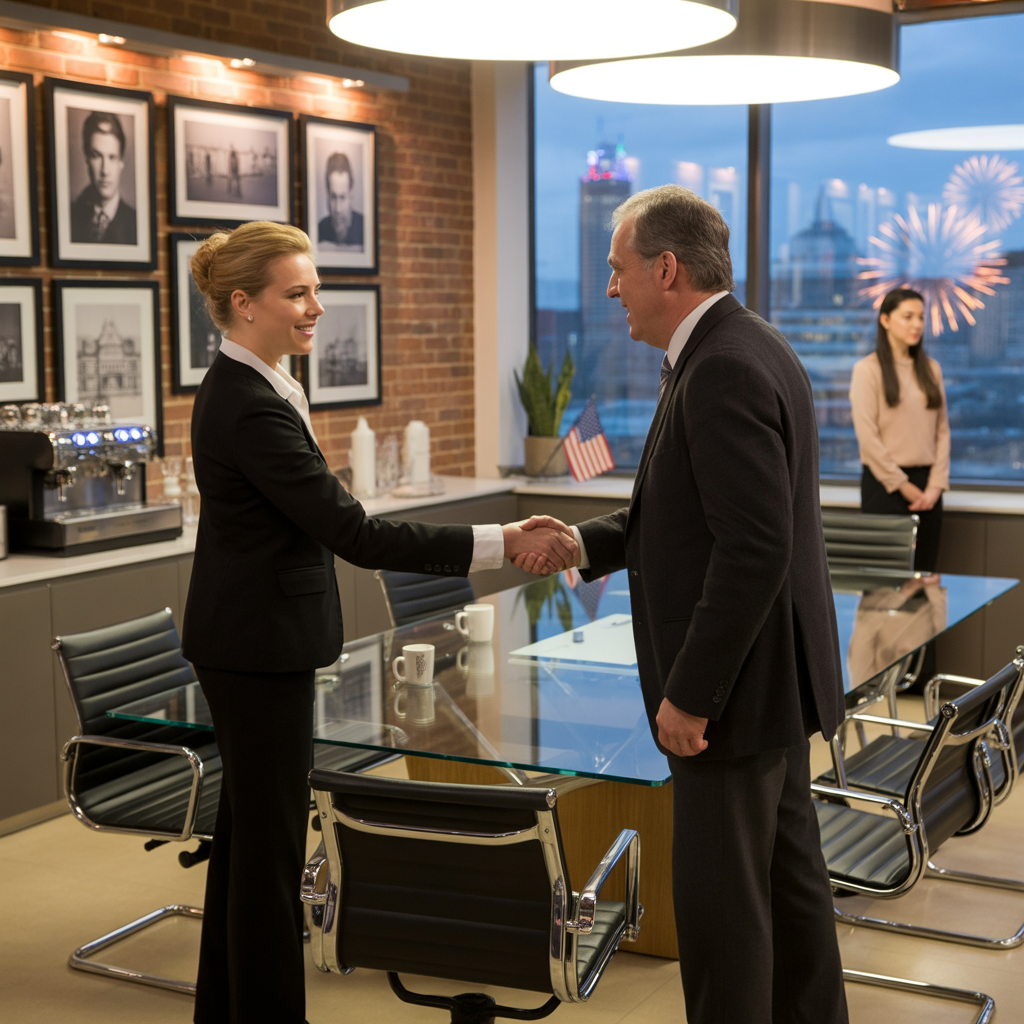
I walked into the executive conference room.
My team had set it up flawlessly.
Leather chairs around a glass table.
Screens ready for presentation.
Coffee station with premium beans.
Pastries from the French bakery.
And on the wall behind my seat: framed press coverage.
The Wall Street Journal profile.
Forbes fast-growing companies feature.
TechCrunch article about our Series C funding.
Business Insider piece on women-led fintech companies.
The Wall Street Journal profile was the largest.
Full color photo of me in the same conference room.
Arms crossed.
Confident smile.
Headline: How Rachel Morrison built a $400 million fintech empire in 5 years.
I’d changed my last name legally at 25.
Morrison was my maternal grandmother’s maiden name.
My family still knew me as Rachel Chin.
Yes—same last name as Michael.
Common Chinese surname.
Pure coincidence.
Or perhaps fate had a sense of humor.
At 8:55, reception called.
“Ms. Morrison. The Meridian Capital team has arrived.”
“Send them up.”
I stood at the elevator bank as the doors opened.
Four people emerged in business formal.
Three men.
One woman.
At the front, Richard Walsh.
62 years old.
Silver hair.
Custom suit.
The kind of presence that commanded rooms.
He extended his hand.
“Ms. Morrison. Richard Walsh. Thank you for hosting us.”
“Mr. Walsh, welcome to Payout.”
I shook hands with his team.
“Please follow me.”
I led them to the conference room and watched their eyes take in the space, the press coverage on the walls, the panoramic view of downtown Manhattan.
“Impressive operation,” Walsh said, settling into a chair.
His eyes landed on the Wall Street Journal profile.
He studied it for a moment.
“I read this piece when it published,” he said. “Compelling story.”
“Thank you,” I said. “Shall we begin?”
For the next ninety minutes, my team presented.
Samantha walked through financials.
Revenue growth.
Profit margins.
Customer acquisition costs.
Our CTO demonstrated the platform.
Our VP of Sales showed client testimonials and retention rates.
Walsh asked sharp questions.
His team took extensive notes.
This was a man who’d built his career on evaluating companies.
Nothing got past him.
At 11:30, we broke for the Q&A session.
“Your customer concentration looks healthy,” Walsh said. “No single client above 4% of revenue. How do you maintain such strong retention with small business clients?”
I walked him through our customer success model.
White-glove onboarding.
Algorithm improvements that saved clients an average of $47,000 annually.
The way we designed the product to feel invisible when it was working.
“And you’re completely bootstrapped until Series C?” he asked.
“Correct,” I said. “I self-funded through year three. Series C was purely for expansion capital, not survival.”
“Remarkable,” Walsh said, making a note. “Most founders can’t resist taking early venture capital.”
“I wanted to maintain control,” I said. “Build something sustainable rather than chase hypergrowth.”
Walsh nodded.
“It shows in your unit economics.”
We broke for lunch at 1:00.
My team had catered from a Michelin-starred restaurant nearby.
The conversation shifted to industry trends.
Regulatory changes.
Competitive landscape.
Walsh was encyclopedic.
Strategic.
The kind of person who saw three moves ahead.
He didn’t talk to hear himself.
He talked like he was mapping a system.
“You mentioned you left Goldman Sachs to start Meridian,” I said. “What drove that decision?”
“I’d spent thirty years building wealth for other people,” he said. “I wanted to build something of my own. Deploy capital toward companies I believed in, with founders who reminded me why I fell in love with finance in the first place.”
I smiled.
“Founders like you,” he said. “Patient. Focused on fundamentals instead of hype.”
He paused.
“You remind me of myself at your age.”
Then, a slight tilt of his head.
“Actually, you’re significantly ahead of where I was.”
At 2:30, Walsh’s team stepped out to make calls.
He asked if we could speak privately.
“Of course.”
I closed the conference room door.
He sat back, studying me.
“Rachel Morrison,” he said. “You’ve built something exceptional here. The numbers work. The technology is sound. Your team is excellent.”
“Thank you.”
“I want to put something on the table,” he said.
“We came here prepared to offer $340 million as discussed. But after today, I’m recommending to my partners that we go to $385 million. All cash. 45-day close.”
I kept my expression neutral.
Inside, my heart raced.
$385 million.
“That’s generous,” I said.
“You’ve earned it,” he replied.
“There’s one thing I’m curious about, though.”
He gestured to the Wall Street Journal profile.
“The article mentions you changed your name legally at 25. Any particular reason?”
This was the moment I could deflect, change the subject, keep my family separate from my professional life.
But something in his question felt like he already knew.
“Family reasons,” I said simply. “I wanted to build something independent of family expectations.”
“Understandable,” Walsh said.
Then he pulled out his phone.
“Speaking of family, this might be an odd question. Do you have a sister named Claire?”
My pulse quickened.
“I do.”
“Interesting,” he said. “She’s engaged to one of my former analysts at Goldman. Michael Chin.”
The room seemed to tilt slightly.
“Small world,” I said carefully.
“Very small.” Walsh’s expression was unreadable.
“Michael spent twenty minutes at brunch yesterday explaining how his future in-laws are successful but traditional. How his fiancée Claire is the accomplished one in the family.”
“How the sister—you—is still finding her path.”
My hands clenched under the table.
“Michael seems to think you work at a small company,” Walsh continued. “Maybe make sixty to seventy thousand a year.”
He paused.
“He actually said, and I quote, ‘It’s sweet that she’s trying, but some people aren’t cut out for high-level business.’”
The words hit like physical blows.
Walsh continued.
“And then I show up here this morning to negotiate a $385 million acquisition with Rachel Morrison, who I now realize is Rachel Chin.”
“And I’m sitting across from the woman Michael described as a well-meaning failure.”
“He doesn’t know,” I said quietly.
“Clearly not.” Walsh’s eyes gleamed. “The question is why?”
I met his gaze.
“Because I learned a long time ago that my family sees what they want to see,” I said.
“Claire needed to be the successful one. That was her identity.”
“I didn’t need to take that from her.”
“So you built a $400 million company in silence,” Walsh said.
Then he laughed—a genuine, delighted sound.
“Success doesn’t require an audience.”
I smiled.
“Rachel,” he said, standing and extending his hand, “you are exactly the kind of founder I love working with.”
“Let’s finalize this deal.”
Then, with a sharp glint of humor.
“And if you’re amenable, I’d very much like to see the look on Michael Chin’s face when he realizes who his fiancée’s sister actually is.”
I shook his hand.
“I think that can be arranged.”
The deal closed 43 days later.
$385 million.
All cash.
Meridian Capital would take a 60% stake.
I’d retain 40% and stay on as CEO for a minimum of three years.
The press release went out on a Tuesday morning.
Meridian Capital acquires majority stake in Payout Analytics for $385 million.
Leading fintech company Payout Analytics announces strategic acquisition by Meridian Capital.
Founder and CEO Rachel Morrison will retain significant equity and continue leading the company’s growth.
The Wall Street Journal ran it as front-page business section news.
TechCrunch led with it.
Bloomberg covered it on their morning show.
My phone started ringing at 6:00 a.m.
I ignored the calls.
I was in my office watching the news coverage on my monitor when my assistant buzzed.
“Ms. Morrison, there’s a Michael Chin here to see you. He says it’s urgent. He doesn’t have an appointment.”
I checked my watch.
9:47 a.m.
“Send him up.”
Three minutes later, Michael Chin stood in my office doorway.
He looked exactly like his photos—handsome, well-dressed.
But now his face was pale.
His eyes were wide.
“You’re Rachel Morrison,” he said.
“I am.”
“Claire’s sister is Rachel Chin.”
“Also me,” I said. “I changed my name legally six years ago.”
He stepped into my office, staring around like he’d entered an alternate dimension.
Floor-to-ceiling windows overlooking SoHo.
Modern art on the walls.
The Bloomberg terminal on my desk.
“You’re the Payout CEO?”
“Yes.”
“Richard Walsh called me this morning,” Michael said, voice rising. “He asked if I knew that my fiancée’s sister just closed a $385 million acquisition deal.”
“He asked if I was aware that I described her as sweet but not cut out for high-level business at Easter brunch.”
I said nothing.
Michael’s voice rose.
“You let me say those things.”
“You let Claire tell you not to come to Easter because you’d be awkward around finance people.”
“You let your entire family think you’re some kind of struggling tech worker.”
“I never lied about what I do,” I said.
“But you never corrected us,” he snapped.
“You never asked,” I replied.
I leaned back in my chair.
“Michael, when’s the last time anyone in my family asked me a single specific question about my work?”
He opened his mouth.
Closed it.
“Claire knows I run a fintech company,” I continued. “She’s never asked the name. Never asked about revenue or employees or funding.”
“She knows I work with payment systems and decided that meant I was an entry-level analyst somewhere.”
“Because you let her think that,” he said.
“No,” I said. “Because she needed to think that.”
“Claire’s identity is built on being the successful one,” I said. “The accomplished daughter. The one who made it.”
“If I had told her the truth—that I built something worth $400 million while she was climbing the corporate ladder—it would have shattered her self-image.”
“So you protected her ego by hiding your success,” Michael said.
“I protected my peace by not making my success her crisis,” I replied.
Michael stared at me.
“Richard Walsh thinks this is hilarious,” he said. “By the way, he’s telling everyone at Meridian about Michael Chin’s fiancée, whose awkward sister just became wealthier than everyone at the Easter table combined.”
“Your concern seems to be about your professional reputation,” I said.
His face flushed.
“Do you have any idea how this makes me look?” he demanded.
“I vouched for Claire’s family being normal, middle class, respectable.”
“Now my managing director knows I didn’t even know my future sister-in-law is a major player in the industry I work in.”
“Again,” I said, “you never asked.”
“Claire’s going to be devastated,” he said.
“Claire’s going to be embarrassed that she didn’t know,” I corrected. “There’s a difference.”
My phone buzzed.
A text from Claire.
“Rachel, we need to talk now.”
Michael’s shoulders dropped.
“She knows,” he said. “Mom called her. A friend saw the Bloomberg coverage and sent it to your parents.”
“Your dad thought it was a different Rachel Morrison until he saw your photo.”
“And now Claire’s upset.”
“She’s in complete meltdown. She thinks you deliberately hid this to humiliate her.”
“I hid it to avoid exactly this conversation,” I said.
“You should have told us why,” Michael insisted.
I stood and walked to my window so I didn’t have to watch him perform outrage.
“So you could all treat me differently?” I asked.
“So Claire could feel threatened?”
“So my parents could suddenly be interested in my life after ignoring it for 30 years?”
“I built this company because I’m good at what I do,” I said. “Not because I needed my family’s validation.”
“Family shares these things,” Michael said.
I turned to face him.
“Michael,” I said, “let me ask you something.”
“When you started dating Claire, she told you all about me, right? What did she say?”
He hesitated.
Let me guess.
“My sister works in tech, but she’s not really successful. She’s still finding herself.”
“Sweet girl, but not driven like me.”
His silence was confirmation.
“And you never thought to question that?” I asked. “Never thought it was strange that a 31-year-old woman in the New York tech scene might have accomplished more than Claire assumed?”
“I trusted Claire’s assessment,” he said.
“Exactly,” I replied.
“You trusted her need to be superior more than you trusted the possibility that I might be competent.”
I walked back to my desk.
“Michael, I don’t blame you,” I said. “You saw what you expected to see.”
“But don’t stand in my office and tell me I owed you disclosure when you never bothered to look.”
He stood there, visibly wrestling with something.
“Richard wants me to bring Claire to dinner this Friday,” he said finally. “You, him, his wife, me, and Claire.”
“He says it’s important for family dynamics in the deal.”
“That’s not about family dynamics,” I said.
Michael swallowed.
“Richard wants to watch Claire realize who you are.”
“Will you come?”
I considered.
“Where?”
“Le Bernardin. 7:00 p.m.”
Le Bernardin.
One of the most expensive restaurants in Manhattan.
Where people went to impress.
“I’ll be there,” I said.
Friday evening, I wore a black Tom Ford dress and the Cartier watch I’d bought myself when Payout hit $100 million in revenue.
My driver dropped me at Le Bernardin at 6:55 p.m.
Richard Walsh was already there with an elegant woman I assumed was his wife.
He stood when I approached.
“Rachel, you look wonderful.”
“This is my wife, Catherine.”
“Lovely to meet you,” Catherine said warmly.
“Richard hasn’t stopped talking about your company all week.”
“It’s kind of him to be so enthusiastic,” I said.
“Kind nothing,” Richard said. “He’s got excellent instincts, and you’re exactly the kind of founder he respects.”
Michael and Claire arrived at 7:03.
Claire wore a blush pink dress.
Expensive, but trying too hard.
Her eyes found me immediately.
I watched the calculation happen.
She’d Googled me.
Seen the articles.
Done the math.
Now she had to figure out how to play this.
“Rachel,” she said, air-kissing both my cheeks. “You look… successful.”
“Thank you,” I said. “You look lovely too.”
We sat.
Richard orchestrated the seating.
Him at the head.
Catherine to his right.
Then me.
Michael to his left.
Then Claire.
Directly across from me, the sommelier brought wine.
Richard made small talk about the restaurant, the menu, the weather.
All the while, Claire’s eyes kept darting to me.
Finally, after we’d ordered, Richard leaned back.
“So, Claire,” he said, “Michael tells me you work in strategic consulting.”
“Yes,” Claire said quickly. “I’m at Brighton Advisory. We work with Fortune 500 companies on operational efficiency.”
“Impressive,” Richard said. “What’s your client portfolio like?”
Claire launched into her pitch.
Companies she’d worked with.
Problems she’d solved.
Promotions she’d earned.
Richard listened politely.
Catherine asked intelligent questions.
When Claire finished, Richard turned to me.
“Rachel, tell Claire about the Q1 numbers. I think she’d find them interesting.”
Claire’s smile tightened.
“Oh, I don’t think—”
“Please humor me,” Richard said.
I set down my wine.
“Q1 revenue was $127 million,” I said. “We exceeded projections by 23%.”
“Processed $2.4 billion in transactions, added 847 new clients, EBITDA margin held at 34%.”
Claire’s face froze.
“And the expansion plans?” Richard prompted.
“We’re opening European operations in Q3,” I said. “Already have regulatory approval in the UK and Germany.”
“Projected European revenue of $80 million by end of year two.”
“Outstanding,” Richard said.
Then he turned to Claire.
“Your sister built quite an operation.”
Michael mentioned you two are close.”
Claire’s smile was brittle.
“We’re family.”
“Rachel mentioned she couldn’t make Easter brunch,” Richard continued. “That must have been disappointing.”
“It was a small gathering,” Claire said carefully.
“Of course,” Richard said. “Michael mentioned his managing director might stop by.”
His smile stayed pleasant.
“That was me, actually.”
Michael looked like he wanted to disappear into his chair.
“I remember you mentioning your sister worked in tech,” Richard said. “Something about a startup.”
Michael’s face went gray.
Claire’s eyes met mine.
In them, I saw the full scope of her realization.
Not just that I was successful.
That I’d been successful the entire time she’d been pitching her career to me.
Every condescending comment.
Every dismissive assumption.
“I didn’t realize Rachel’s company was so substantial,” Claire managed.
“$400 million valuation,” Richard said cheerfully. “Post-money, of course.”
“With the acquisition, she’s now one of the most successful fintech founders under 35 in the country.”
“That’s wonderful,” Claire whispered.
“And she did it while you were telling people she was finding her path,” Richard added.
His tone was still pleasant, but his eyes were sharp.
“That must be quite a revelation.”
The table fell silent.
Catherine cleared her throat delicately.
“Richard, darling, I think we’ve made our point.”
“Have we?” Richard took a sip of wine.
“Because I’m curious, Claire.”
“When was the last time you asked your sister about her work? Really asked.”
“Not assumed, but inquired.”
Claire’s face flushed.
“I… we don’t really talk about work.”
“No,” Richard said. “That’s interesting because Michael mentioned you spent quite a bit of time at Easter explaining your career to my wife and me.”
“But when it came to Rachel, the description was—what was it, Michael?”
Michael looked miserable.
“I said she was still figuring things out.”
“Right,” Richard said. “Still figuring things out.”
He looked at me.
“Rachel, when you founded Payout, what year was that?”
“2019,” I said.
“Five years ago.”
“And Claire,” Richard said, “how long have you been at Brighton?”
“Four years.”
“So Rachel was already building a company when you started your current position,” Richard said.
“And in those five years, you never once asked her how it was going.”
“Never checked revenue.”
“Never asked about funding or growth.”
“She never mentioned it was successful,” Claire said, voice rising slightly.
“Did you ask if it was?” Richard asked.
Silence.
I set down my fork.
“Richard,” I said quietly, “this isn’t necessary.”
He looked at me seriously.
“Rachel, you’re about to become a significant figure in this industry,” he said. “The deal we closed will make headlines for months.”
“You’ll be speaking at conferences, featured in magazines, courted by investors.”
“And your family didn’t even know you existed professionally.”
“That was my choice,” I said.
“Was it?” Richard asked.
“Or was it easier to let them underestimate you than to challenge their assumptions?”
The words hit harder than I expected.
Catherine reached across the table and touched my hand gently.
“What Richard is trying to say, in his characteristically blunt way,” she said, “is that you deserve to be seen.”
“Not just by us, but by the people who are supposed to know you best.”
I looked at Claire.
Really looked at her.
She wasn’t angry.
She was shattered.
Her entire self-concept—the successful daughter, the accomplished one, the family star—had been built on the foundation of being superior to me.
And that foundation had just been revealed as fiction.
“I’m sorry,” I said quietly.
Claire’s eyes widened.
“You’re sorry?”
I nodded.
“I let you build an identity around being better than me,” I said. “That was unkind.”
“I could have corrected you years ago.”
“I didn’t because it was easier to let you have that than to deal with the fallout.”
“But you are better than me,” Claire whispered. “You built something worth $400 million.”
“You’re excellent at what you do,” I said. “Your work matters.”
“It just doesn’t have to matter more than mine for you to be valuable.”
Her eyes filled with tears.
“I told you not to come to Easter because you’d be awkward,” she whispered.
“I know.”
“I told everyone you were struggling.”
“I know.”
“And you just let me.”
“Yes.”
“Why?”
I took a breath.
“Because fighting with you about who’s more successful seemed exhausting,” I said. “And because I didn’t need you to know.”
“My success wasn’t about proving anything to you.”
“It was about building something I believed in.”
Michael spoke quietly.
“Richard called me into his office Wednesday,” he said. “He asked if I understood that I’d spent Easter brunch insulting one of the most successful founders in the industry.”
“He asked if I made a habit of dismissing people without knowing their credentials.”
“What did you say?” I asked.
“I said I was an idiot who believed my fiancée’s assessment without questioning it.”
He looked at Richard.
“He agreed.”
“He’s right,” Richard said unapologetically. “Michael, you’re a bright analyst. But you have a blind spot when it comes to assumptions.”
“You assumed Rachel was unsuccessful because Claire told you she was. You never verified.”
“In our industry, that’s a fatal flaw.”
“I know, sir,” Michael said.
“Do better,” Richard said.
“I will.”
Richard turned to Claire.
“And you— you’re talented at your job.”
“But talent without humility is just arrogance.”
“Your sister built something extraordinary while you were convinced she was failing.”
“That should teach you something about assumptions.”
Claire nodded, tears still streaming.
The dinner continued—awkward but honest.
We talked about Payout’s future.
Claire asked questions.
Real questions.
About the technology.
The business model.
The growth strategy.
I answered them.
By dessert, the tension had shifted into something else.
Not resolution exactly.
But the beginning of actual understanding.
As we left, Claire pulled me aside.
“Can we have coffee?” she asked. “Just us.”
“I want to… I need to actually know you.”
“Not the version I invented.”
“I’d like that,” I said.
“And Rachel,” she added, voice small, “I’m sorry for all of it. The dismissiveness. The assumptions. Telling you not to come to Easter.”
“I forgive you,” I said.
Just like that.
Claire holding grudges takes energy I’d rather spend building things.
She laughed through her tears.
“You really are better than me.”
“No,” I said. “I’m just different. And that’s okay.”
Three months later, Payout’s European expansion launched successfully.
Claire attended the celebration dinner I hosted.
She brought a gift: a framed photo from Easter brunch, but photoshopped to include me at the table.
“Revisionist history?” I asked, smiling.
“Corrected history,” she said. “This is how it should have been.”
Mom and Dad called after the Bloomberg article.
Dad cried.
Mom asked a thousand questions.
They wanted to understand—finally—who I’d become while they weren’t looking.
I told them patiently.
Honestly.
Were we fixed?
Families don’t fix in three months.
But we were honest.
And that was a start.
Michael sent me a client referral: a Goldman Sachs portfolio company that needed payment optimization.
I gave them a friends-and-family discount.
The relationship between us would always be slightly awkward.
But it was functional.
Richard Walsh became a mentor.
He introduced me to contacts, advised on strategy, and never once let me forget that success was meant to be visible.
“Stop hiding,” he told me over coffee one morning. “You built something incredible. Let people see it.”
So I did.
I accepted the speaking invitation at Fintech Summit 2025.
I did the Fortune magazine cover story about women in tech.
I let the Wall Street Journal profile my journey from overlooked daughter to industry leader.
And when people asked why I’d kept quiet for so long, I told them the truth.
“I wasn’t ready to be seen until I was sure of who I was.”
Success doesn’t require an audience.
But once you’re certain of your foundation, there’s power in letting people witness what you’ve built.
Claire called me the night the Fortune cover released.
“You look incredible,” she said.
“Thank you,” I replied.
“I’m proud of you,” she said. “I should have said that years ago.”
“You’re saying it now,” I told her. “That matters.”
“Next Easter,” she said, “you’re coming. No excuses.”
“And I’m telling everyone exactly who you are.”
I smiled.
“I’d like that.”
Because ultimately, that’s what I’d learned.
You can build success in silence.
You can protect yourself by staying small in others’ eyes.
You can avoid conflict by accepting their limited vision of who you are.
But there’s a profound freedom in being fully seen.
Not despite your success.
Because of it.
My family thought Easter brunch was too sophisticated for me.
They thought Goldman Sachs people were above my understanding.
They thought I needed to be protected from my own inadequacy.
They were wrong.
And now they knew it.
Not because I fought to prove them wrong.
Because I built something so undeniable that the truth revealed itself.
Richard Walsh had been right.
Success doesn’t require an audience.
But it’s so much sweeter when the people who underestimated you finally see who you’ve become.
And the look on Michael Chin’s face when he walked into my office that Tuesday morning?
That was worth every quiet year of building in the shadows.