I Arrived Early to My In-Laws’ Christmas Party—Heard My Wife Giggling, “I’m 3 Weeks Pregnant…”
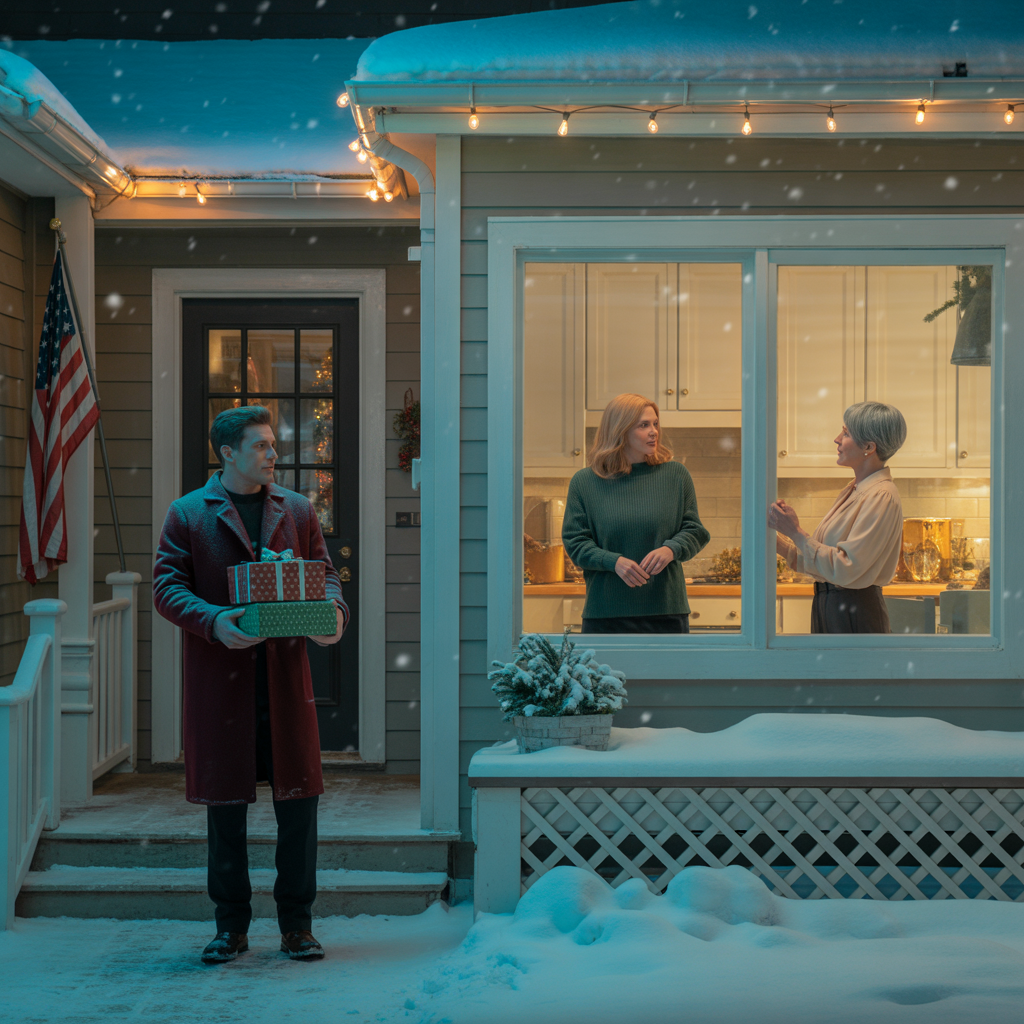
I arrived early to my in-laws’ Christmas party and heard my wife giggling.
“I’m three weeks pregnant with my boss’s baby.”
I didn’t confront her. Three weeks later, I served divorce papers while the FBI took her lover away in handcuffs.
I’m Ryan Mitchell, and this is the story of how I died and came back to life, all in the span of sixty seconds on Christmas Eve.
I left work early. Traffic was lighter than expected, so I pulled into my in-laws’ driveway at 4:17 p.m. instead of the planned 6:00. The plan was simple: surprise Emma, help set up for dinner, maybe sneak a few of Patricia’s cookies before the family arrived.
The house looked warm. Golden light spilled from the kitchen windows, and I could see shadows moving inside. I grabbed the gifts from the back seat—carefully wrapped, including the ridiculously expensive watch for Emma that I’d saved up for—and walked up the driveway.
That’s when I heard the laughter. Emma’s voice, bright and sharp, cutting through the winter air. The kitchen window was cracked open despite the cold, probably to vent the oven heat.
I was about to call out to announce myself like some idiot in a sitcom when I heard my name.
“Ryan has no idea,” Emma said.
There was a lightness in her voice, like she was discussing vacation plans. I stopped walking and just stood there in the snow, gifts in my hands, breath fogging in the December air.
Patricia’s voice responded.
“When are you going to tell him?
“I’m not,” Emma said, and then she laughed—actually laughed. “Why would I? Derek and I have it all figured out. We’ll wait until January after the holidays, after his guard is completely down. Then I’ll file. Ryan gets blindsided. I get the house.”
My fingers went numb. Not from the cold.
“And the pregnancy?” Patricia asked.
I could hear the smile in her voice, the conspiratorial tone of someone fully invested in a secret.
“Three weeks along,” Emma said, her voice dropping to something almost giddy. “Derek’s thrilled. He’s already talking about us getting a place together once his divorce is finalized. Something bigger than what Ryan could ever afford.”
“Does Ryan suspect anything?”
“God, no.” Emma’s laugh was sharper now—cruel in a way I’d never heard from her before. “He’s so reliable, it’s boring. Works his ass off, comes home tired, never questions anything. I could probably tell him I’m working late every night, and he’d just nod and ask if I need dinner saved.”
Patricia made a humming sound. Agreement. Approval.
“He’s going to be devastated,” Patricia said—not with sympathy, with satisfaction.
“He’ll survive. Ryan always does.” Emma’s voice stayed light. “He’s the type who just accepts things. He won’t even fight for the house. He’ll probably just sign whatever papers I put in front of him.”
I should have burst through that door. I should have screamed. I should have thrown those gifts through the window and demanded answers.
But I didn’t.
Instead, I stood there in the snow, twenty feet from the kitchen window, and felt something inside me go completely cold. Not hot rage, not explosive anger—just this vast, empty coldness that spread through my chest like ice water.
Eleven years of marriage. Eleven years of working overtime so she could finish her degree. Of supporting her career moves, of building what I thought was our life, our future, our home—gone, erased in sixty seconds of overheard conversation.
I walked back to my car quietly like a ghost, placed the gifts in the passenger seat, and sat there, engine off, staring at that warm house with its golden windows and its rotting core.
My phone buzzed.
“Emma: where are you? Thought you’d be here by now.” ❤️
I stared at that heart emoji and felt nothing. Then I did something I’d never done before in eleven years.
I lied to my wife.
“Work emergency. Server crash. Going to be late. Maybe eight or nine. So sorry, babe. Tell your mom I’ll make it up to her.”
Three dots appeared. Disappeared. Appeared again.
“No problem. Take your time. Love you.” 💕💕
I drove to my brother Cameron’s apartment across town. I didn’t call first, just showed up and knocked until he answered, looking confused in sweatpants and a Bears jersey.
“Ryan—what?”
“She’s pregnant,” I said. My voice sounded strange. Flat. “With her boss’s baby. I heard her telling Patricia. They’re planning to divorce me in January and take the house.”
Cameron went very still. He’s a private investigator, and he’s seen enough to know when someone’s serious.
“Come inside,” he said quietly. “Tell me everything.”
That night, as Emma slept beside me with her hand on her stomach, I lay awake staring at the ceiling. And that’s when I realized I wasn’t going to scream.
I was going to dismantle her world piece by piece.
Christmas morning, I woke up at 6:00 a.m. to Emma kissing my shoulder.
“Merry Christmas,” she whispered, smiling like she hadn’t just planned my destruction twelve hours earlier.
I smiled back and kissed her forehead.
“Merry Christmas, babe.”
We opened presents in our pajamas like we had every year since we got married. I watched her unwrap that expensive watch—the one I’d worked overtime for—and her face lit up with what looked like genuine joy.
“Ryan, you didn’t have to.”
“I wanted to,” I said, and I meant it. The man who bought that watch three weeks ago was dead. I was something else now.
She hugged me. I hugged her back. Felt her stomach press against mine—flat still, but not for long.
Not my kid. Not my problem. Not anymore.
December 26th, 9:00 a.m., I sat across from Theodore Morrison in his law office downtown. Theo’s been my lawyer since I bought the house—quiet guy, late fifties, the kind who doesn’t waste words.
“How solid is the prenup?” I asked.
Theo pulled the file, scanned it for maybe thirty seconds.
“Ironclad. You drew this up before the marriage. Both parties had independent counsel. Everything’s notarized.”
He looked up at me over his reading glasses.
“Infidelity clause is explicit. If she’s proven to have committed adultery, she forfeits any claim to marital assets acquired during the marriage. House, savings, retirement accounts—all yours.”
“What do I need to prove it?”
“Photos, documentation, witnesses if possible. DNA test if the child isn’t yours.” He paused. “Ryan, I have to ask… are you absolutely certain about this?”
I told him what I’d heard. Every word, every laugh, every cruel detail. Theo’s jaw tightened.
“Then we proceed carefully. No confrontation until we have everything documented. Can you maintain appearances at home?”
“I’ve been doing it for two days already.”
“Good. Keep doing it. Make no accusations. No changes in behavior. Let her think everything is normal.”
He pulled out a legal pad.
“I’ll start drafting the petition. We’ll need that evidence first.”
Cameron started surveillance December 27th. I gave him Derek Patterson’s name, the company—Gallagher Industrial Manufacturing—and Emma’s schedule. Cameron’s good at this: invisible, patient.
He called me December 28th at lunch. I was at work pretending everything was fine.
“They met at the Embassy Suites on Riverside,” Cameron said. “Went in together at 12:43 p.m. Came out at 2:31. I’ve got photos—clear shots of them entering together. Body language is intimate.”
“Send them to Theo.”
“Already did. Ryan, I’m sorry, man.”
“Don’t be. Just keep watching.”
I went home that night and cooked dinner—Emma’s favorite, lemon chicken with roasted vegetables. She came home at 7:30, kissed me like nothing was wrong.
“How was work?” I asked, plating her food.
“Exhausting.” She sat down. “Derek had us in meetings all day. I barely had time to eat lunch.”
I nodded and set the plate in front of her.
“You work too hard.”
She smiled at me and touched my hand.
“You’re so good to me.”
The crazy thing was, I felt nothing. No anger, no betrayal in that moment—just clinical detachment, like I was watching someone else’s life through glass.
December 29th brought more photos: lunch at an Italian place downtown, Emma laughing, touching Derek’s arm across the table. December 30th: coffee meeting, parking garage, a kiss that lasted too long to be anything but what it was.
Cameron sent everything to Theo. The file was getting thick.
I maintained the façade. Watched movies with Emma on the couch, asked about her day, made love to her when she initiated because refusing would have raised suspicion. It was the most hollow I’d ever felt.
December 31st, 2:13 a.m., my phone buzzed on the nightstand. Emma was asleep, breathing softly beside me.
“Cameron: call me now. Don’t care what time it is.”
I slipped out of bed, went to the bathroom, and turned on the fan for noise cover.
“What is it?” I whispered.
Cameron’s voice was tight. Urgent.
“You need to see this. I’ve been tracking Derek’s movements and something felt off. Weird meetings with accountants at odd hours, carrying locked briefcases to meetings that aren’t on his public calendar, so I did some digging.”
My heart started pounding.
“I called in a favor from a forensic accountant I know. Had her look at Gallagher Industrial’s public filings, cross-reference some expense reports Derek submitted.”
Cameron paused, then said the line that changed everything.
“Your wife’s problem just became her boss’s prison sentence.”
“Cameron—”
“Derek Patterson isn’t just a cheater. He’s been embezzling millions from Gallagher Industrial Manufacturing. I’ve got evidence of shell companies, falsified expense reports, offshore account transfers. This isn’t just an affair, Ryan. This is federal fraud.”
I stood there in my bathroom at 3:00 a.m., phone pressed to my ear, and felt the strangest sensation.
I smiled.
“How much?” I asked.
“Preliminary estimate north of four million. Probably more if we dig deeper.”
“Send everything to Theo.”
“Already did.”
Then I said the next thing like it was inevitable.
“Derek Patterson has a wife, doesn’t he?”
There was a pause. Then Cameron said quietly, “Claire. Married fifteen years. Two kids.”
“She deserves to know,” I said. “And I think we’re going to need her help.”
January 3rd, I assembled the package. Nothing about the embezzlement. Not yet. Just the affair evidence: photos of Derek and Emma at the hotel, the restaurant, the parking garage. Timestamps, locations, and a burner phone number.
I dropped it at Claire’s doorstep at 6:00 a.m., rang the bell, and left.
The burner phone rang January 4th at 2:37 p.m.
“This is Claire Patterson.”
Her voice was controlled, measured, but I could hear the tremor underneath.
“Is this real?”
“Yes.”
Silence.
“Then how long?”
“At least four months that I know of. Probably longer.”
“I want to meet you,” she said.
We met January 5th at a coffee shop forty minutes outside the city. Neutral ground. I got there early, sat in the back corner, and watched her walk in at exactly 11:00 a.m.
Claire was tall, athletic build, dark hair pulled into a practical ponytail. She wore jeans and a university sweatshirt. Nothing fancy, but her eyes were sharp.
I slid the folder across the table.
“You’re not crazy,” I told her.
She looked through the photos, then sat back.
“My kids are twelve and nine,” she said. “I gave up my legal career to raise them. We moved four times for Derek’s promotions.”
“What do you want from me?” she asked.
“There’s something else you need to know,” I said. “Something bigger than the affair.”
“Federal crime?” she guessed.
“Yes.”
I told her about the embezzlement. Shell companies. Offshore accounts. Four million, maybe more.
Claire didn’t flinch. She got quiet, and in that quiet I saw the person she used to be before she became someone’s supportive wife.
“I used to work at the U.S. Attorney’s office,” she said. “I still have contacts.”
She smiled once, sharp.
“I’m thinking we coordinate. Your divorce papers. My divorce papers. FBI arrest. Same day. Maximum impact.”
“January 15th,” she said. “We hit them so hard they don’t have time to breathe.”
January 15th, 11:09 a.m., the process server read Emma the papers in front of Derek and executives.
January 15th, 11:27 a.m., the FBI arrested Derek in the parking lot.
Emma called seventeen times. I blocked her.
Patricia called. I told her I heard everything. Then I sent the truth to every social circle she’d built.
The fallout moved like fire.
February 3rd, DNA confirmed Derek was the father.
February 28th, the judge enforced the prenup. Emma lost everything she thought she’d steal.
I rebuilt.
And that’s where the part nobody tells you begins.
Because the day the papers are signed isn’t the end. It’s just the day the noise stops long enough for you to hear what’s left inside you.
In the weeks after the hearing, I kept expecting some dramatic emotional swing—anger, sorrow, a collapse. Instead, I felt tired in a way that reached into my bones. I went to work, answered emails, sat in meetings, nodded at jokes I didn’t hear, and drove home to a house that suddenly felt too big for one person.
The first night I slept alone, I stayed up until 2:00 a.m. not because I was scared, but because my body didn’t know what to do without performing normal. I walked from room to room touching things like I was checking if they were real. The couch where we’d watched movies. The kitchen chair where she’d sat and lied to my face. The hallway mirror where she’d fixed her lipstick before “working late.”
I didn’t cry. I didn’t scream. I just stood there and tried to understand how someone could live next to you for eleven years and still treat you like a stepping stone.
Theo told me the emptiness was normal. Dr. Henderson told me grief doesn’t always show up as tears. Sometimes it shows up as numbness, because numbness is how your brain gives you time to survive.
“You’re not a machine,” Dr. Henderson said one day, watching me sit with my hands folded like I was waiting for a verdict.
“I feel like one,” I admitted.
“Because the alternative feels like free fall,” she replied.
That was the truth. For eleven years, I’d built my life around being steady. Reliable. The man Emma called boring because boring meant predictable, and predictable meant she could plan around me.
Now the steadiness was still there, but it didn’t have a purpose. It was just a habit floating in space.
Then the first wave of public fallout hit, and suddenly my private pain became other people’s entertainment.
Gallagher Industrial’s scandal made the local news for weeks. Derek’s face on TV, his name in headlines, reporters parked outside the building like it was a movie set. And because office gossip has a bloodstream of its own, Emma’s name started circulating too. Not always on camera, but in whispered add-ons.
“His mistress.”
“The one who got fired.”
“The one who was pregnant.”
Strangers decided they understood my life because they’d seen a headline.
At the grocery store, the cashier looked at my credit card name and said, “Are you…?” then stopped when she saw my face.
At work, people tried to be kind in the way people are kind when they’re afraid you might break. They asked if I needed time off, if I wanted to talk, if I was okay. I told them I was fine. I wasn’t lying. I just wasn’t sure what “okay” looked like yet.
Emma tried to find ways around the blocks. She emailed from accounts I didn’t recognize. She sent messages through mutual friends. She showed up at the house twice, once early in the morning and once at night, banging on the door like she could pound her way back into control.
The first time, I didn’t answer. The second time, I called the non-emergency line and had an officer come tell her to leave.
She screamed at me from the porch.
“You’re ruining my life!”
I didn’t go outside. I didn’t give her a scene. I watched from the window as she paced, crying and furious, and I felt something I didn’t expect.
Not satisfaction.
Not pity.
A strange, clean distance.
Like she’d already become someone from a story I used to read.
The pregnancy advanced. I heard through a mutual friend that she was staying with Patricia now, that she’d been to three different doctors because she didn’t like what they told her, that she was trying to argue her way into a narrative where she was the victim.
Patricia, meanwhile, was unraveling in the way people unravel when their social power is taken away. She’d always been a woman who ran on approval. Church committees. Charity boards. Book club leadership. She treated those roles like proof she mattered.
Once the truth moved through those circles, the invitations stopped. The phone calls stopped. The polite smiles turned into polite avoidance.
She blamed me, of course.
She wrote a long Facebook post about forgiveness and family and the danger of “malicious gossip.” It had twenty-three comments of supportive prayer hands, but I knew what that was.
It was her trying to patch a reputation with emojis.
Claire told me later, in a clipped voice, that Patricia had tried to contact her too.
“She called me,” Claire said. “To apologize. Not to me. To ask me to help Emma.”
“Help her how?” I asked.
Claire’s laugh was humorless. “By convincing the FBI Derek is a ‘good man who made a mistake.’”
I stared.
Claire sighed. “He stole millions. He didn’t forget to pay a parking ticket.”
That was the moment I fully understood: the women who enabled Emma weren’t confused. They were invested.
They weren’t defending the truth.
They were defending the illusion.
Derek’s legal situation escalated fast. The FBI didn’t just arrest him and wait. They raided offices. They seized devices. They froze accounts. The company’s board issued statements like controlled bleeding.
Claire had a front-row seat to the collapse of a life she’d spent fifteen years propping up.
I had a front-row seat to mine.
We kept talking, mostly in short, practical bursts at first. Coordination turned into check-ins. Check-ins turned into something that felt oddly human.
The first time Claire texted me outside of logistics, it was in late March.
You eating?
I stared at the question longer than I should have.
Because it wasn’t a legal question.
It was a human one.
I typed back.
Not really.
A minute later.
Try. Even if it’s toast.
I made toast.
It tasted like nothing.
But I ate it anyway.
By April, Claire and I had built a quiet rhythm of honesty. Not romantic. Not even hopeful.
Just honest.
“How are the kids?” I’d ask.
“Angry,” she’d say. “But calmer than I expected.”
“How are you?” she’d ask.
“Tired,” I’d say.
“Same.”
Then, slowly, we started saying things that had nothing to do with Derek or Emma.
Claire would complain about the school pickup line.
I’d complain about office politics.
She’d send a photo of her daughter’s science project.
I’d send a photo of the terrible attempt I made at cooking.
Normal life, trying to reassert itself.
When June came, Claire asked me to dinner “just as friends,” and it felt like stepping back into daylight after living underground.
Antonio’s was warm and noisy and normal. I remember noticing small things like the way the waiter refilled water without being asked, the way a couple at the next table laughed so loudly they didn’t care who heard. The world kept happening.
Claire showed up in a simple black jacket, hair shorter, eyes less haunted than they’d been in January. She looked like someone who’d survived a storm and decided she didn’t owe it softness.
We talked for two hours, and when I drove home after, I realized I hadn’t checked my phone once.
That was the first time in months.
In July, Derek’s lawyers started pushing narratives. They hinted that employees had exaggerated. They suggested the money was “misallocated,” not stolen. They tried to frame it as a misunderstanding.
The FBI didn’t care.
Evidence is stubborn.
In August, Derek took the plea deal. Claire called me after the hearing.
“Eight years,” she said.
“That’s… a lot,” I replied.
“It’s not enough,” she said, then she exhaled. “But it’s real.”
“How are you?” I asked.
Claire was quiet for a moment.
“I feel… lighter,” she admitted, and hearing her use my word made my chest tighten.
“Good,” I said.
In September, Emma tried one last time to reset the board.
She showed up at my work building.
Not in the lobby.
Outside, near the entrance, where everyone could see.
Cameron called me.
“She’s there,” he said. “I’m across the street. Do you want me to handle it?”
“No,” I said.
Not because I needed to face Emma.
Because I needed to prove to myself that she didn’t control the rules anymore.
I walked out with Cameron a few steps behind me.
Emma looked different. Pregnant now, unmistakably. Her hair was pulled back, makeup too heavy, eyes bright with the desperate kind of energy that looks like courage until you recognize it as panic.
“Ryan,” she said, voice trembling. “Please. Just talk to me.”
I kept my voice even.
“Not here,” I said.
“You owe me—” she started.
I lifted my hand.
“No,” I said. “You don’t get to use that word on me anymore.”
Her eyes filled.
“I’m scared,” she whispered.
I believed her.
But fear doesn’t create entitlement.
“You should be,” I said, and the bluntness of it made her flinch.
She stared at me, shocked, like she expected softness because she was pregnant.
“You’re really going to leave me with nothing,” she said.
“I’m not doing anything to you,” I replied. “I’m not responsible for the consequences of your choices.”
Emma’s mouth tightened.
“You’re cruel,” she said.
I almost laughed.
“Cruel is planning to steal someone’s house over Christmas cookies,” I said. “Cruel is laughing about it.”
She looked away, tears falling.
“Please,” she tried again. “Just… help me.”
Cameron stepped closer, voice calm.
“You need to leave,” he said.
Emma looked at Cameron like she recognized him as an obstacle.
“I’m not leaving,” she snapped.
Cameron didn’t move.
“You are,” he said.
Emma took one more breath, eyes locked on me.
“I’m sorry,” she said, and it sounded like someone saying a word in a language they didn’t understand.
I didn’t respond.
Because apologies that arrive after consequences aren’t apologies.
They’re bargaining.
Emma walked away, and I went back upstairs.
That afternoon, Dr. Henderson asked me a question.
“What did it feel like?”
I thought about Emma’s face, her trembling voice.
“Like closing a door,” I said.
“And what’s on the other side?” she asked.
I surprised myself with the answer.
“Space,” I said. “Room to breathe.”
That fall, Claire and I grew closer without deciding to. We weren’t trying to replace our old lives. We were just building a new rhythm that didn’t require pretending.
I met her kids in August, like I’d said. Foster tested me the way twelve-year-olds test adults. He asked me questions designed to see if I’d flinch.
“Did you really catch my dad cheating?” he asked one day, blunt as a hammer.
I looked at him and didn’t lie.
“I found out,” I said. “And I told your mom the truth.”
Foster studied me.
“Why?”
“Because she deserved to know,” I said.
He nodded once, like he respected honesty more than comfort.
Isla warmed up faster. She showed me her rock collection and asked if I’d ever seen “a rock that looks like a heart.”
I told her yes, and it was in my desk drawer at home. The smooth gray stone I’d kept since I was ten, from a childhood beach trip, because some part of me always believed small things could be lucky.
When I gave it to her, she held it like a treasure.
Claire watched from the porch, eyes soft.
“They like you,” she said later.
“I like them,” I admitted.
“That scares me,” she whispered.
“Me too,” I said.
In November, on a night when the wind made the windows rattle, Claire admitted something I hadn’t dared say out loud yet.
“I keep waiting for the other shoe,” she said.
“Me too,” I admitted.
She looked at me, eyes sharp and tired.
“Promise me something,” she said.
“What?”
“If you ever start lying,” she said, “tell me you’re scared instead.”
My throat tightened.
“I can do that,” I said.
She nodded once.
“Good,” she said. “Because I’m not doing this again.”
“I’m not either,” I said.
The second Christmas after that first one felt strange in a different way. Not haunted, not sharp, just… quiet.
Claire and I cooked dinner in my kitchen, the same kitchen that had once felt like a museum of lies. Foster and Isla were with her parents that weekend, and we kept the evening simple: pasta, salad, a cheap bottle of wine.
After dinner, Claire put on music and we cleaned up together, moving around each other like we’d done it before.
“Do you miss it?” she asked suddenly.
“Miss what?”
“The old version,” she said. “Before you knew.”
I thought about that warm house with golden windows. The gifts in my hands. The snow under my shoes.
“No,” I said. “I miss who I thought I was.”
Claire’s eyes softened.
“And who are you now?” she asked.
I didn’t answer right away.
Because the honest answer wasn’t heroic.
“I’m someone who doesn’t ignore my own instincts anymore,” I said. “Someone who believes myself when something feels wrong.”
Claire nodded.
“Good,” she said.
That night, I told her the part I hadn’t told anyone—the exact moment I decided I wouldn’t scream.
“I felt… empty,” I admitted. “And that scared me. Because I thought if I didn’t feel rage, it meant I didn’t care.”
Claire took my hand.
“It meant you were protecting yourself,” she said. “You went into survival.”
I nodded.
“And then you came back,” she added.
I looked at her.
“Yeah,” I said. “I did.”
In January, I proposed. Not because the calendar made it poetic, but because I was tired of living like good things should be postponed just because bad things happened first.
Claire said yes, and the yes felt like air returning to a room.
We married the next December, small ceremony, no production, no pretending. Cameron stood beside me. Foster and Isla stood beside Claire. It was the first wedding I’d ever attended where I didn’t feel like I was watching people perform.
After the ceremony, Isla hugged me and said,
“Now you’re really family.”
My throat tightened.
“Yeah,” I said. “Now I am.”
Years later, when Emma emailed “I’m sorry,” I deleted it without opening.
Not because I was still angry.
Because I was done.
Because the life I had now didn’t have room for her voice.
I’m Ryan Mitchell. When my world shattered that Christmas Eve, I didn’t break. I evolved.
Emma thought she could erase eleven years with lies and betrayal. Instead, she erased herself from my story. And I’ll never apologize for choosing dignity over desperation, for choosing truth over being someone’s fool, for choosing to rebuild instead of self-destruct.
I didn’t win by screaming. I won by surviving.
The part nobody warns you about is that rebuilding isn’t one big moment. It’s not a montage. It’s a hundred tiny choices you make when no one’s watching, when your old life keeps trying to reach for you out of habit.
After the wedding, Claire and I moved into the house we bought together, the one with the cracked stone walkway and the maple tree out front that dropped red leaves like confetti in the fall. It wasn’t grand, but it was honest, and after living inside lies for so long, honest felt like luxury.
Foster claimed the upstairs room with the slanted ceiling and immediately started sketching floor plans on graph paper, because architects-in-training apparently can’t relax unless they’re redesigning something. Isla picked the smaller room and taped her rock collection to the windowsill in a careful line, each one labeled in marker like it mattered.
The first morning all four of us were there, Claire made pancakes, and I stood at the sink rinsing dishes, watching the kids argue about whether chocolate chips count as a “breakfast food.” It was so normal I felt my throat tighten.
Claire noticed. She always noticed.
“You okay?” she asked quietly, not in front of the kids.
“Yeah,” I said, and I meant it. “I just… didn’t think I’d get this.”
She nodded once like she understood without needing the details. “Neither did I,” she said.
We didn’t talk about Emma much after that, not because she didn’t exist, but because she stopped mattering. The longer I lived in a house where no one lied to my face, the more her voice faded into something distant, like a radio station you used to listen to in a different city.
But the world has a way of bringing back old chapters when you least expect it.
One afternoon in March, I got a call from an unknown number while I was driving home from work. I almost ignored it out of habit, but I answered because Foster had a habit of calling from his friends’ phones when his died.
“Ryan?” a woman’s voice said.
My hand tightened on the steering wheel. “Yes.”
“This is Special Agent Monroe,” she said, calm and professional. “I’m with the FBI’s financial crimes division. I’m calling regarding the Gallagher Industrial matter.”
I pulled into a parking lot and put the car in park. My heart didn’t race the way it would have two years ago, but it did that slow, deliberate thump that meant something was about to be real again.
“I thought everything was resolved,” I said.
“Derek Patterson’s case is proceeding,” she replied. “We’re finalizing restitution and asset tracing. Your name came up in the initial reports as someone who provided information.”
I glanced at my reflection in the rearview mirror. Older, maybe. Not in years, but in weight.
“What do you need?” I asked.
“Just confirmation,” she said. “Did you record any audio on December 24th of that year? The conversation you referenced in civil proceedings?”
“Yes,” I said.
“Do you still have the original file?”
I hesitated. Not because I didn’t have it. Because I hadn’t touched it in a long time. It lived on an encrypted drive in my desk, buried like something toxic.
“Yes,” I said.
“We may request it as supporting material,” she said. “You may receive a subpoena. It’s routine. I wanted to give you notice.”
“Okay,” I said.
Her voice softened slightly, still professional but less mechanical. “I’m sorry you were pulled into this,” she said.
I exhaled. “I’m not,” I replied, and surprised myself. “If he stole from people, he should be held accountable. That part is… clean.”
She paused like she respected the word choice. “Understood,” she said. “You’ll hear from us if needed.”
When I hung up, I sat there for a minute with the engine idling. Then I drove home.
Claire was at the kitchen island when I walked in, laptop open, papers spread out like she was building a case. She looked up immediately.
“You have that face,” she said.
I set my keys down. “FBI called,” I said.
Claire’s posture tightened for a second, the old reflex. Then she made herself breathe. “About Derek?”
“Yeah,” I said. “They might request the audio.”
Claire nodded, slow. “Okay,” she said. “We’ll handle it.”
That was the difference between my old life and my new one.
In my old life, a phone call like that would have led to secrecy, scrambling, trying to control perception.
In my new life, it was just information. Something we dealt with together, in daylight.
Foster walked in and tossed his backpack on the floor.
“Why do you look like you just got audited?” he asked, because teenagers are allergic to subtlety.
Claire raised an eyebrow. “That’s oddly specific.”
Foster shrugged. “Economics class. Also, your faces.”
I smiled. “It’s nothing you need to worry about,” I said.
Foster’s eyes narrowed. “That means it’s definitely something.”
Claire gave him a look. “It means it’s adult paperwork,” she said.
Foster held up his hands. “Say less.” He walked to the fridge, grabbed a juice, and left us in peace.
Later that night, after the kids were asleep, I pulled the encrypted drive out of my desk drawer. It felt heavier than it should have, like the past had weight.
Claire sat beside me on the couch as I plugged it into my laptop.
“Do you want to listen?” she asked.
I stared at the folder on the screen. A single file named with a date.
“Not really,” I admitted.
“Then don’t,” she said simply.
I closed the laptop and exhaled. The file existed. That was enough.
Two weeks later, the subpoena arrived. It was formal, clean language, all the things the law uses to make chaos orderly. I forwarded it to Theo, who still represented me when old ghosts tried to walk back in.
Theo called within an hour.
“Routine,” he said. “Annoying, but routine. We’ll provide the file through proper channels.”
“Will this pull me into court?” I asked.
“Unlikely,” Theo replied. “But prepare for a possibility. If it happens, we’ll handle it.”
I hung up and stared at the wall for a moment. The idea of being in the same building as Derek again made my skin crawl.
Claire came into my office, leaned against the doorframe.
“You thinking worst-case scenarios?” she asked.
I nodded.
She walked over and took my hand. “If you have to show up,” she said, “I’ll be there.”
I swallowed. “You don’t have to—”
“I know,” she cut in gently. “But I want to.”
In May, we didn’t end up going to court. The prosecutors accepted the audio file and the documentation, and Derek’s plea deal expanded into additional charges. Claire told me the restitution order was brutal.
“He’s paying it back for the rest of his life,” she said one night, voice flat.
I should have felt triumphant.
I didn’t.
I felt tired, the way you feel when a storm finally moves out of your weather.
Then, in June, my phone buzzed with an email notification that made my stomach drop.
From: Emma.
Subject: Please don’t ignore me.
I stared at it longer than I wanted to admit. Claire looked up from her book.
“You don’t have to,” she said.
“I know,” I replied.
But curiosity is a strange thing. Not because you miss the person. Because you want to confirm they’re real, that what happened wasn’t something your brain invented in a fever.
I didn’t open it.
I forwarded it to Theo.
Then I deleted it.
That was my version of control.
Not engaging.
Not feeding the narrative.
Just handing it to the right person and moving on.
A week later, Cameron came over for dinner. He’d always been my brother, but after Christmas Eve, he’d become something else too—my witness.
He showed up with a six-pack and that familiar grin he used when he didn’t want the room to sink into heaviness.
“Still married?” he asked as soon as he saw Claire, because Cameron believes humor is a form of affection.
Claire smiled. “Still,” she said.
Foster rolled his eyes. “Uncle Cameron, you’re weird.”
Cameron pointed at him. “Correct.”
We ate in the backyard under string lights, the same kind of warm glow I’d once mistaken for safety at my in-laws’ house. Except this time the glow matched the inside.
After the kids went inside, Cameron sat with me on the patio.
“You ever think about how close you came to walking into that kitchen?” he asked quietly.
I stared out at the dark yard. “Yeah,” I said.
“And?”
“And I’m glad I didn’t,” I admitted. “If I had, it would have turned into a screaming match. No evidence. No leverage. Just… trauma.”
Cameron nodded. “You played it smart.”
“It didn’t feel smart,” I said. “It felt like my body left.”
“Sometimes that’s survival,” Cameron said.
I looked at him. “You ever regret getting involved?”
Cameron snorted. “Regret helping my brother not get robbed blind?”
He leaned back in the chair. “No.”
Then his expression softened. “But I regret that you needed it.”
I swallowed. “Me too.”
In July, we went on another beach trip, this time with Foster and Isla. Claire’s kids hadn’t been to the ocean in years because vacations under Derek had always been about Derek.
Isla stood at the waterline and squealed when the waves hit her feet.
Foster tried to act too cool for it, then got knocked over by a wave and came up laughing despite himself.
Claire watched them with her hand over her mouth like she was holding in a sob.
“You okay?” I asked.
She nodded quickly. “I’m fine,” she whispered. “I just… forgot this was possible.”
That night, we sat on the balcony of the rental, the kids asleep inside, the ocean a dark sheet in front of us.
Claire turned to me.
“Do you ever worry,” she asked, “that we’re building this because we’re afraid to be alone?”
I thought about it.
“I’m not afraid to be alone,” I said slowly. “I’m afraid to be lied to.”
Claire’s eyes softened.
“Same,” she said.
We sat there listening to the waves until the fear quieted down.
Back home, life settled into something steady. School mornings. Work meetings. Soccer practices. Dinner dishes. Foster’s college talk starting earlier than either of us wanted.
Then, in October, Isla brought home a permission slip for a “Family Tree Project.”
She waved it at Claire like it was a prize.
“We have to bring pictures,” she announced.
Claire’s face froze.
I watched the old pain flash through her eyes like a shadow.
Foster noticed too.
“Mom,” he said carefully, “we can just… not include him.”
Claire swallowed. “I know,” she said. “It’s just… the teacher’s going to ask.”
I sat down at the table with them.
“Then we tell the truth,” I said.
Isla blinked. “What truth?”
Claire took a breath. “That families can change,” she said softly. “That sometimes people leave, and it hurts, and then you build something better.”
Isla stared at her for a long second, then nodded like it made perfect sense.
“Okay,” she said. “Can I put Ryan on it?”
My throat tightened.
Claire’s eyes filled.
“If you want,” Claire whispered.
Isla smiled. “I do.”
Foster didn’t say anything, but he slid the paper toward me and handed me a pen.
“Write your name,” he muttered.
I wrote it.
That was the moment I understood something I hadn’t fully understood even on our wedding day.
This wasn’t replacement.
It was choice.
It was love with consent.
In November, we hosted Thanksgiving. Not a huge gathering, just Maria, Cameron, and a few friends. Claire cooked, I did dishes, Foster tried to pretend he didn’t like helping, and Isla decorated the table with little paper turkeys.
Cameron raised his glass at dinner.
“To new traditions,” he said.
Everyone clinked.
And in that simple sound, I felt the final piece of the old life loosen.
December came again, and I braced for it the way you brace for an anniversary of pain. Except it didn’t hit the way I expected.
On Christmas Eve, Claire and I sat on the couch after the kids went to bed. The tree lights blinked softly. The house smelled like cinnamon.
Claire took my hand.
“This is the night,” she said quietly.
“I know,” I replied.
“Do you want to do something different?” she asked.
I thought about standing in the snow with gifts in my hands. About breath fogging. About my name said with laughter.
“Yes,” I said.
So we did.
We walked outside into the cold, stood on the porch, and let the winter air hit our lungs.
Claire squeezed my hand.
“You survived,” she said.
I looked at her. “So did you.”
We stood there for a minute, not talking, just breathing, and then we went back inside where the lights were warm.
That was the final revenge.
Not emails.
Not court.
Not handcuffs.
Peace.
And the quiet certainty that the people who laughed in that kitchen window no longer had access to my life.
I’m Ryan Mitchell. When my world shattered that Christmas Eve, I didn’t break.
I evolved.