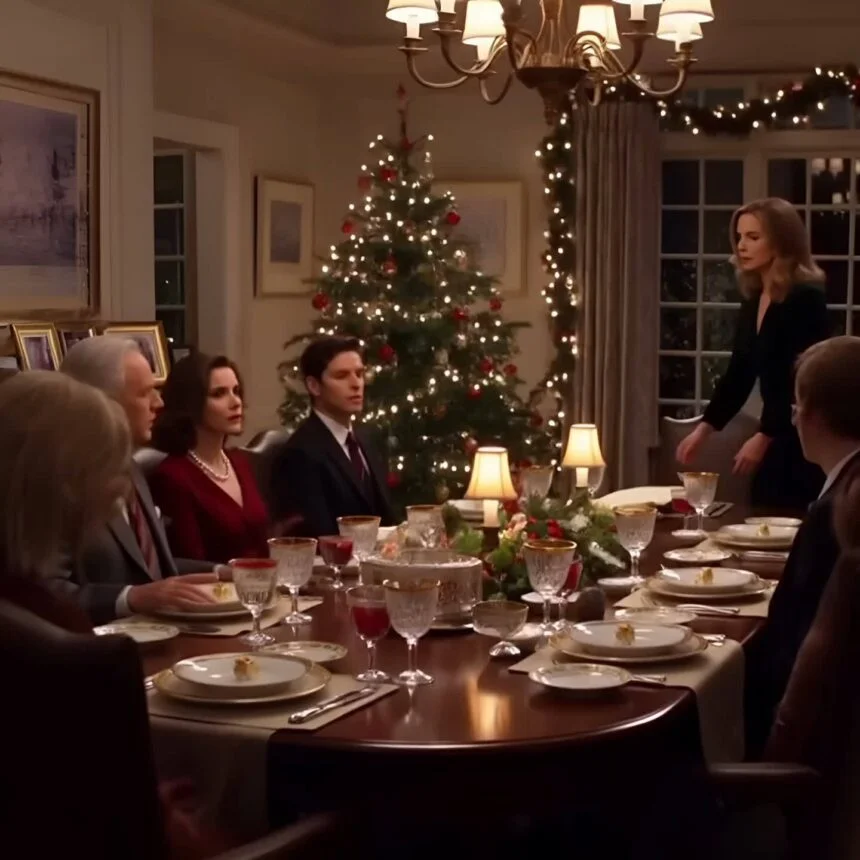
Fifteen years ago, I stared at eight empty chairs at my own wedding and a text calling me a disgrace. I swore I would never ask for a scrap of their validation again. But this morning, the moment my $680 million hotel chain hit the news, my phone buzzed.
Family dinner. 7:00 p.m. It wasn’t an invitation.
It was a summons. I’m going. But the only thing I’m bringing to their table is a trap.
My name is Delilah Hughes, and for the first twenty-six years of my life I was told my value was directly tied to how well I could disappear into the background of a photograph. I was trained to be the silent accessory to my father, Gordon Waverly, a man who treated real estate and fatherhood with the same cold calculation. The day I truly became myself was the day I ceased to exist to him.
It was fifteen years ago. The air in the bridal suite was stagnant, smelling of hairspray and expensive lilies. I was staring at myself in the mirror, adjusting the lace on a dress that cost more than most people made in a year.
My phone buzzed against the marble vanity. A single vibration—short and dismissive. I picked it up.
The sender name was simply Father. Do not expect us. You have disgraced this family.
Two lines. No punctuation, no hesitation, no second thoughts. I read it once.
Then I read it again. I didn’t drop the phone. I didn’t scream.
I felt a strange, icy calm settle over my chest, like a heavy door closing in a drafty room. The disgrace he was referring to wasn’t a crime or a scandal. It was my refusal to marry the son of his biggest rival—a merger disguised as a marriage.
Instead, I had chosen Ethan Pierce, a structural engineer with calloused hands, a calm voice, and a bank account that my father found laughable. My stepmother, Lenora, had hinted at this outcome. She’d smiled that tight porcelain smile of hers during the rehearsal dinner, telling me that choices had consequences.
But I hadn’t believed they would actually do it. I hadn’t believed they would leave the bride’s side of the church entirely empty. I walked out of the suite.
The wedding coordinator, a woman with a headset and a permanently stressed expression, turned toward me with wide eyes. She knew. Everyone knew.
The gossip had likely outrun me down the hallway. “Delilah,” she whispered, glancing toward the entrance where my father should have been waiting to walk me down the aisle. “We can wait—maybe traffic—”
“Open the doors,” I said.
My voice didn’t shake. “Are you sure?”
“Open. The doors.”
The organ music swelled.
The heavy oak doors swung outward. As I stepped into the nave of the church, the silence that fell over the room was heavy enough to crush bone. I looked straight ahead.
To my left, the groom’s side was packed—friends, colleagues, Ethan’s boisterous and warm family, all squeezed into the pews. To my right, the first two rows were desolate. Eight chairs.
Eight mahogany chairs with velvet cushions reserved for the Waverly family sat empty. They looked less like furniture and more like tombstones. I could feel the gaze of three hundred guests drilling into the side of my face.
I could hear the rustle of silk as people leaned in to whisper. Where is Gordon? Where is Lenora?
Is Blair not even here? I walked alone. I didn’t rush.
I forced myself to take every step with agonizing precision. One, two, three. I held my head high, not out of pride but because I refused to give them the satisfaction of seeing me stare at the floor.
At the altar, Ethan stepped forward. He broke protocol. He didn’t wait for me to reach him.
He walked down the steps and met me halfway up the aisle. He took my hand, his grip warm and solid. “I’ve got you,” he whispered.
“I know,” I replied. And I did. But as I stood there and recited my vows, part of me wasn’t thinking about love.
Part of me was thinking about those eight empty chairs, and the text message burning a hole in my mind. The reception was a blur of pity. That was the worst part.
I could handle anger. I could handle judgment. Pity was a slow poison.
Ethan’s mother, a wonderful woman who’d spent her life teaching elementary school, kept hugging me. She squeezed my arm every time she passed, giving me sad, watery smiles. His cousins went out of their way to pull me onto the dance floor.
They were filling the void with kindness, packing the empty space my family had left with aggressive warmth. But every kind word felt like a reminder of what was missing. Every “You look beautiful, honey,” sounded like, “You poor orphan.”
Halfway through the night, I went to the bathroom just to breathe.
I looked at my reflection. I was Mrs. Delilah Hughes now.
The Waverly name was gone—not just legally, but by decree from the man who’d given it to me. I made a decision then. I washed my hands, dried them on a linen towel, and looked myself in the eye.
I would not cry over them. I would not send a letter asking for reconciliation. I would not play the victim in their narrative.
If I was a disgrace, I would be a disgrace so successful they would choke on it. The war began the next morning. I tried to use my credit card to pay for the hotel incidentals.
Declined. I tried the backup card. Declined.
I called the bank. The account—a trust I’d had access to since I was eighteen—was closed. Not frozen.
Closed. The car I drove, technically leased under my father’s company, was gone from the hotel parking lot when we went outside. He’d sent a tow truck while I was sleeping.
“Okay,” Ethan said, standing on the curb with our suitcases. He looked at the empty parking spot, then at me. He didn’t panic.
“Okay. We take a cab.”
“He’s cutting me off,” I said, my voice flat. “This isn’t a temper tantrum, Ethan.
He’s trying to starve us out. He thinks I’ll come crawling back in a week when I realize I can’t buy groceries.”
Ethan laughed—short, dry. “He really doesn’t know you, does he?”
We moved into a walk-up apartment in a neighborhood my stepmother would’ve locked her car doors driving through.
Fourth floor. No elevator. The radiator hissed like a dying animal, and the bedroom window didn’t quite close, letting in the constant drone of traffic.
It was the first home I’d ever lived in that didn’t have a housekeeper. It was perfect. We sat on the floor that first night, eating pizza out of the box because we hadn’t unpacked the plates yet.
“We have $17,000 in savings between us,” Ethan said, looking at a spreadsheet he’d drawn in a notebook. “If we’re careful, that lasts us four months. I can pick up extra shifts at the firm.
I can do freelance drafting on weekends.”
“No,” I said. I took the pen from him. “You keep your job.
You’re the stability. I’m the risk.”
“What are you going to do?” he asked. “I’m going to learn.”
“My father builds buildings.
He owns half the skyline, but he doesn’t know how to run them. He hires people to do that. I’m going to learn the one thing he thinks is beneath him.”
“Service.”
I got a job three days later at a mid-range business hotel near the convention center.
I didn’t apply as a manager, even though I had a business degree. I applied for the front desk. The pay was minimum wage.
The hours were the graveyard shift from eleven at night to seven in the morning. For the next two years, I lived in a state of perpetual exhaustion. I slept in four-hour bursts.
I smelled like industrial cleaner and stale coffee. But I was awake in a way I had never been in the Waverly mansion. I bought a black Moleskine notebook.
Every night, standing behind that laminate counter, I took notes. I didn’t just do the job. I dissected it.
I tracked the guests. Why did the businessman in room 304 always complain about noise? Because the HVAC unit on the roof vibrated through a steel beam directly above his room.
I wrote: Structural acoustics affect guest retention. I watched the housekeeping staff during shift changes. I timed them.
I realized the way the linen carts were stocked wasted twelve minutes per floor because the maids had to walk back and forth to the service elevator for fresh towels. Twelve minutes per floor. Ten floors.
Seven days a week. Hundreds of paid hours vanishing into thin air. I wrote: Logistical inefficiency is invisible profit leakage.
I learned that a guest would forgive a small room, but they would never forgive a rude greeting. I learned that luxury wasn’t about gold faucets. It was about anticipation.
It was about knowing the guest needed water before they asked. My coworkers thought I was intense. They saw a woman with dark circles under her eyes scribbling furiously into a notebook at three in the morning.
They didn’t know I was building a blueprint. One night, about eighteen months in, the regional manager came for a surprise inspection. His name was Mr.
Henderson, a man in his sixties who’d started as a bellboy and worked his way up. He’d seen everything. He found me in the back office reorganizing the filing system because the current one made check-in take forty seconds too long.
“You’re not supposed to be back here,” he said, standing in the doorway. “The alphanumeric system is inefficient for corporate accounts,” I said, not looking up. “I switched it to a frequency-based sorting method.
It cuts check-in time by fifteen percent.”
Mr. Henderson walked over. He picked up my black notebook, which was sitting on the desk.
I stiffened. That book was my mind. He flipped through the pages.
He read my notes on HVAC vibrations. He read my analysis of linen cart logistics. He read my breakdown of the profit margin on the continental breakfast versus the waste cost of perishable fruit.
He closed the book and looked at me. For the first time, someone in this industry looked at me and didn’t see a tired front desk clerk. He saw a shark.
“Who are you?” he asked. “I’m Delilah Hughes,” I said. “You’re wasting your time behind a desk, Mrs.
Hughes,” he said. “But you know that. You’re just gathering intel.”
“I’m learning the machinery,” I corrected.
“You have the eye,” he said, tapping the notebook against his palm. “You see the money falling through the cracks. Most people just see a hotel.
You see a system.”
That night, Mr. Henderson sat with me for two hours. He told me about a property coming onto the market.
A disaster of a building. A money pit. “No bank will touch it.
No developer wants it,” he said. “It’s a wreck. But the bones are good.
If someone with discipline—not just money, real discipline—got their hands on it, they could turn it.”
He gave me his card. He gave me a contact at a small credit union that specialized in high-risk small business loans. He opened a door.
Just a crack. But it was all I needed. I went home that morning as the sun was coming up.
I walked into our small apartment. Ethan was already awake, drinking coffee and getting ready for the site. He looked at me, seeing the strange energy vibrating off me.
I went to the drawer where we kept our important papers. I pulled out our wedding album. We had never really looked at it.
It was too painful. I opened it to the centerfold. There it was.
The wide shot of the ceremony. The beautiful vaulted ceiling of the church, the flowers, and there, on the right side, the gap—the eight empty chairs. They looked like missing teeth in a smile.
I traced the empty space with my finger. I didn’t feel the sting of tears this time. The sadness had calcified into something harder, something useful.
I felt cold, sharp, and ready. My father had thought that by absenting himself, he would make me disappear. He thought that without the Waverly name I would fade into the gray noise of the world.
He was wrong. He’d given me the ultimate freedom. I had nothing to lose and no one to thank.
I closed the album and looked at Ethan. “From now on,” I said, my voice steady in the morning light, “they’ll hear my name, and they’ll hear it in the way they hate the most. They’ll hear it associated with something they can’t claim, can’t control, and can’t ignore.”
“We’re doing it?” Ethan asked.
He knew what I meant; we’d talked about it in hypotheticals for months. “We’re doing it,” I said. “I found the first one.”
That was the beginning.
I was twenty-six, tired, and broke. But I was no longer a daughter waiting for approval. I was a CEO in waiting.
And I had a lot of work to do. Sleep became a concept rather than a reality. In those first few years, I worked three distinct jobs.
By day, I was a consultant for a struggling catering company, helping them trim food waste costs. By night, I worked the front desk at a different hotel, archiving every mistake their management made into my mental database. On weekends, I helped Ethan with administrative work for his engineering projects.
We were running on caffeine and a terrifying amount of ambition. We saved every cent that didn’t go to rent or basic sustenance. My shoes were worn down at the heels.
My coats were threadbare. I stopped getting haircuts. To the outside world, it looked like we were drowning.
We weren’t drowning. We were holding our breath. Then I found it.
It was a Tuesday in November, raining hard enough to flood the gutters. I was walking between jobs, taking a shortcut through a historically significant but currently neglected district. I looked up and saw a building.
The Sterling. The neon sign was missing three letters, so in the rain it just read THE S IN. It was a forty-room boutique hotel squeezed between two office buildings.
The location was technically perfect—three blocks from the financial district, four blocks from theater row. It sat on a corner that thousands of people walked past every day. Yet nobody looked at it.
It was invisible because it was mediocre. I walked in. The lobby smelled of damp wool and lemon polish that was trying too hard to mask mildew.
The receptionist was on her phone, chewing gum, and didn’t look up for forty-five seconds. The carpet was frayed. The furniture was a clash of three different decades.
But I looked at the ceilings. High, with original crown molding that had been painted over in garish beige. I looked at the flow of the room.
The elevator placement was central. The bones of the building were solid steel and brick. It was a queen wearing rags.
I did the research that night. The owner was an absentee landlord living in Florida, tired of the maintenance costs. The hotel was bleeding money.
The occupancy rate hovered around thirty percent. He wanted out. The price was low.
Suspiciously low, in real estate terms. A price that usually meant the building was haunted or structurally unsound. I brought Ethan to see it two days later.
He walked through the lobby, tapped the walls, checked the basement, and looked at the plumbing. “The boiler needs replacing,” he said, wiping dust from his hands. “The electrical is outdated but safe.
The roof probably has a leak on the north side.”
“Can we fix it?” I asked. “I can fix the structure,” he said. “The question is, can you fix the reputation?”
“Give me six months,” I said, “and I’ll make this place the hardest reservation to get in the city.”
The problem was the money.
Even at the fire-sale price, the down payment was more than our scraped-together savings. We were short by a significant amount. I spent three nights staring at spreadsheets, trying to find a mathematical miracle.
I considered high-interest loans. I considered selling jewelry, but I’d left all the Waverly diamonds behind. On the fourth night, Ethan came home late.
He placed a small blue bank book on the kitchen table. “It’s done,” he said. I opened it.
It was a cashier’s check. The amount was $120,000. I stared at him.
“Ethan, no. If this fails, you lose everything. This is your safety net.”
“This is my grandmother’s inheritance,” he said quietly.
“And my retirement fund. And the stocks I bought when I was twenty-two.”
The air left my lungs. He sat down across from me and took my hands.
His palms were rough, warm, and steady. “You’re my safety net, Delilah. I’m not betting on a building.
I’m betting on you. I’ve watched you for two years. You’re the sharpest operator I’ve ever seen.
If I leave this money in a mutual fund, it grows by six percent a year. If I give it to you, you’ll build something that lasts.”
He didn’t ask for a partnership agreement. He didn’t ask for a controlling stake.
He didn’t ask to be chairman. He just pushed the check across the scratched table. “Go buy our empire,” he said.
We bought The Sterling. The next hurdle was operating capital. I needed money for renovations, payroll, linens that didn’t feel like sandpaper.
I went to a local bank that claimed to support small businesses. The loan officer was a man named Mr. Wu Gables.
He had a weak chin and a habit of staring at my forehead instead of my eyes. He looked over my application, then looked at me. “Mrs.
Hughes,” he said, leaning back in his chair, “you have experience at a front desk. That’s admirable. But running a hotel is a different beast.
Do you really know what you’re doing? Perhaps your husband should be here for this conversation.”
I didn’t blink. I reached into my bag and pulled out a binder.
I opened it to page one. “Mr. Gables,” I said, my voice low and precise, “the current revenue per available room in this district averages $80.
The Sterling is currently performing at $32. By cutting the laundry outsourcing and bringing it in-house, I save fourteen percent on overhead immediately. By reconfiguring the lobby to include a coffee bar, I create a secondary revenue stream that captures foot traffic from the adjacent office buildings.
I have a vendor lined up for linens who will give me net-60 terms. “I don’t need my husband to explain these margins to you. I need you to sign the paper so I can make your bank interest.”
He blinked, looked at the numbers, and looked at me again.
The condescension evaporated, replaced by a nervous respect. I walked out of there with the loan. The next four months were a blur of drywall dust and bleach.
We couldn’t afford a full construction crew, so Ethan and I did the demolition ourselves at night. I learned how to sand floors. I learned how to glaze windows.
I learned that physical pain is temporary, but a bad finish on a banister is forever. I renamed the hotel. The Sterling was dead.
The Meridian was born. But the physical renovation was the easy part. The hard part was the culture.
I hired a staff of twelve. Some were industry veterans who’d been burned out. Others were kids with zero experience.
I gathered them in the unfinished lobby for orientation. “We’re not a luxury hotel yet,” I told them. “We don’t have gold taps.
We don’t have a spa. But we have something the Ritz doesn’t have. “We have memory.”
Most hotels teach their staff to be invisible or servile.
I taught mine to be present. “We don’t fawn,” I said. “Fawning is cheap.
It makes the guest feel powerful but isolated. We treat them with dignity. We’re warm, but we are not servants.
We are hosts. There’s a difference. “If a guest is rude, you don’t apologize for existing.
You solve the problem with a straight spine.”
I created the guest profile system. It was a physical card catalog behind the desk at first. Every time a guest checked in, we noted something.
Did they ask for extra pillows? Did they drink the complimentary water immediately? Did they struggle with the stairs?
When Mr. Vance, a traveling salesman from Ohio, checked in for the second time, I had a firmer pillow waiting on his bed and a list of local steakhouses printed out because he’d asked about “good meat places” on his last visit. He came down to the desk an hour later.
“How did you know?” he asked. “It’s my job to know, Mr. Vance,” I said.
He booked his next six trips with us on the spot. That was the turning point. It wasn’t marketing.
We couldn’t afford billboards. It was word of mouth. It was the review on a travel forum that read: The rooms are small, but the staff treats you like you’re the only person in the city.
Our occupancy rate climbed. Forty percent. Sixty percent.
Eighty percent. Six months in, we hit ninety-five percent occupancy for three consecutive weeks. I sat in the small back office staring at the month-end report.
The numbers were black. Deep black. We’d covered the mortgage, the loan payment, payroll—and we’d generated a profit of $18,000.
Ethan came in, covered in drywall dust from a side project on the third floor. He looked at the screen. “We did it,” he said.
“We should celebrate. Dinner. A real dinner.”
I looked at the number.
$18,000. It was enough for a vacation. Enough for a down payment on a better apartment.
Enough to buy a dress that would make me look like a Waverly again. “No,” I said. I picked up the phone and dialed the supplier for high-end acoustic insulation.
“What are you doing?” Ethan asked, smiling because he already knew the answer. “Room 204 has a noise-complaint history because of the street traffic,” I said. “We’re soundproofing the street-facing wall.
And I’m upgrading the Wi-Fi routers for the business center. And I’m giving the housekeeping staff a five-percent raise to lock in their loyalty.”
I looked at Ethan. “We don’t eat the seed corn, Ethan.
We plant it. I don’t want a good month. I want a fortress.”
We reinvested every single dollar.
We lived in the same cramped apartment. I wore the same three suits. But the Meridian got sharper, faster, better every day.
Then came the vulture. A local real estate investor named Mr. Conincaid requested a meeting.
He was a small fish in the city, but he had cash. He sat in my lobby, looking around at the bustling space, the fresh flowers, the efficient staff. “You’ve done a nice job, little lady,” he said.
He actually used those words. “I’m willing to take this off your hands. I’ll give you a lump sum.
You pay off your debts, walk away with maybe $200,000 in your pocket. Nice profit for a year’s work. You and your husband can buy a house in the suburbs.”
He slid a term sheet across the table.
I looked at the paper. $200,000 clear profit. It was tempting.
It was safety. It was the end of the eighteen-hour days. It was a ticket to a normal life.
I looked up at Mr. Conincaid. I saw my father in him—the same arrogance, the same assumption that everyone has a price and that women eventually get tired of the fight.
“Mr. Conincaid,” I said, sliding the paper back without touching it, “you seem to be under the impression that I built this hotel to sell it.”
“Everyone sells eventually,” he smirked. “Smart people sell at the top.”
“This isn’t the top,” I said, leaning forward.
“This is the foundation. I’m not building one hotel. I’m building a chain that will make the name Waverly look like a footnote in the history books.
“Two hundred thousand dollars isn’t an exit strategy. It’s an insult.”
He laughed, standing up. “You’re arrogant.
You’re one bad season away from bankruptcy.”
“Get out of my lobby,” I said. “And when you come back in five years to ask for a job, wear a better tie.”
He left. I sat there, my heart hammering against my ribs.
I’d just turned down a fortune. I’d just bet everything again on the long haul. I walked over to the front desk.
My night manager, a young woman named Sarah whom I’d trained from scratch, looked at me nervously. “Everything okay, Mrs. Hughes?” she asked.
“Everything is perfect, Sarah,” I said. “Call the floral supplier. Tell them we’re doubling the order for the lobby.
We’re going to need more lilies.”
I wasn’t selling. I was just getting started. The Meridian wasn’t just a business.
It was a weapon. And I was sharpening it. If the first hotel was a battle for survival, the second was a test of sanity.
The third through the fifteenth were a masterclass in engineering a nervous system. Most people think scaling a business is just doing the same thing more times. They’re wrong.
When you run one hotel, you can touch every wall. You know if the receptionist is having a bad day because you can see her eyes. When you run five, you’re blind.
When you run fifteen, you’re paralyzed—unless you build a second brain. I spent the three years after stabilizing the Meridian building that brain. I called it the Hughes Standard.
It was a digital and operational manual that dictated everything. It defined how many seconds it should take to greet a guest—under five. The exact angle at which the duvet corners must be tucked—forty-five degrees.
The precise script for handling a double-booking crisis. I became obsessed with consistency. A guest waking up in my Seattle property had to feel the exact same level of care as a guest waking up in my Chicago property, even if the architecture was completely different.
I wasn’t building a chain of hotels. I was building a chain of trust. This period is where I earned my reputation for being ruthless.
The industry began to whisper about the “dragon lady of the Meridian,” a nickname I quietly adored. They called me that because of my hiring policy. I had a simple rule: I paid twenty percent above the market rate for every single position—from dishwasher to general manager.
If the Marriott paid $15 an hour, I paid $18. If the Hilton paid a manager $80,000 a year, I paid $96,000. But the trade-off was absolute.
I remember firing a general manager at our fourth location, a beautiful historic renovation in Boston. His name was Julian. He was brilliant with numbers—he’d cut food costs by twelve percent in two months.
But I watched him on the security feed one afternoon. A housekeeper had dropped a tray of glasses in the lobby. It was an accident.
Julian didn’t help her. He stood over her, pointing at the mess, his body language aggressive and demeaning while guests walked by. I flew to Boston the next morning.
I walked into his office while he was on a conference call. I waited for him to hang up. “Delilah,” he smiled, standing.
“To what do I owe the pleasure? Did you see the quarterly report? Our EBITDA is up eight percent.”
“I saw the lobby feed from yesterday,” I said.
His smile faltered slightly. “Oh, that. Just a clumsy maid.
I handled it. We need to be stricter with breakage.”
“You’re fired, Julian,” I said. He laughed, thinking it was a joke.
“Excuse me? I’m the best-performing manager in your portfolio.”
“You’re a toxicity risk,” I replied. “I pay you a premium to be a leader, not a warden.
You watched a sixty-year-old woman get on her knees to pick up glass and you didn’t lift a finger. That is not the Hughes Standard. Pack your things.
Security will escort you out in ten minutes.”
“You’re making a mistake,” he hissed. “You can’t run a business on feelings.”
“I’m not running it on feelings,” I said, checking my watch. “I’m running it on culture.
Toxic management leads to high turnover. High turnover destroys guest consistency. Inconsistency kills the brand.
“You’re a liability. Goodbye, Julian.”
That story spread through the company like wildfire. The message was clear: the Hughes Meridian had a heart for service, but management had teeth.
We attracted the best talent because they knew they’d be paid well and protected from tyrants. Our turnover rate dropped to single digits in an industry where fifty percent was normal. With the team locked in, we expanded aggressively.
I didn’t build new towers. I didn’t have the capital for skyscrapers yet. I bought distress.
I looked for the grand old dames—historic hotels in city centers that had fallen into disrepair, owned by families who’d lost interest or corporations trimming fat. I bought them for the value of the land, gutted the interiors, and injected the Hughes Standard. Ethan was instrumental here.
He left his firm to become my chief technical officer. He oversaw every renovation. We had a rhythm.
I found the deal and crunched the numbers. He assessed the bones and managed the build. We were a machine.
We slept maybe six hours a night. But we were building something that was ours. By year seven, we had five hotels.
By year ten, we had twelve. By year twelve, we had fifteen prime locations across the United States. The media began to take notice.
But I played a different game than my father. Gordon Waverly loved cameras. He loved charity galas, ribbon cuttings, seeing his face in the society pages.
I did the opposite. I refused interviews. I declined awards.
I let the hotels speak for themselves. The silence created a vacuum, and the business press rushed to fill it with mythology. A major industry publication ran a six-page feature titled “The Phantom CEO.” They described me as a data-driven savant who’d risen from nowhere.
They speculated about my background. They didn’t know I was a Waverly. I’d legally changed my name to Delilah Hughes years earlier.
My family had erased me so thoroughly that no one made the connection. I was no longer Gordon Waverly’s disappointing daughter. I was Delilah Hughes, the woman who turned rust into gold.
We reached a tipping point in the fourteenth year. The cash flow was immense. We were no longer scraping by.
We were sitting on a mountain of liquidity. I decided it was time to stop hiding behind the generic Meridian name. It was time to put a stamp on the world that couldn’t be washed off.
I initiated a total rebrand. We consolidated the fifteen properties under a single flagship identity:
Hughes Meridian Hotels. It was a declaration.
Me putting my husband’s name—the name my father had sneered at—in neon on top of fifteen skylines. And then came the valuation. We were preparing for a large-scale refinancing to fund international expansion.
I hired one of the Big Four accounting firms to conduct a comprehensive audit and valuation of the enterprise. They spent three weeks digging through my books. They analyzed our assets, intellectual property, brand equity, projected earnings.
I was sitting in the boardroom of our headquarters, a sleek glass-walled office in Chicago, when the lead auditor presented the final binder. “Mrs. Hughes,” he said, adjusting his glasses, “it’s impressive.
Your debt-to-equity ratio is better than Hyatt’s. Your operational margins are the best in the mid-luxury sector.”
“The number,” I said, tapping the table. “Give me the number.”
He slid the paper across the polished wood.
$680,000,000. I stared at the figure. It was so large it felt abstract.
But I knew what it meant. It meant I was worth more than my father. It meant the disgrace who’d been cut off without a penny was now a titan.
The news broke three days later. Forbes put me on the cover. Not a society-page mention.
The cover. The photo was stark: me in a black suit, arms crossed, looking directly into the lens. No smile.
No softening. The headline read: THE $680 MILLION SECRET: HOW DELILAH HUGHES BUILT AN EMPIRE IN THE SHADOWS. The morning the magazine hit stands, my phone exploded.
Vendors, old classmates, bankers, rivals—everyone wanted a piece of me. I let the calls go to voicemail. I sat in my office, looking at the city skyline, drinking lukewarm tea.
I thought I’d feel triumphant. Instead, I felt a cold, sharp clarity. I’d done it.
I’d climbed the mountain barefoot, bleeding and alone. I’d reached the summit without asking them for a single handhold. I was in the middle of a strategy meeting with my VP of Marketing, discussing the launch of our London property.
The room buzzed with energy. “The projection for the London opening is strong,” she was saying. “If we leverage the Forbes article, we can pre-sell fifty percent of the suites.”
“Do it,” I said.
“But control the narrative. Focus on the product, not the personality. I don’t want this to become a celebrity circus.”
My personal phone, face-down on the table, vibrated.
A specific vibration pattern. Long, short, long. I froze.
Only three people had that number: Ethan, my lawyer Harlon, and a number I’d blocked fifteen years ago but had never forgotten. I picked up the phone. The screen glowed in the dim room.
It was a text from a number ending in 440. My father’s private line. Family dinner.
7 p.m. Important business. Five words.
No hello. No congratulations. No I’m sorry for missing fifteen years of your life.
No I’m sorry for leaving you at the altar. Just a command. He’d seen the magazine.
He’d seen the $680 million. And suddenly the daughter he’d thrown away like garbage was useful again. The audacity of it took my breath away.
It was so perfectly, predictably Waverly. He thought he could whistle and I’d come running back to the kennel. “Delilah?” my VP asked, noticing my silence.
“Is everything all right?”
I looked up. The room seemed to tilt slightly. I looked at the text again:
Important business.
He didn’t want a reunion. He wanted something. You don’t summon a shark to dinner unless you need to clear the water—or unless you’re bleeding and need protection.
I felt a smile touch my lips, but it wasn’t a happy smile. It was the smile of a general who has just seen the enemy expose their flank. “Everything’s fine,” I said, flipping the phone back over.
“Better than fine.”
I looked at the city stretching out below. Fifteen sets of lights on that skyline were mine. He wanted a family dinner.
He wanted the prodigal daughter to return. “Clear my schedule for tonight,” I told my assistant. “But you have the investors’ call at eight,” she stammered.
“Cancel it,” I said, standing and smoothing my jacket. “I have a prior engagement. It seems I’ve been summoned.”
I wasn’t going as Delilah Waverly, the scared girl in the wedding dress.
I was going as Delilah Hughes, CEO of a $680 million empire. And I wasn’t bringing a peace offering. I was bringing a reckoning.
I didn’t text back. Instead, I walked out of the conference room and went straight to the secure server room on the forty-second floor, where my head of internal audit, a man named Marcus, kept his office. Marcus was a former forensic accountant for the federal government.
He could find a missing dime in a billion-dollar budget. He looked up, surprised to see the CEO standing in his doorway. “I need a full workup,” I said, my voice completely devoid of familial warmth.
“Waverly Industries. Gordon Waverly. The personal accounts, the holding companies, the real estate portfolio.
I want to know everything that’s not on their glossy brochures—and I need it in two hours.”
Marcus didn’t ask why. He saw the look in my eyes. He nodded and started typing.
I spent the next two hours pacing in my office and watching Chicago move below me. I felt a strange sensation in my stomach. Not fear.
Adrenaline. My father thought he was the predator summoning a wayward sheep. He had no idea he was inviting a wolf into his living room.
At four o’clock, Marcus walked in. He looked pale, holding a tablet. “It’s bad, Delilah,” he said.
“It’s not just a downturn. It’s a collapse.”
I took the tablet. The numbers screamed in red.
“Walk me through it,” I ordered. “Waverly Industries is leveraged at nearly ninety percent,” Marcus explained, pointing to a graph that looked like a cliff. “Your father bet big on commercial office space three years ago.
The market shifted. The buildings are empty. He’s carrying three major loans that are about to mature.
The banks are not refinancing. They’re calling the notes.”
I swiped through the documents. It was worse than incompetence.
It was desperation. He’d moved money between shell companies to hide losses. He’d taken personal loans against the Waverly estate—the house I grew up in.
“He’s insolvent,” I whispered. “He’s technically bankrupt right now,” Marcus confirmed. “He’s just juggling paperwork to keep the balls in the air for a few more weeks.
He has less than $200,000 in operating cash. He can’t make payroll next month.”
I set the tablet down. The picture was complete.
He didn’t want a family reunion. He wanted a lifeline. He wanted to plug the hole in his sinking ship with my $680 million.
He probably had a contract already drawn up, disguised as some kind of partnership or “legacy consolidation.”
But something nagged at me. Gordon Waverly was a narcissist. He was also a man of immense pride.
To beg his banished daughter for money was a humiliation he would avoid until the gun was literally at his temple. Why now? Why not six months ago when the loans first went bad?
There was a missing piece. A legal piece. I needed a different kind of expert.
I searched my memory for a name I hadn’t spoken in years. Harlon Keats. He’d been a junior associate at the law firm my father used when I was a child.
I remembered him because he was the only one who looked me in the eye at my mother’s funeral. He’d been involved in the administration of her estate—a small inheritance that had supposedly vanished into market losses under my father’s guardianship. I found him.
He had his own firm now, a boutique practice specializing in high-stakes estate litigation and corporate fraud. I called his office. His secretary tried to schedule me three weeks out.
“Tell him it’s Delilah Hughes,” I said. “Tell him it’s about the Waverly signature.”
I didn’t know if that still meant anything. Thirty seconds later, Harlon was on the line.
His voice sounded like gravel grinding against steel. “I wondered when you’d call,” he said. “Be here in twenty minutes.”
His office wasn’t in a glass tower.
It was in a brownstone on the north side, filled with the smell of old paper and leather. He was older now, hair completely white, but his eyes were sharp and terrifyingly calm. He didn’t offer me coffee.
He pointed to a chair. “You saw the Forbes article,” he stated. “My father saw it,” I corrected.
“He texted me. He wants dinner.”
Harlon laughed, a dry, humorless sound. “Dinner?
Is that what he’s calling an ambush?”
“I know he’s broke,” I said. “I ran the numbers. He’s drowning.
He needs my capital.”
“He needs more than your capital, Delilah,” Harlon said, leaning forward. “He needs your clean hands. If he goes under, the auditors come in.
If the auditors come in, they find the bodies.”
A chill ran down my spine. “What bodies?”
“Financial ones,” Harlon said. “Your father’s been playing a shell game for twenty years, but he’s out of shells.
If he declares bankruptcy, a court-appointed trustee tears his books apart. He needs to merge with a solvent, legitimate entity to bury the evidence. He needs to mix his toxic water with your clean wine so no one can taste the poison.”
“He wants to acquire me,” I realized.
“He wants to absorb Hughes Meridian to save himself.”
“He’ll frame it as a legacy move,” Harlon warned. “He’ll talk about family unity, ‘stronger together.’ He’ll try to guilt you. If that fails, he’ll try to bully you.
“And if that fails, he’ll try to destroy you.”
“He can’t destroy me,” I said. “I built this. He has no leverage.”
Harlon looked at me with something close to pity.
“He’s your father. He knows where the buttons are because he installed them. Don’t underestimate the power of a drowning man.
He’ll pull you down just to get one more breath of air.”
“I’m going tonight,” I said. “Don’t go,” Harlon advised. “I have to,” I said.
“If I don’t, he’ll keep coming. I need to end this. I need to look him in the eye and close the door so tight he never knocks again.”
Harlon sighed.
He opened a drawer and pulled out a fresh legal pad. “If you go,” he said, “you don’t go as a daughter. You go as a hostile party.
We prepare right now.”
For the next hour, we war-gamed the dinner. Harlon was brilliant. He outlined every trap my father would set.
Trap one: the emotional appeal. Counter: silence. Let them talk until they contradict themselves.
Trap two: the minority-stake offer. Counter: refuse to sign anything without full due diligence and independent valuation. Trap three: the threat of scandal.
Counter: the nuclear option. “I need a weapon,” I said. “Something that makes him afraid to attack me.”
Harlon looked at me for a long moment.
The room was silent except for the ticking of a grandfather clock. “I have something,” he said slowly. “I’ve kept it in a safe deposit box for twenty years.
I was a junior lawyer then. I was scared. I didn’t want to lose my license.
I didn’t want to lose my life.”
“What is it?”
“Your mother’s estate,” Harlon said. “The money that started Waverly Industries. The seed capital that built his first skyscraper.
He told you it was lost in the market crash, didn’t he?”
“Yes,” I said. “He said it was unfortunate timing.”
“It wasn’t lost,” Harlon said. “It was transferred.
Three days before she died. While she was in a coma.”
My blood ran cold. “That’s impossible.
She couldn’t sign.”
“Exactly,” Harlon said. He reached into his briefcase and pulled out a thin folder. It looked innocuous—just a few sheets inside a manila cover—but as he slid it across the desk toward me, it felt heavy.
“This is a copy,” he said. “The original is in a vault in Zurich. This shows the transfer authorization.
And this—” he tapped the bottom of the page “—is the signature.”
I looked at it. My mother’s name. But the loop on the L was wrong.
The slant was too sharp. It was a forgery. A good one, but a forgery.
“He stole it,” I whispered. “He didn’t just inherit it. He stole it from a dying woman.”
“And from you,” Harlon added.
“That money was supposed to go into a trust in your name. He bypassed the trust. He took it all to build his empire.
Every brick he owns, every dollar he’s spent for twenty years, is fruit of the poisonous tree. “It’s fraud, Delilah. Major criminal fraud.”
I touched the paper.
My hand trembled—not with sadness, but with rage. Pure, white-hot rage. All those years he called me a disgrace.
All those years he looked down on me for being unsuccessful. He was a thief in a custom suit. “If you use this,” Harlon said softly, “you burn him to the ground.
He goes to prison. The company dissolves. The name Waverly becomes synonymous with theft.”
“He called my wedding a disgrace,” I said, my voice steady now.
“He left me with nothing. He watched me struggle to buy groceries while he spent my mother’s money on country clubs.”
I stood. I picked up the folder.
“I want you to come with me tonight,” I said. “Where?”
“To dinner.”
His eyebrow lifted. “You’re not going alone,” I said.
“I’m bringing my legal counsel. If they want to talk business, let’s talk business.”
Harlon smiled—a sharp, sharklike smile. “I’ll get my coat,” he said.
We left his office and climbed into my car. I told the driver the address: the Waverly estate. The house where I’d spent a lonely childhood.
I took out my phone and finally typed a reply to my father’s text. See you at 7. I checked my reflection in the rearview mirror.
Charcoal-gray suit, sharp enough to cut glass. Hair pulled back tight. No jewelry except my wedding band—the simple gold ring Ethan bought me when we had nothing.
I looked at the folder on the seat beside me. They thought I was the main course. They had no idea I was the health inspector.
And I’d just found the rats in the kitchen. As the car pulled up to the iron gates of the mansion, a calm settled over me. The fear and hesitation were gone.
“Let’s go make them regret they ever learned how to read,” I said to Harlon. The gates opened. We drove in.
The trap was set. They were the ones standing on the X. The iron gates swung open not because they recognized my car, but because Harlon buzzed the intercom and simply said, “She’s here.”
I stepped out and looked up at the house.
A sprawling neoclassical beast of limestone and arrogance. Fifteen years ago, I’d left this house through the side door, crying, dragging a suitcase that contained my entire life. Tonight, I walked up the main steps.
I didn’t ring the bell. I turned the handle of the massive double doors and walked in. The foyer was exactly as I remembered it.
Checkered marble floor, chandelier that cost more than a small house, the smell of beeswax and old money. A butler I didn’t recognize stepped out from the shadows, flustered. “Ma’am, you can’t just—”
“Take my coat,” I said, slipping off my trench without looking at him.
I held it out in midair. For a second, he hesitated. Then, conditioned by a lifetime of servitude to people who expected obedience, he took it.
“And Mr. Keats’s coat as well,” I added. Harlon stood beside me, a silent gray ghost.
He handed over his coat with a polite nod that somehow seemed more threatening than a glare. We walked into the dining room. They were already seated.
My father, Gordon Waverly, sat at the head of the table. He looked older. His jawline had softened, and there was a frantic energy in his eyes that Botox couldn’t hide.
To his right sat Lenora, my stepmother, wearing a dress that was too tight and diamonds that were too big. To his left was Blair, my half sister. When we entered, the air left the room.
“Delilah,” my father said. He didn’t stand. He gestured to the empty chair opposite him.
“You’re late.”
“I’m on time,” I said, checking my watch. “It’s seven o’clock exactly. You were always early to things you were desperate for.”
“Father.”
I saw a muscle twitch in his jaw.
“And you brought a guest,” Lenora said, her smile stretching thin like plastic wrap over leftovers. She looked at Harlon, squinting. “This is Harlon Keats,” I said, taking my seat.
“My legal counsel.”
Gordon’s fork clattered against his plate. He remembered. He stared at Harlon, eyes narrowing.
Harlon had been a junior lawyer when my mother died. A loose end Gordon thought had been tied off. “I asked for a family dinner,” Gordon said, his voice dropping an octave.
“Not a deposition.”
“I don’t sign contracts without my lawyer,” I said, placing my napkin in my lap. “And since you called this meeting to discuss ‘important business’ four hours after my valuation hit the news, I assumed there’d be paperwork.”
“It’s just dinner, Delilah,” Blair sighed, rolling her eyes. At thirty-five, she still acted like a bored teenager.
She took a sip of wine, her gaze flicking to the diamond tennis bracelet on my wrist. She was assessing my net worth in real time. “God, you always have to make everything so dramatic.
Can’t we just eat?”
The staff brought out the first course: lobster bisque. I didn’t touch it. I sat with my hands folded, watching them.
“So,” Gordon said, clearing his throat, trying to project the image of the benevolent patriarch. I could smell the fear on him—scotch and desperation. “I saw the Forbes article.
Impressive numbers. Although valuations are often inflated. The market is fickle.”
“My numbers are audited,” I said calmly.
“By Deloitte. Are yours?”
The silence that followed was heavy. Lenora took a quick, nervous sip of water.
“We’re not here to compare bank accounts,” Gordon said quickly. “We’re here to talk about the future. The Waverly legacy.”
He signaled to the butler, who brought over a leather portfolio and placed it beside Gordon’s plate.
Gordon slid it across the table. It stopped inches from my untouched soup bowl. “I’ve been thinking,” he said, leaning back.
“You’ve done well. Better than I expected, frankly. But a hotel chain needs more than good management.
It needs heritage. The weight of a dynasty. “I have a dynasty,” I said.
“It’s called Hughes Meridian.”
“It’s a startup,” he scoffed. “A successful one, but a startup. Waverly Industries has been a pillar of this city for forty years.
What I’m proposing is a merger. A reunification of the family assets.”
Harlon reached out and opened the portfolio. He began to read, face expressionless.
“A new holding company,” Gordon continued, his voice gaining momentum. “The Waverly Hughes Group. We consolidate the assets.
We leverage the combined equity to dominate the market. “I’ll remain as chairman of the board, naturally, to handle the politics and the city planning commissions. You’ll come on as chief operating officer.
You run the day-to-day. You do what you’re good at—the towels and the service. I handle the empire.”
I looked at him.
It was almost funny. He was drowning in debt. His ships were sinking, and he was offering to let me board his wreck if I promised to bail out the water while he wore the captain’s hat.
“So,” I said softly, “you want to absorb my $680 million solvent company into your debt-ridden real estate firm. You want to use my liquidity to pay off your loans. And in exchange… I get to be your employee again.”
“You get to be a Waverly again,” Lenora interjected, her voice shrill.
“Delilah, think of the social standing. The Hughes name, well, it’s fine for business—but it’s not society. The Waverly name opens doors.”
“The Waverly name is currently toxic,” Harlon said, not looking up.
“I’m reading your proposed structure. Class A shares for Gordon Waverly with ten-to-one voting rights. Class B shares for Delilah Hughes with no voting rights.
“This isn’t a merger. This is a theft.”
“Watch your mouth,” Gordon snapped, slamming his hand on the table. “It’s a standard protective structure.”
“It’s exploitation,” Harlon replied.
Blair slammed her wine glass down. “It’s a gift!” she shouted. “You walked away.
You left us. We stayed and kept this family together. Now you come back with your millions and you think you’re better than us.
You owe this family. You carry the blood. You owe us.”
I looked at Blair.
I saw the panic behind her anger. She knew the money was gone. She knew her credit cards were about to be declined.
I didn’t yell back. I did what I’d learned to do in a thousand negotiations. I let the silence stretch.
I looked at Gordon. Then Lenora. Then Blair.
I let them sit in their own discomfort. “Is that all?” I asked finally. “Delilah, be reasonable,” Gordon said, changing tactics.
He leaned forward, trying to look fatherly. “I’m offering you protection. The market is going to turn.
You’re a woman alone in a brutal industry. You need a roof over your head that can’t be blown away. “I built this family’s fortune from nothing.
I made the hard choices. I know how to survive.”
“You made the hard choices?” I repeated. “Yes,” Gordon said, emboldened.
“Twenty years ago, when your mother died, we were in a precarious position. The market had crashed. I had to be creative.
I had to move mountains to keep us afloat. I saved this house. I saved your future.
That capital, that initial push—that came from my sweat and my risk.”
There it was. The rewrite. He’d forgotten who was sitting next to me.
Harlon closed the portfolio. The sound was like a gunshot in the quiet room. “Your sweat?” Harlon asked, his voice rasping.
“Is that what we’re calling it now?”
Gordon frowned. “Excuse me?”
“You said you saved the family with your risk,” Harlon said. “But the timeline doesn’t match.”
He flipped a page.
“Twenty years ago, Waverly Industries was insolvent. You were days away from liquidation. Then suddenly, three days before your first wife passed away, a massive injection of capital appears in your offshore accounts—four point two million dollars.
Enough to clear your debts and buy the waterfront property that made your career.”
Gordon’s face went the color of ash. “That was an inheritance,” he muttered, trying to wave it away with a trembling hand. “A private matter.”
“It was an inheritance intended for a trust,” I said.
I picked up my wine glass, swirling the red liquid, watching it coat the sides. “A trust for me. “But it never reached the trust, did it, Father?”
“I don’t know what you’re talking about,” Gordon said.
His voice shook. He glanced toward the door, as if checking for an escape route. “We’re talking about the signature,” I said.
I looked him dead in the eye. “Harlon has the file. The transfer authorization from the Zurich account, dated three days before Mom died.
She was in a coma. She couldn’t lift a finger, let alone sign a complex financial instrument.”
The room went so quiet I could hear the refrigerator humming in the distant kitchen. Blair looked between us, mouth slightly open.
“You forged it,” I said. It wasn’t a question. “You took her hand—or maybe you just practiced until you got it right.
You stole four million dollars from a dying woman and her ten-year-old daughter to save your own ego.”
“That is a lie,” Gordon whispered. “You have no proof.”
Harlon rested his hand on his briefcase. “We have the forensic handwriting analysis,” he said calmly.
“We have the bank records. And we have the statement from the retired notary public you bribed. He was very willing to talk when we reminded him of the statute of limitations on fraud versus the benefits of immunity.”
Gordon slumped in his chair.
The arrogance evaporated. He looked small. A thief in a dinner jacket.
“You… you wouldn’t,” he stammered. “You’re right,” Lenora whispered, panic finally breaking through. “Delilah, think of the scandal.
If this comes out, we’re ruined. All of us. You too.
The press will drag the name through the mud.”
“I don’t use the name Waverly anymore,” I said coldly. “I’m a Hughes. My name is clean.”
I stood.
Harlon rose with me. “You invited me here to steal my company,” I said, looking down at my father. “You thought you could bully me into signing away my life’s work to cover your failures.
You thought I was still the little girl who cried because you wouldn’t look at her.”
I placed my hands on the table and leaned in. “I am not that girl. And I am not here to negotiate a merger.”
Gordon looked up at me.
His eyes were wet. “What do you want?”
“I want the truth,” I said. “And I want you to understand exactly where you stand.
You’re not the chairman. You’re a criminal who’s been living on borrowed time and stolen money for two decades.”
I picked up the untouched glass of wine and set it down firmly. “If you want to take my company,” I said, my voice slicing through the air, “then ask yourself this: are you brave enough to tell the world where your money actually came from?
Because if you don’t sign what I give you next, I’ll tell them for you.”
I nodded to Harlon. He opened his briefcase and pulled out the thick document we’d prepared. It hit the table with a heavy thud.
“Read it,” I said. “You have until dessert.”
The document sat between us, thick stack of paper bound with a black clip. No one moved.
Steam from the forgotten main course curled into the air and dissipated. Harlon didn’t wait for them. He flipped the cover open and turned it so it faced my father.
“Exhibit A,” he said, voice flat. “Bank of Zurich. Routing number ending in six-seven-eight.
October 14th, 2004. Transfer of four point two million dollars from the late Mrs. Waverly’s personal account to GW Logistics, Cayman Islands.”
“That’s an old account,” Gordon muttered.
“Closed years ago. What’s the point of digging up ancient history?”
“The point,” I said, leaning back, “is the origin of the funds. I didn’t just audit your current books, Father.
I audited your life.”
I spoke like I was delivering a board presentation. “October 14th,” I said. “Four point two million dollars withdrawn from my mother’s holding fund.
Legally designated for a trust in my name. October 16th: the same amount is wired into GW Logistics. October twentieth: my mother dies.
“You didn’t save the company with your sweat. You saved it with my inheritance. And you did it while she was hooked up to a ventilator.”
“It was a loan,” Gordon snapped.
“She agreed. We discussed it before she got sick. It was a verbal agreement.”
“A verbal agreement?” Harlon repeated, as if it were a bad joke.
“The bank required a signature for a transfer of that magnitude.”
He tapped the page. “We had it analyzed by a former FBI document examiner. The pressure points are wrong.
The loop on the L doesn’t match. There’s a hesitation mark at the apex, a micro-tremor that occurs when someone is copying a shape instead of writing from muscle memory. “It’s a forgery, Gordon.
And not even a particularly good one.”
Lenora hissed, “This is ridiculous. You’re accusing your own father of a felony based on squiggles.”
“I’m accusing him of wire fraud, bank fraud, and embezzlement,” I said. “And the statute of limitations on fraud that was actively concealed resets the moment the concealment is discovered—which was this morning.”
Gordon stared at the tablecloth.
He knew I had the power to put him in a federal prison. “You won’t do it,” he said finally. His eyes hardened.
“You won’t go to the authorities.”
“Why not?” I asked. “Because you’re a Hughes now,” he sneered, clawing at his last leverage. “You’re the cover of Forbes.
You’re the CEO of a $680 million brand. You crave respectability. “If you drag me into court, you drag yourself into the mud.
‘CEO’s father arrested for fraud. Hughes heiress sues her own family.’ Investors hate drama. You know that, Delilah.
“You won’t tank your own stock price just to hurt me.”
He picked up his wine glass, taking a long drink, thinking he’d cornered me. He thought the only thing I had was the threat of scandal. “You’re right,” I said softly.
“I don’t like scandal. It’s messy. It creates volatility.”
Gordon smiled—a smug, victorious smile.
“Exactly. So put that file away. We can work out a payment plan.
I’ll pay you back the four million with interest over ten y—”
“You misunderstand the situation,” I said. “The fraud file is just the opener. Just to establish character.
To remind you you’re a criminal.”
I leaned forward. “The real issue isn’t what you did twenty years ago. It’s what you did three years ago.”
Gordon frowned.
“What?”
“The Sovereign Bridge loan,” I said. The color drained from his face so fast it was like watching a curtain drop. “Forty-two million dollars,” I continued.
“Secured against the entire Waverly real estate portfolio—including this house. Balloon payment, high interest. You took it out to fund the Waterfront Heights project, but the project stalled.
The zoning permits were denied. And the loan…” I paused. “The loan is due.”
“It’s under negotiation,” Gordon stammered.
“I’m talking to the bank. They’re going to extend the term.”
“They were going to,” Harlon said. “Until last week.”
“Last week?” Blair asked, finally understanding that the ground was moving.
“What happened last week?”
“The bank sold the debt,” I said. “That’s common practice,” Gordon said, his voice rising. “Banks sell bad debt all the time.
It doesn’t matter who holds the paper. I can negotiate with them.”
“Can you?” I asked. Harlon pulled a thin blue folder from his briefcase and slid it across the table.
It stopped in front of Gordon. “The debt was purchased by a private equity shell called Northstar Assets,” I said. “You wouldn’t have heard of them.”
“I own Northstar Assets, Father.”
Silence.
“I bought your debt,” I said, spelling it out. “The notes on your office buildings. The notes on the unfinished construction sites.
The mortgage on this house. I paid eighty cents on the dollar because the bank was convinced you were going to default. They were happy to get rid of you.”
Gordon stared at me.
He wasn’t looking at a daughter anymore. He was looking at his creditor. “You—” His voice cracked.
“You own the debt?”
“I’m your creditor,” I said. “And unlike the bank, I’m not interested in an extension. I’m not interested in renegotiating terms.
“The loan is in default as of forty-eight hours ago.”
Lenora let out a strangled sound. “What does that mean?”
“It means,” Harlon said, “that Mrs. Hughes has the legal right to initiate foreclosure proceedings immediately.
She can seize the collateral. All of it.”
“The house?” Blair whispered. She looked around the dining room—the silk wallpaper, the crystal chandelier, the life she’d taken for granted.
“You can’t take the house. We live here.”
“It’s an asset,” I said coldly. “Just like the hotels I bought and renovated.
It’s bricks and mortar collateralizing a bad loan.”
Blair stood. “Mom, do something. She’s lying, right?
She can’t just kick us out.”
Lenora wasn’t looking at Blair. She was looking at the diamond bracelet on her own wrist, then at the table settings—as if tallying what she could fit in a suitcase. The facade of the perfect stepmother had shattered.
She looked old, tired, terrified. “You planned this,” Gordon whispered. “You didn’t come here for dinner.
You came here to kill us.”
“I came here to finish what you started,” I said. “Fifteen years ago you sent me a text on my wedding day and told me I’d disgraced the family. You cut off my access to my own money.
You tried to starve me into submission so I’d marry a man I didn’t love to secure a merger for you. “You taught me business is war, Father. You taught me that family is a resource to be exploited.
“I learned my lesson. I just learned it better than you expected.”
“I’m your father,” he shouted, slamming his fist down. “You ungrateful child.
I gave you life.”
“And then you tried to ruin it,” I said, my voice like granite. “Don’t talk to me about gratitude. You stole my mother’s legacy.
You ignored my existence for a decade and a half. Tonight, you tried to trap me into a partnership so you could steal my company to cover your incompetence. “You’re not a father.
You’re a liability.”
I stood. Smoothed the front of my suit. The power dynamic in the room had flipped so completely that the air felt thin.
They were sitting in chairs that effectively belonged to me, eating food paid for by credit I now controlled. “Here’s the situation,” I said. “I have two piles of paper on this table.
“Pile A is the fraud evidence that goes to the district attorney. “Pile B is the foreclosure notice that goes to the sheriff. “There’s a third option.”
I nodded to Harlon.
He pulled out the final document—a settlement agreement, thick, comprehensive, brutal. “You sign this,” I said. “You transfer full control of Waverly Industries to Northstar Assets.
You step down from the board and the chairmanship. You liquidate the remaining assets to pay off a portion of the principal. “And the house?” Blair asked, voice small.
“The house is collateral,” I said. “But I’m not a monster. I’ll give you a grace period.”
I leaned in close to my father.
“You sign the agreement. You admit to the mismanagement privately, in writing, so I have it on record. You walk away.
“Or I trigger foreclosure and file the fraud charges tomorrow morning.”
Gordon looked at the contract. He looked at Lenora, weeping into her napkin. He looked at Blair, staring at me like I was a stranger.
“You want my company?” he rasped. “My name?”
“I don’t want your name,” I said. “I have my own.
I want the truth.”
I tapped the contract. “Sign it, or in ninety days the locks on the front door get changed and everything in this house becomes the property of Hughes Meridian Hotels.”
I checked my watch. “You have until I finish my water.”
I picked up the glass and took a slow, deliberate sip.
The only sound in the room was the scratching of a pen. He was signing his own obituary. But I wasn’t done.
“Don’t sign yet,” I said. He froze. “That’s just the financial settlement,” I continued.
“That covers the debt and transfer of assets. We’re not finished discussing the terms of your surrender.”
Gordon looked up, eyes bloodshot. “You have the company.
You have the house. You have the debt. What more could you possibly want?”
“Clarity,” I said.
“Guard rails. I want to make sure that five years from now, when the dust settles, none of you try to rewrite history. “I’m installing non-monetary covenants.”
I nodded to Harlon.
He turned to a section titled NON-MONETARY PROVISIONS AND PUBLIC DECLARATIONS. “Condition number one,” I said. “A total, permanent renunciation of any claim to Hughes Meridian Hotels.
“You will not tell the press you mentored me. You will not tell your country-club friends you gave me my start. You will sign a statement acknowledging that I built this enterprise independently, without Waverly capital or Waverly counsel.
“You will admit that any reconciliation is solely at my discretion.”
“You want me to sign a paper saying I was a bad father?” Gordon sneered. “I want you to sign a paper saying you were an irrelevant one,” I corrected. “There’s a difference.”
“Condition number two,” I continued.
“The apologies. “They’ll be written by my legal team. They’ll be formal.
They’ll be released to the industry trade journals and local business press. No ‘mistakes were made’ passive voice. “You will admit that the separation between us was the result of your decision to disown me—and that any current association is professional, not paternal.”
“People will talk,” Lenora whispered.
“They’ll say we were cruel.”
“People are already talking,” I said. “They just have the wrong story. I’m correcting the record.”
I turned to her.
“Condition number three applies to you, Lenora. You will cease all image-rehabilitation efforts for Gordon using my brand. “I know you’ve been hinting to gala organizers that Hughes Meridian might sponsor the autumn ball if they give Gordon a keynote slot.
That ends tonight. “If I see my logo on an invitation next to his name, I will sue the organizers and I will sue you for trademark infringement.”
Lenora paled. Social capital was the only currency she valued as much as money.
I had just marked it to zero. Then I turned to Blair. “And you,” I said.
“I didn’t do anything,” she muttered. “I just live here.”
“You spent two hundred fourteen thousand dollars on a corporate credit card in the last eighteen months,” I said. Harlon slid a bank statement toward her, thick with highlighted rows.
Designer handbags. First-class flights to Milan. Spa treatments.
All charged to Waverly Logistics Consulting—a subsidiary with no clients and no revenue. “That’s not ‘living here,’ Blair,” I said. “That’s embezzlement.
You were treating a dying company like a personal piggy bank while employees were facing layoffs.”
Blair looked at her father, but Gordon wouldn’t meet her eyes. “You will repay forty percent of that sum,” I said. “I’m being generous.
The IRS would demand all of it and put you in handcuffs. “You’ll liquidate your personal assets—the jewelry, the car, the closet—and you’ll write a check to the creditors. Consider it your first lesson in actual economics.”
“I can’t,” she whispered, tears finally spilling.
“I don’t have that kind of money.”
“Then you’ll get a job,” I said. “I hear retail is hiring.”
Finally, I turned back to my father. “Condition number four,” I said, my voice dropping.
“The name. “As of the moment you sign this document, the name Waverly is retired from the business world. “You will dissolve the holding company.
You will not register new LLCs, corporations, or nonprofits using the name. You will not license it. You will not franchise it.”
“You can’t do that,” Gordon said, horror finally overcoming rage.
“That’s my name. That’s my legacy.”
“Your legacy is fraud,” I said. “The name Waverly is now synonymous with bad debt and stolen inheritances.
I’m doing the market a favor. “You can be Gordon Waverly at home, Father. But in the boardroom, the name does not exist.
It dies in this room tonight.”
He looked as if I’d struck him. For a man like Gordon, money was replaceable. Buildings were replaceable.
But his name on the side of a building was his immortality. I was stripping the letters off the skyline one by one. “And finally,” I said, “the future of the assets.
“You think I’m going to chop them up and sell them for parts.”
He said nothing. “I’m not,” I said. “I’m going to repurpose them.
“The Sterling—the first hotel I scrubbed with my own hands?” I looked around at their faces. “I’m converting it. “It will no longer be a commercial hotel.
Next month, it reopens as the Hughes Academy.”
“A school?” Lenora asked, genuinely confused. “A sanctuary,” I said. “And a training ground.
For women who’ve been financially abused. Women controlled by their families, cut off from their resources, told they’re worthless. “We’ll provide housing, legal aid, and education in business and hospitality.
We’ll teach them how to build their own empires so they never have to sit at a table like this and beg.”
I paused. “I’m using the money you stole from my mother to fund a school that teaches women how to survive men like you.”
The silence stretched. The clock on the mantle ticked.
The butler had vanished. “Sign,” I said. Gordon looked at the pen.
Looked at Lenora. At Blair. No one spoke.
He was alone. He picked up the pen. The scratching of the nib on paper sounded like a saw.
He signed the settlement. Then the apology. Then the resignation.
Then the agreement to retire the name. He pushed the papers away with a mix of disgust and exhaustion. “It’s done,” he croaked.
Harlon gathered the documents, checking every signature. He nodded to me. “We have what we came for,” he said.
I stood. The air felt lighter. “You have ninety days to vacate the property,” I said, addressing the room.
“The foreclosure process is formal, but I own the debt. I control the timeline. “Don’t damage the fixtures.
My team will conduct a walk-through.”
I walked toward the double doors, my heels echoing on marble. I didn’t look back. I didn’t need to.
I knew exactly what they looked like. Three ghosts haunting a house that no longer belonged to them. In the foyer, Harlon was putting on his coat when Gordon’s voice drifted from the dining room.
“She thinks she’s won,” he muttered. “She thinks ink on paper stops a war. She has no idea what happens when you corner a wild animal.”
My hand hovered over the doorknob.
Harlon froze. “Did you hear that?” he asked. “I heard it,” I said.
“He’s just venting. He’s powerless, Harlon. We stripped him of his assets, his name, his reputation.”
“You stripped him of the things you value,” Harlon said quietly.
“Honor. Money. Legality.
“A man like Gordon doesn’t play by the rules of the contract he just signed. He signed it because he had to—not because he agrees with it. “He has nothing left to fight with.”
“He has spite,” Harlon said.
“And nothing left to lose. That makes him dangerous. He won’t attack you with money anymore.
He’ll attack you with something else.”
“Let him try,” I said, opening the door to the crisp night air. “I’m ready.”
“I hope so,” Harlon murmured. “Because that wasn’t a resignation speech.
“That was a threat.”
For three days, there was silence. The kind of silence that happens when the tide pulls back right before a tsunami hits. I went to work.
I signed contractor approvals for the academy renovation. I monitored the foreclosure timeline on the Waverly estate. I allowed myself to believe that ink on the settlement agreement was actually binding.
I should have listened to Harlon. The counterattack didn’t come in the form of a lawsuit. Gordon knew he’d lose in court.
He didn’t have the money for a legal war, and he knew the signature forgery was a silver bullet. So he chose a battlefield where evidence matters less than emotion. He chose the court of public opinion.
It started on a Wednesday morning. I was drinking coffee, reviewing the first-semester curriculum for the Hughes Academy, when my VP of Communications burst into my office. She didn’t knock.
Her face was pale. She grabbed the remote and turned on the wall-mounted TV. A morning talk show.
The kind housewives and retirees watch. The kind that thrives on sob stories. There, sitting on a beige couch, looking frail, confused, and utterly defeated, was my father.
He was wearing an old cardigan I’d never seen in my life. No Rolex. No tailored suit.
He looked like a grandfather who’d been kicked out into the snow. Beside him sat a woman I recognized—a crisis PR specialist known for being a pit bull in designer lipstick. “I just don’t understand it,” Gordon was saying, his voice trembling perfectly.
“I raised her. I gave her everything. And now, to take the family home?
To evict her own sister?”
He sniffled theatrically. “I offered to merge our companies. I wanted to build something together.
But she’s so angry. She’s become so cold.”
The host leaned in, her face twisted into sympathetic outrage. “And you’re saying she’s doing this because of a grudge?
A childhood grudge?”
“She calls it business,” Gordon said, wiping a nonexistent tear. “But how can it be business to throw your seventy-year-old father onto the street? She has hundreds of millions of dollars.
She doesn’t need the house. “She just wants to hurt us.”
I watched, stone-faced. It was a masterclass in manipulation.
He’d omitted the debt, the fraud, the forgery. He’d spun a narrative where I was a ruthless corporate shark devouring the kindly aging patriarch. By noon, the internet was burning.
#HeartlessHughes was trending. People who knew nothing about balance sheets left one-star reviews on my hotels, calling me a monster. Then came the second wave.
At two o’clock, my director of operations for the academy project called. “We have a problem with the city,” he said. “The zoning board just put a hold on our occupancy permit.”
“On what grounds?” I demanded.
“We passed inspection last week.”
“Anonymous tip,” he said. “Someone filed a formal complaint alleging the academy is a front for a tax-evasion scheme and that the building has structural failures you covered up. They’re freezing the license pending a full investigation.
“Delilah… this could take six months. We’re supposed to open in two weeks.”
I hung up and stared out the window. Gordon wasn’t trying to win the company back.
He knew that was impossible. He was trying to burn down my reputation so that when I finally opened the academy—my legacy—it would be tainted. He wanted the world to look at my school for abused women and see a monument to hypocrisy.
Harlon arrived an hour later. “He hired Vanguard,” Harlon said, naming the PR firm. “They’re expensive.
And they play dirty.”
“He doesn’t have money,” I said. “I control his accounts.”
“He has friends,” Harlon corrected. “Old boys from the club who hate seeing a woman win.
Or he borrowed from someone worse than a bank. It doesn’t matter how he paid for it. “The narrative is setting in wet cement.
If you don’t break it now, it hardens forever.”
“So what do I do?” I asked. “Go on TV and scream he’s a liar? Then I look like I’m just in a domestic squabble.
I look guilty.”
“If you stay silent, you’re guilty by default,” Ethan said from the corner. He’d left a site inspection to be there. “You have to fight.”
“I’m not going to fight,” I said.
They both stared at me. “I’m going to audit,” I said. “Set up a press conference.
Not at the hotel—at the academy. Tomorrow morning at nine. Invite everyone.
Business press, tabloids, bloggers. All of them.”
“What’s the angle?” my VP asked. “Radical transparency,” I said.
“He wants to tell a story. I’m going to show them the math.”
The next morning, the lobby of the academy—formerly The Sterling—was packed. The air smelled of fresh paint and nervous energy.
I didn’t set up a stage. I stood at floor level behind a simple podium. Behind me, on a massive screen, was a blank white slide.
I walked out. I wasn’t wearing a power suit. I wore a white shirt and black trousers.
I looked like a worker. Cameras flashed. “Yesterday,” I began, my voice clear and amplified, “accusations were made about my character, my business practices, and my relationship with Waverly Industries.
“I’m not here to cry. I’m not here to tell you how I feel. “I’m here to show you where the money went.”
I clicked the remote.
The screen behind me filled with a spreadsheet. Complex, yes, but the highlighted rows were simple. “This,” I said, pointing, “is the ledger for the Waverly Family Trust, dated twenty years ago.
You’ll see a withdrawal of $4,200,000.”
I clicked again. “This is the deposit slip for a Cayman Islands shell company controlled by Gordon Waverly, dated two days later.”
A murmur rippled through the crowd. “My father claims I’m evicting him out of spite,” I continued.
“The truth is, I purchased a distressed debt note that was forty-eight hours away from foreclosure by a commercial bank. “If I hadn’t bought it, the sheriff would have been at his door last week. He would have lost the asset entirely.
I granted him ninety days. The bank would have given him zero.”
I looked directly into the main camera. “But words are cheap,” I said.
“So I brought people who have no reason to lie for me.”
Mr. Henderson walked out. Retired now, leaning on a cane, but eyes bright.
“I managed hotels for forty years,” he said into the mic. “I met Delilah when she was scrubbing floors and working nights. She didn’t have a trust fund.
She didn’t have a father helping her. She had a notebook and a work ethic that scared me. “I watched her build this business from a single broken-down building.
Gordon Waverly never visited. Not once.”
The reporters typed furiously. Then a second witness—Mrs.
Higgins, former bookkeeper for Waverly Industries, fired five years earlier. “I worked for Mr. Waverly ten years,” she said, voice trembling but strong.
“I was fired when I refused to recategorize personal expenses as business losses. I saw the bills. Vacations.
Jewelry. Cars. All paid with company loans.
“The company isn’t bankrupt because of the market. It’s bankrupt because they ate it.”
I stepped back to the mic. “I’ve uploaded the full unredacted audit of the Waverly portfolio to a public server,” I announced.
“The link is live. You can see the loans, the defaults, the forensic analysis of the forged signature that misappropriated my mother’s estate.”
I paused. “I’m building this academy to help women escape financial abuse,” I said.
“It would be hypocritical to allow my own abuser to control the narrative. “My father is not a victim. He’s a man who spent a fortune he didn’t earn, and now that the bill is due, he’s looking for someone else to pay it.
“I’m not paying it. “And neither are the women of this city.”
I walked off the stage. There were no questions.
There didn’t need to be. The data was on the screen. By that evening, the tide had turned with violent speed.
The news cycle shifted from heartless daughter to the $680 million fraud. The zoning board called at four to say the anonymous tip had been reviewed and dismissed. Our permit was reinstated.
I sat in my office watching the sunset. Ethan handed me a glass of whiskey. “You won,” he said.
“Did I?” I asked. On the TV, they replayed footage of my father refusing to comment, rushing into his car. He looked truly old now.
“He didn’t care if he won,” I said quietly. “He knew the fraud would come out if I pushed back. He knew he’d be destroyed.
“He did it anyway.”
“Why?” Ethan asked. “Because he’d rather be destroyed publicly than ignored privately,” I said. “He wanted to drag me into the mud.
He wanted to make sure that even if I won, I smelled like him.”
The victory felt hollow. I’d exposed him, yes. But I’d also engaged in the one thing I swore I never would: a public brawl with my family.
“We need to increase security,” I told Ethan. “For the opening.”
“You think he’ll try something?”
“I think he has nothing left,” I said. “A man with nothing left is capable of anything.
He’s not calculating profit and loss anymore. He’s calculating pain.”
I hired a private security firm. Not standard hotel security—executive protection.
Ex-military. They swept the academy for bugs, for sabotage. I doubled the guard at my apartment.
Two days passed. The opening of the academy was forty-eight hours away. The press called it the event of the year, mostly because of the drama.
Friday night, as I was leaving the office, my phone buzzed. Unknown number. The text:
Meet me at the diner on 4th and Main.
Back booth. Come alone. Please.
It’s about Gordon. I hesitated. Trap.
Then a second text came through. He’s gone. He took the gun from the safe.
He’s going to do something irreversible. Signed: Lenora. I stared at the screen.
Lenora—the woman who’d sneered at me for fifteen years—was reaching out. Not asking for money. Warning me.
“Ethan,” I called, grabbing my coat. “What is it?” he asked. “I have to go out.”
“I’m coming with you.”
“No,” I said.
“If she sees you, she might bolt. It’s Lenora.”
“It’s dangerous.”
“I’ll take the security detail. They can wait outside.
But if he’s planning something for the opening, I have to know what it is.”
The diner on Fourth and Main was the kind of place that smelled like frying onions and desperation. A place people go when they don’t want to be seen—or when they have nowhere else to go. I slid into the back booth, my back to the wall, watching the door.
My security team sat in an SUV across the street. Inside, I was alone. Lenora arrived at 10:08.
Unrecognizable. The polished socialite had vanished. In her place stood a woman in a buttoned-up raincoat, hair pulled back in a messy knot, eyes darting like a trapped animal.
She sat opposite me. “He borrowed money,” she said without preamble, her voice a dry whisper. “I know,” I said evenly.
“He took out loans against the company. That’s why I foreclosed.”
“No,” Lenora said, shaking her head. “Not from the banks, Delilah.
The banks cut him off six months ago. “The money for the PR firm, the lawyers, keeping the lights on at the mansion—he didn’t get that from a bank.”
She pulled a crumpled envelope from her bag and slid it across the table. I opened it.
Photocopies of promissory notes. Not on bank letterhead. Handwritten.
Signed with scrawled names I didn’t recognize—but the terms were clear. Astronomical interest. Weekly vig.
“Collateral” that sounded less like property and more like flesh. “He went to the sharks,” I whispered. “He owes them four hundred thousand dollars,” Lenora said, tears spilling.
“They called the house yesterday. They didn’t ask for him. They asked for me.
They told me they know where Blair goes to the gym. They told me they know what time you leave your office.”
Cold settled in my stomach. This wasn’t a corporate dispute anymore.
Gordon had brought violence into the equation. “Why are you telling me this?” I asked. “You stood by him for fifteen years.
You watched him cut me out. You watched him steal my mother’s money.”
Lenora stared at her hands. “Do you remember when you were twenty-four?” she asked quietly.
“Working the night shift? Your car broke down. You needed five hundred dollars for a new alternator.”
I stiffened.
“I remember. I got an anonymous envelope in my mailbox. Cash.
I thought it was Ethan’s mother.”
“It was me,” Lenora said. I stared. “I sent you money three times,” she admitted.
“Small amounts. Enough so Gordon wouldn’t notice the withdrawals. I wanted to send more.
I wanted to call you. But I was afraid of him. I was afraid of losing the lifestyle.
“I was a coward, Delilah. I chose my comfort over your safety, and I’ve lived with that shame every day.”
She lifted her eyes to mine. “I’m not asking for forgiveness.
I don’t deserve it. But he’s out of his mind. He thinks if he destroys your reputation the investors will force you to settle, and he can use the settlement money to pay off the sharks.
“He’s not trying to win a PR war anymore. He’s fighting for his life. And he’ll burn the academy to the ground if he thinks it will get him a check.”
I looked at her.
I didn’t feel warmth. I didn’t feel a sudden urge to hug her. The betrayal was too deep.
But I felt the battlefield shift. This wasn’t about pride. It was about a drowning man trying to drag me under for one last breath.
“Go to your sister’s in Vermont,” I said, slipping the envelope into my bag. “Take Blair. Leave tonight.
Don’t tell him where you’re going.”
“What are you going to do?” she asked. “I’m going to make sure he never hurts anyone again,” I said. I left the diner and called Harlon.
“Meet me at the office,” I said. “We need to change strategy. “This isn’t a lawsuit.
It’s a hostage situation.”
By midnight, my office was a war room. Harlon, Ethan, and my head of security sat around the conference table. I laid out the promissory notes.
“He’s compromised,” Harlon said, reading. “These people don’t sue. They break legs.
Gordon is acting out of terror.”
“We need to lock down the opening,” I said. “He’s going to try to disrupt it. He needs a spectacle.
He needs to prove to these loan sharks he still has power—that he can still squeeze money out of me.”
We drafted a multi-layered defense. First, legal. Emergency restraining orders for me and the academy premises, citing the threats Lenora received.
Second, media. A dossier ready to release if Gordon tried another stunt—police reports about his debts, the loan sharks, the threats. Third, physical.
Triple the security budget. Every guest screened. Off-duty police officers patrolling the perimeter.
But the most important layer was the one that made me feel like I was finally cutting the cord. At two in the morning, my phone rang. Blair.
“Delilah,” she sobbed. “He’s screaming. He’s in the study.
He’s screaming at the television.”
“Where are you?”
“In the bathroom. Locked in. Mom packed a bag.
She says we’re leaving. But he—Delilah, he isn’t making sense. He’s talking about you like you’re the devil.
He says he’s going to reveal the truth tomorrow. Says he has documents that will shut you down forever.”
“He has nothing, Blair,” I said, trying to calm her. “He’s hallucinating victory because he can’t face reality.”
“He has a gun,” she whispered.
My hand froze. “What?”
“He took the revolver from the safe,” she said. “He put it in his briefcase.
He said he needs protection for the meeting.”
“What meeting? It’s three in the morning.”
“Get out of the house,” I commanded. “Go out the window if you have to.
Get in the car with your mother and drive. Don’t stop until you cross the state line.”
“I’m scared,” she cried. “Be scared later,” I snapped.
“Be alive now. Go.”
The line went dead. I sat in the silence of my office.
The gun changed everything. He wasn’t just a desperate debtor. He was an armed, unstable man who blamed me for the collapse of his universe.
I looked at the brochure for the Hughes Academy on my desk. The cover featured the face of a woman I’d met in a shelter three months earlier. Beaten for years because she had no financial independence.
She was waiting for us to open. Fifty women like her were on the waiting list for the first semester. If Gordon stormed that stage tomorrow waving a gun—or even just screaming more lies—he wouldn’t just hurt me.
He’d traumatize every woman who walked through those doors hoping for safety. He’d turn their sanctuary into another place of violence. “He’s willing to sacrifice fifty innocent women to save his own skin,” I said aloud.
That was when the last ember of pity I held for him died. “Harlon,” I said. He jolted awake in the corner chair.
“The strategy where we just block him isn’t enough,” I said. “We can’t just play defense. If he shows up tomorrow, even if we stop him at the door, the story becomes, ‘Delilah’s crazy father causes scene.’ The focus shifts back to the drama.”
“What are you proposing?” he asked.
“We need to preempt him,” I said. “Take him off the board before the game starts.”
“You want him arrested?” Ethan asked. “On what grounds?
The fraud is real, but white-collar from twenty years ago won’t get a SWAT team tonight.”
“Not for the fraud,” I said. “For the threat. “Lenora is willing to testify about the loan sharks.
Blair will testify about the gun and his mental state. We can file for an involuntary psych hold. “A 5150.”
“That’s aggressive,” Harlon said.
“If you do that, you’re declaring him incompetent. Stripping him of agency. If we’re wrong, he sues you for false imprisonment and wins.”
“I’m not wrong,” I said.
“He’s armed. He’s unstable. He’s threatened a public event full of vulnerable women.
If we let him walk into that opening, whatever happens is on me.”
My assistant rushed in holding a tablet. “Ms. Hughes,” she said, voice shaking.
“We just picked up chatter. A press release went out from a throwaway email:
THE TRUTH ABOUT DELILAH HUGHES: A FATHER’S REVELATION. PRESS CONFERENCE TOMORROW, 10 A.M., OUTSIDE THE HUGHES ACADEMY.”
“He’s doing it,” I said.
“He’s calling the press to the sidewalk right as we cut the ribbon. He wants a confrontation.”
“He wants you to come out and argue with him,” Harlon said. “He wants cameras to see you screaming at your elderly father.”
“He wants a show,” I said.
“I’m not going to give him one.”
I walked to the window. Dawn was bruising the sky. “Call the police,” I told Harlon.
“Give them Lenora’s statement. Give them Blair’s text about the gun. Tell them Gordon Waverly is armed and mentally unstable and has threatened a public event for domestic abuse survivors.
“We’re not filing a lawsuit. We’re calling in a threat assessment. “Tomorrow, it ends.
No half measures.”
The morning of the academy opening was bright, crisp, and absurdly loud. The street outside the renovated building was a circus. Satellite trucks.
Reporters. Paparazzi who usually chased movie stars now chasing a hotelier. They weren’t here for philanthropy.
They were here for blood. I stood backstage watching the feed on a monitor. The front row was a tangle of city council members who’d tried to block my permits forty-eight hours earlier.
Now they smiled for cameras, ready to take credit for “supporting women.”
Then I saw him. Gordon. He stood near the press pit, flanked by two unfamiliar lawyers.
He looked like the ghost of the man who’d terrified me for two decades. His suit hung loose. His face was gray.
But his eyes still burned. He held a microphone connected to a portable speaker his team had set up on the sidewalk. He was ready to hijack my event.
“Target is stationary at the perimeter,” my security chief, Corbin, said into his earpiece. “Police watching him. Do you want us to remove him?”
“No,” I said, adjusting my white blazer.
“If you drag him away, he becomes a martyr. Let him stay. “Let him watch.”
I walked onto the stage.
Applause rolled weakly across the crowd. Flashbulbs exploded. I stood at the podium and looked out.
I saw the women—the first class of students—sitting in the reserved section. They looked scared. They saw the cameras, saw the angry man on the sidewalk, and wondered if they’d made a mistake.
I had to fix this. I didn’t start with the prepared empowerment speech. “I know there’s a lot of noise today,” I said, my voice echoing down the block.
“Let’s address it.”
I pointed directly at my father. The cameras swung to him. Gordon straightened, thinking this was his moment.
He raised his microphone. “Delilah!” he shouted, his voice thin over his speaker. “Tell them the truth.
Tell them how you stole this family’s legacy.”
Gasps. I didn’t flinch. “I intend to,” I said calmly.
I signaled to the AV team. The huge screen behind me—intended to show architectural renderings of the academy—went black. Then a single legal document appeared.
“Yesterday afternoon,” I said, “an emergency injunction was granted regarding the assets and intellectual property of the former Waverly Industries. “As the sole creditor and owner of the debt, I restructured the entity.”
I looked at Gordon. “You’re holding a press conference, Father, claiming to speak for the family.
To defend the Waverly name. “But you seem to have forgotten the terms of the default.”
I clicked the remote. The screen zoomed in on a highlighted clause.
“This is the brand conservatorship clause,” I explained. “As of midnight last night, the name Waverly—as a commercial or public entity—is the sole property of Hughes Meridian. “Any individual attempting to use that name to solicit funds, issue press releases, or represent the estate without written authorization from the owner—me—is in immediate violation of a federal cease-and-desist order.
“Any damages caused to the brand by such unauthorized representation trigger immediate liquidation of personal assets to cover the liability.”
Gordon lowered his microphone. His lawyers whispered frantically. They knew exactly what I’d done.
I hadn’t just sued him. I’d gagged him financially. Every word out of his mouth now carried a price tag he couldn’t afford.
“But we’re not done with the truth,” I continued. I clicked again. The screen changed to the audit trail—the anonymous tips, the IP addresses, the payments to the PR firm, the forensic report on the forged signature.
“For weeks, accusations have been made that this academy is a sham,” I said. “That I’m a ruthless predator. “The documents behind me prove that every regulatory complaint, every smear story, and every legal hurdle was manufactured by one source.
“A source who borrowed money from dangerous criminals to fund a campaign of lies against his own daughter.”
The crowd turned. The mood snapped from curious to disgusted. I stepped from behind the podium to the edge of the stage.
I was ten feet above him, looking down. “Fifteen years ago,” I said, my voice low but carrying, “you sent me a text on my wedding day. You told me not to expect you.
You told me I had disgraced the family.”
Gordon looked up. His eyes were wet. His mouth opened but no sound came out.
“I carried that word for a long time,” I said. “I let it drive me. I let it haunt me.
“Today, I’m giving it back to you.”
I took a breath. “A disgrace isn’t a daughter who marries for love. A disgrace isn’t a woman who builds her own fortune.
“A disgrace is a man who steals from his dying wife and tries to destroy his child to cover his failures. “You called my wedding a disgrace. “Today, I’m returning the true definition of that word to its rightful owner.”
The silence was absolute.
Gordon’s shoulders sagged. He dropped his microphone. It screeched against the pavement.
He turned away. His lawyers didn’t follow. The cameras didn’t follow.
He disappeared into the city. Erased by his own actions. I watched until he was gone, then turned back to the crowd.
“Enough of the past,” I said. “We have work to do.”
I handed the microphone to the academy’s director—a woman named Sarah, once my first front-desk hire. “This building isn’t about me,” I said.
“And it’s certainly not about him. “It’s about them.”
I pointed to the women in the front row. “We’re offering fifty full scholarships,” I announced.
“Housing. Legal aid. Job placement within the Hughes Meridian network.
“We’re not just giving charity. We’re giving power. “We’re teaching women they never have to stay at a table where respect isn’t on the menu.”
The applause this time was different.
It was real. Thunderous. The ceremony ended an hour later.
The press dispersed, racing to file stories about the fall of the House of Waverly. I walked through the lobby of the academy. It was beautiful.
Light streamed through tall windows, spilling across fresh marble floors. “Excuse me,” a voice said. I turned.
Blair stood near the reception desk. No designer clothes. Jeans and a simple sweater.
Face scrubbed clean. She looked younger—and for the first time, human. “I saw it on the news,” she said, voice shaky.
“I saw him leave.”
“He’s gone,” I said. “The police have a protective detail on your mother. He won’t get near you.”
“I don’t have anywhere to go,” she admitted.
She didn’t say it with a whine. She said it with a terrifying flatness. “The cards are canceled.
The house is locked. Mom’s going to stay with her sister. But I can’t go there.
I can’t be that person anymore.”
“What do you want?” I asked. “I want to work,” she said. I looked at her hands.
Manicured, soft. Hands that had never done an honest day of physical labor. “I don’t have any vice president positions open,” I said.
“I don’t want a title,” Blair said. “I want to pay you back the money I took. And I want to know what it feels like not to be afraid of the bill coming due.”
I studied her.
I saw a flicker of the girl I used to be—scared, broke, but willing to do the hard thing. “Housekeeping,” I said. Blair blinked.
“What?”
“The housekeeping team is short-staffed on the third floor,” I said. “It’s minimum wage. You scrub toilets.
You change sheets. You stand on your feet for eight hours. “If you’re late once, you’re fired.
If you complain, you’re fired. You live in the dorms with the other trainees. You pay rent out of your paycheck.”
She looked at her hands.
Then at the bustling lobby. “Okay,” she whispered. Then stronger: “Okay.
When do I start?”
“Tomorrow at six a.m.,” I said. “Don’t be late.”
She nodded. She didn’t try to hug me.
She didn’t call me sister. She turned and walked toward the service elevator. She was starting at the bottom, exactly where I had.
It was the only kindness I could offer her—the dignity of earning her own way. I stood in the center of the lobby. Staff were cleaning up.
Guests had gone. Years earlier, in this very building, I’d decided to gamble Ethan’s inheritance on a broken-down hotel. My phone buzzed.
A text from Lenora. Thank you for saving us. We won’t bother you again.
I didn’t reply. I deleted the thread. There would be no Sunday dinners.
No fake reunions. The boundary was concrete. I’d saved them from Gordon.
But not for myself. I’d done it to close the book. I looked at my reflection in the glass doors.
A woman in a white blazer. Forty-one years old. Standing in an empire she’d built with her own hands.
I searched for the anger that had fueled me for so long. For the need for revenge. It was gone.
I realized then the real victory wasn’t seeing my father walk away in disgrace. It wasn’t the $680 million. It wasn’t even the applause.
The victory was that I no longer needed them to tell me who I was. I pushed open the doors and stepped into the city. The sun was setting, painting the sky in gold and violet.
I took a deep breath of cool air. I was Delilah Hughes. And for the first time in my life, that was enough.
Thank you so much for listening to this story. I would love to know where you are tuning in from. Are you listening while driving to work in London, cooking dinner in Texas, or maybe relaxing in a café in Tokyo?
Please let me know in the comments below. I read every single one. And if you enjoyed Delilah’s journey, please subscribe to the Maya Revenge Stories channel, like this video, and hit that hype button so we can share this story of strength with more people around the world.