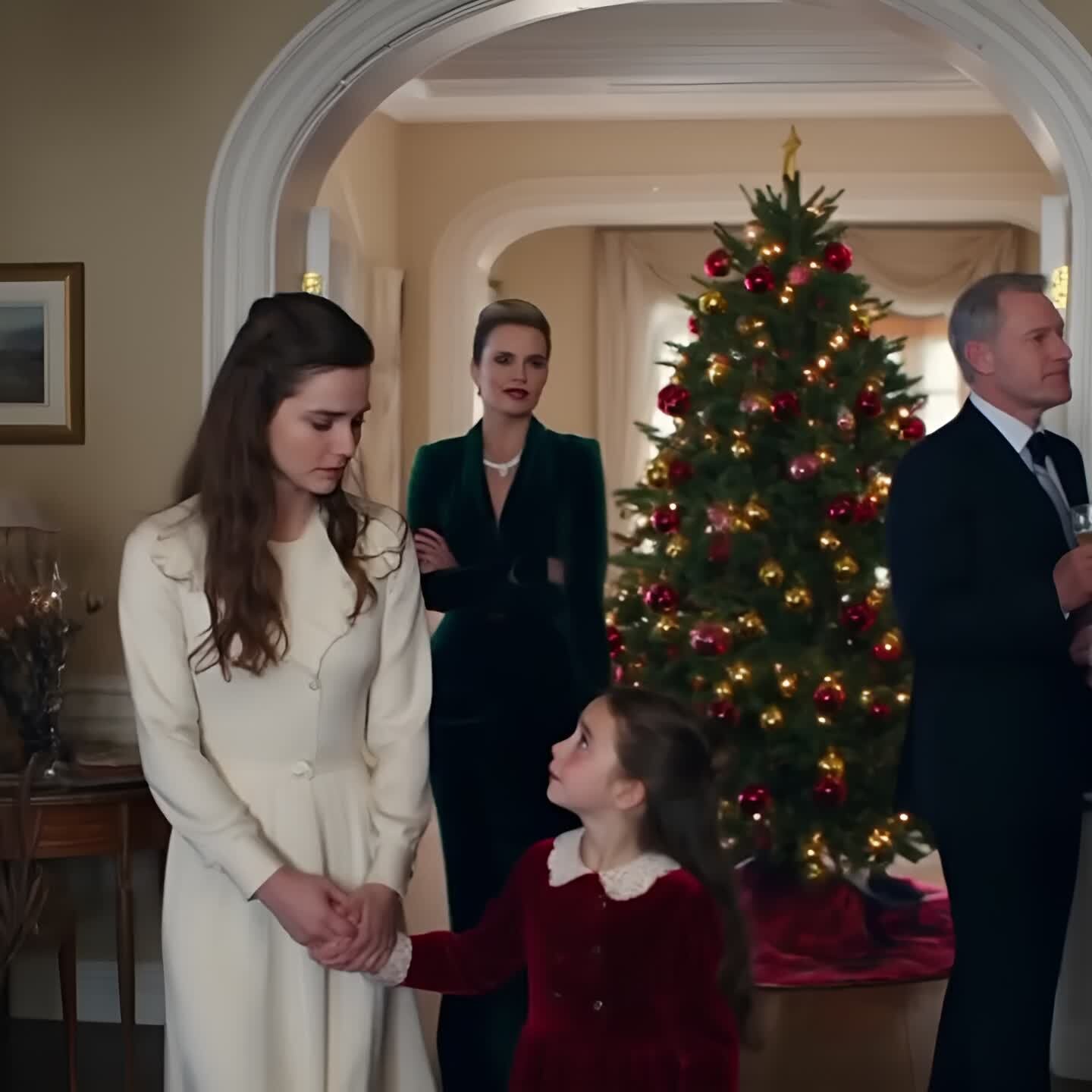
My Daughter’s Eyes Filled With Tears. My Husband Looked At The Family, Then At Our Little Girl, And Something In His Face Changed. Without A Word, He Stepped Aside, Made One Quick Phone Call, Stood Up In Front Of Everyone, And Said One Sentence That Wiped The Smiles Off Every Face In That Room.
The crystal chandeliers in my sister Victoria’s dining room caught the afternoon light as I helped my daughter Emma adjust her dress. It was a simple cotton piece from Target, clean and pressed. But next to the designer outfits swirling around us, it might as well have been burlap. The other children wore clothes with labels I recognized from magazine spreads, silk ribbons, handstitched details, shoes that cost more than our car payment.
“Mommy, do I look okay?” Emma whispered, tugging at her collar. Her voice was small, uncertain in a way it never was at home.
“You look beautiful, sweetheart,” I said, smoothing her hair.
And she did. Her natural beauty didn’t need expensive fabric to shine through.
My husband Marcus stood quietly by the entrance, his hands in the pockets of his khaki slacks. He wore a simple button-down shirt, no tie. In a room full of Armani and Versace, we were clearly the budget option.
Victoria swept past us in a champagne-colored silk dress that probably cost more than our monthly grocery bill. Her heels clicked against the marble floor as she air-kissed arriving guests.
“Darling,” she called to someone behind us. “So glad you could make it to our little gathering.”
Little gathering? There were at least sixty people here for her anniversary party. The catering staff alone outnumbered our entire extended family.
My mother approached, her expression carefully neutral. She’d mastered that look over the years, the one that said she was trying very hard not to compare her daughters.
“Sarah, you made it,” Mom said. Not happy we came, just acknowledging that we had.
“Of course. Twenty-five years is a big milestone for Victoria and James.”
“Yes. Well.” Mom glanced at Emma. “The child looks nice.”
Nice. The word hung in the air like a participation trophy.
Emma’s younger brother, six-year-old Tyler, was holding Marcus’s hand, staring wide-eyed at the elaborate dessert table, three tiers of delicacies he’d probably never seen before, arranged like edible art.
“Can I have a cookie?” Tyler asked.
Before I could answer, Victoria materialized beside us.
“Those are imported macarons from a bakery in Paris, not cookies. Perhaps the children would be more comfortable in the kitchen. The staff has some simpler options.”
Marcus’s jaw tightened slightly, but he said nothing.
“They’re fine here,” I said quietly.
Victoria’s smile was sharp. “Of course. How silly of me.”
She glided away, and I felt Emma press closer to my side.
The afternoon crawled forward. My father held court near the bar, discussing his latest real estate acquisition with James and several other men in expensive suits. My brother Daniel and his wife Stephanie were showing off photos of their recent Mediterranean cruise on an iPad. We stood near the window, observing. Always observing.
“Aunt Sarah!” my nephew Christopher, Daniel’s eldest, ran up to us. He was ten, Emma’s age. “Want to see my new watch? Dad got it in Switzerland. It costs more than a car.”
Emma looked down at her bare wrist.
“That’s very nice, Christopher,” I said.
“What did your dad get you?” he asked Emma innocently.
“A library card,” Emma said softly. “We go every Saturday.”
Christopher blinked. “Oh. That’s free, right?”
“Christopher, come here,” Stephanie called. “Show the Hendersons your watch.”
He bounded away, and I felt Emma’s small hand slip into mine.
Marcus had moved to the corner of the room. He was checking his phone, his expression unreadable. When he caught my eye, he gave a slight nod.
Everything okay?
I wasn’t sure.
Dinner was announced, and we were seated at the far end of the long table, away from the main family cluster. The message was clear. We were included out of obligation, not desire. The meal was exquisite, seven courses, each more elaborate than the last. Wine flowed freely, though Marcus and I stuck to water. We couldn’t afford to lose focus in this environment.
“So, Sarah,” James said from the head of the table, his voice carrying over the conversation, “still working at that little clinic downtown?”
“Yes,” I said. “I’m a nurse practitioner now.”
“How admirable,” Victoria interjected. “Working with the less fortunate. Very charitable of you.”
“I help people,” I said simply.
“Of course you do, dear.” Mom patted my hand. “Someone has to.”
Marcus set down his fork carefully. Very carefully.
After dinner, the adults gathered in the living room while the children were directed to the sunroom. Emma hesitated.
“Go on, sweetie,” I encouraged. “Tyler’s already in there.”
She walked away slowly, and I felt a knot form in my stomach.
Ten minutes later, she was back. Her eyes were red.
“What happened?” I knelt beside her.
“The other kids…” she started, then stopped.
Victoria appeared with several other women, all holding champagne flutes.
“Oh dear, is something wrong?”
“Emma, what happened?” I asked again, ignoring my sister.
“They said we don’t belong here. That our clothes are from poor people’s stores.”
The women behind Victoria exchanged glances. One of them, Amanda-something, whispered to another, not quite quietly enough, “Well, they’re not wrong.”
Victoria sipped her champagne. “Children can be so honest, can’t they? No filter.”
I stood up, my hand on Emma’s shoulder. “They learned it somewhere,” I said evenly.
“Oh, don’t be dramatic, Sarah. Kids notice differences. It’s natural.”
Victoria’s eyes swept over Emma’s dress, my off-brand handbag, Marcus’s department store shirt.
“Some families prioritize different things. You’ve chosen a more modest lifestyle. Nothing wrong with that.”
“There’s nothing wrong with how we live,” I said.
“Of course not.” Victoria’s voice was honey-sweet. “Discount stores serve an important purpose. Where would people shop without them? Someone has to keep Target in business.”
The other women laughed. Polite, tinkling laughs that made my skin crawl.
Emma’s tears started falling, silent, dignified tears that broke my heart.
“Victoria,” I said quietly. “That’s enough.”
“I’m simply being honest. Sarah, I love you. You’re my sister, but let’s not pretend. You show up to events in clearance-rack clothing. Your children look like they’re dressed for a garage sale, and you expect them to fit in with—”
She gestured around the room.
“All of this? Maybe it’s time to acknowledge that not everyone belongs everywhere.”
The room had gone quiet. Everyone was listening now.
“No room for your discount-store kids at this party,” Victoria said, smiling that sharp smile. “Perhaps next time a more age-appropriate gathering would be better for them. Chuck E. Cheese, maybe.”
The women behind her snickered.
Emma’s face crumpled, and that’s when Marcus stood up. He’d been sitting in a chair near the fireplace, so still I’d almost forgotten he was there. His phone was in his hand.
“Marcus,” I said.
He didn’t look at me. He looked at Victoria, then at Emma, then at the entire room full of people who’d spent the evening making us feel small. Then he made a phone call.
“David, it’s Marcus. Yes, I know it’s Saturday. I need you to pull the property file for 2847 Riverside Boulevard.” He paused. “Yes, this one. I need documentation sent to my email within the hour. Complete ownership records.”
The room was silent now. Victoria’s smile faltered slightly.
“Marcus, what are you—”
He held up one finger, still listening to his phone.
“Perfect. Also, I need you to contact the property management company. Effective immediately, I’m implementing a review of all current lease agreements.” Another pause. “Yes, all of them. Starting with the primary residence.”
He ended the call.
Then Marcus turned to face the room. His voice was calm, almost conversational.
“This house,” he said, gesturing around the ornate living room, “2847 Riverside Boulevard. Victorian architecture, six bedrooms, renovated in 2019. Estimated market value of three point two million dollars.”
Victoria laughed nervously. “Yes, James and I worked very hard to—”
“You rent it,” Marcus said simply.
The champagne glass in Victoria’s hand stopped halfway to her lips.
“I own it,” Marcus continued. “I own this house. I own the property management company that processes your lease payments. I’ve owned it since 2018, two years before you moved in.”
The color drained from Victoria’s face.
“That’s not—” James started.
Marcus pulled out his phone, tapped the screen a few times, and held it up.
“Lease agreement signed by James Hartford and Victoria Hartford. Monthly rent: twelve thousand dollars. Landlord: MW Property Holdings.”
He looked at them.
“MW—Marcus Williams. That’s me.”
My father set down his drink. “That’s not possible.”
“I also own four other properties on this street. The entire eastern block, actually. Bought them through various LLCs between 2015 and 2020. Property development has been very good to me.”
Marcus’s voice remained perfectly even.
“I kept it quiet because Sarah preferred it that way. She didn’t want family dynamics to change. She wanted to be treated normally.”
He paused, letting that sink in. The room was frozen, sixty people who’d spent hours judging us, now realizing they’d been celebrating in a building owned by the man they dismissed as beneath them.
“The law firm that handled Victoria’s lease. The inspection company that approved your renovations. I own that, too. Every upgrade you’ve made, every modification to this property passed through companies I control.”
He looked at Victoria.
“But ‘normal’ apparently means watching my daughter cry because she’s wearing a Target dress to a party in a house I own.”
Victoria’s hand was shaking. “Why would you hide this? Why would you let us think—”
“Think what?” Marcus asked. “That you were better than us? That your designer clothes and catered parties made you superior?”
He gestured to Emma.
“She’s ten years old, Victoria. She didn’t choose discount stores. We did, because we’d rather invest in her college fund and her brother’s education than in Italian leather and French macarons.”
Stephanie had gone pale. “Daniel, did you know about this?”
My brother looked like he’d been slapped.
Mom sank into a chair. “Sarah, you never said—”
“You never asked,” I said quietly. “You just assumed.”
Marcus walked over to Emma and knelt down to her level.
“Hey, kiddo. That dress? Your mom and I picked it because you love the color. You said it made you feel like a princess, remember?”
Emma nodded, wiping her eyes.
“You are a princess. And don’t let anyone tell you different.”
He stood up, keeping his hand on her shoulder. Then he looked at Victoria again.
“Your lease is up for renewal in three months. Given this evening’s events, I’ll be reviewing whether to offer a renewal or list the property for sale. I’ll let you know my decision in thirty days.”
Victoria’s champagne glass slipped from her fingers, shattering on the marble floor. The sound echoed through the silent room.
“Marcus, please,” she whispered. “This is our home, our life. We’ve decorated. We’ve invested—”
“Into a rental property,” Marcus said. “Which you can be evicted from with sixty days’ notice if the owner chooses not to renew. Standard lease terms. You signed them.”
James had gone gray. “We can’t afford to move. Not right now. The business expansion, the cars—”
“Perhaps you should have considered that before mocking my children for their clothing choices.” Marcus’s voice was ice. “Sarah wanted to come today. She wanted Emma and Tyler to know their extended family. She wanted them to feel connected to you all.”
He looked around the room at the frozen faces.
“Instead, you taught them that cruelty comes in expensive packaging.”
My father finally found his voice. “Now, let’s not be hasty. Victoria made a mistake, but—”
“A mistake is an accident,” Marcus said. “This was deliberate. Calculated. And it wasn’t just today. It’s been every family gathering for five years. The comments, the exclusions, the subtle and not-so-subtle reminders that we don’t measure up to your standards.”
He picked up Emma even though she was getting too big for it. She wrapped her arms around his neck.
“We measure up just fine,” Marcus said. “We just measure different things.”
“Wait.” Victoria’s voice cracked. “Please, can we talk about this privately?”
Marcus looked at me. I looked at our daughter’s tear-stained face, then at Tyler peeking around the doorway from the sunroom, confused by all the tension.
“No,” I said softly. “I don’t think so. Not today.”
We walked toward the door. Behind us, the silence was deafening.
“Sarah,” Mom called out. “Don’t leave like this. We can fix—”
I turned back.
“Fix what, Mom? The fact that you’ve spent five years treating my family like charity cases? The fact that you measure worth in price tags? That ends today.”
Marcus opened the front door. The evening air was cool and clean. As we reached the car, Emma spoke quietly.
“Dad, are they really going to have to move?”
Marcus buckled her into her seat. “Maybe, maybe not. That’s up to them.”
“Will we ever see them again?” she asked.
I got into the passenger seat and turned to look at my children.
“I don’t know, babies. But I know this: wherever we go, whatever we do, we’re enough. Just as we are.”
Marcus started the engine.
As we pulled away from the house worth three point two million dollars, Emma asked one more question.
“Dad, if you own all those houses, why do we still shop at Target?”
Marcus smiled, the first real smile I’d seen from him all day.
“Because Target has everything we need, kiddo. And we’d rather save money for experiences than things. Remember our camping trip last summer?”
“That was the best,” Tyler piped up.
“Better than a Swiss watch?” Marcus asked.
“Way better,” Emma said, her tears finally dry.
In the rearview mirror, I could see the lights of Victoria’s house blazing in the dusk. Inside, a family was probably having a very different conversation than they’d planned for this evening.
My phone buzzed. A text from Daniel: We need to talk. Then Stephanie: I’m so sorry. I didn’t know. Then Mom: Please call me.
I turned off my phone.
Marcus reached over and took my hand. “You okay?”
“I will be,” I said. And I meant it. Because for the first time in years, my children had seen that their worth wasn’t determined by price tags or champagne parties. It was determined by dignity, respect, and the quiet strength of knowing who you are.
The next morning, the house was too quiet.
Sunlight slanted through our kitchen window, catching on the chipped ceramic mug I always reached for first. Tyler sat at the table with a bowl of cereal going soggy in front of him, absently pushing pieces around with his spoon. Emma was at the counter, chin propped on her fist, her untouched toast cooling on the plate. Marcus stood at the stove pretending to focus on scrambling eggs, but the way he kept stirring after they were done told me his mind was somewhere else.
“Do we have to go to school today?” Emma finally asked, without looking up.
“Yes,” I said gently. “We do.”
She made a face. “What if Christopher says something?”
Tyler perked up. “I can punch him.”
“Hey,” Marcus said, turning from the stove. “We don’t solve things with punching.”
Tyler shrugged and took a bite of cereal. “I was just saying I could.”
Emma sighed and pushed her toast away. “I just don’t want everyone to know. About the party. About the house.”
I sat down beside her. Our kitchen table had scratches and a faint ring from when Tyler spilled orange juice the first week we moved in. It was ours in a way nothing in Victoria’s house would ever be.
“What do you think they would know?” I asked.
“That Aunt Victoria was mean,” Emma said. “That Dad owns their house. That she said we don’t belong.”
Marcus slid a plate of eggs onto the table and leaned his hip against the counter, watching us.
“If they hear anything,” I said, “and if anyone says anything to you, what you say back is up to you. You can tell the truth. Or you can say it’s family stuff and you don’t want to talk about it. That’s allowed.”
Emma’s brow furrowed. “But aren’t you supposed to always tell the truth?”
“Always to yourself,” Marcus said quietly. “Not always to nosy people at lunch.”
That got a tiny smile out of her.
Tyler slurped the last of his cereal milk. “Is Aunt Victoria going to live in our house now?”
“No,” Marcus said, a wry look flickering across his face. “She’s going to live in the same place for now. Whether that stays true in a few months is up to her and Uncle James.”
Emma bit her lip. “So you really can make them move?”
Marcus hesitated. I could see the conflict in his eyes. He didn’t like being the villain in anyone’s story, even if they’d earned it.
“I can,” he said finally. “Legally, yes. But just because you can do something doesn’t mean you should. Grown-ups forget that sometimes.”
“Did you do something wrong?” Tyler asked.
Marcus looked at me, then back at Tyler. “No. I told the truth. I just told it loudly in a room full of people who weren’t expecting it.”
Emma stared at her plate. “They were mean to us for years and no one ever said anything loudly.”
She was right. The words landed heavier than anything Victoria had thrown at us the night before.
After I dropped the kids at school, I pulled the car into a quiet corner of the parking lot and just sat there, letting the engine tick as it cooled. My phone flashed with unread messages. Mom. Daniel. Stephanie. Even Dad, which was rare enough to make my stomach tighten.
I didn’t open any of them.
Instead, I scrolled to another thread and typed.
Hey, you up?
Three dots appeared almost immediately.
Always, came the reply. What happened?
It was Lauren, my best friend from nursing school, the one who’d listened to a decade of stories about my family’s subtle cruelties and never once told me I was overreacting.
Can I call you later? I wrote. Long story.
You can call me now if you want, she replied. I’m between patients.
I stared at the screen, then shook my head and put the phone down. If I started talking now, I wouldn’t stop, and I had a full day of patients who needed me to be present, not spiraling about champagne and leases.
At the clinic, the fluorescent lights hummed their familiar tune. The waiting room smelled faintly of lemon cleaner and coffee. My first patient was Mrs. Rodriguez, who wore the same faded blue cardigan she always wore and handed me a Ziploc bag full of pill bottles with apologetic eyes.
“Estoy tratando, mija,” she said. “I’m trying.”
“I know you are,” I answered, adjusting her medications, talking her through side effects, printing out instructions. I liked my work. Loved it, actually. It felt like something solid, a counterweight to the flimsy status games of my family.
Between patients, I caught myself replaying the previous night like a movie. The way Victoria’s smile had cracked. The way Mom’s hand had trembled over her glass. The way Emma’s tears had cut through my chest.
At lunch, I sat in the tiny break room with a yogurt and a banana, scrolling through my messages again.
Daniel: We seriously need to talk. Call me tonight.
Stephanie: I had no idea about the lease. I’m so, so sorry for how Victoria has treated you. Please pick up.
Mom: Your father is very upset. This has all gotten out of hand. We need to discuss this as a family.
No one said, I’m sorry Emma was crying. I’m sorry Tyler heard adults talking about him like he was clutter. I’m sorry we laughed.
I locked my phone and finished my yogurt in three quick bites.
That night, after the kids were asleep, Marcus and I sat on the couch with the TV off and a single lamp on, the room dim and quiet. The house felt small in the best way, like it was wrapping around us.
“So,” I said, curling my legs under me. “How does it feel to have outed yourself as a secret landlord vigilante?”
Marcus huffed out a laugh, but it didn’t reach his eyes. “Like I’m going to be very popular at the next HOA meeting if anyone connects the dots.”
I leaned my head against the back of the couch. “Do you regret it?”
He took a moment to answer.
“I regret that Emma had to cry in that room,” he said. “I regret that it took that for me to stop playing along with their narrative. I don’t regret telling the truth.”
“You scared them,” I said.
“They needed to be scared,” he answered. “Your sister walks around like the world owes her deference because she married a guy with a European watch collection and a leased Maserati. Meanwhile, I’m supposed to sit and nod while she acts like our children are… clutter.”
He rubbed a hand over his face.
“I kept my business quiet because you asked me to,” he said. “Because you didn’t want to deal with all the questions and the expectations. I was fine with that. But Sarah, I can’t let them make our kids feel small. That’s where I draw the line.”
“I know,” I said. “I’m glad you drew it.”
We sat in silence for a few minutes, listening to the faint hum of the refrigerator.
“What are you going to do about the lease?” I asked.
He let out a long breath.
“I don’t know yet,” he said. “Legally, I can give them notice. Ethically… I keep ending up on Emma’s face in that sunroom, and then I see Christopher bragging about his watch and I wonder what he’s being taught at home. Maybe a shock to the system would force them to reevaluate. Maybe it would just make them resent us more.”
“Mom will definitely resent us more,” I said.
Marcus chuckled. “Your mom resented me the day I showed up to Thanksgiving in a plaid shirt instead of a blazer.”
“That plaid shirt was a choice,” I said, smiling.
“It was a test,” he said. “I needed to know how she reacted to cotton before I brought in actual life choices.”
I laughed then, really laughed, the tension in my chest loosening a little.
He reached over and laced his fingers through mine.
“We’ll figure it out,” he said. “But we are not going to make decisions out of guilt. Not this time.”
That night, I dreamt of houses.
In my dream, Victoria’s Victorian mansion and our small three-bedroom split-level and the duplexes Marcus owned all blurred together into one endless hallway of front doors. Behind one, I heard Emma laughing. Behind another, I heard Mom and Victoria whispering, that frantic, sharp-edged whisper they used when they were talking about money or appearances. When I tried to open that door, the knob burned my hand.
I woke up with my heart racing and my pillow damp.
Two days later, Daniel showed up on our doorstep.
It was a Wednesday evening, the sky over our Ohio suburb streaked pink and gold. Emma and Tyler were in the living room building a lopsided Lego fortress. Marcus was in his small home office down the hall, going over spreadsheets. I was chopping onions for dinner when the doorbell rang.
“Mom! Someone’s here!” Tyler yelled, as if I couldn’t hear the chime.
“I’ve got it,” I called, wiping my hands on a dish towel.
When I opened the door, Daniel stood on the porch, one hand stuffed into the pocket of his golf jacket, the other resting awkwardly on Christopher’s shoulder. Christopher stared down at his sneakers.
“Hey,” Daniel said.
“Hey,” I answered.
For a moment, neither of us moved. We’d grown up in the same house, shared a bathroom and a battered minivan and a bunk bed for a year when Mom decided we needed to “learn to share.” Suddenly, we felt like strangers.
“Can we come in?” he asked.
I studied his face. There were lines there I hadn’t noticed before, a tightness around his mouth.
“Yeah,” I said finally. “Come in.”
Emma looked up as they stepped into the living room. Her body stiffened, but she didn’t move closer or farther away. Christopher lifted his head, saw her, and swallowed.
“Hi,” he said.
“Hi,” she answered.
Tyler looked between them, then at me. “Is this about the watch?” he said.
“Tyler,” I warned.
Daniel cleared his throat. “Actually, yeah. Partly.”
I gestured toward the couch. “You guys can sit.”
Christopher perched on the edge of the cushion like the furniture might reject him. Daniel stayed standing for a second, then sat too, elbows on his knees.
Marcus appeared in the doorway to his office, glasses pushed up on his head. His eyes met mine in a quick question.
It’s okay, I mouthed.
He came to stand beside me, his arm brushing mine.
“So,” I said. “What brings you over?”
Daniel blew out a breath.
“I know you’re mad,” he said. “And you have every right to be. What Victoria said, what all of us have let slide over the years… it’s not okay.”
He looked at Emma.
“I’m sorry,” he said to her directly. “I should have said something a long time ago. I should have told Christopher to knock it off with the bragging. That’s on me.”
Christopher’s cheeks flushed. “I didn’t know,” he mumbled. “I just thought… I don’t know. Dad was proud of it.”
Daniel winced.
“That’s the problem,” he said. “I’ve been proud of things that don’t matter and quiet about things that do. I don’t want my kids to grow up thinking their worth is in their stuff.”
Emma studied him with those serious eyes of hers.
“You didn’t say anything when Aunt Victoria said we shouldn’t be at the party,” she said.
Daniel’s shoulders sagged. “I know. I was a coward. I laughed at her jokes because it was easier than calling her out and starting a fight. That doesn’t make it okay. It just makes me complicit.”
He turned to Marcus.
“And I owe you an apology too,” he said. “I’ve made comments about your job, about your ‘little projects,’ like I had any idea what you were actually doing. I didn’t. I just liked feeling like I was ahead.”
Marcus’s face softened a fraction. “Apology accepted,” he said. “For the record, they were never little projects.”
A ghost of a smile flickered at the corners of Daniel’s mouth and vanished.
“There’s another reason I’m here,” he said. “Two reasons, actually.”
“Okay,” I said slowly.
“First…” He cleared his throat again. “Christopher has something he wants to say.”
Christopher twisted his hands together.
“I’m sorry I made you feel bad about not having a watch,” he said to Emma. “And about the library card. I thought it was funny, but it wasn’t. We read that book you told me about? The one with the dragon who lives in the library? It was really cool. I… I think going to the library every Saturday is actually kind of awesome.”
Emma’s eyes widened. For a ten-year-old, being told your life is “awesome” instead of “cheap” is a bigger shift than most adults understand.
“Thanks,” she said quietly. “We could show you sometime. If you want.”
Christopher nodded quickly. “I want.”
Some of the tension in the room eased.
“And second?” Marcus prompted.
Daniel looked at him, then away, shame creeping into his features.
“I need to know if you’re really going to evict them,” he said. “Victoria and James. The kids. If you’re going to make them move.”
The air seemed to thin. Tyler stopped rolling his Lego car across the rug. Emma’s hand found mine.
“That depends,” Marcus said. “On a lot of things.”
Daniel nodded like he’d expected that.
“I’m not asking you to just let this go,” he said quickly. “I’m not saying there shouldn’t be consequences. God knows Victoria has needed a reality check for years. I just… I need you to know some things.”
He rubbed a hand over his jaw.
“We’re not as okay as you think,” he said. “None of us. The cruise, the watches, the cars—they’re all on credit. James’s last business expansion is hanging by a thread. They’re leveraged to the eyeballs. If they have to move, they won’t just move to a slightly smaller house. They’ll probably have to move out of the neighborhood, out of the school district. The kids will lose everything they know. And yeah, maybe that’s the price of years of snobbery, but…”
He trailed off.
“But kids didn’t choose it,” I finished for him.
“Exactly,” he said.
Marcus was quiet for a long moment.
“You’re asking me to feel sorry for people who laughed while my daughter cried,” he said.
“I’m asking you to see the whole picture,” Daniel replied. “You’re good at that. You’ve always been good at that. You see around corners. I’m asking you to see that if you drop this hammer, you don’t get to aim where all the cracks go. Money stress does something to people, Marcus. I’ve watched it make Mom meaner, make Dad more checked out, make Victoria… well, Victoria. It could make her worse. Or it could finally break something open. I don’t know.”
He spread his hands helplessly.
“I just don’t want us to become them,” he added softly. “People who use what they have to make other people feel small.”
That last sentence landed heavier than he probably intended.
Marcus leaned back against the wall, folding his arms.
“I didn’t make them feel small,” he said. “I reminded them of actual scale. They’re renters pretending to be royalty.”
“But you did it in the middle of their party,” Daniel said. “In front of everyone. I’m not saying they didn’t deserve to be called out. I’m just saying you chose a nuclear option. Maybe they forced your hand. Maybe they earned it. But if there’s any part of you that did it for the satisfaction of watching them squirm…”
He met Marcus’s eyes.
“Be careful with that part of you,” he finished. “I’ve been feeding that part of myself for years. It doesn’t lead anywhere good.”
The room went quiet.
Emma shifted closer to me. Tyler, sensing the gravity in the air, scooted next to Marcus and leaned against his leg.
Finally, Marcus nodded once.
“I’ll think about it,” he said. “I won’t make any decisions tonight.”
“That’s all I’m asking,” Daniel said.
He stood up. Christopher did too.
“Can we still go to the library?” Christopher blurted.
Emma’s mouth twitched. “Yeah,” she said. “Just don’t bring your watch. They might make you check it at the door.”
Christopher’s eyes went round before he realized she was teasing. Then he grinned.
“I’ll leave it at home,” he said.
After they left, the house felt different. Not lighter, exactly, but like someone had cracked a window.
Later that week, Mom asked to meet.
She didn’t call. She texted, which told me she was nervous.
Can we talk? Just you and me. Not at the house.
She suggested a little diner off the interstate, the kind of place with plastic-coated menus and bottomless coffee. When I walked in on Saturday morning, the bell over the door jingled, and the smell of bacon and syrup wrapped around me.
Mom was already there, sitting in a corner booth. She looked smaller somehow, her usually helmet-perfect hair a little softer, her lipstick less precise.
“Hi, Sarah,” she said, standing halfway, then thinking better of it and sitting back down.
“Hi, Mom.”
I slid into the booth across from her. A waitress appeared with a pot of coffee.
“Top you off?” she asked.
“Yes, please,” I said.
Mom gestured to her own cup, already full. “I’m fine, thank you.”
When the waitress left, Mom wrapped both hands around her mug like it was cold instead of steaming.
“You look tired,” she said.
“So do you,” I replied.
She let out a short breath that might have been a laugh if there’d been more air in it.
“This is not how I pictured that party going,” she said.
“Me neither,” I answered.
She looked at me carefully, as if I might break.
“I didn’t realize Marcus owned the house,” she said.
“Yeah,” I said. “That was kind of the point.”
“Why didn’t you tell us?”
“Because I knew exactly what would happen if I did,” I said. “The same thing that’s happened my whole life, just worse. Every conversation would be about his money. About what he could do for you. For Victoria. For Daniel. You already treat him like a curiosity half the time because he didn’t go to college and doesn’t wear suits. I didn’t want to add another layer.”
Mom flinched.
“That’s not fair,” she said automatically.
“Isn’t it?” I asked.
She stared into her coffee.
“I just wanted you girls to be taken care of,” she said eventually. “Your father and I worked so hard so you wouldn’t have to struggle the way we did when we were first married. I thought encouraging you to marry well, to aim high—”
“To marry rich,” I said.
“To marry someone stable,” she corrected weakly.
I thought of Marcus coming home covered in drywall dust in the early days, so exhausted he fell asleep sitting up on the couch, then getting up and doing it again. I thought of him driving across town at midnight to fix a broken furnace for a tenant because the management company’s emergency line had glitched.
“Stability isn’t about what’s in the driveway,” I said. “You know that. You lived it.”
She rubbed her thumb along a coffee stain on the table.
“When I was your age, my whole world was what other people thought,” she said. “We lived in that two-bedroom apartment over the hardware store, remember?”
“I remember the noise from the street,” I said. “And the radiator that hissed.”
She smiled faintly.
“I used to scrub those windows until my hands hurt because I didn’t want the ladies from church to see streaks,” she said. “I thought if I kept everything perfect looking, they wouldn’t notice that we didn’t have much.”
“You noticed when other women didn’t,” I said softly.
She looked up, and for the first time in a long time, I saw something like shame in her eyes.
“Yes,” she said. “I did. And I still do, apparently.”
The admission hung between us like a fragile bridge.
“What Victoria said to Emma…” She swallowed. “I should have stopped it. I should have shut it down years ago. I told myself it was just teasing, that you were over-sensitive. But seeing Emma’s face… it was like watching you at that age. Standing in Grandma’s kitchen while she talked about Victoria’s good posture and your ‘sturdy legs.’ I hated it. And I repeated it.”
Her voice broke on the last word.
A crack opened in my anger.
“I can’t change what I’ve done,” Mom said, dabbing at her eyes with a napkin. “But I don’t want that to be the legacy I leave. I don’t want my grandchildren to think their worth is hanging in a closet.”
“Then stop acting like it is,” I said. “Stop measuring your love in status updates and milestones. Stop treating my kids like charity projects you have to tolerate.”
“I don’t—” she started, then stopped. “Okay. Maybe I do, without realizing it.”
“You realize it now,” I said. “So what are you going to do about it?”
She looked out the window, where a family was climbing out of a dented minivan, kids in mismatched jackets tumbling onto the sidewalk.
“I called Victoria,” she said. “I told her she was out of line. That if she wanted my support, she’d need to apologize. Not just to you and Marcus, but to the kids. She hung up on me.”
“That sounds like Victoria,” I said.
“She called back later,” Mom added. “Crying. Saying she was scared of losing the house, of losing face, of losing everything. I asked her why she wasn’t more scared of losing her sister.”
I blinked. I hadn’t expected that.
“What did she say?”
“Nothing for a while,” Mom said. “Then she said she didn’t know how to fix it. That every time she tried to talk to you, she felt like you were judging her choices. And I said, ‘That’s called a mirror, darling. You’ve been judging hers for years.’”
I snorted despite myself.
“Harsh,” I said.
“True,” Mom replied.
We sat in silence for a moment.
“I can’t promise Victoria will change,” Mom said. “She’s stubborn. She gets that from your father.”
“And the judgmental streak?” I asked.
Mom lifted her brows. “That would be me,” she said. “Congratulations, you’ve done the work to break it. I’m late to the party.”
I traced the ridges in the Formica with my fingertip.
“I’m not sure I want my kids around them,” I said. “Not unless something’s really different.”
Mom nodded slowly.
“That’s your right as their mother,” she said. “To decide who gets access to them. I may not like your decisions, but I will respect them. I’m asking for one thing.”
“What?”
“If Victoria reaches out with a real apology, not one of her half-hearted ‘sorry you were offended’ things… will you at least listen?”
I thought of Emma’s face pressed into my side, Tyler peeking around the doorway, the sound of glass shattering against marble. I thought of the way Victoria’s voice had wobbled on “our life” when she begged Marcus not to take the house.
“I’ll listen,” I said. “Listening is not the same as forgiving. And forgiveness is not the same as forgetting. Or trusting.”
“Understood,” Mom said.
When I got home, Emma was at the dining table working on a school project about communities. She had construction paper spread out, a rough drawing of our street taking shape in marker. Our house was in the middle, a little box with a tree drawn beside it.
“What’s that one?” I asked, pointing to a house she’d drawn bigger, with extra windows and a fancy front door.
“That’s Aunt Victoria’s,” she said. “I was going to leave it off, but Ms. Carter says communities are made up of everyone, even people you don’t like.”
“Ms. Carter is very wise,” I said.
Emma held up a brown marker. “Should I draw people in the windows?”
“That’s up to you,” I answered.
She frowned in concentration and drew four small stick figures in the big house’s windows. Then she drew our house again on another piece of paper, this time with six stick figures on the lawn, holding hands.
“What’s that one for?” I asked.
“That’s for me,” she said. “I like this one better.”
A week later, Victoria emailed.
The subject line was just Sarah.
The body was longer than I expected. No emojis, no exclamation points. Just words, plain and surprisingly raw.
She asked if we would meet her somewhere neutral. Not her house, not ours, not our parents’. “I don’t want the space to do the talking for me,” she wrote. “I need you to hear this from my actual mouth.”
Marcus read it over my shoulder.
“What do you think?” he asked.
“I think I don’t recognize my sister in this tone,” I said. “Which might be a good thing.”
We agreed to meet at a coffee shop near the river downtown. When we walked in on a chilly Sunday afternoon, Victoria was already there, sitting at a corner table. For the first time in as long as I could remember, she wasn’t dressed to impress. Jeans, a simple sweater, no statement jewelry. Her hair was pulled back in a low ponytail. She looked… normal.
“Hi,” she said when we approached.
“Hi,” I replied.
Marcus gave her a small nod.
We sat. A barista called out orders behind us, the hiss of the espresso machine filling some of the silence.
“I don’t really know how to do this,” Victoria said, fingers wrapped around her paper cup. “Apologize, I mean. We didn’t grow up doing that, did we?”
“Not really,” I said.
She took a breath.
“I’m sorry,” she said. “For what I said to Emma. For everything I’ve said to you over the years. About your clothes, your house, your job, Marcus’s work. I was cruel. On purpose. I knew exactly where your insecurities were and I poked them because it made me feel better about mine.”
She looked up at me, eyes shining.
“I was jealous,” she said. “I’ve been jealous of you for years.”
The words were so absurd, I almost laughed.
“Jealous of what?” I asked. “My clearance-rack wardrobe?”
“Your life,” she said simply. “Your marriage. Your kids. The way you know your neighbors’ names. The way you talk about your patients like they’re people and not ‘cases.’ You walk into a room and you know who you are. I walk into a room and try to be whoever the room will like.”
I didn’t have a snappy response for that.
“When Marcus said you owned the house…” She shook her head. “It felt like someone had yanked the rug out from under me. Not because of the money—okay, partly because of the money—but mostly because it proved what I’d been afraid of. That I’d built my whole identity on something fragile and fake. I thought I was the successful one. The one who got it right. And you were just… getting by. It made me feel safe to believe that. And then suddenly it wasn’t true. Or it was never true. And I realized I’d spent years talking down to the person who had the life I actually wanted.”
She swiped at a tear with her thumb, annoyed with it.
“I’m not telling you this so you’ll feel sorry for me,” she added quickly. “I just… I want you to understand that my cruelty came from ugliness in me, not something lacking in you.”
Marcus shifted slightly beside me.
“What about Emma?” he asked. “And Tyler?”
Victoria closed her eyes for a second, then opened them.
“I am so sorry for what I said in front of them,” she said. “To them. I can’t stand thinking about Emma crying in my house because of my words. I’ve talked to the kids. We had a big, ugly conversation about kindness and class and how we talk about other people’s clothes and houses. Christopher cried. Madison said she was just repeating what she heard me say. That one hurt.”
“It should,” I said.
“It does,” she answered. “We’re looking into moving them to public school next year.”
That surprised me more than the apology.
“Why?” I asked.
“Because their current school is a bubble,” she said. “Everyone looks the same, spends the same, thinks the same. That’s how you end up with ten-year-olds casually ranking people by their shoes. James is panicking about it, of course, but after Marcus’s little reveal, he’s panicking about a lot of things.”
She sent Marcus a rueful look.
“I know you haven’t decided what to do about the lease,” she said. “Part of me wants to beg you to keep it as is. Part of me thinks we need to be forced into a smaller life. A life we can actually afford. A life where we’re not sprinting on a treadmill to impress people who would drop us the second we lost the house.”
She took another sip of coffee.
“I don’t expect you to trust me,” she said. “Or even like me. I just… I’m asking for a chance to show your kids a different version of Aunt Victoria than the one they’ve met so far. If you decide you don’t want them around us, I’ll live with that. I’ll deserve it. But I hope you won’t.”
My throat felt tight.
“I don’t know yet,” I said honestly. “What I want. Part of me wants to never see that house again. Part of me wants Emma and Tyler to learn that people can change. That adults can admit when they were wrong.”
Victoria nodded. “Fair.”
Marcus leaned forward, resting his forearms on the table.
“I’m not going to evict you,” he said.
Victoria’s shoulders sagged in visible relief.
“Thank you,” she breathed.
“Yet,” he added.
Her eyes snapped back up.
“In three months, we’ll revisit,” he said. “I’m not giving you a lifetime guarantee. I’m giving you a window. During that time, your rent is going into a separate account.”
Her brows knit. “What kind of account?”
“A fund,” he said. “For the kids. All the kids. Emma, Tyler, Christopher, Madison. If you stay in the house, you stay with the understanding that part of what you pay every month is going to their futures, not just your image. College, trade school, whatever they choose. If you move, the fund stays. It’s theirs, not yours. You don’t get to touch it.”
Victoria stared at him.
“Why would you do that?” she asked, genuinely baffled.
“Because I’d rather leverage your money for something good than watch you pour it into another chandelier,” he said. “Because I want my kids to know that sometimes power can be used to build instead of just to punish. And because full revenge would feel good for about five minutes and then leave a bad taste in my mouth for years.”
She let out a shaky laugh.
“You really are better than me,” she said.
“No,” Marcus replied. “I just married up.”
He glanced at me as he said it, and despite everything, I smiled.
We didn’t walk out of that coffee shop magically healed. There were still years of comments lodged under my skin. There were still moments when Victoria’s voice would hit a certain pitch and I’d feel my defenses rise. But something had shifted.
Months later, on a bright Saturday in late spring, we had a picnic at the park.
It wasn’t a grand family reunion, just a small experiment. Mom and Dad brought folding chairs and a cooler. Daniel and Stephanie showed up with a soccer ball. Victoria and James arrived a little late, carrying a container of fruit salad and looking like they’d practiced being casual in the mirror.
The kids took to the wide, grassy field like they’d been let out of cages.
“Pass it here!” Tyler shouted, racing after the ball.
“Over here!” Emma called, ponytail bouncing.
Christopher, red-faced and grinning, kicked the ball too hard and sent it sailing past everyone. It rolled to a stop near a girl about Emma’s age who was at the park with her grandmother. Her T-shirt was a little too big, her sneakers scuffed, her hair pulled back with a rubber band.
“Sorry!” Christopher yelled, running over.
The girl laughed and kicked the ball back with surprising force.
“Nice shot,” Emma said when it reached her.
“Thanks,” the girl replied, jogging closer. “Can I play?”
“Yeah,” Tyler said immediately. “We need more people on my team.”
No one asked where she got her clothes.
On the blanket, Mom watched them with a soft, faraway look.
“They’re better than we were,” she said.
“They have more to unlearn,” I replied. “But maybe less than we did.”
Victoria handed Emma a water bottle when she ran over, cheeks flushed.
“You okay, kiddo?” she asked.
Emma nodded, a little wary but not afraid.
“Good,” Victoria said. “You’re fast. You get that from your mom.”
Emma glanced at me, then back at her aunt. “Mom says she was always picked last in gym,” she said.
Victoria winced. “Your mom was good at more important things,” she said. “Like sticking up for people who needed it. I’m trying to learn that from her.”
Emma considered that, then took a long drink of water.
“Do you still think we don’t belong at your parties?” she asked, perfectly direct.
Victoria’s throat worked.
“I think any party you’re not at is probably boring,” she said. “And I think I was very wrong.”
Emma studied her a moment longer, then nodded as if checking off a box in her head.
“Okay,” she said. “You can come to our next camping trip if you want.”
Victoria blinked. “Camping?”
“In a tent,” Tyler shouted from the field. “There are bugs!”
James made a strangled noise. “We’ll… think about it,” he called back.
Marcus laughed beside me.
“You realize if they actually come, we’re going to have to explain s’mores to your sister,” he said.
“Good,” I replied. “Everyone should know the joy of slightly burnt marshmallows.”
As the sun dipped lower, casting long shadows across the park, Marcus put his arm around my shoulders.
“Do you ever wish I’d just kept my mouth shut at that party?” he asked quietly.
I watched Emma and the new girl race side by side, Tyler and Christopher arguing good-naturedly over whether the ball had gone out of bounds.
“No,” I said. “I wish it hadn’t been necessary. I wish they’d seen our worth without needing a dollar sign attached. But I don’t regret the moment our kids saw us refuse to let anyone treat them like they were less.”
He squeezed my shoulder.
“We still shop at Target,” Emma said later, as we walked back to the car with our arms full of blankets and half-empty coolers.
“Yes, we do,” I said.
“And Aunt Victoria still lives in the big house,” Tyler added.
“For now,” Marcus said.
Emma kicked a pebble down the sidewalk.
“I like our house better,” she decided. “It feels like us.”
“Me too,” I said.
In my mind, I saw that long dream hallway of doors again. But this time, when I reached for ours, the knob was cool in my hand. When I opened it, I didn’t hear whispers or the clink of champagne flutes. I heard laughter. I heard the rustle of library books. I heard the soft, steady hum of a life built on something more solid than marble floors.
There will always be people who measure worth in square footage and brand names. There will always be parties where someone decides there’s no room for people like us. But standing in the grass that day, watching my children run and shout and exist without apology, I knew this much:
We would never again ask permission to belong.
Not in their houses.
Not at their tables.
And not in our own stories.
Life didn’t turn into a fairy tale after that picnic.
Bills still showed up in the mailbox with their familiar, unromantic regularity. The clinic still smelled like lemon cleaner and burnt coffee. The kids still forgot their lunchboxes, lost their socks, and argued over who got the last waffle on Saturday mornings. The difference was small and huge at the same time: in our house, no one used the word “enough” like a weapon anymore.
A few weeks after the park, our Saturday library routine expanded by one person.
Emma and Tyler were already halfway up the wide concrete steps of the downtown branch, racing to see who could reach the lion statue first, when a familiar voice called out behind us.
“Wait up!”
We turned to see Christopher jogging toward us, his backpack thumping against his side, his hair sticking up in three different directions. He was in a faded superhero T‑shirt, not a polo. His fancy Swiss watch was nowhere in sight.
“Dad dropped me off,” he panted when he caught up. “He said to tell you he’ll pick me up at noon sharp and if I’m late, I owe him five dollars.”
Tyler snorted. “You have five dollars?”
Christopher grinned. “I have a library card.”
Emma’s eyes flicked to his wrists, then back to his face. “You forgot your watch,” she said.
He shrugged one shoulder. “It didn’t match my vibe.”
Tyler looked at me. “Mom, what’s a vibe?”
“It’s when you decide who you want to be before your clothes decide for you,” I said.
“Oh,” he said, satisfied, and took off toward the lion again.
Inside, the library was cool and quiet, the high ceilings tracing arches of muted color overhead. The same librarian who’d been stamping my summer reading logs since I was ten sat at the front desk, glasses perched on the end of her nose. She smiled when she saw us.
“Back again, Sarah,” she said. “You brought reinforcements.”
“This is my nephew, Christopher,” I said. “He’s new to the cult.”
“It’s not a cult,” Emma muttered. “It’s a community.”
The librarian chuckled. “Couldn’t have said it better myself. Welcome to the community, Christopher. The graphic novels are still in the back left.”
Christopher’s eyes lit up. “They have the new Galaxy Rangers here,” he breathed.
“You know it’s free to find out,” I said.
They scattered like they always did—Tyler toward the animal books, Emma to middle‑grade fantasy, Christopher to comics. I browsed the new nonfiction for a while, then found a seat in a cushioned chair by the window where I could see all three heads bobbing in their respective aisles.
After a while, Emma came over with an armful of books and a frown.
“Did you find anything?” I asked.
“Too much,” she said. “Ms. Carter gave us that personal narrative assignment. ‘Write about a moment when you felt small and what you did about it.’”
“Ah,” I said. “That one.”
She shoved her hair behind her ear. “I started writing about the party,” she said. “But it sounded… weird. Like I was telling a story about somebody else. Or like I was tattling.”
“Do you want to tattle?” I asked.
She shook her head. “Not really. I just—” She stared down at the book in her hands. “Ms. Carter says we get to pick which moments we carry with us and which ones we put down. I don’t know which one this is yet.”
I thought about the way my chest had felt in that living room, tight with shame and anger and fifteen years of swallowed words. I thought about Marcus standing up in front of everyone and choosing, very publicly, to put something down.
“You don’t have to decide today,” I said. “The assignment is due Friday. You’ve got time.”
She rolled her eyes. “That’s like three years in school time.”
“You could write about the first time you checked out your own book,” I suggested. “Or about the camping trip. Or about the time Tyler put peanut butter in the DVD player.”
“Hey!” Tyler called from two aisles over. “That was an accident!”
Emma smirked. “That’s not what you said when you were trying to see if it would ‘play snacks.’”
She looked back at me, bittersweet.
“If I don’t write about the party,” she said slowly, “is that like letting them win?”
“No,” I said. “Letting them win would be pretending it didn’t hurt. Or pretending it didn’t happen. You admitting it happened—even just to yourself—is already winning. What you put on paper is up to you. It’s your story.”
She let out a breath I didn’t know she’d been holding.
“Okay,” she said. “Maybe I’ll write about two moments. One where I felt small and didn’t say anything. And one where I didn’t feel small anymore.”
“Sounds like an A‑plus to me,” I said.
She rolled her eyes again, but the corner of her mouth turned up.
Across the room, Christopher appeared at the end of an aisle, holding up two books like he was on a game show.
“Which one?” he called. “Space pirates or zombie detectives?”
“Both,” Emma and Tyler shouted in unison.
Later, in the car on the way home, Christopher stared out the window for a while, then said, “My mom said we might have to move.”
The words dropped into the car like a stone into a pond.
Emma glanced at him. “Because of the house?” she asked quietly.
He nodded. “Dad said we’ve been spending money like a broken fire hydrant. He said Uncle Marcus gave them a chance to fix it instead of just turning it off.”
“That sounds like your dad,” I said. “Broken metaphors and all.”
Christopher smiled faintly, then sobered. “If we move, can I still come to the library with you?”
“Of course,” Emma said, like it was the most obvious thing in the world. “Library cards don’t expire just because your address changes. Mom said so.”
All three of them looked at me.
“She’s right,” I said. “The library is one of the few places that will always make room for discount‑store kids and watch‑kids and everybody‑else kids. No dress code, remember?”
They seemed to like that.
At night, after the kids were in bed and the dishwasher was humming, Marcus sat at the kitchen table with his laptop open, spreadsheets glowing on the screen. The soft blue light picked out the lines of concentration on his face.
“How’s the not‑evicting‑my‑in‑laws project going?” I asked, topping off his mug with decaf.
He huffed a laugh. “Complicated,” he said. “They’ve never missed a payment, but their debt‑to‑income ratio is a horror movie. If interest rates bump another point, they’re in trouble whether I renew or not.”
“Is that your problem?” I asked.
“Not technically,” he said. “But everything’s connected. You squeeze one place, it bulges out in another. That’s how you end up with foreclosures and kids changing schools and whole neighborhoods turning upside down.”
He clicked to another sheet, rows and columns of numbers shifting.
“I talked to David,” he said. “We set up the kids’ fund officially. Separate account, legal language, the whole nine yards. First deposit hit today.”
“From Victoria’s rent,” I said.
“And from three other properties,” he added. “If I’m going to leverage their status obsession for something good, I might as well go big.”
I slid into the chair across from him.
“Does it bother you?” I asked. “That they still live in that big house?”
“Less than it did,” he said. “Especially now that I know twelve percent of every champagne flute they pour is going into a pot that will help four kids who didn’t ask to be born into our family’s nonsense.”
I smiled.
“And if they move?” I asked.
“Then someone else will pay rent,” he said. “And the fund will grow anyway.”
He reached across the table and took my hand.
“For what it’s worth,” he said, “I like our house better too.”
Three years passed in that slow, sneaky way time has when you’re busy making lunches and signing permission slips and squeezing in date nights between shift schedules.
Victoria and James did not, as it turned out, lose the house overnight. There was no dramatic eviction, no moving truck in the middle of the night. What there was, was something quieter and, in its own way, more startling.
They sold the Maserati.
The first time I saw their driveway without that sleek, obnoxiously loud car in it, I had to blink twice. In its place was a modest hybrid that looked like it spent more time at the grocery store than at valet stands.
“They traded it in,” Mom said on the phone one afternoon, a mixture of horror and grudging respect in her voice. “James said the payment was ‘no longer reflective of their values.’”
“He means his blood pressure couldn’t take it,” I said.
“Sarah,” Mom scolded automatically, then sighed. “Maybe it’s a good thing. Maybe they’re finally learning.”
The country club membership quietly lapsed. The kids switched from that private academy with the crested blazers to the local public middle school, where no one cared if your backpack had a brand name as long as your homework was done. Victoria started showing up in jeans more often, her hair in a practical ponytail instead of a salon‑sculpted wave.
She still had sharp edges. But they didn’t cut as deep.
On Emma’s thirteenth birthday, we held a backyard movie night instead of a restaurant party. We strung twinkle lights along the fence, spread blankets on the grass, and projected a movie onto a white sheet Marcus had rigged up between two poles. Kids from school came over in sweatshirts and sneakers, carrying bowls of chips and bags of store‑brand candy.
Halfway through the movie, I noticed a familiar car pull up to the curb.
Victoria climbed out of the driver’s seat of the modest hybrid, balancing a large, lopsidedly wrapped package. Christopher and Madison tumbled out behind her, each holding a grocery bag that clearly came from the discount party aisle.
“Hey,” I said, meeting them at the gate.
“Hey,” Victoria echoed, a little breathless. “We brought popcorn. The real kind, not the microwave kind. James is parking around the corner; there wasn’t a spot big enough for his ego.”
I laughed despite myself. It was an old joke, but there was new softness in it.
“Em’s with her friends,” I said. “You can put the popcorn on the table.”
Later, as the movie played and a dragon swooped across the makeshift screen, I saw Emma sitting on the grass with Christopher and two kids from her class. They were sharing a giant metal bowl of popcorn, fingers brushing, laughing at something I couldn’t hear.
Madison was running around with Tyler and a pack of younger kids, glow sticks looped around their wrists.
Victoria hung back near the porch with me, holding a paper cup of lemonade.
“Nice party,” she said quietly.
“Thanks,” I said. “No imported macarons, but the popcorn’s a hit.”
She winced. “I still think about that,” she said. “The macarons. The way I said it. Like homemade cookies were beneath me.”
“It wasn’t the macarons,” I said. “It was the way you used them. Like a measuring stick.”
She nodded, eyes on Emma.
“I’ve been going to therapy,” she blurted.
I blinked. “Wow. Okay. How’s that going?”
“Humbling,” she said. “Apparently I have ‘deeply internalized class anxiety.’”
“Shocking,” I said dryly.
She huffed a laugh. “I’m trying, Sarah. I really am. James is, too. He still cares too much about what people at the office think, but he cancelled his second golf membership. That’s something, right?”
“It’s a start,” I said.
We watched the kids for a while.
“Do you think Emma will ever forgive me?” she asked softly.
“I think she’s already working on it,” I said. “She invited your kids tonight. That’s not nothing.”
Victoria swallowed. “I brought her a present,” she said. “Not clothes. I wasn’t sure what to get, so I asked Mom and she said… a journal.”
She held out the lumpy package.
“It’s leather,” she said. “But like… reasonably priced leather.”
I took it and smiled.
“I’ll tell her it’s from you,” I said. “Or you can.”
She hesitated. “I don’t want to ruin her night.”
“You might make it better,” I said.
She thought about that, then squared her shoulders in a way that used to mean she was about to walk into a room and dominate it. This time, it looked more like she was bracing herself to be vulnerable.
“Okay,” she said. “I’ll try.”
Emma received the journal with polite surprise that melted into real appreciation when she opened it and saw the inside front cover. In neat, unfamiliar handwriting—not Victoria’s looping script—were the words:
For the stories only you can tell.
Love,
Aunt Victoria
“Thanks,” Emma said. And she meant it.
That fall, Dad turned seventy.
He announced that he didn’t want a big party, which meant Mom immediately started planning a medium‑sized one and pretending it was small. In the end, we landed on a compromise: a private room at an Italian restaurant downtown with good bread and bad parking.
Marcus and I dressed in our usual semi‑nice way—him in a sports coat over a Henley, me in a dress I’d gotten on clearance last season and actually liked. Emma wore black jeans, a soft plaid shirt, and the same boots she’d worn to the school dance. Tyler insisted on a clip‑on tie that kept turning sideways.
“Do we have to sit with the grown‑ups?” he asked as we walked in.
“Unfortunately,” I said. “There’s no kids’ table tonight. Just one big table where everyone pretends they’re not listening to each other.”
He groaned theatrically.
Dad was already there, standing near the head of the table with a glass of red wine in his hand, accepting handshakes and back pats. He’d always been a sturdy man, broad‑shouldered and barrel‑chested, but he’d shrunk a little in the last few years. His hair was more silver than gray now, his hands a little shakier when he lifted his glass.
“Hey, Dad,” I said, kissing his cheek.
“Hey, kiddo,” he said, hugging me with one arm. He smelled like aftershave and marinara sauce.
Marcus shook his hand. Emma and Tyler got hugs and envelope‑stuffed birthday cards “for ice cream,” which I knew meant Dad had slipped in a twenty.
Victoria and James arrived late, as usual, but without the usual flurry of grand entrance energy. They came in quietly, almost cautiously, Victoria in a simple black dress, James in a blazer that might have been from an actual department store instead of a boutique.
Dinner was loud and messy and full of overlapping stories. The bread was passed back and forth; the kids argued over the last mozzarella stick; Mom worried about whether there would be enough tiramisu for everyone as if we were on the brink of dessert rationing.
Halfway through, Dad cleared his throat.
“I want to say something,” he said.
The room quieted in that rippling way it does when older patriarchs decide to speak.
“I know, I know,” he joked. “Shocker. Me, talking.”
A murmur of polite laughter.
“For seventy, you still think you’re a comedian,” Mom muttered under her breath.
He set his glass down, hands flattening on the white tablecloth.
“I’ve been doing a lot of thinking this year,” he said. “About legacy. About what I’m leaving behind when I’m not here to pretend I can lift heavy things anymore.”
My stomach tightened. Marcus’s hand found my knee under the table.
“I spent most of my life measuring success in pretty simple terms,” Dad went on. “Square footage. Profit margins. How many people showed up when I opened a new building and cut a ribbon.”
He glanced down the table at Victoria, then at me, then at Daniel.
“I raised my kids in that world,” he said. “I told myself I was pushing them. Encouraging them to aim high. I didn’t notice I was also teaching them that some people are above others because of what they own.”
The restaurant seemed to get quieter, even the clatter and chatter from the main dining room fading.
“I watched something, a few years back,” he said. “At an anniversary party I should have managed better.”
Victoria’s eyes dropped to her plate. My throat went dry.
“I watched one of my granddaughters get humiliated for wearing a dress from Target,” Dad said. “In a house that wasn’t even ours. I watched my other granddaughter and grandson learn from that. And I watched my son‑in‑law stand up and tell the truth in a way I didn’t have the backbone to.”
Marcus shifted beside me, uncomfortable in the spotlight.
“I’ve apologized to Sarah and Marcus, privately,” Dad said. “But I want to say this where everyone can hear it: I was wrong. I was wrong to laugh off those comments as ‘just jokes.’ I was wrong to stay quiet while my kids hurt each other. I was wrong to send the message that what matters most is how things look instead of how people are treated.”
He took a breath.
“So I’m changing my will.”
Forks clinked against plates. Mom closed her eyes like she might pass out.
“Harold,” she hissed.
He held up a hand.
“Relax, Elaine. I already went to the lawyer. No one’s getting cut out, unless they work really hard for it.” A faint smile ghosted across his face. “But I realized I don’t want to leave behind a pile of assets for you all to fight over. I want to leave behind a structure that forces us—forces you—to think about the next generation.”
He nodded toward Emma, Christopher, Madison, and Tyler, who were all pretending not to listen and failing.
“I’ve set up a trust,” he said. “For the grandkids. Some of my properties are going into it over the next few years. Marcus has agreed to be co‑trustee with the bank.”
Victoria’s head snapped up. “Marcus?” she repeated, like she hadn’t heard right.
“He understands real estate better than anyone else at this table,” Dad said. “And he’s proven he’s willing to value people over appearances. That’s who I want helping manage this, not some guy in a suit who’s never set foot in the neighborhoods we own in.”
Daniel nodded slowly, like the decision hurt his pride but made sense.
“The trust has strings,” Dad went on. “Good strings. Money will be available for education, for starting businesses, for down payments on reasonable homes. Not for third cars or second kitchens. There are provisions for charity, too. Ten percent of the income goes to community programs. You want a slice of that as kids? You don’t just ask for a check. You volunteer. You show up.”
He leaned back, looking suddenly tired and lighter at the same time.
“I can’t undo the messages I sent when you were growing up,” he said. “But I can try to send a better one now: this family doesn’t measure worth in marble countertops anymore. Not on my watch.”
For a long moment, no one spoke.
Then Emma, bless her brave, honest heart, raised her hand like she was in class.
“Does that mean I still get birthday cards with twenty dollars?” she asked.
The whole table laughed, the tension breaking like a cracked shell.
“Yes,” Dad said. “Those are separate line items.”
Later, in the parking lot, as we walked to our car, Emma slipped her arm through mine.
“Grandpa did a good job,” she said.
“He did,” I agreed.
“Do you think people can really change that much?” she asked.
I thought about my father, about Mom’s quiet coffee‑shop confession, about Victoria in jeans at my backyard movie night.
“I think people can choose to practice being different, one decision at a time,” I said. “Sometimes it sticks. Sometimes it doesn’t. But it’s worth trying.”
She seemed to accept that.
“Also,” Tyler piped up, “does this mean we’re trust‑fund kids now?”
“Technically,” Marcus said. “But don’t get too excited. It’s a very boring, responsible trust fund.”
“Do they give you a card?” Tyler asked. “Like a membership card? That would be cool.”
Emma elbowed him. “You already have the only card that matters,” she said. “The library one.”
Ten years after the day my sister told me there was no room for my discount‑store kids at her party, I stood on the wide front porch of 2847 Riverside Boulevard and watched a line of people stream up the walk.
The house looked the same from the street—still Victorian, still six bedrooms, still framed by manicured hedges. The paint was fresher now, the porch railings repaired, the once‑cracked front steps smooth underfoot.
The people walking up those steps looked different from the crowd that had filled it a decade earlier.
There were parents in work boots and scrubs, kids in hoodies and thrift‑store jackets, a group of teenagers in matching T‑shirts with the logo of a local tutoring program printed on the front. A banner hung above the door, flapping gently in the breeze:
RIVERSIDE COMMUNITY LEARNING HOUSE
OPENING DAY
“Mom!” Emma called from inside. “They’re ready for you!”
I took a breath and stepped over the threshold into what used to be my sister’s castle and was now something better.
The front parlor—the room where Victoria had once held court with her champagne flutes and designer friends—had been transformed. The heavy drapes were gone, replaced by light curtains and shelves lined with books. A chalkboard hung on one wall, already covered in equations and doodles from the after‑school math club that had been using the space during the soft opening. The crystal chandelier still hung overhead, but now it cast its light on mismatched but comfortable couches instead of carefully staged conversation clusters.
Emma stood near the fireplace, a clipboard in her hand and a name tag pinned to her sweater that read:
EMMA WILLIAMS
PROGRAM COORDINATOR (INTERN)
She was twenty now, her hair pulled back in a low bun, a few wisps escaping around her face. She wore a simple navy dress and white sneakers. The only jewelry on her was a thin silver necklace Marcus had given her for her high‑school graduation.
“You’re supposed to cut the ribbon,” she said, thrusting a giant pair of ceremonial scissors at me. “Marcus says it’s in your contract as ‘person who survived the original party.’”
Marcus appeared behind her, grinning.
“Fine print,” he said.
“Where’s your aunt?” I asked, looking around.
“Parking the car,” Emma said. “She insisted on bringing brownies. From scratch.”
“Progress,” Marcus murmured.
The front door opened and a gust of early autumn air swept through. Victoria stepped in, carefully balancing a tray of brownies covered in foil. James followed with a stack of folding chairs. Christopher and Madison came behind them, carrying a crate of art supplies between them.
Victoria wore a simple blouse and slacks, her hair shorter now, streaked with tasteful gray she hadn’t bothered to dye away. She looked around the room with an expression that was hard to read.
“Hi,” she said. “Traffic was a nightmare. But we’re here.”
“You made it,” I said.
She nodded, swallowing.
“I wouldn’t miss this,” she said. “Not for anything.”
As guests settled in, Emma tapped a spoon against a glass.
“Hi, everyone,” she said. Her voice rang out clear and sure. “Thank you for coming. I’m Emma, and this is my mom, Sarah. Ten years ago, this house was the kind of place that made some kids”—she glanced at me, then at Victoria—“feel like they didn’t belong. Today, we’re opening it up as a place where everyone gets to belong on purpose.”
She gestured toward me with the scissors.
“And she’s going to tell you why,” Emma finished, eyes dancing.
I shot her a look that said, You’re in trouble, but stepped up anyway.
Public speaking had never been my favorite thing, but nursing had taught me how to talk to scared people in sterile rooms. This wasn’t so different, I told myself. Just more hardwood floors and fewer blood pressure cuffs.
“Hi,” I said. “I’m Sarah. Some of you know me as the lady at the clinic who nags you about your blood sugar.”
A ripple of laughter.
“I wasn’t sure I wanted to say anything today,” I admitted. “Ten years ago, this house was the backdrop for one of the worst afternoons of my life and one of the best. The worst because my daughter cried in this room over a dress. The best because my husband stood up in this room and reminded all of us—including me—what actually matters.”
I glanced at Marcus. He gave me a small, steady nod.
“Since then,” I said, “we’ve learned a lot as a family. We’ve learned that you can’t buy your way out of insecurity. You can’t decorate over cruelty. And you can’t measure a child’s worth by what’s hanging in their closet.”
I looked around at the faces in front of me—kids fidgeting, parents leaning against doorframes, my father sitting a little straighter in one of the armchairs, Mom with a tissue already out.
“This house was built for showing off,” I said. “Big parties, big gestures, big egos. Thanks to a lot of people in this room—my husband, my dad, our friends at the community foundation—it’s now going to be used for something different. Homework help. GED classes. Financial literacy workshops. Free Wi‑Fi for kids whose apartments don’t have it. A place where you don’t need an invitation to walk through the door.”
I lifted the scissors.
“So,” I finished, “here’s to second chances—for people and for houses. And here’s to making room. For every kid. From every store.”
The applause that followed was loud and warm and a little overwhelming. I cut the ribbon. Emma whooped. Tyler, now sixteen and too cool for everything, actually cheered.
Afterward, as people filtered into the rooms, exploring, signing up for tutoring slots and class times, my father shuffled over to me. He wore his old blazer, the one he’d worn to more closings than I could count. It hung a little looser on him now.
“You did good, kiddo,” he said.
“So did you,” I said. “If you hadn’t set up that grandkids’ trust, we couldn’t have done half of this.”
He shrugged, embarrassed.
“Marcus did most of the heavy lifting,” he said. “I just signed where the lawyer told me to.”
“That’s how we started,” I said. “But you’ve done more than that. You changed.”
He patted my hand.
“Had to,” he said. “The grandkids were starting to unionize.”
Later, I found Victoria in what used to be her formal dining room, now turned into a multipurpose space with folding tables and chairs that could be rearranged at will. She was standing in the doorway, watching a group of teenagers argue good‑naturedly over a chessboard.
“You okay?” I asked.
She nodded, eyes a little shiny.
“I keep seeing ghosts,” she said. “The version of me who would have walked in here ten years ago and started mentally pricing everything. The version who would have wondered whether all these people ‘fit’ the neighborhood.”
“What does the current version think?” I asked.
She smiled, small and real.
“She thinks the neighborhood just got better,” she said. “And she’s honored anyone still lets her be part of it.”
We stood there for a while, side by side, watching two girls in thrift‑store hoodies lean over a science worksheet, their heads almost touching.
Emma joined us, slipping an arm around each of our waists.
“I just signed up a mom for the budgeting workshop,” she said. “She said she’s never felt comfortable asking questions about money before. Said she always felt dumb. I told her the dumb thing would be pretending she already knows everything.”
“Sounds like something Marcus would say,” I said.
“Or Grandpa,” Victoria added.
Emma grinned. “Maybe we’re all rubbing off on each other.”
That night, back at our still‑modest, still‑exactly‑right house, I tucked a stack of leftover brochures into a drawer and sat at the kitchen table with a cup of tea.
Emma dropped her backpack on the floor and plopped into the chair across from me.
“What?” I asked, amused by her dramatic sigh.
“I had to write another personal narrative for my college application,” she said. “They wanted ‘an experience that shaped your understanding of community.’”
“Let me guess,” I said. “The library card?”
She shook her head.
“The party,” she said. “And the house. And today.”
My chest tightened, but not with the same pain it once did.
“Can I read it?” I asked.
“Maybe,” she said. “Later. When I’m sure I’m done editing and not just being dramatic.”
I smiled.
“For what it’s worth,” I said, “it’s a pretty good arc. Discount‑store dress to program coordinator.”
She rolled her eyes affectionately.
“I wrote about something Ms. Carter said once,” she said. “About how home isn’t always the place you sleep. Sometimes it’s the place that stops asking you to prove you deserve to be there.”
I felt my throat go thick.
“That’s beautiful,” I said.
She shrugged, suddenly shy. “I had good material.”
After she went to bed, I found her old Target dress at the back of her closet, tucked behind newer things. The cotton was a little faded now, the hem a little shorter than it used to be. I smoothed the fabric between my fingers and, for the first time, didn’t feel the burn of humiliation when I pictured her wearing it in that chandelier‑lit room.
I felt pride.
She had walked into a house full of people who thought price tags were a personality trait, and she had walked out with her head high, eventually. She had taken that day and turned it into something that would outlast marble and imported macarons: a house where kids like her—and kids nothing like her—could show up in whatever they had on and be told, without question, that there was room.
We still shopped at Target. We still bought generic cereal when it was on sale and used coupons at the grocery store. Marcus still drove his same reliable truck, now with a Riverside Learning House bumper sticker slightly crooked on the back.
We just didn’t apologize for any of it anymore.
There would always be people who whispered about “those” kids at parties, who used phrases like “our kind of people” and meant “people who can afford to pretend nothing ever hurts.” There would always be houses where the chandeliers were brighter than the welcome.
But in the life we were building—in our three‑bedroom split‑level with the squeaky stair and the Lego‑scarred coffee table, in the reclaimed Victorian with the open doors and the crowded bookshelves—my discount‑store kids, and everyone who came after them, had something better than approval.
They had a place.
And this time, no one could smirk them out of it.
Years later, when the sharp edges of that day had worn down to smooth stones I could turn over in my pocket without cutting myself, I sat on the same library steps with a different small hand in mine.
My granddaughter’s name was Lily. She had Marcus’s eyes and Emma’s stubborn chin. At four years old, she had very decided opinions about which socks matched which shoes and an endless curiosity about everything.
“Grandma,” she said, peering up at the stone lions flanking the entrance, “are they real?”
“They’re real stone,” I said. “But they don’t bite.”
“Do they read?” she asked, dubious.
“They listen,” I said. “They’ve heard a lot of stories.”
She seemed to accept that. She held up the plastic rectangle clutched in her other hand.
“Is this really all I need?” she asked. “Just this little card?”
I looked at her bright, expectant face and felt a whole decade fold in on itself, like pages turning backward.
“That’s all you need,” I said. “That, and your imagination.”
She considered this, then nodded, satisfied. “Okay,” she said. “Then I think this is the fanciest thing I own.”
Behind us, the automatic doors whooshed open and Emma stepped out, juggling a stack of returns.
“Hey,” she said, kissing my cheek. “Sorry I’m late. Some kid needed help finding dragon books and then we got into a whole debate about whether dragons should be allowed in city limits.”
“You’re the one who told them fantasy has to follow rules,” I reminded her.
She laughed, then crouched so she was eye‑level with her daughter.
“Ready, Lil?” she asked. “You’ve got a big day. First official kids’ card.”
Lily bounced on her toes. “Grandpa says that means I’m part of a legacy,” she announced, clearly pleased with the new vocabulary word.
Emma glanced at me over Lily’s head, eyes dancing.
“Grandpa talks too much,” she said fondly.
Together, we walked up the steps and into the cool, book‑scented air. The same librarian who’d stamped my first card, and Emma’s, now had more wrinkles and a streak of white in her hair, but her smile hadn’t changed.
“Another Williams?” she asked as Lily carefully signed her name in wobbly letters on the back of the card. “You all are going to have to start paying rent on these shelves.”
“We tried that once,” I said. “Didn’t stick.”
When we came back out, sunlight pooled on the sidewalk, warm and familiar. Across town, I knew, the Riverside Learning House would be opening its doors for the afternoon session. There would be kids spreading homework over the tables that used to hold catered desserts, parents filling out financial aid forms where place cards once sat.
Some of those kids would come from houses with granite countertops. Some would come from apartments where the heat clicked on and off only when the landlord remembered. Some would be wearing brand‑name sneakers. Some would be in scuffed hand‑me‑downs.
None of it would determine how carefully their names were written on the sign‑in sheet.
Lily tugged my hand.
“Grandma?” she asked. “Did you ever feel like you weren’t allowed somewhere?”
Once, the question would have hollowed me out. Now it just made me thoughtful.
“Yes,” I said. “When I was your mom’s age, I went to a party in a big house where I felt like I didn’t belong.”
“What happened?” she asked.
“I learned that the house was wrong,” I said. “Not me.”
She mulled that over as we walked toward the car.
“Can I go there?” she asked finally. “To the wrong house?”
“It’s not wrong anymore,” I said. “We fixed it. I’ll take you sometime. Maybe you can show the stone lions there your new card.”
She beamed, satisfied.
As we buckled into the car, my phone buzzed with a text. A picture from Victoria popped up: her and James in hiking boots at the edge of a trail, faces flushed and happy, a caption that read, Look, we survived a weekend without room service.
Old me might have rolled my eyes. New me just smiled and typed back, Proud of you. Bring brownies next time.
Because that was the other thing about second chances: they didn’t just belong to kids from discount stores or sisters who’d learned to stop weaponizing their closets. They belonged to all of us who’d ever believed the lie that belonging was something granted from the outside instead of claimed from within.
The world would keep throwing parties in shiny rooms, some of which my family might attend, most of which we wouldn’t. There would be more sharp comments, more quiet cruelties disguised as jokes. There would be moments when my grandchildren would come home with damp eyes and stories about who said what in whose kitchen.
But they would also have this: the memory of walking into grand houses and small libraries and modest split‑levels and knowing, in their bones, that they were never the ones who had to earn their way in by changing who they were.
They would know, because we had lived it in front of them, that sometimes the biggest, bravest thing you can do in a room that tells you there’s no place for you is to stand up, take your kids by the hand, and walk out the door.
And sometimes, if you’re really lucky, you get to come back years later, throw the doors wide open, and say to everyone else who ever felt that way:
There’s room now.
Come in.