


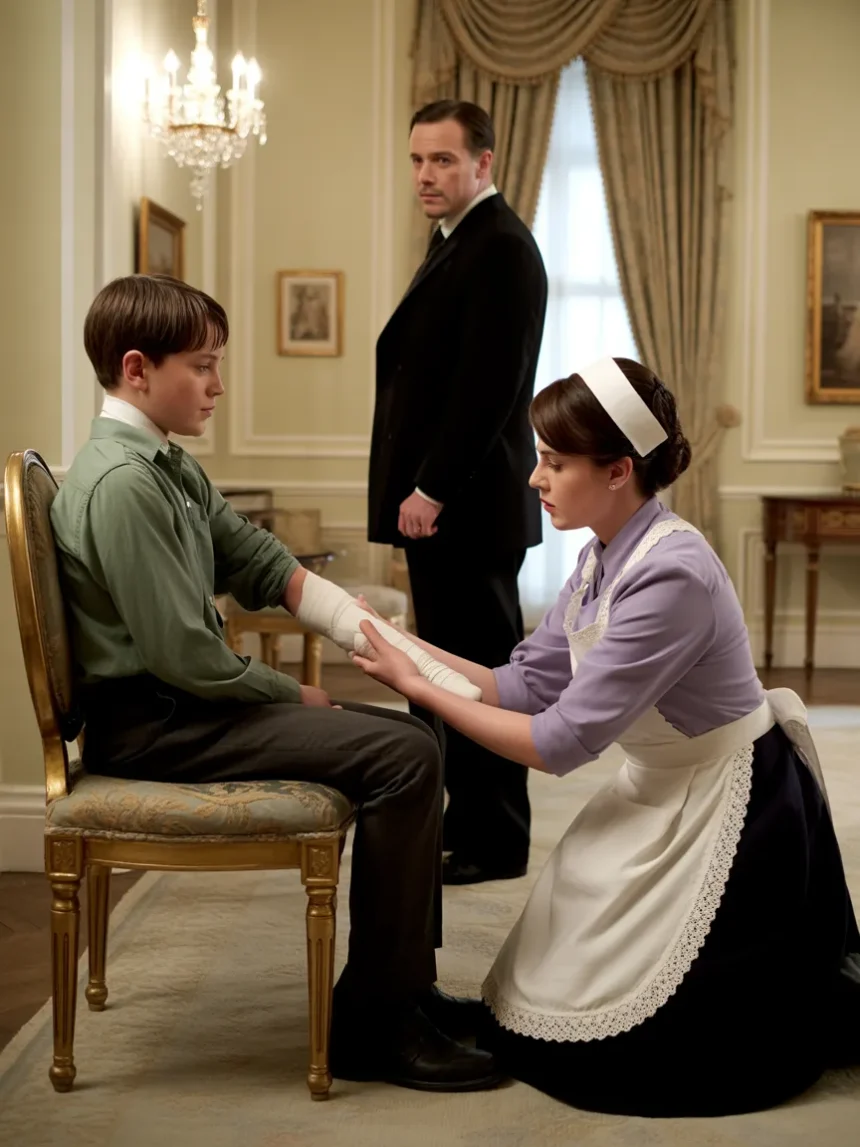
It didn’t come from care. It came from fear sharpened into anger. He crossed the room in three strides, grabbed his son by the shoulders, and forced him onto the bed, pinning the casted arm down with shaking hands.
“Stop this right now,” Jonathan shouted, voice cracking under strain. “You’re going to hurt yourself. This has gone too far.”
To Jonathan, it looked like panic spiraling into hysteria—a boy unable to handle the normal discomfort of healing.
He didn’t notice the heat radiating off Oliver’s body. He didn’t register how his son flinched at the slightest touch, as if every nerve had turned to fire. What he saw was chaos.
What he couldn’t see was pain with nowhere to go. Elaine Reed stood quietly in the doorway, arms folded neatly, observing the scene with unsettling composure. She didn’t rush in.
She didn’t soften her voice. She didn’t offer comfort—not to Oliver, not to Jonathan. Instead, she tilted her head slightly, as if watching a problem solve itself.
“I warned you this would happen,” she said evenly. “The doctor said the recovery would be simple. This isn’t physical.
He’s spiraling.”
Oliver turned his head toward her, expression tightening into something darker than fear. Something like recognition. Something like understanding that she would never help him.
“He’s fixated,” Elaine continued, smooth and confident. “First the pain complaints, now stories about things crawling. He needs professional intervention before this turns dangerous.”
Jonathan hesitated.
Doubt flickered across his face. But exhaustion won. He released Oliver and stepped back, raking a hand through his hair as the room filled with heavy, brittle silence.
Marisol Vega, the family’s longtime nanny, had spent over twenty years caring for children. She trusted patterns more than explanations. She noticed things the way only someone who lives in the background can.
She noticed the smell first. It clung to Oliver’s room no matter how often she cleaned—a thick, sweet odor that didn’t belong. It wasn’t just sweat.
It wasn’t just bandaging. There was something sour beneath it, something cloying that turned her stomach every time she leaned over him. One afternoon, she pressed her hand to Oliver’s forehead and recoiled.
“He’s burning up,” she whispered, more to herself than anyone else. Later, while adjusting his sheets, she saw it—small, unmistakable, and real. A red ant crossed the white fabric.
It disappeared beneath the edge of the cast, as if drawn there. Marisol’s heart dropped so hard she felt it in her throat. She went to Jonathan immediately, trying to keep her voice steady so she wouldn’t sound like she was panicking.
“Sir, something isn’t right,” she said. “There’s an odor, and insects—this isn’t normal healing.”
Jonathan sighed sharply, rubbing his temples. “He probably dropped food in his room,” he replied.
“Please don’t encourage this.”
Elaine nodded in agreement and placed a reassuring hand on his arm, as if to seal the conversation shut. And that should have been the end of it. But Marisol couldn’t forget what she’d seen.
That night, the house went silent in a way that felt wrong. Oliver wasn’t crying anymore. He wasn’t thrashing.
He wasn’t begging. He lay still under the blankets, breathing shallowly, trembling faintly—as if his body had finally run out of energy to fight. Marisol sat beside him, fear tightening like wire around her chest.
Waiting wasn’t an option anymore. Locking the bedroom door, she acted on instinct instead of permission. When the cast finally split under her hands, the truth revealed itself without mercy.
The air filled with that sickly sweetness, stronger now, overwhelming, and movement became visible where movement should never have been. Marisol covered her mouth, eyes burning, fighting tears as she understood what Oliver had been enduring—awake, alone, dismissed. Moments later, Jonathan forced the door open.
And he saw everything. He didn’t argue. He didn’t defend anyone.
He didn’t ask questions first. He fell to his knees. At the hospital, doctors later confirmed what Marisol already knew: the sealed cast had trapped contamination against Oliver’s skin, turning healing into danger.
Had it gone on longer, the damage could have been severe. But the cast wasn’t the only thing that broke open. When Jonathan found the syringe hidden in the medicine drawer, still tacky with residue, the final piece slid into place like a knife.
Elaine left the house that night. She didn’t argue. She didn’t return.
Weeks later, Oliver sat on the living room couch, his arm free at last, wrapped gently around Marisol as they watched television together. The scars would remain—physical and otherwise—but the pain had eased into something quieter. Something survivable.
Jonathan stood nearby, silent and humbled, knowing how close he’d come to losing what mattered most. Some lessons arrive softly. Others have to be cracked open to be seen.

