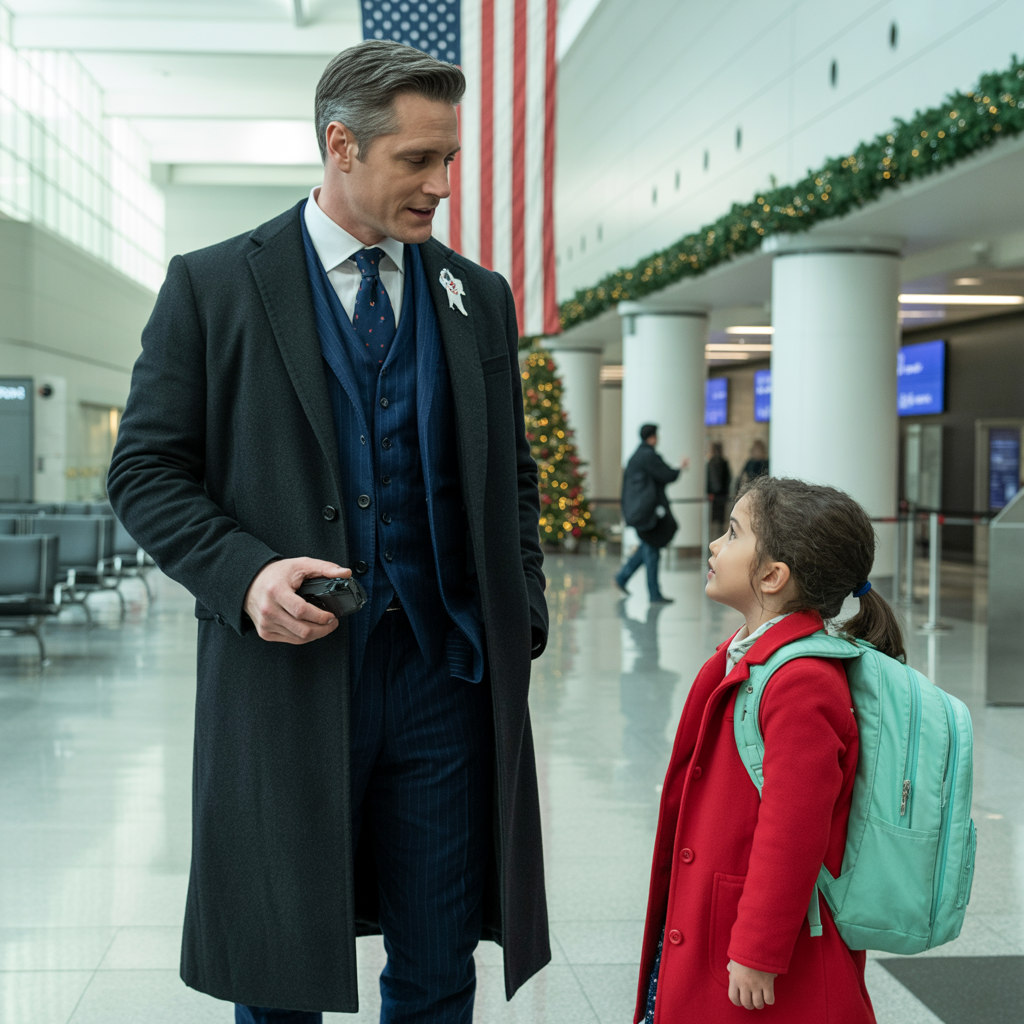
He Looked Up From His Phone, More Exhausted Than Important. A Moment Later, He Stood, Put His Phone Away… And What He Did Next Left Everyone At The Gate Stunned.
Michael Warren adjusted his tie for the third time in as many minutes.
The airport terminal stretched before him, vast and impersonal, a bright, humming no-man’s-land between lives. Overhead, flat voices announced delayed flights and gate changes. Wheels of carry-ons rattled over polished tile. Somewhere to his left, a child laughed. Somewhere to his right, a man cursed softly into a phone about quarterly numbers.
At fifty-seven, Michael had spent more hours in airports than he could reasonably count. But today was the first time he’d ever felt like the airport fit him better than his own life did. He sat in a row of molded plastic chairs near Gate B14, the armrests digging into his ribs, his charcoal suit pressed, his leather shoes shined, his watch ticking in smooth, expensive silence on his wrist.
He should have felt like himself here. Business trip. Direct flight to Seattle. Closed-door negotiations about a merger that would make headlines in the business section on Monday. This was his terrain. His kingdom.
Instead, his life felt like it had been vacated and left behind somewhere at the security checkpoint alongside everyone’s shoes and half-empty water bottles.
The divorce papers had been finalized three weeks ago. After thirty-one years of marriage, his attorney had slid the documents across a long mahogany table like a waiter delivering a bill.
“Congratulations,” the lawyer had said with a wry half-smile. “You’re a free man.”
Free.
The word had hit him like a brick in the chest.
His corner office on the forty-third floor of a glass tower downtown now felt like a mausoleum. Clean. Quiet. Climate-controlled. Full of trophies from a life that looked successful in photos and hollow in motion.
His daughter, Sarah, hadn’t returned a single one of his calls in six months. Six months of voicemail. Six months of texting things like, Hey kiddo, just checking in, and You on the East Coast this week? and Sorry I missed your call, can we try again later?, even when she hadn’t called at all.
He shifted in his seat, loosening his tie slightly. The silk fell open a fraction of an inch, giving his throat just enough room to breathe. He ran his fingers through his dark hair, still mostly thick, still mostly brown, styled back in the same careful way he’d learned in his early thirties when he first started presenting to boards. His watch—a limited-edition piece he’d bought himself last year to celebrate closing a major deal—caught the fluorescent light and flashed.
He remembered that night. Room-service steak. Champagne he didn’t even like. The view of a city he couldn’t remember now, all glass and lights and nothing to do with him. He’d stood by the window of yet another hotel suite, loosening yet another tie, sending yet another short email to his wife explaining why he’d miss yet another family dinner.
He couldn’t remember what deal he’d closed that night.
He could remember with painful clarity the voicemail Sarah had left him that same week, her voice small and tight as she said, “Dad, you missed my defense. It was my thesis presentation and you promised. I know you’re busy, but… never mind. I’ll see you around.”
He hadn’t responded to that one. He’d listened to it twice, then deleted it, telling himself he’d call when things “settled down.” Things never did.
Now here he was, alone in a crowded terminal, ticket to Seattle in his jacket pocket, an expensive rolling suitcase at his feet, a life full of accomplishments and no one he felt brave enough to call.
Passengers moved around him in a blur of sandals, sneakers, and worn-out boots. A young couple argued about which gate they were at. An older man balanced a cardboard coffee carrier with four cups, trying not to spill. A little boy tugged on his mother’s sleeve and pointed at a plane outside the window, shouting, “Look! It’s flying!” as if he were the first person in history to see such a miracle.
Michael dropped his gaze to the floor and let his thoughts dissolve into the background noise.
He was staring at nothing in particular, the world reduced to the pattern in the speckled tile beneath his feet, when a small voice cut through the fog in his head.
“Excuse me, mister.”
He blinked and looked up.
A little girl stood in front of him, so close he could have reached out and touched the sleeve of her coat. She couldn’t have been more than four, maybe five at most. Her blonde hair fell in soft, uneven waves around her round face, as if it had been cut at home with dull scissors and a lot of love. She wore a red wool coat that looked one size too big, the sleeves swallowing her wrists, the hem brushing the tops of light-up sneakers. A tan knit hat with little cat ears perched crookedly on her head, the yarn slightly pilled from too many washes.
A mint-green backpack with a cartoon cat face hung from her small shoulders. The straps were twisted like she’d put it on herself in a hurry. Her blue eyes were wide and shimmering with unshed tears, lashes clumped together in damp spikes.
For a strange half-second, Michael wondered if she was a hallucination. Some manifestation of the part of him that remembered when life had been about softball games and birthday candles instead of profit margins and shareholder calls.
“Are you lost too, mister?” she asked, her voice trembling just enough to make the words wobble.
The question hit him square in the chest.
Lost.
He swallowed.
“Yes,” he thought. “God, yes.”
Not in any way the airport maps could fix. Not in any way a gate agent could help with.
But he didn’t say that.
Instead, he slowly set his briefcase aside and pushed himself up from the chair. His knees crackled in protest as he knelt to bring himself level with her eyes. The movement felt unfamiliar. He couldn’t remember the last time he’d gotten down on the floor for anyone.
“I might be,” he said gently, surprised at the honesty that slipped out. His voice sounded rusty to his own ears, like someone who hadn’t spoken about real things in a long time. “Are you lost, sweetheart?”
Her lower lip quivered.
“I can’t find my mommy,” she whispered. “She was right here and then she wasn’t. And now I don’t know where she went.”
A single tear escaped and slid down her cheek.
Michael’s heart clenched so sharply he almost put a hand to his chest.
For an instant, he saw Sarah at that age—pigtails crooked, wearing a purple jacket with stars on it, holding a stuffed rabbit that had lost one eye. She’d always squeezed his hand so hard when they crossed busy streets, trusting without question that he could keep her safe from everything.
He had believed that too.
Then the late nights had started. The early flights. The just-this-once missed ballet recital that turned into three. He’d been so sure there would always be time to make it up to her.
He hadn’t noticed the way her hand stopped reaching for his somewhere along the way.
“It’s going to be okay,” he heard himself say now, softly, like he wished someone would say it to him. He slipped one hand into the inner pocket of his suit jacket and pulled out a folded white handkerchief, monogrammed in small navy letters. An old-fashioned habit his father had passed down to him in another lifetime. “Here,” he said, offering it, “I bet your mom’s looking for you right now, and she’s probably really worried.”
The little girl took the handkerchief with both hands like it was something fragile and precious. She dabbed clumsily at her cheeks.
“What’s your name?” he asked.
“Emma,” she answered, voice still small but a little steadier.
“That’s a beautiful name,” Michael said, and it wasn’t just something to say. It felt right. “I’m Michael.”
She studied him like she was trying to decide whether “Michael” was the sort of man who could be trusted with big things.
“I got lost once,” he lied gently. “You know what helped?”
“What?” she whispered.
“Finding someone whose whole job is to help people who get turned around,” he said. “This airport has people like that. Maybe we can talk to one of them together. How does that sound?”
Emma looked over her shoulder at the sea of strangers moving past them, then back at Michael. After a heartbeat, she nodded and reached out her hand.
Her fingers were small and warm and a little sticky. They curled around his own hand with unthinking trust. The contact sent a jolt through him, like grabbing a live wire.
Something in his chest he’d assumed was finished with all that—trust, connection, responsibility—stirred faintly, like a heart restarting after a long sleep.
“Okay,” he said, his throat tight. “Let’s find your mom.”
He straightened slowly, Emma’s hand still in his, and for the first time in a very long time, he adjusted his pace to match someone else’s. Her little legs took two quick steps for every single one of his. Normally, he was the man everyone scrambled to keep up with, striding through terminals with his carry-on in one hand and his phone in the other.
Now, he walked more slowly.
Carefully.
The way a man walks when he knows he’s holding something breakable.
They moved together through the terminal, weaving between suitcases and strollers, past a newsstand selling glossy magazines and neck pillows, past a coffee shop that smelled like burnt espresso and sugar. Emma’s grip tightened whenever someone brushed too close. Michael found himself instinctively shifting his body to the outside, placing himself between her and the chaos of the crowd.
“When was the last time you saw your mom?” he asked gently.
Emma scrunched up her nose, thinking.
“She told me to sit on the blue chairs,” she said finally, nodding toward a cluster of worn seats near the windows. “She said, ‘Stay right here, Emmie, while I get our tickets,’ and I was staying, I promise, but then a lady dropped her phone and it broke and everyone was looking and then there was a man with a big dog and the dog sneezed and then I was looking at the dog and then…” Her voice trailed off.
“And then when you looked back, your mom wasn’t there,” Michael finished softly.
Emma nodded, eyes filling again.
“Hey,” he said, squeezing her hand very gently. “You did your best. Sometimes grown-ups get turned around too. That’s why we’re going to go find someone whose whole job is to help un-stick things.”
They reached the information desk, a curved island of faux wood and laminated maps near the center of the concourse. Behind it sat a woman in her sixties with gray hair pulled into a smooth twist. She wore a navy blazer with a tiny airplane pin and a name tag that said PATRICIA in block letters.
Her eyes flicked up as Michael and Emma approached. Her face softened instantly when she saw the little girl.
“Oh, honey,” she said, pushing her reading glasses up onto her head. “Are we missing somebody?”
Emma’s mouth opened, but the words tangled on her tongue. She looked up at Michael instead.
“Her mom went to get boarding passes and got separated,” Michael said quickly. “I found her over by B14. She said she’d been told to wait in the blue chairs, but you know how that goes.” He tried to sound light.
Patricia nodded, the corners of her mouth tightening in a way that said she knew exactly how that went.
“Okay, Emma,” Patricia said kindly. “We’re going to help your mom find you, all right? Can you tell me her name?”
“Jennifer,” Emma said. “Jennifer Foster. And my grandma’s name is Nana, but that’s not her real name. Her real name is Diane, but we don’t call her that.”
“Jennifer Foster,” Patricia repeated, fingers flying across her keyboard as she pulled up manifests and recent announcements. “And you’re flying out today?”
Emma nodded.
“To Phoenix,” she said, the word coming out like a place she’d only heard in stories.
“Phoenix,” Patricia echoed. “Got it. We’ll page your mom. Don’t you worry, sweetheart. She’s probably tearing this place apart looking for you already.”
Michael stepped back a little, letting Patricia work. He could feel Emma still pressed close to his side, her shoulder tucked against his leg like he was a piece of furniture she’d decided was safe.
The terminal buzzed around them. A group of college kids in sweatshirts walked past, laughing too loudly. A businessman barked into his phone about margins. Somewhere nearby, an espresso machine hissed.
Then, cutting through all of it, came a voice over the PA system.
“Attention, passengers. Jennifer Foster, please report to the main information desk near Concourse B. Jennifer Foster, your party is waiting at the information desk near Concourse B.”
Emma’s head whipped around, eyes wide.
“That’s my mom,” she whispered.
“I know,” Michael said, forcing a smile. “Now we just have to watch for her.”
They didn’t have to watch for long.
Less than a minute later, a woman in her early thirties came into view at a near-run, weaving through the crowd with the determination of someone who’d shove a wall out of the way if she had to. She wore faded jeans and a blue sweater with a smear of something white—maybe toothpaste or paint—near the hem. Her brown hair was twisted up in a messy ponytail that looked like it had started neat at 5 a.m. and had been losing the battle ever since.
Her eyes were red-rimmed and wild.
“Emma!” she called, voice cracking. “Em—”
“Mommy!” Emma squealed.
She let go of Michael’s hand and ran, the too-big red coat flapping behind her like a cape. Jennifer dropped to her knees on the scuffed tile and scooped her daughter into her arms, wrapping her up so tightly Michael could see the strain in the muscles of her forearms.
“Oh God,” she gasped, burying her face in Emma’s hat. “Oh, thank God. I told you to stay in the chairs. I turned around and you were gone. I was so scared, baby, I was so, so scared.”
“I’m sorry,” Emma hiccuped, clutching at her mother’s sweater. “I looked at the dog and then you were gone and then I couldn’t find you.”
“It’s okay,” Jennifer said, voice shaking. “You’re okay. That’s all that matters. You’re okay.”
The reunion felt almost too intimate to witness. Michael found himself stepping back another pace, hands slipping reflexively into his pockets. His role in whatever this was—this small, urgent human drama—felt suddenly complete.
He could go back to his seat now. Back to his phone. Back to emails and muted conference calls and the numb gray river of his life.
He was turning to leave when Emma twisted in her mother’s arms and pointed.
“Mommy,” she said, breathless. “That’s Michael. He helped me. He wasn’t lost like me, but he was lost in a different way.”
The words landed with uncanny precision.
Jennifer’s gaze followed her daughter’s finger.
For the first time, she really looked at him.
Michael was used to people looking at him. As CEO, he’d spent years walking into rooms where faces turned automatically his way, waiting for direction, for decisions, for approval.
This look was different.
There was no calculation in it. No deference. Just a woman seeing a stranger who’d done her a kindness and trying to understand who he was and why.
She shifted Emma to one hip and stood, still holding onto her like she might vanish if she loosened her grip even a little.
“I don’t know how to thank you,” she said, and her voice broke on the last word. “I turned around and she was gone and my heart just… dropped. I thought I’d lost her.” She swallowed hard and wiped at her eyes with the back of her free hand. “I’m Jennifer. Jennifer Foster. You have no idea what this means to me.”
“Michael,” he said, offering his hand automatically, then thinking better of it and letting it drop. His fingers curled loosely at his side instead. “I’m just glad she’s okay. She’s a remarkable little girl.”
Emma preened a little at that, pressing her cheek against her mother’s shoulder.
“She is,” Jennifer agreed, looking at her daughter with a mix of exhaustion, terror, and bone-deep love that made Michael’s chest ache. “I’m sorry, I’m still shaking. We’re flying to Phoenix. My mom—Emma’s grandma—she’s… she’s not doing well.” Her voice dropped, roughening. “Stage four. They don’t know how long. I was already so stressed about getting there, and then I couldn’t find Emma and I thought…”
She stopped herself, embarrassed by how much she’d said to a stranger.
“You don’t have to apologize,” Michael said quietly. “Airports are… a lot, even on a good day.” He hesitated, then added, “I’m sorry about your mom.”
Jennifer nodded, jaw clenched.
“Emma’s been so excited,” she said, looking down at the girl. “She colored a picture for Nana on the plane. I promised we’d be there by tonight.”
“Are we still going to see Nana?” Emma asked anxiously.
“Of course we are,” Jennifer said, kissing the top of her head. “I just had a little scare. But you’re safe. That’s what matters.”
Emma seemed to accept that.
She reached down and grabbed Michael’s hand again with her free one, as if this were the most natural thing in the world.
“Michael’s going on a trip too,” she informed her mother. “But he said he’s a little bit lost.”
Michael felt his face flush in a way it hadn’t in decades. He let out a quiet, self-conscious laugh.
“Kids pick up more than you think,” he said.
“I know,” Jennifer replied, her eyes searching his face for a beat longer than politeness required. There was something like recognition there—not of him, but of that word.
Lost.
It was a look he’d seen in the mirror more often lately.
“I don’t want to keep you from your flight,” she said after a moment, glancing at the digital board overhead. “But, um… would you like to sit with us for a bit before we board? I think I need a few minutes for my heart to stop trying to escape through my throat.” She gave a shaky laugh. “And Emma seems pretty taken with you.”
Michael checked his watch out of habit.
Forty minutes until boarding.
He could go to the airline lounge. Have a scotch. Answer a dozen emails. Pretend the empty feeling in his chest was just jet lag.
Or he could sit near a window with a little girl in a cat-eared hat and her frantic, grateful mother and listen to someone talk about something other than acquisitions and market share.
“I’d like that,” he heard himself say.
They found three seats near a wide bank of windows overlooking the tarmac. Planes nosed slowly into gates. Baggage carts scurried like beetles. Out beyond the glass, the sky was a dull winter gray, the edges of the runway dusted with old snow where the plows hadn’t bothered to scrape perfectly clean.
Emma took the middle seat, her short legs swinging, red coat bunched up around her. She leaned forward so her face was almost pressed to the window.
“Look,” she said, pointing as a plane began to taxi. “It’s going to fly!”
“It is,” Michael said. “And so are you.”
He realized, with a faint jolt, that this was the first plane in years he’d noticed as anything other than a schedule entry.
Jennifer sat on the other side of Emma. Her hands were still trembling a little, so she wrapped both of them around a paper cup of coffee from the vending machine kiosk like it might anchor her.
“So, Michael,” she said after a moment, glancing over Emma’s head. “Do you travel a lot?”
“Too much,” he admitted. “Most weeks it feels like I spend more time in the air than on the ground.” He thought about making a joke, something light about frequent flyer miles, but the words felt thin.
“That sounds lonely,” Emma said suddenly, turning away from the window.
Children had a way of dropping truth into conversations like quarters into vending machines.
Michael’s throat tightened.
“Sometimes it is,” he said.
“My mommy says everyone needs somebody,” Emma continued, as if she were explaining a law of physics. “She says nobody should be alone.”
“Your mommy sounds very wise,” Michael said.
Jennifer let out a soft, surprised laugh.
“I don’t know about wise,” she said. “Mostly tired. But I try.”
Emma yawned, the adrenaline of the scare wearing off, and let her head tip sideways until it rested, incredibly, against Michael’s upper arm. Her hat scratched lightly against his suit jacket. Her small body was solid and warm, a real weight against him.
Michael went very still.
It had been years since a child had leaned on him like that. Years since Sarah had fallen asleep on his shoulder on a red-eye flight to Orlando when she was nine, her hair smelling like chlorine and sunscreen, her sticky fingers still faintly tasting like cotton candy when she’d grabbed his hand.
He’d been annoyed that night. He’d had a presentation to finish. He’d spent half the flight trying to maneuver his laptop open without jostling her, irritated he couldn’t type comfortably.
He would have given anything now to go back and shake that younger version of himself by the shoulders.
Jennifer watched the way he froze, then the way something in his expression melted, just a fraction.
“You have kids?” she asked quietly.
“One,” he said. “A daughter. Sarah. She’s twenty-four now.” He tried for a smile, but it came out crooked. “I missed the years when she used to fall asleep on my arm like this.”
Jennifer’s face softened.
“Are you two close?”
The question felt like a test he’d already failed.
“Not lately,” he said after a pause. “I… I wasn’t around enough when she was growing up. I told myself I was doing it for her, for our family, for the life we could have. But the truth is, she needed me more than she needed any of that.”
He hadn’t meant to say so much.
But the words kept coming, pulled out of him by the warmth of the little body leaning against his arm and the tired kindness in Jennifer’s eyes.
“You ever climb a ladder,” he said slowly, “and realize when you get to the top that it’s been leaning against the wrong wall?”
Jennifer huffed a quiet breath that might have been a laugh.
“Can’t say I’ve done that particular thing,” she said. “But I get what you mean.”
She took a sip of her coffee, grimaced at the taste, then set it down on the floor between her feet.
“My husband was a soldier,” she said. “Army. He loved what he did. Loved serving. When we first got married, I used to get so mad about the deployments, the missed birthdays, the holidays where it was just me and my mom and an empty chair at the table. But he always called when he could. He always made sure we knew we were his home base.”
Her eyes shone.
“He was killed in Afghanistan four years ago,” she said. The words came out flat, like a fact she’d repeated often enough that the edges had worn smooth. “Roadside bomb. Wrong place, wrong time. They sent a chaplain and another officer to my front door. I knew the second I saw them, you know?”
Michael nodded slowly.
“I’m sorry,” he said, and it felt inadequate, but he meant it.
“Me too,” she said. “Emma was a baby. I don’t think she remembers him. Not really. She knows stories. Photos. The way my mom’s voice changes when she talks about him. But she never got to know how he laughed when he was really tired or how he burned every pancake he ever tried to make.” A small smile tugged at her mouth. “My mom stepped in. She’s been… everything. Babysitter, co-parent, backup brain. When she got sick last year, I…”
She trailed off, looking out at the runway.
“When she got sick, I realized just how much I’d been leaning on her,” Jennifer finished. “Stage four breast cancer. It spread fast. We’ve been flying back and forth whenever I can get the time off work and afford the tickets. I keep thinking, ‘If something happens and I’m not there, I’ll never forgive myself.’ And then I almost lost Emma in the airport because I was rushing and distracted.”
Tears welled in her eyes again.
“You didn’t lose her,” Michael said quietly. “You came running the second they called your name. That counts.”
Jennifer took a shaky breath and nodded.
“You ever notice,” she asked, “how life just keeps handing you chances to feel like you’re failing the people you love?”
Michael let out a surprised, humorless chuckle.
“Lately,” he said. “Yeah.”
They fell into a gentle, strange kind of conversation. The kind people sometimes have when they know they’ll likely never see each other again, and that knowledge makes it easier to be honest.
Jennifer told him about her job as a medical receptionist at a small clinic. About the way she timed her bathroom breaks around Emma’s school pick-up. About the guilt of watching her mother fade and not being able to fix it.
Michael found himself talking too—really talking in a way he hadn’t in years.
He told her about how he’d grown up in a two-bedroom house over his dad’s hardware store in Ohio. About how he’d promised himself at eighteen that his kids would never have to worry about money the way he had.
He told her how he’d met his wife in their college library, how they’d lived on boxed macaroni and cheese for the first three years of their marriage while he worked insane hours at a consulting firm and she student-taught.
He told her about the first time he’d flown on a private jet and thought, “I’ve made it,” and how now, sitting in a regular economy seat felt more honest, somehow.
“I used to think success was measured in deals and numbers,” he said, keeping his voice low so as not to wake Emma, whose head had begun to slide down his arm toward his shoulder. “Now I’m not sure I’ve ever gotten a single measurement right.”
Jennifer watched him for a long moment.
“Do you want to fix things with your daughter?” she asked.
The question was so simple it almost hurt.
“Yes,” he said. There was no hesitation. “I just… I don’t know how. If I call, she sends me to voicemail. If I text, I get one-word answers. I’ve apologized, but it feels like shouting down a very long hallway.”
“Maybe she doesn’t believe the apology yet,” Jennifer said gently. “Maybe she needs something bigger than words.”
“Like what?” he asked.
“I don’t know,” Jennifer admitted. “Showing up? Listening? Not making excuses?” She shrugged. “I’m not an expert. I just know that when my husband was deployed, sometimes all I needed was to hear him say, ‘You’re right, that sounds really hard,’ instead of ‘You’ll be fine.’”
Michael thought about the last real conversation he’d had with Sarah, more than a year ago. She’d called from Boston, where she’d moved for grad school, upset about a fight with her roommate and overwhelmed by her thesis schedule.
He’d been in an Uber on the way from the airport to a dinner with investors.
“You’re tough,” he’d said, glancing at his watch as the car inched through traffic. “You’ll figure it out. I have to jump into a meeting, but let’s catch up this weekend, okay?”
They hadn’t.
An overhead announcement crackled, startling him back into the present.
“Attention, passengers. Flight 482 to Phoenix is now beginning pre-boarding at Gate C-9.”
Jennifer jolted.
“That’s us,” she said, wiping quickly at her eyes. “We should go line up.”
Emma stirred and blinked up at Michael, lashes heavy with the remnants of sleep.
“Is it time?” she asked.
“It is, kiddo,” Jennifer said softly. “We’re going to go see Nana.”
Emma slid off Michael’s arm and sat up properly, rubbing her eyes with small fists. Then she turned to Michael with sudden, sharp focus.
“Michael?”
“Yeah?”
“Are you still lost?”
The question was a direct hit. No softening. No detour.
Michael could have deflected. Could have said something joking like, “Not anymore, because I found the coffee,” or “I’m a grown-up, we don’t get lost.”
That’s what he would have done a month ago. A year ago. For most of his adult life.
Instead, he took a breath and let himself tell the truth.
“You know what, Emma?” he said, and he found himself kneeling again so they were face to face. “I think I might not be as lost as I thought I was.”
“Because you helped me?” she asked.
“Yes,” he said, surprised to realize it was entirely true. “Because I helped you.”
Emma considered that.
“Sometimes my mommy says when you help somebody else find their way, you find your way too,” she said solemnly.
Jennifer flushed slightly.
“That sounds like something I’d say,” she admitted.
“I think your mom’s onto something,” Michael said.
Jennifer adjusted the straps of Emma’s backpack, then reached out a hand to Michael.
“Thank you,” she said again, and this time her voice steadied on the words. “For finding her. For sitting with us. For… reminding me there are still good people in the world.”
“Thank you,” he replied, squeezing her hand once. “For reminding me it’s not too late to try to be one.”
Emma flung her arms around his legs in a fierce little hug.
“Bye, Michael,” she said into his trousers. “I hope you find your way home.”
He felt something in his chest crack open a little more.
“Bye, Emma,” he said, resting a tentative hand on her back. “Take good care of your mom, okay?”
“I will,” she promised.
He watched them walk away toward Gate C-9, Emma’s red coat bright against the dull airport palette, Jennifer’s hand resting protectively on her daughter’s shoulder. Twice, Emma turned back to wave. Both times, Michael lifted his hand and waved back, feeling foolish and exposed and, somehow, more alive than he had in weeks.
When they finally disappeared into the boarding line, swallowed up by the crowd, he was left staring at the empty spot where they’d been.
The terminal noise rushed back in.
He stood there for a long moment, then exhaled and reached into his pocket.
His phone felt heavy in his hand in a way it never had before. Not as a tool, but as a possible bridge—or a wall, depending on what he did next.
He unlocked it and scrolled down his contacts until he reached a name he hadn’t tapped in months.
Sarah.
His thumb hovered over it.
His heart pounded harder than it ever had before a board meeting. This, somehow, felt more dangerous than any hostile takeover he’d ever negotiated.
He could put the phone away. Tell himself he’d call “later,” maybe after the Seattle meeting. After his schedule calmed down. After he’d rehearsed what to say one more time.
Or he could press the button.
He hit “Call.”
The ringing sounded unnaturally loud in his ear.
Once.
Twice.
Three times.
He almost hit “End,” his thumb already moving toward the red circle, when the ringing cut off.
“Dad.”
Sarah’s voice.
He froze.
He hadn’t heard that voice in so long he’d forgotten the particular cadence. A little lower now than when she’d been sixteen and furious with him for missing her senior night, but still distinctly hers.
“Sarah,” he said, and his throat tried to close around the word.
There was a pause.
“I know I’m probably the last person you want to hear from right now,” he said quickly, before he could lose his nerve. “If this is a bad time, I can—”
“It’s… fine,” she said. The word sounded cautious, like someone stepping onto ice they didn’t trust. “I just… wasn’t expecting you to actually call. Usually it’s a voicemail.”
He flinched.
“I know,” he said. “I deserve that.”
Silence stretched between them, thin and fragile.
“I met someone today,” he said finally, his eyes on the window, watching a plane lift into the sky. “A little girl who got separated from her mom in the terminal. She looked up at me and asked if I was lost too.” He let out a breath that shook more than he liked. “And I realized I have been. For a very long time.”
Another pause.
“I’ve been lost, Sarah,” he said, the words tumbling out now, unpracticed and raw. “And I made you feel lost too. I wasn’t there when you needed me. I chose work over you. Over your mother. Over everything that actually mattered. I can list you the deals I’ve closed for the last twenty years, but I can’t tell you what you wore to prom. I don’t know what your favorite movie is. I’m not sure what kind of person your best friend is. And I am… so, so sorry.”
He waited for anger. For the click of disconnection.
He heard her breathing instead. A little hitch in it.
“I don’t expect you to forgive me,” he said. “I don’t even know if I deserve that. I just… I want to try, if there’s any part of you that will let me. I want to know you now. The real you. I want to hear about your life, your work, what you’re excited about, what scares you. I want to be your father—not just in name on a birth certificate, but in reality. I know I can’t go back and fix everything I broke. But I would really like a chance to do better from here.”
He heard a sound that might have been a sob.
“Dad,” she said, and now her voice was thick. “I’ve waited so long to hear you say anything like that.”
He swallowed hard.
“I know,” he said. “I’m sorry you had to wait. I’m sorry for all of it.”
He realized his hands were shaking.
“Where are you right now?” she asked after a moment.
“At the airport,” he said. “I’m supposed to be flying to Seattle for a meeting.”
“Are you… going to go?” she asked.
He looked down at the boarding pass in his other hand. He pictured the conference room waiting for him tomorrow, the executives checking their watches, the big digital screen where he’d prepared slides about synergies and growth projections.
Then he thought of Emma’s small hand in his. Of Jennifer’s tired eyes. Of the way his chest had felt when Emma said, I hope you find your way home.
He thought about home, and how it was not a glass office or a corner suite in a hotel.
“No,” he said slowly. “No, I’m not.”
He could sense her surprise through the line.
“Would it… would it be okay if I came to see you instead?” he asked. “Today. As soon as I can get there. If that’s too much, if you’d rather talk more on the phone first, I understand. I just—”
He broke off, afraid he’d said too much.
Sarah let out a laugh that sounded like it had been trapped behind her ribs for years.
“Yeah, Dad,” she said. “That would be… really okay.”
He closed his eyes for a second.
“Then I’m coming,” he said. “Boston, right? Still?”
“Yeah,” she said. “I’m still in Boston.”
“I’ll text you my flight info,” he said. “And Sarah?”
“Yeah?”
“I love you,” he said. The words felt new and old at the same time. “I should have said it more. I should have shown it more. But I love you.”
There was no pause this time.
“I love you too,” she said. “I never stopped. I just… didn’t know what to do with all the hurt on top of it.”
“I get that,” he said softly. “I really do.”
He hung up only when they’d agreed on a rough plan—she’d text him her address, he’d message when he landed—and then he walked straight to the ticket counter.
The line was short. A bored-looking agent glanced up as he approached.
“Hi there,” she said. “Flying today?”
“I was supposed to be on the four p.m. to Seattle,” Michael said, setting his original boarding pass on the counter. His voice sounded strangely steady. “I need to change that. I’d like to go to Boston instead. As soon as you can get me there.”
The agent’s fingers tapped quickly across the keyboard.
“You’re in luck,” she said after a moment. “We’ve got a flight leaving in an hour and a half with a few seats left. Tight connection, but doable.”
“I’ll take it,” he said.
She processed the change, slid a new boarding pass across the counter, and told him the gate.
His phone buzzed as he turned away.
It was an email from his assistant.
Where are you? it read. Seattle team asking if your flight was delayed. Need ETA.
A month ago, even a week ago, that question would have spiked his blood pressure. He would have fired off apologies and explanations and tried to get on a different flight to still make most of the meeting.
Now, he typed back slowly.
Change of plans. Family emergency. I won’t be in Seattle today. Please let the team know and we’ll reschedule.
He hesitated, then added: We’ll talk when I’m back. Some priorities are shifting.
He hit send before he could overthink it.
At the new gate, he sat near the window again, watching planes taxi and lift into the gray sky.
He thought about Emma buckled into her seat somewhere above the country by now, on her way to a house where a frail woman waited in a recliner, a scarf wrapped around a scalp gone bare.
He pictured Jennifer holding her mother’s hand, introducing her to Emma, watching them memorize each other’s faces.
He hoped they made it in time.
He hoped Emma would grow up with enough stories of her Nana to fill the missing years.
He hoped, fiercely, that the world would be gentle with them.
When his flight was finally called, he boarded quietly, carrying nothing but his briefcase and a ridiculous, fragile sense of hope.
On the plane, buckled into a narrow seat in row 14, he felt his usual restlessness rise—a conditioned response to flight time he’d always used as working hours. Normally, he’d flip open his laptop as soon as the seatbelt sign went off and bury himself in spreadsheets until the plane touched down.
This time, when they reached cruising altitude, he took out a pen and the back of an old printout instead.
He wrote Sarah’s name at the top in block letters.
Underneath it, he made a list, the way he would prepare for a presentation.
Don’t make excuses.
Don’t talk about work.
Ask her questions and actually listen.
Apologize without using the word “but.”
Tell her specific memories you have of her as a kid.
Tell her you’re proud of her.
Tell her you’re sorry you didn’t say that more.
He stared at the list until the words blurred, then turned the paper over and, without meaning to, found himself sketching a little figure in a red coat and a cat-eared hat.
By the time the wheels bumped down on the runway in Boston, the list was worn soft from his thumb rubbing over it.
Logan Airport smelled different from the one he’d left—saltier somehow, tinged with ocean and cold air. He stepped off the plane with his briefcase in one hand and the folded paper in his jacket pocket, his stomach tight.
Sarah texted as he cleared the jet bridge.
I’m outside arrivals, she wrote. Black Subaru. No judgment if you turn around and get back on a plane. Just… letting you know I’m here.
He almost laughed at the familiar edge of sarcasm in her message. It was the same tone she’d used at fifteen when she’d said, “Nice of you to show up,” as he’d slipped into the back row of her school auditorium halfway through her solo.
This time, he wasn’t late.
He followed the signs to Baggage Claim, then out through the sliding doors where the cold hit him like a slap. He zipped his coat for the first time in years—he usually went straight from car to building, climate-controlled cocoon to climate-controlled cocoon.
Cars lined the curb in a chaotic shuffle. People loaded suitcases, slammed trunks, waved frantically at ride-share drivers.
Then he saw her.
A black Subaru idling near the end of the row. A woman leaning against the driver’s side door, arms folded tight across her chest, dark curls peeking out from under a knit beanie.
Sarah.
His brain tried to overlay old images onto the present—pigtailed girl with missing front teeth, annoyed teenager rolling her eyes at him—but they didn’t quite fit.
She was a woman now. Twenty-four. Shoulders set, jaw strong, eyes wary.
He walked toward her feeling like he might be walking into an exam he hadn’t studied for.
She straightened as he approached.
“Hey,” she said.
“Hey,” he echoed.
Up close, he could see the fine lines beginning at the corners of her eyes, the faint dark circles beneath them. He wondered how many of those circles he’d caused.
“You look good,” he said, and immediately winced. It sounded lame, thin.
She snorted softly.
“You look… like you,” she said. “Maybe more gray.”
He huffed out a breath that was almost a laugh.
“I earned every one,” he said.
They stood there a moment, the cold wind whipping around them, people bumping past with suitcases. Then Sarah took a step forward and, to his stunned relief, wrapped her arms around him in a quick, tight hug.
He hugged her back, probably too hard.
“Okay,” she said after a few seconds, pulling away and swiping her mitten across her eyes. “Let’s get in the car before we both freeze and make this more dramatic than it already is.”
They climbed in, the Subaru’s heater blasting blessed warmth.
For the first few miles, the only sounds were the swish of the wipers and the hum of the engine as they merged onto the highway.
“So,” Sarah said finally, eyes on the road. “Family emergency, huh?”
He let out a slow breath.
“Yeah,” he said. “Me.”
That earned a small, surprised laugh.
“Fair enough,” she said.
He pulled the folded paper from his pocket, felt its edges, then decided against looking at it. He knew what he needed to say.
“I’m sorry,” he began. “For all the ways I wasn’t there. For every school thing I missed. For the times I emailed instead of showing up. For making you feel like… like you were something I could pencil in between meetings.”
She gripped the steering wheel tighter.
“You remember when I broke my wrist in middle school?” she asked abruptly.
He blinked.
“Yes,” he said. “You fell off the monkey bars.”
“No,” she said. “I fell off the stage during rehearsal. For the musical. Mom called you from the ER.”
He closed his eyes briefly.
“I told her I was in Chicago,” he said. “Big client pitch. I said I’d ‘touch base’ when things settled down.”
“Yeah,” Sarah said. “You sent flowers. To the house. I watched Mom sign your name on the card because the florist had left it blank by mistake.”
He felt physically ill.
“I’m sorry,” he said again. “I can’t… I can’t fix that. I can’t go back and sit in that ER with you. I can only tell you that I was wrong. That none of those meetings were worth the times I wasn’t there.”
She swallowed.
“You remember my college graduation?” she asked.
He flinched.
“I watched the livestream,” he said. “From the back of a town car. On the way to the airport.”
“I walked across the stage and looked for you,” she said quietly. “I told myself I didn’t care if you were there. But I still looked.”
His eyes stung.
“Sarah,” he said, voice thick. “I am so sorry. Those are… some of the worst decisions I’ve ever made. And the fact that I made them over and over…” He shook his head. “If I could trade every deal I’ve ever closed to go back and sit in those bleachers instead, I would.”
They drove in silence for a few beats.
“So why now?” she asked finally. “Why today? You’ve said sorry before. In emails. In voicemails where you’re out of breath running between flights. What’s different?”
He thought of Emma’s small hand in his. Of the way she’d looked at him when she asked if he was still lost.
“I met a little girl in the airport,” he said. “She got separated from her mom. I helped her find her way back. And she looked up at me and said, ‘I hope you find your way home, too.’” He swallowed. “And for the first time, I really heard it. That I’ve been spending my life flying around all over the place without ever actually going home.”
He glanced at her.
“Home isn’t my office,” he said. “It’s not the car service or the hotel loyalty program. For me, home is… supposed to be you. And your mom. And I’ve treated it like an optional layover instead of the destination.”
Sarah blew out a breath that fogged the windshield.
“Mom’s not part of that equation anymore,” she said. “Not like that.”
“I know,” he said. “And that’s on me too.”
They pulled up in front of a brick apartment building on a tree-lined street. The branches were bare, the sidewalks dusted with leftover snow.
“Do you want to come up?” she asked, fingers drumming on the steering wheel. “I mean… you came all this way. We might as well have coffee that isn’t from an airport kiosk.”
He let out a weak laugh.
“I’d like that,” he said.
Her apartment was small and cluttered in a way that spoke of real living. Books stacked on the coffee table. A throw blanket half-fallen off the couch. A plant in the corner that looked like it was thriving despite benign neglect.
There were photos on the wall—Sarah and a group of friends at the beach, Sarah in a lab coat, Sarah hugging a golden retriever—but none of him.
He noticed the absence and knew he’d forfeited any right to be surprised by it.
They sat at the tiny kitchen table with mugs of coffee that tasted infinitely better than anything he’d ever gotten near a gate. For the next three hours, he did something he hadn’t done in far too long.
He listened.
He listened as Sarah told him about her research job at the hospital. About the obstinate printer that ate everyone’s documents. About her roommate, who left half-empty cups of tea in every room.
He listened as she talked about the panic attacks she’d started having in undergrad and how hard it had been to tell her mother when she couldn’t bring herself to tell him.
He listened as she confessed that there had been nights when she’d almost called him, thumb hovering over his name, before talking herself out of it because she didn’t want to feel small or foolish or unimportant again.
He didn’t interrupt to explain.
He didn’t say, “But I was busy,” or “You know how my job is.”
Every time the word “but” rose to his tongue, he bit it back.
“I’m sorry,” he said instead. “I didn’t know. I wish I’d been there. I should have been there.”
At one point, she looked at him across the table, eyes shining.
“I used to think,” she said, “that if I could just accomplish enough, you’d have to see me. Like if I got good enough grades or got into a good enough program, you’d say, ‘Wow, I should pay attention to this person, she’s my daughter.’”
He felt something crumble inside.
“You shouldn’t have had to earn my attention,” he said. “That should have been yours just for existing.”
They talked until Sarah’s voice was hoarse and his own felt scraped raw.
When he finally checked his watch, it was nearly midnight.
“You can stay at my place,” Sarah said awkwardly, rubbing at her eyes. “The couch folds out. Or I can call you a hotel if that’s weird. I don’t really know how this is supposed to work.”
He smiled, small and genuine.
“I don’t either,” he admitted. “Maybe that’s okay.”
He stayed on the couch. It was lumpy and too short, and he slept better than he had in months.
In the morning, they walked together to a little diner on the corner. They sat in a booth by the window, watching Boston wake up over plates of pancakes and scrambled eggs.
At one point, Sarah’s phone buzzed.
She glanced at it and smiled.
“Mom says hi,” she said. “I told her you were here.”
He felt his pulse jump.
“How did she… take that?”
Sarah shrugged.
“She said, ‘About time,’” she replied.
He let out a breath he hadn’t realized he’d been holding.
Over the next weeks and months, what had started in an airport terminal slowly turned into something sturdier.
Michael went home and did something no one at his company had ever thought he would do.
He stepped back.
He sat down with the board and explained that he wanted to begin transitioning out of the CEO role within the year. He wanted to mentor his successor, reshape his job so it didn’t require living in airports.
Some of them were skeptical. Some were outright annoyed. But he stuck with it.
He started seeing a therapist—an older man with kind eyes who called him out when he tried to turn sessions into strategy meetings.
He scheduled weekly video calls with Sarah and treated them like the most important appointments on his calendar. He set alarms for them. He didn’t reschedule.
Sometimes they talked for an hour. Sometimes they only had ten minutes. Sometimes they ran out of things to say and just watched the same stupid cooking show while texting sarcastic commentary back and forth.
Every interaction laid one more plank across the chasm between them.
One afternoon, several months later, his phone buzzed with an unfamiliar number from Arizona.
He almost let it go to voicemail, then picked up.
“Hello?”
“Is this Michael?” a woman’s voice asked.
“Yes.”
“This is Jennifer,” she said. “From the airport. Emma’s mom.”
He straightened in his chair.
“Jennifer,” he said, surprised at how glad he was to hear her. “How’s your mom? How’s Emma?”
There was a pause.
“My mom passed away last month,” Jennifer said. “Peacefully. At home. Emma was with her. I wanted to… I don’t know. Let you know? It felt strange not to.”
“I’m so sorry,” he said. “I’m glad you made it there. That she had you both with her.”
“We wouldn’t have if we’d missed that flight,” Jennifer said quietly. “If I’d wasted more time looking in the wrong places. I think about that sometimes.”
“So do I,” he said.
There was a rustling sound, and then a small voice came on the line.
“Michael?”
He smiled involuntarily.
“Hey, Emma,” he said. “How are you?”
“I’m okay,” she said. “Nana’s in heaven now. Mommy says she’s not sick anymore.”
“I think your mom’s probably right,” he said.
“I drew you a picture,” Emma announced. “Of the airplane. And you. And me. And Mommy. Mommy said we don’t have your address so we can’t mail it, but I wanted to tell you I did it.”
Warmth spread through his chest.
“Thank you,” he said. “I’m honored.”
“Did you find your way home?” Emma asked.
He thought about Sarah’s last text—a photo of the two of them at a Red Sox game, her grin wide as she leaned into his shoulder.
He thought about Sunday afternoons spent on FaceTime with his ex-wife and Sarah, trading recipes like normal people who had shared history and complicated love instead of just lawyers and court dates.
“I think I did,” he said.
“Good,” Emma said firmly. “’Cause I told Nana you would.”
His eyes stung.
“Thank you for believing that,” he said.
After they hung up, he sat in his office—still his for now, though no longer a mausoleum—and looked out at the city.
He thought about all the airports he’d rushed through, all the flights he’d taken, all the times he’d chosen the gate that led away from the people who loved him instead of toward them.
Sometimes, angels appear in the most unexpected forms.
Sometimes they’re little girls in red coats with cat-eared hats and a grip that reminds you what it feels like to be trusted.
Sometimes they’re exhausted mothers with boarding passes in one hand and the weight of the world in the other, telling you it’s not too late as long as you’re both still breathing.
Sometimes they’re moments of grace in fluorescent-lit terminals, hiding in plain sight between delayed flights and bad coffee.
Michael had been lost.
For years, he’d wandered glass corridors and high-rise offices, mistaking motion for progress, altitude for meaning.
He didn’t kid himself that everything was magically fixed now. Years of distance couldn’t be undone in a single visit, or a handful of calls, or even a dozen. There would be setbacks. Awkward pauses. Old habits that tried to sneak back in.
But he’d chosen a different gate.
He’d changed his destination.
And that made all the difference.
Months later, sitting on a plane bound for Boston for the third time that year—not for a conference, but for Sarah’s birthday—he found himself smiling as the ground fell away beneath the wings.
This time, when the clouds wrapped around the aircraft in soft gray, he didn’t feel like he was leaving anything important behind.
He closed his eyes and whispered a quiet prayer of gratitude—for airport angels and second chances and the simple, profound truth that it is never too late, not really, to turn around and start walking back toward love.
Somewhere over the country, a little girl in a red coat might be drawing another airplane, coloring the sky too blue and the clouds too purple.
Somewhere, a woman named Jennifer might be sitting on a porch step in Phoenix, watching the sun sink and thinking of her mother’s laugh.
And somewhere in Boston, a young woman named Sarah was waiting at an arrivals curb, arms folded, pretending not to be excited and failing.
Michael smiled.
He wasn’t lost anymore.
He was finally, finally on his way home.