


“Some babies are like that from the start.
Watching everything.”
She stayed that way. As a toddler, she’d line up her toys in careful rows, sorting them by color or size, lost in her own world. At five, while other kids ran screaming through playgrounds, Lily would sit under the slide with a picture book, tracing letters with her finger.
She wasn’t the loudest kid.
She wasn’t the first to answer questions in class. But she was always paying attention, taking notes in her head.
My mother read all of that as weakness.
“She needs to speak up,” Mom would say at family gatherings, watching Lily hover near me with her hands twisted in the hem of her shirt.
“No one remembers the quiet ones, Rachel. You’re doing her no favors.”
“It’s okay,” I’d say, too quickly.
“She’ll talk when she’s ready.”
“She’ll miss opportunities,” Mom would reply, in that tone that somehow managed to sound both concerned and condemning.
“The world doesn’t slow down for quiet children.”
I told myself it was a generational thing. My mother grew up in a house where affection was rationed out like sugar during a war, where praise had to be earned through tangible achievements: grades, trophies, jaw-dropping accomplishments you could show off to neighbors. She genuinely believed she was pushing us to succeed, that anything less than relentless critique was neglect.
But the truth is, some wounds don’t care about context.
By the time Lily was twelve, I’d learned to edit our interactions around my mother like a movie director cutting out a bad scene.
I didn’t tell her about every parent-teacher conference, every test, every detail that would give her more ammunition for comparison.
I shared the safe things: “Lily joined the book club,” or “Lily’s doing art now.” Vague, nonspecific, unmeasurable.
Because the more specifics Mom had, the more she’d measure.
“She’s not like Amanda,” my mother would say, often within earshot of both girls. “Amanda’s a star.
That kid has a trajectory.” She’d make a vague gesture toward the ceiling, as if Amanda were already ascending into a more rarefied, worthy atmosphere.
Amanda was my cousin’s daughter—witty, confident, the sort of child who made adults laugh and teachers adore her. Straight A’s, student council, soccer team captain, advanced math, extracurriculars stacked like trophies on a shelf.
My mother loved her the way she loved anything shiny.
I didn’t begrudge Amanda any of that.
She was a good kid. What I couldn’t stand was the way my mother used her like a yardstick, holding her up against Lily again and again, measuring, comparing, announcing the results as if we’d all been waiting for the verdict.
The thing my mother didn’t know—because she never asked—was that Lily got bored.
School, to her, was a place where everything moved too slowly. She did the worksheets, filled in the bubbles, turned in the homework, but a lot of it was busywork to her.
She didn’t see the point of spending thirty minutes on something she could grasp in five.
She’d do the bare minimum required, then retreat back into her thoughts, or a book, or a doodle in the margins of her notebook.
Her grades reflected that disengagement. Not failing, not exceptional, just… adequate.
A quiet string of B’s and C’s that, to my mother, confirmed what she already believed: Lily was “not academic.”
What my mother also didn’t know—because again, she never asked—was that Lily spent hours on her tablet at night, not scrolling social media, but reading about logic puzzles, following along with online lectures, and playing games that revolved around patterns and problem-solving. She loved riddles.
She devoured math puzzles if they were presented as a challenge rather than a worksheet.
She just didn’t light up in front of a whiteboard.
The summer before the party, one of Lily’s teachers pulled me aside after school.
“I think you should consider enrichment programs for her,” Mrs. Patel said. “She finishes tests early and then starts over-complicating them, second-guessing herself.
She’s restless in class, but when we do logic activities, she’s laser-focused.
I think she needs more of that.”
She mentioned the Johns Hopkins Center for Talented Youth program, CTY, almost in passing. “You could look into it,” she said.
“She might qualify.”
When we got home, I sat Lily down at the kitchen table and explained it. She listened quietly, chewing on her lower lip in that way she did when she was thinking.
“They make you take the SAT?” Lily asked finally, eyes wide.
“Like the real SAT?”
“Yes,” I said carefully.
“But for CTY, they’re not expecting you to get a perfect score or anything. It’s just a way to see how you think, what you’re ready for. It’s okay if you don’t want to do it.”
She was quiet for a long moment.
“Would Grandma know?” she asked.
My chest tightened.
Lily didn’t specify which grandma; she didn’t have to. There was only one grandmother whose opinion she feared enough to factor into a decision about an opportunity like this.
“Not unless you want her to,” I said.
“This would be just between you, me, and your teachers. You’re allowed to have things that don’t go through Grandma’s public relations department.”
Lily snorted, a quick little laugh that she tried to hide behind her hand.
“Public relations department,” she repeated.
I grinned.
“You know what I mean.”
She hesitated. “What if I fail?”
“Then we’ll know it wasn’t a good fit,” I said. “That’s all.
It won’t change how I feel about you.
Or how Grandma Chen feels about you.”
My other grandmother—my father’s mother—was the one who always asked Lily about what she was reading, what she was curious about, never what her grades were. She was the one who’d pressed a book of logic puzzles into Lily’s hands the Christmas she turned ten and said, “These are fun.
They keep your brain wiggly.”
Lily took a breath. “Okay,” she said.
“I want to try.”
So we did it quietly.
We signed up.
We studied a little, but not obsessively. I made sure she understood the format, the timing, the bubble-filling, the way the test day would go, and then I let it be. I didn’t want “CTY” to become another mountain for her to climb in order to prove something to adults who’d already decided what she was.
On test day, I dropped her off at the high school where they were administering the exam.
She walked into a building full of teenagers, looking small in her jeans and hoodie, hair pulled back into a messy ponytail.
When she came out hours later, her face was flushed and her shoulders were relaxed.
“How’d it go?” I asked, trying to sound casual.
“There was a lot,” she said. “But…” She shrugged.
“Some of it was kind of fun.”
“Fun?” I repeated, amused.
“The puzzle-y stuff,” she said. “Like the logic questions.
Those were cool.”
We went for ice cream.
We didn’t talk about scores.
Weeks passed. The envelope from Johns Hopkins came on a Tuesday, folded, creased slightly from the mailman’s indifferent handling. Lily held it in her hands for a full minute before she opened it, her fingers trembling just enough that I wanted to grab it and do it for her, but I didn’t.
Her eyes scanned the letter.
She swallowed.
“What does it say?” I whispered.
She read silently, her lips moving just a little.
Then she let out a breath she’d been holding and smiled—a small, stunned smile, like someone who’d stumbled into a room and found a treasure chest where they expected a broom closet.
“I got in,” she said. “I qualified.”
We sat at the table together and read the details—how she’d scored in the qualifying range in math, how she was eligible for advanced coursework in mathematical problem-solving and logic.
There was information about summer programs, online classes, financial aid. It was like a door had opened in the middle of our cluttered living room, revealing a hallway of possibilities neither of us had known existed.
“When they say ‘college level,’ they mean… like actual…?” Lily asked, pointing to the phrase.
“Actual college-level material,” I said.
“Just taught in a way that’s appropriate for your age, I think.
It’ll be hard work.”
She stared at the paper. “Do you think I could do it?”
“I think you already did the hard part,” I said. “You took a test meant for older kids, and you did well enough that they want you.
The rest is just learning.
And you’re good at that, even if school doesn’t always feel like it.”
She didn’t tell my mother. I didn’t either.
It wasn’t a deliberate secret at first, more like a private bubble of joy we weren’t ready to let anyone else touch.
We filled out forms. We talked about which course she might take.
She chose the one on mathematical problem solving and logic, of course.
We applied for financial aid and got enough covered that it was possible, just barely, if I squeezed the budget and took on a few extra shifts.
“You don’t have to,” Lily said when she heard about the cost. “It’s okay if we can’t.”
“We can,” I said. “It might mean more spaghetti nights and fewer takeout pizzas, but we can.
This matters.”
Summer became a blur of problem sets, online lectures, and proctored assessments.
I’d pass by Lily’s door and hear her murmuring to herself as she worked through a question, erasing, rewriting, trying again. Sometimes she’d come to me with a problem drawn on a piece of paper and say, “Can I just… talk this out loud?” She didn’t need me to solve it—she just needed me to listen while she solved it herself.
Halfway through the course, I caught her smiling at her screen, that same small, stunned smile I’d seen when she opened the acceptance letter.
“What?” I asked, leaning on her doorframe.
“They wrote, ‘Excellent reasoning,’” she said, pointing to a comment from her instructor under one of her assignments.
“They said my solution was ‘elegant.’”
“Elegant,” I repeated, feeling something swell in my chest. “That’s a good word.”
She kept going.
Some nights she was frustrated, some nights exhilarated, some nights simply exhausted.
But she finished. She completed every assignment, attended every online session, wrote every test. When the final grade came, she stared at the screen, cheeks flushed, eyes wide.
“Mom,” she said, voice trembling.
“I got an A.”
And then, beneath that: a note about her “exceptional performance and dedication to academic excellence,” and a mention that she’d be receiving a certificate.
We printed the certificate the day it came in the mail so she could hold the physical evidence of what she’d done.
It wasn’t about the paper. It was about what it represented: the hours, the doubt, the persistence, the quiet, relentless effort that no one outside our apartment had seen.
“Do you want me to tell Grandma?” I asked tentatively, meaning my mother.
Lily’s shoulders tensed.
“No,” she said. “Please don’t.”
“Okay,” I said immediately.
“It’s your achievement.
You get to decide who knows.”
“Grandma Chen can know,” she said. “And maybe… maybe Grandma Margaret someday. But not now.
I don’t want her to make it… weird.”
“Okay,” I repeated.
“Not now.”
I meant that. I meant to protect that little bubble a while longer.
But then came the party.
It was one of those family gatherings that feel like a reunion and a performance review at the same time. My aunt was hosting—a potluck, so everyone arrived with foil-covered dishes and something to say about how traffic had been.
The house smelled like roast chicken and garlic and too many perfumes mixing in the air.
Children darted around with paper plates, uncles debated sports, a playlist of old pop songs hummed from a Bluetooth speaker in the corner.
Lily stuck close to me when we arrived, as she always did in crowded spaces. I could feel the weight of her presence beside my arm, her body angled slightly toward me like I was her anchor. Eventually, she drifted toward the couch with her phone in her hand.
She sat, curled one leg under herself, and began reading quietly on her screen.
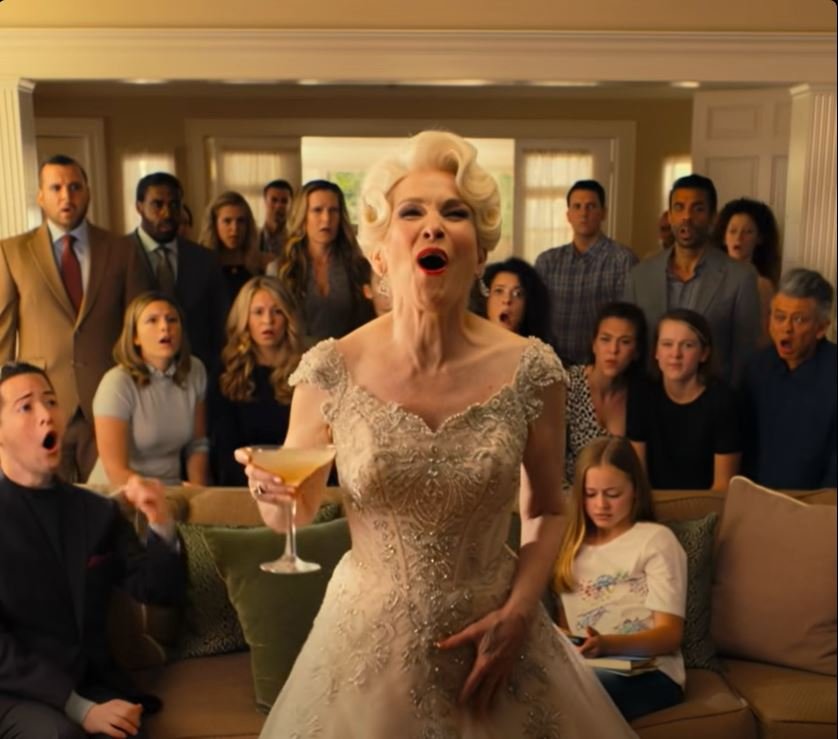
From across the room, my mother watched everything.
She was in her element, standing near the center of the living room with a drink in her hand, surrounded by relatives who were half-listening, half-checking their phones.
She gestured animatedly as she spoke, her bracelets clinking when she moved her wrist, her earrings catching the light when she tossed her head back to laugh at her own jokes.
When my cousin announced that Amanda had been accepted into a competitive high school program, my mother seized on it like fresh gossip.
“I just knew she would,” Mom said loudly, her voice carrying over the low hum of conversations. “Amanda is just so bright.
Top of her class. Always has been.
Such a smart girl.”
She looked around as she spoke, making sure her words landed in multiple ears, making sure the room knew she was attached, however tangentially, to this shining success story.
I felt my stomach tighten.
I could see the trajectory of her sentences already.
“Not like some kids who just coast along, you know,” she added, tone light and airy.
Lily didn’t look up, but I saw her shoulders stiffen—just a tiny flinch, like a muscle spasm in her back. My hand tightened around my glass.
My mother’s gaze flicked toward Lily, lounging on the couch with her phone, then flicked back to her audience.
“Some children,” she continued, “are just naturally gifted. And some, well, they’re just not academic, and that’s okay.
Not everyone can be smart.”
The room went quiet in that particular way that indicates everyone heard what was said and no one knows what to do about it.
Someone cleared their throat. Someone else took a too-long sip of their drink.
The TV, muted in the corner, flashed a series of bright colors over the silence.
I opened my mouth to say something, but the words stuck. I could feel the familiar warning buzz of childhood—don’t embarrass yourself, don’t make a scene, don’t challenge her in front of people—humming at the base of my skull.
My mother kept going.
“Take Lily, for example,” she said, and my blood ran cold.
My hand, halfway to my mouth with my drink, froze.
Across the room, my aunt glanced at me quickly, then back at my mother.
“Sweet girl,” my mother continued, smiling in Lily’s general direction.
“Very sweet. But let’s be honest, she’s not exactly winning any awards.”
My chest burned. Lily’s hands, from where I was standing, looked still—too still.
She wasn’t scrolling.
The screen had gone dim. She was frozen in that particular teenage way that says, If I don’t move, maybe no one will notice I’m here.
I took a step forward, ready to cut in, but my mother plowed on, laughing a little.
“I mean, we love her anyway,” she said.
“But we can’t all be geniuses, right? Some kids are just, you know…”
I watched her mouth form the word before the sound reached me.
It was said with a shrug, an almost playful lilt on the “b,” as if she were talking about someone being clumsy or tone-deaf.
The casualness of it was a slap.
I saw my aunt flinch.
My uncle looked down at his phone as if something urgent had appeared there. My cousin shifted in her seat and gave Lily a quick, sympathetic glance that didn’t quite make it all the way across the room.
My mother turned to me, sensing, perhaps, the shift in the air.
“Rachel, you know I’m not being mean,” she said, palms up in a faux-placating gesture. “I’m just being realistic.
Not every child is going to excel academically.
And Lily, bless her heart, she tries, but she’s just not that bright.”
Something in me snapped into focus.
“Mom,” I said, my voice low but sharp. “Can I talk to you in the kitchen?”
She waved a hand, like she was batting away a pesky fly.
“Oh, don’t be sensitive. I’m just telling the truth.
Everyone here knows it.”
I looked around the room.
My aunt was staring fixedly at her drink. My uncle’s jaw was clenched. My cousin looked like she wanted to sink through the floor.
No one said anything.
“Kitchen.
Now,” I repeated, still calm, but with an edge that left no room for negotiation.
My mother sighed theatrically, making sure everyone saw how put-upon she was. “Fine,” she said, setting her drink down and following me.
The moment the door swung closed behind us and the murmur of voices dulled, I turned to her.
“You just called my daughter dumb in front of the entire family,” I said.
She rolled her eyes.
“I said she’s not academic. That’s not the same thing.”
“You said she’s dumb,” I replied, each word measured.
“You literally used that word.”
“Well, she is,” my mother said, shrugging.
“I’m not going to lie just to protect her feelings.”
I stared at her, feeling a kind of cold clarity settle over my anger. “Lily is not dumb,” I said quietly.
“Rachel, I love her,” my mother replied, with that condescending softness that wasn’t soft at all, “but let’s not pretend she’s something she’s not. She’s a C student at best.
She doesn’t participate in class.
She’s quiet. She doesn’t stand out.
That’s just who she is.”
“You don’t know anything about her,” I said.
My mother laughed, a short, disbelieving sound. “I know enough.
I see her report cards.
I hear what you say about parent-teacher conferences. She’s not thriving. That’s obvious.”
She said “obvious” like it was the final word, like the case was closed.
I looked at her for a long moment, at the woman who had raised me to believe that love was something you earned by impressing people at dinner parties, at the woman who genuinely believed she was just “telling it like it is.” And I thought of Lily, sitting on that couch, frozen in humiliation, carrying this careless verdict around in her chest for who knows how long if I let this stand.
“Come with me,” I said.
She frowned.
“Where?”
“Just—come.”
I walked out of the kitchen before she could argue, my heart pounding.
She followed, heels clicking against the linoleum, mouth set in a thin line of annoyance.
Back in the living room, the conversations had picked up again, but the energy was strained, like everyone was pretending they hadn’t heard what she’d said. Lily hadn’t moved.
Her phone was still in her lap, screen dark. She stared at a spot on the floor in front of her, jaw clenched.
I went straight to my bag, which I’d left near the side table.
My fingers pushed past my wallet, my keys, the small pack of tissues, until they found the folder I’d tucked in there earlier—a simple, unassuming manila folder that suddenly felt like a lifeline.
I had brought it with me intending to show it only to my grandmother—my father’s mother—because she was the one who cared about the things that mattered to Lily, not the things that would look good on a Christmas card.
I hadn’t planned on making it a spectacle. But my mother had already dragged Lily’s supposed lack of intelligence into the center of the room like a party game.
If she wanted a show, fine. She was going to get one.
I pulled out the certificate and turned to the room.
“This,” I said, my voice steady, “is what I was going to show Grandma today.
But since we’re apparently discussing Lily’s intelligence in public, I think everyone should see it.”
I handed the certificate to my aunt, who was nearest.
She took it, eyebrows raised in mild curiosity. As her eyes scanned the page, they widened.
“Oh my god,” she breathed.
She passed it to the person next to her, who frowned in confusion before their expression shifted to surprise.
The certificate made its way around the circle, from hand to hand, each pair of eyes registering something new.
My mother frowned. “What is that?” she demanded.
My cousin, who’d gotten hold of it, cleared her throat and read aloud.
“Johns Hopkins Center for Talented Youth,” she said.
“This certificate is awarded to Lily Chen for successful completion of advanced coursework in mathematical problem solving.
Awarded for exceptional performance and dedication to academic excellence.”
The room went silent.
My mother’s face went pale, then flushed, as if the blood in her body couldn’t decide where to settle.
“What is this?” she asked, her voice thinner now. “What—what is that?”
“It’s a certificate from Johns Hopkins,” I said, keeping my tone even. “Lily qualified for their CTY program.
She had to take the SAT as a thirteen-year-old and score high enough to get in.
She did. Then she completed college-level coursework over the summer.”
My aunt turned to Lily, eyes wide.
“You took the SAT?” she asked.
Lily nodded, not quite looking at anyone. “Yeah,” she said softly.
“And you passed?” my cousin asked, still sounding stunned.
“She didn’t just pass,” I said.
“She qualified for one of the most prestigious gifted programs in the country.
She completed an entire course on logic and problem solving. College-level. At thirteen.”
My mother grabbed the certificate from my cousin’s hands, her fingers trembling slightly.
She stared at it as if she could will the words to rearrange themselves into something that made more sense to her worldview.
“This can’t be right,” she muttered.
“It’s real,” I said.
“You can look it up. Johns Hopkins CTY.
It’s for academically advanced students. Lily worked her ass off for that course.”
I realized I’d sworn in front of my grandmother and some of the younger kids, but no one seemed to notice.
All eyes were on my mother and Lily.
“Why didn’t you tell anyone?” my mother asked, her voice climbing an octave.
“Because Lily didn’t want me to,” I said.
“She wanted to keep it private. She doesn’t like attention. She doesn’t like people making a big deal out of her achievements.”
My grandmother, who’d been sitting quietly in the corner armchair, spoke up for the first time.
“I would have liked to know,” she said gently, directing her gaze at Lily.
“But I understand wanting to keep something just for yourself.”
My mother looked between the certificate and Lily, her confusion morphing into something like anger—not at Lily’s accomplishment, but at being left out of the narrative.
“You did this?” she asked Lily, as if the idea were somehow offensive.
Lily finally looked up, meeting her grandmother’s eyes.
Her voice was quiet but steady.
“Yes,” she said. “I did.”
“But you’re not even in advanced classes at school,” my mother stammered.
“How—why—”
“Because she finds regular classes boring,” I cut in. “She doesn’t struggle because the work is too hard.
She struggles because it’s too easy.
She’s not failing. She’s disengaging.”
My aunt nodded slowly, the puzzle pieces rearranging in her mind. “So she’s been what?” she asked.
“Just coasting?”
“She’s been trying to be normal,” I said, my voice tightening.
“Because every time she’s shown that she’s good at something, people like you,” I looked at my mother, “have made her feel bad about it. Or dismissed it.
Or compared it to someone else’s success.”
My mother opened her mouth, closed it, opened it again. “I didn’t—I thought—”
“You thought she was dumb,” I said, the word tasting like ash.
“You said it out loud.
In front of everyone. You called your own granddaughter dumb.”
The sentence hung in the air like smoke.
My mother looked around the room, desperate for someone, anyone, to rescue her, to join in her version of reality where she was just “honest” and everyone else was too sensitive.
No one did.
My grandmother straightened in her chair, her eyes sharp.
“Margaret,” she said, her voice calm but firm. “You owe that child an apology.”
“Mom, I didn’t know,” my mother protested, her voice breaking slightly.
“That’s not an excuse,” my grandmother replied.
“You assumed.
You judged. And you humiliated her.
That’s on you.”
My mother’s shoulders slumped. For a moment, she looked like a little girl who’d been caught doing something she’d convinced herself was harmless.
She turned to Lily.
“I’m… I’m sorry,” she said, the words sounding awkward in her mouth, like a foreign language she’d never quite learned to pronounce.
“I didn’t know.”
Lily stared at her for a moment, then looked down again.
She didn’t say anything. She didn’t have to. Her silence spoke louder than any sarcasm could have.
My mother tried again, voice trembling.
“Lily, I didn’t know you were so smart.”
Lily didn’t look up.
“I know,” she said quietly.
“Because you never asked.”
The room exhaled, collectively. I felt it, like a physical shift in the air.
That line—simple, soft, devastating—hit harder than anything I could have said in Lily’s defense.
My grandmother extended her hand toward Lily.
“Come here, sweetheart,” she said.
Lily hesitated, then stood, clutching her phone like a shield. She walked over and took her great-grandmother’s hand.
My grandmother squeezed it gently.
“I’m very proud of you,” she said.
“Not because of this certificate, though it is impressive. I’m proud of you because you worked. Because you tried.
Because you’re kind and you think deeply.
Those things matter more than any piece of paper.”
“Thank you, Grandma,” Lily whispered.
“Don’t let anyone make you feel small,” my grandmother added, her gaze sliding back to my mother. “Not even family.”
Lily nodded.
“Okay.”
We didn’t stay much longer after that. The party continued, technically, but the mood had shifted.
Conversations felt strained, careful.
My mother retreated to the kitchen under the pretense of “helping,” though she mostly rattled dishes and kept her back to the room.
I helped my aunt tidy up a bit, thanked her for hosting, and then said we needed to get going.
In the car, Lily stared out the window. Streetlights slid across her face in intermittent streaks of gold. For a while, the only sound was the engine and the soft thud of tires over potholes.
“I’m sorry that happened,” I said eventually, breaking the silence.
She shrugged one shoulder without looking at me.
“It’s okay.”
“It’s not okay,” I said.
“What she said was cruel. And wrong.”
Lily was quiet, then she asked, very softly, “Do you think she really thought I was dumb?”
I gripped the steering wheel tighter.
“I think she made assumptions,” I said. “She looked at your grades and your quietness and decided that told her everything she needed to know.
She didn’t look any deeper.
And she was wrong.”
Lily nodded, still watching the blur of houses and trees pass by.
“I don’t like being called smart either,” she said after a minute.
“I know,” I said. It wasn’t the first time she’d said that. She’d always bristled at praise that felt like a label rather than an observation.
If someone said, “You did a good job on this,” she’d accept it.
If someone said, “You’re so smart,” she’d look uncomfortable, like she’d been handed a heavy box she hadn’t agreed to carry.
“You just want to be Lily,” I added gently.
“Yeah,” she said. “Just Lily.”
“You can be both,” I said.
“You can be Lily and you can be smart. Those things aren’t separate.
They’re not all you are, but they’re part of you.
You get to decide what that means.”
She thought about that, chewing her lip. “What if people treat me different?” she asked. “Now that they know?”
“Some of them will,” I said honestly.
“Some will expect more from you.
Some will be weird about it. Some might be jealous, or dismissive.
But the people who matter? They’ll see you the same way they always have.
Maybe with a little more understanding of what you need.”
She nodded slowly.
“Okay.”
When we got home, she went straight to her room. I gave her a few minutes before knocking gently.
“Can I come in?”
“Yeah,” she said.
I stepped into her room. Posters lined the walls—a mix of space imagery, abstract art, and a few bands she liked.
Her desk was cluttered with notebooks and pencils.
The folder with the certificate lay on her bed, opened to the page with the embossed seal.
She sat cross-legged next to it, fingers resting on the edge.
“Do you want to talk more about it?” I asked.
“I don’t know,” she said. “I just… I knew she didn’t think I was smart.
I could tell. But hearing her say ‘dumb’ like that…” She swallowed.
“It was like she was taking something from me.”
I sat down on the edge of the bed.
“What do you feel like she took?” I asked.
Lily frowned slightly, searching for the words. “Like—if she says it out loud, in front of everyone, then that’s… the truth now,” she said. “Like it becomes real because everyone heard it.”
I nodded slowly.
“Words are powerful,” I said.
“Especially from people we’re supposed to trust. But they’re not spells.
They don’t have to rewrite who you are. They can hurt, but they don’t get to decide your truth.”
She picked at a loose thread on her blanket.
“It still feels like they do,” she said.
“I know,” I replied.
“It’ll take time for it not to. But every time you solve a problem, every time you understand something new, every time you do anything that proves to you who you are—her word gets smaller. It doesn’t disappear overnight.
But it doesn’t get to be the whole story.”
She nodded, not entirely convinced, but willing to consider it.
“I’m proud of you,” I added.
“For how you handled tonight. You didn’t cry in front of her.
You didn’t explode. You just… told the truth, when you said she never asked.”
Lily’s mouth twitched.
“She looked really shocked,” she said.
“That’s because you hit her with something she wasn’t expecting,” I said.
“Honesty that forced her to look at herself. That’s scary for some people.”
She was quiet for a moment. “Did I do something wrong?” she asked.
My heart ached.
“No,” I said firmly.
“You told the truth. You answered a question.
You stood up for yourself without yelling. That’s not wrong.”
She nodded, then looked at the certificate again.
“Can we… put this up?” she asked tentatively.
“In here.
Not in the living room or anything. Just… somewhere I can see it.”
“Of course,” I said. “We can frame it if you want.”
She smiled, small but real.
“Okay.”
We bought a simple frame the next day.
Black border, glass front. Nothing flashy.
We hung it on the wall above her desk. She didn’t stare at it constantly or brag about it to anyone.
But sometimes, when she was struggling with a homework assignment or feeling down about a bad quiz grade, I’d see her glance up at it, her shoulders straightening a fraction.
Two weeks later, my mother called.
Her name flashed on my phone while I was washing dishes.
For a second, I considered letting it go to voicemail. Then I reminded myself that avoidance wouldn’t fix the parts of this that needed fixing.
“Hello,” I said, propping the phone between my shoulder and my ear.
“I’ve been thinking about what happened at the party,” she said without preamble.
There was a tightness in her voice I wasn’t used to hearing. My mother was many things—dramatic, opinionated, overbearing—but rarely reflective.
“Okay,” I said cautiously.
“And I want to apologize properly,” she added.
“To me?” I asked.
“To both of you,” she said.
“But especially to Lily.”
I wiped my hands on a towel and leaned against the counter.
“You should apologize to Lily,” I said. “Not to me.”
“I know,” she said quickly.
“Can I… can I come by?”
I hesitated. The memory of her saying “dumb” in front of half our family was still fresh.
“I’ll ask Lily if she wants to see you,” I said.
“It’s up to her.”
Lily thought about it for a long time when I asked. She lay on the couch with her feet dangling over the arm, staring at the ceiling, her brow furrowed.
“Okay,” she said finally. “But only if she promises not to make it weird.”
“What does ‘weird’ mean, in this case?” I asked, half-smiling.
“Like… crying a lot, or making it all about how bad she feels, or talking about how hard it is for her to be wrong,” Lily said.
“I don’t want to comfort her.”
“That’s fair,” I said.
“You shouldn’t have to.”
So when my mother came over the next day, we set some ground rules. I met her at the door.
“Before you come in,” I said, “you need to know this: Lily is willing to hear your apology.
But this is about her, not you. She doesn’t want a big performance.
No tears unless they’re real and controlled.
No ‘I’m sorry, but…’ Just ‘I’m sorry’ and what you’re going to do differently.”
My mother bristled. “You think I’m going to put on a show?” she asked.
“I think you don’t always realize when you’re performing,” I said gently. “This is not the time for that.”
She pressed her lips together, then nodded.
“Okay,” she said.
“I’ll… try.”
Lily was at the kitchen table when we walked in, a glass of water in front of her, fingers tapping nervously against the side.
“Hi, Grandma,” she said.
“Hi, Lily,” my mother replied, sitting down across from her.
For a moment, no one spoke. The clock on the wall ticked loudly, filling the silence.
“I’m sorry,” my mother said finally.
“For what I said. At the party.
I was wrong.”
Lily looked at her, expression careful.
“Do you actually think I’m smart now?” she asked. “Or are you just saying that because of the certificate?”
My mother paused, taken aback by the directness of the question.
“I think…” she began, then stopped, took a breath, and started again. “I think I didn’t give you a chance,” she said.
“I looked at your report cards and decided that was all there was to see.
I made assumptions about you based on limited information. And that was wrong.
I’m sorry.”
“Yeah,” Lily said softly. “It was.”
My mother nodded.
“Can we start over?” she asked.
There was no dramatic hand gesture, no trembling lip. Just a woman in her sixties looking, for once, unsure of herself.
Lily thought about it. “Maybe,” she said.
“But you have to stop comparing me to other people.
To Amanda, to Mom, to anyone. I’m not them.”
“I will,” my mother said.
“I promise. I’ll try.
And if I mess up, you can tell me.”
Lily glanced at me.
I nodded.
“Okay,” she said.
It’s been six months since the party.
My mother is trying. That’s the only honest way I can put it. She hasn’t transformed into a perfect, emotionally aware person overnight.
She still slips.
She still makes comments that land like tiny barbs—“Are you sure you’re taking on too much with those advanced classes?” or “Well, let’s not brag; there are always kids smarter than you”—but the difference now is that Lily doesn’t swallow them silently.
“Grandma,” Lily will say, evenly. “That makes me feel like you’re minimizing what I’ve done.”
And my mother, to her credit, has started to listen.
“I’m sorry,” she’ll say.
“I didn’t mean it like that.” Sometimes she even asks, “How should I say it instead?” which is something I never thought I’d see her do.
Lily is in advanced classes at school now. Not all of them, but the ones that matter most to her—math, science.
She’s still quiet.
She still prefers the back of the classroom to the front row. But her teachers tell me she raises her hand more often, that she helps her classmates understand concepts when they’re stuck, that she lights up when they do logic puzzles as a group.
At home, she’s still Lily. She still sprawls on the couch with her phone, gets sucked into fantasy novels, and laughs at ridiculous memes.
She still hates group projects and forced small talk.
But there’s a steadiness in her now that wasn’t there before—a sense that she is allowed to take up intellectual space, even if she’s not shouting about it.
And that certificate? It’s framed on her wall, right above her desk.
Not as a trophy to show off to visitors—half the people who come over don’t even notice it until the second or third visit—but as a reminder to herself.
On rough days, when she gets a low grade on something because she forgot to do the last page, or when a group of kids at school makes a snide comment about “nerds,” I’ve seen her glance up at it. She doesn’t always smile.
But her breathing slows.
Her shoulders drop a little. Like she’s recalibrating her sense of self around something more solid than whatever was said about her that day.
Sometimes I think back to that moment at the party, to my decision to pull out the certificate. I wonder if there was another way to handle it.
Could I have taken my mother aside quietly, again, and tried one more time to explain Lily to her?
Could I have shielded Lily more, kept her out of the center of the confrontation?
Maybe.
But then I remember the look on Lily’s face when my mother called her dumb, the way she stared at the floor, paralyzed, swallowing humiliation like it was something she’d always been expected to accept silently. I remember the way her voice sounded when she said, “Because you never asked.”
That day, my mother turned my daughter into a public example.
She used Lily as the cautionary tale in her favorite narrative about who is worthy of pride and who is not. She did it loudly, without shame, assuming everyone agreed with her.
Maybe pulling out the certificate wasn’t just about proving my mother wrong.
Maybe it was about shifting the narrative mid-scene, refusing to let Lily walk away from that room with only the word “dumb” echoing in her ears.
That piece of paper didn’t suddenly make Lily smart.
She was always smart. But it forced the people in that room—my mother, my relatives, maybe even Lily herself—to see what had been hidden under a layer of assumptions and quietness.
If I could go back, I’d still choose my daughter’s dignity over my mother’s comfort. I’d still pull out the certificate.
I’d still stand in that living room and say, “You don’t know anything about her,” and then show them exactly how little they’d been paying attention.
Because sometimes, the most important thing we can do for our kids is to say, in front of the people who insist on misunderstanding them: You are not what they say you are.
You are more.
And you always have been.
THE END.

