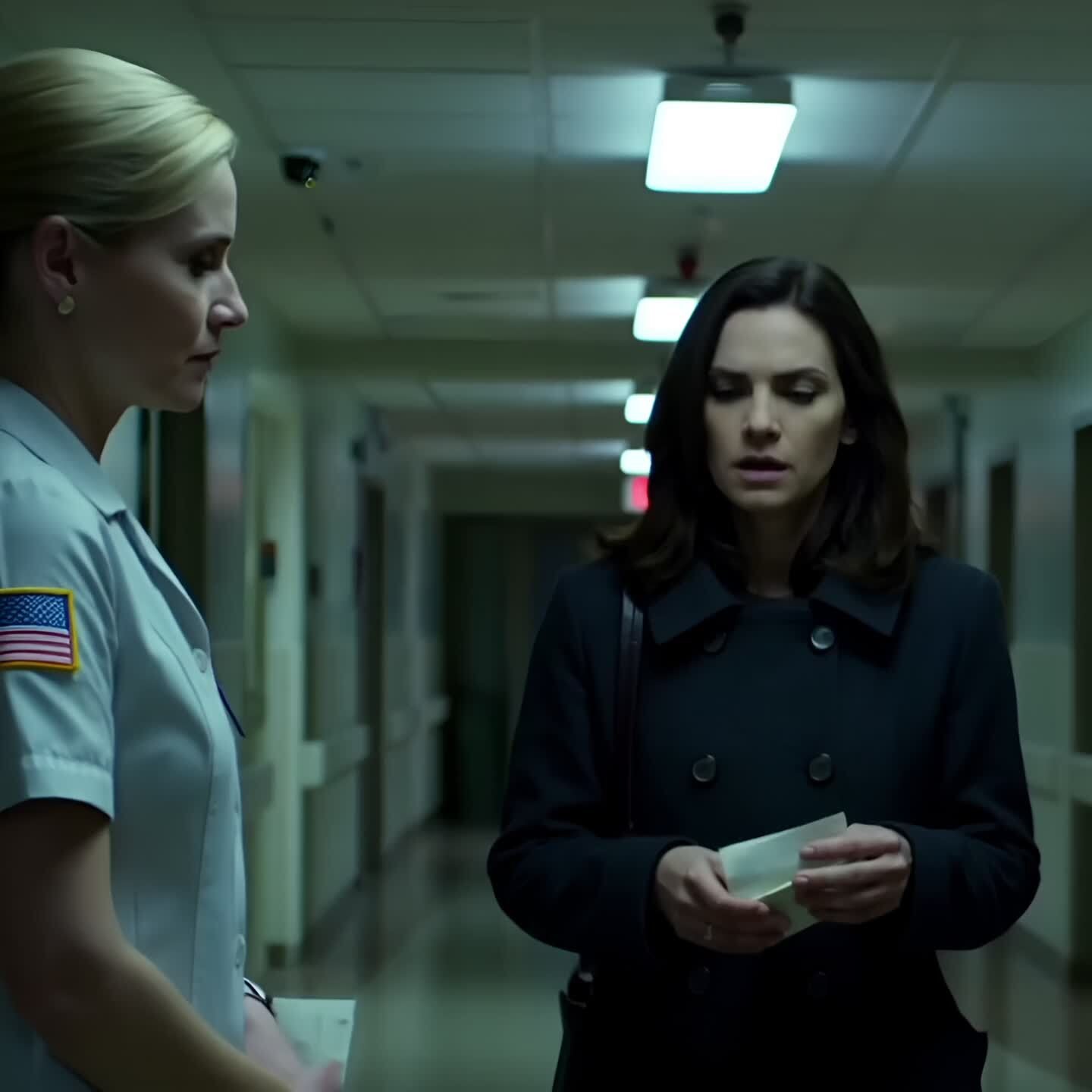
🏥 At the hospital for my husband’s “broken legs,” a head nurse slipped me a note that said: Stop coming. Check last night’s security camera.
Mercy General Hospital, downtown Chicago, was unnervingly quiet at 3 a.m.
The whole white building felt like a giant beast, asleep with its mouth slightly open. Only the faint green hallway lights and the cold, flickering EXIT sign stained the walls with a sickly glow. The smell of antiseptic, bandages, and old linens clung to the air—one of those scents that, if you breathe it too long, makes your head heavy and your lungs tighten.
I sat hunched on a folding chair beside the bed, my back half-propped against the wall, half suspended in midair. My spine ached like someone was twisting it by hand. But I didn’t dare move much. Even the smallest creak from the chair could make the man in the bed frown and groan.
That man was my husband, Michael.
He lay perfectly still, both legs wrapped in thick white casts and suspended in a traction frame—a tangled mess of ropes and pulleys. He looked like a specimen fate had decided to put on display.
Michael let out a soft moan, his voice thin and broken. Sweat dotted his forehead. His eyebrows pulled into one dark line.
I shot up instantly, my own legs so numb they felt like they didn’t belong to me. I poured a glass of warm water, stuck a straw in it, and held it to his lips.
“Mike, drink some water,” I whispered. “It’ll help with the dryness. Just sip slowly.”
He struggled to open his eyes.
Those eyes used to melt my heart with their kindness. Now they were bloodshot, staring at me with a mixture of guilt and weakness.
“Emily… this is too hard on you,” he rasped. “I was so careless on the road, and now you have to take time off work to care for me. I feel so useless.”
I managed a faint smile, trying to keep my voice steady.
“Don’t be silly. We’re husband and wife. The stronger one helps the weaker one. You’re laid up now, so I’ll take care of you. If it were me, you’d do the same. This is our life, not someone else’s. There’s nothing to be ashamed of.”
I used a tissue to wipe a few drops of water from the corner of his mouth.
But my heart still felt that deep, sharp pang.
Three days ago, Michael had a car accident on his way home. The Chicago police report concluded it was brake failure—his car slammed into a median. He was lucky to be alive.
But the doctor, after looking at the X-rays, had sighed and told me, “Severe fractures with nerve compression. You need to prepare yourselves. There’s a chance he may be in a wheelchair for a long time.”
For a man whose career was just starting to stabilize, those words weren’t just bad news. They were a door slamming shut.
And for me—Emily, thirty years old, a forensic accountant—it felt like someone had kicked down the house I’d spent nearly ten years building, brick by brick.
Our careers. Our home. Our plans for kids. All the small dreams we’d sketched out together.
Paused in a single night.
For three days, I’d barely slept.
During the day, I sat in that chair by his bed, monitoring his IV drip and his medications while juggling emails and reports from my firm on my laptop. At night, I woke every couple of hours to help him shift, wipe him down, and keep his bedding clean—careful that the casts stayed dry.
Every nerve in my body felt stretched tight, like a violin string ready to snap.
“Where’s Chloe?” Michael asked after a few sips, his eyes scanning the room. He tried to sound casual, but his gaze swept quickly before landing on the empty chair on the other side of the bed.
“She went home to make you some broth,” I said, adjusting the flow of his IV. “She said she’ll bring it tomorrow to help you get your strength back.”
“I had to practically force her to go,” I added. “She needed sleep.”
Chloe was Michael’s younger cousin. Fresh out of college, new to the city, crashing with us until she found her own place. She was quick on her feet and sweet-talking in a way that made people relax.
For the past three days, she’d been a lifesaver—running errands, handling paperwork, picking up meals. Without her help, I probably would’ve folded.
Thinking about it, I felt genuinely grateful.
“Don’t let her work too hard,” Michael murmured, closing his eyes. “And you need to rest too. You look paler than the patient.”
I was about to tease him—anything to lighten the mood—when the door creaked open.
A soft rolling sound followed. Wheels on tile.
The woman who entered was the head nurse, Sarah.
She was in her forties. Not glamorous, not warm. Her face was always impassive, like someone who’d seen so much life and death that surprise had burned out of her years ago. She spoke little and worked efficiently, keeping a professional distance from patients’ families.
But over these past few days, she’d always give me an extra glance as she passed.
Not annoyance.
More like… she was weighing something. Then deciding against it.
“Bed seven,” she said quietly, pushing her cart toward Michael’s bed. “Time for your medication.”
I quickly stood and moved aside.
“Thank you, Sarah. You work so hard.”
She didn’t reply.
She put on gloves and lifted the blanket, checking the casts and the catheter. Her movements were practiced, gentle. But her eyes were sharp as a scalpel—darting from Michael’s face to his legs, then settling on the IV bag.
“Ma’am,” she said, turning to me suddenly, “could you go to the nurses’ station and grab two more bags of saline for me? This one’s almost empty, and I’m out of singles on my cart.”
I blinked. Tasks like that were usually handled by an aide.
But her tone left no room for questions.
I nodded, turned, and walked out.
Just as I passed her, something small and cool pressed into my hand.
A folded piece of paper.
It was slipped into my palm with incredible speed. The cold shock startled me like a needle prick.
I almost cried out.
But when I looked up, Sarah had her back to me, pretending to adjust Michael’s pillow. With her other hand hidden behind her back, she made a swift gesture—index finger to her lips.
Silence.
My heart seized.
The instincts I’d built from years of tracking irregularities—of spotting what didn’t add up—rose in me like a flare.
Something was wrong.
I didn’t turn back. I didn’t stop.
My hand clenched around the paper as I walked into the hallway.
The corridor was deserted. The only sound was the low hum of the air conditioner.
I kept moving until I reached a small kitchenette around the corner—an awkward blind spot where staff joked the cameras didn’t really catch anything useful. The light there was dim and yellow, just bright enough to see someone’s face.
I pressed my back to the wall and took a slow breath.
The paper was damp from my sweat.
I unfolded it carefully, still hoping it was something ordinary—an instruction, a warning about a medication, anything.
But the words, scribbled in a hurried hand with smudged ink, sent a chill straight down my spine.
Stop coming.
Check last night’s security camera.
He’s faking sleep.
Just a few words.
But to me, they hit like a bucket of ice water.
My scalp tingled. My palms went cold.
Faking sleep.
Who was faking sleep?
Michael.
And last night’s camera?
What happened last night?
The past three days flashed through my mind like a fast-forwarded tape.
Michael constantly complained about pain—especially whenever I got close to his casted legs. He wouldn’t let me look at the injuries, always saying, “It’s gruesome, Emily. Don’t look.”
His phone, which he used to leave unlocked on the counter, was now tucked under his pillow every night. The moment a message came in, he’d silence it fast.
And Chloe… every time she entered the room, Michael would moan louder, acting weaker.
But when it was just the two of us, sometimes he seemed to settle. Less pain. Less drama.
I’d dismissed those details—blamed exhaustion, stress, my own paranoia.
But now, under that dim yellow light, with those words in my hand, every scattered grain of doubt suddenly snapped into a single chain—and it felt like it was tightening around my throat.
I stood frozen until the sting of my nails digging into my palms brought me back.
Don’t panic.
I wasn’t just a wife.
I was a forensic accountant.
For years, my training had drilled one lesson into me: when you find an anomaly, you find the evidence. You don’t jump to conclusions.
With that thought, I tore the note into tiny pieces and dropped them into the toilet. I flushed until nothing was left.
Then I splashed cold water on my face.
In the mirror, a pale woman stared back at me—eyes sunken from no sleep, hair flattened, lips pressed tight.
But something in her gaze had changed.
The familiar softness had been replaced by a thin, cold glint.
“Get it together, Emily,” I whispered. “Crying, screaming, fighting… none of that solves anything right now. You need the truth.”
I grabbed the two saline bags like Sarah asked, forced my face into calm, and walked back to the room.
As I entered, I kept my expression smooth.
“Sarah, I’ve got the saline.”
Sarah looked up at me.
In her eyes, I saw two things clearly.
Pity.
And determination.
She took the bags, hung a new one, checked the line one last time. Then she said—like she was talking to herself, like it meant nothing—“He should be stable tonight. You should try to get some rest. We’ll call you if anything changes.”
I nodded.
But I didn’t sit down right away.
I stood there a long time, watching Michael.
He lay still again, eyes closed, breathing evenly.
To anyone else, he was just a husband suffering through a terrible accident—with his devoted, exhausted wife standing guard.
But in my mind, after that note, his face had become strangely unfamiliar.
Like a masterfully painted mask.
Tonight, I’ll let you sleep, I thought. Tomorrow, we’ll see what’s real.
That night, for the first time in three days, I didn’t stay awake counting his groans.
I lay back on the folding chair, pulled the thin blanket up, and stared at the ceiling with my eyes wide open.
One thought repeated, over and over.
Tomorrow, I have to see that hospital footage—no matter what.
The next morning, the first weak rays of sunlight cut through the window.
I got up to adjust the blinds and smooth Michael’s blanket. It felt like waking up after a long fever—my body weak, my mind unnaturally sharp.
Michael was still lying quietly, eyes shut, lips dry, wincing now and then like he was in pain.
Chloe walked in carrying a container of soup and set it on the small table.
“Emily, you’re up,” she chirped, bright as always. “I made some broth for Mike. You must not have slept well—look at those dark circles.”
I glanced at Michael.
His eyes stayed closed, but his shoulders trembled slightly, like he was trying to suppress a reaction.
To an outsider, it looked like a family united in tragedy.
If this had been yesterday, I would’ve smiled, thanked Chloe, felt my heart warm.
But this morning, everything looked… warped. Like staring into a cracked mirror.
I smoothed my hair back.
“Thanks, Chloe.” I kept my voice even. “I have to stop by the office for a bit. They need me to handle some urgent paperwork. Can you stay here and keep an eye on Mike for me? Call me if anything changes.”
Michael’s eyes opened slowly.
“Emily… will you be long?” he asked, concern spilling into his voice. “I feel anxious being here alone.”
“What are you talking about?” I said lightly. “Chloe’s been a huge help. We haven’t even properly thanked her yet.”
I turned and smiled at Chloe, then patted Michael’s hand.
“I’ll only be a few hours. Just take it easy. If you need anything, call a nurse.”
After I spoke, I bent to adjust the traction ropes and smooth the bedding near his back. My hands moved as carefully as always.
Inside, there was a cold emptiness.
Before, every time I touched Michael, I’d think: This is my husband. The man I chose.
Now, a different question wouldn’t leave me alone.
Is he acting?
I gathered my coat, handbag, and laptop.
Chloe took the bag from me, adding softly, “Drive safe, Emily. Come back for lunch. Don’t eat too much greasy food. It’s not good for you.”
I nodded.
Michael grabbed my hand before I could go. His eyes looked red and helpless—like a man terrified of being abandoned.
“Emily… I’m so sorry,” he whispered. “What if… what if I end up disabled? If it gets too hard for you… please don’t leave me. Don’t divorce me, okay? You’re the only reason I’m still alive.”
If this were yesterday, I might have broken.
I might have cried and rushed to promise him I’d never leave.
But now, all I felt was a thick lump in my throat.
I gently pulled my hand free and forced a smile.
“What are you thinking? I’m just stepping out for a bit. I’ll be back. Lie still. Don’t move too much or it’ll hurt more. Chloe’s here. The nurses are here. No one is abandoning you.”
I walked out.
The door clicked shut behind me—soft, ordinary.
But to my ears it sounded like a life splitting in two.
Instead of heading for the main exit, I went down into the parking garage.
It was vast and dim, smelling of gasoline and damp concrete.
I found a secluded spot, parked close to a wall, rolled up the windows, and locked the doors.
Only in that sealed space did I allow myself to exhale.
I pulled out my phone and found Kevin—an old friend from college who now worked in cybersecurity.
I texted him: Kevin, I need your help with something personal. It’s urgent and has to stay private.
The “seen” receipt popped up almost instantly.
Typical Kevin.
A second later, he replied: What’s going on?
My fingers hovered over the screen.
I kept it simple.
I need to view security footage from Mercy General’s orthopedic ward, room 307—sometime between 1 a.m. and 3 a.m. last night. Is there any way you can help me get eyes on it?
My heart pounded as soon as I hit send.
I knew I was stepping into something messy.
But I also knew that if I didn’t, I’d spend the rest of my life trapped in doubt.
Kevin called me.
“Emily,” he said, low and serious, “this is a big ask. Hospital systems aren’t casual. But… there might be a way to get a temporary viewing link. Tell me the exact hospital name, the location, and send me a photo of the room sign so I’m not guessing.”
He paused.
“Are you sure you want to see this? Some things—once you see them—you can’t unsee.”
His voice landed in my chest like a weight.
But there was no turning back.
“I’d rather get hurt once,” I said softly, “than live with this doubt forever.”
“Okay,” he replied. “Stay nearby with decent signal. If I can pull it, I’ll send it. And Emily—whatever you see, keep your head.”
I sent him the photo I’d taken of the door sign on my way down.
Then I opened my laptop, tethered it to my phone’s hotspot, and sat curled in the driver’s seat, listening to the car’s AC hum.
Time crawled.
Every minute felt like an hour.
While I waited, my mind betrayed me with old memories.
When Michael and I first started dating, he was hardworking and almost sweet in his effort. He’d ride his motorcycle from Evanston to Wicker Park just to bring me soup because he heard I was stuck working late.
Back then, I believed there were still sincere men in the world.
After we got married, he started a small construction supply company.
He used to boast to his friends, “My wife’s a forensic accountant. She’s tough. If I do anything crooked, she’ll sniff it out.”
Then he’d laugh, ruffle my hair, and say, “Don’t worry. You handle the finances. I’m just out here trying to make a name for us.”
Those words felt warm then.
In recent years, the business had gotten shaky. Less money. More irritation. He came home later, smelling like beer and stale smoke.
Whenever I asked, he’d brush me off.
“A man has to network,” he’d say. “It’s tough to land projects these days. Don’t make it harder.”
And I let it go.
Partly because I trusted him.
And partly because I thought a marriage couldn’t survive if the wife was always suspicious.
Sitting in that garage, clutching my laptop like a life raft, I realized something that made me feel sick.
I’d spent years auditing blueprints and budgets.
But I’d forgotten to audit the man sleeping beside me.
An hour passed.
Then another.
My eyes burned. My neck stiffened.
Just when I thought Kevin had given up, my phone buzzed repeatedly.
A message appeared.
Emily. Sending you a link. It will only work for a short window. Watch quietly. Don’t panic.
I took a deep breath, put in my headphones, opened the browser, and clicked.
The screen showed a dark window.
Then the image resolved.
A top-down view from a ceiling-mounted camera. Black and white, but clear.
It covered most of the room—Michael’s bed, the folding chair I always sat in, the door, the small table.
A timestamp in the corner read 1:58 a.m.
I dragged the timeline to around 2:00 a.m.—the time I remembered finally giving in to Michael’s pleas to go home, shower, and come back early.
There I was on screen, moving around the room, tidying things, leaning down to say something to Michael.
Then I opened the door and left.
The door closed.
The room fell silent.
Michael lay motionless.
I clenched my fists.
A sliver of hope still lived in me.
Maybe Sarah misunderstood.
Maybe he just shifted in his sleep.
But less than a minute later, the thing I dreaded most happened.
Michael’s eyes snapped open.
Quick.
Alert.
None of that groggy, pained haze he always wore for me.
He lifted his head, scanned the room, and propped himself up on his elbows.
The movement was sharp and steady—nothing like someone who was supposedly immobilized.
Then he lifted his casted legs.
Up.
Down.
Even rotated them slightly side to side.
He stretched to grab the phone hidden under his pillow, tapping with casual ease.
Something dropped in my car—a soft thud.
My pen.
My fingers were trembling so badly I couldn’t even feel them.
I didn’t look away.
A few minutes later, the door in the video opened again.
Chloe walked in carrying a large bag.
As soon as she stepped inside, she grinned.
“Brought you the good stuff,” she said. “Is Emily gone?”
Michael chuckled—clear, normal.
“Yeah,” he said. “She just left. God, I was starving.”
He pulled out a box of fried chicken and a couple cans of beer.
His hands moved fast, hungry, confident.
Not the hands of a man who claimed he could barely swallow.
Chloe perched on the edge of the bed, leaning in, giggling.
“Eat slow. You’ll choke.”
Then her voice dropped.
“You have to keep playing the suffering patient. If Emily gets suspicious, everything falls apart.”
Michael chewed and shrugged.
“She’s soft,” he said, like it was a joke. “That’s why this works.”
Chloe laughed.
Michael gave her a casual tap—too familiar, too comfortable.
“You’re a great actress,” he said. “Without you, she’d never have bought it.”
My stomach turned.
Then the words came—clear enough for the mic to catch.
“A few more days and she’ll agree to sell the Lincoln Park brownstone,” Michael said. “Once that’s sold, we pay off the debts and still walk away with over a million. Plenty to start over somewhere else.”
The Lincoln Park brownstone.
My parents’ house.
A three-story home in my name.
The last thing they left me.
My anchor.
My safety net.
In my husband’s mouth, it sounded like a lifeboat he’d already claimed.
Chloe’s excitement was almost impossible to hide.
“Are you sure she’ll do it?” she asked. “She can be stubborn.”
“That’s why she’s easy,” Michael scoffed. “I had my doctor friend scare her with worst-case talk. Then I act hopeless. ‘I’m scared I’ll be a burden.’ Emily always chooses sacrifice. Big heart for everyone but herself.”
He popped open a beer.
“You just wait. Once the place is sold… I’ll give you half. We’ll leave Chicago. Miami. San Diego. Somewhere warm. Start clean.”
Chloe leaned her head on his shoulder.
“What about the lenders?” she asked. “I heard you owe a lot.”
“A debt’s a debt,” Michael said, like he was talking about a parking ticket. “Once we have the money, we’re fine. I owe around two hundred grand. The interest keeps stacking. But that house fixes everything.”
He took another long drink.
“The only thing that matters is Emily has to finalize the paperwork.”
Chloe went quiet for a beat.
Then she asked, hesitantly, “So… when are you leaving her?”
Michael frowned—annoyed for half a second—then smoothed it away.
“After everything’s settled,” he said. “If I do it now, she gets suspicious. Ruins the whole plan. Don’t worry. It’s over between us.”
He snorted.
“What woman would stay with a disabled, broke husband? She’ll walk eventually. Then I’m the abandoned victim. And I’ll have the money. And I’ll have you.”
I couldn’t listen anymore.
My chest felt tight, like the air had thickened into something I couldn’t swallow.
I pulled the headphones off.
The sound of my own breathing filled the car, loud and unfamiliar—like it belonged to someone else.
Outside, in the garage, a few people in scrubs walked past quietly, their soft-soled shoes making almost no sound.
No one knew that inside this small car under the hospital, a wife had just watched her marriage die in real time.
I didn’t cry.
My eyes were dry—as if my tears were too afraid to show up.
The first thing I felt wasn’t grief.
It was humiliation.
Humiliated for being underestimated.
Humiliated for priding myself on being sharp, on being able to account for every dollar in a multi-million-dollar project… and still letting the man I shared my bed with turn me into an easy mark.
I pictured the brownstone.
The front steps where my dad used to sit in an old T-shirt, sipping iced tea, smiling when I came home.
My mom, every Thanksgiving, telling me to cherish that house.
“If anything ever happens,” she’d say, “that place is your anchor.”
In Michael’s mouth, my anchor was just collateral.
Something snapped.
Not loudly.
Quietly.
Like a switch flipping.
I let out a short laugh—dry, hollow.
Then I texted Kevin with hands that had stopped shaking.
I saw enough. If you can, save the clip from the moment I left until Chloe walked in and they started talking. I’ll need it. Thank you.
Kevin replied almost immediately.
I can keep a record of what I pulled. Be careful, Emily. Do you need someone to call for you?
My jaw tightened.
No. I’m okay. Please don’t tell anyone. Act like this never happened.
I stared at my reflection in the rearview mirror.
Disheveled hair. Hollow eyes.
But the gaze looking back at me wasn’t trembling anymore.
In that moment, I understood with perfect clarity:
From this second on, the gentle, endlessly patient Emily was gone.
What was left was Emily the auditor.
And this time, the thing I needed to audit wasn’t a business.
It was my marriage.
I started the car.
And instead of walking back into that hospital room like nothing happened…
I drove home.
…
The familiar streets on the way home suddenly felt alien.
The tree-lined avenues. The coffee shop where Michael and I used to sit. The bakery where I’d buy his favorite pastries.
Everything slid past my windshield like scenes from an old movie—like I’d hit fast-forward just to skip the parts that hurt.
When I got home, the place was silent, drained of warmth.
Chloe’s shoes were still scattered by the door. Michael’s jacket hung on the rack. The faint trace of his cologne lingered in the air like a lie that refused to leave.
I stood in the middle of the living room for a moment, then reached back and locked the door.
The soft click of the deadbolt sounded in my chest like a boundary being sealed.
The first thing I did was go to our bedroom safe.
Inside were the deed to the Lincoln Park brownstone, my savings bonds, and a few documents my parents had left behind—papers that represented years of work, and the kind of safety you don’t realize you’re clinging to until someone tries to pry it from your hands.
I took everything out and slid it into a large tote bag.
Then I opened my laptop and signed into my accounts.
The password was one Michael used to know.
I changed it.
Then the next.
And the next.
Bank access, email, investment logins—one by one, methodical and quiet, like I was clearing broken glass off a floor.
While I worked, my phone rang.
Michael.
I stared at his name for a beat before answering, forcing my voice into softness.
“Hey,” I said.
“Emily… where are you?” His voice came through weak and needy, the same performance I’d been fed for days. “You’ve been gone so long. I was worried.”
“Just got home to grab more things,” I said lightly. “The house is a mess, so I’m tidying up a bit. I’ll be back soon.”
“Try to come back early,” he sighed. “I feel… empty here without you.”
I let out a small laugh, the kind that sounded warm but meant nothing.
“Lie still. Don’t move too much,” I told him, sweet as sugar. “Endure the pain a little longer. I’ll be back.”
After I hung up, a bitter smirk pulled at the corner of my mouth.
If I hadn’t seen that footage, I would’ve been racing back to the hospital right now, fear clawing at my throat.
Now every word he spoke sounded like a line from a script.
I picked up my phone again and called Kevin.
“Kevin,” I said. “I need one more thing.”
He didn’t joke this time.
“What do you need?”
“Find out everything you can about Michael’s debts,” I said quietly. “Loans, unpaid balances, anyone chasing him for money, anything connected to his name or his company over the past year.”
Kevin went silent for a second.
“…Okay,” he finally said. “But this means digging. Multiple sources. And Emily—if what you said is true, this isn’t small.”
“I know.”
“I’ll move fast,” he promised. “Just… be careful.”
When I ended the call, the exhaustion hit me like a delayed wave.
I sank onto a chair, back against the wall.
But instead of weakness, I felt something else.
A small heat.
Not wild rage.
Just a steady flame—controlled, persistent.
Later that afternoon, I returned to the hospital.
The moment I walked into the room, Michael’s face contorted like he’d been in pain for hours.
Chloe stood beside him and greeted me with that bright voice.
“You’re back. I just gave him his medication—he’s feeling a little better now.”
“Okay,” I said, stepping closer. “Let me check on him.”
I placed my hand on Michael’s forehead.
Warm, but no fever.
Michael opened his eyes and squeezed my hand tightly.
“You’re back,” he whispered. “Emily… I’m in so much pain. I don’t know how much longer I can take this.”
I looked at his face.
And for the first time in my life, I felt no sympathy.
I almost felt… detached. Like I was watching an actor who’d been on stage too long.
“Hang in there,” I said gently. “This afternoon, I have to meet with someone about the accident paperwork. They need additional forms.”
Michael flinched—barely.
“A lawyer?” he asked quickly. “Why does it have to be so complicated?”
“It’s a major company,” I said, calm and flat. “There’s paperwork.”
Chloe, standing nearby, stiffened for half a second.
The reaction was subtle.
But I saw it.
Then the door opened again.
David walked in.
Michael’s younger brother was three years younger than him. A delivery driver. Quiet, honest—one of those men who seemed built from patience and routine.
He carried a bag of fruit and looked like he’d barely slept.
“Emily,” he said, eyes already turning red, “how’s Mike doing? Mom told me he’s in a lot of pain.”
“He’s more stable,” I replied. “The doctor said we still need to monitor him.”
David stepped closer to the bed.
“Hang in there, bro,” he said, voice thick. “We’re all worried.”
Michael nodded with practiced weakness.
Watching them, my heart pinched—not for Michael, but for David.
He had no idea he was comforting a man performing for profit.
That evening, Sarah came by.
When she saw me, her gaze lingered longer than usual.
I knew what she was asking without words.
Did you see it?
I waited until Michael drifted off from the medication, then stepped quietly into the hallway.
Sarah was writing on a chart.
I stood beside her and lowered my voice.
“I saw it.”
Her pen paused.
She looked up and met my eyes.
“So,” she said softly, “what are you going to do?”
I glanced toward the room, then back at her.
“I can’t say yet,” I whispered. “But I need you to help me keep this quiet for now.”
Sarah didn’t ask why.
She just nodded.
Her silence felt heavier than any advice.
That night, while Chloe was out buying dinner, I sat by the bed and pretended to be exhausted.
I rested my head near the mattress.
Michael thought I was asleep.
He let out a soft sigh.
But I was wide awake.
Waiting.
My phone vibrated.
Kevin.
I have a preliminary report.
He has loans from at least four unofficial lenders. Principal close to $200,000 with extreme interest. Some under the company, some personal. History of online betting that moved offline. Transactions point to predatory-lending networks. I have screenshots.
I read the message with an eerie calm.
Everything fit.
The accident.
The performance.
The pressure to sell.
The urgency.
It wasn’t about “saving his life.”
It was about saving himself.
I replied with one sentence.
Keep everything safe. I’ll need it.
Later that night, Michael called his mother.
I heard her voice on the other end of the line—crying, complaining, blaming me for not taking better care of her son.
Then, like a knife slipping under the skin, she brought up the house.
Michael moaned on cue, voice trembling.
“I’ve talked to Emily,” he said.
“Mom, I think she’s considering it. Don’t push her too hard. She’s stressed with work. She needs time.”
I sat not far away, listening to every word.
My heart felt numb enough to frighten me.
A whole family—from top to bottom—pressuring me to hand over the last thing my parents left me.
If I hadn’t seen that footage, guilt would’ve swallowed me.
The next morning, Helen came to the hospital.
My mother-in-law looked thin and worn down. The moment she walked in, she started sobbing.
“Oh, my son… why is your life so hard?”
Michael took her hand, weak and trembling.
I stood to the side and said politely, “Hi, Helen.”
She turned to me.
Her eyes were pleading and reproachful at the same time.
“Emily,” she said, voice shaking, “I know this is hard on you, but right now the only way is to sell the house to take care of Michael. Don’t be so stubborn. What’s the point of holding onto property when your husband’s suffering?”
I looked at her for a long moment.
This was the woman who’d held my hands at my wedding and told me to think of her as my own mother.
Now all I could see was fear… and something sharper under it.
I took a slow breath.
“I understand,” I said, steady. “I’m thinking about it. But selling a house is a big decision. I need to review everything and check the accident coverage and paperwork so there aren’t complications later. Please… give me a little time.”
Helen opened her mouth to argue.
David gently touched her arm.
“Mom,” he said quietly, “let Emily take her time. She’s been through a lot.”
Helen pressed her lips together.
She didn’t like it.
But she said nothing.
I knew the pressure was only going to intensify.
Michael and Chloe would act harder.
Helen would tighten her grip on my compassion.
That afternoon, when everyone went out for food and it was just me and Michael, he squeezed my hand.
“Emily,” he whispered, “have you thought it through? I’m scared that if we wait too long, it’ll be too late.”
For the first time, I didn’t avoid his gaze.
“Don’t worry,” I said softly. “If I sell, I sell. But everything has to be clear and proper. I won’t risk losing the money and then getting blamed later.”
Relief flickered across his eyes.
He thought I was giving in.
Inside, a colder voice answered.
Oh, I’ll sell it.
Just not the way you think.
After that, Michael’s attitude changed.
He got gentler.
Held my hand more.
Looked at me like I was his savior.
He even let tears fall when he talked about being a burden.
Before, it would’ve broken me.
Now, every tear summoned the image of him eating fried chicken and laughing with Chloe.
Helen started visiting almost daily.
She switched from harshness to softness.
She’d hold my hand and whisper, “Emily, please. Just sacrifice a little. Once he’s better, you can buy another place.”
I’d nod without committing—just enough to stop her.
David was different.
Every time he visited, he stood quietly in a corner, watching Michael too long.
Like he wanted to say something.
One day, as I walked him out, he pulled me aside.
“Emily,” he whispered, “Mike’s been acting strange lately. Sometimes I walk in unexpectedly and he’s perfectly still. But other times I can hear him on the phone and his voice is completely normal.”
He swallowed.
“Be careful.”
My chest tightened.
From the outside, it looked like I was cornered.
But I wasn’t alone.
“Thank you, David,” I said quietly.
That evening, Chloe came back late.
She was wearing a strong perfume that didn’t fit a hospital hallway.
Michael shot her a quick, sharp look.
I saw everything.
Chloe set a bowl of soup on the table and kept her gaze down.
“Emily,” she said softly, “I have an interview early tomorrow morning. I probably won’t be able to help as much the next few days. I hope you understand.”
“Of course,” I said calmly. “You’re young. You need to think about your future. The nurses are here. I’m here.”
She flinched when Michael’s fingers brushed hers for a brief second.
Fear.
Guilt.
Panic.
And when people panic, they make mistakes.
That night, Kevin sent another message.
He’d compiled a full file—debts, transfers tied to betting, the names of several lenders.
There was even an audio clip someone had shared with him—Michael’s voice frantic, promising he’d get the money within two weeks.
Listening to it, my eyes closed on their own.
So that was the deadline.
Not for his “recovery.”
For his repayment.
I couldn’t tip my hand.
If Michael realized I knew everything, desperation could push him into something reckless.
So I kept acting.
The devoted wife.
Willing to sacrifice.
The next morning, I told Helen, “I’ve thought a lot about it. If selling the house helps, I’ll do it. But I need a bank and an agent so everything is done properly and we get a fair price. I don’t want to sell it at a loss.”
Helen’s face lit up like she’d just been rescued.
“That’s wonderful,” she breathed. “Thank you. If Michael knew, he’d be so happy.”
She turned to the bed, took his hand, and sobbed.
“Son… your wife agreed. You have to keep going.”
Michael’s eyes filled with tears.
“Emily,” he whispered, “you’re my savior.”
I smiled and lowered my head.
“I’m doing this for our family.”
Inside, the colder voice answered.
Yes.
For my family.
Not for the one you’re building behind my back.
That afternoon, I left early and went straight to a quiet law office tucked into a side street.
Mr. Anderson was a lawyer I’d worked with on a contract dispute years ago. Calm, discreet, the kind of man who didn’t raise his voice unless it mattered.
I told him everything.
The “accident.”
The note.
The footage.
The debts.
He listened without interrupting.
When I finished, he sat in thoughtful silence for a long time.
“Legally,” he said at last, “if we can show staged injury or falsified claims, the consequences are serious. But right now, you shouldn’t make a move that warns them. Their plan is to pressure you into selling willingly.”
He leaned forward.
“So we let them believe you’re doing exactly that.”
I nodded, hands resting on his desk.
“I don’t need revenge,” I said softly. “I need to protect my parents’ property. And I don’t want to be painted as someone who ‘abandoned’ him later.”
Mr. Anderson studied me for a beat.
“You’re stronger than you think,” he said.
I gave a weak smile.
“I’m not strong because I don’t feel it,” I said. “I’m strong because I can’t afford to fall apart yet.”
That evening, I returned to the hospital.
Michael looked frantic when he saw me.
“Where have you been?” he whispered. “I called you.”
“I met with an agent,” I said evenly. “They looked at the house. There’s interest, but nothing is final yet.”
Michael’s eyes lit up.
“How much?”
“Around eight hundred thousand,” I said slowly. “But I want nine.”
I intentionally quoted low to keep them greedy and impatient.
As expected, Michael nodded quickly.
“Yeah,” he said, anxious. “As long as it sells fast. We can worry about the number later.”
He meant his deadline.
Not his legs.
That night, Chloe slipped out again.
I pretended not to notice.
I needed her away more often, needed Michael to lose one of his secret supports.
And just as I predicted, without Chloe, Michael’s performance slipped.
His pain became inconsistent.
Sometimes he forgot his role and sat up a little too straight.
I saw it.
Two days later, Helen came again, rushing me about signing paperwork.
I told her the agent needed original documents and that it would take a few days.
She didn’t like that.
But she held her tongue.
Because she was relying on me.
David grew quieter.
One afternoon, while he helped me carry things to my car, he asked suddenly, “Emily… if Mike did something wrong… would you forgive him?”
I looked him straight in the eyes.
“What do you think?”
David dropped his gaze.
“I just hope,” he said hoarsely, “if he did something wrong, he stops in time.”
For a second, my heart sank.
Then I understood.
Some mistakes don’t get fixed just by stopping.
When someone gambles with money, honor, and the life you built together… there’s no clean rewind.
That night, after Michael drifted into medicated sleep, I stood by the window in the hallway and stared down at the dim parking lot.
My phone buzzed.
Kevin.
They’re getting impatient, he wrote. One of the lenders said if he doesn’t pay on time, they might show up at the hospital to “talk.” Be careful. I think something is coming within the week.
I tightened my grip on my phone.
My time was running out.
This play had to end before things turned dangerous.
I went back into the room and looked at Michael sleeping peacefully, face innocent as a saint.
I pulled up a chair and sat down.
“You’re a great actor, Michael,” I whispered, barely above my breath. “But your leading lady is about to exit the stage.”
The next morning, I deliberately took the day off.
Not to care for Michael.
To wait.
To time it.
To end it.
Michael was thrilled I stayed all day.
He performed harder than ever.
Whenever someone came in, he’d groan, clutch my hand, voice thin as thread.
“Emily… don’t leave me. Please. You’re all I have.”
Helen sat beside him wiping tears.
David leaned against the door, watching with suspicion.
And me?
I played the devoted wife so convincingly that sometimes even I felt uneasy—like I’d become a stranger to my own face.
Around noon, Chloe returned.
The moment she stepped inside, her eyes darted around.
When she saw me sitting there, she froze for half a second.
I smiled.
A perfectly calm smile.
“How was the interview?”
“Oh… uh… they said they’ll call me back,” she stammered.
Michael shot her a look—impatience flashing through his mask.
They were missing their private conversations.
Good.
I let them sit in that discomfort.
In the afternoon, I called Mr. Anderson.
“I’ve followed the plan,” I said quietly. “They’re moving. I think the lenders will show up tonight or tomorrow.”
His voice was grave.
“I’ve already contacted law enforcement,” he said. “When you give the signal, they’ll come in. Stay calm. Don’t let anyone provoke you.”
I looked through the glass toward the room where Michael was smiling weakly at his mother.
“I’m calmer than I’ve ever been,” I replied.
I hung up.
The fear was gone.
All that was left was clarity.
Around 7 p.m., visiting hours began winding down.
Helen was preparing to leave when Michael suddenly gripped my hand.
“Emily,” he whispered urgently, “what’s the update on selling the house?”
I looked straight into his eyes.
“Tomorrow afternoon,” I said, slow and steady, “they scheduled an appointment for me at the title office to put down a deposit. If all goes well, we can finalize everything in three days.”
Michael’s eyes lit up.
Helen looked like she could finally breathe.
“That’s wonderful,” she said, hands clasped. “Now I can rest.”
David stared at me for a long moment.
“Emily,” he asked quietly, “are you sure there won’t be problems?”
I nodded.
“Don’t worry, David.”
Around 8 p.m., just after the evening nurse finished her round and the room settled into a heavy quiet…
the door was suddenly shoved open.
Three unfamiliar men walked in.
They didn’t look like family.
Their shoulders were squared. Their eyes were cold.
And the air in the room changed in an instant.
…
The man in front scanned the room, then looked straight at Michael.
“Michael,” he said, voice flat. “We’re here to visit.”
Michael’s face went pale for a split second.
Then the performance snapped on.
He moaned loudly.
“Who… who are you?” he stammered. “What are you doing here? I’m seriously injured. My wife… my wife is about to sell the house to pay you back.”
Helen shot up, alarmed.
“Who are you people?” she cried. “This is a hospital.”
One of the men gave a thin smile.
“We’re just checking on an old friend,” he said. “Don’t worry, ma’am.”
Then their eyes landed on me.
I took one step forward.
My voice didn’t shake.
“If you’re looking for Michael, state your business,” I said evenly. “I’m his wife.”
The leader raised an eyebrow.
“So you’re the wife,” he murmured. “Even better.”
He tilted his head like he was considering me.
“Your husband owes close to two hundred thousand in principal,” he said. “And the interest isn’t small. He promised he’d have the money in two weeks. That deadline is almost up.”
His gaze sharpened.
“We want a clear answer. When do we get paid?”
Silence dropped into the room like a weight.
Helen turned to Michael, trembling.
“Michael,” she whispered, voice cracking, “you owe that much money? Why didn’t you tell me?”
Michael’s mouth opened.
Nothing came out clean.
“I… I just borrowed a little,” he stammered, sweat shining on his forehead. “For the business.”
Then he turned to me fast.
“Emily,” he pleaded, “tell them we’re about to have the money.”
I looked at him.
And my voice came out colder than I expected.
“Don’t worry,” I said. “There will be money.”
Michael’s eyes brightened.
But then I finished.
“It just won’t come from selling my house.”
The room froze.
The three men stared at me.
“What’s that supposed to mean?” the leader asked.
I didn’t answer with words.
I reached into my bag, pulled out my phone, and tapped the screen.
The wall-mounted TV flickered.
Then it lit up.
Black-and-white footage filled the screen.
A top-down view of Room 307.
Michael sitting up.
Grabbing his phone.
Eating.
Drinking.
Chloe leaning close.
Their voices carried in the room—clear, unmistakable.
“Once the Lincoln Park brownstone is sold…”
Helen made a sound like her lungs forgot how to work.
“Oh my God,” she cried, eyes wide, hands flying to her mouth. “What is this? Michael… what have you done?”
David stood like he’d been turned to stone.
Chloe’s face drained so fast she looked unreal.
Michael stopped moaning.
Because there was nothing left to act.
His eyes darted wildly.
“Emily,” he choked out, “listen to me—let me explain. This is… this is a misunderstanding.”
I let out a short, cold laugh.
“A misunderstanding?”
I pointed at the screen.
“A misunderstanding about you faking injuries to pressure me into selling my parents’ home?”
I took a breath and kept going.
“Or a misunderstanding about you and Chloe planning to use my money to cover your betting debts?”
The three men exchanged looks.
The leader let out a low chuckle.
“Well,” he said, almost amused, “I didn’t think Michael had this kind of nerve.”
I turned to them.
“The money he owes you is his. Not mine,” I said. “I’ve already spoken with my attorney, and the authorities have been notified. The evidence is documented. If you cause trouble here, you won’t be the only ones facing consequences.”
The leader stared at me for a long moment.
Then he laughed.
“Fine,” he said, lifting both hands slightly. “We’re not stepping into your family mess.”
His smile vanished as he looked back at Michael.
“But you still owe us.”
His voice went flat.
“This is your last chance.”
Then the three men turned and walked out, leaving the room behind them like a door slammed shut.
The silence that followed was worse than shouting.
Helen collapsed into sobs, striking Michael’s chest with weak fists.
“What have you done?” she cried. “You’ve ruined us!”
David stared at his brother, eyes red.
“You… you lied to your wife,” he whispered. “You lied to your mother. For money?”
Chloe’s knees buckled.
She sank to the floor, shaking.
“Emily,” she sobbed, “I was wrong. I was—he manipulated me. I didn’t think it would go this far.”
Michael’s eyes snapped to me—terrified, desperate.
“Emily,” he begged, “please. Don’t leave me. I was wrong. I really was.”
I looked at him for a long, long moment.
It didn’t burn like the first shock.
It didn’t even sting the way I expected.
All that was left was exhaustion.
“You weren’t wrong just once,” I said quietly. “You were wrong the moment you chose to lie. The moment you decided my parents’ house was something you could gamble with.”
I turned to Helen.
My voice stayed slow and deliberate.
“Helen… I gave everything to this family,” I said. “But from today, I’m no longer your daughter-in-law.”
Helen froze.
Then her face crumpled.
David’s throat worked like he was swallowing grief.
I looked at him.
“I’m sorry,” I said softly. “I couldn’t preserve the image of your brother for you.”
David didn’t answer.
He just stared, broken.
Then I turned my back and walked out.
Behind me—crying, shouting, pleading.
I didn’t stop.
Michael’s play was over.
And the rest of my life?
I was going to write it myself.
Outside, the wind cut sharp.
Streetlights painted long pale streaks across wet asphalt.
For the first time in years, I walked through Chicago and didn’t feel like I belonged anywhere.
Before, no matter how hard life got, I always had a place called home.
Now, that home felt like a wound.
I went back to the Lincoln Park brownstone.
The house my parents left me.
The house that almost got traded for Michael’s mess.
The door closed behind me.
I leaned against the wall and slid down to the floor.
As controlled as I’d been in that hospital room… here, I finally cracked.
My tears fell.
Not because I still loved Michael.
Because I couldn’t believe how many years I’d given away to someone who saw me as leverage.
The next morning, I called Mr. Anderson.
My voice didn’t waver.
“Please help me finalize the divorce as quickly as possible,” I said. “I don’t want to drag this out another day.”
He was silent for a moment.
“Rest assured,” he said. “With this evidence, the process will be straightforward. You won’t be responsible for his debts.”
A clean line.
A clear exit.
That was all I wanted.
A few days later, the divorce was granted.
On paper, we were no longer husband and wife.
The house stayed mine.
The rest of Michael’s life stayed his.
Stepping out of the courthouse, I took a deep breath.
The sky was painfully blue.
So blue it made me smile.
It wasn’t that the world had suddenly become kind.
It was just that I’d finally stopped living inside someone else’s lie.
Not long after, David came to the brownstone.
He stood at the gate for a long time before ringing the bell.
When I opened the door, he kept his head down.
“Emily,” he said, voice rough, “I’m sorry. I had no idea Mike was like that. If I had known…”
I shook my head.
“I don’t blame you, David,” I said. “You did nothing wrong.”
He swallowed hard.
“Mom… she cried all night,” he whispered. “She regrets pressuring you. She asked me to apologize to you on her behalf.”
I went quiet.
I couldn’t fully hate Helen.
She wasn’t evil.
She was blinded.
“Tell her I’m not angry,” I said. “But what happened between Michael and me can’t be undone.”
David wiped at his eyes with his sleeve.
“I just hope you find peace,” he said.
“I hope so too,” I answered.
After that, I didn’t go back to the hospital.
I handed everything to my lawyer.
I didn’t want to see Michael again.
Didn’t want to hear another excuse.
Everything I needed to know, I already knew.
A week later, I got a call from an unknown number.
It was Helen.
“Emily,” she whispered, voice thin, “I’m sorry. I was wrong. I trusted my son and made you suffer. Now I understand you were the one who was hurt the most.”
I stayed silent for a long time.
Then I said softly, “I don’t blame you. But I can’t come back. I’m too tired.”
On the other end, she broke into quiet crying.
I hung up.
Some pain doesn’t come from hate.
It comes from realizing there’s no road back.
Months passed.
Work kept me moving.
I transferred to another branch—new schedule, new pressure, a different routine that didn’t carry his shadow in every corner.
One afternoon, leaving a grocery store, I saw Chloe.
She looked thinner, bare-faced, like someone who’d been awake too long.
When she saw me, she froze.
“Emily,” she whispered.
I nodded.
“I’m sorry,” she said quickly. “I don’t expect you to forgive me. I just… I needed to say it.”
I looked at her.
And to my own surprise, I felt no rage.
What I’d lived through had burned me past the point of wanting to punish her.
“You’re young,” I said. “You made a choice. You paid for it. Learn from it. Don’t do it again.”
Chloe’s eyes filled.
She nodded over and over.
I walked away without looking back.
To me, Chloe had become part of the past.
Nothing more.
Life stayed quiet for a while.
Then, on a business trip, I met Daniel.
He was an engineer on a project team we were auditing—reserved, calm, with a steady gaze that didn’t try to take more than it offered.
He didn’t pry.
He didn’t fish for my personal life.
We talked about work. Deadlines. Real problems.
When the evening ended, he walked me to my car and smiled.
“It was really nice talking with you,” he said. “If you don’t mind… I’d like to buy you coffee next time you’re in town.”
I surprised myself by nodding.
“Okay.”
It wasn’t fireworks.
It was gentle.
Like a small stream running through rock.
Not loud.
Just enough to remind you you’re not standing alone.
Weeks later, in a quiet coffee shop, Daniel asked softly, “Have you been living alone long?”
I stared into my cup.
“A little over a year,” I said. “I got divorced.”
He nodded.
Then, after a pause, he said, “I’ve been through loss too. I married young. My wife passed away in a car accident four years ago.”
The sadness in his eyes wasn’t dramatic.
It was quiet.
Like a still lake.
We didn’t talk about it again.
Some pains don’t need to be performed.
Over time, Daniel showed up in small, respectful ways.
A bag of fruit.
Hot cocoa.
A ride home when the rain came hard.
He didn’t push.
He didn’t demand.
He arrived at a reasonable time and left the same way.
That respect made something in me unclench.
Then one day, David called.
His voice sounded shaken.
“Emily… Mike had a serious medical emergency. He’s in the ICU.”
I went still.
“You don’t have to come,” David added quickly. “I just… I thought you should know.”
I stood by the window for a long time.
Part of me wanted to turn away.
Another part remembered the years I’d called that man my husband.
Finally, I sighed.
“What hospital?”
I went.
Not as a wife.
Not as family.
As someone visiting a piece of her past.
Michael lay in the bed, thinner than I’d ever seen him. One side of his face slack, his body weakened.
When he saw me, his eyes widened.
His lips trembled.
He couldn’t form words.
David stood beside him.
“The doctors say he made it through the worst part,” he whispered. “But he’ll likely have limited movement on one side.”
I looked at Michael.
I expected a stab of pain.
What I felt was distant pity—like watching a stranger face the consequences of his own choices.
I leaned closer and spoke slowly, just loud enough for him to hear.
“Michael… live the rest of your life as best you can,” I said. “I’m not angry anymore. But we can’t go back. Don’t hold on.”
A single tear slid from the corner of his eye.
I didn’t try to interpret it.
I didn’t need to.
Leaving the hospital, I felt something strange.
Not triumph.
Not relief.
More like setting down something I’d carried too long.
My hands were finally free.
That evening, Daniel was waiting outside my building.
He didn’t ask questions.
He just handed me a tissue when he saw my eyes.
“Are you tired?” he asked softly.
I nodded.
He opened the car door, turned on the heater, and drove in silence.
That silence didn’t feel lonely.
It felt safe.
In the months that followed, my life steadied.
Work.
Home.
Occasional coffee.
Not flashy.
But real.
One morning, David called again.
This time his voice was heavy.
“Emily… Michael didn’t make it.”
I held the phone and stared out the window.
Yellow leaves swirled in the wind.
I knew this day would come.
Still, hearing it made something inside me pause.
“When?” I asked quietly.
“Early this morning,” David said. “It got worse. There wasn’t time.”
He hesitated.
“Will you… come?”
I was silent for a moment.
Then I said, “I’ll come.”
Not as an ex-wife.
As someone who once walked beside him.
The funeral was small.
A few relatives.
A few old acquaintances.
David handled everything.
When I walked in, his eyes were red.
He gripped my hand like he was holding onto the last piece of family he understood.
“Thank you for coming,” he whispered.
In the quiet room, Michael lay in the casket, face peaceful.
I stood there for a long time.
No blame.
No pity.
Just a faint regret for a life that went down the wrong path and couldn’t find its way back.
His mother was already gone.
There was no one left to cry for him the way she once would have.
I stepped forward, placed a small white flower near him, and whispered in my head:
From now on, all debts between us are settled.
Outside, Daniel waited.
He didn’t ask.
He just walked beside me all the way home.
After that, everything truly closed.
David moved back to his hometown to live a quieter life.
He texted me once: I guess it’s time for me to live my own life now.
I read it with sadness and relief.
Sometime later, Daniel asked me to meet his mother.
I was nervous in a way that felt almost embarrassing.
His mother was gentle, silver in her hair, voice soft.
She studied me for a moment, then smiled.
“You must be Emily,” she said. “Daniel talks about you.”
During dinner, no one poked at my past.
No one demanded a story.
The kindness without curiosity made me feel… safe.
When I stood to leave, Daniel’s mother took my hand.
“From now on,” she said simply, “think of this as your home too.”
One sentence.
My eyes stung.
It had been so long since anyone offered belonging without conditions.
A week later, Daniel gave me a small box.
He didn’t kneel.
He didn’t use dramatic words.
He just looked at me and said, steady and honest:
“Emily… I can’t promise you a perfect life. But I promise I will never deceive you. I won’t disappear when things get hard. If you’re ever ready to take another step… I want to be the one who takes it with you.”
Inside was a simple ring.
A delicate silver band.
I held it, feeling something unfamiliar.
Not fear.
Trust—quiet and cautious.
I didn’t answer right away.
I closed the box and met his eyes.
“Give me time,” I said. “Not because I don’t trust you… but because I want to be ready when I step forward.”
Daniel nodded.
“I can wait.”
I kept the box.
For days, I didn’t open it.
But I didn’t return it either.
One weekend, Daniel texted:
Are you busy? I’m near your neighborhood. Can I buy you coffee?
I looked at the sky outside my balcony.
Clear.
Bright.
A rare afternoon where work wasn’t swallowing me alive.
I’ll be right down, I replied.
Later, in a small café, he asked, “Do you ever regret waiting for something?”
I stared at my cup for a beat.
Then I said, “I used to think waiting meant weakness.”
Daniel shook his head.
“Sometimes,” he said, “the price of holding the wrong hand just to avoid being alone… is higher than loneliness itself.”
His words touched the softest part of me.
That night, at home, I pulled out the box again.
The ring lay quietly inside.
I understood something simple:
Some promises don’t need a speech.
They just need time.
Spring came slowly.
The nightmares faded.
The random stabs of pain eased.
One evening, Daniel drove me out to a quiet country road with fields stretching wide—flat land under a big Midwestern sky.
We parked.
We walked.
No pressure.
Just presence.
Finally, I stopped and looked at him.
“I don’t want to enter a relationship because I’m afraid of being alone,” I said. “I want to enter one because I feel safe.”
Daniel’s gaze didn’t waver.
“I know,” he said. “And I respect that.”
I took the small box from my purse and placed it in his hand.
“I can’t say yes yet,” I told him. “But I want to thank you for coming into my life the way you did.”
Daniel opened the box, looked at the ring, then looked at me.
He didn’t look disappointed.
He just smiled gently.
“I still want to wait,” he said. “Not with the ring. With my presence.”
In that moment, the word wait didn’t scare me.
Because this time, waiting wasn’t a demand.
It was respect.
“Okay,” I said softly. “Then let’s keep walking like this. No rush.”
The months that followed were steady.
Not a storm.
A slow stream.
One evening at Daniel’s house, his mother brought out tea and smiled.
“Emily,” she said, “no matter who you are or where you’ve been… you’re always welcome here.”
I bowed my head, lips trembling.
It was the kind of acceptance I didn’t know how to ask for.
That night, back home, I opened the drawer and took out the box again.
The ring lay there—quiet, patient.
I wasn’t wearing it yet.
But for the first time, I wasn’t afraid of the day I might.
Later, Daniel drove me to visit David in his new town.
He’d opened a small repair shop on a dusty road, his hands stained with honest work.
He smiled the kind of smile that said he’d finally chosen his own life.
On the drive home, I reached into my purse and pulled out the box.
My hand was steady.
My heart beat slow and clear.
“Open it,” I said.
Daniel did.
The silver ring rested in his palm.
I spoke carefully.
“I can’t promise we’ll never argue. I can’t promise I’ll be perfect,” I said. “But I know this—if I don’t step forward now, I’ll spend the rest of my life hiding behind fear. And I don’t want that anymore.”
Daniel looked at me for a long time, eyes shining.
He didn’t rush.
He didn’t dramatize it.
He just slid the ring onto my finger.
It fit like it had always belonged.
“Marry me in your own way,” he whispered. “Let time answer the rest.”
I nodded.
I didn’t cry.
I just felt warmth spread through my chest—quiet and real.
Our wedding was small.
David was there.
When I stood in a simple white dress, I thought of the woman I used to be—the one who sat in a hospital chair, who swallowed doubt, who endured a love built on lies.
And I finally understood something.
Peace isn’t forgetting.
Peace is looking your wounds in the eye and choosing to walk forward anyway.
After the wedding, Daniel and I moved into a small house he owned.
Not grand.
But every evening there was warm light in the windows.
Dishes clinking in the kitchen.
A quiet sense of home.
Sometimes I still dreamed of Michael.
But he passed through the dream like a stranger.
No more debts.
No more ties.
Just a closed chapter.
One morning, while I drank tea on the porch, Daniel rested a hand on my shoulder.
“I’ve never asked for the details,” he said softly. “But I want to tell you one thing. I’m grateful you were strong enough to get here.”
I took his hand.
“And I’m grateful you waited,” I said.
We looked at each other.
No more words needed.
Life has losses that can’t be replaced.
I lost a marriage.
I lost trust.
I lost years of my youth to anxiety.
But I found myself again.
I found clarity.
And eventually… I found a love that didn’t require me to shrink.
If I hadn’t seen that security footage—if I hadn’t dared to face the truth—I might still be living in a beautiful lie.
And if I hadn’t been brave enough to let go, I would’ve never reached this steady present.
In the end, I learned something simple.
Happiness isn’t never being broken.
Happiness is having the courage to live—and to love again—after you’ve been shattered, with a heart that remembers pain but refuses to stay trapped inside it.
The story of Emily is a long journey of tears, betrayal, collapse, and rebuilding.
From a woman living in blind faith, she paid a price in dignity and years she can’t get back.
But from that darkness, she learned to stand up—rediscovering clarity, self-respect, and the strength to choose her own life.
It’s a reminder that blind endurance can feel noble, but it often stretches out the suffering.
When respect and honesty are gone, patience doesn’t heal—it just deepens the wound.
The greatest lesson isn’t revenge.
It’s the courage to face the truth, choose again, and take responsibility for your own future.
In life, sometimes you accept a loss to protect what matters more.
Money can be earned again.
Love can be rebuilt.
But once self-respect is lost, it can be painfully hard to find.
Don’t cling to a relationship that drains you just because you’re afraid of being alone.
Don’t twist yourself into knots to please people who only value what you can sacrifice.
Emily found happiness not because she was lucky—
but because she finally chose herself.
And that choice… was the real beginning.