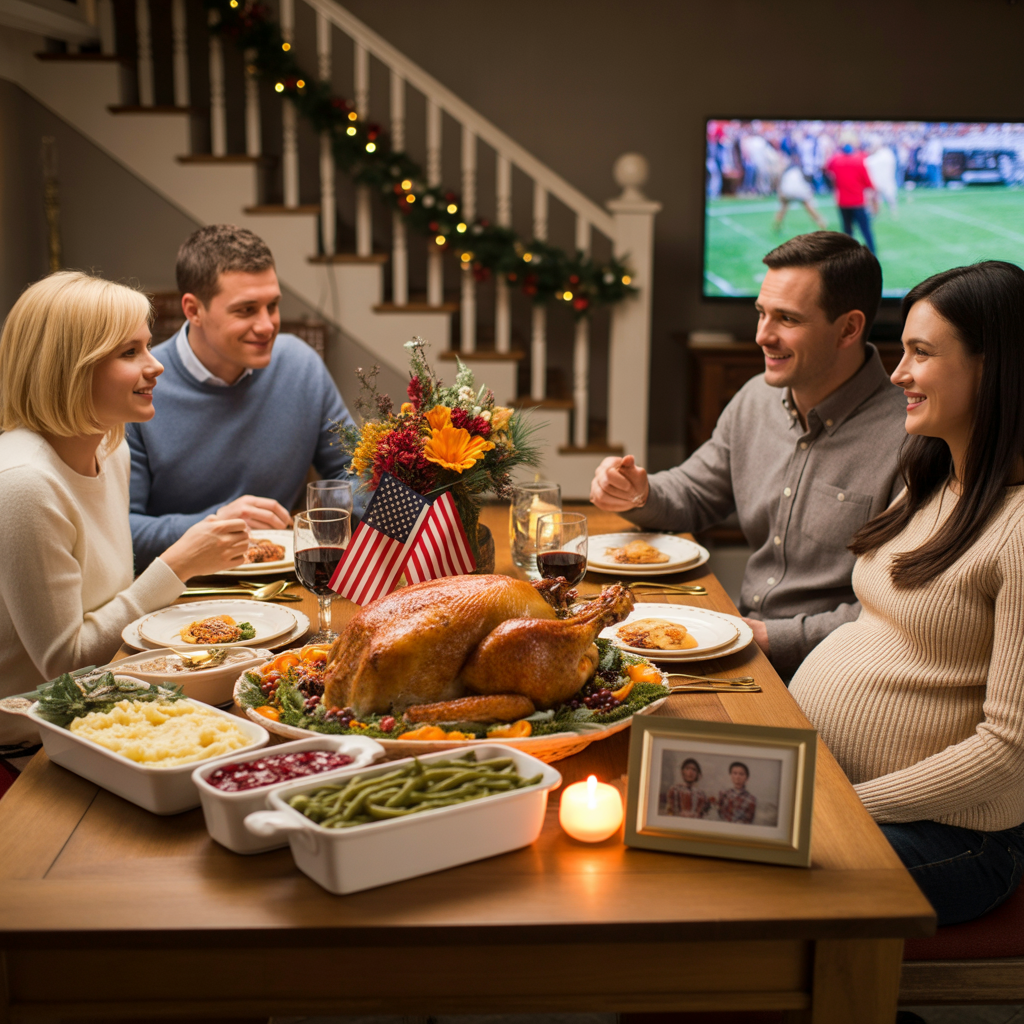
At Thanksgiving dinner, right as the room settled into warm chatter, my mother looked at me and said, “Why didn’t you come to your sister’s baby shower?” Her voice carried loud enough for relatives three chairs down to turn. Vanessa’s eyebrows lifted, amused. A hush swept over the table, everyone waiting for me to break under the question. But I didn’t blink. I placed my napkin down slowly, feeling my pulse steady. They assumed I’d stayed home out of spite. They assumed the missing invitations were my fault. They assumed too much. The signature told a different story.
My name is Ashley, and if you asked anyone in my family to describe me, they’d probably pause because they’ve never taken the time to look closely. I was the quiet kid, the one who blended into doorways while my older sister, Vanessa, three years ahead of me, lit up every room simply by walking into it. My mother, Helen, never meant to draw a line between us, but she did. Every compliment she gave Vanessa had a shadow shaped exactly like my name. My father, Robert, softened the edges when he could, but he spent most of his life avoiding the spotlight and the arguments that came with it.
I grew up studying silence the way other kids studied instruments. I could tell what kind of day we’d have just by the sound of Helen’s footsteps on the stairs, or how Vanessa dragged out the word “Mom” when she wanted something. I learned early that affection in our house wasn’t shared, it was allocated. Still, life has a way of pushing you forward whether you’re ready or not.
I’m thirty-one now, living in a modest apartment in Denver, freelancing as a brand designer. My work keeps me home, which I don’t mind, especially with my pregnancy. Six months in, some days feel heavier than others, but I’ve grown used to carrying weight alone. When I first shared my news, the reaction was polite, pleasant, almost administrative. Helen congratulated me, then immediately shifted to Vanessa’s pregnancy like it was the main event and mine was a supporting act. Vanessa smirked through the call, one hand resting dramatically over her barely visible bump, as if she were starring in a commercial. Robert said he was happy for me, but his eyes flicked toward Helen, waiting for permission to feel the right thing. I told myself not to expect more, and yet I did.
Maybe that’s why I poured so much of myself into planning my baby shower. I wanted it to be simple, warm, something that felt like a welcome into a family I’d spent years trying to belong to. I designed delicate invitations on cream card stock, wrapped each in ribbon, and brought the stack to the shipping store myself. I triple-checked names and city addresses, making sure no envelope was misplaced. The clerk scanned everything and assured me delivery would be fast. For the first time in a long time, I let myself imagine a room filled with people who were there for me.
A week later, when nothing appeared on the tracking page except the same word over and over — signed — I told myself it had to be a glitch because the alternative felt too familiar.
The morning of my baby shower felt strangely bright, the kind of sunlight that makes you believe things might finally go right. I spent hours moving slowly around my apartment, adjusting the string lights, checking the dessert table, making sure the chair cushions were soft enough. Jenna arrived early with a tray of muffins and that look, the one that tried to be cheerful but carried worry around the edges. I told her not to fuss. I told myself the same thing.
By noon, the room smelled like vanilla and citrus cleaner. The music was soft, the decorations gentle, nothing extravagant. I wanted something intimate, something real. I kept glancing at the door whenever the elevator chimed. It wasn’t until the second hour passed that I realized I had memorized the sound too well. No one from my family came.
Jenna placed a hand on my back when she saw me staring toward the hallway again. “Maybe traffic,” she whispered. I nodded, though it wasn’t traffic. It wasn’t weather. It wasn’t anything except the same silence I’d grown up with, just dressed in different clothes.
I checked my phone. No messages, no missed calls. The group chat was quiet, the little seen timestamp sitting there like a bruise. Vanessa hadn’t written anything all day. Helen and Robert hadn’t sent as much as an emoji. I kept swallowing hard, telling myself to smile at the friends who did show up, but every time I blinked, I saw the empty chairs again.
When the shower ended, Jenna helped me clean up. She tried to distract me with jokes, but when she left, the silence in my apartment felt heavier than the boxes stacked in the corner. I sank onto the couch, my hands over my stomach, and forced myself to breathe evenly so the baby wouldn’t feel my heartbeat racing.
Then my phone buzzed. A message from Vanessa.
Next time, plan earlier, sis.
Eight words. No heart emoji, no apology, no question, just condescension so casual it made my jaw tighten.
Something was off. Even for her, this was too smooth, too confident. I opened the baby registry to check if maybe they’d at least looked. The line glared back at me: Not opened. That’s when I remembered the tracking numbers.
I pulled up the shipment receipts I’d saved, tapping through each one. Delivered. Delivered. Delivered. Every invitation marked the same way. And under each status, a new detail I hadn’t noticed before. Signed for.
My pulse kicked. Signed by who?
I opened the tracking history for the first envelope. There was a signature on file. I blinked, breath stalling in my throat. It looked familiar. Too familiar. My chest tightened as I tapped the download icon for the entire batch. Pages loaded slowly, one signature after another, all written by the same hand. And I already knew whose.
I didn’t open the signatures right away. I couldn’t. I sat there on my couch, staring at the file thumbnails glowing on my screen, my thumb hovering but unmoving. It felt like standing on the edge of something high, knowing the second you lean forward, the world changes.
Eventually, I grabbed my keys and walked out, letting the cold Denver air slap the heat out of my face. I ended up at the small diner near my building, the one with flickering neon and chipped red booths. I ordered fries I didn’t touch and sat there while the hum of the vent filled the silence.
When I finally tapped the first file open, the screen lit with a looping, confident signature.
Vanessa.
Not a version that looked like hers. Not a coincidence. Her exact handwriting. The same swoop on the V. The same dramatic flourish at the end. The same pressure on the downstroke. A signature I’d seen a thousand times growing up on permission slips, notebooks, little post-its she used to label things as hers.
My throat dried. I opened the next file. Same signature. Next. Same. Next. Same. Twelve invitations. Twelve identical signatures. She hadn’t just intercepted one envelope. She’d taken every single one.
I leaned back against the booth, my chest tight. The fries were cold now, untouched. Outside, someone scraped ice off a windshield, the sound harsh and uneven. It grounded me just enough to keep breathing. I pulled up the extended tracking logs and scrolled through timestamps. Every package was delivered to the building where Vanessa lived. Same delivery window, same signature, one after another, precise, intentional, not a mistake.
I closed my eyes and flashes of the past rushed through. Helen praising Vanessa for things I did. Birthday gifts that must have gotten lost. A Christmas card I’d sent last year that Mom never acknowledged. The time I mailed a framed photo and was told it never showed up. All those little disappearances I’d brushed off as accidents — they weren’t accidents.
I opened a new tab and printed everything. The tracking pages, the signature sheets, the logs. My small printer whirred loudly in my silent apartment, spitting out page after page until they created a neat stack that somehow made my anger feel organized. I slipped everything into a simple folder. No labels, no drama, just truth.
The next morning, I sat at my kitchen table with a cup of tea I barely tasted and stared at that folder like it was a living thing. I wasn’t scared. I wasn’t unsure. I was steady, for the first time in years. Thanksgiving was in a week. This wasn’t going to be a scene. It wasn’t revenge in the loud, messy way people expect. It was clarity. It was finally refusing to be erased. And when the moment came, I was going to be ready.
Thanksgiving always looked the same in my parents’ house: warm lighting, the smell of roasted turkey, relatives crowding the long wooden table. But that evening, as I stepped inside with the folder tucked under my arm, everything felt sharper, clearer, like every sound had been turned up and every emotion stripped of its disguise.
Helen spotted me first. “There she is,” she said, smiling just wide enough for people to think it meant something. Vanessa glanced over from her seat, one hand resting theatrically on her seven-month belly as if she were posing for a camera. I took my seat across from them, placing the folder beneath my chair. My pulse stayed steady, my breathing calm. Silence for once belonged to me.
Dinner began the usual way: small talk, clinking silverware, my mother bragging about Vanessa’s nursery theme while Robert nodded along. I listened the way someone listens to a familiar story they’ve outgrown.
Then it happened. As the room settled into soft conversation, Helen turned toward me and said loud enough for the far end of the table to hear, “Why didn’t you come to your sister’s baby shower?” The question cut straight through the room. A couple of relatives stopped mid-bite. Vanessa’s lips curved, not into a smile, but something close.
This time, I didn’t let the silence swallow me. I folded my napkin neatly and placed it beside my plate.
“I had mine, too,” I said, my voice even. “You were invited.”
The reaction was instant. A hush rippled across the table. Someone gasped. Robert blinked twice like he hadn’t heard me correctly. Helen frowned, offended.
“We never got anything.”
There it was, the line she clung to, the denial she thought would hold.
I reached down, pulled the folder from under my chair, and placed it on the table. The soft thud wasn’t loud, but it was enough to draw every pair of eyes.
“I know,” I said. “That’s why I brought these.”
Helen’s brows tightened. Vanessa straightened in her seat. A few cousins leaned forward. I opened the folder slowly, the pages whispering against one another. I didn’t rush. I didn’t perform. I simply laid the first page flat on the table: tracking logs, identical statuses printed down the left margin.
“This,” I said calmly, “is the delivery history for every invitation I sent.”
Vanessa scoffed. “Ashley, seriously—”
I lifted a hand. “Just look.”
Helen reached for the paper, scanning the first few lines. The confusion on her face didn’t last long because the truth was right there. Delivered. Delivered. Delivered. All to the building where Vanessa lived.
“That doesn’t prove anything,” Vanessa snapped, her voice tightening.
I added the second stack of documents — delivery confirmations with timestamps and shipping route details. Then I slid the signature pages across the table like a quiet final card in a game she thought she was winning. I showed the signed-for packages.
The room froze. Twelve signature lines, twelve identical loops, twelve confident practiced flourishes, twelve of Vanessa. Helen covered her mouth. Robert leaned closer, squinting like the truth was too bright to look at directly. An aunt whispered, “Oh my god.” A cousin exchanged a look with his wife.
Vanessa’s chair scraped the floor as she jerked back. “This is ridiculous. Anyone could have signed.”
“They could have,” I said softly. “But they didn’t.”
I pushed the top sheet toward her. Every signature matched. My sister’s.
Vanessa’s face drained of color. “You’re twisting things. You don’t know—”
“I know you didn’t want me to have a baby shower that mattered,” I replied, still calm. “I know you intercepted every invitation. I know my family didn’t ignore me. They simply never had the chance to show up.”
Robert’s jaw clenched. “Vanessa,” he said carefully. “Why would you—”
“Dad, stop,” she snapped, her voice rising. “She’s making this dramatic. She always does this. She’s jealous.”
I shook my head. “This isn’t jealousy. This is your signature on twelve separate deliveries.”
Helen rounded on Vanessa, her voice trembling. “Did you do this? Tell me right now.”
Vanessa’s breathing grew fast, erratic. Her hands shook. “You always take her side when she plays the victim. She’s had everything so easy while I—”
I almost laughed at that. Almost.
“Easy,” I said. My voice didn’t rise, but something in it sharpened. “You mean growing up invisible? You mean every accomplishment I earned turning into a conversation about you? You mean hosting a baby shower alone and wondering if my own family hated me that much?”
The room held its breath. Robert rubbed his forehead. “Vanessa, this isn’t right.”
Helen was still staring at the signatures, her face cracking in real time. “I can’t believe I didn’t know.”
“You didn’t ask,” I said quietly. “But I’m not here to fight. I’m here to stop pretending this didn’t happen.”
Vanessa pushed her chair back again, her voice wobbling. “You’re trying to embarrass me. You planned this.”
“I didn’t plan your actions,” I answered. “Just the moment I stopped letting them stay hidden.”
Something in the room shifted. The relatives who had always viewed me as the quiet one began looking at me differently, as if seeing me clearly for the first time. And when they turned to Vanessa, the usual admiration wasn’t there. It was something colder, sharper, something earned.
Vanessa stood abruptly, tears gathering in her eyes. “I’m done with this,” she snapped. “I don’t deserve to be ambushed while pregnant.”
She stormed away from the table, one hand gripping the edge of her chair for balance as she pushed past a relative who flinched out of her way. Silence settled again, but it wasn’t heavy this time. It wasn’t mine to carry.
Helen lowered her gaze, unable to look at me. Robert exhaled slowly like the truth had been sitting on his chest for years. I gathered the papers and slid them back into the folder. I didn’t need applause. I didn’t need anyone to side with me. The truth had already done what it needed to do.
For the first time that night, I felt air fill my lungs without resistance. No shouting, no drama, just clarity. And as I stood to leave, I realized something else. Exposure wasn’t the revenge. Finally being heard was.
The house felt different after Vanessa stormed out, like someone had opened a window and let all the noise drain into the cold. Relatives shifted in their seats, murmuring in low voices, avoiding eye contact with Helen, who sat frozen at the head of the table. The pride she wore so effortlessly just an hour ago had slipped, replaced by something far more fragile. She kept glancing at the door as if Vanessa might reappear and undo everything with a single breath. But the evidence still lay in front of her, and she couldn’t outrun it.
Robert cleared his throat, a hesitant sound in the quiet room. He walked over to me, stopping just a step away. “Ashley,” he said softly. “I’m sorry. I should have noticed. I should have asked questions.” It wasn’t a grand apology, but it was the kind that came from a man who had carried silence like a shield his whole life. It was enough.
I picked up the folder and held it against my side. I didn’t need to explain anything further. I didn’t need them to agree or defend or repair what had already cracked. My worth didn’t hinge on their understanding.
“I’m going home,” I said, keeping my voice steady. No anger, no bitterness, just truth.
Some relatives nodded at me. Small gestures, but genuine ones. Helen looked away, unable to meet my eyes. Maybe someday she would. Maybe not. Either way, I wasn’t waiting for permission to feel whole. I stepped outside into the cold evening, the air crisp and honest. And for the first time in a long time, the silence felt like mine.
The house felt different after Vanessa stormed out, like someone had opened a window and let all the noise drain into the cold. Relatives shifted in their seats, murmuring in low voices, avoiding eye contact with Helen, who sat frozen at the head of the table. The pride she wore so effortlessly just an hour ago had slipped, replaced by something far more fragile. She kept glancing at the door as if Vanessa might reappear and undo everything with a single breath, but the evidence still lay in front of her, and she couldn’t outrun it.
Robert cleared his throat, a hesitant sound in the quiet room. He walked over to me, stopping just a step away. “Ashley,” he said softly, “I’m sorry. I should have noticed. I should have asked questions.” It wasn’t a grand apology, but it was the kind that came from a man who had carried silence like a shield his whole life. It was enough.
I picked up the folder and held it against my side. I didn’t need to explain anything further. I didn’t need them to agree or defend or repair what had already cracked. My worth didn’t hinge on their understanding.
“I’m going home,” I said, keeping my voice steady. No anger, no bitterness, just truth.
Some relatives nodded at me, small gestures but genuine ones. Helen looked away, unable to meet my eyes. Maybe someday she would, maybe not. Either way, I wasn’t waiting for permission to feel whole. I stepped outside into the cold evening, the air crisp and honest. And for the first time in a long time, the silence felt like mine.
I walked to my car with the folder tucked under my arm, the cold air biting just enough to remind me I was finally standing on my own. Families fall apart in a thousand tiny ways. But sometimes they reveal themselves in one sharp moment. One question, one signature, one truth no one can bury.
I didn’t win anything tonight. I simply stopped losing, and that was enough.
If you’ve ever felt erased by the people who were supposed to show up for you, tell me your story below.
On the drive home from Thanksgiving, the folder sat on the passenger seat like a quiet passenger, its cardboard edge pressing into the seatbelt. The highway stretched ahead of me, dark and endless, dotted with red taillights and the occasional green sign flashing by. Denver’s skyline glowed faintly in the distance, a cluster of lights against the mountain shadows. My hands were steady on the wheel, but every so often my throat tightened, like my body was only just catching up to what had happened.
I had played the truth out in my head a hundred times, but I had never actually heard my own voice say those words to my family. I know you intercepted every invitation. I know my family didn’t ignore me. They simply never had the chance to show up. The lines replayed like dialogue from a movie I hadn’t realized I’d been rehearsing my whole life.
At a red light, I glanced at the folder again. The signatures, the logs, the neat stack of proof. For weeks, it had felt like armor. Tonight, for the first time, it felt like something else—like a mirror my family had been forced to look into, whether they wanted to or not.
When I finally pulled into the parking lot of my apartment complex, the cold bit through my coat as soon as I stepped out. The sky over Denver was clear, stars pricked into the black, my breath clouding the air. I slipped the folder under my arm and rested my other hand over my stomach, feeling the faintest flutter. The baby’s movements were small, rhythmic reminders that life didn’t pause while you confronted your past.
Inside, my apartment smelled faintly of vanilla and citrus cleaner, remnants of the baby shower that hadn’t really been one. The string lights I’d forgotten to take down cast a soft glow on the walls. I set the folder on the coffee table and lowered myself onto the couch, the cushion sinking beneath my weight and the fatigue of the day.
For a long time, I just sat there, hands folded over my belly, listening to the hum of the heater.
My phone buzzed once on the table. I stared at it, already braced for some frantic group text, some message from Helen telling me I had ruined Thanksgiving, or a long monologue from Vanessa about betrayal and pregnancy stress.
It was neither.
It was a text from Jenna.
You okay?
I stared at the screen, my thumb hovering over the keyboard. A year ago, I would have minimized everything. I’m fine. No big deal. You know how my family is. Tonight, the words that formed in my mind felt different.
Not really. But I think I will be.
I hit send and watched the message bubble appear, then disappear as she started typing.
Want me to come over? I have leftover pumpkin pie and zero shame about eating it at midnight.
A laugh slipped out, small but real. I pictured her standing in her kitchen in that faded Colorado State hoodie, barefoot, hair in a messy bun, holding a foil-covered pie and her keys.
You don’t have to, I wrote. It’s late.
Her reply came fast.
I know I don’t have to. I’m asking if you want me to.
I looked around my apartment. The small kitchen with the chipped white cabinets. The couch still bearing the faint impression of where I’d crumpled after the shower. The string lights, the quiet, the folder like a boundary line on my coffee table.
Yeah, I wrote. Come over.
Twenty minutes later, Jenna was knocking on my door with a pie tin in one hand and a grocery bag in the other. Her cheeks were pink from the cold; she smelled like cinnamon and car heater air. I let her in and she kicked the door shut behind her.
“Okay,” she said, setting everything on the counter. “I brought pie, whipped cream, and that decaf herbal tea your doctor guilted you into trying. Also, if necessary, I can contribute dramatic reenactments of your family’s faces when you dropped the receipts.”
I smiled. “It wasn’t that dramatic.”
She snorted. “You walked into your parents’ house with a folder like it was a legal exhibit. Don’t ruin this for me.”
We settled on the couch. The folder sat inches from us, its edges lined up with the wood grain of the table. Jenna poured tea into mismatched mugs and handed me a slice of pie, then waited, not pushing, just giving me space to decide where to start.
“Did you do it?” she asked quietly. “Did you show them?”
I nodded, feeling my throat tighten again. “Yeah. At dinner. Mom asked me why I didn’t come to Vanessa’s baby shower. In front of everyone. Like she was… confused. Like I was the one who didn’t show up.”
Jenna’s jaw tensed. “Of course she did.”
“I told her I had mine, too,” I said. “And that they were invited. Then I put everything on the table.”
As I talked, the scene replayed in my mind—the way Helen’s face had changed, the way Robert’s hand trembled when he picked up the paper, the way Vanessa’s voice had cracked when she insisted I was jealous.
“She signed for all of them, Jen,” I whispered. “Every single one. It wasn’t an accident. It was planned. Twelve separate times, she wrote her name and decided I didn’t deserve anyone to show up for me.”
Jenna was quiet for a moment, her eyes on my face, not the folder.
“How do you feel?” she finally asked.
It was such a simple question, one my family rarely asked without immediately twisting the answer into something else.
“Tired,” I said. “Relieved. Sad.” I let out a breath. “But not crazy. Not wrong. Not… small.”
She nodded slowly. “You weren’t wrong,” she said. “You were erased. That’s different.”
Her words settled over us like a blanket, gentle but heavy. For years I had dragged this feeling around without a name. Tonight, it had one.
Erased.
We talked for a while, our voices low, the TV off, the lights dim. Jenna told me about a Thanksgiving years ago when her uncle had cornered her about her career choices in front of the whole family. “All I remember,” she said, “is thinking, ‘If I say what I actually feel, they’ll never forgive me. If I smile and swallow it, I’ll never forgive myself.’ I swallowed it. Took me a decade to stop doing that.”
“So what changed?” I asked.
She smiled wryly. “Therapy, mostly. And the realization that I’d rather have a small life where I can breathe than a big one where I’m always holding my breath.”
By the time she left, the folder was back on the table, unopened. My eyes burned with fatigue, but my chest didn’t feel so tight. I walked her to the door, promising to text when my next doctor’s appointment was over, and when I closed the door behind her, the apartment felt less like a cave and more like a place I had chosen.
When I finally went to bed, I left the folder on my nightstand, within reach but not looming. I fell asleep to the baby’s soft kicks, the distant sound of a siren somewhere in the city, and the quiet certainty that something had shifted in me.
The next morning, my phone buzzed before my alarm. For a second, I forgot why my stomach clenched as I reached for it.
It was a text from Helen.
Call me.
No punctuation. No “Love, Mom.” Just two words that felt like a command, not a request.
I stared at the screen. My thumb hovered over the call button, then moved instead to the little gray text box.
I can’t talk right now. I’ll reach out when I’m ready.
I hit send and watched the message whoosh into the void. A small, strange thrill ran through me. I had never told my mother I wasn’t available to her. I had always rearranged, apologized, acquiesced.
Three dots appeared, blinked, vanished. She didn’t respond.
Robert called a few hours later. When I let it go to voicemail, he left a message, his voice low and uncertain.
“Hey, Ash. It’s… um, it’s Dad. I just… I wanted to say I’m sorry again. And that I’d like to talk when you’re ready. No pressure. Just… I’d like to hear your voice. Love you, kiddo.”
The “kiddo” broke something loose in me. It was a word he used when I was small, when he was still tucking me in at night and sneaking me extra story time after Helen turned off the hall light. Before he started living in the spaces between her moods.
I listened to the voicemail twice, then saved it.
Days passed. Denver slid into full winter, the air sharp and dry, snow dusting car roofs in the mornings. I started attending a prenatal yoga class at a studio a few blocks away. The room smelled like eucalyptus and rubber mats; other expectant mothers moved through the poses with varying degrees of grace. There was a woman named Mariah who laughed at herself every time she wobbled in tree pose, and a quiet, older first-time mom named Claire who always walked out with her hand on her lower back, wincing and grinning at the same time.
No one there knew about my family. No one there saw me as Vanessa’s shadow or Helen’s quiet daughter. I was just Ashley, the woman in the gray leggings with the messy ponytail and the baby on the way. It felt good to be anonymous, to let my story exist in the spaces I chose to share, not the ones other people assigned to me.
One afternoon after class, as I laced my boots in the lobby, Mariah glanced at my phone, where my lock screen photo—an old picture of Jenna and me at Red Rocks—glowed.
“Is that your sister?” she asked.
I hesitated, then smiled. “Best friend.”
She nodded. “Sometimes that’s better than blood.”
It was said casually, without agenda, but my eyes prickled anyway.
At my next OB appointment, the doctor smeared warm gel on my stomach and moved the ultrasound wand in slow, practiced motions. The room lights were dim; the monitor glowed blue-white in the half-dark. The baby’s profile appeared, blurry and perfect, tiny nose and rounded head.
“There we are,” she said. “Strong heartbeat. Baby looks good.”
I watched the flicker of movement on the screen, listening to the steady thump-thump-thump that filled the room. It was the sound of something I had grown, nourished, protected, even when I couldn’t protect myself.
“Do you have a support system for when the baby comes?” the doctor asked, tapping notes into the computer.
“I have a friend,” I said. “And… maybe my dad. We’re figuring things out.”
She nodded. “That’s a good start. Don’t be afraid to ask for help. Even if it’s not where you expected it to come from.”
I thought about that on the drive home, snow starting to drift in lazy, uncertain flakes. Help. For most of my life, help had felt like something I owed other people, not something I was allowed to receive.
That night, as I folded tiny onesies on my couch, my phone buzzed again.
This time, it was Vanessa.
The text came in three separate bubbles, like she’d typed, deleted, retyped.
I can’t believe you did that at Thanksgiving.
I was humiliated.
You know stress is bad for pregnancy, right?
My first impulse was familiar: defend, explain, minimize. I could almost hear our childhood script kicking in. It was just a misunderstanding. I shouldn’t have brought it up at dinner. Let’s talk later.
Instead, I set the phone down and finished folding the onesies, smoothing their soft cotton edges with slow care. I stacked them in a neat pile and carried them to the small dresser I’d painted white over the weekend, each drawer lined with floral contact paper.
By the time I went back to the couch, more texts had stacked up.
You’ve always been dramatic.
You made everyone think I’m some kind of villain.
You know how Mom gets when she’s upset.
I was just trying to keep things organized.
You didn’t have to invite that many people.
You twisted everything.
I scrolled, feeling my jaw tighten.
I typed slowly, deliberately.
You signed for my invitations and kept them. Twelve times. That’s not organization. That’s sabotage.
I stared at the sentence, then added,
I didn’t twist anything. I showed the truth.
I hit send. A minute later, the three dots appeared.
You’re overreacting. You always do this. One little mistake and you turn it into a persecution narrative. You could have just talked to me.
My chest burned. I typed again.
I tried to talk to you, Ness. For years. About a lot of things. You never listened unless it was about you.
Then, before I could overthink it, I added,
I won’t be accepting any more blame for your choices. I’m focusing on my baby and my own life from now on.
Her response came fast, jagged.
Wow. Okay. Good to know where we stand. Enjoy being a martyr.
She didn’t send anything else after that. The silence that followed felt strange, but not empty. It was like walking into a room that had finally been cleared of clutter.
Weeks slid by. Christmas came and went, my apartment filled not with family but with small, intentional gatherings. Jenna came over with her boyfriend, Eli, who wore ridiculous holiday sweaters and insisted on making hot chocolate from scratch. A couple of women from yoga joined us one night with store-bought cookies and stories about their pregnancies. We watched movies, laughed at terrible Hallmark plotlines, and passed around the baby’s ultrasound picture like it was a celebrity headshot.
Helen sent a group text the week before Christmas with a photo of her tree. Vanessa and her husband, Mark, stood beside her, arms linked, smiling like an ad for seasonal joy. I stared at the picture for a long time, looking for cracks. A crooked ornament. A forced smile. Something that betrayed the carefully constructed illusion.
There was nothing.
She didn’t mention me. Didn’t ask if I’d be visiting. Didn’t ask how the baby was.
Robert texted me separately on Christmas morning.
Merry Christmas, Ash. I’m thinking about you today. Hope you and the little one are warm and safe.
He added a photo of the backyard, snow covering the old swing set, the well-worn path to the shed where he used to hide my birthday gifts.
I replied with a photo of my tiny artificial tree on the coffee table, a few small presents underneath—mostly things I’d bought for myself on sale, wrapped because I was done waiting for other people to prove I mattered.
Merry Christmas, Dad. We’re okay. Thank you for the picture.
New Year’s Eve was quiet. I sat on the couch in leggings and an oversized sweatshirt, a blanket over my belly, and watched the Denver fireworks from my window. The bursts of color reflected in the glass, muted but still bright. When the clock struck midnight, my phone lit up with messages from Jenna, from Mariah and Claire from yoga, from a couple of old college friends who’d recently seen my ultrasound photo on Instagram and reached out.
No texts from Helen. None from Vanessa.
My hand moved instinctively to my stomach.
“Happy almost-new-year, little one,” I whispered. “This year, we choose us.”
The baby kicked once, like a tiny fist bump.
As winter began to thaw into a muddy, tentative spring, my due date crept closer. I installed a car seat with Jenna’s help, both of us squinting at the instruction manual like it was written in another language. We built the crib together too, swearing and laughing as we lined up screws and rails.
“You know,” Jenna said, tightening a bolt, “my mom still thinks I’m incapable of assembling IKEA furniture without a man.”
“Tell her you built a crib from scratch with a pregnant woman supervising,” I said.
She grinned. “Oh, I will.”
One evening in March, as I was wiping down the kitchen counter, my phone rang. Not a text—a call. Helen’s name flashed on the screen.
I watched it until it went to voicemail, my fingers curled around the damp dishcloth.
A minute later, a voicemail notification popped up.
I hesitated, then tapped play.
“Ashley, it’s your mother,” she began, the words clipped, formal. “I just—your father told me your due date is coming up. I thought…” She paused, and in that silence I heard the clink of dishes, the faint murmur of a TV in the background. “I thought maybe we could… talk. You shouldn’t go through this alone. Family should be there for each other during big moments.”
I almost laughed at that, the irony sharp and bitter.
She went on. “I know you’re upset. I know you think we failed you. But things are always more complicated than you make them out to be. Vanessa is very emotional right now, and all of this hasn’t helped. Anyway, call me back. We need to figure out how to move forward.”
There was no apology. No acknowledgment. Just a gentle redirection of the blame back toward me and the mess I had supposedly made.
I hit delete.
That night, I lay in bed, hand on my stomach, and asked myself a question I’d been avoiding.
What do you want for this baby?
Not what did I want from my mother, or from Vanessa, or from the hollow idea of family I’d been chasing for decades.
What did I want for this child who hadn’t asked to be born into any of it?
I pictured them—tiny, eyes just opening to the world, hands curling around my finger. I pictured birthday parties and school plays and holidays. I pictured their face crumpling because someone they loved didn’t show up, and me trying to explain why.
I didn’t want to explain why their grandmother and aunt never came. I didn’t want to teach them that the price of belonging was swallowing cruelty with a smile.
I wanted them to know that family were the people who answered the phone when you called at 2 a.m. Family were the people who didn’t need proof to believe you. Family were the people who showed up.
A week before my due date, I sent two messages.
The first was to my father.
Hey, Dad. I’m scheduled for an induction next Friday at Denver General. I’d like you to be there if you can. Jenna will be with me in the room. You don’t have to bring anything. Just you.
His response came five minutes later.
I’ll be there. Thank you for letting me.
The second was to Helen.
My baby will be born soon. Right now, I need distance to protect my mental health and my child. When and if I decide I’m ready to have a relationship with you again, I’ll let you know. Please respect that.
I stared at the message for a long time before hitting send. My hands shook slightly; my heart pounded. It felt like stepping off a ledge and trusting the ground would rise up to meet me.
She didn’t respond that day. Or the next.
The night before my induction, Jenna slept on my couch, her suitcase by the door, toothbrush on the bathroom counter. The air felt charged, like that moment before a storm when everything holds its breath.
“Are you scared?” she asked quietly as we sat at the table, sipping tea.
“Terrified,” I said. “Excited. Overwhelmed. Every word you can think of.”
She nodded. “That makes sense. You’re about to meet your roommate for the next eighteen years.”
I laughed, then wiped at my eyes when they unexpectedly filled.
“I keep thinking about… all the times I begged Mom to come to things,” I said. “Band concerts, art shows, little stuff. And how often she sent Vanessa instead, or forgot, or showed up late and made it about her. I don’t want to be that for this baby. I don’t want to spend their whole life asking them to understand why I chose someone else’s comfort over theirs.”
“You won’t,” Jenna said firmly. “You already made a different choice. You chose you. You chose them. That’s the hardest part.”
At the hospital the next morning, everything moved both too fast and agonizingly slow. Nurses in purple scrubs, the hiss of machines, the sterile smell of antiseptic. They hooked me up to IVs and monitors; the contractions rolled in waves that grew closer, sharper, until they swallowed my breath.
Jenna stayed at my side, cracking jokes between contractions and squeezing my hand until both of us lost feeling in our fingers. At some point, my father arrived, still in his work boots, his hair flattened from a hard hat. He stood in the doorway for a second, looking smaller than I’d ever seen him, his eyes shiny.
“Hey, kiddo,” he said.
“Hey,” I croaked, sweaty and exhausted.
He didn’t try to touch me or crowd the room. He just moved to the corner chair and sat, hands clasped between his knees, watching the monitor like it held the secrets of the universe.
Hours blurred. Pain, breathing, the midwife’s calm voice, Jenna counting, a nurse adjusting something on the stand. And then, suddenly, impossibly, there was a cry—raw, indignant, beautiful.
The world narrowed to a single point: the tiny human they placed on my chest, damp and warm and wailing with a ferocity that made my heart swell. Their fingers were impossibly small, their eyes squeezed shut, their chest rising and falling against mine.
“Hi,” I whispered, tears streaming down my face. “Hi, baby. I’m here. I’m here. I’ve got you.”
Jenna was sobbing openly. My dad had his hand over his mouth, shoulders shaking.
“Do you want to know the sex?” the nurse asked gently.
I nodded, laughing and crying at the same time. “Yeah. I guess that would be good.”
“A healthy baby girl,” she said, smiling.
A daughter.
Something in me broke and healed all at once.
I pictured Helen, her focus on Vanessa’s baby, on the grandchild she’d already decorated a nursery for. I pictured Vanessa, storming away from the Thanksgiving table, insisting she was the victim. And I felt, for the first time, not envy, not rage, but a fierce, primal determination.
This little girl would never have to beg for a seat at the table. Not mine.
We named her Lily.
In the hospital room later, after the nurses had left and Jenna had gone home to shower and sleep, my father sat quietly in the chair by the window, Lily cradled carefully in his big hands. He looked at her like he couldn’t believe she was real.
“She has your nose,” he said.
“Poor kid,” I replied weakly, sipping water through a straw.
He chuckled, then fell quiet again. After a moment, he cleared his throat.
“I should have protected you,” he said, still looking at Lily. “From your mother. From Vanessa. From all of that. I thought… I thought keeping the peace was the same thing as keeping you safe. But it wasn’t. I see that now.”
My eyes stung. “Dad, you don’t have to—”
“I know I don’t have to,” he said. “I need to.” He looked up at me, eyes red-rimmed. “I can’t fix what’s already done. But I’d like to do better with her. If you’ll let me.”
The image came to me then, clear and unexpected: my father teaching Lily how to ride a bike in the cracked driveway of my parents’ house, his hand hovering near her back but not gripping, letting her wobble, fall, get back up. Not erasing her falls, but being there for them.
“I’d like that,” I said.
He nodded once, like he’d received a verdict he’d been bracing for.
Helen didn’t call the day Lily was born. She didn’t text the next day either. On the third day, as I was getting ready to be discharged, I checked my phone and saw a single message.
Your father told me the baby was born.
Period. No question mark, no exclamation point. Then another bubble.
I hope she’s healthy.
I stared at the words for a long time. They weren’t cruel. They weren’t loving. They were… safe. Distant. Like she was commenting on the weather, not her first grandchild.
Thank you, I wrote back. She’s healthy and we’re both fine.
I didn’t send a picture. Not because I wanted to punish her, but because I needed to protect the space I was building.
Weeks after bringing Lily home, the days blurred together in a loop of feeding, changing, bouncing, sleeping (or not sleeping), and staring at her tiny face like it held all the answers. The late-night feedings were the hardest and somehow also the softest. The apartment was quiet, Denver’s sounds muted by the thick winter air. The streetlights cast a gold wash across the floor. I’d sit in the rocking chair Jenna had found on Facebook Marketplace, Lily cradled against my chest, her small mouth latched, her hand gripping my shirt.
Sometimes, in those hours when the world felt very far away, my mind drifted back to my own childhood. To nights when I’d stand in the hallway, listening to my parents argue in low voices behind their bedroom door. To mornings when Helen would serve pancakes just for Vanessa because she had an exam, while I poured my own cereal and tried not to take up too much space.
One night, as Lily sucked noisily and then drifted off, her breath soft and even against my skin, I whispered to her.
“You’re not going to grow up wondering if you’re too much or not enough,” I said. “You’re not going to think love is something you compete for. If anyone makes you feel small, it won’t be me.”
She burped in her sleep, then sighed, her tiny fingers relaxing.
At her two-month checkup, the pediatrician smiled at Lily’s weight chart, at her alert eyes.
“She’s thriving,” she said. “You’re doing great.”
I nodded, blinking back sudden tears. It was the kind of simple affirmation I had rarely received growing up, certainly not without a comparison attached. You’re doing well, but your sister…
A few days later, I opened my mailbox to find a cream-colored envelope with my mother’s handwriting on the front. My stomach flipped.
Inside was a card with a watercolor baby carriage on the front. The message inside was generic, the kind you could buy at any grocery store. Congratulations on your new arrival. Wishing you all the best as you start this new chapter.
At the bottom, in smaller handwriting, she’d added,
I saw the pictures your father took. She’s beautiful.
I turned the card over. No apology. No acknowledgment of the baby shower, Thanksgiving, the years of quiet neglect. Just sentiment wrapped in politeness, a layer of frosting over a cake that was still rotten underneath.
I put the card back in the envelope and slid it into the folder on my bookshelf with the tracking logs and signatures. Proof of something, even if I wasn’t sure what yet.
When Lily was almost four months old, Jenna convinced me to join a local moms’ group that met at a community center on Saturdays. The first time we walked in, the room buzzed with chatter, strollers lined up against the wall, diaper bags splayed open like blooming flowers.
Women introduced themselves in between soothing cries and wiping spit-up. There was a woman whose husband was deployed overseas, another whose parents lived three states away, another who was raising her baby alone after an ugly breakup.
“Family’s weird,” one of them said, bouncing a fussy baby on her hip. “Sometimes the people who share your DNA are the ones you have to keep the farthest away.”
We laughed, not because it was funny, but because it was true.
One Saturday, as we sat in a loose circle sharing stories about the weirdest thing our babies had done that week, the group leader—a woman named Tessa with curly hair and permanent under-eye circles—asked a question.
“What’s one thing you want to do differently from your own parents?” she said. “Just one. Big or small.”
The room went quiet for a moment. Then, one by one, women spoke.
“Listen more,” someone said.
“Say I’m sorry when I mess up,” another added.
“Actually play with my kids instead of just supervising them,” a third chimed in.
When it was my turn, I shifted Lily in my arms. She was half-asleep, her head lolling against my shoulder.
“I don’t want my daughter to feel like love is something she has to earn by being easy,” I said slowly. “I want her to know she’s allowed to take up space. Even if it makes other people uncomfortable.”
A murmur of agreement rippled around the circle.
“Preach,” one woman said under her breath.
That night, after Lily went down, I sat at my kitchen table with the folder. I pulled out the documents—not because I needed to stoke my anger, but because I wanted to see them with new eyes.
Tracking logs. Signatures. A baby card with no apology.
Proof that my reality had not been a figment of my imagination. Proof that I had been erased, and that I had finally drawn my own outline back in.
I opened my laptop and started typing. Not a letter to my mother or sister. Not an email I’d never send. Something else.
I wrote about the little ways families erase people—the “forgotten” invitations, the redirected conversations, the jokes at someone’s expense that never quite land as jokes. I wrote about my baby shower, about standing in my apartment surrounded by empty chairs. I wrote about the signatures, the folder, the moment at Thanksgiving when I decided I would rather be inconvenient than invisible.
The words came in bursts, messy and unfiltered. I didn’t worry about making them pretty. I just told the truth.
When I finished, hours later, my back ached and my eyes burned, but there was a strange lightness in my chest. I read what I’d written and realized it wasn’t just a vent—it was a story. Mine.
I didn’t know what I was going to do with it yet. Post it on some blog Jenna had been nagging me to start. Share it anonymously in some forum. Keep it for Lily, for when she was old enough to understand. All I knew was that putting the story on paper had loosened something inside me.
A week after that, as I was washing bottles at the sink, my phone buzzed.
The number was unfamiliar, but local. I glanced at it, hands still wet.
“Hello?” I answered, tucking the phone between my ear and shoulder.
There was a pause.
“Ashley?” a woman’s voice said. “It’s Claire. From yoga. I hope it’s okay that I’m calling.”
“Yeah, of course,” I said, turning off the water. “What’s up?”
She exhaled. “This is going to sound weird, but… I think I met your mother.”
I froze. “What?”
“At the grocery store,” she said quickly, as if trying to get it out before I hung up. “I was in the baby aisle at King Soopers, and there was this woman asking the clerk if they carried a specific kind of diaper cream. We got to talking. She asked how old my baby was, and I said four months. She said her daughter’s baby was about the same age, living in Denver, a single mom, graphic designer, had a difficult pregnancy—”
My heart hammered. “That… could be a lot of people,” I said weakly.
“She mentioned that they were estranged,” Claire went on gently. “That her daughter was very sensitive, easily influenced by ‘outsiders,’ and had recently caused a big scene at Thanksgiving over some misunderstanding with invitations. She sounded… well, she sounded like someone who would rather rewrite a story than admit she hurt someone.”
My throat closed. “What did you say?”
“I said that sometimes the people we call sensitive are the ones finally telling the truth,” Claire replied. “And then I walked away before I said something I couldn’t take back.”
A shaky laugh escaped me. “That does sound like her.”
“I didn’t tell her I knew you,” she added quickly. “I wasn’t sure if you’d want that. But I thought you should know that she’s out there telling her version. And that at least one stranger in a grocery store didn’t buy it.”
I leaned against the counter, gripping the phone.
“Thank you,” I whispered.
After we hung up, I stood there for a long time, the kitchen quiet except for the hum of the refrigerator. The thought of my mother out in the world, shaping the narrative to strangers, didn’t surprise me. She’d been doing it my whole life, just in smaller circles.
For once, though, I didn’t feel the immediate urge to correct it. To chase down every person she’d spoken to and hand them a folder of proof.
Let her tell her story, I thought. I have mine.
Months slipped by. Lily learned to smile, then to laugh, a high, delighted sound that made my whole body warm. She started rolling over, grabbing my hair with alarming accuracy, shrieking with joy at her own reflection.
One warm evening in late summer, as the sun sank low over Denver, Jenna and I took her to Washington Park. Families sprawled on blankets; kids chased each other near the pond, their voices rising and falling like waves. Joggers moved along the path, earbuds in, ponytails bouncing.
We spread a blanket under a tree and set Lily down on her back. She blinked up at the leaves, then kicked her legs and let out a happy squeal.
“She loves trees,” I said, smiling. “The pediatrician says it’s normal. Something about contrast and light, I don’t know.”
“Or she’s just really into nature,” Jenna said. “Future botanist.”
As we sat there, I noticed a little girl watching us from a nearby bench. She was maybe five or six, with pigtails and a pink backpack. Beside her, a woman who looked exhausted scrolled on her phone, glancing up occasionally.
The girl slid off the bench and toddled closer.
“Is that your baby?” she asked, pointing.
“Yeah,” I said. “Her name’s Lily.”
“She’s cute,” the girl declared. “My mommy says babies are a lot of work.”
“She’s right,” I said. “But she’s worth it.”
The girl grinned, then scampered back to her bench. As she climbed up, she said, loudly enough for us to hear, “That baby’s mom looks happy.”
Something in my chest cracked open.
Happy.
Not dramatic. Not difficult. Not invisible.
Happy.
As the sun dipped lower, casting long shadows across the grass, my phone buzzed with a new email notification. Absentmindedly, I checked it.
It was from an editor at a small online magazine Jenna had dared me to submit my story to a month ago. I’d sent it late one night while Lily was sleeping, fully expecting it to disappear into the void.
Hi Ashley,
We just finished reading your piece, “Signed For,” and we’d love to feature it in our next issue. Your writing is beautiful and your story will resonate with a lot of people who’ve felt erased by their own families. If you’re open to it, we’d love a short author bio and any edits you’d like to make before we publish.
My heart thudded. I read the email twice, three times. Jenna watched my face carefully.
“Good news or bad?” she asked.
“Good,” I said, the word tasting unfamiliar and sweet on my tongue. “They want to publish my story. The one about… all of it.”
She shrieked, causing Lily to startle, then laughed and clapped a hand over her mouth.
“Sorry, Lil,” she whispered, then turned back to me. “Ash, that’s huge. People are going to read your words. Your truth.”
A flicker of fear flared. My family. What if Helen saw it? What if Vanessa did? What if relatives recognized themselves in the scenes and decided I’d betrayed them?
Then another thought rose, quiet but firm.
They’ve been telling their version for years. You get to tell yours.
That night, after Lily fell asleep and the park’s sounds had faded into the hum of the city, I sat at my kitchen table and wrote a short bio.
Ashley Miller is a brand designer and new mom living in Denver, Colorado. She writes about quiet girls, loud families, and the courage it takes to reclaim your own story.
I hovered over my last name for a moment. Miller. Not my real last name, but a version of it. Close enough to feel true, far enough to feel safe. I hit send before I could talk myself out of it.
The story went live two weeks later. Jenna sent me a screenshot within five minutes, followed by ten exclamation points. Messages trickled in from strangers who’d read it.
I thought I was the only one whose invitations always got “lost.”
Thank you for putting words to something I’ve never been able to explain.
This made me cry in the best way.
Not everyone was kind. One comment accused me of exaggerating for attention. Another suggested I was ungrateful and should just “move on.” But the vast majority were from people who knew, immediately and instinctively, what it meant to be erased by the people who were supposed to see you first.
One afternoon, as I rocked Lily for her nap, my phone buzzed with a number I recognized: my parents’ landline.
I watched it ring until it stopped. A few minutes later, a voicemail appeared.
I pressed play, holding the phone away from Lily’s sleeping face.
“Ashley, it’s your mother,” Helen said, her voice tight. “We saw your… article. Your father found it. I can’t believe you would put our private business on the internet like that. Do you have any idea how humiliating this is for us? For your sister? You’ve always been sensitive, but this is too much. Call me back. We need to discuss how to fix this.”
I listened to the message twice. The words “humiliating for us” echoed in my mind.
I thought of the empty chairs at my baby shower, the signatures, the way she’d asked me at Thanksgiving why I hadn’t come, in front of a roomful of people.
I deleted the voicemail.
Then I opened my laptop and pulled up the article. I read it slowly, checking every line. Did I lie? Did I embellish? Did I turn my family into monsters, or did I simply describe what happened?
I told the truth.
I closed the laptop and looked at Lily, her little chest rising and falling, her fist curled near her cheek.
“Someday,” I whispered, “you might read that. I hope when you do, you see it for what it is. Not a weapon. A record.”
Months later, as fall returned and leaves in Denver turned gold and red, another Thanksgiving approached. Grocery stores set up displays of canned pumpkin and cranberry sauce. Store windows filled with turkeys and “Gather” signs.
My phone pinged one afternoon with a text from my father.
Your mother wants to know if you and Lily are coming for Thanksgiving this year. I told her I’d ask, but that the choice is yours. No pressure.
Also, if you want, we can do something just us another day.
I stared at the text, feeling multiple emotions jostle for space. Anger. Sadness. Nostalgia. Even a small flicker of longing—for a big table, for family, for the kind of holiday movies promised and my childhood rarely delivered.
Lily toddled over from the area rug, grabbing my knee for balance. She’d just learned to walk, and her steps were wobbly but determined. Her hair curled around her ears, her eyes bright and curious.
“Hi,” I said, scooping her up. “You want to go to Grandma’s house and watch Mommy pretend everything’s fine?”
She babbled something that sounded like “no,” then squished my cheeks with her hands and laughed.
I texted back.
I’m not ready to see Mom. I don’t feel safe with her right now.
But I’d love to see you and introduce Lily to Grandpa properly. Maybe we can do a small dinner at my place? Just us and Jenna. No pressure if that’s hard for you.
His reply took longer this time, but when it came, it was simple.
I’d like that very much.
On Thanksgiving, I roasted a small turkey in my cramped kitchen. The apartment filled with the smell of butter and herbs. Jenna arrived with mashed potatoes and green beans; Eli showed up with pumpkin pie and a six-pack of non-alcoholic cider. My father brought rolls from the bakery we used to go to when I was little and a bouquet of grocery store flowers that he awkwardly handed me at the door.
“For my girls,” he said, glancing shyly at Lily, who clung to my leg.
We ate at my small table, knees bumping, plates crowded. Lily sat in her high chair with sweet potato smeared across her cheeks, shrieking with delight every time someone laughed. They told stories about their worst cooking disasters; Jenna teased my dad about his obsession with weather apps; Eli assigned everyone the task of saying one thing they were grateful for that had nothing to do with family or work.
When it was my turn, I looked around the table.
“I’m grateful,” I said slowly, “that I finally realized I don’t have to stay where I’m not seen. And that I get to build this. Whatever this is.”
Jenna raised her glass. “To whatever this is.”
We clinked glasses and baby sippy cups. For the first time in my life, Thanksgiving didn’t feel like a test I could fail.
Later that night, after everyone left and Lily was asleep, I stood at the window, looking out at the city. Somewhere across town, my mother was probably loading dishes into her dishwasher, complaining to relatives about her ungrateful daughter who’d ruined everything.
Let her talk, I thought.
I had my own house now. My own table. My own child, whose story was just beginning.
The folder still sat on my bookshelf, a quiet reminder of the night everything cracked open. I didn’t need it the way I used to, but I wasn’t ready to throw it away. Proof could be both a burden and a safety net.
One day, when Lily was much older and asked about the grandmother who rarely called and the aunt she’d never met, I would tell her the truth. Not all at once, not as a rant, but as a story. About a woman who learned that being quiet and being good are not the same. About signatures and invitations and a Thanksgiving where she finally chose herself.
For now, though, it was enough that when she woke in the night crying, I went to her. That when she reached her hands out, I picked her up. That when she took her first steps, someone was there, clapping and cheering, camera ready.
At next year’s Thanksgiving, if my mother asked someone at her table, “Why didn’t Ashley come?” maybe someone would finally answer, “She did. Just not here.”
And if anyone ever asked me why I didn’t go to my sister’s baby shower, or to my parents’ house, or to any place where my existence was treated like an inconvenience, I’d have a simple answer.
Because I finally believed I belonged somewhere else.
With my daughter in my arms, my name on my own stories, and a table where my chair would never go missing again.