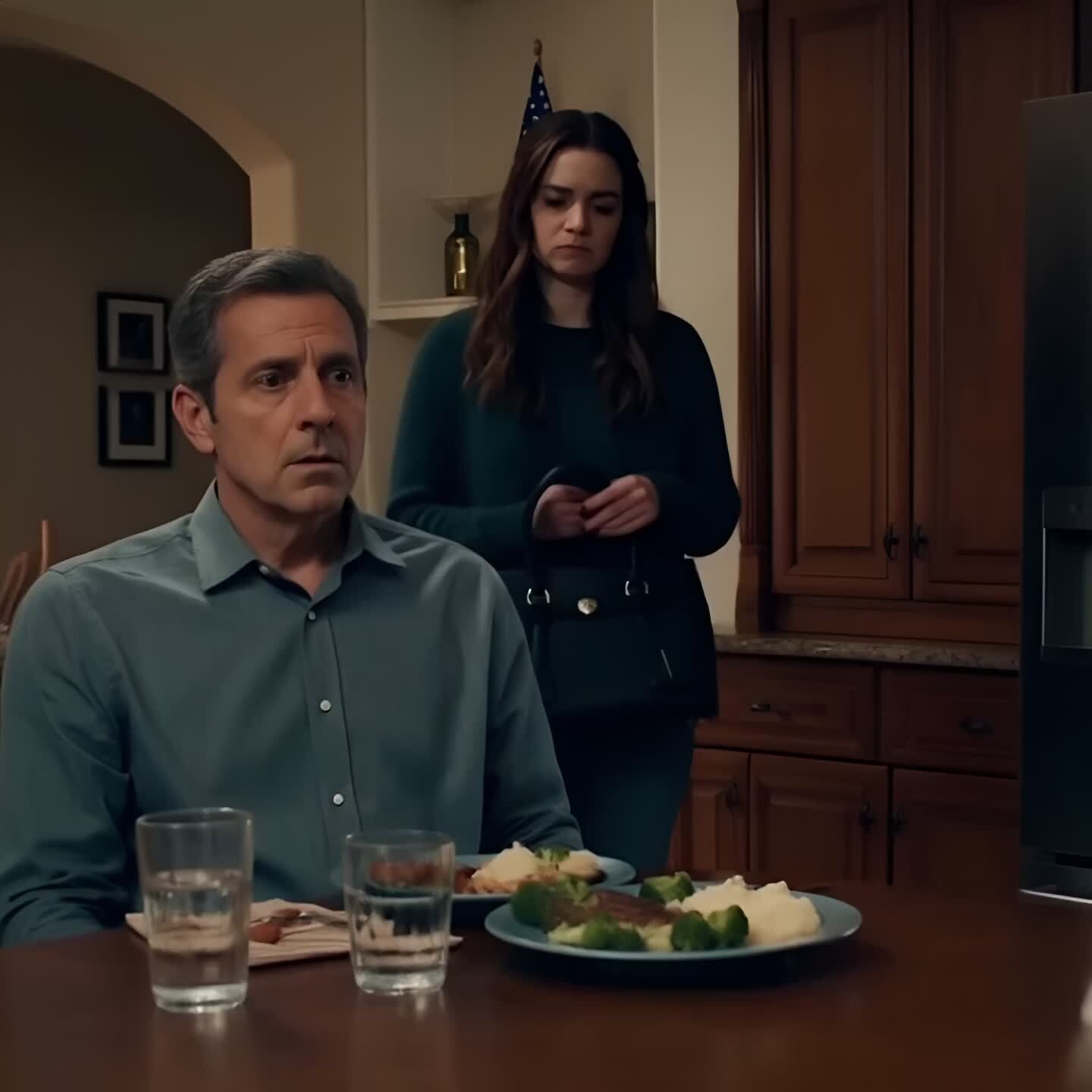
The marinara sauce had been simmering for 3 hours. I stirred it one more time, checked my phone again. Still no text from Devo, and I wiped down the counter for the fourth time that evening.
My son was driving up from San Francisco and I hadn’t seen him in a year. The pasta water rolled into a boil just as my phone buzzed.
Parking now. Smells amazing from the street.
I grinned, turned down the heat, and went to unlock the door.
Devo came through first, carrying a bottle of wine that probably cost more than my weekly grocery budget. He wrapped me in a hug that lifted my feet off the ground.
“68 and still cooking for my kids,” I said when he sat me down.
“Best chef in Portland,” he said, then spotted the old playbills stacked on my shelf.
“You kept all those?”
“Thirty-five years of theater doesn’t just disappear.”
Velma arrived 15 minutes later with Cornelius trailing behind. She kissed my cheek, handed me store-bought cookies, and complimented the apartment in that tone people use when they’re trying too hard.
Cornelius shook my hand without making eye contact and asked where the bathroom was.
We settled around my small kitchen table. I’d pulled in a folding chair so all four of us could fit. The pasta came out perfect.
Devo launched into stories about his AI startup, something about machine learning and Series B funding that went over my head. Velma nodded along, playing the supportive sister, asking all the right questions.
“Seventy-hour weeks,” Devo said, twirling linguine on his fork. “But we just closed the round, so things should calm down.”
“Must be nice,” Cornelius muttered, “having money to burn on startups.”
The table went quiet for a beat. I jumped in with something about dessert, but Devo was already pivoting.
“So, Dad, I’ve been meaning to ask.” He set down his fork. “Why haven’t you moved into the house yet? It’s been a whole year since I—”
My wine glass tilted in my hand. A few drops hit the tablecloth.
“What house?”
“The one in East Morland.” Devo looked genuinely confused. “I sent Velma $850,000 last February for the purchase. You said you wanted something in that neighborhood near the golf course. Remember? Velma handled everything because I was swamped with the company launch.”
The room tilted. My reading glasses slid down my nose.
“I never— Velma, what’s he talking about?”
Her fork clattered against her plate. The sound rang out like a gunshot in the sudden silence. Her face went white, actually white, like someone had drained the blood right out of her skin.
“I—we should—Cornelius, we need to—”
She stood so fast her chair scraped backward across the linoleum. Cornelius grabbed her arm, but she was already moving toward the door, fumbling with her purse.
“Velma, sit down,” Cornelius said. His voice had that edge people get when they’re trying to control something that’s already spiraling. “Let’s just—”
“I forgot something in the car.”
She bolted. Those designer heels that probably cost $300 caught on my doorframe. Karma works fast in Portland. One second she’s fleeing a crime scene, the next she’s doing a pratfall worthy of a community theater audition.
Her Prada bag hit the floor so hard I’m pretty sure it depreciated another 500 bucks. The contents scattered everywhere. Three lipsticks rolled under my couch. A vape pen skittered across the hardwood. Designer sunglasses cracked against the baseboard.
And there, fanned out like accusatory evidence, were papers, documents with official seals and typewritten text. Keys jangled against the floor.
I bent down, picked them up. A tag dangled from the ring.
4521 SE Woodstock Blvd, East Morland.
Cornelius moved faster than I’d seen him move in 10 years of family dinners. Guess adrenaline kicks in when your wife’s grand larceny gets exposed over pasta. He had Velma by the arm, practically lifting her off the ground, and they were out the door before I could stand up straight.
The door slammed. The apartment went silent except for the sound of Devo’s breathing behind me.
I picked up one of the documents. My hands shook enough that the text blurred. Devo took it from me gently, held it up to the light.
“4521 Southeast Woodstock Boulevard,” he read, his voice hollow, distant. “Purchase date, February 18th, 2024. Buyer, Velma King Richardson. Purchase price $850,000.”
He looked up at me.
“Dad, did you know about this?”
“I’ve never seen these papers before in my life. She stole from both of us.” The words came out flat, factual. “From you because it was supposed to be your house, from me because I paid for it.”
I wanted to say something about explanations, about misunderstandings, about how Velma wouldn’t do this, but my mouth wouldn’t form the words among the wreckage on my floor. Three lipsticks, a vape pen, designer sunglasses, and oh, look, keys to an $850,000 house I apparently didn’t own.
At least she had good taste in theft targets.
Devo paced behind me, phone in hand, already pulling up bank records. I stayed at the kitchen counter, property deed spread before me. The pasta grew cold in its serving bowl. The marinara sauce developed a skin.
My finger traced Velma’s signature on the document. A signature I taught her to write when she was seven years old, loops and curves I’d guided with my hand over hers, practicing her name on wide-ruled notebook paper.
Devo said something about lawyers, police, fraud charges, but my eyes caught on something else in the documents—margin notes handwritten in Velma’s careful script. A second address, also in East Morland, also with a purchase date from last February.
My daughter didn’t just steal a house. She stole a house and hid it while buying herself another one. The scale of the betrayal doubled in an instant.
Neither of us slept much. By 7:00 a.m., we were back at the kitchen table with fresh coffee, documents spread between us, both mugs already forming rings on the paper.
“Look at this.” Devo tapped the purchase date with his finger. “February 18th, 2024. I sent the wire transfer February 14th. Valentine’s Day. Remember? I thought it was poetic, giving you a home. Four days. She moved fast. The deed lists only her name. Not yours. Not even ‘in trust for.’ Just ‘Velma King Richardson, sole owner.’”
He scrolled through his phone.
“Wait, pull up your bank records. What was the wire labeled?”
I didn’t have bank records. Devo pulled them up himself, logged into his account, found the transaction.
“Gift for JK house purchase. East Morland property,” he read aloud. “I was explicit. This isn’t ambiguous.”
“So she committed fraud. Wire fraud. Actually, that’s federal.”
The words hung in the air.
Federal.
My daughter facing federal charges.
I took a sip of coffee that had already gone lukewarm. Something nagged at me, a memory floating just out of reach.
Last February, a year ago. What else happened last February?
Then it hit me. My hand stopped midair, coffee mug frozen halfway to my mouth, eyes unfocusing, transported back 12 months.
Velma and Cornelius showing up at my apartment, giddy with news.
“We bought a house!” Velma had practically sung the words. “In East Morland. Can you believe it? Cornelius got this huge bonus at work, and we found the perfect place.”
I’d been happy for them, relieved even. They’d been struggling financially for years. Cornelius’s consulting business had been hit or miss. Suddenly, they had money. Suddenly, they were moving to one of Portland’s wealthiest neighborhoods.
I never questioned it. Families don’t always discuss finances deeply. Kids grow up, make their own money, buy their own homes.
I’d felt proud.
“Dad,” Devo’s voice pulled me back. “You okay?”
“They bought a house last February. Velma and Cornelius. They moved to East Morland around the exact same time this house was purchased. They said Cornelius got a big bonus.”
Devo’s jaw muscles worked.
“There was no bonus.”
“No. There wasn’t.”
I grabbed my keys.
“Let’s go.”
The drive took 15 minutes. My old Honda Civic looked shabby among the Tesla and BMW driveways lining the streets of East Morland—tree-lined boulevards, perfect lawns, houses that cost more than I’d earned in my entire theatrical career.
4521 SE Woodstock Boulevard sat behind an iron gate at the end of a long driveway. The house was massive, brick and white columns, three stories, probably 5,000 square feet, worth well over a million dollars now, easily.
I parked on the street and walked up to the gate. It was unlocked. The house had one of those fancy smart doorbells with a camera.
I gave it a little wave. If Velma was monitoring her stolen property remotely, she just got a live feed of dear old Dad showing up to the crime scene. Hope she choked on her organic breakfast smoothie.
I cupped my hands around my eyes and peered through the front windows.
Empty. Completely empty. No furniture, no curtains, nothing. Just bare floors and echoing rooms.
“Can I help you?”
I jumped.
An elderly woman stood on the sidewalk with a Pomeranian that immediately started yapping at me. The neighbor’s Pomeranian took an immediate dislike to me, yapping like I was personally responsible for the housing crisis. At least someone in this neighborhood was honest about their feelings.
“Oh, are you interested in this property?” she asked. She had a walker and curiosity in her eyes. “It’s been on and off the market. Such a strange situation.”
I straightened up, tried to look casual instead of like a man confronting his daughter’s theft.
“I’m actually a friend of the family. The Kings?”
“The Kings? Yes, they bought it last February. Lovely couple, I thought, but they never moved in, not once. The realtor comes by monthly to check on it, but otherwise it just sits empty. Do you know them personally?”
“Only met them at closing. The wife seemed nervous. The husband did all the talking. They mentioned something about renovations, but no contractors ever showed up.” She tilted her head. “Are you thinking of buying it from them?”
“Just looking. Thanks for the information.”
Back in the car, Devo waited with his phone in hand.
“Empty. Completely empty. Neighbor says they’ve never moved in. Not once in a whole year.”
“Why would she buy a house and never live in it?”
“Because I would have found out.”
The pieces clicked together. She stole the house but was too afraid to live in it. So she bought herself a different house with separate money, probably from another source, and told everyone about that one. This one just sits here, generating property taxes she pays from who knows where.
My rental apartment could fit inside this house’s garage. Velma really went for the upgrade.
We drove back in silence. Back at the apartment, Devo pulled out his phone.
“I’m calling the police. This is straightforward theft.”
“Wait, wait,” I said. “She stole $850,000. That’s not a family dispute. That’s a felony.”
“I know what it is,” I said, setting down my coffee mug carefully, “but I need to understand why. Velma wasn’t always like this. Something changed.”
“Who cares why? She’s a thief.”
“I care. She’s still my daughter. And if we go straight to police, we’ll never know the truth. She’ll lawyer up and we’ll get legal answers, not real ones.”
Devo’s fist slammed the counter. The sound made me flinch.
“So what do you want to do?”
I paused. Something cold and creative was emerging in my mind, something from decades of building illusions on stage.
“I want her to feel exactly what I felt last night. Confused, betrayed, blindsided by someone she trusts.”
My phone buzzed. I glanced at the screen. Velma again. Her texts had been coming in all morning, increasingly desperate.
Dad, please talk to me. I know you’re angry, but there’s context. Can we meet? Just you and me. Dad, please don’t do anything rash.
I read them all, responded to none. Let her sit in that silence, wondering what was coming.
“Dad, what are you thinking?” Devo asked.
I walked to my bedroom closet and pulled out an old theatrical trunk. Dust motes swirled in the afternoon light. The trunk hadn’t been opened in years.
Inside, decades of tools from my scenic design career: hologram projectors from a 2010 production of “A Christmas Carol,” motion sensors from “Dracula,” sound equipment from countless shows.
Devo stood in the doorway watching me.
“Dad, what are you doing?”
I lifted out a small projector, turning it in my hands, light catching on the lens.
“You know what I did for 35 years? I made people believe in ghosts. I created illusions so convincing that audiences forgot they were in a theater.” I looked up at my son. “That house is sitting empty. Velma’s too scared to live in it, too greedy to sell it, and now too guilty to go near it.”
His expression shifted as he understood where I was heading.
“I think it’s time my daughter’s stolen house became haunted.”
I texted Goldie Hayes at dawn.
Need your expertise. Remember the ghost effects from “McBTH”? Coffee at nine.
She responded in 30 seconds.
Intriguing. See you at Hawthorne Grounds.
Goldie and I went back 30 years. She’d been the lead actress in a dozen productions where I designed the sets. We’d collaborated on horror shows with elaborate special effects—holograms, projections, soundscapes that made audiences forget they were watching a performance. She’d retired from acting 5 years ago, moved into real estate, but her eyes still lit up when someone mentioned theatrical illusions.
I arrived at the coffee shop first, claimed a corner table away from the morning laptop crowd. Hawthorne Grounds was one of those Portland institutions—brick walls, local art, single-origin coffee, baristas with more tattoos than patience.
Goldie swept in at nine sharp, silver hair cut short, leather jacket that probably cost more than my monthly rent. She dropped into the chair across from me and studied my face.
“Jasper King, I haven’t heard from you in what, three years? Since you retired.”
“I need help with a project,” I said. “Something theatrical.”
“You’re directing again? I thought you were done.”
“Not directing. Creating. Remember that production of ‘The Turn of the Screw’ where we made the audience think they saw ghosts in the mirrors?”
Her fingers drummed the table.
“The Pepper’s Ghost illusion took us three months to perfect.”
“I need to make a house haunted. Convincingly. Professionally.”
She leaned forward, voice dropping.
“This isn’t for a show, is it?”
“It’s personal. And before you ask, yes, it’s legal. Mostly.”
A slow smile spread across her face.
“Tell me everything.”
So I did.
The stolen house, Velma’s betrayal, Devo’s wire transfer, the empty mansion sitting in East Morland like evidence waiting to be discovered.
Goldie listened without interrupting, that old creative spark building behind her eyes. When I finished, she sat back and laughed.
“You want to gaslight your daughter with professional special effects, Jasper? This is either the most brilliant or most unhinged thing I’ve heard this year. I’m leaning toward both. When do we start?”
“Soon as we have a plan. And equipment. And access.”
She pulled out her phone, started typing notes.
“Motion sensors, hologram projectors, wireless speakers. We’ll need power sources, concealment strategies, trigger mechanisms. This is like that ‘McBTH’ production, except now the victims are real.”
We spent two hours sketching ideas on napkins. Goldie’s enthusiasm was infectious, pulling me out of the dark place I’d been inhabiting since the dinner. This wasn’t just revenge. It was creation, art with a purpose.
That afternoon, I climbed the interior stairs to the third floor of my building. Oswald Tucker lived in 3B, had been my neighbor for 6 years, a real estate attorney who mostly handled property disputes and title issues.
I knocked at an awkward hour, when most people were working, but Oswald answered in sweats and reading glasses.
“Jasper, everything okay?”
“Need legal advice. Can I come in?”
His home office overlooked the street, walls lined with law books that probably hadn’t been opened since he passed the bar. He gestured to a chair, grabbed a legal pad, and settled behind his desk like we were in an official consultation.
“Let me get this straight.” His reading glasses slid down his nose as he reviewed the documents I’d brought. “Your son wired your daughter $850,000 with explicit instructions it was for your house. She bought a house and put it in her own name. Correct?”
“Correct.”
“And you want to sue her for fraud.”
“Can I?”
“Technically, yes. Practically, it’s complicated. Devo gave the money voluntarily. There’s no written contract specifying terms. He trusted family. Courts see this as breach of trust, civil matter, not criminal fraud.”
“What does that mean?”
“It means years of litigation, tens of thousands in legal fees, and maybe you win, maybe you don’t. Family court judges hate these cases.”
He set down the documents.
“Add in that she’s your daughter, that you’ll both have to testify, that family dynamics will be examined. It’s ugly, expensive, and uncertain.”
“So she gets away with it.”
“I didn’t say that. But if you want quick justice, the legal system isn’t your answer.”
I left Oswald’s apartment with a clear understanding. I was on my own. The law couldn’t help me—or wouldn’t—or would take so long it wouldn’t matter.
I went back downstairs and started researching.
Velma’s Instagram was a highlight reel of lies. Beach vacation photos tagged “#blessed” from the same month she stole $850,000. Cornelius posted a quote about “family values.” I took a screenshot. Evidence? No. Satisfying? Absolutely.
I scrolled through Facebook, LinkedIn, mutual friends’ pages. Clicked through tagged photos, read comments, built a timeline.
Then I called Diana Chen, an old friend who knew Velma from yoga class.
“Diana, this is awkward, but I need to ask about Velma and Cornelius.”
“Oh, Jasper, how are you? I heard Devo was in town.”
“Did Velma mention anything unusual happening with them last year? Financial changes?”
Her pause told me everything.
“Well, Cornelius had some health thing. Velma was really stressed, but wouldn’t talk about it. They disappeared for like two months.”
“Health thing?”
“She wouldn’t say, but they came back different, quieter, and suddenly they had that new house.”
“Thanks, Diana.”
“Don’t mention it. I asked. Everything okay?”
I hung up without answering.
Two months disappeared. Medical issues. Sudden money. The pieces weren’t fitting together yet, but they were accumulating.
That night, alone in my apartment, I made my biggest mistake.
I’d found a YouTube tutorial about phone monitoring apps, software parents used to track teenagers. Turns out YouTube tutorials from guys named TechNinja20 aren’t reliable sources for covert operations. Who knew?
I followed the instructions anyway. Crafted an email to Velma disguised as a photo-sharing link.
Thought you’d want these pictures from Thanksgiving.
Sent it from a new email address she wouldn’t recognize.
My phone buzzed an hour later. Not a response from Velma. A system notification.
Your number has been blocked.
She’d detected the malware attempt, shown it to someone who confirmed it was suspicious. And now I’d tipped my hand, revealed I was actively trying to surveil her. The element of surprise was gone.
I threw the phone onto the couch, paced my apartment, ran my hands through my gray hair until it stood up in all directions, called myself an idiot out loud to the empty room.
Goldie showed up 20 minutes after I texted her in panic. She found me still pacing, still cursing my impatience.
“I wanted to know what they were saying, what they were planning,” I explained. “Now she knows I’m watching.”
Goldie didn’t lecture me, just perched on the arm of my couch and said, “So we adjust. Theater is all about improvisation. You lost direct communication. Fine. That means she can’t anticipate your next move. She’s paranoid now, waiting for something to happen. We use that.”
I took a breath, nodded.
“Then we move to the next act. And this time, I don’t make contact until I want her to know I’m there.”
The next morning, Goldie spread blueprints across my kitchen table, hand-drawn floor plans of 4521 SE Woodstock Boulevard she’d sketched from memory after I showed her the address.
“I sold a house three doors down from this place five years ago,” she said. I’d forgotten she’d gone into real estate after retiring from theater. “I walked through this exact property during the open house. I remember the layout.”
Her finger traced the basement stairs.
“There’s a window here, east side, hidden behind overgrown rhododendrons. Doesn’t lock properly. The seller mentioned it, but never fixed it before closing. If you needed to get inside without keys…”
She looked up at me.
“We could be in and out in three hours. Install everything before they ever think to check the property.”
Devo’s voice crackled through my phone speaker. I’d put him on during Goldie’s explanation.
“You’re talking about breaking and entering.”
Goldie didn’t blink.
“I’m talking about set construction in an unconventional venue.”
My hand hovered over the blueprint, over that basement window, over the point of no return.
A memory surfaced. Fifteen years ago, recovering from surgery, Velma staying at my apartment to care for me. We’d watched old movies together, laughed at inside jokes from her childhood. She’d made my favorite soup every day for a week.
What changed her? When did the daughter who cared become the daughter who stole?
My finger touched the blueprint, right on that basement window.
“Let’s do it.”
The hardware store opened at seven. Goldie and I were waiting in the parking lot before dawn, my Honda loaded with empty bags for transporting equipment discreetly.
Inside, we moved through the aisles with purpose. Motion sensors, three of them. Wireless speakers, compact models with good sound projection. Extension cords, power strips, mounting hardware.
The employee at checkout watched us load everything onto the counter.
“This is a lot of equipment for a home project. You doing a security system?”
“Community theater production,” I said. “We’re doing a modern ‘A Christmas Carol.’ Lots of ghost effects.”
“In February?”
Goldie jumped in smoothly.
“Pre-production. We mount the show in November. Smart theaters start early.”
“You’ll need extension cords for this many devices. What’s your power supply situation?”
“The venue has multiple circuits. We’re professionals. Been doing this for years.”
He shrugged, rang up the total.
“That’ll be $847.63.”
Goldie leaned toward me as I swiped my card.
“Almost as much as a down payment on a stolen house.”
Eight hundred forty-seven dollars to terrorize my own daughter. Parenting advice columns never covered this scenario.
Back at my apartment, we loaded the real equipment: the theatrical gear from my old trunk. Hologram projectors I’d used in a 2010 production of “A Christmas Carol”—irony not lost on me. Motion sensors from “Dracula.” Audio equipment from countless shows. Thirty-five years of accumulated tools, finally getting one last performance.
We dressed in black, work gloves tucked in pockets, and drove to East Morland in the cold dark. Parked two blocks away, walked to the property carrying equipment in dark canvas bags that could have been gym gear.
The rhododendrons behind the house had grown wild, branches thick as my wrist blocking the basement window. Goldie produced wire cutters from her pocket and went to work while I kept watch on the street. The snapping branches sounded loud in the quiet neighborhood, but no lights came on. No dogs barked.
The window sat there behind the cleared branches just as Goldie remembered. She pushed on the frame. It didn’t budge. Pushed harder, angling upward. Something clicked and the window swung inward.
“After you,” she whispered.
I’d spent 35 years building theatrical sets. Never thought I’d use those skills for breaking and entering. My theater union would be so proud—or horrified. Probably both.
My knees cracked as I squeezed through the window, dropping into musty darkness below. Cobwebs caught in my hair. My feet hit concrete, and I fumbled for my phone’s flashlight.
The basement spread before me, empty, dusty, exactly as abandoned as the rest of the house.
Goldie handed equipment down piece by piece. Projectors wrapped in towels, sensor boxes, portable speakers, a drill, mounting hardware, my old microphone from recording session work.
We worked methodically, Goldie following me up the basement stairs with bags slung over her shoulders. The house felt massive in the darkness. Our footsteps echoed on hardwood floors. I tried not to think about property values, about what this place would mean to me if things had been different, and just focused on the work.
We started in the main hallway. I drilled tiny holes for sensor mounts, hands steady despite circumstances, muscle memory from decades of set construction. Goldie positioned the motion detectors, tested the angles, adjusted until she was satisfied.
“This one catches movement from the front door,” she explained, marking positions with tape. “This one monitors the staircase. This one covers the kitchen entrance. Anyone walking through gets triggered.”
The audio equipment went next. Wireless speakers hidden behind crown molding, tucked into closet corners, mounted in the basement ceiling. I’d recorded the audio track earlier that day, sitting in my apartment bathroom because the acoustics were best, speaking my own words into the microphone, voice steady and accusing.
Why did you betray me, Velma?
And:
I know what you did.
And:
This was supposed to be my home.
Hearing my disembodied voice play through the empty house sent chills down my spine. Goldie triggered the motion sensor accidentally during setup, and my own voice scared me.
If I give myself a heart attack with my own haunting equipment, the irony will kill me faster than the cardiac arrest.
The hologram projector was last, the most complex setup. Goldie adjusted angles while I walked through the hallway, testing the throw distances. When she was satisfied, she triggered it manually. A shadowy figure appeared on the wall, distorted, accusing, recognizably human but wrong somehow—my silhouette stretched and warped.
She grinned.
“Perfect.”
We were out three hours later, exactly as planned. Goldie climbed through the window first and I handed equipment bags up to her, then hauled myself out with muscles that protested the whole way. We replaced the rhododendron branches as best we could, walked back to the car without speaking.
Devo called the next morning.
“The report came back. I’m forwarding it now.”
I pulled up his email on my laptop while he stayed on the line. The private investigator’s work was thorough: twenty pages of financial records, credit reports, property documents, timeline reconstructions.
“Four hundred fifty thousand in debt,” Devo said. “Credit cards, medical bills, personal loans. Dad, they’re drowning.”
“Medical bills for what?”
“The investigator couldn’t get details. HIPAA protection. But there’s a paper trail to Oregon Health & Science University. Big charges starting March 2024, continuing through September, right after they bought the house—or maybe right before. Maybe that’s why they needed the money.”
I scrolled through page after page of collection notices, court filings for unpaid debts, credit card statements with balances maxed out. The numbers painted a picture of desperation, but not the whole picture. The medical specifics stayed locked behind privacy laws.
“Then why not just ask?” I said. “Why steal?”
“Pride. Shame. I don’t know, Dad, but they’re desperate.”
Twenty years ago surfaced in my memory without warning. Working three jobs to pay Velma’s college tuition—scenic designer by day, night janitor at a hospital, weekend handyman—falling asleep at the kitchen table over bills, Velma coming home for spring break, finding me like that, making coffee, and sitting across from me with tears in her eyes.
“Dad, I can take a semester off, get a job, help with—”
And me cutting her off.
“No. You’re going to finish. You’re going to have the opportunities I didn’t.”
She’d hugged me hard that day.
“I’ll never forget what you’re doing for me. Never.”
But she had forgotten. Or something had changed her. Or maybe I never knew her as well as I thought.
I sat in the public library a few days later, at a computer where no one could trace me easily, and typed out an anonymous letter, hunt-and-peck style so I wouldn’t leave recognizable patterns.
The house is waiting for you. It’s time to move in.
I printed it on library paper, no return address, drove to the downtown post office and mailed it from there. Untraceable.
My phone buzzed that Friday evening. Unknown number. Text message.
We know you’re behind this. Leave us alone or we’ll get a restraining order.
I stared at the screen, showed it to Goldie, who’d come over to finalize our monitoring plan.
She read it and laughed.
“They think you sent the letter. They have no idea what’s actually waiting for them.”
I didn’t laugh.
“That’s what worries me. They’re going to walk into that house with no warning.”
“That was the whole point, wasn’t it?”
My hand kept reaching for the phone, hovering over the power button for the remote kill switch we’d installed. Tempted to shut everything down, call this off, find some other way.
But I didn’t. Not yet. The system stayed live, armed, waiting.
Somewhere across town in their actual house, Velma was reading my letter, her hands probably shaking, coffee mug tilting dangerously, fear building in her chest. Cornelius was probably dismissing it, calling me an old fool, insisting they had nothing to worry about.
They had everything to worry about. They just didn’t know it yet.
Cornelius threw clothes into suitcases that afternoon, aggressive energy radiating off him like heat. Velma hesitated at every item, hands hovering over hangers.
“Do we really need to do this now? We’ve owned this house for a year.”
“If we don’t establish residency, it looks suspicious.”
“Suspicious to who? We’re already caught. My brother knows. My father knows.”
“Legally, it’s ours. If we’re living in it, using it, we have more claim if they try to sue. Plus…” He checked his phone calculator. “We can rent the basement suite for 1,500 a month. Maybe the upstairs bedroom for another thousand.”
“Rent? You want strangers living in my father’s house?”
“It’s our house now, and we’re drowning. This is a life raft.”
“It’s a crime scene.”
“It’s four bedrooms and three bathrooms in East Morland. Pack a bag. We’re going tonight.”
Their car pulled up to 4521 SE Woodstock at dusk, headlights sweeping across the massive empty house. Velma’s hand shook as she unlocked the front door with keys that had burned in her purse for a year.
The house smelled of dust and abandonment. They set up an inflatable mattress in the master bedroom, ate Thai takeout straight from containers on the kitchen counter. No furniture, no curtains, just echoing rooms and their guilt.
Velma lay awake in the middle of the night, staring at the ceiling, already unable to sleep in the stolen house.
In the small hours, something clicked—imperceptible, mechanical. Then my voice filled the darkness, not from one direction but everywhere, layered with theatrical reverb.
“Velma, why did you take my home?”
She bolted upright, heart hammering.
“Cornelius! Cornelius!”
He groaned, rolled over.
“What? What is it?”
“Did you hear that? The voice. Dad’s voice.”
“I don’t hear anything.”
The voice came again, echoing through walls.
“I’m here. In the walls. In your guilt.”
“There! You had to hear that.”
Cornelius listened, eyes adjusting to darkness.
“I don’t hear anything, Velma. You’re freaking yourself out.”
“The hallway. There’s someone in the hallway. I saw—”
She pointed.
A shadow figure stood on the wall, human-shaped, distorted. My silhouette, stretched and warped, accusing.
Cornelius grabbed his phone, stumbled out of bed in boxer shorts and a T-shirt. His flashlight beam swept through the empty hallway. Nothing.
He checked windows. Locked. Doors locked from inside.
“It’s an old house. It makes noises.”
“That wasn’t a noise. That was his voice. And that shadow.”
“There’s nobody here.”
He climbed back into bed.
“Go to sleep.”
She didn’t. Couldn’t. Velma lay there until dawn painted gray light through curtainless windows.
The next morning, she shuffled into the living room and froze.
A silver picture frame sat on the mantle, prominent, positioned where the morning light hit it perfectly. She walked closer, recognized the photo—her at six years old, me beside her, both grinning at the camera.
They hadn’t brought any photos, just a mattress and takeout.
“Cornelius, come here. Now.”
“What?”
“This photo. Where did this come from?”
He walked in, coffee mug in hand.
“What photo?”
Her hand shook as she held it up.
“This. Me and Dad. We didn’t bring any photos.”
“Maybe the previous owners left it.”
“There were no previous owners. We bought it empty.”
She flipped the frame. Words were written on the back in handwriting that looked eerily like mine.
Remember when I loved you?
Cornelius took the frame, examined it.
“This is him. He’s doing this. He’s been in this house, or someone’s been here for him. He knows we moved in.”
“That’s impossible. We locked everything. Nobody has keys except—”
“Except what? The realtor? The inspector? I don’t know.”
Velma dialed Devo’s number. Voicemail. Dialed again. Voicemail. Six times in ten minutes, each call going unanswered, desperation building with each failed connection.
She grabbed her keys.
“I’m going to Dad’s apartment. He needs to know I’m sorry. We need to talk.”
Twenty-five minutes later, she stood outside my building on SE 34th Avenue, climbed the stairs to my first-floor unit, knocked.
“Dad. Dad, it’s Velma. I know you’re angry. I know I—”
She knocked harder, hollow echo of emptiness.
“Dad, please. We need to talk. I can explain everything.”
The doorknob didn’t turn. She pressed her ear to the door. Silence. She peered through the mail slot. Lights off. Mail piled on the floor inside.
“I’m sorry. I’m so sorry. I didn’t know how else to—”
Her voice broke.
“Okay. Okay. I’m leaving a note. Please call me.”
She scribbled on paper from her purse, taped it to the door, walked away, whispering to herself, “Where did you go? You’ve lived here for 15 years.”
Twenty minutes away, I sat in Goldie’s living room, laptop open, watching the doorbell camera feed I’d installed before leaving. Forty bucks at Best Buy. Velma probably paid more for her guilty-conscience therapy sessions. Best forty bucks I ever spent.
I watched my daughter cry on the screen, watched her tape the note, watched her drive away defeated, poured bourbon, didn’t taste it, just watched my phone light up with her messages.
Goldie appeared beside me.
“She looks terrible. When’s the last time she slept?”
“Not my problem,” I said.
“Jasper, she’s your daughter.”
“She’s a thief who stole from her own family.”
“And you’re a father torturing his child with ghost stories. Where’s the line?”
I took a drink.
“I’ll know it when I see it.”
“Will you?” she asked softly. “Because from here it looks like you’re enjoying this.”
I watched Velma’s car disappear off-screen.
“I’m not enjoying it,” I said. “But I’m not stopping either.”
A few nights later, the motion sensor triggered again on my laptop screen. Velma was wandering the house alone, phone in hand.
I switched to the cellular interceptor Devo’s PI had installed, monitoring data through the house’s network. Her text message appeared.
I need to talk to someone about Dad. Something’s wrong. He’s been gone for a week and nobody’s seen him. Should I file a missing person report?
Sent to Diana.
My blood ran cold. A missing person report meant police investigation. They’d find me at Goldie’s. They’d ask why I left. The whole revenge plan could unravel. And worse, I’d look like the guilty one, hiding.
I grabbed my phone, started to call Velma to stop her, then froze. I’d blocked her number. She’d blocked mine after the spyware attempt. We couldn’t communicate even if I wanted to.
Goldie appeared in the doorway in her bathrobe.
“What happened?”
I turned the laptop toward her.
“She’s going to call the police and I can’t stop her.”
Goldie made coffee at four in the morning while I paced her kitchen.
“If she files a missing person report, police come looking. They find you here. They ask questions.”
“So I go home, show my face, prove I’m fine, and blow the whole thing. She’s cracking. Another week and she’ll confess everything.”
“Another week and you’ll be explaining to cops why you disappeared. And your daughter’s having a nervous breakdown in a house full of hidden cameras.”
“I’ll make an appearance. Quick. Then disappear again.”
Goldie set down her mug.
“Jasper, this is getting dangerous. Not legally—psychologically. For her. For you.”
“She stole $850,000. She deserves dangerous.”
“Does she? Or does she deserve honesty, consequences, maybe therapy? This is starting to feel like torture.”
“It’s justice.”
“You keep saying that. I’m not sure you believe it anymore.”
Before dawn, I slipped into my apartment building through the back entrance. Mrs. Chen from 2B came out of the laundry room with a basket, saw me in the hallway.
“Oh, Jasper, we were worried. We thought maybe you died.” Mrs. Chen grabbed my arm. “Where you been?”
I told her I was visiting family. She nodded like that explained the full beard I’d grown specifically to look more haunted-house-worthy.
I climbed to my apartment, unlocked the door, turned on lights, set timers, stood visible in the window for a full minute, took out trash, checked mail with neighbors watching. Proof of life established, then I drove back to Goldie’s, feeling like a fugitive in my own life.
Over the next few days, I intensified the haunting. Clicked through laptop interfaces, selecting audio files.
Velma, I taught you better than this.
Remember the time I taught you to ride a bike on Hawthorne?
You trusted me then.
Camera feeds showed Velma pacing the house in the same pajamas for three days straight, hair unwashed, dark circles like bruises under her eyes. Cornelius slammed kitchen cabinets, phone pressed to his ear, arguing with credit card companies about minimum payments.
One afternoon, Goldie snuck into the house during their grocery run, using a key copy we’d had made from a locksmith weeks ago. She placed a theatrical script on Velma’s pillow, the show about guilt and redemption that I’d designed in 2009—worn pages, my handwritten notes in the margins.
Velma found it that evening. The camera showed her reading highlighted passages, recognition dawning, sinking to the floor with the script clutched to her chest.
She read aloud to the empty house.
“The guilt follows you. Not because someone places it there, but because you placed it in yourself. Every locked door, every darkened hallway, every creak in the night—it’s not the house that’s haunted. It’s you.”
Then she whispered, “Dad, I know you’re doing this. I know these are your words. I remember this play. I was seventeen. You let me read lines with you at the kitchen table.”
She traced my margin note.
Velma helped with this scene. Brilliant instincts.
“I’m sorry,” she said. “I’m so sorry. But I can’t undo it. The money’s gone. The treatments cost everything, and Cornelius is too proud to admit we failed.”
Treatments.
I leaned closer to the screen. Turned up the volume.
“What treatments?”
Later that week, an electrician spent two hours in the house, checking every outlet, breaker, and wire. He found nothing wrong. Charged them $350. On the way out, I watched him make the sign of the cross.
He wasn’t even Catholic. Just covering all bases.
The equipment had worked, but now there was no evidence. The detective, when he eventually came, would find nothing. But that visit came later.
That afternoon, the system triggered during daylight hours. Velma, alone in the house.
“I taught you better than this,” my voice said.
She sat down on the hallway floor instead of running and talked back to the empty house, calm despite the tears.
“I know, Dad. You did teach me better. You taught me about honesty and integrity and working hard. You worked three jobs so I could go to college. I remember. I remember all of it.”
She paused, composing herself.
“But you never taught me what to do when someone you love is dying and insurance won’t cover it, and you have 72 hours to come up with three-quarters of a million dollars or watch him die. You never taught me that.”
She sat there twenty minutes, explaining everything to silence. I sat frozen at Goldie’s, listening.
Dying. Insurance. Three-quarters of a million.
The next morning, Cornelius climbed into the attic, investigating sounds. He found a motion sensor mounted in the rafters. He held the small device in his palm, eyes widening with understanding.
He stormed downstairs.
“Velma.”
“What? What’s wrong now?”
“This.” He thrust the sensor at her. “It’s a motion sensor. Wireless. Commercial grade. There are probably others. This whole haunting is fake.”
“But the voices, the shadows—”
“Speakers. Projectors. Your father worked in theater for 40 years. He knows exactly how to do this. He’s been inside installing equipment. Him or someone working for him. This is harassment. It’s illegal. Breaking and entering. Surveillance. We can press charges.”
“Press charges against my father?”
“He’s terrorizing us. Yes, press charges. I’m calling him right now.”
Cornelius scrolled through Velma’s phone, found my blocked contact, unblocked it, dialed.
My phone buzzed. Unknown number.
I answered cautiously.
“Hello?”
“I know it’s you,” Cornelius said. “I know what you’re doing.”
“Cornelius. Been a while.”
“Cut the act. The motion sensors, the speakers—very creative, also very illegal.”
“I don’t know what you’re talking about.”
“Breaking and entering, unlawful surveillance, harassment. Should I continue?”
“You’re living in a house bought with stolen money. Should we compare felonies?”
“Meet me tomorrow. Laurelhurst Park. Ten a.m. We settle this face to face.”
“Or what?”
“Or I call Portland Police and report that you’ve been breaking into our property, installing surveillance equipment, and stalking my wife.”
Long pause.
“What do you want?” I asked.
“To end this. One way or another.”
I texted Devo immediately.
Cornelius just called. Wants to meet.
Don’t go. He threatened police about the equipment.
He’s bluffing. He can’t call cops without admitting the house is stolen. But he found the sensors. The plan’s compromised.
So what’s next?
I meet him. Hear him out.
Dad, this could be a trap.
It could be surrender.
Laurelhurst Park was cool and gray the next morning. I sat on a bench overlooking the lake, watching joggers and dog walkers pass—normal people living normal lives. Goldie parked a few hundred feet away with binoculars. She’d insisted on being backup.
Devo’s text buzzed my phone again.
Don’t admit to anything. He has no proof without admitting his own crimes.
A few minutes before the hour, Cornelius appeared on the path. He looked worse than in the camera feeds—weight lost, skin gray, moving with visible effort. For the first time, I saw him not as the antagonist but as someone who might actually be sick.
We made eye contact. He walked over, sat down on the opposite end of the bench, careful distance between us. Neither of us spoke at first, just two men on a park bench, strangers to anyone watching.
Finally, Cornelius broke the silence.
“I’m dying.”
My prepared response evaporated.
“What?”
He pulled out a medical file from inside his jacket, handed it over.
“Pancreatic cancer. Stage three when they caught it. March last year. Experimental treatment at OHSU cost $780,000. Insurance covered $40,000. We had 72 hours to come up with the rest or I’d be dead by August.”
He pointed at the file.
“It’s all there. Diagnosis, treatment plan, bills. I’m in remission now. Velma saved my life with that stolen house. So before you finish destroying her, you should know—she didn’t do it for greed. She did it because I was dying, and she couldn’t watch it happen.”
Later, a much thicker report would arrive from the private investigator—seventy-three pages of medical and financial history. I paid $5,800 for it. About eighty dollars a page. For that price, it should have been leather-bound and included a massage.
But the first page alone was worth every dollar.
Patient: Richardson, Cornelius James.
Diagnosis: Pancreatic adenocarcinoma, stage three.
Date: March 14th, 2024.
Prognosis: Fifteen percent five-year survival rate.
Recommended treatment: Experimental immunotherapy protocol, Oregon Health & Science University.
Estimated cost: $780,000.
Insurance coverage: $40,000.
My hands trembled, scrolling through billing statements, insurance denials, a timeline that made my stomach drop.
March 15th to 17th: Velma liquidated everything. Maxed credit cards for $200,000. Personal loans, $150,000. Borrowed from friends, $50,000. Total raised: $400,000. Still $380,000 short.
March 18th: Devo’s email arrived, asking her to find a house for me in East Morland. Would send $850,000.
March 19th: She told Devo she’d found the perfect house, gave him wiring instructions.
March 21st: Treatment deposit paid. Cornelius began experimental immunotherapy.
I drove to Goldie’s at sunrise without calling first, still in pajamas under my coat. She found me at her kitchen table with the report printed out, pages spread like evidence.
“Pancreatic cancer. Stage three. Fifteen percent chance of survival,” I said. “Diagnosis came March 14th last year. Devo’s email about buying me a house came March 18th. Four days. She had four days between learning her husband was dying and seeing a way to save him. The treatment worked. He’s in remission. She saved his life by stealing from mine.”
Goldie pulled out a chair.
“What would you have done if it was your wife? If someone you loved was dying and you saw $850,000 you could access?”
Long pause.
“I’d like to think I would have asked,” I said slowly. “Explained. Been honest.”
“Would you?” she asked gently. “Or would you have been too proud, too ashamed, too desperate?”
“I’ll never know. But she should have asked.”
“Yes, she should have,” Goldie said. “But desperation makes thieves of honest people.”
I sat there another hour, then logged into the haunting system control panel.
Disable all systems.
A confirmation box popped up.
Are you sure?
I hovered over “Yes” for 30 seconds.
Clicked.
I clicked disable all systems on my theatrical haunting rig. A thousand dollars of equipment rendered useless. Goldie said it was the most expensive moral epiphany she’d ever witnessed.
That afternoon, I met with Oswald.
“You want to offer what?” he asked, eyebrows climbing. “Let me make sure I understand. They return the house. You drop all financial claims. They walk away with zero penalties.”
“Yes.”
“Jasper, you have a winning case. They owe Devo $850,000 in restitution. You could destroy them.”
“I know.”
“Then why show mercy?”
“Because I learned why she did it. And while it doesn’t excuse the theft, it explains the desperation. Courts don’t care about explanations. I’m not a court. I’m a father. And I’m tired of destroying my daughter.”
Oswald looked at me like I’d suggested we settle by playing rock-paper-scissors.
“You want to give away your winning case?”
“Yes.”
He muttered something about billable hours walking away. Lawyers hate clean consciences.
I called Devo that evening.
“You’re letting them off after everything,” he said.
“I’m offering settlement, not forgiveness,” I replied.
“Dad, they stole my money, your house, and you want to just let it go.”
“I want the house back. I want this to end. I don’t want to spend the next two years in court watching your sister disintegrate. She made her choice. She made a terrible choice in an impossible situation. Her husband was dying. Devo, stage three pancreatic cancer. Fifteen percent survival chance.”
Pause.
“I didn’t know that,” he said quietly.
“Neither did I. Neither did you. She didn’t tell anyone because Cornelius was too proud to admit weakness. So she stole instead of asking for help.”
“Yes, and that was wrong. But I understand it now. And I’m choosing to offer a way out that doesn’t destroy what’s left of our family.”
Long silence.
“If this is what you want, I’ll support it,” he said finally. “But I’m not ready to talk to her. Not yet.”
“I know. Neither am I. But maybe someday.”
Saturday evening, I drove to 4521 SE Woodstock. The neighborhood was dark and quiet. I had an envelope in hand, my handwritten letter offering settlement.
I placed it against the door, a small rock holding it down, then sat in my car across the street for an hour, watching, waiting.
Her car pulled up, returning from the hospital. Exhausted, she walked to the door, noticed the envelope, bent to pick it up, recognized my handwriting on the outside.
Velma stood on the porch reading by phone flashlight.
I’d written:
Velma,
I know about Cornelius. I know about the cancer, the treatment, the impossible choice you faced. I know you had 72 hours and $740,000 between him living and dying. I know you tried everything before taking Devo’s money. I know you saved his life, and I know it cost you everything else—your integrity, your family, your peace.
I don’t forgive what you did. Theft is still theft, even when motivated by love. But I understand why you did it, and understanding changes how I move forward.
We have two paths.
First path: court. The hearing is set. You’ll lose. The house will go to Devo. You’ll be ordered to pay restitution. You can’t pay. You’ll declare bankruptcy. Your marriage probably won’t survive.
Second path: settlement. You voluntarily deed the house to Devo. No restitution demanded. No financial penalties. You walk away with your existing debt, but no additional legal consequences. Clean break.
I’m offering this once. Not because you deserve mercy—you don’t—but because I’m tired of being the instrument of your destruction.
Respond within 72 hours.
Dad
Her knees buckled. She sat down on the porch steps. Her shoulders shook, not from fear this time, but from overwhelming shame and grief.
She read it again.
I understand.
Three words she didn’t know she desperately needed.
“I don’t deserve this,” she whispered to the empty street. “I don’t deserve this.”
But there was no one to hear. Just a woman sitting on the steps of a stolen house, holding a letter from the father she betrayed, crying from shame because he understood her better than she wanted to be understood.
The next morning, my voicemail notification lit up. Velma’s number was unblocked, her voice thick with tears.
“Dad, I got your letter. I don’t—I don’t know what to say except I’m sorry. I’m so sorry. You’re right about everything. I made a terrible choice. I should have asked you. Should have asked Dev. Should have been honest. I was just so scared and so desperate, and I thought I could fix it later, pay it back somehow, make it right. But I couldn’t. And I destroyed everything.
“I accept the settlement. I’ll deed the house to Devo. I’ll sign whatever you need. But I need you to know I never stopped loving you. Even when I was betraying you, I loved you. I just loved Cornelius, too. And I couldn’t watch him die. I couldn’t. That’s not an excuse. Just the truth. Thank you for understanding, even though you can’t forgive. That’s more than I deserve.”
Monday morning, my phone rang again. Velma’s number.
I stared at it, thumb hovering over the answer button. Four rings. Five.
I didn’t answer.
Voicemail, then text.
Dad, I signed the settlement papers. Oswald has them. The house is Devo’s. But I need to tell you something in person. Can we meet? Please, just once. There’s something about Cornelius you don’t know. Something that changes everything again.
I read it three times.
What could possibly be left?
Goldie read over my shoulder.
“What now?”
“I don’t know,” I said.
Finally, I typed: Wednesday, 2 p.m. Laurelhurst Park. Same bench as before. You come alone.
Her response was immediate.
Thank you. I will be there. And Dad, I know you don’t forgive me, but thank you for understanding. That means more than you know.
Goldie touched my shoulder.
“Whatever she tells you Wednesday, remember you already decided to show mercy. Don’t let new information make you regret that choice.”
I nodded but didn’t answer, because part of me wondered: What if there’s something that does change everything? What if the story I think I understand is still incomplete?
Wednesday arrived faster than I wanted and slower than I could bear.
I watched from my car as Velma sat on the park bench, checking her phone every 30 seconds, wiping her palms on her jeans.
“You ready for this?” Goldie asked beside me.
“No.”
“Good. That means you’re being honest.”
I walked across the park at exactly two, hands in jacket pockets, shoulders squared, steps heavier than they used to be.
Velma saw me coming, stood, then sat again, unsure of protocol. I sat down, three feet of space between us, both of us staring at the lake, neither making eye contact.
“Thank you for coming,” she said.
I didn’t respond.
“I need you to understand what happened. Not to excuse it. Just to understand.”
“I’m listening.”
“March 14th last year, Cornelius was diagnosed. Pancreatic cancer. Stage three. Fifteen percent chance of survival. They said experimental treatment was his only option. Immunotherapy at OHSU. Cost: $780,000. Insurance covered $40,000. We had 72 hours to pay or lose the treatment slot.
“I liquidated everything. Credit cards, loans, borrowed from friends, got to $510,000. Still needed another $270,000. I was sitting at the kitchen table crying when Devo’s email came through. The email about buying you a house. Eight hundred fifty thousand dollars. The exact amount we needed, plus some to cover immediate debt. It felt like fate, like the universe giving me a way to save him.
“So I took it. And I told myself I’d pay it back. Sell the house later. Return the money. Nobody would know. But the debt spiral, the medical bills kept coming, and I couldn’t.”
Her shoulders shook.
“I destroyed everything trying to save one thing.”
“You could have asked me,” I said. I kept looking at the lake.
“Dad, you live on Social Security. Eighteen hundred a month. I couldn’t.”
“You could have asked me,” I repeated. “I would have given you every penny I had. Would have taken out a reverse mortgage. Would have called everyone I knew. You didn’t even try.
“You could have asked Devo honestly, told him the truth. He would have helped.”
“Cornelius wouldn’t let me. He said asking for help meant admitting weakness. He’d rather die than be pitied.”
“So instead, you stole.”
I turned to look at her for the first time.
“And you know what the worst part is? I spent weeks making you pay for that choice.”
Her hand flew to her mouth.
“What do you mean?”
“The haunting. The voices saying your name. The shadows in the hallways. The photographs appearing. That was me, Velma. All of it. Theater equipment, motion sensors, audio systems. I broke into that house and installed a ghost.”
She stared at me, eyes widening, then unexpectedly laughed—bitter, exhausted laughter through tears.
“Of course it was you. I should have known. You spent 40 years creating illusions.”
“I wanted you to feel what I felt,” I said. “Betrayed. Haunted. Watched.”
“Well, congratulations,” she said. “It worked.”
Footsteps crunched on the path. Cornelius approached from the parking lot, walking slowly, still recovering physically. He sat on the opposite end of the bench, creating a triangle, head bowed, hands clasped, defeated.
“Mr. King,” he said, “I need to say something.”
I barely glanced at him.
“I’m listening.”
“This is my fault. I pressured Velma. I was terrified of dying and I made her do terrible things. If you want to hate someone, hate me.”
“I don’t hate anyone anymore,” I said. “I’m too tired for hate.”
“Can you forgive us?” Velma whispered.
“I can offer you a way forward,” I said. “That’s not the same as forgiveness.”
I pulled out the settlement document I’d brought, placed it on the bench between us, made Velma reach for it.
“This…” she said.
“You deed the house to Devo voluntarily. No restitution demands. Court case dismissed. You walk away with your existing debt, but no additional legal consequences.”
Velma’s tears dropped onto the paper.
“That’s more than we deserve.”
“It’s mercy, not absolution,” I said. “There’s a difference.”
“What about our debt?” Cornelius asked. “Four hundred fifty thousand. How do we pay that?”
I stood, voice cold.
“That’s your problem now. I’m not your father. I’m not your savior. Figure it out the way honest people do: work, sacrifice, time. The way I did when I worked three jobs to pay for her education.”
“Dad…” Velma said.
“Sign the papers. Oswald has them. You have until Friday.”
I started walking away.
“Will I see you again?” she called.
I paused, didn’t turn.
“Maybe someday, when I can look at you without seeing the betrayal.”
I kept walking.
I spent 40 years in theater, built hundreds of sets, created countless illusions. That 20-minute conversation was the hardest performance of my life.
That evening at Goldie’s, my bourbon sat untouched on the table.
Oswald called.
“They signed the settlement. House transfers to Devo Monday. It’s over.”
Over.
The word felt wrong.
I opened my contacts. Scrolled to Velma’s name, unblocked after our meeting. My thumb hovered over the call button.
“Don’t,” Goldie said from the doorway.
“Don’t what?”
“Whatever you’re thinking about doing, give it time. Give yourself time.”
I set the phone down.
“How much time?”
“I don’t know,” she said. “But not tonight.”
I picked up the bourbon, took a sip, winced.
“I thought I’d feel different when it ended,” I said. “Satisfied, vindicated, something.”
“What do you feel?” she asked.
“Empty. Like I won a game nobody should have been playing.”
“That’s called growing up,” she said. “Even at 68.”
My phone buzzed again. Devo.
Dad, it’s Devo. Thank you for the settlement. I know it wasn’t easy. The house tenants move in next month. I’m sending Velma 60% of the rent for five years to help with her debt. Not forgiveness. Just family.
I closed my eyes. Even my loyal son was showing mercy.
Maybe that’s what I taught them after all.
Six weeks later, the courthouse hearing took 15 minutes. The judge’s gavel came down approving the settlement. Velma and Cornelius stood before the bench, nodding understanding. No drama, just paperwork and finality.
The house officially transferred to Devo’s name. He decided to rent it out. He set up an agreement: 60% of the monthly rent to Velma for debt repayment over five years—not charity, a business arrangement with family.
A moving truck sat outside a modest apartment complex in Gresham a few weeks after that. Forty minutes from East Morland by car. Forty years by lifestyle. They’d come full circle to where they started, just older and deeper in debt.
I drove there with final paperwork to sign. Knocked on the apartment door.
Velma answered. There was an awkward moment before she invited me in.
Their new living room was cramped, furniture from thrift stores, a dramatic contrast to the house they never really had.
“Dad, come in,” she said. “It’s not much, but it’s clean. That’s something.”
Cornelius called from the kitchen.
“Coffee? I just made a pot.”
“No, thank you. I won’t stay long. Just need your signatures on the final transfer documents.”
Velma sat, took the papers.
“Devo’s really letting us pay back through the rent,” she said.
“It’s not ‘letting,’ it’s an agreement,” I said. “Sixty percent of monthly rent for five years. You’ll pay back about $162,000 of what you took. The rest—consider it the cost of your education.”
“That’s more than fair,” she said.
“It’s what Devo decided, not me.”
She signed, then looked up.
“Dad, have you forgiven us?”
Long pause.
“I understand why you did what you did,” I said. “Understanding and forgiveness are different things.”
“Will you ever forgive me?”
“Maybe someday, when I can look at you and not see the year you stole from me, the trust you broke, the family you fractured.”
She nodded, tears falling.
“That’s fair.”
I stood, gathered the papers.
“I need to go.”
“Will we see you again?” she asked. “At holidays, birthdays?”
I stopped at the door, my back to her.
“I don’t know. That’s honest. I don’t know if I can sit across a table from you and pretend everything’s fine.”
Cornelius spoke up.
“We don’t expect pretending. Just a chance.”
I turned slightly.
“You have five years to prove you’ve changed,” I said. “Maybe by then I’ll be ready to see it.”
I left.
A week later, a package arrived at my apartment. Small, carefully wrapped.
Inside was my old theatrical award trophy from 2005, bronze theater masks I’d given Velma 20 years ago. There was a note in her handwriting.
I don’t deserve this, but I’ll try to deserve it again. Thank you for the lesson.
She’d sent back my award. Twenty years ago, I’d given it to her, saying, “May you always make art that matters.”
Apparently larceny and desperation don’t qualify.
At least she finally read the engraving.
I cried reading it. First time I’d cried through all of this.
I set the trophy on my shelf where it belonged originally.
One May afternoon, Goldie picked me up.
“You’ve been quiet all morning,” she said.
“Just thinking about whether I did the right thing,” I said. “The haunting, the revenge, all of it.”
“Did you?” she asked.
We drove to East Morland, parked across from 4521 SE Woodstock Boulevard. A young couple with a baby was moving in. New tenants, a normal family inhabiting the house that caused so much pain.
“I don’t know,” I said, watching movers carry furniture. “I got justice. The house is back with Devo. They’re paying consequences. But I lost my daughter in the process. Maybe permanently.”
“You didn’t lose her,” Goldie said. “She’s still alive. Still trying. Still your daughter. You gave her the hardest gift: accountability with mercy.”
“Doesn’t feel like a gift.”
“Growth never does,” she said. “For either of you.”
The young father carried a baby carrier, his wife directing movers. They looked excited, happy.
“That house was supposed to make my life better,” I said. “Instead, it destroyed my family.”
“The house didn’t destroy anything. Choices did. And choices can rebuild, too.”
“You sound like a playwright.”
“I was married to one for 15 years,” she said. “Some things stick.”
She paused.
“What now?”
“Now?” I said. “I’m thinking about a new show. Maybe something about forgiveness or trying to forgive. Not sure yet.”
“That sounds like healing,” she said. “Or procrastination. Hard to tell the difference at your age.”
We stood there another moment. The young couple disappeared inside, carrying boxes of their future. The house glowed with warm light from its windows, new life and new beginnings. People who knew nothing of its history.
We turned and walked back to the car.
In the upper window, for exactly three seconds, something flickered. A shadow figure. My silhouette, hand raised in farewell or blessing, then disappeared.
Equipment malfunction, or had I activated it remotely one final time, one last theatrical signature?
Even I didn’t know.
The last ghost disappearing. The curtain falling.
December rolled around. Velma sent a Christmas card. Return address: Gresham. Devo sent one, too. Return address: San Francisco. I put them on opposite ends of my mantle. Geography as metaphor. Two coasts of my fractured family.
Two months after that, an envelope from Velma arrived. No note, just a forwarded letter from Cornelius’s oncologist.
The latest scan showed complete remission. Cancer undetectable. Essentially cured. The experimental treatment had worked beyond their hopes. Attached was a note from the doctor.
Your husband’s case is being published in medical journals. His response to the immunotherapy is helping us save other pancreatic cancer patients. He’s literally part of medical history now.
I read it three times. Her terrible choice, her theft, her betrayal—it saved not just Cornelius, but potentially hundreds of future patients.
It didn’t excuse what she did, but it gave it meaning beyond their personal tragedy.
I kept the letter, slid it into the frame next to Velma’s childhood photo on my shelf, face up now for the first time in months.
Maybe that’s the beginning of forgiveness—not erasing the past, but allowing it to be complicated. Allowing people to be both wrong and desperate. Allowing mercy to coexist with justice.
Spring came again. I started writing a new play. Working title: “After the Curtain,” about a father and daughter, betrayal and redemption, revenge and mercy, about the space between understanding and forgiving.
Goldie asked if it was therapeutic.
“Maybe,” I said. “Or maybe I just needed to make sense of it all the only way I knew how—through theater.”
Someone once told me revenge is a dish best served cold.
They were wrong.
Revenge isn’t a dish at all. It’s a performance. You plan it, stage it, execute it, and when the curtain falls, you realize the audience was just you, and you’re not sure if you like the show.
I spent 40 years creating illusions in theaters, made people believe in ghosts, magic, impossible things.
Turns out the hardest illusion to create is the one where you convince yourself that justice and satisfaction are the same thing.
They’re not.
Justice I got.
Satisfaction remained elusive.
But understanding—that came slowly, painfully, like everything worth having.
Velma’s working two jobs now. Devo sends me updates. She’s paying her debts, attending counseling, trying to rebuild. Cornelius is in remission, humbled, contributing what he can.