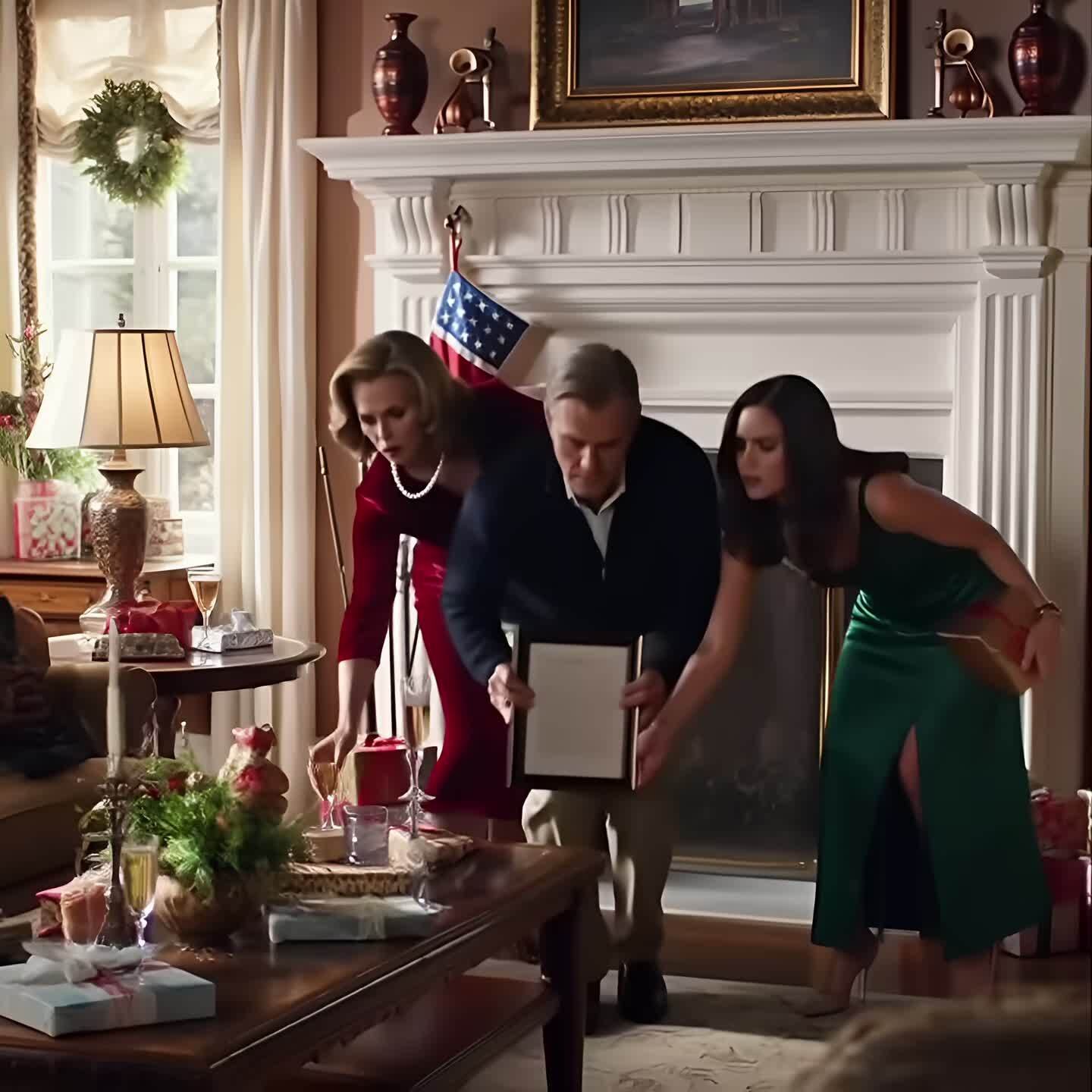
On Christmas morning, I watched my younger sister cry tears of joy as she unwrapped the key to her dream house. My parents clapped, and my mother whispered, “You’ll understand someday.” But I already understood, because I was the one who paid off the house they were supposed to lose.
My name is Clare Matthews, and I’ve spent thirty-two years being the invisible daughter in a family that only sees what it wants to see. The morning had started like every other Christmas in the Matthews household: the smell of cinnamon rolls wafting from the kitchen, the sound of Bing Crosby crooning from the old stereo system my father refused to replace, and the sight of our twelve-foot Douglas fir drowning in ornaments that each held a story. I’d arrived the night before, pulling into the driveway of my childhood home in Burlington, Vermont, with a trunk full of carefully wrapped presents and a heart full of hope that this year would be different.
I should have known better.
Lily was already there, of course. My younger sister had been staying with our parents for the past three months—”between opportunities,” as she liked to call it. The latest opportunity that hadn’t panned out was a poetry residency in Portland that had promised a stipend but delivered only exposure. Now she was back in her old room, the walls still painted the lavender she’d chosen at sixteen, working on what she called her “breakthrough collection” while our parents tiptoed around her artistic temperament.
“Clare,” Mom had exclaimed when I walked through the door, flour dusting her cheeks. “You made it! We weren’t sure with the weather and your busy schedule.” The subtext was clear: Lily’s schedule was never too busy. Lily always made it home. Clare was the one who sometimes chose work over family, responsibility over connection—the successful one who didn’t need them as much.
“Of course I made it,” I’d said, setting down my bags and accepting her quick hug. “It’s Christmas.”
Dad had emerged from his study then, wearing the same flannel shirt he’d owned since I was in high school. “There’s my girl,” he’d said, but his eyes were already drifting past me to the window. “Did you see Lily’s new poem in the Burlington Review? They featured her on the cover.” I had seen it. I’d also seen that the Burlington Review was a free literary circular that featured anyone who submitted. But I smiled and nodded because that’s what I did. That’s what I’d always done.
The evening had progressed with the usual rhythm. Lily regaled us with stories from her poetry circles, each tale more dramatic than the last. Mom fussed over her, making sure she ate enough, worried about the circles under her eyes. Dad listened with rapt attention, occasionally interjecting with questions that showed he’d been reading up on contemporary poetry to better understand his daughter’s world. When they asked about my work, I kept it simple. “Things are good. Busy season with year-end tax planning.” They nodded politely, the way people do when they’re being courteous about something that doesn’t interest them. No follow-up questions, no requests for stories, just a polite acknowledgement before steering the conversation back to Lily’s upcoming reading at the local bookstore.
I excused myself early, claiming travel fatigue, and retreated to my childhood bedroom. Unlike Lily’s preserved sanctuary, mine had been converted into a guest room years ago. Neutral beige walls, a generic landscape print, a bed that wasn’t quite as comfortable as the one I remembered. I sat on the edge of that bed, staring at the wrapped package in my suitcase—the one that contained the deed to this very house.
Three months earlier, I’d come home for Dad’s seventieth birthday. While looking for photo albums in the attic to create a memory book, I’d found something that stopped me cold: a manila folder stuffed behind old tax returns, filled with foreclosure notices. Final warnings, desperate correspondence with the bank. The house my parents had lived in for thirty-five years, the one they’d raised us in, was three months away from being seized.
The construction business Dad had run for decades had been struggling for years. Apparently too proud to adapt to new methods, too stubborn to admit defeat, he’d been hemorrhaging money. Mom’s medical bills from a series of “minor procedures” she’d downplayed had delivered the final blow. They were $212,000 behind on their mortgage with no way to catch up. I’d sat in that dusty attic, surrounded by Christmas decorations and old report cards, feeling the world tilt. Not because of the money—I had money. My career as a tax policy adviser at one of the most prestigious economic think tanks in the country had been lucrative. I’d lived well below my means, invested wisely, and built a substantial portfolio. The money wasn’t the issue.
The issue was that they hadn’t told me. They hadn’t asked for help. They hadn’t even hinted at the problem. Instead, they’d been quietly drowning while maintaining the facade that everything was fine, while still sending Lily monthly support checks for her art, while still paying for her health insurance, car insurance, and phone bill.
I made my decision that day in the attic. Using a combination of my savings and liquidating some investments, I quietly paid off the entire remaining mortgage. The bank had been surprisingly easy to work with once they realized they’d be getting their money. The paperwork had been straightforward. Within six weeks, the house was free and clear, the deed transferred fully to my parents’ names. I’d had it professionally framed, wrapped in elegant silver paper, and saved it for Christmas. Finally, I thought, they would see me. Finally, they would understand that I wasn’t just the daughter who was doing fine and didn’t need their attention. I was the daughter who had saved their home.
But now, sitting in the living room on Christmas morning, watching Lily hold up that house key like it was the Holy Grail itself, I understood with perfect clarity that I had been a fool.
“It’s perfect,” Lily gasped, tears streaming down her face. “My own house? Really?”
“Well, it needs some work,” Dad said, beaming with pride. “Nothing I can’t handle. New paint, update the kitchen, fix that wonky step on the porch.”
“It’s in the arts district,” Mom added, clasping her hands together. “Walking distance to all those little galleries and cafes you love. And there’s a perfect room for your writing with northern light.”
I found my voice, though it sounded strange to my own ears. “You bought Lily a house?”
“We’ve been planning it for months,” Dad said. “That’s why we’ve been so secretive lately. Wanted it to be a surprise.”
“How?” The word came out sharper than I’d intended. “How did you afford it?”
Something flickered across Dad’s face. “We’ve been careful with money, Clare. You know that.”
Careful with money. The man who had been three months from losing his family home was claiming to be careful with money. I felt a laugh building in my chest, the kind that had nothing to do with humor.
“The cottage appraised at three-eighty,” Mom was telling Lily. “But we got it for less because it needs work. And you know your father, he’s never met a fixer-upper he couldn’t handle.”
Three hundred and eighty thousand dollars. They’d bought my sister a $380,000 house while they couldn’t pay their own mortgage. The cognitive dissonance was making my head spin.
“Clare, aren’t you going to congratulate your sister?” Mom’s voice held that familiar note of mild reproach, the one that suggested I was being difficult, the one that reminded me I was supposed to be happy for Lily. Always happy for Lily, because Lily needed our support and Clare was fine on her own.
“Congratulations,” I managed, the word like ash in my mouth.
Lily bounded over to hug me, key still clutched in her hand. “You’ll have to come see it! Maybe you can help me pick out colors. You always had such good taste.”
Good taste. Good grades. Good job. Good daughter who never needed anything, never asked for anything, never got anything.
“Speaking of gifts,” Dad said. “Looks like there’s still one under the tree. Pretty big one, too.”
It was mine. The silver-wrapped deed that was supposed to change everything. I watched him pick it up, shake it theatrically. “Heavy,” he commented. “What did you get me, Clare? A new drill set?”
“Something like that,” I heard myself say.
He tore into the paper with the enthusiasm of a child, Mom and Lily watching with anticipation. Then, the room went very still. Dad stared at the framed document in his hands. The color drained from his face as he read the legal language, processing what he was holding.
Mom leaned over, confused. “What is it, Doug?”
“It’s the deed,” he said, voice hollow. “To the house. Clare… how did you…?”
“I found the foreclosure notices,” I said quietly. “In October, when I was looking for photo albums in the attic.”
The silence that followed was deafening. Lily’s expression shifted from confusion to dawning comprehension. Mom’s hand went to her throat.
“You paid off our mortgage?” Dad’s voice was barely above a whisper.
“Two hundred and twelve thousand dollars,” I confirmed. “The house is yours. Free and clear. Merry Christmas.”
Mom sank onto the couch. “Oh my God, Doug. You told me we’d refinanced. You said the business loan covered it.”
“There is no business loan,” I said, still in that eerily calm voice. “The business has been dead for two years. Dad’s been moving money around, paying minimums, trying to keep up appearances.”
“How do you know that?” Dad demanded, a flush creeping up his neck.
“Because I’m a financial adviser. Because once I found the first notice, I did what I do for a living. I investigated. I traced the patterns. I understood exactly how bad things were.” I turned to Lily. “Bad enough that they were going to lose this house in February. But apparently not bad enough to stop them from buying you a $380,000 cottage.”
Lily’s face had gone pale. “Mom? Dad? Is that true?”
“It’s complicated,” Dad started.
But I cut him off. “It’s not complicated. It’s math. You couldn’t afford your own home, but you bought her one anyway. With what money, exactly?” The answer, when it came to me, was worse than I’d imagined. “You took out a loan against Mom’s life insurance policy. You borrowed from your retirement accounts. You used the last of your emergency savings. All to buy Lily a house while your own slipped away.”
“She needed stability,” Mom said weakly. “For her art. You don’t understand what it’s like for creative people, Clare. The world isn’t built for them the way it’s built for people like you.”
People like me. Responsible people. Successful people. Invisible people.
“You’re right,” I said, standing. “I don’t understand. I don’t understand how you can take my stability for granted while mortgaging your future for hers. I don’t understand how you can accept $212,000 from me without a word while celebrating giving her even more. I don’t understand any of it.”
“We didn’t ask you for the money.” Dad’s pride had finally kicked in, making him defensive.
“No,” I agreed. “You didn’t. You never ask me for anything. You never tell me anything. You never see me as anything but ‘Clare who’s doing fine.’ Clare who doesn’t need us. Clare who will always be okay.”
“That’s not fair,” Mom protested. “We’re proud of you. We’ve always been proud.”
“Proud, maybe, but not interested. Not engaged. When’s the last time you asked me about my work with genuine curiosity? When’s the last time you bragged about my accomplishments the way you brag about Lily’s poems in free circulars? When’s the last time you looked at me and saw someone who might need her parents, too?”
The questions hung in the air like accusations, which I suppose they were. Lily set the house key on the coffee table with a small click.
“I don’t want it,” she said quietly. “Not like this.”
“Don’t be ridiculous,” Dad snapped. “This has nothing to do with your gift.”
“It has everything to do with it!” Lily shot back, surprising me. “You’re losing your house and you bought me one? What were you thinking?”
“We were thinking of your future!” Mom’s voice rose, stress fractures showing. “You’re thirty years old, Lily. You need stability. You need a foundation.”
“I need parents who don’t lie to me,” Lily countered. “I need a family that functions on truth, not fairy tales. Do you think I’m a child? Do you think I can’t handle reality?”
“You’ve never had to,” I said, the words slipping out before I could stop them.
Lily turned to me, and for the first time in years, I saw anger in her eyes. Real anger. Not the performative sensitivity of an artist, but genuine fury. “You think I chose this? You think I asked to be the fragile one? The one who needs protecting?”
“Didn’t you?” I challenged. “Every time you called crying about a rejection letter and they sent money? Every time you needed a place to stay and they welcomed you home? Every time you—”
“Every time I what? Failed? Yes, Clare. I’ve failed repeatedly, publicly, humiliatingly. And yes, I’ve needed help. But did you ever think that maybe I hate it? That maybe being the family project is its own kind of prison?”
The room felt too small suddenly, like all our carefully maintained illusions were expanding, taking up space, demanding to be acknowledged.
“We should all calm down,” Mom tried, but her voice was shaking. “It’s Christmas. We should be grateful we’re together.”
“Grateful?” I laughed, and it was bitter. “I just found out my parents would rather lose their home than tell me they need help. That they’d rather go into debt buying unnecessary gifts than admit they see me as an actual person with feelings. Yes, Mom. I’m overflowing with gratitude.”
“You’ve always been so strong,” she said helplessly. “Even as a child, you never needed—”
“I needed you!” The words ripped out of me, years of suppressed hurt finally finding a voice. “I needed you to see past the grades and the achievements and the smile I wore like armor. I needed you to ask if I was okay and mean it. I needed you to be as interested in my victories as you were in Lily’s struggles. But you decided when I was eight years old and didn’t cry at Grandma’s funeral that I was the strong one, and you never looked closer.”
Dad stood up, the deed still clutched in his hands. “We did our best. We loved you both.”
“You loved us differently,” I interrupted. “And love isn’t supposed to be different. It’s not supposed to have conditions and categories and assumptions baked in.”
“So what do you want?” His voice was hard now, defensive. “You want us to apologize for being proud that you succeeded? You want us to feel guilty that you didn’t need us the way Lily did?”
“I want you to realize that I did need you, that I do need you. That succeeding doesn’t mean I don’t have bad days or fears or a deep, aching wish to be seen by my own parents.” I took a breath, trying to steady myself. “And I want you to understand that by never letting me need you, you guaranteed I never could.”
The silence that followed was different from before. This wasn’t the shocked quiet of revelation, but the dense atmosphere of truth finally spoken aloud. We stood there, the four of us, in the living room where we’d opened presents for thirty years, and it felt like we were strangers who’d been playing family all along.
Lily broke first. “I’m sorry,” she said, and I could tell she meant it. “I never… I didn’t realize. I was so caught up in my own struggles, I never saw yours.”
“How could you?” I asked, not unkindly. “They made sure of that. Every time you worried about being a burden, they reassured you. Every time you felt guilty about needing help, they told you it was fine. They protected you from the truth because they decided you were fragile. And they excluded me from the truth because they decided I was strong. Neither of us got to be whole people.”
Mom was crying now, silent tears sliding down her cheeks. “I don’t know how it happened,” she whispered. “You were both babies, and then… and then you were these roles we’d assigned. And I don’t know when it became real.”
“It became real when you stopped looking,” I said. “When ‘Clare’s fine’ became a mantra instead of a question. When ‘Lily needs us’ became an excuse instead of an examination.”
Dad set the deed on the mantle, his movements careful and deliberate. When he turned back to us, he looked older than his seventy years. “What happens now?”
It was the first honest question he’d asked me in years.
“Now we have some choices to make,” I said. “About the house, about the money, about whether this family can exist without the lies we’ve been telling ourselves.”
“I meant what I said,” Lily interjected. “I don’t want the house. Not if it means Mom and Dad destroying their finances. Not if it means perpetuating this… this dysfunction.”
“You love that house,” Mom protested weakly.
“I love the idea of it,” Lily corrected. “The independence it represents. But I can find that other ways. Ways that don’t require my parents to sacrifice their security or my sister to feel invisible.”
I studied my sister, really looked at her for the first time in years. Beneath the artistic exterior and the emotional volatility, I saw something I’d missed: strength. Different from mine, less obvious perhaps, but there nonetheless.
“We should sell it,” Lily continued, voice gaining confidence. “Use the money to shore up Mom and Dad’s finances. Pay Clare back some of what she spent. Start over. With transparency this time.”
“You can’t just give up your future,” Dad argued, but it lacked conviction.
“I’m not giving up my future. I’m choosing a different one. One where I’m not the family’s perpetual child.” She looked at me. “And where my sister isn’t the family’s invisible ATM.”
The metaphor stung because it was accurate. I’d been dispensing emotional and financial support for years, never acknowledging the withdrawals, never admitting the account was running low.
“There’s something else,” Mom said suddenly. She was staring at her hands folded in her lap. “Something I haven’t told anyone. Not even your father.”
We all turned to her, waiting. The morning sun had shifted, casting long shadows across the room. The Christmas tree lights blinked steadily, oblivious to the unraveling happening around them.
“The procedures,” she said finally. “They weren’t minor. I’ve been seeing a neurologist. There are concerns… early signs. It might be nothing, but it might be…” She trailed off, unable to say the word we were all thinking.
Dad’s face went white. “Ellen, what are you talking about?”
“I didn’t want to worry anyone. Not until we knew for sure. The tests are expensive, and insurance only covers so much. I’ve been paying out of pocket, trying to get answers before I had to tell you.”
“Mom,” Lily breathed, moving to sit beside her.
I remained standing, processing this new information. Another secret. Another burden carried alone. The pattern was so deeply ingrained in our family DNA that even facing a crisis, we defaulted to isolation.
“This is what I mean,” I said quietly. “This is exactly what I mean. We’re a family of strangers keeping secrets to protect each other from truths we all need to hear.”
“I was trying to be strong,” Mom said, and the irony of it nearly broke me.
“We’re all trying to be strong,” I replied. “And we’re all failing because we’re trying to do it alone.”
Dad moved to Mom’s other side, taking her hand. For the first time all morning, he looked vulnerable, human. “We need to talk,” he said. “All of us. Really talk. About everything.”
So, we did.
For the next four hours, we sat in that living room and dismantled thirty years of assumptions and half-truths. Dad admitted the business had been failing for five years, that pride had kept him from adapting or asking for help. Mom revealed the extent of her health concerns, the specialists she’d been seeing, the fear that had kept her silent. Lily shared her own truth: that she’d been working at a bookstore café for six months, that the poetry wasn’t paying anything, and that she’d been too ashamed to admit she needed a real job. The artistic persona had become a trap, preventing her from exploring other paths that might bring stability and satisfaction.
And I finally let them see behind my own carefully maintained facade. The therapy I’d been in for two years, trying to understand why I felt so alone in my own family. The romantic relationship I’d ended because I didn’t know how to let someone care for me. The nights I’d sat in my beautiful, empty apartment, wondering if success meant anything if no one really knew you.
By lunch, we were exhausted but clearer. The Christmas turkey sat forgotten in the kitchen as we mapped out a new way forward. Lily would list the cottage immediately, using the proceeds to reimburse me partially and create a medical fund for Mom. Dad would swallow his pride and file for bankruptcy for the business, clearing the slate for whatever came next. Mom would include all of us in her medical journey—no more solo battles.
And me? I would learn to need them. To call when I had a bad day, to share my fears alongside my successes, to stop being the family’s emergency fund and start being their daughter.
“It won’t be easy,” Dad said as we finally moved to the kitchen, reheating side dishes and salvaging what we could of the meal. “Changing patterns this old.”
“No,” I agreed. “It won’t. But the alternative is losing each other completely. And I think we’ve come too close to that already.”
Lily raised her glass of wine. “To the worst Christmas ever.”
“The most honest Christmas,” Mom corrected, raising her own glass.
“To starting over,” Dad added.
I lifted my glass last. “To seeing each other. Finally.”
We clinked glasses, and for the first time in years, it felt real. Not the performance of family togetherness we’d perfected, but actual connection. Messy and painful and uncertain, but genuine.
The months that followed were a case study in reconstruction. True to her word, Lily listed the cottage in January. The arts district location made it desirable, and despite the needed repairs, it sold within six weeks. The proceeds went three ways: a third to reimburse me, a third to Mom’s medical fund, and a third to what we called the “Family Emergency Account,” accessible to all of us with full transparency.
Dad’s bankruptcy proceedings were humbling for a man who’d built his identity on self-sufficiency, but he handled it with more grace than I’d expected. Perhaps because the secret was finally out. He even started working part-time at a large construction firm, bringing his decades of experience to projects without the crushing responsibility of ownership.
Mom’s diagnosis came in March: early-stage Parkinson’s. Manageable with medication and monitoring. The relief of knowing, of being able to plan and prepare together, far outweighed the fear of what lay ahead. We attended appointments as a family, rotating who could be there, sharing notes in a group chat that would have been unimaginable months earlier.
Lily’s transformation was perhaps the most surprising. Free from the pressure of being the family’s designated dreamer, she discovered she actually enjoyed the structure of regular work. The bookstore promoted her to events coordinator, and she found she could support other artists while maintaining her own financial stability. She still wrote poetry, but now it was for herself, not for the maintenance of an identity that had been assigned rather than chosen.
As for me, the journey was internal, but no less dramatic. Learning to be vulnerable with my family was like speaking a foreign language. The first time I called Mom crying after a particularly brutal day at work, she was so shocked she nearly dropped the phone. But she listened. She comforted. She mothered me in a way I’d forgotten I needed. I started sharing my wins, too—not just the polished summary, but the messy process. When I was promoted to senior adviser, I told them about the presentation where I’d fumbled my words, the moment I thought I’d blown it, and the relief when the board approved my recommendations. They celebrated not just my success, but my humanity.
The real test came at Easter. We gathered at the family home—the one I’d saved, though we rarely mentioned that anymore—for our first holiday since Christmas. There was no grand gift exchange, no surprises. Just the four of us cooking together, sharing stories, existing in the same space without our old roles to define us.
“I’ve been thinking,” Lily said as we cleared the table. “About patterns. How we create them without meaning to.”
“What kind of patterns?” Mom asked, genuinely curious. We’d all gotten better at really listening to each other.
“The stories we tell ourselves. Like how I was the creative one, so I couldn’t be practical. Or how Clare was the successful one, so she couldn’t be vulnerable. They’re just stories. But we lived like they were laws of physics.”
Dad nodded slowly. “I told myself a story, too. That asking for help meant failure. That providing meant never admitting when I couldn’t.”
“And I told myself that being sick would burden everyone,” Mom added. “That strength meant suffering in silence.”
“We all did it,” I said. “Created these rigid narratives and then got trapped inside them.”
“But stories can be rewritten,” Lily said, raising her coffee mug. “To new stories.”
“True stories,” I amended.
Six months later, I hosted my first family dinner in my apartment. It was a milestone I’d never thought I’d reach: inviting my family into my space, my life, without the armor of perfection. The apartment was clean, but lived-in. The meal was good, but not flawless. And for once, I didn’t care about the impression I was making.
“This is beautiful,” Mom said, admiring the view from my balcony. “I can’t believe we’ve never been here before.”
The old me would have deflected, made excuses, maintained the distance. The new me told the truth. “I never invited you. I was too afraid you’d see through my perfect facade to how lonely I really was.”
She hugged me then. Really hugged me, the kind that lasts long enough to mean something. “I see you now,” she whispered. “We all do.”
Later, as we sat around my dining table playing cards—a new tradition we’d started, simple and requiring nothing but presence—I watched my family with fresh eyes. Dad, learning to be vulnerable in his seventies. Mom facing her diagnosis with courage and openness. Lily building a life that balanced creativity with stability. And me, finally understanding that being seen meant letting yourself be visible.
“You know what I realized?” Lily said, studying her cards. “That Christmas morning when I got the key… for a moment, before I understood what it meant, I was terrified.”
“Terrified?” Mom asked. “Why?”
“Because it felt like being pushed out. Like being told I was officially on my own. I’d wanted independence for so long, but when it was handed to me like that, all I could think was that you didn’t want me around anymore.”
“Oh, honey,” Dad said. “That was never—”
“I know,” Lily interrupted gently. “I know that now. But in that moment, all I felt was alone. And then I looked at Clare and realized she’d been feeling that way for years.”
We were quiet for a moment, remembering that morning. It felt like a lifetime ago, though it had only been nine months.
“The key was never really about the house,” I said finally. “It was about what we thought we needed to give each other. You thought Lily needed independence, so you nearly bankrupted yourselves providing it. You thought I didn’t need anything, so you gave me nothing. But what we all really needed was honesty.”
“And each other,” Mom added softly. “We needed each other.”
Dad won the hand, grinning as he collected the cards. “You know, for a family that nearly imploded, we’re doing pretty well.”
“We’re doing the work,” I corrected. “That’s different from doing well.”
“Better, maybe.”
As the evening wound down and they prepared to leave, I felt the familiar pull of old patterns—the urge to clean up alone, to restore perfection, to close the door on the messiness of real intimacy. Instead, I left the dishes in the sink and walked them to the door, accepting their offers to help clean up next time.
“Thank you for tonight,” Mom said, kissing my cheek. “For letting us in.”
“Thank you for seeing me,” I replied.
Finally, after they left, I stood in my imperfect apartment with its dinner debris and card game remnants, and felt something I’d never experienced in all my years of pristine success. I felt whole. Not strong or weak, not successful or struggling. Just complete in my complexity.
My phone buzzed with a text from Lily: Same time next month? I’ll host. Wouldn’t miss it, I typed back.
Another buzz, this time from Dad: Proud of you, kiddo. Always have been. Now I know why.
I smiled, setting the phone aside. There would be time tomorrow for cleaning, for returning to the accomplished professional the world expected. But tonight, I was just Clare. Daughter, sister, human. Seen, and seeing in return.
The Christmas tree was long gone, but the gift we’d unwrapped that morning remained. Not a house, or a deed, or any object that could be held. Instead, we’d received the rarest present of all: a second chance at being a real family. And this time, we were determined not to waste it.
A year later, almost to the day, we gathered again for Christmas. The tree was smaller. We’d decided to scale back on performances and focus on presence. The gifts were modest, thoughtful rather than grand, and the atmosphere was completely different.
“Remember last year?” Lily said as we settled in the living room with hot chocolate. She was living in her own apartment now, a reasonable rental she could afford on her bookstore salary. “I thought the world was ending.”
“It kind of was,” I pointed out. “Our world, anyway. The fake one we’d built.”
“Best disaster ever,” Dad chimed in. He looked healthier these days, the crushing weight of secret debt no longer bowing his shoulders, though I could have done without the bankruptcy court appearances.
“Character building,” Mom teased. Her tremor was slightly more noticeable now, but she handled it with the same grace she’d found in honesty. “Besides, you needed some humility.”
“I had plenty of humility,” he protested. “I just kept it hidden along with everything else.”
We laughed, and it was genuine—the kind of laughter that comes from surviving something together, from choosing truth over comfort, and finding out the truth was more comfortable after all.
“I have something to say,” I announced, setting down my mug. “A year ago, I gave you the deed to this house, thinking it would fix everything. That it would finally make you see me. I was wrong about that. Objects can’t fix relationships. But I wasn’t wrong about needing to be seen.”
“Clare…” Mom started, but I held up a hand.
“Let me finish. This year has been hard. Harder than I expected. Learning to be vulnerable, to need you, to let you need me in return. It’s been like rewiring my entire nervous system. There were times I wanted to go back to the old way, where I was fine and you were proud and we all kept our distance. But I’m glad we didn’t.”
“So are we,” Dad said firmly. “Even when it hurt. Especially when it hurt.”
“The thing is,” I continued, “I realized something that morning when everything fell apart. It was the first time in my adult life I was completely honest with you, and you were honest back. And somehow, that disaster became our foundation.” Lily leaned forward. “What are you saying?”
“I’m saying that I want to mark it somehow. To acknowledge that sometimes the worst day becomes the best day in retrospect.” I reached behind the couch and pulled out a small, wrapped package. “I got us all something.”
Inside were four simple silver ornaments. Each was engraved with the same date—last Christmas—and the words: The day we became real.
“I thought we could hang them on the tree every year,” I explained as they examined them. “To remind us that perfection isn’t the goal. Connection is.”
Mom was crying, but smiling through it. “It’s perfect. And I mean that in the most imperfect way possible.”
We hung the ornaments together: four slightly tarnished silver discs on a tree that would never make a magazine cover, and it was beautiful in its authenticity.
“My turn,” Lily said, producing her own gift. “It’s not much, but…” She handed out small handmade books. “I wrote about us. About this year. About learning to be a person instead of a role. I thought maybe reading it would help us remember why we’re doing this work.”
I opened mine, seeing her careful handwriting, the poems interspersed with prose, the story of our unraveling and rebuilding told through her eyes. It was raw and honest and beautifully crafted.
“Lily, this is incredible,” I breathed. “You should publish this.”
“Maybe someday,” she said, and I could tell she meant it. “When we’re further along in the story. This is just the beginning, after all.”
Dad cleared his throat. “Since we’re doing meaningful gifts…” He pulled out four envelopes. “These aren’t from me alone. Doug helped, but the idea was mine.”
Inside each envelope was a membership card to a local community center that offered family counseling services.
“I figured we could all use some professional help navigating this,” he explained, looking almost shy. “Together and separately. Because wanting to change and knowing how are different things.”
“Dad,” I said, genuinely moved. “This is… thank you.”
“Don’t thank me yet,” he warned with a wry smile. “I have a feeling we’re going to hear some things we don’t like about ourselves.”
“We’ve already heard them,” Mom pointed out. “From each other. At least with a counselor, we’ll have a referee.”
Her gift was last. Photo albums she’d compiled, one for each of us, filled with pictures from throughout our lives. But these weren’t the curated highlight reels families usually created. These included the awkward moments, the angry faces, the tears alongside the smiles.
“I wanted us to see our whole story,” she explained. “Not just the pretty parts. Because all of it led us here.”
I flipped through mine, seeing myself at various ages: the serious child, the driven teenager, the isolated adult. But also moments I’d forgotten. Times when the mask had slipped, when real emotion had broken through, when I’d been more than my accomplishments.
“Look at this one,” Lily said, showing a photo of us as children. She was crying over a broken toy while I stood beside her, clearly torn between comfort and composure. “Even then, you wanted to help, but didn’t know if you were allowed.”
“And here,” Mom pointed to another picture. Lily’s high school graduation. “Look how proud Clare looks. But also how separate. Like she’s watching from outside the family instead of being part of it.”
The albums were painful and beautiful, showing us patterns we’d been blind to in the moment. But they also showed love. Complicated and imperfect, but undeniably present.
“We’ve always loved each other,” Dad said quietly. “We just didn’t know how to do it well.”
“We’re learning,” I reminded him. “That’s what matters.”
The day progressed gently. We cooked together, no one person bearing the burden of the meal. We told stories, but they were full stories now: the failures alongside the successes, the fears alongside the hopes. When Mom’s hands shook too much to chop vegetables, she simply passed the knife to Lily without shame. When Dad admitted he didn’t understand my latest work project, I explained it without condescension, and he asked questions without feeling diminished.
After dinner, we sat by the fire Dad had built, watching the flames dance. The silence was comfortable now, not laden with things unsaid, but rich with understanding.
“I’ve been thinking about forgiveness,” Lily said eventually. “How it’s not a one-time thing, but a practice. I forgive you all every day for the years of misunderstanding. And I hope you forgive me, too.”
“There’s nothing to forgive,” Mom started, then caught herself. “No, that’s the old way. There is something to forgive. We all hurt each other, even with love as the intention. So yes, I forgive you, Lily. And I ask your forgiveness, too.”
“Same,” Dad added simply. “All of it. The pride, the blindness, the favoritism I didn’t even realize I was showing. I’m sorry. And I’m grateful you both gave me the chance to do better.”
They all looked at me, waiting. I thought about the years of invisibility, the weight of being the strong one, the loneliness of success without witness. Then I thought about this year: the terrifying vulnerability, the unexpected joy of being seen, the relief of sharing burdens I’d carried alone for so long.
“I forgive it all,” I said finally. “And I ask forgiveness for my part, too. For the walls I built. For the distance I maintained. For choosing isolation over the risk of disappointment. We all did the best we could with the stories we were telling ourselves. Now we know better stories.”
“To better stories,” Lily echoed, and we all nodded.
As the evening drew to a close, I helped Mom with her coat, noting how her fingers struggled with the buttons. A year ago, she would have hidden that struggle. Now, she simply accepted the help with grace.
“Same time next year?” she asked, though it wasn’t really a question anymore.
“And all the times in between,” I confirmed.
They left together, Dad’s arm around Mom for stability, Lily carrying the leftovers she’d actually asked for instead of pretending she didn’t need them. I watched from my doorway as they made their way to the car, no longer the family I’d grown up in, but the family we’d chosen to become.
Back inside, I didn’t rush to clean up. Instead, I sat in my living room, looking at the photo album Mom had made, the poems Lily had written, the counseling membership Dad had provided, and the ornaments we’d hung together—gifts that acknowledged our brokenness while celebrating our willingness to heal.
My phone buzzed with messages in our family group chat. Everyone confirming they’d made it home safely, already planning our next gathering, sharing photos from the day. Simple communications that would have been unthinkable in our era of careful distances and maintained facades.
I thought about the morning one year ago when I’d watched my sister receive a key to a house built on lies, when my gift of truth had shattered our careful constructions. It had felt like the end of everything then. Now I understood it had been the beginning. The key had never been about the house, just as my salvation of their home had never been about the money. Both had been desperate attempts to create connection through objects, to purchase what could only be given freely: recognition, acceptance, love without conditions.
In the end, we’d all gotten what we’d really wanted that Christmas morning. Lily got independence, but the real kind that comes from being seen as capable rather than protected from reality. Our parents got security—not just financial, but the deeper safety of honest relationships with their children. And I got visibility. The gift of being known in all my complexity rather than simplified into a role.
The house still stood, saved by my intervention, but no longer bearing that weight. It was just a house now, shelter for a family learning to shelter each other in more important ways. The cottage was gone, sold to a young couple who would make their own memories there, while Lily built her life on foundations of her own making.
And somewhere in between the collapse and the reconstruction, we’d found each other. Not the versions we’d projected or protected, but the real people underneath: flawed and struggling and absolutely worth knowing.
I picked up my phone and typed a message to the group chat: Thank you for the best gift. Being seen. And for seeing me in return. I love you all.
The responses came quickly. Mom: Love you too, sweetheart. Both my girls, exactly as you are. Dad: Proud of the person you are, Clare. Not what you do. Who you are. Lily: Sister of my heart. Keeper of truths. Destroyer of facades. Love you forever.
I smiled, setting the phone aside. Tomorrow would bring its own challenges. Mom’s condition would progress. Dad would struggle with pride. Lily would face setbacks. I would battle my instincts to handle everything alone. But we would face it all with truth as our foundation and love as our practice.
The Christmas tree lights twinkled in the darkness, illuminating our four imperfect ornaments marking the day everything changed. They would hang there until Twelfth Night, then be carefully packed away until next year. But what they represented—the choice to be real over being perfect, to connect over being comfortable—that would remain.
I thought of Lily with her books and her bookstore job, building a life that honored both creativity and responsibility. I thought of our parents, learning in their seventies that strength could include vulnerability, that providing meant more than money. I thought of myself, successful still, but no longer alone in that success, sharing both achievements and fears with people who saw me fully.
We’d traveled so far from that morning of revelations and recriminations. The journey had been painful, full of difficult conversations and uncomfortable truths. We’d had to grieve the family we’d thought we were to become the family we could be. But in the end, the authenticity we’d found was worth more than all the perfect Christmases we’d performed.
I raised my mug of cold cocoa in a private toast. To truth over tinsel. To connection over perfection. To the messy, beautiful reality of a family willing to do the work. To the day we unwrapped our carefully maintained illusions and found each other underneath.
To the Christmas that ruined everything, and saved us all.