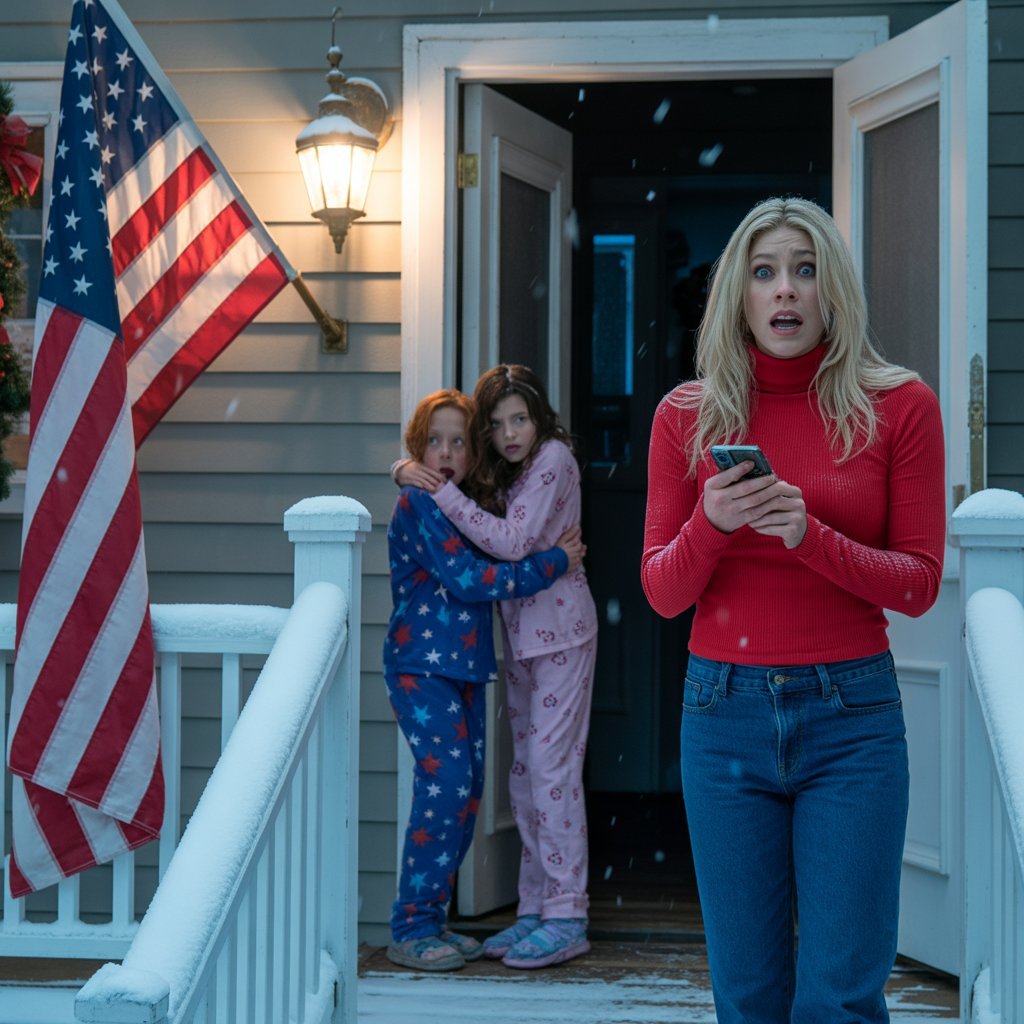
The banging started soft, a dull thud against wood that pulled me from the edge of sleep like a fishhook. I lay still in the darkness of my duplex, disoriented, my body heavy with the exhaustion of a twelve-hour ER shift. The sound came again. Three deliberate knocks. Then, silence. I blinked at the ceiling, my breath visible in the cold air. The heating unit had cycled off hours ago, and the room felt like a morgue.
Outside, wind screamed against the windows, rattling the panes in their frames. The weather report had warned of a winter storm moving in, temperatures dropping into the low 20s, wind chill pushing toward zero. The banging resumed. Harder now. More urgent. I threw off the blankets and my skin pebbled instantly.
The floor was ice against my bare feet as I stumbled toward the door, grabbing my phone from the nightstand. The screen flashed 4.32 AM, in harsh white numbers. My heart kicked into a faster rhythm, nobody knocked on doors at this hour with good news. I flicked on the porch light and pulled the door open. Then I froze.
Dean stood on my doorstep, his eleven-year-old frame bent forward under the weight of his sister on his back. Hannah’s small arms were wrapped loosely around his neck, her head lolling against his shoulder. Dean’s face was bone white, his lips tinged purple, eyes glassy with the vacant stare of severe cold exposure.
He wore long pajama pants soaked through at the knees, sneakers dark with ice melt, no socks. A filthy garage rug the kind mechanics use to catch oil drips was draped over his shoulders, crusted with grease stains and stiffening in the frigid air. Hannah wasn’t moving. My training kicked in before conscious thought could catch up. I registered the cyanosis first, her lips and fingernails were blue-gray.
Her chest rose and fell in shallow, rapid movements, each breath accompanied by a harsh strider that sounded like air being forced through a straw. She was wearing a pink princess nightgown, thin as tissue paper, but Dean’s heavy winter coat had been wrapped around her small body. He’d given her his coat. Inside, now. My voice came out steady, clinical.
I reached for Hannah, lifting her from Dean’s back. She was frighteningly light, her skin cold and waxy under my fingers. Dean’s legs buckled the moment the weight came off him, and he collapsed onto my floor in a boneless heap, his legs too numb to hold him. I carried Hannah to the couch, laying her down while my mind ran through protocols like a checklist.
Hypothermia. Severe. Core temperature likely below 95 degrees. Respiratory distress, possible croup, possible pneumonia, airway compromised. I grabbed every blanket within reach, wrapping her carefully, avoiding the extremities. Warm the core first. Warm the arteries.
Rapid re-warming of frozen limbs could send cold blood flooding back to the heart and trigger cardiac arrest. Her breathing was getting worse. I ran to the bathroom, yanking open the cabinet where I kept my personal medical supplies a habit from years of night shifts and emergencies. The nebulizer was still in its box, unopened. I’d bought it six months ago when a patient’s family couldn’t afford one. Never thought I’d need it for my own niece.
My hands shook as I assembled the mask, filled the chamber with saline, and fitted it over Hannah’s small face. The machine hummed to life, mist flowing into her airway. Her strider eased slightly, the desperate wheeze dropping half an octave. Dean was still on the floor near the door, curled on his side. Shivering so violently his teeth clattered.
I grabbed my phone, hands trembling now not from cold, but from rage so pure it felt like ice water in my veins. I hit 911 and put it on speaker, my fingers already moving back to Hannah to adjust the nebulizer angle. 911. What’s your emergency? This is Nurse Willow Hart. License number RN4022. My voice was glass smooth, professional. Reporting two pediatric medical emergencies at a private residence.
Suspected severe child neglect. I need an ambulance and police immediately. Two children, ages 11 and 7. Hypothermic, one with acute respiratory distress. Address is 447 Maple Grove. Unit B. Ambulance is dispatched. Stay on the line. I set the phone down and moved to Dean. His eyes tracked me but he couldn’t speak, his jaw locked from the cold.
I pulled him away from the door, wrapped him in my comforter, tucked it tight around his torso. Then I went to the kitchen, grabbed the carton of chocolate milk from the fridge, poured it into a mug, and put it in the microwave for 40 seconds. Not too hot. Hot enough to warm his core from the inside without scalding his throat. The microwave beeped. I tested the temperature against my wrist warm, but not burning, and brought it to Dean with a straw.
He took small sips, his hands too stiff to grip the mug. Each swallow made his face twist in pain as warmth met frozen tissue. I knelt beside him, one hand holding the mug, the other checking Hannah’s pulse thin and rapid, but there, my brain cataloged injuries with clinical detachment. Frostbite on Dean’s toes, visible through the holes in his soaked sneakers. Malnutrition, both children were underweight, cheekbones too prominent, eyes sunken.
Hannah’s fingernails were dirty, ragged. Dean’s hair was matted, greasy. These were my brother’s children. Joshua and Jane lived in a mansion in Riverside Heights. Five bedrooms. Heated floors. An expensive wine collection. And they’d sent their children out into a winter storm in pajamas. My hand tightened on the milk carton until it crumpled slightly. Dean flinched, and I forced myself to loosen my grip.
This wasn’t the time. Later, there would be time for rage. Right now, I was a nurse. Right now, these children needed me steady. Sirens cut through the wind outside distant at first, then louder, red and blue lights washing across my windows.
I looked down at Dean, still wrapped in my comforter, his eyes ancient in his child’s face. Those eyes had seen too much, understood too much. They held no surprise at being here, no confusion. Just a weary resignation that broke something in my chest. The paramedics would ask questions, the police would ask questions, and I would answer every single one, because this wasn’t over.
This was just beginning. The ambulance doors slammed shut behind us with a metallic finality that echoed in my chest. Hannah lay strapped to the gurney, her small face obscured by an oxygen mask fogging with each labored breath.
The rhythmic hiss of compressed air filled the cramped space as the EMT adjusted the flow rate, his gloved hands moving with practiced efficiency. I sat on the bench beside Dean, my hand wrapped around his smaller one. His fingers were still cold despite the thermal blankets cocooning him. The boy stared at the ceiling of the ambulance, his eyes tracking the LED strips overhead with that same unsettling flatness I’d seen at my door.
Can you tell me what happened tonight? I kept my voice low, clinical, the same tone I used when coaxing information from trauma patients who needed to talk but couldn’t bear to be pushed. Dean’s throat worked. For a moment, I thought he wouldn’t answer. Then his lips parted, and words began to spill out in that same monotone whisper that made my skin crawl. Mom and Dad left at 5 o’clock. There was a party.
A casino opening. Dad said they needed to beat the cold front. He paused, swallowing. They told us to order pizza and go to bed by 9. The EMT’s hands stilled for half a second on Hannah’s A4 line before resuming their work. I felt my jaw tighten but kept my expression neutral. At 10, we noticed snow wasn’t inside.
I put on my pajamas and my winter coat and went to look in the backyard. Hannah was to wait in the living room. His voice cracked slightly. She got impatient. She only had her nightgown and that thin jacket. She didn’t understand how cold it was.
I watched his profile as he spoke, 11 years old and already carrying the weight of protecting his sister like armor he couldn’t remove. The wind caught the door. It slammed shut. The smart lock engaged automatically. He said those last two words with a bitterness that sat wrong on a child’s tongue. I tried the code. It didn’t work. I called dad. Then mom. No one answered. My free hand curled into a fist against my thigh. The vinyl bench crinkled beneath my scrubs.
Why didn’t you call me? Dean’s eyes finally moved, sliding toward me with a guilt that carved something hollow in my chest. I almost did. I had my thumb on your name. But the phone died. He drew a shaky breath. Earlier, Hannah was crying for mom. I let her play the restaurant game to calm her down. I forgot to charge it after. The monitor above Hannah’s head beeped steadily.
Each sound marked another second these children had survived despite every system designed to protect them failing. It’s not your fault, son. I squeezed his hand tighter, feeling the fragile bones beneath his skin. None of this is your fault. His expression didn’t change, but his fingers gripped mine back with surprising strength.
We went to the garage. There was a rug, old and dusty, but I wrapped myself in it. I gave Hannah my coat. She needed it more. He spoke faster now, as if pushing the words out before they could stick in his throat. The temperature dropped. It kept dropping. The garage isn’t heated. It got down to the same as outside. 23 degrees. The EMT made a soft sound that might have been a curse or a prayer.
I couldn’t tell which. After what felt like a long time, Hannah started wheezing. Bad. Really bad. I knew if we stayed there, she’d die. Dean’s voice finally broke, cracking on that last word like ice under pressure. So I picked her up, and I walked. Through the forest. The shortcut to your place. One mile.
The ground was frozen and the air felt wet and it just kept taking our heat and taking our heat and… You saved her life. My voice came out rougher than intended. You saved both your lives. I heard a sniffle from the front of the ambulance. The EMT turned away, suddenly very focused on checking equipment that didn’t need checking. My own eyes burned but I blinked the heat away. There would be time for that later. Right now, Dean needed me steady.
The ambulance pulled into the bay at Mercy General at 5.30am, the same fluorescent lights I’d worked under for 12 hours yesterday now greeting me from the other side. Hannah was rushed to the ICU immediately, a team of nurses I recognized surrounding her gurney. Dean was transferred to a wheelchair, his frostbitten feet too damaged to bear weight. Officer Jasper found me in the hallway outside the pediatric ward.
He was young, maybe 25, with the kind of earnest face that hadn’t yet learned to hide horror behind professional detachment. Ms. Hart, I need to take your statement. I recounted everything in the same clinical precision I’d used for charting. The temperature of their skin, the color of Hannah’s lips, the timeline Dean had given me.
Jasper’s pen moved across his notepad with increasing pressure, the tip nearly tearing through the paper by the time I finished. And the parents? His voice had gone flat. Where are they now? I don’t know. They left for a casino opening at 5pm. As far as I know, they haven’t been contacted yet. Something cold moved behind his eyes. We’ll find them.
At 8am, as I was closely watching Dean resting, I heard the sharp click of heels on linoleum. I turned to see a woman in her 50s approaching, her charcoal blazer pressed to knife-edge perfection despite the early hour. Rimless glasses sat on a narrow nose, and her eyes moved over me with the same assessing quality I used when triaging patients. Ms. Hart? She didn’t offer her hand.
Carla Evans, Child Protective Services. My stomach dropped. Carla moved past me into the room where Dean sat in his wheelchair, his damaged feet elevated and wrapped in sterile dressings. She observed him with the detached precision of someone conducting an inventory, her gaze cataloging every visible injury, every sign of neglect. Her pen scratched across a leather-bound notebook.
After what felt like an hour but was probably three minutes, she turned back to me. Ms. Hart. I am Carla Evans from CPS. Her voice carried no warmth, no sympathy, only the weight of bureaucratic authority. Currently, the children are under emergency protective custody. I need to conduct a home study at your residence tomorrow.
Our priority is kinship care, but safety regulations are strict. She paused, and those cold eyes pinned me in place. If your home does not meet safety and hygiene standards immediately, the children will be placed into the foster care system upon discharge. The words hit like a physical blow. My duplex was small, cluttered with the chaos of a nurse working 60-hour weeks.
I had no children’s furniture, no safety locks on cabinets, no funds to transform my space into something suitable for two traumatized kids who’d just survived the worst night of their lives. But I couldn’t let her see that panic.
I forced my spine straight, channeling every ounce of the composure that had carried me through codes and traumas and patients bleeding out on tables. I’ll handle it. Carla’s expression didn’t change. She simply nodded, made another note, and walked away with that same precise clicking of heels. I stood in the hospital corridor as the sun began to rise somewhere beyond these walls I couldn’t see.
Around me, the familiar sounds of the morning shift change echoed footsteps, beeping monitors, the low murmur of report being given. I’d been part of this rhythm for years. Now I was on the outside of it, looking in. In this building, my niece fought for every breath while my nephew sat in a wheelchair, his legs still numb and without feeling.
Somewhere out there, my brother and his wife were sleeping off champagne and roulette losses, unaware that their children had nearly died in the cold. And tomorrow, a woman with rimless glasses and a leather notebook would judge whether I was worthy of keeping these children safe. I had less than 24 hours to become someone I wasn’t sure I knew how to be. The fluorescent lights hummed overhead, indifferent to the weight settling onto my shoulders.
I pulled out my phone, already mentally cataloging what I owned that I could sell, how fast I could make it happen, whether it would be enough. It had to be enough. I turned back toward Dean’s room, squaring my shoulders against the impossible task ahead. The corridor stretched before me, sterile and endless, and I walked forward anyway.
The phone in my hand buzzed with a notification I’d been expecting a response from the pawnshop on Fifth Street. They’d take the diamond necklace my grandmother left me. They also told me I could bring the necklace in later this afternoon so they could assess it in person and finalize the price.
I stared at the screen, the blue light washing my face in the pre-dawn corridor, and felt nothing. Not grief, not regret, just the cold arithmetic of survival. I slipped the phone into my scrub pocket and turned back toward Dean’s room. Through the small window in the door, I could see him in the wheelchair, his bandaged feet propped on the footrests, staring at the wall with those ancient eyes.
A child who’d carried his dying sister through a frozen forest shouldn’t look like that empty, waiting, resigned to whatever came next. I wouldn’t let him wait anymore. Earlier, at 6-10 A.M., the wind had teeth as Officer Jasper pulled his collar up and approached the Hart Mansion, its modern facade glowing with recessed lighting that probably cost more than his annual salary.
Motion sensors flickered to life, illuminating the curved driveway where a Tesla sat covered in frost. Jasper pressed the video doorbell. A soft chime echoed somewhere inside the cavernous house. He waited ten seconds, then pressed again. The small camera lens above the button blinked red recording. Mr. Hart? This is Officer Jasper with the Police Department. We have confirmed there is no guardian at this address during hazardous weather conditions.
Your children are in emergency care at Mercy General Hospital. He paused, letting the words sink into whatever device was capturing this moment. You are required to present yourselves immediately to speak with Child Protective Services. Any delay will be recorded as child abandonment. Silence. Just the whistle of wind through the decorative columns flanking the entrance.
Forty miles away, Joshua Hart’d been dozing in a leather chair at the high-stakes blackjack table, his chip stack diminished to a fraction of what he’d started with. Jane was somewhere near the slot machines, her fifth martini making her laugh too loud at something that wasn’t funny. The notification made his stomach drop before he even opened it. Front door motion detected.
He fumbled with his phone, nearly dropping it. The app loaded slowly, always slowly, when you needed it fast. Then the feed appeared. Two uniformed officers standing on his porch, one speaking directly into the camera. He didn’t hear the audio. Didn’t need to.
The rigid posture, the official gestures, the squad car visible in the driveway, he knew exactly what this was. Jane. His voice came out strangled. Jane. We need to leave. Now. She looked up from her drink, mascara smudged beneath her eyes. What? We just got here. The police are at the house. Her face went white beneath the foundation she’d applied 12 hours ago. The ER lobby smelled like burnt coffee and anxiety.
I’d just finished checking my online bank account calculating how fast I could liquidate everything when the automatic doors burst open at nine o’clock sharp. Joshua came first. His expensive suit wrinkled like he’d slept in it. He had. His hair stuck up on one side where he’d tried to smooth it down with wet fingers in the car. The Rolex caught the fluorescent light gleaming obscenely against his pale wrist.
Jane stumbled in behind him, still wearing last night’s evening gown. The silk dragged on the floor, stained along the hem. She reeked of gin and cigarette smoke. Where are they? Jane’s voice cracked across the waiting room. Heads turned. Where are my babies? A security guard stepped forward, hand raised. Ma’am, you’ll need to.
I’m their mother. She lunged toward the nurse’s station, heels clicking erratically. Someone tell me where my children are right now. Joshua spotted me standing near the hallway entrance. For a moment, our eyes met. I saw him calculate, watched his expression shift from panic to something sharper. He straightened his jacket and walked toward me with the confident stride of a man used to getting what he wanted. Willow.
He kept his voice low, reasonable. The voice he used when he needed something. Thank God you were there. This whole thing it’s a terrible misunderstanding. I didn’t move. Didn’t speak. He stepped closer, dropping his voice to a whisper. I know how hard nursing school was for you. Those loans, what are you carrying now? Sixty thousand? Seventy? His breath smelled like alcohol and desperation.
I’ll pay them off. All of them. Today. Just tell the police this was an accident. My hands were shaking. I pressed them against my sides, felt the rough fabric of my scrubs ground me. You locked your children outside in 23 degree weather. We didn’t lock the smart lock malfunctioned. You know how technology is. His smile was practiced, polished. Think about it, Willow.
No more debt. You could finally breathe. No. The word came out flat. Final. His smile evaporated. You’re making a mistake. The only mistake was letting you near those kids for 11 years. His hand shot out and gripped my arm, fingers digging in hard enough to bruise. Listen to me very carefully. I will hire the best attorney in this state. I will strip that nursing license right off your wall.
You’ll never work in healthcare again. You’ll. Joshua. Jane appeared at his elbow, her voice taking on that practice sweetness she used when she wanted something. Maybe Willow just needs time to think about what’s best for the children. A stable home. Their own rooms. Everything they’re used to. She looked at me with eyes that were calculating beneath the smudged makeup.
You live in a duplex, right? How many bedrooms? Something cold and sharp crystallized in my chest. I met her gaze and watched her confidence flicker. One, I said. But it’s warmer than your garage. Joshua’s face went purple. You self-righteous. He shoved me. Hard. I stumbled backward, my hip hitting the corner of a metal medical cart. The impact sent instruments clattering across the linoleum.
Pain exploded through my elbow as I caught myself against the wall, my palms scraping against the rough concrete. My thick winter coat had absorbed some of the blow, but my arm throbbed where I’d connected with the cart’s edge. Don’t touch her. The voice was small but fierce.
Dean stood, actually stood, gripping the arms of his wheelchair, his bandaged feet bare against the footrests. His face was white with pain, but his eyes burned. Don’t you ever touch her. His voice cracked, rising to a scream. You left us. You left us to die and you don’t even care. Jane stared at her son like she’d never seen him before. Her mouth opened, closed. No sound came out. Security! The nurse at the station was already on the phone.
We need security to the ER lobby immediately. Two guards appeared within seconds. The police received the call. Five minutes later, Officer Jasper appeared on the scene. Joshua tried to back away, hands raised, already shifting into his reasonable man persona. This is a family matter. My sister is clearly upset and making… Turn around.
Jasper’s voice was ice. Hands behind your back. You can’t be serious. I barely… I said turn around. Jasper pulled out his handcuffs. You’re under arrest for assault and disorderly conduct. The metal clicked around Joshua’s wrists with a sound that echoed through the silent lobby. His face went from purple to grey.
Jane started crying real tears this time, or a convincing approximation. This is insane. We came here worried about our children and she’s trying to frame us. Jasper turned to her, his expression unchanging. Jane Hart, you’re also under arrest for child endangerment and disorderly conduct. He nodded to another officer who’d appeared. Read them their rights. I stayed against the wall, cradling my scraped palm.
My elbow throbbed. The officers led Joshua and Jane toward the exit. Joshua tried to turn back, tried to say something, but Jasper’s hand on his shoulder kept him moving forward. Dean sank back into his wheelchair, his small body trembling. A nurse rushed over to check his feet, scolding him gently for standing. He didn’t seem to hear her, he was looking at me.
Are you okay? His voice was barely a whisper. I pushed off the wall and walked to him, my legs unsteady, knelt down so we were eye level. My palm stung where I’d scraped it, and I could already feel the bruise forming on my elbow, but none of it mattered. I’m okay, I said. Are you? He nodded. Then, so quietly I almost missed it. Thank you.
I reached out and took his hand, the one that wasn’t hooked to an IV, and held it gently. His fingers were still cold. Behind us, the security cameras had captured everything. The hospital was already pulling the footage. My arm hurt. My palm was bleeding. I had less than 20 hours to make my duplex suitable for two children I barely knew.
But as I watched the automatic doors close behind Joshua and Jane, their expensive clothes and empty promises disappearing into the cold morning light, I felt something I hadn’t felt in years. I felt strong. The next morning arrived under a cloak of dull winter light. Outside Joshua’s mansion at 8.55 am, the house looked carefully styled what Jane liked to call a symbol of their standard of living. Carla’s sedan pulled up precisely at 9 o’clock.
Officer Jasper followed in his patrol car. Neither vehicle belonged in this neighborhood of pristine driveways and ornamental trees. Ready? Carla asked, stepping out with a leather portfolio tucked under her arm. Officer Jasper entered the emergency code taken from Joshua’s testimony, unaware that it wasn’t the same code Dean had memorized.
The door clicked open with a cheerful electronic chime, the same sound that had sealed two children outside in 23-degree weather. The foyer opened into a vaulted living room. Italian leather furniture formed perfect right angles around a glass coffee table. A wine cabinet stood against the far wall, backlit and temperature controlled. In the cabinet sat 12 bottles of red, their labels turned outward like small badges of sophistication.
Carla walked to the kitchen. Her heels clicked against marble tile. The Sub-Zero refrigerator hummed with expensive efficiency. Carla pulled it open. The interior light revealed two slices of pizza in a grease-stained box, the cheese spotted with blue mold. Three energy drinks. A half-empty bottle of vodka.
Nothing else. No milk. No vegetables. No bread. No evidence that children lived here at all. Officer Jasper opened the pantry. A bag of stale tortilla chips. A jar of olives. Carla uncapped her pen. She made a mark on her form. The scratch of ink on paper felt final. Second floor, she said. Dean’s room sat at the end of the hallway. The door hung slightly ajar, revealing walls painted a fashionable gray.
A mattress lay directly on the hardwood floor, no frame, just a bare fitted sheet and a thin blanket. In the corner, a professional ring light stood on a tripod, its cord snaking toward an outlet. Carla photographed everything. The empty space where a bed should be. The ring light. The closet containing three pairs of jeans and four shirts. All too small. They threw out his bed, she said, to make room for Jane’s streaming setup.
Officer Jasper’s jaw tightened, but he said nothing. Hannah’s room was worse. A toddler bed she’d long outgrown. A pile of stuffed animals that looked like they’d been purchased in bulk and never touched. The window latch was broken, leaving a draft that made the curtains flutter. Carla made another mark on her form. Then another. They went back downstairs.
Officer Jasper moved to the garage door and stepped outside. When he returned, an elderly man in a cardigan followed him inside. Mr. Clint from next door. He was always in his garden, pruning roses with careful attention. Thank you for coming over, sir, Officer Jasper said.
You mentioned you’d observed some concerning behavior? Mr. Clint’s hands shook slightly as removed his glasses and cleaned them on his sweater. Those two, the parents, they’re party animals. Every weekend there’s noise until three, four in the morning. White-claw cans all over the driveway. Carla’s pen hovered over her notepad. And the children? Mr. Clint’s face creased with something that looked like shame.
The boy. Dean. I used to see him dragging these heavy black trash bags to his little red wagon. Took me a while to figure out what he was doing. What was he doing? Carla asked, though her tone suggested she already knew. Collecting their empties. Taking them to the bottle return machines at Kroger. Mr. Clint’s voice cracked.
The more they drank, the more money he had. I’d see him and his sister sitting right there at the store entrance afterward, tearing into lunchables like they hadn’t eaten in days. The room went quiet. Even the expensive refrigerator seemed to stop humming. I asked him about it once. Mr. Clint continued. Asked if everything was okay at home.
He just stammered something about being too busy playing to eat dinner. He looked at Carla, then at me. That wasn’t the truth, was it? No, it wasn’t, Carla said. Carla made three more marks on her form. When she looked up, her expression remained professionally neutral, but her knuckles had gone white around the pen.
Environment unsafe. She said aloud, checking a box. Inadequate nutrition. Evidence of chronic neglect. I’m recommending immediate termination of parental custody pending criminal trial. Back at my apartment, I sat with my phone in my hand and a decision on my shoulders. I needed a shark. Someone who could gut Joshua’s legal team and make sure those kids never spent another night in that house.
The name everyone whispered with equal parts fear and respect was Attorney Vance, the most effective family law attorney in the region. He didn’t lose. He also didn’t come cheap. But I’d already started preparing for this fight.
While I was still in the hospital with Dean and Hannah, while my arms still throbbed from where Joshua had shoved me into the doorframe, I’d made a mental inventory of everything I owned that could be converted to cash. Yesterday afternoon, I’d walked into the pawn shop on 5th Street with my grandmother’s diamond necklace. She’d given it to me on my 16th birthday, told me it was a family heirloom passed down from her mother.
The gemstone wasn’t huge, but it was flawless vintage cut, platinum setting. I’d worn it exactly twice, once to her funeral, once to my nursing school graduation. The pawnbroker had examined it under his loop for what felt like an eternity before looking up. $3,800. Cash. Right now. I’d signed the paperwork without hesitation.
The laptop was next. I’d posted it in the community resident group, a sleek, high-end model I’d just finished paying off last week. $900 in monthly installments. Finally mine. A sophomore college student showed up in an hour. Cash in hand. $900. Gone in 30 seconds. But the espresso machine god, that hurt.
I stood in front of it for 10 minutes before I could bring myself to unplug it. It was a beautiful piece of engineering. Brushed stainless steel, Italian made, with a steam wand that produced microfoam so perfect, it could make a hospital cafeteria coffee taste like a cafe in Milan. I’d bought it two years ago, right after I made the final payment on mom’s medical bills. Joshua had inherited all of dad’s life insurance money, $75,000.
I’d asked him to help with mom’s hospital costs, just to split them. He’d laughed. That money’s for investing in the future, he’d said, swirling bourbon in a crystal glass. And now, here I was, selling the only thing I’d ever bought for myself, not for bills, not for necessities. Just for joy, to clean up the mess his future had made for his children.
A young man arrived to pick it up. Fresh out of college, first job, eager smile. He handed me $600 and thanked me profusely, saying it was a steal. I smiled and told him to enjoy it, then closed the door and stared at the empty counter. The outline was still visible, a clean rectangle in the dust. My brother didn’t just exploit me, he was cruel to his own children.
I stealed my resolve. Those kids would not spend one more day under his roof. Total funds, $5,300 from sales, $7,500 from savings, $12,800. I walked into the law offices of attorney Vance at 10am. The receptionist led me to a Attorney Vance was a man in his early 50s, silver-haired and sharp-eyed, with the kind of presence that made you sit up straighter.
He didn’t waste time on pleasantries. Show me what you have. I slid the medical records across his desk. Dean’s frostbite treatment, Hannah’s hypothermia and asthma crisis, my own injury report from the ER. Then the photos, my bruised arm, the kids’ hollow eyes, the screenshots I’d taken of Jane’s Instagram stories, showing champagne bottles and party lights on the same nights Mr. Clint described.
Vance studied them in silence, removing his glasses halfway through. When he looked up, his expression was unreadable. I can guarantee you win permanent custody, he said flatly. I can also guarantee your brother serves time. The retainer is $9,000. I reached into my bag and pulled out the cash, bills in neat stacks.
I placed them gently on his mahogany desk. Then let’s begin, I said. He slid a contract across the desk. I signed. This transaction, this exchange of every material thing I valued was purchasing a peaceful future for two children who’d never known one. The afternoon, Carla Evans arrived at my duplex for the home study.
She swept through the apartment with the precision of a drill sergeant, checking expiration dates on every carton of milk in the shaking the newly assembled bunk beds to test their sturdiness. I’d stayed up until midnight putting those beds together, my hands blistered from the allen wrench. She paused in front of the kitchen counter, the empty space where the espresso machine used to be and I saw her eyes linger there.
Then she looked at the stack of receipts I’d left on the table. New bedding, children’s clothes in the correct sizes, asthma medications, a humidifier for Hannah’s room, nightlights shaped like stars. Carla picked up the receipts, studied them, then set them down. She uncapped her pen, stamped past on her clipboard, and looked me in the eye.
You can pick up the children tomorrow morning. That nod brief, professional, almost imperceptible was the most valuable validation I’d ever received. Day three, morning. Hannah had recovered faster than expected. Her oxygen saturation levels were stable, her breathing clear.
The doctors were cautious her lungs would need monitoring, follow-up appointments, a strict medication schedule, but because I was a pediatric RN with the skills and training to manage her care, the hospital felt completely reassured releasing her into my custody. Dean walked through my door first, Hannah’s small hand in his.
He looked around the apartment, the mismatched furniture, the coffee pot on the counter, cheap drip, nothing fancy, the empty space where something clearly used to be. Then he saw the bunk beds in the corner room, the quilts I’d bought in primary colors, the wooden toy chest already stocked with books and puzzles. His eyes wavered. He didn’t cry, this kid had been trained not to, but I saw the crack in his armor.
Hannah, still weak but smiling, lit up when she saw the two teddy bears on the bottom bunk. They were the latest models, the kind every kid in her class probably begged for. I’d seen her looking at them through a store window once, months ago, when I’d taken her and Dean for ice cream. She hadn’t asked for one, she’d just looked. Now she had two. This one’s yours, she said solemnly to Dean, handing him the blue bear.
We match. Dean took it, clutching it like a lifeline. I knelt down, meeting their eyes. This is home now, for as long as you need it, forever, if that’s what you want. Dean looked at the empty counter again, then back at me. He didn’t say anything, he didn’t have to. Two weeks later, Jane made bail. Attorney Vance had already notified me of the conditions. No contact with victims or witnesses, and no public mention of the case.
They were standard protective measures, designed to shield the children from further trauma. Jane ignored them immediately. That evening, Dean was doing homework at the kitchen table when my phone exploded with notifications. Instagram, Facebook, Twitter, Jane had gone live on every platform simultaneously.
I pulled up the stream. She sat in the living room of her mother’s home, eyes rimmed with carefully applied red makeup to simulate crying. The comments were already rolling in thousands of her followers, tuning in for the performance. I need to speak my truth, Jane began, her voice trembling. I’ve been silent too long, and I can’t, I can’t, let this continue.
My children were taken from me by a jealous, vindictive woman, who has always resented my happiness. My stomach dropped. My sister-in-law, Willow, she continued, saying my name like a curse, is a lonely, bitter spinster, who couldn’t stand to see me with a loving family. She lured my babies away with promises of toys and treats, then called the authorities with fabricated stories of neglect.
The door code incident? A simple mistake. Kids forget things all the time. But she twisted it into something sinister. The comments lit up. Jane would never neglect her children. This is clearly a custody battle. So sad. Praying for you, babe. Stay strong. But just as many read, Who forgets their own kids outside? The aunt is a hero.
Jane dabbed at her eyes. My children are scared and confused, being held by a woman who doesn’t understand them. I’m their mother. I’m fighting to bring them home where they belong. The livestream ended. Within an hour, my social media was under siege. Messages flooded my inbox, most of them vicious. Child stealer. You’re disgusting. Give those kids back to their mom.
Someone found out where I worked. The hospital’s main line started ringing angry callers demanding the kidnapper nurse be fired immediately. Security had to disconnect the phones. I sat in the break room, shaking, while my co-workers whispered in the hallway. Some looked at me with sympathy, others with suspicion. Week 2. Day 3.
Two days later. Two days after the livestream began, the call I feared finally came. I was summoned to HR immediately. I walked through the corridors feeling like I was heading to my execution, certain they were going to cut me loose to avoid the liability and bad press. I knocked on the HR director’s door.
Come in, Willow. Inside, I found not just the HR director, but Dr. Grayson, chief of medicine, the man who’d hired me five years ago. A thick file sat on the desk between them. I sat down, hands folded in my lap, waiting for the blow. Dr. Grayson spoke first. We’ve reviewed the hospital admission records for Dean and Hannah Hart.
We’ve also reviewed the security footage from the ER, showing your brother’s physical assault on you in the hallway. And we’ve seen the social media campaign being waged against you by Jane Hart. I nodded, throat tight. I understand if you need to. We know the truth, the HR director interrupted. Her expression was steel.
We know you did the right thing, and we’re not going to let an influencer with a vendetta destroy the career of one of our best nurses. I blinked. What? Dr. Grayson slid the file toward me. The hospital’s legal department has prepared a countersuit for defamation and libel. Jane Hart made specific, false claims about your character and your professional conduct.
She did so publicly, to an audience of over a hundred thousand people, causing direct harm to this institution and to you personally. We have documentation, witnesses, and video evidence to refute every claim she made. We’re going to bury her, the HR director added quietly. I stared at the file, then at them. You’re… supporting me? Willow? Dr. Grayson said, and his voice was gentler than I’d ever heard it.
You’ve dedicated to this hospital. You’ve worked double shifts, covered holidays, trained new staff, and saved countless lives. When your mother was sick, you didn’t miss a single shift. You’re the kind of nurse we build a hospital around, so yes, we’re supporting you, unequivocally. Treasoned. I wept with relief. They were shielding me.
The final piece of the puzzle fell into place the very next afternoon. The text came from an unknown number while I was giving Hannah her nebulizer treatment. You don’t know me, but I was at the party the night your nephew and niece were locked out. I need to tell you something about the door code. My heart stopped. I stepped into the hallway and called the number. A woman answered, voice hushed, nervous.
I can’t give my name, she said, but I was friends with Jane, and after seeing her on that livestream, lying through her teeth, I couldn’t stay quiet. What happened? I asked. At the party, Joshua was showing off. He’d just installed this fancy smart lock system and wanted everyone to see how advanced it was. He pulled out his phone and demonstrated changing the code remotely.
Made a big deal about how secure it was, how he could control it from anywhere. Everyone went, ooh wow, and he loved the attention. He was drunk, so proud of himself, and then he just… kept drinking. I don’t think he ever sent the new code to Dean. I sat down hard on the hallway floor. It wasn’t an accident. I whispered. No, the woman said. It was negligence born of arrogance.
I’m sorry. I should have said something sooner. You’re saying it now, I told her. That’s what matters. I thanked her, ended the call, and immediately forwarded the information to Attorney Vance. Attorney Vance moved with predatory speed. He subpoenaed the smart lock company’s server logs, using the witness’s tip as grounds.
The data was damning. It showed that at 11.47 pm on January 14, the code had been changed remotely via Joshua’s iPhone to 8-2-6-4. Dean hadn’t forgotten the code, his father had changed it, and never told him. Armed with this evidence and the recording of Jane’s livestream, Vance went to court. He presented the video as proof of bail violation.
The judge issued an immediate order, and police arrested Jane in the middle of preparing for another broadcast. The footage of her being handcuffed while screaming about her platform went viral, turning the tide of public opinion overnight. Six months later, the courtroom was packed for the trial. Jane’s high-priced lawyer tried to argue that the house was merely messy, but Carla Evans destroyed that defense on the stand.
She described the lack of food, the mattress on the floor, and the $18,000 wine cabinet in a house where children were starving. I have never, in two decades of this work, seen a home where the alcohol was better cared for than the children,” Carla stated. That’s not neglect. That’s calculated torture. The sentencing was severe.
Joshua Hart received five years in state prison for child endangerment and felony neglect. Jane received two years. Both had their parental rights terminated permanently. To avoid a crushing civil lawsuit, Joshua accepted a plea deal. He would liquidate the mansion and luxury cars to pay off debts.
The remaining equity approximately $300,000 would be transferred directly into a trust fund for Dean and Hannah, managed by me. Additionally, 40% of his future income post-incarceration would be automatically garnished for child support. I sat in the courtroom watching my brother lose everything, feeling no joy, only the immense, quiet relief of safety. The suburbs smelled different, cleaner somehow, like fresh-cut grass and possibility.
I stood in the backyard of our new house, our house watching Dean pitch baseballs to Aaron while Hannah drew chalk flowers on the patio. The house wasn’t huge, but it was ours. Three bedrooms, two bathrooms, a kitchen with enough counter space for a proper coffee maker, and a backyard big enough for a swing set and a vegetable garden. Two years had passed since the trial.
Two years since I’d sold my grandmother’s necklace and my espresso machine. The court had auctioned Joshua’s mansion, and while the trust fund secured the children’s future, I’d used a portion of the settlement to buy this house outright. No mortgage. No landlord. Just a deed with my name on it. I’d been promoted to head nurse at Mercy General six months ago.
The raise wasn’t enormous, but it was enough. Enough for soccer cleats, art supplies, and Friday night pizza. And then there was Aaron. Dr. Aaron Mitchell, ER, attending physician, cat lover, accidental hero. He’d treated me that night in the ER, signed the injury report that helped jail my brother, and then simply never left our orbit.
What started as professional courtesy visits evolved into helping with homework, bringing takeout, and eventually becoming the father figure these kids desperately needed. A week after the kids came to live with me, once the initial chaos had settled, Hannah had asked about Snow, the cat they’d left behind. We posted flyers, though I had little hope.
But miracles happen. Mr. Clint called a few days later. He had found the scrawny orange tabby shivering on his porch and had been feeding him in his garage. Aaron drove us to pick him up. When Snow meowed pitifully at the sight of Dean, the boy who had held everything together finally broke down and cried. Aaron had put a hand on his shoulder and simply said, He’s home now.
You all are. Now, Snow was fat and spoiled, sleeping in sunbeams and demanding treats. Dean was thirteen, taller and playing shortstop with a wicked curveball. The frostbite scars on his fingers had faded to faint white lines. Hannah was nine, her asthma fully controlled, her laughter filling the hallways that used to be so quiet. On my birthday, Dean handed me a small box wrapped in newspaper.
Inside was a silver keychain engraved with the word HOME. Thank you for opening the door that night, he said, his voice cracking slightly. And thank you for selling your coffee machine for me. I knew about that for a long time.
I hugged them both tight, knowing every sacrifice, every scary moment, every dollar sold and spent had been worth it. I clutched the keychain, a symbol totally opposite to the cold smart lock that started it all. We had finally found a truly safe home.