I pull into the gravel driveway at Martin’s Highpoint Orchard just as the sun dips below the tree line, turning the barn’s string lights into fuzzy golden orbs against the October dusk. The parking lot is already half full of cars I don’t recognize, sleek sedans that belong to the investor crowd my sister Kendra has been courting for months. Country music drifts from the open barn doors, something twangy about pickup trucks and Friday nights.
My stomach clenches. I’m late to my own son’s thirteenth birthday party. Six months of overnight shifts at the warehouse, every Thursday and Saturday from ten until six in the morning, all to scrape together enough money for the camera I gave him this morning.
A professional DSLR with interchangeable lenses, the kind Silas has been circling in YouTube reviews for two years. I handed it to him before school, barely able to keep my eyes open, but the look on his face had been worth every hour of lost sleep. I hurry toward the barn, scanning the grounds, hoping to catch him testing it out in this light.
I can already picture him, one eye squinted against the viewfinder, completely absorbed in his own world. The barn looks like something from a magazine spread. White tablecloths, mason jar centerpieces stuffed with wildflowers, a dessert table that probably cost more than the camera I bought.
This isn’t a kid’s birthday party. This is a showcase, another opportunity for Kendra to parade the Martin family brand in front of people with money. I spot Silas near the entrance before he sees me.
My breath stops. He’s ghostly pale, his left arm encased in a fresh white plaster cast that practically glows under the lights. Sweat beads across his forehead despite the cool evening air.
His eyes have that unfocused glaze I recognize from the one time he had his wisdom teeth removed, when the dentist sent him home with painkillers that made him sway on his feet. I’m moving before I think. “Silas, baby—what happened?”
He turns toward my voice, and the relief that floods his face nearly breaks me.
But before I can reach him, Kendra materializes between us like she’s been waiting for this exact moment. “Lindsay,” she says brightly. “Finally.”
Her smile is wide and glittering and completely wrong.
Her fingers dig into Silas’s right shoulder—the uninjured one—hard enough that I see him wince. “We were starting to think you’d miss the whole thing.”
I try to step around her. “Silas, are you okay?”
“He’s fine,” Kendra says.
Her voice drops to a hiss even as her lips stay fixed in that pageant smile. “Stand up straight, Silas. Mr.
Hendricks from the development group is watching.”
“He just got out of the emergency room two hours ago,” I say. The words come out sharper than I intend. “He should be home in bed.”
“It was just a clumsy accident on the hayride.”
Kendra waves her free hand dismissively, but her grip on Silas tightens.
“Nothing that should ruin his special day. Right, sweetie?”
Silas doesn’t answer. His good hand trembles at his side.
“Lindsay Marie? Is that what you’re wearing?”
My mother’s voice cuts through the music. Sylvia Martin appears beside Kendra wearing a cream sweater set that probably costs more than my monthly utilities.
Her eyes rake over my work jeans, my flannel shirt with the frayed cuffs. “You look like the hired help,” she says, her voice pitched low but sharp enough to cut. “We have investors here tonight, people who are considering putting serious money into this venue, and you show up looking like you just rolled out of a barn.”
The irony of that, given our current location, would be funny if I didn’t feel like I might vomit.
“Mom, Silas is hurt,” I say. “He needs to go home.”
“What he needs,” Kendra says, smile never wavering, “is to enjoy his party like a normal teenager instead of being coddled.”
Over Kendra’s shoulder I see Brock swagger through the crowd in his varsity jacket, the number 16 glinting on his back. He’s laughing with a group of his football friends, all of them holding red Solo cups.
When he spots Silas, his grin widens. He leans in close to Silas’s ear. I can’t hear what he says, but I see my son flinch.
I see the way his eyes drop to the floor. Then Brock says, louder, “Pathetic that you need pain meds just for a broken arm, dude.”
Something cold and sharp lodges itself behind my ribs. I watch Kendra raise her hand to fix Silas’s hair, a gesture that should be maternal and kind.
But Silas jerks back like she’s about to strike him. His whole body goes rigid—protective, terrified. The noise of the party fades to a dull roar in my ears.
That wasn’t a random flinch. That was recognition. My mother is still talking, something about professionalism and family image, but I’m not listening anymore.
I’m watching my sister’s hand hover near my son’s face. I’m watching the way her thumb and forefinger pinch together, just slightly—a silent threat. I’m watching my son’s eyes plead with me to understand something he can’t say out loud.
This was no hayride accident. “I need to use the restroom,” I hear myself say. My voice sounds distant, mechanical.
“I’ll be right back.”
Kendra’s smile sharpens. “Don’t take too long,” she says. “We’re cutting the cake soon.”
I walk toward the main house on legs that don’t quite feel like my own, leaving my mother mid-sentence about dress codes and family loyalty.
Inside the house, I lock myself in the downstairs bathroom and grip the edge of the sink. My reflection stares back at me—calloused hands, tired eyes, a lifetime of keeping the peace. But peace isn’t supposed to leave bruises.
Peace isn’t supposed to make a thirteen-year-old boy flinch away from his own family. I turn on the faucet to cover any sound and pull out my phone with shaking hands. Tabitha answers on the second ring.
“I need you,” I whisper. “Something’s wrong. Something’s really wrong.”
Tabitha grabs my elbow the second I step out of the bathroom, her fingers urgent against my skin.
She doesn’t say anything, just jerks her head toward the back of the barn and starts walking. I follow without question, because Tabitha Miller doesn’t panic—not when the tractor caught fire last summer, not when that wedding party got food poisoning from the caterer. Never.
But her jaw is locked tight now, tendons standing out in her neck. She pulls me into the supply closet where we keep the extra chairs and tablecloths, the smell of cedar and dust thick in the cramped space. The music from the party is muffled here, reduced to a bass thump that vibrates through the walls.
“I saw it happen,” she says. Her voice comes out rough, like she’s been swallowing gravel. “I saw Brock corner Silas by the cider press.
Not the hayride. The industrial press near the loading dock.”
My stomach drops. “When?”
“This afternoon.
Around four.” She swipes at her face with the back of her hand. “I was doing inventory in the storage barn, heard something metal smashing on concrete. Loud.
Really loud.”
The cast. The painkillers. The way Silas flinched when Kendra raised her hand.
“I need to see the cameras,” I say. Tabitha blinks. “What cameras?”
“The security system.
Dad installed it two weeks ago.” I’m already moving toward the door, but she catches my arm. “Lindsay, your dad didn’t tell anyone about cameras,” she says. “He installed them because he thought Brock was stealing equipment to sell.”
The words taste bitter.
“4K resolution. Motion-activated,” I say. “He didn’t want Kendra to know he was watching her son.”
Tabitha’s expression shifts from confusion to something darker.
“Server room?”
I nod. The server room is tucked behind Dad’s office in the main house, a glorified closet where he keeps the computer that runs the sound system and handles the venue bookings. I use the key from under the mat because of course they still keep it there, same spot it’s been since I was twelve.
My hands shake as I lock the door behind us. The monitor wakes up with a tap, password already saved because Dad can never remember his login credentials. The security software opens to a grid of camera feeds, twelve different angles of the property.
I scroll back through the timeline, searching for four o’clock. There—camera seven. A wide-angle view of the loading dock where the massive cider press sits, all steel and mechanical jaws designed to pulp two hundred pounds of apples per hour.
Silas walks into frame. He’s holding the camera—my camera, the one I gave him this morning—close to his face, checking a setting on the lens. My throat closes.
Brock appears from the left side of the screen, moving fast. He’s talking, but there’s no audio on these feeds. Silas turns, lowers the camera, holds it closer to his chest.
Protective. Brock lunges, grabs the strap. Silas tries to hold on.
The strap snaps. Brock yanks the camera away. For one second I think maybe he’s just teasing, maybe this is all some stupid roughhousing.
Then he raises it above his head and slams it down on the concrete loading dock with both hands. The camera explodes. Pieces of black plastic and glass scatter across the frame.
Six months of night shifts, every Thursday and Saturday, every missed dinner with Silas, every morning I came home too exhausted to do more than collapse on the couch—destroyed in less than two seconds. Silas drops to his knees, reaching for the pieces. Brock shoves him—not hard at first, just enough to knock him off balance.
Silas tries to gather the shattered equipment anyway, his hands moving frantically across the concrete. That’s when Brock puts his palm flat against Silas’s shoulder and pushes. Really pushes, driving my son backward into the steel frame of the cider press.
The impact is silent on the feed, but I hear it anyway. The crack of bone against metal, the way Silas’s mouth opens in a scream that never makes it to the camera. His arm bends at an angle that makes my vision blur.
Beside me, Tabitha makes a sound like something has been ripped out of her chest, but the feed keeps playing because we haven’t stopped it. Kendra walks into frame now, heels clicking on concrete. She looks around, scanning for witnesses.
Then she crouches down and grabs Silas’s face with both hands, her perfectly manicured nails digging into his cheeks. She’s talking. I can see her mouth moving, see the way Silas’s whole body goes rigid with terror.
She holds his face for fifteen seconds. Twenty. Thirty.
Making sure he understands whatever threat she’s delivering. Then she releases him and walks away like nothing happened. Brock follows, laughing.
Silas stays on the ground, cradling his broken arm, surrounded by the shattered pieces of the camera I sold pieces of my life to buy him. I lean over the trash can in the corner and vomit until there’s nothing left. Tabitha’s hand rests on my back, steady and warm.
“I’ll call Jim,” she says. I spit, wipe my mouth with the back of my hand. My whole body is shaking, but my mind feels crystalline—sharp, clear in a way it hasn’t in years.
“Not yet,” I say. I sit up and pull out my phone. “I need to download this first.”
It takes four minutes to copy the footage to my cloud storage.
Another two to email it to the lawyer I consulted six months ago when Dad threatened to fire me for asking about my grandmother’s will. The same lawyer who explained that Grandma’s land deed in my name supersedes the business LLC my parents created later. The same lawyer who told me to document everything.
Tabitha watches me work, her expression shifting from horror to understanding. “You’re not going to scream,” she says. “You’re not going to cry.”
“No.” I watch the email confirmation ping.
“I’m going to let them think they’ve won.”
I pull up my text messages and type quickly. It’s happening. Come now.
Sheriff Jim Miller’s response comes back in ten seconds. Twenty minutes out. I delete the texts, clear my recent calls, and wipe my face with my sleeve.
In the monitor’s reflection I look pale but composed, tired but not hysterical. Exactly how they expect me to look. Beaten down.
Harmless. Tabitha opens the door and checks the hallway. “They’re getting ready to cut the cake,” she says.
“Perfect.”
I stand, smooth my flannel shirt. My legs feel solid beneath me now. “Let’s go watch my son blow out his candles,” I say.
She catches my wrist as I pass. “Lindsay,” she says. I meet her eyes.
“I own the land,” I say. “They just don’t know it yet.”
Her smile is fierce. “Let’s go to a party,” she says.
I find my parents in the office behind the barn, exactly where I knew they’d be. The room smells like leather and old wood, lined with photos of Martin family orchards going back four generations. Garrett and Sylvia stand behind the massive oak desk like they’re holding court, reviewing catering invoices with the intensity most people reserve for mortgage documents.
My father looks up when I enter. He doesn’t smile. “We need to talk about Silas,” I say.
My voice comes out steadier than I expected. “Not now, Lindsay,” Mom says. She doesn’t even glance up from the spreadsheet.
“We have the Hendricks proposal to finalize before they leave tonight.”
“Silas says Brock pushed him,” I say. The words land like stones in still water. Dad’s pen stops moving.
Mom’s head snaps up, her reading glasses sliding down her nose. For one brief, stupid moment, I let myself hope. Maybe they’ll be horrified.
Maybe they’ll demand answers, protect their grandson, choose family over business for once in their lives. Garrett leans back in his chair, fingers steepled. “That’s a serious accusation,” he says.
“I know.”
“Based on what, exactly?” Mom’s voice has that tight quality I remember from childhood, the tone that always preceded lectures about not embarrassing the family. “The ramblings of a thirteen-year-old hopped up on emergency room painkillers,” Dad says. My jaw clenches.
“Based on what my son told me,” I say. “Your son,” Dad says, each word deliberate, “broke our industrial cider press this afternoon during one of his clumsy episodes. Do you have any idea what that machine costs?”
The floor seems to tilt beneath my feet.
“What?”
“Silas was messing around near the equipment,” Mom says. She removes her glasses and sets them on the desk with careful precision. “He stumbled, grabbed the frame to catch himself, and damaged the pressure mechanism.
The whole thing will need to be replaced.”
“That’s not what happened,” I say. “Are you calling us liars?” Dad’s voice drops to a dangerous quiet. “Were you there?”
“No, but—”
“Then you don’t know what happened, do you?”
He stands, and even though I’m forty-two years old, some part of me still wants to step back.
“What you do know,” he says, “is that your sister has worked incredibly hard to build this venue into something special. Something that provides jobs for this entire community. Including you.”
“Garrett,” Mom says, touching his arm, but her eyes never leave my face.
“Let’s be reasonable about this.”
She walks around the desk, her cream sweater catching the lamplight. When she’s close enough, she reaches out like she might touch my shoulder. I don’t move.
“Lindsay, sweetheart,” she says. “We understand you’re protective of Silas. That’s natural.”
Her voice has gone soft, almost kind.
It makes my skin crawl. “But you need to understand the position you’re putting us in,” she says. “Brock is about to sign with a Division One program.
The family has invested thousands in his training, his prospects. These accusations could ruin everything he’s worked for.”
“What about what Silas has been through?” I ask. “Silas has a broken arm that will heal in six weeks,” Dad says.
He’s back at the desk, writing something on the invoice. “Brock’s football career won’t recover from assault allegations, true or not.”
The overhead light flickers. Outside, someone laughs—high and bright.
“The cider press damage is going to cost about five thousand to repair,” Dad says. He doesn’t look up from his writing. “We’ll dock your wages a thousand for the next five months to cover it.
Consider it a family discount.”
My mouth goes dry. “You can’t be serious,” I say. “Completely serious.” Now he meets my eyes.
“And Lindsay, if you continue spreading these lies about Brock, we’ll have to reconsider your housing situation.”
The threat hangs in the air like smoke. “You’d evict us,” I say. “The farmhouse is Martin family property,” Mom says gently, like she’s explaining simple math to a child.
“We’ve let you stay there at a significantly reduced rate because you’re family, but if you’re going to jeopardize the business, create hostile working conditions, make false accusations against your nephew…”
She trails off. The implication is clear. For years they’ve made me believe that piece of paper in my safety deposit box was worthless without their money to pay the taxes, their business to maintain the structures.
They’ve gaslit me into thinking I’m a guest in my own inheritance. Something inside me goes very still. They’re not angry because I’m wrong.
They’re angry because I’m right, and they don’t care. These people aren’t my parents—not in any way that matters. They’re business partners who view Silas and me as line items on a balance sheet, liabilities to be managed and minimized.
Garrett Martin and Sylvia Martin, LLC holders, protecting their investment. The realization doesn’t hurt as much as I thought it would. Maybe because somewhere deep down, I’ve always known.
“Do we understand each other?” Dad asks. His pen taps the desk once, twice. I look at my mother’s carefully arranged face, my father’s cold certainty.
I think about Silas standing in the barn with his broken arm and haunted eyes, about Kendra’s fingers digging into his shoulder, about Brock’s smirk. I think about the video footage sitting in three separate cloud accounts, already forwarded to my lawyer. About Sheriff Jim Miller’s text from ten minutes ago.
Five minutes out. Don’t tip your hand. I think about the land deed locked in my safety deposit box, the one thing my grandmother made sure they couldn’t take from me.
“Yes,” I say quietly. Dad nods, satisfied. Mom smiles like we’ve just had a productive family meeting.
“Good. Now go fix your hair before the cake cutting,” she says. “You look like you’ve been through a tornado.”
They turn back to their invoices, crisis managed, daughter handled.
I walk out of the office on steady legs. The party sounds drift from the barn, that same country song about Friday nights and empty promises. String lights turn the evening into something from a fairy tale—sparkle and warmth and lies.
Tabitha waits near the dessert table. She catches my eye. I give her the smallest nod.
Everything’s ready. Kendra’s voice rises above the music, calling for everyone’s attention. Time for speeches, for toasts, for the carefully orchestrated performance of family unity.
I slip into the shadows near the barn’s side entrance, pulling out my phone. My hands don’t shake anymore. The screen glows in the darkness, showing Sheriff Miller’s location.
Two minutes away. They think they’ve won. Think they’ve successfully bullied me back into my place, back into silence and compliance and keeping the peace at any cost.
They have no idea what’s coming. My eyes are dry. My hands are steady.
And I’m done keeping their secrets. I find Kendra near the dessert table, her wineglass catching the light as she laughs with a couple in matching cashmere. Her posture radiates victory.
She thinks she’s won. Good. I smooth my flannel shirt and force my shoulders to curve inward, making myself smaller—the posture of surrender.
My boots scuff the barn floor as I approach, loud enough that she turns. “Kendra,” I say. My voice cracks just right.
“Can we talk?”
Her eyes narrow, calculating. Then her smile widens, sharp as a blade. “Of course, sis,” she says.
“What is it?”
“I want to make things right,” I say. The words taste like copper. “I shouldn’t have caused a scene.
Not tonight. Not with all these important people here.”
She sets her wineglass down with deliberate care. “I’m listening,” she says.
“I know I embarrassed the family,” I say. I let my gaze drop to my boots, the same ones Mom criticized earlier. “Silas shouldn’t have made such a fuss about his arm.
Kids can be so dramatic, right?”
The lie burns coming out, but I watch Kendra’s shoulders relax. Watch the predatory gleam in her eyes shift to something worse—satisfaction. “I’m glad you’re finally seeing reason,” she says.
She reaches out and pats my shoulder, the same crushing grip she used on Silas. “You know, Lindsay, you could really be an asset to this business if you’d just learn to be a team player.”
My jaw aches from clenching. I manage a weak nod.
“Actually,” Kendra says, her voice dropping to that syrupy tone that means she’s about to stick the knife in deeper, “since you’re so eager to make amends, I have the perfect opportunity for you.”
I wait, let her think I’m hanging on her every word. “Mr. Hendricks and the other investors are concerned about tonight’s little drama,” she says, gesturing vaguely toward where Silas disappeared with Tabitha earlier.
“They’re wondering if this venue is really as family-friendly as we’ve advertised. If the management can handle pressure situations with grace.”
My heart thuds against my ribs. “What do you need me to do?”
“Take the microphone.”
She points toward the small stage we set up for the DJ.
“Get up there and apologize to our guests,” she says. “Explain that you overreacted to a simple accident. Show everyone you’re a team player who puts the family business first.”
The trap she’s laying is almost beautiful in its cruelty.
Get me on stage, humiliate me publicly, force me to protect Brock and gaslight my own son in front of a crowd—the ultimate power move. “I don’t know if I can,” I say. I let my voice waver, let her see my hands shake.
“You can,” she says. Her fingers dig deeper into my shoulder. “Unless you want Dad to follow through on docking your pay,” she adds.
“Unless you want to lose that little farmhouse you and Silas have been squatting in.”
The threat hangs between us like smoke. She doesn’t know. None of them know about the cameras, the footage, the fact that Sheriff Miller is already in the building.
They have no idea I own the ground they’re standing on. I check my watch. Quarter past eight.
Right on schedule. “Okay,” I say. I force the word out like it’s being dragged from my chest.
“I’ll do it.”
Kendra’s smile could light the whole barn. “Wonderful,” she says. “Come on, let’s not waste time.”
She practically drags me toward the stage, her heels clicking against the wood floor.
I catch Tabitha’s eye across the room, stationed near the projector controls like we planned. She gives the tiniest nod. Mom and Dad materialize from the crowd as Kendra leads me up the steps.
Garrett looks smug. Sylvia looks relieved. They think I’ve finally learned my place.
Brock lounges near the front with his football buddies, red Solo cup in one hand, phone already out and recording with the other, probably planning to post this on every social media platform he can find. Footage of me groveling will be priceless for his image. “Ladies and gentlemen,” Kendra says, tapping the microphone.
Feedback squeals. “If I could have your attention for just a moment,” she says. “My sister Lindsay has something she’d like to say.”
She steps aside with a flourish, presenting me like a prize.
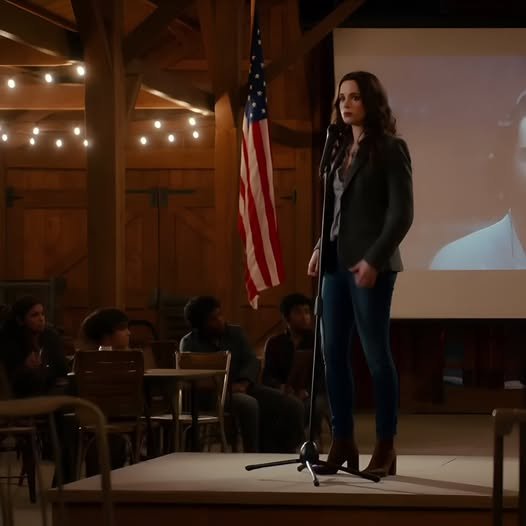
The barn quiets, all those investor faces turning toward the stage. I can feel their judgment, their curiosity about what fresh entertainment this family drama will provide. I grip the microphone stand and let my head bow, let my shoulders shake just enough to suggest tears.
Through my lashes, I check the positions. Kendra to my right, glowing with triumph. Mom and Dad just offstage, arms crossed in identical poses of satisfaction.
Brock front and center with his phone raised high. Perfect. They’re all here.
All gathered in one spot, guards completely down. I glance toward the back wall. Sheriff Miller and two deputies stand in the shadows, hands resting casually on their belts.
I look at Tabitha. She holds up the projector remote, finger hovering over the button, her expression steel. My breathing steadies.
The trembling in my hands stops. I tap the microphone once, twice. The barn falls completely silent.
“I was asked to apologize,” I say. My voice comes out softer than I planned, and I let it. Let them lean in.
Let them think I’m about to crumble. Kendra shifts beside me, already relaxing, already savoring this moment. I lift my head and meet her eyes.
I watch confusion flicker across her face as she registers that something has changed. My next words will detonate everything. The tears on my cheeks are gone.
My spine straightens. My grip on the microphone turns white-knuckled. Behind me, I hear the projector whir to life.
The baby photos that were supposed to play for the rest of the party flicker and die. “In a way, I am sorry,” I say. My voice is steady now.
“I’m sorry I didn’t protect my son from criminals sooner.”
Kendra’s face goes blank with shock. The first frame of security footage hits the massive projection screen. I meet Tabitha’s eyes across the barn and nod once.
The Martin family slideshow, the carefully curated brand, disappears. For one heartbeat, the screen goes black. Then camera seven fills the wall.
The loading dock. The cider press. Brock.
Silas. The timestamp at the bottom reads two days ago, 4:47 p.m. I don’t need to watch.
I’ve seen it thirty times already, each viewing carving the images deeper into my brain. But I hear it. The whole barn hears it.
The crack of expensive camera equipment hitting concrete. Silas’s voice, high and desperate, saying, “That’s mine, you can’t—”
The sound of my son’s body slamming into the steel frame of the cider press makes someone in the crowd gasp. Then comes the snap—sharp and wet and final.
The sound bones make when they break. Silas screams. The investors from the development group stand frozen near the dessert table.
The church ladies from my mother’s Bible study have their hands pressed to their mouths. Mrs. Henderson’s phone is already out, recording the screen—recording the truth that’s about to burn this family to ash.
Kendra appears in the frame now, moving fast. She grabs Silas by the face, her manicured nails digging into his cheeks as he sobs. Her voice booms through the barn’s sound system with perfect clarity.
“If you tell anyone Brock did this, I’ll tell Grandpa you sabotaged the machine,” she says. “Your mom will be fired and you’ll be homeless. Do you understand me?”
My thirteen-year-old son, arm dangling at an impossible angle, nods through his tears.
The screen goes black. The silence that follows is the loudest thing I’ve ever heard. Then it shatters.
From the shadows near the back wall, Sheriff Jim Miller steps into the light. He doesn’t need to make an entrance. His presence alone drops the temperature in the room by ten degrees.
His boots sound heavy on the wooden floor as he walks toward the stunned group. Jim’s face is granite, all the warmth I’ve seen at family barbecues replaced with something cold and professional. “Brock Vance,” he says.
His voice carries. “You’re under arrest for felony assault on a minor.”
Brock drops his Solo cup. The red liquid spreads across the floor like blood.
“What? No, that’s—Mom, tell them!”
But Kendra isn’t looking at her son. She’s staring at me, and for the first time in my life, I see fear in her eyes.
“You can’t do this,” she says. Her voice cracks. “That footage is private property.”
“Ma’am, I’m going to need you to step aside,” Jim says.
A deputy moves toward Brock, handcuffs already out. The boy who called my son pathetic for needing pain medication is suddenly crying, his varsity jacket pulling tight across his shoulders as his arms are wrenched behind his back. The number 16 catches the light.
“Mom, Mom, don’t let them—”
“Kendra Martin Vance,” Jim continues. “You’re being detained for questioning regarding witness intimidation and accessory after the fact.”
The investors are backing toward the exits now. Mr.
Hendricks from the development group nearly trips over a hay bale in his rush to leave. The church ladies are filming, and I know by tomorrow morning this video will be everywhere—every text chain, every Facebook group, every whispered conversation in the grocery store checkout line. The Martin family social mask just shattered on camera.
“This is insane,” Garrett booms. His face is purple. “Sheriff, this is a family matter.
We can handle this internally.”
“A broken bone and terroristic threats against a minor aren’t a family matter, Mr. Martin,” Jim says. “They’re crimes.”
Garrett rounds on me instead, his finger jabbing the air.
“You’re fired,” he snarls. “You hear me? Get off my property right now.”
This is the moment.
I reach into my jacket pocket and pull out the folded document I’ve been carrying all night. The paper is cream-colored, official, stamped with the county seal. I unfold it slowly, letting the moment breathe.
“This property,” I say, my voice carrying to every corner of the barn, “isn’t yours, Dad.”
I hold up the land deed so everyone can see—the one my grandmother left me directly, bypassing my parents entirely. The one that’s been sitting in a safety deposit box for fifteen years while I worked this orchard and kept the peace and pretended I didn’t hold all the power. “You own the business.
The LLC. The Martin’s Highpoint brand. The venue operation,” I say.
I turn the deed so Garrett can see his mother’s signature. “But I own the land. Every acre.
The barn. The cider press. The farmhouse.
All of it.”
My mother makes a sound like something dying. “And according to the lease agreement you signed when Grandma died, there’s a criminal activity clause,” I say. I flip to the second page, where my lawyer highlighted the relevant section in yellow just this morning.
“Any felony committed on my property by business license holders or their immediate family members voids the lease immediately.”
I pull the final document from my pocket. “Notice to quit,” I say. Prepared by my lawyer.
Signed by me as the legal property owner. “You have thirty days to remove your business operations from my land.”
Garrett’s mouth opens and closes. No sound comes out.
Behind him, Kendra is being led toward the exit by a deputy, her hands cuffed in front of her, mascara running in black rivers down her face. Brock is already outside, loaded into a patrol car, the red and blue lights painting the barn walls. The investors are gone.
The church ladies are still filming. My mother has collapsed into a folding chair, her cream sweater rumpled, her face gray. I fold the notice to quit and set it on the dessert table, right next to the untouched birthday cake that cost more than my monthly grocery budget.
“The party’s over,” I say. And I walk out of that barn with my head up, leaving the Martin family legacy burning behind me. Fourteen months later, I stand in the parking lot and barely recognize the place.
The pretentious gold script that used to announce MARTIN’S HIGHPOINT ORCHARD: PREMIER WEDDING VENUE AND ESTATE is gone. In its place hangs a hand-painted wooden sign, the letters carved deep and filled with cheerful yellow paint. SILAS’S CIDER MILL & ART STUDIO.
My son chose the colors himself. He designed the whole thing, actually—during one of those quiet Sunday afternoons when the October light slants through the barn windows just right. “Mom, you’re blocking the contractor’s truck,” Silas calls.
I turn to find him jogging across the gravel, his left arm swinging freely at his side. No cast, no hesitation. Just a thirteen-year-old kid who’s grown three inches in the past year and finally stopped flinching when people raise their voices.
“Sorry, sorry,” I say. I move my truck closer to the barn, where a handful of local families are already gathering for this afternoon’s community art class. Through the open doors I can see the easels Silas set up this morning, each one positioned to catch the natural light he’s so particular about now.
The contractor—a patient man named Dale, who’s been helping us convert the old storage loft into proper studio space—waves as he maneuvers his truck past mine. No rush. No demands.
Just good work at a fair price. I don’t miss the chaos of wedding season. Don’t miss the constant pressure to perform, to smile, to pretend everything was beautiful when it was rotting from the inside.
Silas appears beside me with his camera, the one he bought himself with money from the cider stand he runs every weekend. It’s not as fancy as the one I saved for, the one Brock destroyed. But it’s his—earned through his own sweat and Sunday mornings spent talking to customers about apple varieties and the best way to make caramel dip from scratch.
“The Rodriguez kids are here early,” he says, already adjusting his lens settings. “I told them they could start sketching the orchard while we wait for everyone else.”
I watch him head back toward the barn, stopping to show a shy seven-year-old girl how to hold a pencil at the right angle for shading. He’s patient with her, encouraging, the way nobody ever was with him when he was learning.
My phone buzzes. A text from Tabitha. Shipment of cider jugs arrived.
Want me to inventory or wait for you? Go ahead, I text back. I trust you.
Those words used to terrify me—trust, delegation, letting go of control. I’d spent so long convinced that if I didn’t do everything myself, everything would fall apart. Turns out things only fall apart when you’re holding them together with lies.
Inside the barn, laughter echoes off the old beams. Real laughter, not the polished kind that used to fill this space during receptions. The kind that comes from kids concentrating on mixing paint colors and adults remembering what it felt like to create just for the joy of it.
I’m crossing toward Tabitha when I notice the envelope on the workshop table. The handwriting stops me cold. Brock’s chicken-scratch scrawl, the same messy letters that used to appear on birthday cards signed by the whole family—before, when we all pretended we were something we weren’t.
Silas sees me staring at it. “It came this morning,” he says quietly. “Return address showed it was from him.”
My hand moves toward the envelope, but Silas picks it up first.
He weighs it in his palm for a moment, studying the way his middle name is spelled wrong. Brion instead of Brian—the name his grandmother gave him. “You don’t have to read it,” I tell him.
“I know.”
He walks to the workshop’s old fireplace, the one we kept functional for those days when the studio heaters can’t quite reach the corners. A small fire crackles there now, more for ambience than warmth. Silas tosses the letter in without opening it.
The envelope catches immediately, curling at the edges. Through the transparent address window, I glimpse the opening lines before the flames consume them—something about mistakes and second chances. Something about money, probably, given that Kendra’s bankruptcy left them with nothing but legal bills and a criminal record that killed every scholarship Brock ever had lined up.
Silas watches the letter burn, then looks at me and smiles. Not a bitter smile. Not a triumphant one.
Just peaceful. “The kids are waiting,” he says, and heads back to his easels. Through the barn’s open doors, I can see the hand-painted sign swaying gently in the breeze.
My son’s name, bold and permanent, marking this place as his—not the abuser’s legacy, not the family that chose image over integrity. Just a boy who survived. And the mother who finally chose him first.
I rest my hand on his shoulder as we walk back toward the laughter. He leans into the touch, solid and unafraid. The letter burns to ash behind us, taking the past with it.