My fiancée said, “Stop introducing me as your future wife. It makes me look like I settled.”
I replied, “Good to know.”
I didn’t shout it. I didn’t slam a door, or swerve the car, or do any of the dramatic things you see in movies. I just said it quietly, like she’d given me a piece of information I’d been waiting on, and now the last empty box on a form was finally checked.
We were standing in the hallway of our apartment when she said it the first time, half an hour earlier. Her heels were already on, her coat draped over one arm, lip gloss half-applied as she leaned toward the mirror by the door. The TV in the living room was still on CNBC, muted, green and red numbers flickering across the screen. My tie was crooked. I remember reaching up to fix it and just… stopping, because my hands suddenly felt heavy.
I’d just finished telling a stupid story about my coworker’s dog when she glanced at her watch and said, “By the way, can you not do that tonight?”
I blinked. “Do what?”
“That whole ‘future wife’ thing.” She smeared gloss along her bottom lip, eyes fixed on her reflection. “Just… don’t introduce me like that again. It makes me look like I settled.”
She said it in the same tone she used when she asked me not to forget to take out the trash on Tuesdays.
I must have misheard her, I thought.
“Come again?” I said.
She sighed like I’d asked her to explain basic math. “Owen, don’t make it a thing. I’m just saying you don’t have to push the ‘future wife’ spiel on everybody. It’s weird. It makes me look like I settled. Can we go? We’re going to be late.”
She didn’t even look away from the mirror. She just capped the lip gloss, grabbed her clutch, and walked out the door before my brain finished forming a response.
So I locked the apartment, walked behind her down the hallway, and followed her into the elevator. My body was on autopilot. Smile at the neighbor. Hold the lobby door. Hit the unlock button on the key fob. The whole time, the sentence just kept bouncing around my skull like a loose screw in a dryer.
It makes me look like I settled.
We drove to her friend’s dinner, made small talk, laughed at the right moments. I refilled her wine twice. She rested her hand on my arm when she told a story and leaned into my side when she got cold on the patio. If you’d snapped a picture of us, we would have looked like any other engaged couple.
Inside my chest, it felt like I was holding my breath underwater.
On the way home, in the slow red glow of brake lights on the freeway, I finally said it.
“Good to know.”
It slipped out like a sigh. Not sarcastic. Not icy. Just… final.
She glanced at me. “What?”
“Nothing,” I said. “You were clear.”
She opened her mouth like she was going to push, then thought better of it. She turned the music up a notch and stared out the window.
When we got home, she kicked off her shoes in the hallway, tossed her bag onto the accent chair, and curled up on the couch with her phone. By the time I’d loosened my tie, she was already laughing at something on Instagram, thumb flicking across the screen like the conversation in the car had never happened.
I went into the bedroom, sat on the edge of the bed, and stared at the floorboards.
I’m Owen, by the way. Thirty-three years old, portfolio manager at a mid-sized investment firm in Seattle. Decent salary, decent 401(k), steady routine. I’d always thought of myself as a safe bet in the relationship market: not the flashiest pick on the shelf, but good value.
Three days before that brunch, my fiancée told me that being engaged to me made her look like she’d settled for less. Two days later, she walked into a restaurant with her friends and found an envelope at her seat that made her forget how to breathe.
By the time she opened it, I’d already stopped being anyone’s consolation prize.
We hadn’t started out this way.
I met Andrea three years earlier at a work conference in Chicago. It was February, brutally cold, the river choked with chunks of ice. The kind of conference where the hotel ballrooms all smell faintly like burnt coffee and cologne, and there’s always one guy who keeps asking “big picture” questions so people remember his name.
Andrea was on a panel about risk in emerging markets. I wasn’t supposed to be in that session. My buddy Caleb had dragged me in at the last second because he didn’t want to sit through it alone.
“I hear the law firm on this panel sends their people solo to this thing,” he whispered as we ducked into the back row. “High chance of ambitious, stressed-out lawyers in need of free drinks later.”
I rolled my eyes but followed him in anyway.
She was the only one on the stage who didn’t sound like she was reading off a teleprompter. She made some dry joke about forecasting models and everyone chuckled, but she didn’t laugh at her own joke. She just smiled in this small, controlled way and kept going, like she had a limited number of grins she was willing to spend that day.
Later, at the hotel bar, we ended up ordering drinks at the same time. I made some comment about how all the panels could be replaced with one slide that just said “It depends,” and she snorted into her gin and tonic.
“You laugh like you bill by the hour,” I said.
“You look like you say ‘alpha’ and ‘beta’ more than you say ‘please’ and ‘thank you,’” she shot back.
I liked her immediately.
We spent that week slipping into each other’s orbit—sharing Ubers to sessions, comparing notes on terrible swag bags, escaping to a diner down the street when the boxed lunches got too grim. On the last night, we walked along the river in a sideways snowstorm, both of us underdressed, hands wrapped around paper cups of coffee that had gone lukewarm.
She looked at me over the lid of her cup. “I’m going to marry someone like you one day,” she said. “Boringly stable. No offense.”
“None taken,” I said. “Boring is the new sexy.”
She laughed, and little puffs of breath ghosted into the night air.
We did the long-distance thing for almost a year after that—her in Chicago, me in Seattle. Late-night FaceTimes, red-eye flights, airport hugs. Then she got an offer at a big firm in Seattle. We moved in together after a year. The first six months of living together were that honeymoon blur where even the arguments feel like proof that the relationship is real because you’re finally fighting over whose turn it is to buy paper towels.
Last spring, on a weekend trip to Napa to celebrate her promotion, I proposed in a vineyard at sunset like a walking cliché. She said yes with tears in her eyes and a laugh in her throat, and for a while it felt like I was exactly where I was meant to be.
We picked a venue in the mountains for October. Booked a photographer who shot weddings like moody indie films. Chose a color palette Andrea called “earthy elegance” and I called “expensive green and beige.”
I make solid six figures. I like my job. I like my clients. I’m home most nights by six, home-office days when the market’s quiet. I thought that mattered. I thought stability meant something to her, the same way it did to me.
About two months before the brunch, something shifted.
It didn’t happen all at once. It came in through the cracks in our everyday conversations, disguised as jokes and half-concerns.
“You’re comfortable where you are, aren’t you?” she said one Tuesday night while we ate takeout on the couch. “Don’t you ever think about gunning for partner track or something?”
“In asset management?” I said. “We don’t really do ‘partner’ the way your firm does. It’s more like equity, leadership, long-term incentives—”
“You know what I mean,” she said, cutting me off. “Everyone my friends are with is either on partner track, founding something, or already in the C-suite. You’re so good at what you do. It just feels like you could be… bigger.”
I laughed it off. “What, you don’t think ‘reasonably solid portfolio manager’ sounds sexy on a wedding program?”
She laughed too, but there was a tightness around her eyes that didn’t match the joke.
Other comments followed.
“If you’d networked more aggressively in your twenties, you’d be in a totally different bracket right now,” she said one night when I turned down an invite to a “visionary founders” mixer because I’d already worked a ten-hour day.
“If you were making partner-level money, we could swing that Lakeview place with the rooftop,” she mused while scrolling through listings on her phone.
“How long do you think you’ll stay where you are?” she asked in bed once, staring at the ceiling in the dark. “Like… is this it? Is this the job you retire from?”
Each comment had an exit ramp. She could always backpedal and say she didn’t mean it like that. Usually she did.
“You know I’m proud of you,” she would say, smoothing it over. “I just want the best for us.”
I wanted to believe her. I’d seen how brutal her world was—law school, clerkships, firms where people bragged about sleeping under their desks. I told myself she was just projecting that hyper-competitive energy outward. It wasn’t personal.
Until it was.
Three weeks before the brunch, we went to her friend Vanessa’s engagement party. It was at a rooftop bar downtown with a view of the skyline, strings of light overhead, a DJ in the corner playing music just loud enough to make everyone lean closer when they talked.
Andrea looked like an ad for some luxury brand: simple black dress, gold hoops, hair swept back. I’d chosen a navy blazer and gray slacks, my one “fancy but not try-hard” outfit. On the elevator up, she checked her reflection in the mirrored walls, then looked me over.
“You look nice,” she said. “Try not to talk about bond yields in the first five minutes of every conversation.”
“You say that like it’s not my main personality trait,” I replied.
Inside, a lot of familiar faces. Her law school friends, their partners. A couple of her firm’s senior associates. People with serious watches and perfect teeth. The kind of crowd where everyone’s “just back from” somewhere expensive.
Andrea steered us toward a small group near the bar. “That’s Mark,” she murmured. “He just made partner. His wife, Lena, does something in venture. I want to say hi.”
“Got it,” I said.
When we reached them, I smiled and stuck out my hand. “Hi, I’m Owen, and this is my fiancée, Andrea.”
Mark shook my hand. Lena complimented Andrea’s dress. They welcomed us in like it was nothing. No one flinched at the word “fiancée.” We talked about travel and the weather and some high-profile merger everyone had an opinion on. Normal party stuff.
Later, when we left and got into the car, Andrea kept quiet as I pulled out of the garage. I thought she was tired. Seattle drizzle smeared across the windshield, the city lights blurring.
“Can you not do that?” she said finally.
“Do what?” I asked.
“Introduce me as your fiancée,” she said. “It’s… weird. It feels like you’re announcing a sale. ‘Limited-time offer: get your future wife here!’”
“We are engaged,” I said slowly. “What would you prefer I call you? ‘That woman I’ve been hanging out with for three years’?”
She rolled her eyes. “Don’t be dense. I’m saying you don’t have to lead with it. It makes me feel like you’re staking a claim or something.”
I stared at the road. “Okay,” I said. “Noted.”
I told myself it was a one-off. A weird insecurity. A bad mood.
Two nights later, we went to dinner with some of her colleagues and old law school friends. The restaurant was one of those dimly lit places where the menu is printed on rough paper and every dish has at least one ingredient you’ve never heard of.
I was the only non-lawyer at the table. I’ve gotten used to that over the years. I know enough legal jargon to nod along without looking completely lost.
Halfway through the meal, someone asked how we’d met.
“Well,” I said, smiling, “Andrea is my future wife. We met at a work conference in Chicago three years ago, and I annoyed her into giving me her number.”
There was a beat of silence, just long enough to register. Then laughter, teasing, questions about the wedding. Andrea joined in, raised her glass when someone toasted us, even told the story of the proposal herself.
But the warmth in her eyes when she looked at me had been replaced with something else. Strain. Embarrassment. I could feel it like a draft.
On the drive home, it broke.
“I asked you not to introduce me like that,” she said as soon as we’d pulled away from the curb.
“Like what?” I said. “As my future wife? That’s literally what you are.”
“It makes me look like I settled,” she snapped. “Like I couldn’t do better, so I just picked you.”
There it was. Naked, ugly, impossible to misinterpret.
I felt the words slam into me. For a second, my brain lagged behind my ears. The road blurred.
“You think marrying me makes you look like you settled?” I asked.
“That’s not what I meant,” she said, but her voice wavered.
“It’s exactly what you meant,” I said quietly. “You just said introducing you as my future wife makes you look like you settled. How else am I supposed to take that?”
“You’re twisting my words,” she fired back. “I’m just saying you don’t need to be so public about it. My friends are all marrying doctors, executives, entrepreneurs, and you—”
She stopped, but it was too late.
“—you’re fine. You’re good at what you do, but you’re not ambitious like them. When you announce me as your fiancée, it highlights that.”
“Highlights that you’re marrying someone you consider beneath you,” I said.
“I didn’t say beneath me,” she insisted.
“You said I make you look like you settled,” I replied. “Same thing.”
Silence rolled through the car like a fog. She folded her arms, stared out the passenger window, and eventually muttered, “I’m tired. I don’t want to fight about this.”
“I bet you don’t,” I said.
That night, after she went to bed, I sat in the living room with the lights off. The city glowed faintly through the blinds. I could hear the low hum of the fridge, the occasional car passing outside. The apartment, usually cozy, felt like a stranger’s Airbnb.
All the little comments from the past months came back, lined up in my mind like witnesses.
“You’re comfortable where you are, aren’t you?”
“If you were making partner-level money…”
“When you introduce me like that, it makes me feel like you’re staking a claim…”
“It makes me look like I settled.”
You know when you’re working on a puzzle and finally find the piece that makes a whole section click? It felt like that, except the picture that appeared was one I didn’t want.
The woman I loved was embarrassed by me. By my job, my income, my place on her invisible scoreboard.
I’d spent years thinking we were equals. Suddenly, I could see that, in her head, we were not.
At some point around one in the morning, I got up, went to the kitchen table, and opened my laptop. I pulled up my email.
That evening, I quietly removed my name from every guest list she had added me to.
Andrea loves her calendar. She lives out of it. Showers, parties, galas, brunches—everything color-coded and cross-referenced. I knew she’d RSVPed for both of us to half a dozen events over the next few months, often with a quick, “I told them we’re coming,” tossed over her shoulder like it was no big deal.
If I was such an embarrassment, she could start arriving solo.
I scrolled through my inbox and found each event one by one: Sarah’s bridal shower, the firm’s spring gala, a colleague’s birthday dinner, Sunday brunches with her “inner circle.”
For each one, I found the RSVP confirmation and edited it, or emailed the host.
“Hi, unfortunately I won’t be able to attend after all,” I wrote. “I’m so sorry for the late notice and hope the event goes wonderfully.”
One host replied within minutes: “Of course, we’ll miss you. Everything okay with you and Andrea?”
I stared at that for a full minute before typing, “Just some things we need to work through. Thank you for understanding.”
The words felt like stepping onto a path I couldn’t back away from.
Then I did something that, a year earlier, I never would’ve imagined myself doing.
I texted Melissa.
Melissa is Andrea’s best friend. They met the first week of law school and survived three years of hell together. Where Andrea is controlled and polished, Melissa is loud and messy and impossible to ignore. She works in marketing now, has three houseplants she keeps forgetting to water, and a laugh you can hear across a crowded room.
Of all of Andrea’s friends, she was the one who’d always made a point to talk to me like I was a full person, not just “Andrea’s boyfriend.” She’s also the only one who ever gently called her out.
Once, after Andrea had made a snide remark about someone’s boyfriend being “nice but not exactly impressive,” Melissa waited until we were alone in the kitchen and said, “You know you’re impressive, right? Even if you never become CFO or whatever?”
I’d laughed it off, but I remembered it.
Now I typed: “Hey, can I run something by you? It’s about Andrea.”
She called within thirty seconds.
“You’re stressing me out,” she said. “What’s going on?”
I told her. Not everything, not every micro-comment. But I gave her the shape of it: the engagement party, the car ride, the way she’d snapped about settling. The feeling that I’d gone from partner to accessory in Andrea’s head.
There was a long silence on the other end.
“She really said that?” Melissa asked, her voice lower.
“Word for word,” I said. “It makes me look like I settled.”
I could picture her pinching the bridge of her nose. “That’s… wow. That’s bad, Owen.”
“Yeah,” I said.
We talked for a while. She asked careful questions. She didn’t rush to defend Andrea. She also didn’t rush to tell me what to do. She just listened.
Finally, I asked about the brunch Andrea had planned that Sunday. Just her “inner circle”—the core group of women she cared most about impressing.
“Are you going?” I asked.
“Yeah,” she said. “We’ve had it on the calendar for weeks. Why?”
“I’m not,” I said. “But I want her to understand that I heard what she said. And I want the people whose opinions she cares about so much to understand why I’m not there.”
I told Melissa what I was thinking: a letter, a cancellation, and a public line that I wouldn’t cross back over.
At first, she hesitated. “Isn’t that kind of… theatrical?” she asked.
“Probably,” I said. “But Andrea is very invested in optics. She said what she said because of how she thinks she looks to other people. I don’t think she’ll really hear it unless other people know why I’m gone.”
I could almost hear the struggle happening in Melissa’s head. Loyal friend to Andrea. Also person who hates watching someone get treated like a downgrade.
Finally, she exhaled. “Tell me exactly what you want me to do,” she said. “And send me the letter so I can make sure the restaurant doesn’t lose it.”
The next morning, Andrea acted like nothing had happened.
She hummed under her breath while she curled her hair. She talked about chair rentals and linen options. She asked if I thought her parents would pitch in for the nicer bar package if we framed it as a “family experience.”
She also kept glancing at me in the mirror, testing the temperature.
“Did you confirm our RSVP for Sarah’s shower?” she asked while fastening an earring.
“About that,” I said, cutting a piece of toast. “I canceled my RSVP.”
Her hand froze mid-air. “What? Why?”
“Because you’re embarrassed to introduce me as your fiancé,” I said. “So I figured you’d rather go to these events solo. Avoid the whole ‘settled’ thing.”
Color crept up her throat. “Oh, don’t be ridiculous.”
“I’m not being ridiculous,” I said. “I’m respecting your wishes. You don’t want people knowing you’re marrying me because it makes you look bad. So go to your events alone. Problem solved.”
“You’re being childish,” she snapped.
“I’m being clear,” I replied. “You said what you said. I heard you. Now I’m acting accordingly.”
She stared at me like she didn’t recognize me. For years, I’d been the one smoothing things over, making jokes, calming storms. She wasn’t used to me being the storm.
“So you’re just not coming to Sarah’s shower or any of the other events you signed us up for?” she demanded.
“I went through the list last night,” I said. “Removed myself from everything.”
“You can’t just—”
“I can,” I said, “and I did. If you’re embarrassed to be engaged to me, don’t bring me. Simple.”
I left for work. She texted all day—angry at first, then defensive, then pleading.
“I didn’t mean it the way it sounded. You’re overreacting. Can we please just talk about this?”
Finally, I answered once.
“I heard exactly what you meant,” I wrote. “Enjoy your brunch Sunday.”
Saturday, she brought out the big guns: apology pancakes and soft eyes.
She stood at the stove in one of my old college T-shirts, hair tied up messily, flipping pancakes like we were in a commercial for couples who’d worked through their issues.
“I’m sorry I hurt your feelings,” she said as she slid a stack onto my plate. “I’ve been really stressed about work. The firm’s been brutal. I didn’t mean what I said the way it came out.”
“So you’re not embarrassed to introduce me as your future husband?” I asked.
“No, of course not,” she said quickly.
“Then why did you say it makes you look like you settled?” I asked.
She opened her mouth and closed it. “I phrased it badly,” she said. “You’re taking it out of context.”
“The context was pretty clear,” I replied. “You, in the car, pissed off that I called you my future wife, telling me it makes you look like you settled. That’s not phrasing. That’s content.”
“Owen, please.” Her eyes were bright with frustration. “Are you going to the brunch tomorrow? I want us to show up together and move past this.”
“I’m not going,” I said. “You’ll have to explain to your friends why I’m not there.”
“What am I supposed to tell them?” she asked.
“Tell them the truth,” I said. “Tell them you’re embarrassed to be engaged to someone who makes you look like you settled.”
We spent the rest of the day orbiting each other in the apartment, avoiding direct collisions. She buried herself in work at the dining table. I left for a few hours and climbed until my arms shook, thankful for routes that demanded enough focus to shove everything else to the edges of my mind.
That night, before bed, she tried one more time. “Please just come,” she said quietly from the doorway of the bedroom. “We can talk after. We’ll figure it out.”
“I already figured it out,” I said.
She didn’t know that, while she brushed her teeth, I’d been at the table handwriting a letter on thick stationery.
She didn’t know Melissa had a copy saved in her phone, just in case.
She didn’t know her seat at the brunch restaurant was reserved not just for her, but for the truth she’d given me and thought I’d bury.
Sunday morning, she got ready for brunch like someone preparing for battle.
Rust-colored dress. Gold earrings. Hair smooth and glossy. Makeup more careful than usual. I watched from the doorway as she put on mascara, hand steady.
“Are you really not coming?” she asked, meeting my eyes in the mirror.
“I’m really not coming,” I said.
“You’re really going to make this a spectacle,” she muttered.
“I’m not making anything,” I said. “I’m just not going.”
She grabbed her keys and purse. “Fine,” she said. “Enjoy your day of… whatever this is.”
The door clicked shut behind her.
I tidied the kitchen. Tried to read. Failed. Stared at the clock. Checked my phone. Put it face down on the coffee table.
At 11:15, it started ringing.
Andrea.
I let it go. It rang again. And again.
Then my phone buzzed with a text from Melissa:
“She opened it. You should have seen her face.”
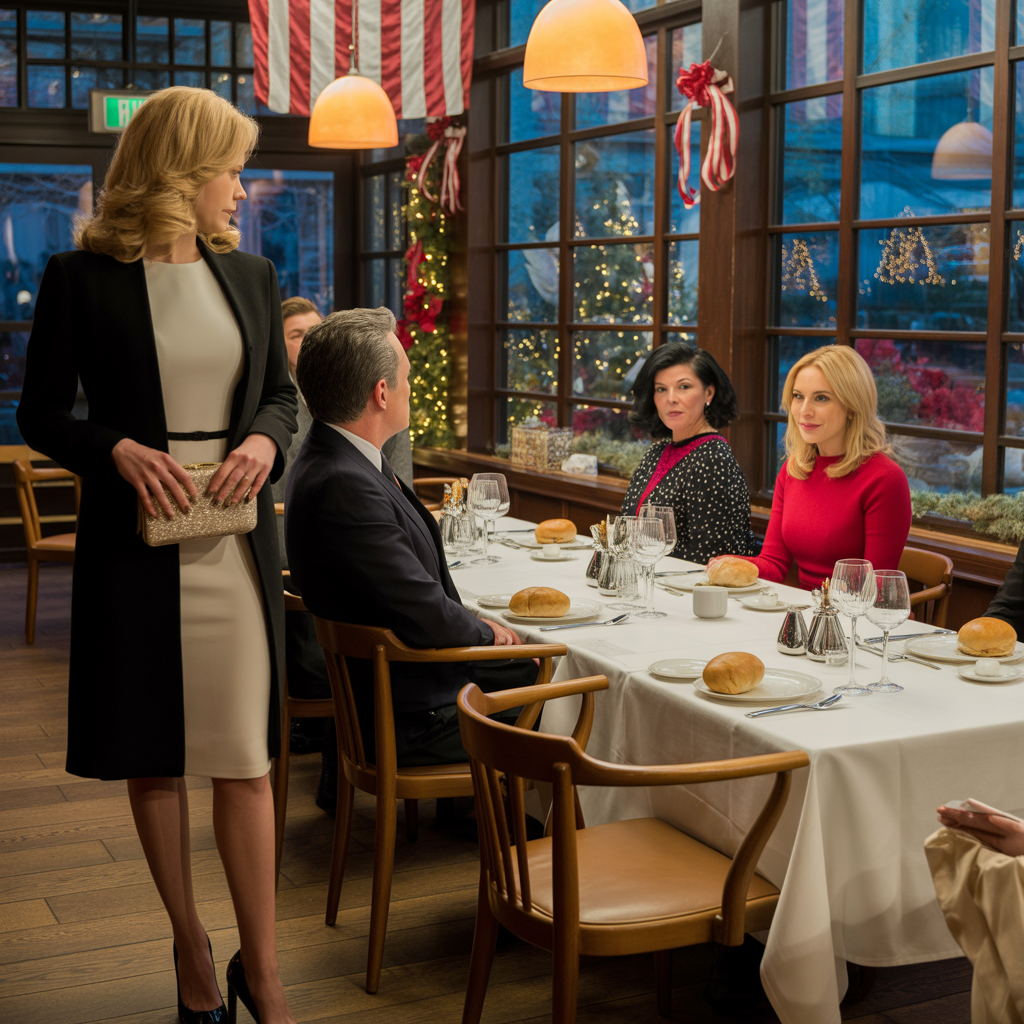
My heart thudded once, hard, in my chest. I pictured Andrea walking into that restaurant—sunlight slanting through big windows, the hum of conversation, the clink of cutlery—seeing her friends, seeing her place at the table. Seeing the envelope with her name on it, in my handwriting.
Opening it.
Reading the letter.
Seeing the printed confirmation from the venue with one word that mattered more than any floral arrangement we’d ever discussed: CANCELED.
Fifteen minutes later, the front door flew open.
Andrea stood there in her brunch dress, hair slightly out of place, envelope crumpled in one fist. Her mascara had smudged in the corners of her eyes. She looked like someone who’d run through rain even though the sky was clear.
“What the hell is this?” she demanded, shoving the papers at me.
“It’s exactly what it says,” I answered. “Cancellation confirmation for our wedding venue.”
“You canceled our venue without talking to me?” she screamed. “Are you insane?”
“You told me marrying you makes you look like you settled,” I said, my voice steady in a way that surprised even me. “I decided to solve that problem. No wedding. No settling.”
“You can’t just cancel our wedding!” she cried. “We have deposits down! We have contracts! We have—”
“I didn’t just cancel the venue,” I said. “I’m canceling the engagement. As of right now, we’re not engaged anymore.”
She stared at me, breathing hard.
“You’re breaking up with me because of one comment?” she whispered.
“It wasn’t one comment,” I said. “It was months of little comments. Months of you making me feel like I’m not enough. Months of you comparing me to your friends’ partners, asking why I’m not chasing titles I don’t even want, acting like I’m some downgrade you’re tolerating. The comment in the car was just the first time you said the quiet part out loud.”
“That’s not fair,” she said, tears starting to spill. “I was stressed. I didn’t mean—”
“You meant it,” I said. “You may not have meant for me to finally act on it, but you meant what you said.”
She swallowed. “I love you,” she said, voice cracking. “I’m just… I just get in my head about stuff. You know that. My friends—”
“Your friends didn’t make you say I make you look like you settled,” I cut in. “You did.”
She shook her head, shoulders shaking. “You humiliated me,” she said. “Do you have any idea how it felt to sit down in front of my closest friends and open that? To have Melissa—”
“She didn’t tell them anything I didn’t write,” I said. “She just made sure the truth didn’t disappear.”
“You had no right,” she said. “You made me look pathetic.”
“You made me feel pathetic for months,” I shot back. “You told me I wasn’t ambitious enough. You acted embarrassed when I introduced you as my fiancée. You said marrying me makes you look like you settled. I’m not interested in being someone’s PR problem.”
She sank down onto the arm of the couch like her knees might give out. The envelope looked small and limp in her hand now.
“The letter explains everything,” I said more quietly. “How your comments have made me feel. How I’ve spent months wondering if I’m good enough for you, while you secretly wondered if I were good enough for your image. I deserve someone who’s proud to be with me. You’re not that someone.”
“What if I fix it?” she whispered. “I’ll go to therapy. I’ll introduce you to everyone as my amazing, smart, successful fiancé. I’ll—”
“You had years to do that,” I said. “If your first instinct when I call you my future wife is to worry that you look like you settled, you don’t actually want me. You want a version of me that makes you look better on paper.”
We argued in circles for hours. She begged, bargained, accused, cried. I stayed on the same line.
In the end, I told her to pack a bag and stay with her sister for a few days while we worked out the logistics. The apartment, suddenly, felt too small for both of us and the truth hanging between us.
She left just before sunset, shoulders slumped, suitcase wheels rattling down the hallway. I watched her go, my chest aching and somehow lighter at the same time.
The practical fallout started the next morning.
I called the venue myself to confirm that our cancellation had gone through. The coordinator was polite, professional, and just curious enough to ask if there was “any chance” we might reschedule.
“No,” I said. “This isn’t a timing issue.”
We lost forty percent of the deposit. Some vendors refunded partial amounts; others kept their non-refundable fees. In total, the breakup cost me a few thousand dollars. I filed the confirmations in a folder on my computer labeled “Wedding (Cancelled).”
I also called my parents.
They live in Colorado, still in the same split-level house where I grew up. My mom answered on the third ring.
“Hey, honey!” she said. “How’s my favorite engaged son?”
“I’m your only son,” I said automatically. Then, “I’m… actually not engaged anymore.”
There was a beat of silence.
“Oh,” she said. “What happened?”
I told her. Not the entire word-for-word script, but enough: that Andrea had said that being engaged to me made her look like she’d settled, that she was more concerned about how I looked to her social circle than about how I felt in our relationship.
My mother, who sometimes worries about whether she’s using the right fork at restaurants, surprised me.
“That girl doesn’t deserve you,” she said firmly. “I don’t care how shiny her job is. If she can’t introduce you as her fiancé with a smile on her face, she doesn’t get to be your wife.”
My dad got on the line and was quieter. “You sure you can’t work it out?” he asked. “People say stupid things when they’re stressed.”
“I could work with a stupid thing said once,” I said. “This was a pattern. The comment just showed me the through-line.”
He exhaled. “Then I’m proud of you,” he said. “It takes guts to walk away from a wedding once there’s money on the line.”
Later that day, my phone rang again. This time, it was Andrea’s mother.
“Owen, honey, what’s going on?” she said. “Andrea called us crying, said you ended the engagement.”
“I did,” I said.
“She said you overreacted to something she said,” her mother continued carefully. “That you’re being unreasonable.”
“Did she tell you what she said?” I asked.
“No,” she admitted.
“She told me being engaged to me makes her look like she settled,” I said. “She said introducing her as my future wife embarrasses her because I’m not impressive enough for her friends. Those are her exact words. And it wasn’t the first time she made comments like that. It was just the first time she stopped pretending she didn’t mean them.”
Silence hummed through the line.
“Oh, Owen,” her mother finally breathed. “I am so, so sorry. That’s… that’s not how you talk to someone you love.”
“I didn’t think so either,” I said.
“Is there any chance you two can work through it?” she asked. “Therapy, maybe? Time?”
“No,” I said. “I’ve spent enough time wondering if I’m enough. I’m not going back to that.”
“I understand,” she said quietly. “For what it’s worth, I think you’re making the right call. And I’m sorry. You’ve always been good to our family.”
We talked a little more. She promised to talk to Andrea, to try to make her see why this was serious. I told her I appreciated it, but the decision was already made.
The next three weeks were a strange mix of grief and relief.
Andrea and I divided our life like a business. Which furniture went with her. Which streaming services were in whose name. Who kept which wedding deposit credits that could be repurposed. We met in person a couple of times to sign forms and close a joint account. Those meetings felt like handshake deals between strangers.
In between, she sent long messages.
“I know I hurt you,” one of them said. “I’ve started therapy to work on my obsession with status and image. I’ve realized how much my parents’ anxiety about appearances rubbed off on me. I took it out on you because you were safe. I’m so, so sorry.”
“I believe you’re sorry,” I replied. “I still don’t want to marry you.”
Her friends were divided. A few reached out to me directly. One sent a cautious, “Hey, I heard what happened. Are you okay?” Another, who’d always treated me like background, wrote a surprisingly sincere apology for not stepping in when Andrea made comments at parties.
Others thought I’d gone too far.
“At least give her another chance,” one mutual friend said when we bumped into each other in the lobby of Andrea’s old building. “Everyone says messed-up things when they’re stressed.”
“I don’t want to marry someone who says that when they’re stressed,” I replied. “That’s when the truth slips out.”
Melissa was firmly in my corner.
We met for coffee one afternoon at a place near my office. She arrived in a denim jacket and leggings, hair in a messy bun, eyes tired.
“I feel like I should be wearing a shirt that says ‘I swear I didn’t orchestrate your breakup,’” she said. “Even though I did help with the envelope.”
“You didn’t say anything she didn’t already say,” I told her. “You just made sure I wasn’t the only one who heard it.”
“She’s mad at me,” Melissa said. “Says I betrayed her. I told her she betrayed herself when she opened her mouth.”
“How did the brunch go?” I asked.
Her face softened. “Silent,” she said. “You know how she likes to hold court? She couldn’t. She sat there white as a sheet, reading your letter. When she hit the word ‘canceled,’ she made this sound… like a balloon popping but in slow motion. Then she grabbed her stuff and left.”
“Do they all think I’m some vindictive psycho now?” I asked.
“Some do,” she admitted. “At least at first. Then I told them what she said. Word for word. A few of them admitted they’d heard her make comments about you before. ‘He’s great, he’s just comfortable.’ ‘Sometimes I wish he’d push harder.’ That sort of thing. None of them called her out, but they heard it. They know this wasn’t out of nowhere.”
We sat in silence for a moment.
“I’m sorry,” she said finally. “You didn’t deserve that.”
“Thanks,” I said. “I’m starting to think that too.”
Four months after the brunch, Andrea was gone from the apartment.
We staggered the move-out so we didn’t have to navigate boxes together. One weekend I stayed with my brother on the other side of town while she packed up her things. The next weekend, I moved my stuff into the rooms she’d left behind, rearranging furniture until the space felt less like a crime scene and more like a blank page.
She took the fancy bar cart and half the wine glasses. I kept the couch, the TV, and the dining table. She took the framed engagement photo from the mantel. I replaced it with a framed print of a trail I’d hiked once in Colorado.
It was amazing how different the apartment looked with her things gone. Less magazine-ready, more lived-in. Less gold accents, more climbing gear.
She found a new place across town. We kept contact to the bare minimum required by logistics. Signed the last bit of paperwork. Closed the last joint account.
I heard about her life through other people.
“She’s in therapy, for real,” Melissa told me over coffee. “Not just saying she is. They’re talking about her parents, and class anxiety, and why she thinks being with someone ‘impressive’ will fix something inside her.”
“I hope it helps,” I said. And I meant it. “Just not for me.”
“She’s also mad at the world,” Melissa added. “Mad at you, mad at herself, mad at anyone who agreed with you. That’s not my problem to fix.”
I ran into Andrea once.
It was a Tuesday around noon at a coffee shop near our old apartment. I was coming out with a latte; she was at a corner table with a man in a blazer, papers spread between them. Maybe a coworker. Maybe a date. Maybe both.
Our eyes met through the glass.
For a heartbeat, I saw the woman I’d loved—the one in the snow in Chicago, laughing into her scarf. Then the woman who’d told me I made her look like she’d settled flashed over that image like a projection.
Her face went pale. She mustered a small, rigid smile. I nodded once and kept walking.
Later that day, she sent a text: “It was good to see you. You looked happy. I’m glad.”
I stared at it for a minute, then put the phone down and went back to my spreadsheet. I didn’t reply.
These days, my life looks quieter on Instagram and better in person.
I’ve reconnected with the friends I’d gradually sidelined as Andrea’s social calendar took over my weekends. My college buddy James dragged me back into pickup basketball on Saturdays. My coworker Kaylee got me to join a trivia team on Wednesday nights. I’ve said yes to more “you should come” invitations than I had in years.
I signed up for a rock climbing membership instead of just dropping in when I felt guilty about sitting all day. The first time I made it to the top of a V4 route I’d been failing on for weeks, a group of complete strangers clapped. No one asked what my job title was. They just high-fived me and gave me tips for the next wall.
I’ve gone on a handful of dates. Coffee, drinks, a long walk along the waterfront with a woman who rescues senior dogs. Nothing serious. I’m not in a hurry.
I pay attention now to things I used to ignore: how someone talks about waitstaff, how they describe their exes, how often they use the word “status.” I listen for whether “ambition” in their mouth means “drive to build something meaningful” or “relentless hunger to be seen as better.”
I’ve also started therapy myself—something I didn’t think I needed until my therapist gently asked, “Why did it take you so long to believe you deserved more than being someone’s second-choice narrative?”
We’ve talked about my tendency to smooth things over, to downplay my own hurt, to accept jokes that dig a little too deep because calling them out felt like I was being too sensitive. We’ve talked about my parents, my upbringing, the subtle ways I learned that being “easygoing” was how you stayed lovable.
“I’m starting to think there’s a difference between being easygoing and being easy to walk on,” I told her last week.
She smiled. “There is,” she said. “Which one do you want to be?”
I’m thirty-three, single, and living in an apartment that finally feels like mine. There’s a plant in the corner that I keep forgetting to water but somehow still looks alive. There’s chalk dust on the floor near the door from my climbing bag. There are takeout menus on the fridge and a grocery list on the counter with more vegetables than it used to have.
There are also nights I sit on the couch and feel the ghost of what almost was—a wedding, maybe kids, holidays with two families instead of one. I’d be lying if I said I never think about those.
But when I do, I remind myself of something simple: that Andrea didn’t just say one ugly thing in a moment of stress. She showed me the framework she’d been building in her mind for a long time, where I was an almost-good-enough piece that didn’t quite fit the picture she wanted to show the world.
She thought I wasn’t impressive enough for her circle.
The truth is, she wasn’t kind enough for the life I want.
My brother asked me not long ago, “Do you ever think about reaching out? Just to see how she’s doing?”
“No,” I said. “We already had our goodbye. She had it at brunch when she opened that envelope. I had it in the car when she told me I made her look like she settled.”
He nodded. “Fair,” he said. “You know Mom’s still mad on your behalf, right?”
“I’d be worried if she wasn’t,” I said.
Melissa and I still talk. Sometimes in group settings, sometimes one-on-one. People love to speculate that we’ll end up together. Maybe we will someday. Maybe we won’t. Right now, she’s just a friend who looked at the same scene I did and said, “No, you’re not crazy. That was messed up.”
She told me recently that Andrea had asked if I was seeing anyone.
“I told her it’s not her business anymore,” Melissa said. “I told her she had someone good, and she made him feel like he wasn’t enough. Let him move on.”
I thanked her. Not because I needed Andrea reminded, but because it still means something to have someone in your corner when your world gets rearranged.
Some people still think I went too far. That canceling the venue and sending the letter to brunch was theatrical. Overkill. Petty.
I understand why it looks like that from the outside.
But from where I was sitting, in a car with someone who saw me as a downgrade, it felt like the first time I’d chosen myself in a long time.
I’m not interested in convincing anyone else that I did the right thing. I’m the one who has to live with the fallout. And I’d rather live with the memory of an envelope at brunch than with the slow, grinding ache of marrying someone who believes they could have done better.
Being alone, I’ve learned, is infinitely better than being with someone who makes you feel small.
Andrea thought I wasn’t impressive enough for her friends.
Turns out, she wasn’t impressive enough as a partner.
That’s all there is to it.