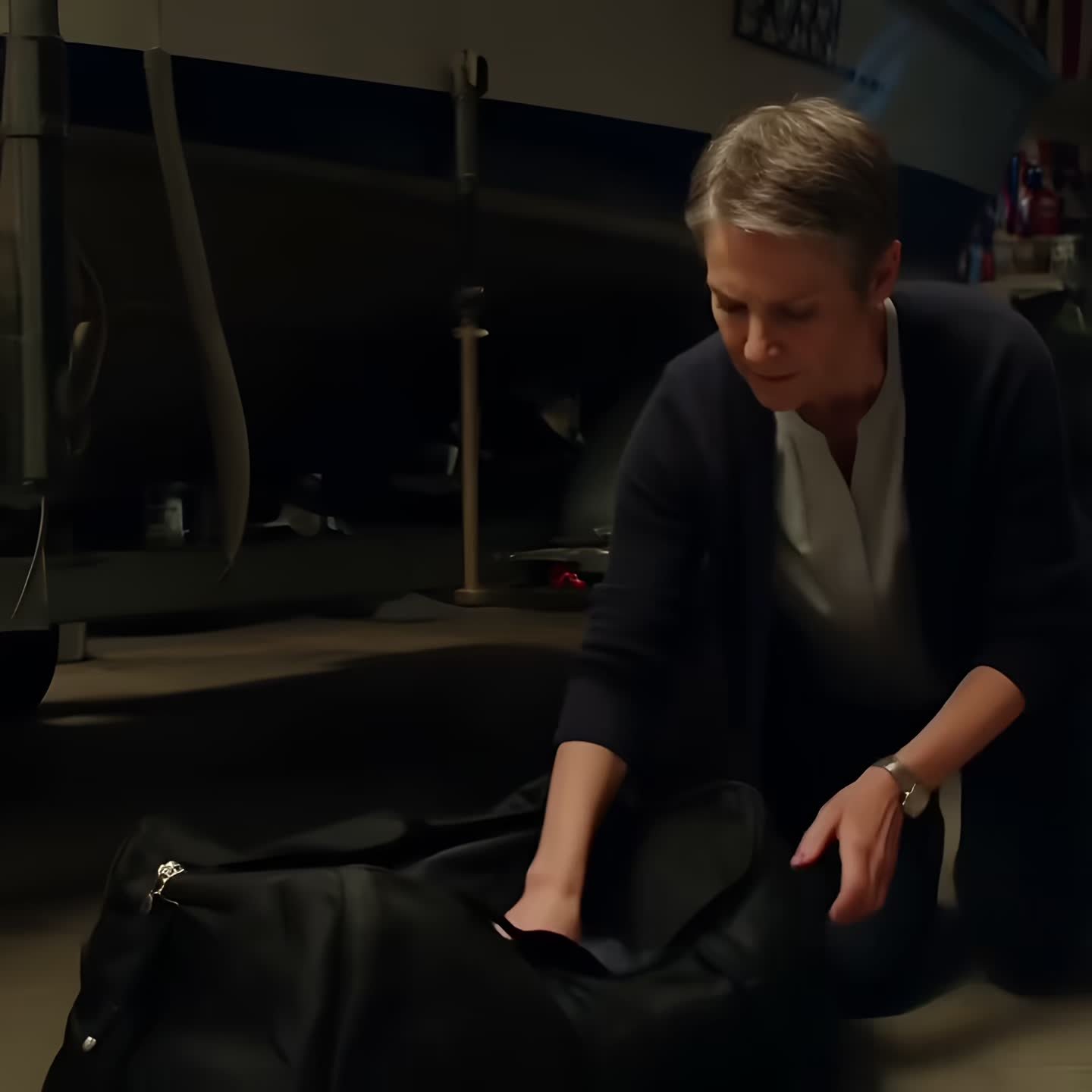
The note arrived during Sunday dinner.
My grandson Tommy slipped it into my hand so quietly I almost didn’t notice. He did it while reaching for the salt shaker, his small fingers trembling as they brushed my palm.
He’s only eight. In the past month he’s gone from a bright, chattering little boy to a pale, silent shadow. That alone had my grandmother’s intuition humming. The note turned it into a siren.
I unfolded the paper under the table. The letters were blocky and careful, a child’s handwriting gone slightly crooked from fear.
Grandma, take a look under the boat in the garage. Then you’ll understand.
I read it three times. My heart hammered so hard I could feel it in my throat.
When I looked up, Tommy was staring at his plate, pushing mashed potatoes around without eating. The dark circles under his eyes hadn’t been there a month ago.
Across from him sat Victoria, my son Eugene’s new wife of six weeks. Her manicure was perfect, her smile bright and cold as winter stars as she cradled a glass of California chardonnay.
“Tommy, sweetheart, eat your vegetables,” she said in that sweet, syrupy tone. “You know the rules.”
Tommy flinched.
Not the way a child flinches when reminded to eat broccoli. It was a full-body recoil, like he was bracing for a blow that never came. My chest tightened.
Something was very wrong.
I’m sixty‑three years old, born and raised in the Midwest, and I’ve learned the hard way that a grandmother’s intuition in this country is rarely wrong. Ever since Eugene married Victoria in that hasty courthouse ceremony, I’d watched my grandson dim. My son kept insisting it was just an adjustment to a new mother figure.
This wasn’t adjustment. This was fear.
“More wine, Nancy?” Victoria asked, turning those sharp green eyes on me.
She’d called me by my first name from day one, despite my gentle hints that “Mom” or even “Mrs. Phelps” would be fine. It was a small thing, but disrespect always shows itself in the small things first.
“No, thank you,” I said, keeping my voice even. “I’m driving home soon.”
“Are you sure?” she asked lightly. “Eugene says you live alone now, since George passed. Must be lonely in that big farmhouse all by yourself. No one waiting for you.”
The words were wrapped in sugar, but they landed like a slap. My husband had died two years earlier—heart attack in his sleep, the doctors said. Yes, the old farmhouse out in the county could feel empty sometimes, but I’d rebuilt a life: my garden, my book club at the local library, my volunteer shifts at the town branch.
I didn’t need Victoria’s pity. I certainly didn’t need her hint that I was irrelevant.
“I manage quite well,” I replied.
Eugene came in from the kitchen carrying dessert, oblivious to the tension. My son has always preferred to see the best in people. It’s one of his loveliest traits—and his biggest blind spot.
“Apple pie, Mom,” he announced, setting the dish down. “Your recipe. Victoria made it especially for you.”
I doubted Victoria had ever baked anything in her life, but I smiled and accepted a slice. Across the table, Tommy’s eyes met mine for a brief, desperate second before Victoria laid a hand on his small shoulder.
He went rigid.
“Tommy’s been such a good boy lately,” she crooned, her fingers digging in just a little too hard. “Haven’t you, sweetheart? So quiet and well behaved.”
That wasn’t how you described a healthy eight‑year‑old boy. That was how you described a terrified one.
Dinner dragged on. I made polite conversation, praised the meal, and watched. Victoria steered every topic away from Tommy. When Eugene mentioned taking his son to the science museum in the city, she quickly suggested a spa weekend for just the two of them instead. When I asked Tommy about school, she answered for him before he could speak.
She was isolating him. Controlling him. But why? And what in the world did the boat in the garage have to do with any of it?
Finally, around eight, Eugene checked his watch.
“We should get ready, Vic. Our reservation’s at nine.”
“Reservation?” I asked.
“Anniversary dinner,” Victoria purred, leaning into him. “Six weeks married today. Can you believe it? Time flies when you’re happy.”
Eugene beamed. “Mom, would you mind staying with Tommy? We won’t be late. Ten‑thirty at the latest.”
This was it. My chance.
“Of course,” I said, maybe a little too quickly. “Take your time. Tommy and I can watch a movie.”
Victoria’s eyes narrowed a fraction, but she couldn’t protest without looking ridiculous. “How wonderful. Thank you, Nancy.” She turned to Tommy. “You be good for Grandma. Remember what we talked about.”
He nodded, expression flat.
Twenty minutes later they pulled out of the driveway in a cloud of perfume and promises to bring back dessert. The second the taillights disappeared, Tommy’s shoulders sagged as if a weight had fallen off him.
He looked at me, eyes wet. “Grandma,” he whispered. “Did you read it?”
“I did, sweetheart.” I knelt beside him, taking his hands. “But I need you to tell me: are you safe? Has anyone hurt you?”
He shook his head fast. “Not me. But, Grandma, you have to look. You have to see. Then you’ll understand why I’m scared.” His voice dropped. “She’s not who Dad thinks she is.”
My blood ran cold. “What do you mean?”
“Just look. Please. But be careful. Don’t let her know you know.”
PART TWO – UNDER THE BOAT
The garage was detached from the house, big enough to fit two cars and then some. Eugene kept his pickup in the driveway most days and used the garage for storage—a sixteen‑foot fishing boat on its trailer, old furniture, camping gear, boxes of the past.
I’d been in that garage a hundred times. George and I had organized it together. I’d helped Eugene sort through it after George died. I knew every corner.
Or I thought I did.
I made sure Tommy was settled in front of the TV with a movie before crossing the backyard. The October air had that thin, chilly bite that comes just before the Midwest starts flirting with winter. The motion‑sensor lights flicked on as I approached, throwing long shadows across the gravel.
The garage door creaked when I opened it. Inside, everything looked perfectly normal: boat under a tarp, fishing rods on one wall, neatly stacked boxes on metal shelves. Nothing screamed danger.
I walked slowly around the boat, my shoes scraping against concrete. The overhead bulb cast a weak yellow pool of light. I could see under the trailer: support beams, a couple of old paint cans, cobwebs. No monsters, no body, no boogeyman.
Maybe Tommy had misunderstood something. Maybe his fear was twisting things in his mind.
Then I noticed the tarp.
On one side, it wasn’t tied down properly. It hung loose over the gunwale. When I lifted the corner, I could see into the boat’s interior. Eugene usually stored life jackets and tackle inside during winter.
I pulled the tarp back farther and leaned over.
At first I saw only shadows and gear. Then my eyes adjusted and caught a shape that didn’t belong: a black duffel bag, shoved halfway under a life jacket.
It wasn’t one of Eugene’s. I knew his things. I’d never seen this bag.
My hands shook as I reached for the zipper. It was already partly open. Inside, I saw the edge of what looked like a passport.
I unzipped it the rest of the way.
Passports. Driver’s licenses. Credit cards. All with different names.
But every single photo showed the same face.
Victoria’s face.
My breath caught. I pulled one passport free.
VICTORIA BLACKWOOD.
That wasn’t the name she’d married my son under. To the county clerk, she’d been Victoria Hartley. The next passport showed a different name: Victoria Morrison. A driver’s license: Victoria Drake. Four identities. Four different birth dates. One woman.
This wasn’t normal. This wasn’t harmless. This was criminal.
Underneath the stack of documents lay a small notebook. I opened it.
Neatly written in blue ink were names, dates, dollar amounts. Life‑insurance policies. Bank account numbers. Property values. On the third page I saw it.
Eugene Phelps – $500K life insurance, $1.2M home equity, $300K savings. Timeline: 6 months.
The notebook slipped from my fingers and hit the floor with a soft thud.
Six months.
My son’s name, written like a line on a ledger in some cold American crime drama, with his assets itemized beneath it. This woman wasn’t just a grifter. She had a plan. A long‑term, carefully organized plan.
And my son was the next project.
I was still backing away from the boat when I heard it: a car door slam in the driveway, then voices.
They were home early.
My heart lurched. I stuffed the notebook back into the bag, shoved the papers on top, yanked the zipper closed, and dropped the tarp where it had been.
The door from the driveway swung open. Light streamed in. Eugene and Victoria stood side by side, silhouetted.
“Mom?” Eugene blinked. “What are you doing out here?”
Victoria’s expression froze when she saw me. The charming smile vanished. Something colder slid into its place.
Just for a heartbeat. Just long enough for me to see it.
“Just looking for some old photo albums,” I said, forcing my voice to sound breezy. “Tommy mentioned he wanted to see pictures of his mother.”
“The albums are in the house,” Victoria said softly. Her eyes never left my face. “Everyone knows that, Nancy.”
The air between us crackled.
Eugene glanced between us, puzzled. “Well, I should get changed. Mom, you’ll be okay with Tommy?”
“I should go check on him,” I said, moving toward the door.
Victoria shifted just enough to let me pass. As I walked by, she leaned in close, her perfume cloying.
“You should be more careful, Nancy,” she whispered. “Accidents happen to curious people—especially older women who live alone on isolated farms.”
My legs carried me back to the house somehow. Behind me I heard Eugene asking what that had been about and Victoria’s bright, fake laugh, smooth as glass.
Nothing was fine. Not anymore.
Now I knew what Tommy knew: Victoria was dangerous. She was planning something terrible. And she had just learned that I knew it.
According to that notebook, she was very good at making people disappear.
PART THREE – NO ONE BELIEVES GRANDMA
I didn’t sleep that night.
Every time I closed my eyes, I saw Victoria’s cold smile, heard her whisper. The farmhouse, usually my safe place, suddenly felt exposed. Every creak in the old floorboards made me jump. Every shadow outside the window looked like a threat.
By dawn I was sitting at my little kitchen table with a legal pad, trying to untangle my thoughts. I had seen the passports. I had seen the notebook. But I hadn’t taken anything. No photos, no physical proof. Just my word against hers.
And she’d already painted herself as the devoted new wife, while I was the grieving, possibly lonely widow. Who would a small‑town officer in the United States believe—charming young wife or anxious older mother‑in‑law?
I picked up the phone three times to call Eugene and three times set it down. What was I supposed to say?
Your wife of six weeks has multiple identities and a notebook that reads like a murder plan.
He’d think I was jealous. Or losing my grip.
I needed something undeniable.
I might not be tech‑savvy, but I knew someone who was.
At nine a.m., I drove into town to the public library where I volunteered twice a week. Rosa, our systems librarian, was in her small office behind the circulation desk.
“Nancy,” she said, then paused when she saw my face. “What happened? You look shaken.”
“I need your help,” I said quietly. “And I need you to keep this between us.”
In that cramped office, with the smell of printer ink and coffee, I told her everything. Tommy’s note. The duffel bag. The passports. The notebook with Eugene’s name and that ugly word timeline. Victoria’s whispered warning.
Rosa listened without interrupting, her expression turning grimmer by the minute.
“You’re sure about what you saw?” she asked when I finished.
“Absolutely.”
She turned to her computer. “Okay. Let’s start with the name she used to marry Eugene. What was it?”
“Victoria Hartley.”
Rosa’s fingers flew over the keyboard. Public records, social media, court databases. Minutes passed.
“Nancy,” she said slowly, “there’s no birth record for a Victoria Hartley matching the age Eugene told you. Nothing before about two years ago. It’s like she just…appeared.”
My stomach clenched.
“What about the other names?”
More typing. More windows opening.
“What we’re finding isn’t good,” Rosa said. “Victoria Morrison married a man named James Morrison in Nevada four years ago. He died in a house fire six months after the wedding. Insurance payout: four hundred thousand dollars. Fire ruled accidental—faulty wiring. She was cleared.”
I gripped the edge of the desk.
“Victoria Drake was engaged to a wealthy businessman in Arizona named Robert Drake. He died in a hiking accident before the wedding. She didn’t inherit—but she was dating someone new within a month.”
“This is a pattern,” Rosa whispered.
“A black widow,” I finished.
“You need to go to the police.”
I had already been thinking it, but fear made me hesitate. “With what? Screenshots from Google? ‘My librarian friend found some articles?’ Every one of these cases was closed.”
“Then we get real evidence,” Rosa said. “Photos of the documents in your son’s garage. The notebook. Everything.”
I thought of Tommy, of his thin shoulders and dark‑ringed eyes.
“I’ll have to be careful,” I said. “Very careful.”
That afternoon, Eugene called.
“Mom, could you pick Tommy up from school?” he asked. “Victoria has a doctor’s appointment, and I’m stuck in a meeting until five.”
“Of course,” I said, grateful for the chance to see my grandson alone.
Pine Grove Elementary looked like every elementary school in every small American town—flag out front, playground out back, buses lining up in neat yellow rows. I parked and waited.
Tommy came out with his backpack hanging off one shoulder, looking small and tired. His face lit up when he spotted me.
“Grandma!”
I hugged him tight, feeling how light he was. “Hey, sweetheart. Hungry?”
“Starving.”
I took him to the diner on Main Street, the one with the red vinyl booths and the ancient jukebox that still played Elvis if you fed it quarters. We ordered grilled cheese and chocolate milkshakes. For a few minutes, he looked like a regular eight‑year‑old again, swinging his legs and humming along to the music.
When the food arrived, the smile faded.
“Did you look?” he whispered. “Did you see?”
“I did.” I kept my voice low. “Tommy, I need to ask you some very important questions, and I need you to be completely honest. Can you do that?”
He nodded.
“How did you know there was something under the boat?”
“I heard her,” he said. “On the phone late at night. She thought I was asleep. She was talking about Dad. About money and insurance. She said she keeps ‘important papers’ in the garage where Dad would never look. I got scared, so I snuck out there one night and found the bag.”
My heart ached. This little boy had been carrying this by himself.
“Has she ever hurt you?” I asked.
“No. But she’s mean when Dad’s not around.” His voice wobbled. “She says I’m in the way. That everything would be easier without me. She makes me stay in my room a lot. And she keeps asking Dad about his health, his medicines. He doesn’t even take any, Grandma, but she keeps trying to find something wrong.”
A chill slid down my spine.
“Tommy,” I said carefully, “has she ever given your dad pills or special drinks?”
“Yeah. Every morning she makes him take vitamins. She says they’re for energy.”
This was worse than I’d thought.
“Listen to me,” I said, squeezing his hands. “From now on, if you see your dad about to take something she gives him, spill something. Juice, milk, anything. Make a mess. Make a distraction. Can you do that?”
He nodded, eyes wide. “I think so. But, Grandma…what are we going to do? Dad won’t believe us. He thinks she’s perfect.”
“I know,” I said. “But I’m going to get proof. Real proof he can’t ignore. I promise you that.”
Victoria was waiting when I dropped him off. Her car was already in the driveway. She opened the front door before we reached it, that bright smile fixed in place.
“There you are. I was starting to worry.” She looked from Tommy to me. “Thank you for picking him up, Nancy. So helpful.”
“Anytime,” I said.
“Tommy, go wash up for dinner,” she said, her voice suddenly sharp.
He vanished up the stairs. The second he was out of sight, Victoria turned back to me.
“Eugene mentioned you’ve been asking questions,” she said softly. “About me. About my past.”
I felt my pulse jump but kept my face neutral. “Just making conversation. Getting to know my daughter‑in‑law.”
She stepped a little closer. “The thing is, I value my privacy. My life before I met Eugene isn’t anyone’s business. I’m sure you understand.” She smiled thinly. “Everyone has things they’d rather keep buried. Even you, Nancy.”
It sounded like a threat.
“I should go,” I said. “Tell Eugene I’ll call him tomorrow.”
All the way to my car, I felt her eyes on my back.
That evening, the sense of being watched followed me home. I double‑checked the locks on my old farmhouse, pulled every curtain closed. The place that had been my refuge since the 1980s suddenly felt like a house in a horror movie.
I was reaching for the kettle when my landline rang.
“Hello?”
Heavy breathing. Then a woman’s voice, distorted by some cheap electronic filter.
“Stop digging, old woman,” it said flatly, “or you’ll have an ‘accident’ just like your husband did.”
The line went dead.
My hand shook so badly I nearly dropped the phone.
George had died of a heart attack in his sleep. Natural causes. No question, the doctor had said.
But what if there had been questions we never thought to ask?
I forced myself to breathe. No. Victoria had only known Eugene for a matter of months. She hadn’t been in our lives when George passed. That was one thing I clung to in the middle of the fear: at least she hadn’t taken my husband from me.
She was, however, trying very hard to take my son.
PART FOUR – THE BREAK
By the next morning, I had a plan. A risky one.
I needed to get back into that garage during the day, when Eugene was at work and Victoria was gone. I needed photographs of every page in that notebook and every fake ID in the duffel bag.
Tommy had mentioned that Victoria went to yoga on Tuesday and Thursday mornings from nine to eleven. Today was Monday. I had one day to get ready.
I spent Monday night digging through my bedroom until I found what I hoped was still there: a tarnished house key tucked behind George’s wedding ring in my jewelry box.
Years ago, when Tommy was a baby and Sarah—Eugene’s first wife—was overwhelmed, I’d kept a spare key to their place so I could slip in while the baby napped and leave casseroles or fold laundry. After Sarah died in that terrible car accident, Eugene had told me to keep it “for emergencies.”
I decided this counted.
Wednesday morning, at nine fifteen, I drove past Eugene’s subdivision. Victoria’s SUV was gone. Eugene’s truck was nowhere in sight. The white‑sided house looked still and ordinary, like any other on the quiet American street.
I parked two blocks away and walked, my heart pounding so loudly I could hear it in my ears.
The key slid into the front lock smooth as if no time had passed.
No alarm. No barking dogs. Just silence.
Inside, everything was different from the last time I’d visited. Victoria had stripped out Sarah’s warm, cozy furniture and replaced it with sleek, expensive pieces that looked like they belonged in a catalog. The family photos that used to line the hallway were gone, as if she’d erased my daughter‑in‑law from the walls.
I moved quickly through the kitchen, unlocked the door to the garage, and stepped into the cool dim space.
The boat sat exactly where it had before. The tarp was a little neater, the knot on the side newly tied. She’d moved the duffel bag for sure. But where?
I checked the boat first. Empty. Then the shelves. The corners. Nothing.
That was when I noticed the workbench along the far wall. Eugene’s tools hung neatly above it. Underneath, a metal cabinet I’d never paid attention to before.
The cabinet door was locked.
The lock, thankfully, looked cheap.
My hands shook as I grabbed a flathead screwdriver from the pegboard and worked it into the latch. It took longer than it should have; my fingers kept slipping. Finally, the lock popped.
Inside was the black duffel bag.
My mouth went dry.
I pulled it out, dropped it on the bench, unzipped it, and started snapping photos with Rosa’s old smartphone, which she’d insisted I borrow because it had a better camera than mine.
Passports. Four of them, all with different names, all with Victoria’s face.
Driver’s licenses from different states. Credit cards. Bank statements.
I photographed every page of the notebook. James Morrison – house fire – large insurance payout. Kenneth Chambers – boating “accident” – inheritance. Robert Drake – hiking “accident” – no payout but “useful connections.”
Then I found the pages about Eugene.
Eugene Phelps – 40, engineer. Assets: 500K life insurance, 1.2M home equity, 300K savings. Healthy. No chronic conditions. No prescription meds. Positive public image. Grieving widower. Vulnerable.
Timeline: 6 months.
Method: TBD.
My eyes burned. I kept taking pictures.
A few pages later, I saw my own name.
Obstacle: Nancy Phelps (mother). Suspicious. Potential interference.
Options – Discredit (in progress). Isolate from family (successful). Remove if necessary. Lives alone on isolated farm outside town. Easy to explain medical event or home incident at her age. Community already aware of her grief and vulnerability.
My lunch lurched in my stomach. She’d written about me like a line item in a business plan.
I took the photos, zipped the bag closed, returned it to the cabinet, and forced the latch to sit like it had before. Then I headed back toward the house.
I was halfway down the hallway when I heard the front door open.
“Hello?” Victoria called. “Is someone here?”
She was home early.
Panic slammed into me. I ducked into the tiny powder room off the hall and eased the door closed without a sound.
Footsteps in the kitchen. Cupboard doors opened. Closed. A pause.
Then the soft click of the door to the garage.
She was checking.
I clutched the phone in my hand, praying the photos had saved. If I could just get out of here, I could walk into any police station in the United States and shove this evidence under a detective’s nose.
The powder‑room door swung open.
Victoria stood there in yoga pants and a fitted jacket, hair pulled into a sleek ponytail. In her right hand she held a kitchen knife, its blade catching the hallway light.
“Hello, Nancy,” she said. “I’ve been expecting you.”
My mouth went dry. “Victoria, I was just—”
“Breaking into my house,” she said calmly. “Yes, I know. I’ve been tracking your car since you parked two streets over.” She held up her phone, showing a GPS app. “Did you really think I’d let you wander around unsupervised after what happened in the garage?”
“The police know I’m here,” I said, bluffing. “I called them before I came.”
She laughed, low and cold.
“No, you didn’t. You took those photos less than fifteen minutes ago. I watched you on the garage camera.”
My stomach dropped. Cameras.
“Yes, Nancy, there are cameras,” she went on. “You’re clever for an older woman; I’ll give you that. But not clever enough.”
She took a step closer, knife steady in her hand.
“You’re making a huge mistake,” I said, trying to keep my voice from shaking. “I’ve already sent the evidence to people I trust. If anything happens to me—”
“You’re lying.” Her eyes glinted. “But it doesn’t matter. In a few hours you’ll be on the highway back to your farmhouse, and you’ll suffer a sudden medical emergency. Very sad. Very common for women your age under stress.”
She raised the knife.
I did the only thing I had left.
I screamed.
I screamed with every ounce of breath in my sixty‑three‑year‑old lungs, the kind of scream that cuts right through drywall and into your neighbors’ living rooms.
Victoria’s expression flickered from amusement to irritation. She lunged.
I hurled Rosa’s phone straight at her face.
It hit her cheek with a satisfying crack. She stumbled just enough for me to shove past her and sprint down the hallway.
She grabbed my arm, yanking me back. Pain flared as the knife sliced across my forearm. Warmth bloomed under my sleeve.
“You should have minded your own business,” she hissed.
A car door slammed outside.
All three of us froze.
Footsteps on the front porch. A key scraping in the lock.
I wrenched my arm free, bolted for the foyer, and yanked the front door open.
Eugene stood there, keys in hand. His eyes went wide when he saw me.
“Mom, what are you—” He stopped when he saw the blood on my arm. Then he saw Victoria behind me, knife in hand.
“What is going on?”
“She tried to hurt me,” I gasped.
Victoria immediately dropped the knife. Her face crumpled into tears so quickly it made my head spin.
“Eugene, thank God you’re home,” she sobbed. “I came back early and found your mother in the garage going through our things. I panicked. I grabbed a knife because I was scared. I didn’t even know it was her until she came at me. I tried to push past and—oh my God, Nancy, I’m so sorry, I must have cut you—”
She was very, very good.
Eugene looked from her to me, horror and confusion warring on his face.
“Mom,” he said slowly, “is that true? Did you break into our house?”
I swallowed. “Yes, but I had to. I needed proof, Eugene. I have photos. I—” I looked down.
The phone I’d thrown at Victoria was lying on the tile at her feet, screen cracked.
She bent down, picked it up, and, with careful deliberation, let it slip from her hand.
It hit the floor and shattered completely.
“Oops,” she murmured, so softly only I could hear.
The screen went black.
All my evidence vanished with it.
“Eugene, listen to me,” I pleaded. “She’s not who you think she is. She’s been married under other names. Men around her keep dying. She has a notebook about you, about your life insurance, your assets—”
“That’s enough,” he snapped. “Victoria told me you’ve been…struggling since Dad died. Making wild accusations. I didn’t want to believe it, but this—breaking into my home, attacking my wife?”
“I didn’t attack her,” I said, but even to my own ears it sounded weak.
“Victoria, call 911,” he said. “Tell them we need an officer and an ambulance.”
Sirens wailed in the distance a few minutes later. Officer Martinez, who’d been at more than one traffic accident out near my farmhouse, took my statement on the front steps while a paramedic bandaged my arm.
Behind me I could hear Victoria sobbing as she told her perfectly polished version of events.
“She’s never liked me,” she said. “I understand I’m not Tommy’s real mother, but breaking in, going through our private things, threatening me with a knife—”
“I never threatened you,” I protested.
Officer Martinez’s face stayed neutral, but his eyes said he’d already heard enough.
“Mrs. Phelps,” he said, “your son says you’ve been making unfounded accusations since his father’s death. He’s worried about you. So is his wife. Maybe it would be good to talk to someone. Professionally.”
They didn’t arrest me. Eugene declined to press charges. Officer Martinez gave me a stern warning about trespassing and made it clear that if there was any further incident, I’d be in serious trouble.
Eugene couldn’t even look at me as I walked to my car.
Victoria stood with her arm around his waist, the very picture of a supportive spouse. Her eyes met mine over his shoulder.
“I hope you get the help you need, Nancy,” she called sweetly. “We’ll be praying for you.”
I drove home with my arm throbbing and my heart in pieces.
I’d gambled everything on that break‑in.
And lost.
PART FIVE – THE HUNTER BECOMES THE PREY
When I pulled into my driveway, I noticed something that made my stomach twist.
My mailbox was hanging open. A large manila envelope stuck out, too big to fit properly.
Inside were legal documents.
A petition for a psychological evaluation, filed by my own son, Eugene Phelps, requesting guardianship over me due to concerns about my mental competency and ability to care for myself.
Victoria wasn’t just trying to discredit me in conversation. She was trying to erase me on paper.
If she got me declared incompetent, no one would ever believe anything I said. I’d be under Eugene’s legal control—which meant under her control. She could arrange my living situation, my medical care, my access to money.
And once I was safely tucked away somewhere “for my own good,” she could finish what she’d started with Eugene and vanish with everything.
My house phone rang.
“Nancy, it’s Rosa,” came the familiar voice. “I heard there were police at Eugene’s place. Are you okay?”
“No,” I said honestly. “She’s trying to destroy me, Rosa. And she’s winning.”
“Listen,” Rosa said, her voice dropping. “After you left the library yesterday, I kept digging. I found something. Can you come to the library tomorrow morning? Before we open? Seven a.m.”
“What did you find?”
“Not over the phone. Just come—and don’t tell anyone.”
Sleep was impossible.
Around two in the morning, I heard gravel crunch in my driveway. Then a car door closed. Quiet footsteps on my front porch.
Someone was at my door, but they weren’t knocking. The handle rattled. Metal scraped.
They were working the lock.
I grabbed my landline and dialed 911 with shaking hands.
“Someone is trying to break into my house,” I whispered. “Please. I live out on County Road 12, the old Phelps farm.”
“Officers are on their way,” the dispatcher said. “Is there somewhere safe you can go?”
I grabbed George’s old baseball bat from the hall closet and locked myself in the upstairs bathroom. The farmhouse creaked under unfamiliar footsteps. Whoever it was moved through the rooms below, opening doors, searching.
The footsteps came up the stairs. Stopped outside the bathroom.
The knob turned. Rattled. Stopped.
“I know you’re in there, Nancy,” a man’s voice called, muffled by the door. The accent was local, but I didn’t recognize him. “This would be easier if you’d just cooperate.”
“The police are coming,” I shouted back, trying to sound braver than I felt.
“Not fast enough,” he said. “Open up and this looks like a quiet medical problem in your sleep. Keep hiding and it gets messier.”
My hands clenched around the bat.
Sirens wailed in the distance.
The man cursed under his breath and pounded down the stairs. By the time Officer Martinez and his partner arrived, whoever he was had vanished into the night. The front lock hung twisted and broken.
“This looks fresh,” Martinez admitted, examining it. “I’ll file a report, but without a suspect or video, there’s not much we can do.”
He didn’t say out loud what I could see in his eyes: Maybe she did this herself. Maybe she’s not well.
As soon as the cruisers pulled away, my farmhouse didn’t feel like home anymore. It felt like a target.
PART SIX – ALLIES
At six‑thirty I drove into town and let myself in the back door of the library. Rosa was waiting, her face serious.
She locked us into her office and pointed to her computer.
“I found her,” she said. “Or at least, I think I did. Her real name.”
On the screen was a mugshot of a younger woman—maybe twenty‑five—hair dyed darker, makeup heavier. But the face was the same.
The caption read: Veronica Castano sentenced to five years in federal prison for fraud and identity theft.
“She used to run a marriage con,” Rosa said. “Targeted older men, convinced them to marry her, drained their accounts. She got caught, did five years, got out on good behavior eight years ago…and then she disappeared. Changed her name.”
“Into Victoria,” I whispered.
“Into a lot of Victorias,” Rosa corrected. “I called the detective who handled her case. He retired to Florida. He always believed she’d go back to her old habits. But unless someone could prove she was committing new crimes, there was nothing he could do.”
My shoulders slumped. “So we still have nothing?”
“Not nothing.” Rosa pulled out another file. “Remember the name Kenneth Chambers from the notebook?”
I nodded.
“His adult daughter, Rebecca Chambers Wade, filed a complaint years ago. Said her father changed his will days before he died in a boating ‘accident’ on a lake in Washington state. Said his new wife—your Victoria, under another name—isolated him from his family and controlled his meds. The police closed the case for lack of evidence, but Rebecca never accepted it.”
Rosa handed me a printed email.
“I called her. She lives three hours away. She’s been waiting for years for this woman to slip up. She’s gathered records, talked to other families, hired a private investigator who specializes in fraud. Nancy, you’re not alone. She’s on her way here. Today.”
By evening, I was sitting at a cabin deep in the woods an hour from town. Rosa’s friend owned it and had agreed to let me stay there for a while.
Rebecca was there, mid‑forties, with tired eyes that looked too old for her age. Beside her sat Frank, the private investigator, a grizzled man in his sixties who looked like he’d seen every scam the American justice system could handle—and a few it couldn’t.
“Mrs. Phelps,” Rebecca said, shaking my hand firmly. “I’m sorry we’re meeting because of this. But I’m glad we found you. I’ve spent years telling people what she is. No one listened. They all said I was bitter about my father’s will.”
“I know the feeling,” I said.
Frank spread surveillance photos out on the cabin’s table: Victoria meeting a man in a cheap diner, stepping into a lawyer’s office, walking into a medical supply store.
“She started working on your son long before they ever ‘met’ at that grief support group,” Frank said. “She researched him, found his address, checked property records, social media, work history. This wasn’t fate. It was targeting.”
“Can you prove it?” I asked.
“We’re getting there,” Frank said. “But she’s good. If we move too early, she’ll disappear again, change her name, start over in another state. Your son will be gone and she’ll be halfway across the country.”
“So what do we do?”
“You,” Frank said, “have to disappear first. At least for a while. She’s already trying to paint you as unstable. We’re filing an emergency order of protection on your behalf, claiming harassment and threats. That will give us a reason to keep her away from you while we work.”
“It won’t hold forever,” Rebecca added. “But it buys time.”
Time. The one thing we didn’t have.
“Your grandson is still in that house,” I said. “My son is still drinking whatever she hands him.”
Frank slid a small device across the table.
“A burner phone,” he said. “Unregistered. Rosa’s grandson already helped Tommy install a gaming app at the library, right? Kids love those. Use this. Short messages only. She looks over his shoulder; she won’t think twice about a game notification.”
That night, my first message came through while the cicadas screamed outside the cabin windows.
Grandma it’s me. This is Tommy. Using Leo’s game thing like you said. Dad’s tired all the time now. Victoria makes him drink special tea. Found empty pill bottles in her trash. Labels torn off.
Every text after that was a small blade twisting in my chest.
She locks the bedroom door at night. Won’t let Dad in sometimes.
She gets mad when I knock. Says I’m needy.
Dad says he’s just stressed.
Each message was evidence. Each message was also a countdown.
PART SEVEN – THE COUNSELOR
Ten days into my stay at the cabin, after Rebecca and Frank had spent every waking hour chasing paper trails and knocking on doors, my phone rang again.
“Mom,” Eugene said. His voice sounded strained and oddly formal. “We need to talk. Victoria and I would like to meet with you. Neutral ground. Counselor’s office on Maple Street tomorrow at two. For Tommy’s sake.”
In the cabin’s small living room, Rebecca and Frank listened through the speaker.
“Tell him yes,” Frank mouthed.
“I don’t think that’s a good idea,” I said.
“Please,” Eugene said. “Victoria’s willing to drop the petition for guardianship if we can work something out. She wants peace. So do I.”
A trap. It had to be.
“I’ll be there,” I said.
The next afternoon, I pulled into the parking lot of the low brick office building that housed half the therapists in our little Midwestern city. Frank and Rebecca waited in an unmarked van three spaces away, headphones on, equipment ready.
Before I went in, Frank handed me something that looked like a black button.
“Clip it inside your blouse pocket,” he said. “It’s a recorder. We’ll be listening in real time. If things go sideways, we call the police. The minute she incriminates herself, we start filing paperwork.”
My hands shook as I clipped it in place.
Eugene’s truck pulled in right on time. He stepped out looking exhausted, his skin slightly gray. My son had always been healthy, the kind of man who played pickup basketball with coworkers and mowed his own lawn in the Kansas heat. Now he looked like he’d aged ten years in two months.
Victoria emerged from the passenger side in a cream‑colored suit, every hair in place. She scanned the parking lot the way a hunter scans a clearing, eyes flicking to corners and shadows.
They went inside together.
I followed a minute later.
Dr. Hannah Price, the counselor, was a woman in her fifties with kind brown eyes and a calm voice. She’d already been briefed by Frank and Rebecca. Today, she was more than a therapist. She was an ally.
“Nancy, thank you for coming,” she said. “Please, have a seat. Eugene. Victoria.”
We arranged ourselves around a small coffee table. Dr. Price sat in a chair angled just so, making us all visible to each other.
“Nancy,” she began, “Eugene tells me you’ve been having a hard time since your husband’s passing. Would you like to tell us how you’ve been feeling?”
This was my cue.
I let my shoulders slump, let my voice shake.
“I’ve been lonely,” I admitted. “I’ve been lost without George. When Eugene remarried so quickly, it felt like I was losing my son and grandson, too. I let that fear turn into suspicion. I broke into their home. I said terrible things about Victoria. I know I crossed lines.”
I turned to Victoria, forcing my face into something that looked like remorse.
“I’m sorry,” I said. “I was wrong about you. I see that now. I’d like to fix this. For Tommy.”
Victoria studied me for a long moment. Then she offered a gracious little smile.
“Grief does strange things,” she said. “I understand. I forgive you, Nancy.”
Dr. Price nodded encouragingly. “That’s a good start. Eugene, how does it feel hearing your mother take responsibility?”
Relief flickered across his face. “It’s all I’ve wanted,” he said. “For us to be a family again.”
“I want that, too,” I said. “Which is why I’ve been thinking about my will.”
I pulled a stack of papers from my purse.
“The farm is worth quite a bit,” I said. “I’m not getting any younger. I’d like to transfer the property to you and Victoria now, while I’m still here to see you enjoy it. As a gesture of good faith.”
Eugene stared. “Mom, you don’t have to—”
Victoria reached for the papers before he could finish.
“This is incredibly generous,” she said, eyes scanning the legal language. “But Nancy, are you sure? That farm has been in your family for decades.”
“I’ll keep living there,” I said, “but you and Eugene would own it jointly. It’s what George would have wanted.”
My heart thudded. The real transfer documents were safely locked in my lawyer’s office downtown. These were bait—legally meaningless, but dressed up to look very real.
“There is one small condition,” I added.
Victoria’s eyes narrowed just a fraction.
“Oh?” she said lightly.
“I’d like us to have a family dinner tomorrow night. At the farmhouse. Just you, Eugene, Tommy, and me. A fresh start before we sign anything. Can we do that?”
Eugene nodded immediately. “That sounds perfect.”
Victoria hesitated. I could almost see the calculations behind her polished expression. Two million dollars’ worth of combined property and insurance dangling in front of her. Was a dinner at an old Kansas farmhouse too much risk?
Apparently not.
“All right,” she said. “Tomorrow night.”
I exhaled slowly. The hook was set.
PART EIGHT – THE TRAP
The next day crawled.
Frank and Rebecca spent the morning at my farmhouse, installing tiny cameras in the living room and dining room. Microphones hidden in a vase on the sideboard, in a decorative clock on the mantel, in the light fixture over the table. Years of working fraud cases across the United States had given Frank a knack for making recording equipment vanish into everyday clutter.
Rosa arrived at four with Tommy’s favorite chocolate cake.
“How are you holding up?” she asked.
“Terrified,” I admitted. “But ready.”
“Tommy and I will come a little late,” she said. “If things go badly, I want him out of here. Frank will text me when it’s safe.”
At five‑thirty I put the chicken in the oven. I mashed potatoes, steamed green beans. The routine steadied me. I’d cooked this same meal for Eugene a hundred times growing up, in this same kitchen with its creaky floor and chipped countertops.
At five‑fifty‑five, headlights swept across the front windows.
They were early.
I wiped my hands on my apron and went to the door.
Eugene looked worse than he had the day before. His skin had a sickly pallor, and he swayed slightly as he got out of the truck.
“Eugene,” I said, alarmed, “are you all right?”
“Just tired, Mom,” he said. “Victoria says it’s stress.”
“I’m sure that’s all it is,” Victoria said smoothly, helping him up the porch steps.
“Where’s Tommy?” Eugene asked as he stepped inside.
“Running a bit late with Rosa,” I said. “They’ll be here soon. Come sit down.”
We made empty small talk as I served dinner. Victoria watched every move I made, her gaze sharp and measuring.
“This looks wonderful,” she said, taking a small bite. “Just like old‑fashioned Sundays.”
“Not quite,” I said. “Sarah used to sit in that chair.”
Eugene flinched. Victoria’s expression cooled.
“Sarah’s gone,” she said quietly. “It’s time to accept that and move forward.”
“You’re right,” I said. I set down my fork. “And that’s why I wanted us together tonight. I have something to confess.”
The room went still.
“I lied yesterday,” I said.
Eugene frowned. “What do you mean?”
“I’m not sorry for investigating you, Victoria,” I said, meeting her eyes. “I’m not wrong about you. And I’m not giving you my farm.”
Eugene’s chair scraped. “Mom, what—”
“Let me finish.”
I stood, walked to the sideboard, and picked up a folder.
“Victoria,” I said, “or should I call you by your real name? Veronica Castano. That is your real name, isn’t it? The one on the federal prison intake forms.”
The color drained from her face.
“You can’t prove any of that,” she said, but her voice wasn’t as smooth as before.
“Actually, we can,” I said. I opened the folder and spread photos across the table. “These are surveillance photos from the past two weeks. You, meeting with a man named Marcus Webb, a black‑market dealer in unapproved pharmaceuticals. You, buying plant‑based cardiac toxins from an herbalist in the next county. You, visiting a lawyer about rewriting Eugene’s will.”
Eugene stared at the photos. “Victoria?”
“This is harassment,” she snapped, shoving back her chair. “Eugene, we are leaving.”
“We’re not done,” I said. “Because while you were busy running errands, other people were busy talking—to your former in‑laws in Nevada, to the Chambers family in Washington, to a retired detective in Florida who remembered a young woman named Veronica with a very similar pattern.”
“This is insane,” she said. “You set me up.”
“No,” I said. “We caught up.”
I tapped my blouse pocket.
“The police have been listening for the last twenty minutes,” I said. “They’re in the driveway right now.”
For the first time, real panic flashed in her eyes.
She lunged for her purse.
Eugene grabbed her wrist. “Victoria, what is this?”
Her composure cracked.
“You stupid, gullible man,” she spat. “Do you have any idea how much time I wasted on you? You were supposed to be gone by now.”
The words hung in the air like a gunshot.
Eugene went white. “Gone?”
“She’s been feeding you toxins in your morning tea,” I said quietly. “Slowly. Careful doses to make it look like your heart just gave out. Another grieving widower in small‑town America taken too soon.”
The front door burst open. Uniformed officers, led by Detective Sandra Carson, flowed into the room. Behind them came Rebecca and Frank, carrying boxes of documents.
“Veronica Castano,” Detective Carson said, voice crisp, “you are under arrest for attempted murder, fraud, and violation of parole. You have the right to remain silent—”
“You can’t do this!” Victoria shrieked. “This is entrapment. She invited me here. She set this up!”
“You confessed, on tape, to planning my son’s death,” I said. “That’s not entrapment. That’s the truth finally catching up with you.”
As the officers cuffed her, she twisted around to glare at me.
“You think you’ve won?” she hissed. “I’ll get out. I always get out. And when I do, I’ll come back for all of you. Starting with that grandson you’re so proud of.”
Rebecca stepped forward, her voice steady.
“No,” she said. “You won’t. Because tomorrow morning I’m filing wrongful‑death suits in three states. James Morrison’s family. Kenneth Chambers’s family. Robert Drake’s family. Every time you show up in a courtroom from now on, there’ll be another family waiting to tell a judge what you did.”
Victoria’s face twisted.
“You’re just a pathetic old woman clinging to your dead husband’s memory,” she spat at me. “You’re nothing.”
“I’m a grandmother,” I said softly. “And I’m the one who stopped you.”
They led her out.
The house fell quiet except for Eugene’s ragged breathing.
“Mom,” he whispered. “I’m so sorry. I should have listened. I should have believed you.”
I reached for him. He felt thinner than ever in my arms.
“Hush,” I said. “You’re here. You’re alive. That’s what matters.”
The front door opened again. Tommy rushed in with Rosa right behind him, eyes wide from seeing the patrol cars in the driveway.
“Grandma!” he cried. “We saw the lights. Is it over? Is she gone?”
“She’s gone,” I said. “She can’t hurt us anymore.”
He flung himself into my arms, and Eugene wrapped his arms around both of us. For the first time in a long time, I felt my family pulling together instead of being torn apart.
PART NINE – AFTERMATH
Three months later, the farmhouse felt alive again.
Morning sunlight spilled across the old wood floors as I stood at the stove flipping pancakes. Tommy sat at the table doing a word search, humming some pop song he’d picked up at school. The shadows that had haunted his eyes were gone.
“Grandma, can I have extra syrup?” he called.
“Just a little,” I said. “Your dad says you’ve been bouncing off the walls.”
“That’s because I’m happy,” he said simply.
Eugene shuffled in from what we’d long since stopped calling the guest room. It was his room now. He’d taken a leave of absence right after the arrest; now he was back at work part‑time, easing into full days.
“Morning, Mom,” he said, kissing my cheek. He looked more like himself again—color back in his face, a little weight on his frame.
The doctors confirmed what we’d suspected. Toxicology tests showed plant‑based cardiac compounds in his system—substances that, in the wrong hands, could quietly sabotage a heart over weeks. Combined with other drugs Victoria had been slipping into his drinks, another month or two might have been fatal.
“You didn’t have to cook,” he said. “I could’ve made breakfast.”
“I like cooking,” I said. “It makes me feel useful.”
He caught my hand. “You’re the reason I’m alive,” he said. “You saved my life. You saved Tommy’s future. I don’t ever want to hear you question your usefulness again.”
My eyes stung. We’d had versions of this conversation many times as he worked through his guilt. I always gave him the same answer.
“What matters is we’re here,” I said. “We’re together.”
The legal system moved faster than I expected.
The county prosecutor pushed for no bail, arguing that Veronica was a flight risk with a long history of changing identities and crossing state lines. The judge agreed. While she waited in a county jail in our very ordinary American town, prosecutors from Nevada, Washington, and Arizona began coordinating with our local DA.
Charges stacked up: attempted murder, multiple counts of fraud and identity theft, violation of parole. Rebecca’s civil suits added more weight.
Her public defender tried to argue that she’d been manipulated, that she was a victim of her own trauma, that the recordings were “taken out of context.” But the audio from my dining room painted a clear picture of a calculating predator finally losing control of her carefully polished mask.
She was looking at decades behind bars.
“Talked to the realtor yesterday,” Eugene said one Saturday as we cleared dinner dishes. “She thinks we can list the other house next week.”
“You’re sure you want to sell?” I asked. “That was your home with Sarah.”
“Sarah isn’t in that house,” he said gently. “She’s here.” He tapped his chest. “And that place…it feels contaminated now. I can’t breathe there without thinking about what almost happened.”
He glanced around the farmhouse kitchen, at the mismatched cabinets and the worn table where he’d done homework as a boy.
“This is home,” he said. “If you’ll let us stay.”
“Let you?” I snorted. “Eugene, I’m sixty‑three years old and this place is too much work for one person. Having you and Tommy here is a blessing, not a burden.”
“Then we’ll make it official,” he said. “We’ll pay rent. Help with expenses. You shouldn’t carry this alone.”
“This house belongs to family,” I said. “End of discussion.”
Tommy grinned. “Grandma wins.”
He wasn’t wrong.
PART TEN – MOVING FORWARD
Later that week, my friend Rosa called.
“The book club loved your suggestion for next month,” she said. “Also, Rebecca phoned. The civil case in Nevada is moving forward. James Morrison’s family is joining hers. That makes how many?”
“Five families so far,” I said, leaning against the counter. “Five that we know about.”
“The prosecutor thinks there may be more,” Rosa said. “You can’t con your way through that many years without leaving more damage.”
It was sobering. But for the first time in months, thinking about Victoria didn’t make my stomach tie in knots. It just made me tired.
“Rosa,” I said, “do you think the library would host a community seminar? Something on protecting older adults from financial predators? Maybe with a local attorney and someone from the bank?”
“I think that’s a fantastic idea,” she said. “You want to help lead it?”
“Yes,” I said. “I do.”
After we hung up, I sat down at the table across from Tommy. He was working on math homework, his tongue sticking out slightly in concentration, just like Eugene’s used to when he was eight.
“Tommy?” I asked.
He looked up. “Yeah, Grandma?”
“Can I ask you something?”
“Sure.”
“That note you gave me at dinner,” I said. “The first one. You were very brave to do that. But why a note? Why not just tell me out loud?”
He stared at the table for a second.
“She was always watching,” he said. “Always listening. Even when I thought I was alone, she’d know things I said. The only time I felt safe was when I could pass you something without her seeing.”
He swallowed.
“And I was scared you wouldn’t believe me,” he admitted. “Everyone kept saying how lucky we were, how nice she was. I thought maybe I was being selfish because I missed Mom. I thought maybe I was crazy.”
My heart broke all over again.
I moved around the table and wrapped my arms around him.
“You were never crazy,” I said. “You were right. And you were brave.”
“You believed me when nobody else would,” he whispered.
“That’s what grandmothers do,” I said. “We listen. We pay attention. And we never, ever give up on our grandchildren.”
He hugged me tighter.
“I’m glad you’re my grandma.”
“I’m glad you’re my grandson.”
A few days later, I drove out to the cemetery on the edge of town, where the wind always smelled like cut grass and diesel from passing trucks on the highway.
George’s headstone was plain granite, his name and dates crisp against the weathering: Beloved husband, father, and grandfather.
I knelt, brushed away leaves, and set fresh flowers in the vase.
“Hi, sweetheart,” I said. “Sorry it’s been a while. Things got…complicated.”
The breeze rustled through the trees. For a moment it felt like he was there, the way he’d always been during hard times—a steady presence in my corner.
“In the last few months, I did things I never imagined I’d do at my age,” I said. “I investigated a criminal, set up a sting operation in our dining room, wore a wire for the police. You’d either be proud or horrified. Probably both.”
I smiled through the sting in my eyes.
“Eugene and Tommy are living with me now. The house is noisy again. There are shoes by the door and cereal bowls in the sink and homework on the table. It feels like a home again, not a museum of what we used to have.”
I pressed my hand to the cool stone.
“I miss you,” I said. “I always will. But I’m okay. Better than okay. I’m living again, not just existing.”
When I stood, my knees creaked in protest. Sixty‑three will do that to you. I patted the stone one last time.
“I’ll bring the boys next time,” I promised. “They should visit more often.”
PART ELEVEN – WHAT AGE REALLY MEANS
That afternoon, I met Rebecca for coffee at a little shop downtown, the kind with chipped mugs and college kids bent over laptops.
“The prosecutor in Nevada thinks they can prove she caused my father’s death,” Rebecca said, stirring sugar into her drink. “Between the pattern, the money trail, and what she did to Eugene, they’ve got a strong case. You’ll probably have to testify. So will I.”
“I’ll do whatever it takes,” I said. “Your father deserves that. They all do.”
Rebecca smiled.
“When I first started digging into this, I thought I’d be alone forever,” she said. “Everyone told me to move on. To ‘accept the official report.’ Meeting you changed everything. You’re proof I wasn’t crazy.”
“You gave me the same thing,” I said. “When no one believed me, you and Frank did. We saved each other.”
Rebecca lifted her cup.
“To stubborn women who don’t know when to quit,” she said.
I clinked my mug against hers.
“To stubborn women who know exactly when to fight,” I replied.
Six months after Victoria’s arrest, we threw a small dinner party at the farmhouse.
Rosa and her husband came. Frank arrived with his wife. Rebecca drove up with her teenage daughter. We crowded around my old dining table with its worn edges and mismatched chairs.
“Speech!” Rosa called, raising her glass. “Nancy has to give a speech.”
“Oh, I don’t—” I began.
“Speech!” Tommy chanted. The others joined in.
I stood, feeling both embarrassed and strangely proud.
“Six months ago,” I said, “I thought my life was basically over. I thought being a sixty‑three‑year‑old widow in rural America meant being invisible, powerless. I thought no one would believe me if I spoke up, and for a while, they didn’t.”
I looked at each of them in turn.
“But I learned something. Age doesn’t make us weak. Experience makes us wise. Every year we live, every loss we endure, every challenge we survive—it all adds up to strength. The kind of strength that’s quiet and stubborn and absolutely refuses to back down when it matters.”
I lifted my glass.
“To all of you, for proving that patience and determination beat manipulation and cruelty. And to the future, whatever it brings.”
“Here, here,” everyone said, glasses clinking.
Later, after the guests had gone and Tommy was asleep, Eugene and I sat on the front porch, watching fireflies blink over the fields.
“Mom,” he said softly, “I never really thanked you. For not giving up on me. For fighting for me when I pushed you away.”
“You’re my son,” I said. “I wasn’t about to hand you over to a predator just because she smiled pretty and baked an apple pie.”
“You could have walked away,” he insisted. “When I accused you of being unstable, when I chose her side, you could’ve protected yourself and let me deal with the consequences.”
“Yes,” I said. “I could have. But I never would have forgiven myself.”
I looked at him, really looked: the fine lines at the corners of his eyes, the streak of gray at his temple he’d earned the hard way.
“I’ve been your mother for thirty‑six years,” I said. “I changed your diapers, nursed you through the flu, taught you to drive, watched you become a father. That doesn’t stop because things get hard. Being a parent isn’t about the easy seasons. It’s about showing up for the impossible ones.”
He was quiet for a long moment.
“I want to be that kind of parent,” he said finally. “The kind who doesn’t walk away.”
“You already are,” I said.
The next morning I woke early and walked through the farmhouse before anyone else was awake.
I ran my hand along the wall George and I had painted together back when interest rates were double‑digits and we were barely scraping by. I paused at the window seat where I’d read Charlotte’s Web to Eugene when he was Tommy’s age. I stepped out onto the back porch and watched the Kansas sun push over the soybean fields, turning everything gold.
For two years after George died, I’d told myself my life was basically done. I was just marking time in that house, waiting for the years to pass.
Victoria tried to use that against me. She saw gray hair and wrinkles and heard “old farmhouse outside town” and decided I was weak. A footnote.
She was wrong.
I was sixty‑three years old, and I had just helped take down a serial predator who’d slipped through the cracks of the system for over a decade.
I’d outsmarted a professional con artist. I’d protected my son and my grandson. I’d rediscovered my own strength along the way.
If that was what sixty‑three looked like, I thought, I couldn’t wait to see what seventy would bring.
Or eighty.
The farmhouse wasn’t just a relic of my past. It was the foundation for our future—Eugene’s, Tommy’s, and mine.
Age, I realized, isn’t about shrinking. It’s about accumulation—of wisdom, of courage, of the quiet certainty that you’ve faced hard things before and you can face them again.
Victoria had underestimated that.
She saw a “lonely old woman” living on an isolated American farm.
What she missed was the most important part: I was a mother. I was a grandmother. I was a survivor.
And I was just getting started.