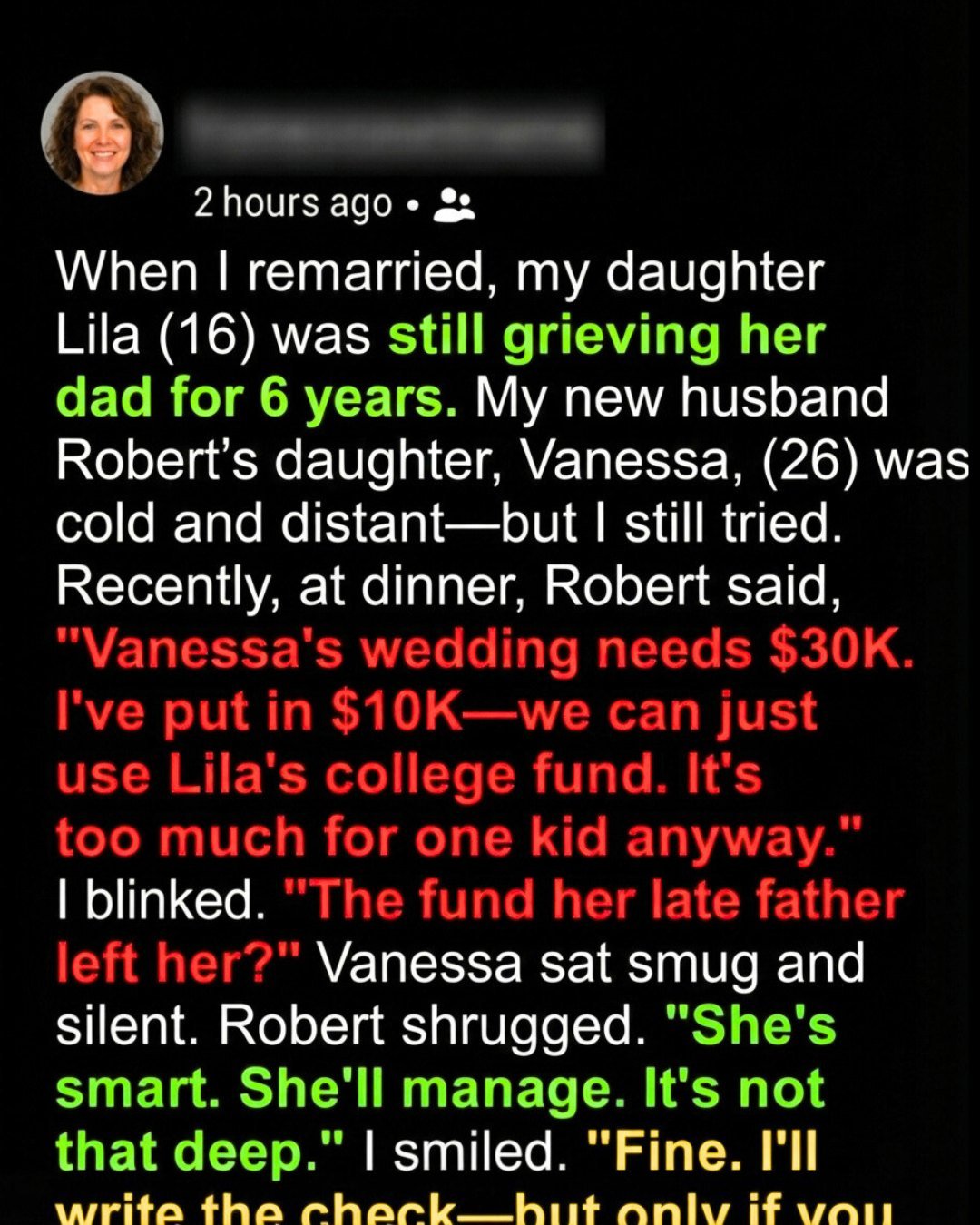
When my husband casually suggested that we could temporarily dip into my daughter’s college fund to cover the remaining costs of his grown daughter’s wedding, I didn’t raise my voice, didn’t cry, and didn’t storm out of the room the way people expect a woman to do in moments like that.
I simply smiled, nodded once, and said I would think about it.
What he failed to realize was that, in that exact moment, something inside me solidified with terrifying clarity, because I already knew precisely what I was going to do.
Six years earlier, I had remarried, fully aware that blending two families was never as simple as love alone. Love might begin a marriage, but respect is what sustains it—and respect, I was about to learn, was something my husband expected to receive without ever offering in return.
My daughter, Lila, was only ten when I married Robert. She was still learning how to breathe again after losing her father, Michael, just a year before. Michael had never been loud or flashy; he was steady in the quiet way that makes the world feel safer. He believed deeply in preparation, responsibility, and giving his child more opportunities than he himself had ever known.
Every Saturday morning, no matter how tired he was, Michael made pancakes from scratch. He burned the first batch every single time and laughed like it was a tradition. At night, after Lila fell asleep, he sat alone at the kitchen table with spreadsheets open, carefully transferring money into a college fund he had started the day she was born.
“That money,” he once told me, gently tapping the screen, “is her freedom. Her choices. Her safety net.”
When Michael passed away unexpectedly, that account became sacred. It wasn’t just money—it was his voice reaching into the future, his promise to our daughter that her dreams mattered.
Robert entered our lives later, charming and attentive in the beginning. He knew how to say the right things, how to show up with flowers and reassuring smiles. He also came with a daughter of his own, Vanessa, who was already twenty at the time.
Vanessa never openly insulted us—she was far too calculated for that. Instead, she perfected a colder approach built on indifference. Conversations were clipped. Silence was deliberate. It was made very clear that Lila and I were not her family, merely people occupying space in her father’s new life.
I tried. I truly did.
I invited her to coffee, shopping trips, weekend outings. I offered help with resumes, apartment hunting—anything she might need. She declined every single time, often without even lifting her eyes from her phone.
Lila, sweet and hopeful, tried too. She asked about Vanessa’s work, complimented her outfits, and once even left a handmade card on her pillow welcoming her “home.”
Vanessa never acknowledged it.
The message was unmistakable: we were tolerated, not embraced.
Years passed, and the distance never softened.
Then one ordinary Wednesday evening, everything finally reached a breaking point.
We were halfway through dinner. The house hummed quietly with the refrigerator’s buzz and the steady ticking of the clock above the stove. Lila was excitedly talking about her upcoming science exams and the advanced courses she hoped to take the following year. She had big dreams and spoke about them with the same quiet determination her father once had.
Robert set his fork down—too carefully.
“So,” he said, wiping his hands with his napkin, “Vanessa’s wedding is coming up faster than expected.”
I looked up but stayed silent.
“I’ve already contributed ten thousand dollars,” he continued, “but we’re still about thirty thousand short.”
My stomach tightened.
Lila paused mid-sentence, completely unaware of what was coming.
Robert cleared his throat. “I was thinking… we could take it from Lila’s college fund. She’s only sixteen. We have time to build it back up. Family helps family, right?”
The words settled over the table like ash.
I felt an unsettling calm—the kind that arrives right before something irrevocably breaks.
Across from us, Vanessa sat with her arms crossed, her expression unreadable but expectant. This wasn’t a spontaneous thought. It had been discussed. Planned. Decided—without me.
I kept my voice steady. “You’re asking me to use the money my late husband set aside for his daughter’s education… to pay for a wedding?”
Robert sighed, irritation already creeping in. “When you say it like that, it sounds worse than it is.”
“That’s because it is,” I replied.
He leaned back. “It’s Vanessa’s big day. Lila is smart—she’ll figure things out. Nobody pays full tuition anymore anyway.”
Vanessa smirked, finally looking up from her phone.
Something inside me fractured.
Michael’s final gift.
Lila’s future.
Reduced to a line item in a wedding budget.
But I didn’t argue. I didn’t raise my voice.
“I’ll review the numbers,” I said calmly. “I’ll think about it.”
Their relief was immediate. They thought they had won.
They had no idea.
Two days later, I asked them both to sit down with me.
“I’ve made a decision,” I said.
Robert smiled, already reaching for his coffee. Vanessa leaned back, satisfied.
“I’ll release the money,” I continued. “But there’s one condition.”
The atmosphere shifted.
“What kind of condition?” Robert asked, frowning.
“You’ll sign an agreement,” I said, sliding a document across the table. “A legally binding contract stating that every dollar taken from Lila’s fund will be repaid in full within one year.”
Silence stretched.
Vanessa laughed sharply. “You can’t be serious.”
“I am,” I said evenly. “If family helps family, then family honors commitments.”
Robert’s face darkened. “That’s not how family works. We don’t treat each other like a bank.”
“Family also doesn’t decide that a child’s future matters less than a party,” I replied.
“It’s borrowing!” he snapped.
“Borrowing requires intention to repay,” I said quietly. “What was your plan?”
He had none.
That’s when I placed a second document on the table.
“And this,” I said calmly, “is a divorce filing. If you choose not to protect my daughter’s future, I will—whether you stand beside me or not.”
Vanessa went pale.
“You’re bluffing,” she muttered.
“Try me.”
Robert stared at the papers, stunned. He had expected compliance. Silence. Sacrifice—mine.
“You’d really end our marriage over this?” he asked.
“I’d end it to protect my child,” I replied. “The choice is yours.”
He moved out two weeks later.
Vanessa’s wedding still happened—smaller, quieter, funded by her mother and whatever Robert could manage on his own.
Lila and I weren’t invited.
There were no regrets.
The night Robert left, Lila wrapped her arms around me and whispered, “Thank you for choosing me.”
“I always will,” I told her. “That’s what mothers do.”
Michael’s money remains untouched, growing quietly, waiting for the future it was meant to protect.
And one day, Lila will use it—not for a single night of spectacle, but for a lifetime of possibility.
Exactly as her father intended.