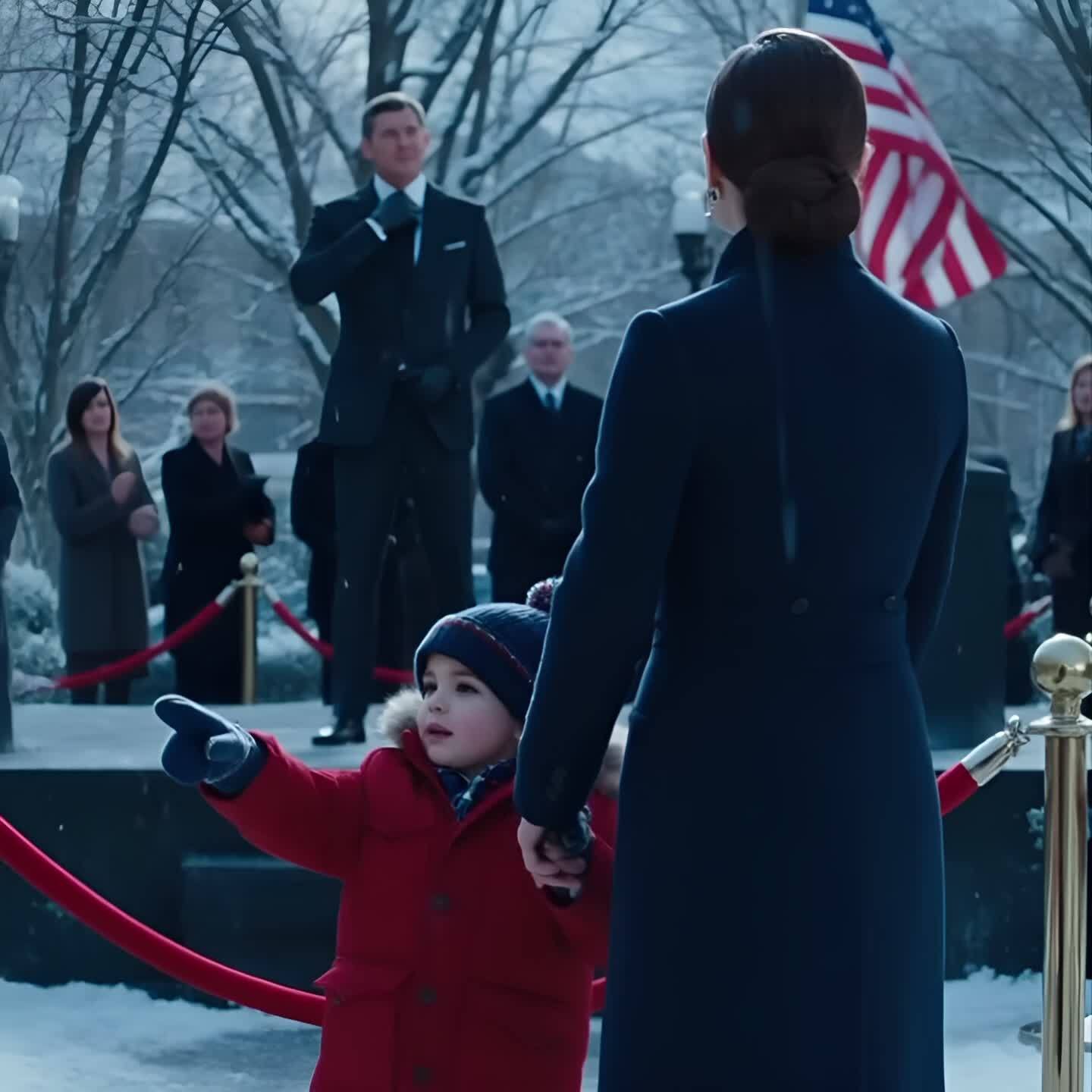
I thought rock bottom was my husband draining our accounts. But the real blow came when my father told me I was no longer his daughter, standing in the rain with less than $20. I clutched the hand of the homeless boy I refused to abandon. I had no idea that in two weeks this child would point at a billionaire on the news and calmly tell me that was his dad.
My name is Brooklyn Sanchez. And as I stood shivering on the concrete porch, I felt like a ghost haunting the life I used to be proud of.
The rain in Maple Bridge Heights did not fall like it does in the movies. Romantic and cleansing, it was freezing, relentless, and it smelled of wet asphalt and dead leaves. It soaked through the thin fabric of my coat, plastering my hair to my skull, making me feel exposed and small.
I was thirty-two years old. I had a degree in data analytics. I used to manage spreadsheets that tracked millions of dollars in logistical assets. Yet, in that moment, my entire net worth was stuffed into a scuffed suitcase with a broken zipper, and my bank account held exactly $12.40.
But the heaviest thing I carried was not the suitcase. It was the small, trembling hand gripped tightly in mine.
Jonah stood beside me, trying to make himself invisible. He was wearing a hoodie two sizes too big that I had scavenged from a donation bin, and his sneakers were soaked through. He did not say a word. He knew, with the terrifying intuition of a child who has seen too much, that our survival hung on what happened when this door opened.
I raised my hand to knock. My knuckles were white. I hesitated.
This house, with its manicured lawn and the soft golden glow spilling from the bay windows, was where I grew up. It was the stage where Ronald and Elaine Sanchez performed their lifelong play of the perfect American family. Inside, there would be the smell of potpourri and lemon polish. The temperature would be set to a perfect 72°. It was a fortress of comfort.
And I was standing outside the gate, a barbarian begging for entry.
I knocked.
Three sharp wraps. My heart hammered against my ribs, loud enough to drown out the hiss of the rain.
“Please,” I prayed silently. Just for a few weeks, just until I can get a paycheck. Just let me be your daughter again.
The lock clicked. It was a heavy, solid sound.
The door swung inward.
My father, Ronald, stood there. He was wearing a cream-colored cashmere sweater that probably cost more than my first car. He looked warm. He looked clean. He looked at me, and for a split second I saw recognition.
Then the recognition was replaced by a look of sheer, unadulterated distaste. It was the way one might look at a stray dog that had vomited on a pristine rug.
“Brooklyn.” His voice was not welcoming. It was an accusation.
My mother, Elaine, appeared behind him a second later. She was clutching a glass of white wine, her fingers adorned with the pearl ring she never took off. She peered around his shoulder, her eyes widening as they swept over me. They took in my wet hair, the cheap suitcase pooling water onto her welcome mat.
And finally, they landed on Jonah.
Her lip curled. A microscopic movement, but I saw it.
“Mom. Dad.” I managed to say. My voice cracked. I hated how weak I sounded. I wanted to be the strong, independent professional they had bragged about at their country club dinners.
Instead, I was a drowned rat.
“I… I need help.”
Ronald did not step back to let us in. He stood firm in the doorway, blocking the warmth.
“What is this, Brooklyn? It is 9:00 at night.”
“I know,” I said, squeezing Jonah’s hand so hard I worried I might be hurting him.
But he squeezed back just as hard.
He was my anchor.
“I was evicted today. The landlord did not give me the extension he promised. I have nowhere else to go.”
Silence stretched between us, filled only by the drumming of rain on the porch roof.
“Evicted.” Ronald repeated the word as if it were a profanity. “We told you this would happen. We told you when you walked out on that marriage, everything would crumble.”
“I didn’t walk out, Dad.” I said, the old argument rising in my throat like bile. “Ryan cheated on me. He drained our joint accounts. He left me with nothing but debt.”
“Ryan was a good provider,” Elaine cut in, her voice shrill. She took a sip of her wine, her eyes cold. “He had a future. Every man makes mistakes. Brooklyn, you were too rigid. You were always too focused on your little charts and numbers, and you forgot how to be a wife. If you had just forgiven him, you would be sleeping in your own bed tonight instead of standing here humiliating us.”
Humiliation. That was their currency. Not love, not support, but image.
“I can’t change the past,” I said, fighting the urge to scream. I had to swallow my pride. I had to do it for Jonah. “I just need a place to stay. Just for two or three weeks. I have an interview next Tuesday. I just need a base. Please.”
Ronald looked at the suitcase again.
Then he looked at Jonah.
He pointed a manicured finger at the boy.
“Who is this?”
Jonah flinched. He tried to hide behind my leg.
“This is Jonah,” I said, stepping slightly in front of him to shield him from their glare. “He has been staying with me.”
“Staying with you?” Ronald scoffed. “You can’t even feed yourself, and you are playing mother. Is this why you lost the apartment? Because you are dragging strays into your life.”
“He is not a stray,” I snapped, a spark of anger finally igniting in my chest. “He is a child. He had nowhere to go. I am his temporary guardian. I am taking care of him.”
Elaine laughed. It was a dry, brittle sound.
“Oh, Brooklyn. Always the martyr. Always trying to save the world while your own life is a disaster. Who is he? Where are his parents?”
“He doesn’t have anyone else,” I said, my voice dropping. “Just like I don’t.”
I looked my mother in the eyes, begging for a shred of the maternal instinct she claimed to possess.
“Mom, look at him. He is wet. He is hungry. Please. Just let us in. We will sleep in the basement. We won’t make a sound. I just need to get him out of the cold.”
Ronald and Elaine exchanged a look. It was a look of silent communication practiced over forty years of marriage. A conversation held in eyebrows and slight nods.
Ronald turned back to me. His face was a mask of indifferent calculation.
“We cannot have this,” he said.
“What?” I whispered.
“The neighbors,” Elaine whispered loudly, leaning in. “Mrs. Gable next door is already watching from her window. What will they think? Brooklyn, our daughter—divorced, jobless—showing up in the middle of the night with a homeless child. It is scandalous. It makes us look like we raised a failure.”
“I don’t care about Mrs. Gable,” I cried out, desperation making me loud. “I care about not freezing to death. I’m your daughter.”
“Are you?” Ronald asked. His voice was deadly quiet. “Because the daughter I raised had dignity. The daughter I raised knew her place. She didn’t throw away a successful husband to play social worker in the slums.”
He took a breath, adjusting his cuffs.
“Here’s the deal. We will take you in for two weeks until you get back on your feet.”
Hope surged in my chest, hot and blinding.
“Thank you. Oh, God. Thank you. We just need—”
“No,” Ronald interrupted, holding up a hand. “Not we. You.”
I froze.
“What?”
“You can come in,” Ronald said, pointing at me.
Then he pointed at Jonah, his finger stabbing the air near the boy’s face.
“He stays out.”
The world seemed to tilt on its axis.
“Dad, he is seven years old. I can’t leave him.”
“That is not my problem,” Ronald said smoothly. “Elaine, call the number for child services or the police. They will come pick him up. They have systems for children like that. He belongs in the system.”
“Brooklyn, not in a respectable home. He is a liability,” Elaine added, nodding as if this was the most logical thing in the world. “You need to focus on yourself. You need to fix your life. Get back in shape. Maybe call Ryan and apologize. See if he will take you back. You cannot do that with this baggage hanging around your neck.”
I looked down at Jonah.
He was looking up at me, his eyes wide and dark, filled with a terrifying resignation.
He expected this. He expected to be discarded.
He loosened his grip on my hand just a fraction. Preparing to let go, preparing to be left behind so I could be safe.
That small movement broke me.
And then it rebuilt me.
In that second, standing in the freezing rain, I realized something profound. The warmth inside that house was a lie. The fire in the hearth was cold. The people standing in the doorway were not my parents. They were strangers who shared my DNA.
I tightened my grip on Jonah’s hand. I squeezed it so hard I hoped he could feel my soul pouring into him.
I am not letting go, I told him silently. Not today. Not ever.
I looked up at Ronald. The rain dripped from my eyelashes, blurring his face. But I had never seen him more clearly.
“No,” I said.
Ronald blinked.
“Excuse me.”
“No,” I repeated, my voice steady for the first time all night. “I am not leaving him. If he doesn’t come in, I don’t come in.”
Ronald’s face turned a shade of red I remembered from my childhood, the color of suppressed rage.
“Do not be stupid. Brooklyn, look at yourself. You have nothing. You are nothing without us. This is your last chance. If you walk away with that boy, you are choosing a life of poverty. You are choosing to be trash.”
“I would rather be trash with a heart than whatever you are.”
I spat the words out.
Elaine gasped, clutching her pearls.
“How dare you speak to your father like that.”
“After everything we have given you—”
“You gave me nothing that didn’t come with a price tag,” I shouted. “You want me to abandon a child to save your reputation? You want me to crawl back to a man who betrayed me just so you can save face at the country club? No.”
Ronald stepped forward, his eyes narrowing into slits.
“Listen to me closely, Brooklyn. If you turn around and walk off this porch with that boy, you are done. Do not call us when you are hungry. Do not call us when you are sleeping under a bridge. You are not my daughter anymore. I will write you out of the will. I will block your number and I will forget you ever existed.”
The words should have hurt. They should have felt like a knife to the gut.
But strangely, they felt like a key turning in a lock.
A heavy chain fell away from my neck.
“You know what, Ronald?” I said, using his first name for the first time in my life. “I think I can live with that.”
I didn’t wait for his response. I didn’t wait for Elaine’s theatrical sobbing. I turned my back on them.
“Come on, Jonah,” I said softly.
Ronald screamed after us.
“From now on, you are on your own. Don’t bring that boy back here. Don’t you dare come back.”
The door slammed shut behind us. It was a thunderous sound. Final and absolute. The click of the deadbolt sliding into place echoed like a gunshot in the quiet suburban street.
We walked down the driveway. The rain was coming down harder now, a deluge that washed away the last traces of the Maple Bridge Heights illusion. I dragged my suitcase over the cracked pavement, the wheels rattling in the dark. My shoes squelched with every step. My coat was heavy with water. I was shivering so violently my teeth chattered.
I walked until we were out of sight of the house, until the golden glow of their windows was just a memory.
Then I stopped under the meager shelter of an oak tree near the street corner.
I looked down at Jonah. He was staring at me, his face wet with rain and tears.
“You didn’t go inside,” he whispered, his voice barely audible over the wind.
“No,” I said, crouching down to be eye level with him. I brushed a wet lock of hair from his forehead. “We are a team. Remember? I don’t leave my team behind.”
He threw his arms around my neck, burying his face in my wet shoulder. I hugged him back, holding him as tight as I could, trying to transfer whatever body heat I had left into his small frame.
But as I held him, the adrenaline began to fade, and the cold reality of our situation crashed down on me.
I looked down the dark, empty street. There were no cars, no buses at this hour. I had $12. I had no job. I had no parents. I had just been disowned by the people who were supposed to love me unconditionally.
I had just promised a seven-year-old boy that I would protect him, that we were a team.
But as I stared into the black void of the night, terror clawed at my throat.
I was a data analyst. I solved problems. I found patterns.
But there was no data for this. There was no spreadsheet that could calculate a way out of this nightmare.
How, I thought, panic rising like floodwater. How am I going to feed him tomorrow? How am I going to keep him warm? Where are we going to sleep?
The street lights flickered overhead, indifferent to my despair.
I stood up, took Jonah’s hand again, and started walking into the dark, pulling my broken suitcase behind me.
The rain kept falling, and for the first time in my life, I didn’t know where the road was leading.
All I knew was that I was walking away from the past and walking straight into a future that looked terrifyingly empty.
Two years before the rain washed away my identity, my life was a grid. It was a perfectly organized, color-coded spreadsheet where every variable had a place and every outcome was predictable.
I lived in Lakeshore City in a two-bedroom apartment on the 14th floor that smelled of vanilla reed diffusers and sanitized ambition. If you had looked at my life from the outside through the floor-to-ceiling windows that overlooked the marina, you would have seen the American dream packaged in premium wrapping paper.
I was a senior data analyst at Nex Helio Quantitics. My job was to turn chaos into order. I spent ten hours a day staring at three monitors, tracking supply chains and market fluctuations, ensuring that million-dollar shipments arrived exactly when they were supposed to.
I was good at it. I found comfort in the certainty of numbers.
Numbers did not lie. Numbers did not wake up one day and decide they no longer loved you.
My husband, Ryan Mercer, was the opposite of a spreadsheet. He was all kinetic energy and carefully curated charisma. Ryan was a personal trainer at an upscale gym downtown, but he liked to call himself a lifestyle architect. He spent more time editing photos of his protein shakes and flexing his biceps for his 12,000 Instagram followers than he did actually training clients.
Our evenings were a ritual of performance. We would sit at our reclaimed wood dining table, eating arugula salads with grilled chicken because Ryan was always cutting carbs, and we would talk about the future as if it were a product we had already ordered from Amazon.
One Tuesday night in November stands out in my memory. It was raining then, too, but it was a polite, quiet rain against the double-paned glass, not the violent deluge that would later soak me to the bone.
Ryan was scrolling through his phone, the blue light illuminating his chiseled jawline. He looked like a model from a cologne advertisement.
“Babe,” he said, not looking up from his screen. “I was thinking about the house in the suburbs, the one on Elm Street. The open house is this Sunday.”
“The colonial with the red door?” I asked, stabbing a piece of cherry tomato. “Ryan, the asking price is $650,000. Even with our savings, the monthly mortgage would be stretching us thin.”
He finally looked up, flashing that white, dazzling smile that had charmed me five years ago.
“That is why your parents are helping with the down payment, right? They said they wanted us to have a good start, a proper start.”
My stomach tightened.
My parents, Ronald and Elaine, had indeed promised to help. But in the Sanchez family, money was never a gift. It was a leash.
“They are giving us $50,000,” I reminded him. “But you know how they are. If they pay for the house, they will want to pick the curtains. They will want a key. They will want to approve the landscaping.”
“So let them.” Ryan shrugged, reaching for his water glass. “Your dad loves me. I can handle Ronald. He just wants to feel involved. Besides, we need the space. If we are going to start trying for a baby next year. We can’t be stuck in this apartment. It doesn’t fit the brand.”
The brand.
That was what our marriage had become—a brand partnership.
My parents were obsessed with the brand. To Ronald and Elaine, I was a project that needed constant management. I was the reliable, slightly boring engine that kept the car running.
But Ryan was the shiny paint job.
They invited us over for dinner every Sunday without fail. These were not casual family meals. They were inspections. My mother would set the table with her fine china, and we would sit stiffly in their dining room in Maple Bridge Heights—the very house I would later be barred from entering.
I remember one specific Sunday about six months before the divorce began. I had just received a promotion at Nex Helio Quantitics, a bump in salary that put me in the six-figure bracket.
I was proud. I had worked nights and weekends for months to land that position.
“That is nice, dear,” my mother said when I told them the news, barely looking up from her soup. “But make sure you don’t work too hard. You look tired. You’re getting those lines around your eyes again.”
She turned to Ryan, her face lighting up like a Christmas tree.
“And Ryan, tell us about the gym. I saw your post on Facebook yesterday. You looked so strong. Mrs. Gable next door told me her daughter follows you. She says you are an inspiration.”
Ryan preened. He literally puffed out his chest.
“Thanks, Elaine. It is going really well. I am thinking of launching a premium coaching app, subscription-based. It is going to be huge.”
“See,” my father chimed in, pointing his fork at Ryan. “That is ambition. That is thinking big. Brooklyn, you could learn something from your husband. You are always so focused on the safe path, capping your potential at a desk job. Ryan is out there building an empire.”
I sat there, gripping my fork until my knuckles turned white.
My safe path paid our rent. My desk job paid for the lease on Ryan’s luxury SUV. My salary was the reason we could afford the organic groceries Ryan insisted on.
But in the Sanchez household, being the breadwinner did not matter if you were a woman, and it certainly did not matter if you weren’t flashy about it.
They wanted me to be successful. Yes, they wanted me to be wealthy, but they wanted it to look effortless. They wanted me to be the perfect accessory to Ryan’s leading-man energy.
Their golden rule was unspoken but deafening:
Be honest, be lawful, but for the love of God, never be poor, and never be ugly.
As the months went on, the cracks in our foundation started to show, though we plastered over them with filters and forced smiles.
Ryan began to resent my stability. It was a subtle, insidious poison.
He would make jokes when we were out with friends.
“Oh, Brooklyn can’t stay out late,” he would say with a mock sympathetic pat on my back. “She has to go count beans at the factory. She is the fun police.”
Everyone would laugh. I would laugh too, because that is what a good wife did.
But in private, the jokes became sharper.
“You think you are so smart because you bring home the steady check?” he snapped at me one evening when I asked him why he had spent $400 on new sneakers when we were saving for the house. “You think I am just some dumb jock, but I am building something.”
“Brooklyn, you are just a cog in a machine. Nobody knows your name. Nobody cares about your spreadsheets.”
“I care about them because they pay for your sneakers,” I shot back, exhaustion making me reckless.
“You are so materialistic,” he sneered, turning away to admire his reflection in the hallway mirror. “You have no soul. That is why your parents like me better. I have spark. You are just gray.”
I swallowed the hurt. I told myself it was just stress. I told myself that once we bought the house, once we had the baby, he would settle down. He would feel secure.
So, I worked harder.
I started staying at Nex Helio until eight or nine at night. I told myself it was for the promotion, for the bonus, but deep down I knew the truth.
I was staying at the office because the hum of the server room was more comforting than the silence of my own home.
I was hiding in the data.
I sacrificed everything for that illusion of stability. I missed my best friend’s birthday party because I was finishing a report. I stopped painting—a hobby I had loved since college—because Ryan said it made a mess and didn’t generate income.
I streamlined myself. I became efficient. I became exactly what my parents wanted: a high-functioning, low-maintenance component of the family unit.
But you cannot build a life on a foundation that is rotting. You can only ignore the smell for so long.
The night the dam finally broke was a Tuesday. Much like the one where we discussed the house, but the atmosphere was volatile.
I had come home late, my eyes burning from staring at screens for twelve hours. I found Ryan in the living room surrounded by travel brochures.
“Babe,” he said, not even asking how my day was. “I was thinking, instead of the house right away, maybe we take a trip. Maldives or Bora Bora. I need content for the launch of my app. We could stay in those overwater bungalows. It would look insane on camera.”
I stared at him. I dropped my bag on the floor.
“Ryan, those trips cost $10,000 minimum. We have the deposit due for the house in three months.”
“So?” he challenged, standing up. “Ask Ronald for more. He will give it to you. Tell him it is for—I don’t know—networking. He loves that corporate buzzword stuff.”
“I’m not asking my father for money so you can take selfies in a bikini,” I said, my voice trembling. “I am tired, Ryan. I am so tired of being the only adult in this relationship.”
His face darkened, the charm evaporating, leaving behind something ugly and petulant.
“Oh, here we go. St. Brooklyn, the martyr. You think you are so superior. You know what? You are boring. You are boring and you are stiff. And honestly, I don’t know how I have put up with it this long. I need someone who inspires me, not someone who drains the life out of the room.”
The words hit me like physical blows.
But I didn’t scream. I didn’t throw things. I did what I always did.
I retreated.
I grabbed my car keys and walked out the door.
“Yeah, run away!” he shouted after me. “Go make a spreadsheet about it.”
I got into my sedan—the practical silver car my father had approved of—and I drove.
It had started to rain, a slow, miserable drizzle that blurred the city lights into streaks of neon.
I drove aimlessly through Lakeshore City. I drove past the expensive restaurants where my parents held court. I drove past the park where Ryan filmed his workouts. I drove out toward the highway where the city gave way to the darkness of the suburbs.
I turned on the radio, but I didn’t hear the music. All I could hear was my father’s voice telling me to be grateful and my husband’s voice telling me I was boring.
I pulled over into the empty parking lot of a closed shopping mall. I turned off the engine and just sat there, listening to the rain drum against the metal roof.
It was a rhythm I would come to know intimately in the future—the sound of isolation.
I looked at my hands on the steering wheel. They were shaking.
I had a credit score of 800. I had a retirement fund. I had a marriage license. I had a leased luxury apartment.
But sitting there in the dark, I felt a terrifying hollowness in my chest. I felt like an actor who had forgotten their lines in the middle of a play. And the audience was starting to boo.
I didn’t know it then, but I was already falling.
I was walking across a bridge that looked solid, painted in bright, happy colors, but underneath the wood had turned to dust. I was one step away from the collapse.
I thought the worst thing that could happen was a divorce or a fight. I thought the bottom was just a few feet down.
I had no idea that the fall would not stop until I hit the cold concrete of a sidewalk, holding the hand of a boy I hadn’t even met yet.
I sat in that car for two hours, terrified to go home, yet terrified to leave.
Eventually, I started the engine and drove back to the apartment. Back to the vanilla-scented air and the husband who despised me. Back to the lie I called a life.
I thought I was making the responsible choice. I thought I was saving my future.
In reality, I was just driving back to the burning building, locking the door, and swallowing the key.
The tablet was sitting on the kitchen island, innocent and sleek, glowing with a soft notification light.
It was a Sunday morning—usually the only time Ryan and I pretended to be a normal couple over coffee and bagels.
He had gone for a run, or so he said, and in his rush to maintain his perfect physique, he had made a fatal error.
He had left his iPad unlocked.
I did not mean to snoop. I was looking for a recipe for avocado toast that he had bookmarked.
But when I swiped the screen, the recipe app was not open.
His messages were.
The world stopped.
It did not slow down. It simply ceased to exist.
There were photos. Dozens of them. There was Ryan, shirtless and laughing, his arm draped around a woman with platinum blonde hair and skin that looked like it had been airbrushed.
I recognized her immediately.
Selena Ward.
She was the marketing manager at his gym. She was twenty-four, vibrant, and everything I was apparently not.
The messages were worse than the photos. They were intimate, grotesque in their familiarity.
Cannot wait to see you tonight.
She is working late again. Boring.
I love you, babe.
We will be together soon.
I felt a physical blow to my chest, as if someone had swung a sledgehammer into my ribs.
I dropped the tablet. It clattered loudly against the granite countertop, but the screen did not crack.
My life cracked instead.
I stood there for an hour, paralyzed, staring at the device as if it were a bomb.
When the front door opened and Ryan walked in, smelling of sweat and expensive cologne, I did not turn around.
“Babe, did you make coffee?” he asked, his voice cheerful. The voice of a man who thought he was smarter than everyone else.
I turned slowly. I held up the tablet.
Ryan froze.
For a second, I saw panic flicker in his eyes, but it was quickly replaced by something far more chilling: annoyance.
He did not drop to his knees. He did not beg for forgiveness.
He sighed, rolling his eyes as he tossed his gym bag onto the sofa.
“Okay,” he said, crossing his arms. “So you saw. I was going to tell you eventually.”
“Eventually,” I choked out. “You are sleeping with Selena. You told her you love her. You told her I am boring.”
Ryan walked into the kitchen and poured himself a glass of water, completely unbothered.
“Well, you are, Brooklyn. Look at us. When was the last time we did anything fun? When was the last time you didn’t talk about work or bills? You are suffocating. I am suffocating.”
“I am suffocating,” I screamed, the rage finally breaking through the shock. “I pay for everything, Ryan. I pay for this apartment, your car, your clothes. I work sixty hours a week so you can play pretend at the gym.”
“See,” he sneered, slamming the glass down. “That is exactly it. You always throw money in my face. You emasculate me. Selena makes me feel like a man. She supports my dreams. She doesn’t ask me about the price of eggs every time I walk through the door.”
He was twisting it. He was taking his betrayal and turning it into my failure.
“Get out,” I whispered.
“No,” he said calmly. “This is my home, too. And if anyone is leaving, it is going to be you eventually. I am not going anywhere until we figure out the assets.”
I grabbed my keys and fled.
I drove straight to Maple Bridge Heights.
I needed my parents. I needed them to be angry for me. I needed my father to threaten Ryan, my mother to hold me and tell me it was going to be okay.
I found them in the sunroom reading the Sunday paper.
When I burst in, tears streaming down my face, telling them everything about Selena, about the messages, about how cold he was, they did not stand up.
Elaine took a sip of her tea.
Ronald folded his newspaper slowly.
“Brooklyn, calm down,” my mother said, her voice tight. “You are making a scene. Mrs. Gable might hear you.”
“Ryan is cheating on me,” I cried. “He has a girlfriend. He blames me for it.”
Ronald cleared his throat.
“Well, Brooklyn, let us look at this objectively. Ryan is a young, virile man. Men have needs. If you have been unavailable or stressed or neglecting your appearance, these things happen.”
I stared at him.
“Are you blaming me?”
“We are not blaming you,” Elaine said, smoothing her skirt. “We are just saying that marriage is work. You cannot just throw it away because of a mistake. Think about the humiliation. A divorce. In our family, it is unheard of. We just told the club about your house plans.”
“I am not buying a house with him,” I yelled. “I am divorcing him.”
“You will do no such thing.” Ronald stood up, his voice booming. “You will go home. You will sit down with Ryan. You will suggest counseling. You will fix yourself up. Maybe lose five pounds. Buy some new clothes. You will win him back. We have invested too much in this image for you to ruin it because you are too proud to forgive.”
Something inside me snapped.
It was the last thread of the tether that had bound me to their approval for thirty-two years.
“No,” I said.
The room went silent.
“Excuse me,” Elaine whispered.
“No,” I repeated, shaking. “I am not fixing this. I am not forgiving him. I am done. And if you care more about your reputation at the country club than the fact that your daughter’s heart is broken, then I am done with you, too.”
I walked out.
I filed for divorce the next morning.
That was when the real war began.
I thought the emotional pain was the worst part.
But I was wrong.
The financial violence was far more brutal.
Two days after I filed, I went to the grocery store. I put a carton of milk and a loaf of bread on the counter.
When I swiped my debit card, the machine beeped.
Declined.
I frowned and swiped again.
Declined.
I opened my banking app on my phone. My hands started to shake so hard I almost dropped it.
The joint savings account, which had held nearly $45,000—money I had saved for the house, for our future—showed a balance of zero.
The checking account had $12.
I called the bank, hyperventilating in the middle of the dairy aisle. They told me that because it was a joint account, Ryan had every legal right to withdraw the funds.
He had transferred everything to a private account at a different bank that morning.
I called Ryan. He answered on the first ring.
“Where is my money?” I screamed.
“Our money,” he corrected me, his voice smug. “And I am holding on to it for safekeeping. I know you, Brooklyn. You would use it to hire some shark lawyer to destroy me. I am just protecting my interests.”
“I earned that money, too.”
“I was the one who managed our lifestyle. You haven’t contributed to savings in three years.”
“I contributed my brand,” he said, and hung up.
I went to a lawyer—a tired woman with a messy desk—who told me that fighting to get the money back would take months, maybe a year, and it would cost me a retainer of $5,000 upfront.
“I don’t have $5,000,” I told her. Tears of frustration hot in my eyes. “He took it all.”
“Then you have to settle,” she said, looking at her watch. “If you want this over quickly, if you want to stop the bleeding, you sign what his lawyer sends over. You take the debt, he keeps the cash, and you walk away.”
It was a robbery. It was a mugging in broad daylight, sanctioned by the legal system.
Ryan’s lawyer sent over a separation agreement that was laughable.
Ryan wanted half of my 401k. He wanted to keep the SUV. He wanted me to assume the debt on the credit cards he had maxed out buying gym equipment and gifts for Selena.
I fought it for a month, but every letter my lawyer wrote cost me $300.
I was putting groceries on a credit card with an insane interest rate.
I was drowning.
Finally, I broke.
I signed the papers.
I let him keep the $45,000. I let him keep the car. I took the credit card debt just to make him go away.
I was left with nothing but my job at Nex Helio.
The lease on our luxury apartment was up and I could not afford to renew it alone.
I had to move.
I packed my life into cardboard boxes. I sold my designer handbags—gifts from my parents to help me look the part—to pay for a moving truck.
I called my parents one last time before I moved.
I didn’t want to, but I was desperate.
I needed a buffer.
“Dad,” I said when he answered. “I am moving out today. I was wondering…the guest house. It is empty. Could I stay there for a month? Just until I save up for a deposit on a decent place.”
“The guest house.” Ronald laughed, but it was a cold, mirthless sound. “Brooklyn, you made your choice. You chose to create a scandal. Mrs. Gable has already asked me why Ryan posted that status about escaping a toxic marriage. Do you know how embarrassing that is for me?”
“He is lying, Dad.”
“It does not matter what the truth is,” Ronald snapped. “Perception is reality. You are a divorced woman now. You are damaged goods. If you come back here, it just reminds everyone of your failure. No, you cannot stay here.”
“Please,” I whispered. “I have nowhere else.”
“I will send you a check for $500,” he said, his tone dismissing me like a beggar. “That is it. Consider it a severance package from this family. Do not ask for more. You wanted to be independent. Be independent.”
The line went dead.
I moved into a studio apartment on the edge of the industrial district. It was four hundred square feet. The carpet smelled like stale cigarettes and wet dog. The window looked out onto a brick wall.
My first night there, I sat on the floor because I didn’t have a sofa. I ate instant noodles using a plastic fork.
I pulled up Facebook on my phone, a habit I couldn’t break.
There was a picture of Ryan. He was at a beach club in Miami. He was holding a glass of champagne, and Selena was kissing his cheek.
The caption read: “Finally free. Living my best life with the one who truly gets me. New beginnings. Upgrade.”
Underneath, my mother had liked the photo.
I threw my phone across the room. It hit the wall and cracked, but I didn’t care.
I curled up on the thin mattress I had dragged onto the floor and sobbed until my throat bled.
I was the villain in my own story.
I was the crazy ex-wife.
I was the disappointment.
But the next morning, I woke up.
I put on my blazer, which I had carefully hung on the shower rod to steam out the wrinkles. I put on my makeup to hide the dark circles under my eyes.
I drove my old sedan to Nex Helio Quantitics.
When I walked into the office, the hum of the servers greeted me like an old friend.
The fluorescent lights were harsh, but they were consistent.
I sat down at my desk. I turned on my three monitors.
The data streamed across the screens—rows and columns of logic. Supply chains. Delivery times. Profit margins.
I took a deep breath.
This, I told myself, this is mine.
They can take my husband. They can take my money. They can take my family, but they cannot take my brain.
I threw myself into the work with a terrifying intensity.
I was the first one in the office at 6:00 in the morning and the last one to leave at 9:00 at night.
I volunteered for every extra project. I double-checked every analysis.
I convinced myself that as long as I had this job, I was safe.
I convinced myself that I was rebuilding.
I was a survivor.
I didn’t see the emails circulating in the upper management inboxes. I didn’t see the quarterly reports that showed a dip in the market.
I didn’t see the massive merger looming on the horizon that would make my department redundant.
I was clinging to a sinking ship, polishing the brass railings, telling myself that if I just shined them hard enough, the water wouldn’t reach me.
I was so focused on the pain of the past that I didn’t see that tsunami of the future rising up to swallow me whole.
I thought I had hit rock bottom in that smelly studio apartment.
I was wrong.
I was still falling.
It was a Tuesday night in late October when the universe decided to test the last shred of humanity I had left.
I had just finished a fourteen-hour shift at Nex Helio Quantitics. My eyes were burning, dry and gritty from staring at blue-light monitors, and my lower back ached from sitting in a chair that was designed for ergonomics but felt like a torture device.
I was driving home to my tiny studio apartment on the edge of the industrial district, taking the long way because the highway was closed for construction.
This part of the city was a ghost town after dark. It was a landscape of shuttered warehouses, chain-link fences topped with razor wire, and flickering street lamps that buzzed like angry hornets.
It was not the Lakeshore City of my past life with its valet parking and rooftop bars.
This was the city’s underbelly, the place where things and people got lost.
I stopped at a red light next to a 24-hour laundromat called The Spin Cycle. The fluorescent lights inside were humming with a sickly yellow glow, illuminating rows of battered washing machines.
That was when I saw him.
He was curled up on a metal bench under the laundromat’s awning, trying to shield himself from the biting wind.
At first glance, he looked like a pile of discarded laundry, a heap of gray and navy fabric.
But then the pile moved.
A small hand reached out to pull a hood tighter.
I stared.
The light turned green, but I did not move my foot to the gas pedal.
My heart gave a painful lurch.
I was looking at a child.
He could not have been more than six or seven years old.
A week ago, I might have kept driving. I might have told myself that it was someone else’s problem, that calling the police was the right thing to do, that I was too tired and too broken to intervene.
But tonight, staring at that small figure bracing against the cold, I felt a terrifying resonance.
I knew what it felt like to be discarded.
I knew what it felt like to have the people who were supposed to protect you lock the door in your face.
I was thirty-two years old, and I had a job.
Yet, I felt just as homeless as that boy looked.
I pulled the car over.
I sat there for a moment, gripping the steering wheel, fighting a wave of fear.
What was I doing?
I was a single woman living paycheck to paycheck. I was barely keeping my own head above water.
But the image of his small sneakers, the rubber soles worn thin, made up my mind.
I drove to the burger joint two blocks down. I bought a double cheeseburger, a large order of fries, and the hottest chocolate they had.
Then I drove back.
He was still there.
I parked the car and got out slowly.
The wind whipped my hair across my face.
I held the paper bag in one hand and the cup in the other.
I walked toward him, making sure my footsteps were loud enough so I wouldn’t startle him.
“Hey,” I said softly.
The boy jumped.
He scrambled backward on the bench, pressing his back against the brick wall of the laundromat.
His eyes went wide. They were dark, terrified eyes, framed by dirty lashes.
He hugged a torn backpack to his chest as if it contained diamonds.
“I am not going to hurt you,” I said, stopping a few feet away. I crouched down to be on his level. “It is freezing out here. I thought you might be hungry.”
I held out the bag.
The smell of grease and grilled meat wafted through the cold air.
I saw his nose twitch.
The survival instinct was warring with his fear.
“I don’t have money,” he whispered.
His voice was unused.
“It is free,” I said, forcing a smile. “My treat. I bought too much. I hate wasting food.”
He hesitated for another second, then reached out with a trembling hand.
He snatched the bag and ripped it open.
He didn’t eat.
He devoured.
He shoved fries into his mouth two and three at a time.
It broke my heart to watch.
I handed him the hot chocolate.
“Careful. It is hot.”
He took a sip, wrapping both hands around the cup to steal its warmth.
The color started to come back to his pale cheeks.
“What is your name?” I asked gently.
He looked at me over the rim of the cup. He seemed to be assessing me, deciding if I was a threat.
Finally, he lowered the cup.
“Jonah.”
“Nice to meet you, Jonah. I am Brooklyn.”
I looked around the empty street.
“Jonah, where are your parents? Is someone coming for you?”
He shook his head.
He stared down at his sneakers.
“No. Just me.”
“How long have you been out here?”
“A while,” he mumbled. “I don’t know. The days get mixed up.”
“Do you remember where you lived before? Maybe I can help you find your way back.”
Jonah frowned, his forehead wrinkling in deep concentration.
“It was a big house. Really big. With a gate and a fountain.”
“A fountain,” I repeated.
That didn’t sound like this neighborhood.
“Do you remember the street name or your last name?”
He shook his head again, frustration creeping into his voice.
“No. I just remember the man. He wore suits. Gray suits. He was always on the phone.”
“And then the car ride. And then I was here.”
A chill that had nothing to do with the weather ran down my spine.
A man in suits. A big house.
It sounded like a fragment of a dream, or a memory from a different life entirely.
“Okay,” I said. “Okay, Jonah.”
I stood up. My knees popped.
I looked at the dark sky.
It was going to rain soon. I could smell it.
I had a choice.
I could call the police right now. They would come in a squad car with flashing lights. They would put him in the back seat. They would take him to a precinct, then to a holding center.
He was already terrified.
The system would swallow him whole.
Or—
“Jonah,” I said, “I live about ten minutes from here. It is small, but it is warm, and I have a shower with hot water and a sofa that is much softer than this bench.”
He looked up at me, his eyes wide with suspicion.
“I am going to call the people who help kids like you in the morning,” I told him honestly. “I have to. It is the law. But tonight, you don’t have to sleep outside. Would you like to come with me?”
He studied my face.
I don’t know what he saw there.
Maybe he saw the exhaustion. Maybe he saw the sadness that matched his own. Or maybe he just saw that I wasn’t wearing a uniform or a suit.
Slowly, he nodded.
We drove to my apartment in silence.
He sat in the passenger seat, staring out the window, clutching the empty burger wrapper.
When we got inside, I locked the door.
My apartment was basically one room with a kitchenette in the corner, but to Jonah, it seemed to be a sanctuary. He stood in the middle of the room, looking at my bookshelf, at the small TV, at the rug.
“You can take a shower,” I said, handing him a clean towel and one of my oversized t-shirts. “Just leave your clothes outside the door. I will wash them for you.”
While he was in the shower, I put his dirty clothes in my tiny washing machine.
His hoodie was threadbare. His jeans had holes in the knees that weren’t a fashion statement.
I felt a lump in my throat.
When he came out, he looked like a completely different child. His face was scrubbed clean, revealing a smattering of freckles across his nose. My t-shirt hung down to his knees.
I made him a bed on the sofa with my duvet and two pillows.
I sat in the armchair across from him while he settled in.
“Thank you, Brooklyn,” he whispered.
“Sleep tight, Jonah,” I said.
I didn’t sleep that night.
I lay in my bed, listening to his breathing, wondering if I had just committed a crime or saved a life.
The next morning, the reality of the situation hit me with the sunrise.
I had a homeless child in my apartment.
I had to go to work.
I called Nex Helio and told them I was sick.
Then I sat down at the kitchen table and dialed the number for child and family services.
It took forty-five minutes to get through to a human being.
When I finally did, the woman on the other end sounded exhausted.
Her name was Ms. Vance.
I explained everything. I told her about the laundromat, the burger, the night on the sofa.
“We are overloaded,” Ms. Vance sighed, the sound crackling over the line. “We have no open beds in emergency placement right now. Not for a non-critical case where the child is safe and fed. If you bring him in, he will likely sit in an office for twelve hours until we can find a foster placement, which might be two towns over.”
“So, what do I do?” I asked, looking at Jonah, who was sitting on the floor drawing on the back of an old electric bill with a pen he had found.
“You can apply for temporary kinship care,” she said. “Since you have already established contact, it is informal until we can run a background check and process the intake. It means you keep him for a few days while we search for his records or missing person reports. Can you do that? Can you afford to feed him for a week?”
Could I?
I had $12 in my checking account and a credit card that was nearing its limit.
“Yes,” I said. “I can.”
Ms. Vance said she would come by in the afternoon to do a preliminary site visit and file the paperwork.
After I hung up, I made the mistake of calling my mother.
I don’t know why I did it.
Maybe part of me still craved her validation. Maybe I thought that hearing about a child in need would melt the ice around her heart.
“Mom,” I said when she picked up. “Something happened. I found a little boy. He was homeless. I took him in.”
There was a silence on the line.
Then a sharp intake of breath.
“You did what?”
Elaine’s voice was like a whip.
“He is seven years old, Mom. He was freezing. I called social services and they are letting him stay with me while they look for his family.”
“Brooklyn, have you lost your mind?” She didn’t ask if the boy was okay. She didn’t ask if I was okay. “You are barely keeping your own life together. You are living in that box of an apartment and now you are bringing in street children.”
“He is not a street child,” I defended him, keeping my voice low so Jonah wouldn’t hear. “He is a human being.”
“He is a burden,” she snapped. “Do you know what people will think? A divorced woman living alone, picking up random boys? It looks unstable. Brooklyn, it looks desperate. Mrs. Gable was just asking me if you were having a breakdown. This proves it.”
“I don’t care about Mrs. Gable.”
“Well, you should care about us.”
Ronald’s voice boomed from the background. He must have been listening on speaker.
“We are not going to support this. Brooklyn, if you think we are going to send you money to feed some stranger’s kid, you are mistaken. We gave you that $500 to get back on your feet, not to start an orphanage.”
“I didn’t ask for money,” I said, tears stinging my eyes. “I just wanted you to know.”
“We know,” Ronald said cold. “We know that you are making another bad decision. If you keep him, Brooklyn, you are on your own. Do not expect a Christmas card. Do not expect anything. You are choosing this chaos over your own flesh and blood.”
“I am choosing to be kind,” I cried. “Something you two forgot how to do a long time ago.”
I hung up the phone.
My hands were shaking.
I walked into the main room.
Jonah was still drawing.
He looked up at me.
He must have heard the shouting, but he didn’t say anything about it.
He held up the piece of paper.
It was a drawing of a stick-figure woman with long hair and a stick-figure boy holding hands. They were standing next to a square that was supposed to be a building. Above them, he had drawn a yellow sun.
“It is us,” he said shyly. “And your house.”
I looked at the drawing.
It was crude, scribbled with a blue ballpoint pen on the back of a disconnection notice I had been dreading paying, but it was the most beautiful thing I had ever seen.
“It is perfect, Jonah,” I said, my voice thick with emotion.
“Thank you for letting me stay,” he whispered. “The bench was really cold.”
I looked at him—this small, fragile boy who had been abandoned by the world, just like I had.
I realized then that my parents were wrong.
He wasn’t a burden.
He was a mirror.
If I sent him away, if I let the system swallow him, I was no better than Ronald and Elaine.
I would be just another adult who put convenience over compassion.
“You are welcome,” I said. “And you are not going back to the bench. I promise.”
When Ms. Vance arrived that afternoon, she looked around my cramped apartment. She saw the clean sheets on the sofa. She saw the grilled cheese sandwich I had made for Jonah’s lunch. She saw the drawing on the fridge.
She checked my background.
No criminal record.
Gainfully employed—for now.
“Ideally, we would have more space,” she said, tapping her clipboard. “But the shelters are full, and he seems comfortable with you. If you are willing to sign the temporary guardianship papers, we can authorize him to stay here while we run the investigation.”
“But I have to warn you, Ms. Sanchez, we provide a very small stipend for food. But it won’t be much. And if he gets sick or needs clothes, that is on you.”
“I understand,” I said.
I signed the papers.
The pen scratched against the paper—a sound that felt like sealing a pact.
For the next few weeks, my life transformed.
I went to work, but my mind was always rushing home.
I stopped buying coffee. I stopped buying makeup.
Every spare cent went to Jonah.
I went to a thrift store on Saturday. I bought him three t-shirts, two pairs of jeans that were only slightly faded, and a winter coat that was a little too big but warm.
I spent my entire evening washing and ironing them, making sure they smelled fresh and clean.
When Jonah put on the clean clothes for his first day at the local elementary school—where I had managed to enroll him—he stood taller.
He looked at himself in the bathroom mirror and smiled.
“I look real,” he said.
“You are real,” I told him, smoothing his collar.
That evening, the apartment—usually silent and depressing—was filled with the sound of a cartoon playing on the TV and Jonah laughing at a cat chasing a mouse.
It was a sound I hadn’t realized I was starving for.
But late at night, when Jonah was asleep and the laughter faded, I would sit at my small kitchen table with my calculator. I would add up my paycheck. I would subtract the rent, the utilities, the cost of extra groceries.
The numbers were red.
They were angry red.
I was bleeding money.
My savings were gone. My parents had cut me off. My credit card was maxed out.
I was one car repair, one medical emergency, one lost paycheck away from total collapse.
I looked at Jonah sleeping on the sofa, his chest rising and falling in a rhythm of peaceful trust.
He thought he was safe.
He thought I was his savior.
He didn’t know that his savior was drowning and the water was rising fast.
I stroked his hair gently, terrified that I was making a promise I couldn’t keep.
I didn’t know then that the man in the gray suits he remembered was not just a fragment of a dream, but a key that would unlock a world I couldn’t even imagine.
All I knew was that I loved this boy, and I was going to fight the world to keep him warm, even if I had to burn everything I owned to build the fire.
The email from HR came on a Tuesday morning, flagged with high importance.
The subject line was innocuous: Mandatory town hall meeting 10:00 a.m.
I knew what it meant.
In the world of corporate data, mandatory meetings with zero notice were never about celebrating record profits.
They were about trimming the fat.
I sat in the glass-walled conference room with thirty other analysts. We were the people who predicted market trends, yet none of us had predicted that the algorithm we spent two years training would eventually learn to do our jobs faster and cheaper than we could.
The vice president of operations did not look us in the eye.
He read from a script.
He used words like restructuring, streamlining, and strategic pivot.
He did not use the word fired, but the result was the same.
Nex Helio Quantitics was cutting forty percent of its workforce.
My department was being dissolved.
“We have prepared severance packages,” he said, his voice monotone. “Security will escort you to your desks to collect your personal effects.”
I walked back to my cubicle in a daze.
A security guard named Mike—who I used to joke with about the terrible breakroom coffee—stood behind me with his arms crossed.
He did not smile.
He was just doing his job, ensuring I didn’t steal trade secrets on my way out.
I packed my life into a single cardboard box.
My ergonomic mouse.
A framed photo of Jonah and me at the park.
A succulent plant that was half dead.
I did not cry.
I went into survival mode.
My brain immediately started running the numbers.
I had my final paycheck coming.
I had the small severance, which amounted to two weeks of pay.
I had rent due in eight days.
When I picked Jonah up from school that afternoon, I left the box in the trunk of the car.
I put on my best customer-service smile.
“Why are you home so early?” he asked, climbing into the passenger seat.
“I decided to take a break,” I lied. “Mom is going to look for a new adventure. Maybe a job where I don’t have to stare at screens all day.”
“Like an astronaut?” he asked, his eyes wide.
“Maybe something a little more grounded.”
I laughed, but the sound was hollow.
The next morning, the hunt began.
I treated unemployment like a full-time job.
I woke up at six. I scoured LinkedIn, Indeed, and Monster. I customized my resume for every single application.
I applied for senior analyst roles, then junior analyst roles, then administrative assistant roles.
I sent out fifty applications a day.
The responses were a digital avalanche of rejection.
Thank you for your interest, but we have moved forward with other candidates.
This position has been put on hold.
We are implementing a hiring freeze.
The economy was contracting. Companies were hoarding cash, not hiring staff, and I was a thirty-two-year-old divorcée with a gap in her resume and a dependent that wasn’t legally hers yet.
Two weeks passed.
The severance money evaporated into the black hole of bills.
I looked at my bank account.
$300.
Rent was $1,600.
I put my degree in a drawer and drove to a staffing agency that specialized in manual labor.
“I will take anything,” I told the recruiter, a woman who looked like she hadn’t slept in a week. “Night shift, weekends, heavy lifting—I don’t care.”
She looked at my soft hands and my blazer.
“Are you sure, honey? This isn’t office work. It is stocking warehouses. It is standing on concrete for twelve hours.”
“I am sure.”
I got a job stocking shelves at a massive superstore called Mega Mart.
My shift was from ten at night until six in the morning.
The first night, I thought I would die.
My job was to unload pallets of canned soup and dog food.
Thousands of cans.
Lift, twist, place.
Lift, twist, place.
My lower back screamed. My feet swelled inside my sneakers until they felt like they were going to burst.
I earned $15 an hour.
I would come home at 6:30 in the morning smelling of cardboard dust and floor wax. I would shower quickly, wake Jonah up, make him breakfast, and drive him to school.
Then I would sleep for four hours, wake up, drive for a food delivery app during the lunch rush, pick Jonah up, help him with homework, feed him dinner, and go back to the warehouse.
I was a zombie.
My eyes were permanently bloodshot.
I lost weight I couldn’t afford to lose.
But every time I looked at Jonah, I found a reserve of energy I didn’t know I had.
“You look tired, Brooklyn,” he said one evening over spaghetti.
“Just working hard, buddy,” I said, forcing my eyes open. “Building our empire.”
But $15 an hour was not enough.
The math simply did not work.
The rent was late.
I paid a partial amount—$700—and promised the landlord, Mr. Henderson, that the rest was coming.
Mr. Henderson was not a bad man, but he was a businessman.
“Brooklyn, I like you,” he told me, standing in my doorway with a clipboard. “But I have a mortgage, too. If you can’t pay the full amount by the first of next month, I have to file the paperwork. It is company policy.”
“I will have it,” I promised.
I had no idea how.
I started selling things.
The flat-screen TV went first. I sold it on an online marketplace for $200.
“Where is the TV?” Jonah asked when he came home from school.
“I thought we read too much news,” I said, handing him a library book. “Books are better for our brains anyway. Right?”
“Right.”
Next was the bookshelf itself, then the coffee table, then my jewelry—the few pieces Ryan hadn’t pawned.
The apartment started to echo.
It looked skeletal.
“Are we moving?” Jonah asked one night, looking at the empty spot where the armchair used to be. “Are we going to a big house like the one I remember?”
I choked back a sob.
“We are downsizing so we can save up for something really special. A fresh start.”
It was a lie.
We were not saving.
We were drowning.
The notification came on a bright, sunny Thursday.
I came home from my delivery shift to find a piece of orange paper taped to the door.
Notice to quit.
Eviction proceeding.
I had thirty days to vacate.
I stood there in the hallway staring at the legal jargon.
Pursuant to state law.
Failure to pay rent.
Immediate possession of the premises.
I went inside and sank onto the floor.
I didn’t even have a chair left to sit on.
I had tried everything. I had worked until my hands bled. I had sold my dignity.
I had done everything a responsible person was supposed to do.
And I was still losing.
Desperation is a strange thing. It tastes like copper in your mouth. It makes you do things you swore you never would.
I picked up the phone.
I dialed the number I had deleted from my contacts but burned into my memory.
My mother answered on the fourth ring.
“Hello, Mom,” I said. My voice was a whisper. “It is me.”
“Oh.” Elaine’s tone dropped twenty degrees. “I thought you were done with us. You said some very hurtful things, Brooklyn.”
“I know,” I said, gripping the phone. “I am sorry. I was emotional. Mom, I need help. Please.”
“Help with what?”
“I am being evicted,” I confessed, the shame burning my face. “I lost my job at Nex Helio. I have been working nights, but it is not enough. They are kicking us out in three days.”
“Us,” she repeated the word with disdain. “You mean you and that boy?”
“Yes. Me and Jonah.”
“I see,” she said.
I could hear the clinking of silverware in the background. She was probably eating lunch.
“Well, Brooklyn, this is exactly what your father predicted. You took on a responsibility you couldn’t handle. You tried to play savior, and now you are paying the price.”
“I am not asking for a lecture,” I cried. “I am asking for a lifeline. I have nowhere to go. We will be on the street. Can you just lend me $2,000? I will pay you back. I swear.”
“$2,000?” Elaine laughed. “So you can spend it on him—on a stranger? No, Brooklyn. We are not throwing good money after bad. If you want to come home, you know the condition. You come alone. You put that boy in the system where he belongs, and you come home and apologize to your father. Then we will help you.”
“I can’t do that,” I said. “He is my son now in every way that matters.”
“Then you have made your choice,” she said. “Don’t call here again asking for money. It is embarrassing.”
The line went dead.
I sat there for a long time, listening to the silence.
It was the sound of a bridge burning, turning to ash, and falling into the river below.
The next three days passed in a blur of panic and resignation.
On the final morning—the deadline day—I woke Jonah up early.
“Is it a school day?” he asked, rubbing his eyes.
“No,” I said softly. “Today is moving day.”
We packed everything we had left into two bags.
I took the scuffed suitcase with the broken zipper—the one I had used for college, for business trips, for my honeymoon—and I stuffed it with our clothes, our toiletries, and the folder with Jonah’s guardianship papers.
Jonah packed his backpack. He put in his drawing pad, his few toys, and the blanket I had bought him from the thrift store.
We left the rest—the mattress, the kitchen table, the pots and pans.
They were just things.
I did a final sweep of the apartment.
It looked exactly as it had when I moved in: empty, cold, impersonal.
The only difference was the ghost of the laughter we had shared over cheap dinners.
I locked the door and slid the key through the mail slot.
It made a metallic clink as it hit the floor on the other side.
That sound was the period at the end of a sentence.
We walked to my car.
It wouldn’t start.
I turned the key and the engine sputtered and died.
The starter was dead.
I had known it was failing for weeks, but I didn’t have the money to fix it.
“Perfect,” I whispered, hitting the steering wheel. “Just perfect.”
“Is the adventure car broken?” Jonah asked from the back seat.
“Yeah, buddy,” I said, fighting back tears. “It looks like we are taking the bus.”
We walked to the bus stop.
I dragged the suitcase.
Jonah carried his backpack.
I had a plan.
A terrible, desperate plan.
I would go to Maple Bridge Heights. I would stand on my parents’ porch. I would beg one last time, face to face.
They couldn’t say no.
If they saw Jonah shivering in the rain, they couldn’t be that cruel.
It was raining by the time we got off the bus in my old neighborhood.
We walked the familiar streets—the streets where I had learned to ride a bike, where I had trick-or-treated.
We arrived at the house.
We knocked.
And you know what happened.
You know about the rejection.
You know about the door slamming.
You know about the finality of my father’s voice telling me I was no longer his daughter.
So now here I am.
The time is 11:30 at night.
The rain has stopped, replaced by a damp, bone-chilling mist.
We are sitting on a metal bench at a bus stop three miles away from my parents’ house.
My suitcase is next to me, wet and heavy.
Jonah is asleep, his head resting on my lap, his legs curled up to keep warm.
A bus is approaching, its headlights cutting through the fog like twin searchlights.
I don’t know the route number.
I don’t know where it goes.
I check my pocket.
I have exactly $4 in quarters and wrinkled bills.
The bus screeches to a halt in front of us.
The doors hiss open.
The driver—a large man with a gray beard—looks down at us.
“You getting on?” he grunts.
I look at the dark, empty road behind us.
There is nothing there.
No home.
No family.
No job.
I look at the open door of the bus.
It is warm inside.
“Yes,” I say.
I wake Jonah up gently.
“Come on, baby. The chariot awaits.”
We climb the steps.
I drop the coins into the farebox.
They clatter loudly.
“Where to?” the driver asks.
I look at him, and for the first time in months, I feel a strange, terrifying sense of freedom.
I have hit the bottom.
There is no further down to go.
“Just drive,” I say.
“Until the money runs out.”
We walk to the back of the bus.
I sit down and pull Jonah close to me.
The bus lurches forward, leaving Maple Bridge Heights behind.
We are moving into the darkness.
Two ghosts in a city that sleeps, heading toward a destination that doesn’t exist on any map.
I close my eyes and listen to the hum of the engine.
I don’t know where we will sleep tonight.
But I know one thing.
I am still holding his hand.
And as long as I am holding his hand, I am not completely lost.
The smell of St. Jude’s shelter was a specific cocktail of industrial bleach, damp wool, and the sour perspiration of a hundred people trying to disappear. It was a smell that stuck to your skin and wove itself into your hair, marking you as one of the invisible class.
We had been living this way for three weeks.
The first night after the bus ride from Maple Bridge Heights, we had slept in the back pew of an unlocked chapel until a janitor gently woke us up at 5:00 in the morning and told us about the shelter system.
Since then, our life had become a series of queues.
We lined up for a bed at 4:00 in the afternoon.
We lined up for the shower at 6:00.
We lined up for breakfast at 7:00.
“Okay, Agent J,” I whispered to Jonah one Tuesday morning. The overhead lights had just flickered on, harsh and unforgiving against the gray cinder-block walls. “Mission starts in t-minus sixty seconds. We need to be packed and at the door before the rush. Are you ready?”
Jonah sat up on his cot, rubbing sleep from his eyes. His hair was sticking up in three different directions.
He looked at me with a seriousness that broke my heart.
“I am ready.”
“Agent B, go.”
We turned it into a game because if we didn’t, the reality would crush us.
We raced to fold the thin, scratchy blankets.
We raced to shove our few toiletries into my battered suitcase.
We raced to put on our shoes.
“Time?” Jonah asked breathless as he zipped his backpack.
“Forty-five seconds,” I lied, checking a non-existent watch on my wrist.
“New world record,” he grinned.
For a moment, we weren’t a homeless woman and a discarded child.
We were an elite team on a covert operation.
We left the shelter before the sun was fully up. The air was crisp, biting at our cheeks.
We walked to a diner five blocks away, where the owner—a gruff man named S—let me wash dishes for two hours in exchange for $20 and two egg sandwiches.
I sat Jonah in the corner booth with his coloring book while I plunged my hands into scalding water in the back.
The steam curled around my face, loosening the grime of the shelter.
I scrubbed plates until my fingers were raw, thinking about spreadsheets.
I used to calculate logistics for international shipping fleets.
Now I was calculating how long $20 would last if we skipped lunch.
When I finished, S handed me the cash in a brown paper bag.
“You are good, Brooklyn,” he grunted, not looking me in the eye. “Same time tomorrow.”
“I will be here,” I said.
We ate the sandwiches on a park bench.
I broke mine in half, gave the larger portion to Jonah, and told him I wasn’t that hungry.
“You have to eat the protein,” I told him, tapping his nose. “It makes your brain grow. I’m already grown, so I just need the coffee.”
He ate with the focused intensity of a child who had learned that food was not guaranteed.
When he was done, he looked at me.
“Are we going to the hotel tonight?” he asked.
The hotel was the Starlight Motel—a run-down establishment on the edge of the highway where they rented rooms by the hour.
On days when I managed to scrape together $45 from odd jobs—cleaning gutters, handing out flyers, washing dishes—we treated ourselves to a night there.
It had a lock on the door.
It had a private bathroom.
It had a TV that got six channels.
To us, it was the Ritz.
“Not tonight, buddy,” I said, smoothing his hair. “We are short about ten dollars, but maybe tomorrow.”
He nodded, accepting the disappointment with a maturity that no seven-year-old should possess.
To kill time before the shelter opened again, we went to the community resource center.
It was a warm place where we could sit without being chased away.
It was filled with people like us—people waiting for paperwork, waiting for housing vouchers that never came, waiting for a miracle.
The waiting room was crowded.
A heavy, humid heat hung in the air, smelling of wet coats and old coffee.
A television mounted in the corner was blaring a 24-hour news cycle.
I found two plastic chairs in the back.
I pulled out a notebook I had scavenged.
“Okay,” I said, opening it to a fresh page. “Math lesson. If we have five apples and we give two to the neighbor, how many do we have left?”
Jonah sighed.
“Three. That is easy math. Mom, can we do the big numbers?”
Mom.
He had started calling me that a week ago.
The first time he said it, I had frozen, terrified that I was overstepping, that I was stealing a title I didn’t deserve.
But he had slipped his hand into mine and looked up at me.
And I realized he wasn’t asking for permission.
He was stating a fact.
I was the one feeding him.
I was the one holding him when he had nightmares.
I was Mom.
“Okay, big numbers,” I smiled. “If a train is traveling at 60 mph—”
I stopped.
The volume on the TV had suddenly increased.
Or maybe the room had just gone quiet.
The news anchor’s voice cut through the hum of conversation.
“And in financial news, tech mogul Grant Holloway has announced a massive expansion of his logistics empire into the Midwest. The billionaire CEO of Holloway Transit and Nexus arrived in the city today to oversee the merger.”
I glanced up at the screen.
There was footage of a private airfield.
A sleek silver jet was taxiing to a stop.
The door opened, and a man stepped out.
He was tall.
Even through the grainy screen, you could see the power radiating off him.
He wore a charcoal suit that fit him perfectly.
He had dark hair touched with gray at the temples and a jawline that looked like it had been carved from granite.
He wasn’t smiling.
He looked serious, focused, and incredibly alone despite the entourage surrounding him.
I was about to look away to go back to our math lesson when I felt a small hand grip my arm.
The grip was tight. Painful.
I looked down at Jonah.
He was not looking at his notebook.
He was staring at the television.
His mouth was slightly open.
His eyes were wide, fixed on the screen with an intensity that bordered on a trance.
The color had drained from his face, leaving his freckles standing out like dark constellations.
“Jonah,” I whispered. “What is it?”
He didn’t answer.
He stood up slowly, as if pulled by an invisible string.
He took a step toward the TV, dragging me with him because he wouldn’t let go of my arm.
On the screen, the camera zoomed in on Grant Holloway’s face as he ignored the shouting reporters and walked toward a waiting black SUV.
Jonah raised a trembling finger and pointed at the billionaire.
“Mom, Brooklyn,” he said.
His voice was quiet, steady, and terrifyingly certain.
“That is my dad.”
The words hung in the air between us.
Heavy and absurd.
“That is my dad,” he repeated. “My dad is a billionaire.”
I blinked.
I looked at the screen, then back at the boy in the oversized thrift-store coat.
My first instinct was denial.
It had to be.
Trauma did strange things to children. I had read about it.
They invented stories to cope.
They created fantasies where they were secret princes or superheroes to escape the pain of abandonment.
Jonah had probably seen this man on TV before. Or maybe Grant Holloway just looked like someone Jonah wished was his father.
“Jonah,” I said gently, pulling him back toward the chair. “That man on TV? That is Grant Holloway. He is a very famous businessman. Maybe he looks like your dad.”
“No.” Jonah shook his head violently.
He didn’t take his eyes off the screen until the segment ended and cut to a weather report.
“It is him. He smells like mint and old paper. And he has a scar on his hand right here.”
Jonah touched the back of his own left hand, tracing a small line.
I froze.
That was a specific detail.
“You remember a scar?” I asked.
“Yes. From the boat. We were on a boat and he cut it on the fishing hook. He bled on his white shirt.”
I felt a chill ripple down my spine.
“Jonah,” I said, crouching down so I was eye level with him. I took both his hands in mine. “Listen to me. This is important. Do you remember living with him?”
Jonah frowned, his face scrunching up in that pained expression he always got when he tried to look into the past.
“I… I think so. I remember a big house with the fountain and a room full of cars. But then… then what?”
“Then I woke up,” he whispered. “I was in the dark, and the man in the gray suit—not my dad, the other man—he told me to be quiet. He said if I made a noise, the bad things would happen.”
“Who was the other man?”
“I don’t know his name, but he worked with my dad. I saw them talking in the office.”
My heart was hammering against my ribs.
It sounded like a kidnapping.
It sounded like a movie script, but looking into Jonah’s terrified, honest eyes, I couldn’t dismiss it.
Grant Holloway.
I grabbed my notebook.
My hand was shaking as I wrote the name down in block letters.
Grant Holloway.
Underneath it, I wrote Holloway Transit and Nexus.
I stared at the name.
It felt impossible.
If this boy was the son of a billionaire, why was he sleeping in a church basement?
Why hadn’t his face been on every milk carton in America?
I had watched the news. I had never seen a report about a missing Holloway.
Unless…
Unless he was illegitimate.
Or unless the disappearance had been covered up.
“Did you ever run away?” I asked carefully.
“No,” Jonah said. “I was sleeping and then I wasn’t home anymore.”
I closed the notebook.
I didn’t know what to believe.
Part of me—the logical data-analyst part—said the probability was zero.
It was a coincidence.
A child’s confusion.
But another part of me—the part that had learned to trust my gut since the night I stood on my parents’ porch—felt a hook sink into my chest.
“Okay,” I said. “We will look into it. I promise.”
I didn’t tell him that looking into it meant using the library computer to Google a man who lived in a stratosphere I couldn’t even see with a telescope.
For the next two days, the name Grant Holloway haunted me.
I saw it on billboards.
I saw it on the sides of delivery trucks.
It felt like the universe was shouting at me.
On Thursday, a flyer appeared on the bulletin board at the shelter.
Winter warmth event.
It read:
Sponsored by the Open Hand Foundation and a special corporate partner.
Hot meals, winter coats, and toy distribution for children in need.
Saturday 12:00 p.m. at City Hall Plaza.
“Look,” I told Jonah, pointing to the flyer. “Free coats. Maybe we can find you one that actually fits. And toys. Maybe they have Legos.”
Jonah’s eyes lit up.
“Legos?”
“Maybe.” I smiled. “We have to get there early, though. You know the drill. First in line, first to dine.”
He recited our motto.
Saturday morning was gray and overcast.
We arrived at City Hall Plaza at 10:00 in the morning—two hours early—but the line already wrapped around the block.
It seemed half the city was hungry.
We took our place in line.
I sat on my suitcase, and Jonah stood between my knees, playing with a piece of string he had found.
The atmosphere was a mix of festive and desperate.
Volunteers in red vests were setting up long tables covered in white cloths.
There was a stage being assembled at the front with a podium and a microphone.
“Who is the special partner?” a woman in front of us asked her friend.
“Some big company.” The friend shrugged, adjusting her worn scarf. “They do this for the tax write-off. But hey, if they are giving out turkeys, I don’t care who they are.”
I tightened Jonah’s scarf.
“Are you cold?”
“I am okay,” he said.
He was looking at the stage.
“Mom, do you think the Lego man will be there?”
“I think the volunteers will have the toys.” I laughed softly.
We waited.
The line inched forward.
The smell of roasting turkey and stuffing began to waft through the air, making my stomach cramp with hunger.
I hadn’t eaten since yesterday morning, so Jonah could have the last bagel.
At noon, a hush fell over the crowd.
A convoy of black SUVs pulled up to the curb near the stage.
They were sleek, polished, and out of place against the backdrop of worn-out people.
The doors opened.
Security guards with earpieces stepped out, scanning the crowd.
Then the VIPs began to emerge.
I wasn’t paying much attention. I was busy trying to spot the coat rack.
But then I felt Jonah go rigid against my legs.
He stopped playing with the string.
“Mom,” he whispered.
I followed his gaze.
A man was walking up the steps to the stage.
He was wearing a long wool coat over a charcoal suit.
He moved with a purpose that commanded attention.
Even from this distance, I recognized the profile.
It was the man from the TV.
It was Grant Holloway.
My breath hitched in my throat.
“It is him,” Jonah said, his voice rising in pitch. “It is my dad.”
I grabbed his shoulder, panic flaring.
“Jonah, stay close to me. Don’t run.”
But he is right there.
Jonah turned to me, his face flushed with a desperate hope.
“He is right there. He came for me.”
“We don’t know that,” I hissed, terrified that he would bolt and get tackled by security. “We don’t know if it is really him.”
“Or if it is him—” Jonah shouted.
A few people in line turned to look at us.
Grant Holloway reached the podium.
He adjusted the microphone.
He looked out over the sea of faces—hundreds of homeless, hungry people.
His expression was unreadable.
He looked like a man fulfilling an obligation.
Yet there was a sadness in his eyes that the cameras didn’t quite catch.
“Good afternoon.” Grant’s voice boomed through the speakers. It was deep, resonant. “I am here today on behalf of Holloway Transit to share a little bit of what we have.”
Jonah was vibrating.
He was shaking so hard I thought he might shatter.
“I have to go to him,” Jonah cried, tears spilling down his cheeks. “He doesn’t know I am here. He thinks I’m lost.”
I looked at the stage.
I looked at the security guards.
I looked at the boy who claimed to be a billionaire’s son.
If I let him go and he was wrong, he would be crushed.
He would be humiliated.
But if he was right…
I took a deep breath.
I grabbed my suitcase with one hand and Jonah’s hand with the other.
“Okay,” I said, my heart pounding a frantic rhythm against my ribs. “We are going to get closer, but you do not run. We walk. We walk like we belong there.”
We stepped out of the line.
“Hey, no cutting,” someone shouted.
“We aren’t cutting,” I muttered, moving toward the side of the plaza where the VIP entrance was roped off. “We are just delivering a message.”
We got to the velvet rope.
A massive security guard blocked our path.
He looked down at us—a disheveled woman with a suitcase and a crying child.
“Back in line,” he said, his voice bored.
“Please,” I said, my voice shaking. “We need to… he thinks that man is his father.”
The guard rolled his eyes.
“Yeah, and I am the Queen of England. Back in line.”
On stage, Grant was finishing his speech.
“Because family is the most important cargo we carry.”
Jonah couldn’t take it anymore.
He didn’t run.
He didn’t scream.
He just looked through the gap in the barricade, right at the man on stage, and let out a sound that was half sob, half shout.
“Dad!”
It wasn’t the loudest sound in the plaza, but it was a frequency that cut through the cold air like a knife.
Grant Holloway stopped.
He was turning away from the podium, but he froze.
His head snapped up.
He scanned the crowd, his eyes wild, searching for a ghost.
“Dad!” Jonah screamed again, waving his small arm.
Grant’s gaze swept over the hundreds of people.
And then it locked.
It locked on the small boy in the oversized coat standing by the velvet rope.
The billionaire’s face went white.
He took a step forward, stumbling slightly, as if the ground had shifted beneath his feet.
I gripped Jonah’s hand tighter, knowing that whatever happened in the next thirty seconds would either save us or destroy us completely.
The gap between the street and the stage suddenly felt like a canyon, and we were standing on the edge, waiting to see if a bridge would appear.
The moments following Jonah’s scream were not linear.
They were a fractured mosaic of sound and light—a chaotic slideshow where every image was burned into my retinas with the flash of a thousand cameras.
Grant Holloway had stopped dead in his tracks.
The professional mask of the billionaire CEO cracked, revealing the raw, terrified face of a father seeing a ghost.
He stood just ten feet away from us, separated only by the velvet rope and a wall of security guards who had tensed up at the disturbance.
The crowd around us—previously a cohesive mass of hungry people waiting for turkey dinners—suddenly fractured into a mob of spectators.
Phones were raised like weapons.
I could feel the lenses focusing on us, capturing my disheveled hair, my worn coat, and the crying boy clinging to my leg.
“Jonah,” I whispered, my voice trembling.
I tried to pull him back just an inch, instinctively wanting to shield him from the sudden aggressive attention.
“Jonah, stay close.”
But Jonah was past listening.
The dam that had held back his memories for two years had burst.
He dropped my hand and lunged toward the rope, his small body hitting the barrier with a dull thud.
“Dad!” he screamed again, his voice cracking with hysteria. “It is me. It is Leo. Dad.”
Leo.
The name hung in the air.
Foreign yet undeniably right.
Jonah was not Jonah.
He was Leo.
Grant Holloway moved.
He didn’t walk.
He scrambled.
He shoved past a stunned aide, ignoring the security detail that tried to flank him.
He fell to his knees on the dirty pavement on the other side of the rope, putting himself at eye level with the boy.
“Leo!” Grant’s voice was a strangled gasp.
He reached out a hand.
His fingers were trembling violently, hovering inches from Jonah’s face as if he were afraid the boy would evaporate if touched.
“Oh my God.”
“Leo. It is me,” Jonah sobbed, reaching through the ropes to grab the lapel of Grant’s expensive wool coat. “I came back. I came back from the dark.”
The crowd erupted.
A collective gasp rippled through the plaza, followed immediately by the roar of speculation.
I heard fragments of sentences swirling around me like shrapnel.
Is that his son?
I thought his son drowned years ago.
Look at the kid. He looks just like him.
Who is the woman? That—who is that?
When the eyes turned to me, I was standing frozen, my hands still reaching out for Jonah.
I looked guilty.
I knew exactly how I looked.
I looked like a woman who had been hiding a stolen child.
I looked like a homeless drifter who had snatched a golden heir and dragged him into the mud.
A large hand clamped onto my shoulder.
It was the security guard from before.
The one who had mocked us.
His grip was bruising.
“Step back, ma’am,” he barked. “Get away from the boy.”
“I am his guardian,” I shouted, panic rising in my throat like bile. “I have papers. I have documents from child services.”
“He called him dad,” the guard yelled over the noise, tightening his grip. “You are hurting him. Let go.”
I wasn’t holding Jonah anymore.
But the narrative had already been written.
In the eyes of the security team, I was the threat.
I was the obstacle between the billionaire and his miracle.
Grant was not listening to us.
He had pulled Jonah—Leo—over the rope, embracing him in a crush of wool and desperate tears.
He was burying his face in the boy’s neck, breathing him in, sobbing with a guttural, animalistic sound that made my heart ache even as terror clawed at my insides.
“I have him,” Grant choked out to his security team. “I have him. Do not let anyone near us.”
Then he looked up.
His eyes—red-rimmed and wild—locked onto mine.
The gratitude I had hoped for was not there.
Instead, I saw a terrifying confusion that hardened instantly into suspicion.
He saw a woman in dirty clothes.
He saw the suitcase.
He saw the desperate way I was trying to push past the guard.
“Who is she?” Grant demanded, his voice turning cold. “Leo, who is this woman? Did she take you?”
“No,” Jonah cried, trying to pull away from his father to reach for me. “No, Dad. That is mom. Brooklyn. She saved me.”
But the words got lost in the chaos.
The security guard twisted my arm behind my back.
“We have a situation,” the guard shouted into his earpiece. “Possible abductor on site. We need police now.”
“I am not an abductor,” I screamed, struggling against the weight of the man. “My name is Brooklyn Sanchez. The papers are in the suitcase. Look in the suitcase.”
“Shut up,” the guard hissed.
The siren started.
They were close.
Deafeningly close.
Two police officers who had been patrolling the event sprinted toward us, pushing through the crowd.
“Get on the ground!” one of the officers yelled, pointing a taser at me.
“I didn’t do anything,” I sobbed, dropping to my knees—not because I wanted to obey, but because my legs gave out. “Please, just listen to him. Ask the boy.”
Jonah was screaming now.
It was a high, thin sound of pure terror.
“Don’t hurt her. Stop it. She is my mom. She is my mom.”
The confusion was absolute.
The police saw a homeless woman being restrained.
They heard a child calling her mom, but also calling the billionaire dad.
They saw the richest man in the state clutching a child who had been missing for two years.
They did what police always do in chaos.
They secured the person who looked the least powerful.
I felt the cold steel of handcuffs snap around my wrists.
The metal bit into my skin.
The click was final—echoing the sound of the door slamming at my parents’ house, echoing the sound of the key sliding through the mail slot.
“You are under arrest for suspected kidnapping and endangerment of a minor,” the officer recited, hauling me to my feet.
“No!” Jonah lunged toward me, dragging Grant with him.
“No, let her go.”
Grant held him back.
The billionaire stood up, keeping a tight grip on his son’s shoulders.
He looked at me, and for a second, I saw the war in his eyes.
He heard his son defending me.
But he also remembered two years of agony.
Two years of wondering who had taken his boy.
The grief had made him paranoid.
The relief had made him protective.
“Bring her in,” Grant said to the police officer.
His voice was flat, devoid of emotion.
“Bring her to the station and get that suitcase.”
“Grant, please,” I begged, tears streaming down my face. “I found him at a laundromat. I have taken care of him. I love him.”
“If you are telling the truth,” Grant said, turning his back on me to shield Jonah from the cameras, “then you have nothing to worry about. But if you touched a hair on his head, I will bury you.”
He ushered Jonah toward the waiting black SUV.
I watched them go.
I saw Jonah twisting in his father’s grip, reaching his hand out toward me.
His fingers splayed, screaming my name.
“Brooklyn. Brooklyn.”
Then the heavy door of the SUV slammed shut, cutting off his voice.
I was shoved into the back of a squad car.
The crowd jeered.
I saw phones recording my shame through the window.
I saw the headline writing itself in real time.
Homeless grifter arrested for kidnapping tech tycoon’s son.
The ride to the precinct was a blur of gray buildings and flashing lights.
I sat in the hard plastic seat, my hands numb behind my back.
I didn’t cry anymore.
The shock had frozen my tear ducts.
I went into a state of hyperfocus.
I was a data analyst.
I needed to organize the facts.
I needed to survive this.
They brought me into an interrogation room that looked exactly like the ones on television.
Cinder-block walls painted a depressing shade of beige.
A metal table bolted to the floor.
A two-way mirror that hummed with the presence of unseen watchers.
They uncuffed one of my hands and handcuffed it to the bar on the table.
“Sit tight,” the officer said.
Then he left me alone.
I sat there for what felt like three hours.
It was probably only forty-five minutes.
My stomach rumbled, a painful reminder that I still hadn’t eaten.
Finally, the door opened.
A detective walked in.
He was older, with tired eyes and a coffee stain on his tie.
He carried a manila folder—my file, or rather, the lack of one.
He sat down opposite me and placed a digital recorder on the table.
“State your name for the record,” he said.
“Brooklyn Sanchez,” I said.
My voice was raspy.
But it didn’t shake.
“I want my one phone call, and I want you to open the suitcase you confiscated.”
“We will get to the suitcase,” the detective said, leaning back. “Right now, we have a very confusing situation. Ms. Sanchez, we have Grant Holloway—a man with the GDP of a small country—claiming you had his son, and we have a seven-year-old boy who is currently hysterical, claiming you are his mother. Do you want to explain how a homeless woman ends up with the heir to the Holloway fortune?”
“I am not homeless by choice,” I said, sitting up straighter. “And I did not take him. I found him.”
“Found him?” The detective raised an eyebrow like a stray cat.
“I found him freezing to death outside a laundromat in the industrial district three weeks ago,” I said, locking eyes with him. “He was starving. He had no memory of his name or where he came from. He only remembered a man in a gray suit.”
“And you didn’t call the police.”
“I called child and family services the very next morning,” I shot back. “My case worker is Brenda Vance. Her number is in my phone, which you also confiscated. Call her. She will tell you that I signed temporary guardianship papers. She will tell you that we were waiting for an investigation into his identity.”
The detective paused.
He scribbled something on his notepad.
“We are trying to reach Ms. Vance,” he said, “but it is a Saturday. Government offices are closed.”
“Then look in the suitcase,” I insisted. “The copies of the forms are in the front pocket along with his school enrollment papers. I put him in school. Detective, kidnappers don’t enroll their victims in the second grade.”
The detective looked at me for a long moment.
He seemed to be weighing the dirt on my coat against the clarity of my diction.
“Mr. Holloway is pressing charges,” the detective said softly. “He believes you might be part of a ransom scheme that went wrong, or that you brainwashed the boy.”
“Grant Holloway is in shock,” I said. “He just got his son back. He’s looking for a villain because that is easier than accepting his son was sleeping on a park bench for two years while he was flying on private jets.”
The door opened again.
A uniformed officer leaned in and whispered something to the detective.
The detective’s expression shifted.
He looked surprised.
“Bring it in,” the detective said.
The officer walked in carrying my battered suitcase.
He placed it on the table.
“Open it,” I said.
The detective unzipped the front pocket.
He pulled out a sheath of papers.
They were wrinkled and stained with dampness, but the official seal of the Department of Children and Families was clearly visible.
He read the first page, then the second.
He looked up at me, and the hostility in his eyes dialed down from a ten to a five.
“This looks legitimate,” he muttered.
“It is legitimate,” I said. “I spent every cent I had to feed that boy. I sold my furniture. I got evicted because I bought him clothes instead of paying rent. I didn’t steal him. Detective, I saved him. And if you keep me chained to this table while he is out there scared and confused, you are traumatizing him all over again.”
The detective sighed.
He rubbed his face with his hand.
“Ms. Sanchez, you have to understand this is a high-profile case. The press is camped outside. The mayor has already called. We can’t just let you walk out.”
“Then let me talk to Grant,” I said. “Let me talk to the father, not the billionaire. The father.”
“He is in the observation room,” the detective admitted, glancing at the mirror. “He has been watching this whole time.”
I turned my head.
I looked straight into the reflective glass of the mirror.
I couldn’t see him, but I knew he was there.
I could feel the weight of his judgment, his grief, and his power.
“Grant,” I said, speaking directly to the glass. “I know you can hear me. I know you are angry. You have every right to be, but look at the drawing in the backpack—the one in the blue pocket. Just look at it.”
There was silence in the room.
The detective looked at the mirror, waiting for a signal.
After a long minute, the door to the interrogation room opened.
Grant Holloway walked in.
He had taken off his coat.
His tie was loosened.
He looked exhausted, aged ten years in the last two hours.
He was holding a piece of paper in his hand.
The drawing Jonah had made on the back of the eviction notice.
The stick figures holding hands.
The sun.
He looked at the drawing.
Then he looked at me.
“He says you made him brush his teeth every night,” Grant said.
His voice was quiet, stripped of the booming authority he used on stage.
“He says you gave him the bigger half of the sandwich.”
“He needs the protein,” I said simply. “His brain is still growing.”
Grant pulled out the chair next to the detective and sat down.
He didn’t look at the cop.
He looked at my wrists, at the metal cuff securing me to the table.
“Unlock her,” Grant said.
“Sir, we haven’t finished—” the detective started.
“I said unlock her,” Grant repeated, his voice sharpening like a blade. “She is not a criminal. She is the only reason my son is alive.”
The detective fumbled for his keys.
The cuff clicked open.
I rubbed my wrist. The skin was red and raw.
Grant placed the drawing on the table between us.
He leaned forward.
And for the first time, I saw the man behind the money.
I saw a father who had been hollowed out by loss and was slowly, painfully filling back up with hope.
“He told me about the bench,” Grant whispered. “He told me about the nights you stayed awake to watch him. He told me you call yourself Agent B.”
I smiled weakly.
“And he is Agent J.”
“It was a game to make it less scary.”
Grant covered his face with his hands.
His shoulders shook.
He took a deep, shuddering breath and looked up.
His eyes were wet.
“I have spent millions of dollars on private investigators,” he said. “I have had teams searching three continents. I thought he was in Europe. I thought he was dead—and he was three miles away sleeping in a laundromat, being protected by a woman who couldn’t even afford her own rent.”
“He is a good boy, Grant,” I said. “He is smart and he loves you. He never stopped looking for you in the crowds.”
Grant reached across the table.
He took my hand—the hand that was dirty, calloused, and shaking.
He held it with a grip that was desperate and firm.
“I made a mistake today,” Grant said. “I let my fear dictate my actions. I humiliated you. I am sorry.”
“It doesn’t matter,” I said. “Just take care of him.”
“No.” Grant shook his head. “That is not how this ends. Brooklyn… Leo—Jonah—he won’t stop crying. He won’t eat. He says he won’t go home unless Agent B comes too.”
I froze.
“Grant, I can’t. I am… look at me. I am a mess. I am a nobody.”
“You are the person who saved my son,” Grant said. “And right now, you are the only person he trusts. I cannot lose him again. I need you to help me bring him back—not just to the house, but to himself.”
He stood up and offered me his hand again.
Not as a handshake.
As an invitation.
“Come with us,” he said. “I have a job for you. A real job. And a place to stay. Not as a charity case, but because my son needs his mother.”
I looked at his hand.
Then I looked at the mirror where I imagined my reflection: a woman who had lost everything.
Her marriage.
Her job.
Her parents.
Her home.
I had nothing left to lose.
And for the first time in a long time, I had something to gain.
I stood up.
I took his hand.
“Okay,” I said. “Lead the way, Agent H.”
Grant actually smiled.
It was a small, broken thing.
But it was there.
“Let’s go get our boy,” he said.
We walked out of the interrogation room, past the stunned detective, past the watching officers, and out the back door where the black SUV was waiting.
The window rolled down, and a tear-streaked face appeared.
“Mom!” Leo screamed.
I climbed into the back seat, and seventy pounds of sobbing boy collided with my chest.
I held him tight, breathing in the smell of the strawberry shampoo I had used on him at the shelter.
Grant climbed in beside us.
“Home,” Grant said to the driver.
As the car pulled away from the precinct, leaving the flashing lights and the judgments behind, I looked out the tinted window.
I saw the city that had chewed me up and spit me out.
But this time, I wasn’t watching it from a bus bench.
I was watching it from the inside of a fortress—holding the hand of a billionaire on one side and his son on the other.
The rain started to fall again.
But for the first time in months, I wasn’t wet.
The interrogation room—with its smell of stale coffee and fear—was replaced by a conference room that smelled of mahogany and expensive leather.
The transition was jarring.
One minute I was a suspect, handcuffed to a table.
The next, I was sitting in a chair that cost more than my father’s car, surrounded by the best legal minds money could buy.
The vindication, when it came, was swift and absolute.
Grant Holloway did not do things by halves.
Once he realized I wasn’t a kidnapper, he turned the full force of his resources toward proving my innocence.
It was terrifying to watch how quickly the truth could be assembled when you had billions of dollars behind you.
A lawyer named Mr. Sterling—who wore a suit so sharp it could cut glass—laid out the timeline on the polished table.
“We have spoken to Brenda Vance at Child and Family Services,” Mr. Sterling said, his voice smooth and professional. “She confirmed everything. You filed for temporary guardianship exactly fourteen hours after finding the boy. You enrolled him in Roosevelt Elementary under the name Jonah Doe. You have attended every scheduled check-in.”
He slid a folder across the table.
“We also interviewed the staff at the soup kitchen on Fourth Street and the shelter director at St. Jude’s. Their statements are consistent. They describe you as a protective, self-sacrificing caregiver. One volunteer noted that on three separate occasions, you gave your portion of the meal to the child and claimed you had already eaten.”
Grant was sitting at the head of the table.
He was still wearing the same clothes from the rally, but he looked different.
The frantic, wild-eyed father was gone.
In his place was a man processing a level of guilt that would crush a lesser person.
He stared at the witness statements, his hand covering his mouth.
“I am sorry,” Grant said.
He didn’t look at the lawyers.
He looked at me.
“I said that before, but I need you to hear it again. When I saw him—when I saw Leo standing there in those old clothes—my brain just broke. All I could think was that someone had stolen him and kept him in misery. I didn’t let myself hope that someone had actually saved him.”
I looked at my hands, which were now clean but still rough from weeks of scrubbing dishes and warehouse work.
“You don’t have to apologize for protecting your son,” I said quietly. “I would have done the same thing.”
The atmosphere in the room shifted.
The lawyers shuffled their papers, sensing that the legal threat was over, but the emotional negotiation was just beginning.
Then they brought out the old file.
The case of Leo Holloway.
It was a thick binder.
The cover photo showed a five-year-old boy with a bright smile, standing on the deck of a boat wearing a little captain’s hat.
“It was Leo,” Grant explained, his voice hollow. “He disappeared two years ago from our summer estate on Lake Genevieve. It was a holiday weekend. Security was tight. There were cameras at the gates, cameras at the docks, but somehow between three and four in the afternoon, he just vanished. No footage of him leaving, no ransom note, nothing.”
“The police concluded he must have fallen into the lake and drowned. They dragged the water for weeks. They found nothing.”
I felt a chill run through me.
“He told me he remembered a man in a gray suit,” I said. “He remembers being told to be quiet or bad things would happen. Grant… he didn’t drown. Someone took him out of that house.”
Grant nodded, his jaw tightening.
“I know. And now that we know he’s alive, the police are reopening the investigation as a kidnapping case, but that is for the detectives to handle.”
“Right now, I need to handle you.”
Mr. Sterling cleared his throat and opened a checkbook.
“Ms. Sanchez,” the lawyer said. “Mr. Holloway is incredibly grateful. We understand you have incurred significant financial losses while caring for Leo. You lost your apartment, your job, and your personal assets. We have calculated a sum that we believe is fair compensation for your expenses, plus a substantial reward for the safe return of the child.”
He wrote a number on a check and slid it toward me.
I looked at it.
It was for $500,000.
It was enough money to buy a house.
It was enough to tell my parents to go to hell.
It was enough to never scrub a dish again.
I looked at the check.
Then I looked at the door where Leo was waiting in the other room with a child psychologist.
I pushed the check back.
Mr. Sterling looked confused.
“Is the amount insufficient? We can discuss a higher figure.”
“I don’t want your money,” I said.
My voice was steady, surprising even me.
“Brooklyn,” Grant said, leaning forward. “Please. You are homeless. You have nothing. Let me help you.”
“I didn’t do it for money,” I said, meeting his gaze. “I didn’t pick him up off that bench because I thought there was a reward. I did it because he was a child and he was cold. If I take this check, it makes it a transaction. It makes it a job. He is not a job to me. He is my family.”
“He is my son,” Grant said gently.
“I know.” I swallowed the lump in my throat. “And I am giving him back to you. I am happy he has his dad, but I am not selling him to you.”
Grant stared at me for a long time.
He seemed to be studying me, looking for the catch, looking for the greed that everyone in his world seemed to possess.
He didn’t find it.
“Leave us,” Grant said to the lawyers.
“Sir, we advise against—”
“Get out,” Grant ordered.
The lawyers gathered their briefcases and left.
The heavy door clicked shut, leaving us alone in the silence of the boardroom.
“He won’t stop asking for you,” Grant said softly. “The psychologist says Leo has severe separation anxiety. He has attached himself to you as a survival mechanism. If I take him back to the mansion and you just disappear, it will break him. He thinks I abandoned him once. If he loses you, too… he might never trust anyone again.”
I felt tears prick my eyes.
“So what do you want me to do? Visit on weekends?”
“No.”
Grant stood up and walked to the window, looking out at the city skyline.
“I did some checking on you, Brooklyn. Before the divorce. Before the eviction. You were a senior data analyst at Nex Helio Quantitics. You managed supply chain logistics for mid-sized fleets. You were up for a promotion before the layoffs.”
I blinked, surprised.
“Yes. That is right.”
Grant turned back to me.
“Holloway Transit is acquiring a new logistics hub here in the city. We are merging three different legacy systems into one. It is a nightmare of data integration. I need a lead operations analyst who understands how to clean up a mess.”
He paused, looking me right in the eye.
“I am offering you a job, Brooklyn. A real job, not a charity position. You have the skills. You have the experience. The salary is $85,000 a year plus full benefits and a housing allowance.”
“You want me to work for you?”
“I want you to be close,” Grant corrected. “I want you to be a stable presence in Leo’s life. If you work at headquarters, you can see him every day. You can help him transition. You can come to dinner. You can be the bridge between his life on the street and his life as a Holloway.”
“I am not asking you to be a nanny. I am asking you to be his family.”
“But I am paying you to be my analyst.”
My heart hammered against my ribs.
It was a lifeline.
It was dignity.
It was a way to stay in Leo’s life without being a leech.
But the doubt crept in immediately.
“People will talk,” I whispered. “They will say I am a gold digger. They will say I manipulated the situation to get a job.”
“Let them talk,” Grant said fiercely. “They don’t know what it is like to lose a child, and they don’t know what it is like to save one. Do you care about their opinion more than you care about Leo?”
That was the question.
Did I care about Mrs. Gable and my parents and the sneering faces of society, or did I care about the boy who had drawn a picture of us holding hands under the sun?
I stood up.
“When do I start?”
Grant smiled.
It was the first genuine smile I had seen on his face.
“Monday.”
“But first, let’s get you out of that shelter.”
The transition was disorienting in its speed.
Within forty-eight hours, I had keys in my hand.
It was not a mansion.
I had insisted on that.
It was a one-bedroom apartment in a clean, secure building five blocks from the Holloway Transit headquarters.
It had hardwood floors.
It had a refrigerator that hummed quietly.
It had a shower with water pressure that felt like a miracle.
And most importantly, it had a lock on the door that I controlled.
I stood in the middle of the empty living room on my first night.
I had no furniture yet—just an air mattress Grant’s assistant had arranged—but I felt like a queen.
I walked to the kitchen and opened the fridge.
It was stocked.
Milk, eggs, juice, fresh vegetables.
Real food.
I sat on the floor and ate an apple, crying silently.
Not tears of sadness.
Tears of release.
The adrenaline that had kept me going for months was finally draining away, leaving behind a profound exhaustion and a fragile, blooming hope.
Monday morning came with a crisp blue sky.
I put on a new suit—navy blue, sharp, professional—that I had bought with an advance on my salary.
I walked into the glass tower of Holloway Transit Nexus not as a beggar, but as an employee.
Grant had kept his word.
The job was real.
I was introduced to the operations team on the 12th floor.
They were a group of serious coffee-drinking statisticians who looked at me with curiosity.
They knew who I was.
The news had been everywhere.
But to their credit—or perhaps because of Grant’s strict instructions—they kept it professional.
“Here is the raw data from the Midwest Fleet,” my manager, a woman named Sarah, said, dropping a heavy file on my desk. “The timestamps are a mess. The GPS logs don’t match the delivery manifests. See if you can find the pattern.”
I turned on my computer.
I opened the spreadsheet.
The familiar grid of rows and columns appeared.
The logic.
The order.
I took a deep breath.
My hands hovered over the keyboard.
For the first time in what felt like a lifetime, I knew exactly what to do.
I wasn’t fighting for survival.
I was solving a puzzle.
I dove into the data.
I worked for four hours straight without looking up.
I found the discrepancy in the GPS logs—a coding error in the transponders of the older trucks.
It was a simple fix, but one that would save the company thousands of dollars in fuel efficiency.
At 5:00, my phone rang.
It was a private number.
“Agent B.” A small voice chirped.
“Agent J,” I said.
I smiled, leaning back in my ergonomic chair.
“Report in.”
“Dad says the driver is picking you up. We are having tacos, and he says you have to help me with the math homework because he forgot how to do fractions.”
“Copy that,” I said. “I am on my way.”
I walked down to the parking garage.
The company car—a sensible sedan that was part of my employment package—was parked in spot B12.
But as I walked toward it, I saw a black SUV waiting in the VIP lane.
Grant was leaning against the door, looking at his phone.
The back window was rolled down, and Leo was waving frantically at me.
“Mom, over here.”
I walked over.
Grant looked up, slipping his phone into his pocket.
He looked tired, but the haunted look was gone.
“How was the first day?” he asked.
“I found a bug in your Midwest tracking system,” I said. “You owe me a raise already.”
Grant laughed.
It was a rich, warm sound.
“I will add it to your tab. Get in. The tacos are getting cold.”
I climbed into the back seat next to Leo.
He immediately grabbed my hand, interlacing his fingers with mine.
He looked healthy.
His cheeks were filling out.
The shadows under his eyes were fading.
“Did you catch any bad guys today?” Leo asked.
“Just some bad numbers,” I said, kissing the top of his head.
Grant got into the front seat.
“Home, James,” he said to the driver.
As the car pulled away, I felt a sense of peace settling over me.
I had a job.
I had a home.
And I had this strange, fractured, beautiful family.
But I didn’t see the figure standing on the balcony of the executive level, three floors above the garage.
Victor Lane—the chief financial officer—stood in the shadows, watching the black SUV exit the gate.
He was a man of sharp angles and expensive tailoring.
With eyes that were as cold as a ledger sheet, he held a phone to his ear.
“They just left,” Victor said, his voice smooth and devoid of warmth. “The woman is a problem. She is not just a guardian. She is integrating. She found the error in the Midwest logs today.”
He paused, listening to the voice on the other end.
“Yes,” Victor continued. “That is dangerous. If she starts digging into the logistics data, she might find more than just coding errors. She might find the shipping routes we buried two years ago. The routes that Leo saw.”
Victor watched the tail lights of Grant’s car disappear into the city traffic.
“We need to neutralize her,” he said. “Not physically. That is too messy with the press watching. We need to discredit her. Make Grant doubt her. Make the boy doubt her. Dig into her past. Find the dirt. And if there isn’t any, manufacture it.”
He hung up the phone and stepped back into the brightly lit office.
A shark disappearing into the deep, waiting for the blood to hit the water.
The first time I met Victor Lane, the chief financial officer of Holloway Transit Nexus, the temperature in the room seemed to drop ten degrees.
It was my second week on the job.
I had just presented my preliminary findings on the Midwest fleet inefficiencies to a small team.
I felt good—confident, competent—back in my element.
Then the door opened.
And a man walked in who looked like he had been sharpened to a point.
Victor was immaculate.
His suit was a shade of midnight blue that probably cost more than my parents’ entire house.
His hair was silver, slicked back with military precision.
And his eyes were the color of slate—flat, hard, and utterly devoid of warmth.
“So,” he said, not offering a hand to shake. “This is the miracle worker I have heard so much about. Brooklyn Sanchez.”
“Mr. Lane,” I said, standing up. “It is a pleasure.”
He looked me up and down—not in a sexual way, but in the way an appraiser looks at a piece of furniture he suspects is a forgery.
“We will see,” he said. “Grant seems to think you have a unique perspective. I prefer data to sentimentality, Ms. Sanchez. In this department, we don’t save strays. We save margins.”
From that moment on, I knew I was a target.
Victor Lane was not just the CFO.
He was the gatekeeper.
He controlled the flow of information, the budgets, the staffing.
And he decided—with a quiet, terrifying efficiency—that I was an infection that needed to be purged.
The assignments started landing on my desk at 4:00 on Fridays.
Need a full audit of the eastern seaboard fuel expenditures for 2018 through 2023. Have it on my desk by Monday morning.
The automated sorting facility in District 9 is reporting a lag. Go there tonight. Physically monitor the belt speed for six hours. Report back.
It was busy work designed to break me.
It was hazing wrapped in corporate jargon.
He wanted me to quit.
He wanted me to run to Grant complaining that the work was too hard so he could prove I was just a charity case who couldn’t hack it in the big leagues.
But Victor Lane didn’t know about the nights I spent stocking dog food at Mega Mart.
He didn’t know about the fourteen-hour shifts at Nex Helio.
He didn’t know that I was fueled by a fear far greater than his disapproval—the fear of losing the stability I had finally built for Leo.
So I did the work.
I stayed until midnight.
I drank stale office coffee.
I drove to the freezing logistics center in District 9 and stood on a catwalk, shivering, timing conveyor belts with a stopwatch until my eyes watered.
I submitted the reports.
They were flawless.
Victor never praised them.
He would just glance at the stack of papers, tap his manicured finger on the desk, and say, “Fine. Now do the southern route.”
The whispers started in the breakroom.
I would walk in to get water and the conversation would die instantly.
“I heard she didn’t even interview,” a junior analyst whispered one day when she thought I was out of earshot. “She just knew the right kid.”
“Victor says she is a liability,” another voice replied.
“Says she is sleeping her way into the trust fund.”
It stung.
It burned like acid.
But amidst the hostility, there were small mercies.
A senior database manager named Arthur—a man with thick glasses and a kind smile—started leaving files on my desk when no one was looking.
They were shortcuts.
Pre-compiled data sets that saved me hours of manual entry.
“Watch your back, Brooklyn,” he murmured one afternoon as we passed in the hallway. “Victor doesn’t like loose ends, and he really doesn’t like people Grant trusts more than him. He buried the last analyst who asked too many questions about the shipping logs.”
“What happened to them?” I asked, gripping my tablet.
“Transferred to a satellite office in Alaska,” Arthur said grimly. “Then fired for performance issues three months later. Just be careful. Stick to the current data. Don’t dig into the archives.”
I didn’t have time to dig.
I was just trying to survive the current week.
Then came the Thursday that changed everything.
Grant had to fly to London for an emergency shareholder meeting.
He called me from the tarmac.
“Brooklyn,” he said, his voice crackling over the line. “I hate to ask this, but the nanny called in sick. Can Leo hang out at the office with you for a few hours this afternoon until the driver can take him home? He loves the vending machines.”
“Of course,” I said, feeling a warmth spread through my chest. “Agent J is always welcome at headquarters.”
Leo arrived at 3:00, wearing his school uniform and clutching his backpack.
He looked healthier now—his cheeks rosy, his eyes bright.
He high-fived the receptionist and marched to my desk like he owned the place.
“Agent B,” he chirped. “Dad says you have the best snacks.”
“Dad is a snitch,” I laughed, opening my drawer to reveal a stash of granola bars and fruit snacks.
We spent a happy hour.
I worked on a pivot table while Leo sat on the floor, building a fortress out of highlighters and sticky notes.
It was peaceful.
It felt normal.
“I want to see the trucks,” Leo announced suddenly. “The big ones. Can we see the floor?”
My office was on the fourth floor overlooking the main atrium.
But there was a glass-walled observation deck on the second floor that looked down into the central sorting bay—a massive cavern where the fleet trucks were loaded and unloaded.
“Okay,” I said, checking the time.
Victor was in a budget meeting.
The coast was clear.
“Ten minutes, then we have to get back to work.”
We took the elevator down.
The observation deck was quiet, a long corridor of polished glass below us.
The warehouse was a symphony of motion.
Forklifts beeped.
Conveyor belts hummed.
Massive 18-wheelers backed into loading docks with pneumatic hisses.
Leo pressed his face and hands against the glass.
“Whoa,” he breathed. “It is like a giant robot.”
“It is logistics, buddy,” I said, standing beside him. “It is how we get things from A to B.”
I was pointing out a forklift driver who was skillfully maneuvering a pallet of crates when the elevator doors behind us slid open with a soft chime.
I turned, expecting to see a maintenance worker.
Maybe Arthur.
It was Victor Lane.
He was walking fast, holding a phone to his ear, his brow furrowed in irritation.
He was wearing a light gray suit today, tailored to perfection.
The scent of his cologne—a sharp, metallic musk—drifted down the hallway before he even reached us.
“I don’t care about the audit trail,” Victor was saying into the phone, his voice low and venomous. “Just bury the 2021 logs. If anyone asks, the server crashed. Do I have to teach you how to wipe a drive?”
He looked up.
And saw us.
He stopped.
Leo turned around at the sound of the voice.
The reaction was instantaneous.
And terrifying.
The color drained from Leo’s face so fast it looked like a light switch had been flipped.
His eyes—which had been full of wonder seconds ago—dilated into black pools of sheer panic.
He didn’t scream.
He didn’t run.
He froze.
His small body going rigid as a board.
His hand shot out and grabbed mine.
His fingernails dug into my skin—sharp and desperate.
“Leo,” I whispered, alarmed by the sudden change.
Victor was staring at us.
For a split second, the mask of the corporate executive slipped.
His eyes widened.
His mouth opened slightly.
It was a look of recognition.
Not the polite recognition of seeing a boss’s son.
But the shocked, horrified recognition of seeing a ghost.
He looked at Leo.
Leo looked at him.
The air in the hallway seemed to vibrate with a silent, screaming tension.
Victor recovered first.
He blinked.
The slate-gray shutters came down over his eyes.
He lowered the phone.
“Ms. Sanchez,” he said.
His voice was steady, but I noticed a slight tremor in the hand holding the phone.
“I didn’t realize this was a daycare center.”
I pulled Leo closer to my leg.
He was trembling now—a fine vibration that traveled up my arm.
He was breathing in short, shallow gasps.
“Grant is out of town,” I said, my voice defensive. “Leo is visiting for an hour. We were just looking at the trucks.”
Victor’s eyes flicked to Leo.
Then quickly away.
As if looking at the boy was painful.
Or dangerous.
“Right,” Victor said. “Well, keep him away from the glass. It is safety glass, but you never know. Accidents happen.”
The threat hung in the air—heavy and unmistakable.
He didn’t say hello to Leo.
He didn’t ask how he was.
He turned on his heel and walked away.
His footsteps clicked sharply on the tile floor.
He got back into the elevator and pressed the button.
His eyes fixed on the numbers above the door, refusing to look at us again.
When the doors closed, Leo let out a sound—a whimpering exhale like a balloon losing air.
“Leo, honey.” I knelt down, gripping his shoulders. “What is it? Did he scare you?”
Leo buried his face in my neck.
He was shaking so hard his teeth were chattering.
“I don’t like that man,” he whispered. “I don’t like him.”
“Why?” I asked gently. “Did he say something mean?”
“He smells like the phone,” Leo mumbled into my blouse.
“He smells like the phone?” I repeated, confused.
“He smells like the man who talked on the phone,” Leo corrected, pulling back to look at me with tear-filled eyes. “In the car when it was dark. The man who smelled like sharp water.”
Sharp water.
The cologne.
That metallic, musky scent.
My stomach dropped.
“Leo,” I said, trying to keep my voice calm. “Do you remember seeing that man before?”
“Not at the office before.”
Leo looked at the elevator doors where Victor had vanished.
He chewed on his lip.
“I think he was at the house. The big house. A long time ago. He was arguing with Daddy, and then he was in the car. The night I went to sleep and woke up on the street.”
He started to cry—silent, fat tears rolling down his cheeks.
He looked at me.
“Mom. He looked at me like he was mad I was here.”
“It is okay,” I soothed him, standing up and picking him up even though he was getting too big to be carried. “I have got you. He is gone. We are going back to my desk.”
I carried him back to the fourth floor.
I gave him his favorite juice box.
I put on his favorite cartoon on my tablet.
But the joy was gone.
He sat huddled in my chair, watching the door, flinching every time a phone rang.
That night, after the driver took Leo home to the mansion and I was alone in my apartment, I couldn’t sleep.
I sat at my kitchen table with a glass of wine that I didn’t drink.
I replayed the scene in the hallway over and over.
The recognition in Victor’s eyes.
The phone call about wiping the drives.
The sharp water smell.
Arthur’s warning.
He buried the last analyst who asked too many questions about the shipping logs.
It wasn’t just a hunch anymore.
It was a pattern.
Leo had disappeared on a holiday weekend.
Grant had been at the house.
Security had been tight.
It had to be an inside job.
Someone who knew the codes.
Someone who knew the schedule.
Someone who could drive a car off the property without being searched.
Someone like the CFO.
But why?
Why kidnap the boss’s son and then just let him go?
Why dump him on the street instead of asking for a ransom?
Unless the goal wasn’t money.
Unless the goal was distraction.
Two years ago… what was happening two years ago?
I opened my laptop.
I logged into the company’s public archive.
Not the secure internal server.
I searched for news articles about Holloway Transit from two years ago.
Holloway Transit stock plummets.
After heir disappears.
CEO Grant Holloway steps back from day-to-day operations to lead search.
CFO Victor Lane takes over interim operations management.
There it was.
When Grant was grieving—when he was distracted by the search for Leo—Victor Lane had been in charge.
He had run the company.
I thought about the phone call I had overheard today.
Bury the 2021 logs.
2021 was the year Leo disappeared.
My heart started to pound a frantic rhythm against my ribs.
I looked at the clock.
It was 2:00 in the morning.
I was a data analyst.
My weapon was information.
If Victor Lane had done something to Leo—if he had stolen a child just to seize power or cover up a financial crime—it would be in the numbers.
You could wipe a drive.
But you couldn’t erase the ripple effect of a massive discrepancy in a logistics network.
But if I went looking for it, I wasn’t just risking my job.
I was risking my safety.
Victor had threatened me.
Accidents happen.
I walked to the window and looked out at the city lights.
I thought about Leo shaking in my arms.
I thought about him sleeping on a park bench for two years because someone decided he was collateral damage.
I wasn’t just a data analyst anymore.
I was a mother.
Maybe not by blood, but by the fierce protective fire burning in my gut.
I went back to my laptop.
I didn’t log into the public archive this time.
I used the remote access token Arthur had given me—the one with the admin privileges he wasn’t supposed to share.
I typed in the search query:
shipping manifests, executive fleet, July 2021.
The screen loaded.
A list of files appeared.
I took a deep breath.
I clicked on the first folder.
The next morning, when I walked into the office, I walked past Victor Lane’s office.
The door was open.
He was sitting at his desk, staring at his computer screens, his face illuminated by the blue light.
He looked up.
Our eyes met.
There was no pretense this time.
He knew that I suspected something.
And I knew that he was dangerous.
I looked at the brass nameplate on his door.
Victor Lane.
Chief Financial Officer.
It looked less like a title and more like a warning sign.
I kept walking, clutching my bag tight.
In that bag was a USB drive containing the raw data I had downloaded at 3:00 in the morning.
I didn’t know what it meant yet.
It was a mess of codes and routed coordinates.
But I knew one thing.
I was going to find the pattern.
I was going to find the line of code that led from a boardroom to a bench outside a laundromat.
And when I did, I wasn’t just going to fire him.
I was going to destroy him.
I walked into Grant’s office and did something I had never done before.
I locked the door behind me.
Grant looked up from his desk, his pen hovering over a contract.
He saw the expression on my face—a mixture of terror and absolute resolve—and he put the pen down.
“Brooklyn,” he asked. “What is it?”
I didn’t say a word.
I walked over to his desk and placed a small silver USB drive on the mahogany surface.
Next to it, I placed the drawing Leo had made—the one of the stick figures and the sun.
“We need to talk about Victor Lane,” I said. “And we need to talk about why your son starts shaking every time he smells metallic cologne.”
For the next hour, I laid it all out.
I told him about the encounter in the hallway.
I told him about the phone call I had overheard regarding the wiped server logs.
I told him about the shipping manifests I had decrypted at 3:00 in the morning showing a company vehicle leaving the estate grounds exactly forty minutes before Leo was reported missing two years ago.
Grant listened in silence.
His face went through a terrifying transformation.
The color drained from his skin, leaving it gray and waxy.
He didn’t look like a billionaire CEO.
He looked like a man realizing that the knife in his back had been placed there by his right hand.
“I suspected,” Grant whispered, staring at the USB drive. “Deep down, I always suspected it was an inside job. The security system wasn’t breached. Someone turned it off. But Victor… he has been with me for fifteen years. He is the godfather to Leo.”
“He was running the company while you were grieving,” I said gently. “I checked the stock archives. When you stepped back to lead the search, Victor executed three mergers that you had previously blocked. He made millions in bonuses that year.”
Grant stood up.
He walked to the window and looked out at the city.
When he turned back, his eyes were cold fire.
“Get the legal team,” he said. “Get the private investigators and get the police. If he touched my son, I am going to destroy him.”
The next three days were a blur of covert operations that made my time on the streets feel like a vacation.
We couldn’t fire Victor.
Not yet.
We needed undeniable proof.
Grant hired a team of forensic accountants and former FBI agents.
They set up a command center in a soundproof conference room on the executive floor.
I was right there with them, guiding them through the logistical anomalies I had found.
The evidence came together like a horrifying puzzle.
We found the cell tower pings.
On the day of the abduction, Victor’s personal phone had pinged off a tower three miles from the lakehouse in a dead zone where he claimed he never went.
We found the car.
The sedan logged in the shipping manifest had been sent to a scrapyard two days after Leo disappeared, marked as flood damage.
But the scrapyard records showed it had been crushed, not repaired.
And then we found the smoking gun.
One of the investigators managed to recover a deleted voicemail from an old server backup.
It was a recording of a call between Victor and an unknown associate.
The audio was grainy.
But the voice was unmistakable.
“He is just insurance,” Victor’s voice sneered through the speakers. “Grant is getting soft. He is blocking the Nexus merger. If he is distracted—if he is grieving—I can push the deal through. We don’t have to hurt the kid. Just put him somewhere. Grant cannot find him. Let the old man fall apart, and I will pick up the pieces.”
I sat in that conference room listening to a man discuss a five-year-old boy like he was a poker chip.
I felt sick.
I wanted to scream.
But the final blow came from a direction I didn’t expect.
On Friday morning, the receptionist called me.
“Ms. Sanchez,” she said, sounding confused. “There is a man here to see you. He says he is your ex-husband. He looks well. He looks rough.”
I went down to the lobby.
Ryan was standing by the security desk.
He wasn’t wearing his gym clothes or the designer suits he used to covet.
He was wearing a stained windbreaker and jeans that were too loose.
He looked ten years older.
When he saw me, he didn’t sneer.
He flinched.
“Brooklyn,” he said, his voice shaking. “I saw the news about you and the Holloway kid. I need to tell you something before the police come for me.”
“What are you talking about, Ryan?” I asked, crossing my arms.
“Two years ago,” he stammered, looking around nervously, “I was personal training Victor Lane at the private gym.”
My blood ran cold.
“You knew Victor.”
“He paid well,” Ryan said, wiping sweat from his forehead. “He asked questions about you—about your parents—and about Grant Holloway’s security. He knew I had done some consulting for the estate security team back when I was trying to start my own firm.”
“He offered me $10,000 for the shift schedules of the gate guards.”
I stared at him.
The man I had shared a bed with.
The man I had wanted to buy a house with.
“You sold the security codes,” I whispered.
“I didn’t know,” Ryan cried. “I swear. Brooklyn, he said he wanted to surprise Grant with a new security audit. He said it was a test. I took the money because I wanted to buy the boat. I didn’t know he was going to take the kid.”
“You idiot,” I hissed. “You greedy, pathetic idiot.”
“I am scared, Brooklyn,” Ryan pleaded. “Victor called me yesterday. He said if I talk, he will pin it all on me. He said he has emails linking me to the breach. You have to help me. You are in good with Holloway now.”
I looked at him and I felt nothing.
No anger.
No sadness.
Just a profound sense of clarity.
“I can’t help you, Ryan,” I said. “But the FBI agents upstairs might cut you a deal if you testify.”
I watched security take him away.
I realized then that every man who had held power over me—my father, my husband, my boss—had shared the same fatal flaw.
They all believed that people were disposable.
They all believed that money and reputation were worth more than a human life.
They were wrong.
And tonight, we were going to prove it.
The trap was set for the annual Holloway Foundation Gala.
It was the social event of the season.
The ballroom of the grand hotel was dripping with crystals and white roses.
Every major investor, politician, and media outlet in the city was there.
And so were my parents.
Ronald and Elaine Sanchez had managed to secure an invitation.
I saw them from the wings of the stage.
My father was wearing his tuxedo, puffing out his chest.
My mother was in a silver gown, smiling at the cameras, telling anyone who would listen that her daughter was the hero of the hour.
They thought this was their victory lap.
They thought that because I was standing next to Grant Holloway, they were back in the inner circle.
They thought I had forgotten the night in the rain.
I stood backstage, my hands trembling.
Grant stood next to me, holding Leo’s hand.
Leo was wearing a miniature tuxedo.
He looked like a prince.
But he was holding on to my index finger like it was his lifeline.
“Are you ready?” Grant asked me.
“No,” I admitted. “But let’s do it anyway.”
“Victor is in the front row,” Grant said, his jaw tight. “He thinks I am announcing his promotion to CEO tonight. He thinks I am stepping down to focus on Leo.”
“Let’s disappoint him,” I said.
The lights dimmed.
The orchestra swelled.
Grant walked out onto the stage, leading Leo.
The applause was deafening.
I watched from the side.
I saw Victor Lane sitting in the VIP section, clapping politely, a smug smile playing on his lips.
He looked like a king waiting for his crown.
“Thank you,” Grant said into the microphone.
The room went silent.
“Two years ago, my world ended. I lost my son. I was told he drowned. I was told to move on, but I couldn’t.”
He looked down at Leo.
“I was lost,” Grant continued. “And while I was lost, there were wolves at the door. Wolves who pretended to be sheep. Wolves who sat at my table and ate my food while plotting to steal the most precious thing I had.”
Victor’s smile faltered slightly.
He uncrossed his legs.
But Grant’s voice grew stronger.
“I was lucky because while the wolves were circling, a lioness found my son.”
He gestured to me.
“Please welcome the woman who saved Leo’s life—Ms. Brooklyn Sanchez.”
I walked out.
The applause was polite.
Confused.
I wasn’t wearing a gown.
I was wearing my navy-blue work suit.
I stood next to Grant.
I looked down at the audience.
I saw my parents beaming, waving at me like proud peacocks.
“Brooklyn didn’t just find Leo,” Grant said. “She uncovered the truth. A truth that some people in this room have tried very hard to bury.”
Grant nodded to the technician in the booth.
The massive screen behind us—which had been displaying the foundation’s logo—suddenly flickered.
It didn’t show a charity video.
It showed a map.
A GPS tracking log.
A red line traced a path from the Holloway estate to a scrapyard.
Then the audio started playing.
“He is just insurance. Put him somewhere. Grant could not find him. Let the old man fall apart.”
Victor’s voice boomed through the ballroom.
The room gasped.
It was a sound like all the oxygen being sucked out of the space.
Victor Lane stood up.
His face was white.
He looked around wildly, realizing the exits were blocked by stone-faced men in suits who weren’t waiters.
“This is a lie,” Victor shouted, his voice cracking. “This is a fabrication, Grant. Turn that off.”
The police moved in.
They emerged from the shadows of the ballroom, their badges glinting under the chandeliers.
They marched down the aisle toward the VIP row.
“Victor Lane,” the lead detective announced, his voice carrying over the murmurs of the crowd. “You are under arrest for the kidnapping of Leo Holloway, conspiracy to commit fraud, and corporate embezzlement.”
“No!” Victor screamed, backing away. “You have no proof. That recording is fake.”
Leo stepped forward.
He let go of Grant’s hand.
He let go of mine.
He walked to the edge of the stage, looking down at the man in the gray suit.
The room fell deadly silent.
“I remember you,” Leo said into the microphone.
His voice was small—high-pitched—but it didn’t shake.
“You gave me the water that tasted bad. You told me to go to sleep, and you smell like sharp water.”
Leo pointed a small finger at Victor.
“You are the bad man.”
It was over.
The accusation from a seven-year-old boy carried more weight than a thousand legal briefs.
Victor lunged—not at the police, but toward the stage.
Perhaps to beg.
Perhaps to attack.
But the officers were on him instantly.
He was slammed against a banquet table, sending champagne glasses crashing to the floor.
The click of handcuffs echoed through the room as they dragged Victor away, kicking and screaming about his lawyers.
The press turned their hungry eyes to the stage.
A reporter in the front row shouted, “Ms. Sanchez—Ms. Sanchez—this is an incredible story. Your family must be so proud. Your parents are here tonight, aren’t they?”
The spotlight swung to Ronald and Elaine.
They stood up, smiling nervously, ready to accept the adulation.
“Yes,” Ronald called out. “We are here. We are so proud of our Brooklyn. We always knew she was special.”
I looked at them.
I looked at the people who had shut the door in my face when my suitcase was wet with rain.
I stepped to the microphone.
“Actually,” I said, “I have one more piece of evidence to share.”
I pulled out my phone.
I tapped the screen.
I held it up to the microphone.
The audio quality was poor—recorded on a rainy night—but the words were crystal clear.
“From now on, you are on your own. Don’t bring that boy back here. Don’t you dare come back. You are not my daughter anymore.”
It was Ronald’s voice.
The anger.
The cruelty.
The absolute rejection.
The recording ended.
The silence in the ballroom was different this time.
It wasn’t shocked.
It was disgusted.
Hundreds of heads turned to look at Ronald and Elaine.
My mother’s hand flew to her mouth.
My father looked like he had been slapped.
“My parents didn’t help me save Leo,” I said, my voice ringing out. “They disowned me for trying. They threw us out into the rain because they were worried about what the neighbors would think. They are not here tonight because they love me. They are here because they love the spotlight.”
Grant stepped forward.
He put his arm around my shoulders.
He pulled Leo close to his other side.
“Brooklyn Sanchez is family,” Grant declared to the room, to the cameras, to the world. “She is a Holloway in spirit, if not in name, and anyone who disrespected her when she was down will not be welcome at our table now that she is up.”
Ronald tried to push toward the stage.
“Brooklyn, please. It was a misunderstanding. We were stressed. We love you.”
I looked at them.
I felt the phantom weight of the rain on my skin.
I felt the cold of the bus stop.
“No,” I said softly. “You don’t love me. You love the idea of me, and that idea doesn’t exist anymore.”
I tightened my grip on Leo’s hand.
“My family is right here,” I said, looking at Grant and the boy. “You two are just people I used to know.”
I turned my back on them.
“Let’s go,” Grant whispered.
“Yeah,” Leo said, looking up at me with a smile that outshone the diamonds in the room. “Let’s go home, Mom.”
We walked off the stage together.
We walked past the flashing cameras, past the cheering crowd, past the ruin of my old life and the wreckage of the villains who had tried to break us.
We walked toward the exit door at the back of the stage.
The exit sign was glowing green.
Grant pushed the door open.
The cool night air hit our faces.
It smelled of rain.
But for the first time, the rain didn’t feel like despair.
It felt like a baptism.
It felt like a clean slate.
We stepped out into the night.
Three survivors who had found each other in the wreckage.
I didn’t know exactly what tomorrow would look like.
I didn’t know if Grant and I would fall in love or if I would just be the aunt who stayed for dinner forever.
I didn’t know if the trauma would fade or if we would have to fight it every day.
But as I watched Leo jump over a puddle, holding both our hands, I knew one thing for sure.
I wasn’t walking alone anymore.
And that was enough.