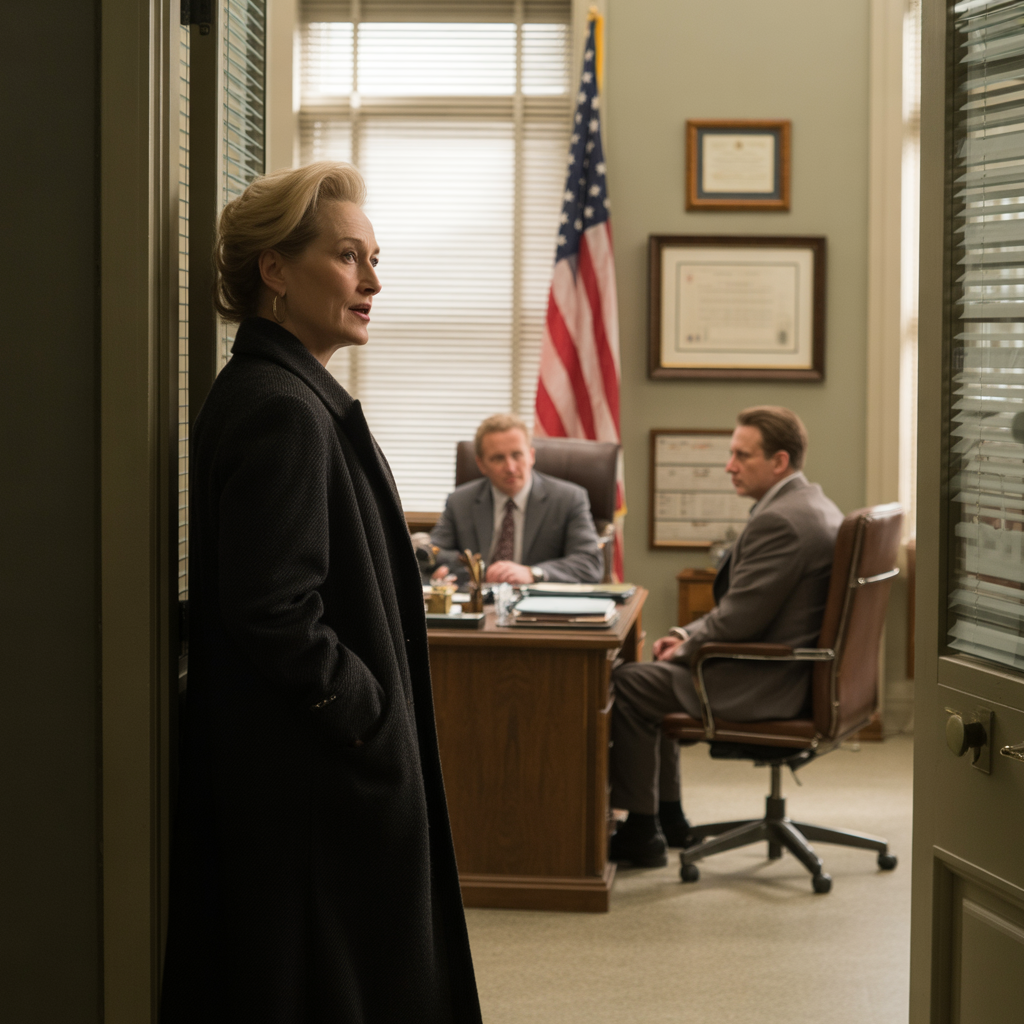
He said I was basically already gone. I heard it before I even stepped fully into the room, and for a moment, I honestly thought he was talking about someone else—an elderly patient, perhaps, or one of those cases lawyers whisper about with rehearsed sympathy.
But then he said my name. My name spoken as if I were a fading photograph, not a breathing woman standing in the doorway.
“Once she signs, the house is free,” my son told the lawyer. “She’s practically not there anymore. Mentally, emotionally, basically already gone.”
I felt something cold move up my spine, like a draft from a door I hadn’t noticed was open. He didn’t see me yet. Neither of them did. I stood there still as an old coat hanging on a hook, listening to my own son reduce me to a burden, an object, a piece of furniture he was eager to push out of the way so he could remodel the room.
The lawyer, a younger man with kind eyes that didn’t match his profession, hesitated. “Mr. Hail, I understand your concerns, but your mother is legally—”
That’s when I stepped forward. I didn’t plan it. My feet simply moved as if pulled by the last scrap of dignity I still had.
“Legally, what?” I asked, my voice quiet, but sharp enough to cut through the room.
They both froze.
Andrew’s head snapped toward me first. He went pale, the way people do when they’re caught saying the truth they never meant anyone to hear aloud. His mouth opened, but no words came out.
I walked toward the table, each step steady, though my heart was hammering like it hadn’t in years. I’d been a nurse for most of my life. I’d tended to dying men and screaming newborns. I’d held hands through pain worse than this. But nothing had prepared me for hearing my own child bury me while I was still on my own two feet.
The lawyer cleared his throat and stood up. “Mrs. Hail, I—”
“It’s all right,” I said, raising a hand. “You were doing your job. My son, on the other hand…”
I turned to Andrew. He couldn’t meet my eyes. That hurt in a way nothing else had. Cowardice always looks downward.
“Mom,” he finally muttered. “You weren’t supposed to hear that.”
“But I did.” I kept my voice calm, almost serene. Something in me had already begun to shift, settle, harden. “And I imagine it wasn’t the first time you said it. Just the first time I caught you.”
He sighed sharply. “You’re twisting things. I was just explaining that I’m—”
“Gone?” I tilted my head. “I drove myself here. I cook. I garden. I read. I pay my own bills. When exactly did I disappear, Andrew? What year? What day? I’d like to know when you stopped seeing me.”
Silence. Heavy. Thick. The kind that tastes metallic.
The lawyer murmured something about giving us privacy and slipped out. The door clicked behind him, leaving me alone with the man whose diapers I’d once washed by hand when we had no washing machine.
Andrew rubbed his forehead. “Mom, I didn’t mean it like that. I’m under pressure. The market is insane. The house is valuable. And you… you don’t use most of it.”
Ah, so that was it. Not my well-being. Not my future. Just square footage.
I nodded slowly. “I see.”
He relaxed a little, mistaking my calm for surrender. He had done that too many times in his life. Assumed quietness was weakness. That was his first mistake.
“Let’s go home,” he said softly, placing a hand on my arm. “We’ll talk later. You need rest.”
“Rest?” A word people use when they want you silent. I pulled my arm away. “No,” I said. “You go home. I’m going to take a walk.”
“At your age. Mom, this isn’t—”
“That,” I said, meeting his eyes for the first time since I walked in, “is the last time you speak to me as if I’ve already disappeared.”
He blinked, confused, annoyed, a child surprised the stove is still hot.
I walked past him, opened the door, and stepped into the hallway. My legs were trembling. My hands too, but not from age. Not from weakness. From something awakening.
By the time I stepped outside, the air felt sharper, almost new, as if the world had tilted slightly, revealing a path I hadn’t seen before. I wasn’t gone, but someone else was about to be gone from my decisions, my finances, my home.
He just didn’t know it yet.
The walk home felt longer than usual, though it was the same three blocks I’d crossed for 30 years. The same cracked sidewalks, the same sycamores leaning over the street like old neighbors, the same row of houses that had never pretended to be more than they were.
Yet somehow everything looked clearer, sharper, like my eyes had been rinsed in something bitter and honest. I stopped twice, not because I was tired, but because I needed to breathe through the shaking inside me. It wasn’t fear, not quite. Fear has a frantic edge. This was steadier, deeper, like the slow settling of heavy stones in a riverbed.
When I reached my porch, the wooden step groaned under my weight. George always promised he’d fix that step. Twenty years later, it still complains every time I come home. And I suppose today I complained right back.
I unlocked the door and stepped into the house. The air inside felt still, as if it had been holding its breath, waiting for me.
My house. My last real territory.
I put my purse down and stood in the middle of the living room, looking around with new eyes—the way you look at someone you’ve loved for decades and suddenly see the bruise on their cheek they’ve been hiding.
The quilt on the sofa. I sewed it when I was 42.
The ceramic lamp. A gift from my former patient.
The picture on the wall of George laughing with his head thrown back. God, how long has it been since I heard that sound?
If I’m basically already gone, then why does every inch of this place remember me better than my own son does?
I lowered myself into George’s old armchair. It welcomed me like it always did, the cushion dipping under my weight in a familiar way. I rested my hands on the armrests and noticed how they trembled.
My fingers have always been steady. Years of holding syringes and stitching wounds taught them discipline. But this was different. This was a shaking that came from a deeper place. The kind that comes after a truth you can’t unhear.
Basically already gone.
I whispered the words aloud, testing their weight. They didn’t break me. They didn’t even crack me. They only made me angrier, but in a quiet, almost peaceful way.
Anger at 74 isn’t loud. It doesn’t shout or throw things. It doesn’t pace the house or slam doors. Real anger—the kind that comes after a lifetime of swallowing smaller versions of it—sits down. It thinks. It remembers.
It remembers every bill I helped Andrew pay when he just needed a temporary boost. It remembers the down payment I made on his first house. It remembers looking after his children while he traveled for work, sometimes for months. It remembers how his wife once said, “I hovered too much,” when all I did was help.
And it remembers the last time Andrew hugged me. I think it was four years ago at Christmas, and even then it felt like he was already halfway out of the room.
I looked toward the kitchen doorway. For years I couldn’t walk into that room without thinking of George leaning on the counter, peeling apples in that slow, methodical way of his. But today the kitchen meant something else. It meant that I’d fed a family, loved a family, built one.
And the hands that did that were still strong enough to sign papers or refuse them.
The phone rang suddenly, making me jump. Andrew’s name glowed on the screen. I didn’t answer, not out of spite. I just didn’t have the strength to listen to excuses, explanations, soft little lies meant to smooth over the violence of what I heard in that office.
I let the phone ring until it stopped.
Then, in the quiet that followed, I realized something startling.
I didn’t owe him my fear.
I stood up slowly, moving toward the hallway. The house creaked. It does that sometimes, like it’s reminding me that everything old still has a voice. I passed the mirror on the wall and caught my reflection.
Not gone. Not fading. Not invisible.
My hair is white, my skin soft and lined, my shoulders not as straight as they once were. But my eyes were clear, steady, alive. I looked like a woman who’d taken care of countless people and forgotten somewhere along the way to take care of herself.
Not anymore.
I rested my palm on the photo of George at the end of the hall. His smile—warm, patient, knowing—met mine.
Sometimes I still talk to him. Not out of madness, but out of habit, out of love.
“What would you think of all this?” I murmured.
If he were here, he’d say what he always said when life grew cruel.
Stand up straight, Maggie. Don’t let them walk through you.
So I did.
I straightened my back, took a breath, and understood something with absolute clarity. Andrew may have planned my disappearance, but I was the one who would decide what in this life I surrendered and what I kept.
And I wasn’t giving up my home or my mind or my dignity. Not now. Not for him, not for anyone.
Sophia always knocked twice, softly, as if asking permission to enter my world. That afternoon, the sound came just as I was folding laundry, though I hadn’t told her I needed anything. She must have sensed something. She often did.
Some grandchildren inherit their grandparents’ eyes, some their gestures. Sophia inherited intuition, the kind you can’t learn.
“Grandma,” her voice drifted through the screen door. “Are you home?”
I wiped my hands on a towel and opened the door. The moment she saw me, her face changed. She could read me like a thermometer. A quick assessment: the stiffness around my shoulders, the quietness in my eyes, the small tremor in my fingers.
She stepped inside without waiting for an invitation and closed the door with unusual care, as if noise might make things worse.
“What happened?” she asked. No hesitation, no warm-up.
I sat down at the kitchen table. The room felt too bright, too clean for the kind of words I needed to say. Sophia took the chair opposite mine, leaning forward, elbows on her knees. Her hair, dark and thick like her mother’s, fell forward, framing her face.
I didn’t want to tell her. Not because I was ashamed, but because she was the only one in the family who hadn’t hurt me. I didn’t want to add weight to her shoulders.
But the truth has its own gravity.
“I went to see a lawyer today,” I began.
Her brows lifted. “About what?”
“Your father,” I said, “was there too.”
A shadow crossed her face, the kind that appears when a person already suspects the answer, but hopes they’re wrong.
I told her everything, not dramatically, not in a flood—just plain, steady facts. The simple cruelty of hearing my son speak of me as if I’d already disappeared, as if my presence was a technicality standing between him and a profitable sale.
When I finished, the room went quiet.
Sophia’s breath caught. She wasn’t crying. Not exactly. Her eyes shone, but in a way that was more anger than tears.
“He said that?” she whispered. “Dad actually said that about you.”
I nodded.
She sat back, exhaling slowly, her hands clasped together. Then she shook her head in disbelief.
“You know, I’d suspected… not this,” she quickly added, “but something. He’s been talking about the house a lot lately. Saying things like, ‘It’s too much for you,’ or, ‘It should be used for something productive.’”
“Productive?” she repeated, bitterness seeping into the word.
I swallowed. “Did he say anything to you directly?”
“Not to me.” She hesitated. “But he and Mom had a conversation last month. They didn’t know I was upstairs. She asked how long you’d be able to keep living alone. He said…” Her voice faltered.
“What did he say, dear?”
She met my eyes. She’s 23, but in that moment, she looked older—not aged, but awakened.
“He said he was sure you wouldn’t make a fuss because you were easy to manage. That you trusted him too much to ever push back.”
I felt something inside me tighten. Not break. No, breaking is sudden. This was slow. A tightening of the heart, the kind that comes when a fact you avoided looking at finally forces its way into the light.
“Grandma,” Sophia said softly, “you don’t deserve this.”
I managed a small smile. “I’ve lived long enough to know what I do and don’t deserve, but thank you.”
She reached for my hand, held it firmly. Her hands were warm, steady—hands of a young woman who still believes she can fix things. I envied that optimism even as I cherished it.
“What are you going to do?” she asked.
I looked toward the window. Outside, the late afternoon sun slanted across the yard, catching on the old swing Andrew used to sit on when he was little. He’d pump his legs so hard I’d worry he might fly right off into the sky.
Back then, his world was small and safe. I made it that way.
Now he was building a world where I no longer had a place.
“I’m not sure yet,” I answered. “But I know I can’t ignore this.”
Sophia squeezed my hand. “Do you want help? Because I’ll stand with you. I don’t care if he’s my dad. What he’s doing isn’t right.”
Her voice was steady, but her jaw trembled. Loyalty, love, anger—all tangled together.
I brushed her knuckles with my thumb. “I won’t put you in the middle.”
“I’m not,” she insisted. “He put me there years ago.”
I didn’t respond. Some truths don’t need an answer. They just sit between two people. Understood.
We sat in silence a while. She finished the last of the tea I’d poured without noticing. And then she stood, smoothing her coat.
“Grandma, if you ever need a lawyer or paperwork explained or anything, promise me you won’t go alone.”
I nodded slowly. “I promise.”
But even as I said it, I knew this was something I had to begin on my own. A woman can lean on love, but she must stand on her own feet when the ground shifts beneath her.
Sophia hugged me before she left, lingering longer than usual, the kind of hug that tries to hold someone together. When the door closed behind her, the house grew quiet again—too quiet, and yet not empty.
For the first time in years, resolve sat beside me like an old friend returning after a long absence.
Tomorrow, I told myself, I would take the next step, whatever it turned out to be.
I didn’t sleep that night, not because of fear and not even because of anger. It was something else entirely—a kind of alertness I hadn’t felt since my nursing days when a night shift meant every sound might be a call for help.
My body remembered that state well. Age doesn’t take everything.
By morning, I already knew I would see Andrew. Not to fight, not to plead. Just to look him in the eye and hear—truly hear—the man he had become, the one I apparently hadn’t noticed growing inside my own son.
He came earlier than expected. I’d barely finished making tea when I heard his car door slam. Not a polite closing, a slam—the kind that says a person has already decided he’s the victim in the story.
He didn’t knock. He never knocked. He pushed the door open the way people enter a house they believe they own.
“Mom,” he called out, his tone already carrying irritation. “We need to talk.”
I stayed at the kitchen table, hands wrapped around my cup. “Then come in,” I said.
He appeared in the doorway, tense, his shoulders squared in that defensive posture he’d developed after becoming successful. The suit jacket was too tight, the tie too sharp, the expression too practiced.
He looked at me with the same eyes he had as a boy. Only back then they held openness. Now they held calculation.
“You left yesterday without saying anything,” he began. “You just walked out. I’ve been trying to call.”
“I know,” I answered calmly.
He blinked, thrown off by my lack of apology. “Well, why didn’t you answer?”
“Because I didn’t want to.”
His jaw tightened. He wasn’t used to hearing no from me, not even small ones.
“Mom, this isn’t the time for stubbornness.”
“What you heard yesterday was what you meant,” I finished for him. “I don’t need a rephrasing. I heard you clearly.”
He let out a breath, annoyed. “You’re twisting my words. You always get emotional and make things big. I was just trying to explain the situation to the lawyer.”
“And the situation is that you think I’m already gone,” I said quietly. “Just a body in a house you want to sell.”
“That’s not fair,” he snapped, his voice rising. “You know damn well I care about you.”
I took a sip of tea. “How? In what way?”
He opened his mouth and closed it again, caught off balance. He hadn’t expected that question. Not the way I asked it.
“You’re alone in this big house,” he tried again. “You fall sometimes. You forget things. I’m trying to make sure you’re safe. The home we talked about.”
“The home you mentioned once in passing when you thought I wasn’t listening,” I corrected him. “You never asked me if I wanted that.”
“Well, maybe you don’t always know what’s best for you.”
Ah, there it was. The quiet cruelty behind the soft voice.
“How long have you been planning this?” I asked.
He looked away.
That was the answer.
“Andrew,” I said gently. “When did I stop being your mother and start being your inconvenience?”
He closed his eyes briefly as if gathering patience. “Mom, please don’t do this. Don’t make this dramatic. You’re 74. This house is old. It needs work. It’s better for everyone—”
“For everyone,” I asked, “or better for you?”
His silence was louder than an argument.
He sat down across from me, leaning forward. “Listen, if you sign the transfer, I can sell this place for a good price. You’ll get a room in a perfectly nice facility. You’ll have nurses, activities, people your age. You won’t have to worry about anything.”
“I’m not worried now,” I said. “I live in my own home. I take care of myself. I walk to the store. I bake. I read. I see Sophia.”
He frowned. “You’re being unreasonable. You’re acting like I’m trying to hurt you.”
A pause stretched between us.
“You are,” I said finally. “But I don’t think you realize it.”
He sighed sharply, pushing a hand through his hair. “Mom, I don’t have time for this. I’m trying to help you. Why can’t you see that?”
Because help is something offered, I thought, not forced, and certainly not dressed up as kindness when it’s just hunger for property.
I studied him for a long moment. The man in front of me wasn’t cruel in the way villains in stories are cruel. He was the real-life kind. The kind that grows from entitlement, convenience, long habits of taking without asking—the quiet kind that always expects someone else to bend.
I had bent all my life for him, for his children, for the idea of being a good mother, but something inside me had straightened.
“I am not signing anything,” I said.
His eyes snapped up. “Excuse me.”
“You heard me. I’m not signing my home away, and I’m not being moved anywhere.”
He stood abruptly, the chair scraping across the floor. “This is unbelievable. After everything I’ve done—”
“What have you done for me, Andrew?”
My voice wasn’t loud. It didn’t need to be. It landed like a stone dropped in water—quietly, but with ripples that went far.
He stared at me. I could see him searching for something to say, some memory, some gesture, some proof, and finding nothing. His silence said more than any admission.
“I see,” I murmured.
He grabbed his jacket. “We’re not done. You can’t make these decisions alone.”
“I’ve been making decisions alone for years,” I replied. “You just didn’t notice.”
He paused in the doorway, anger and disbelief tightening his face. “This isn’t over, Mom.”
But it was over. Not the situation, not the conflict, but something deeper: the version of me he thought he could manage. That woman was gone.
I turned back to my tea as the door slammed.
For the first time in decades, the silence that followed didn’t feel empty. It felt like space. Space to stand. Space to think. Space to act.
And I would act tomorrow.
The next morning, I woke up before the sun, not because of restlessness this time, but because something inside me had finally settled into a clear, steady line. It wasn’t anger anymore. It wasn’t fear. It was resolve—the kind that doesn’t shout, but moves your feet exactly where they need to go.
I dressed simply: gray slacks, a soft sweater, my warm coat. Clothes for a woman who means business but doesn’t need anyone to know it. I made tea, drank half a cup, and left it on the counter still warm when I picked up my purse.
I didn’t call ahead. People make fewer assumptions when you arrive unannounced.
The law office was quiet at that hour. A receptionist greeted me with a polite smile, the kind meant for clients who are expected, not for elderly women who walk in alone with steady eyes.
“Mrs. Hail, do you have an appointment?”
“No,” I said, “but your attorney, Mr. Rush, handled my husband’s probate years ago. I’d like to speak with him.”
Something in my tone must have told her not to argue. She nodded and disappeared down the hall.
When he came out, he recognized me instantly. “Mrs. Hail. It’s been a long time.”
He didn’t ask why I was there. Good lawyers don’t ask until you’re seated.
Inside his office, I took the same chair I’d taken twenty years ago when grief had made my hands cold and my voice thin. Today, my hands were warm, my voice steady.
“How can I help you?” he asked.
I looked directly at him. “I need to protect my home and my autonomy.”
His brows lifted slightly—not in surprise, more like confirmation, as if he’d seen this situation many times. The quiet ones where children become impatient and parents become vulnerable.
“Is someone attempting to pressure you into signing documents?” he asked gently.
“Yes.” There was no reason to soften the truth.
He nodded slowly. “Your son.”
“Yes.” Again, no surprise. Sometimes the simplest answers are the saddest.
“I see,” he said. “Then we need to put safeguards in place. First, let me explain your rights.”
And he did, plainly, cleanly.
He told me I had complete legal capacity unless a doctor declared otherwise, which no doctor had. He told me no one could force me to sign anything. He told me that verbal pressure, manipulation, and strategic planning behind my back—his words—were more common than anyone liked to admit.
“Do you want to restrict your son’s access to your legal matters?” he asked.
“Yes.”
He wrote it down without a flicker of hesitation. “Then we’ll start with revoking any implied authority he might attempt to claim, and we’ll document your wishes formally.”
I listened as he explained options. Durable power of attorney revoked. Medical decisions designated to a neutral third party if needed. Property secured. Future directives written clearly enough that no one could twist them.
When he finished, he sat back and studied me.
“Mrs. Hail, has he threatened you?”
“No,” I said. “Not directly, but he spoke as if my absence was a foregone conclusion.”
“And you are not ready to be absent,” he concluded.
A thin smile touched my lips. “No. I’m quite present.”
He nodded once, respectfully. “Good. Then we’ll keep it that way.”
We went through the paperwork slowly, not because my mind was slow, but because I wanted every line to settle into my bones. With each signature, I felt something loosen from my shoulders. Years of being the dependable one, the accommodating one, the quiet one.
When it was done, he gathered the documents and folded his hands.
“Your son may not take this well.”
“I’m not doing it for him,” I replied. “I’m doing it for me.”
He inclined his head as though acknowledging a truth too often spoken too late in life.
As I left the office, the receptionist smiled at me differently—not politely this time, but warmly, as if she’d seen a woman walk in uncertain and walk out standing taller.
Outside, the morning was cold enough to sting my cheeks. But I didn’t mind. I had my home. I had my voice. And now I had protection.
Andrew could plan whatever he wanted, but he wouldn’t be the one deciding my future. Not anymore.
When I got home from the lawyer’s office, I didn’t sit down right away. I walked from room to room, touching the backs of chairs, the edges of framed photos, the little wooden bowl George carved when he was learning to work with his hands.
I wasn’t stalling. I was preparing myself because the next step wasn’t emotional. It was practical. And practicality has a way of cutting deeper than any argument.
I went to the drawer in the hallway, the one I always kept too organized, almost out of habit. Inside were folders I’d labeled over the years: Utilities, insurance, house repairs, family support.
That last one, I realized, was the thickest.
I carried everything to the kitchen table and sat down. The chair creaked slightly, as if bracing itself for what was coming.
I opened the first folder.
Short-term loan, the note said in Andrew’s handwriting. Short term. That was twelve years ago. $4,000 for car trouble. He never paid it back.
Next: private school enrollment fee for my granddaughter before Sophia switched to public school because her mother said it was too stressful. I’d paid for the application, books, uniforms—almost $7,000.
I turned another page.
House emergency repairs: roofing, plumbing, windows sealed poorly after one of Andrew’s renovation projects went wrong. I had paid every invoice, every time.
Then, a thick envelope with a clipped stack of receipts: credit card debt consolidation. Andrew Hail.
He had cried on the phone that night. He said he was drowning. I wired the money before I even had time to think. It wasn’t the amount. It was the urgency in his voice. The way he said, “Please, Mom, it’s never been this bad.”
And now, years later, when I needed only respect—not money, not effort, not sacrifice—he spoke of me as though I were fading from the world.
I took a breath, slow and deep.
The next folder was heavier. Home projects. A new oven for him. A new water heater. His family trips. If you could help just a little, Mom, it would make the kids so happy.
A down payment he had covered. Except I was the one who covered it.
Thousands upon thousands of dollars scattered across years like breadcrumbs I’d left in the hope he’d find his way back to me.
But money has never been the bridge people imagine it to be. It’s more like a rope—one that eventually frays.
I sat there for nearly an hour, flipping through the quiet evidence of a lifetime of giving. It didn’t make me bitter. Not exactly. But it clarified things the way sunlight clarifies dust floating in the air, showing what has always been there, even when unseen.
Andrew didn’t become entitled overnight.
I helped him grow into it.
That truth was painful in its honesty.
I gathered the papers into neat stacks, not to put them away, but to remind myself that history existed—documented, and undeniable.
My phone buzzed. A message from Andrew.
Mom, call me. We need to straighten out yesterday.
Straighten out? As if I had been the one bending things.
I set the phone face down. I wasn’t ready to talk. I wasn’t done gathering my strength.
I opened one more folder, the one I kept almost hidden: George, estate, medical records, letters.
Inside were reminders of a man who saw me fully. A man who trusted my judgment, who never once made me feel like my mind was slipping away simply because I aged.
I touched the edge of a faded medical report from the night George died. I didn’t cry. Grief softens with time, becoming a familiar ache rather than a sharp wound.
But touching his handwriting—his lists, his notes—reminded me of who I used to be before I became just a supporting pillar in Andrew’s life. I used to be a woman with a spine, a woman who knew what was right and acted on it.
And she was coming back.
I closed the folder gently. Then I stacked everything—all the receipts, all the records, all the proof—into one box and placed it beside my chair. Not to confront Andrew with it. Not yet. But to remind myself that nothing I was doing was impulsive, nothing was petty, nothing was emotional revenge.
It was simply time to stop paying for a relationship that had long since stopped being reciprocal.
And the more I looked at that box, the easier the next steps became.
Andrew showed up two days later. I knew he would. His silence was never a sign of acceptance, only calculation. When he didn’t get his way immediately, he regrouped. That was always his pattern. Even as a child, he’d fold his arms, storm off, and return only when he believed the room was ready to agree with him.
But this room—my home—was no longer arranged for his comfort.
I saw his car pull up through the front window. He sat there for a moment, shoulders tight, rehearsing the version of himself he wanted to present. Then he got out and walked to the door, not briskly, but with that determined stride men use when they expect resistance and intend to crush it.
He didn’t knock again. Just opened the door and stepped inside like my house was a waiting room with his name on it.
“Mom,” he said sharply. “We’re talking now.”
I didn’t rise from my chair. I simply looked up at him.
“Hello, Andrew.”
He froze for a moment. The simplicity of my greeting threw him off. He had come expecting tears, frantic explanations, maybe even guilt, but I had washed all of that out of myself days ago.
He shut the door loudly, as if making a point.
“Why haven’t you returned my calls?”
“I wasn’t ready to talk.”
“That’s not how family works.”
I let that sit in the air, because if anyone had forgotten how family works, it wasn’t me.
He stepped closer, lowering his voice into what he must have believed sounded reasonable.
“Look, I know you’re upset. I should have phrased things differently at the lawyer’s office. Fine. But you walking out like that—it made everything harder.”
“For whom?” I asked.
He blinked. “For all of us.”
There it was again. That imagined collective he hid behind—us—as if I wasn’t part of that group anymore.
He pulled out a chair opposite mine and sat down abruptly. He didn’t ask permission. He didn’t even seem to consider he should. His entitlement wasn’t loud, but it was constant, steady, woven into his posture.
“Mom, you need to see this from a practical standpoint,” he said. “The house is too much. You can’t keep up with repairs. You shouldn’t be alone at night. I’m trying to plan ahead.”
“You’re planning for you,” I said. “Not for me.”
His jaw twitched. “I’m planning for all of us,” he repeated, irritated that I hadn’t accepted the script.
“Andrew,” I said quietly, “you spoke about me as if I were already gone.”
“I told you that came out wrong.”
“No,” I corrected him. “It came out honest.”
He stiffened, eyes narrowing. “Are you punishing me? Is that what this is?”
I almost laughed, not because it was funny, but because it revealed the core truth. The moment a dependent relationship shifts, the one who benefited feels injured.
“I’m not punishing anyone,” I said. “I’m protecting myself.”
He leaned forward, palms on the table. “Against your own son.”
“Against someone who doesn’t listen,” I replied. “Against someone who’s decided my future without asking if I had one in mind.”
He exhaled sharply, his frustration finally cracking through the polished tone. “Mom, don’t be dramatic. I’m trying to help you. But if you won’t even consider—”
“I have considered it,” I interrupted. “And my answer is no.”
“No to what?”
“To everything you’ve planned.”
His eyes flashed. A quick, sharp anger. The kind that doesn’t explode, but simmers.
“Mom,” he said slowly, “I don’t think you understand how serious this is. You can’t just make decisions like this alone. You need support. You need guidance.”
I met his gaze steadily. “I’ve been making decisions alone ever since your father died. I guided myself. I supported myself. You just didn’t notice.”
His mouth opened, closed. For once, he had no prepared comeback.
He tried a different tactic, softening his voice—a trick he’d used many times.
“I’m worried about you. I’m doing what’s best.”
“Is it best for me?” I asked. “Or best for you?”
Silence. A long one.
Then he stood abruptly as if the air had become too tight. “This isn’t over.”
“No,” I said calmly. “It’s beginning.”
He frowned. “What?”
But I didn’t clarify. Not today.
He left without another word, slamming the door hard enough that a picture frame rattled on the wall. I sat there long after the sound faded, letting the quiet settle around me like a shawl.
Years of habit pressed on me—the instinct to chase after him, to soothe, to explain, to smooth things over.
But I stayed seated, still rooted, certain.
I wasn’t the one who needed smoothing anymore.
And tomorrow, he would learn that my boundaries were no longer suggestions.
They were walls. Walls he could no longer walk through.
For three days, Andrew didn’t call. Not a message, not a visit, not a curt, We need to talk. He vanished into that busy, self-important silence he uses whenever he’s regrouping, when he’s building a new strategy.
And I knew him well enough to understand: a quiet Andrew was more dangerous than an angry one.
But on the fourth evening, I heard the familiar sound of his car door followed by quick footsteps on the walkway. Determined footsteps. Steps rehearsed for confrontation.
He didn’t knock. Of course, he didn’t.
He walked straight in. “Mom,” he said, breath sharp. “We’re done playing games.”
I was standing at the counter drying a plate. I didn’t hurry. I placed the plate on the rack, wiped my hands, and finally turned to him.
“I wasn’t aware we were playing anything,” I said.
He ignored that. His face was flushed, not with embarrassment, but with irritation—the kind that comes when someone accustomed to control suddenly meets resistance.
“I spoke with a colleague,” he said, “a financial adviser. He told me that if we don’t move quickly, this house will lose value. Repairs, insurance, maintenance. It’s all too much for you. And if something happens—”
“Nothing has happened,” I said quietly.
He raised his voice just a touch. “Not yet.”
There it was. Not a threat, but the shadow of one.
“Andrew,” I said, pulling out a chair. “Sit.”
He didn’t. Instead, he moved closer, standing over me the way men stand when they want the room tilted in their favor.
“Mom,” he said. “I’m trying to protect our future. Don’t make this difficult. You’re 74. Be reasonable.”
I let out a slow breath. Not shaky—measured.
“You talk as if my age erases my rights,” I said.
He stared at me for a long moment. Then something shifted in his expression. A flicker of cold honesty, too quick to hide.
“You can’t live here much longer,” he said. “This house is practically mine already.”
I felt the words land, but they didn’t pierce me. I’d expected them, prepared for them.
“Practically yours,” I repeated.
“You know what I mean,” he said impatiently. “The family home. You won’t need it forever. And you will—” he hesitated, not because he doubted himself, but because he hadn’t planned for me to question him so directly.
“This place,” he said, gesturing around the room, “is potential. You’re comfortable here, sure, but that doesn’t change reality. Eventually, you’ll need to move somewhere safer. And I’ll need space for my plans.”
Finally.
Finally.
The quiet truth behind all the excuses.
His plans.
Not my safety, not my comfort, not my dignity—his plans.
I nodded slowly, as if marking the exact moment his intentions took shape in full light.
“You’ve already decided my future,” I said. “Without me?”
“I’m trying to help you,” he insisted.
“No,” I said softly. “You’re trying to move me.”
He flinched. A tiny movement, barely visible. But I saw it.
“Mom,” he said, rubbing his forehead. “Don’t do this. You’re making everything harder. If you’d just cooperate—”
“I have cooperated for years,” I said.
He froze.
“For your mortgages, your debts, your home repairs, your children’s schooling,” I continued, my voice steady. “I cooperated when you needed loans, when you needed me to babysit for weeks at a time, when you needed a down payment, when you needed silence. But now, for the first time, I need something.”
“What?” he scoffed. “What could you possibly need that I haven’t tried to give you?”
I looked at him—really looked at him—and saw a grown man who had confused my kindness with weakness, my support with servitude, my love with obligation.
“I need you,” I said, “to stop treating me as if I’ve already disappeared.”
He exhaled through his teeth and stepped back, throwing up his hands.
“This is pointless,” he muttered. “Mom, you don’t understand what’s coming. If you refuse to sign, you’re putting everything at risk. The house, the finances.”
“No,” I said. “You’re the one at risk. That’s why you’re pushing.”
For one second—one quiet, fragile second—he didn’t speak. Then he said the line that told me everything.
“You’re being selfish.”
I almost smiled at the absurdity.
“Selfish?” I repeated, tasting the word.
After a lifetime of giving.
He opened his mouth, closed it again, then grabbed his coat with a sharp movement.
“We’ll talk when you calm down,” he said.
I shook my head. “No, Andrew. We’ll talk when you start listening.”
He didn’t answer. He stormed out, slamming the door with enough force to rattle the hallway picture frames.
When the house fell silent again, I stood there a long moment, feeling not fear, not defeat, but clarity.
He thought the fight was about a house.
He still didn’t understand it was about my life, and he certainly didn’t know that I’d already taken steps—quiet, deliberate, legal—to ensure that whatever he believed was practically his no longer would be.
The morning I went to set up the trust, the sky was overcast, the kind of gray that usually settled into my bones. But not that day. That day, the clouds felt like cover, a quiet shield while I stepped into the next part of my life.
I took the bus downtown. I didn’t want Andrew’s questions if he saw my car missing from the driveway. He’d begun driving by more often. I could feel him checking, measuring, waiting—a man watching a door he expected to open for him again.
But that door wasn’t opening.
The financial office was warm and smelled of polished wood. The adviser, a woman near my granddaughter’s age, stood when I entered.
“Mrs. Hail, please come in. You said you wanted to discuss a trust.”
I nodded. “Yes. For my granddaughter. It’s time.”
We sat down. She pulled out a folder, the crisp kind that makes people feel safe. I didn’t need safety. I needed structure, clarity—a future that wasn’t written by my son.
“Whom do you want to designate as the beneficiary?” she asked.
“Sophia Hail,” I said. The words felt steady and right. “She’s the only one I trust to handle what I leave behind.”
The adviser smiled gently.
“And do you want the trust to activate only after your passing or during your lifetime?”
“During,” I said. “Quietly.”
Her pen paused halfway down the page. Not judgment—just recognition. She’d heard this story before in different shapes: parents who’d been drained dry, grandparents who’d been cornered, elders suddenly treated like burdens instead of people.
She didn’t ask for details. I respected that.
She walked me through each form, each clause. My eyesight isn’t what it once was, but I read every line, tracing the language with my finger like a prayer. This trust would protect the money from Andrew. It would protect my home. It would protect my choices.
When we reached the final section, she looked up.
“This means your son won’t be able to contest access to your assets. Everything will be shielded under your granddaughter’s name. Are you sure you want this level of restriction?”
I thought of the words he said in the lawyer’s office.
She’s basically already gone.
I thought of him telling me I was being selfish for wanting agency over my own life. I thought of the house—my house—spoken of like a prize he deserved once I stepped aside.
“I’m sure,” I said.
I signed.
My hand didn’t shake.
When we finished, the adviser placed the documents in a neat envelope and slid them toward me.
“This is legally binding,” she said softly. “Your granddaughter will inherit control. Your son cannot override this without your explicit permission.”
I nodded, folding the envelope carefully and tucking it into my purse.
“Thank you,” I said. “You’ve helped more than you know.”
Outside, the air felt lighter even though the clouds remained. The bus ride home was quiet. But inside me, something hummed. Not excitement, not triumph, but steadiness. Alignment. The sense of a spine returning to its natural shape after years of bending.
Sophia didn’t know yet. I would tell her in time. But Andrew—Andrew must never know until the moment comes when knowing teaches him something.
As I stepped off the bus, my knees ached, my breath puffed in the cold, but nothing in me felt weak. I had taken back my life—not loudly, not dramatically, but with signatures written in clean blue ink.
And in that simple act, I was no longer a disappearing figure in my son’s plans.
I was present. I was rooted. I was unmovable.
The day after I signed the trust, I woke up with a surprising sense of quiet. Not peace. That would come later, I hoped, but clarity—a stillness inside me, like the house itself was holding its breath, wondering what I would do next.
I didn’t rush. I made tea, fed the birds, straightened the quilt on the sofa. Then I went to my desk, the small one under the window, and pulled out the stack of documents I hadn’t touched for years.
Bank accounts, automatic payments, insurance authorizations, old signatures granting Andrew temporary access, temporary management, temporary oversight—temporary.
And yet, like most temporary things, they’d lingered far beyond their welcome.
I took a pen, uncapped it, and began.
First, the bank authorizations. I revoked them one by one online and on paper. I changed passwords. I added two-factor verification. I removed his phone number as my backup contact. With every confirmation message, something inside me loosened. Not vindictively—simply rightly.
Next, the credit union account we once opened together when he said he wanted to help me organize expenses. I closed the joint feature, kept the account in my name only.
Then insurance. He had listed himself years ago as the primary emergency contact, a role he rarely fulfilled unless it benefited him. I changed it to my neighbor, a retired nurse I trusted far more with my well-being.
The final piece was the medical release form, the one that had allowed him to receive updates about my condition if anything happened. I read it twice. Then I tore it down the middle, and again and again, until it became a pile of harmless paper. I took out a fresh form and assigned the authority to no one for now.
I wasn’t rushing to replace Andrew with someone new. I would choose carefully when the time was right.
All of it—every change—felt like opening windows that had been nailed shut for years.
By noon, my hands were tired, but my mind was lighter. I stacked the revised documents neatly and slipped them into a new folder labeled Current, placing it at the front of my drawer. A small act, but symbolic. My life at the forefront again.
Just as I did, my phone vibrated. A message from Andrew.
We need to finalize the paperwork for the house. Let’s talk tonight.
There it was—the assumption, the impatience, the ownership disguised as concern. He thought the world had paused, waiting for his next instruction.
I didn’t answer, not out of spite. Silence was simply the most honest response.
A second message followed ten minutes later.
Mom, please be reasonable. I’ve already started discussions with a contractor. Don’t complicate things.
Contractor. He was already planning renovations on a home he didn’t own.
I set the phone down, face turned to the table. I wasn’t angry. Not anymore. Because now I had taken back every lever he once pulled without asking. Not one account, not one payment, not one signature was under his hand.
He didn’t know it yet, but the ground had shifted beneath him.
By evening, I received a third message.
Call me.
I didn’t.
Instead, I sat on the porch wrapped in a blanket, watching the sky darken. Cars passed, leaves rustled. Somewhere down the street, a dog barked at nothing.
For the first time in a long while, I wasn’t waiting for anyone. Not for permission, not for approval, not for understanding. I had made myself steady.
And when Andrew finally learned the truth—that his access was gone, his influence severed, his plans hollow—he would be forced to see me, not as a fading shadow, but as the woman who had quietly closed every door he assumed he owned.
I didn’t wait long.
The day after I ignored his third message, he arrived without warning again. But this time, he didn’t storm in. No—he walked slowly, deliberately, as if rehearsing calmness in the driveway. That alone told me everything.
He’d realized force wouldn’t work. So now he’d try persuasion. The gentler mask over the same intention.
He stepped into the kitchen while I was peeling potatoes. His voice was soft. Careful.
“Mom. We need to talk.”
I didn’t put the knife down. “Then talk.”
He exhaled, visibly, restraining himself. “I’ve been thinking. Maybe we both said things we didn’t mean.”
“I meant everything I said,” I answered.
He blinked. His smile faltered. “Okay. All right.”
He pulled out a chair and sat across from me. “Look, I don’t want us to fight. This isn’t good for either of us.”
A familiar phrase, the one he used during every disagreement from childhood to adulthood. This isn’t good for us meant, I need you to stop resisting me.
I peeled another potato. The skin curled away easily.
“Mom, can you look at me?”
I set the knife aside and raised my eyes slowly. He seemed relieved, as if the simple act of looking at him meant I was returning to my old self.
“Good,” he said softly. “Now we can get somewhere.”
He folded his hands like a man preparing to negotiate a deal.
“I understand you’re scared,” he began.
Wrong one.
“I’m not scared,” I corrected. “I’m aware.”
He paused again, recalibrating. “Fine. You’re overwhelmed. This is a lot for you to process. Lawyers, paperwork…”
“I handled all of it,” I said.
His lips parted slightly. “Handled? What do you mean handled?”
I wiped my hands and sat down across from him. I met his eyes.
“I met with my lawyer. We discussed everything.”
For a moment—just a flicker—a crack of worry slid across his face, but he hid it quickly.
“Mom, you didn’t need to do that,” he said gently. Too gently. “You should have waited for me. I would have helped you understand things.”
“I understand perfectly.”
He laughed under his breath, the way one laughs when trying to make someone feel small. “You think you do, but trust me, these processes are complicated.”
I leaned back. “They seemed very clear to me.”
Silence. A long one.
Then, cautiously: “What did you sign, Mom?”
There it was. The true question. The real fear.
“I signed protections for myself,” I said. “Revoked old permissions, cleaned up accounts, updated who can access what.”
His face drained of color. “Updated? Who can? Mom, what exactly did you change?”
“My life,” I said simply. “I changed my life.”
He stood up so fast the chair scraped the floor. “You can’t do that without talking to me.”
I looked at him the way I once looked at difficult patients—not unkindly, but firmly, with the understanding that their outburst said more about their fear than their anger.
“I don’t need your permission,” I said.
“You do,” he insisted, voice rising. “You absolutely do, because these decisions affect all of us.”
“No,” I said, shaking my head. “They affect me. Only me.”
He paced once, running his hand through his hair. The gesture he used when he was about to lose control.
“What about the house?” he asked sharply.
Not are you okay. Not what’s happening. Not can we talk.
The house. Always the house.
“It stays with me,” I said.
His jaw tightened. “Do you know what you’re doing? You’re ruining everything I’ve planned.”
“Yes,” I said quietly. “I know.”
He stared at me then. Really stared. As if trying to see the woman he had underestimated for so long, and he finally understood—at least for a moment—that she was gone, or maybe that she had never been here the way he imagined.
He pointed toward the door, trembling with furious disbelief.
“This conversation isn’t finished.”
“It is,” I said, and it was.
He left without another word, but not with the triumph he had expected. He left with fear in his eyes, because he had finally realized I was no longer his silent shadow.
I was standing in my own doorway, and he could no longer walk through me.
Sophia arrived that evening without calling first. I heard her gentle knock—two short taps, then one softer—the same pattern she’d used since childhood. It was the knock of someone who had never once demanded my door open, only asked.
I opened it and she stepped inside, her eyes searching my face before she even took off her coat.
“Grandma, I saw Dad. He looked…” She paused, trying to find the right word. “Angry, but also scared. Is everything okay?”
I motioned her to sit. “Everything is finally becoming okay.”
She sat across from me, folding her hands on the table. She had George’s steadiness in her posture—that grounded way of being present without crowding a person.
“What happened?” she asked.
I told her. Not the details she didn’t need—not the revocations, not the passwords, not the legal language. Only the heart of it.
“That part of my life where your father made decisions for me is over.”
Sophia listened with that deep, attentive quiet I’d always admired in her. When I finished, she didn’t rush to speak. She let the words breathe as if giving them room to settle into the air.
Finally, she reached across the table and took my hand.
“Good,” she whispered. “Gee, he’s been treating you like you don’t matter. And you do. You matter so much more than he realizes.”
Her voice trembled, not from fear, but from something that felt like relief.
“I was afraid you’d keep letting him handle everything,” she continued. “Afraid he’d push and push until you stopped fighting back.”
I smiled faintly. “He thought I already had.”
She shook her head, eyes bright. “People confuse quiet with weakening. You’ve never been weak. You just didn’t want to hurt him.”
That pierced deeper than she knew, because it was true. All these years, my silence had been an act of love—misread as surrender.
“Sophia,” I said gently. “I didn’t tell you this so you would choose sides.”
“I chose my side years ago,” she said. “I chose you.”
Her certainty warmed me more than any heater could.
For a moment, neither of us spoke. The house felt different with her in it—younger, lighter—not because she filled the space with noise, but because she made room for honesty.
She hesitated then, biting her lip.
“Grandma, what if Dad gets worse? What if he tries something desperate?”
“He might,” I admitted. “But I’ve protected everything that needs protecting.”
“You did it alone?” she asked, worry threading through her voice.
“Yes.”
She exhaled slowly, processing that. Then she leaned back, studying me—not like a child looking at an elder, but like a woman looking at another woman, measuring her strength.
“You know,” she said softly, “you look calmer than I’ve seen you in a long time.”
“I feel calmer,” I said. “Not because the situation is easy, but because I finally stopped stepping aside for someone who never looked where he was walking.”
Her smile was small, but full. “That sounds like something Grandpa would have said.”
I nodded. “He taught me more than I realized.”
She reached for her coat after a while, but before leaving, she turned in the doorway.
“If you ever need me,” she said, “day or night, I’ll come.”
“I know,” I replied. “But this part, I must finish myself.”
She seemed to understand. She gave a small nod and left, closing the door gently—a softness Andrew had never learned.
When silence filled the house again, it didn’t feel heavy. It felt companionable.
I had my granddaughter’s trust. I had my own resolve. And soon Andrew would learn that love does not grant ownership. And age does not erase autonomy.
I sat down, wrapped my shawl around my shoulders, and let the calm settle deeper into my bones. Tomorrow, I thought, would bring whatever it brought, and I would be ready for it.
Andrew returned three days later.
I sensed him before I heard him. That particular tension in the air, the way the floorboard seemed to brace a little under my feet, as if the house itself recognized his steps. Not anger this time—something heavier, more purposeful.
He didn’t barge in. He knocked. For the first time in months, he actually knocked.
When I opened the door, he stood there with his shoulders squared, chin tight, eyes red from lack of sleep. A man who felt the ground shifting beneath him and didn’t yet know how to steady himself.
“Mom,” he said. “We need to talk.”
I stepped aside. “Then come in.”
He walked into the living room, but he didn’t sit. He stayed standing, pacing a little, trying to gather his thoughts. Finally, he turned to me.
“I talked to the bank,” he said.
My pulse didn’t change. “Did you?”
“Yes. And they told me I’m no longer listed on anything. Not the accounts, not the authorizations, nothing.” His voice tightened. “What did you do? What did you do?”
“What I needed to.”
“That’s not an answer,” he snapped, then caught himself and took a breath. “Mom, this is serious. You can’t just cut me out of your finances.”
“I can,” I said, “and I did.”
He took a step toward me. Then another.
“Why?”
The word hung between us. Not gentle, not pleading— incredulous, as if he truly couldn’t grasp the concept of me acting without him.
“Because you were using my access against me,” I said. “Because you planned my future without asking if I wanted it. Because you treated my life as a loose thread to be trimmed.”
His jaw flexed. “I was trying to help you.”
“No,” I said. “You were trying to manage me.”
He laughed short, bitter. “Is that what Sophia told you?”
“She didn’t need to,” I replied. “You said it yourself over and over.”
His face darkened. “So that’s it? You’re choosing her over me?”
“I’m choosing myself,” I said calmly.
He looked startled, as if the idea had never occurred to him—that I had a self to choose.
He ran a hand through his hair. “Mom, listen. You’re making a huge mistake. You know you can’t keep track of all that paperwork. You know the house is too much. And now you’ve cut me out. What if something happens to you? What then?”
“I’ll handle it,” I said.
“You can’t,” he burst out. “You’re not—”
He stopped. Too late. But the unspoken word echoed anyway. Capable. Sharp. All there.
I looked at him a long moment.
“Say it,” he swallowed hard.
“No,” I said. “Say it.”
But he couldn’t. Not because he felt shame, but because saying it aloud would make it real, no longer disguised as concern.
“Mom,” he tried again, softer now, almost desperate, “you’re putting me in an impossible position. I’m your son. I’m responsible for you.”
“No, Andrew,” I said, my voice steady as stone. “You’re responsible for your life. I’m responsible for mine.”
His face contorted with frustration. “I don’t understand why you’re doing this.”
“Because you forgot I’m alive,” I said. “You acted like I was already fading, already leaving, and you built your plans on that assumption.”
He stared at me, breathing hard. Finally, he spoke the line he’d come here to deliver, the one he’d been building toward with all his pacing and anger and disbelief.
“If you don’t give me access back,” he said quietly, “I won’t be able to take care of you when you need it.”
I didn’t flinch.
“Then I’ll take care of myself,” I said.
His eyes widened, not with anger, but something closer to fear. Because for the first time, he truly believed me.
He took a step back as if the air between us had shifted.
“This isn’t how families work,” he whispered.
“No,” I agreed. “But it’s how boundaries work.”
He stood there another moment, searching my face for the softness I’d always given him, but I wasn’t offering softness—not cruelty, just truth.
He finally turned toward the door. “We’ll finish this conversation later,” he said.
“No, Andrew,” I said. “This time you won’t decide when the conversation ends.”
He stopped but didn’t look back. Then he left, closing the door quietly. Too quietly for a man who believed he still had control.
I stood there, hands steady, heart steady. He had tried manipulation. He had tried pity. He had tried authority. None of it worked anymore.
And he knew it.
That was what frightened him most.
I had known for weeks that this moment would come. The moment when everything quietly arranged behind closed doors would need to be spoken aloud, stamped, witnessed.
I didn’t dread it. In some strange way, I even welcomed it. There is relief in truth when you no longer fear the echo it leaves behind.
My lawyer, Mr. Rush, scheduled the meeting for Friday morning.
“Your son may come,” he warned gently. “He has a right to ask questions, but not to interfere.”
I nodded. “Let him ask.”
The office was calm when I arrived. Soft lights, a faint smell of printer ink and polished wood. Familiar now—a space where my voice had begun returning to me piece by piece.
I sat across from Mr. Rush as he laid out the documents: the trust for Sophia, the revocation of all prior permissions, the declaration of full legal capacity, the notarized statement outlining my wishes regarding my home and personal autonomy—everything in clean type, without sentiment, but full of backbone.
We were halfway through reviewing them when the door opened sharply.
Andrew.
He walked in with a controlled urgency, the kind used by people who believe arriving late still gives them authority. He didn’t look at me right away. He looked at the documents, at the lawyer, at the empty chair beside me, then finally at my face.
“Mom,” he said. “What are you doing?”
I gestured to the chair. “Sit.”
He didn’t. He stayed standing like a man trying to loom over the outcome.
Mr. Rush adjusted his glasses. “Mr. Hail, your mother is here to finalize several legal directives. You’re welcome to listen, but she alone will be making decisions.”
Andrew’s nostrils flared. “She doesn’t understand what she’s signing.”
I spoke before the lawyer could. “I understand exactly what I’m signing.”
He turned to me, voice low but sharp. “Mom, please think about this. You’re cutting your own son out.”
“I’m setting boundaries,” I corrected. “It’s long overdue.”
“This isn’t you talking,” he said. “Someone got in your head. Who? Sophia.”
I shook my head slowly. “No one got in my head. I finally cleared it myself.”
He ran a hand through his hair, pacing once. “Mom, this is insane. You’re creating legal barriers for no reason. We’re family.”
“Families,” I said quietly, “don’t make plans for each other’s disappearance.”
He stopped pacing.
I watched something shift in his expression—first defiance, then confusion, and just briefly, something that looked like fear.
Mr. Hail, the lawyer said, keeping his tone neutral, “your mother is fully competent. We conducted a cognitive assessment. She scored above average. She understands every clause.”
That silenced him.
For a long moment, he simply stared at me, searching for weakness. Some hint I might waver. He found none.
“Mom,” he tried again, softer now. “Once you sign these, I won’t have any legal involvement. None. Not with the house, not with your finances, nothing.”
“I know,” I said.
“And you’re okay with that?”
“I’m relieved by it.”
He swallowed hard. It hurt him—not because he lost access, but because he finally realized he’d lost trust. The thing he thought he could always reclaim with a few soft words.
“Let her continue,” I told the lawyer.
And so he did.
I signed my name. Steady strokes, no tremor. Each signature felt less like a rebellion and more like a return. My hands remembered themselves. My spine remembered its shape.
When the last page was complete, Mr. Rush gathered everything and stamped it.
“Legally finalized,” he said.
Andrew let out a breath, shaken, angry, but also stunned, as if he’d never believed I would go this far. As if the mother he knew would always yield in the final moment.
But that mother was done disappearing.
I stood, put on my coat, and looked at him with the softness I still had—softness that had nothing to do with surrender.
“Andrew,” I said quietly. “I’m your mother, not your possession. You don’t get to organize my ending.”
He opened his mouth, but nothing came out.
I walked past him toward the door, the papers safe in my bag. For the first time, he didn’t follow me. He didn’t argue. He simply stood there, watching a woman he never truly knew walk out of a room he once believed he controlled.
I didn’t look back. I didn’t need to.
The morning after the documents were signed, the house felt different. Not larger, not quieter—simply mine again. Not a place waiting to be emptied. Not a structure my son measured in resale value.
Just a home. A place that had held me, witnessed me, carried decades of my breath and my grief and my laughter.
For the first time in years, I sat at my kitchen table without glancing at the door, anticipating the next request, the next interruption, the next: Mom, I need you to sign something.
That part of my life was done. Folded shut like an old letter.
The kettle whistled softly. I poured myself tea, the steam rising in gentle curls. No urgency, no heaviness, no audience—just a woman in her 70s, sitting in her home on a quiet morning, knowing she had reclaimed something essential: ownership of her own life.
I walked to the porch, wrapped in my cardigan, and sat in the old rocking chair George once repaired using nails that never matched. The wood creaked under me, easing into its familiar rhythm.
I breathed in. The air had that crispness early mornings sometimes carry—the kind that feels like truth, unadorned and unafraid.
Across the street, Mrs. Callahan watered her begonias. A dog barked at a passing car. A teenager rode by on a bike too small for him. Ordinary things. Beautiful things. Alive things.
Not one of them belonged to Andrew’s plans.
A car slowed near my driveway. For a moment, I thought it was him. My heart didn’t jump. It simply waited. But the car rolled past without stopping.
I exhaled.
He would come eventually. Not today. Perhaps not tomorrow. But someday soon, he would knock. Maybe with apology, maybe with accusation, maybe with a silence too full to name.
And by then, the truth would already be settled. He could visit my life, but he could no longer rearrange it.
I wasn’t angry with him anymore. Anger takes too much space. What I felt now was something steadier: a firm, quiet boundary, a line drawn not out of spite, but out of self-respect.
When Sophia arrived later that afternoon, she didn’t ask many questions. She simply sat beside me, her shoulder brushing mine, her presence warm and gentle.
“Are you okay, Grandma?” she asked softly.
“I am,” I said. “And I meant it.”
“Did it feel heavy signing everything?”
“No,” I said. “It felt like standing up.”
She smiled then—that small aching smile young people get when they see strength in someone they worry about. She leaned her head lightly against my shoulder.
“You taught me something,” she murmured.
“Oh, and what is that, dear?”
“That a woman doesn’t disappear just because someone decides she should.”
I reached over and took her hand. Her fingers curled around mine immediately.
Inside the house, the clock ticked. Slow, even, unhurried. Time moving forward, not taking anything from me—just carrying me with it.
Age does not diminish a person. Silence does not erase them. Love does not require surrender. And dignity is not something someone gives you. It’s something you refuse to give away.
When Sophia left, she kissed my cheek and said, “Call me if you need anything.”
I nodded, but I knew the truth.
I finally had myself, and that was enough.
As evening settled in, I made one more cup of tea and stood at the window, watching the last light fade over the yard. The world outside kept moving slowly, tenderly.
And I stood with it, steady on my own feet—not gone, not fading, not basically already anything.
Here. Present. Living.
And I hoped quietly that anyone reading my story—any woman who had ever felt herself pushed aside, overlooked, spoken over—might feel the same.
You are not gone. You are not done. Your voice still belongs to you.
If this story touched you, if it reminded you of your own strength, stay, follow, keep reading.
There are so many more voices like mine and so many women who deserve to hear theirs again.