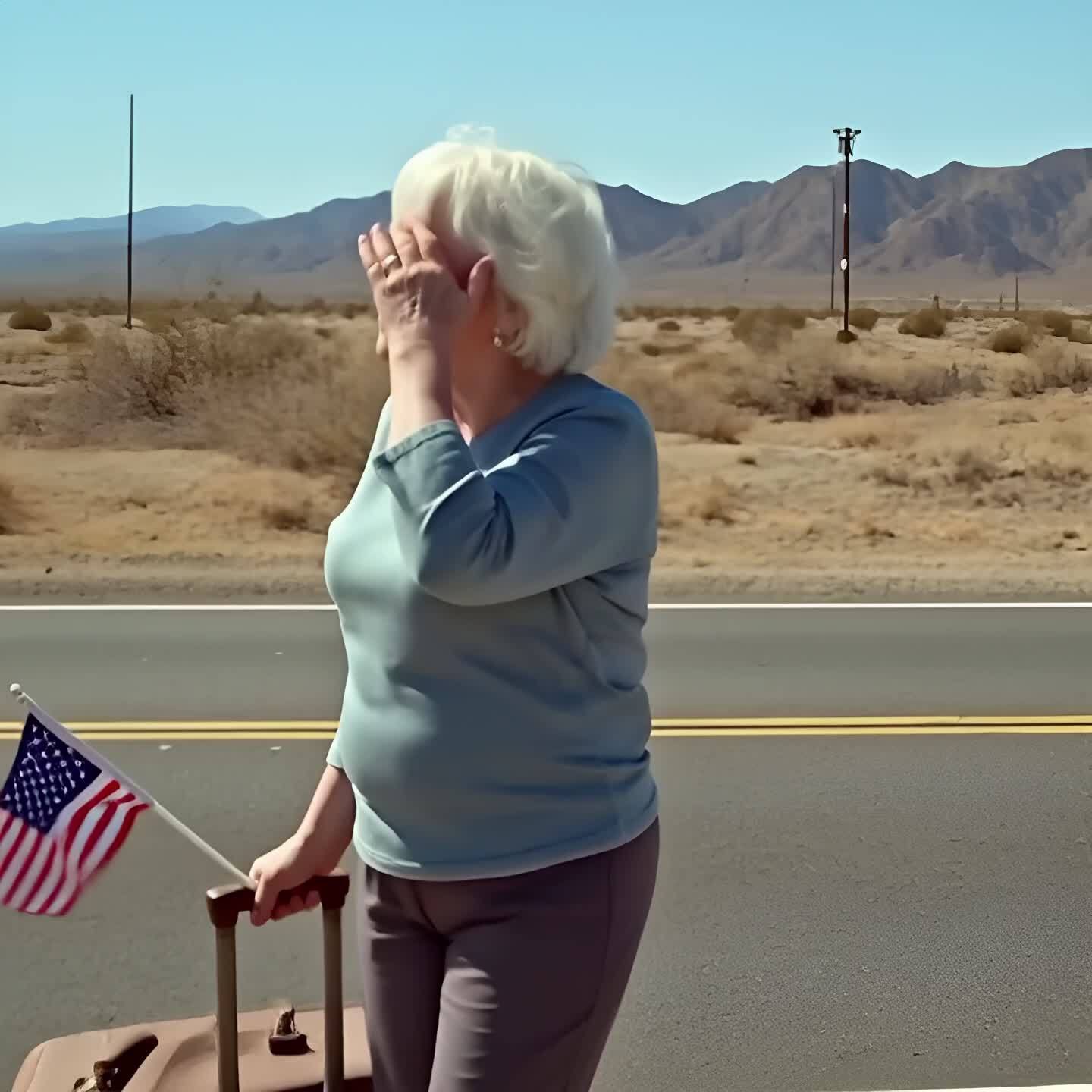
A family road trip is supposed to be a time of bonding and togetherness, creating memories that last a lifetime and strengthening the connections between generations. But for me, at sixty-eight years old, what should have been a pleasant Sunday drive to the countryside became the single moment that shattered my trust in my own family and altered the course of my life forever.
My name is Margaret Thornton, and this is the story of how my son’s family abandoned me on the side of a highway—and how I made absolutely certain they would never forget the consequences of that decision.
It was supposed to be such a simple, lovely thing: a drive to the countryside with my son David, his wife Jessica, and their two teenage children, Emma and Tyler. They’d invited me to join them for what Jessica described as “a beautiful fall foliage tour through the mountains, just a nice family day together.” She’d been so enthusiastic on the phone, insisting that the kids really wanted their grandmother along, that it had been too long since we’d all spent quality time together.
I should have known something was wrong. Jessica was never enthusiastic about including me in anything.
But I was lonely. I’d been a widow for six years, living alone in the same house where I’d raised David, and the invitation felt like an olive branch I desperately wanted to accept. So I said yes, packed a small bag with snacks and my medication, and waited excitedly for them to pick me up that Sunday morning.
They arrived exactly on time—9:00 a.m.—with David driving their SUV, Jessica in the passenger seat, and the teenagers plugged into their phones in the back row. I climbed into the middle row, settling in between Emma and Tyler’s sullen silence and the tension I could already feel radiating from the front seats.
“Thanks for inviting me,” I said warmly, trying to inject some enthusiasm into the cold atmosphere. “It’s such a beautiful day for a drive.”
“Mm-hmm,” Jessica responded without turning around.
David met my eyes briefly in the rearview mirror but said nothing.
The first hour passed in uncomfortable near-silence, broken only by occasional navigation instructions from Jessica’s phone and the teenagers’ whispered conversations that I couldn’t quite hear. I tried making conversation several times—asking about school, about David’s work, about their plans for the holidays—but received only monosyllabic responses that made it clear my attempts at connection weren’t welcome.
We stopped once at a gas station about ninety miles from the city. David filled up while Jessica took the kids inside for snacks. I stayed in the car, my knees aching from sitting in the same position too long, wondering why this trip felt so different from what I’d imagined.
When they returned with fountain drinks and chips—nothing offered to me, I noticed—we continued driving deeper into the mountains, the roads becoming narrower and less populated with each passing mile.
That’s when I heard Jessica whisper something to David that I wasn’t meant to catch: “Just a little further. The spot we talked about.”
My stomach tightened with an instinct I didn’t yet want to acknowledge.
Twenty minutes later, David suddenly pulled over onto a wide shoulder next to what looked like a hiking trail entrance. The area was completely deserted—no other cars, no buildings, nothing but dense forest on both sides of the two-lane highway.
“Mom,” David said, and his voice sounded strained, artificial, like he was reading from a script he didn’t believe in. “We need you to get out here.”
I laughed, thinking it must be a joke, some kind of misunderstanding. “What? Why? Is something wrong with the car?”
“Just get out,” Jessica said sharply, turning to look at me directly for the first time all morning. Her face was set in an expression of cold determination I’d never seen before.
“I don’t understand,” I said, genuine confusion mixing with the first threads of real fear. “What’s happening?”
“Mom, please don’t make this harder,” David said, still not meeting my eyes in the mirror. “Just… we need you to get out of the car. Now.”
Emma and Tyler had gone completely silent, both staring determinedly at their phones, their faces carefully blank.
My hands started shaking as I reached for the door handle. “David, sweetheart, I don’t understand what’s happening. Did I do something wrong? Are you angry about something?”
“Out. Now.” Jessica’s voice could have frozen water.
I climbed out of the SUV on trembling legs, still clutching my handbag, my mind racing to make sense of what was happening. This had to be some kind of misunderstanding, some explanation that would make everything clear and normal again.
But as soon as my feet hit the gravel shoulder, Jessica reached back and slammed the door shut.
“Wait!” I called out, rushing toward the driver’s window. “David, please, what is this about? At least tell me—”
The engine roared to life.
“David!” I screamed, genuine panic flooding through me now. “You can’t just leave me here! I don’t have my phone—it’s in my bag in the trunk! I don’t—”
The SUV lurched forward, tires spitting gravel.
I ran after it for a few desperate steps, my sixty-eight-year-old legs no match for the accelerating vehicle, watching in absolute horror as my son—my only child, the boy I’d raised alone after his father died, the child I’d sacrificed everything for—drove away without a single backward glance.
As the car disappeared around a curve in the highway, I stood there on that deserted shoulder, my handbag clutched to my chest, my mind completely unable to process what had just happened.
How could my own family—people I had supported and loved unconditionally for nearly seven decades—abandon me in such a heartless, calculated manner?
The betrayal cut so deep it felt physical, like a knife twisting in my chest.
I looked around desperately. No cars coming from either direction. No houses visible. No pay phone (did those even exist anymore?). Nothing but forest and empty highway and the sound of birds calling from the trees.
My phone, I remembered with rising panic, was in the overnight bag they’d told me to pack “just in case we decide to stay somewhere overnight.” That bag was in the trunk of David’s SUV, now miles away and getting further with every passing second.
I had my handbag with my wallet, my keys to a house forty miles away, a half-empty bottle of water, my medication, and exactly nothing that could help me in this situation.
For the first five minutes, I simply stood there in shock, waiting for them to come back. This had to be some kind of cruel joke, some misguided prank that would end with David pulling a U-turn and apologizing profusely for scaring me.
But ten minutes passed. Then twenty. Then an hour.
No one came back.
I tried flagging down the few cars that passed, but on a Sunday morning in the mountains, traffic was sparse. Three vehicles drove past without stopping, their drivers probably not even seeing the elderly woman standing on the shoulder, or perhaps seeing her and choosing not to get involved.
Finally, a pickup truck slowed down. An older man, probably in his seventies, rolled down his window with a concerned expression.
“You alright, ma’am? Car break down?”
“My family left me here,” I said, and hearing the words out loud made them real in a way they hadn’t been before. My voice broke. “They just… they drove away and left me.”
His weathered face showed shock and then deep compassion. “Get in. I’ll take you wherever you need to go.”
His name was Frank, and he was a retired contractor heading home from his daughter’s house. He listened to my halting, confused explanation as he drove, his expression growing darker with anger on my behalf.
“That’s elder abuse,” he said bluntly. “What your son did—that’s illegal. You could press charges.”
“He’s my son,” I whispered, still not quite believing this was real.
“He’s a criminal,” Frank corrected gently. “Family or not.”
He drove me all the way back to the city, refusing my offers of gas money, and made sure I was safely inside my house before he left. He pressed a business card into my hand with his daughter’s phone number on it.
“If you need anything—a witness statement, someone to talk to, anything—you call that number. My daughter’s a lawyer. She’ll help you.”
I thanked him through tears and watched him drive away, this stranger who’d shown me more kindness in two hours than my own family had in… how long had it been? Years, I realized. Years of subtle coldness, of excuses for why I couldn’t visit, of holidays spent alone while they celebrated “just our immediate family.”
This hadn’t been a sudden impulse. This had been planned.
Once inside my house—the same house where I’d raised David as a single mother after my husband died when David was only twelve—I sank onto the couch and finally let myself cry. Deep, wrenching sobs that came from a place of profound betrayal and loss.
But underneath the grief, something else was forming. Something cold and hard and absolutely certain.
I was done being the convenient doormat. Done being the burden they clearly saw me as. Done accepting crumbs of affection and pretending it was enough.
In the days that followed, I had plenty of time to reflect on my situation and on the pattern I’d been too close to see clearly.
After my husband died sixteen years ago, I’d poured everything into David. I’d worked two jobs to put him through college. I’d helped with the down payment on his first house. When that marriage fell apart, I’d been there to support him emotionally and financially. When he married Jessica five years later, I’d welcomed her with open arms despite her obvious coolness toward me. When the kids were born, I’d provided free babysitting for years, rearranging my own life to accommodate their schedules.
And three years ago, when David and Jessica were struggling financially after David’s business venture failed, I’d made what I thought was a generous offer: I would buy them a house outright, allowing them to live there rent-free while they got back on their feet financially. The house would remain in my name for tax purposes and asset protection, but they would have complete use of it as their family home.
They’d accepted immediately, with effusive thanks and promises that this was temporary, that they’d buy it from me properly once David’s new job stabilized their income.
That was three years ago.
They’d never mentioned buying the house again. They’d settled in, renovated with money I suspected came from somewhere I didn’t want to think about, and treated it as their own property while I continued living alone in my much smaller, older house across town.
And now, sitting in my living room, still shaken from being abandoned on a highway, I finally understood what I’d been too naive to see: I wasn’t their beloved mother and grandmother. I was a resource to be used and discarded when convenient.
The house I’d bought them—the four-bedroom colonial in a good school district, currently worth about $650,000—was legally mine. Entirely mine. I had the deed, the title, all the documentation.
I called Frank’s daughter, the lawyer. Her name was Patricia, and she listened to my story with professional calm before confirming what I’d already suspected.
“You have every legal right to sell that property,” she said. “It’s in your name. They’re essentially tenants at will. You’ll need to give them proper notice—typically thirty days in this state—but yes, you can absolutely sell it.”
“Even though they’re family?”
“Especially because they’re family who abandoned you on a highway,” Patricia said with barely contained anger. “Mrs. Thornton, what they did was criminal abandonment of a vulnerable adult. You could press charges.”
“I don’t want to press charges,” I said slowly, the plan forming clearly in my mind now. “But I do want to sell the house.”
“Then that’s exactly what we’ll do.”
The decision to sell wasn’t made out of pure spite, though I won’t pretend spite wasn’t a factor. It was a response to a deep-seated hurt and the realization that sometimes, drastic actions are necessary to reclaim one’s dignity and self-respect.
If my son could coldly plan to abandon me on a highway, then I could coldly plan to sell the house I’d bought for him.
I hired Patricia officially. She drafted the required thirty-day notice to vacate, which she hand-delivered to David and Jessica on a Tuesday afternoon when she knew they’d be home.
My phone rang approximately six minutes later.
I let it go to voicemail.
David’s message was panicked and angry in equal measure: “Mom, what the hell is this? A notice to vacate? You can’t be serious. Call me back immediately. We need to talk about this.”
I deleted it without responding.
Jessica called next: “Margaret, I don’t know what you think you’re doing, but you can’t just kick us out of our home. We have children. We have rights. Call us back and we’ll figure this out like adults.”
Our home, she’d said. Not your house that you generously let us use. Our home.
I deleted that message too.
Over the next week, I received forty-seven phone calls, thirty-two text messages, and one visit where they rang the doorbell for twenty minutes while I sat silently in my living room, waiting for them to leave.
I responded to exactly none of it.
Instead, I worked with Patricia and a real estate agent to list the property. We priced it competitively—$625,000, slightly below market value for a quick sale.
It sold in four days.
The buyers were a young family with three children who fell in love with the house immediately and paid cash, closing in just two weeks.
David and Jessica had thirty days from the notice to vacate. They used twenty-nine of them, clearly hoping I’d relent, change my mind, respond to their increasingly desperate messages.
I didn’t.
On day twenty-nine, a moving truck appeared in front of the house. Through my lawyer, I learned they’d found a rental apartment across town—much smaller, much less nice, in a school district that wasn’t nearly as good.
On day thirty, Patricia conducted the final walk-through to ensure they’d actually left. They had, though they’d stripped the house of every upgrade they’d installed—light fixtures, the expensive appliances, even the custom closet organizers.
“Petty,” Patricia noted, “but technically legal since they installed those themselves.”
I didn’t care. The house sold to the new family exactly as specified in the contract, and any deficiencies came out of the final walk-through contingency funds, not my pocket.
The closing happened on a Friday. I received a check for $612,000 after fees, taxes, and Patricia’s legal costs.
That evening, my doorbell rang again.
This time, I answered.
David stood there alone, looking haggard and years older than the last time I’d seen him. No Jessica, no kids. Just my son, the person who’d driven away and left me stranded on a highway.
“Can I come in?” he asked quietly.
I stepped aside.
We sat in my living room, the same room where I’d comforted him after his father died, where I’d helped him with homework, where I’d celebrated every achievement and consoled every disappointment.
“Why?” he asked simply.
“Why did I sell the house?” I asked. “Or why didn’t I respond to your calls?”
“Both. All of it. Mom, you destroyed us. Do you understand that? We have no equity, no stability. The kids had to change schools. Jessica is barely speaking to me because I convinced her the house was secure—”
“Stop.” My voice was calm but firm. “You destroyed yourself, David. You and Jessica made a choice on that highway three months ago. You planned it, discussed it, drove to a specific location, and deliberately abandoned your elderly mother on the side of the road with no phone, no way to contact help, nothing.”
“That was—” he started, but I cut him off.
“That was what, exactly? A momentary lapse in judgment? A mistake? David, you PLANNED it. Jessica mentioned ‘the spot we talked about.’ This wasn’t impulsive. This was calculated abandonment.”
He looked down at his hands.
“Why?” I asked, the question I’d been holding for three months. “Why did you do it?”
The silence stretched for a long moment before he finally spoke.
“Jessica convinced me you were becoming a burden,” he said quietly. “She said you were getting too old, too needy, that we needed to establish boundaries before you became our responsibility. She suggested that if we… if we made it clear we couldn’t be relied on to take care of you, you’d make other arrangements. Find a retirement community or something.”
I stared at him. “So you abandoned me on a highway. That was your boundary-setting strategy.”
“It was supposed to scare you,” he admitted, shame heavy in his voice. “Teach you to be more independent. Jessica said—”
“I don’t care what Jessica said,” I interrupted. “You’re a grown man, David. You made a choice. You chose to prioritize your wife’s cruelty over your mother’s safety. You chose to commit what is, by the way, a criminal act of elder abuse.”
His head snapped up. “What?”
“I spoke with a lawyer. What you did is legally classified as abandonment of a vulnerable adult. I could have pressed charges. I could have had you arrested.”
The color drained from his face.
“But I didn’t,” I continued. “Because you’re my son, and despite everything, I don’t want to see you in jail. What I wanted was for you to understand that actions have consequences. That you can’t treat people—treat your own mother—as disposable and expect no repercussions.”
“By taking our house,” he said bitterly.
“By taking MY house,” I corrected. “The house I bought with MY money. The house you were living in rent-free for THREE YEARS while I continued paying the property taxes and insurance. The house you never once offered to actually purchase from me as originally discussed.”
He had nothing to say to that.
“I provided for you your entire life,” I said, and my voice cracked despite my efforts to stay controlled. “I worked two jobs after your father died to give you opportunities. I helped you financially over and over again. I bought you a house when you were struggling. And the moment I became inconvenient, you literally threw me away on the side of a highway.”
“Mom—”
“I’m not finished,” I said. “You want to know why I sold the house? Because I finally understood that I was enabling you to treat me like garbage. I was rewarding your cruelty with generosity. And I decided I was done.”
“So what now?” he asked. “You’ve made your point. You’ve punished us. What happens now?”
I looked at my son—this man I’d raised, this person I’d loved more than anything—and felt a profound sadness for what we’d lost.
“Now you rebuild your life without using me as a safety net,” I said. “You figure out how to support your own family without relying on your mother’s money. You learn what it means to actually value the people who love you before you lose them completely.”
“Have we lost you?” he asked quietly.
“I don’t know,” I answered honestly. “That depends on whether you can understand why what you did was unforgivable, and whether you can become the kind of person who would never do it again.”
He sat there for a long moment, then stood up.
“I’m sorry,” he said. “I know that’s not enough, but I am genuinely sorry. You deserved better. You deserved better your whole life, and especially from me.”
I nodded but said nothing.
He walked to the door, then turned back.
“The money from the house—what are you going to do with it?”
I smiled, the first real smile I’d felt in months.
“I’m buying a condo in Arizona,” I said. “Near a retirement community with activities and people my own age who won’t abandon me on highways. I’m going to make friends, take classes, maybe even date. I’m going to live the rest of my life for myself instead of as a resource for people who don’t appreciate me.”
Something shifted in his expression—maybe respect, maybe regret, maybe just the final understanding that he’d lost something irreplaceable.
“That sounds really nice, Mom,” he said quietly. “You deserve that.”
After he left, I sat in the silence of my house and felt something I hadn’t expected: peace.
The betrayal still hurt. The loss of the relationship I’d thought I had with my son and his family still ached like a physical wound.
But underneath that pain was something stronger: self-respect.
I’d spent sixty-eight years being accommodating, being generous, being the person who sacrificed her own needs for others. I’d been the devoted wife, the dedicated mother, the convenient grandmother, the reliable financial backup plan.
And where had it gotten me? Abandoned on a highway.
The house sale wasn’t revenge, though it probably felt like that to David and Jessica. It was a boundary. It was me finally saying: you cannot treat me this way and expect me to continue supporting you.
It was me reclaiming my own value.
Six months later, I’m writing this from my new condo in Scottsdale, Arizona. I have friends here—actual friends who invite me to things because they enjoy my company, not because they need something from me. I take watercolor classes on Tuesdays. I go hiking with a group on Saturdays. I’ve been on three dates with a retired teacher named Robert who makes me laugh and treats me with respect.
David and I talk occasionally now. Brief, careful conversations where we’re both trying to figure out what our relationship can be after such fundamental trust was broken. Jessica doesn’t call, and I don’t ask about her. The kids—Emma and Tyler—sent me a card on my birthday, which I appreciated.
Maybe someday we’ll rebuild something resembling a family relationship. Maybe we won’t.
But either way, I’ve learned the most important lesson: I am not responsible for managing other people’s comfort at the expense of my own dignity.
My son’s family left me on a highway, and I sold their house from under them.
And I would do it again.
Because sometimes, the only way to teach people about consequences is to let them experience the full weight of their own choices.
And sometimes, the most loving thing you can do—for them and for yourself—is to stop enabling their worst behaviors.
They learned that family isn’t just about unconditional support.
It’s about mutual respect.
And respect isn’t inherited.
It’s earned.