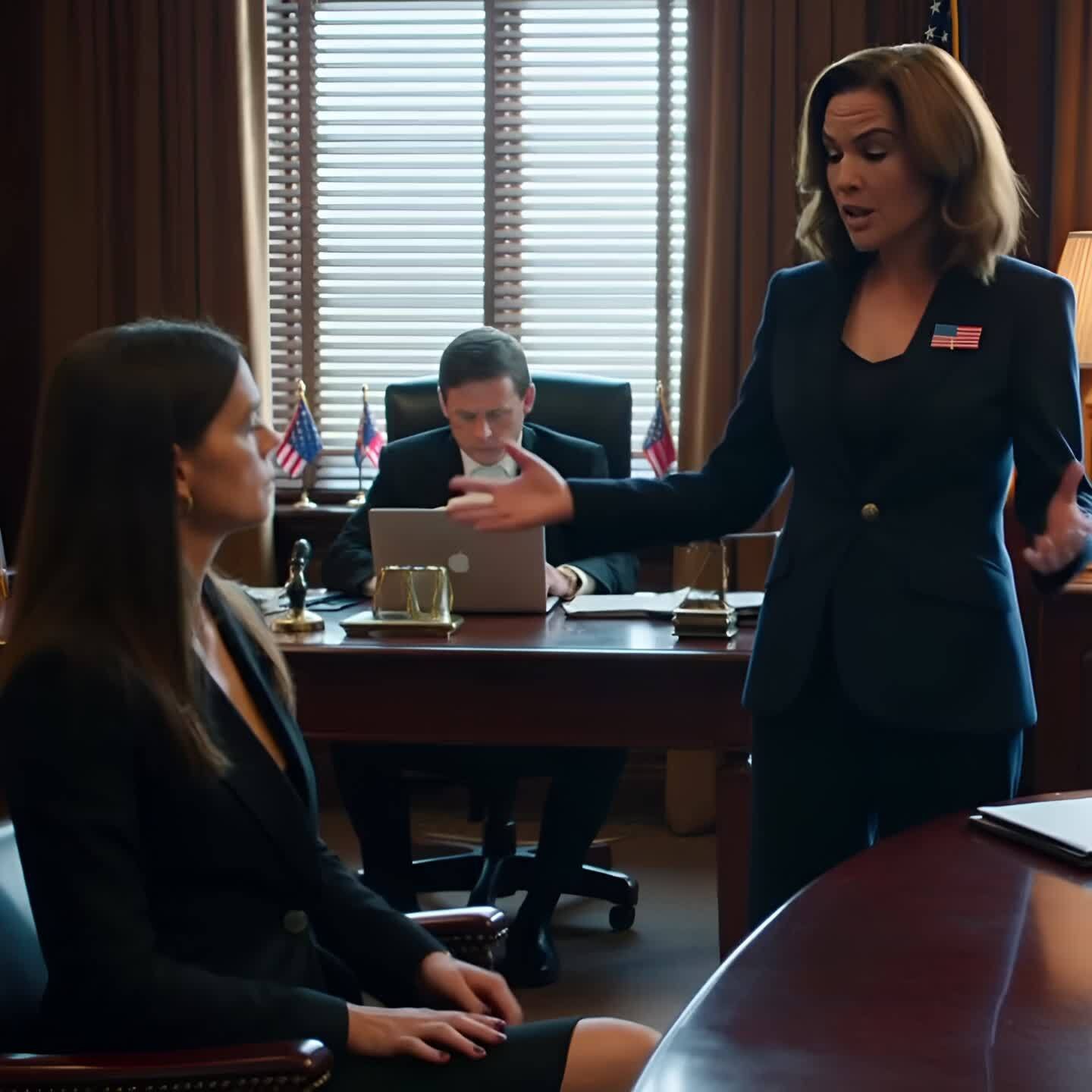
The moment my stepmother stood to announce she was cutting me from the will, the lawyer just smiled, then clicked on a file labeled “If Veronica Speaks First.” He had left me a weapon she never knew existed: a clause, a password, and an appointment where the dead still keep perfect time. Tonight, my father’s honor, our family fortune, and her freedom would be decided in a dark, wood-paneled room where every word left legal fingerprints.
My name is Nora Bennett, and I’ve spent the last fifteen years watching my stepmother erase me from my father’s life, one calculated move at a time. Now, sitting in attorney Daniel Whitaker’s conference room, I watched her attempt the final erasure.
The recording device on the mahogany table blinked red in steady intervals, capturing every word as Veronica Voss rose from her leather chair. At fifty-two, she still commanded attention: silver-blond hair swept into an elegant chignon, a Hermès scarf draped precisely over her charcoal suit. Behind her, arranged like a human barricade, sat her sister Margaret and two cousins I’d met exactly twice in fifteen years.
“Before we proceed with the reading,” Veronica announced, her voice carrying that practiced blend of grief and authority, “I have a document that supersedes whatever version Daniel has prepared.”
The wall clock ticked.
1:28 p.m. Three days since we’d buried Graham Bennett, my father, in Redwood Heights Cemetery. Three days since I’d stood at his graveside, wondering if the distance between us these past years had been my fault or something more deliberate.
She produced a manila envelope, extracting papers with theatrical precision.
“A codicil to Graham’s will, properly witnessed and notarized. He signed it six weeks ago.”
I felt the familiar numbness creeping up my spine, the same sensation that had protected me through the funeral, through the condolences of business associates who seemed surprised to learn Graham Bennett even had a daughter.
“The codicil is quite clear,” Veronica continued, addressing the room as if conducting a board meeting at Harborline Dynamics, where I’d climbed to head of brand operations without ever mentioning whose daughter I was. “Given Nora’s extended absence from Graham’s life, her lack of involvement in his care during his illness, and her failure to maintain meaningful contact, Graham chose to redirect her portion of the estate.”
Extended absence. Lack of involvement.
The words hung in the climate-controlled air like accusations.
I wanted to tell her about the seventy-three unreturned calls, the birthday cards that mysteriously never reached him, the Thanksgiving dinners where my invitation somehow got lost, the hospital visits where I was told he was sleeping, only to learn later he’d been asking for me.
But I remained silent, studying Daniel Whitaker’s expression.
The sixty-year-old attorney sat with his fingers steepled, gray eyes revealing nothing behind wire-rimmed glasses. He’d been my father’s lawyer for thirty years. He’d drafted the incorporation papers for Bennett Development Group. He’d been at my mother’s funeral when I was seven.
“The amendments are extensive,” Veronica said, sliding the papers across the table to Daniel. “The house on Willow Crest, the company shares, the investment portfolios—all designated for family members who demonstrated genuine care and presence.”
Family members. Not me.
Apparently, I was just the inconvenient reminder of Graham Bennett’s first marriage, the daughter who looked too much like the wife he’d lost to cancer. The living ghost Veronica had spent fifteen years trying to exorcise.
Daniel accepted the papers, adjusting his glasses as he scanned the first page. The conference room fell silent except for the whisper of turning pages and the persistent tick of the clock.
Through the floor-to-ceiling windows, Redwood Heights stretched out below us, a city built on old money and new tech, where Bennett Development Group had helped shape the skyline for forty years.
“Interesting,” Daniel murmured.
A word that could mean anything or nothing.
Veronica’s cousins shifted in their seats, exchanging glances. Margaret placed a supportive hand on Veronica’s shoulder, a gesture so rehearsed it might have been choreographed. They’d all dressed in the same palette of respectful grays and blacks, a unified front of grief and greed.
I thought about the last real conversation I’d had with my father two years ago, before his diagnosis, before the walls Veronica built became impenetrable.
We’d met for coffee secretly. He’d insisted, though I hadn’t understood why then. He’d looked tired, older than his sixty-eight years, and he’d pressed an envelope into my hands.
“Give this to Tom Hail,” he’d said. “Tell him to hold it for you until the time comes.”
“Dad, what—?”
“Just promise me, Nora. Promise you’ll remember.”
I’d promised.
The envelope still sat in Tom’s safe, unopened, waiting for a moment I couldn’t define—until now.
“Ms. Bennett.” Daniel’s voice pulled me back to the present. “Are you aware of the contents of this codicil?”
“I can guess,” I said, my voice steadier than my pulse. “I’m being disinherited.”
“Redirection of assets,” Veronica corrected, as if semantics could soften the blow. “Graham wanted his legacy to benefit those who truly valued him.”
The recording device blinked on, capturing every word, every pause, every calculation in the reflection of the polished table. I could see myself—thirty-two years old, my father’s dark eyes in my mother’s angular face—wearing the same black sheath dress I’d worn to both their funerals.
Daniel set the papers aside and opened his leather portfolio.
“Well then,” he said, fingers hovering over his laptop keyboard. “This certainly changes things.”
For the first time since entering the room, he smiled. A subtle upturn of lips that Veronica, lost in her moment of triumph, failed to notice. But I saw it, and in that instant I understood why my father had told me to trust Daniel Whitaker, why he’d smiled that same knowing smile when handing me that envelope two years ago.
The time had come.
The house on Willow Crest had been my entire world until I was seven. After Mom died, it became a museum. Her photos gradually disappeared from mantels and walls. Her garden was redesigned into something architectural and cold. Her piano was moved to the basement and eventually sold.
Veronica arrived eighteen months after the funeral. Dad introduced her at a company gala, this poised marketing executive who laughed at all the right moments and remembered everyone’s names. She moved in six months later, bringing with her an interior designer and a mission to “refresh” our home.
I was nine when I found Mom’s wedding china in boxes marked for donation. Ten when her art studio became Veronica’s home office. Eleven when the family portraits in the hallway were replaced with abstract prints that “better suited the space.”
But it wasn’t just the house that changed. It was the carefully orchestrated distance that grew between Dad and me, so gradual I didn’t recognize it as strategy until years later.
“Graham’s very busy with the Singapore project,” Veronica would explain when I called. “He’s in meetings all day.”
“Your father has a dinner with investors tonight,” she’d say when I asked to visit. “Perhaps next weekend.”
Next weekend would bring another excuse, another commitment, another barrier.
School events went unattended. Birthday dinners were rescheduled, then forgotten. When I graduated summa cum laude from Northwestern, Dad sent a congratulations card—store-bought—with Veronica’s handwriting.
The summer before my senior year of college, I’d driven home unannounced, determined to break through whatever wall had formed between us.
I found them hosting a pool party—Veronica’s business contacts, her family, couples from the country club. Dad was at the grill, laughing at something Margaret’s husband said, looking relaxed and present in a way I hadn’t seen in years.
“Nora.” He’d seemed genuinely surprised. Then something else—guilty, concerned. “Sweetheart, we weren’t expecting you.”
Veronica appeared at his elbow within seconds.
“How wonderful,” she said. “Though you should have called. We would have prepared your room.”
My room had been converted to a guest suite. Neutral colors, hotel-like furnishings, no trace of the teenage girl who’d once lived there. They’d put me in the pool house, Veronica explaining that all the bedrooms were occupied by “Graham’s important guests.”
That night, I’d overheard her in the kitchen with Margaret.
“She shows up when it’s convenient for her, expecting everything to revolve around her schedule. Graham’s finally building the life he deserves.”
The life he deserves—as if the life that included me had been some kind of punishment.
The patterns became clearer as years passed: calls I made that Dad never seemed to receive, emails that went unanswered and were later explained as “technical difficulties,” holiday invitations that Veronica “forgot” to mention.
She’d built a fortress around my father, brick by subtle brick, until I appeared to be the negligent daughter who’d abandoned him.
“Have you tried being more understanding?” well-meaning relatives would ask at the few family functions I still attended. “Veronica says you rarely visit.”
How could I explain that my visits were deflected, my calls screened, my attempts at connection filtered through Veronica’s careful control? That scheduling a simple lunch with my father required navigating her assistant, her calendar, her permission?
The worst part was the doubt she cultivated in me. Maybe I hadn’t tried hard enough. Maybe I was being selfish, expecting him to make time. Maybe the distance was my fault—the price of pursuing my own career, of not being the daughter who stayed close to home and played by Veronica’s rules.
Even Tom Hail, Dad’s closest friend and my godfather, had been pulled into her orbit. His invitations to family dinners grew rare, then stopped. When I’d run into him at a coffee shop last year, he’d seemed uncomfortable, eager to leave.
“Your father’s very happy,” he’d said, not meeting my eyes. “Veronica takes good care of him.”
Only once did the mask slip.
Dad’s sixty-fifth birthday—a surprise party Veronica organized at the country club. She’d invited two hundred people. I wasn’t on the list. I found out through a mutual acquaintance and showed up anyway, gift in hand.
The look on Veronica’s face when she saw me—pure, cold fury quickly masked by concern.
“Oh dear, I thought you were traveling for work,” she said smoothly. “Your assistant said you were completely booked.”
I didn’t have an assistant. I’d never told anyone I was traveling.
Dad had hugged me that night, held on a little too long, whispered, “I’ve missed you, sweetheart.” But Veronica was there within moments, guiding him to other guests—”important people”—managing the narrative as always.
The diagnosis came two years later. Pancreatic cancer, aggressive and advanced. I learned about it not from family, but from a Bennett Development employee who assumed I knew.
By the time I forced my way through Veronica’s barriers to see him, he was already in treatment, already wrapped in her version of care that somehow never included visiting hours when I could come.
“He needs rest,” she’d say. “The doctors are very strict about limiting visitors.”
“He had a bad night. Perhaps tomorrow.”
“The new medication makes him confused. It would upset him to see you like this.”
I saw him four times during his eight-month battle. Four times, while Veronica’s family maintained constant vigil, taking photos for social media that showed their devotion, their sacrifice, their love for a man they’d known for fifteen years.
While his daughter remained inexplicably absent.
Now, sitting in this conference room, watching Veronica orchestrate her final move, I understood the completeness of her victory. She hadn’t just stolen my father. She’d made me complicit in my own erasure, turned my love into abandonment, my presence into absence.
But there was still that envelope with Tom Hail. Still Daniel’s knowing smile. Still the recording device blinking red, capturing every word of Veronica’s carefully rehearsed performance.
My father might be gone, but perhaps he’d left me one last gift—the truth, and the means to finally expose it.
The call from Tom came at 6:00 a.m. the morning after the will reading.
I’d spent the night in my downtown apartment, staring at the ceiling, replaying Veronica’s performance and Daniel’s cryptic smile.
“Nora, it’s time,” Tom said without preamble. “Meet me at my office in an hour. Bring nobody. Trust nobody except Daniel.”
The drive to Tom’s law firm took me through empty streets, still dark with pre-dawn shadows. He was waiting in his private office, looking older than his seventy years, but sharp-eyed behind his exhaustion.
“Your father knew,” he said, pushing a sealed envelope across his desk. “He knew everything.”
My hands trembled as I broke the seal. Inside were three pages of my father’s handwriting, still strong despite his illness, still unmistakably his.
My dearest Nora,
If you’re reading this, then Veronica has made her move and I am gone.
Please forgive me for the years of distance, for the pain I allowed her to cause. I need you to understand I knew about the blocked calls, the deleted messages, the lies about your absence. I knew, and I let it happen.
Not because I didn’t love you—because I loved you too much to let her destroy you the way she was destroying me.
The words blurred. I blinked hard and forced myself to continue.
By the time I understood what Veronica truly was, she had already positioned herself too deeply into my life, my business, my finances. She had evidence of irregularities in the company—things done years ago, minor infractions that she documented and could spin into scandals. She controlled access to medication I needed. She isolated me from everyone who might have helped.
But I am not a fool, and I did not survive forty years in business without learning how to plan.
If Veronica has presented a codicil cutting you from my will, know this: it is worthless. Here’s what I’ve actually done.
Four months before my death, I executed a pour-over will that supersedes all previous versions. Daniel has the original. Everything flows into the Bennett Legacy Trust, where you are the primary beneficiary.
Two: The Bennett Legacy Trust contains an ironclad no contest clause. Anyone who challenges its distributions forfeits their share entirely. Veronica believes she’s getting thirty percent. If she contests, she gets nothing.
Three: I’ve prepared what I call a dead man’s switch—a collection of evidence scheduled to release if anyone challenges the trust. USB drives with encrypted files are in my safety deposit box at First National. Daniel has one key. You’ll find the other taped behind your mother’s portrait. Yes, I kept it—hidden in the basement storage room Veronica never enters.
Trust Daniel completely. He’s been documenting everything for three years. Per my instructions, when the time comes, he’ll know exactly what to do.
I’m sorry I couldn’t be stronger, couldn’t fight her while alive, but perhaps from death, I can give you justice and the truth.
All my love.
P.S. The house on Willow Crest was always meant to be yours. Your mother chose it. Don’t let Veronica keep it.
I read it twice more before looking up at Tom. His eyes were wet.
“He came to me three years ago,” Tom said quietly. “Told me everything. How she controlled his communications, monitored his contacts, used his health as a weapon. He was afraid if he fought her openly, she’d escalate—hurt you somehow, destroy your career, your reputation.”
“So he played the long game,” I whispered.
Tom nodded. “Graham was always a strategist. He knew Veronica’s weakness. Her greed would make her overconfident. She’d assume a sick old man couldn’t outmaneuver her.”
Tom smiled grimly.
“She assumed wrong.”
He handed me another document.
“This is a copy of the trust summary. You need to understand what he’s done.”
The Bennett Legacy Trust was a masterpiece of legal engineering. Every asset funneled through it—the company shares, the real estate, the investment accounts. I was designated to receive seventy percent, with thirty percent to Veronica “in recognition of companionship provided,” but the no contest clause was brutal.
Any legal challenge, any attempt to contest or modify the trust distributions, and the challenger’s share went directly to designated charities.
“There’s more,” Tom continued. “The dead man’s switch he mentioned—it’s not just financial records. Graham hired a private investigator, Gregory Barnes, former FBI. Three years of surveillance, documentation, witness statements. If Veronica contests, it all goes public. And not just public. Copies go to the IRS, the state attorney’s office, the boards of every charity she sits on.”
“What did she do?” I asked, though part of me already knew.
“Start with the small things,” Tom said. “Redirecting his mail. Filtering his calls. Federal crimes, technically. Then there’s the medication manipulation, financial elder abuse, forgery. Gregory has evidence of her meeting with Joseph Mercer.”
I recognized the name—a disgraced accountant who’d been caught embezzling from another development firm.
“She was building a case to take over the company,” Tom explained, “claiming Graham was mentally incompetent. The meetings with Mercer were about creating financial irregularities she could discover and use to force a conservatorship.”
The full scope of my father’s counter-strategy was staggering. He’d let Veronica believe she was winning while building an elaborate trap around her. Every move she made had been documented. Every crime cataloged. Every lie recorded.
“Why didn’t he just divorce her?” I asked.
“He tried, early on,” Tom said. “She threatened to destroy you. Said she had connections at Harborline, could make sure you were blacklisted in the industry. She showed him how easily she could manipulate your professional reputation.” Tom’s jaw tightened. “Graham loved you more than his own life. He chose to protect you the only way he could.”
I stood and paced to the window.
Dawn was breaking over Redwood Heights, painting the sky in shades of gray and gold. Somewhere out there, Veronica was probably celebrating her victory, planning how to dispose of my father’s assets.
“What do I do now?” I asked.
“Go to the bank,” Tom said. “Get the USB drive and the original trust documents. Then we wait for Daniel to spring the trap.”
Tom joined me at the window.
“Your father wrote one more thing,” he added. “A letter to be read only if Veronica contests. He called it his ethical will—explaining everything to the board, to the employees, to the community. He wanted them to know who he really was and who she really was.”
I thought about the recording device in Daniel’s conference room, blinking red as Veronica presented her fraudulent codicil, about Daniel’s smile as he said, “This certainly changes things.”
My father had been gone for less than a week, but his plan was very much alive. He’d given me three keys: a pour-over will Veronica didn’t know existed, a trust she couldn’t challenge without losing everything, and evidence that would destroy her if she tried.
“He loved you,” Tom said softly. “Never doubt that. Every move he made these last three years was about protecting you and ensuring you got justice.”
I touched the letter to my lips, then folded it carefully.
My father had played a long, painful game, sacrificing his own happiness to ensure my future.
“Now it’s my turn to see it through,” I said. “Tell Daniel I understand. I’ll be ready when the time comes.”
Tom smiled—the first genuine smile I’d seen from him in years.
“Graham would be proud,” he said. “You’re very much his daughter.”
I was.
And Veronica was about to learn exactly what that meant.
The second meeting at Daniel Whitaker’s office was scheduled for 2:00 p.m., exactly one week after Veronica’s dramatic performance.
This time, I arrived early, watching from the lobby as her Mercedes pulled into the parking garage, followed by a black Lexus carrying her legal team. She’d brought Jeffrey Cole, her personal attorney, a man known for aggressive litigation and flexible ethics.
The sight of him confirmed what Daniel had predicted. Veronica wasn’t going down without a fight.
In the conference room, the same recording device blinked red on the mahogany table. Daniel sat at the head, flanked by two associates I hadn’t met before. I took my seat across from Veronica, noting how she’d positioned her entourage: Cole on her right, Margaret on her left, cousins behind her like foot soldiers.
“Thank you all for coming,” Daniel began, his tone professionally neutral. “As executor of Graham Bennett’s estate, I need to address the codicil presented last week.”
Cole leaned forward.
“My client’s position is clear. The codicil is valid and supersedes any previous arrangements.”
Daniel nodded slowly, pulling out a manila folder.
“I’ve had our forensic document examiner review the codicil,” he said. “There are some interesting findings.”
He slid a report across the table. I caught Veronica’s micro-expression—a flicker of uncertainty quickly suppressed.
“First,” Daniel continued, “the signature date. According to this codicil, Graham signed it on March 15th. However, hospital records show he was under general anesthesia that day for a procedure. Rather difficult to sign legal documents while unconscious.”
Cole’s face reddened.
“There must be a clerical error, perhaps—”
“But there’s also the matter of the notary seal,” Daniel said.
He produced a magnified image.
“The notary public listed is Sandra Williams. Her commission expired in January, two months before this was allegedly notarized.”
Veronica’s composed mask began to crack.
“These are technicalities,” she said.
“There’s more,” Daniel replied, relentless and professional. “The codicil references the Bennett estate property at 42 Riverside Drive. Graham sold that property in 2019—rather odd to bequeath something he no longer owned.”
He paused.
“Most interesting,” Daniel continued, pulling out another document, “is the forensic analysis of the paper and ink. The watermark on this paper? It’s from a batch manufactured in April, after Graham’s death.”
The room fell silent.
Cole shuffled through papers, searching for a defense that didn’t exist.
“But let’s set aside these discrepancies,” Daniel said smoothly. “The real issue is that this codicil, even if it were genuine, would be irrelevant. Graham executed a new will on January 10th, properly witnessed by myself and two associates, video recorded, and filed with the court.”
He opened his laptop, fingers flying across the keyboard.
“Before we proceed to the actual will reading, there’s a scheduled item Graham insisted upon,” Daniel said. “He called it his contingency protocol. If anyone presented a competing claim to his estate, which Ms. Voss has done, we’re instructed to play recording number fourteen.”
Veronica straightened.
“This is ridiculous,” she snapped. “Theatrical.”
Daniel clicked play.
Veronica’s voice filled the room, crystal clear.
“Jeffrey, I need you to draft something ironclad. If the old man doesn’t sign it voluntarily, we’ll need to be creative.”
Cole’s recorded response: “Veronica, I have to advise—”
“I don’t pay you for advisories,” her voice cut in. “I pay you for results. That little girl isn’t getting a penny of Graham’s money. I’ve worked too hard, put up with too much. Delete this call from your records.”
Daniel paused the recording.
“There are forty-seven more files,” he said mildly. “Would you like me to continue?”
Margaret had gone pale. The cousins exchanged panicked looks. Cole was frantically texting someone.
“Those recordings were obtained illegally,” Veronica managed, her voice strained.
“Actually, they weren’t,” Daniel replied. “Graham recorded them himself in his own home during conversations where he was a participant. Perfectly legal in North Midlands. He was quite thorough—three years of documentation.”
He pulled out another folder.
“We also have email metadata,” he continued, “showing systematic interference with Nora’s communications. Deleted voicemails—we have the carrier logs. Intercepted letters—we have postal service tracking. Calendar appointments mysteriously canceled—we have the digital footprints.”
“You can’t prove—”
“We have sworn affidavits from household staff,” Daniel interrupted. “Maria, the housekeeper, details being instructed to say Mr. Bennett was unavailable whenever Nora called. James, the driver, confirms being told to report Nora’s visits in advance so you could ensure Graham was indisposed. Shall I continue?”
I watched Veronica’s world crumble in real time. Each revelation stripped away another layer of her carefully constructed façade until only the truth remained—ugly, grasping, exposed.
“Furthermore,” Daniel added almost gently, “we have records of your meetings with Joseph Mercer—discussions about creating financial irregularities to trigger a competency hearing. Graham knew about those, too.”
Cole stood abruptly.
“We need to caucus with our client.”
“Of course,” Daniel said. “But before you do, you should understand the complete situation.”
His expression was almost sympathetic.
“Graham’s actual will leaves thirty percent of his estate to Ms. Voss,” he said. “A generous provision, considering the circumstances. However, it includes a comprehensive no contest clause. Any legal challenge, any attempt to dispute or modify the will’s provisions, and that thirty percent is forfeit.”
“That’s coercion,” Cole sputtered.
“That’s estate planning,” Daniel corrected. “Perfectly legal and quite common. Ms. Voss can accept her thirty percent—approximately eighteen million dollars—or she can challenge and receive nothing. Her choice.”
“And if she challenges?” I spoke for the first time, my voice steady.
“Every piece of evidence goes public,” I said. “The recordings, the emails, the witness statements. All of it.”
Veronica’s eyes met mine across the table.
For fifteen years, she’d worked to erase me from my father’s life. Now I held the power to erase her from society.
“You wouldn’t,” she said.
“The scandal would hurt the company. Graham’s reputation.”
“My father’s reputation will survive the truth,” I replied. “Will yours?”
Daniel cleared his throat.
“There’s one more thing,” he said. “Graham maintained a separate fund—completely legal, properly taxed—that he used to hire Gregory Barnes, a private investigator. Mr. Barnes has compiled a comprehensive report on certain offshore accounts, questionable charity expenditures, and interesting tax positions. That report is currently sealed. It remains sealed if Ms. Voss accepts the will’s provisions.”
The trap was complete. Every exit blocked. Every contingency covered.
My father had spent three years building this moment, and Veronica had walked right into it.
Cole whispered urgently in Veronica’s ear. Margaret clutched her sister’s hand. The cousins looked like they wanted to disappear.
“I need time,” Veronica said finally, her voice hollow.
“Of course,” Daniel agreed. “You have seventy-two hours to decide. Accept the will as written, or challenge it and trigger the contingencies. I should mention the IRS has already expressed interest in Mr. Barnes’s findings. We’ve held them off. But if litigation begins…”
He let the threat hang in the air.
As they gathered their things to leave, Veronica turned to me one last time.
“He never loved you the way he loved me,” she said, venom in every word.
I smiled—my father’s smile, the one that meant checkmate.
“No,” I said calmly. “He didn’t. He loved me more. That’s why he spent three years protecting me from you. And that’s why you’ve already lost.”
She swept from the room, her entourage trailing behind her. Cole paused at the door, giving Daniel a look that said he knew exactly how badly they were beaten.
When they were gone, Daniel allowed himself a small smile.
“Your father would have enjoyed that,” he said.
“He did enjoy it,” I corrected, thinking of all the planning, all the preparation, all the love that had gone into this moment. Every move. Every countermove. “He saw it all coming.”
The recording device continued to blink, capturing the victory my father had orchestrated from beyond the grave.
Veronica had seventy-two hours to decide. But we all knew what she would choose: eighteen million dollars in silence or nothing and public destruction. For someone who’d spent fifteen years valuing money and status above all else, it wasn’t really a choice at all.
Daniel’s fingers hovered over his laptop keyboard as we waited for the others to settle in that second, crucial meeting.
“Before we proceed further,” he said, his voice cutting through the whispered consultations from Veronica’s side of the table, “I should clarify something about the recordings. Mr. Bennett was quite specific about their use.”
He clicked on a folder labeled with today’s date. Inside, dozens of audio files appeared, each meticulously named and timestamped—but one stood out.
If Veronica speaks first, play immediately.
“Graham anticipated various scenarios,” Daniel continued. “He created specific protocols for each. When Ms. Voss stood up last week to present her codicil before I could begin the official reading, she triggered this particular contingency.”
Cole’s face darkened.
“You’re saying this was a trap?” he asked.
“I’m saying Graham Bennett knew his wife very well,” Daniel replied. “He predicted she would try to seize control of the narrative. The file we’re about to play was recorded fourteen months ago, during a conversation Ms. Voss believed was private.”
He clicked play.
The audio was pristine. Graham had spared no expense on surveillance equipment.
Veronica’s voice filled the room, sharp and clear.
“The key is timing, Jeffrey. If we move too early, he might recover and change everything. Too late, and that girl could manipulate him in his final moments. We need him coherent enough to sign, but weak enough not to fight.”
Jeffrey Cole’s recorded voice answered, “The medications could help with that. Dr. Morrison says adjusting the doses—”
“I don’t need details, just results,” Veronica cut in. “I’ve spent fifteen years building this life, keeping that girl at arm’s length. I’m not letting Graham’s guilt undo everything. Now, what about the household staff? They might notice.”
“I’ve already handled them,” her voice continued. “Maria knows her immigration status depends on her discretion. James needs this job for his daughter’s medical bills. They see what I tell them to see.”
Daniel paused the recording.
In the present, Cole had gone ashen. Margaret was pulling away from her sister as if Veronica had become radioactive.
“Should I continue?” Daniel asked. “There’s a particularly interesting section about accessing Graham’s email to delete messages from Nora.”
“Enough,” Veronica snapped, but her voice cracked.
“Have I?” Daniel asked mildly.
He pulled up another file.
“This one’s from six months ago,” he said. “You’re discussing Graham’s will with someone named Patricia Morse. Should I refresh your memory about who she is?”
I watched Veronica’s face cycle through calculations.
Patricia Morse was a disbarred attorney who’d been caught forging estate documents. The implications were clear.
“Play it,” I said quietly.
Daniel obliged.
This time, Veronica sounded frustrated.
“Patricia, I need something that will hold up to scrutiny, not like the last one.”
Patricia’s voice responded, smooth and oily.
“The last one was perfect until that judge got suspicious. This time we’ll use the notary I suggested. She owes me.”
“I don’t care who owes who,” Veronica snapped. “I care about results. Graham’s getting sentimental, talking about making things right with Nora. If he changes the will now—”
“He won’t get the chance,” Patricia cut in. “Not if we move fast. I can have documents ready by next week.”
Daniel stopped the recording.
“Patricia Morse was arrested last month for fraud,” he said. “She’s been quite cooperative with authorities. Her testimony about your meetings is comprehensive.”
The room felt airless.
Cole was no longer even pretending to defend his client. He sat slumped in his chair, probably calculating how quickly he could distance himself from this disaster.
“There’s more, of course,” Daniel continued, scrolling through files. “Recordings of Ms. Voss instructing staff to lie about Graham’s availability. Conversations about monitoring his communications. Discussions about isolating him from friends and family.”
He pulled up a spreadsheet.
“Graham also documented every instance,” he said. “Date, time, what was said, who was involved. Three years of meticulous records. He called it his insurance policy.”
“Why?” Veronica’s question came out as a whisper. “Why did he stay if he knew?”
Daniel’s expression softened slightly.
“He explains that in a video message,” he said. “Would you like to see it?”
Before anyone could object, he opened another file.
My father’s face appeared on the screen, gaunt from illness but eyes still sharp. The date stamp showed three months before his death.
“If you’re watching this, Veronica,” my father’s recorded voice said, “then you’ve done exactly what I expected. You’ve tried to steal from my daughter.”
Veronica flinched as if slapped.
“I stayed because leaving would have meant war,” he continued. “You made that clear enough with your threats about Nora’s career, your connections, your ability to destroy what I loved most. So I stayed and I documented everything—every lie, every manipulation, every crime.”
His image leaned forward slightly.
“You thought you were controlling me,” he said. “But I was building a case. You thought you were isolating me, but I was protecting Nora. You thought my illness made me weak. But it just made me determined.”
“Turn it off,” Veronica pleaded.
“Let him finish,” I said.
“I know you’ll contest whatever will I leave,” my father continued. “It’s your nature. You can’t help but grab for more. So I’ve made it simple. Accept what I’ve given you—more than you deserve—or lose everything. The choice is yours. But know this: I’ve already won. My daughter is safe. My legacy is secure. And your true nature is about to be exposed.”
The video ended. Silence descended like a heavy curtain.
“The ‘If Veronica Speaks First’ protocol,” Daniel said quietly, “includes one hundred forty-seven audio files, eighty-nine video recordings, three hundred twelve documented incidents, and corroborating evidence for each. If Ms. Voss proceeds with any legal challenge, all of this becomes part of the public record.”
He turned his laptop toward Veronica.
“This is a preview of the press release Graham prepared,” he said. “It includes links to a website containing all non-privileged evidence. The domain is already registered. The site is built and ready. One click, and it goes live.”
I read the headline over Veronica’s shoulder.
Bennett Development Founder Documents Years of Elder Abuse: A Final Testament to Truth.
“You’re bluffing,” Veronica said weakly.
“Graham Bennett never bluffed,” Daniel replied. “He prepared for every contingency, including this one.”
He pulled out a tablet showing a timer counting down.
“The website is set to go live automatically in seventy-one hours and forty-three minutes,” he said. “I can stop it with a code. A code I’ll enter only when Ms. Voss signs acceptance of the will as written.”
“This is extortion,” Cole finally managed.
“This is consequence,” I corrected. “Fifteen years of consequences delivered all at once.”
Margaret stood abruptly.
“Veronica, take the money,” she urged. “Take it and run.”
“Shut up,” Veronica snarled, but the fight was leaving her. She looked older suddenly, the careful polish cracking to reveal something desperate underneath.
“Thirty percent of Graham Bennett’s estate is approximately eighteen million dollars,” Daniel said. “Enough for a comfortable life anywhere. The alternative is public humiliation, potential criminal charges, and financial ruin. As your attorney should have told you, no contest clauses are strictly enforced in North Midlands.”
Cole found his voice.
“We need to review everything,” he said. “All the recordings, all the documentation.”
“Of course,” Daniel replied. “I’ve prepared copies. All forty-seven hours of audio, sixteen hours of video, and roughly three thousand pages of documentation. Should keep you busy for the next seventy-one hours.”
He slid a hard drive across the table.
“Take your time,” he said. “But remember—the clock is ticking.”
As Veronica reached for the drive with shaking hands, I saw the exact moment she understood. My father hadn’t just prepared for this. He’d orchestrated it. Every move she’d made, every scheme she’d hatched, had been anticipated and countered before she even thought of it.
“He played me,” she whispered.
“No,” I said, speaking directly to her for the last time. “You played yourself. He just made sure there would be consequences.”
“Seventy-one hours, Ms. Voss,” Daniel said, standing. “The choice is yours.”
As they filed out—Veronica broken, Cole calculating, Margaret disgusted—I remained seated, staring at the frozen image of my father on the screen.
“He really thought of everything,” I said softly.
“Everything and more,” Daniel confirmed. “There are contingencies for the contingencies. Graham Bennett was the most thorough client I’ve ever had.”
The recording device continued its steady blink, capturing the moment when Veronica Voss learned that my father’s greatest trick wasn’t staying silent all those years. It was letting her believe she’d won, right up until the moment she lost everything.
Daniel lifted a leather portfolio from his briefcase, extracting documents with the practiced efficiency of someone who’d rehearsed this moment.
The conference room had emptied of Veronica’s entourage, leaving just the three of us—Daniel, myself, and an associate who’d remained silent throughout the confrontation.
“Now,” Daniel said, adjusting his glasses, “let me read you what Graham actually intended.”
He opened the formal will, its pages crisp with official seals and notarizations.
“Last Will and Testament of Graham Marcus Bennett,” he read, “executed January 10th, 2025, in the presence of three witnesses and video recorded for authentication.”
The language was precise, leaving no room for interpretation.
“I direct that all assets not specifically distributed below shall pour over into the Bennett Legacy Trust established on the same date as this will.”
“The house at 17 Willow Crest,” Daniel continued, “is specifically bequeathed to my daughter, Nora Elizabeth Bennett, along with all contents, free and clear of any liens or encumbrances.”
I felt my throat tighten.
He’d kept Mom’s portrait after all.
“Now, the Bennett Legacy Trust,” Daniel said, producing another document, thicker than the will. “This is where Graham got creative. The trust holds seventy percent of Bennett Development Group shares, the commercial real estate portfolio, the investment accounts, and various other assets. Total value as of last appraisal: approximately sixty-two million dollars.”
He turned to a marked page.
“You, Nora, are the primary beneficiary of seventy percent of the trust assets,” he said. “Veronica Voss receives thirty percent, subject to the following conditions.”
The no contest clause was a masterpiece of legal engineering. It didn’t just threaten forfeiture; it created a web of consequences that would trap anyone who challenged it.
“Any beneficiary who contests, disputes, or challenges this trust or its distributions forfeits their entire share,” Daniel read. “But Graham went further. Upon such challenge, the forfeited share doesn’t revert to the estate. It transfers immediately to the Bennett Foundation for Childhood Cancer Research”—my mother’s charity, the one she’d established before her death.
“Furthermore,” Daniel continued, “any such challenge triggers the release of all documentation collected regarding the challenger’s conduct during Graham Bennett’s lifetime. This documentation shall be provided to relevant authorities, media outlets, and professional organizations.”
“He weaponized charity,” I murmured, almost admiring the elegance.
“There’s more,” Daniel said. “The trust includes specific provisions about the evidence collected. Graham established what he called the Sunshine Protocol. If anyone challenges the trust, all evidence becomes public domain—available to journalists, prosecutors, anyone who wants it. But if the trust distributions are accepted, the evidence remains sealed forever.”
Daniel flipped to another section.
“Graham also included a fascinating provision about timing,” he said. “Veronica’s thirty percent vests over five years, but only if she maintains appropriate distance from trust operations and beneficiaries. Any attempt to contact you, interfere with Bennett Development, or influence trust decisions results in immediate forfeiture.”
“He’s controlling her from the grave,” I said.
“Protecting you from the grave,” Daniel corrected. “Every provision is designed to ensure your safety and peace of mind.”
The associate finally spoke.
“There’s also the matter of the secondary evidence cache,” he said. “Mr. Bennett established a separate documentation repository with instructions for release upon specific triggers. Not just legal challenges, but any attempts at harassment, defamation, or interference with Ms. Bennett’s life or career.”
Daniel nodded.
“Gregory Barnes maintains copies of everything,” he said. “He’s been retained by the trust for ongoing monitoring. If Veronica tries anything—spreading rumors, influencing your professional contacts, even indirect harassment—Gregory activates the protocol.”
I studied the trust documents, seeing my father’s strategic mind in every clause. He’d thought through scenarios I hadn’t even imagined, created protections for threats that might not emerge for years.
“What about the company?” I asked. “Seventy percent gives me control, but—”
“Complete control,” Daniel confirmed. “Graham structured the share classifications carefully. Your seventy percent carries enhanced voting rights—effectively eighty-five percent of voting power. Veronica’s shares are non-voting preferred stock. She gets dividends, but no say in operations.”
“She’ll hate that,” I said.
“She’ll hate everything about this trust,” Daniel replied. “But she’ll take it, because the alternative is catastrophic.”
He pulled out another document.
“This is a summary of what Gregory Barnes compiled,” he said. “Shall we review what Veronica is so desperate to keep hidden?”
The list was extensive.
Documentary evidence of medication tampering—adjusting Graham’s doses to increase confusion and dependence. Financial transfers to offshore accounts totaling 2.3 million dollars over five years. Forged signatures on seventeen documents, including charity pledges and property transfers. Recorded conversations discussing plans to have Graham declared incompetent. Evidence of bribing household staff and medical personnel. Systematic interception and deletion of communications. Meeting records with individuals later convicted of elder abuse and fraud.
“The FBI white-collar crime division has expressed interest,” the associate added. “They’re particularly intrigued by the interstate commerce aspects—some of the diverted funds crossed state lines.”
“Graham documented everything,” Daniel said. “Credit card receipts, bank records, phone logs. He even wore a wire to his own dinner parties—three years of building an airtight case.”
“Why didn’t he use it while alive?” I asked, though I suspected the answer.
“He explains that in his ethical will,” Daniel said, holding up a sealed envelope. “The letter to be read only if Veronica contests. But I think you already know—he was protecting you. Using this evidence would have meant a public battle, dragging you through courts and media. This way, Veronica has every incentive to disappear quietly.”
I thought about the five-year vesting schedule, the geographic restrictions implied by “appropriate distance.”
“Where will she go?” I asked.
“Graham anticipated that too,” Daniel said. “The trust will pay her distributions to any valid bank account anywhere in the world. He’s essentially offering her exile with a golden parachute—3.7 million per year for five years, if she stays away and stays quiet.”
“And if she doesn’t?”
“Then Gregory Barnes has standing orders to release everything,” Daniel replied. “The trust will pursue criminal charges, civil suits, and public exposure. Graham called it ‘mutually assured destruction with a strong incentive for peace.’”
Daniel closed the portfolio.
“There’s one more thing,” he said. “Graham left a personal message for you, to be delivered after Veronica makes her choice. He was very specific—only after she decides.”
I nodded, understanding even this final timing. Everything had to play out in sequence, each move triggering the next.
“The Bennett Development board meets next month,” Daniel noted. “With your shares, you’ll have full control. The interim CEO has been briefed and is prepared to transition leadership whenever you’re ready.”
Ready.
Was anyone ever ready to step into their father’s shoes?
But I thought about the company he’d built, the legacy he’d protected, the lengths he’d gone to ensure I could claim it safely.
“Veronica has sixty-seven hours left,” Daniel said, glancing at his watch. “Based on the panicked calls from Jeffrey Cole’s office, I suspect she’ll make her decision much sooner. No legitimate attorney will advise her to challenge this trust.”
“And then?” I asked.
“Then you begin,” Daniel said. “The house is yours immediately. We can arrange key transfer tomorrow. The company transitions at your pace. The trust ensures you have resources and protection. Your father made sure of that.”
As we gathered the documents, I felt the weight of what my father had done. He’d spent his final years as a prisoner in his own life. But he’d used that time to build an unbreakable fortress around my future. Every humiliation he’d endured, every isolation he’d suffered, had been transformed into another brick in the wall protecting me.
“He won,” I said softly.
“Graham Bennett always played the long game,” Daniel agreed. “And he never lost when it really mattered.”
The recording device clicked off, having captured the reading of a will that was less about distributing assets and more about delivering justice.
Somewhere across town, Veronica was discovering that my father’s greatest gift to me wasn’t money or property. It was freedom from her influence, her manipulation, her very presence.
He’d given me back the life she’d tried to steal, wrapped in legal provisions so tight she couldn’t touch it without destroying herself.
The trust was named perfectly: the Bennett Legacy—not just wealth, but wisdom; not just assets, but assurance. My father’s final move in a game fifteen years in the making.
Checkmate.
Gregory Barnes looked exactly like what he was: former FBI, now private investigator, with gray eyes that missed nothing and hands that never stopped moving, constantly organizing the evidence spread across Daniel’s conference table.
“Your father hired me three years ago,” Gregory began, his voice carrying the measured cadence of someone used to testifying. “He said he needed everything documented, legally obtained, and bulletproof. I’ve handled elder abuse cases before, but nothing this methodical on either side.”
He opened a laptop, revealing a database that would have made the FBI proud.
“Every piece of evidence is triple-backed, timestamped, and verified,” he said. “Let me show you what Veronica Voss doesn’t want the world to see.”
The first file was a location-tracking report.
“Ms. Voss’s phone GPS, cross-referenced with deleted voicemail logs,” Gregory explained. “Look here. January 15th, 2:47 p.m.—you left a voicemail for your father. At 2:51 p.m., Veronica’s phone shows her location in Graham’s home office. At 2:52 p.m., that voicemail was deleted from the system.”
Red dots on a map. Each one a stolen message.
“Seventeen occasions over six months,” Gregory said. “She got sloppy. Didn’t realize the phone company keeps deletion logs for ninety days. We subpoenaed them all.”
Next came the financial forensics.
“Joseph Mercer,” Gregory said. “Disgraced accountant. Served eighteen months for embezzlement. Veronica met him fourteen times between September and December. Always at the Riverside Motel, always paid cash for the room.”
He pulled up photographs—Veronica entering the motel, Mercer arriving minutes later, timestamps clear in the corner.
“Their plan was sophisticated,” Gregory explained. “Create phantom invoices in Bennett Development’s system, make it look like Graham approved them, then claim mental deterioration when the irregularities surfaced. Classic setup for a competency hearing.”
“But Mercer kept copies,” I said, reading the seized documents.
“Criminals always do,” Gregory replied. “Insurance against their partners.”
He smiled grimly.
“When he was arrested in January, he rolled immediately. Full cooperation. Documented everything.”
The evidence kept coming.
Email headers showing forwarding rules Veronica had set up on Graham’s account, routing his messages to her first, letting her screen everything. Security footage from the house showing her entering his office at night, accessing his computer. Bank records revealing transfers to an account in the Caymans—small enough to avoid automatic reporting, but steady over years.
“This is my favorite,” Gregory said, pulling up an audio file. “Graham started wearing a recording device to family dinners. Listen to this.”
Veronica’s voice, wine-slurred but clear:
“The old fool actually thinks Nora cares about him. She hasn’t visited in months because I make sure she can’t. Every call blocked, every letter intercepted. By the time he dies, she’ll look like the neglectful daughter who abandoned him. And Margaret, stop looking at me like that. You’re getting your cut.”
Margaret’s voice, uncomfortable:
“I just think—”
“Don’t think. That’s not what I pay you for.”
Daniel leaned forward.
“That recording alone establishes conspiracy,” he said. “Margaret’s testimony in exchange for immunity would be devastating.”
Gregory moved to a thicker folder.
“The medication manipulation was harder to prove, until we found her supplier,” he said.
He produced invoices from a Canadian pharmacy.
“She was ordering Graham’s medications online,” he explained. “Same drugs, but different dosages. The pills looked identical but were significantly stronger. Classic elder abuse tactic—increase confusion and dependence.”
“We have the housekeeper’s testimony confirming Veronica personally managed all medications,” the associate added. “She never let anyone else near them.”
“There’s more,” Gregory said, his expression darkening. “She had Graham’s will copied at a twenty-four-hour print shop—security footage shows her there at 2:00 a.m. with estate documents. She was practicing his signature.”
He showed blown-up comparisons—Graham’s real signature versus increasingly accurate forgeries.
“But here’s what will really destroy her,” Gregory said, opening a final folder. “The charity fraud.”
My stomach dropped.
“What charity fraud?” I asked.
“The Bennett Foundation for Childhood Cancer Research,” Gregory said gently. “Your mother’s charity. Veronica was on the board, had signing authority. Over five years, she redirected almost four hundred thousand dollars in donations—small amounts disguised as administrative expenses, consulting fees, vendor payments, all to companies that trace back to her.”
“She stole from my mother’s charity,” I whispered.
“Every penny documented,” Gregory said. “The foundation’s audit trail is impeccable. Your father made sure of that after Veronica got involved.”
He showed spreadsheets, canceled checks, wire transfer confirmations.
“This isn’t just civil liability,” Daniel said quietly. “This is federal wire fraud. The U.S. Attorney’s Office is very interested. Charity fraud, especially involving cancer research, tends to generate aggressive prosecution.”
I stared at the evidence, overwhelming in its scope and detail. Phone records, emails, financial transfers, recorded conversations, video surveillance, witness testimony.
Three years of my father building an airtight case while pretending to be a weak old man under her control.
“How?” I asked. “How did he manage all this while sick?”
Gregory smiled with genuine admiration.
“Graham Bennett was brilliant,” he said. “He played helpless during the day, then worked with me at night. Had a secure phone she didn’t know about, a laptop hidden in the garage, meetings disguised as medical appointments. Even when the cancer got bad, he never stopped gathering evidence.”
“He wore a wire to his own anniversary party,” Daniel added. “Recorded Veronica telling her sister about the insurance policy she was building—the forged codicil.”
Gregory pulled up one final document.
“This is the crown jewel,” he said. “Graham’s journal, updated daily for three years. His contemporaneous record of everything—dates, times, conversations, his state of mind—in his own handwriting, notarized weekly by Daniel. Any court would find it devastatingly credible.”
I picked up the journal, reading random entries.
March 3rd. Veronica deleted seven voicemails from Nora today. I heard them first on my hidden phone. My daughter loves me. She’s never stopped trying.
May 18th. Overheard V telling Margaret that once I’m gone, she’ll “clean house” at the company. She has a list of people to fire—all my loyalists.
August 22nd. Increased my medication again. Vision blurry, hands shaking. She says it’s the cancer. It’s not.
December 1st. Nora came by. V sent her away. Told her I was sleeping. I was at the window. Saw my baby girl crying in her car. Soon, sweetheart. Daddy’s almost done building your fortress.
The journal blurred through my tears.
“Everything is admissible,” Daniel said quietly. “Gregory maintained chain of custody and proper documentation. If Veronica challenges the will, this all becomes public record. The FBI gets copies. The IRS gets interested. The state attorney files charges. The media has a field day.”
“And if she doesn’t challenge?” I asked.
“Then it stays sealed forever,” Daniel replied. “Graham was offering her a choice. Take the money and run, or fight and be destroyed. He knew her greed would win.”
Gregory began packing the evidence back into boxes.
“Your father gave me one last instruction,” he said. “If Veronica accepts the deal, I’m to maintain surveillance for five years—the vesting period. Any attempt to contact you, interfere with your life, or return to North Midlands triggers immediate release of everything.”
“He thought of everything,” I said.
“Not everything,” Gregory corrected gently. “He couldn’t protect you from the pain of losing him, or the years Veronica stole. But he made sure she could never hurt you again.”
As they prepared to leave, Gregory handed me a card.
“My retainer is paid for five years,” he said. “If she so much as sends you a birthday card, call me. Your father’s orders were explicit—total protection. Whatever it takes.”
“Thank you,” I managed.
“Don’t thank me,” he said. “Thank your father. In thirty years of investigative work, I’ve never seen anyone play such a long game. He turned his own abuse into your shield.”
After they left, I sat alone with the boxes of evidence.
Sixty-two hours remained on Veronica’s clock, but we all knew her decision. The evidence was too damning, the consequences too severe.
She would take her thirty percent and disappear.
My father had won from his deathbed, fighting cancer and a woman who controlled his every move. He’d orchestrated perfect justice, not through violence or vengeance, but through patience, documentation, and the inexorable power of truth.
Somewhere across town, Veronica was learning what Gregory Barnes had compiled. She was discovering that every crime leaves evidence, every lie creates a record, and every cruelty can be documented. Most of all, she was learning that Graham Bennett’s love for his daughter was stronger than her greed, smarter than her schemes, and more enduring than her control.
The evidence would stay sealed—my father’s final mercy—unless she was foolish enough to fight.
The call came at 10:00 a.m. the next morning.
“Jeffrey Cole,” he announced, his clipped tone that of a lawyer who knew he was holding a losing hand. “My client wishes to discuss terms.”
“The terms are non-negotiable,” Daniel replied, his voice carrying through the speakerphone. “Thirty percent, the no contest clause, and complete separation from Ms. Bennett and Bennett Development Group.”
“Ms. Voss has a counterproposal,” Cole said.
Of course she did. Even facing complete destruction, Veronica couldn’t resist trying to negotiate.
Two hours later, we were back in the conference room.
Veronica looked like she’d aged five years overnight. Her perfect composure was cracked, designer suit wrinkled, hands trembling slightly as she clutched her Hermès bag.
“Forty percent,” she said without greeting, “and I keep the house on Willow Crest.”
“No,” I said simply.
“That house was my home for fifteen years,” she protested.
“That house was my mother’s,” I replied. “She chose it, decorated it, raised me in it. You were a guest who overstayed her welcome.”
Veronica’s jaw tightened.
“Thirty-five percent and one of the commercial properties—the Riverside complex,” she countered.
“Thirty percent,” Daniel repeated, “as specified in the trust. No amendments. No negotiations.”
“This is robbery,” Margaret interjected, apparently still supporting her sister despite everything.
“Fifteen years of marriage,” Veronica added.
“Fifteen years of elder abuse,” I corrected. “Would you prefer we discuss the recordings where you acknowledge being paid for your cooperation?”
Margaret fell silent.
Cole tried a different approach.
“The evidence Gregory Barnes compiled,” he said carefully. “Some of it was obtained through questionable means. A good defense attorney could challenge—”
“Try it,” Daniel interrupted. “Everything was legally obtained. Recorded conversations where Graham was a participant. Financial records subpoenaed properly. Witnesses who came forward voluntarily. Would you like to test it in court?”
The air in the room felt pressurized, like before a storm. Veronica’s carefully constructed world was collapsing, and she was scrambling for any handhold.
“I could go to the media myself,” she said desperately. “Tell them how I was manipulated, taken advantage of by a sick old man.”
“Who would believe you?” I asked. “The woman caught on tape discussing medication tampering and stealing from a cancer charity? The evidence tells a very different story.”
Daniel pulled out a tablet.
“Speaking of stories,” he said, “shall we review what happens if you refuse our terms?”
He tapped the screen.
“Gregory Barnes has prepared a comprehensive package for the media,” Daniel continued. “The headline reads: Trophy Wife’s Systematic Abuse of Dying Millionaire—A Three-Year Investigation. Catchy, don’t you think?”
Veronica’s hands clenched.
“You wouldn’t,” she said. “The scandal would hurt the company.”
“Bennett Development survived the 2008 crisis and a dozen market downturns,” I said. “It will survive the truth about you. In fact, showing how my father protected the company even while dying might actually improve our reputation.”
“Fifty-three hours remain,” Daniel noted. “Every moment you waste arguing reduces your options. Accept the thirty percent, sign the agreements, and leave with some dignity—or fight and lose everything.”
Cole whispered urgently in Veronica’s ear. She shook her head, whispered back. The negotiation between lawyer and client played out in hisses and sharp gestures.
Finally, Cole straightened.
“We need certain assurances,” he said. “The sealed evidence—how do we know it won’t be released anyway?”
Daniel produced a legal document.
“The trust agreement includes strict confidentiality provisions,” he explained. “All evidence remains sealed as long as Ms. Voss complies with the terms. Any violation by the trust results in significant financial penalties and potential litigation.”
“And what constitutes compliance?” Cole asked.
“Simple,” Daniel said. “Take the money. Stay away from Ms. Bennett. No contact, no interference, no attempts to influence her life or business. Geographic restriction of five hundred miles from North Midlands for the first two years, one hundred miles thereafter.”
“That’s exile,” Veronica spat.
“That’s freedom,” I corrected. “Freedom from prosecution. 3.7 million per year for five years. Most people would call that winning the lottery.”
“I want it all at once,” Veronica said. “Lump sum.”
“Impossible,” Daniel said. “The vesting schedule is ironclad. Annual payments, conditional on continued compliance. Violate the terms, forfeit the remainder.”
The sound of the wall clock seemed unnaturally loud—tick, tick, tick—each second bringing Veronica closer to a decision she desperately wanted to avoid.
“What about my reputation?” she asked. “People will ask questions. Why I left. Where I went.”
“Tell them whatever you want,” I said. “Grief. A need for change. A spiritual journey. I don’t care, as long as you’re gone.”
“You’re enjoying this,” Veronica accused.
“No,” I said honestly. “I’m ending this. Fifteen years of manipulation, isolation, and lies. It ends now, one way or another.”
Daniel cleared his throat.
“There’s also the matter of immediate assets,” he said. “Ms. Voss must vacate the Willow Crest property within seven days. Personal belongings only—
all artwork, furnishings purchased with Bennett funds, and household items remain.”
“Seven days?” Margaret protested. “That’s impossible.”
“Seven days or forfeiture,” Daniel said firmly. “The trust has movers standing by to assist. But Ms. Voss must be gone by next Thursday at 5:00 p.m.”
I watched Veronica calculate, seeing her options shrink with each demand. The woman who’d controlled every aspect of my father’s life was being systematically stripped of all power.
“I want guaranteed safe passage,” she said finally. “No criminal charges if I comply.”
“The trust can’t guarantee what prosecutors might do independently,” Daniel said carefully. “However, if you comply with all terms, the evidence remains sealed.”
“Without evidence, no case,” Cole finished. “It’s the best deal you’ll get, Veronica.”
“I need to think,” she said.
“Fifty-two hours,” Daniel reminded her. “The clock doesn’t stop for indecision.”
Veronica stood abruptly.
“I want to see him,” she said. “Graham. I want to visit his grave.”
The request surprised everyone.
I studied her face, looking for the angle, the manipulation.
“Why?” I asked.
“Because I did love him,” she said. “In my way. Before it all became about money and control. There was a time…”
She trailed off.
“You can visit before you leave town,” I conceded. “Once. Supervised. Gregory Barnes will accompany you.”
She nodded stiffly.
“And if I accept? What then?” she asked.
Daniel outlined the process.
“Sign the acceptance documents,” he said. “Provide your banking information for transfers. Execute the non-disclosure agreements. Surrender all keys, access codes, and Bennett property. Complete departure within seven days.”
“Then you disappear,” I added. “Permanently. My father gave you a golden parachute, Veronica. Use it wisely.”
Cole gathered his papers.
“We’ll provide an answer within forty-eight hours,” he said.
“Twenty-four,” Daniel countered. “The trust needs time to process transfers if accepted. Unnecessary delays benefit no one.”
As they prepared to leave, Veronica turned back one last time.
“He never mentioned you without smiling, you know,” she said. “Even when I convinced him you’d abandoned him, deep down he never believed it.”
I held her gaze.
“I know,” I said. “That’s why he spent three years protecting me instead of fighting you. Every document Gregory collected, every recording he made—it was all for me. His real legacy.”
She left without another word, Margaret trailing behind, Cole already on his phone, presumably arranging emergency meetings.
When they were gone, Daniel allowed himself a small smile.
“She’ll take it,” he said. “No competent attorney would advise otherwise.”
“Twenty-four hours,” I repeated.
“Or less,” Daniel said. “Cole knows they’re beaten. He’s probably already drafting the acceptance.”
I thought about Veronica visiting my father’s grave, looking for what—absolution? A final goodbye to the man she’d controlled but never truly possessed?
“Make sure Gregory stays close during the grave visit,” I said.
“Of course,” Daniel replied. “Your father’s instructions were clear. ‘Supervised’ means supervised.”
Twenty-four hours until Veronica decided between wealth and warfare. But we all knew her choice. Greed had driven every decision for fifteen years. Now greed would drive her away, paid in installments, contingent on staying gone.
My father’s final manipulation—using Veronica’s own nature against her.
The conference room fell quiet, except for the persistent clock and the hum of fluorescent lights.
Somewhere across town, Veronica was learning what my father had known all along.
In the end, everyone chooses according to their nature.
And Veronica’s nature was to take the money and run.
The acceptance came eighteen hours later, delivered with all the enthusiasm of a surrender document.
Cole’s voice through Daniel’s speakerphone was professionally neutral, but I could hear the defeat underneath.
“Ms. Voss accepts the terms as specified,” he said. “We’ll need the formal documents prepared for signature.”
“Already done,” Daniel replied. “Can you be here at 2:00 p.m.?”
A pause.
“Yes.”
The final meeting had the atmosphere of a funeral.
Veronica entered flanked by Cole and Margaret, her designer armor intact but her eyes hollow. She’d applied her makeup carefully, but nothing could hide the fractures in her façade.
Daniel had arranged everything with surgical precision—three copies of each document, color-coded tabs marking signature lines, a notary waiting quietly in the corner. The recording device blinked red, capturing this last performance.
“Before we proceed,” Daniel said, “there’s one additional item, per Graham’s instructions. If Ms. Voss accepted the trust terms, this was to be delivered.”
He slid an envelope across the table. Veronica’s name was written on it in my father’s handwriting.
She stared at it like it might explode.
“What is this?” she asked.
“I don’t know,” Daniel said honestly. “Graham gave it to me three months ago with specific instructions: only to be delivered if you accepted without litigation.”
Veronica’s hands shook as she opened it. I watched her face change as she read—surprise, anger, then something that might have been regret.
“Read it aloud,” I said.
She looked up sharply.
“It’s private,” she protested.
“Nothing between you and my father is private anymore,” I replied. “Read it.”
She cleared her throat, voice barely above a whisper.
“Veronica, if you’re reading this, you’ve chosen wisdom over war,” she read. “That tells me there’s still some part of the woman I once cared for buried under the greed and manipulation. I won’t pretend to forgive what you’ve done—the isolation from Nora, the theft from her mother’s charity, the medications. These are unforgivable. But I understand why you did it. You were afraid of being poor again. Afraid of losing control. Afraid of being abandoned as you abandoned others.”
She swallowed hard and continued.
“The trust provides for you generously—more than you deserve, but less than you wanted. Use it to find whatever peace someone like you can find. But know this: I documented everything, not just to protect Nora, but to ensure you could never hurt anyone else the way you hurt us. My investigators will watch you for the rest of your life. Any attempt to remarry into wealth, to ingratiate yourself with another vulnerable family, will trigger release of everything. Consider this my final gift—forcing you to live honestly, perhaps for the first time.
“You wanted my money. You’ve got some of it. You wanted my life. You stole years of it. But you never got what mattered—my love for my daughter, my memories of my first wife, my integrity. These were never yours to take.
“Leave. Don’t look back. And pray my daughter is more merciful than I would have been.
“Graham.”
The letter fluttered to the table. Veronica’s careful composure finally cracked completely.
“He knew,” she said to no one. “All those years, he knew everything.”
“Sign the documents,” Daniel said quietly. “It’s time to end this.”
What followed was methodical—Veronica’s signature on acceptance forms, non-disclosure agreements, transfer authorizations. Each document was stamped by the notary, witnessed by Daniel’s associates. The systematic dismantling of fifteen years was reduced to ink on paper.
“The house keys,” Daniel prompted when the signing was complete.
Veronica removed a key ring from her purse, fingers lingering on it before sliding it across the table.
“The alarm code is being changed as we speak,” Daniel said. “All access codes, passwords, and security protocols were updated this morning.”
“My belongings,” Veronica said faintly.
“Movers will arrive tomorrow at 9:00 a.m.,” Daniel replied. “You may supervise but not participate. Personal clothing. Jewelry gifted to you personally. Toiletries. Nothing purchased with Bennett funds. Nothing of sentimental value to the family.”
“The Mercedes,” she said, almost defiantly.
“Leased through Bennett Development,” Daniel said. “Leave the keys.”
Each restriction further diminished her, stripping away the life she’d built on my father’s destruction. By the end, she had millions promised but nothing left of the world she’d controlled.
“There’s one more thing,” Daniel said, producing a final envelope. “If Ms. Voss refuses to open this, I’m instructed to open it myself and read it aloud.”
This time, Veronica didn’t hesitate. She tore it open with something like desperation. As she read, her face went white.
“No,” she breathed.
“What?” Cole demanded, trying to read over her shoulder.
She held the letter away from him, looking at me with genuine fear for the first time.
“You can’t do this,” she said.
“I’m not doing anything,” I said. “What did he write?”
With trembling hands, she read.
“Final terms—non-negotiable,” she read. “You will provide a full written confession of all crimes committed during our marriage. This confession will be sealed with the other evidence, released only if you violate the trust terms. Consider it your insurance policy and mine. You have one hour to decide.”
“That’s self-incrimination,” Cole protested. “I can’t advise—”
“It’s sealed unless she violates the terms,” Daniel pointed out. “If she honors the agreement, it never sees light.”
“And if she doesn’t provide it?” Cole asked.
“Then the acceptance is void,” Daniel said. “And we proceed to litigation, with all evidence released immediately.”
The room fell silent except for the hum of the air conditioning.
Veronica sat frozen, calculating. A written confession would be damning if released, but refusing meant certain destruction now.
“He thought of everything,” she whispered again.
“One hour,” Daniel said, checking his watch. “I have a legal pad and pen ready.”
What followed was excruciating.
Veronica, prompted by Daniel’s questions, wrote out a detailed confession. The medication tampering. The diverted charity funds. The isolation tactics. Each crime cataloged in her own handwriting, her own words.
“Initial each page,” Daniel instructed. “Full signature on the last page.”
When it was done, Veronica looked broken—fifty-seven years old, wealthy by any standard, but utterly defeated. The confession went into a sealed envelope, added to the boxes of evidence that would shadow her forever.
“Is there anything else?” she asked, voice barely audible.
I stood, looking down at the woman who’d stolen fifteen years from my father and me.
“Yes,” I said. “Get out of my city today. Take Margaret, take your cousins, take whoever else was feeding off my father’s life. Leave and never come back.”
She rose unsteadily, Cole supporting her elbow at the door. She turned back one last time.
“What if I’d refused everything?” she asked. “Fought you with everything I had?”
“Then you’d have lost everything you have,” I answered. “My father knew you’d choose money over principle. You always did.”
They left in silence. Margaret cast one last venomous look, but even she seemed subdued by the completeness of their defeat.
When they were gone, Daniel opened his desk drawer and pulled out a bottle of champagne.
“Graham left this,” he said, “with instructions to open it when Veronica signed.”
The cork popped, echoing in the empty conference room. We drank in silence, toasting a man who’d orchestrated his own justice from beyond the grave.
“There’s still the matter of her visiting his grave,” Daniel reminded me.
“Let her,” I decided. “Gregory will be there. Let her say goodbye to the man she thought she controlled.”
I gathered my copies of the signed documents—deeds to the house, corporate transfer papers, trust acceptances.
Tomorrow, I would walk into my childhood home for the first time in years. Next month, I would take my father’s seat at Bennett Development.
But tonight, I would remember him—not the isolated man Veronica had created, but the strategist who’d spent three years building my freedom. The father who’d loved me enough to appear weak while being stronger than anyone imagined.
“He really won,” I said to Daniel.
“He did,” Daniel agreed. “Graham Bennett’s final development project: your future, free and clear.”
The recording device clicked off, having captured the end of Veronica’s reign.
Somewhere across town, she was packing what little she could claim, preparing for exile with a fortune that would feel like poverty compared to what she’d lost.
My father’s last letter to her had been perfectly crafted—forcing honesty from someone who’d lived in lies, creating a sword that would hang over her forever. She’d entered our lives with manipulation and greed. She was leaving with money and fear.
And that, my father would have said, was justice.
The transfer was complete.
I sat in Daniel’s office one last time, holding the final piece of my father’s plan—a sealed letter marked For Nora, After Everything Is Finished.
“He gave me this two weeks before he died,” Daniel said softly. “His hands were shaking, but he insisted on writing it himself.”
I opened it carefully, seeing his handwriting less steady than in his earlier letters, but still unmistakably his.
My dearest Nora,
If you’re reading this, then the plan worked. Veronica has taken her money and fled. The house is yours again, and the company awaits your leadership.
But more importantly, you know the truth. I never stopped loving you. Not for a single moment.
I need you to understand why I chose this path. A direct confrontation would have meant lawyers, courts, public battles that could have lasted years. She would have dragged your name through mud, used her connections to damage your career, turned our private pain into public spectacle. I couldn’t let that happen.
Instead, I became what she expected—a weak old man she could control. I let her believe she’d won while I built your fortress brick by brick. Every humiliation I endured, every isolation I accepted, was another piece of evidence, another protection for your future.
The house on Willow Crest belongs to you now. Your mother chose it. Your mother loved it. Your mother made it a home. Veronica tried to turn it into a stage. Make it a home again.
Your mother’s portrait is in storage unit 47B. I saved everything Veronica tried to discard. Her piano is there, too, waiting to come home. Make that house alive again, filled with the warmth she brought to it.
The company needs you. I’ve kept good people in key positions, waiting for real leadership. Trust Sarah Chen in operations, Marcus Wade in finance. They stayed loyal despite Veronica’s attempts to force them out.
But beyond property and business, I want you to have what Veronica tried to steal—peace. The investigations will continue monitoring her, ensuring she never returns to hurt you. Live your life free from looking over your shoulder.
I have one last confession. The cancer gave me clarity—strange as that sounds. It showed me what mattered. Not the empire I built or the wealth I accumulated, but the daughter I raised and the love that survived despite everything.
Be happy, sweetheart. Be free. Be everything Veronica tried to prevent you from becoming.
And know that somewhere beyond all this, your mother and I are watching, proud of the woman you’ve become.
All my love, always,
Dad.
P.S. Check the basement workshop. I left one more surprise.
The tears came then—fifteen years of grief and anger and love pouring out in Daniel’s quiet office. He handed me tissues, waited patiently while I composed myself.
“The workshop?” I asked when I could speak.
“I don’t know,” Daniel admitted. “Graham had many secrets, even from me.”
An hour later, I stood in my childhood home for the first time since that disastrous pool party.
The house felt different—not just empty of Veronica’s presence, but waiting, like it had been holding its breath.
The basement workshop had been my father’s sanctuary, where he’d built dollhouses for me as a child, later teaching me about construction and design. Veronica had declared it off-limits years ago, citing “insurance concerns.”
I descended the stairs and found the light switch.
The workshop was exactly as I remembered—tools hung precisely, blueprints cabinet against the wall, the smell of sawdust and possibility.
On the workbench sat a model house, intricate and perfect.
Not just any house.
Our house.
The Willow Crest property rendered in miniature, every detail exact—from the wraparound porch to the oak tree in the backyard.
A note was attached.
Started this when you were seven, after Mom died. Kept adding to it over the years—your treehouse, the garden expansion, the studio addition we planned but never built. Thought someday we’d finish it together. Maybe now we can, in a different way. Build the life that was interrupted. Make it yours.
I lifted the model carefully, seeing the thousands of hours worked into it. Hidden in the tiny rooms were more surprises—furniture that matched pieces from my childhood, a microscopic piano in the living room, family photos rendered in impossible detail.
In the model’s version of the workshop sat an even tinier model house. Infinity reflected in miniature, dreams within dreams.
I carried it upstairs and placed it on the mantle where Veronica’s abstract art had held court.
Tomorrow, movers would bring my mother’s things home. Next week, I’d meet with the Bennett Development board. Next month, I’d start the studio addition my father and I had dreamed about.
But tonight, I walked through empty rooms full of possibility.
In the kitchen, I found one wine glass—my mother’s favorite crystal—hidden in the back of a cabinet. I poured wine, raised it to the empty air.
“To Graham Bennett,” I said aloud, “who lost every battle to win the war.”
My phone buzzed.
A text from Gregory Barnes.
Subject departed North Midlands via interstate. Tracking active. No issues to report.
Veronica was gone. Her exile began now—funded generously, but absolute. She’d have her millions, her distance, her life built on my father’s final mercy, and hanging over her forever—boxes of evidence, a written confession, the knowledge that one violation meant total destruction.
I thought about her visiting his grave that morning, Gregory standing watch. What had she said to the stone that marked Graham Bennett? What final words had passed between controller and controlled, manipulator and mastermind?
It didn’t matter.
She was gone.
And I was here.
I climbed to my old room, found it stripped of personality but structurally unchanged. The window still looked out on the oak tree. The reading nook still caught afternoon light. Ghosts of posters remained on the walls—shadows of the girl who’d lived here before Veronica’s arrival.
From here, I could see the city lights—North Midlands spread below like a circuit board. Somewhere among those lights was Bennett Development, waiting for leadership. Somewhere was my apartment, soon to be vacated. Somewhere was the future my father had built with patience and pain.
The will had been read. The trust was secure. The evidence was sealed. Veronica had her money and her banishment. The house was mine. The company was mine. The truth was mine.
My father’s final development project was complete.
I pulled out my phone, opened my email, and began typing.
To: Sarah Chen, Marcus Wade, Bennett Development Senior Staff
Subject: New Leadership
This is Nora Bennett. I’ll be taking my position as majority shareholder and CEO effective Monday. Staff meeting at 9:00 a.m. We have work to do.
Send.
Then another.
To: Daniel Whitaker
Subject: Thank you for everything
For keeping his secrets, for springing his trap, for helping him protect me even when I didn’t know I needed protecting. Dad chose his allies well.
Send.
One more.
To: Tom Hail
Subject: Dinner
I’m home. Really home. Willow Crest, where it all started. Bring wine and stories about Dad. I want to hear everything Veronica kept from me.
Send.
The house settled around me, walls exhaling years of tension.
Tomorrow would bring challenges—running a company, reclaiming a life, building the future my father had preserved.
But tonight was for gratitude and grief, for understanding the full scope of a love that had seemed absent but was working always in shadow.
Graham Bennett had spent three years dying to give me life.
The least I could do was live it well.
I raised the crystal glass once more, this time to the model house on the mantle—dreams in miniature, waiting to be built full scale.
“Welcome home, Dad,” I whispered. “We won.”
The end.
Thank you for listening to this story of justice served cold and love proven through patience. Where are you listening from today? Please share your thoughts in the comments below—I’d love to hear what resonated with you.
If this story moved you, please subscribe to the channel and hit the like button. And if you really want to help others discover this tale of a father’s ultimate protection, please hit that hype button to boost this video’s reach. Your support helps these stories find the audiences who need to hear them most.