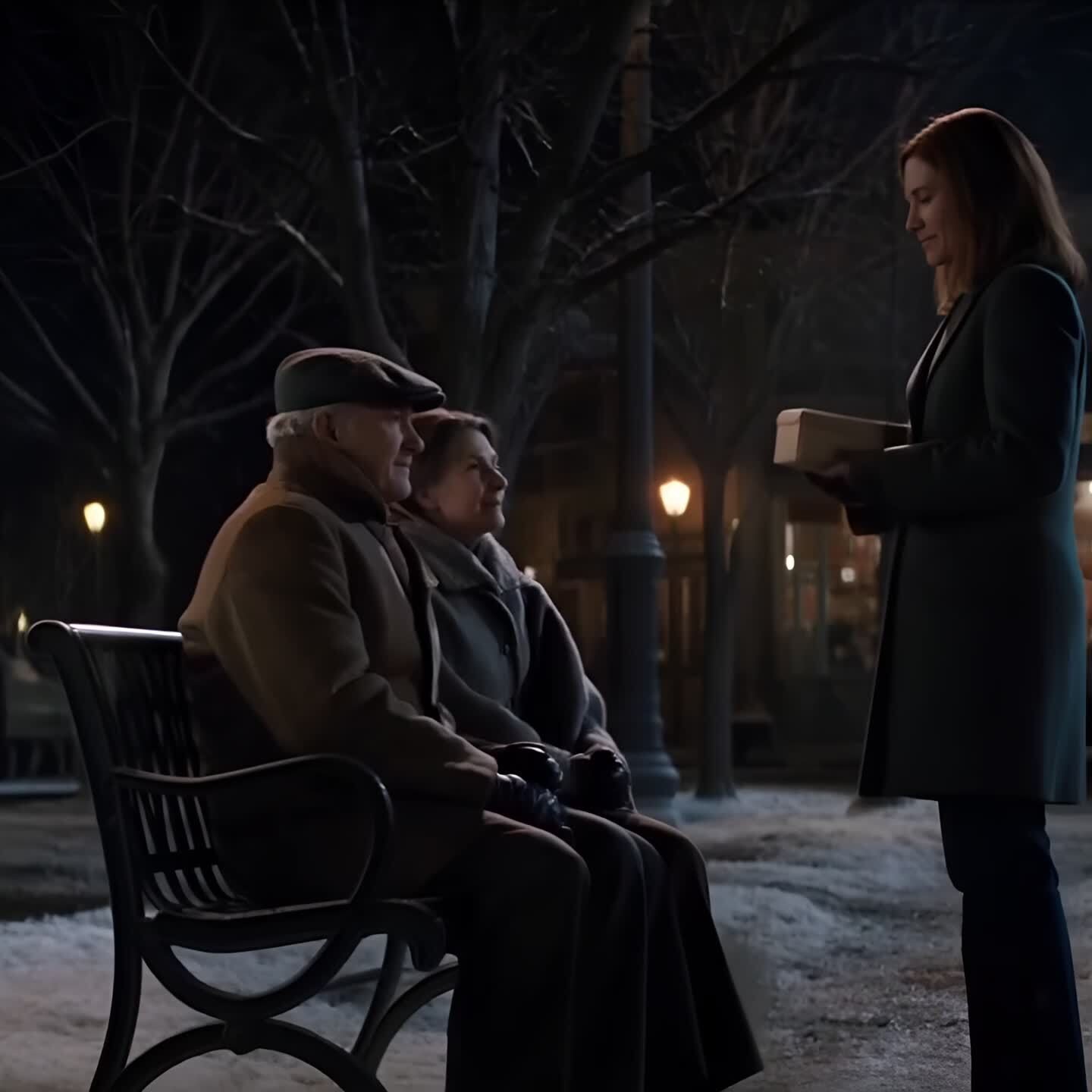
It was nineteen degrees on Christmas Eve in a small town in Oregon, USA.
Sarah Mitchell stepped out of the post office with a cardboard box receipt in her pocket and numb fingers wrapped around her car keys. Her breath hung in the air in little white clouds. The parking lot she crossed was the kind every small American town seems to share—a kind of accidental town square where too much had been crammed into one space.
The post office sat on one corner, the Greyhound bus station on the next. Beside the depot was Rosie’s, a narrow diner that served the best pie in three counties, and next to that a laundromat that had been “closing soon” for about fifteen years. Cars idled, buses rumbled, and a bitter winter wind knifed right through Sarah’s coat.
She should have been heading straight home. It was her first real break in three weeks from the hospital. Christmas Eve had fallen on a Tuesday that year, and she’d worked the weekend shift. She finally had Tuesday through Thursday off. That morning she’d spent hours wrapping presents she’d bought on her lunch breaks and hiding them in the closet Marcus used to keep his fishing gear in.
Marcus.
Even thinking his name hurt.
Her kids—ten‑year‑old Jake and seven‑year‑old Emma—were at her older sister Linda’s house, helping bake cookies and making a royal mess of the kitchen, no doubt. That had given Sarah a precious, quiet window to finish the last of her “Santa preparations.” She was nearly done when she realized she’d forgotten one thing: the package.
The box she’d just mailed had been sitting on the kitchen counter like an accusation.
It was for Marcus’s mother, Ruth, who lived in an assisted living facility in Arizona. Eighty‑three, frail, and living in a place with palm trees and beige hallways, Ruth’s mind had started to blur at the edges. But no matter what she forgot, she still remembered Marcus.
She asked about him every single time Sarah called.
Every time, Sarah had to tell her again, had to explain that her son—Ruth’s only child—had died. And every time, Ruth reacted as if she were hearing it for the first time. It was torture for both of them, but Sarah couldn’t stop calling. Ruth was the last piece of Marcus she had left outside of their children.
In the box, Sarah had packed photos of the kids and a soft blanket Emma had chosen with great ceremony. She’d added a few of Marcus’s old letters she’d found in a shoebox in the garage—letters he’d written to his mother back in college, before Sarah even knew him. She thought Ruth would want them, that maybe they’d help her remember her son the way he’d been before the sickness took everything.
The post office closed at noon on Christmas Eve. When Sarah checked the oven clock and saw 11:15, she’d grabbed her coat, her keys, the box, and driven straight there.
Now the package was on its way to Arizona. Her errand was done. Her mind had already jumped ahead to everything else waiting for her: picking up the kids, finishing the ham, getting through the evening without breaking down when Emma asked, as she did most nights, if Daddy was watching from heaven.
She was halfway to her car when something made her look toward the bus station.
She had driven past that Greyhound depot a thousand times and barely noticed it beyond the diesel fumes and faded sign. But that day her gaze snagged on the metal bench out front—the kind designed to be deliberately uncomfortable so no one could sleep on it.
Two people sat hunched together on the cold slats.
Even from thirty feet away, Sarah saw that the woman was shivering. She was tiny, maybe five‑two, with white hair pinned back neatly, though wisps had blown loose in the wind. A decent but worn coat was buttoned tight around her, and her lips had a bluish tint that set off every alarm in Sarah’s nurse’s brain.
Beside her sat a tall, broad‑shouldered man who had probably been powerful once, before age shrank him. His coat—a thin, old thing—wasn’t on his own back. He had wrapped it around the woman’s shoulders on top of her own coat, leaving himself in nothing but a flannel shirt. His big hands clutched his upper arms, and his breath puffed out in sharp, visible bursts.
They had to be in their eighties.
They were sitting outside in nineteen‑degree weather.
Sarah stopped walking.
There was something about the way they leaned into each other, about the way the man angled his body to shield the woman from the wind, that hit her like a fist in the chest. It was exactly how Marcus used to hold her. Exactly how he’d sat with her in the hospital waiting room on the day they got the diagnosis—like he could block the bad news with his own body if he just stayed wrapped around her tightly enough.
She should have kept going. She had a hundred things to do and two kids waiting for her. Any reasonable person would have hurried to their warm car and told themselves it wasn’t their business.
Instead, Sarah’s feet turned toward the bench.
The closer she got, the more details she saw. The woman’s hands, clasped in her lap, trembled violently. Her cheeks were streaked with tears—tears that had frozen on her skin. The man’s face was deeply lined, his eyes a washed‑out gray that looked exhausted and, underneath that, absolutely heartbroken.
Sarah crouched a little as she approached, trying not to startle them.
“Excuse me,” she said. “Are you folks okay?”
The woman looked up, and Sarah saw it clearly: actual frozen tears, tiny beads of ice on her wrinkled cheeks.
“We’re fine,” the man said quickly, his voice gruff and defensive—the sound of someone who’d spent a lifetime handling his own problems and didn’t know how to ask for help. “Just waiting for our ride.”
“How long have you been waiting?”
He didn’t answer, but the woman did, her voice thin and wavering.
“Since this morning. Our son Kevin was supposed to come. He said he’d be here by ten.”
Sarah glanced at her phone. It was 11:45. Nearly two hours late already. And something in her gut told her it had been much longer.
“What time did your bus get in?” she asked gently.
The man’s jaw tightened like he hated having to say it.
“Five‑thirty,” he muttered.
Five‑thirty in the morning.
They had been sitting on that metal bench for over six hours in nineteen‑degree weather, on Christmas Eve, in a random Oregon parking lot.
“Sir,” Sarah said, crouching so she was at eye level with them. “You really need to get inside somewhere. There’s a diner right there.” She nodded toward Rosie’s. “Let me buy you some coffee, get you warmed up, and we can figure out what’s going on with your ride.”
“We can’t leave,” the woman whispered, panic flickering in her eyes. “What if Kevin comes and we’re not here? He won’t know where to find us.”
“Dorothy.”
The man’s tone softened instantly, the gruffness melting away. He laid a large, weathered hand over hers.
“Dorothy, honey, Kevin’s not coming.”
Dorothy looked at him, and in that look Sarah saw everything: confusion, denial, and the slow, horrible realization settling over her like another layer of ice.
“He said he would,” Dorothy breathed. “He promised, Harold. He promised he’d take care of us.”
“I know.” Harold’s voice broke on the words. “I know he did.”
Sarah felt like she was intruding on something unbearably private, but she couldn’t just walk away now. Not when every instinct in her body was screaming that something was terribly wrong.
“What happened?” she asked quietly.
Harold studied her for a long moment, weighing this stranger who’d stopped when everyone else had walked past. Finally, he seemed to decide something.
“Our son,” he said. “Kevin. He sold our house three months ago. The house Dorothy and I lived in for fifty‑two years. Raised him in. I built half of it with my own hands.” He swallowed hard. “He said he was moving us in with him and his wife. Said it was time, with Dorothy’s memory issues. Said he’d take care of everything.”
“Harold,” Dorothy said softly, her voice begging him not to relive it.
But it was as if, once he started, he couldn’t stop. He needed someone—anyone—to hear what had been done to them.
“He put us on a bus yesterday,” Harold went on. “Said he’d pick us up here and drive us to his place in time for Christmas. We were excited.” He let out a rough laugh with no humor in it. “First Christmas with the grandkids in four years. Dorothy bought presents—little things, a doll for Lily, a book for Michael. Wrapped them herself, even with her hands shaking.” He jerked his chin toward two small suitcases at their feet. “Everything we own in the world is in those two bags now. Fifty‑two years of life, fifty‑two years of memories, packed into luggage sitting on frozen concrete outside a bus station.”
Sarah’s stomach twisted.
“Kevin called this morning,” Harold said. “At six‑fifteen. Dorothy lit right up when she saw his name on the phone. Thought he was calling to say he was on his way.” His big hands were trembling now, and Sarah knew it wasn’t from the cold. “Instead, he told us he couldn’t do it anymore. Said we were ‘too much.’ Said Dorothy’s condition was getting worse and he wasn’t prepared to handle it. Said we needed to ‘figure something else out.’ Then he hung up.”
“Figure something else out,” Sarah repeated, horrified. “What does that even mean?”
“That’s what I asked him,” Harold said, his voice hollow. “He told me there were shelters. Programs. Places that take people like us.”
On Christmas Eve morning, their son had called his elderly parents—his mother with dementia, his father who had literally built his childhood home—and told them they were on their own.
Dorothy started crying again, fresh tears tracking over the frozen ones.
“He’s our son,” she whispered. “Our only child. We gave him everything. Everything.”
Sarah stood there in that bleak little American parking lot and felt something shift inside her. All the grief she’d been carrying for eight months, all the loneliness and anger and confusion, rose up, sharp and hot. Not anger at Marcus, not anger at God, but at this Kevin she’d never met, this man who could look at the people who created him and see nothing but inconvenience.
She thought of Ruth in Arizona—alone in her assisted living facility, clinging to foggy memories of a son who would never walk through her door again. Marcus had visited his mother every month until he got sick, called her every Sunday, sent flowers on her birthday and cards on every holiday. When Ruth started forgetting things, Marcus never got frustrated. He told her the same stories over and over, laughed at the same jokes, because making her feel loved mattered more than making her remember.
Marcus would never have abandoned his mother.
And Sarah knew, in her bones, that he wouldn’t have let her walk away from Harold and Dorothy, either.
“Okay,” Sarah said, straightening up. “Here’s what’s going to happen.”
Harold looked up at her, surprise breaking through the exhaustion in his eyes.
“You’re going to let me help you up,” she said. “We’re going to grab your bags, and you’re coming with me.”
“Ma’am—” Harold began.
“My name is Sarah,” she cut in. “Not ma’am. And I’m a nurse, so I can tell you for a fact that your wife is showing early signs of hypothermia, and you’re not far behind. I have a car. I have heat. And I have a house with a guest room nobody’s using.
“It’s Christmas Eve. Nobody should spend it on a frozen bench because their own child walked away.”
Dorothy stared at her like she’d just offered a miracle.
Maybe she had.
Or maybe Dorothy was offering one to Sarah. Sometimes it was hard to tell who was saving whom.
“Why?” Harold asked quietly. Suspicion still threaded his voice, but underneath it Sarah heard something else: fragile, desperate hope. “Why would you do this? You don’t even know us.”
Sarah thought of Marcus. Of the way he’d always said you could measure a person’s character by how they treated people who couldn’t give them anything in return. Of how he volunteered at the food bank every Thanksgiving, even in years when they weren’t sure they could afford their own turkey.
She thought of the last thing he’d said to her before he died.
Take care of people, Sarah. The way you took care of me.
“Because it’s the right thing to do,” Sarah said simply. “And because I think we all need a little kindness right now.”
Harold searched her face for a long moment, looking for the catch, the angle, the hidden agenda. All he found was a woman with tired eyes and steady hands who’d stopped when everyone else had passed by.
Slowly, he nodded.
Sarah helped Dorothy to her feet. The older woman’s legs were stiff from hours of sitting still in the cold, and she leaned heavily on Sarah’s arm. Harold, his pride still stubbornly intact, grabbed the suitcases himself before she could offer.
They walked across the lot to Sarah’s car, an aging Honda Civic Marcus had always promised to replace “one of these days.” He never got around to it. Sarah helped Harold and Dorothy into the back seat and cranked the heat up as high as it would go.
As she pulled out of the parking lot, Dorothy reached forward and touched Sarah’s shoulder.
“Thank you,” she whispered. “Thank you.”
Sarah met her eyes in the rearview mirror. Harold had his arm around his wife, holding her close like she was the only warm thing left in the world. Two strangers who had, in the space of an hour, become her responsibility.
What have I just done? Sarah thought.
But she kept driving.
Sometimes you don’t know why you’re doing something until after you’ve done it. Sometimes the leap of faith comes before the understanding.
And sometimes the people who show up in your life at your lowest moment are exactly the people you need.
Sarah had no idea how much her life was about to change.
PART TWO
Sarah’s house was a modest three‑bedroom ranch on a quiet street lined with old oak trees. She and Marcus had bought it eleven years earlier, right after Jake was born. The kitchen was outdated, the bathroom tile needed replacing, and the back porch railing had been on Marcus’s to‑do list for three years before he got sick. It wasn’t fancy, but it was home.
Tonight, for however long they needed it, it would be Harold and Dorothy’s home too.
She pulled into the cracked driveway and shut off the engine.
“This is it,” she said, turning in her seat. “It’s not much, but it’s warm, there’s food, and there’s a bed.”
Harold looked at the small house, then back at Sarah.
“You’re sure about this?” he asked. “You’ve got a family. We don’t want to impose.”
“You’re not imposing,” Sarah said firmly. “I’m inviting you. There’s a difference.”
She helped Dorothy out carefully, one arm around her waist to steady her on the icy walkway. Harold followed slowly, still carrying the suitcases.
The house was quiet when they stepped inside. The kids wouldn’t be back for another hour, and Sarah was grateful for that small cushion of time. She needed to get Harold and Dorothy settled, to figure out how exactly she was going to explain all this to Jake and Emma.
The living room was modest but comfortable: a worn couch that had seen better days, a coffee table with faint crayon marks that never quite came out, and a real Christmas tree in the corner, twinkling with colored lights. Marcus had always insisted on real trees, and even now Sarah couldn’t bring herself to break that tradition.
Wrapped presents were scattered underneath, all in the same red‑and‑green plaid paper she’d used every year, tied with little gold ribbons.
Dorothy stopped in the doorway and just stared.
“Oh,” she breathed. “Oh, Harold, look.”
Harold came up behind her. Sarah saw his throat work as he swallowed.
“It’s beautiful,” Dorothy whispered. “It’s been so long since we had a real tree. Kevin’s wife says they’re too messy, too much work.”
There it was again. Kevin decided. Kevin’s wife said. Kevin couldn’t be bothered.
Sarah felt anger flare in her chest, but she pushed it down. This wasn’t the time.
“Come sit down,” she said gently, guiding Dorothy toward the couch. “I’ll make some tea. Or coffee. Or hot chocolate.”
“Tea would be lovely,” Dorothy said. “Thank you, dear. Thank you so much.”
In the kitchen, Sarah filled the kettle and set it on the stove, her hands shaking slightly as she reached for mugs. Adrenaline, she realized—the adrenaline of doing something impulsive, something completely out of character. Sarah Mitchell did not bring strangers home. Sarah Mitchell was careful, measured, responsible. She planned things.
But the Sarah who’d existed before Marcus died and the Sarah standing in her tiny Oregon kitchen now were two very different women. Maybe this new version of herself, this grieving, cracked‑open person, was capable of things the old Sarah never would have considered.
Her phone buzzed on the counter.
A text from Linda: Kids are ready. Heading over in 20. They’re hyped about Santa. Good luck tonight lol.
Twenty minutes.
Sarah had twenty minutes to figure out how to explain Harold and Dorothy.
She carried three cups of tea into the living room on a tray. Dorothy had drifted toward the fireplace and was studying the photos on the mantle: baby pictures of Emma, Jake’s first day of school, and in the very center, in a simple silver frame, a picture from Sarah and Marcus’s tenth anniversary. They’d taken it at a lake not far from town—Marcus’s arm around her, both of them laughing at something the kids had yelled from the dock.
It was the last photo they’d taken together before the diagnosis.
“Is this your husband?” Dorothy asked softly, pointing at Marcus’s face.
Sarah nodded, her throat suddenly tight.
“He has kind eyes,” Dorothy said. “Is he at work?”
Harold made a small sound, a low hiss of breath. He’d heard the past tense Sarah had used earlier.
“He passed away,” Sarah managed. “Eight months ago. Cancer.”
Dorothy’s hand flew to her mouth.
“Oh, honey,” she said. “I’m so sorry. And here we are, showing up on your doorstep on Christmas Eve, making more work for you.”
“You’re not more work,” Sarah said honestly. “You’re… company. This house has been too quiet since he’s been gone. The kids and I have been rattling around in here like ghosts. Maybe having people around is exactly what we need.”
Dorothy’s eyes filled with tears again, but this time they weren’t just from sorrow. There was gratitude there. Recognition. One broken heart recognizing another.
“You’re an angel, Sarah Mitchell,” Dorothy whispered.
Sarah shook her head.
“I’m just the person who happened to be at the bus station,” she said. “Or maybe you were the ones who happened to be there. I don’t know. I just know you needed help and I could give it.”
Harold had been quiet, watching all this with those sad, intelligent eyes. Now he set his teacup down on the coffee table.
“Kevin wasn’t always like this,” he said. “I want you to know that. When he was a boy, he was…”
He trailed off, searching for the word.
“Good,” Dorothy finished softly.
“He was a good boy,” Harold said. “Helped me in the workshop. Took care of his mother when she was sick with the flu. Always said please and thank you.”
“Harold,” Dorothy murmured, “you don’t have to—”
“No, I do,” he insisted. “This woman took us into her home. She deserves to know who we are. What happened to us.” He looked at Sarah. “If you don’t mind?”
Sarah shook her head and sank into the armchair across from them.
“Kevin was our miracle baby,” Harold began. “Dorothy and I tried for years to have children. Doctors said it wasn’t likely. Then, when Dorothy was thirty‑seven, after we’d practically given up, she got pregnant.”
Dorothy smiled faintly at the memory.
“He was born on March fifteenth, 1975,” Harold said. “Eight pounds, six ounces. Healthiest baby the doctor had seen all week.”
“He was perfect,” Dorothy whispered. “Perfect little fingers, perfect little toes.”
“We gave him everything,” Harold said. “Not spoiled, mind you. I don’t believe in that. But we made sure he had opportunities—good schools, summer camps. We paid for his college, his first car, the down payment on his first house. When he got married, we paid for the wedding. Dorothy insisted on that.”
“I wanted it to be special,” Dorothy said.
“It was special,” Harold said. “Fifteen thousand dollars’ worth of special. But we didn’t mind. He was our son. That’s what parents do.”
Sarah thought of her own parents—both gone now. Her father had died of a heart attack when she was twenty‑two, her mother from a stroke five years later. She thought of Ruth in Arizona, alone with her fading memories. She thought of Jake and Emma and the lengths she’d go to for them. There was nothing she wouldn’t do for her kids.
“So what changed?” she asked quietly.
Harold’s jaw tightened.
“He met Valerie,” he said.
“Harold…” Dorothy’s voice carried a warning note.
“It’s the truth, Dot, and you know it.”
“Valerie came from money,” Harold explained. “Old money. Her family looked at us like we were dirt on their shoes. A carpenter and a schoolteacher weren’t exactly what they wanted for in‑laws. And after a while, Kevin started to see us through their eyes.”
“That’s not entirely fair,” Dorothy protested weakly. “She’s not all bad. She gave us grandchildren.”
“Grandchildren we’ve seen maybe a dozen times in ten years,” Harold shot back. “Grandchildren whose birthday parties we weren’t invited to because we might embarrass Valerie in front of her country club friends.”
Bitterness sharpened his voice, and Sarah understood. This wasn’t just about what had happened at the bus station. This was about years—decades—of being slowly pushed out of their own son’s life, of being treated as an inconvenience instead of a blessing.
“Dorothy was diagnosed with early‑stage dementia two years ago,” Harold went on, his voice quieter now. “The doctor said it was manageable. With medication, routine, support, she could have a good quality of life for years, maybe decades.” He reached for his wife’s hand and squeezed it. “But Kevin didn’t want to deal with it. Said it was too stressful. Said watching his mother forget things was too painful for him.”
Not for Dorothy, who was living it.
Not for Harold, who watched the love of his life slip away piece by piece.
“For him,” Harold said. “From the comfort of his big house in the suburbs.”
“When the house became too much for us to maintain, Kevin offered to sell it,” Harold continued. “Said he’d handle everything. Said he’d put us up in his guesthouse until we got settled.
“They have a guesthouse,” he added dryly. “Can you believe that?”
“So we agreed,” Dorothy said quietly. “We signed the papers. Fifty‑two years in that house, and we signed it away because our son said he’d take care of us. He got three hundred thousand dollars for it. The house Harold built with his own hands.”
“And we never saw a penny,” Harold finished. “He said he was ‘holding it for us.’ For our care. For our future. But when I asked him about putting it in our names, he got angry. Said I was accusing him of stealing. Said if we didn’t trust him, maybe we should find somewhere else to live.”
Sarah felt physically ill.
This wasn’t just neglect. This was theft. This was financial exploitation.
“I’m so sorry,” she said. The words felt useless in the face of such betrayal, but she had nothing else.
“Not your fault,” Harold said gruffly. “Not your burden to carry.”
“Maybe not,” Sarah said. “But you’re here now, and you’re safe. Whatever comes next, we’ll figure it out together.”
Before anyone could respond, the crunch of tires on the icy driveway made them all glance toward the front window.
Sarah’s heart rate spiked.
Linda’s minivan.
“That’ll be my sister,” Sarah said quickly. “And my kids. Emma’s seven and Jake’s ten. They don’t know about…” She gestured vaguely at Harold and Dorothy. “Any of this yet. I’ll go talk to them. Just, um, give me a minute.”
She hurried to the front door and stepped outside, pulling it closed behind her. The cold air slapped her in the face, but she hardly felt it.
Linda was just climbing out of the driver’s seat, her breath puffing in the frosty air. Her face split into a grin.
“Hey! Kids are sugared up and ready to—” She stopped mid‑sentence, reading something in Sarah’s expression. “What’s wrong? Did something happen?”
“Nothing’s wrong,” Sarah said too quickly. “I just… need to tell you something before you come in.”
Linda’s eyes narrowed. Three years older than Sarah and a protective big sister down to her bones, she’d been Sarah’s rock since Marcus died—showing up with casseroles and babysitting offers and endless patience for tears. She could read Sarah like a book.
“Sarah,” she said slowly. “What did you do?”
“I brought some people home,” Sarah said.
“What people?”
“An elderly couple. Harold and Dorothy. I found them at the bus station. Their son abandoned them there this morning. They had nowhere to go, Linda. Nowhere.”
Linda stared for a second, then let out a disbelieving laugh.
“You brought home strangers,” she said flatly. “On Christmas Eve. With your kids in the house.”
“They’re not dangerous,” Sarah said.
“You don’t know that. You don’t know anything about them. They could be anyone, Sarah—people who take advantage, people who—”
“They’re an eighty‑one‑year‑old woman with dementia and her eighty‑three‑year‑old husband,” Sarah cut in. “They were sitting on a metal bench in nineteen‑degree weather for six hours because their son told them to ‘figure something out.’ Dorothy’s lips were blue. Linda, I’m a nurse. I couldn’t just leave them there.”
“You could have called someone,” Linda insisted. “A shelter, the police, social services.”
“On Christmas Eve? You know everything’s closed or running skeleton crews. And how long would it have taken anyone to get there?”
“So you brought them home,” Linda said, her voice rising. “Sarah, I know this Christmas is going to be brutal without Marcus. I know you’re not yourself right now. But this is not a safe choice. This is… reckless.”
The word hit Sarah like a punch.
Reckless.
Her sister thought grief had pushed her over the edge. Maybe it had. Maybe she was doing something no calm, logical person would do.
But then she pictured Dorothy’s frozen tears. Harold’s bare arms. Two people who had given their lives to raising a son who had put them on a bus and walked away.
“Maybe it is reckless,” Sarah said quietly. “But I would rather be reckless and kind than cautious and cruel. They needed help, Linda. I could help them, so I did.”
Linda opened her mouth to argue, then stopped. Something in Sarah’s face must have told her this wasn’t a battle she was going to win.
“Fine,” Linda said at last. “But if anything—and I mean anything—seems off, you call me. Right away. Do you understand?”
“I understand.”
“And I’m staying for dinner,” Linda added. “I want to meet them myself.”
Sarah almost smiled.
Classic Linda. If she couldn’t talk Sarah out of something, she’d march right into the middle of it to keep an eye on things.
“Fine,” Sarah said. “Stay. You’ll see. They’re good people. Just… broken, like us.”
Linda’s expression softened at that, because if anyone understood brokenness, it was her. She’d held Sarah together on nights when the grief felt heavy enough to crush her.
“Mommy! Mommy!”
Emma barreled around the side of the minivan, blonde curls bouncing, face smeared with frosting. Jake followed more slowly, hands shoved in his pockets, trying very hard to look cool and unimpressed—the way ten‑year‑old boys in the United States sometimes do when they’re actually thrilled.
“Hey, baby,” Sarah said, crouching to catch Emma in a hug. “Did you have fun making cookies?”
“We made so many cookies,” Emma gushed. “Sugar cookies and gingerbread men and Aunt Linda let me put sprinkles on and I only ate four of them.”
“Only four, huh?” Sarah said.
“Okay, maybe five. But Jake ate more.”
“Did not,” Jake muttered automatically.
Sarah stood, keeping Emma’s sticky hand in hers.
“Listen, guys,” she said. “Before we go inside, I need to tell you something. We have guests.”
“Guests?” Jake’s eyebrows shot up. “Who?”
“An older couple,” Sarah said. “Their names are Harold and Dorothy. I met them today and they needed a place to stay, so I invited them to spend Christmas with us.”
Emma’s eyes went wide.
“Strangers?” she asked. “Are they nice strangers?”
“Very nice,” Sarah assured her. “But they’ve had a really hard day, so I need both of you to be on your best behavior. Be kind. Be welcoming. Can you do that for me?”
Jake was studying her face with a seriousness that reminded Sarah painfully of Marcus. He had the same analytical gaze, the same ability to see straight through to the truth underneath whatever words she used.
“What happened to them?” he asked quietly. “Why do they need a place to stay?”
Sarah hesitated. How much could a ten‑year‑old carry?
“Their son let them down,” she said finally. “Sometimes family disappoints us. When that happens, other people need to step in. That’s what we’re doing.”
Jake thought about that for a moment, then nodded.
“Dad would’ve done the same thing,” he said.
The words hit Sarah like a wave.
“Yeah,” she said, her voice thick. “Yeah, he would have.”
“Then it’s the right thing to do,” Jake said simply.
And that was that.
They went inside together, Linda trailing behind with her jaw set in protective big‑sister mode.
In the living room, Harold and Dorothy stood awkwardly near the couch, as if they weren’t sure where they were allowed to sit.
“Harold, Dorothy,” Sarah said warmly. “These are my children—this is Emma and this is Jake—and this is my sister, Linda.”
Emma, never shy, marched straight up to Dorothy and stuck out her hand.
“Hi, I’m Emma,” she said. “I’m seven. Do you like Christmas?”
Dorothy’s whole face transformed. The exhaustion and fear melted under a bright, astonished smile.
“Hello, Emma,” she said, shaking the small hand with exaggerated seriousness. “I’m Dorothy. I’m eighty‑one, and I love Christmas. It’s my favorite holiday.”
“Mine too,” Emma said. “Do you know any Christmas songs? Mommy says I sing them too much, but I don’t think you can sing Christmas songs too much. Do you?”
“I don’t think you can either,” Dorothy said. “In fact, I think we should probably sing more Christmas songs. The world would be a better place if everyone sang more.”
Then, without warning, she began softly: “Silent night, holy night…”
Her voice was thin with age but still hauntingly beautiful, the kind of voice that had probably filled church choirs all over the United States sixty years ago. Emma’s mouth dropped open. Then, slowly, she joined in.
“All is calm, all is bright…”
Sarah stood frozen, watching her daughter and this elderly stranger sing together under the glow of the tree lights. Dorothy’s eyes were closed, lost in the music. Emma watched her with open wonder, matching her timing and pitch as best she could.
Linda came to stand beside Sarah.
“Okay,” she whispered. “I get it now.”
“Yeah,” Sarah whispered back. “She’s not really a stranger anymore, is she?”
Jake had drifted over to Harold.
“She used to sing in our church choir,” Harold said quietly, watching his wife. “Forty years, lead soprano. Even after the dementia started, she never forgot the music. Everything else fades, but the songs stay.”
“My dad used to sing too,” Jake said. “Not good. Really bad, actually.” A ghost of a smile crossed his face. “But he’d sing anyway, just to make us laugh.”
“Your father,” Harold said gently, “he’s the man in the photos, isn’t he?”
Jake nodded, his jaw tight.
“He died eight months ago,” he said. “Cancer.”
“I’m sorry, son,” Harold said. “That’s a heavy thing to carry.”
“Yeah,” Jake said.
He was quiet for a moment, then asked, “Do you build stuff? Mom said you’re a carpenter.”
“Fifty years in the trade,” Harold said. “Built houses, furniture, cabinets. Built our home—the one Kevin sold. Put in every nail. Sanded every board.”
“Dad used to build things with me,” Jake said. “In the garage. We were making a birdhouse before he got sick. We never finished it.”
Something passed between the old man and the boy—a recognition of shared loss.
“Maybe,” Harold said carefully, “if your mother has some tools in that garage, we could finish it together. If you’d like.”
Jake’s face did something complicated—hope, pain, longing all at once.
“Yeah,” he said finally. “I’d like that.”
The song ended. Emma was beaming at Dorothy as if she’d just discovered a new best friend. Dorothy wiped tears from her eyes and laughed.
“That was beautiful,” Linda said, stepping forward. “Dorothy, right? I’m Linda. It’s good to meet you both.”
She shook their hands, and Sarah watched the last of Linda’s skepticism melt away. Because how could you look at these two—these abandoned elders—and see anything but fellow human beings who deserved better?
They had ham and mashed potatoes and green beans for dinner. Nothing fancy—just a solid American holiday meal—but it was warm and filling. All six of them squeezed around a table built for four, elbows bumping, dishes being passed back and forth.
Dorothy told stories about teaching third grade for thirty‑five years. Harold talked about houses he’d built and the satisfaction of making things with his hands. Emma peppered them with questions about the old days. Jake, to Sarah’s quiet astonishment, talked more than he had in months—about his dad, about the projects they used to tackle in the garage, about the half‑finished birdhouse.
“We’ll finish it,” Harold said firmly. “Tomorrow, if your mother says it’s okay. A man should always finish what he starts.”
Jake looked at Sarah, hope shining through the grief.
“Of course,” she said, blinking away tears. “I think that’s a wonderful idea.”
Later, after more Christmas songs and after Emma had introduced Dorothy to every single stuffed animal she owned, Sarah helped Harold carry their suitcases down the hall to the guest room.
It was small—a double bed, a dresser, and a window overlooking the backyard—but Dorothy ran her hand over the faded quilt like it was something precious.
“It’s perfect,” she said. “Absolutely perfect.”
“It’s not much,” Sarah began.
“It’s a room,” Harold said firmly. “With a bed and heat and people who don’t see us as problems to be solved.” Emotion thickened his voice. “Sarah, what you did today—taking in strangers, sharing your holiday with us… I’ve lived eighty‑three years, and I’ve never seen kindness like this from someone who had every reason to keep walking.”
“I had reasons to stop, too,” Sarah said quietly.
Harold studied her face for a long moment, then nodded slowly.
“The grief,” he said. “I see it in you, the same way I see it in your boy. You’re still carrying it.”
Sarah didn’t deny it. Couldn’t.
“My wife is going to forget everything,” Harold said. “The doctor says three to five years, maybe more, maybe less. One day she won’t remember my name. Won’t remember Kevin. Won’t remember our life together.” His voice cracked. “But she’ll remember kindness. That stays. That always stays.
“What you did today, she’ll carry that with her into whatever comes next. Even when the details go, that feeling will be there. So… thank you. From whatever’s left of my heart, thank you.”
Sarah couldn’t find words. She just squeezed his hand and slipped out, leaving them to settle in.
Later, after Emma had fallen asleep dreaming of Santa and Jake lay in bed clutching the unfinished birdhouse, Sarah sat alone at the kitchen table. The house was quiet except for the soft hum of the heater and the faint rustle of the tree lights in the next room.
For the first time in eight months, the silence didn’t feel oppressive.
It felt peaceful.
Linda had left an hour earlier, hugging Sarah hard at the door.
“You did a good thing,” she’d whispered. “A wild thing, but a good thing. Marcus would be proud.”
Marcus would be proud.
Sarah held on to that as she sat in the dim kitchen light.
Tomorrow would bring problems. Harold and Dorothy couldn’t stay in the guest room forever. There would be calls to make, systems to navigate, futures to figure out.
But that was tomorrow.
Tonight was Christmas Eve.
Tonight, two people who had been left on a bench in the cold had a warm bed to sleep in.
Tonight, her daughter had sung carols with a woman who might not remember the song in the morning.
Tonight, her son had smiled—really smiled—for the first time since his father died.
Tonight, Sarah thought, maybe she’d done something right.
Christmas morning arrived with Emma’s shriek of delight at 6:15 a.m.
“Santa came! Santa came! Mommy, wake up! Santa came!”
Exhausted but smiling, Sarah stumbled out to the living room. Emma was already tearing into wrapping paper. Jake was there too, trying and failing to look unimpressed.
In the hallway stood Harold and Dorothy, watching with shining eyes.
“I hope we’re not intruding,” Harold said. “We heard the commotion.”
“You’re not intruding,” Sarah said. “Come sit. This is your Christmas too.”
Dorothy’s eyes filled.
“We don’t have anything for the children,” she said. “We didn’t know… we couldn’t…”
“You being here is more than enough,” Sarah said firmly.
And it was.
Watching Emma chatter to Dorothy as she opened each gift, explaining every plastic doll and art set in detail. Watching Jake show Harold the new set of basic woodworking tools Sarah had bought him months ago, hoping they might help him feel close to Marcus again. Watching two broken families knit themselves together in front of the tree—it turned a morning that could have been unbearable into something almost whole.
The ache of Marcus’s absence was still there, a phantom limb that throbbed with every tradition. But for the first time, the ache felt shareable, diluted by the presence of people who understood loss.
After presents and pancakes shaped like lopsided Christmas trees—a tradition Marcus had started when Jake was three—Harold turned to Jake with a serious expression.
“So,” he said, “about that birdhouse.”
Jake’s whole face lit up.
“Really? Today?”
“No better day than Christmas to finish something important,” Harold said. “If your mother approves.”
“The garage is all yours,” Sarah said, her throat tight.
From the kitchen window, she watched them walk to the detached garage at the back of the small Oregon lot. Harold moved slowly, joints stiff from years of physical work and the recent ordeal. Jake practically bounced beside him, gesturing excitedly with his hands the way Marcus used to when he got talking about a project.
“He looks happy,” a voice said behind her.
Sarah turned. Dorothy had come to stand at her side, a mug of coffee cradled in her hands.
“He does,” Sarah agreed. “He hasn’t looked like that in a long time.”
“Harold’s always been good with kids,” Dorothy said. “Always patient. Kevin used to follow him around the workshop like a little shadow, wanting to learn everything. I don’t know where we lost that boy.”
Sarah didn’t have an answer.
“Can I help with something?” Dorothy asked suddenly. “I feel useless just sitting around. I taught third grade for thirty‑five years. I’m not used to being idle.”
“Want to help me with lunch?” Sarah asked.
Dorothy’s face brightened.
“I’d love that.”
They worked side by side, chopping vegetables for soup and cutting out biscuit dough. Dorothy’s hands remembered the motions even when her mind occasionally wandered. Sometimes she’d pause, staring at the cutting board as though she’d just landed in the kitchen without a map. Then she’d shake herself, smile apologetically, and pick up where she’d left off.
“My mother had dementia,” Sarah said quietly at one point, without really planning to. “Toward the end, she’d forget my name sometimes. Forget she even had daughters.”
Dorothy’s knife stilled.
“Was she scared?” she asked.
“Sometimes,” Sarah said. “But mostly she was peaceful, like she’d finally put down all the worries she’d carried for years. The forgetting wasn’t all bad. She forgot a lot of the hard things, too.”
“I’m scared,” Dorothy admitted, her voice barely above a whisper. “Not of forgetting, really. Of being a burden. Of making Harold’s life harder than it already is. Of being the reason Kevin…” She trailed off, unable to say the rest.
Sarah set her knife down and turned to face her.
“Dorothy, listen to me,” she said. “You are not the reason Kevin did what he did. That’s on him. His choice. His failure. Not yours.”
“If I weren’t sick—”
“He would have found another excuse,” Sarah said. “People who abandon their parents don’t do it because of one challenge. They do it because of who they are on the inside. That didn’t start with your diagnosis. It just gave him a justification.”
Dorothy studied her face for a long moment, then nodded slowly.
“You’re very wise for someone so young,” she said.
Sarah actually laughed—a rusty, unfamiliar sound.
“I’m thirty‑eight,” she said. “I don’t feel young.”
“Everyone under sixty is young to me,” Dorothy said with a small smile.
Emma burst into the kitchen then, claiming she was “starving to absolute death,” and the moment passed. But something between Sarah and Dorothy had shifted—solidified into something like friendship.
The days between Christmas and New Year’s slipped into a gentle rhythm. Harold and Jake spent hours in the garage, the clack of hammers and whir of an old saw drifting through the house. Dorothy and Emma became inseparable. Dorothy taught her songs and old‑fashioned games—Cat’s Cradle and Jacks and clapping rhymes Sarah hadn’t heard since her own childhood. In return, Emma taught Dorothy how to work the remote and which streaming service had the best cartoons.
Sarah found herself breathing more easily than she had in months. Cooking for more than three, listening to the house hum with life and music and the occasional argument over whose turn it was with the good blanket—it didn’t erase the grief. Nothing could. But it made it bearable.
On December twenty‑seventh, Sarah started making phone calls.
She called the county social services line first, explaining as best she could: an elderly couple abandoned at a bus station on Christmas Eve, no home, no money, no plan.
The woman on the other end was sympathetic but realistic.
“There are programs,” she said. “But they take time. There are waiting lists for subsidized housing and assisted living. If they need immediate shelter, there are emergency beds at some local nonprofits.”
“They’re not going to a shelter,” Sarah said. “They’re staying with me until we figure something out.”
“That’s very generous,” the social worker said. “But you should know, you don’t have any legal authority over them. If their son decides to get involved—”
“The son who left them at a bus station?” Sarah cut in. “I doubt he’s going to ‘get involved.’”
“You’d be surprised,” the woman said. “Family situations are complicated. If there are assets, if there’s money—”
“There’s no money,” Sarah said. “He took everything when he sold their house.”
“In that case,” the social worker sighed, “you might want to talk to an attorney who knows elder law. What you’re describing sounds like financial exploitation, and there may be legal options. But again, it depends on what Harold and Dorothy want to do.”
“I’ll mention it to them,” Sarah said.
After she hung up, she sat at the kitchen table for a long time, staring at nothing. Social workers, lawyers, exploitation. This was a lot bigger than a guest room and some hot soup.
That night, after everyone had gone to bed, Sarah opened her laptop and started reading. She looked up elder abuse laws in Oregon and across the United States, articles about financial exploitation, adult protective services, and conservatorships. The more she read, the angrier she became.
What Kevin had done wasn’t just cruel. It might be criminal.
He’d sold their house, pocketed three hundred thousand dollars, promised to take care of them, and then abandoned them in winter with two suitcases and an old flip phone.
But prosecution, she learned, required Harold and Dorothy to go on record. To press charges. To testify.
Harold was proud. Dorothy’s memory drifted in and out like fog. Sarah wasn’t sure what they’d be willing or able to do.
She closed the laptop and rubbed her eyes.
Tomorrow, she told herself. She’d talk to Harold tomorrow.
She had no idea that by the time tomorrow came, their story would belong to thousands of strangers.
PART THREE
December twenty‑eighth, Sarah worked a half shift at the hospital, covering for a colleague who wanted extra time with family. She’d left Harold and Dorothy at the house with Jake and Emma, trusting her serious ten‑year‑old to call if anything went wrong.
It wasn’t ideal, but it was only four hours.
Her phone buzzed in her scrub pocket during lunch.
A text from Linda: Have you seen Facebook?
Sarah frowned. No, she typed back. Why?
The typing dots appeared, disappeared, appeared again.
Just look, Linda finally replied. I’m sorry. I didn’t think it would blow up like this.
That did not sound good.
During her break, Sarah slipped into a quiet corner of the staff lounge and opened the app. She navigated to Linda’s profile.
There it was—a post from Christmas Day, set to public.
My sister did something incredible yesterday, it began. She found an elderly couple abandoned at our local Greyhound bus station—abandoned on Christmas Eve by their own son—and brought them home.
Harold, 83, and Dorothy, 81, had nowhere to go. Their son sold their house, took the money, and left them stranded in the cold. Sarah didn’t hesitate. Even though she’s still grieving her husband, who died earlier this year, she opened her door and her heart.
This is what Christmas is really about.
Please share this as a reminder that kindness still exists—and that some people don’t appreciate the parents they have.
Below the caption were photos Sarah vaguely remembered Linda snapping with her phone: Harold and Dorothy on Sarah’s worn couch, looking stunned but grateful; Emma and Dorothy singing by the tree; Jake and Harold bent over the birdhouse in the garage.
The post had been shared over two thousand times.
Sarah’s hands trembled as she scrolled through the comments. Most were supportive—people praising her, cursing the unnamed son, sharing their own stories of elder neglect.
But some were different.
Does anyone know who the son is? one commenter wrote. He should be held accountable.
This is in Oregon, right? another said. Somebody find this guy.
I think I know who this is, someone else chimed in. There’s a realtor in Portland named Kevin Whitmore. His parents’ names are Harold and Dorothy, around this age.
Then, a newer comment that made Sarah’s blood run cold:
Update: Someone contacted Kevin Whitmore. He’s saying his parents are confused and walked away from a care facility. He claims this woman basically kidnapped them. He’s threatening legal action.
Sarah’s phone rang.
Linda.
“Sarah, I am so, so sorry,” Linda blurted the moment Sarah picked up. “I just wanted to share what you did so people would see some good news for once. And then people started asking questions and—”
“Linda, breathe,” Sarah said. Her voice sounded calmer than she felt. “What’s done is done. Right now I need you to do something for me.”
“Anything,” Linda said.
“Find out everything you can about this Kevin Whitmore,” Sarah said. “Where he lives, where he works, what he’s saying. If he’s really threatening legal action, I need to know exactly what we’re dealing with.”
“Okay,” Linda said. “Okay. I’ll dig. And Sarah?”
“Yeah?”
“I’m sorry,” Linda said again, quieter now. “I never meant to make things harder.”
“I know,” Sarah said. “Just… call me as soon as you’ve got something.”
She hung up and stared at her phone.
Kidnapped.
Kevin was telling people she’d kidnapped his parents.
The same parents he’d left to freeze.
The same parents whose house he’d sold and whose money he’d kept.
The audacity took her breath away.
She finished her shift on autopilot, hands moving through the familiar rhythms of blood pressures and charting while her mind spun ahead.
When she got home, Harold was sitting in the living room, Dorothy’s old flip phone resting on his knee. He looked up as she came in, his face tight.
“He called,” Harold said.
“Kevin?”
Harold nodded.
“What did he say?”
“That we need to come home,” Harold said bitterly. “That you’ve ‘manipulated’ us. He said he’s been worried sick and trying to find us.” Harold snorted. “Worried sick. The same man who left us sitting outside in the cold.”
“There’s more,” Sarah said, sitting down across from him. “A post about you two went viral. People started piecing together who Kevin is. He’s telling people online that you wandered away from a care facility. That I took you.”
Harold’s jaw clenched.
“That’s a lie,” he said.
“I know,” Sarah said. “But if he decides to push it—if he brings in lawyers—things could get messy.”
“Then we tell the truth,” Harold said firmly. “We tell anyone who will listen exactly what he did.”
“Are you willing to do that?” Sarah asked carefully. “To talk to the police, maybe a judge? To press charges if it comes to that?”
Harold was silent for a long moment. From the kitchen came the sound of Emma and Dorothy laughing over some shared joke, the clink of mugs, the squeak of an old chair.
“He’s my son,” Harold said finally. “My only child. For fifty years, I protected him. I made excuses. I blamed myself. I blamed Valerie. I blamed his job, his stress—anything but him.”
He looked up at Sarah, and she saw something harden in his eyes.
“I’m done protecting him,” Harold said. “If he wants a fight, I’ll give him one.”
“You might not have to,” Sarah said slowly. “The court of public opinion is already against him. If he keeps pushing, he might only make himself look worse.”
“You don’t know Kevin,” Harold said. “When he wants something, he doesn’t stop. He doesn’t care how it looks or who gets hurt. He just takes.”
“What does he want?” Sarah asked. “You said there’s no money left.”
For the briefest second, something flickered across Harold’s face—guilt, maybe, or fear.
“Harold,” Sarah said quietly. “Is there something you haven’t told me?”
He exhaled slowly, like air leaking from a punctured tire.
“There’s an account,” he said. “Dorothy doesn’t know about it. I opened it forty years ago when my father died. He left me a little money. I put it aside and never touched it. Let it sit and earn interest in case we ever really needed it.”
Sarah felt a prickle of dread.
“How much?”
“Last time I checked,” Harold said, swallowing hard, “about a hundred eighty thousand dollars.”
Sarah sat back.
“And Kevin knows about this?”
“I didn’t tell him,” Harold said. “But maybe he went through papers when he sold the house. Maybe he found an old statement. If he knows… that’s why he’s coming. Not because he’s suddenly worried about us. Because he wants that money.”
“Does he have any legal claim to it?” Sarah asked.
“It’s in my name only,” Harold said. “Always has been. But if he convinces a court I’m not capable of managing my own affairs…” His voice trailed off.
“He’d need a conservatorship,” Sarah said slowly. “He’d have to prove you can’t make decisions for yourself. That’s not easy.”
“I’m eighty‑three,” Harold said quietly. “My wife has a diagnosis that’s right there in her medical chart. How hard do you think it would be for a smooth‑talking real estate agent with money and lawyers to convince someone we’re ‘better off’ under his control?”
Sarah wanted to argue, but she couldn’t. The system was supposed to protect vulnerable people, but she’d seen enough in her work as a nurse to know it didn’t always work the way it should.
“What do you want to do?” she asked.
Harold looked toward the kitchen, where Dorothy’s laugh rang out again.
“I want to protect her,” he said simply. “That’s all I’ve ever wanted. To give her a safe place to land when the world gets confusing. To make sure she’s cared for when I’m gone.”
He turned back to Sarah.
“If fighting Kevin protects her, I’ll fight,” he said. “If walking away protects her, I’ll walk away. Whatever it takes.”
“You shouldn’t have to walk away from what’s yours,” Sarah said fiercely. “You worked for that money. You saved it. It belongs to you.”
“Rights don’t mean much when you’re old and tired and the world sees you as a problem,” Harold said.
“I don’t see you that way,” Sarah said. “My kids don’t. And I know a lawyer who doesn’t either. I called her today—friend of a friend. She thinks we have a case, but it has to be your choice.”
Harold studied her, his gaze sharp.
“Why do you care so much?” he asked. “We’re strangers. You’ve got your own grief, your own kids, your own life. Why fight for us?”
Sarah thought about it. Really thought.
“Because Marcus would have wanted me to,” she said at last. “Because my kids deserve to see that kindness isn’t just words. Because Dorothy reminds me of my mother, and you remind me of Marcus—stubborn and loyal and way too willing to make excuses for people who hurt you.”
She hesitated, then added, “And because I’ve been at that bus station, too. Not literally. But I’ve spent the last eight months feeling like the universe dropped me off somewhere cold and told me to ‘figure it out.’
“You and Dorothy walked into my life right when I was about to fall apart. Maybe I’m helping you, or maybe you’re helping me. Either way, we’re in this together now.”
Harold’s eyes shone.
He didn’t speak, but he reached out and squeezed her hand.
The next couple of days felt like waiting for a storm.
Kevin didn’t call again.
Online, Linda’s post kept circulating, though the pace slowed. The comments multiplied—some supportive, some skeptical, most just curious about what would happen next.
On December thirty‑first, another cold front swept across Oregon, dropping temperatures into the single digits. Sarah had planned a quiet New Year’s Eve: sparkling cider for the kids, real champagne for the adults, a movie marathon until midnight.
At 8:47 p.m., someone knocked on the front door.
Sarah’s heart jumped into her throat.
“Stay here,” she told Harold and Dorothy. “I’ll get it.”
Through the frosted glass, she could just make out a tall male figure in an expensive overcoat, with another, slighter figure beside him.
She opened the door.
The man standing on her snowy front step was about forty‑nine, with Harold’s height but none of his warmth. His face was handsome in a way that belonged on real estate billboards, all practiced smiles and bright teeth. A sleek wristwatch flashed under the porch light—a Rolex, if Sarah had to guess.
Beside him stood a woman in a pale coat and high heels utterly unsuited to a Pacific Northwest winter. Her hair was perfectly styled. Diamonds glinted at her ears.
“Mrs. Mitchell,” the man said smoothly. “I’m here for my parents.”
Sarah looked at him—the man who had left Harold and Dorothy at a bus station—and felt a strange, icy calm settle over her.
“I don’t think we’ve met,” she said.
He smiled tightly.
“I think you know exactly who I am,” he said. “I’m Kevin Whitmore. Harold and Dorothy’s son. I’m here to take them home.”
“Home,” Sarah repeated, tilting her head. “That’s interesting. Because from what I understand, you sold their home three months ago. So where exactly is ‘home’ these days?”
The woman at his side—Valerie, surely—made a small impatient noise.
“Kevin, we don’t have time for this,” she said. “Just call the police and tell them this woman is keeping your parents against their will.”
“That’s a very serious accusation,” Sarah said evenly. “And completely untrue. Your in‑laws are here because they chose to be—because when they had nowhere else to go, the son they raised and sacrificed for decided they were too much trouble, and a stranger offered them more kindness than their own family did.”
Kevin’s jaw tightened.
“I don’t know what stories they’ve told you,” he said. “My parents are confused. My mother has a medical condition. I’m the one who’s supposed to take care of them.”
“Funny way of showing it,” Sarah said.
“I want to see them,” Kevin snapped, the slick politeness fading.
“That’s up to them, not me,” Sarah said.
She stepped aside, opening the door wider, not because she wanted Kevin in her house, but because she knew Harold deserved the chance to face his son.
Kevin strode into the entryway like he owned the place, Valerie’s heels clicking behind him. They stopped dead at the threshold of the living room.
Harold stood near the fireplace, one hand resting on the mantle for balance. Dorothy sat on the couch beside Emma, who instinctively pressed closer to her. Jake stood between the older couple and the door, shoulders squared.
“Dad,” Kevin said, his voice suddenly softer, carefully threaded with concern. “Thank God you’re okay. We’ve been worried sick.”
Harold didn’t move.
He didn’t smile. He didn’t open his arms.
He just looked at his son, his expression something Sarah had never seen on his face before. Not anger, exactly. Something colder. Something final.
“Mom,” Kevin said, turning to Dorothy. “It’s me. It’s Kevin. I’m here to take you home.”
Dorothy looked at him for a long moment. Recognition flickered, followed by something that looked a lot like fear.
“Kevin,” she said softly. “You left us at the bus station. You said you couldn’t do it anymore.”
“Mom, that’s not—” Kevin began.
“You’re confused,” he said quickly, shooting Sarah a dark look. “Your condition makes it hard to remember things. That’s why you need to come with me, so we can get you proper care.”
“She’s not confused about this,” Harold said.
His voice was quiet, but it carried the weight of every year he’d lived.
“She remembers exactly what you did. So do I.”
“Dad, listen—”
“No,” Harold said.
He lifted his hand, and for once, Kevin fell silent.
“For fifty years, I’ve listened to you,” Harold said. “I’ve made excuses for you. I’ve told myself you were just busy, just stressed, just going through a phase. I told myself the boy who followed me around the workshop with sawdust in his hair was still in there somewhere.”
He took a step toward Kevin, and even though Kevin was in the prime of his life and Harold was old and tired, it was Kevin who shifted back.
“But that boy is gone,” Harold went on. “Maybe he was never really there. Maybe I just wanted so badly to believe in him that I pretended he was real. Either way, I’m done.”
“Done with what?” Kevin demanded.
“Done making excuses,” Harold said. “Done protecting you. Done pretending that what you did to us—for years—is anything but what it is.”
“And what’s that supposed to be?” Kevin asked, his voice sharpening.
“Abuse,” Harold said clearly.
The word landed in the room like a stone.
“You sold our home without truly respecting what it meant to us,” Harold said. “You kept three hundred thousand dollars from the sale. You cut us off from friends and family. You made us dependent on you, and then you dumped us when it wasn’t convenient anymore. That isn’t a misunderstanding, Kevin. That’s abuse.”
The room went very still.
Emma pressed herself closer to Dorothy. Jake’s hands curled into fists.
Kevin’s face cycled from shock to indignation to something harsher.
“You ungrateful—” he began, then forced his tone back toward reasonable. “Everything I did, I did for you,” he said. “Selling that house? It was falling apart. You couldn’t maintain it. I was trying to help. Keeping the money in my account? I was holding it for you. Do you have any idea how expensive quality memory care is? I was planning for your future.”
Harold let out a harsh laugh.
“You put us on a bus with two suitcases and told us to ‘figure it out,’” he said. “That was your plan for our future?”
“I panicked,” Kevin said. “Valerie and I have our own problems. The business is struggling. The kids have needs. I needed some time to figure things out and you were pressuring me and I snapped. It was a mistake. I’m sorry.”
“A mistake is forgetting a birthday,” Dorothy said quietly.
Her voice was clear, her eyes focused. One of her good moments.
“A mistake is saying something you don’t mean when you’re tired,” she said. “Leaving your parents to sit in the cold on Christmas Eve isn’t a mistake, Kevin. It’s a choice.”
Everyone turned to look at her.
“I remember everything about that call,” Dorothy said. “I remember you saying we were too much. I remember you telling us you couldn’t do it anymore. I remember Harold giving me his coat because you left us out in the cold with nothing.”
Tears ran down her face, but her voice didn’t shake.
“I carried you for nine months,” she said. “I held you when you cried. I sat up all night when you were sick. I helped you with your homework. I cheered at every game. I dried every tear. And you threw me away like I was nothing.”
“Mom, that’s not fair,” Kevin protested. “You’re not remembering it right. Your condition—”
“I’m losing my mind, Kevin,” Dorothy said. “Piece by piece. Day by day. One day soon, I won’t remember your name. I won’t remember Harold’s. I won’t remember this house. But I will remember what you did at that bus station. That’s going to be one of the last clear memories I have of you, and you made that choice.”
For a heartbeat, something that looked like shame flickered in Kevin’s eyes. Then it hardened into anger.
“This is ridiculous,” he said. “You’re both clearly overwhelmed. This woman—” he jerked his head toward Sarah “—has been filling your heads with her own issues. Dad, you’re letting a stranger come between us. Mom, you have a medical condition. You can’t trust every feeling you have. I’m your son. I’m the one who’s supposed to take care of you.”
“Then why didn’t you?”
The voice came from the fireplace.
Everyone turned.
Jake stood there, shoulders squared, eyes bright with tears he refused to blink away.
“Why didn’t you take care of them?” he demanded. “They’re your parents. They raised you. They loved you. And you just left them.”
“Kid, this is none of your business,” Kevin said, his patience fraying. “This is a private family matter.”
“They are family,” Jake shot back. “Maybe not by blood. But they’ve been more family to us in one week than you’ve been to them in years.”
“Jake,” Sarah said softly, but he shook his head, eyes locked on Kevin.
“My dad died,” Jake said, his voice cracking. “He didn’t choose to leave us. He fought so hard to stay. He would have given anything for more time with us. And you—you have your parents right here, alive—and you put them on a bus and walked away.”
Tears spilled over now, but Jake didn’t look away.
“You don’t deserve them,” he said. “You don’t deserve any parents at all.”
The words hung in the air like a verdict.
Sarah saw something shift in Harold’s expression—a fierce, aching pride.
Kevin’s face flushed red.
“Who do you think you are?” he snapped. “You don’t know anything about—”
“Enough,” Sarah said, stepping between them. “You heard him. They’re family to us. Whether you want to admit it or not.”
“This is outrageous,” Kevin said. “Valerie, call the police. Tell them this woman has influenced my parents and won’t let them leave.”
Valerie didn’t move.
“Val,” Kevin said sharply. “Did you hear me?”
“I heard you,” Valerie said quietly.
She was still staring at Dorothy—at the tears on her cheeks, at the way Emma clutched her hand.
“I’ve been hearing you for twenty years,” Valerie added. “Every excuse you’ve made for not visiting them. Every time you said they were too demanding, too much, too embarrassing. Every time you ‘forgot’ to invite them to the kids’ parties.”
She shook her head.
“I never thought you’d actually leave them somewhere and drive away,” she said. “I thought—even at your worst—you had limits.”
“You’re taking their side?” Kevin demanded.
“There aren’t sides here,” Valerie said. “There’s just what’s right and what’s wrong. And what you’ve done to your parents is wrong.”
She took a breath.
“I enabled it,” she said. “I looked the other way. I told myself it wasn’t my place to interfere in your relationship with your parents. But watching your mother cry and your father stand there with his heart broken… I can’t look away anymore.”
She met his eyes.
“I want a divorce,” she said.
The words hit the room like a thunderclap.
Kevin actually staggered.
“You can’t be serious,” he said. “We have children.”
“Children who’ve watched you treat your parents like they’re disposable,” Valerie said. “Children who’ve learned from you that family is only family when it’s convenient.
“I won’t let them grow up thinking that’s normal,” she said. “I won’t let them become like this.”
Kevin’s face had gone from red to white.
“You’re all out of your minds,” he said. “This is completely unreasonable.”
“Or maybe it’s the first time anyone’s told you the truth,” Sarah said. “You can’t buy your way out of this, Kevin. You can’t charm your way out. You can’t twist the story and expect everyone to believe you. Your parents know what you did. Your wife knows. Thanks to that post, half the internet knows.”
“You think I care about some social media outrage cycle?” Kevin snapped. “I have lawyers. I have resources. I can sue you for defamation, for interference, for whatever we can make stick.”
“For what?” Sarah asked. “Everything that’s been said is true. Harold and Dorothy are willing to say it under oath. Valerie just backed them up. You don’t have a case.”
“I have three hundred thousand dollars,” Kevin said, grasping at leverage.
“You had three hundred thousand,” Harold corrected quietly. “From the sale of our house—the one I built. I suspect most of it is gone now. Spent on whatever you thought you needed more than your parents.”
Kevin didn’t answer.
“Here’s what’s going to happen,” Harold said, and there was steel in his voice Sarah hadn’t heard before. “You’re going to leave this house. You’re going to transfer whatever’s left from the house sale into an account in my name. And then you’re going to stay away from us. From me. From your mother. From these good people who took us in when you left us in the cold.”
“And if I don’t?” Kevin asked.
“Then I go to the police,” Harold said. “We talk to a prosecutor. We talk to the elder law attorney Sarah already found. We file reports about financial exploitation and abandonment. You think a viral post was bad for business? Wait until your picture’s in the paper next to a story about elder abuse.”
Kevin’s hands clenched.
For a moment, Sarah thought he might actually lunge at his father. She took an automatic step forward, ready to put herself between them.
She didn’t have to.
Jake moved first.
The ten‑year‑old stepped directly in front of Harold, planting himself like a small, determined guard.
“You heard him,” Jake said. “Leave.”
Kevin looked at this child—this stranger’s son—standing up for the parents he had discarded, and something in him seemed to crack.
“Fine,” he said.
His voice sounded hollow.
“You want to throw your lot in with strangers?” he said to Harold and Dorothy. “Don’t expect me to be there when they get tired of you, too. Don’t expect me to pick up the pieces when they realize what a burden—”
“I won’t get tired of them,” Sarah said calmly. “Because I’m not you.”
Kevin had no answer for that.
He turned toward the door, then paused and looked back at his mother.
“Mom,” he said.
For the first time, his voice wavered.
“Mom, I’m sorry,” he said. “I didn’t mean for it to go this far. I never wanted…”
Dorothy looked at him—the boy she had rocked and soothed and cheered for, now a man she barely recognized.
“Goodbye, Kevin,” she said.
Not I forgive you.
Not It’s okay.
Just goodbye.
A door closing.
Kevin’s face crumpled. For a heartbeat, he looked like that scared little boy Harold had described, standing in a workshop with sawdust in his hair.
Then Valerie touched his arm.
“Let’s go,” she said quietly. “There’s nothing else to say here.”
They left.
The front door shut behind them, and the house seemed to exhale.
For a long moment, no one moved.
Then Dorothy made a small sound, part sob and part sigh.
Harold was at her side instantly, gathering her into his arms.
“I told him goodbye,” she whispered. “My baby. I told him goodbye.”
“I know,” Harold murmured. “I know, Dot. I’m so sorry.”
“I’m not,” Dorothy said, surprising them both.
She pulled back, eyes wet but steady.
“He needed to hear it,” she said. “He needed to know there are consequences. He can’t just throw people away and expect them to be waiting when he changes his mind.”
“No,” Harold agreed softly. “He can’t.”
Emma scrambled up onto the couch and wrapped her arms around Dorothy.
“Don’t be sad,” she said. “You still have us. You still have me and Jake and Mommy. We won’t throw you away. We promise.”
Dorothy let out a sound that was half laugh, half sob, and hugged the little girl close.
“I know,” she said. “I know you won’t.”
Sarah realized she was crying too—silent tears sliding down her cheeks.
Harold crossed the room and laid a hand on her shoulder.
“Thank you,” he said. “For stopping that day. For bringing us here. For standing up to him. For…” He gestured around the room—to Dorothy and Emma on the couch, to Jake by the fireplace, shoulders still squared.
“For this,” he said. “For giving us a family when ours failed us.”
“You gave us something, too,” Sarah said. “You may not realize it, but you did. This house has been so empty since Marcus died. So quiet. And then you came, and suddenly there was life again. Laughter. Projects in the garage. Songs in the living room.
“You didn’t just find a family tonight, Harold,” she said. “You gave one back to us.”
PART FOUR
Later, after the tears had dried and the champagne had been opened and the New Year’s ball dropped over Times Square on the TV, Sarah sat on the couch with Dorothy. Through the sliding glass door, she could see Harold and Jake in the backyard, setting off a few small fireworks over the patchy snow—nothing fancy, just colorful sparks lighting the Oregon sky. Emma shrieked with delight every time one popped.
“Can I tell you something?” Dorothy asked.
Her voice was soft and a little dreamy. The confrontation had taken a lot out of her, but she’d refused to go to bed before midnight.
“Of course,” Sarah said.
“I’m going to forget this,” Dorothy said matter‑of‑factly. “All of it. The fight with Kevin. The words I said. Meeting you and the children.”
Sarah’s heart clenched.
“Dorothy…”
“That’s how this goes,” Dorothy said gently. “Maybe not tomorrow. Maybe not next week. But eventually the details go. That’s what the doctors said. It takes everything, piece by piece.”
She turned and took Sarah’s hand, her grip surprisingly strong.
“But here’s what I want you to know,” she said. “I may forget names and faces. I may forget how we all met and why I ended up in this house. But I won’t forget the feeling. The feeling of being wanted. Of being safe. Of being loved.
“Harold told me once that the feelings stay even when the memories go,” she said. “And I believe him. So even if one day I look at you and don’t know who you are, I’ll still feel it. The love. The kindness. The family.”
Sarah couldn’t speak.
She just held Dorothy’s hand and let the tears fall.
“You’re a good woman, Sarah Mitchell,” Dorothy said. “Your husband was lucky to have you. And so are we.”
Outside, a firework burst in a fountain of gold and silver. Emma’s laughter rose into the cold night air. For the first time in eight months, Sarah felt something more than just hope.
She felt peace.
Real peace. The kind that comes when you know, deep down, that you are exactly where you’re supposed to be.
Six months later, the birdhouse was finished.
It hung from a sturdy oak branch in the backyard, painted bright blue with a yellow roof—Jake’s design, Harold’s craftsmanship. Every morning, small brown sparrows came and went through its round doorway. Every morning, Jake sat on the back steps with a mug of hot chocolate and a cheap pair of binoculars, watching them.
“Dad would’ve loved this,” he said one morning as Sarah joined him.
“The birdhouse,” he said. “The birds. All of it.”
“He would have,” Sarah agreed. “He’d be so proud of you.”
Jake was quiet for a moment.
“I think he sent them to us,” he said finally.
“Harold and Dorothy,” he added quickly. “I know that sounds kind of out there, but… I think Dad knew we needed them. And they needed us. So he made it happen somehow.”
Sarah thought of that freezing Christmas Eve at the bus station. Of the way her feet had turned toward the metal bench without her even deciding. Of the way everything in her life had shifted because of one choice.
“I don’t think that sounds strange at all,” she said.
Harold and Dorothy never left.
What had begun as a temporary arrangement slowly became permanent—first in practice, then legally, when Sarah helped Harold navigate the paperwork to make her their designated caregiver. The guest room became their room. The house became their home.
True to Harold’s ultimatum, Kevin transferred what remained from the house sale—about forty‑seven thousand dollars, once his debts were paid—into Harold’s account. Then he disappeared from their lives.
He and Valerie divorced three months later.
Their children, Lily and Michael, started visiting their grandparents for the first time in years. Valerie drove them over on Saturdays, a determined look on her face.
“I can’t undo what their father did,” she told Sarah once, as they watched Lily play cards with Dorothy at the kitchen table. “But I can make sure they see something better. That they know what real family looks like.”
Dorothy’s condition progressed just as the doctors had predicted. Some days she was sharp and present, telling old stories and remembering everyone’s names. Other days she woke up thinking she was still teaching school, or that Harold was the young man who’d first asked her to a dance in the 1960s. On those days, she’d sometimes call Sarah by her sister’s name or ask Emma which class she was in.
But she was never alone.
She was never afraid.
And she never stopped singing.
The viral post—Linda’s post—faded from people’s feeds, replaced by new scandals and new heartwarming stories from all over the United States. Every once in a while, though, Sarah would get a message from a stranger who’d seen it saved somewhere.
Your story reminded me to check on my elderly neighbor, one woman wrote.
I called my dad for the first time in years after reading about Harold and Dorothy, another said.
One message, from a nurse in Florida, stayed with her most.
You reminded me that kindness isn’t just about grand gestures, the woman wrote. Sometimes it’s just about stopping. About really seeing someone everyone else walks past. Thank you for reminding me to stop.
Sarah thought about that often. About all the people who passed one another every day in grocery store aisles and parking lots and public transit stations, wrapped up in their own worries. About how easy it was not to see.
And about how much could change when you did.
She thought about Marcus every day, too.
The grief was still there, but it had changed. It wasn’t a crushing weight anymore; it was more like a quiet companion. He was there in Jake’s quick smile, in Emma’s stubborn streak, in the birdhouse that swayed in the summer breeze.
He was there in the choice Sarah had made on that cold December day—a choice she knew, with absolute certainty, that he would have made himself.
Take care of people, Sarah.
The way you took care of me.
She was.
And in taking care of them, she’d discovered that they were taking care of her, too.
Harold taught Jake real woodworking—how to measure twice and cut once, how to sand with the grain, how to fix the leaky kitchen faucet Marcus had never gotten around to. He taught Sarah how to patch a squeaky step and what to do when the garbage disposal jammed.
Dorothy taught Emma songs and how to bake biscuits that actually rose in the oven. She told stories about former students who’d grown up and sent her letters from all over America, and she reminded Sarah, every day, that memory was important but love was more so.
Together, they built something out of tragedy and abandonment and grief.
Something that looked a lot like family.
On the one‑year anniversary of that Christmas Eve, Sarah made dinner.
Ham. Mashed potatoes. Green beans.
The same simple meal they’d shared that first night.
They all squeezed around the table—Harold at one end, Dorothy at the other, Jake and Emma between them, and Sarah in her usual seat, watching them all.
Harold raised his glass of red wine.
“To Sarah,” he said. “Who stopped when everyone else walked by.”
Sarah lifted her own glass.
“To Harold and Dorothy,” she said. “Who showed up when we needed them most.”
“To Daddy,” Emma added solemnly, lifting her sparkling cider. “Who’s watching from heaven.”
“To family,” Jake said quietly. “The kind you find. The kind you make. The kind that matters.”
They clinked their glasses together. For a moment, the room felt almost sacred—full of gratitude and connection and a love that had been forged in the unlikeliest of places: a frozen bus station parking lot in the United States, on Christmas Eve.
Dorothy looked around the table, eyes bright with tears and something like wonder.
“This is nice,” she said softly. “This is very nice. I don’t quite remember how we all got here, but I’m glad we did.”
Harold took her hand.
“Me too, Dot,” he said. “Me too.”
Sarah looked at them—this strange, beautiful, unexpected family. The grieving widow. The abandoned elders. The children learning, in real time, that love could survive almost anything.
She smiled.
Because sometimes the people you think you’re rescuing turn out to be the ones who rescue you.
Sometimes family isn’t about blood at all.
Sometimes it’s about who refuses to leave you sitting alone in the cold.
And sometimes, one simple act of kindness is enough to change everything.
Sarah had stopped at the bus station that Christmas Eve because two strangers looked like they needed help.
She hadn’t realized, in that moment, how much she needed them too.
That’s how it works, she thought now. The world puts the right people in your path at the exact moment you feel like you’re about to fall apart.
You just have to be willing to stop.
To open your door.
To open your home.
To open your heart.
It wasn’t reckless after all.
It wasn’t even remarkable.
It was just kindness.
Simple. Radical. Life‑changing kindness.
And in the end, that was more than enough.