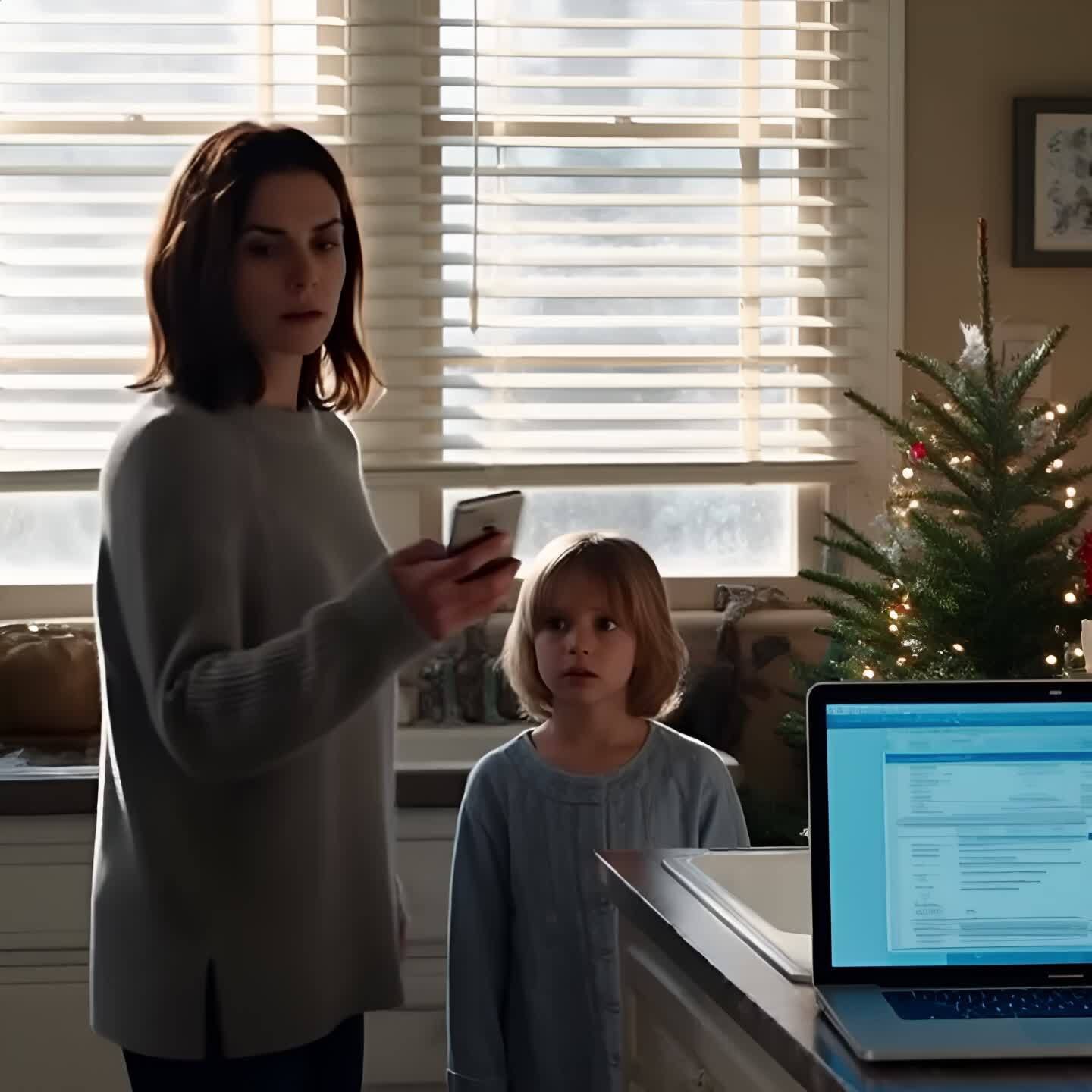
If a single text message erased you from Christmas, what would you do? Drive six hours through a blizzard just to beg for a seat, or would you simply reply, “Then I will stop paying the bills.”
When my mother texted that they were tired of me—and my sister sent a laughing emoji—I realized the truth. They weren’t tired of me.
They were tired of the walking wallet finally waking up.
My name is Scarlet Gutierrez.
If you looked at my life on a spreadsheet, you’d see a woman who had everything under control. I was thirty-six years old. I had a solid job as a data analyst at Northline Metrics. I had a mortgage I paid on time, a car that ran without making suspicious noises, and a twelve-year-old son named Noah, who still thought I was the smartest person in the world.
I was the responsible one. I was the one who fixed things. I was the safety net that caught everyone else when they fell.
But standing there in my kitchen on a gray Tuesday morning in early December, with my hands deep in soapy water, I felt less like a safety net and more like a trapped animal.
The water in the sink was lukewarm. I was scrubbing the remnants of dried corn flakes from Noah’s favorite blue bowl, the ceramic slick against my thumbs. Outside my kitchen window, the Chicago suburbs were waking up under a blanket of frost. It was that biting wet cold that settles in your bones and refuses to leave until April. The sky was the color of a bruised plum, heavy and low. It looked exactly like the kind of weather that would turn the interstate into a parking lot.
My mind was already five hours south of here. I was mentally driving the stretch of highway that led back to Maple Ridge, Indiana. I was calculating the mileage. I was worrying about the tread on my tires. I was running through the mental checklist of things I needed to pack to ensure my mother, Linda, didn’t have a reason to sigh at me.
I needed to bring the expensive wine she liked—the kind she claimed she couldn’t taste the difference in, but always checked the label of. I needed to bring the specific ham from the butcher shop three towns over because the grocery store ham was too salty for Doug’s blood pressure. I needed to bring the gifts wrapped in the gold paper Tasha had mentioned she liked on Pinterest three months ago.
I was dreading it.
God, I was dreading it so much my stomach felt like it was full of rocks.
Every year I did this. Every year I loaded up the car, strapped Noah in, and drove five or six hours—sometimes through blinding snow—just to get back to the house I grew up in. And every year I told myself it would be different.
I told myself this was the year we would actually be a family. We would sit around the fireplace and my mother would ask me how my job was going and she would actually listen to the answer. Tasha wouldn’t make snide comments about my hair or my clothes. Doug wouldn’t turn up the television while I was speaking.
The house was quiet, save for the hum of the refrigerator and the rhythmic thud of Noah’s footsteps upstairs. He was looking for his sneakers. I could hear him opening and closing the closet door. The normalcy of the sound was comforting. It was just a Tuesday, just a regular morning before school.
Then my phone buzzed against the granite countertop.
It was a short, sharp vibration. The sound of a demand.
I dried my hands on the dish towel. Taking my time, because I knew who it was.
My mother usually texted around this time, usually with a request disguised as a complaint. The heat bill was too high. The roof was making a noise. Tasha needed gas money to get to an interview that likely didn’t exist.
I took a breath, stealing myself for the familiar wave of obligation, and picked up the phone.
The screen lit up: a notification from the group chat titled “Family.” It was a message from Mom.
I read it once.
arrow_forward_iosĐọc thêm
Pause
00:00
00:17
01:49
Mute
Then I blinked, sure I’d misread it.
I read it again.
Stay away from Christmas. We’re tired of you.
There was no period at the end of the sentence. No ellipses softening the blow. No preamble, no explanation, no emojis.
Just a command. Stark and brutal.
It sat there on the white screen like a stone thrown through a window.
We’re tired of you.
My heart didn’t pound.
It stopped.
It felt like the blood in my veins had suddenly turned to ice water. I stood there, freezing in the middle of my warm kitchen, staring at the pixels.
A second later, another bubble popped up.
This one was from Tasha.
It was a single emoji: the laughing face, the one with tears streaming from its eyes, tilting to the side, convulsing with hilarity.
Haha.
A joke.
They thought this was funny.
Or maybe Tasha just found my exclusion hilarious.
I pictured them sitting somewhere in Maple Ridge—perhaps at the kitchen table where I paid for the groceries—looking at their phones and bonding over the rejection of the one person who kept their lights on.
My thumb hovered over the keyboard.
The old reflex kicked in immediately. Muscle memory. Decades of conditioning.
The panic rose in my throat.
What did I do?
I wanted to type: I’m sorry.
Was it something I said last week?
I can fix it.
I’ll come down early.
I’ll bring the bigger gifts.
I’ll transfer the money for the property tax right now.
I could feel the urge to beg. It was pathetic, but it was there. The little girl inside me—the one who just wanted her mother to look at her with something other than disappointment—was screaming at me to fix this.
“Apologize,” she whispered. “Just apologize and pay for dinner and smooth it over. Don’t let them cut you out. Don’t be an orphan.”
I closed my eyes.
And then a memory hit me.
Not some distant childhood memory. Last year.
I remembered the drive. It had been a blizzard. The weatherman had told people to stay off the roads, but Linda had called and said she’d made a roast, and if I didn’t come, it would go to waste.
So I drove.
I drove thirty miles an hour on the interstate, white-knuckling the steering wheel while Noah slept in the back, terrified we were going to slide into a ditch. It took us seven hours.
When we finally arrived, shaking from adrenaline and exhaustion, the driveway wasn’t shoveled. I had to park on the street and drag our suitcases through knee-deep snow.
When I walked inside, the house was warm. It smelled of sage and roasting meat. Linda, Doug, and Tasha were sitting in the living room watching a football game.
They didn’t get up.
“You’re late,” my mother had said, not looking away from the screen. “Food’s cold. You’ll have to heat it up yourself.”
I remembered the rest of the night.
I remembered sitting in the kitchen, eating a plate of lukewarm potatoes alone while I listened to them laugh.
I remembered doing the dishes—every single pan, every single plate—while they opened gifts.
I remembered Tasha holding up a new designer purse.
“Doug got it for me,” she had squealed. “Isn’t he the best?”
Doug hadn’t paid for that purse. Doug hadn’t worked a full-time job in four years.
I knew exactly where the money had come from, because I’d transferred two thousand dollars to my mother’s account two weeks prior for “emergency medical expenses.”
I had stood there at the sink, my hands red from the hot water, listening to them praise the generosity of a man spending my money—and I had said nothing.
I’d smiled.
I’d dried the dishes.
I’d driven home the next day in silence, telling myself that families help each other, that being the strong one was a privilege.
We’re tired of you.
I opened my eyes.
The kitchen was the same. The refrigerator still hummed.
But something inside me had snapped.
Not a loud snap.
A quiet, dull sound—like a dead branch finally giving way under the weight of snow.
They weren’t tired of me.
They were tired of my presence. Tired of my face. Tired of the person who reminded them they weren’t the self-sufficient success stories they pretended to be.
But they certainly weren’t tired of my paycheck.
The coldness that had washed over me shifted.
It was no longer fear.
It was clarity.
A sharp, crystalline understanding of the transaction I’d been participating in for fifteen years.
I was buying a seat at a table where I wasn’t welcome.
I was paying a subscription fee for a family that viewed me as a utility provider.
I looked at the phone again. Tasha’s laughing emoji was still there, mocking me.
I didn’t type an apology.
I didn’t ask what I had done wrong.
I didn’t offer to buy my way back in.
My thumb moved calmly.
I typed one sentence.
Then I will stop paying the bills.
I read it over.
Simple. Factual. No exclamation points. No angry emojis. No dramatic declaration of war—just a statement of cause and effect.
If I wasn’t part of the family, I wasn’t part of the family economy.
I hit send.
I placed the phone face down on the counter.
The sound of plastic hitting granite seemed incredibly loud in the quiet kitchen.
I stood there and waited.
I expected the world to end. I expected the roof to cave in. I expected to feel a crushing wave of guilt.
But I felt nothing.
Or rather, I felt the absence of weight.
It was as if I’d been carrying a backpack full of bricks for a decade, and someone had just cut the straps.
The furnace kicked on with a low rumble, blowing warm air through the vents. The house breathed.
The silence stretched out.
But it was different now.
It wasn’t the anxious silence of a woman waiting to see if she’d appeased the gods.
It was the silence of a woman who had just realized she was the one holding the lightning bolt.
“Mom?”
I turned.
Noah was standing at the bottom of the stairs. He was wearing one sock and holding the other. His hair was a mess, sticking up in the back where he’d slept on it. He looked sleepy and soft and incredibly young.
“Hey, kiddo,” I said. My voice sounded steady—surprisingly steady.
“Do we have to go to Grandma’s right on Christmas Eve?” he asked, rubbing his eyes. “Or can I play my new game for a bit first? I told Tyler I might be online.”
I looked at him—really looked at him.
He was twelve.
He was watching me.
Learning from me.
He was learning what love looked like.
He was learning what family meant.
If I got in that car and drove to Maple Ridge after that text message, if I begged for a scrap of turkey and a moment of their time, I would be teaching him that cruelty is acceptable as long as it comes from people who share your DNA.
I would be teaching him his worth is negotiable.
I couldn’t do that to him.
I could endure the disrespect for myself—maybe I’d been doing it for years—but I couldn’t let him watch me do it.
“We might be making some changes to the plan this year,” I said.
I grabbed the milk from the counter and put it back in the fridge.
“How about you worry about finding your other shoe, and I’ll worry about the schedule.”
He shrugged, unbothered.
“Okay. Cool.”
He turned and thudded back up the stairs, humming a tune from a video game.
I leaned against the counter, gripping the edge.
Cool.
It was that simple for him.
And it should’ve been that simple for me.
I walked over to the small desk in the corner of the kitchen where I kept my laptop. I sat down and opened the lid. The screen came to life, white light reflecting on my face.
I navigated to my banking portal. I typed in my username. I typed in my password.
The dashboard loaded: balances, pending transactions, scheduled transfers.
I clicked the tab marked Bill Pay.
There it was.
The list.
It was long.
It was embarrassing how long it was.
Maple Ridge Electric.
Maple Ridge Water & Sewer.
Midwest Gas.
Comcast Xfinity.
State Farm Insurance.
Tasha Gutierrez.
Ford Motor Credit.
Doug Miller.
CVS Pharmacy.
Recurring Prescription.
I stared at the names.
Each one represented hours of my life. Hours I’d spent staring at spreadsheets at Northline Metrics. Hours I’d spent away from Noah. Hours of stress. Hours of labor.
I had converted my life force into electricity that warmed a house I wasn’t allowed to enter.
I had converted my time into internet access for a sister who laughed at my pain.
My cursor hovered over the first entry.
Maple Ridge Electric: status AUTOPAY scheduled for December 12.
I felt a phantom vibration in my hand, imagining my phone buzzing with their rage.
But then I looked at that message in my mind.
Stay away.
Okay.
I would stay away.
And so would my money.
The little white arrow turned into a pointing hand as it hovered over the trash can icon next to the autopay setting.
It felt like I was holding a pair of wire cutters over the main power line of a bomb.
Or maybe it was a life support system.
A life support system for a parasite that had been feeding on me since I was twenty-two.
I took a breath.
I didn’t close my eyes this time.
I wanted to see it.
I clicked.
The screen flickered as the page refreshed.
A small green banner appeared at the top of the browser window confirming that the recurring payment for Maple Ridge Electric had been successfully canceled.
I stared at it.
I waited for guilt.
I waited for that familiar crushing sensation in my chest that told me I was a bad daughter, a bad sister, a selfish person who would let her family freeze in the dark.
But the feeling didn’t come.
Instead, I felt a strange, cold clarity.
It was the same feeling I got at work when I finally found the error in a massive data set that had been ruining quarterly projections.
The satisfaction of identifying the glitch and correcting it.
My kitchen table had ceased to be a breakfast nook.
It was an operations center.
I pulled my legs up onto the chair, wrapping my cardigan tighter around myself, and scrolled down the list.
Next was Midwest Gas, the heating bill for the drafty two-story Victorian house my mother refused to downsize from. She always kept the thermostat at seventy-four in the winter because, as she liked to say, she had poor circulation.
I kept my own house at sixty-eight to save money so I could pay for hers to be seventy-four.
I clicked Edit.
I selected Remove Payment Method.
Are you sure? the bank’s website asked in bold.
Failure to pay may result in service interruption.
“I’m sure,” I whispered to the empty room.
I clicked Confirm.
Next was Comcast Xfinity, the premium package. My mother claimed she only watched the news and the Weather Channel.
Yet the bill included HBO, Showtime, and the high-speed internet tier Tasha insisted was necessary for her “job search.”
Tasha had been searching for a job for three years.
I was fairly certain the only thing she was downloading at gigabit speeds was reality television seasons and Instagram updates.
Click.
Remove.
Confirm.
It felt physical.
Like I was reaching into my own chest and pulling out rusty fishing hooks one by one.
There was a sharp tug of pain with each removal—a phantom ache where the metal had been embedded in my flesh for so long—followed by a rush of blood and air.
Next came the State Farm policy.
Tasha’s car insurance.
My sister had two speeding tickets and a fender-bender on her record, making her premiums astronomical. Mom had told me Tasha couldn’t afford it, and if she couldn’t drive, she couldn’t go to interviews.
So I paid it.
Two hundred forty dollars a month so my sister could drive to the mall and the nail salon.
Click.
Remove.
Confirm.
Then the Ford Motor Credit.
Doug’s truck.
The Ford F-150 he “needed for hauling things.”
Though I’d never seen anything in the bed of that truck other than empty beer cans and snow.
He called it his work truck.
Doug’s work was a vague concept that involved a lot of meetings at the local diner and very few paychecks.
Click.
Remove.
Confirm.
I was moving faster now.
The trembling in my fingers had stopped, replaced by a rhythmic efficiency.
CVS Pharmacy.
My mother’s prescriptions.
Netflix.
Hulu.
Spotify Family Plan.
I paused at the Spotify charge.
Fifteen dollars a month.
My mother had told me just last week during a phone call—where she complained about her arthritis—that she didn’t understand why people paid for music when the radio was free.
Yet here it was.
A family plan.
I clicked the details.
The users listed were Tasha, Doug, and an account named Lilbit, which I assumed was Tasha’s on-again, off-again boyfriend.
I was paying for Tasha’s boyfriend to listen to ad-free hip-hop while I drove to work listening to local news because I was too cheap to upgrade my own account.
I laughed.
A dry, short sound.
Like a bark.
Click.
Remove.
Confirm.
I reached the bottom of the recurring list.
The page was clean.
The scheduled transfers column was empty.
It was done.
But I wasn’t done.
The analyst in me was awake now.
And she wasn’t satisfied with just clearing the future queue.
She wanted to audit the past.
I navigated to the recent transactions tab.
I wanted to see the damage.
I wanted to see exactly what “we’re tired of you” cost in United States currency.
I scrolled through November.
Grocery runs at the Maple Ridge Kroger.
Three hundred here.
Two hundred there.
A charge at a liquor store that I definitely didn’t make.
A charge at a boutique clothing store in downtown Maple Ridge.
And then I stopped.
My eyes snagged on a transaction dated three days ago.
It was pending, but the authorization had gone through.
Northwoods Retreat Cabin.
Pine Hollow, Wisconsin.
Amount: $1,850.
Status: paid in full.
I frowned.
I leaned closer to the screen.
Pine Hollow.
I knew that name.
It was a luxury resort area in Wisconsin about four hours north of us. The kind of place where the cabins had heated floors, outdoor hot tubs, and private chefs if you wanted to pay extra.
The kind of place people went for a picture-perfect snowy getaway.
I hadn’t booked a cabin.
My heart began to hammer against my ribs—different rhythm than before.
This was the panic of theft.
Someone had stolen my card information.
But as I stared at the line item, a sickening realization curdled in my stomach.
The charge was on my primary Chase Sapphire card—the one I had given my mother for emergencies only, five years ago, after she’d called me crying because her car had broken down on the highway.
She had promised to cut it up after that.
Obviously, she’d kept the number.
I opened a new tab and typed in the website for Northwoods Retreat.
It looked expensive.
The homepage featured a slow-motion video of a happy family drinking cocoa by a massive stone fireplace.
I needed to see the booking.
I checked my primary email.
Nothing.
I thought for a moment.
When I set up accounts for my mother, I often used an old Yahoo email address I’d created in college—one I kept specifically for junk mail and family logistics because Linda constantly locked herself out of her own accounts.
I opened a new tab, navigated to Yahoo, and logged in.
The inbox was full of promotional spam, but right at the top—unread—was an email from Northwoods Retreat.
Subject: Your winter wonderland awaits.
“Linda,” I whispered.
My hands were cold as I clicked it open.
Dear Linda, thank you for booking your stay with us. We are thrilled to host you for the holidays.
I scrolled down to the details.
Check-in: December 23.
Check-out: December 26.
Christmas.
They were going away for Christmas.
I looked at the guest list.
Primary guest: Linda Miller.
Additional guests: Douglas Miller, Tasha Gutierrez.
Guest four: name not yet provided.
I read the list three times.
Linda.
Doug.
Tasha.
And a plus one.
There was no Scarlet.
The air left the room.
I sat there staring at the glowing screen, feeling a physical blow to my gut.
They hadn’t just kicked me out of Christmas.
They had planned a getaway.
They had booked a luxury vacation to escape me—to escape the burden of my presence, to escape the daughter they were tired of.
And they’d paid for it with my money.
I remembered the conversation I’d had with my mother two weeks ago.
I’d called to ask about the menu for Christmas dinner.
“Oh, honey,” she had sighed, her voice thin and wavering. “I don’t know if we can do much this year. Money is so tight. Inflation is just killing us. Doug’s back is acting up, so we can’t pick up shifts. We might just do soup and sandwiches. Don’t expect anything fancy.”
I’d felt so guilty.
I’d transferred five hundred dollars to her account that same afternoon—tagged for groceries.
Money is tight.
Money wasn’t tight.
My money was apparently infinite.
A magical river that flowed whenever they were thirsty.
And they drank from it while complaining about the taste of the water.
$1,850.
That was more than my mortgage payment.
That was a new laptop for Noah.
That was a weekend trip to the water park I’d told Noah we couldn’t afford this year because Grandma “needed help with the house.”
I felt tears prick the corners of my eyes, but they were hot, angry tears.
They weren’t the tears of a hurt child.
They were the tears of a woman who realizes she has been the mark in a long con.
I closed the email tab, but not before taking a screenshot.
I saved it to my desktop.
Then I went back to the bank statement and took a screenshot of the charge.
I needed to see the whole picture.
I minimized the browser and opened Excel.
I went to my personal folders, buried deep within a directory structure I hoped no one else would ever look at.
I clicked on a file named Budget Tracking.xlsx.
Inside, there was a tab I’d created eighteen months ago.
I had named it: The Ledger.
I’d started it on a night when I felt particularly crazy.
Tasha had called me selfish for refusing to buy her a four-hundred-dollar pair of boots, and I’d started to believe her.
So I’d started writing it down.
Every transfer. Every bill. Every “emergency.”
I needed to see the data to prove to myself I wasn’t imagining the drain.
I hadn’t looked at the total sum in three months.
I was afraid to.
I updated the rows with the data from the last ninety days.
I added the cabin.
I added the electric bills.
I added the grocery transfers.
I added the car repair I was fairly certain was actually a new television for the living room.
I highlighted the column.
I looked at the bottom-right corner of the Excel window, where the sum automatically appeared.
$32,415.60.
I stared at the number.
Thirty-two thousand dollars.
In eighteen months.
I made sixty-five thousand a year before taxes.
I did the mental math.
After taxes, insurance, and my own meager living expenses, I was giving them nearly sixty percent of my take-home pay.
I sat back in my chair, the plastic digging into my spine.
I wasn’t a daughter.
I wasn’t a sister.
I was an ATM.
I was a grant foundation.
I was a host organism.
“Thirty-two thousand,” I said aloud.
The words hung in the air.
Heavy.
Absolute.
That money could have been Noah’s college fund.
It could have been a down payment on a house in a better school district.
It could have been a retirement plan so I would never have to rely on Noah the way Linda relied on me.
Instead, it was gone.
Dissolved into heating a drafty house, fueling a gas-guzzling truck, and booking a cabin in Pine Hollow for a family that didn’t want me.
A strange calm settled over me.
It was the calm of the absolute bottom.
There was nowhere further to fall.
The illusion was dead.
The story I’d told myself—that they loved me but were just bad with money, that they needed me because they were unfortunate victims of circumstance—was a lie.
They weren’t victims.
They were predators.
And I’d been the willing prey.
I looked at the clock on the laptop.
It was 7:45 in the morning.
Noah would be coming down for breakfast in fifteen minutes.
I had a choice.
I could close the laptop.
I could cry.
I could let the payment for the cabin go through to avoid a fight.
I could accept that I’d lost thirty-two thousand dollars and walk away quietly, preserving the fragile peace for the sake of appearances.
Or I could look at the screenshots on my desktop—the cabin booking, the utility bills, the ledger—and burn it all down.
I thought about Tasha’s laughing emoji.
Haha.
I thought about the guest slot on the booking, the empty space where my name should have been.
I opened the folder on my desktop.
I created a new image file.
I pasted the screenshot of the cabin booking.
Next to it, I pasted the screenshot of the bank transaction showing my name on the card.
I wasn’t going to be quiet.
Not this year.
I heard Noah’s footsteps on the stairs again.
He was humming “Jingle Bells.”
I saved the file.
I named it: The Truth.
I closed the laptop, but I didn’t put it away.
I left it sitting there on the table—a black monolith in the center of my kitchen.
The weapon was loaded.
It was just waiting for me to pull the trigger.
The phone felt heavy in my hand, like a grenade with the pin already pulled.
I sat at the kitchen table, the silence of my house pressing against my ears.
But on the screen in front of me, a loud, chaotic party was in full swing.
I opened the Maple Ridge Clan group chat.
This was the extended family channel. It included everyone—my mother, Tasha, Doug—but it also held my aunt Ruth, Linda’s older sister. It held Aunt Maria and Uncle Sal. It held my cousins Jordan and Maya, and a handful of other relatives scattered across the Midwest.
There were eighteen people in this group.
Eighteen witnesses.
Usually I kept this chat on mute. It was a stream of consciousness for people with too much time on their hands.
But today, the notifications were scrolling up the screen like ticker tape.
Aunt Maria sent a photo.
It was a tray of gingerbread men perfectly decorated.
Text: Baking day. Can’t wait for the big dinner.
Cousin Jordan sent a photo.
A lopsided Christmas tree.
Text: Only took three hours and one broken ornament. Success.
And then there was my mother.
Linda had hearted every single photo. She was replying with the enthusiasm of a woman who had never known a day of hardship.
Linda: Looks beautiful.
Linda: Maria, we are so blessed to have family.
Linda: Jordan, good job. Love you all so much.
I read that sentence.
We are so blessed.
I looked at the screenshot on my laptop screen: the $1,850 charge for the cabin in Pine Hollow—the cabin where they were going to celebrate their blessings while I sat in Chicago, excluded and unpaid.
My thumb hovered over the plus sign next to the text box.
I didn’t feel angry anymore.
Anger is hot. Anger makes you shake.
I felt cold.
I felt clinical.
I felt like a surgeon stepping up to the operating table to cut out a tumor that had been growing for decades.
I tapped the plus sign.
I selected the photo library.
I chose three images.
First: the screenshot of the Northwoods Retreat invoice. I made sure the part listing guests—Linda, Doug, Tasha—was clearly visible right next to the line that said billed to Visa ending in 4022.
That was my card.
Second: the screenshot of Tasha’s State Farm insurance policy renewal, premium paid by Scarlet Gutierrez.
Third: the confirmation email from Maple Ridge Electric showing the autopay cancellation I had just performed, alongside the payment history for the last twelve months.
I hit Add.
The three images loaded into the text input field—small thumbnails waiting to be deployed.
I typed a single sentence.
I didn’t want to write a manifesto.
The evidence was the manifesto.
Just so everyone knows who has been paying for your perfect Christmas.
I took a breath.
The furnace hummed.
Noah dropped a book on the floor upstairs.
I pressed Send.
The messages swooshed into the chat—blue bubbles on the right side of the screen.
For a moment, nothing happened.
The stream of gingerbread men and Christmas tree emojis stopped.
It was as if I’d walked into a crowded room and fired a gun into the ceiling.
The silence was digital, but I could feel it.
I watched the “read by” count tick up.
Read by Linda.
Read by Tasha.
Read by Jordan.
Read by Ruth.
Five seconds passed.
Ten seconds.
Then the three dancing dots appeared.
Someone was typing.
Cousin Jordan: Wait. I thought Doug paid for the cabin.
Aunt Linda said Doug got a bonus.
I stared at the screen.
A bonus?
Doug hadn’t worked a job that offered bonuses since 2010.
Another bubble appeared.
Aunt Maria: Scarlet… are you serious? Is this real?
Then Linda entered the chat.
I could imagine her in her kitchen in Maple Ridge. She’d be wearing her floral bathrobe, phone clutched in her hand, face flushing red—not with shame, but with the indignation of a stage manager whose play had been interrupted by a heckler.
Linda: This is unnecessary. Families help each other.
Linda: Take this down, Scarlet.
Linda: You are being dramatic.
There it was.
The mantra.
Families help each other.
I’d heard that phrase since I was seventeen.
It was the magic spell she used to turn my paycheck into her property. It was the phrase she used when she took my financial aid money to fix the roof. It was the phrase she used when I had to co-sign for Tasha’s student loans.
But reading it now—black and white text—it didn’t look like a moral imperative.
It looked like a lie.
I didn’t take it down.
I didn’t reply to her command.
Instead, I turned back to my laptop.
I opened the file named The Ledger.
I highlighted the summary section I had created—the greatest hits of the last eighteen months.
I hit Copy.
I went back to the phone.
I pasted the text into the group chat.
It was a wall of text.
Dense with numbers and dates.
Mortgage assistance: May, June.
$4,000.
Doug’s truck transmission repair: $1,800.
Tasha’s dental work (emergency crown): $950.
Nephew’s summer camp “scholarship”: $600.
I paused on that last one.
Tasha had posted all over Facebook last summer about how her son, my nephew, had won a community scholarship to go to an elite computer camp. She’d received hundreds of likes. People had called her a great mom.
The “scholarship” was a check I’d written because Tasha had called me crying, saying he’d be heartbroken if he couldn’t go.
I hit Send.
The block of text filled the screen.
It pushed Aunt Maria’s cookies up out of view.
Scarlet: The scholarship was me.
Scarlet: The truck was me.
Scarlet: The house is me.
Scarlet: Mom, I am done.
The silence that followed was heavier than before.
This wasn’t just confusion.
This was the stripping away of dignity.
I was tearing the costumes off the actors in the middle of the performance.
My phone began to buzz in my hand.
A call was coming in.
Mom.
I stared at the name.
My thumb slid over to the red Decline button.
I pressed it.
The phone stopped, then started again immediately.
Tasha.
Decline.
Doug.
Decline.
I wasn’t going to do this over the phone.
I wasn’t going to let them scream at me, cry at me, or gaslight me in a private call where no one else could hear.
If they wanted to speak, they could type.
They could put it on the record.
A notification popped up at the top of my screen.
It wasn’t from the group chat.
It was a direct message.
I clicked it.
It was from Aunt Ruth.
Ruth was Linda’s older sister.
She was a stern woman, a retired school principal.
We rarely spoke, mostly because Linda always kept us apart. Linda always said Ruth was judgmental and cold.
Aunt Ruth: Scarlet, I am reading this. I am looking at these receipts.
I waited, my heart hammering.
Was she going to lecture me too?
Was she going to tell me to respect my mother?
Aunt Ruth: We always felt something was wrong.
Aunt Ruth: Linda has told the whole family for years that you are selfish. She tells us you are rich and stingy.
Aunt Ruth: She told us you refused to help with the electric bill last winter.
Aunt Ruth: She told us Doug paid for everything and you just came home to eat.
I read the message twice.
The air in my lungs turned to glass.
Selfish.
Stingy.
I’d been driving cars with two hundred thousand miles on them.
I’d been wearing clothes from Target.
I’d been skipping vacations.
I’d been depleting my savings to keep them afloat.
And the whole time, my mother had been taking my money with one hand and painting me as a villain with the other.
She had to.
It was the only way to explain why she had money without admitting she was taking it from me.
If she admitted I was helping, she would have to give me credit.
If she called me stingy, she could play the martyr.
Aunt Ruth: Scarlet, I am sorry I stayed silent.
Aunt Ruth: I am sorry I believed her.
A tear slid down my cheek.
It was the first time I’d cried all morning.
Not sadness.
Relief.
Validation.
Someone saw me.
Finally.
Scarlet: Thank you, Aunt Ruth.
Scarlet: I just wanted the truth to be known.
I switched back to the main group chat—the battlefield.
Tasha had finally decided to type.
She wasn’t apologizing.
She was counterattacking.
It was the only move she knew.
Tasha: Seriously, Scarlet, you are doing this in front of everyone.
Tasha: You are making Mom sick with this drama. She is crying in the kitchen.
Tasha: I hope you are happy.
Tasha: You are ruining Christmas over money.
Tasha: You are so petty.
Petty?
I looked at the word.
I remembered a text message from Tasha from three months ago.
Late at night.
She’d been pulled over for doing forty-five in a twenty-five zone. She had no money for the fine, and if she didn’t pay it, her license would be suspended.
I scrolled back through my history with Tasha.
It took a long time because she texted me so often—usually sending TikToks or requests for favors.
I found it.
Tasha: Please, I’m begging you. Don’t tell Mom. Doug will kill me.
Tasha: Just this once. I promise I will pay you back when I get my tax return.
Tasha: Please save me.
I took a screenshot.
I went back to the group chat.
Scarlet: Petty? Is that what we’re calling it?
I attached the screenshot.
Scarlet: You never paid me back for this ticket.
Scarlet: Just like you never paid me back for the tires or the phone bill.
Scarlet: Mom isn’t sick. Mom is embarrassed because the ATM just learned how to talk.
I hit Send.
The group chat went dead.
No more typing bubbles.
No one came to their defense.
Even Linda—the master of spin, the woman who could talk her way out of anything—went silent.
There was no spinning this.
The receipts were absolute.
The dates.
The amounts.
The desperate pleading in Tasha’s text.
All of it glowing on the screens of eighteen different relatives.
I watched the screen for another full minute.
I expected the sky to darken.
I expected the police to knock on my door.
I expected some cosmic punishment for breaking the cardinal rule of my family—protect the lie.
But nothing happened.
The sun continued to rise outside my window, casting pale winter light across the kitchen floor.
The refrigerator hummed.
The coffee maker gurgled.
I realized something profound in that silence.
The world doesn’t end when you tell the truth.
The only thing that ends is the fantasy.
I’d always been afraid of this moment.
I’d been afraid that if I exposed them, I would lose them.
I realized now I had never really had them.
You can’t lose something that was never real.
I’d had a mortgage on their affection.
And I had just stopped making the payments.
I set the phone down on the table, face up.
The notifications had stopped.
I looked at my hands.
They were steady.
I stood up and walked to the window.
Noah was in the backyard now, throwing snowballs at the fence.
He looked happy.
He didn’t know his mother had just detonated a nuclear bomb in the family social circle.
And he didn’t need to know.
All he needed to know was his mother was done being a victim.
I walked back to the table, picked up the phone, and muted the conversation.
I didn’t leave the group.
I wanted them to see my name there.
I wanted them to know I was still watching.
But I was done participating.
I had one more thing to do.
The ledger was public.
The bills were canceled.
But there was still the matter of the past.
The years of conditioning.
The memories flooding back, demanding to be re-examined under this new, harsh light.
I sat back down.
The adrenaline was fading, leaving behind a deep, aching exhaustion.
But it was a clean exhaustion.
The feeling of having cleaned out a wound that had been infected for years.
It hurt.
But for the first time, it had a chance to heal.
The adrenaline that had fueled my fingers in the group chat began to drain away, leaving behind a hollow, aching silence.
I sat alone in the kitchen.
I could hear the faint rhythmic scratching of a pencil on paper.
Noah was doing his science homework.
He was safe.
He was warm.
He was unaware that downstairs his mother was dissecting the corpse of her relationship with her own mother.
I stared at the clean white countertop.
My mind—usually so disciplined, usually so good at compartmentalizing data and emotions—began to drift.
The firewall I’d built to protect myself from the truth had crumbled.
And now the memories were flooding in—not as nostalgic vignettes, but as evidence.
I closed my eyes.
I was sixteen again.
I was standing in the checkout aisle of the supermarket on the edge of Maple Ridge. The fluorescent lights hummed overhead, a sound that always gave me a headache. I was wearing my uniform from my after-school job at the local burger joint, smelling faintly of fryer grease and onions.
My mother was in front of me unloading the cart.
The belt was full.
There were steaks.
There were bottles of wine.
There were the expensive brand of crackers she liked.
It was more food than we usually bought.
“It’s a celebration,” she’d told me. “Doug might get that foreman job.”
The cashier—a tired woman with gray roots showing—rang everything up.
The total came to $212.45.
My mother opened her purse.
She rummaged around.
She frowned.
She pulled out a wallet, opened it, and then gasped theatrically.
“Oh, for heaven’s sake,” she said, voice loud enough for the people in line behind us to hear. “I grabbed the wrong wallet. This is the old one. I left my cards on the kitchen counter.”
She turned to me.
Her eyes were wide, panicked, pleading.
“Scarlet, honey,” she said. “Do you have your debit card? The one from your work account? Just swipe it for me. I’ll pay you back as soon as we get home. I promise. We can’t hold up the line.”
Heat rose in my cheeks.
I could feel the eyes of the people behind us boring into my back.
I was sixteen.
I’d been saving every penny from flipping burgers to buy a used laptop for college.
Two hundred dollars was two weeks of work.
“Mom, I—” I started to whisper.
“Scarlet, please,” she hissed, voice sharpening. “Don’t embarrass me. It’s just a loan. Do you want me to put the steaks back? Do you want to ruin Doug’s dinner?”
I reached into my pocket.
My hand was shaking.
I pulled out my card.
I swiped it.
Approved.
We walked out to the car in silence.
As we loaded the bags into the trunk, I asked, “So, you’ll write me a check when we get home?”
She slammed the trunk shut.
“Honestly, Scarlet,” she said, sighing as if I’d just asked her to donate a kidney. “We just spent two hundred dollars on food for the family. Can you stop obsessing over money for five minutes? You’re so calculating. I said I’d handle it.”
She never paid me back.
When I brought it up a week later, she looked at me with genuine confusion and said she’d used that money to buy me new sneakers.
A lie.
I was wearing the same sneakers I’d bought myself three months prior.
The memory shifted.
I was twenty-one.
I was living in a cramped apartment in Chicago, working two jobs while trying to finish my degree.
I was exhausted.
My hands were constantly burnt from the espresso machine at the coffee shop, and my eyes were red from staring at textbooks until three in the morning.
My mother had called me crying.
The electric bill was three months overdue.
They were going to shut off the power.
It was winter.
“We’re going to freeze, Scarlet,” she sobbed. “Doug is between checks. Please.”
I had three hundred dollars in my account.
It was my grocery money for the month.
I sent it.
I ate ramen noodles and stole stale bagels from the coffee shop for three weeks.
A month later, I came home for a weekend visit.
Dinner was a feast.
Roast beef.
Mashed potatoes.
A case of beer for Doug.
Toward the end of the meal, Doug stood up, face flushed with alcohol. He raised his beer can.
“To this family,” he announced, slurring slightly. “We’ve had a hard winter, but we made it through. We stand on our own two feet. We don’t ask for handouts. We figure it out. That’s the Miller way.”
Linda raised her glass of wine.
“That’s right,” she said, smiling at him with adoration. “We take care of our own.”
I sat there cutting my meat into tiny pieces.
I waited.
I waited for her to look at me.
I waited for a nod, a wink, a whisper of thank you.
Scarlet, we couldn’t have done this without you.
She didn’t look at me.
She looked at Doug.
In their version of the story, Doug was the provider who had magically found the money.
My three hundred dollars had been laundered into his heroism.
I wasn’t the savior.
I wasn’t even a participant.
I was just the audience member required to clap.
The kitchen around me felt colder.
I pulled my cardigan tighter.
Another memory surfaced—sharper than the others.
The Jeep.
I was twenty-six.
I had my first real job as a junior analyst. I was making decent money, finally breathing a little easier.
Tasha had just turned twenty-two.
She needed a car to get to a community college program she would eventually drop out of.
Three weeks later, we were at the dealership.
The salesman—a slick man in a cheap suit—came back from the finance office with a grim look on his face.
“I’m sorry, folks,” he said, looking at Doug. “With your credit score, we can’t finance the vehicle. Not without a twenty percent interest rate.”
Doug threw his hands up.
“The system is rigged,” he grumbled. “Working man can’t catch a break.”
Linda turned to me.
She didn’t ask.
She assumed.
“Scarlet has good credit,” she told the salesman. “She can co-sign.”
“Mom, I’m looking to buy a condo next year,” I said, trying to keep my voice steady. “I can’t have a car loan on my report.”
“It’s not your loan,” Tasha whined. “You’re just a co-signer. I’ll make the payments. Doug will help me. You won’t pay a dime. You’re just vouching for your sister. Don’t you trust me? It’s for my education.”
“Scarlet,” Linda added, voice dropping into that disappointed register that always made my stomach turn, “don’t hold your sister back just because you’re worried about some number on a computer screen.”
I signed.
I sat in that office—the smell of stale popcorn and floor wax in the air—and I signed my name on the line marked Buyer.
Tasha was listed as the authorized driver.
“You’re a good sister,” the salesman said, not looking me in the eye.
Two days later, I saw the post on Facebook.
A photo of Tasha leaning against the bright red Jeep, beaming.
Linda had captioned it: So proud of our girl starting college and so thankful for Doug who works so hard to make sure his girls have safe transportation. Best dad ever.
There were forty-five comments.
Doug is a saint.
Great job, Dad.
You are so lucky, Tasha.
I wasn’t mentioned.
I was the invisible ink on the contract.
I remembered the day I finally tried to speak up.
It was a Sunday afternoon.
I was visiting.
And I found a late notice for the water bill on the counter—a bill I thought I’d paid.
I realized they had spent the money I sent on something else.
“Mom,” I said, trying to keep the tremble out of my voice. “I feel like I’m being used. I feel like you only call me when you need a transaction. It hurts.”
Linda had been washing dishes.
She stopped.
She didn’t turn around.
Her shoulders went stiff.
“Oh, here we go,” she said, letting out a long, ragged sigh. “The Scarlet pity party.”
She turned around, wiping her hands on a towel.
Her face was hard.
“You have a good job, Scarlet. You have a nice apartment. You have your health. Do you know what Mrs. Henderson down the street is dealing with? Her son is in rehab. Her husband has cancer. And you’re standing here crying because you helped your family with a water bill.”
“Don’t play the victim. It does not suit you.”
“Most families can’t help each other a single dime. You should be grateful you’re in a position to help, not acting like we’re robbing you.”
Don’t play the victim.
That was the weapon.
She took my generosity and turned it into an obligation.
And then she took my pain and turned it into selfishness.
If I complained, I was ungrateful for my own success.
I remembered New Year’s Eve three years ago.
A massive ice storm had hit Maple Ridge.
A tree branch had come down on the roof.
The deductible for the insurance was $1,000.
“We don’t have it,” Linda had texted.
I was freelancing on the side to build up my savings.
It was New Year’s Eve.
While my friends were at parties, while Tasha was posting videos of herself doing shots at a bar in downtown Indianapolis, I was sitting in my dark living room staring at Excel spreadsheets—grinding through a data entry gig to make the extra thousand.
I transferred the money at 11:55 p.m.
I texted Mom: Sent. Happy New Year.
She replied the next morning: Thanks. Roofers coming Tuesday.
That was it.
No happy new year.
No thank you for working on a holiday.
When I saw her a month later, she looked at the dark circles under my eyes.
“You work too hard,” she said, shaking her head. “You need to relax more. Look at Tasha. She knows how to enjoy life.”
“I work hard because I have bills to pay,” I said sharply. “Including yours.”
She waved her hand dismissively.
“Oh, you’re always fine. You’re the strong one. I never have to worry about you. That’s a blessing, Scarlet. You don’t need me to coddle you.”
I realized then that being strong wasn’t a compliment.
It was a cage.
It was the label they slapped on me so they didn’t have to feel guilty about neglecting me.
If I was strong, I didn’t need comfort.
If I was capable, I didn’t need gratitude.
If I was fine, they could take everything I had and assume I could just make more.
The final memory—the one that hurt the most—was from when Noah was five.
We were visiting for Thanksgiving.
I’d bought Noah a really nice winter coat.
It was a North Face. Expensive.
But I wanted him warm.
I wanted him to have something nice.
I’d saved for two months to buy it.
Linda saw him wearing it.
She frowned, pinching the fabric.
“Two hundred dollars for a coat he’ll grow out of in a year,” she said, clucking her tongue. “That’s ridiculous, Scarlet. You’re spoiling him. You’re teaching him money grows on trees. My generation knew the value of a dollar. We didn’t indulge children like this.”
As she lectured me about fiscal responsibility and spoiling my child, she was sitting in her recliner playing Candy Crush on an iPad Air.
An iPad Air I had bought her for her birthday three months earlier because she said her old tablet was too slow.
She was judging my spending on my son while using the luxury item I’d purchased for her.
The hypocrisy was so breathtaking I couldn’t speak.
I just zipped up Noah’s coat and took him outside to play.
I sat in my kitchen now, the silence heavy around me.
I looked at the coffee cup in front of me.
It was cold.
For years, I’d thought if I just paid enough, if I just fixed enough problems, eventually they would see me.
Eventually, they would say, “Scarlet, thank you. We love you not for what you do, but for who you are.”
But that was never the deal.
To them, I wasn’t a person.
I was a utility.
Like electricity.
Like running water.
You don’t thank the light switch for turning on.
You only notice it when it breaks.
You only get angry at it when it stops working.
They weren’t mad that I was hurting.
They were mad the appliance had malfunctioned.
I looked at the clean dishes in the drying rack.
I looked at the well-stocked pantry.
I looked at the schedule on the refrigerator that revolved around Noah’s soccer games and piano lessons.
I had built a life.
A good life.
And for fifteen years, I’d been the invisible financial housewife for a second household that despised me.
I’d kept their lights on.
Their cars running.
Their delusions of independence intact.
I was the foundation of their self-esteem.
Doug felt like a man because he drove a truck I paid for.
Linda felt like a matriarch because she hosted dinners I bought.
Tasha felt like a free spirit because she had a safety net woven from my bank account.
I stood up.
I walked over to the sink and poured the cold coffee down the drain.
The memories didn’t hurt anymore.
They just felt heavy—like old stones.
And I was done carrying them.
I looked out the window at the gray sky.
“No more,” I whispered.
I was done being the strong one.
I was done being the fine one.
I was about to become the problem.
And for the first time in my life, I was looking forward to it.
The group chat had gone silent.
But the war room in my kitchen was just getting started.
The silence on my phone wasn’t peace.
It was the stunned quiet of people who had just realized the bank vault was empty and the teller had left the building.
I turned my attention back to the laptop.
I wasn’t done.
I was just warming up.
I opened the digital folder labeled Vehicle — Jeep Wrangler.
Inside was the PDF of the purchase agreement I had signed four years ago.
I scrolled through the legalese, eyes scanning for the specific clauses that mattered.
There it was, in black and white.
Buyer: Scarlett Gutierrez.
Tasha was listed only as the registered operator and authorized driver.
The title was electronic. It was held by the lender.
But the name on the account was mine.
The liability was mine.
And therefore, the asset was mine.
Tasha loved that Jeep.
She’d named it Cherry.
She’d put stickers on the back window.
She treated it like a personality trait.
But she’d missed three payments in the last year, which I’d quietly covered to protect my credit score.
She treated the car like a right.
I treated it like a liability.
I picked up my phone and dialed the number for the financing company.
“Thank you for calling Ally Financial,” the automated voice chirped. “How can we help you today?”
I navigated the menu until I got a human.
Her name was Brenda.
She sounded tired.
“I am the primary account holder on a loan for a 2018 Jeep Wrangler,” I said, voice crisp and professional. “I am looking to sell the vehicle privately to pay off the remaining balance. I need to confirm the payoff amount and the procedure for title transfer.”
“One moment,” Brenda said.
I heard typing.
“Okay, Ms. Gutierrez. The payoff amount is $12,450. As the primary name on the title, you have the full right to sell the vehicle. Once the lien is satisfied, we release the title to you or the new buyer.”
“Thank you,” I said. “That’s all I needed.”
I hung up.
I knew where the spare key was.
It was in the junk drawer in my kitchen, buried under old batteries and takeout menus.
I’d kept it just in case Tasha lost hers—which happened approximately once every six months.
I didn’t have the car in my driveway yet.
It was sitting in Maple Ridge, likely parked illegally in front of a fire hydrant while Tasha slept off her panic.
But that was a logistical problem.
And I was a data analyst.
I solved logistical problems for a living.
I opened a new tab and searched: vehicle recovery services, Maple Ridge, Indiana.
I found a tow company that specialized in repossessions.
I booked a pickup for that afternoon.
I gave them the address.
I authorized the tow to a local impound lot where I could have a transport service pick it up.
It would cost me six hundred dollars to get it to Chicago.
It was worth every penny.
While I waited for the tow confirmation, I drafted the listing.
For sale: 2018 Jeep Wrangler. Red. Good condition. One owner. Price to sell immediately.
I posted it on Facebook Marketplace, but I set the location to my suburb in Chicago—not Maple Ridge.
I priced it at $15,000.
Low.
Aggressively low.
I wanted it gone.
I wanted the cash in my hand and the tie to Tasha severed before the sun went down.
Within ten minutes, my Messenger pinged.
Denise: Is this still available? I can come with cash and a cashier’s check for the balance today. My daughter needs a car for school.
I typed back.
Scarlet: It is available. I’m having it transported here today. You can see it tomorrow morning.
Denise: We’ll be there at 8.
I sat back.
The Jeep was gone.
Tasha just didn’t know it yet.
Now for the rest of the parasites.
I opened the recurring payments tab on my credit card statement again.
I’d cleared the big utilities.
Now I was hunting the smaller, more insidious drains—the ones that felt like tiny cuts, bleeding me dry drop by drop.
Planet Fitness Black Card membership.
Tasha’s gym membership.
She’d told me she needed the black card so she could bring guests.
I was fairly certain the only exercise she got was jumping to conclusions.
I logged into the gym portal using the password I knew she used for everything: her high school boyfriend’s name and the year she graduated.
Cancel membership.
Reason for leaving?
I typed: I have decided to stop running from my responsibilities.
Click.
Confirmed.
Next line item: Paws & Claws Grooming.
This was for Princess—my mother’s neurotic standard poodle.
Linda insisted the dog needed a spa day every six weeks because she “gets depressed” if her coat is matted.
That dog ate better food than I did in college.
I called the groomer.
“Hi, this is Scarlet. I handle the billing for Linda Miller’s dog—Princess. I’m removing my card from the file effective immediately. Any future appointments will need to be paid for by Mrs. Miller directly.”
“Oh,” the receptionist said, sounding confused. “Okay. She has an appointment next Tuesday.”
“I would suggest you call her to secure a deposit,” I said pleasantly. “Have a great holiday.”
Click.
Confirmed.
Next.
Netflix.
Premium Ultra HD.
Hulu + Live TV.
Disney+.
Spotify Family.
Amazon Prime.
I went down the list like an executioner.
Cancel.
Cancel.
Cancel.
The screens popped up with their desperate pleas.
Are you sure you want to go?
We will miss you.
Here is an offer for three months at half price.
I didn’t hesitate.
Every click was a dopamine hit.
Every confirmation screen felt like a weight lifting off my shoulders.
I imagined the screens going dark in the house in Maple Ridge.
I imagined Tasha trying to load the new season of her favorite show and seeing the “update payment method” screen.
I imagined Linda trying to order specialized dog shampoo on Prime and being asked to enter a credit card.
They would have to use their own money.
The horror.
I closed the browser.
The digital cleaning was done.
Now for the physical.
I walked into the living room.
In the corner near the bookshelf was a stack of boxes wrapped in pristine silver and blue paper.
I’d finished my Christmas shopping in October.
That was who I was.
The person who prepared.
The person who made sure everything was perfect.
I picked up the first box.
It was soft.
It contained a pure cashmere cardigan in pale lavender.
Linda had pointed it out in a catalog three months ago and said, “A lady at church has this. Must be nice to afford such soft things.”
It had cost me $280.
I picked up the next box.
A heavy rectangular one.
Limited edition Lego architectural set of the Eiffel Tower.
My nephew—Tasha’s son—had asked for it.
I knew Tasha wouldn’t buy it for him.
She’d buy him clothes he hated and tell him to be grateful.
I picked up the small square box wrapped in velvet ribbon.
Inside was a designer watch for Linda.
Not a Rolex.
But a very nice Movado.
It was to replace the one she’d lost last year.
I looked at the pile.
Thousands of dollars of merchandise.
Thousands of dollars of please love me.
Thousands of dollars of look how good of a daughter I am.
I went to the utility closet and grabbed a large cardboard moving box.
I dragged it into the living room.
I didn’t unwrap the gifts.
That would take too much time.
I simply picked them up and dropped them into the cardboard box.
The cashmere sweater hit the bottom with a soft thud.
The Lego set clattered against the side.
The watch sat on top.
I took a thick black marker and wrote on the side of the box in large block letters:
DONATION.
I would drop it off at the women’s shelter in downtown Chicago on my way to work tomorrow.
There were women there who had fled with nothing.
They would appreciate a cashmere sweater.
They would appreciate a toy for their children.
And they would appreciate it without making a passive-aggressive comment about the color.
“Mom?”
I jumped.
Noah stood in the doorway leading to the kitchen.
He was holding a half-eaten apple.
He was looking at the box.
“Are we not taking presents to Grandma’s house?” he asked.
His voice was small.
Not upset.
Just confused.
He was trying to recalibrate his understanding of how the holidays worked.
I sat back on my heels and looked at him.
I motioned for him to come closer.
He walked over and sat on the arm of the sofa.
“No, buddy,” I said softly. “We’re not.”
“Is it because you’re mad at them?” he asked.
“It’s not about being mad,” I said, choosing my words carefully. I didn’t want to poison him against them. But I refused to lie anymore. “It’s about respect.”
“Do you know how you trade your Pokémon cards?”
He nodded.
“Yeah. I give a good one. I get a good one.”
“Exactly.”
I swallowed.
“Relationships are a bit like that. You give love and you get love. You give kindness and you get kindness. But for a long time, I’ve been giving everything I have—my money, my time, my energy—and getting nothing back but mean words.”
He took a bite of his apple, processing.
“So we are stopping the trade?” he asked.
“Yes,” I said.
“We’re stopping the trade because people who really love you, Noah, they don’t require you to pay an admission fee just to sit at their table.”
“You don’t have to buy a ticket to be loved. If someone makes you pay to be in their life, they’re not selling love. They’re selling a subscription.”
He looked at the box, then back at me.
“Okay,” he said. “Can we still have pizza tonight?”
I laughed.
A real laugh.
“Yes. We can have extra pepperoni.”
He hopped off the sofa and ran back upstairs.
My phone chimed with an email notification.
I pulled it out of my pocket.
It was from Second Time Around Luxury Consignment.
I’d almost forgotten.
Two weeks ago, I’d found the watch I gave Linda last Christmas sitting in the guest bathroom medicine cabinet at her house, gathering dust.
The battery was dead.
When I asked her about it, she said, “Oh, that old thing. It’s too heavy on my wrist. I never wear it. You can take it back if you want.”
She hadn’t even remembered I gave it to her.
She’d called a five-hundred-dollar watch that old thing.
So I’d taken it.
I’d mailed it to the consignment shop in the city.
I opened the email.
Dear Scarlet, good news. We have authenticated and accepted your item, Movado Bold Women’s Watch. Based on its pristine condition, we have listed it for $450 as per our agreement. Once it sells, you will receive 70% of the sale price.
I did the math.
$315.
Not a fortune.
But money coming back to me.
For the first time in my life, the flow of currency had reversed.
Instead of flowing out of my pocket into the black hole of Maple Ridge, it was flowing back in.
I sat on the living room floor, leaning against the donation box.
The Jeep would sell for fifteen thousand.
That would pay off the loan and leave me with about twenty-five hundred in cash.
The refund from the cabin would be nearly fifteen hundred once I canceled or modified it.
The watch would bring in three hundred.
I was looking at over four thousand dollars of reclaimed capital.
Four thousand.
That was a trip to Disney World for Noah.
That was a new transmission for my own car if it needed one.
That was a safety cushion.
I closed my eyes and breathed in the smell of pine from my own Christmas tree.
The one I’d paid for.
In the house I’d paid for.
A vibration in my pocket.
Another text.
It was Denise, the buyer for the Jeep.
Denise: Riley is literally crying. She has been saving her babysitting money for 2 years, but we could never find anything safe in our budget. You have no idea what this means to us. We will treat the car with so much respect.
I smiled.
Tasha had called the Jeep a piece of junk because it didn’t have heated seats.
Riley was crying tears of joy just to have a set of wheels.
Denise: We don’t need an unfair price. Just an honest seller.
I texted back.
Scarlet: See you at 8. Drive safe.
I stood up.
My knees popped.
I felt lighter.
Physically lighter.
I walked to the kitchen and opened the banking app on my phone one last time.
I looked at the balance.
It was static.
It wasn’t dropping.
There were no pending transactions for cabins or electric bills or dog grooming.
The bleeding had stopped.
I looked at the date.
December 22nd.
Tomorrow would be the day the cabin reservation was set to start—the day they expected to check into their winter wonderland.
I had one more button to click.
One final transaction to reverse.
But for tonight, I was going to order a pepperoni pizza.
I was going to watch a movie with my son.
And I was going to sleep the sleep of the dead—knowing that for the first time in thirty-six years, I wasn’t paying for the privilege of being disappointed.
The morning sun sliced through my bedroom blinds, sharp and intrusive.
I rolled over, reaching for my phone on the nightstand.
It was a habit I’d tried to break.
But today it was a necessity.
I needed to see the damage report.
The screen lit up, and the sheer volume of notifications made the device lag for a second.
Twelve missed calls from Mom.
Nine missed calls from Tasha.
Five missed calls from Doug.
Three missed calls from a number I didn’t recognize—likely a burner phone or a neighbor’s landline they’d commandeered.
The text messages were stacked like bricks in a wall I was supposed to run into headfirst.
Mom: Why is the electric bill saying payment declined? They sent a disconnect notice for next week. Fix this immediately.
Doug: You ungrateful little brat. I can’t believe you would do this to your mother.
Tasha: The bank called about the Jeep. They said a payoff quote was requested. Scarlet, what did you do? Answer me.
Mom: Pick up the phone. I am not playing games, Scarlet. You are ruining everything.
Tasha: I can’t drive to my interview if I don’t have a car. You are sabotaging my future.
I sat up, propping pillows behind my back.
The air in my bedroom was cool and quiet—a stark contrast to the screaming digital tantrum unfolding in my hand.
I felt a strange detachment, like I was watching a reality show about someone else’s dysfunctional family.
I opened the thread with my mother.
She had sent a separate message distinct from the group rage at two in the morning.
Mom: You are making me look bad. Family business stays in the house. You do not air our dirty laundry to Ruth and Maria. Do you have any idea how embarrassing this is for me?
There it was.
Not I am hurt.
Not I am scared we will freeze.
But I am embarrassed.
To Linda Miller, losing electricity was an inconvenience.
But losing face was a catastrophe.
She didn’t care that I was bleeding money.
She cared that the audience had seen the blood.
I didn’t reply.
I archived the thread.
A new notification popped up.
Aunt Ruth.
Ruth: Good morning, Scarlet. Just a heads up. Linda is calling everyone. She is telling people you have had a nervous breakdown. She says the stress of your job has made you paranoid and you cut them off to punish them for no reason. She is trying to spin it that she is worried about your mental health.
I let out a short, dry laugh.
Of course.
The crazy woman defense.
Oldest trick in the book.
If I was crazy, then my receipts were just the scribblings of a madwoman.
If I was unstable, then her theft was actually stewardship.
Ruth: But it is not working. Maria saw the bank statements you posted. Jordan did the math on the cabin. No one is buying the poor Linda act this time. The numbers are too loud.
Scarlet: Thank you.
Scarlet: Let her talk. I am done explaining.
Scarlet: Meet me for coffee.
There is a place halfway between us—the Roasted Bean and Highland. Noon.
Ruth: I will be there.
I set the phone down to go make coffee.
It buzzed again.
A text from Tasha.
The tone was different.
Not the angry, entitlement-fueled rage of the previous night.
Softer.
Desperate.
Engineered to bypass my defenses.
Tasha: Scarlet, please. I am not just panicking about the car or the money. I have to tell you something. I did not want to say it in the group.
I waited.
The typing bubbles danced for a long time.
Tasha: I am late. Like almost 2 months late. I took a test this morning. It is positive.
I stared at the words.
A baby.
My stomach twisted.
For a fleeting second, the old Scarlet tried to claw her way to the surface—the Scarlet who would immediately calculate the cost of prenatal vitamins, a crib, diapers. The Scarlet who would think, I can’t let a baby be born into struggle. I have to help. It’s an innocent life.
But then I remembered the scholarship for her son. That was actually a check I wrote.
I remembered the Jeep she claimed was for school but used to drive to parties.
I remembered the laughing emoji she sent when Mom told me to stay away from Christmas.
Tasha knew exactly where my weak spot was.
She knew I had a soft spot for children.
She knew I overcompensated for the neglect we experienced by trying to save the next generation.
Was she really pregnant?
Maybe.
Was she using it as a tactical nuke to blow open the vault door I had just locked?
Definitely.
I typed my response slowly, ensuring every word was a brick in the wall I was building.
Scarlet: If you are pregnant, that is a medical situation. You need a doctor.
Scarlet: You do not need my credit card number.
Tasha: You are heartless. How can you say that? I’m scared, Scarlet.
Scarlet: Being scared is part of being a parent. You figure it out, just like I did.
Scarlet: Do not use a baby as a bargaining chip to get the Jeep back. The car is gone.
I blocked her number for the next twenty-four hours.
I couldn’t have that noise in my head while I drove.
I dropped Noah off at a friend’s house for a playdate, telling him I had a business meeting.
In a way, I did.
I was meeting with the only member of the older generation who seemed to operate in reality.
The drive to Highland was gray and slushy.
The wipers slapped a hypnotic rhythm against the windshield.
I thought about the nervous breakdown Linda was selling to the family.
It was ironic.
I had never felt more sane in my life.
The coffee shop was warm and smelled of cinnamon and burnt sugar.
Aunt Ruth was already there, sitting in a booth in the back.
She looked different than I remembered.
Smaller, maybe.
Or maybe I just wasn’t looking at her through the lens of my mother’s criticism anymore.
Linda had always described Ruth as jealous and bitter.
Now, looking at her sensible coat and the kind lines around her eyes, she just looked tired.
I slid into the booth.
“Scarlet,” she said, reaching across the table to squeeze my hand.
Her skin was dry and papery.
“You look good,” she said. “You look clear.”
“I feel clear,” I said. “I should have done this years ago.”
“Yes,” she said. “You should have.”
She took a sip of her black coffee, then hesitated, looking down into the dark liquid as if searching for the right words.
“I didn’t just ask you here to tell you about Linda’s gossip campaign,” Ruth said. “There is something else. Something I have carried for a long time. Seeing you post those receipts yesterday—seeing how much she has taken from you—I realized I was protecting the wrong person.”
I stiffened.
“What is it?”
“It’s about your father,” she said.
My biological father was a ghost story in our house.
Linda always said he was a deadbeat who ran off before I was born.
A man who never contributed a dime.
I had grown up believing I was the daughter of abandonment.
“What about him?” I asked.
“When you were eighteen,” Ruth said, voice steady but quiet. “Right after you got accepted to that university in Boston—the one you wanted to go to so badly.”
I nodded.
I remembered.
I’d been accepted to Boston University.
It was my dream.
But Linda had sat me down at the kitchen table and cried, telling me there was no money, that financial aid wasn’t enough, that she couldn’t afford plane tickets to visit me.
She had guilted me into staying local—going to a state school and living at home to save money.
“Your father contacted Linda,” Ruth said. “He had done well for himself. He wasn’t in a position to be a dad, but he wanted to help. He sent a check. A cashier’s check.”
I felt the air leave the booth.
He sent money.
He sent $20,000.
Ruth’s eyes glistened.
“He wrote on the memo line: For Scarlet’s tuition.”
Twenty thousand dollars.
In 2005.
Twenty thousand would have covered my first year.
It would have gotten me to Boston.
It would have changed the entire trajectory of my life.
I wouldn’t have had to work two jobs.
I wouldn’t have been trapped in that house for another four years under her thumb—paying her bills while I studied.
“Where did it go?” I whispered.
I already knew.
Ruth looked pained.
“The roof,” she said. “Do you remember the roof being replaced that summer? Linda told everyone she got a loan. She didn’t. She cashed that check. She forged your signature on the endorsement line. She practiced it for two days on a notepad. And she put a new roof on her house.”
The noise of the coffee shop faded into a dull roar.
She stole my education.
She stole my exit strategy.
She’d looked at a check meant to give her daughter wings—
and turned it into asphalt shingles.
“She told me,” I said, voice trembling with cold rage, “that he never cared. She told me I had to stay because we were broke.”
“She didn’t want you to leave,” Ruth said. “If you went to Boston, you would have realized you didn’t need her. You would have seen how big the world was. She needed you there. She needed her retirement plan to stay in Maple Ridge.”
I leaned back against the vinyl seat.
I felt sick.
Physically ill.
It wasn’t just the thirty-two thousand from the last eighteen months.
It wasn’t just the cabin.
Or the Jeep.
It was my life.
She had cannibalized my future to sustain her comfort.
“Why didn’t you tell me?” I asked.
It wasn’t an accusation.
Just a question.
“I was a coward,” Ruth said. “And Linda… she has a way of making you feel like you are the one betraying the family if you speak the truth. She told me she did it for you. That you weren’t ready for a big city, that you would fail and come home crying. She convinced me she was protecting you.”
“She was protecting her asset,” I said.
I stood up.
I couldn’t sit there anymore.
I needed to move.
I needed to scream.
But I couldn’t scream in a coffee shop in Highland.
“Thank you for telling me,” I said. “I am going to go now.”
“Scarlet,” Ruth said, looking up at me. “What are you going to do?”
“I am going to finish it,” I said.
I walked out to my car.
I sat in the driver’s seat and gripped the steering wheel until my knuckles turned white.
Twenty thousand.
I drove home in silence.
No radio.
No podcasts.
Just the sound of tires on wet pavement.
When I got home, the house was empty.
Noah was still at his friend’s.
I walked into the kitchen.
I opened my laptop.
I opened the ledger.
I scrolled to the very bottom of the spreadsheet.
I added a new row.
I didn’t put a date.
I didn’t put a dollar amount.
In the description column, I typed: The tuition fund.
The father I never knew.
Then underneath that I typed: Stolen potential.
I stared at the cursor blinking on the screen.
Linda hadn’t just taken my money.
She had committed fraud.
She had forged a signature.
She had intercepted mail.
This wasn’t just bad parenting.
It was criminal activity.
I closed the spreadsheet and opened a new browser window.
I searched: identity theft affidavit.
I searched: statute of limitations on forgery Indiana.
The statute of limitations for the check had likely passed.
But the credit cards.
The cabin.
The Jeep loan.
Those were fresh.
I’d thought about just walking away.
Cutting the financial cord and letting them drown.
But now—knowing she stole the one thing my father tried to give me—I picked up my phone.
I dialed the number for the lawyer Megan from HR had recommended.
“Hello,” I said when the receptionist answered. “My name is Scarlet Gutierrez. I would like to schedule a consultation regarding financial abuse and identity theft, and I have a lot of documentation.”
I wasn’t just closing the Bank of Mom.
I was opening an investigation.
The breakroom at Northline Metrics smelled of burnt popcorn and stale coffee—a scent that usually made me want to retreat to my cubicle.
But today it felt like a sanctuary.
A place of logic.
Of spreadsheets.
Of clear deliverables.
I sat at a small round table in the corner, picking at a salad I had no appetite for.
Across from me sat Megan, the HR director.
Megan was a sharp woman in her fifties with a bob cut and eyes that had seen every variety of human nonsense.
We’d bonded two years ago over a shared love of true crime podcasts.
But today, the crime we were discussing wasn’t on a podcast.
“So,” Megan said, leaning in, voice low. “You finally cut the cord.”
“I did,” I said. “I canceled everything. The bills, the cards, even the cabin they booked behind my back.”
Megan nodded slowly.
She didn’t look shocked.
She looked proud.
“Good. And let me guess—now comes the guilt trip, the phone calls, the how-could-you-do-this-to-family speech.”
“Linda is telling people I’m having a nervous breakdown,” I said, stabbing a cherry tomato. “She’s spinning it so my financial withdrawal is just a symptom of my mental instability.”
Megan sighed.
“Classic. My father did the same thing when I stopped paying his gambling debts. He told the whole town I was on drugs. It’s the only play they have.”
She leaned closer.
“Scarlet, if you’re sane, then they’re thieves. They have to make you crazy to stay innocent.”
She reached into her purse and pulled out a small business card.
She slid it across the table.
“Take this. His name is David Sorell. He’s a lawyer. He specializes in elder law and financial abuse. Mostly he protects old people from their kids, but he works the other way around, too. He helped me untangle my credit from my dad’s mess.”
I looked at the card.
It felt heavy in my hand.
“Do I really need a lawyer?” I asked. “It feels excessive. I just want them to stop.”
“You need to know what your exposure is,” she said firmly. “You need to know if your name is on anything else, and you need to know how to protect yourself when they get desperate. Because they will get desperate.”
“You just turned off the tap, Scarlet. Thirsty people do dangerous things.”
I took the card.
An hour later, I was sitting in a small glass-walled conference room, my laptop open, on a video call with David Sorell.
I’d used my lunch hour and a personal day request to make it happen.
David was younger than I expected—maybe forty—with a face that was all angles and skepticism.
He listened to my story without interrupting.
He took notes.
He didn’t look surprised when I told him about the twenty-thousand-dollar tuition check my mother had stolen.
“That is technically fraud and forgery,” he said, voice tinny through the laptop speakers. “But the statute of limitations on a check from 2007 has long passed. We can’t prosecute that.”
“However, it establishes a pattern of behavior. Evidence of intent.”
He paused, typing.
“I’m running a comprehensive credit inquiry right now. Not just the standard report you see on Credit Karma. I’m looking at the check systems report and the deeper identity metrics.”
“I need your full Social Security number again.”
I gave it to him.
We waited in silence.
The hum of the office air conditioning filled the room.
“Okay,” David said.
His face changed.
The skepticism vanished.
Replaced by a hard, professional frown.
“Scarlet… are you aware of a Macy’s department store credit card opened in November of 2016?”
I blinked.
“No. I don’t shop at Macy’s. I haven’t been in a mall in five years.”
“It was opened seven years ago,” David said, reading from his screen. “The billing address is listed as 412 Maple Avenue, Maple Ridge, Indiana.”
My mother’s house.
“What’s the balance?” I asked.
My voice sounded very far away.
“The card is maxed out,” David said. “$3,400. It looks like minimum payments have been made fairly consistently for years, which is why it never flagged a collection agency. But the interest rate is twenty-four percent.”
“You have basically paid for that balance three times over in interest payments.”
I felt the blood drain from my face.
Seven years.
For seven years, my mother had been carrying a credit card with my name on it in her wallet.
She’d been buying clothes, curtains, Christmas gifts—using my identity.
She’d been making the minimum payments, probably using money I sent her for groceries to keep it hidden.
“That is identity theft,” David said flatly. “It is a felony in Indiana. Identity deception is a Level 6 felony. If the loss is high enough, it goes up.”
She opened a credit card in my name.
“She did,” David said. “And since she used the mail to do it, it could technically be mail fraud too. Federal.”
He looked at me through the camera.
“Here is the situation, Scarlet. You have two choices.”
“Choice A is the nuclear option. We file a police report for identity theft. We submit an affidavit to the credit card company claiming fraud. They will investigate. They will see the billing address is your mother’s house. They will likely press charges. Your mother could be arrested. She would certainly have a criminal record.”
I closed my eyes.
I imagined Linda in handcuffs.
A police car in the driveway.
Noah seeing his grandmother on the news.
“And Choice B?” I asked.
“Choice B is the civil leverage option,” David said. “We don’t go to the police yet. Instead, we use this as leverage. We draft a legal document. A promissory note. A release of liability.”
“We force her to acknowledge the debt. We force her to transfer the debt to a card in her own name. Or we force her to pay you back.”
“We make her sign a document stating she will never use your identity again under penalty of immediate prosecution. We basically put a legal gun to her head and tell her to behave.”
“She will never sign that,” I said. “She’ll deny it. She’ll say I opened it for her.”
“She can try,” David said. “But I can subpoena the digital signature from the application. I can subpoena the IP address where the application was made. If it matches her home internet, she is cooked.”
“And frankly, Scarlet, the threat of prison is a very powerful motivator for women like your mother.”
“She cares about her reputation, right?”
“More than anything,” I said.
“Then she will sign,” David said. “Because if she doesn’t, her mug shot goes in the local paper.”
I ended the call ten minutes later.
I sat in the conference room, staring at the blank screen of my laptop.
I felt sick.
But it was a different kind of sick.
Before, I’d felt like a victim—helpless, drained by a vampire I couldn’t see.
Now I saw the vampire.
And I was holding a wooden stake.
I packed up my things and walked out to the parking lot.
I needed air.
I sat in my car, the engine cold, hands gripping the steering wheel.
A Macy’s card.
It seemed so small.
So petty.
But it was the intimacy of the violation that made me want to scream.
She hadn’t just asked for money.
She’d stolen my name.
She’d impersonated me.
She’d looked at her daughter and seen a resource to be harvested.
A credit score to be strip-mined.
I looked at the passenger seat.
My folder of evidence was there.
The ledger.
The screenshots.
And now the notes from David Sorell regarding felony fraud.
I realized something then.
I’d walked into this thinking I was defending myself.
I thought I was the one on trial—the one who had to justify why I was ruining Christmas.
But I wasn’t the defendant.
I was the prosecutor.
I had the evidence.
I had the law.
I had the moral high ground.
They weren’t powerful.
They were criminals.
They were moochers.
They were terrified.
Small people who had relied on my silence to survive.
And I was done being silent.
My phone buzzed on the console.
It was Noah.
I picked up.
“Hey, buddy.”
“Mom,” his voice came through clear and innocent. “Mrs. Higgins wants to know if you’re picking me up soon. Also, are we doing pizza or pasta for dinner? Because if it’s pasta, I want the white sauce, not the red one.”
I closed my eyes and let the normalcy wash over me.
Pizza or pasta.
Red sauce or white sauce.
This was my real life.
This boy.
His dinner.
His homework.
His future.
If I didn’t stop them—if I didn’t crush this dynamic right now—they would eventually come for him.
Tasha would ask him for money when he got his first job.
Linda would guilt him into mowing her lawn for free while criticizing his technique.
They would eat him alive like they ate me.
“We’re doing pizza,” I said firmly. “Pepperoni and mushroom. I’ll be there in twenty minutes.”
“Yes!” he cheered. “See you soon.”
I hung up.
I looked at myself in the rearview mirror.
My eyes were hard.
My jaw was set.
“Okay,” I said to the empty car. “Let’s call the meeting.”
I opened my email app.
I started a new draft.
I added Linda, Tasha, and Doug to the recipient list.
My fingers flew across the tiny keyboard.
I didn’t use soft language.
I didn’t use I feel statements.
I used I know statements.
Subject: Immediate family meeting regarding financial irregularities
Linda, Doug, Tasha,
I have just concluded a meeting with a forensic accountant and an attorney regarding my financial history. We have uncovered several discrepancies, including a department store credit card opened in 2016 using my Social Security number without my consent. My attorney has advised me to file a police report for identity theft and fraud immediately.
However, before I take that step—which will result in a criminal investigation involving all of you—I am offering one opportunity to resolve this privately.
We will meet tomorrow at 4:00 in the afternoon. We will not meet at your house. We will meet at the Maple Ridge Public Library in the private study room C. This is a neutral public location.
If you do not show up, or if you cause a scene, I will authorize my attorney to file the charges and release the evidence to the authorities on Friday morning.
This is not a negotiation. This is your only chance to avoid legal action.
I stared at the draft.
Cold.
Terrifying.
I added one more line.
I am bringing a witness.
I sent the email.
Then I sent a text to Aunt Ruth.
Scarlet: I’m calling them out tomorrow at 4 at the library. I need you there. I can’t let them gaslight me when I put the evidence on the table.
Her reply came back thirty seconds later.
Ruth: I will be there ten minutes early. I will bring your Uncle Sal too. He is big and he is quiet, but nobody interrupts when Sal is sitting at the table. You are not doing this alone.
I felt a lump form in my throat.
For the first time in thirty-six years, I was walking into a room with my family.
And I wasn’t outnumbered.
I started the car.
I drove back to the office.
But I didn’t go back to my desk to work.
I went to the printer.
I printed everything.
I printed the ledger, now updated with the tuition fund theft.
I printed the screenshots of the cabin booking.
I printed the Tasha text messages begging for money.
I printed the cancellation notices for the utilities.
I printed the email from the lawyer detailing the Macy’s card fraud and the relevant Indiana penal codes for identity deception.
I went to the supply cabinet and found a thick black binder.
I punched holes in the documents.
I organized them with tabs.
Tab one: the housing subsidies.
Tab two: the vehicle expenses.
Tab three: the unauthorized lifestyle costs.
Tab four: the fraudulent activities.
I snapped the binder rings shut.
The sound was loud.
Like a gunshot in the quiet office.
I ran my hand over the black plastic cover.
It looked like a presentation for a board meeting.
Like a quarterly review for a failing company about to be liquidated.
And that was exactly what it was.
I was the CEO of Scarlet Gutierrez, Inc.
And I was about to fire the entire board of directors for embezzlement.
I picked up the binder.
It was heavy.
It was the weight of my freedom.
I walked out of the office.
I walked to my car to pick up my son.
And for the first time in my life, I wasn’t afraid of going home for Christmas.
I was ready for war.
The snow started falling around two in the afternoon.
Not the gentle picturesque snow you see in movies.
Heavy.
Wet.
Gray.
The kind that slicks the roads and turns the world into a muted, suffocating monochrome.
I stood in my living room watching the flakes hit the front window and melt into streaks of dirty water.
The house was quiet.
Noah was at the neighbor’s house three doors down playing video games with his friend Tyler.
I’d sent him there an hour ago, sensing the air pressure dropping.
Not just in the atmosphere.
In my life.
I knew they were coming.
I didn’t need a psychic.
I’d sent the email demanding a meeting at the library, but Linda Miller didn’t do neutral ground.
Linda Miller didn’t do appointments.
Linda Miller did ambushes.
At 3:45, I heard it.
A sound I’d known since I was twenty.
The distinctive rattling cough of a failing muffler.
The grind of metal on metal as brakes were applied too late.
I moved to the side of the window, peering through the slat of the blinds.
Doug’s rusted Ford Explorer—an old beast of a vehicle I’d paid to repair three times in the last four years—swerved into my driveway.
It skidded slightly on the slush, coming to a halt inches from my garage door.
The doors flew open.
They stepped out like a paramilitary unit sent to quell a rebellion.
First Doug, wearing his faded Carhartt jacket stretched tight around the middle, his face already red from either the cold or the rage.
Then Tasha, wrapped in a puffy white coat that looked new—likely bought with the money she should have used for her car payment.
She looked pale. Her makeup was smudged. Her hair was pulled back in a messy bun.
And finally Linda.
My mother.
She wore her church coat—a long wool trench she saved for funerals and weddings.
She looked immaculate.
She looked severe.
She slammed the car door with enough force to shake snow off the roof of the SUV.
They marched up the walkway.
They didn’t look at the decorations.
They didn’t look at the house I bought with my own money.
They looked only at my front door as an obstacle to be breached.
I walked to the door.
My heart hammered against my ribs—a frantic drumbeat echoing in my ears.
But my hands were steady.
I reached up and slid the heavy brass chain lock into place.
It was a simple mechanism.
But today it felt like the drawbridge of a fortress.
Bam. Bam. Bam.
Doug’s fist hit the wood.
It wasn’t a knock.
It was a demand.
“Scarlet!” Linda’s voice pierced through the door. “Open this door right now.”
I took a deep breath.
I unlocked the deadbolt.
I turned the handle.
I opened the door—but the chain caught, pulling taut with a metallic clink.
A blast of freezing air hit my face, smelling of exhaust and winter.
They were standing on the porch, huddled together against the wind.
When they saw the chain, their faces twisted in collective shock.
They expected me to cower.
They expected me to fling the door wide and usher them in to warm their hands while they berated me.
“Open the door, Scarlet,” Linda commanded, eyes hard. “It is freezing out here. We need to talk like adults.”
“If you want to talk, you can talk from there,” I said.
My voice was low.
But it cut through the wind.
“This is my house. You are not coming in.”
“This is ridiculous,” Doug spat.
He stepped forward, his bulk filling the crack in the doorway.
He smelled of stale tobacco and peppermint.
“You are acting like a child. Unhook the chain.”
“Scarlet, your mother is cold,” Doug said.
“She has a coat,” I said. “And she has a car. If she is cold, she can leave.”
Tasha let out a sob.
A wet, ragged sound.
She pushed past Doug, pressing her face into the gap.
“Scarlet, please,” she cried.
Her eyes were red-rimmed.
“The bank called again. They are coming for the Jeep tomorrow. You have to stop them. You have to call them back. I can’t lose my car. I can’t.”
“The car is already sold, Tasha,” I said calmly. “The new owner is picking it up from the impound lot in the morning. It is over.”
“You sold it,” she shrieked. “You sold my car. How could you? That is my car.”
“It was in my name,” I said. “And you missed six payments. That makes it my liability.”
“You are a monster!”
Linda shouted from the back.
She pushed Tasha aside, forcing her face into the opening.
“You are smearing this family all over the internet. You are posting private financial documents in a group chat with your aunts and cousins. Have you lost your mind? Do you know what Maria is saying about me? Do you know what Ruth is thinking?”
“I know exactly what Ruth is thinking,” I said. “Because I told her the truth.”
“You are lying,” Linda hissed. “You are twisting everything. We took care of you. We put a roof over your head. We raised you. And this is how you repay us? By humiliating me? By cutting off the heat to your mother’s house in the middle of winter?”
“You have money, Mom,” I said. “You have the money you saved by not paying for the cabin. Use that for the heat.”
“That was for Christmas,” she yelled.
“That was for the family to be together without me,” I said, and watched her flinch.
“Because you are unbearable,” Doug roared. “Look at you hiding behind a chain lock like a coward. You think you are better than us because you push buttons on a computer all day. You are nothing without this family. You are a cold, heartless—”
The word hung in the cold air.
I looked at Doug.
The man who had lived in my mother’s house for fifteen years.
Driving a truck I paid for.
Eating food I bought.
Watching a TV I provided.
“I’m the one who paid for your transmission, Doug,” I said. “I’m the one who paid for your dental surgery.”
“Stop it!” Tasha screamed.
She grabbed her stomach, doubling over slightly as if in pain.
“Stop fighting. You’re stressing me out. I can’t take this stress. Scarlet, I can’t.”
She looked up at me, tears streaming down her face, snow melting on her cheeks.
“I’m pregnant, okay? I’m having a baby. Are you happy now? I’m scared, Scarlet. I don’t have any money. I don’t have a husband. And now you took my car.”
“You are stressing the baby. If I lose this baby, it is your fault. You are killing my baby with your selfishness.”
The silence that followed was absolute.
Even the wind seemed to pause.
Linda looked at Tasha, then back at me, eyes gleaming with a new weapon.
She stepped forward, placing a protective hand on Tasha’s shoulder.
“You hear that?” Linda said, voice dropping to a terrifying whisper. “Your sister is pregnant. She is carrying a life and you are out here playing accountant. You are stripping her of her safety.”
“If anything happens to that child, Scarlet, I will never forgive you. You have to fix this. You have to give her the money back. You have to get the car back for the baby.”
It was a masterpiece of manipulation.
The ultimate trump card.
They were weaponizing an unborn child to protect their credit rating.
I looked at Tasha’s stomach.
I felt a pang of instinctual worry.
I wanted to open the door.
I wanted to hug her.
I wanted to say, It’s okay. I’ll fix it. I’ll buy the crib. I’ll pay for the doctor.
But then I saw her eyes behind the tears.
A flicker.
Calculation.
She was watching me.
Waiting to see if the key had turned in the lock.
Waiting to see if the ATM was rebooting.
I gripped the door frame.
My knuckles were white.
“Stop,” I said.
My voice wasn’t loud.
It was granite.
“Stop right there.”
Tasha blinked.
“What?”
“Pregnancy is a medical condition, Tasha,” I said. “It is a life event. It is yours.”
“The credit card fraud? That is mine.”
“The cabin you booked with my stolen money? That is mine.”
“The Jeep I paid for? That is mine.”
“You don’t understand,” Tasha started.
“No,” I cut her off. “You don’t understand.”
“You do not get to use a fetus as a shield for financial crimes.”
“If you are pregnant, I hope you have a healthy baby. I really do. But that baby is not a reason for me to let my mother commit a felony in my name.”
“Do not mix them up.”
“You are sick,” Doug growled.
“She is family, and family—”
“Family does not steal $32,000 from family,” I shouted.
It was the first time I had raised my voice.
The number echoed in the snowy street.
“Thirty-two thousand.”
Linda’s face went pale.
She looked around nervously, checking to see if the neighbors were watching.
“Lower your voice,” she hissed. “You are hysterical.”
“I am not hysterical,” I said. “I am audited.”
Just then, a car turned onto the street.
A silver Toyota Camry.
It drove slowly, crunching over packed snow.
It pulled up to the curb behind Doug’s SUV.
The engine cut.
The doors opened.
Aunt Ruth stepped out of the driver’s side.
She wore a heavy parka and sensible boots.
From the passenger side emerged my cousin Maya—Jordan’s sister.
Maya was tall, broad-shouldered, and worked as a paralegal in Indianapolis.
She held a clipboard.
They walked up the driveway.
They did not come to the porch.
They stopped at the bottom of the steps, standing in the snow like sentries.
They crossed their arms over their chests.
They said nothing.
They just watched.
Linda spun around.
Her eyes went wide.
“Ruth,” she said, voice cracking. “What are you doing here?”
Ruth looked at her sister.
Her face was sad.
Resolved.
“We’re just watching, Linda,” Ruth said. “We are witnesses.”
“This is none of your business,” Doug shouted, turning on them. “Go home, Ruth. This is a private family matter.”
“Not anymore,” Maya said.
Her voice was calm.
Professional.
“Not when you are screaming on a front porch in a subdivision, and not when there is fraud involved.”
“Scarlet asked us to be here to ensure safety.”
“Safety?” Linda sputtered. “Who is unsafe? We are her parents.”
“We are here to ensure honesty,” Ruth corrected. “Because the story you have been telling us for ten years, Linda—it does not match the receipt Scarlet sent me.”
Linda looked from Ruth to me.
She looked trapped.
The audience she feared had arrived.
And they were not buying tickets to her show.
“You brought them here,” Linda whispered, looking back at me through the crack in the door. “You brought outsiders against your own mother.”
“Ruth is not an outsider,” I said. “She is your sister—and she is the one who told me about the tuition check.”
Mom.
Linda flinched.
Physically.
As if I’d slapped her.
Her hand flew to her mouth.
“The check Dad sent,” I said, driving the nail home. “The one you used for the roof. The one you forged my name on.”
Linda went silent.
Her face turned a color I’d never seen.
Gray.
Ashy.
White.
Doug looked at Linda.
“What check?” he asked, stupidly. “What is she talking about?”
Linda didn’t answer.
She stared at me.
And for the first time, I saw fear.
Real fear.
Not embarrassment.
Consequences.
“Here is the deal,” I said.
I spoke clearly so Ruth and Maya could hear from the driveway.
“I am not unlocking this door today.”
“I am not letting you in to cry and scream and gaslight me until I write a check.”
I took a breath.
“Tomorrow. 4:00. The library. Meeting room C.”
“I will have my lawyer’s summary. I will have the bank statements. I will have a settlement agreement ready for you to sign.”
“I’m not signing anything,” Linda muttered, but the fight was draining out of her.
“Then I go to the police,” I said. “I file the report for the Macy’s card. I file the report for the identity theft. And I give them the affidavit about the tuition check to establish a pattern of conduct.”
“You wouldn’t,” Tasha sniffled. “You wouldn’t put Mom in jail.”
“I would put a thief in jail,” I said. “It is up to her if she wants to be Mom or a thief.”
“Scarlet… please,” Linda said.
Her voice was small now.
“It’s Christmas.”
“Then give me a gift,” I said. “Give me the truth. Be at the library, or be ready for the sheriff.”
I looked at Doug.
“Get off my porch.”
Doug looked like he wanted to punch the door down.
His hands were clenched into fists.
Then he looked at Ruth and Maya standing at the bottom of the stairs.
He looked at the Ring doorbell camera I’d installed last week.
“Come on,” Doug grunted.
He grabbed Linda’s arm.
“Let’s go. She’s crazy. Let her rot in here.”
Linda looked at me one last time.
Her eyes were wet.
But they weren’t soft.
They were venomous.
Curdled.
Hate.
“Fine,” she said. “We will be at the library. We will look at your papers. But you remember this, Scarlet. You are choosing money over blood. You will regret this. This Christmas will be the coldest one you have ever known.”
“It is already cold,” I said.
“Mom, I just stopped setting myself on fire to keep you warm.”
I slammed the door.
I threw the deadbolt.
Click.
I leaned my forehead against the cold wood.
My legs were shaking.
My hands were trembling.
My heart raced so fast I thought I might pass out.
But it wasn’t panic.
I filled my lungs with the warm air of my quiet, safe house.
It was adrenaline.
Pure.
Uncut.
Adrenaline.
I had done it.
I had stood in the doorway.
Looked them in the eye.
Refused the guilt.
Refused the manipulation.
I walked to the window and peered out.
I watched them trudge back to the SUV.
Tasha was still crying, but she was checking her phone.
Doug was kicking snow at the tires.
Linda walked with her head down, refusing to look at Ruth.
Ruth and Maya stood there until the SUV backed out of the driveway and roared down the street, trailing gray exhaust.
Then Ruth looked up at my window.
She couldn’t see me through the blinds, but she raised her hand in a small, solid wave.
I waved back.
I turned around and looked at my living room.
The Christmas tree lights were twinkling.
The house was clean.
The storm had come to my door.
And I hadn’t let it in.
I went to the kitchen and poured myself a glass of water.
My hand shook so much I spilled a little on the counter.
I wiped it up.
Tomorrow was the library.
Tomorrow was the legal battle.
But tonight, the siege was broken.
The conference room at the Maple Ridge Community Bank was designed to project stability.
Heavy mahogany tables.
Burgundy carpet.
Portraits of stern-looking founders on the walls.
A room where people signed mortgages and planned estates.
Not a room designed for the demolition of a family unit.
But that was exactly what was about to happen.
It was 4:00 on December 23rd.
Outside, the sky was a bruised purple, heavy with the threat of more snow.
Inside, the fluorescent lights hummed with a clinical brightness that left no shadow to hide in.
I sat at the head of the table.
To my right sat David Sorell, my attorney, who had driven down from Chicago.
He wore a charcoal suit that cost more than Doug’s truck.
A binder lay open in front of him.
To my left sat Mr. Keller, the branch manager and loan officer—a man with thin wire-rimmed glasses and the demeanor of a disappointed school principal.
On the other side of the table sat the opposition.
Linda sat in the center wearing her church coat, clutching her handbag like someone was trying to snatch it.
Doug sat next to her, uncomfortable in a flannel shirt, his eyes darting around the room like a trapped animal.
Tasha sat on the end, pale and nauseous, picking at a loose thread on her sleeve.
Behind them, seated in chairs against the wall like a jury, were Aunt Ruth and cousin Maya.
They held notepads.
They did not smile.
The silence in the room was thick enough to choke on.
The only sound was the ventilation system pushing dry, recycled heat.
I reached into my bag and pulled out the black binder I had assembled.
Three inches thick.
I placed it on the mahogany table.
Thud.
Linda flinched.
“Thank you all for coming,” David began.
His voice was smooth, low, and completely devoid of warmth.
“We are here to conduct a formal audit of the financial entanglements between my client, Ms. Scarlet Gutierrez, and the parties residing at 412 Maple Avenue.”
“An audit,” Doug grumbled, crossing his arms. “We are not a corporation. We are family.”
“You are an entity that has been operating on my client’s capital,” David replied without looking up. “Therefore, you are subject to audit.”
David gestured to Mr. Keller.
Mr. Keller cleared his throat.
He adjusted his glasses and looked at a file in front of him.
“Ms. Gutierrez requested a full review of all accounts linked to her Social Security number within our institution and affiliated credit networks,” Mr. Keller said. “We found some irregularities that require explanation.”
He slid a piece of paper across the table toward Linda.
“This is a statement for a Macy’s department store credit card,” Mr. Keller said. “Opened in November of 2016. The cardholder is listed as Scarlet Gutierrez. However, the billing address is your home address, Mrs. Miller, and the contact phone number is your landline.”
Linda looked at the paper.
She did not touch it.
“I don’t know what that is,” she said, voice trembling slightly. “Junk mail comes to the house all the time. Scarlet probably opened it and forgot.”
“The card has a balance of $3,412,” Mr. Keller continued, ignoring her lie. “It has been used consistently for seven years. Payments have been made from a checking account ending in 5580.”
He paused.
“That is your checking account, Mrs. Miller.”
Linda went pale.
“Well,” she stammered, shifting in her seat. “Maybe Scarlet asked me to make payments for her. We share finances. It’s all mixed up. I’m sure it’s just a misunderstanding.”
“It is not a misunderstanding,” I said.
My voice was quiet.
“I have never shopped at Macy’s in my life, and I certainly did not authorize you to open a line of credit in my name.”
“It was seven years ago,” Linda snapped, defensive instincts kicking in. “Who remembers who signed what seven years ago? You probably told me to do it so I could buy Christmas presents for the family. You used to be generous, Scarlet.”
Mr. Keller tapped his keyboard.
A large monitor on the wall flickered to life.
“We pulled the digital archive of the application,” Mr. Keller said. “The application was signed electronically.”
An image appeared on the screen.
A signature pad capture.
Scarlet Gutierrez.
But it wasn’t my signature.
My signature is sharp—jagged, efficient.
The signature on the screen was loopy. Round vowels. A little heart over the i in Gutierrez.
It was Linda’s handwriting.
“That is not my client’s signature,” David said.
“That is a forgery, and under Indiana Code, that constitutes identity deception. Since the credit line was used to obtain goods over the value of $750, it is a Level 6 felony.”
The room temperature seemed to drop ten degrees.
Doug uncrossed his arms.
He looked at the screen.
Then at Linda.
“Linda,” he said. “You said she opened that card.”
Linda ignored him.
She stared at the screen, her mouth working silently.
“We also found a secondary personal line of credit,” Mr. Keller added, twisting the knife. “Opened years ago. Balance of $1,500. Also signed with the same digital signature. Also billed to your address.”
David leaned forward.
He clasped his hands on the table.
He looked like a shark smelling blood.
“Here is the situation,” David said. “We have the IP addresses. We have the bank records showing you paying off the fraud with your own checking account. We have the forged signatures.”
“This is a slam dunk case for the district attorney.”
Tasha let out a small whimper.
“My client has authorized me to offer you two options,” David said. “Option A is the standard legal route. We file a police report today. Mr. Keller freezes all associated accounts. The police will arrest you for identity theft and fraud. You will face a trial. You will likely go to prison given the duration of the crime.”
Linda’s eyes filled with tears.
“You would put your mother in jail,” she whispered, looking at me. “Over money.”
“Over theft,” I corrected.
“Option B,” David said, sliding a thick document across the table. “You sign this. This is a confession of judgment and a transfer of liability.”
“By signing this, you admit that you opened these accounts fraudulently. You agree to assume full legal responsibility for the debt. The bank will transfer the balances to a new loan in your name if you qualify, or you will agree to a wage garnishment plan to pay Ms. Gutierrez back immediately.”
David tapped the paper.
“It also includes a permanent restraining order regarding financial identity. If you ever use Ms. Gutierrez’s name, Social Security number, or image to obtain credit again, this document serves as an automatic guilty plea in court.”
Linda stared at the document.
“I can’t pay that,” she sobbed. “We don’t have five thousand dollars. Doug is out of work. The baby is coming.”
“Then you should not have spent it,” I said.
“Tasha—”
Linda turned to my sister, desperate for an ally.
“Tell her. Tell her we did this for the family. Tell her about the groceries we bought, the things we needed.”
Tasha looked at Linda.
Then she looked at the screen with the forged signature.
Then she looked at her own stomach.
“You told me she knew,” Tasha whispered.
The room went dead silent.
“What?” Linda hissed.
Tasha looked up, tears streaming.
“When I needed the laptop for school,” Tasha said, voice shaking…
“And you used that card?” I asked.
“I asked if Scarlet would be mad,” Tasha said. “You said, ‘Don’t worry. I talked to her. She said to put it on her tab. She can afford it.’ You told me she gave you permission.”
“Tasha, shut up,” Linda warned, eyes wide.
“No,” Tasha cried, standing up. “I am not going to jail for you.”
“You told me to sign her name on the rental agreement for the carpet cleaner. You said, ‘Just do it. She won’t care. She is rich.’ You lied to me.”
“I was trying to take care of you!” Linda screamed, slamming her hand on the table. “I was trying to give you the things you wanted. Do you think money appears out of thin air?”
“You did what you had to do by stealing from me,” I said.
I didn’t yell.
I didn’t stand.
A cold calm settled over me.
I looked at my mother.
The woman who had given birth to me.
The woman who had guilted me for every success I ever had.
“Mom,” I said.
She stopped screaming and looked at me, chest heaving.
“Is there a single financial decision you have made in the last fifteen years,” I asked, “that did not involve using my name, my money, or my credit?”
She opened her mouth.
She closed it.
She searched for a lie.
A counterargument.
An example of her independence.
She found nothing.
Her eyes darted to Doug.
He looked away, ashamed.
Her eyes darted to Tasha.
She was sobbing.
“I—” Linda started. “I bought… I paid for…”
She trailed off.
“That’s what I thought,” I said.
From the back of the room, Aunt Ruth stood up.
“I am a witness,” Ruth said firmly.
Her voice carried the authority of the principal she used to be.
“I am a witness to this conversation,” she said to Mr. Keller, “and I am a witness to the fact that for the last decade, my sister has lived a life she could not afford, entirely subsidized by her daughter.”
“I watched Scarlet pay for the roof. I watched her pay for the cars. And I listened to Linda call her selfish the entire time.”
Ruth walked over and stood behind me.
She placed a hand on my shoulder.
“I am ashamed that I did not speak up sooner,” Ruth said. “But I am speaking now.”
“Linda, sign the paper, or I will drive Scarlet to the police station myself.”
Linda looked at her sister.
She looked at the wall of evidence.
She looked at the binder that detailed every cent she had siphoned from my life.
She crumbled.
Not gracefully.
She slumped in her chair, covering her face with her hands.
She wept.
But it wasn’t the weeping of a contrite soul.
It was the weeping of a child caught stealing candy, knowing the game was up.
“Give me the pen,” she whispered.
David handed her a heavy black fountain pen.
Linda took it.
Her hand shook violently.
She signed the promissory note.
She signed the admission of fraud.
She signed the release of liability.
Scratch.
Scratch.
Scratch.
The sound was the loudest thing in the room.
“And Doug,” David said, “you are listed as a beneficiary on the household expenses. You need to sign as a witness.”
Doug grunted.
He grabbed the pen from Linda.
He signed his name with an angry, jagged scrawl, nearly tearing the paper.
“Are we done?” Doug snarled, throwing the pen down.
“Mr. Keller?” David asked.
“The bank accepts these documents,” Mr. Keller said, gathering them up. “We will transfer the debt to a personal loan in Mrs. Miller’s name effective immediately. The interest rate will be adjusted to current market risk standards. It will be high. I suggest you make the payments on time.”
“We are done,” David said to me.
He closed his binder.
I stood up.
I felt light.
Like floating.
The tether that had bound me to this sinking ship for my entire adult life had just been severed with a legal machete.
I picked up my binder.
“Let’s go, Scarlet,” Aunt Ruth said. “I will buy you dinner.”
I turned to leave.
“You are a traitor,” Doug said.
I stopped.
I turned back.
Doug was standing, face purple.
“You turned on your own blood. You humiliated your mother in front of strangers. You are a traitor to this family.”
I looked at him.
I looked at his hands—soft because he hadn’t done manual labor in years.
I looked at his jacket, the one I’d bought for his birthday three years ago.
“A traitor?” I asked.
I took a step toward him.
He flinched back.
“A traitor implies I owe allegiance to you,” I said. “But I don’t.”
“Allegiance is earned, Doug. It is not purchased.”
I looked at Linda, still weeping into her hands.
“And nobody betrays a family by refusing to be the host animal.”
“You didn’t lose a daughter today, Linda. You lost a sponsor.”
“And you, Doug—you are not a patriarch. You are a parasite.”
“No one betrays a family by refusing to be eaten alive and calling it sacrifice.”
Something broke in Doug’s eyes.
The illusion of his manhood.
The story he told himself about being the head of the household shattered against the hard truth of my words.
He slumped, suddenly old and small.
I turned around.
“Merry Christmas,” I said.
I walked out of the conference room.
Past the tellers.
Out the double glass doors.
Into the cold, biting wind of the parking lot.
Snow was falling again, covering gray slush with a fresh, clean layer of white.
I took a deep breath.
It hurt my lungs.
But it was the best thing I had ever tasted.
It tasted like freedom.
It was December 22nd.
The shortest days of the year were upon us, casting long, stark shadows across the floor of my home office.
Outside, the world was gray and freezing.
But inside, the glow of my laptop screen was the only light I needed.
My inbox pinged.
An automated reminder from Northwoods Retreat in Pine Hollow, Wisconsin.
Upcoming trip reminder.
Your reservation begins tomorrow.
Check-in is at 3:00.
I stared at the email.
The reservation was fully paid for.
$1,850 of my money.
Sitting there waiting to host a holiday party for three people who had stolen my identity and called me a burden.
The cancellation policy was strict.
If I canceled now—less than twenty-four hours before check-in—I would lose fifty percent of the booking cost.
But if I modified the booking—if I changed the dates and guest names—that was free, provided the new dates were of equal or greater value.
My cursor hovered over the button marked Modify Booking.
For a moment, I hesitated.
I pictured Tasha packing her suitcase right now.
That new white coat.
I pictured Linda telling her church friends she was going on a luxury winter getaway.
I pictured Doug buying beer to stock the cooler for the truck.
They were counting on this.
Even after the bank meeting.
Even after the screaming on my porch.
They still believed the trip was happening.
They believed that because the money was already spent, I would let them have it.
They believed I was too nice to ruin Christmas completely.
I picked up my phone and dialed the number for the resort.
“Northwoods Retreat. This is Sarah speaking. How can I help you?”
“Hi, Sarah,” I said. “This is Scarlet Gutierrez. I am the primary cardholder and the owner of the booking under confirmation code XR9992.”
“One moment, Ms. Gutierrez.”
“Yes, I see it here. Check-in tomorrow for four guests. Linda Miller is listed as the primary contact for check-in.”
“I need to make a change,” I said. “There has been a family emergency. The current guests listed—Linda Miller, Douglas Miller, and Tasha Gutierrez—will not be arriving. I need to remove their names completely from the access list.”
“Oh, I’m sorry to hear that,” Sarah said. “Do you want to cancel?”
“No,” I said. “I want to rebook.”
“I want to move the reservation to January 26th through the 29th. That is winter break for the local schools here.”
“And I want to change the guest list to Scarlet Gutierrez and Noah Gutierrez. Just two people.”
“Okay,” Sarah said. I could hear the clicks in the background.
“The dates in January are actually slightly cheaper, so you will have a credit of $200 on your account for room service or spa treatments.”
“I have removed the other guests. The new confirmation has been sent to your email. Is there anything else?”
“No,” I said. “That is perfect. Thank you.”
“We look forward to seeing you and Noah in January,” she chirped.
I hung up.
It was done.
The cabin was no longer their escape route.
It was my vacation.
The first vacation I’d booked for myself in six years without feeling guilty about the cost.
I looked at the clock.
It was noon.
They were probably packing the car right now.
I opened the smaller group chat—the one labeled Family.
I didn’t want to call.
I didn’t want to hear their voices.
I wanted this written.
Stone.
I typed carefully.
The booking at Pine Hollow no longer belongs to everyone. The reservation has been changed to my name only, and the dates have been moved to January. Do not drive to Wisconsin. You will not be let in. The money I earned is now dedicated to the vacation I deserve with my son. From today forward, my credit card, my name, and my labor serve only the survival and happiness of my own household. Merry Christmas.
I hit Send.
I set the phone down on the desk and watched it.
Three seconds.
Five seconds.
Ten.
Then the explosion.
A call from Doug.
I watched it ring.
I didn’t touch it.
A text from Tasha.
Tasha: What? Are you joking? We are literally putting bags in the car.
Tasha: You can’t do this. I posted about this trip on Instagram. Everyone knows we are going. You’re making me look like a liar.
Then a text from Linda.
Linda: You are evil. You are actually evil. You have destroyed this family. You have broken your mother’s heart for a few dollars. I hope you rot. Scarlet, I hope you die alone with your money.
Doug again.
A voicemail notification.
I didn’t listen.
I knew what it would say.
A stream of profanity and threats.
The desperate barking of a dog realizing the gate was finally locked.
They weren’t upset they were going to miss seeing me.
They weren’t upset about family time.
Tasha was upset because she’d bragged about a trip she couldn’t afford.
Linda was upset because she’d lost her status symbol.
Doug was upset because he’d lost his free beer and hot tub.
I picked up the phone.
Doug’s contact.
Block caller.
Tasha’s contact.
Block caller.
Linda’s contact.
My thumb hovered for a fraction of a second.
This was my mother.
The woman who gave me life.
But she was also the woman who stole my tuition, forged my signature, and called me an ATM.
I pressed Block caller.
The phone went silent.
It was physical.
Like walking out of a heavy metal concert into a quiet snow-covered field.
The noise was gone.
The demands were gone.
The constant low-level hum of anxiety that had defined my existence for decades evaporated.
I sat in the silence, listening to the wind rattle the windowpane.
A moment later, my laptop pinged.
A notification from the other group chat—the Maple Ridge Clan.
I opened it, expecting more abuse, expecting Linda to have found a way to turn the cousins against me.
But the message was from Aunt Ruth.
Ruth: Just so everyone knows, the nervous breakdown Linda is talking about is a lie. Maya and I were at the bank. We saw the forged documents. We saw the credit card statements. Scarlet has been supporting that house for 15 years, and they stole her identity.
Ruth: Scarlet is not crazy. She is finally free.
I watched the replies roll in.
Cousin Jordan: I knew it. I knew Doug couldn’t afford that truck.
Uncle Sal: Scarlet, we are so sorry. We should have asked questions sooner.
Aunt Maria: You are a good girl. You did more than enough.
Cousin Maya: Proud of you. Scarlet, enjoy your peace.
Someone else: If they show up at your house, call me. I’ll come over and sit on the porch.
Tears pricked my eyes.
Not sadness.
Relief.
The gaslighting was over.
The narrative had been corrected.
I was no longer the villain in my own life story.
Two days later, it was Christmas Eve.
The house was small.
But it was warm.
The heating bill was paid.
The lights on the tree twinkled, reflecting off the window where the snow fell softly, covering suburban lawns in a pristine white blanket.
There was no tension in the air.
No rushing to cook a ham that had to be perfect.
No walking on eggshells, afraid that saying the wrong thing would set off a tantrum.
Noah lay on the rug, building the Lego Eiffel Tower I’d rescued from the donation pile.
I’d decided to keep that one gift.
It was the symbol of rebuilding.
I walked into the kitchen and pulled a frozen pepperoni pizza out of the oven.
The smell of melted cheese and spicy meat filled the room better than any roast I’d ever made for people who didn’t appreciate it.
I carried the pizza to the coffee table.
We were breaking the rules tonight.
Dinner in the living room.
“Pizza’s ready,” I said.
Noah sat up, grinning.
“Yes. The crust looks crispy.”
I poured two mugs of hot cocoa and topped them with an embarrassing amount of marshmallows.
We ate in comfortable silence for a while, watching a cheesy holiday movie on TV.
Then Noah put down his slice.
He looked at the tree.
Then at me.
“Mom?”
“Yeah, bud?”
“Are we bad people?” he asked quietly. “Because we didn’t go to Grandma’s.”
He swallowed.
“Tyler said you have to see family on Christmas or you are on the naughty list.”
I set my mug down.
I looked at my son.
Twelve years old.
On the cusp of becoming a young man.
This was the most important lesson I would ever teach him.
“No, Noah,” I said. “We are not bad people.”
I moved from the chair to the floor, sitting next to him.
“Family is a big word,” I said. “But it’s just a word.”
“Real family is about how you treat people. It’s about safety. It’s about respect.”
I took a breath.
“You do not owe anyone your presence in a house where you are treated like a wallet.”
“You do not have to pay an admission fee to be loved.”
“If someone tells you that you have to buy them things or let them hurt you just to be part of the family, they are lying to you.”
“That is not love.”
“That is business.”
Noah frowned, thinking.
“So Grandma was running a business, in a way,” he said.
I nodded.
“She was running a business where I was the only employee and I never got paid.”
Noah looked at the pizza.
“I like this better,” he said.
“The pizza is hot and nobody is yelling.”
“I like it better too,” I said.
“Here in this house, you are loved for free. You never have to pay to be my son. You just have to be you.”
He leaned his head on my shoulder.
“Merry Christmas, Mom.”
“Merry Christmas, Noah.”
My phone buzzed on the table.
I glanced at it, bracing myself.
But it wasn’t them.
It was an email from the credit monitoring service David had set up.
Alert: dispute initiated for Macy’s account ending in 411.
Account status: frozen pending fraud investigation.
Your credit score has been updated.
My score had jumped forty points just from the freeze.
Then another email.
This one from Northwoods Retreat.
Confirmation: Your stay for January 26th is confirmed.
Guest name: Scarlet Gutierrez.
Guest name: Noah Gutierrez.
Balance due: zero.
I looked out the window.
The snow was falling harder, erasing footprints on the sidewalk, smoothing the rough edges of the world.
The street was quiet.
The house in Maple Ridge was hundreds of miles away—existing in a different universe.
A universe I no longer inhabited.
I picked up the remote and turned off the TV.
The room was lit only by the colored bulbs on the tree.
I pulled the blanket up over Noah’s shoulders.
He was already half asleep, full of pizza and sugar.
I closed my eyes and listened to the silence.
It wasn’t empty.
It was full.
Full of peace.
Full of possibility.
Full of money that belonged to me.
And a future that belonged to my son.
I thought about the text message Linda had sent.
I hope you die alone with your money.
She was wrong.
I wasn’t alone.
I was with the only person who mattered.
And for the first time in thirty-six years, I wasn’t tired.
My mother had texted me they were tired of me.
But that was a lie.
They weren’t tired of me.
They were tired of the fact they couldn’t dig anymore.
They were tired because the shovel had hit bedrock.
I took a sip of cocoa.
It was sweet and warm.
And that was the first Christmas I truly felt like I was on vacation.