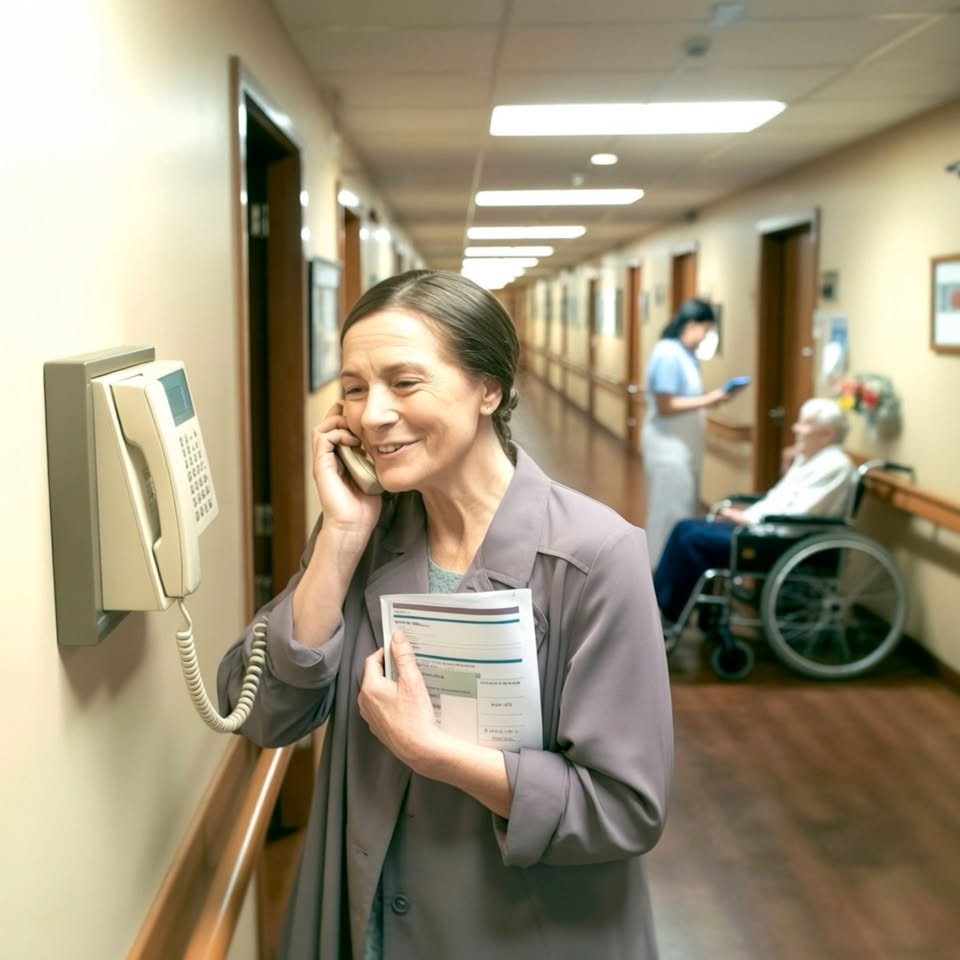
They didn’t say, “We’re locking you in.” They said, “You’ll be safe here, Mom.” That’s the thing about betrayal—it never wears the right name. It comes dressed in concern, wrapped in love, packaged as best interests.
I didn’t scream when my son Thomas took my keys from my purse and dropped them into his jacket pocket with a casual motion, as if confiscating car keys from a teenager who’d missed curfew. I didn’t beg when he emptied my handbag—wallet, checkbook, the little address book with forty years of phone numbers written in fading ink—and left everything on the hallway table of Rose Hill Care like abandoned luggage. I just stood there in the lobby with its artificial plants and motivational posters about aging gracefully, trying to understand what had just happened to my life.
Thomas kissed my cheek, his cologne too strong, his smile too practiced. “It’s temporary, Mom. Just until we make sure you’re okay.” Then he walked out through the automatic doors into the October sunshine, and I watched his Mercedes pull away, taking with it the last shred of pretense that I had any say in my own existence.
I waited ten minutes. Then fifteen. Then twenty-five, standing near the reception desk like a visitor who’d arrived too early, hoping someone would realize a mistake had been made. Finally, I approached the woman behind the desk—young, maybe thirty, with red lipstick and a nursing badge that read SANDRA in cheerful blue letters.
“Excuse me,” I said, keeping my voice steady despite the trembling in my chest. “When will I be allowed to leave?”
She looked up from her computer with an expression of polite confusion. “You’re checked in, Mrs. Leland. You’re a full resident now.”
“But I didn’t sign anything,” I said, though my voice was already losing its certainty.
Sandra gave me the kind of patient smile people reserve for children and the elderly. “Your son signed the admission papers. He has power of attorney for your health and financial decisions.”
The words hit me like cold water. Power of attorney. I’d signed those papers two years ago when Thomas insisted it was just a precaution, something every responsible adult should have in case of emergency. I’d trusted him. I’d believed the emergency would have to actually happen before the power would be used.
I didn’t cry. Not then. Crying felt like surrender, and I wasn’t ready to surrender yet.
They brought me to Room 213, and I remember the number because the door was chipped near the handle and stuck when Sandra tried to open it, requiring her to lean her shoulder against it with practiced force. The bed was made with hospital corners, sheets pulled so tight I knew I’d have to yank them loose to sleep. The closet was half full—my clothes, but not all of them, just the ones Thomas and his wife Marsha had deemed appropriate for my new life. A single framed photograph of my late husband Harold sat on the windowsill beside a plastic cup and a box of tissues, carefully placed details meant to make this impersonal room feel like home.
Except this wasn’t home. Home was 117 Dair Lane, the pale yellow bungalow with the creaky porch swing and the hydrangeas I’d trimmed every summer since 1984. Home was my kitchen with the chipped bird feeder visible through the window, the chair second from the end with the worn cushion that fit my hip perfectly. Home was the house I’d bought with Harold, paid off with grocery store budgets and extra shifts waitressing through my fifties, even after I broke my wrist and had to learn to carry trays with my left hand.
Home was gone. Just like that. Erased by a signature I’d made two years ago in a lawyer’s office, believing I was being responsible.
That first night, I didn’t sleep. Every thirty minutes, someone shuffled past my door—footsteps without direction, sounds without meaning. I didn’t know their names. I didn’t want to learn them. I wasn’t staying. This was a mistake, a misunderstanding that would be corrected as soon as I could explain it to someone in authority.
The next morning, I asked the nurse when I could speak to the administrator. She consulted her clipboard with the air of someone checking a bus schedule. “The administrator’s only in on Wednesdays,” she said. It was Monday.
“I’d like to call my son then,” I replied, trying to keep the desperation from my voice.
She looked at her chart, running one finger down a column of notes. “No phone privileges listed under your care plan.”
My care plan. As if I were a patient recovering from surgery rather than a seventy-nine-year-old woman who’d been functioning perfectly well until my son decided otherwise.
I wanted to laugh or scream, but I just sat on the edge of the bed and folded my hands in my lap the way I’d done a thousand times before when anger threatened to spill over. When you’ve raised a man who can smile while putting his own mother in a nursing home without her consent, you learn quickly that noise won’t get you anywhere. Compliance, patience, and careful observation—those were the tools I had left.
Three days passed. No calls from Thomas. No visits. No explanation of when this “temporary” arrangement might end.
On the fourth day, Sandra brought me a blue cardigan from my old house, delivered in a clear plastic bag like evidence. She said Thomas had cleared out my closet and sent over what he didn’t want to throw out. Throw out. My clothes. The wardrobe I’d built piece by piece over decades, each item chosen carefully because I’d never had money to waste on impulse purchases.
I opened the bag with hands that shook despite my best efforts. One dress—the navy one I wore to Harold’s funeral. A winter scarf I’d knitted myself thirty years ago. My heavy coat, the brown one with the pocket that never zipped properly, the coat older than Thomas’s marriage.
“You’re lucky,” one of the women said to me in the dining room that afternoon. Her name was Hilda, ninety years old with milky eyes that didn’t quite focus. “At least your family visited once. Mine left me here five years ago and moved to Arizona. Haven’t heard from them since.”
I didn’t feel lucky. I felt invisible, erased, filed away like a document no one needed to reference anymore.
They served mushy peas and chicken that tasted like cardboard compressed into the shape of meat. I didn’t complain. Hilda warned me that if you complained about the food, they wrote you up for “mood disturbance” and made you see the therapist who smelled like cough drops and carried sadness in her shoulders.
I didn’t want therapy. I wanted my name back. My keys. My kitchen window with its view of the chipped bird feeder where cardinals came every morning at seven-thirty.
When I asked again about the phone, Sandra said I could use the staff phone in emergencies only. So I manufactured an emergency. I told her I was worried about my furnace, that it might be malfunctioning, that there could be a gas leak.
She let me use the phone, standing close enough to monitor the call.
I dialed Thomas first—straight to voicemail, his cheerful recorded voice telling me to leave a message. Then I called my old neighbor Jenny, but she didn’t answer either. I wasn’t even sure she still lived next door after all these months. I left a message anyway, my voice sounding small and uncertain on her machine.
That night, feeling defeated and exhausted, I took the winter coat Sandra had brought and hung it on the back of my chair. It sagged under its own weight, the broken zipper pocket gaping open like a mouth. I slipped my hand inside absently, the way I’d done a thousand times at the grocery store while searching for receipts or forgotten shopping lists.
But this time, my fingers touched paper—thick, glossy, folded once.
I pulled it out carefully. A lottery ticket. Powerball. The numbers were filled in with black ink, the purchase date stamped clearly: one week ago. The same day Thomas had brought me here.
I stared at it like it had materialized from someone else’s life. I’d bought it on impulse that morning, stopping at the corner store on my way back from the bakery, using two dollars from the grocery money. I’d meant to check the numbers that weekend, but that was the day Thomas showed up with his concerned expression and his talk about my “declining memory” and the “incident” with the stove I’d supposedly left on—an incident that never happened, a knob that was simply broken and wouldn’t turn all the way off.
I turned the ticket over in my hands. No scratches on the barcode. Still intact. Still valid.
For a long moment, I just sat there holding it, this small rectangle of paper that represented two dollars and a moment of hope I’d almost forgotten existed.
Then I smiled for the first time since walking through the doors of Rose Hill Care. Because in that moment, I wasn’t a helpless old woman stripped of her autonomy and locked away like someone’s inconvenient past.
I was someone holding a secret. And maybe, just maybe, that secret would change everything.
The next three days, I kept the ticket in my coat pocket and told no one—not even Hilda, who’d taken to sitting with me at meals, sharing stories about the bridge club she used to run in 1962. I didn’t know yet if the ticket was worth anything, but something about simply possessing it, about having information Thomas didn’t have, lit a small fire inside me that I’d thought had gone out completely.
On Thursday, I asked Sandra again about using the phone, this time citing a potential problem with my old furnace that could affect the whole neighborhood. She sighed but allowed it, distracted by paperwork at the nurses’ station.
I found a quiet corner and dialed the number I’d memorized from a discarded newspaper in the common room. The lottery hotline. I entered the ticket number carefully, listening to the automated voice process my request.
Then the message came: “Congratulations. Your ticket matches all six numbers from the October 14th drawing. Please contact our claims department to arrange collection of your prize.”
My hand shook so badly I nearly dropped the phone. I listened to the message again to make sure I’d heard correctly.
All six numbers. The grand prize for that week’s drawing.
Sixty-two million dollars.
I hung up carefully, my heart hammering against my ribs. I walked back to my room slowly, as if I were carrying something fragile—which I was. I was carrying knowledge that could crack open my prison and rebuild my life, but only if I was careful, strategic, and above all, quiet.
That night, I barely slept, my mind racing through possibilities and obstacles. I couldn’t just walk into a lottery office and claim the prize. I didn’t have identification easily accessible—Thomas controlled all my documents. I didn’t have my own bank account anymore—he’d merged mine with his “for simplification,” he’d said, though now I understood it was for control. I couldn’t drive to the lottery headquarters. I could barely leave this building without someone noting it on a chart.
But for the first time in months, I wasn’t afraid. I wasn’t nothing. I was holding a secret so powerful it could swallow this entire building and spit it out as dust. I just needed to figure out how to wield it without Thomas finding out before I’d secured everything.
The next morning, I made my move. I told Sandra I needed to speak with a lawyer about updating some personal documents.
She actually laughed. “What, are you suing someone?”
“No,” I said calmly. “I just want to ensure my affairs are in order. Surely that’s reasonable for someone my age.”
“Your son handles all your paperwork,” she replied dismissively.
“Then I’d like a lawyer to confirm that arrangement is still legal,” I said, letting steel enter my voice. “And I’d like to understand my rights regarding financial decisions, especially given that I was placed here without informed consent. I believe there are regulations about elder care and financial exploitation you might want to review.”
The smile faded from her face. “Mrs. Leland, that’s not how—”
“If you’re uncomfortable helping me exercise my legal rights, I’ll need to file a formal complaint with the state licensing board about restrictions on resident autonomy,” I continued, my librarian voice emerging—the one I’d used for thirty years when dealing with difficult board members or parents who wanted to ban books. “I’m sure they’d be very interested in your facility’s policies regarding access to legal counsel.”
She stared at me for a long moment, reassessing. Then she made a note on her clipboard. “I’ll pass your request to administration.”
That afternoon, I called Thomas from the staff phone. He didn’t answer, so I left a message, keeping my voice light and slightly confused, playing the part he expected.
“Hi, Thomas. I was going through my coat pockets and found something. Just wanted to let you know in case it’s important. Call me when you can.”
I didn’t specify what I’d found. Let him wonder. Let his imagination fill in the blanks with documents he might have missed, financial statements he’d overlooked, evidence of the competence he’d claimed I didn’t possess.
He called back two days later, his voice too casual, too controlled. “Hey, Mom. Got your message. What did you find?”
“Oh, just an old receipt,” I lied smoothly. “I thought it might have been important, but never mind. How are you?”
The relief in his voice was audible. “I’m good, I’m good. Listen, I hope you’re settling in okay. Marsha sends her love.”
Marsha hadn’t visited once, hadn’t sent so much as a card, but I let it pass.
“The place is very nice,” I said, giving him what he wanted to hear. “Very clean.”
“That’s great, Mom. That’s really great. And about that paper you mentioned, if you find anything else, just hang onto it, okay? I’ll go through everything when I visit next.”
“Of course, dear,” I said sweetly. Then I hung up and allowed myself a small, private smile.
Through careful questions to other residents and observation of the staff, I learned that a lawyer named Andrew Meyers sometimes did consultations at the facility for estate planning. Hilda mentioned he’d helped her draft a will years ago, back when she still had assets to distribute. I asked Sandra to request a consultation, framing it as simple estate planning that wouldn’t interfere with Thomas’s authority.
Two weeks after finding the ticket, Andrew Meyers arrived—a sharp-eyed man in his mid-forties with gray temples and a leather briefcase that looked expensive but not ostentatious. We met in the garden area, a concrete square with artificial plants that was optimistically called an “outdoor wellness space.”
I didn’t waste time with pleasantries.
“I need to claim a lottery prize without my son finding out,” I told him quietly, “and I need to regain control of my own life.”
He didn’t blink, didn’t look shocked, just pulled out a legal pad. “Tell me everything.”
I explained the power of attorney, the involuntary placement, Thomas’s control over my finances, and finally, the ticket. When I showed it to him, he examined it carefully, checking the date and numbers against his phone.
“This is legitimate,” he said after a moment. “Sixty-two million, pre-tax. Unclaimed.” He looked up at me. “Does anyone else know?”
“No one.”
“Do you want them to?”
“No.”
He nodded slowly, already thinking several moves ahead. “We’ll need to set up a trust, claim the prize through a legal intermediary to maintain anonymity, and simultaneously file to revoke the power of attorney. It’s going to require careful timing and absolute discretion.”
“I’ve been quiet my whole life,” I said. “I can be quiet a little longer.”
Over the next three weeks, Andrew worked methodically. He arranged for a lockbox at a bank where documents could be sent without going through Rose Hill’s mail system. He filed the paperwork to contest Thomas’s power of attorney, citing lack of proper consent and evidence of financial manipulation. He set up a blind trust under a pseudonym—Clara Whitmore—to claim the lottery prize. And he got me a court-ordered psychological evaluation from an independent physician who confirmed I was fully competent, mentally sound, and had been placed in care under false pretenses.
During all this, I played my part perfectly. I attended bingo. I ate the terrible food without complaint. I smiled at Sandra and asked no more difficult questions. I became invisible again, just another elderly resident quietly fading into the furniture.
Thomas visited once during this period, clearly checking to see if I’d found anything else significant. He brought flowers—grocery store carnations already wilting—and made small talk about the weather while his eyes scanned my room for evidence of hidden documents or unusual activity.
“You seem good, Mom,” he said, relief evident in his voice. “Calmer. I think this place is really helping you.”
“It’s very peaceful,” I replied, which was true in a way he didn’t understand. I was peaceful because I knew what he didn’t—that his control was about to evaporate like morning fog.
After he left, I found a notice in my mail cubby. The court had set a hearing date for the power of attorney revocation. Thursday, three weeks away. I would be transported under legal escort to testify.
I marked the date in my mind and continued my quiet routine, counting down the days.
The hearing room was smaller than I’d imagined, nothing like the dramatic courtrooms on television. Just a few rows of chairs, a simple bench, and a judge who looked tired but attentive. I sat beside Andrew wearing my best dress—the navy one from Harold’s funeral—and the good shoes Rosie had given me for Christmas three years ago.
Thomas sat across the aisle with his own lawyer, lips pressed into a thin line. Marsha hadn’t come, probably on advice of counsel.
The hearing lasted thirty-six minutes. Andrew presented the timeline, the medical evaluation proving my competence, the financial transactions Thomas had made without consultation, the furniture he’d sold from my house, the utilities he’d transferred to his name. Most damning was the evidence that I’d never actually consented to the care home placement—the admission papers bore only Thomas’s signature, not mine.
“Mrs. Leland,” the judge asked me directly, “do you feel you were placed in Rose Hill Care against your will?”
“Yes, Your Honor,” I said clearly. “I wasn’t asked. I was informed it was happening.”
“And do you feel capable of managing your own affairs?”
“I do, Your Honor. I managed them successfully for seventy-seven years before my son took control.”
The judge reviewed the psychological evaluation, the financial records, the testimony. Then she looked at Thomas with an expression that made him shrink in his seat.
“Your attorney claims you acted in good faith, Mr. Leland, but good faith requires transparency and respect for your mother’s autonomy, both of which appear to be absent here.” She turned back to me. “Mrs. Leland, I’m granting your request for full revocation of the power of attorney, effective immediately. You will regain control of all your financial accounts, property, and personal decisions. Your son will have no legal authority over your affairs unless you choose to grant it in the future.”
Just like that. Gavel, stamped order, freedom.
Outside the courthouse, Thomas followed me down the steps, his face pale. “Mom, wait. Please.”
I stopped and turned to face him.
“I didn’t mean to hurt you,” he said, and I could hear genuine confusion in his voice, as if he truly couldn’t understand how his actions had been anything but helpful.
“But you did hurt me,” I replied calmly. “You took my life and packed it away like winter clothes you thought I’d never need again.”
“I thought I was protecting you,” he insisted.
“No,” I said. “You thought you knew better than me what I needed. There’s a difference.” I paused, looking at this man I’d raised, this stranger wearing my son’s face. “I taught you to tie your shoes, Thomas. I paid for your braces and your college application fees. I sat through every school concert even when your father had to work late. And now you’ve taught me something—that love without respect isn’t love at all. It’s just control with a gentler name.”
His eyes filled with tears. “What do I do now?”
“You learn to live with the consequences of your choices,” I said. “Just like everyone else.”
Then I walked to the car Andrew had arranged and didn’t look back.
I left Rose Hill Care on a Tuesday morning three days later, and no one seemed particularly surprised or concerned. Andrew had arranged all the paperwork—a discharge under the category of “independent living reassessment.” Sandra gave me a generic hug and told me not to forget them. I promised I wouldn’t, which was true. I would never forget what it felt like to be locked away and dismissed.
But I also wouldn’t waste time dwelling on it.
The lottery money had been claimed through the trust, taxes paid, funds secured in accounts only I could access. Andrew had been thorough and brilliant, protecting every dollar from anyone who might try to claim it belonged to them.
I’d designated ten million for my granddaughter Rosie in a trust she’d access at thirty, with provisions for education and emergencies. She deserved a foundation I’d never had. The rest—more money than I could spend in three lifetimes—would be mine to use as I saw fit.
The car drove for two hours, taking me far from the city, far from Thomas and Marsha and the house on Dair Lane that no longer felt like mine even though I legally owned it again. We pulled into a coastal town I’d never visited before, down a narrow street with no signs, to a small white cottage with blue shutters and a view of the ocean.
Andrew had found it, purchased it in the trust’s name, furnished it simply with everything I’d need. A single chair by the window. A bed with soft sheets. A kitchen with a teapot waiting on the counter. Everything chosen for comfort and peace, nothing for show.
I walked through the front door and took off my shoes, feeling the cool wood floor beneath my feet. It smelled like salt air and possibility.
That first evening in my new home, I made tea and sat in the chair by the window, watching the ocean catch the last light. I thought about Hilda and the others still at Rose Hill, about Lillian who’d died alone, about all the people warehoused and forgotten.
Before I’d left, I’d done one final thing. I’d left an envelope with Sandra containing the name and number of an advocacy organization for elder rights, along with an anonymous donation of fifty thousand dollars earmarked specifically for legal aid. I’d left another envelope under Hilda’s pillow with Andrew’s number and a note: “When you’re ready to leave, call this number. Tell them Clara Whitmore sent you.”
I couldn’t save everyone. But I could open doors.
That night, I slept without anyone checking on me, without call buttons or medication schedules or someone else’s timeline for my life. I slept in a bed I’d chosen, in a house I owned, with money I’d won and protected through my own cunning.
In the morning, I woke when I wanted to, not when breakfast was served. I made toast with real butter and sat in the sun streaming through my window. I opened that window—something I’d been unable to do for months—and breathed in air that tasted like freedom.
Later that week, Rosie called. I’d sent her a letter explaining everything, including the trust fund that awaited her.
“Grandma,” she said, her voice thick with tears, “I had no idea what they’d done to you. I’m so sorry I didn’t check on you more.”
“You were in college, living your life,” I said. “That’s exactly what you should have been doing.”
“Dad keeps calling me,” she said quietly. “He’s upset about the money, about losing control of everything. He says you’re being unreasonable.”
“I’m being free,” I corrected gently. “There’s a difference.” I paused. “You don’t have to choose between us, Rosie. You can love your father and still recognize that what he did was wrong.”
“I know,” she said. “I just wish—” Her voice broke. “I wish I’d protected you.”
“You did,” I assured her. “You were the only one who called me at Rose Hill. The only one who asked how I was actually feeling. You saw me when everyone else was just managing me. That mattered more than you know.”
After we hung up, I sat on my small porch and watched the waves roll in with their eternal patience. I thought about all the years I’d spent being quiet, being accommodating, being small so other people could feel large.
I thought about Harold and how he’d loved me but never quite saw me as equal, how even in our happy moments I’d been supporting character in his story rather than protagonist of my own.
I thought about Thomas, raised in a world that taught him his certainty was more valuable than my experience.
And I thought about the lottery ticket, two dollars of hope that had transformed into sixty-two million dollars of freedom—not because of the money itself, but because it gave me leverage to reclaim what should never have been taken.
That ticket hadn’t saved me. I’d saved myself. The money was just the tool I’d used to do it.
A week later, I received a letter from Thomas. I almost didn’t open it, but curiosity won.
Mom,
I’ve been doing a lot of thinking since the hearing. My therapist (yes, I’m seeing someone now) says I have control issues stemming from watching Dad die and feeling powerless. She says I transferred that need to control onto you, trying to manage outcomes so I wouldn’t feel that helplessness again.
I’m not writing to make excuses. I know what I did was wrong. I robbed you of your autonomy because I couldn’t face my own fear of losing you. I treated you like a problem to solve instead of a person to respect.
I don’t expect forgiveness. I’m not sure I deserve it. But I want you to know I’m working on myself, trying to understand how I became someone who could hurt the person who gave me everything.
I hope your new place brings you peace. Rosie showed me the pictures. It looks beautiful.
Love, Thomas
I read it twice, then folded it carefully and placed it in a drawer. Not to treasure, not to burn—just to acknowledge. He was trying. That was something. Whether it would ever be enough remained to be seen.
But his journey was his own to walk. Mine was already underway.
I spent my days reading books I’d never had time for, walking on the beach, learning to paint watercolors at the community center. I made friends with my neighbors—real friends who knew me as Clara, who had no idea about my past or my money, who valued me for my conversation and my company.
On Thursdays, I volunteered at the local library, shelving books and helping people find exactly the story they needed. The head librarian, a woman named Margaret, became a close friend. She never asked about my life before, just accepted me as I was now.
Six months after leaving Rose Hill, I received a letter forwarded through Andrew’s office. It was from Hilda.
Dear Friend,
I used the number you left me. The lawyer was very kind. I’m out now, living with my niece in Vermont. She didn’t know about Rose Hill, didn’t know Dad had put me there after Mom died. She thought I was happy there.
I wasn’t happy. But I’m happy now.
Thank you for seeing me when I’d gotten so used to being invisible.
Your friend, Hilda
I put that letter in a frame and hung it in my kitchen where I could see it every morning. A reminder that small acts of courage could ripple outward in ways we’d never predict.
Some evenings, sitting on my porch watching the ocean turn colors with the setting sun, I thought about the woman I’d been a year ago—diminished, dismissed, locked away and labeled too frail to manage her own life. I thought about how close I’d come to accepting that story, to believing that being old meant being powerless.
And then I thought about the woman I’d become—the one who’d fought quietly and strategically, who’d turned two dollars and a pocket full of luck into complete autonomy, who’d reclaimed not just her money but her name, her voice, her right to exist on her own terms.
If you’re reading this and you’ve ever been silenced, dismissed, or put away like a coat someone decided they didn’t need anymore, I want you to know something: You are not finished. You are not powerless. You are not a burden to be managed.
You are a person with rights, with agency, with a story that isn’t over until you say it is.
Sometimes freedom comes from inheritance or luck. Sometimes it comes from a lottery ticket found in a broken pocket.
But more often than not, it comes from the quiet refusal to disappear just because someone else would find it convenient.
I didn’t win my freedom because of sixty-two million dollars.
I won it because I remembered that I’d never actually lost it in the first place—it had only been stolen, and stolen things can be taken back.
My name is Doris Evelyn Leland. I’m eighty years old. I live in a cottage by the ocean, and every single morning I wake up in a bed I chose, in a house I own, in a life that belongs entirely to me.
And that—more than any amount of money—is worth everything.