


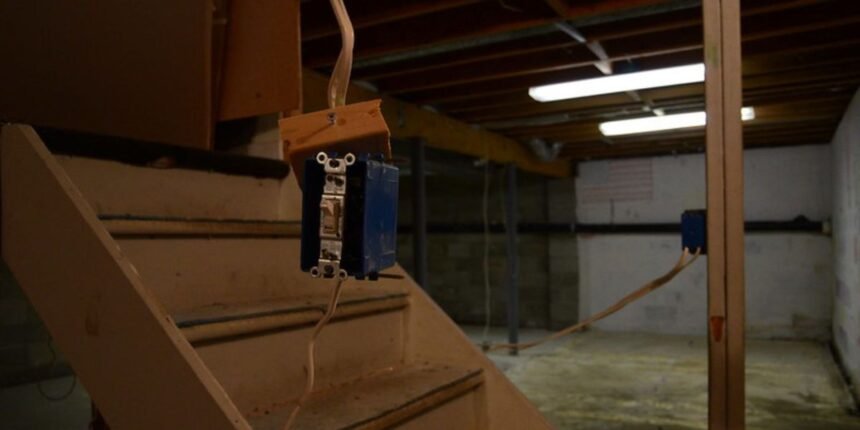
“That’s why Grandma always called my mom the responsible one,” he said.
I rolled my eyes, but my attention was caught by something in the back corner, a thick, patterned rug, bunched up and totally out of place among the neat lines.
Blaine caught me staring. “You want to check under it?”
I hesitated.
“Do you?”
“It’s probably just covering a stain or a bad patch of floor,” he said, but didn’t sound convinced.
I moved closer, kneeling to feel the edge. “Help me with this. It’s heavy.”
We both grabbed a side and pulled.
The rug didn’t budge at first, then it gave away with a muffled scrape.
“What the… Why is it so heavy?” I grunted.
Blaine let go and flexed his hands. “I swear it wasn’t this bad last winter when I helped Mom bring down the Christmas boxes.”
As we rolled it back, a square of lighter wood appeared, right in the middle of the floor.
Blaine frowned.
“Is that… a floor hatch?”
“Yes,” I said, tapping the wood. There was a shiny silver lock.
My cousin squatted down, inspecting it.
“That’s new to me, Gem. My mom never mentioned this.”
My heart sped up. “Why would she need to lock up part of the basement?”
He shrugged, but I saw a flicker of doubt in his eyes.
“You think it’s her jewelry or something?”
I shook my head. “No one keeps jewelry under the floor, Blaine. That’s just…
weird.”
We searched the nearby shelves, then every junk drawer upstairs, tossing aside old mail and sewing needles. Finally, in Aunt Marjorie’s sewing tin, I found a tiny key labeled “Buttons.”
“Here,” I said, tossing it to him.
He held it, then handed it right back. “You do it.
I don’t want to get blamed if something jumps out.”
I took a breath, knelt, and slid the key into the lock. My hands shook. The click echoed in the silence.
We lifted the hatch together, and a rush of cold, metallic, perfume-sour air hit our faces.
A narrow ladder dropped into the unlit space below.
Blaine peered over my shoulder. “You want to go first?”
He handed me his phone for the flashlight. “Don’t fall.
If you break something, Mom’s ghost will kill us both.”
I snorted, but my heart was hammering. One step after another, I climbed down, the ladder creaking beneath my weight. As I reached the bottom, I flashed the light around.
Rows of metal filing cabinets.
Cardboard boxes sagging with mold, banker’s boxes stamped “Orphanage” in blocky print.
“Winter Coats — Donor Envelopes” scrawled on one in Marjorie’s perfect handwriting, with a crayon thank-you note paper-clipped to a donation slip.
The slip said $500. Someone had crossed it into $50.
Blaine’s voice drifted down from the opening above me. “See anything yet?”
I didn’t answer right away.
The note was folded like it had been opened and closed a hundred times. I eased it open under the flashlight and read it out loud, because suddenly my throat felt too tight for silence.
“It says… ‘Thank you for my pink coat. I was warm at the bus stop.
Love, Daisy.”‘
My hand shook as I held the note next to the altered slip.
“Blaine,” I whispered, “this isn’t just numbers.”
I swallowed hard. “Yeah.”
His voice cracked on the next words. “A real kid who thought someone cared.”
“Yeah,” I said quietly.
“I think we just found the part of your mom’s life no one was supposed to see.”
And that’s where the smell came from: damp boxes, old perfume, and a dehumidifier that had leaked onto the floor.
Blaine hovered, biting his lip.
I started flipping through envelopes, at first, just standard forms. Then donation slips, thank-you notes, many handwritten in shaky kid’s script. Then, deeper in the cabinet, I found a fat ledger.
Inside, every page was a record of donations, cash, checks, and in-kind gifts.
But the numbers didn’t add up.
Amounts were crossed out and rewritten, often smaller. Names of donors repeated, but sometimes an envelope stapled to a page would hold half the money listed.
Then I opened another box, stacks of cash bundled with cracked rubber bands. Velvet jewelry boxes spilled open, revealing gold bracelets, pearl necklaces, and rings.
One box had a faded tag: “St.
Matthew’s Church — 1987 Fundraiser Auction.”
I stared, breathless. “Blaine, didn’t the church report all this missing, like decades ago? I remember it…
because my mom was questioned.”
I turned over a brooch, hands shaking. “It is now.”
The worst blow was still to come. I yanked open a metal filing cabinet, flipping through files until one practically leapt out at me, a folder marked “Restricted – Community Relations.”
My hands shook as I opened it.
Inside was a typed list, bold and cold: “Do Not Invite/Do Not Acknowledge”:
At the very top, underlined, was my mother’s name.
“Blaine,” I called.
“Come look at this.” I swallowed, forcing down a surge of anger. “She made sure my mom was never on a church board. She made sure everyone kept asking why Carol wasn’t more like Marjorie.”
Blaine bristled, shaking his head.
“No. My mom gave her life to the church and those kids. Don’t turn this into something it’s not, Gemma.”
I shoved the folder toward him.
“If she gave her life, why are these ledgers locked away? Why is my mom’s name on a blacklist?”
I just looked at him.
His voice went small. “She did this to you and Aunt Carol on purpose…
didn’t she?”
I cut him off, snapping photos of everything. “No. I knew something was off.
Aunt Marjorie couldn’t have been that perfect. I’m calling the police.”
He moved to block me on the stairs, panic flashing across his face. “Wait!
Gemma, please, let’s just figure this out first. If you make this public, you’ll ruin everything. The orphanage, the church, my mom’s —”
“I’m not the one who ruined it.
You want the truth, or you want a fairy tale? You chose to leave this behind years ago, Blaine. Don’t forget that.”
He let out a shaky breath.
“Do what you have to do.”
The police arrived less than 30 minutes later.
The officers secured the house first, asking Blaine and me to step outside while they documented what we’d found.
One of them made several calls from the porch, contacting the church treasurer and the orphanage director so the records could be reviewed properly.
Upstairs, I could hear Blaine pacing, his voice low and desperate on the phone.
Downstairs, I led the police to the hatch, pressing the evidence into their hands, my pulse thundering in my ears.
When they saw everything, one officer let out a low whistle. “You did the right thing calling this in, ma’am.”
By that afternoon, the house was a circus. The church treasurer, the orphanage director, two uniformed officers, and at least a dozen neighbors crowded into Marjorie’s yard.
Some wanted to protect her memory; others just wanted front-row seats.
Blaine stood near the porch, arms crossed tight, eyes darting to every new arrival.
“They’re acting like this is some kind of spectacle.”
I watched Mrs. Lyle, the orphanage director, flip through the ledgers, her hands trembling as she read.

