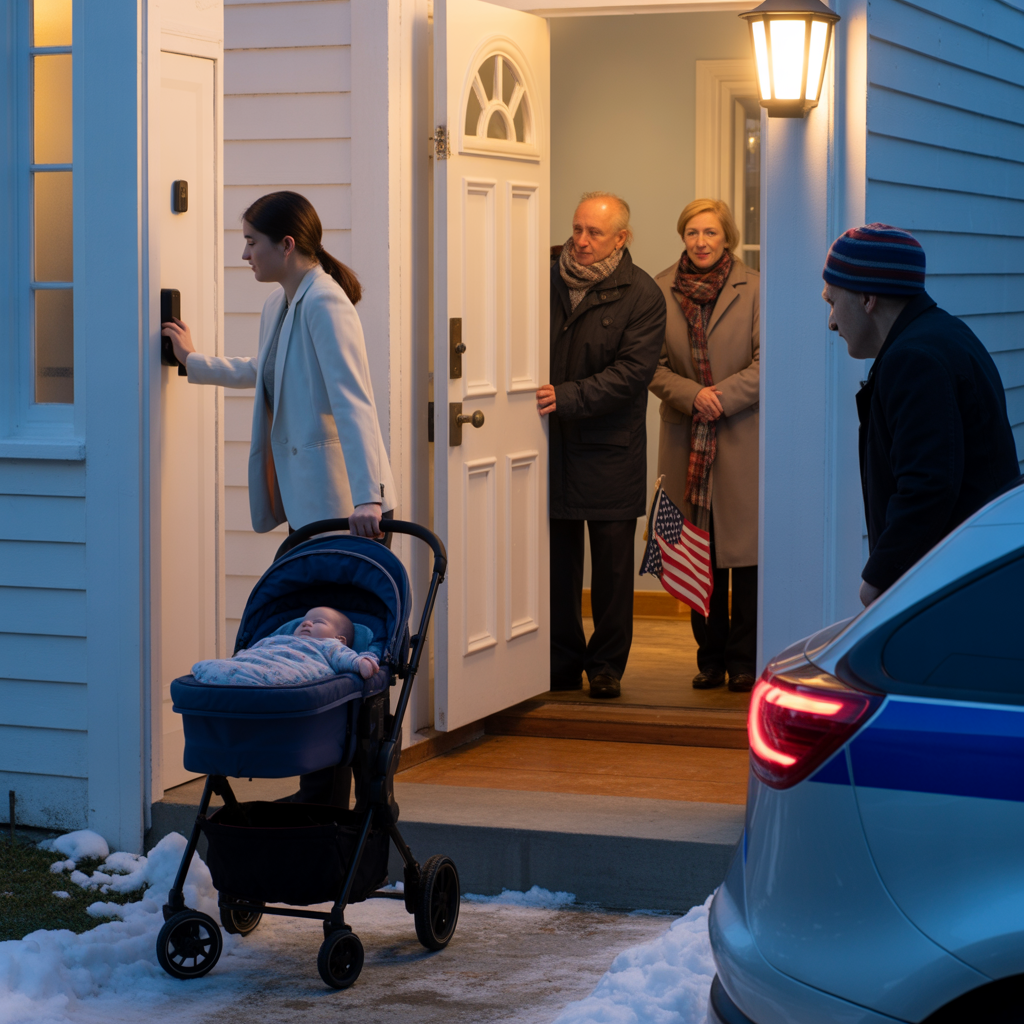
While we were having dinner at my parents’ house, I started having contractions. They rushed me to the hospital. Before leaving, I told my sister, “Please look after my five-year-old daughter.” After a few days, I gave birth to my newborn baby. I rushed home to check on my daughter. When I knocked at my sister’s house, no one answered the door. I kept ringing my sister, but she wasn’t answering her phone. So, I called my parents and they just told me, “She must be coming back soon. Stop worrying.” But before leaving, I heard some faint noises coming from inside. So I decided to break the door down to check. That’s when I found liquid coming out from under the storage room door. I quickly called 911 in panic. When they arrived and quickly opened it to check inside, a shocking truth was exposed.
The contraction started during dessert. One moment I was laughing at my father’s terrible joke about the pot roast, and the next I felt my entire abdomen seize up like someone had wrapped steel cables around my middle. My fork clattered against the plate as I gripped the edge of the dining table, trying to breathe through the sudden pain.
“Honey?” My mother’s voice cut through the fog. “Are you okay?”
I shook my head, unable to form words as another contraction rolled through me. These weren’t the false alarms I’d experienced for the past week. This was real. This was happening.
My sister Brooke jumped up from her seat, her napkin falling to the floor.
“How far apart are they?”
“I don’t know,” I managed to gasp out. “This is the first one.”
That was a lie. I’d felt a dull ache for the past hour, but had convinced myself it was just indigestion from my mother’s cooking. Denial is a powerful thing when you’re not quite ready to face reality.
The second contraction hit barely five minutes later.
My father was already grabbing his car keys. My mother was frantically searching for her purse. And Brooke stood frozen in the middle of the chaos like a statue.
“We need to get you to the hospital,” Dad said, his voice steady despite the panic in his eyes. “Can you walk?”
I nodded, gripping the back of my chair as I stood. Everything felt surreal, like I was watching myself from somewhere outside my body.
The baby wasn’t supposed to come for another week.
My daughter Autumn’s fifth birthday party was tomorrow. We had forty cupcakes waiting at home and a bouncy castle scheduled for delivery in the morning.
Another contraction made me double over.
Seven minutes. They were coming faster than expected.
“What about Autumn?” I asked, my voice tight with pain and worry. My daughter was upstairs in my parents’ guest room, probably still absorbed in whatever cartoon she’d been watching before dinner.
“I’ll take care of her,” Brooke said quickly. “Don’t worry about anything. Just focus on having a healthy baby.”
I looked at my sister—really looked at her.
We’d never been particularly close. There were four years between us, and growing up, that gap had felt like an ocean. She was the artistic one, the free spirit who painted and traveled and never seemed to settle into anything permanent. I was the practical one, the single mother who worked two jobs to keep a roof over our heads.
But family was family.
And in that moment, with my body preparing to bring new life into the world, I needed her.
“Are you sure?” I asked, wincing through another wave of pain.
“Absolutely,” Brooke assured me. Her smile seemed genuine enough. “You know, I love spending time with Autumn. We’ll have a great time. I promise.”
My mother was already halfway out the door, calling back for me to hurry.
Dad had his arm around my waist, supporting most of my weight as we shuffled toward the front entrance. Everything was happening so fast that I barely had time to think.
“There’s emergency information on my phone,” I called back to Brooke as Dad helped me into the backseat of his car. “And she needs to take her allergy medicine before bed. It’s in my purse. The purple bottle.”
“I’ve got it,” Brooke said, standing in the doorway with her arms crossed. “Just go. Everything will be fine here.”
The drive to the hospital passed in a blur of streetlights and contractions.
Mom kept timing them from the front seat, her voice growing more urgent with each announcement.
“Four minutes apart. Three and a half. Three minutes.”
By the time we arrived at the emergency entrance, I could barely walk. A nurse appeared with a wheelchair and suddenly I was being rushed through sterile corridors while someone asked me questions I couldn’t focus enough to answer properly.
The labor lasted thirty-seven hours.
Thirty-seven hours of pain that rewrote my understanding of human endurance.
The epidural helped, but nothing could completely erase the exhaustion that settled into my bones. As the hours stretched on, my mother stayed with me the entire time, holding my hand and whispering encouragement. Dad paced the waiting room, updating relatives and friends.
I asked about Autumn every few hours.
Each time, my mother assured me that Brooke had everything under control. She’d sent a text saying they’d gone to the park. Another saying they’d made cookies. A third saying Autumn had gone to bed without any problems.
But something felt wrong.
I couldn’t explain it. Couldn’t put my finger on what bothered me. Maybe it was just the exhaustion talking or the hormones flooding my system.
Still, that nagging feeling persisted like a splinter I couldn’t quite reach.
My son was born at 3:47 in the morning on a Tuesday.
Seven lb 9 oz of screaming, red-faced perfection.
They placed him on my chest, and despite the overwhelming fatigue, I felt the surge of love so intense it brought tears to my eyes.
“He’s beautiful,” Mom whispered, leaning over to kiss my forehead. “You did amazing, sweetheart.”
The next two days passed in a fog of feeding schedules, diaper changes, and visitors bearing gifts and congratulations.
Dad brought flowers. My co-workers sent a basket of baby clothes. Even my ex-husband’s mother stopped by, though her visit was mercifully brief.
The hospital room became a revolving door of well-wishers.
My best friend from college arrived with balloons and a stuffed elephant that was nearly as big as my newborn. Three women from my book club stopped by with homemade casseroles, already thinking ahead to the meals I’d need once I got home. My boss sent an elaborate fruit arrangement that took up half the windowsill.
Everyone wanted to hold the baby, to coo over his tiny fingers and button nose. They asked about labor, about recovery, about whether I’d chosen a name yet.
I answered automatically, going through the motions while my mind remained elsewhere.
Between visitors, I tried calling Brooke again and again.
Her phone rang endlessly before dumping me into voicemail. I left messages asking her to call back, trying to keep my voice light and casual, even as anxiety gnawed at my insides.
My mother noticed my repeated attempts.
“You need to rest,” she said, adjusting the blanket around my legs. “Stop worrying so much. Brooke knows what she’s doing.”
Did she, though?
Brooke had never had children of her own. She’d never expressed any interest in becoming a mother. Her life revolved around her art, her occasional gallery showings, and a string of relationships that never seemed to last more than a few months.
But she was my sister.
Surely blood meant something.
Surely she understood the weight of the responsibility I placed on her shoulders.
The pediatrician came by that evening for a final check on my son. She was a cheerful woman in her fifties who’d raised four children of her own. She declared him perfectly healthy, right on track developmentally, and ready to go home as soon as I was cleared for discharge.
“Do you have help at home?” she asked, making notes on her tablet. “The first few weeks with a newborn can be overwhelming, especially when you already have another child.”
“My parents live nearby,” I said, which was true, but felt incomplete. My parents would help, but they weren’t the ones primarily responsible for Autumn right now. That fell to Brooke, who still wasn’t answering her phone.
After the pediatrician left, I tried a different approach.
I logged into social media on my phone, checking Brooke’s accounts. She’d always been active online, constantly posting photos of her paintings, her travels, her meals at trendy restaurants.
Her last post was from four days ago: a picture of her breakfast, some elaborate avocado toast situation with a caption about treating herself.
Nothing since then.
No photos of Autumn.
No updates about their time together.
Nothing.
The silence felt deafening.
My phone buzzed with a text from my coworker Jennifer asking how I was feeling and whether I needed anything. I sent back a quick reply thanking her for the baby clothes and assuring her I was fine.
But I wasn’t fine.
Something fundamental had shifted inside me—some maternal alarm system that refused to be silenced no matter how much logic I tried to apply.
Sleep became impossible.
Even when my son dozed peacefully in the bassinet beside my bed, I lay awake staring at the ceiling. The nurses had given me pain medication, but it did nothing to quiet my racing thoughts.
Around midnight, I called my father’s cell phone.
He answered on the third ring, his voice groggy with sleep.
“What’s wrong?” he asked immediately. “Is the baby okay?”
“The baby’s fine,” I assured him. “I just—have you heard from Brooke at all today?”
There was a pause.
“No, but I’m sure she’s just busy with Autumn. You know how exhausting kids can be.”
“Dad, she’s not answering her phone at all. She hasn’t posted anything online in days. Doesn’t that strike you as odd?”
Another pause.
Longer this time.
“Maybe her phone died,” he suggested, though he didn’t sound convinced. “Or maybe she lost her charger. You know how scattered she can be.”
Scattered.
That was the word my parents always used for Brooke.
Scattered, free-spirited, artistic—never irresponsible or unreliable or fundamentally unable to prioritize anyone’s needs above her own.
“Could you drive by her house tomorrow?” I asked, trying to keep the desperation out of my voice. “Just to check on them.”
“Of course,” Dad said. “First thing in the morning. Try to get some rest, sweetheart. Everything’s going to be fine.”
But through it all, that nagging worry about Autumn never quite went away.
I texted Brooke multiple times each day. Her responses came quickly enough, always cheerful and reassuring—pictures of Autumn smiling at the camera, videos of her coloring at the kitchen table.
Everything looked fine.
Everything looked normal.
Except Autumn hadn’t asked to speak to me.
In five years, we’d never been apart for more than a single overnight. And even then, she’d called me three times before bedtime.
Now, radio silence.
“She’s probably just having too much fun with Aunt Brooke,” my mother suggested when I voiced my concerns. “You know how kids are. They get distracted.”
Maybe she was right.
Maybe I was being paranoid.
New mothers were supposed to be overly protective, weren’t they?
The nurses had warned me about postpartum anxiety, how it could make everything seem more frightening than it really was.
On the third day, the doctors cleared me for discharge.
My mother had gone home to shower and change, promising to return within an hour. Dad was in the cafeteria grabbing coffee.
I sat in the hospital bed with my newborn son sleeping in my arms, feeling the weight of everything that had happened finally settling onto my shoulders.
I needed to see Autumn.
The ache to hold my daughter had grown from a dull throb to an urgent demand that I could no longer ignore.
I called Brooke’s number.
It rang five times before going to voicemail.
I tried again immediately.
Same result.
A third attempt brought the same frustrating outcome.
Fear crept up my spine like ice water.
I called my parents’ house next, thinking maybe Brooke had taken Autumn there.
No answer.
I tried my father’s cell phone, but it went straight to voicemail.
My hands were shaking as I carefully placed my sleeping son in the hospital bassinet.
Something was wrong.
I could feel it in my gut—that primal maternal instinct that transcends logic and reason.
When my mother finally returned, I was already dressed and pacing the small hospital room.
“We need to go,” I said before she could even set down her purse. “Now. I need to check on Autumn.”
“Honey, calm down,” Mom said in that placating tone that only made my anxiety worse. “I’m sure everything is fine. Brooke sent a picture just this morning.”
“I haven’t spoken to my daughter in three days,” I said, hearing my voice rise despite my efforts to stay calm. “She hasn’t called me once. Doesn’t that seem strange to you?”
Mom pursed her lips, clearly torn between dismissing my concerns and acknowledging that, yes, it did seem a bit odd.
“Let me try calling Brooke,” she finally offered.
Her call went to voicemail, too.
Then she tried the house phone.
Nothing.
“See?” I said, fighting to keep the panic out of my voice. “Something’s wrong. We need to go there right now.”
“Okay.” Mom agreed, her own expression shifting toward concern. “Let me get your father. We’ll drive over together.”
The discharge process took another forty-five minutes that felt like forty-five years.
Paperwork to sign, instructions to receive, a final check from the pediatrician.
Every minute that ticked by stretched my nerves tighter.
The nurse went through a lengthy checklist explaining warning signs to watch for in a newborn—fever above a certain temperature, excessive crying, feeding difficulties.
I nodded along, barely absorbing the information.
My mind was miles away, locked in the storage closet with my five-year-old daughter.
“Are you listening?” the nurse asked gently, her hand on my shoulder.
“Yes,” I lied. “Sorry, just tired.”
She gave me a sympathetic smile.
“Of course you are. Having a baby is exhausting. Make sure you rest when the baby rests.”
Okay. Rest.
As if I could rest while this gnawing fear consumed me from the inside out.
My mother signed some of the paperwork for me, her own worry now evident in the tight lines around her mouth.
She tried calling Brooke three more times that morning.
All calls went to voicemail.
“Maybe we should file a missing person’s report,” Mom suggested quietly while the nurse stepped out to grab a wheelchair.
“She’s not missing,” I said. “Her car is at her house. She’s there. She’s just not answering.”
Which was somehow worse than if she’d actually disappeared.
At least missing would imply something beyond her control.
This felt intentional, like she was actively choosing to ignore us.
The wheelchair arrived—hospital policy for all patients being discharged.
I settled into it with my son in my arms, his tiny face peaceful and unaware.
My mother carried the bags of gifts and supplies we’d accumulated over three days.
Dad was waiting at the entrance with the car already running.
He’d installed the infant car seat earlier that morning, triple-checking that it was secure.
His hands shook slightly as he helped me transfer my son from my arms to the seat.
“We’ll stop by Brooke’s first,” he said, his jaw set in that determined way he got when he was trying to stay calm. “No arguments.”
I hadn’t planned to argue.
Wild horses couldn’t have dragged me anywhere else.
Finally, we were in the car.
My parents sat up front while I sat in the back with my newborn son, secured in the infant car seat we’d installed three weeks earlier.
The drive to Brooke’s house normally took twenty minutes.
Dad made it in fourteen.
Brooke lived in a small ranch-style home on the edge of town. She rented it from an elderly couple who’d moved to Arizona for retirement.
The neighborhood was quiet, mostly young families and retirees.
Safe.
Normal.
The kind of place where nothing bad was supposed to happen.
Dad pulled into the driveway behind Brooke’s car.
Her vehicle was there, which meant she should be home, but the house looked dark despite it being mid-afternoon.
“Stay here with the baby,” I told my mother, already unbuckling my seat belt. “I’ll be right back.”
I hurried up the front walkway, my body still aching from childbirth, but driven by something stronger than physical discomfort.
I knocked on the door.
No answer.
I knocked harder, then rang the doorbell three times in rapid succession.
Nothing.
I pulled out my phone and tried Brooke’s number again.
Through the door, I could hear the faint sound of her ringtone playing somewhere inside the house.
She was home.
She had to be home.
“Brooke!” I shouted, pounding on the door now. “Open up! Where’s Autumn?”
Silence greeted me—thick and suffocating.
I called my mother’s phone, watching through the window as she answered in the car.
“Something’s wrong,” I said. “She’s not answering, but her phone is ringing inside. Call 911.”
“Now, hold on,” Mom said, climbing out of the car. “Let’s not overreact. Maybe she’s sleeping or in the shower or—”
“Mom, please.” I interrupted, my voice breaking. “Something is very wrong. I can feel it.”
My mother studied my face for a long moment, then nodded.
She pulled out her phone and dialed.
I tried the doorknob.
Locked.
I pounded on the door again, then moved to the front window and peered inside.
The living room looked normal.
Autumn’s little pink backpack sat on the couch.
A few toys were scattered across the floor, but no people.
No movement.
Dad had joined me by this point, his expression grave.
“We should wait for the police,” he said quietly.
“I can’t wait,” I replied.
Every instinct I possessed screamed that my daughter needed me now. Not in ten minutes when the police arrived.
I moved around the side of the house, checking windows.
All locked.
The back door was locked, too.
But as I stood there debating whether to break a window, I heard something.
A faint noise, almost like a voice—but muffled—coming from inside the house.
“Did you hear that?” I asked Dad, who’d followed me.
He cocked his head, listening.
His eyes widened.
“Yeah. Yeah, I heard something.”
The sound came again, slightly louder this time.
It sounded like crying.
Like a child crying.
I didn’t think.
I just acted.
I picked up a decorative garden stone from beside the back steps and hurled it through the nearest window.
The glass shattered with a crash that seemed obscenely loud in the quiet afternoon.
“What are you doing?” Dad shouted, but I was already reaching through the broken window, fumbling for the lock.
The window swung open.
I hoisted myself up and through, ignoring the sharp pain in my abdomen and the small cuts from remaining glass shards.
I landed in what appeared to be a laundry room, my feet crunching on broken glass.
“Autumn!” I screamed. “Baby, where are you?”
The crying grew louder.
It was definitely Autumn.
I’d know my daughter’s voice anywhere, but it sounded wrong—weak and frightened in a way I’d never heard before.
I ran through the laundry room into the kitchen.
Empty.
The living room—empty.
Down the hallway toward the bedrooms.
My footsteps echoed on the hardwood floors as I moved through the house.
The kitchen showed signs of recent use: a coffee mug in the sink, crumbs on the counter, an empty wine bottle on the table.
But no people.
I checked the first bedroom—Brooke’s room.
The bed was unmade, clothes scattered across the floor. Her suitcase sat open on the chair, half packed or half unpacked.
I couldn’t tell which.
The bathroom was empty.
The second bedroom, which Brooke used as an art studio, was also empty.
Canvases leaned against the walls, paint tubes scattered across a worktable.
Everything looked normal.
Mundane.
Completely at odds with the terror building in my chest.
“Autumn,” I called again.
“Mommy.” The voice was so faint I almost missed it, but it was there—and it was coming from behind a closed door at the end of the hallway.
I tried the handle.
Locked from the outside with a simple latch lock that slid open easily.
My hands were shaking so badly I could barely manage it.
The door swung open to reveal a small storage closet.
And there, huddled in the corner among boxes and cleaning supplies, was my daughter.
Autumn looked up at me with eyes that seemed too big for her face.
She was wearing the same clothes I’d left her in three days ago, now stained and dirty.
Her hair was matted.
Her lips were cracked and dry.
“Mommy,” she whispered, and then she was in my arms.
I pulled her against me, feeling her tiny body trembling.
She was so thin.
So fragile.
How long had she been in there?
“You’re okay,” I murmured, even though nothing was okay. “You’re safe now. Mommy’s here.”
That’s when I noticed the wetness seeping through my shirt.
Looking down, I saw that the floor of the closet was damp, puddles collecting in the corners.
The smell hit me then, unmistakable and horrifying.
She’d been locked in here so long she’d had no choice but to relieve herself where she sat.
Rage unlike anything I’d ever experienced flooded through me.
But there would be time for anger later.
Right now, my daughter needed water, food, and medical attention.
I carried Autumn out of that closet, down the hallway, through the kitchen.
Dad met me at the broken window, his face going white when he saw the state she was in.
“Help me get her out,” I said, my voice surprisingly steady despite the storm raging inside me.
Between the two of us, we got Autumn through the window and into the backyard.
Mom was already there, having heard the glass breaking.
When she saw her granddaughter, her hand flew to her mouth.
My mother’s face went through a series of transformations—confusion, shock, horror, and finally something like grief.
She reached for Autumn, but my daughter pressed herself against me, unwilling to let go.
“It’s okay,” I murmured into Autumn’s matted hair. “You’re safe now. Nobody’s going to hurt you.”
Autumn’s small voice was barely a whisper.
“I called for you. I called and called, but nobody came.”
The words broke something inside me.
I held her tighter, feeling her ribs through her dirty shirt.
She’d lost weight, probably five pounds or more from her already small frame.
Dad was on his phone talking to the 911 dispatcher.
“We need an ambulance,” he was saying, his voice sharp and commanding. “A child has been locked in a closet. She’s dehydrated and possibly hypothermic.”
My mother had started to cry, quiet tears streaming down her face.
She kept reaching toward Autumn, then pulling back as if afraid to touch her own granddaughter.
“Where’s Aunt Brooke?” Autumn asked, her voice small and frightened.
“I don’t know, baby,” I said honestly. “But she’s not going to be taking care of you anymore. Not ever again.”
Autumn nodded against my chest.
“She said she’d be right back. She said she just had to go somewhere for a little while, but then it got dark and she didn’t come back. And then it got dark again. And then again.”
Three nights.
My daughter had been locked in that closet for three nights, alone in the dark, with no food and no water—except whatever she could get from the pipes if she’d been able to reach them.
“Oh my God,” Mom breathed. “Oh my God, what has she done?”
“She’s going to prison,” I said flatly. “That’s what’s going to happen. She’s going to prison for a very long time.”
Dad finished his call and knelt beside us.
His eyes were red.
His jaw clenched so tight I could see the muscles jumping.
“The ambulance is two minutes out,” he said. “Police are coming, too.”
“Good,” I said.
“How could she do this?” Mom asked, more to herself than to us. “How could my daughter do something like this?”
I didn’t have an answer.
Maybe there wasn’t one.
Maybe some people were just capable of cruelty that defied understanding.
The sound of approaching sirens cut through the air.
The police were arriving along with an ambulance.
I carried Autumn toward the driveway, unwilling to let her go for even a second.
The next few hours were another blur, but of a different kind than my labor had been.
Paramedics checked Autumn’s vital signs while police officers asked questions I’d barely heard.
Someone mentioned dehydration.
Someone else said something about child services and mandatory reporting.
All I cared about was that my daughter was alive.
At the hospital, they hooked Autumn up to IV fluids and ran a battery of tests.
She’d been without adequate water for at least two days, possibly longer.
Severe dehydration.
Mild hypothermia from the cold storage room.
She hadn’t eaten in days.
“She’s lucky you found her when you did,” the doctor told me, his expression grim. “Another day or two, and we’d be looking at potential organ damage.”
I sat beside Autumn’s hospital bed, holding her small hand in mine.
She’d fallen asleep almost immediately after the IV was started, her body finally able to rest now that it knew help had arrived.
My newborn son was two rooms over with my mother, probably needing to be fed soon.
But I couldn’t leave Autumn.
Not yet.
Maybe not ever again.
The police found Brooke six hours later.
She was at a casino two hours away, drunk and belligerent when they arrested her.
Apparently, she’d received a text from some guy she’d been seeing casually, inviting her to a weekend trip.
She’d made the decision within minutes, locking Autumn in the storage closet with the intention of coming back in a few hours.
Those few hours had turned into three days.
She’d been too drunk, too caught up in gambling, and whatever else she was doing to remember the five-year-old child she’d locked in a closet.
The details emerged slowly over the next few days as the police investigation unfolded.
Detective Walsh shared what she could with me, painting a picture of negligence so extreme it bordered on intentional harm.
Brooke had left that first evening around seven, just an hour after my parents had dropped Autumn off at her house.
She’d fed my daughter dinner—macaroni and cheese from a box—then told her they were going to play hide-and-seek.
She put Autumn in the storage closet, told her to count to one hundred, then simply left the house.
No water.
No food.
No way for Autumn to open the door from the inside.
Security footage from the casino showed Brooke arriving around 8:30 that evening.
She’d met up with this man, someone she’d matched with on a dating app two weeks earlier.
They gambled, drank heavily, got a hotel room.
The next morning, they continued gambling.
Her phone records showed multiple missed calls from me, from my mother, from my father.
She’d glanced at them occasionally, Detective Walsh said, based on witness statements, but she’d never answered.
She’d never even considered that maybe, possibly, she should check on the child she’d abandoned.
“She claims she thought your parents had picked Autumn up,” Walsh told me during one of our interviews. “Says she assumed you’d made other arrangements.”
“That’s ridiculous,” I said, my voice flat with rage. “She never called to confirm. She never checked. She just decided it was someone else’s problem.”
Walsh nodded grimly.
“The prosecutor is going to have a field day with this. The evidence is overwhelming.”
I learned other details, too, pieced together from police reports and witness statements.
Brooke had spent over $2,000 at the casino—money she’d borrowed from the man she was with.
She’d been so intoxicated at one point that security had to escort her back to her hotel room.
She’d gotten into an argument with a dealer over a perceived slight, threatening to sue the establishment.
All while my daughter sat in the dark, crying for help that never came.
The man Brooke had been with, a software developer named Kyle, gave a statement to police.
He had no idea she was supposed to be watching a child.
She told him she was free for the weekend, that she had nothing tying her down.
When police showed him photos of Autumn’s condition, he’d apparently vomited.
“He’s cooperating fully with the investigation,” Walsh said. “Not that he’s facing charges. He didn’t know about your daughter.”
The detective who interviewed me was a woman in her forties with kind eyes and a no-nonsense demeanor.
She sat across from me in a small consultation room while Autumn slept, and my parents watched both children.
“Your sister is being charged with child endangerment and neglect,” Detective Walsh told me. “Given the severity of your daughter’s condition, she’s looking at serious prison time.”
“Good,” I said without hesitation.
“I need to ask you some questions about your family dynamics,” Walsh continued. “Was there any indication that your sister might do something like this?”
I thought about all the times Brooke had flaked on plans, forgotten birthdays, disappeared for weeks without returning calls.
My parents had always made excuses for her.
She was just free-spirited.
She wasn’t good with schedules.
She needed space to be creative.
“She’s never been reliable,” I finally said. “But I never thought she’d hurt a child. I never thought she’d hurt Autumn.”
The guilt was overwhelming.
I’d left my daughter with someone I knew was flaky and irresponsible.
I’d made that choice, and Autumn had suffered because of it.
“You couldn’t have known,” Walsh said gently, as if reading my thoughts. “Most people don’t expect their family members to lock children in closets.”
“But I should have known. I should have trusted my instincts when Autumn didn’t call. I should have gone to check on her sooner.”
Autumn spent two days in the hospital before being released.
The doctors wanted to monitor her hydration levels and make sure there was no lasting kidney damage.
Physically, she would recover.
Emotionally, that was going to take much longer.
Those two days in the hospital brought new challenges.
Autumn woke up screaming from nightmares every few hours.
The nurses had to remove the closet from the bathroom in her room because she refused to let them close any doors.
She wouldn’t eat unless I was holding her hand, and even then, she could only manage a few bites before her stomach rebelled.
The hospital psychologist came by on the second day.
Dr. Patricia Sanders was a gentle woman with silver hair and a calm demeanor that seemed to soothe even Autumn’s worst panic attacks.
“What she experienced was severe trauma,” Dr. Sanders explained to me while Autumn napped fitfully. “Her sense of safety has been fundamentally shattered. Recovery is going to take time, possibly years. She’ll need consistent therapy, probably multiple times a week initially.”
“Whatever she needs,” I said immediately.
Money was tight.
It always was.
But I’d figure it out.
I’d work extra shifts, take on freelance projects, sell everything I owned if necessary.
Dr. Sanders gave me a list of child therapists who specialized in abandonment trauma.
She also recommended support groups for parents of traumatized children—resources I’d never imagined needing.
“You’ll need support, too,” she said gently. “What you’re feeling right now—the guilt, the anger, the fear—those are all normal responses, but they can become overwhelming if you don’t process them.”
I nodded, though I couldn’t imagine sitting in a room talking about my feelings when my daughter needed me to be strong.
The hospital social worker also visited—a tired-looking man named Robert Chen who’d clearly seen too many cases like ours.
He asked questions about our home situation, about my support system, about whether I had adequate childcare lined up.
“Child protective services will need to do a home visit,” he explained. “Standard procedure in cases like this. They’ll want to ensure Autumn is going to a safe environment.”
The irony wasn’t lost on me.
My daughter had nearly died because I’d left her with family.
And now I had to prove my own home was safe enough.
But I understood the protocol.
I’d cooperate with whatever they needed.
Anything to get Autumn home where she belonged.
She didn’t want to be alone.
Even going to the bathroom required me to stand outside the door talking to her so she knew I was there.
She had nightmares every night, waking up screaming about being trapped in the dark.
I found a child therapist who specialized in trauma.
Autumn started seeing Dr. Rivera twice a week.
Slowly—painfully slowly—my daughter began to heal.
The court case was straightforward.
Brooke’s public defender tried to argue that she’d made a mistake, that she’d lost track of time, that she never meant for things to go so far.
But the evidence was damning.
Text messages showed she’d been at the casino the entire time, never once thinking about the child she’d abandoned.
She was sentenced to eight years in prison.
She’d be eligible for parole in five, assuming good behavior.
My parents were devastated.
My mother cried for weeks, unable to reconcile the daughter she thought she knew with the person who’d done something so unforgivable.
My father retreated into silence, the guilt of having raised someone capable of such cruelty eating away at him.
I felt sorry for them, but not sorry enough to offer comfort.
They’d enabled Brooke’s selfishness for years, making excuses and cleaning up her messes.
Maybe if someone had held her accountable earlier, things would have been different.
The relationship with my parents became strained.
They wanted to pretend everything could go back to normal, that we could all move past this as a family.
But I couldn’t forget the way they dismissed my concerns, telling me to stop worrying when my instincts had been screaming that something was wrong.
I let them see the children, but always at my house and always under my supervision.
The trust was broken, and I didn’t know if it could ever be repaired.
Autumn started kindergarten that fall.
She was small for her age now, having lost weight during her ordeal that took months to gain back.
The therapist said she was making progress, though the trauma would likely stay with her in some form for the rest of her life.
My son grew bigger and more alert each day, blissfully unaware of the drama that had surrounded his birth.
He smiled and cooed and reached for toys—perfect and innocent, and untouched by any of the darkness that had nearly consumed our family.
Life moved forward because that’s what life does.
But everything was different now.
I was different.
The woman who trusted her sister, who believed family always came through for each other, no longer existed.
In her place was someone harder, more cynical, but also more certain.
I trusted my instincts now without question.
I listened to that voice inside that said something was wrong.
Even when everyone else said I was overreacting.
Brooke wrote me letters from prison.
I burned them without opening them.
There was nothing she could say that would change what happened.
No apology that could undo those three days Autumn spent alone in the dark.
People sometimes asked if I’d ever forgive her.
The question always struck me as absurd.
Forgiveness was for small transgressions—for hurt feelings and broken promises.
What Brooke had done wasn’t something that could be forgiven.
It could only be survived.
Autumn had nightmares about closets for years.
Even now, at ten years old, she refuses to be in a room with a closed door.
She sleeps with three nightlights and gets anxious if she can’t see an exit.
But she’s alive.
She’s smart and funny and loved.
She has a little brother who adores her and a mother who will never, ever let anyone hurt her again.
That’s what I hold on to when the guilt threatens to overwhelm me.
I found her in time.
Despite everything that went wrong, despite all the ways I failed to protect her sooner, I got there in time.
Brooke will be released from prison eventually.
When that day comes, she’ll find that whatever family she once had no longer exists.
My parents might take her back, might try to rebuild some kind of relationship.
That’s their choice to make.
But she’ll never see my children again.
She’ll never get the chance to explain or apologize or ask for another opportunity.
Some doors, once closed, stay that way forever.
The truth that was exposed that day wasn’t just about Brooke’s cruelty or selfishness.
It was about the fragility of trust, the way we convince ourselves that family means unconditional love and unconditional safety.
It was about learning that sometimes the people who should protect us are the ones we need protection from.
I think about that dinner sometimes—the one where my contractions started.
How normal everything seemed.
How none of us could have imagined what was coming.
Life can change in an instant, in the space between one contraction and the next.
But we survived it.
We’re scarred and changed and will never be the same.
But we survived.