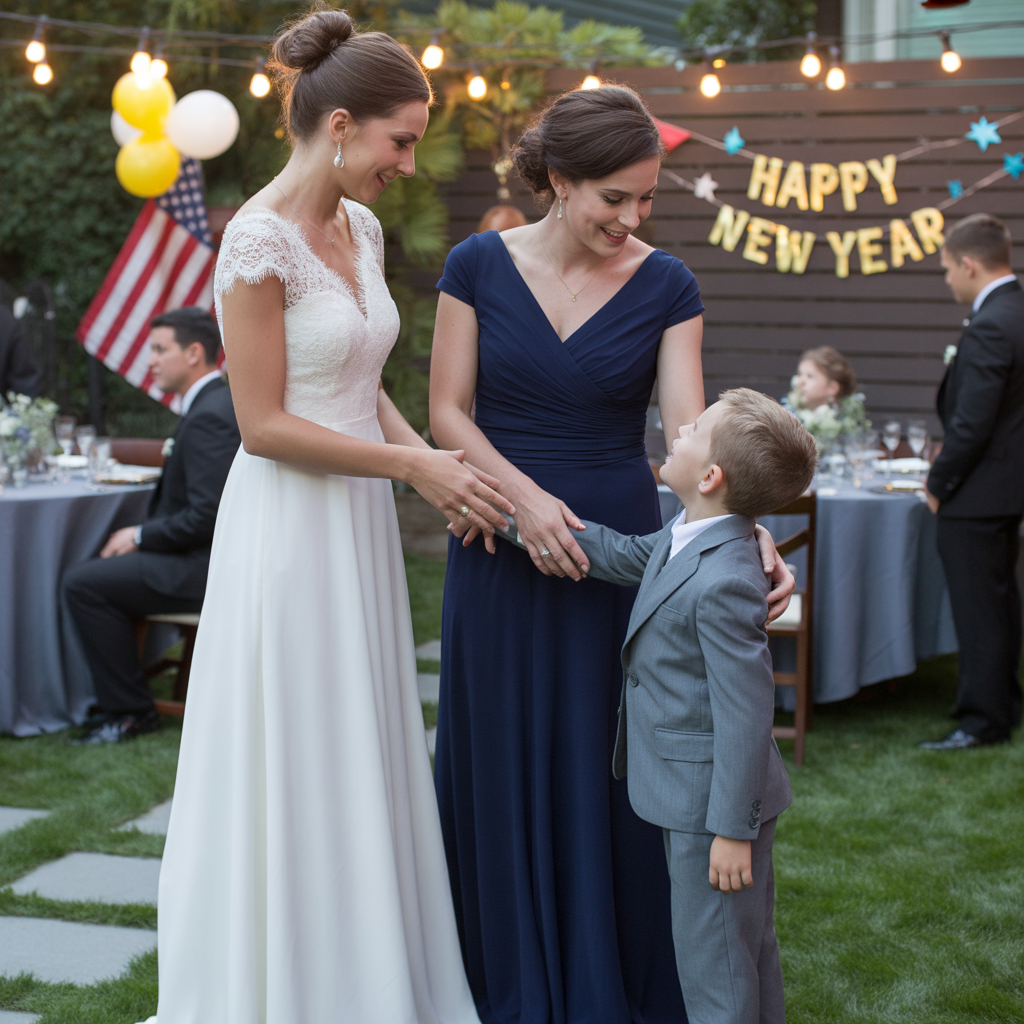
“Your Son Too Loud For The Main Table,” My Sister Told Me Smiling. Her Kids Were Already Seated. But
My name is Carrie J. Allen and I am 34 years old. The way it started was so casual that it took me a second to understand how deeply cruel it was.
We were at my sister Madison’s wedding, standing just outside the reception area where the tables were already set and glowing under soft lights. The ceremony itself had been beautiful in that curated way Madison always favored. an open air garden, a string quartet playing something delicate and expensive, imported roses everywhere, and a crystal chandelier suspended from a tree like it belonged there.
Everything looked perfect, polished, intentional. Madison looked stunning. Her kids looked like they’d stepped out of a catalog. Bow ties, straight, hair sllicked neatly, matching shoes. I was genuinely happy for her. I wanted the day to go smoothly. I wanted her to have everything she’d dreamed of.
Liam, my six-year-old, was holding a small toy car in one hand and the hem of my dress in the other. He wasn’t being loud. He was excited, asking when we’d get to sit down and eat, whispering questions the way kids do when they’re trying to behave. I spotted the main table where our parents and Madison’s children were already seated and started guiding him toward it. That’s when Madison intercepted us.
She smiled, but not the warm, glowing smile you expect from a bride. This was the tight knowing smile I remembered from childhood, the one she used when she enjoyed delivering a quiet cut. She glanced down at Liam, then back at me.
“Your son’s too loud for the main table,” she said. “Mine are already seated.”
And then she turned away just like that, already moving on to her next obligation.
For a moment, I stood there frozen, the words replaying in my head as I tried to make sense of them. I looked back at the table and saw the place cards clearly. Madison’s children beside our parents front and center. And then I noticed where Liam and I were apparently meant to sit. A foldout table near the DJ booth. No tablecloth, no place settings. Half shoved against the wall. The kind of table reserved for staff or vendors practically in the hallway.
Liam didn’t say anything. He just stared at the other kids laughing and tearing apart bread rolls.
I didn’t argue. I didn’t confront Madison. I didn’t make a scene. I took my son’s hand and walked out.
We left before dinner was served, before the cake, before a single photo. I placed the wedding gift on the table by the exit, a clean envelope with $500 inside. I knew in Madison’s world that would be seen as an insult. I didn’t care because I had already paid for something far more generous.
For months, I had been quietly funding a 5-day ski trip in Aspen for the entire family. first class flights, the best cabin available, lift passes, rentals, everything. Madison had been dropping hints about it constantly. My parents were in. Madison had already bought new gear. And of course, they all knew I was paying.
That night, after Liam fell asleep, I sat on my bed staring at the reservation email. $12,000, non-refundable. I hovered over the cancel button for less than a second.
Then I clicked.
Two days passed in silence. Then Madison messaged me.
When do we leave?
I replied with one sentence. We’re not. Trips canled. No emojis, no explanation, just the truth.
She didn’t respond right away. Then came the missed calls. Hers first, then our mother, then our father, then her new husband. I didn’t answer a single one. I wasn’t angry. I was done. And that was only the beginning.
The silence after I canceled the trip didn’t even last a full day. It never does with Madison. She doesn’t sit with discomfort. She broadcasts it until someone else fixes it for her.
By the next morning, my phone was buzzing non-stop on the counter while I made Liam breakfast, letting him drown his waffles in syrup because suddenly the small things mattered more than managing adult tantrums.
At 8:07 a.m., the family group chat lit up. Family trip. I had made the chat months earlier, back when the snowflake emoji felt hopeful instead of ironic. Madison was the first to speak.
“Wow. All this because you didn’t like your table?”
I didn’t respond. I cut strawberries into careful slices and reminded Liam to chew with his mouth closed.
She tried again a few minutes later, sharper this time.
“Not to sound ungrateful, but I honestly didn’t expect just $500 from you. You knew we were short for the honeymoon spa. Thought you had it covered.”
I stared at the screen long enough to feel something settle in my chest.
$500.
That’s what she reduced it to. The only gift anyone could see, the only thing she could quantify in front of others. Not the ski trip, not the months of support, not the quiet transfers I’d never announced.
My mom jumped in quickly, always eager to smooth things over.
“Carrie, I think you misunderstood the seating. Madison said she just didn’t want the kids getting overstimulated.”
Overstimulated? That word echoed in my head. Her kids had tablets, bread basketes, and prime seating. Mine had been parked behind a speaker like an inconvenience to be hidden.
Then my dad chimed in.
“This is ridiculous. You’re upsetting everyone. Don’t let something this minor ruin everything.”
That’s when it clicked. They weren’t asking me to explain how I felt. They were asking me to return to my role. The reasonable one, the mature one, the one who fixes the mood and absorbs the cost so everyone else can enjoy themselves. I had always been good at that. Too good.
I didn’t reply in this group chat. Instead, I poured myself coffee and opened my laptop. Not to vent, not to cry, to calculate.
Madison’s rent, 1,400 a month. I’d been covering it since she got laid off last December. At first it was temporary. Then it was until Joel’s business loan comes through. Then it just became normal.
Utilities 185, groceries, a standing transfer for the kids expenses that I hadn’t seen a receipt for in months, cell phone bill, family plan, over $2,000 a month, quietly draining out of my account.
By the time the group chat started arguing again, I was already on the phone with my bank, cancelling the automatic transfers. No announcement, no warning, just clicks and confirmations.
At 6:42 p.m., Madison sent one last message.
“So, you’re really going to ruin Aspen for all of us over one petty moment.”
I didn’t answer, but I did log into the airline account and cancel her flight, too. The snowflake emoji finally meant what it should have all along.
The next morning, I knew someone would show up.
Madison never sends herself when she wants control. She sends reinforcements.
At 7:42 a.m., the pounding started. Not a polite knock. the kind that demands to be answered.
Liam was half asleep on the couch, cereal bowl balanced on his knees, remote in his hand. I checked the peepphole. My mom, her minivan parked crookedly across the driveway, half blocking the trash bins like she’d come in a hurry.
I opened the door, but didn’t step aside. She brushed past me anyway, heading straight for the kitchen like muscle memory was permission.
“You’re blowing this way out of proportion,” she said, already talking before I’d closed the door.
I leaned against the counter and let her go. She listed excuses like bullet points.
“Madison didn’t mean to hurt your feelings. Weddings are chaotic. You could have pulled her aside. Instead, you punished everyone, and embarrassed her.”
“Did you know I was paying her rent?” I asked quietly.
She stopped talking, looked down at her purse strap, finally nodded. She said it was temporary.
“Did you know it’s been 10 months?”
Silence again.
I told her I’d already contacted the leasing office. I was off the contract. January was on Madison. Utilities, groceries, kids expenses, all of it was done.
She called me financially vindictive. Said I was choosing money over family. I asked if she knew Madison had expected me to pay for the honeymoon spa package, too.
She sighed and said the sentence that cracked everything open.
“She’s under a lot of pressure, and you make good money. You’ve always been the one who could afford to help.”
That’s when I realized this wasn’t entitlement.
It was agreement.
They had all decided who I was years ago. The one who could absorb it. The one who didn’t complain. The one who paid so no one else had to feel uncomfortable.
Later that afternoon, Joel messaged me. Calm, polite. He hoped we could move past the misunderstanding and still do the trip. Said Madison had been crying. Said it was supposed to be a celebration.
I didn’t reply. Joel was always the peacekeeper, the guy who stayed neutral while chaos rearranged itself around him. Neutrality had never saved anyone in my family. It just protected Madison longer.
By that evening, the group chat was a mess. Please, accusations. Can we please talk? This isn’t worth destroying your relationship.
And then Madison’s line, the one that sat like a brick in my chest.
“So now you’re cutting me off after everything I’ve done for you.”
Everything she’d done for me.
I didn’t answer. I didn’t need to.
3 days after the wedding, her rent was due. At 6:12 a.m., I got a text from her landlord. Polite, brief. We’ve been unable to reach Madison regarding rent. Please advise.
I forwarded it to Madison with five words.
Not my responsibility. Good luck.
13 minutes later, the meltdown started. It took exactly 13 minutes for Madison to respond after I forwarded the landlord’s message. First came a voice memo I didn’t listen to. Then a flood of texts, each one more frantic than the last. She accused me of being abusive, of endangering her children, of punishing her for something so small. She said Joel was waiting on a client payment. She said the timing was bad.
Then she delivered the line she must have believed would snap me back into place.
“If we get evicted, that’s on you.”
I stared at my phone, stunned by how sincerely she believed that, that my refusal to keep paying for her life somehow made me responsible for its collapse.
I didn’t reply.
I put my phone face down and took Liam to school like any other morning. Because the thing about breaking patterns is that the world doesn’t end when you do it. It just keeps moving.
I wasn’t expecting Joel to show up next. It was late afternoon when my receptionist buzzed my office.
There’s a man here asking for you. He says it’s urgent. His name is Joel.
I almost told her to send him away. Almost. Curiosity one.
When he walked in, he looked tired in a way I’d never seen before. Not wedding tired, not new husband tired, bone tired. He was holding a paper bag from a trendy bakery near their apartment like a peace offering. He sat down without touching the coffee I offered.
“Madison’s struggling,” he said quietly. “I think she thought you’d come around by now.”
I didn’t say anything. I let the silence do the work.
She didn’t mean to hurt you, he continued. You know how she gets. Things spiral. She doesn’t always know how to stop.
That was familiar. I had heard that sentence my entire life, just with different delivery.
What changed was what he said next.
“She’s scared,” he admitted, not of you. “She’s scared of what it looks like when you’re really done.”
That landed differently. This wasn’t manipulation. This was fear. Real fear. the kind that comes when someone realizes the safety net they never acknowledged is gone.
I asked him one question.
What are you going to do when she runs out of people to blame?
He didn’t answer right away. He looked down at his hands, then finally said, “I don’t think I can keep fixing this for her. I’m not built for it.”
That was the first moment I felt something like respect for him. Not because he was perfect, but because he was finally seeing the reality I’d been living in for years.
He left the pastries on my desk and walked out without asking me to change my mind.
That night, the group chat went eerily silent. No guilt, no outrage, no demands. It was as if someone had finally told Madison the truth, and she didn’t know what to do with it.
At 9:30 p.m., my dad broke the silence with a message.
I think we need to meet in person. The whole family.
I read it once, then again, and felt nothing. There wasn’t going to be a family meeting, no intervention, no apologies wrapped in excuses. I was done negotiating my worth.
Instead, I booked a trip. Not Aspen, not snow, not cabins or forced togetherness. Just me and Liam, somewhere warm, somewhere quiet, somewhere we could swim and eat and laugh without being told we were too loud for the table.
I didn’t tell anyone we were going because for the first time in years, I wasn’t trying to include everyone.
The shift came quietly after that. Madison stopped texting for a while. Maybe Joel told her how the conversation went. Maybe she thought silence would scare me into reaching out first.
It didn’t.
Instead, she moved to Instagram, her favorite stage. Grainy photos of her kids bundled in coats indoors. A candle next to a cardboard box captioned, “Packing again.” A shot of her living room stripped down to a throw pillow and no context.
Some people don’t know what loyalty means.
The comments poured in. Sending love. You’re so strong. What happened? Thought you and your sister were close.
She never answered publicly, but she didn’t have to. She was working the story behind the scenes. I know because three acquaintances messaged me the next day, awkwardly asking if everything was okay. I wasn’t angry. I wasn’t defensive. I was done being hungry for approval.
What she didn’t post was how she hadn’t applied for a job in 6 months, how she had no savings, how every part of her life was still tethered to me in ways I hadn’t fully untangled yet.
So, I sat down and finished the job. Costco membership, Amazon Prime, school lunch accounts, phone plan, streaming services, gym membership, dental insurance I’d added for her kids after a tearful phone call about fillings.
I removed her from all of it.
That evening, she called, not to argue, not to accuse, to beg. She said they were two weeks behind on rent, that the gas company was threatening shut off, that her kids had never lived in a place without Christmas lights before.
I listened without interrupting.
When she finally stopped, I asked her the only question that mattered.
Did you ever plan to take care of yourself?
She answered honestly.
I didn’t think I’d have to.
That was the truth beneath everything. Not confusion, not desperation, assumption.
The next morning, a neighbor sent me a photo of an eviction notice taped to Madison’s door. Final notice, vacate by the end of the month.
I didn’t respond. Not to the neighbor, not to Madison. Not to my parents.
When Madison posted a photo of her empty apartment with the caption, “Sometimes you have to start over with nothing.” I didn’t like it. I didn’t comment. Starting over wasn’t something being done to her. It was something she should have done years ago. And I was no longer standing in the way.
After the eviction notice went up, something strange happened. The noise stopped. No frantic calls, no dramatic texts, no new group chats lighting up with demands that I explained myself. It was the quiet that comes when a performance has ended and the audience has gone home.
For a few days, I wondered if Madison had finally understood, if losing the apartment had shaken her into some version of clarity. I didn’t hope for an apology. I didn’t need one. I just wondered if the cycle had finally broken.
Then the email arrived. Not a text, not a call, an email carefully written, carefully timed, sent on a quiet Sunday morning while Liam was building a Lego spaceship at the kitchen table.
The subject line was simple and nauseating all at once.
Peace.
There was no greeting, no hello, no how are you, no mention of the months of chaos she’d unleashed, just paragraphs that sounded reflective without actually reflecting on anything. She wrote that she was still hurt, but she understood my decision. She said she was in a better emotional place now, that she’d started blogging to process everything, and then almost casually, she added that she hoped I wouldn’t be upset if some of what she wrote overlapped with our shared history.
That was the warning.
She wasn’t reaching out to mend anything. She was asking for permission to rewrite it.
There was no apology, no acknowledgement of the humiliation at the wedding, no mention of the money, no accountability for the rent, the eviction, the manipulation, just a soft announcement that she would be telling her version of events publicly dressed in pastel filters and quotes about resilience.
I didn’t reply, not because I was angry, but because I finally understood something that had taken me years to accept. Madison didn’t want reconciliation. She wanted narrative control. And the only way to deny her that was to stop participating altogether.
So, I did something else. I booked another trip. Not Aspen, not snow, not anything that came with expectations or shared tables or forced smiles. This one was just me and Liam. Arizona, a small cabin near Sedona that smelled like cedar and dust and quiet. No TV, no itinerary, just mornings that started when we woke up and ended when the stars came out.
We hiked. We fed alpacas at a little ranch that Liam still talks about. We ate outside and laughed too loudly and didn’t apologize to anyone for it.
One night, sitting on the porch wrapped in blankets, Liam asked me why we never did trips like this before.
I told him the truth.
because we were always dragging everyone else with us.
When we got back, I finished detaching in ways that felt mundane but were anything but. I took myself off the family phone plan. I blocked the group chat. I created new accounts for the things that mattered to us and closed the ones that tied me to obligations I’d never agreed to. Every click felt like cutting a thread that had been quietly strangling me.
My mom texted me in early December, confused.
Did you change your number?
I hadn’t.
She sent another message later, longer this time, the kind she always sends when she’s trying to sound reasonable.
Families go through hard times. Madison’s been humbled. She’s starting over. You’ve made your point. Now it’s time to forgive and come together.
I read it once and didn’t respond. I hadn’t made a point. I’d made a decision.
Madison’s blog went live a week later. The first post that hinted at me was titled, “When your sister turns her back, but you heal anyway.”
There were no fake names, no disguises. She painted herself as brave, wounded, abandoned. She wrote about how she used to lean on her sister until she learned to stand alone. Except her version of standing alone still involved Joel working two jobs and my parents quietly pitching in when they’d sworn they couldn’t afford to help.
I let it all go. The lies, the comments, the messages that trickled in from people who only knew her version. I didn’t correct them. I didn’t defend myself. I didn’t explain because explaining would have meant I still cared what they thought.
In the quiet that followed, something unexpected happened. I felt light, not relieved. Light, like I’d been carrying weight for so long, I’d forgotten what it felt like to set it down.
Liam slept better. He laughed more. One night, curled up on the couch watching a movie, he said, “I like it when it’s just us.”
And I realized that in trying to keep the peace for years, I’d almost taught him that being small was safer than being seen.
By Christmas, I wasn’t checking for invitations. I didn’t wonder what Madison’s kids got or whether Joel was still delivering food at night. I didn’t care what her blog said because her story wasn’t mine to carry anymore.
I hadn’t lost a family. I had stepped out of a transaction.
And for the first time in my adult life, the silence didn’t feel like punishment.
It felt like peace.
The last thing that broke was not loud. There was no final argument, no slam door, no dramatic message that forced a response. What broke was the expectation, the assumption that I would eventually fold, soften, forgive, resume payments, show up with gifts and smiles and solutions.
When that didn’t happen, when weeks passed and then months, something shifted in the background like a stage being dismantled after a show that never reopened.
My parents stopped calling first. They didn’t say they were done. They just slowed. Messages became shorter, then rarer. Holidays came and went with polite texts that felt more like obligation than invitation.
Madison stopped tagging me online. She didn’t stop writing, didn’t stop posting, but she stopped saying my name. I wasn’t useful to her narrative anymore. I had gone quiet in a way she couldn’t weaponize.
And that’s when I understood it had never been about love. It had been about access. Access to my money, my time, my emotional labor. Access to the version of me who always said yes because saying no felt cruel. Access to the version of me who smoothed things over so everyone else could stay comfortable. the sister who paid rent, covered groceries, booked trips, and swallowed disrespect because it was easier than being the problem.
When I stepped out of that role, the structure collapsed. Not because I destroyed it, but because it couldn’t stand without me holding it up.
Liam noticed the change before I did. He stopped asking why we didn’t see Aunt Madison anymore. He stopped bracing when family came up in conversation. He started inviting friends over without checking my face first. Started laughing louder. started taking up space in a way I hadn’t realized he’d been shrinking before.
One night, he asked me if we could make our own traditions instead of always going to someone else’s house. I said yes without hesitation.
We did. We baked cookies on random Wednesdays. We ate dinner on the couch and didn’t apologize for crumbs. We went on small trips that didn’t require permission or planning committees. I stopped budgeting around emergencies that weren’t mine. I stopped checking my phone with dread.
Once months later, I ran into Joel at the grocery store. He looked older, tired. We exchanged a polite nod. He didn’t ask how I was. I didn’t ask how Madison was. We both knew that anything we said would only reopen doors neither of us wanted to walk through again.
That was enough.
I never confronted Madison about the blog. I never corrected the story she told. People who mattered to me eventually saw through it. People who didn’t were never going to.
I learned that truth doesn’t need defending when you stop handing out invitations to doubt it.
On the anniversary of the wedding, the one where my son was deemed too loud for the table, I took Liam out for ice cream. We sat on a bench downtown, sticky fingers and all, watching people pass by. He asked me why I smiled when I looked sad sometimes.
I told him that sadness doesn’t mean something is wrong. Sometimes it just means something important changed.
He thought about that for a moment, then nodded like it made sense.
That night, after he fell asleep, I scrolled through my phone and deleted the last shared album, the last thread tying me to a version of family that only existed when I was paying for it. I didn’t feel angry. I didn’t feel victorious.
I felt finished.
I didn’t lose a sister. I lost the expectation that love should hurt. I didn’t lose parents. I lost the obligation to keep proving my worth.
And in exchange, I gained something I didn’t know I was allowed to have.
Peace without explanation.
My name is Carrie J. Allen, and walking away wasn’t the end of my family story.
It was the beginning of my
own table.
Not the kind you set with matching napkins and curated place cards. Not the kind Madison liked, where everything looks expensive enough to convince strangers you’re thriving.
My table was smaller. Messier. Real.
It had Lego pieces under the placemat and a stack of library books in the middle because Liam liked to keep them close, like the stories might run away if he put them on a shelf.
It had pancakes that were sometimes overcooked, and cereal nights when I was too tired to pretend I was a domestic goddess.
It had laughter that got loud. It had questions. It had peace that didn’t require me to be quiet.
After the wedding, people asked me why I didn’t confront Madison in the moment. Why I didn’t pull her aside. Why I didn’t look my parents in the eye at that main table and ask them why my child was being treated like a problem.
The truth is, confrontation would have turned it into a debate. A negotiation.
And I had spent my whole life negotiating for a seat I shouldn’t have had to earn.
Leaving was the first time I refused the negotiation.
I used to think that made me cold.
Now I know it made me free.
The weeks after the anniversary ice cream felt quieter on the outside, but inside, they were loud in a different way. Not with fighting or group chats or missed calls. Loud with realization.
I started noticing all the little ways I had been trained to fold.
I used to apologize when someone bumped into me at the grocery store.
I used to say “It’s fine” when it wasn’t fine, because it was easier than having someone roll their eyes at my feelings.
I used to give explanations for boundaries like they were court testimony.
No one had ever asked Madison to explain why she took.
They only asked me to explain why I stopped.
One afternoon, Liam came home from school with a paper crown on his head and glitter on his cheek. He’d been “Student of the Week,” which mostly meant his teacher had chosen him to carry a clipboard and feel important.
He dropped his backpack on the floor and said, “Mom, I told Ms. Carver about the wedding.”
My stomach tightened.
“What did you tell her?” I asked, trying to keep my voice casual.
He shrugged like it was no big deal.
“I told her Aunt Madison said I was too loud,” he said. “I wasn’t loud. I was whispering. So I told Ms. Carver she was wrong.”
My throat closed around something hot.
“And what did Ms. Carver say?”
“She said grown-ups can be mean,” Liam replied. “And then she said some tables aren’t for everyone, and that’s okay. She said we can make our own table. Like at lunch when I sit with Jonah and Ben.”
He said it like it was simple.
Like the idea didn’t break something open in me.
I knelt down and wiped a smear of glitter off his cheek.
“You were right,” I said.
He looked at me, serious.
“I know,” he said.
That was new.
Not arrogance. Not attitude.
Just a child who didn’t assume he was wrong for existing.
I realized, standing there in our kitchen with the afternoon light slanting through the blinds, that I had two choices.
I could keep teaching him the lesson I learned in my family: be quiet, be useful, be easy.
Or I could teach him a new one.
Take up space. Be kind, but don’t shrink.
When my mother used to scold Madison as kids, she’d do it like she was scolding weather.
“Madison, don’t be dramatic,” she’d say.
Then she’d look at me and add, “Carrie, you know how your sister is. Just be the bigger person.”
I was nine years old the first time I heard that.
Nine.
Madison had taken my birthday cake candle and blown it out before I could. Not because she didn’t understand what it meant. Because she wanted to see what would happen.
Everyone laughed like it was cute.
Then my mom leaned down and whispered to me, “It’s okay, honey. You can have another candle. Don’t make a face.”
Madison was given the moment.
I was given the responsibility for how the moment felt.
That pattern didn’t start with rent. It didn’t start with Aspen.
It started in little moments like birthday candles and Christmas gifts and car rides home from school when Madison cried over something she caused and my parents acted like she was the victim of it.
I don’t know exactly when I became the one who paid for everyone else’s comfort. I just know I was good at it.
I was good at swallowing things.
I was good at smiling.
I was good at being the kind of daughter people bragged about.
“She’s so responsible,” my mom would say.
“She never gives us trouble,” my dad would add.
What they meant was: She doesn’t demand anything.
She doesn’t make us feel bad.
She doesn’t make us look in the mirror.
Madison made everyone look. She made a scene. She made people respond.
So they responded.
And I learned that the quiet one doesn’t get protected.
The quiet one becomes the protector.
Two weeks after Liam told Ms. Carver about the wedding, I got a call from the school office.
It was midday, the time of day when you assume a school call means a fever or a scraped knee.
I answered with my heart already bracing.
“Ms. Allen?” the woman said. “This is Mrs. Ortega, the front office. Everything’s fine, but I wanted to check something with you.”
My grip tightened.
“Okay,” I said.
“There’s a woman here,” she continued carefully, “who says she’s Liam’s aunt. She’s asking to speak with him.”
The room around me went quiet.
“Aunt,” I repeated.
“Yes,” Mrs. Ortega said. “She’s not on the pickup list, but she’s insisting she just wants to say hello. We told her we can’t release him, but… she’s upset.”
I could hear the hum of fluorescent lights in my office. I could hear my own pulse.
“What’s her name?” I asked.
There was a pause.
“She said Madison,” Mrs. Ortega replied.
Of course.
Madison didn’t sit with discomfort.
She broadcasted it until someone fixed it.
And now she was at my son’s school, trying to pull him into it.
“I’m on my way,” I said.
I didn’t drive fast like a movie. I drove steady. I drove like a person who had learned that panic is what Madison wanted.
When I walked into the front office, Madison was standing by the counter with her arms crossed. Her hair was done. Her outfit looked like she’d planned it. Not messy. Not desperate.
Performative.
She turned when she saw me and her face did that shift she always had—the instant transformation from victim to aggressor when she realized the audience had arrived.
“Oh,” she said, smile thin. “You came.”
I didn’t return the smile.
“Leave,” I said.
Her eyes widened like I’d slapped her.
“I’m here for Liam,” she said, voice loud enough for the office staff to hear. “I just want to say hi. I’m his aunt.”
“You don’t show up at a school unannounced,” I replied. “You don’t put people in a position where they have to manage your emotions in public.”
Madison’s jaw tightened.
“You’re acting like I’m dangerous,” she snapped.
I met her eyes.
“You’re unpredictable,” I said. “And you don’t respect boundaries. So yes. In this context, that’s dangerous.”
Mrs. Ortega looked between us, uncomfortable.
Madison leaned closer.
“You can’t keep him from me forever,” she hissed.
I didn’t raise my voice.
“Watch me,” I said quietly.
Her face flushed.
“This is because of a table,” she said, like she was trying to reduce it again. Like she could shrink the truth down into something silly.
“It’s because of a pattern,” I said. “And you don’t get to bring it into my son’s life.”
Madison looked past me, searching for support. My parents weren’t there. Joel wasn’t there. No one was coming to rescue her.
That’s when she changed tactics.
She dropped her voice and let it shake.
“I’m losing everything,” she whispered. “You don’t understand what it’s like.”
I studied her face. I tried to find the part of her that meant it. The part that was scared instead of performative.
Maybe it was there.
It just wasn’t enough.
“Go,” I said. “If you need help, call a lawyer. Call a social worker. Call a therapist. Don’t show up at my child’s school.”
Madison’s eyes filled, but her mouth curled.
“You think you’re so righteous,” she said. “You think you’re better than me.”
I exhaled.
“No,” I said. “I think I’m done.”
She stared at me like she didn’t know what to do with that.
Then she turned to the receptionist and said, loud again,
“I hope you’re happy. I hope you can sleep at night knowing you’re doing this.”
I looked at the receptionist, then back at Madison.
“I sleep fine,” I said. “Because my son is safe.”
Madison walked out, heels clicking like punctuation.
After she left, Mrs. Ortega handed me a form.
“We’re going to add a note to Liam’s file,” she said gently. “No contact from her. Only authorized people.”
I nodded, my throat tight.
On the drive back to work, my hands stayed steady on the steering wheel. But I felt something settle deeper.
If Madison was willing to show up at a school, she was willing to push harder than I’d thought.
Silence wasn’t enough anymore.
I needed structure.
That night, after Liam went to bed, I sat at my kitchen table and made a list.
Not of bills.
Not of transfers.
Of boundaries.
No unscheduled contact.
No contact at Liam’s school.
No contact through third parties.
No posts using Liam’s name.
No posts using my full name.
No attempts to involve my child in adult conflict.
The next morning, I called a lawyer.
Not Denise Harper, because she was a family law attorney and my situation wasn’t divorce.
This was something else.
This was the kind of mess people don’t like naming because it feels ugly.
Harassment.
Defamation.
Boundary violations.
I found a woman named Alana Price who specialized in civil matters. She listened to my story without interrupting, asked calm questions, and then said something that made my shoulders drop.
“You’re allowed to protect your child,” she said. “You’re allowed to protect yourself. This doesn’t have to be a family debate. It can be a legal boundary.”
I swallowed.
“What do I do?” I asked.
Alana’s voice stayed practical.
“First, document everything,” she said. “Screenshots. Dates. Instances. Second, we send a cease and desist regarding contact and public posts that identify you or your son. Third, if she violates it, we escalate.”
Escalate.
The word felt heavy.
Not because it was wrong.
Because it meant I was finally choosing to be seen as the problem by the people who benefited from me being quiet.
I told Alana to do it.
Two days later, Madison posted a new blog entry.
I didn’t read it directly. Chloe—my neighbor, who had become one of those quiet friendships you don’t realize you need until you have it—sent me a message.
“Hey,” she wrote. “I saw something online. It’s… not good. Do you want to know, or do you want me to pretend I didn’t see it?”
I stared at her text for a long time.
In the past, I would have asked for screenshots. I would have spiraled.
I would have tried to fix it.
Now I asked myself a different question.
Does knowing help me, or does it just hurt me?
It helped me.
Because my son was involved.
“Send it,” I replied.
Chloe sent screenshots. Madison’s blog entry was titled:
When Family Tries To Silence You.
She didn’t use my name in the title. She used it in the story.
She wrote that her sister had “abandoned” her after she became “too inconvenient.” She wrote that her sister had “weaponized money” to punish her. She wrote that her sister had “threatened her children’s security.”
Then she wrote the line that made my skin go cold.
She mentioned Liam’s name.
Not in a loving aunt way.
In a weapon way.
She wrote about “my sister’s son,” Liam, being “overstimulated” at the wedding, and how she’d been trying to “protect” him.
Protect him.
By putting him at a folding table behind the DJ booth.
The lies weren’t even subtle.
They were just loud.
And they were public.
I forwarded everything to Alana Price.
Alana replied within the hour.
“We send the letter today.”
The cease and desist went out that afternoon.
Madison responded the way she always did.
Not by stopping.
By exploding.
She called from an unknown number, and I didn’t answer.
She texted from a different number, and I didn’t respond.
She emailed my work email, and I forwarded it to Alana.
Then she did what she believed was her ultimate power move.
She showed up at my apartment.
It was a Tuesday evening. Liam was at the table coloring dinosaurs. The TV was on in the background, low. I was stirring pasta in a pot, tired in the normal way.
The knock came sharp.
Not polite.
Demanding.
My body tightened automatically. Liam looked up.
“Is that Grandma?” he asked.
“No,” I said, voice calm. “Stay here.”
I walked to the door and checked the peephole.
Madison.
Joel was beside her. His hands shoved in his pockets like he wasn’t sure where to put them.
My mouth went dry.
I didn’t open the door.
I spoke through it.
“What do you want?”
Madison laughed, brittle.
“You can’t hide behind a door forever,” she said.
I didn’t flinch.
“Watch me,” I replied.
Joel’s voice came softer.
“Carrie,” he said. “Can we talk? Just for a minute?”
I stayed where I was.
“No,” I said. “Not here. Not like this.”
Madison’s tone sharpened.
“You sent me a legal letter,” she snapped. “Do you know how humiliating that is?”
“You showed up at my child’s school,” I said. “Do you know what that is?”
There was a pause.
Joel exhaled.
“She didn’t tell me she went to the school,” he said quietly.
Madison whipped her head toward him.
“Don’t,” she hissed.
Joel looked at the floor.
“I’m tired,” he said, almost to himself.
I felt something shift.
Not sympathy.
Recognition.
Because Joel looked like someone who had been carrying Madison’s chaos the way I used to.
Madison leaned toward the door.
“Open up,” she demanded. “You owe me a conversation.”
I stayed silent.
She pounded once.
“Carrie!”
Liam called from the table, voice small.
“Mom?”
I didn’t move.
Madison heard him.
“Oh, Liam,” she called, sweet as poison. “Aunt Madison is here.”
My chest went tight.
“Stop,” I said, voice low.
Madison laughed again.
“Or what?” she taunted.
I reached for my phone and dialed.
Not my mom.
Not my dad.
Not a family member who would mediate.
The police non-emergency line.
Joel’s voice shifted immediately.
“Carrie,” he said. “Don’t do that.”
Madison’s smile disappeared.
“You wouldn’t,” she hissed.
I kept my voice calm.
“I will,” I said. “And you know I will, because you pushed me into a life where I stop being polite.”
There was a long silence on the other side of the door.
Then Joel said, softer,
“Madison, let’s go.”
Madison scoffed.
“You’re taking her side?”
Joel’s voice didn’t rise. It didn’t have drama.
“I’m taking the side of reality,” he said.
I heard the shuffle of feet. The muffled argument moving down the hall.
Madison’s voice faded, sharp and angry.
Joel’s voice stayed low.
Then the building door shut.
I stood there for a moment with my hand still on my phone, breathing like I’d run.
When I turned back into the kitchen, Liam was staring at me.
His eyes were big.
“Was that Aunt Madison?” he asked.
I walked to him and knelt down.
“Yes,” I said.
“Is she mad?” he asked.
I brushed his hair back.
“She’s upset,” I said. “But it’s not your job to fix her.”
He frowned like he was trying to understand.
“Is it your job?”
My throat tightened.
“No,” I said. “Not anymore.”
That night, I couldn’t sleep. Not because I was scared of Madison hurting me. Not physically.
I was scared of her hurting Liam.
Not with her hands.
With her narrative.
With her ability to turn a child into a prop.
The next morning, Alana filed the next step.
A formal request for a restraining order based on repeated unwanted contact, the school visit, the apartment visit, the online posts involving Liam.
When I told Megan—my best friend, not my sister; my friend Megan, who had become my person after my divorce—she didn’t sound shocked.
“You should’ve done it sooner,” she said.
“I didn’t want it to be that,” I admitted.
Megan snorted.
“It’s already that,” she replied. “You’re just naming it.”
Naming it.
That was the difference.
Madison lived in the space where things were always unnamed, because unnamed things are easier to twist.
The court date came fast.
Madison showed up dressed like a woman auditioning for sympathy. Soft sweater. No makeup. Eyes red like she’d practiced crying.
Joel sat behind her, posture stiff, like he didn’t know what role he was supposed to play.
My parents showed up too.
That was the part I didn’t expect.
My mom avoided my eyes. My dad looked angry, like I was embarrassing him.
Like I was the problem.
The judge was a woman with gray hair and a flat voice. She didn’t care about Madison’s blog tone. She cared about facts.
Alana presented screenshots. Dates. The school call. The apartment incident.
Madison tried to speak.
She cried.
She said she was “just trying to connect.”
She said she was “just trying to keep family together.”
She said I was “punishing her.”
Then she made the mistake she always made.
She tried to make it about money.
“She canceled a trip,” Madison said, voice quivering. “She cut us off. She thinks she can buy power.”
The judge’s eyes narrowed.
“This isn’t a case about vacations,” she said.
Madison blinked.
“It’s about harassment,” the judge continued. “It’s about unwanted contact and involving a minor child.”
Madison’s mouth opened.
No sound came out.
The judge looked at me.
“Do you feel your child is safe with continued contact?” she asked.
My voice stayed steady.
“No,” I said.
The judge issued the order.
No contact.
No contact through third parties.
No contact at school.
No posting the child’s name.
No coming within a certain distance of my home.
Madison looked at me like I’d killed her.
My dad stood up abruptly.
“This is unbelievable,” he muttered.
My mom followed him out, shoulders tight.
Joel stayed seated, staring at his hands.
After court, in the hallway, Joel approached me carefully.
“Carrie,” he said.
I didn’t stop walking.
“Please,” he added.
I turned, but I didn’t soften.
“What?” I asked.
Joel swallowed.
“She’s going to take this out on the kids,” he said.
My chest tightened.
“That’s your job,” I replied. “You’re their father.”
Joel nodded like it hurt.
“I know,” he said. “I just… I didn’t realize how much she leaned on you until you were gone.”
I held his gaze.
“You still don’t,” I said. “Because she didn’t lean. She took.”
Joel’s eyes flicked away.
“I didn’t know about the rent,” he admitted. “I swear I didn’t.”
I believed him.
And that was what made me angrier.
Because it meant Madison wasn’t just entitled.
She was strategic.
Joel’s voice got rough.
“I’m trying to leave,” he said quietly. “I’m trying to get us stable. But she’s… she’s spiraling.”
I stared at him.
“Then document,” I said. “Get a lawyer. Get custody agreements. Get your kids safe.”
He nodded.
“I will,” he said.
I started to walk again.
Joel called after me, voice low.
“I’m sorry,” he said.
I didn’t turn back.
I didn’t need apologies.
I needed patterns to end.
That was when I finally understood something I hadn’t wanted to accept.
Cutting Madison off didn’t just break her access to me.
It exposed her to the world without a cushion.
And without me absorbing consequences, the consequences started landing where they belonged.
At first, it was small. Her blog comments turned. People asked questions. People noticed inconsistencies.
Then it got bigger.
Madison lost her audience.
She started posting less.
She shifted from inspirational quotes to vague threats.
Some people don’t care who they hurt.
Some people will regret this.
I didn’t read them. Alana did.
Alana told me not to worry.
“People like your sister need a target,” she said. “If you don’t present one, they burn out.”
I wanted to believe that.
Then, six months later, I got a call from my mother.
It was the first time she’d called me in months.
I stared at the phone as it rang.
Liam was on the floor building a train track.
I answered.
“Hi,” I said.
My mom’s voice was tight.
“Carrie,” she said. “We need to talk.”
I didn’t ask why.
I already knew.
“About Madison,” I said.
Silence.
Then my mom exhaled.
“Joel left,” she said.
I closed my eyes.
“When?” I asked.
“A week ago,” my mom replied. “He took the kids. There’s a temporary order. Madison… she’s not doing well.”
There it was.
The emergency.
The moment my family always expected me to step into.
My mom waited, like she thought my silence meant I was processing what to do.
It didn’t.
It meant I was deciding whether to let her pull me back in.
“What are you asking me?” I said.
My mom hesitated.
“She needs help,” she said.
I kept my voice steady.
“Help from who?”
My mom’s breath hitched.
“From family,” she said.
I looked at Liam, who was lining up train cars with focused seriousness.
“What kind of help?” I asked.
My mom’s voice got softer.
“Financial,” she admitted.
Of course.
Not therapy.
Not accountability.
Money.
I felt something in me go still.
“No,” I said.
My mom went quiet.
“Carrie—”
“No,” I repeated. “I won’t.”
My mom’s tone changed, irritation creeping in.
“She’s your sister,” she said.
“And Liam is my son,” I replied. “And I’m not putting him back in that.”
My mom’s voice sharpened.
“So you’re just going to let her fall apart?”
I exhaled.
“I’m going to let her be responsible,” I said.
My mom sounded like she was crying now.
“You’ve always been so harsh,” she whispered.
Harsh.
That word.
My whole life, I’d been the gentle one. The accommodating one. The one who made things easier.
I wasn’t harsh.
I was done.
“I’m not harsh,” I said. “I’m just not available.”
My mom swallowed.
“Your father says you’re punishing us,” she said.
I didn’t raise my voice.
“I’m not punishing anyone,” I replied. “I’m protecting myself.”
My mom’s silence stretched.
Then she said, smaller,
“What about the kids?”
The question landed because it wasn’t about Madison.
It was about two children I’d bought dental insurance for. Two children I’d taken to the zoo. Two children who had hugged Liam like cousins were supposed to.
I felt the pull.
I hated that I felt it.
“I hope Joel is stable,” I said. “I hope they’re okay. But I can’t be the bridge. It’s not safe.”
My mom whispered,
“They miss you.”
I swallowed.
“I miss them too,” I admitted. “But I’m not their parent. Joel is. Madison is. And you are their grandparents. Figure it out without using me as the wallet and the therapist.”
My mom’s voice cracked.
“You really think that’s all you were to us?”
I stared at my kitchen wall, at the magnets Liam had made at camp.
“I think you loved me,” I said, honest. “I just think you loved the version of me that made your life easier more.”
Then I ended the call.
I sat at the table for a long time after, staring at my coffee like it held answers.
Liam looked up.
“Was that Grandma?” he asked.
“Yes,” I said.
“Is she mad?”
I smiled, small.
“She’s upset,” I said.
Liam went back to his train.
“Okay,” he said, like it wasn’t his problem.
And I realized how far we’d come.
The old me would have spiraled. Would have called back. Would have tried to patch it.
The new me made dinner.
The next day, Joel emailed me.
Not Madison.
Joel.
The subject line said:
Thank you.
I stared at it, surprised.
I opened it.
“Carrie,” he wrote. “I know I’m not supposed to contact you directly because of the order. I’m not asking for anything. I just wanted you to know: I’m sorry. I didn’t see it. I didn’t understand how much you were carrying. I’m trying to make things stable for the kids. I have a job now that pays less than what we had, but it’s honest. I’m done pretending Madison will change because someone else saves her. I’m trying to be the parent they need. I hope you’re doing well.”
No request.
No guilt.
Just acknowledgment.
It felt like a door closing gently instead of slamming.
I forwarded it to Alana anyway, because rules matter.
Alana wrote back:
“He’s not your problem. But it’s good to see someone in that orbit choosing accountability.”
I didn’t reply to Joel.
Not because I wanted to punish him.
Because I had learned the difference between compassion and access.
Compassion doesn’t require contact.
Compassion doesn’t require me to step back into the role.
A month later, my father showed up at my apartment.
I knew it was him before I checked the peephole, because he knocked the way he always did—hard, impatient, like doors were obstacles.
I opened the door, but I didn’t step aside.
My dad stood there in his work jacket, face set.
“We need to talk,” he said.
I kept my voice calm.
“No,” I said. “We don’t.”
His brows snapped together.
“You can’t keep doing this,” he said.
“Doing what?” I asked.
“Acting like you’re the victim,” he snapped.
I stared at him.
“I didn’t call you,” I said. “You came here.”
My dad’s jaw worked.
“Madison is living with us,” he said. “She’s in the guest room. She’s depressed. She’s not eating. The kids are gone. Joel is turning them against her.”
I felt my stomach twist.
“Joel has custody,” I said. “That’s not turning. That’s court.”
My dad’s face hardened.
“Madison needs help,” he said.
I didn’t move.
“And you need money,” I replied.
His nostrils flared.
“You’re her sister,” he said.
I held his gaze.
“And you’re her father,” I said. “Where were you when she was learning that consequences were optional?”
His face reddened.
“Don’t talk to me like that,” he barked.
I stayed calm.
“Don’t show up at my door like you own me,” I replied.
My dad stared at me, like he was seeing me for the first time.
“You’ve changed,” he said.
“Yes,” I said.
He scoffed.
“Not for the better,” he muttered.
There it was.
The old line.
The old comparison.
Not for the better.
I felt my chest tighten, but my voice didn’t.
“I’m better for Liam,” I said. “And that’s the only metric I care about.”
My dad’s eyes flicked past me, toward the living room.
“Is he in there?” he asked.
“Yes,” I said.
“Let me see him,” my dad demanded.
I shook my head.
“No,” I said.
His face twisted.
“You’re keeping him from his grandparents?”
I corrected him.
“I’m keeping him from conflict,” I said. “You didn’t come here to see him. You came here to pressure me. You don’t get to use my child as leverage.”
My dad’s mouth opened.
I interrupted, quiet but firm.
“If you want a relationship with Liam,” I said, “you can ask like an adult and you can respect boundaries. No Madison talk. No money talk. No guilt talk. You can meet us at a park on a Saturday afternoon. You can be kind. You can be present. Or you can leave.”
My dad looked stunned.
Like he’d never heard a boundary spoken out loud.
Then his face tightened.
“You’re cold,” he said.
I didn’t flinch.
“I’m clear,” I replied.
He stared at me for another beat.
Then he turned and walked down the hallway without saying goodbye.
I closed the door and leaned my forehead against it, breathing slow.
From the living room, Liam called,
“Mom?”
I walked over to him.
He was holding a toy dinosaur, eyes worried.
“Who was that?” he asked.
I sat beside him on the floor.
“Grandpa,” I said.
Liam frowned.
“Is he mad?”
I gave him the truth in a way a six-year-old could hold.
“He’s upset,” I said. “But it’s not your job to fix him.”
Liam nodded like he’d heard that lesson before.
Then he said something that made my throat close.
“Mom,” he said softly, “you’re not too loud.”
I blinked.
“What?”
He shrugged.
“People get mad when you talk,” he said. “But you’re not loud. You’re just talking.”
I stared at my son, the small human watching patterns I thought I’d hidden.
I pulled him into my lap.
“Thank you,” I whispered.
He rested his head against my shoulder like it was the most normal thing in the world.
A year passed.
Not in a single jump. In little steps.
Madison stopped posting. Or maybe she posted and nobody cared. Her blog links stopped showing up in my orbit. The mutual acquaintances who used to message me stopped asking questions. People got bored. That’s the thing about public victimhood. It needs constant feeding.
My life didn’t.
I got a promotion at work, not because I was chasing status, but because I finally had the bandwidth to show up fully without leaving my soul behind in family emergencies.
I started taking Liam to a Saturday morning swim class, and the first time he jumped into the pool without hesitation, I felt something shift.
Confidence isn’t a personality trait.
It’s an environment.
At night, sometimes, I would still think about the wedding table. I would still see that folding table shoved against the wall. I would still feel the sting.
But it didn’t own me anymore.
It was a marker.
A before and after.
One afternoon in early spring, I got a letter in the mail.
Not from Madison.
Not from my parents.
From Joel.
It was addressed to Liam.
I stared at it, confused.
Inside was a simple note.
“Liam,” it said. “This is from your cousins. They made you something.”
There was a drawing. Two stick figures holding hands on a playground. A big sun. A dog. The kind of simple art that still carries pure feeling.
On the bottom, in crooked kid handwriting, it said:
We miss you.
Liam stared at the drawing, quiet.
“Can I see them?” he asked.
My chest tightened.
I didn’t want to deny him connection.
I also didn’t want to open a door Madison could use.
I thought about the court order. The boundaries. The reality.
Then I said,
“We can talk about it,” I told him. “We can figure out what’s safe.”
He nodded, serious.
“I don’t want Aunt Madison to be mean,” he said.
I swallowed.
“Me neither,” I replied.
That weekend, I met Joel at a public park.
Not in secret.
Not like a reunion.
Like two adults trying to keep kids from being collateral.
Joel arrived with the kids—Madison’s kids—walking beside him. They looked like themselves, only taller. More serious around the edges.
When they saw Liam, their faces lit up.
They ran.
Liam ran too.
There was no awkward adult conversation. The kids did what kids do. They collided into a messy hug and then sprinted toward the swings like their bodies remembered.
Joel and I stood a few feet away, watching.
Joel’s face looked tired, but not defeated.
He cleared his throat.
“Thank you for meeting,” he said.
I nodded.
“This is for them,” I said.
Joel swallowed.
“Madison doesn’t know,” he admitted.
I stared at him.
“She doesn’t?”
He shook his head.
“No,” he said. “And I’m not doing it to punish her. I’m doing it because she makes everything about herself. The kids deserve one thing that isn’t a performance.”
I watched the kids on the swings, Liam laughing loud enough that the parents nearby glanced over.
No one told him to be quiet.
I exhaled.
“Okay,” I said.
Joel’s shoulders dropped slightly.
“She’s… still spiraling,” he admitted. “She hasn’t followed the order, but she tries. Through relatives. Through friends. She asks about you. About Liam.”
I didn’t look at him.
“I don’t want updates,” I said.
Joel nodded.
“I know,” he replied. “I’m not asking you to do anything. I just wanted to say—she lied about things. A lot. She lied about you. About what you did. About the money.”
I stared at the grass.
“I know,” I said.
Joel’s voice got rough.
“I didn’t,” he said. “For a long time, I didn’t. I thought you were just… successful. That you helped sometimes. I didn’t know she was living off you.”
I didn’t respond.
Joel looked like he wanted to say more.
Then he swallowed and said,
“I’m sorry.”
This apology felt different.
Not because Joel was a saint.
Because he wasn’t trying to get anything from it.
“I appreciate that,” I said.
The kids played for an hour. Then Joel gathered them.
Liam hugged his cousins goodbye.
They waved.
Liam climbed into the car afterward with a grin on his face.
“That was fun,” he said.
I looked at him in the rearview mirror.
“It was,” I agreed.
Then he asked, quiet,
“Is Aunt Madison going to be mad?”
I swallowed.
“Maybe,” I said. “But we didn’t do anything wrong.”
Liam nodded like he believed me.
And I realized that was the point.
I wasn’t raising him to manage Madison.
I was raising him to trust his own reality.
A month later, Madison found out.
Not from Joel.
From my mother.
My mom called me with the voice she used when she thought she was being reasonable.
“I heard Liam saw the kids,” she said.
I didn’t deny it.
“Yes,” I replied.
My mom’s breath hitched.
“That was… confusing,” she said.
Of course it was.
Because anything I did outside the script was confusing to them.
“What’s confusing?” I asked.
My mom hesitated.
“Madison is really hurt,” she said. “She says you’re trying to turn her own children against her.”
I closed my eyes.
“I’m not discussing Madison,” I said.
My mom’s tone sharpened.
“She’s their mother,” she insisted.
“And I’m Liam’s mother,” I replied. “And I’m not letting her use him as a pawn.”
My mom sighed.
“Carrie, you can’t keep punishing her forever,” she said.
I opened my eyes.
“I’m not punishing her,” I said. “I’m living.”
My mom went quiet.
“She says you’re proud of being cruel,” she whispered.
I let the silence sit.
Then I said something I’d never said out loud to my mother.
“You taught her that my boundaries are cruelty,” I said. “That’s why she can’t handle them.”
My mom’s breath caught.
“That’s not fair,” she said.
“It’s true,” I replied.
My mom’s voice got small.
“I just wanted peace,” she said.
There it was.
The confession.
My mother didn’t want justice.
She wanted peace.
And she’d been willing to sacrifice me to get it.
“I want peace too,” I said. “But not the kind that costs my son his dignity.”
My mom whispered,
“I don’t know what to do anymore.”
I believed her.
I also knew it wasn’t my job.
“Try being honest,” I said softly. “Try telling Madison no.”
My mom didn’t answer.
When the call ended, I sat on my couch and stared at the wall, feeling something like grief.
Not for Madison.
For my mother.
For the version of her I used to believe existed—the one who would protect me if she just understood.
She understood.
She just chose peace over protection.
That’s a hard thing to accept.
But acceptance is how you stop bleeding.
The next holiday season, I didn’t go to my parents’ house.
I didn’t pretend I was too busy.
I didn’t create a work excuse.
I just didn’t go.
Instead, I invited Chloe and her boyfriend and two of Liam’s friends and their parents to our apartment for a casual dinner. Nothing fancy. Just food, kids running around, adult laughter that didn’t feel like walking on glass.
Liam helped me set the table.
He put down mismatched plates.
He lined up forks like soldiers.
He looked at the table and said,
“Is this the main table?”
I smiled.
“This is our table,” I said.
He grinned.
“So it’s the main one,” he decided.
And something in my chest loosened.
Because he was right.
The main table is the one where you’re wanted.
The main table is the one that doesn’t require you to be smaller.
The main table is the one you build when the one you were born into won’t make space.
That night, when the apartment was finally quiet and Liam was asleep, I looked at the table again. The crumbs. The mess. The leftover paper snowflakes Liam had taped to the wall.
And I thought about Madison’s chandelier in a tree.
All that effort to look perfect.
All that energy spent on image.
I wondered if she was sitting in my parents’ house, scrolling her phone, watching other people’s lives, telling herself she was the victim of mine.
I wondered if she missed me.
Not as a sister.
As a resource.
Then I stopped wondering.
Because wonder is a form of waiting.
And I wasn’t waiting anymore.
The final twist came the next spring.
Not from Madison.
From the bank.
I got a notice that someone had attempted to open a line of credit in my name.
My stomach dropped.
It wasn’t approved. The system flagged it. But the attempt was there.
I stared at the paperwork, feeling my blood go cold.
Then I thought of Madison, her obsession with narrative control, her willingness to push boundaries.
I thought of my parents’ house, where she was living. Where she had access to old documents. Old mail.
I called Alana.
Alana didn’t hesitate.
“Freeze your credit,” she said. “Immediately. And we file a report.”
I did.
Within days, the investigation revealed what my gut already knew.
The attempt had come from an address linked to my parents’ house.
Not proof.
But not random either.
I called my mother.
She answered like she’d been expecting me.
“Carrie,” she said.
“Did Madison try to open credit in my name?” I asked.
My mom’s silence was heavy.
Then she whispered,
“I didn’t know,” she said. “I swear I didn’t know.”
My heart pounded.
“So yes,” I said.
My mom started crying.
“She found old papers,” she said. “She said she was just… she said she was trying to consolidate debt. She said she was desperate.”
My voice stayed calm, but it felt like ice.
“Desperate enough to commit fraud,” I said.
My mom sobbed.
“Carrie, please,” she begged. “Don’t do this. Don’t report her. She’ll go to jail.”
I closed my eyes.
The old me would have softened.
The old me would have absorbed it.
The old me would have paid it off quietly and told herself she was keeping the family together.
I opened my eyes.
“No,” I said.
My mom’s sob caught.
“No?”
“No,” I repeated. “I’m filing the report.”
My mom’s voice rose, panicked.
“She’s your sister!”
And I said the sentence that felt like the final nail.
“And she tried to steal from my son.”
Because that money wasn’t mine in my head anymore.
It was Liam’s stability.
His future.
My mother cried harder.
“You’re destroying her,” she whispered.
I kept my voice steady.
“She destroyed herself,” I said. “I’m just not cleaning it up.”
I filed the report.
Madison was charged.
Not because I wanted revenge.
Because boundaries without enforcement are just wishes.
When Madison was arrested, my parents finally stopped pretending.
My dad called me screaming.
He said I was heartless.
He said I was ruining the family.
He said I was selfish.
I let him talk until he ran out of oxygen.
Then I said,
“You taught her she could take from me without consequence. I’m not the villain because I stopped.”
I hung up.
The court case moved quickly because the evidence was clean.
Madison tried to blame everyone.
She tried to blame stress.
She tried to blame desperation.
She tried to blame me.
The judge didn’t care.
She got probation, mandatory counseling, community service, restitution.
No jail, because first offense and because the system loves giving people like Madison one more chance.
But the chance came with a record.
A label.
A consequence.
And suddenly, my parents had to look at her without my money softening the edges.
Joel got full custody.
My mom called me once after everything settled, her voice quieter than I’d ever heard.
“I didn’t know it would get this far,” she said.
I held the phone in my hand and stared at Liam, who was doing homework at the table, tongue sticking out in concentration.
“It was always that far,” I said. “You just had me standing in front of it.”
My mom whispered,
“I’m sorry.”
I didn’t rush to comfort her.
I didn’t say it was okay.
I just breathed.
“I hope you mean that,” I said.
She cried.
“I do,” she whispered.
I didn’t know if she did.
Maybe she did.
Maybe she meant it in the way people mean things when they’re finally out of options.
I didn’t build my life on maybes anymore.
A year after Madison’s wedding, the one with the chandelier in a tree, I took Liam to a small restaurant for his seventh birthday.
Nothing fancy.
Just pizza and a slice of chocolate cake.
He brought two friends. They were loud. They laughedted. They made a mess.
The waitress smiled like it was normal.
Because it was.
Halfway through dinner, Liam stood up on his chair and announced,
“This is the best day!”
People glanced over.
Someone laughed.
No one told him to sit down.
No one told him he was too loud.
I watched my son, cheeks flushed, eyes bright, and I felt the full weight of what I’d saved.
Not money.
Him.
His sense of self.
His right to exist without earning it.
On the drive home, Liam leaned his head against the window.
“Mom,” he said sleepily.
“Yeah?”
“Do we have to go to Aunt Madison’s table ever again?”
I swallowed.
“No,” I said.
He smiled, eyes closing.
“Good,” he murmured. “Our table is better.”
And that’s the thing.
Madison spent her whole life trying to sit at the main table.
The one that looked good.
The one that made her feel important.
The one she thought proved she mattered.
I spent mine trying to earn a seat.
Until my son was told he didn’t belong.
That was the moment everything stopped being about pride.
It became about protection.
Walking away wasn’t dramatic.
It was necessary.
My name is Carrie J. Allen.
I used to think love meant keeping people comfortable.
Now I know love means keeping my child safe.
Sometimes that means saying no.
Sometimes that means leaving.
Sometimes that means building a new table and letting the old one collapse without you.
And if anyone ever tells my son he’s too loud for the main table again, I won’t argue.
I won’t explain.
I won’t negotiate.
I’ll take his hand.
And we’ll go home.
Because the only table that matters is the one where he’s wanted exactly as he is.