





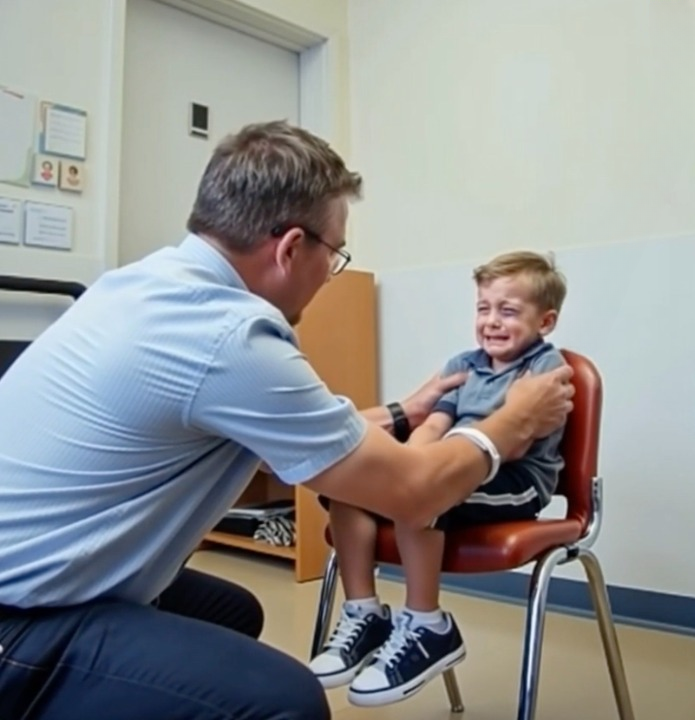
“You’ve been very kind.”
As I signed the dismissal form, I promised myself I’d find the root of whatever was troubling him — but carefully. Children sometimes see the world through tangled emotions, and rushing could cause more harm than help. The Drive Home
The car ride was quiet, except for the rhythmic hum of the tires.
Leo gazed out the window, lost in thought. I wanted to ask questions, but I knew silence can sometimes be the safest space. “Want to stop for ice cream?” I finally asked.
He looked at me, hesitant at first, then nodded. “Yeah. Vanilla.”
That small nod felt like a victory.
Vanilla — his favorite since he was three. It was a reminder that not everything was broken. At the ice cream shop, he smiled faintly as the server handed him his cone.
Watching him, I felt the familiar ache of parenthood — the helplessness of knowing you can’t shield your child from every shadow in the world. But you can stand beside them, unflinching. “Dad,” he said quietly, his voice barely audible over the soft music in the shop.
“Sometimes people change, right?”
The question startled me. “Yes,” I said after a pause. “Sometimes they do.
Why?”
He shrugged, looking away. “Just wondering.”
I didn’t press. Instead, I said, “People change, but love shouldn’t.
You and I — we’re a team. No matter what.”
He smiled then, just a little. “Okay, Dad.”
That was enough for now.
An Uneasy Discovery
Later that evening, after Leo had gone to his room, I sat at the kitchen table with my wife, Karen. The light above us buzzed faintly, casting long shadows across the counter. “Something’s bothering him,” I said quietly.
“The nurse said he seemed emotionally shaken.”
Karen frowned, stirring her tea. “He’s been quiet lately. Maybe something at school?
Kids can be rough sometimes.”
“Maybe,” I replied. But there was something in her tone — a strain, a hesitation. It wasn’t guilt; it was weariness.
Family life had its cracks, ones we rarely admitted aloud. Work had consumed me for years, and Karen had shouldered more than her share of the emotional load. Still, we tried to keep things steady for Leo.
That night, long after everyone had gone to bed, I sat awake on the couch, replaying the day in my mind. My thoughts kept circling back to Leo’s question: “Sometimes people change, right?”
What had he seen? What had he felt that made him ask that?
The Quiet Storm
Days passed, and I began noticing subtle shifts in our home — unspoken tension, brief glances between Karen and her brother, Steve, who was staying with us temporarily after losing his job. Nothing overtly wrong, just… unease. Steve was friendly, always helpful, but his presence had slowly filled the house with invisible friction.
Leo avoided him, often choosing to stay in his room when Steve was around. One evening, while setting the table for dinner, I noticed Leo pushing his food around his plate, silent again. “Everything okay at school?” I asked.
He nodded. “And at home?”
This time, he hesitated. “I just don’t like how people talk sometimes,” he said softly.
Karen glanced at me, her expression unreadable. “Leo, Uncle Steve’s been through a lot lately. Maybe he’s just not himself.”
Leo nodded, but I caught the faint flicker of discomfort in his eyes.
That night, after tucking him in, I stepped into the hallway and exhaled slowly. I didn’t have proof of anything — only a growing certainty that my son’s world had been shaken in a way words couldn’t describe. So I did what any father would do: I paid attention.
Truth in the Smallest Moments
The truth didn’t reveal itself in a single dramatic moment. It came quietly, piece by piece — in silences, in glances, in the heaviness that seemed to hang over simple conversations. I realized Leo’s fear wasn’t of danger but of disappointment.
Something or someone he trusted had let him down, and he didn’t know how to make sense of it. It could’ve been a broken promise, a harsh word, or simply the loss of innocence that comes when a child realizes adults are imperfect too. I decided to have a calm conversation with both Karen and Steve — not an interrogation, but an open talk.
“Leo’s been feeling uncomfortable lately,” I said one afternoon. “I’m not blaming anyone. I just want us to be aware, to make sure this house feels safe and peaceful for him.”
Karen nodded, her eyes softening.
Steve, to his credit, looked genuinely remorseful. “If I said anything out of line, I’m sorry,” he admitted. “I’ve been under stress, but I’d never want Leo to feel uneasy.”
I accepted that, though I made it clear that our priority was Leo’s emotional wellbeing.
That conversation, quiet as it was, shifted something. Steve became more mindful. Karen seemed relieved.
The atmosphere lightened. And Leo — my precious boy — began smiling again. Healing and Understanding
Over the following weeks, Leo and I spent more time together.
We fixed his old bike, built a model airplane, and watched his favorite movies on weekends. During one of those nights, as we sat surrounded by popcorn and laughter, he leaned against me and said, “Dad, I think I understand now.”
“Understand what?” I asked. “That sometimes people forget how to be kind.
But they can remember again if someone reminds them.”
I stared at him, amazed by his wisdom. “You’re right,” I said softly. “And sometimes that reminder is love.”
He smiled.
“Like yours?”
“Exactly like that,” I replied. It was in that moment I realized — my role wasn’t to protect him from every sadness, but to teach him that love could outlast it. Months Later
Life slowly found its rhythm again.
Steve moved out, starting fresh in another city. Karen and I began couples counseling, not because our marriage was broken, but because we wanted to rebuild it stronger, with honesty and care at its core. Leo flourished.
His teachers said he’d become more confident, more expressive. He even joined the art club — his paintings full of light and color. One day, he showed me a drawing of a small boat sailing across a calm ocean under a bright sun.
“That’s us,” he said proudly. “You’re the boat, and I’m the sun. You keep me steady.”
I smiled, holding back tears.
“Then let’s keep sailing, champ.”
Reflection
Now, when I look back on that day — the call from the nurse, the fear, the confusion — I realize it wasn’t just about a worried father rushing to school. It was about rediscovering the fragile, beautiful threads that bind a family together. Parenthood isn’t about control; it’s about connection.
It’s not about sheltering from storms, but teaching how to stand through them. Leo taught me that. He reminded me that love is not the absence of hardship — it’s the courage to keep showing up, again and again, even when things feel uncertain.
And so, I made a new promise that day — not one built on fear or protection, but on trust and presence. “I will always be here,” I told him. “Not to fight your battles, but to walk beside you through them.”
He smiled, that same soft smile he gave me in the nurse’s office months ago, and said, “I know, Dad.”
And this time, I knew he really did.

