





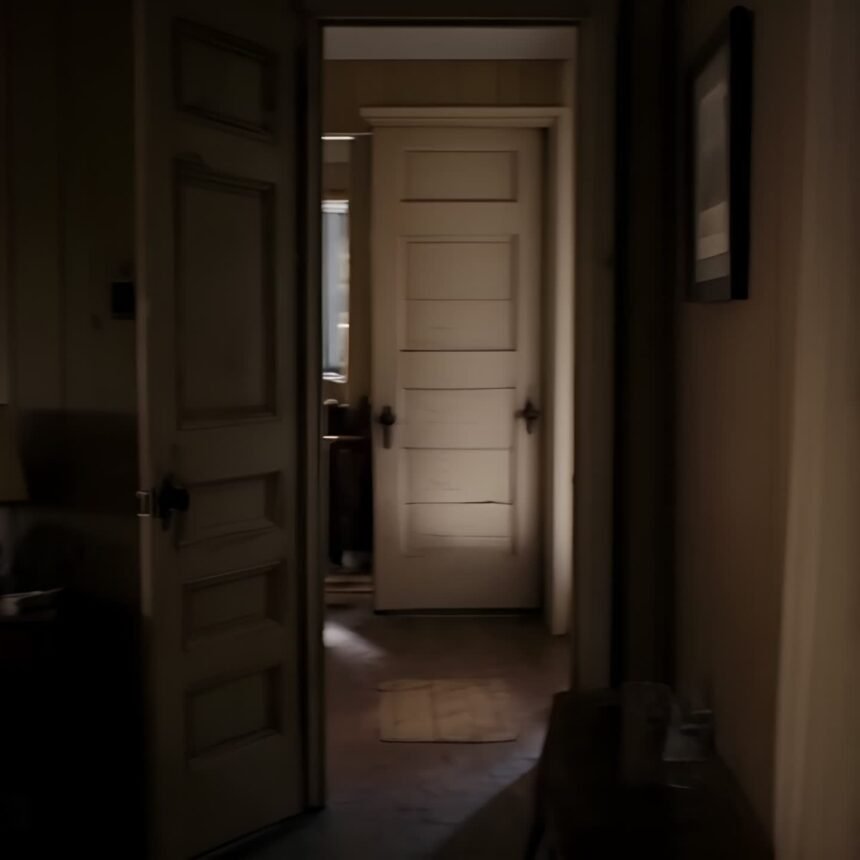
That made no sense. It was late summer in Ohio, warm and muggy. The air conditioner in the hallway buzzed quietly, doing its best against the humidity.
But my skin broke out in goosebumps like I’d stepped into a walk-in freezer. Behind me, the old analog clock on the wall ticked loudly, marking the seconds in a way I had never really noticed until then. I glanced over at my mother-in-law.
Her name was Remedios, though everyone in the family called her Doña Remedios out of habit, even here in the Midwest, far from the village in Mexico where she’d grown up. For three years, since the stroke, her face had been mostly expressionless, her dark eyes dull and unfocused, her lips slack. She could move her right hand a little, enough to squeeze a finger or tug at a blanket.
Words came rarely and with great effort, like each one cost more than she could afford. But in that moment, her eyes were wide open. And they were not empty.
They were locked on the bundle in my hand. Not on my face, not on Lucía, not on the TV that almost always murmured daytime shows she couldn’t follow anymore. On the tiny, wrapped thing I held.
For the first time in three years, I saw an unmistakable expression in her gaze. Fear. It was pure, naked fear, the kind you see in a wild animal trapped in a corner.
Her breathing hitched, the rise and fall of her narrow chest suddenly shallow and rapid. “Mommy?” Lucía whispered, pressing closer to my leg. “Why does Grandma look like that?”
I swallowed.
“It’s okay,” I said automatically, though nothing about the room felt okay. “Just… go downstairs and tell Daddy I need him to come up, alright? Tell him Mom needs help with Grandma.”
“Am I in trouble?” she asked again, always the same worry.
“No, sweetheart.” I bent down and kissed the top of her head, trying to sound steady. “You were very brave.”
She nodded seriously and scampered toward the hallway, her small socks making soft shushing sounds on the carpet. When the door clicked shut behind her, the room seemed to close in around me.
It was suddenly just the three of us: me, the silent old woman, and the thing wrapped in ancient cloth. Slowly, carefully, I unfolded the handkerchief. Inside lay a medallion.
It was larger than a quarter, smaller than the palm of my hand, made of silver that had darkened with age to a deep, mottled gray. The surface was engraved with a circular symbol I didn’t recognize—something like a twisted sun, its rays curling into abstract, human-like figures around the edge. They seemed to twist and bend into one another, their tiny arms raised in poses I couldn’t interpret—worship, or warning, or something in between.
It didn’t look like a piece of jewelry an elderly woman would keep tucked into her blankets out of sentiment. It certainly didn’t look like any cross or saint medal I’d seen in the small Catholic church we sometimes attended on the edge of town. It looked… wrong.
Behind me, the mattress creaked. I turned. My mother-in-law’s right hand had shifted, fingers trembling against the sheet as if trying to reach for me.
Her lips twitched. “Doña Remedios,” I said softly, stepping closer. “What is this?
Where did it come from?”
Her throat worked. For a second, I thought she wouldn’t answer—three years had taught me that questions often floated over her like clouds she couldn’t quite grab. But then, in a voice rough with disuse and fear, she whispered two words I would never forget.
“Don’t… open it…”
Her voice was just a rasp of air, but every syllable was clear. Another shudder ran through me. My mind scrambled for something reasonable.
Maybe it was a pill box. Maybe there was medicine inside she wasn’t supposed to have. Maybe—
“Not… mine…” she added, each word dragged up from somewhere deep and painful.
“Then whose?” I asked quietly. Her eyes fluttered. For a moment, I thought she might pass out.
Then she pushed the words past her lips like they were made of stone. “He… came back…”
My mouth went dry. “Who?” I asked, though I wasn’t sure I wanted to know.
Before she could answer, footsteps pounded on the stairs. The bedroom door flew open, and my husband, Javier, burst into the room, chest heaving. “What happened?” he asked.
“Lucía said something scared you. Is it Mom? Did she—”
He stopped when he saw the medallion in my hand.
Everything in his face changed in an instant. Color drained away. His jaw slackened.
For a moment, he looked like a little boy caught doing something wrong. “Where did you get that?” he whispered. I looked from him to his mother and back.
“In her blankets,” I said. “Lucía found it. Your mother says it’s not hers.”
He didn’t move closer.
If anything, he took a tiny step back, the sole of his sneaker scuffing against the threshold. “That’s impossible,” he said, but his voice lacked conviction. “What is it, Javi?” I asked.
“You know what this is?”
He dragged a hand over his face. I could see the muscles in his throat working as he swallowed. “It belonged to my uncle,” he said finally.
“My mom’s younger brother. Mateo. I haven’t seen that medallion since I was twelve.”
The name hung in the air like another presence.
“They said he ran away,” Javier went on, his eyes never leaving the silver disk. “He and my mom had a big fight about something, and then he was just… gone. No note.
No goodbye. They told us he was always restless, that it was only a matter of time. But…” He shook his head.
“No one ever found him. Not in the village. Not in the city.
Nothing.”
I stared down at the medallion. It suddenly felt much heavier in my palm. “And this?” I asked.
“This was his?”
Javier nodded once. “He never took it off,” he said. “My mom used to say it was his inheritance.
Something from a relative he never talked about. When he disappeared, she tore the house apart looking for it. Then one day she just… stopped.
She wouldn’t let anyone mention his name. If she heard it, she’d shut down. Like a door slamming.”
Behind him, his mother let out a soft, keening sound.
It was almost a whimper, almost a moan. “She says it’s not hers,” I reminded him. “But it’s been under her blankets.
For how long, we don’t know.”
Javier rubbed the back of his neck, a habit he had when he was stressed. “I don’t understand,” he said. “That medallion… it should be gone.
We thought it was gone with him.”
We both fell silent. The room seemed to lean inward, every old piece of furniture listening. At that moment, something small and mechanical clicked.
I looked down. The medallion had opened. I hadn’t pressed anything.
I hadn’t even realized it had a hinge. But there it was, split cleanly along a barely visible seam, the two halves resting on my palm like a tiny clamshell that had decided all on its own to show what it held. Inside, instead of a locket space for a photo, was a smooth, concave surface.
From its center, a faint light glowed—pale at first, like the reflection of a TV left on in another room. It pulsed once. Twice.
Then it brightened. “María, drop it,” Javier said sharply. His hand shot out, stopping short of actually grabbing me, as if he was afraid to touch me while I held it.
“Just—put it down. Don’t touch it.”
“I’m not touching it,” I said, though of course I was; it rested against my skin, cold and humming faintly, as if some tiny engine inside had switched on after years of silence. A smell rose in the room.
At first, I thought it was the scent of something electrical burning out—like when an old toaster finally dies. But there was no smoke, only that sharp, metallic tang of overheated wiring and something else underneath… earth, maybe. Wet earth.
The light grew stronger, spilling out of the medallion’s hollow like water poured from a bowl. It projected upward, fanning out, and then—impossibly—painting itself across the far wall. I had seen projectors, of course.
We used an old one at church sometimes on movie nights in the fellowship hall. But this wasn’t the steady, rectangular beam of a machine. This was hazy at the edges, flickering like candlelight, colors bleeding into one another.
At first, it was just brightness and motion, a swirl of gray and green. Then the image sharpened, as though a camera had finally come into focus. I saw trees.
Rows and rows of olive trees stretching out over a hillside, their leaves a dusty silver-green that swayed in a wind I couldn’t feel. A narrow dirt path wound between them. The sky above was washed out, the way the sky looks in old photographs.
And on that path, walking away from us, was a man. He wore a faded jacket and jeans, his shoulders narrow and slightly slouched. His hair was dark and wavy, the back of his neck browned by sun.
One hand was tucked in his pocket. The other swung at his side. Javier made a sound low in his throat.
“That’s him,” he whispered. “That’s Mateo.”
As if he’d heard his name, the man in the projection stopped. He turned.
The image shifted with him, not like a video on a wall, but as if we stood inside some invisible bubble that had been set down in the middle of that orchard. The trees loomed around him. A breeze moved dust across the path at his feet.
His face came into view, and my breath caught. I’d seen pictures, of course. In a box of old photos in the hallway closet, there were a few tucked away that Javier had once shown me in secret, as if he were breaking a family rule.
A lanky teenager with laughing eyes. A young man with an arm thrown around his sister’s shoulders. A blurry shot of him holding an infant—Javier—up toward the camera.
The man on the wall had the same angular jaw, the same wide mouth, the same intense eyes. But the laughter was gone. Those eyes, now, were shadowed and deep, full of something that made my chest tighten: sorrow.
And under that, something like warning. My mother-in-law began to cry. It was a raw, animal sound, pulled from a place I’d never heard in her before.
Tears spilled from the corners of her eyes, tracking down her temples into her gray hair. Her right hand clawed weakly at the blanket. “Please,” I said, stepping toward her, the medallion still open in my hand.
“Tell us what’s happening. What is this?”
Her gaze tore away from the wall and fixed on me. It was like watching someone wake up in the middle of a nightmare and realize the nightmare has followed them into daylight.
“Don’t…” she forced out, the word barely there. “Don’t let… him… in…”
My mind snagged on that single, terrible phrase. “Into the house?” I whispered.
Her fingers tightened around the edge of the sheet, exerting more strength than I’d seen in months. “Yes,” she breathed. “Not… again…”
The light flared brighter.
The air seemed to hum, a low vibration that buzzed in my teeth. Then, from downstairs, came the unmistakable groan of the front door. Our front door.
It was the sound it made when someone pushed it open slowly, because the frame had shifted over the years and the hinges complained unless you gave it a little extra shove. Javier’s head snapped toward the hallway. “Stay here,” he said, already moving.
“Stay with Mom. Don’t—don’t do anything.”
“Javi—” I started, but he was gone, his footsteps thudding down the stairs. The stairs creaked.
The hallway seemed to breathe. For a moment, all I could hear was the hammering of my own heart. The light from the medallion pulsed again.
Shadows in the corners of the room elongated and twisted, as if they’d grown impatient with staying where they belonged. The smell of hot metal and earth grew stronger, mixing with the faint scent of antiseptic and powdery lavender lotion. I wasn’t alone.
I felt that before I saw anything. It was the sensation of someone standing just behind you in a grocery store line, their presence close enough that your body reacts before your brain registers why. I turned my head slowly.
The bedroom door, which Javier had left half-open, slammed shut with a sudden, sharp crack that made me jump. The sound echoed around the room, too loud for such a small space. My mother-in-law’s hand shot out, her fingers surprisingly strong around my wrist.
“Don’t open it again,” she choked. “Don’t… let it… choose…”
Before I could answer, something shifted in the strange, smoky light near the far wall. At first, it was just a distortion, the way heat rises off asphalt in August, making the air shimmer.
Then it thickened, coalescing into a darker shape that separated itself from the rest of the moving shadows. A tall, thin silhouette stepped forward. It was more suggestion than solid form, its edges blurred, but unmistakably human in shape: head, shoulders, arms hanging at its sides.
It moved with slow, deliberate grace, each step silent on a floor that should have creaked. For one wild second, I thought it was a trick of my own frightened mind. Then I heard a sound from downstairs—a child’s high, terrified scream.
Lucía. The scream cut off abruptly. My knees nearly gave out.
Whatever this medallion was supposed to keep out, I realized with a clarity that hurt, it hadn’t been standing on our porch, waiting to be invited in. It had already found its way inside. If I’m honest, that isn’t where this story begins.
It’s just the first time I stopped pretending everything in that house made sense. The real beginning was three years earlier, in the kitchen of our cramped apartment on the other side of town, with a sink full of dishes and a baby crying in the next room. Back then, my life felt crowded in the small, ordinary ways.
It was crowded with bills stacked in a neat but accusing pile on the table, with toys underfoot, with the weight of being pulled between who I’d been before motherhood and who I was expected to be now. Javier worked at an auto parts warehouse, driving a forklift all day and coming home with the smell of oil in his clothes. I worked part-time as a receptionist at a small medical clinic, answering phones and filing insurance forms, my hours carefully arranged around daycare drop-offs and pick-ups.
We were tired, but we were managing. We had a used minivan, a tiny balcony where I kept a few struggling plants, and neighbors who banged on the ceiling when Lucía cried too loudly at night. Then the phone rang one afternoon at the clinic, and everything took a sharp turn.
It was Javier, his voice sounding far away and brittle. “It’s Mom,” he said. “She had a stroke.
They took her to St. Vincent’s. I’m on my way there now.”
St.
Vincent’s was the hospital downtown, the one everyone in Toledo knew, the one with the big cross on the side and the emergency room that always seemed full. I left work early, heart racing, and met him there. When we walked into her room, the woman in the bed barely looked like the tough, sharp-tongued mother-in-law I knew.
The person I had met when Javier first brought me home to “see what Mom thinks,” the one who wore bright lipstick and said my name—María—in a way that turned it into a series of careful tests. She’d judged me for not speaking Spanish as well as she thought I should. She’d judged me for not being Catholic enough, for still sending my own mother money even though we were struggling, for putting Lucía in daycare instead of staying home.
Her love for her son came wrapped in expectations I didn’t always meet. Now, half her face drooped. Wires snaked from her arms to machines that beeped softly.
Her eyes moved back and forth, unfocused, as Javier leaned over her and took her hand. “Mamá,” he whispered. “I’m here.”
It took weeks of hospital visits and whispered conversations with doctors in white coats to understand the new shape of our lives.
The stroke had damaged the parts of her brain that controlled speech and movement. With therapy, the neurologist said, she might regain a little more control. Or she might not.
It was impossible to know. “We’ll need to think about long-term care,” the social worker told me in a small office with posters about Medicare and home health agencies on the wall. “Your mother-in-law will need help with almost everything—bathing, dressing, feeding.
She’ll be at high risk for falls. She shouldn’t live alone.”
“She doesn’t have anyone else,” Javier said that night, sitting at our apartment table with his head in his hands. “Her neighbors can’t take care of her.
My sister is in Arizona. It has to be us.”
There were nursing homes, of course. We toured one on the west side of town, walking past residents slumped in wheelchairs in front of a blaring TV.
The staff were kind, but overworked. The rooms were small, the waiting list long, the cost astronomical. “We can’t afford this,” Javier said quietly in the parking lot, his gaze fixed on some point far beyond the rows of cars.
I knew what he was really saying: We can’t afford it, and I can’t live with the guilt of putting her here even if we could. “I know,” I said. “But she can’t live by herself.”
That’s when the idea surfaced—the one that seemed almost simple in the beginning.
“She has that house,” I said. “The one outside town. If we moved in with her, at least we’d have more room.
Lucía could have a yard. We could use the extra money we’re paying in rent for her medications.”
Javier looked at me, studying my face. “You’d do that?” he asked.
“You’d move in with my mother?”
I thought of the way his mother used to scrutinize me, the way she’d once told him in front of me, “She doesn’t know how our people do things,” as if I weren’t standing there. I thought of our tiny apartment, the noisy neighbors, the daycare notices about late fees. I thought of the woman in the hospital bed who, for all her faults, had raised the man I loved.
“Yes,” I said, surprising myself with how sure I sounded. “We’ll make it work.”
People talk about caregiving like it’s one decision. You choose to do it or you don’t.
But the truth is, you choose it over and over, every day, in a hundred small ways. We moved into the house in early spring. It sat on a quiet street at the very edge of Toledo, just past the last gas station and fast-food strip and before the land flattened out into fields.
The front yard was patchy, more moss than grass, but there was a big maple tree that shaded the cracked driveway. A black mailbox with peeling numbers leaned slightly by the curb. The back yard held an old metal swing set and a rusted grill that hadn’t been used in years.
Inside, the house smelled like dust and old cooking oil. Religious candles lined the top of the living room TV, their saints’ eyes watching everything. In the hallway, a framed picture of the Virgin of Guadalupe hung slightly crooked.
Family photos crowded every surface: Javier at his high school graduation, his sister holding a toddler, a much younger Remedios with glossy hair and serious eyes. We turned the front room into my mother-in-law’s bedroom, moving in a hospital bed and a bedside commode, clearing out her old sofa and knickknacks. A home-health nurse came by twice a week to check her vitals and go over medications.
The rest of the time, it was mostly me. I learned how to lift her without hurting her or my own back. I learned how to puree foods so she wouldn’t choke.
I learned how to change adult diapers without making her feel like a child. I learned which pills made her drowsy and which made her restless. There were good days, when she watched Lucía play in the yard through the front window and smiled faintly, her hand twitching against the blanket as if waving.
There were bad days, when she seemed to retreat into some place in her mind where we couldn’t reach her, her eyes unfocused, her face slack and distant. There were also days when I could swear she was more present than the doctors said she could be. On those days, if a commercial came on TV with two siblings laughing and hugging, she would turn her face away and stare at the wall, her jaw tightening.
Once, when a Spanish-language channel ran a news story about remains found in a remote area, she made a sound I’d never heard from her—a strangled, harsh noise that made Lucía drop her toy and back away. “Shh, Mamá,” Javier had said, rushing to her side. “It’s okay.
It’s just the television.”
But it didn’t feel like “just” anything. Not to me. The house had its own moods, too.
On some afternoons, light streamed in through the front window and the air felt almost soft, the kind of quiet that makes you want to nap. On others, it seemed like the shadows stretched just a little too long in the corners, and the creaks in the floorboards sounded less like old wood settling and more like footsteps pausing just out of sight. I told myself it was just the result of too much time inside.
Caregiving can shrink your world until the walls themselves feel like they’re listening. Javier did what he could. He’d help with transfers on the weekends, fix whatever broke, take Lucía to the park so I could have an hour to myself.
But he worked long hours, and his mother’s care fell mostly on my shoulders. Some nights, as we lay in the small bedroom that used to be his, listening to the distant rush of cars on the highway, I would stare at the ceiling and feel a slow resentment simmering in my chest—a resentment I didn’t know where to aim. At the stroke.
At the healthcare system. At the narrow margins of our finances. At this old house that creaked and sighed and held more history than I understood.
At times, at her. And beneath all of that, at myself for feeling anything less than grateful that we still had a roof over our heads and a family to care for. We settled into a routine.
Mornings were the hardest. That meant bathing, dressing, changing linens, cleaning up whatever had happened during the night. By the time I got to my first cup of coffee, it was often lukewarm and forgotten on the counter.
That morning—the one with the medallion—began like any other. I woke up to the sound of the old furnace kicking on even though it wasn’t that cold, the thermostat stubbornly doing what it had always done. Lucía padded into our room in her Minnie Mouse pajamas, climbed into our bed, and whispered, “Is it Grandma-day or preschool-day?”
“Both,” I’d said, kissing her forehead.
“Like always.”
We made eggs and toast. Javier left for work with a travel mug of coffee and a kiss on my cheek, promising to pick up milk on the way home. I loaded the washing machine in the dim little laundry room off the kitchen, its single bulb buzzing overhead, and then carried a basket of folded towels upstairs.
I remember thinking about nothing remarkable at all—whether we had enough detergent, whether I’d have time to vacuum, whether I could squeeze in a quick call to my sister on her lunch break. I remember all of that because it felt so intensely normal. Until Lucía pulled that bundle from her grandmother’s blankets and everything in the house tilted sideways.
Downstairs, something crashed. It wasn’t the sharp, fragile sound of glass breaking, but a heavier thud, like something had been knocked off a table. Javier shouted something I couldn’t make out.
“Lucía!” I yelled, my voice cracking. No answer. I tried to move toward the door, but my mother-in-law’s grip tightened, surprisingly strong for someone who could barely lift her hand most days.
“Don’t go,” she rasped. “Don’t… leave it…”
Her eyes flicked to the medallion in my hand and then to the tall, shifting silhouette by the wall. It had moved closer, though I hadn’t seen it take any steps.
It simply was further into the room now, nearer to the bed, its form still indistinct but undeniably there. The light from the medallion seemed to roar silently, though it made no sound. The image of the olive trees flickered behind the silhouette, then faded, then flared again, as if some invisible wind were trying to tear it apart.
My mind scrambled for something rational. It’s a hallucination, I thought wildly. You’ve been sleeping badly, you’re under stress, this is some kind of… episode.
Maybe you’re about to faint. Maybe—
“María!” Javier’s voice rang from downstairs, urgent and frightened. “Stay with Mom!”
My body ignored him.
I yanked my wrist free from my mother-in-law’s grip—gently, as gently as I could in that moment—and set the medallion down on the rolling bedside table, the handkerchief still spread beneath it like a flimsy shield. The light spilled out over the wood, reaching for the walls. Then I did the most ordinary, human thing I could in the face of something I didn’t understand.
I grabbed the doorknob, wrenched the bedroom door open, and ran toward the sound of my child. The hallway seemed longer than usual, its beige walls closing in. My socks slid on the hardwood at the top of the stairs.
I gripped the railing, heart pounding, and took the steps two at a time. At the bottom of the stairs, in the entryway by the front door, I stopped short. The door stood half-open, cool air from outside curling in around the edges.
The welcome mat my sister had mailed us with the word “Family” in cursive letters was askew. One of the hooks where we hung our coats had been ripped from the wall, the screws dangling. Lucía stood in the middle of the hallway, her eyes huge, her hands clutched under her chin.
“Mommy,” she said, her voice wobbling. “The door opened by itself.”
Javier was near the door, his body angled like he’d just jumped back. His face was white.
“I was in the kitchen,” he said, his voice too calm, the kind of calm you use when you’re balancing on a very narrow ledge. “I heard the knob turn. No knock.
No footsteps on the porch. Just… turning. I thought it was the wind, but then—”
He gestured toward the doorway.
The glass storm door in front of the wooden door was closed, latch firmly in place. The wind rattled it gently, but not nearly enough to have turned the inner knob. Lucía edged closer to me, pressing herself against my side.
I felt her shaking. “There was a shadow,” she whispered against my shirt. “On the floor.
It was tall. But no feet.”
I felt the smallest part of myself try to dismiss her words as overactive imagination. But the larger part remembered the shadow upstairs—tall and thin and wrong.
I closed the front door slowly and turned the deadbolt with hands that trembled. The simple, solid sound of the lock sliding into place felt like the only anchor in a world that had suddenly gone strange. “Okay,” I said, more to myself than anyone.
“Okay. We’re going back upstairs. All of us.”
In movies, this is the point where people split up.
One person goes to check the basement, another goes outside, someone inevitably says, “I’ll be right back,” and you, watching from your couch, yell at the screen. I was not going to be that person. We went upstairs together—me, Javier, and Lucía clinging to my hand.
Every step felt like a choice. When we reached the bedroom, the air inside felt even colder than before, as if the small space had been holding its breath. The medallion still lay on the bedside table, open and glowing softly.
The projection on the wall had dimmed, like a TV picture with the brightness turned down, but the olive grove was still visible. The path. The sky.
The figure of Mateo, now standing still, as if waiting. The tall, thin shadow was gone. My mother-in-law’s eyes darted between us and the wall.
Lucía hid her face against my hip. Javier hovered near the door, looking like he wanted to be anywhere else. “Close it,” he said hoarsely.
“Just—close it.”
“How?” I asked. The medallion had opened on its own. There was no visible latch, no button.
“Try,” he insisted. I stepped closer, each movement feeling deliberate and strange, like I was walking underwater. The light from the medallion washed over my hand, bright and cold.
I could feel the vibration in my fingers now, a subtle hum that made my skin prickle. Up close, the interior surface of the medallion looked almost wet, though when I brushed it lightly with my fingertip, it was dry and smooth. “What are you?” I whispered, not expecting an answer.
Carefully, I cupped my other hand over the top half and applied gentle pressure, trying to hinge it shut. At first, it resisted, as if pushing against some invisible force. Then, slowly, it yielded.
The two halves came together with a soft, final click. The light vanished. The projection on the wall faded instantly, leaving only the familiar off-white paint and the shadow of the curtain rod.
The smell of hot metal and earth dissipated, replaced by the usual faint mix of lotion and laundry soap. The silence that followed buzzed in my ears. Lucía peeked out from behind me.
“Is it gone?” she asked. “For now,” I said, though I had no idea what “it” was. My mother-in-law’s chest rose and fell rapidly.
Tear tracks glistened on her cheeks. Her right hand, the only part of her that still obeyed her consistently, twitched toward the medallion. “Water,” she rasped.
I poured a small cup from the pitcher on the dresser and held a straw to her lips. She took a sip, her eyes never leaving my face. “Talk,” she whispered.
“To who?” I asked softly. “Us?”
She blinked once, hard. “Now?” Javier asked, his voice cracking.
“Mamá, you haven’t said more than a few words in months, and now you want to talk about—about that?”
He gestured toward the medallion, keeping his distance, as if it might leap up and attach itself to his skin. Her lips trembled. “Before,” she whispered.
“Before… I go.”
A heaviness settled in my chest. For all the strange things happening, the reality of her mortality cut through with painful clarity. Javier swallowed.
“You’re not going anywhere,” he said, though we all knew that wasn’t true. “You’re staying right here. We’ll take care of you.”
She made a sound that could have been a laugh if it hadn’t been so sad.
“No,” she said. “You… don’t… know.”
“What don’t we know?” I asked gently. “About Mateo?”
The name seemed to hurt her.
Her eyes squeezed shut for a moment, a single tear escaping. “Sin,” she whispered. “My sin.”
The word hung in the air between us, heavier than anything the medallion had projected.
The days that followed were some of the strangest of my life. On the surface, nothing changed. I still woke up early, still made coffee in the scratched Mr.
Coffee machine on the counter, still folded sheets and checked pill bottles and signed forms for the home-health nurse. Lucía still went to preschool three mornings a week, bringing home crumpled construction-paper art that she proudly taped to the fridge. Javier still went to work at the warehouse, coming home with new aches in his back and stories about shipments and overtime.
But under all that routine, something had shifted. The medallion sat on the dresser in my mother-in-law’s room, wrapped again in its yellowed handkerchief. I couldn’t bring myself to throw it away or lock it in some drawer.
It felt wrong to pretend it hadn’t happened. It also felt dangerous to pretend it was just an ordinary object. Sometimes, as I adjusted pillows or wrote down blood pressure numbers, I would catch my mother-in-law watching it, her gaze flicking to that little bundle like a compass needle swinging toward north.
She spoke more in those days than she’d spoken in months. The words weren’t steady—they came in bursts, each one dragged up from deep inside her—but they were enough to begin fitting pieces together. “Fought,” she said one afternoon, her voice barely more than air.
“We fought.”
“About what?” I asked, dabbing lotion on her dry hands. She stared at the ceiling. “Land,” she said.
“House. He wanted… sell. I said… never.”
“Back home?” I asked.
“In Mexico?”
Her eyes rolled toward me, as if surprised I understood. “Yes,” she whispered. “Our parents’ land.
His… birthright. My… duty.”
Over the next week, in short, halting fragments, the story came out. She and Mateo had grown up on a small piece of land outside a village, olive trees and a modest house.
Their parents had worked hard, scraping together enough to send both of them to school. When their father died, the land was supposed to go to Mateo. As the son, it was his inheritance.
But life isn’t as simple as what’s supposed to happen. Their mother had fallen ill. Medical bills mounted.
Opportunities in the city beckoned. Remedios had married and moved away. Mateo had stayed, at first, but he resented the weight on his shoulders.
“He said… land is curse,” she rasped, fixing me with a look that was suddenly sharp. “Always someone… wants it. Taxes.
Officials. Thieves. He said… sell and go.
Start new life.”
“And you?” I asked. “I said… never.” Her jaw clenched, the old stubbornness flashing through. “Land is… family.
Roots. You don’t sell… your dead.”
The medallion, she told me, had belonged to an uncle, some relative on their father’s side who had traveled far, always coming back with pockets full of stories and strange trinkets. The uncle had no children of his own.
On his deathbed, he’d pressed the medallion into Mateo’s hand and whispered something about protection and choice. “Protect us from what?” I asked. She shrugged weakly.
“From… ourselves,” she said. “From… what we can’t see.”
They’d laughed it off back then, two skeptical young people in a changing world. Mateo had worn the medallion anyway.
Maybe out of respect. Maybe out of habit. On the night everything changed, any trace of laughter had been gone.
“He said… he was leaving,” she whispered one evening as rain pattered softly against the bedroom window. “Said he had buyer. Said money will… fix everything.”
“And you?” I prompted gently.
“I told him… if he sell… he is not my brother.” Her voice broke. “I said… land will… spit him out.”
They’d shouted, words thrown like knives. In the end, he’d grabbed a small bag, thrown on his jacket, and stormed out into the night, the medallion hanging at his chest.
“He didn’t come back,” I said quietly. She shook her head. “Never,” she whispered.
“We looked. Police looked. Nothing.”
“Did you think he ran away?” I asked.
“Or that something happened to him?”
Her eyes filled with tears. “Both,” she said. “Every day… both.”
We sat in silence for a moment, the weight of old guilt filling the room.
“Why didn’t you tell anyone?” I asked finally. “Why never talk about him?”
She turned her head slightly on the pillow, looking at the faded photo on the wall of Javier as a toddler. “Because,” she said slowly, each word careful, “if I don’t say… his name… maybe he is… not dead.
Maybe he is… somewhere else. Angry. But alive.”
“And the medallion?” I asked.
“How did it get here?”
Her gaze slid toward the dresser where the wrapped bundle sat. She licked her dry lips. “Came… in mail,” she whispered.
My skin prickled. “What do you mean, ‘came in the mail’?”
She blinked slowly, the effort of remembering heavy. “Few years… before stroke,” she said.
“Small package. No return address. Postmark… smudged.
Inside… only that. No note. No explanation.”
“And you recognized it?” I asked.
She nodded once. “I knew,” she said. “Mateo’s.
I… felt him. Angry.”
“What did you do?” I asked. “I hid it,” she said simply.
“Far. But… not far enough.”
When I asked where she had hidden it, she turned her face away. “You saw,” she whispered.
“Blankets.”
I sat back on the chair, my mind spinning. “Why under your blankets?” I asked softly. A strange, small smile curved her mouth, bitter and sad.
“Where else?” she said. “If he comes… he comes for me first.”
I told Javier what she’d said in bits and pieces, not wanting to overwhelm him all at once. He listened with the same expression he wore when looking at an impossible problem at work—a mix of disbelief, frustration, and a reluctant need to accept whatever reality he was faced with.
“She’s confused,” he said at first. “The stroke… it mixed up her memories. She probably dreamed half of that.”
“Maybe,” I said.
“But the medallion is real. We both saw what it did.”
He flinched. “There has to be a logical explanation for that,” he said.
“Some kind of… projection thing. Or maybe we were just… tired.”
“Lucía saw something too,” I reminded him. “The shadow by the door.”
He looked at me sharply.
“Don’t tell her it’s real,” he said. “She’s five. She’s going to have nightmares.”
“She already had one,” I said quietly.
“She woke up last night screaming that someone was standing in the corner of her room, watching her.”
His shoulders sagged. “This house,” he muttered. “Sometimes I think… it holds onto things.”
“It’s not the house,” I said.
“It’s what we’ve brought into it.”
We argued more in those weeks than we had in the past year. Not just about the medallion, but about everything it seemed to drag to the surface: the way his family never talked about hard things, the way my family talked about them too much; my resentment over how much of his mother’s care fell on me; his guilt over not being able to do more; our fear about what would happen when she was gone. At night, when the house had settled and the roads outside were quiet, I sometimes heard faint sounds from my mother-in-law’s room: a soft humming, like someone singing to themselves, or a low murmur as if two people were talking too quietly for words to be distinct.
Once, I got up and stood outside her door, listening. The murmur continued. I pushed the door open gently.
The room was dim, the small lamp casting a circle of light on the dresser. My mother-in-law lay still, eyes closed, breathing shallow. The medallion sat where I’d left it, wrapped in its cloth, unmoving.
The air, though, felt… full. Full of what, I couldn’t have said. I’m not a superstitious person by nature.
I grew up in a small town in Indiana, in a family where we prayed before meals and went to church on Christmas and Easter and the occasional Sunday when my mother felt particularly guilty. Ghost stories were for campfires. Demons were for horror movies.
Life, my father always said, was hard enough without inventing more things to be afraid of. Yet there I was, in a modest house on the edge of Toledo, lighting a candle on the kitchen table and dialing the number of the priest from the small Catholic church Javier’s mother had insisted we attend after we moved in. When he answered, I cleared my throat.
“Father,” I said, “this is María. We come sometimes, my husband Javier, our little girl. You came to bless our house when we first moved in.”
There was a pause.
“Ah, yes,” he said, his accent soft and familiar. “How is your mother-in-law?”
“About the same,” I said. “Actually, that’s partly why I’m calling.
I… we… found something in her room. Something that doesn’t feel right.”
It felt strange to say it out loud. I chose my words carefully, leaving out the projection on the wall and the shadow in the smoke.
Even to myself, those details sounded as if I were making them up. Instead, I spoke of the medallion, of its sudden appearance, of the way it seemed to disturb my mother-in-law so deeply. On the other end of the line, the priest was quiet for a moment.
“Sometimes,” he said slowly, “objects can carry the weight of what they have witnessed.”
I stared at the candle flame, watching it flicker. “What should we do?” I asked. “I can come bless the house again,” he said.
“We can pray together. But remember, the heart that holds the most power over your home is not in any metal or wood. It’s in the people who live there.
If there is unresolved guilt, anger, fear… they find ways to speak.”
That wasn’t the answer I’d been hoping for, but it was the one I needed. He came by that Sunday afternoon, a small man in a black shirt, carrying his worn leather Bible and a bottle of holy water. He walked through the rooms, sprinkling water on the walls, murmuring prayers.
Lucía followed him, curious, holding onto my hand. When we came to my mother-in-law’s room, he paused. She watched him with wary eyes.
“Señora Remedios,” he said gently, switching to Spanish. “How are you feeling today?”
She made a motion with her hand that could have meant anything. He took it as permission.
He sprinkled holy water on the bed, on the walls, on the dresser. When he reached for the medallion, wrapped in its cloth, her hand shot out. “No,” she gasped.
“Don’t… touch.”
He withdrew his hand, nodding slowly, understanding more in her fear than in her words. “We will not touch it, then,” he said. “But we will pray for peace for all who are connected to it, living and dead.”
He prayed in Spanish and English, mixing the languages the way our family did at the dinner table.
As he spoke of forgiveness and release, my mother-in-law’s eyes filled with tears. When he left, he touched my shoulder by the front door. “Talk to one another,” he said quietly.
“Secrets are heavy. Sometimes, when they become too heavy for the mind, they start to sit in the air around us instead.”
That night, after Lucía was in bed and the house had fallen into its familiar creaks and sighs, I sat beside my mother-in-law. The room was lit only by the lamp on the dresser.
The medallion lay between us on the little table, wrapped but not hidden. “I know you’re tired,” I said softly. “And I know you’re scared.
So am I.”
Her eyes met mine, sharp and clear in a way they hadn’t been for a long time. “I don’t know if that thing can trap souls, or show the past, or open doors,” I continued. “All I know is that it showed us your brother’s face.
And that you’ve been carrying his absence like… like a stone strapped to your chest for decades.”
Her eyes glistened. “I have my own stones,” I admitted, surprising myself with the confession. “Resentment.
Fear. The feeling that I’ve lost myself in taking care of everyone else. Sometimes it feels like this house is full of ghosts, and none of them are dead people.
They’re all the versions of us we could have been if things had gone differently.”
Her lips curved faintly. “You… are… good,” she rasped. I shook my head.
“Not always,” I said. “But I’m trying.”
I took a breath. “If you want,” I said slowly, “we can open it again.
Together. Not to ‘let anything in,’ but to see. To finally stop guessing.”
Her fingers twitched on the blanket.
She stared at the little bundle, face tight with conflict. “Choose,” she whispered at last. “What does that mean?” I asked.
“Uncle… said,” she murmured. “Medallion… doesn’t just… protect. It makes you… choose.
Hold on… or let go.”
The idea that an object could hold that kind of power over a family’s fate seemed absurd. Then again, so did the idea that guilt and silence could hollow out whole generations, and yet here we were. “Okay,” I said quietly, my heart pounding.
“Then let’s choose.”
The second time I opened the medallion, I did it the same way I had the first: slowly, carefully, my thumb finding the barely there seam and applying pressure until it clicked. The light poured out like breath held too long. It filled the room, soft and pale at first, then brighter, wrapping the walls in a new skin.
The image that formed wasn’t the olive grove this time. It was a small kitchen I didn’t recognize and yet somehow knew. The cabinets were old, painted a pale green, chipped at the corners.
A cheap table sat in the center of the room, covered with a plastic tablecloth with a faded floral pattern. The air wavered with heat from a stove where a pot simmered. Two younger faces sat at the table: a young Remedios, her hair dark and thick, her back straight, her eyes blazing; and a man in his late twenties, his features a familiar blend of what I’d seen on the wall before and what I saw in Javier now.
“Stop being so dramatic,” the younger Remedios said, slamming her hand on the table. Her voice echoed around us, clear and strong. “I am not being dramatic,” Mateo shot back.
“I am being realistic. We cannot keep paying for taxes that keep going up while we earn nothing. We are drowning, hermana.”
“It is our father’s land,” she snapped.
“He broke his back on that soil. You will not sell it to some outsider who sees it as just numbers on a page.”
“And what do you see it as?” he demanded. “An altar?
A prison? How many more years will we sacrifice everything to protect something that cannot feed us?”
“You want the easy way,” she accused. “You always have.
You want to run away from responsibility and call it freedom.”
“And you want to chain yourself to a grave and call it duty,” he fired back. They went on like that, the words sharp and cutting, years of resentment boiling over. The translation wasn’t even needed; the emotions were clear in any language.
At one point, he grabbed the medallion that hung around his neck and held it up. “Do you know what tío said when he gave me this?” he challenged. “He said, ‘This will show you what you need to see, not what you want to see.’ I see a life beyond this.”
“And I see you abandoning us,” she retorted.
“Go then. Take your little miracle charm. See if it feeds you when you are alone.”
He pushed back his chair so hard it toppled.
“Maybe I will,” he said. “Maybe the land will finally be free of your stubbornness.”
The scene shifted, blurring at the edges. The kitchen dissolved, replaced by a narrow dirt road under a dark sky that mirrored the first projection.
Rain fell, turning the ground to mud. Mateo walked alone, his shoulders hunched, the medallion a small glint at his chest. A truck’s headlights appeared in the distance, growing larger, too fast.
My stomach clenched. “No,” I whispered, even though this had all happened decades ago. The truck barreled into view, swerving on the slick road.
Mateo turned too late. The world exploded in light and motion. The image flickered, then jumped, as if someone had hit fast-forward on an old tape.
We saw the truck stopped at a crooked angle, one headlight smashed. We saw the medallion lying in the mud, its chain broken. We saw a pair of hands—weathered, trembling—pick it up and cradle it like something both hated and cherished.
An old man’s face appeared in the frame, tear-streaked and lined with grief. He looked down at the medallion and whispered words we couldn’t hear. Then the scene snapped away, replaced once more by the olive grove, quiet and empty under a pale sky.
The light dimmed. The projection shrank. The room came back into focus around us: beige walls, the old dresser, the lamp, the sound of the furnace kicking on.
I realized I was shaking. My hand ached from gripping the medallion so tightly. My mother-in-law was sobbing, her shoulders jerking with each breath, her frail body wracked with emotion decades delayed.
“He died,” she gasped. “On the road. Alone.
I did not… know. For so long… I thought he left… because of me.”
I set the medallion down gently on the table, my own eyes burning. “You both said things,” I said softly.
“You were both angry. But he was killed by a truck, not by your words.”
She shook her head weakly. “If he had not… left that night…” she began.
“We can’t untangle every thread like that,” I said, my voice firm in a way it hadn’t been with her before. “If we pull on one, we end up blaming ourselves for every bad thing that ever happens in the world.”
She blinked at me through her tears. “You don’t… understand,” she whispered.
“I asked God… to punish him. I said… if he leaves… I never want to see his face again.”
My breath caught. The weight of that admission hung between us.
“And now?” I asked quietly. “Now… I would give anything… to see him walk through that door,” she said, her voice breaking. “To tell him… I was wrong.
That I was afraid. That I didn’t know… how to let go.”
I reached for her hand. It was cold and trembling.
I wrapped my fingers around it, feeling the fragile bones beneath the papery skin. “You did see his face again,” I said, glancing at the now-closed medallion. “And he didn’t look angry.
Not really. He looked… sad. Worried.
Maybe he wanted the same thing you did—to let go.”
A soft sound came from the doorway. I turned. Javier stood there, his hand braced on the frame, his eyes wet.
He had heard everything. “Mamá,” he said, stepping into the room. His voice cracked on the word.
“Why didn’t you tell us?”
She looked at him, her son, now nearly the age her brother had been in that last projection. For a moment, the lines of time seemed to blur, past and present folding over one another. “I didn’t… want you to know,” she whispered.
“The ugliness. The hate. I wanted you to think… we were better.”
He came around to the other side of the bed, taking her free hand in his.
For the first time in a long time, the three of us formed a small circle around her, our hands connected like a living chain. “We are better now,” he said softly. “Because we know the truth.”
The house felt different after that night.
Not in some dramatic, Hollywood way. There were no more shadows twisting on the walls, no more doors opening by themselves. The medallion stayed closed on the dresser, wrapped in its cloth.
When I picked it up, it was just metal—cool and heavy, but still. The difference was subtler, like the air after a summer storm. Lighter.
Clearer. My mother-in-law’s health declined rapidly over the next few weeks. It was as if, in finally letting the truth out, she had exhaled something she’d been holding for too long, and her body finally allowed itself to rest.
We called hospice. A nurse came and explained what to expect in gentle, practiced tones. They brought a special bed table, thick pads, small vials of medicine for comfort.
They talked about “transition” and “peace,” words that felt both too big and too small. One afternoon, I sat by her bed while Lucía napped and Javier ran errands. The winter light through the window was thin and gray.
The furnace hummed. “I am… sorry,” she whispered suddenly. “For what?” I asked.
“For making you… live here,” she said, surprising me. “So much… work. So much… weight.”
I laughed, though tears pricked my eyes.
“You didn’t make me,” I said. “We chose. Maybe not with all the information we wanted, but we chose.”
“You are… a good wife,” she said.
“A good mother. Better than… I was to you.”
I thought of the critical comments, the passive-aggressive remarks, the way she had clung to her way of doing things like a shield. I also thought of the small kindnesses: the way she had taught me to make her rice and beans, the way she had stroked Lucía’s hair when she thought no one was looking.
“You did the best you could with what you had,” I said quietly. “Just like I’m doing. Just like your son is doing.
None of us get it all right.”
She gave me the ghost of a smile. “You talk… too much,” she murmured, and for a second I could see the woman she’d been before the stroke, sharp and stubborn and alive. “Runs in the family,” I said.
Her gaze shifted to the medallion on the dresser. “After I go,” she said, the words costing her, “you choose. Keep.
Or throw. Don’t let it… choose you.”
I followed her eyes. The bundle sat there, unassuming.
A small weight that had tipped lives in directions none of us could have predicted. “We’ll decide together,” I said. “As a family.”
She exhaled slowly, her grip on my hand loosening.
She died two days later, in the early hours of the morning, when the house was as quiet as it ever got. Javier and I were both there, one on each side of the bed, our hands on her arms, whispering that we loved her, that it was okay to rest. There was no vision, no strange light, no shadow in the corner.
Just a long, slow breath that didn’t start again, and a stillness that filled the room. The medallion didn’t move. It stayed exactly where it was, a witness rather than a participant.
In the weeks that followed, the house became a different kind of crowded. There were family members visiting from out of state, casseroles dropped off by neighbors, paperwork from the funeral home. There were calls to Social Security and the bank, decisions about what to do with her belongings, arguments about who should get which piece of furniture.
Javier’s sister flew in from Arizona, carrying her own guilt and grief. She and Javier sat at the kitchen table one night, talking late into the evening in a mix of English and Spanish, their voices rising and falling. They talked about their mother’s stubbornness, their own childhoods, the ways they had both left and stayed.
“We never knew,” his sister said, wiping her eyes. “About Tío Mateo. About any of it.”
“Neither did I,” Javier said.
“Not really. Not until now.”
“What are you going to do with that thing?” she asked, nodding toward the medallion, which now sat in the center of the table between their coffee mugs. He looked at it for a long time.
“I don’t know,” he admitted. “Part of me wants to throw it in the river. Part of me feels like… like we owe it to him to keep it.
To remember.”
I listened from the doorway, Lucía asleep upstairs, the dishwasher humming. “Maybe it’s not about owing him,” I said, stepping into the light. “Maybe it’s about what you want your daughter to carry.”
They both looked at me.
“I don’t want her to inherit secrets,” I said. “Or silent guilt. Or the feeling that love is something that can be cut off in a moment and locked away for decades.
I want her to know that we can talk about hard things. That we can make mistakes and still come back to each other.”
Javier reached for my hand under the table. His fingers laced with mine.
“Then maybe we keep it,” he said slowly, “but not as some… magical object. Just as a reminder. Of what happens when we let pride and fear make our choices for us.”
His sister nodded.
“We could put it in a box with pictures,” she suggested. “Write the story down. So one day, when Lucia is older, she can know where she comes from.
All of it. The good and the bad.”
We did exactly that. We bought a small wooden box from the craft aisle at Walmart and stained it at the kitchen table one Saturday, the smell of varnish mixing with the scent of coffee.
We printed out a few of the old photos from the hallway, including one of Mateo holding baby Javier, and one of my mother-in-law as a young woman, standing in front of a row of olive trees. I wrote down the story, as much as we knew it, in my own words in a spiral notebook: the land, the fight, the disappearance, the medallion’s journey. I wrote about the night in the bedroom with the light on the wall, not in the language of horror but in the language of a family finally seeing itself clearly.
We wrapped the medallion in its worn handkerchief and placed it on top of the papers and photos. Then we closed the box and put it on the top shelf of the hallway closet, where the holiday decorations lived. Lucía watched us, her small brow furrowed.
“Is it a treasure chest?” she asked. “In a way,” I said. “It holds stories.
Some are sad. Some are complicated. But they’re ours.”
She nodded solemnly.
“Can I see it when I’m big?” she asked. “Yes,” Javier said. “When you’re ready.”
Eventually, we sold the house.
It wasn’t an easy decision. There were finances to consider, of course—the medical bills, the mortgage, the cost of living in a place that didn’t belong to a ghost anymore. There were also emotional ties, memories packed into every corner: birthdays, hospital equipment deliveries, arguments, reconciliations, quiet evenings watching the local news with the sound turned down.
In the end, what made the decision clear wasn’t a balance sheet or a sign from above. It was something smaller and more practical: the realization that the house no longer fit the shape of our family. It had been built around Remedios—around her habits, her shadows, her stories told and untold.
Without her, the rooms felt too big in some places and too small in others, the way a coat does when the person it was tailored for is gone. We found a modest ranch house closer to the city, with a tiny backyard where Lucía could plant the sunflowers she’d been begging for. It had a mailbox right next to the driveway and neighbors who waved from their porches.
The mortgage was manageable. The commute to my new full-time job at a clinic was shorter. There was no front room set up as a sickroom.
On our last day in the old house, I walked through each room, turning lights off one by one. In my mother-in-law’s room, now empty of furniture, the indentations in the carpet where the bed had been were still visible. I stood in the middle of that rectangle of flattened fibers and closed my eyes.
“Thank you,” I whispered. For the roof, for the lessons, for the hard days that had stretched my patience like taffy and shown me where it broke and how to mend it. “Let go,” I added quietly, to myself as much as to anything that might still be listening.
Of guilt that wasn’t mine. Of expectations I could never have met. Of the idea that love meant carrying other people’s secrets like my own.
When I opened my eyes, the room looked like any other empty room. Beige walls. Scuffed baseboards.
A scrap of something in the corner I’d missed when cleaning. I bent to pick it up. It was a single, stiff thread from the yellowed handkerchief, no bigger than my thumbnail.
It must have fallen when we moved the medallion weeks earlier. I rolled it between my fingers, then tucked it into my pocket. Not as a relic.
Just as a reminder that even when we move on, tiny pieces of where we’ve been sometimes come with us. In our new house, there are no strange lights on the walls, no doors that open by themselves. There are other things, of course.
Nights when I’m so tired from working and parenting that I snap at Javier over nothing. Days when money is tight and the car needs work and Lucía comes home with a note from school about a problem I don’t know how to fix. There are also quiet Sunday afternoons when we sit in the backyard, the neighbor’s grill sending up the smell of burgers, the sound of a football game drifting from someone’s TV.
Lucía rides her bike in circles on the driveway, her laughter bright in the air. Javier brings out lemonade and sits beside me on the little patio we’ve put together from mismatched chairs. Sometimes, on those afternoons, my thoughts drift back to the old house, to the projection on the wall, to the tall, thin silhouette in the corner of the room.
I don’t know what it was, exactly. A manifestation of guilt. A trick of the mind.
Something we don’t have names for. Maybe all of the above. What I do know is this: whatever was “already inside” that day, whatever presence the medallion revealed, wasn’t just a ghost in the horror-movie sense.
It was the accumulation of years of silence, of unspoken blame, of a family trying to protect itself by not talking about the very thing that was tearing it apart. We still argue, still stumble, still hurt each other sometimes. But we talk more now.
We say the names of the people we’ve lost. We tell the stories, even the ones that make us look less than perfect. When I tuck Lucía into bed at night and she asks for a story, sometimes I tell her about a boy named Mateo who loved his family and his land and wanted more than one life offered him.
I don’t tell her about trucks on wet roads or medallions that glow in dark rooms. Not yet. Instead, I talk about choices and pride and how sometimes the bravest thing you can do is say, “I was wrong.”
One evening, months after we moved, she looked up at me with her serious brown eyes and said, “I think ghosts are just feelings that got stuck.”
I smiled, smoothing her hair back from her forehead.
“Maybe,” I said. “And maybe the way we help them move on is by feeling them all the way through.”
As I turned off her lamp and stepped into the hallway, the nightlight casting a soft glow down the corridor, I glanced at the hallway closet. Behind its door, on the top shelf, sat a small wooden box holding metal and cloth and paper and decades of weight.
It doesn’t feel heavy anymore. It just feels like part of our story—one we chose to open, and then, finally, to set down.

