




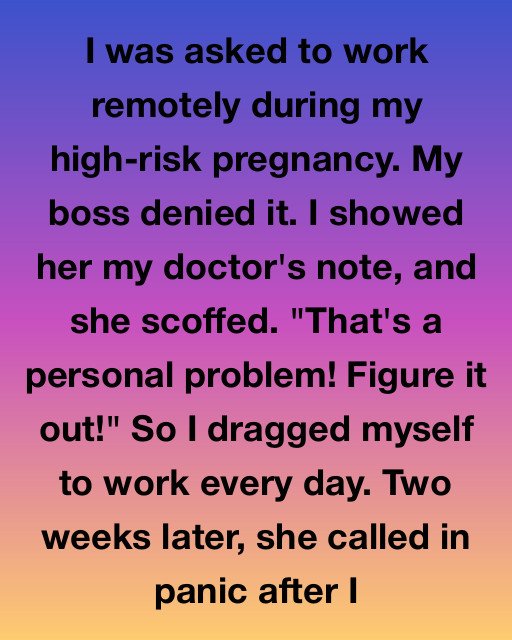
I didn’t tell anyone I was leaving. I just caught a taxi straight to my OB-GYN’s office, ignoring the frantic pings from the office group chat. By the time I arrived at the clinic, my blood pressure was in the danger zone.
My doctor, a kind man named Dr. Aris, admitted me to the hospital immediately for observation and bed rest. I finally turned off my phone, sinking into the hospital bed with a sense of relief that outweighed my fear of being fired.
Two weeks later, I was still in the hospital under strict monitoring. I had finally turned my phone back on to check on my husband, and it immediately exploded with notifications. I saw dozens of missed calls and frantic emails from Mrs.
Sterling. I assumed she was calling to officially terminate my employment for “job abandonment.” But when I finally answered her latest call, her voice was shaking with panic. “Elena, thank God you picked up,” she gasped, sounding like she had been running.
I prepared myself for a lecture, but she didn’t mention the project or the missed meetings. She said, “I’m at the hospital, the same one you’re in. I’ve been trying to find your room for two hours.” I was confused, wondering if she was coming to serve me legal papers or demand my company ID back.
When she finally walked into my room, she wasn’t wearing her usual designer suit. She looked smaller, her eyes red-rimmed and her hands trembling as she clutched a bouquet of lilies. She sat in the plastic chair by my bed and didn’t say anything for a long time.
Then, she reached into her bag and pulled out a stack of documents that weren’t work-related at all. Mrs. Sterling hadn’t just been mean because she was “old school,” she told me that she had been diagnosed with an early-stage heart condition just a few weeks before I made my remote work request.
She had been so terrified of appearing “weak” in a male-dominated industry that she had projected her own fear onto me. She thought that if she could force me to be “strong,” she could force herself to be strong too. “The day you walked out,” she whispered, “I had a panic attack in my office.
I thought I was having a heart attack.” She explained that my absence had caused the firm’s board to step in and investigate why a senior staff member had disappeared. In the process of looking into my case, they discovered her own medical records, which she had accidentally left on the office scanner. The company didn’t fire her; they actually forced her to take a medical leave of absence.
Then, she told me about the “remote work” policy. Because of the investigation into my situation, the board had realized that the company was severely outdated. They had looked at my performance reviews and realized I was one of their top assets.
To prevent a massive HR lawsuit and to retain talent, they had overhauled the entire employee handbook while I was in the hospital. “They’ve implemented a permanent hybrid and remote option for everyone,” Mrs. Sterling said, a small, sad smile on her face.
“And they’ve appointed a new VP of Employee Wellness to make sure this never happens again.” I realized then that my “job abandonment” hadn’t ruined my career; it had completely transformed the company for the better. My refusal to stay in a toxic situation had forced the hand of the leadership. But the most rewarding part wasn’t the policy change.
Mrs. Sterling looked at me and said, “I recommended you for the VP role, Elena. You’re the only one who actually understands why it matters.” She told me that she was resigning from her position to focus on her health and her family.
She realized that by calling my pregnancy a “personal problem,” she had been ignoring the most important personal problems of her own. I sat there in the hospital bed, stunned by the turn of events. I had spent months feeling like a victim of a heartless system, only to find out that my actions had broken that system for everyone.
I didn’t lose my job; I was being offered a seat at the table to ensure that no other woman in that office would ever have to choose between her baby and her paycheck. We spent the afternoon talking—not as boss and employee, but as two women who had been pushed to their limits by a culture that demanded too much. Mrs.
Sterling apologized to me, not with a corporate email, but with a sincere, tearful acknowledgment of the stress she had caused. I realized that she wasn’t the villain of my story; she was a casualty of the same environment I was fighting. I gave birth to a healthy baby girl three weeks later.
I named her Maya, and her first “visitor” besides family was Mrs. Sterling, who brought a handmade blanket and a box of chocolates. I started my new role as VP of Employee Wellness from my home office four months later.
I make my own hours, I see my daughter grow every day, and I make sure that every “doctor’s note” that comes across my desk is treated with the respect it deserves. The lesson I learned is that sometimes, “figuring it out” means walking away from the table. We are taught that loyalty to a job is the highest virtue, but true loyalty should always be to your own well-being and the people you love.
When you stand up for yourself, you aren’t just helping yourself; you are often clearing a path for the people behind you who are too afraid to speak. Your health and your family are never just “personal problems.” They are the foundation of your life, and any career that asks you to sacrifice them isn’t a career worth having. It took a hospital stay for me to realize that I was more than a project coordinator; I was a human being with value that didn’t depend on “face time” in an office.
Don’t be afraid to be the one who walks out the door when it’s the right thing to do. If this story reminded you to prioritize your health and stand up for your rights at work, please share and like this post. You never know who is struggling in silence today and needs a reminder that their “personal problems” matter.
Would you like me to help you draft a professional but firm letter to your employer about your own needs for a healthier work-life balance?

