




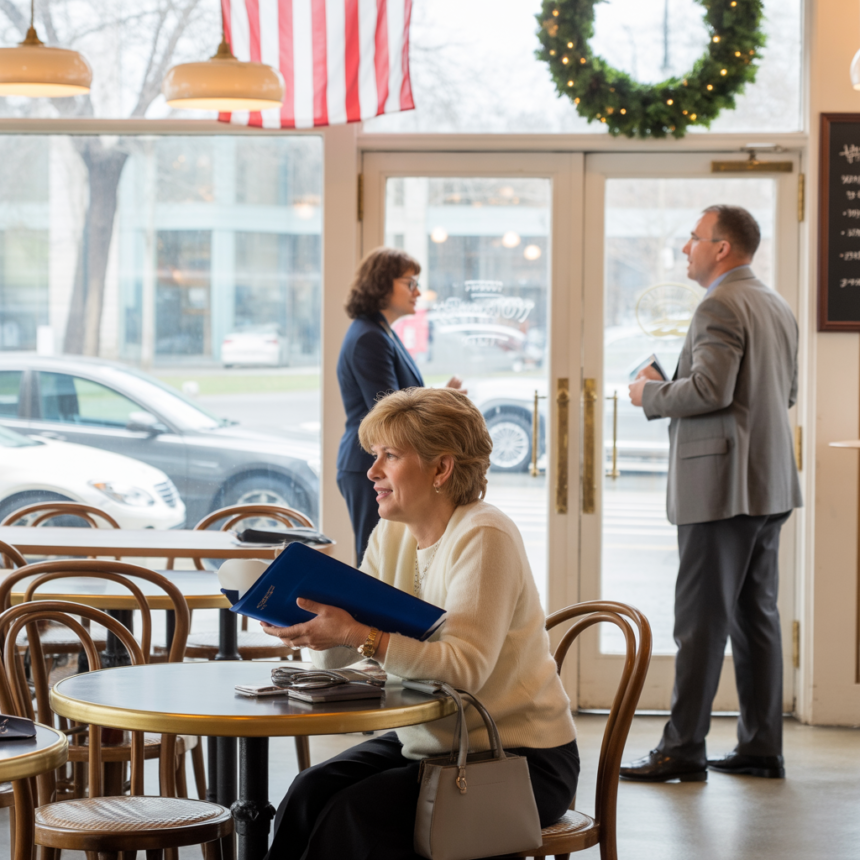
Talked about me when they thought I couldn’t hear. At 64, I’d discovered that being a widow made people treat you like you were made of glass—fragile, and liable to shatter at any moment. I was reaching for my purse when I noticed her.
She appeared beside my table so suddenly that I startled, my hand knocking against my water glass. The woman was perhaps 50, with steel-gray hair pulled back in a severe bun and eyes that seemed to look straight through me. She wore a dark coat despite the warmth of the café, and she carried nothing except a small blue box about the size of a hardcover book.
“Mrs. Whitmore,” she said. Not a question.
A statement. “Yes,” I replied, my heart beginning to pound for reasons I couldn’t explain. She placed the blue box on the table between us with deliberate care.
Her fingers, I noticed, were trembling slightly. “You’ll need this tonight.”
“I’m sorry—what?”
“I don’t understand.”
“11:15.” Her voice was barely above a whisper, urgent and afraid. “Answer it when it rings.
“And Mrs. Whitmore… trust no one.”
Before I could form another question, before I could ask who she was or what she meant, the woman turned and walked swiftly toward the exit. I half rose from my chair, but she was already gone, disappearing into the street crowd as if she’d never existed at all.
The blue box sat on the table, innocent and threatening all at once. I looked toward the counter. Timothy and Diane were still there, Diane pointing at something on her phone while the cashier rang up their order.
Neither had noticed the exchange. My hand moved almost of its own accord, snatching the box and shoving it deep into my purse just as they turned back toward the table. “Ready to go, Mom?” Timothy asked.
“Yes,” I managed, my voice steadier than I felt. “Yes. Let’s go.”
The drive back to the farmhouse was a blur.
I let Timothy and Diane’s conversation wash over me—something about property values and retirement communities—while my mind churned. The blue box felt like it was burning a hole through my leather purse. Who was that woman?
How did she know my name? And what could she possibly have given me that I would need tonight? They dropped me off at the end of my long gravel driveway, declining my half-hearted invitation for coffee.
I watched their SUV disappear down the rural road, red tail lights fading into the dusk before I finally allowed myself to breathe. The farmhouse stood before me, two stories of white clapboard and green shutters that Mark and I had painted together five summers ago. The barn loomed to the left, its red paint fading now, and beyond that stretched 40 acres of fields and woodland that had been in the Whitmore family for three generations.
I’d loved this place once. Now it felt like a mausoleum. Inside, I locked the door—something I never used to do before Mark disappeared—and went straight to the kitchen.
The blue box landed on the oak table with a soft thud. I stared at it for a full minute, my hands shaking before I finally worked up the courage to open it. The lid came off easily.
Inside, nestled in white tissue paper, was a cell phone. Not just any cell phone. Mark’s cell phone.
I recognized it immediately. The scratched case with the faded Dartmouth sticker. The crack in the corner from when he dropped it while fixing the barn roof two years ago.
The police had told me they never found his phone. “It must have gone into the lake with him,” they’d said. “Lost to the depths along with his body.”
But here it was in my kitchen, delivered by a stranger who knew my name.
My hands were numb as I lifted the phone from the box. The screen was dark, lifeless. I pressed the power button with trembling fingers, half expecting nothing to happen.
It powered on. The screen glowed to life, showing a full battery and a single bar of signal. The wallpaper was the same photo that had been there a year ago.
Mark and me at our 40th wedding anniversary party. His arm around my shoulders. Both of us laughing at something our granddaughter had said.
My vision blurred with tears. This wasn’t possible. The phone had been missing for a year.
The police had searched. I had searched—going through every drawer, every pocket, every corner of this house—looking for any trace of my husband. And now it simply appeared.
Handed to me by a stranger in a café. I checked the recent calls. Empty.
Messages. Empty. Everything had been wiped clean except for that one photo.
That one memory preserved like a ghost in the machine. The kitchen clock read 6:47 p.m. 11:15.
The woman had said, “Answer it when it rings.”
Four and a half hours to wait. Four and a half hours to sit with this impossible object and wonder if I was losing my mind. If grief had finally cracked something fundamental inside me.
I made tea. Chamomile—the kind Mark used to joke was just hot plant water. I didn’t drink it.
I just held the mug and watched the steam rise while the phone sat on the table like an unexploded bomb. At 7:30, I tried calling Timothy. The phone rang six times before going to voicemail.
I didn’t leave a message. What would I say? Your father’s phone just appeared.
A strange woman gave it to me. He already thought I was fragile. This would push him over the edge into thinking I needed supervised care.
At 8:15, I walked through the house, checking locks. The paranoia felt foolish, but the woman’s words echoed in my mind. Trust no one.
At 9, I pulled out the case files I’d kept from the investigation into Mark’s disappearance. I’d read them so many times, I had them memorized. Accident reconstruction reports.
Witness statements from the fisherman who’d seen the car go into the lake. Dive team logs. Search patterns.
Everything pointed to a tragic accident. A wet road. A sharp turn.
A moment of inattention. But Mark had driven that road a thousand times. He knew every curve, every pothole.
He’d been the most careful driver I’d ever known, almost to the point of annoyance. At 10:10, I found myself back in the kitchen staring at the phone. At 10:30, I started pacing.
At 11, I sat down and forced myself to breathe. The clock ticked toward 11:15 with agonizing slowness. Each minute felt like an hour.
My heart hammered against my ribs. Part of me wanted to throw the phone away, to pretend none of this had happened. But a larger part—the part that had never quite believed Mark was really gone—needed to know.
At 11:14, I watched the second hand sweep around the clock face. At 11:15 exactly, the phone rang. The sound was shrill in the silent kitchen.
Mark’s old ringtone—“Born to Run,” his favorite. My hand hovered over the device, shaking so badly I could barely control it. It rang again.
The screen showed Unknown Caller. Third ring. I picked it up, pressed the green button, raised it to my ear.
“Hello.”
My voice cracked. Silence. Not dead air.
I could hear breathing—soft and measured. “Hello,” I said again, louder now. “Who is this?”
More silence.
Then finally, a voice. Low. Distorted, as if passed through an electronic filter.
But unmistakably—impossibly—familiar. “Christina,” the voice said. “Don’t trust Timothy.
“Don’t trust Diane. “Don’t trust the police. “Your life is in danger.”
The line went dead.
I sat frozen. The phone still pressed to my ear as the implications crashed over me. That voice.
That distorted, electronically altered voice. It had sounded exactly like my husband, Mark Whitmore—gone for nearly a year, buried, or rather commemorated in an empty grave in the Oak Hill Cemetery. My husband had just called me.
And he’d warned me that I was in danger. I didn’t sleep that night. How could I?
My husband had called me—or someone who sounded like him. Someone who knew things only Mark would know. I sat at the kitchen table until dawn broke over the eastern fields.
The phone in front of me like a piece of evidence I didn’t know how to interpret. Don’t trust Timothy. Don’t trust Diane.
Don’t trust the police. Your life is in danger. By 6:00 a.m., I’d made a decision.
I couldn’t go to the authorities. The warning had been explicit. And I certainly couldn’t confide in Timothy—not when the voice had specifically named him—which meant I was alone in this, whatever this turned out to be.
But I wasn’t helpless. Mark and I had run this farm together for nearly four decades. I’d balanced books, negotiated contracts, dealt with lawyers and bankers and county inspectors.
I knew how to research, how to ask questions, how to dig for answers. I just had to be careful. The first thing I did was examine the phone more thoroughly.
In the morning light, I noticed details I’d missed the night before. The battery showed 100% charge despite the phone being missing for a year. Someone had maintained it.
Kept it powered. Preserved it for exactly this moment. I scrolled through the settings.
The phone number was still Mark’s old number—the one that had been disconnected after his disappearance. Yet somehow, it had received a call. I checked the call log again.
Still empty. As if the midnight conversation had never happened. But it had.
I knew it had. I was searching through the photo gallery when I heard gravel crunching in the driveway. My heart leaped into my throat.
I shoved the phone into my cardigan pocket and moved to the window. Timothy’s SUV. 8:15 in the morning, and he was here unannounced.
I forced myself to breathe normally as I opened the front door. Timothy climbed out alone this time, carrying a cardboard tray with two coffee cups. “Morning, Mom,” he called out, his smile a little too bright.
“Thought I’d bring you breakfast. Hope you haven’t eaten yet.”
“This is a surprise,” I said, keeping my voice light. “Diane not with you?”
“She had a yoga class.”
He handed me one of the coffees as he stepped inside.
“Besides, I wanted to talk to you. “Just us.”
A chill ran down my spine. Just us.
The words felt weighted. Deliberate. We sat in the living room and I watched Timothy look around the space with an expression I couldn’t quite read.
Appraising. Calculating. “Mom, I need to be honest,” he began, setting his coffee on the side table.
“Diane and I are concerned. “Really concerned.”
“About what?”
“About you. “About this house.
“About…”
He gestured vaguely. “Everything. “You’ve been different since Dad disappeared.
“Distant. “And we think maybe it’s too much being out here alone with all these memories.”
I sipped my coffee to buy time. It was from the expensive place downtown, not the café where we’d been yesterday.
Timothy never brought me expensive coffee unless he wanted something. “I’m managing perfectly well,” I said. “Are you?”
He leaned forward, his expression earnest.
“Because we’ve been thinking, and we really believe it would be better if you moved into town. “Maybe one of those nice senior living communities. “They have independent apartments, activities, people your own age.”
“I’m 64, Timothy, not 90.”
“I know, I know.
“But this place, it’s a lot of work. “And the property taxes alone are eating up your savings. “If you sold, you could have real financial security.
“Live comfortably. “Not have to worry.”
There it was. The real reason for the morning visit.
“The farm isn’t for sale,” I said firmly. Timothy’s jaw tightened. “Mom, be reasonable.
“You can’t keep it running by yourself. “The fields are going. “The barn needs repairs.
“And winter’s coming. “What are you going to do when the pipes freeze or the furnace breaks down?”
“The same thing your father and I did for 37 years,” I said. “Fix them.”
“Dad’s not here anymore.”
The words came out sharper than he’d intended.
He caught himself, softened his tone. “I’m sorry. I just mean, you need to think practically.
“This is a valuable piece of property. “We could get top dollar for it, especially with developers moving into the area.”
“We,” he’d said. We.
“Developers,” I repeated slowly. He had the grace to look uncomfortable. “There’s been some interest.
A company called Pinnacle Holdings reached out to Diane’s firm last month. “They’re looking to acquire land in this county for a new residential development.”
“And you’ve been talking to them.”
“Just preliminary conversations. “But Mom, they’re offering serious money—enough that you’d never have to worry about finances again.”
I set down my coffee cup with deliberate care.
“Let me make something very clear, Timothy. “This farm has been in the Whitmore family for three generations. “Your grandfather built this house with his own hands.
“Your father and I raised you here. “I’m not selling it to developers so they can tear it down and build giant houses.”
“You’re being emotional.”
“I’m being loyal to your father’s memory.”
Something flickered across Timothy’s face. Guilt.
Maybe anger. “Dad is gone, Mom. “He’s been gone for almost a year.
“We can’t keep pretending otherwise.”
The phone in my pocket seemed to burn against my leg. If only Timothy knew. “I think you should leave,” I said quietly.
He stood, his movement stiff. “Fine, but think about what I said. Really think about it.
“Because Diane and I are not going to stand by and watch you run yourself into the ground trying to maintain this place alone.”
There was something in his tone that made my skin prickle. A hint of threat beneath the concern. “What does that mean?”
“It means we love you and we’re going to do what’s best for you whether you like it or not.”
He left without another word, the door closing firmly behind him.
I watched through the window as he sat in his car for a long moment, his phone pressed to his ear before finally driving away. My hands were shaking. I pulled out Mark’s phone and stared at it.
Don’t trust Timothy, the voice had said. And now Timothy was pressuring me to sell the farm. Had been talking to developers.
Making veiled threats about doing what was best for me. What was happening here? I needed information.
Real information. Not just suspicions and desperate theories. I went to Mark’s office—still thought of it as his office, even though I’d been using it for months—and pulled out the file cabinet where we kept all our important documents.
Property deed. Insurance papers. Bank statements.
Mark’s will. I spread them across the desk and started reading with fresh eyes, looking for anything I might have missed. The will was straightforward.
Everything went to me, with Timothy as the sole heir after my death. Standard. Nothing unusual.
Except…
I pulled out the property deed and examined it more carefully. The farm was in both our names. Had been since we’d inherited it from Mark’s parents 37 years ago.
But there was an annotation I’d never noticed before, dated two months before Mark disappeared. A notation about a survey request. Someone had requested a property survey last September.
I grabbed my laptop and started searching through our email history. Mark and I had shared an email account for household business. Old-fashioned maybe, but it had worked for us.
I searched for survey and property and Pinnacle. Three emails popped up. The first was from a company called Boundary Line Surveyors confirming an appointment for September 15th of last year.
The second was a receipt for their services paid in full. The third was from an email address I didn’t recognize. Email protected.
Subject line: Re: Whitmore property. Preliminary assessment. I opened it with trembling fingers.
Mr. Whitmore,
Thank you for your inquiry regarding the potential sale of the Whitmore farm property. Based on the survey results and current market conditions, we would be prepared to make a preliminary offer in the range of $2.3–$2.5M for the full 40 acres pending environmental assessment and zoning approval.
As discussed, we would require certain assurances regarding family consent prior to moving forward. Please advise on the timeline for securing necessary agreements. Best regards,
Richard Pembroke,
Acquisitions Director,
Pinnacle Holdings.
The email was dated September 28th. Six weeks before Mark’s car went into Eagle Lake. My husband had been negotiating to sell our farm without telling me.
I sat back in the chair, my mind reeling. This couldn’t be right. Mark would never.
We’d always made decisions together. Always. He knew how much this place meant to me.
To our family history. Unless…
Unless I didn’t know Mark as well as I thought I did. My phone—my actual phone—buzzed.
A text from Diane. Hi, Christina. Just wanted to check in.
Timothy mentioned you seemed upset this morning. Everything okay? We’re here if you need anything.
Xo. The timing felt calculated. Timothy had probably texted her the moment he left.
I didn’t respond. Instead, I went back to Mark’s phone and did something I should have done hours ago. I tried to access his email on the device.
But when I opened the email app, it asked for a password. I tried our anniversary. Our address.
Timothy’s birthday. All wrong. I was still trying combinations when a knock at the door made me jump.
I shoved both phones into my pocket and went to answer it. A man stood on my porch, mid-40s, wearing a sport coat over jeans. He held up a badge and a leather wallet.
“Mrs. Whitmore, I’m Detective Brian Hardwick, Vermont State Police. “Do you have a few minutes to talk?”
My throat went dry.
“What’s this about?”
“It’s regarding your husband’s disappearance. “We’ve received some new information, and I need to ask you a few questions. “May I come in?”
Every instinct screamed at me to refuse.
Don’t trust the police, the voice had said. But refusing to talk to a detective would look suspicious. Would draw exactly the kind of attention I couldn’t afford.
“Of course,” I heard myself say, stepping aside. Detective Hardwick had kind eyes and a patient manner that probably put most people at ease. It had the opposite effect on me.
We sat in the living room and he pulled out a small notebook. “I apologize for the intrusion,” he began. “I know this must be difficult revisiting everything, but we’ve been reviewing cold cases and something came up regarding the incident last November.”
“What kind of something?”
“A witness has come forward.
Someone who was in the area the night your husband’s car went into the lake. “They claimed to have seen another vehicle nearby, possibly following Mr. Whitmore’s car.”
My heart pounded.
“Following him?”
“That’s what they say. “We’re trying to verify the account, but it raises some questions about the circumstances of what happened.”
He paused. “Mrs.
Whitmore, was your husband having any problems before he disappeared? “Financial troubles? Disputes with anyone?
“Anything unusual in his behavior?”
The emails about selling the farm flashed through my mind. “No,” I said. “Nothing.”
The lie came easily.
Instinctively. Because if I told the truth—that Mark had been secretly negotiating to sell our property—it would open doors I wasn’t ready to walk through. Not until I understood what was really going on.
“And you haven’t noticed anything strange recently?”
He leaned forward slightly. “Unusual phone calls? Anyone asking questions about your husband?”
The blue box.
The midnight call. The stranger in the café. “No,” I said.
“Nothing like that.”
Detective Hardwick studied me for a long moment. His kind eyes suddenly seemed much sharper. “Mrs.
Whitmore, if there’s something you’re not telling me, now would be the time. “If your husband’s disappearance wasn’t an accident, if someone caused it, you could be in danger.”
The exact words the voice on the phone had used. “I appreciate your concern, Detective, but I’ve told you everything I know.”
He handed me a business card.
“If you think of anything, or if anything unusual happens, call me. “Day or night. “We take these things seriously.”
After he left, I locked the door and leaned against it, my legs barely holding me up.
New witness. Another vehicle possibly following. Mark’s disappearance might not have been an accident.
And someone—Timothy, Diane, the police, all of them—was lying to me about what really happened. I pulled out Mark’s phone again. This time, I didn’t try to guess the password.
Instead, I examined the phone itself more carefully, running my fingers along the edges until I found it. A tiny piece of paper wedged between the phone and its case. I pried it out.
It was folded so small it was almost invisible. The paper thin as tissue. I unfolded it with shaking hands.
Four words in Mark’s handwriting. The truth is buried. The truth is buried.
I stared at Mark’s handwriting until the words blurred. Buried where? In what sense?
Was it metaphorical, or was he telling me to literally dig somewhere? I needed help. Real help.
But who could I trust? The answer came to me as I sat at Mark’s desk, surrounded by documents and secrets. Sarah Brennan.
Mark’s sister. She lived 3 hours away in Boston, and we’d always been close. She’d been devastated by her brother’s disappearance, had driven in for the service, and stayed for a week, helping me sort through the initial chaos.
More importantly, she’d never liked Diane. And she had no financial stake in the farm. I called her on my regular phone, keeping my voice casual in case anyone was listening.
“Sarah, it’s Christina. “I was wondering if you might have time for a visit this week.”
“Of course. Is everything all right?”
“I just… I’d like to see you.
“Maybe you could come up for a few days.”
There was a pause. Sarah had always been perceptive. “Christina, what’s wrong?
“And don’t say nothing. “I can hear it in your voice.”
“I can’t talk about it on the phone. “Please, can you come?”
“I’ll leave tomorrow morning.
“Hang tight.”
“Okay.”
After we hung up, I felt marginally better. One ally at least. One person I could potentially confide in.
But tomorrow was 24 hours away, and I couldn’t just sit here waiting. The note said the truth was buried. If Mark had hidden something, where would he put it?
I spent the rest of the afternoon searching the house. The attic. The basement.
His workshop. In the barn. I looked for loose floorboards, hidden compartments, anything that might conceal documents or evidence.
I found nothing but dust and memories. By evening, I was exhausted and no closer to answers. I made myself eat some soup, though I could barely taste it, and was washing the dishes when Mark’s phone rang again.
My hands went slippery with soap. I dried them frantically and grabbed the phone from the counter. Unknown Caller.
Just like last night. I answered before I could lose my nerve. “Hello?”
The same distorted voice.
“Did you find the note?”
“Yes. “What does it mean? “The truth is buried where— not where.
“When?”
A pause. “Think, Christina. “What happened exactly one year before the accident?”
I racked my brain.
November of the previous year. Two years ago now. “I don’t— we were just living our normal lives.
Nothing special happened.”
“Think harder. “November 2022. “What changed?”
And then I remembered.
“Mark went to New York. “A business trip. “He was gone for three days.”
“Not business.
“He was meeting with a lawyer. “A criminal defense attorney named Robert Castellano.”
My legs went weak. I sank into a kitchen chair.
“Why would Mark need a criminal defense lawyer?”
“Because he’d discovered something. “Something that put him in danger. “He was trying to figure out what to do about it.”
“Discovered what?
“Please, just tell me.”
“I can’t. “Not over the phone. “But you need to find Castellano.
“He has files. “Documentation. “Everything Mark gathered before—”
The voice broke.
Static filled the line. “…before they stopped him.”
“Who? “Who did this?”
“The same people who are pressuring you to sell the farm.
“The same people who stand to profit from your disappearance.”
The line went dead. I sat frozen, my mind spinning. Timothy.
The voice was talking about Timothy. My son? No.
It couldn’t be. Timothy was ambitious. Yes.
And married to a woman who was even more so. But… this? And yet the emails.
The pressure to sell. The timing. I pulled up a browser on my laptop and searched for Robert Castellano, attorney, New York.
His website appeared immediately. A criminal defense practice in Manhattan. High-profile cases.
The kind of lawyer you hired when you were in serious trouble. I called the office number, knowing it was past business hours but needing to try. To my surprise, someone answered.
“Castellano and Associates.”
“Yes. Hello. My name is Christina Whitmore.
I need to speak with Mr. Castellano about my husband, Mark Whitmore.”
A pause. “I’m sorry, ma’am, but Mr.
Castellano doesn’t typically discuss client matters with family members without—”
“My husband is gone. “And I think his disappearance is connected to whatever he hired Mr. Castellano for.”
Another pause.
Longer this time. “Hold, please.”
Classical music filled my ear. I waited, my heart hammering.
Finally, a man’s voice. Deep. Careful.
“Mrs. Whitmore, this is Robert Castellano. “I was very sorry to hear about Mark.”
“I need to know why he came to you.”
“I’m sure you understand that attorney-client privilege extends beyond death.”
“Yes.
“But I’m being pressured. “And I think I’m in danger. “If he was working with you on something, I need to know what it was.”
Silence on the other end.
Then:
“Not over the phone. “Can you come to New York?”
“When?”
“Tomorrow. “2 p.m.
“Come alone, Mrs. Whitmore. “Don’t tell anyone where you’re going.”
He hung up before I could respond.
I sat staring at the phone, my mind reeling. New York tomorrow. The same day Sarah was supposed to arrive.
But this couldn’t wait. Whatever Mark had discovered, whatever had gotten him pulled under, the answers were in that lawyer’s office. I was booking a train ticket online when I heard a car in the driveway.
My stomach clenched. I shoved Mark’s phone into my pocket and went to the window. Diane’s car.
Alone. This was unusual. Diane never came to the farm by herself.
She always brought Timothy. Used him as a buffer between us. I opened the door before she could knock.
“Diane. This is unexpected.”
She smiled, but it didn’t reach her eyes. She was dressed in what I’d come to think of as her armor—expensive suit, heels, hair pulled back severely.
“Hi, Christina. I hope I’m not intruding. I wanted to talk to you about this morning.”
“Timothy already said everything that needed saying.”
“Did he?”
She stepped past me into the house without waiting for an invitation.
“Because I’m not sure he made our position entirely clear.”
Our position. Not his. Ours.
We stood in the living room and I noticed how Diane’s eyes swept across the space. Cataloging. Assessing.
Looking at my home the way a realtor might. “Timothy told me you were upset when he mentioned selling,” Diane continued. “I understand this is an emotional topic, but Christina, we need to be realistic here.”
“I am being realistic.
The farm isn’t for sale.”
“Even if keeping it means losing everything else.”
The words hung in the air like a threat. “What does that mean?”
Diane sat down on the sofa, crossed her legs with deliberate grace. “It means that maintaining this property is expensive.
“Property taxes, utilities, insurance, repairs. “And your income is limited.”
“I’m managing fine.”
“Are you? “Because I’ve been reviewing your financial situation.”
“You’ve been… what?”
“As your daughter-in-law, as someone who cares about your well-being, I asked Timothy for access to the household accounts—just to make sure everything was in order.”
She pulled out her phone, scrolled through something.
“You’ve been dipping into savings at an unsustainable rate. “At this pace, you’ll be broke in 18 months.”
My face burned. “You had no right.”
“I had every right.
“Timothy is your heir. “He needs to understand the financial situation he’ll be inheriting.”
She looked up, her expression sympathetic in a way that felt practiced. “And frankly, Christina, what we found was concerning.
“Your husband made some very questionable financial decisions in the months before his death.”
I went very still. “What kind of decisions?”
“Large cash withdrawals. “Payments to entities we can’t trace.
“Almost like he was hiding money.”
She lifted her eyes again. “We’re not accusing Mark of anything improper, of course, but the irregularities raise questions. “Questions that might interest the IRS.”
It was a threat.
Barely veiled. “Get out,” I said quietly. “Christina—”
“Get out of my house.
“Now.”
Diane stood, smoothing her skirt. “I’m trying to help you. “We both are.
“If you’d just be reasonable about this—if you’d agree to sell—these problems would go away. “You’d be financially secure. “We could handle any complications from Mark’s financial activities.
“And you could live somewhere more appropriate for someone your age.”
“Someone my age,” I repeated. “You mean somewhere you could control me?”
“I mean somewhere safe.”
Her voice hardened. “This is a big property, Christina.
“Lots of isolated areas. “The barn. “The woods.
“That old well behind the north field. “Accidents happen on farms, especially to older people living alone.”
The room felt like it tilted. “Are you threatening me?”
“Of course not.
“I’m worried about you.”
She headed for the door, then paused. “Oh, one more thing. “We’ve been in contact with an elder care attorney.
“Did you know that in Vermont, family members can petition for guardianship if they believe a loved one is no longer capable of making sound decisions? “It’s a legal protection, really. “To prevent older people from being taken advantage of.”
My blood ran cold.
“You wouldn’t.”
“We would if we had to. “If we felt you were putting yourself at risk. “Making irrational choices.
“Refusing help.”
She smiled that empty smile again. “Think about it, Christina. “Think about what’s best for everyone.
“We’ll give you a week to decide about the sale. “After that… we’ll have to explore other options.”
She left, her heels clicking across the porch. I locked the door behind her with shaking hands.
They were going to question me. Take away my rights. My home.
My autonomy. And there was nothing I could do to stop them. They had lawyers.
Money. And apparently evidence of Mark’s questionable financial decisions. I pulled out Mark’s phone and stared at it.
The cash withdrawals. The payments to untraceable entities. That wasn’t hiding money.
That was paying for something. Paying someone. Paying a lawyer in New York, maybe.
Paying for information. Paying for protection. I went back to the computer and pulled up our bank statements from two years ago.
There they were. Withdrawals of $5,000. $8,000.
$12,000. Over the course of six months. All marked as cash withdrawals from our savings account.
All ending one week before Mark disappeared. He’d been investigating something. Something big enough to require a criminal defense attorney.
Something that had gotten him pulled into the lake. And whatever it was, it was connected to this property. I looked out the window at the 40 acres of fields and forest.
The barn silhouetted against the darkening sky. The woods stretching toward the hills beyond. What was buried here?
What had Mark found? My phone buzzed. A text from Timothy.
Mom. Diane told me about your conversation. Please don’t make this harder than it has to be.
We love you. I deleted it. Then I went upstairs to my bedroom and started packing a bag.
Train to New York in the morning. Meet with Castellano at 2. Find out what Mark knew.
I was folding clothes into a small suitcase when I heard something that made my heart stop. Footsteps on the porch. Heavy footsteps.
Slow and deliberate. I moved to the window and looked down. A figure stood in the shadows near my front door.
Dark clothes. Face obscured. They weren’t knocking.
They were just standing there, waiting. I grabbed my phone to call 911, then remembered. Don’t trust the police.
The figure moved, stepping into the pale light from the porch lamp. I couldn’t see the face clearly, but I could see enough. The build.
The posture. The way they stood with hands in pockets, weight shifted to one leg. It was exactly how Mark used to stand.
The figure raised one hand in a small wave, then pointed toward the barn and walked away into the darkness. My hands were trembling so badly I could barely hold the phone. That couldn’t have been Mark.
Mark was gone. I’d seen the car pulled from the lake. I’d sat through the funeral.
I’d spent a year grieving. But that gesture—I’d seen it ten thousand times in 40 years. Mark’s phone buzzed in my pocket.
A text message. From no number. The barn.
Midnight. Come alone. Trust no one else.
I looked at the clock. 11:47 p.m. Thirteen minutes.
I stood at my bedroom window, watching the seconds tick by. 11:52. The barn was a dark shape against the darker sky, its familiar silhouette suddenly menacing.
This was insane. Walking out to an isolated barn at midnight to meet someone who might—or might not—be my husband. It was exactly the kind of thing people did in movies right before everything went wrong.
But what choice did I have? Every instinct I had screamed that the answers were out there. In that barn where Mark had spent countless hours working on equipment.
Where he’d taught Timothy to drive the tractor. Where we’d stored 50 years of family history. I grabbed a flashlight from the nightstand drawer and headed downstairs, moving quietly even though I was alone.
At the kitchen door, I paused. Some practical part of my brain insisted I needed protection—something I could use if this was a trap. The problem was, I’d never owned a weapon in my life.
Mark had kept a hunting rifle once years ago, but he’d sold it when Timothy left for college. There were tools in the mudroom—a hammer, a wrench—but the thought of using them against another person made me feel sick. Instead, I grabbed my regular phone and set it to record audio.
If something happened to me, at least there would be evidence. 11:58. I stepped out into the November night.
The cold hit me immediately, cutting through my cardigan. I should have grabbed a coat, but it was too late now. The barn was 100 yards away, across the gravel parking area and past the old vegetable garden.
I’d walked this path thousands of times. Never once had it felt threatening. Tonight, every shadow seemed alive.
The barn door was slightly ajar. Wrong. I always kept it closed.
A faint light glowed from inside. Not electric. Something softer.
A lantern. Maybe. “Hello,” I called out, my voice barely above a whisper.
No answer. I pushed the door open wider and stepped inside. The interior was exactly as I remembered it.
Stalls along one wall. Mark’s workbench at the far end. The old tractor that no longer ran parked in the center.
The light came from a battery-powered camping lantern sitting on the workbench, casting long shadows across the space. And standing beside the workbench, half in shadow, was a man. My breath caught.
From this angle, in this light, he looked exactly like Mark. Same height. Same build.
Same way of standing with hands clasped behind his back. “Mark.”
The word came out broken. The figure stepped into the light.
It wasn’t Mark. But the resemblance was striking—close enough to be his brother. Though Mark had only one sibling, Sarah.
And she was very much female. This man was perhaps 50, with Mark’s broad shoulders and sharp jawline, but his face was harder, more weathered. There was a scar running along his left cheekbone.
“Who are you?” I demanded, anger replacing fear. “Why are you doing this to me?”
“My name is David Hall,” he said. His voice was different from the distorted one on the phone.
Rougher. With a slight accent I couldn’t place. “And I’m doing this because your husband asked me to.”
“Mark is gone,” I said.
“I know. I was there.”
He moved closer and I saw his eyes were red-rimmed, exhausted. “I was the one driving the other car that night—the one the witness saw following him.”
My legs went weak.
I grabbed the edge of the workbench for support. “You caused it?”
“No.”
The word was fierce. Pained.
“I was trying to protect him. We both were.”
“Both?”
He pulled something from his jacket pocket. A wallet.
He flipped it open to show me a badge and an ID. Federal Bureau of Investigation. “Mark came to us two years ago,” Hall said.
“He’d discovered something about this property, something that put him in danger. “I was assigned to his case.”
I stared at the badge, my mind refusing to process. “The FBI?
“Why would they care about a family farm in Vermont?”
“Because it’s not just a farm, Mrs. Whitmore. “Under your property—specifically under the north field near the old stone wall—there’s a natural cave system.
“And in that cave system, someone has been storing something very valuable. “Very illegal.”
The world tilted. “What are you talking about?”
Hall moved to the workbench and pulled out a folder that had been hidden beneath some tools.
“About 18 months ago, your husband noticed some unusual activity on the property. People hiking through your woods at odd hours. Tire tracks where there shouldn’t be any.
“He started investigating on his own, which was dangerous and foolish, but understandable.”
He handed me the folder. Inside were photographs. Night-vision images of men carrying boxes through woods I recognized as mine.
Close-ups of the cave entrance hidden behind the old stone wall. And most damning—photos of Timothy and Diane meeting with men I didn’t recognize in parking lots, passing envelopes back and forth. “Your son,” Hall said quietly, “found the cave system about five years ago.
“He’s been renting it out to a smuggling operation. “They use it as a storage facility. “Illegal cargo comes up from the south, gets stored here temporarily, then distributed throughout New England.”
I couldn’t breathe.
Couldn’t think. Timothy. My son.
A criminal. “You’re lying.”
“I wish I was. “Your husband found evidence of the operation.
“He came to us. “Agreed to cooperate. “Help us build a case.
“We were close, Mrs. Whitmore. So close to making arrests.”
His voice broke.
“And then someone inside the investigation tipped them off. “We think it was local law enforcement. “Maybe Detective Hardwick, maybe someone else.
“Mark was compromised. “They knew he was working with us.”
Hall swallowed. “So they staged an accident.
“Made it look like the lake. “I was following in an unmarked vehicle trying to protect him, but I was too far back. “By the time I got there…”
He stopped.
Composed himself. “I couldn’t save him. “And I couldn’t prove it was intentional.
“The local police handled the investigation, declared it accidental. “Case closed.”
I sank onto an old wooden stool, my mind reeling. “Why didn’t you tell me this a year ago?”
“Because we didn’t know who else was involved.
“If you’d known the truth, you might have confronted Timothy or done something that would have put you in danger, too. “The safest thing was to let you believe the official story while we continued investigating.”
“And now?”
“Now things have escalated. “Timothy and Diane are pressuring you to sell because they need you gone.
“The longer you stay here, the more risk there is that you’ll discover what they’re doing. “They can’t have the property seized in a federal investigation, so they’re trying to force you out, sell it quickly to a shell company, and destroy the evidence.”
I thought of Diane’s visit. Her talk of guardianship.
“They’re going to question my ability to make decisions,” I whispered. “I know. “We’ve been monitoring their communications.
“That’s why I’m breaking protocol by contacting you now. “Once they get guardianship, they can sell the property without your consent. “We’ll lose our chance to make the case.”
“What case?”
I looked down at Mark’s phone.
“You said Mark is gone. “Why haven’t you arrested them?”
Hall’s expression darkened. “Because we still don’t have enough evidence.
“Mark gathered a lot of information, but he hid it before he disappeared. “We’ve been searching for months. “Following every lead.
“But we haven’t found his documentation. “Without it, we can’t prove the connection between Timothy, the operation, and the property.”
“The truth is buried,” I whispered. “What?”
I pulled out Mark’s phone and showed him the note.
“He left this for me. ‘The truth is buried.’
“I thought it was metaphorical. “But what if it’s literal?
“What if he buried the evidence somewhere on the property?”
Hall stared at the note, then at the phone. “Where did you get that?”
“Someone gave it to me. “A woman in a café.
“She said I’d need it.”
“What did she look like?”
I described the gray-haired woman. Hall’s face went pale. “That’s Jennifer Ward.
“She was Mark’s handler—my partner in the investigation. “She disappeared three days ago. “We thought she was taken.
“If she’s alive and passing you Mark’s phone, it means she’s gone dark. “Operating outside official channels.”
“Why would she do that?”
“Because she doesn’t trust the bureau anymore. “If there’s a mole in local law enforcement, there could be one elsewhere, too.”
He grabbed my shoulders, urgent.
“Mrs. Whitmore, you need to find what Mark buried. “It’s the only way to stop them.
“And the only way to protect yourself.”
“But I’ve searched everywhere. “The house. The barn.
I don’t know where else.”
“Think. “The message said buried. “Where would Mark bury something important?
“Somewhere only you would think to look.”
I closed my eyes, thinking back through 40 years. Mark and his hiding places. He’d always been careful about keeping important documents safe.
Had talked about getting a fireproof safe. Never had. And then I remembered.
“The garden,” I said. “My mother’s rose garden behind the house. “When we first moved here, I planted a memorial rose bush for her.
“Mark helped me dig the hole, and he joked about how it was deep enough to bury treasure.”
Hall was already moving toward the door. “Show me.”
We were halfway across the yard when headlights swept across the driveway. A car was pulling in.
Then another behind it. Hall swore and pulled me back toward the barn. “They’ve been watching the property.
“They must have surveillance hidden somewhere.”
We ducked back into the barn, and Hall pulled out his phone. “I’m calling for backup, but they’re at least 20 minutes away.”
Timothy’s voice carried across the yard. “Mom.
“Mom, we know you’re out here. “Your bedroom lights been off for 10 minutes, and we saw you walk to the barn.”
Diane’s voice—sharper. “Christina, stop being ridiculous.
“We’re here to help you.”
Detective Hardwick. “Mrs. Whitmore, I need you to come out.
“We need to talk about your mental state and some concerning behavior that’s been reported.”
I looked at Hall. “What do we do?”
“You need to get to that garden and find what Mark buried. “I’ll distract them.”
“They’ll take you.”
“I’m a federal agent.
They can’t.”
But he stopped. And I saw the fear in his eyes. If Hardwick was corrupt, if Timothy and Diane were willing to stage an accident for Mark… what would they do to a federal agent investigating them?
Timothy was closer now. “Mom, please. We’re worried about you.
“Diane told us you were acting paranoid, talking about Dad being alive. “We think you need help. “Professional help.”
They were going to have me committed.
Take me away tonight. Claim I was having a breakdown. And by the time anyone questioned it, the property would be theirs.
Hall handed me his flashlight. “Back door of the barn. “Head for the garden.
“Dig at the base of your mother’s rose bush. “Whatever you find, take it and run. “Get to the road.
“Get somewhere public.”
“What about you?”
“I’ll be fine. “Go. “Now.”
I ran.
Behind me, I heard Hall step out the front of the barn. “Federal agent. “Nobody move.”
Shouting.
Timothy’s voice, shocked. “What—”
I didn’t wait. I slipped out the back door and ran through the darkness toward the house, my flashlight beam bouncing wildly.
The rose garden was on the east side, a small plot we’d fenced off years ago to keep deer out. I could hear shouting from the barn. A crash.
The sound of a scuffle. My hands shook as I fumbled with the garden gate latch. Finally, it opened.
I dropped to my knees in front of the memorial rose bush. The ground was hard. Cold.
I had no shovel. Nothing to dig with except my hands. I started clawing at the earth.
Behind me—footsteps. Running footsteps. “Mom!”
Timothy.
He was coming. I dug faster. My nails breaking.
Fingers stinging. The dirt gave way and I felt something hard. A box.
Plastic. Waterproof. I wrenched it free just as Timothy rounded the corner of the house.
“Mom, stop! “What are you doing?”
I clutched the box to my chest and ran. Not toward the driveway.
They’d catch me there. Toward the woods. Into the darkness.
“Christina!”
Diane’s voice behind me, sharp with anger. “You’re only making this worse!”
I crashed through the underbrush, branches tearing at my clothes and skin. Behind me, flashlight beams swept through the trees.
They were following. My lungs burned. I was 64 years old, running through dark woods from my own son, carrying a box that contained evidence of his crimes.
I didn’t know how much longer I could keep going. And then I broke through the treeline and found myself on the old logging road that ran along the edge of our property. And there—like a miracle—was a car.
Headlights on. Engine running. Passenger door open.
“Get in.”
A woman’s voice. The gray-haired woman from the café. Jennifer Ward.
I didn’t hesitate. I dove into the car, clutching the box, and she gunned the engine before my door was even closed. As we sped away, I looked back and saw Timothy and Diane standing on the edge of the woods, illuminated by their flashlights, watching us disappear.
Ward looked at the box in my lap. “Is that it? Mark’s evidence?”
“I think so.”
“Then we have a chance.
“But Christina, you need to understand something. “Your son just saw you take that box. “He knows what it contains.
“And he’s going to do whatever it takes to get it back.”
“Where are we going?”
“Somewhere safe. “Somewhere we can open that box and figure out exactly what Mark risked everything to protect.”
She handed me her phone. A message thread was open.
On the screen was a text message just received from an unknown number. You have 24 hours to return the documents and convince your mother to sell. If you don’t, we handle all loose ends.
That means you, the federal agent, and anyone else who knows about the operation. Your choice, Timothy. Family or prison.
My son had 24 hours to choose. And I had no idea which way he would lean. Jennifer Ward drove us to a motel 40 minutes away, a shabby roadside place where nobody asked questions if you paid cash.
We sat in room 117, the box from Mark’s grave between us on the stained carpet. For a long moment, neither of us moved to open it. “Before we look,” Ward said quietly, “you need to understand what opening this means.
“Once we see what’s inside—once we know what Mark found—there’s no going back. “People have been hurt over this information.”
“My husband risked everything for it,” I said. “I need to know why.”
She nodded and carefully pried open the waterproof seal.
Inside were three items. A USB drive. A leather journal.
And a sealed envelope with my name written in Mark’s handwriting. My hands shook as I picked up the envelope. Ward busied herself with her laptop, giving me privacy as I carefully opened it.
My dearest Christina,
if you’re reading this, then I’m gone. And you’ve been smart enough and brave enough to find what I buried. I’m so sorry, my love.
Sorry for the secrets. Sorry for the danger I’ve put you in. Sorry that I couldn’t tell you the truth while I was alive.
I discovered what Timothy was doing 18 months ago. I wanted to believe I was wrong. Wanted to think my son couldn’t be capable of such things.
But the evidence was undeniable. He’d been using our property to facilitate a contraband operation, making hundreds of thousands of dollars while putting our family and our legacy at risk. I confronted him.
He cried, said he’d gotten in over his head with debts from Diane’s lifestyle. Promised it was almost over. Like a fool, I believed him.
I gave him two months to extract himself. He tried to stage an accident for me instead. The first attempt was subtle.
Brake lines on my truck made to look like mechanical failure. I survived only because I happened to take your car that day. The second was less subtle.
A break-in while you were visiting Sarah, where someone searched my office and tried to make it look like a robbery. I knew then that Timothy wasn’t going to stop. That’s when I went to the FBI.
Agent Ward has been my lifeline, and Agent Hall has risked everything to protect both of us. If they’re helping you now, trust them completely. On this USB drive is everything.
Financial records linking Timothy to the operation. Photographs. Recordings.
Documentation of the cave system and its use. It’s enough to put him away for a very long time. But Christina, here’s what you need to understand.
Timothy didn’t do this alone. Diane orchestrated everything. She found the contacts, set up the operation, pushed Timothy into it when he hesitated.
And she has connections we didn’t know about. Her law firm represents some very dangerous people. That’s why the local police can’t be trusted.
That’s why even the FBI has been compromised. The journal contains my personal observations and a detailed account of how I discovered everything. Use it however you see fit.
I know this will break your heart. I know you’ll want to protect Timothy despite everything, because that’s who you are. Kind.
Forgiving. Always seeing the best in people. But please, my love, protect yourself first.
Our son made his choices. You don’t have to suffer for them. I love you.
I have loved you every day of our 40 years together. I’m sorry I won’t be there to grow old with you, to see more grandchildren, to take that trip to Ireland we always talked about. Be strong.
Be smart. And remember: you have always been the toughest person I know, even when you didn’t realize it. Forever yours,
Mark.
Tears streamed down my face as I read the last line. Ward handed me a tissue without comment. “He knew,” I whispered.
“He knew Timothy would try to take him out.”
“Yes. “And he built this case anyway because he believed in doing the right thing.”
Ward pulled up files on her laptop from the USB drive. “Mrs.
Whitmore… this is incredibly thorough. “Financial transactions, dates, times. “Photographs of meetings.
“Mark even managed to get recordings of conversations between Timothy and the network.”
She looked up. “This is everything we need.”
I wiped my eyes and forced myself to focus. “So, what do we do with it?”
“We need to get it to the right people.
“Not Hardwick. “Not the local field office. “I have a contact in the Boston field office—someone I trust.
“If we can get this to him…”
Her phone rang. She glanced at the screen. Her expression darkened.
“It’s Hall.”
She put it on speaker. “Jennifer.”
Hall’s voice was tight with pain. “They broke my arm.
“I’m at Hardwick’s station supposedly for questioning, but they’ve made it clear I’m not leaving until Christina returns the evidence.”
“Are you—”
“I’m alive. “But listen to me carefully. “Timothy and Diane aren’t working alone.
“The operation belongs to a man named Victor Klov. “He’s not going to wait 24 hours. “He’s going to force the issue tonight.”
“How?”
“They’re planning to go to your sister’s house.
“Sarah Brennan. “They know you two are close. “They think you might run to her.
“If they don’t find what they’re looking for…”
He didn’t finish. My blood turned to ice. Sarah.
I’d called her. Asked her to visit. If something happened to her because of me—
Ward was already grabbing her keys.
“We’ll warn her. “Get her somewhere safe.”
“No,” I said. Both of them looked at me.
“No. “This ends tonight. “I’m tired of running.
“Tired of hiding. “Tired of letting them control everything.”
“Christina, these are dangerous people,” Ward said. “And I’m a dangerous woman when my family is threatened.”
I picked up Mark’s journal, flipping through pages of his neat handwriting.
Mark spent months building this case. He knew exactly what he was doing. And I think… I think he left me more than just evidence.
I found the page I was looking for. A diagram of the cave system under our property, with dates and times marked at various points and a note in the margin. Emergency exit tunnel leads to old Peterson farm.
They don’t know about this route. “Ward,” I said, “how many agents can you get here in the next two hours?”
“If I call my contact in Boston… maybe six, maybe eight. “But that’s not enough to—”
“It’s enough.
“Here’s what we’re going to do.”
I laid out the plan using everything I knew about my property, everything Mark had documented, everything I’d learned about Timothy and Diane’s operation. Ward listened, her expression shifting from doubt to cautious optimism. “It’s risky,” she said finally.
“Everything about this is risky,” I replied. “But I’m not letting them hurt Sarah. “I’m not letting them destroy what Mark risked everything for.
“And I’m not letting my son become something I can’t recognize.”
She nodded slowly. “Okay. “Let’s do it.”
By 10 p.m., we were back at my farm.
It felt surreal, walking up my own driveway like a criminal returning to the scene of a crime. But this was my home. My land.
My family’s legacy for three generations. I wasn’t going to lose it. The house was dark except for one light in the kitchen.
Ward had called ahead, set up the meeting. Timothy and Diane thought I was coming to negotiate—to return the evidence in exchange for my safety and Sarah’s. They had no idea what was really about to happen.
I walked through my front door—unlocked as requested—and found them waiting in the kitchen. Timothy sat at the table, his head in his hands. Diane stood by the window, perfectly composed in a black suit, her phone in her hand.
Detective Hardwick was there too, leaning against the counter with his arms crossed. And two other men I didn’t recognize—large and intimidating—clearly Klov’s people. “Mom.”
Timothy looked up and I saw my son.
Really saw him. Maybe for the first time in years. He looked exhausted.
Frightened. Decades older than 42. “Thank God.
Are you okay?”
“Am I okay?”
I kept my voice level. “Timothy, you tried to have me declared unfit tonight. “You’ve been using our family property for illegal trafficking.
“And you were part of what happened to your father. “So no. I’m not particularly okay.”
“I didn’t—”
He stopped, looked at Diane.
“I didn’t want any of this. “You have to believe me.”
“Enough,” Diane snapped. “Christina, you have something that belongs to us.
“We need it back. Now.”
“What I have,” I said, “belongs to federal investigators. “Evidence of what you’ve done.”
“Mark’s disappearance was an accident,” Hardwick interjected.
“The official report was shaped by you, Detective.”
His face reddened. “You can’t prove—”
“Actually, I can.”
I pulled out my regular phone. “The one I set to record.
“You see, I’ve been recording everything. “Every conversation. “Every threat.
“Every admission. “Including Agent Hall’s statement about your corruption before you detained him.”
The room went very still. Diane’s expression didn’t change, but her hand tightened on her phone.
“You’re bluffing.”
“Am I? “Would you like to hear the recording of you threatening me yesterday? “Talking about accidents on farms.
“Talking about guardianship. “Talking about making my problems disappear?”
I looked at Timothy. “Or maybe you’d like to hear your conversation with Diane where she told you your father had to disappear because he knew too much.”
Timothy’s face went white.
“How did you—”
“Your father wasn’t the only one who knew how to keep things safe.”
I let the lie hang. It wasn’t true. I hadn’t recorded anything until last night.
But Mark’s journal had mentioned that Timothy and Diane often had their conversations in my kitchen, thinking I was too old to notice. The suggestion that I’d been listening all along was enough to shake their confidence. “You’re lying,” Diane said, but her voice wavered.
“The USB drive has it all. “Every transaction. “Every piece of evidence.
“And it’s not here. “It’s already in the hands of the FBI.”
One of Klov’s men moved toward me. “Then you’re no use to—”
“Touch her and you’re on camera,” Ward’s voice cut in from the doorway.
She stood there, steady, and behind her were agents—more than six. Federal agents. “All of you on the ground.
“Hands visible.”
Everything broke at once. Hardwick moved. One of Klov’s men lunged.
Timothy shouted, “No!”
And then the lights went out. Ward had cut the power, just as we’d planned. In the darkness, I dropped to the floor and crawled toward the mudroom, counting steps in my head.
Five. Six. Seven.
Shouting. The sound of heavy thuds. A few sharp cracks.
I reached the mudroom, felt for the door handle, slipped outside into the cold November night. Behind the house, more agents emerged from the woods, flooding the property. Ward had brought more than a dozen, all positioned around the house, barn, and surrounding forest.
The arrests happened quickly after that. Hardwick, face down in my kitchen with his hands cuffed behind his back. Klov’s men subdued.
And Diane, still trying to negotiate, still trying to lawyer her way out of a situation no maneuvering could fix. They found Timothy in the living room, sitting on the couch with his hands raised, tears streaming down his face. “I’m sorry,” he kept saying.
“Mom, I’m so sorry. “I didn’t mean for any of this.”
“But you let it happen,” I said quietly. “You chose money over family.
“Over your father. “Over everything we taught you.”
“I know. “I know.
“I just… Diane said it would only be for a little while, just until we paid off our debts. “And then it got bigger and I couldn’t stop it.”
“And you could have come to us. “To your father and me.
“We would have helped you.”
“Dad found out. “I told him everything and he said he was going to the police, that he couldn’t protect me from this. “And Diane said that meant he had to… he had to—”
Timothy broke down completely.
“I didn’t want him gone. “I swear I didn’t. “But Diane said it was him or us.
“And I was scared. “And I just… I didn’t stop it. “I should have stopped it.”
I looked at my son—the man I’d raised—and felt something break inside me.
Not the grief that had broken me a year ago. Something else. The final severing of an illusion.
The last remnant of the family I thought I had. “Goodbye, Timothy,” I said. And I walked away.
Outside, Ward found me sitting on the porch steps, wrapped in a coat one of the agents had handed me. “Hall is at the hospital,” she said. “Broken arm, some bruised ribs, but he’ll be fine.
“He wanted me to tell you that Mark would be proud.”
“Mark would be heartbroken.”
“Maybe. “But he’d also be glad you’re safe. “And strong enough to do what he couldn’t—stop his own son.”
I watched as they led Timothy to a federal vehicle.
He looked back once. Our eyes met. And for a second I saw the little boy he’d been.
The child who used to help his father in the fields. Who’d built tree houses and collected tadpoles. And promised he’d always take care of me when I got old.
“Will they offer him a deal?” I asked. “If he testifies against Diane and Klov?”
“Probably. “He’s looking at serious time either way, but cooperation might reduce it.”
Ward sat down beside me.
“I know this isn’t the ending you wanted.”
“No,” I agreed. “But it’s the ending Mark fought for. “Truth, even when it hurt.”
The last vehicle pulled away.
The farm that had been a crime scene was slowly returning to just being a farm. Though it would never feel the same. Sarah pulled up just as the final lights disappeared down the road.
She jumped out of her car and ran to me, gathering me into a fierce hug. “Jennifer called me. “Told me what happened.
“Are you okay? “Are you hurt?”
“I’m fine,” I said. And the strange thing was, I meant it.
The fear that had been crushing me for days was gone, replaced by something solid and sure. I’d faced the worst. Betrayal.
Danger. The loss of my son in a way more painful than death. And I’d survived.
More than survived. I’d won. Mark’s evidence was in the right hands.
The operation was shut down. Corrupt officials were arrested. And my farm—my family’s three-generation legacy—was safe.
“Come on,” Sarah said gently. “Let’s get you inside. You need rest.”
“Actually,” I said, standing up and brushing off my pants, “I need to make some phone calls.
“There’s a lawyer in New York who’s been waiting to hear from me. “And then I need to start making arrangements.”
“Arrangements for what?”
I looked at the farmhouse, the barn, the 40 acres stretching into darkness. Keeping this place running.
“It’s too much for one person. “Mark was right about that. “But I’m not selling it to developers.
“I’m going to find someone who will help me maintain it properly. “Maybe turn it into something useful.”
Sarah smiled through tears. “He would have wanted that very much.”
We went inside and I locked the door behind us.
Not out of fear this time. Just out of habit. My home.
My sanctuary. My battleground. And my victory.
Tomorrow would bring lawyers and statements and the long process of prosecuting everyone involved. Tomorrow would bring grief and reckoning and rebuilding. But tonight, I was just a woman who’d outsmarted criminals, protected her family’s legacy, and discovered that at 64 years old, she was far from finished.
Mark’s phone buzzed one final time. A text message from an unknown number. Well done, Christina.
He always said you were tougher than you looked. —JW
I smiled and set the phone down. Mark had been right about a lot of things.
Three months later, I stood in the north field watching as the federal excavation team finished sealing the cave entrance. They’d spent six weeks documenting every inch of the underground system, collecting evidence, photographing everything. Now they were sealing it permanently at my request.
“That’s the last of it,” Agent Hall said, walking up beside me. His arm was out of the cast now, though he still favored it. “The cave system will be completely inaccessible by tomorrow.
“Are you sure about this?”
“Completely sure.”
That cave had brought nothing but poison to this property. I wanted it gone. He nodded.
“For what it’s worth, Mrs. Whitmore, the evidence your husband collected was instrumental. “We made 47 arrests connected to the operation across three states.
“Klov’s organization is finished. “And Detective Hardwick pleaded guilty to corruption charges. “He’s looking at 15 years federal prison.”
Hall paused.
“He wasn’t the only one involved, but he was the highest ranking. “The investigation is ongoing.”
I watched the workers smooth over the earth where the cave entrance had been. In spring, I’d plant wildflowers there.
Something beautiful to cover the ugly truth beneath. “Thank you,” I said, “for trying to protect Mark.”
“I wish I could have done more.”
“You did exactly what he would have wanted.”
After Hall left, I walked back toward the house, taking my time, enjoying the cold February air and the way the snow crunched under my boots. The farm looked peaceful under its blanket of white, almost the way it had when Mark and I first inherited it 30 years ago.
So much had changed. So much had been lost. But not everything.
Sarah was in the kitchen when I came in, stirring something on the stove that smelled like her famous beef stew. She’d moved into the farmhouse two weeks after the arrests, claiming she needed a change of scenery from Boston. We both knew the real reason.
She didn’t want me to be alone. I was grateful. The house felt less empty with her here.
Less haunted by Mark’s absence and Timothy’s betrayal. “Mail came,” she said, nodding toward the table. “Including something from the district attorney’s office.”
I picked up the official envelope, knowing what it would contain.
The plea deal. Timothy’s lawyers had been negotiating for weeks. Inside was a summary.
Timothy Whitmore had agreed to plead guilty to conspiracy charges and provide testimony against Diane and the remaining members of Klov’s organization. In exchange, his sentence would be reduced. There was a handwritten note clipped to the document from Timothy’s attorney.
Mrs. Whitmore, your son asked me to convey that he understands if you don’t wish to visit him. He knows he has no right to ask for your forgiveness, but he wants you to know that he thinks about you every day and he’s profoundly sorry for the pain he’s caused.
I set the letter down carefully. “Are you going to visit him?” Sarah asked gently. “I don’t know.
“Not yet. “Maybe someday when…”
I trailed off. “When it hurt less?
“When I could look at him without seeing Mark’s absence in his eyes? “Maybe someday.”
“For what it’s worth,” Sarah said, “I think Mark would want you to forgive him eventually. “Not forget.
“But forgive.”
“Mark had a bigger heart than I do.”
“No,” Sarah said firmly. “You have the same heart. “You’re just being realistic about how long healing takes.
“There’s wisdom in that.”
The other letters were easier to handle. A thank-you note from Agent Ward, who’d been promoted for her work on the case. An update from the historical society about documenting the farm’s history.
And a formal letter from Pinnacle Holdings withdrawing their offer to purchase the property and apologizing for any inconvenience. I’d learned that Pinnacle Holdings was a shell company connected to Klov’s organization. The whole development scheme had been a cover for legitimizing the property transfer and destroying evidence.
They’d planned to buy the land, demolish everything, and build a residential community on top of the sealed cave system. It would have worked, too, if Mark hadn’t been the careful, thorough man he was. If he hadn’t noticed the small inconsistencies.
The odd visitors. The tire tracks where they shouldn’t be. My husband had saved this farm with his attention to detail and his unwavering sense of right and wrong.
Even knowing it would cost him everything. He’d chosen truth over family loyalty. I wasn’t sure I could have made the same choice.
But I was grateful every day that he had. A week later, I drove into town for my appointment with Robert Castellano. He’d flown up from New York specifically to meet with me, insisting there were matters we needed to discuss in person.
His temporary office was in a converted Victorian house near the town square. He greeted me warmly, his handshake firm, his eyes kind behind wire-rimmed glasses. “Mrs.
Whitmore, thank you for coming. Please sit.”
We settled into chairs by a fireplace, and he pulled out a folder I recognized immediately. Mark’s file.
“I’ve been waiting to give you this until the criminal proceedings were settled,” he said. “Your husband was not just my client, Mrs. Whitmore.
“He became my friend. “What he was doing—building a case against his own son—took remarkable courage. “It broke his heart.
“I know he talked about it often. “The conflict between doing what was right and protecting his child.”
Castellano opened the folder. “But he wanted to make sure that if anything happened to him, certain provisions were in place.
“He updated his will through my office six months before his death.”
My breath caught. “Updated it how?”
“First, he established a trust. “He’d been quietly selling off some investments.
“Nothing that would attract attention, but enough to create a substantial fund. “$230,000.”
I stared at him. “I never knew.”
“He was very discreet.
“The trust is in your name with specific instructions for its use. “He wanted to ensure that the farm could be maintained properly, that you’d have financial security regardless of what happened.”
“Timothy doesn’t know about this.”
“No one knew except Mark and myself. “The trust was designed to be invisible until it was needed.
“And there’s more.”
He pulled out another document. “Mark also created a provision that in the event of his death under suspicious circumstances, Timothy would be disinherited entirely. “The farm, the property, all remaining assets would go solely to you, with Sarah Brennan as alternate beneficiary should you predecease her.”
The paper blurred as tears filled my eyes.
Mark had known. Known that Timothy might be behind what happened. Known that I’d need protection.
Known that I’d need the means to fight back. “He thought of everything,” I whispered. “He was a remarkable man.”
“He also left you a letter.
“He gave it to me two months before his death with instructions to deliver it only after all legal proceedings concluded.”
Castellano handed me a sealed envelope. “He said you’d know what to do with it when the time was right.”
I didn’t open the letter until I was back at the farm, sitting in Mark’s office with the door closed. Sarah respected my privacy, staying in the kitchen while I carefully broke the seal.
My dearest Christina,
if you’re reading this, then everything I feared has come to pass. The legal matters are resolved, and you know the full truth about Timothy, about the farm, about everything I discovered and tried to stop. I imagine you’re angry with me for keeping secrets.
You have every right to be. We promised each other no secrets and I broke that promise. But I need you to understand why I kept the truth from you.
Because I couldn’t bear to break your heart before it was absolutely necessary. You loved Timothy so completely, so unconditionally. Telling you that our son was a criminal, that he was willing to do unforgivable things… it would have destroyed something beautiful in you.
That capacity for love. For seeing the best in people. I couldn’t take that from you until there was no other choice.
I know that by the time you read this, your heart is already broken. I’m sorry, my love. So profoundly sorry.
But here’s what I need you to know. This isn’t the end of your story. You’re 64 years old and you have so much life ahead of you.
Don’t let Timothy’s choices define your future. Don’t let my death trap you in grief. The farm is yours now.
Truly yours to do with as you wish. If you want to keep it, the trust will help. If you want to sell it and travel the world, do that.
If you want to turn it into something completely new, I support that too. What matters is that you live, Christina. Really live.
Not just survive or endure, but thrive. Remember our dreams? Ireland in the spring.
Learning to paint. Taking cooking classes in Italy. Writing the novel you always talked about.
We put those dreams on hold because the farm needed us, because Timothy needed us, because there was always something more urgent. Nothing is more important than your happiness now. Nothing.
I’ve set up the trust so you’ll have freedom. Freedom to choose. To explore.
To become whoever you want to be in this next chapter. You’ve spent 40 years being a wife, a mother, a farmer. Now be Christina.
Just Christina. And discover what that means. I’ll be watching over you, my love, cheering you on.
Proud of your strength. Your courage. Your incredible capacity to keep going even when everything falls apart.
You are the strongest person I have ever known. You just don’t realize it yet. All my love forever and always.
Mark. P.S. There’s one more thing in the trust.
A first-class ticket to Dublin. Open-ended. Whenever you’re ready to use it, we’ll take that trip together after all.
You’ll just have to tell me about it when we meet again. I sat in that office for a long time. Crying and laughing.
Grieving and healing all at once. Mark had given me more than just financial security or evidence. He’d given me permission.
To move forward. To find joy again. To be more than just a woman trapped in the past.
Spring came slowly to Vermont that year. The snow melted gradually, revealing the brown earth beneath, and I spent my days planning. Planning the garden.
The repairs. The ways I could make the farm productive again. Sarah and I hired a young couple—Daniel and Rebecca Porter—recently married, passionate about sustainable agriculture, to help run the property.
They moved into the small cottage at the edge of the north field—the one Mark’s grandparents had built—and threw themselves into the work with an enthusiasm that reminded me of my younger self. The farm began to transform. We converted ten acres to organic vegetable production.
We repaired the barn and brought in chickens, goats, a small dairy cow. We started a farm stand on the road, selling produce to locals and tourists. It would never be what it was in Mark’s time.
But it was becoming something new. Something vital. Something that honored the past while reaching toward the future.
On a warm day in May, I finally went to see Timothy. The federal prison was three hours away, a sprawling complex of gray buildings surrounded by fences. I sat in the visiting room with my hands folded on the table, waiting, my heart pounding.
When they brought him in, I barely recognized him. He’d lost weight. There was gray in his hair that hadn’t been there before.
Time had hardened something in his face. “Mom,” his voice broke. “You came.”
“I came.”
We sat in silence for a long moment.
There was so much to say and no words adequate for any of it. “I don’t expect you to forgive me,” Timothy said finally. “I know what I did is unforgivable.
“Dad is gone because of my choices. “Because I was weak and greedy and stupid.”
“Yes,” I said. No point in lying.
“I think about him every day,” he said. “About what he must have felt knowing his own son—”
He stopped. Composed himself.
“The guilt is worse than prison.”
“Good,” I said. His eyes widened. “I’m sorry, Timothy, but good.
“You should feel it. “Your father was a good man. “And he deserved better from you.
“We all did.”
“I know.”
“But here’s what I need you to understand,” I continued. “Your father’s last act was to protect me. “To set up trusts.
“To build a case. “To make sure I’d be safe. “He did that while knowing you’d betrayed him.
“He did that because despite everything, he still loved you. “He still hoped that someday you’d become the person he raised you to be.”
Timothy’s eyes filled. “I’m not there yet,” I said.
“I can’t forgive you. “Not now. “Maybe not for a long time.
“But I can give you the same thing your father gave you. “Hope. “Hope that you use this time to become better.
“Hope that when you get out, you spend the rest of your life making amends. “Hope that someday we can remember him without this weight between us.”
“I’ll try,” he whispered. “I swear I’ll try.”
“That’s all I ask.”
I didn’t visit again after that.
Maybe I would someday. When more healing had happened. When the sharp edges of betrayal had dulled into something more manageable.
But for now, I’d said what I needed to say. Diane, I learned, had received 22 years. She’d refused plea deals, fought the charges to the bitter end, and was convicted on every count.
Part of me felt satisfaction. A larger part just felt tired. The legal proceedings finally concluded in July.
Klov himself was extradited. His organization dismantled. The corruption investigation led to resignations and charges.
Mark’s legacy wasn’t just the farm. It was truth. And the courage to stand against evil even when it wore your own son’s face.
In August, I booked the ticket to Dublin. Sarah came with me. We spent three weeks wandering through green hills and ancient castles, listening to traditional music in crowded rooms.
I told Mark about everything. Whispered my adventures to him. Felt him with me—not as a ghost, but as a presence.
When we returned to Vermont in September, the farm was thriving under Daniel and Rebecca’s care. The stand had been wildly successful. They talked about expanding.
Adding a small bakery. Hosting farm-to-table dinners. I told them yes.
To all of it. Legacy wasn’t about preserving everything exactly as it had been. Legacy was about taking what was good from the past and building something new with it.
One year after the blue box appeared in that café, I stood on my porch watching the autumn leaves fall. The same season. The same colors.
But everything was different. I was different. At 65, I’d discovered I was capable of things I’d never imagined.
Investigation. Courage. Confrontation.
I’d outsmarted criminals and corrupt officials. I’d faced down my own son and survived the breaking of my heart. I’d rebuilt a life from the ashes of everything I’d lost.
Mark’s phone sat on the table beside me, powered off now. Its purpose served. I’d never learned who the mysterious voice on the other end truly was.
Whether it was some electronic trick or something else entirely. It didn’t matter. What mattered was that it had given me the push I needed.
The warning that saved my life. Sarah came out with two mugs of tea and sat beside me. “What are you thinking about?” she asked.
“Everything. “Nothing. “How strange life is.”
“Strange doesn’t quite cover it.”
We sat in comfortable silence, watching the day fade to evening.
The farm spread out before us, golden in the slanting light. My home. My battleground.
My victory. “Mark was right,” I said finally. “I am strong.
“I just never knew it.”
“He always knew,” Sarah replied. “That’s why he trusted you with all of this. “He knew you’d do exactly what needed to be done.”
I thought about Mark’s faith in me, even when I hadn’t had faith in myself.
The way he’d prepared for every possibility. Set up every safeguard. Given me every tool I’d need to survive.
“I miss him,” I said. “I know.” Sarah’s voice softened. “But Christina… look at what you’ve built.
“Look at what you’ve done. “He’d be so proud.”
She was right. Despite everything—the betrayal, the danger, the loss—I’d emerged on the other side stronger, wiser, more fully myself than I’d ever been.
The farm would continue. The truth would be remembered. And I would keep living—really living—with the courage and wisdom that only came from surviving the unthinkable.
I was 65 years old, and my story was far from over. In fact, I realized as I watched the sun set over my 40 acres of hard-won peace, it was just beginning. Now, tell me—what would you have done if you were in my place?
Let me know in the comments. Thank you for watching, and don’t forget to check out the video on your screen right now. I’m sure it will surprise you.
Have you ever had a moment where something small—a stranger’s warning, a sudden detail—made you trust your instincts even when no one else noticed? What did you do next?

