




But they had underestimated me. They always had. I did not cry.
A strange peace settled over me. My hand was perfectly steady as I reached for my water glass. I took a slow, deliberate sip, then placed the glass down with a soft, definitive click.
I looked up, meeting Walter’s eyes, then Agnes’s. Their smiles were still plastered on their faces, but they began to look strained. My silence was not in their script.
Their laughter died when I calmly said, “Don’t worry. It’s already been taken care of. I knew you would do this.”
Three years ago, I thought love was enough.
I learned how wrong I was the night of our engagement party. It wasn’t a celebration; it was an inspection. The party was held at their mansion, a place so large and cold it felt more like a museum.
Agnes greeted me at the door with a kiss that never touched my cheek, her eyes scanning the simple dress I had spent a month’s savings on. “How quaint,” she murmured, a compliment that felt like a slap. Walter spent the next hour parading Leo around, loudly reminiscing about his ex-girlfriends.
“Remember Amelia?” he bellowed to a group of men in tuxedos. “Her father owns half the shipping industry. A fine girl from good, wealthy stock.” He was talking to them, but his words were aimed directly at me, drawing a map of the world I didn’t belong to.
The real test came later in the study. It felt like an interrogation. Walter slid a thick, bound document across the polished wood.
“A prenuptial agreement,” he announced. “Just a formality, you understand. To protect the family legacy.”
Leo tensed.
“Dad, we talked about this. It’s not necessary.”
“Nonsense, son,” Agnes cut in, her voice smooth as silk. “It’s just smart planning.
Any sensible young woman would understand.”
They stared at me, their trap set. They wanted me to cry, to get angry, to prove I was the gold digger they believed me to be. I picked up the document.
Page after page of legal language designed to say one thing: You get nothing. When I finished, I placed it neatly back on the desk. “Do you have a pen?” I asked quietly.
I signed my name on the line they had so carefully prepared. I finally looked up and met their stunned gazes. “I am marrying Leo,” I said, my voice even and calm.
“Not your bank account.”
My compliance didn’t end the war. It just made them more determined to find a different way to win. Their battle was a quiet, relentless siege—death by a thousand cuts.
The cuts kept coming. At a dinner party, Agnes “accidentally” spilled a boat of greasy gravy onto my one expensive handbag, a gift from my parents. “That’s what happens when you buy cheap things,” Walter grunted.
For Leo’s 30th birthday, they gifted him a new sports car. To me, in front of everyone, they gave a $20 gift card to a big-box store. “I’m sure you can find something nice for your little kitchen,” Walter said with a wink.
But the deepest cut, the one that truly changed things, happened a year ago. A family heirloom, a diamond bracelet, went “missing” from Agnes’s jewelry box. She never accused me directly.
Instead, she sighed heavily in every room I entered and spoke in loud whispers. “One just hates to think it,” she said to no one in particular, “but you hear such stories. New people in the family can’t always be trusted.”
Leo defended me fiercely, but the poison hung in the air.
The next morning, Agnes came to breakfast, humming, the diamond bracelet sparkling on her wrist. “Silly me,” she announced cheerfully. “It must have slipped behind the dresser.”
There was no apology.
In that moment, looking at her triumphant face, I understood something with cold, hard clarity. Leo couldn’t save me from them. If I was going to survive, I would have to save myself.
My opportunity arrived during a mandatory family brunch. “Our 45th anniversary is just around the corner,” Agnes said, her voice light and airy. “I heard the mayor himself couldn’t get a table at Aurelia last month.
They say it’s booked for the next five years.”
Aurelia wasn’t just a restaurant; it was a myth. Getting a reservation was a matter of being invited into a club that had no doors. Her eyes landed on me.
“Clara, dear,” she said with poisonous sweetness. “You’re so resourceful. Why don’t you handle the reservation for our anniversary dinner?
Our treat, of course.”
It was a sentence. They were handing me a shovel and expecting me to dig my own grave of humiliation. Leo saw the trap immediately.
“Mom, that’s not fair. No one can get a table there.”
“I’d be happy to,” I said, my voice cutting through his protest. The table went silent.
They thought my quick agreement was naive. They thought I didn’t understand the game. Later, I didn’t go online.
I walked to my bookshelf and pulled out an old photo album. I found a picture of my father, a baker, his hands covered in flour, standing next to a young man with intense, hopeful eyes in front of a tiny, run-down storefront. That young man was a chef with big dreams and empty pockets.
My father gave him a small loan from his own meager savings to help him start his first bistro. He never asked for the money back. That young man was named Alistair—the now-legendary owner of Aurelia.
I picked up the phone. I didn’t introduce myself as Walter’s daughter-in-law. “Mr.
Alistair,” I said. “This is Clara. Daniel’s daughter.”
There was a moment of silence, then a warm voice full of emotion.
“I’ve been waiting for this call for twenty years.”
The next Sunday, I placed an elegant card on the brunch table: a reservation confirmation for four at Aurelia. The stunned silence was the most beautiful sound I had ever heard. Walter snatched up the card, blustering, “Well, I’ll be.
My name must have finally gotten to the top of the list!”
He could believe what he wanted. Their perfect trap had snapped shut, but I wasn’t the one caught inside. In the weeks leading up to the dinner, they became sickeningly sweet.
Their kindness was a new kind of weapon. They were constructing a golden trap, a beautiful evening that would end with my utter ruin. What they didn’t know was that I was having my own quiet conversations.
“They’re not happy,” I told Mr. Alistair a few days later. “They see this as a challenge.”
“Your father told me once,” he replied, his tone serious, “that true character is shown not in how a person handles failure, but in how they handle someone else’s success.”
“I need to ask you for a favor,” I said.
“It’s not about the reservation anymore. It’s about justice.” And I told him everything. He listened patiently.
“Your father was the kindest man I ever knew,” he said finally. “He invested in me when I was nothing. It’s time to repay that investment.
What do you need me to do?”
Together, we devised a plan. A very special plan, just for Walter and Agnes. The night of the dinner, they strode into Aurelia as if they owned it.
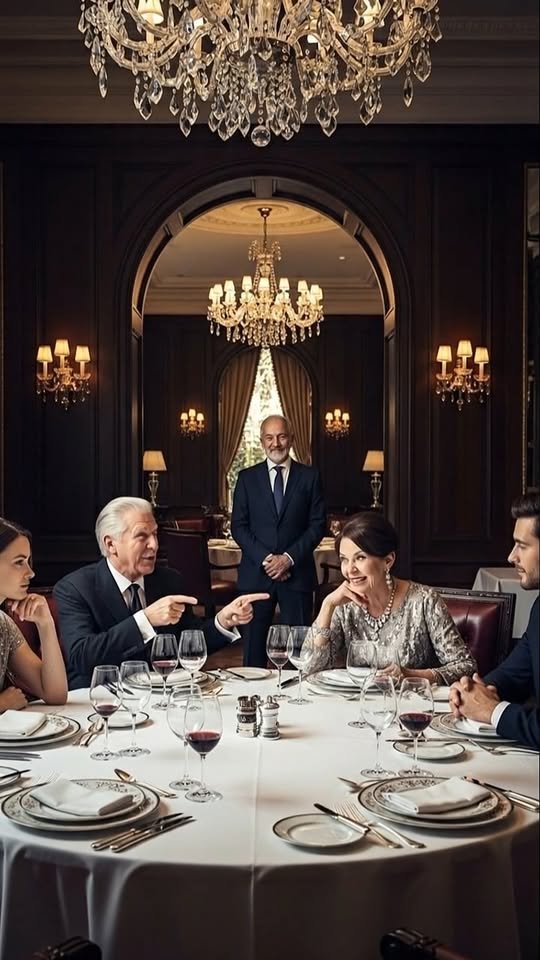
They ordered with a theatrical flare that was both absurd and deeply cruel. “Bring us your oldest bottle of wine,” Walter commanded the sommelier. “The one you tell stories about.”
With every extravagant order—oysters with pearls of rare vinegar, Japanese steak covered in edible gold leaf, lobster flown in that morning—Walter would pat my hand.
“Don’t you worry your pretty little head, dear,” he’d say loudly. “Tonight, you live like us.”
They believed my silence was fear. They had no idea I was simply memorizing the details.
Finally, the meal was over. Mr. Alistair himself approached our table, holding the black leather folder like a death sentence.
He placed it in front of me. Walter grandly gestured for him to open it and present the total. The number was revealed.
The performance reached its climax. “Oh, daughter-in-law!” Walter boomed after his magnificent roar of laughter. “We didn’t bring our wallet or cards!”
The laughter hung in the air before it was snuffed out like a candle flame.
They stared at me, their triumphant smiles cracking. “What do you mean, you knew we would do this?” Walter blustered, his voice losing its confidence. I turned my gaze to the manager.
“Mr. Alistair, would you be so kind as to explain the Legacy Menu to my in-laws?”
Mr. Alistair gave a slight, formal bow.
“Of course, madam. Everything you ordered this evening was part of a unique, off-menu experience we created especially for your anniversary. We call it the Legacy Menu.”
“What nonsense is this?” Walter scoffed.
“The price of this menu is not for the ingredients, sir,” Mr. Alistair continued smoothly. “It is a pledge.
The entire sum of your bill, $150,000, is a mandatory, non-refundable donation.”
Agnes let out a small, strangled sound. Mr. Alistair’s eyes found Walter’s.
“It will be transferred tomorrow morning to the city’s largest children’s hospital fund—the very same charity, I believe, your company has publicly claimed to be a major supporter of, despite their records showing not a single dollar ever received.”
The color drained from their faces. Their cruel prank had become a legally binding contract for public decency. “And how could you possibly afford a deposit on such a thing?” Agnes hissed.
“You have nothing.”
“That’s where you’re wrong,” I said softly. “The prenup you insisted on was the best gift you ever gave me. You made it clear I could never rely on your family’s wealth, so I decided to build my own.
For the past two years, I have been running a tech consulting firm. It’s become quite successful.”
The look of utter disbelief on their faces was more satisfying than any revenge. But I wasn’t finished.
“Speaking of business,” I continued, reaching into my purse, “I heard Walter’s company was on the verge of bankruptcy a month ago. And then a last-minute emergency bailout from an anonymous benefactor saved everything.”
I slid a single-page shareholder report across the table. “I was that anonymous benefactor.”
Walter’s eyes darted to the paper.
He saw the name of my firm and, next to it, the percentage of shares it now held: 51%. Controlling interest. I leaned forward.
“The family legacy you were so desperate to protect from me,” I said, my voice barely a whisper, “is now mine.”
Complete, shattering silence. Then, I felt a hand cover mine. It was Leo.
His eyes shone with shock, awe, and a profound sadness for what his parents were. He stood up, pulling me gently to my feet. “We’re leaving,” he said, his voice firm and clear.
We turned and walked away. We didn’t look back. A weight I had carried for three years lifted from my shoulders.
We left them there in the opulent silence of Aurelia—two broken people left alone to face the bill, the public humiliation, and the quiet, unassuming woman who now held their entire world in the palm of her hand.

